
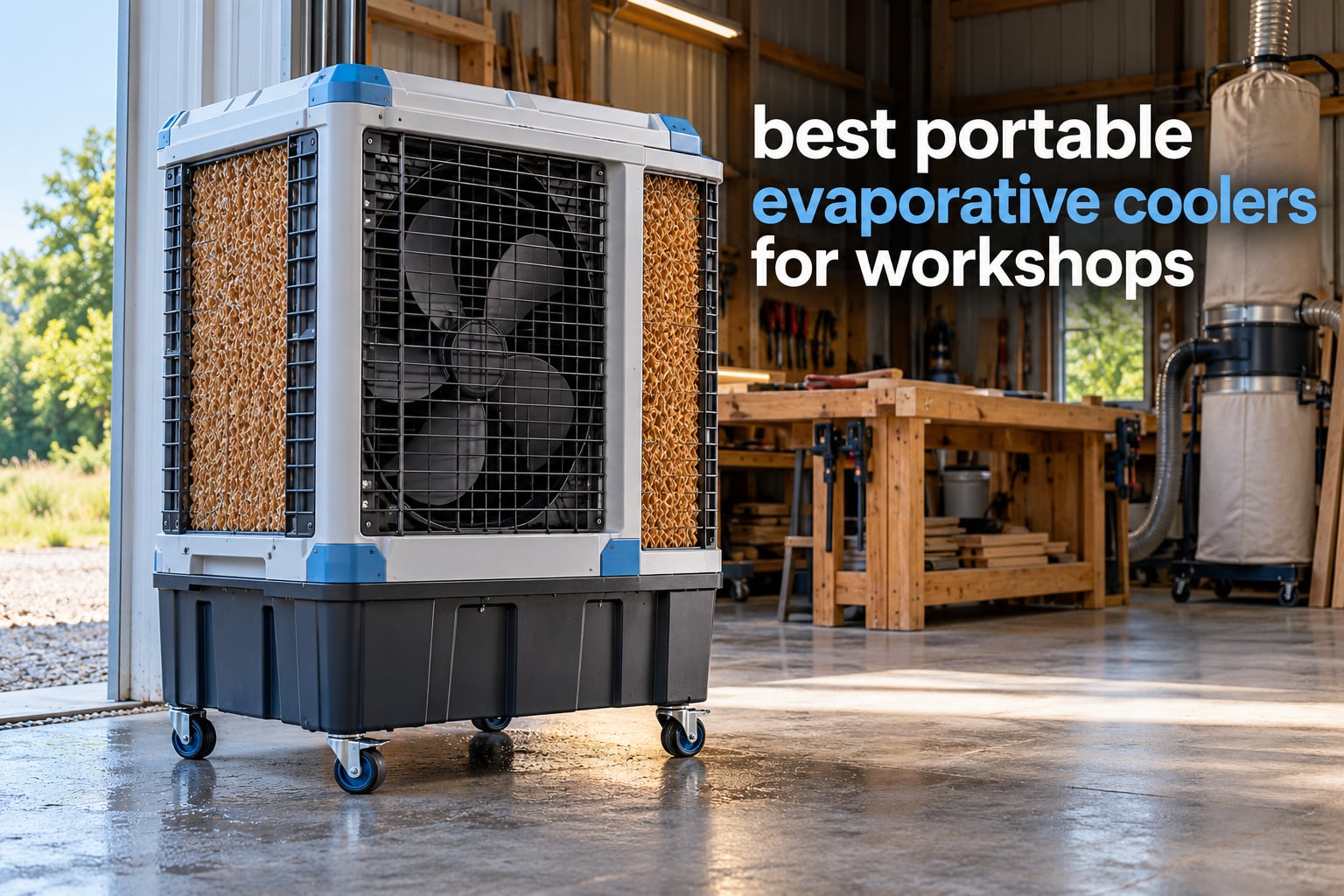
Do portable evaporative coolers really work in a workshop? Yes, but with conditions. A portable evaporative cooler pulls warm shop air through water-saturated cooling pads, lets the water evaporate, and pushes the cooled air back into the space. In a dry climate with a door or window open, that realistically drops the temperature 10 to 25F for a few hours. It is not air conditioning, and no evaporative unit will ever match a compressor for spot cooling on a hot afternoon in humid weather.
That honest limit is what most roundups leave out, and it is the first thing we checked. Below roughly 60% relative humidity with moving air available, a good portable evaporative cooler for workshop use is genuinely effective and costs a fraction of a ductless mini-split. Above that humidity ceiling, the pads cannot evaporate fast enough, output air gets closer to input air, and you are really just running a fan through wet cardboard. A few of the ten units we looked at are built for a 300 sq ft personal spot rather than a working shop floor, and we flag each one clearly.
We compared airflow ratings, tank capacity, noise levels, power draw, pad construction and warranty terms across ten evaporative coolers, then sorted them against what actually shows up in workshop use: sawdust, metal fines, hard water, a 20A circuit, and a garage door that is either open or a thermal brick. Our picks cover small hobby shops, two-car garages, pole barns, welding bays and multi-day job sites. You will also find the cross-ventilation layout that shop owners describe on woodworking forums, and the point where a mini-split becomes the better purchase.
One note before the picks: if you already have a dust collector in the shop, our guide to the best dust collectors for small workshops is worth reading first, because airflow and dust control pull in opposite directions.
Table of Contents
Top 3 Best Portable Evaporative Coolers for Workshops in 2026
Hessaire MC37M
- 3100 CFM for up to 950 sq ft
- 10.3 gal tank with hose adapter
- 8-hour timer and oscillation
- 55 dB

Hessaire MC92V
- 11K CFM airflow
- 33 gal tank with hose direct connect
- 50 watt draw
- Adjustable vertical and horizontal vanes

Uthfy 40 Inch 4800 CFM
- 4800 CFM with 120 degree oscillation
- Three sided intake panels
- 11 gal tank with auto refill
- 50 dB
All 10 Workshop Evaporative Coolers Compared in 2026
| Product | Specs | Action |
|---|---|---|
| Hessaire MC37M |
|
Check Latest Price |
| Hessaire MC92V |
|
Check Latest Price |
| Uthfy 40 Inch 4800 CFM |
|
Check Latest Price |
 OEMTOOLS 23968 OEMTOOLS 23968 |
|
Check Latest Price |
 SereneLife 12000 CFM SereneLife 12000 CFM |
|
Check Latest Price |
 Big Ass Fans Cool-Space 300 Big Ass Fans Cool-Space 300 |
|
Check Latest Price |
 DREO 40 Inch Tower DREO 40 Inch Tower |
|
Check Latest Price |
 Hessaire DC18 Hessaire DC18 |
|
Check Latest Price |
 VEVOR 1400 CFM VEVOR 1400 CFM |
|
Check Latest Price |
 DEWALT DXACN01B DEWALT DXACN01B |
|
Check Latest Price |
Swamp Cooler vs Evaporative Cooler: What Is the Difference?
There is no difference. Swamp cooler, evaporative cooler and evaporative air conditioner are the same machine sold under different names, often by the same factory. Both terms describe a fan that moves air through wet cooling media, removing heat by evaporation rather than by compressing a refrigerant.
The confusion comes from two other devices people lump in. A portable air conditioner uses a compressor and refrigerant, so it cools hard air and adds no humidity, but it dumps heat out the back and costs far more to run. A spot cooler is a directional, high-velocity unit aimed at one person rather than a space. The rule of thumb: swamp cooler and evaporative cooler are identical, and both are useless in a sealed room with no way for cooled air to escape.
1. Hessaire MC37M: Best Overall for Workshops
Hessaire MC37M Indoor or Outdoor Portable Oscillating Evaporative Swamp Air Cooler for 950 Square Feet of Space with Water Reservoir
3100 CFM
Covers 950 sq ft
10.3 gal tank
55 dB
276 watts
8-hour timer
Pros
- 4.3 stars across 553 reviews
- the deepest review base here
- 10.3 gallon tank with garden hose adapter
- Three speeds plus oscillation and an 8 hour timer
- Consistently cools dry climate porches and garages
Cons
- Louder than expected even on the lowest speed
- Adds humidity unless paired with exhaust fans
- Open tank design sloshes when the unit is moved
The MC37M is the unit we keep coming back to for a home shop. It moves 3,100 CFM, covers a claimed 950 sq ft, and carries 3,100 CFM of airflow through a single-sided pad arrangement that works well when the shop door is open. At 276 watts it draws about 2.4 amps, so it runs comfortably on a standard 15A shop circuit without fighting your table saw or dust collector.
Owners report roughly 15 to 20 degrees of perceived cooling on a dry afternoon, which matches what a properly vented setup should deliver. The 10.3 gallon tank holds about six hours in moderate heat, and the included garden hose adapter is the feature that changes daily use: instead of refilling, you leave it connected and forget about it.
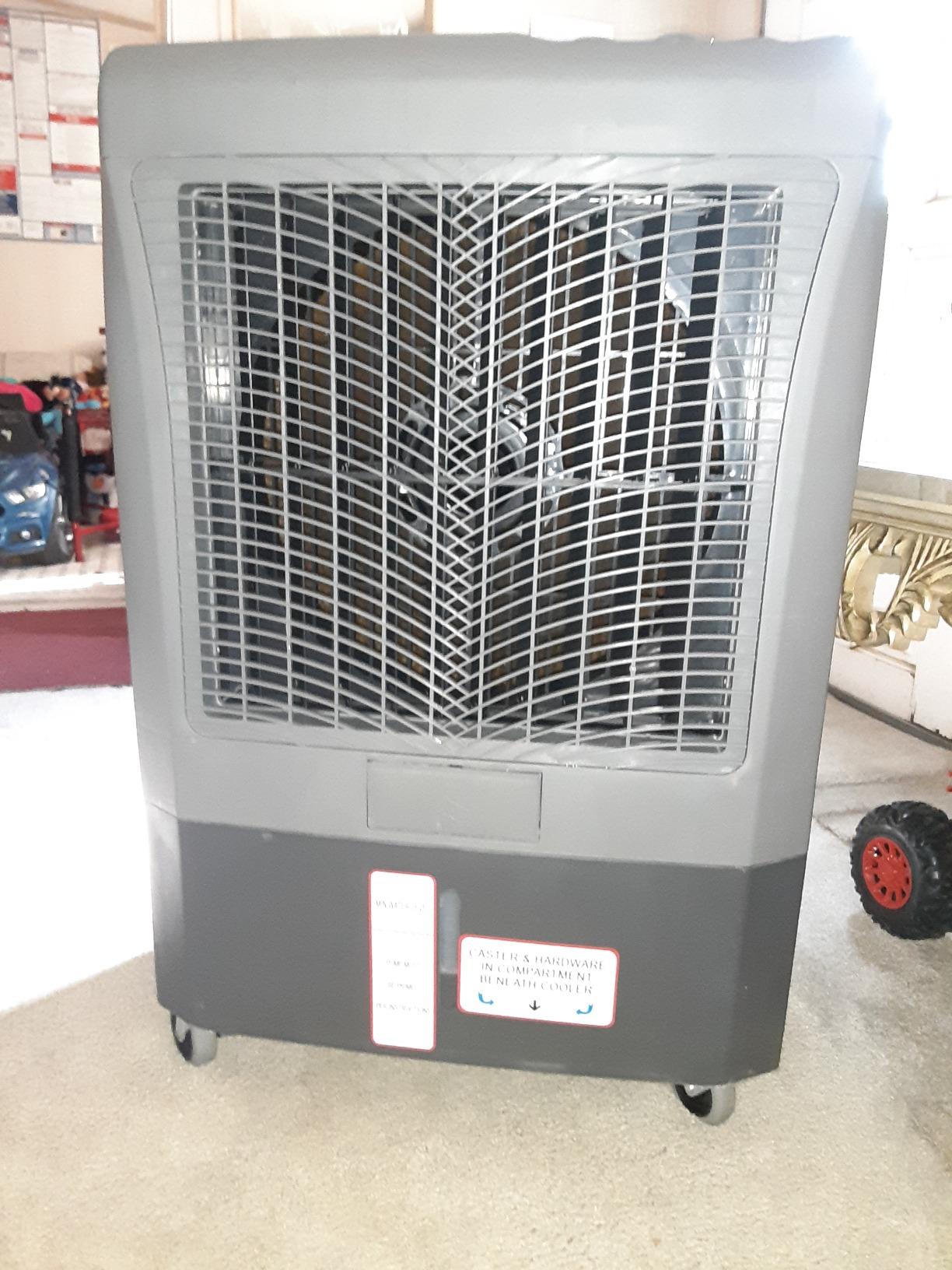
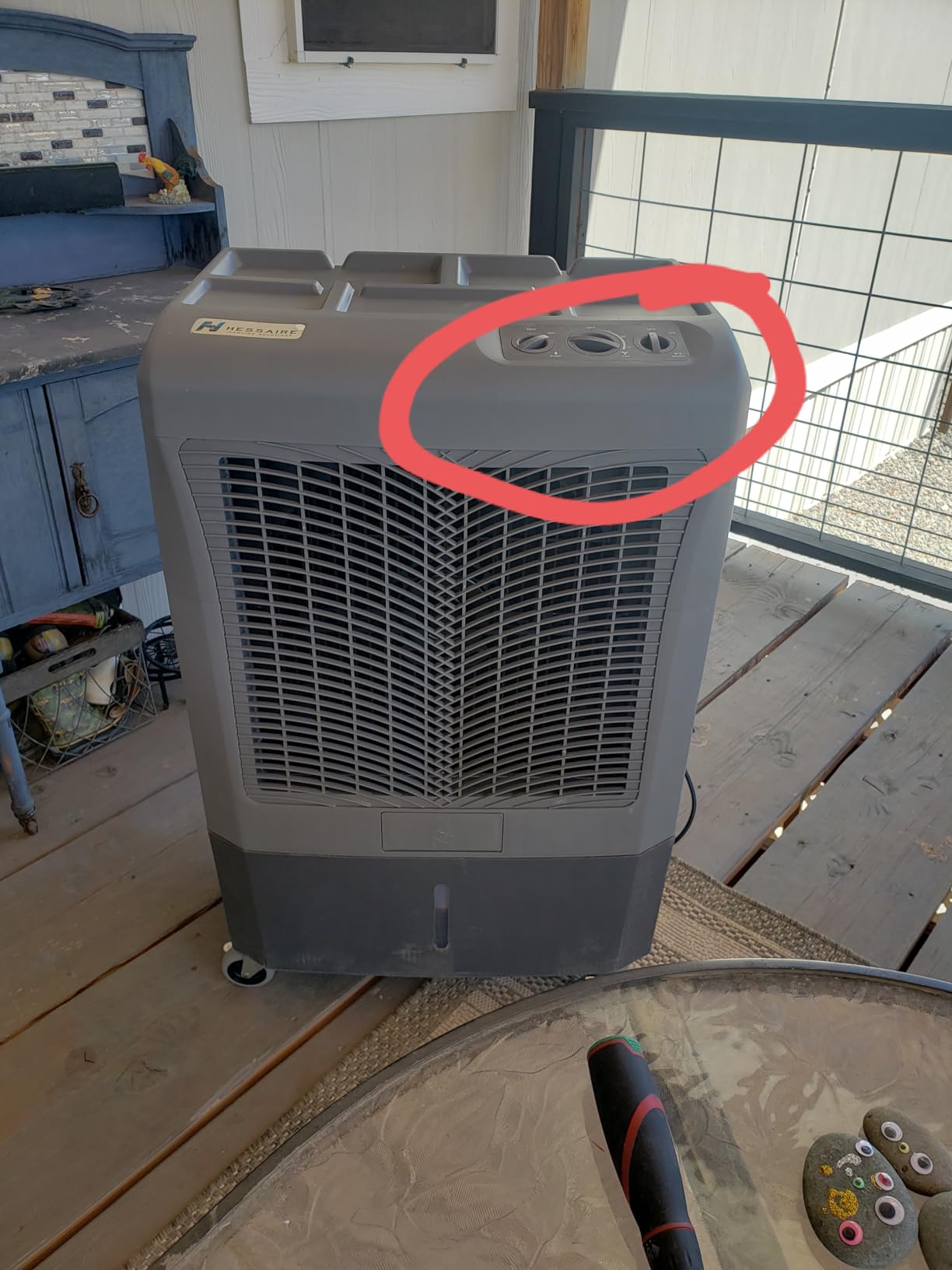
Control is simple rather than clever. Four fan-only settings, two evaporation settings, oscillating vents and an 8-hour timer cover the whole working day. There is no Wi-Fi, no app and no display, and after a few days that becomes a feature rather than a gap.
The honest weakness is noise. Even on the lowest speed it is clearly audible, which matters if you listen to a radio while working or if anyone else is in the room. The second weakness is humidity: the MC37M adds moisture to the air, so in regions with humid summers it needs a dedicated outflow fan to work at all. For a dust collector sitting nearby, pair your airflow planning with our shop vacuum and dust pickup roundup so cleanup does not eat your afternoon.
Who the MC37M suits
A one-car or two-car garage workshop up to about 950 sq ft in a dry or temperate climate. It is the right pick for someone who wants proven performance, a real review history and a tank that can run a full morning on a hose connection.
Who the MC37M does not suit
It is wrong for anyone who needs near-silence, and wrong for humid regions without an exhaust plan. If your shop is sealed, or if you work at a bench away from the airflow, the same money spent on a ducted mini-split is a better long-term decision.
2. Hessaire MC92V: Best for Large Shops and Warehouses
Hessaire MC92V Evaporative Cooler 11,000 CFM,Gray
11,000 CFM
33 gal tank
Hose direct connect
57 dB
50 watts
3 speeds
Pros
- 11000 CFM is felt from 20 to 25 feet away
- 33 gallon tank with direct hose connection
- Only 50 watts so any 15A circuit is fine
- Independently adjustable horizontal and vertical vanes
Cons
- Paper media can dry out away from the pump
- Strong wet dog odor on the first fill
- Flimsy stock casters when the tank is full
When a shop gets past about 1,500 sq ft, the MC92V changes the conversation. Owners of large shops and warehouses in hot, dry climates describe it as making un-airconditioned space workable, and 11,000 CFM of airflow is felt across a bay, not just across a bench. Three speeds and a remote keep it manageable when you only need a breeze on one end.
The reservoir is 33 gallons, roughly a full shift of water in many setups, and the direct hose connect bypasses the tank entirely. That means a weekend project does not stop for refills. Power draw is 50 watts, which is close to a light bulb and lets the unit share a circuit with everything else in the shop.
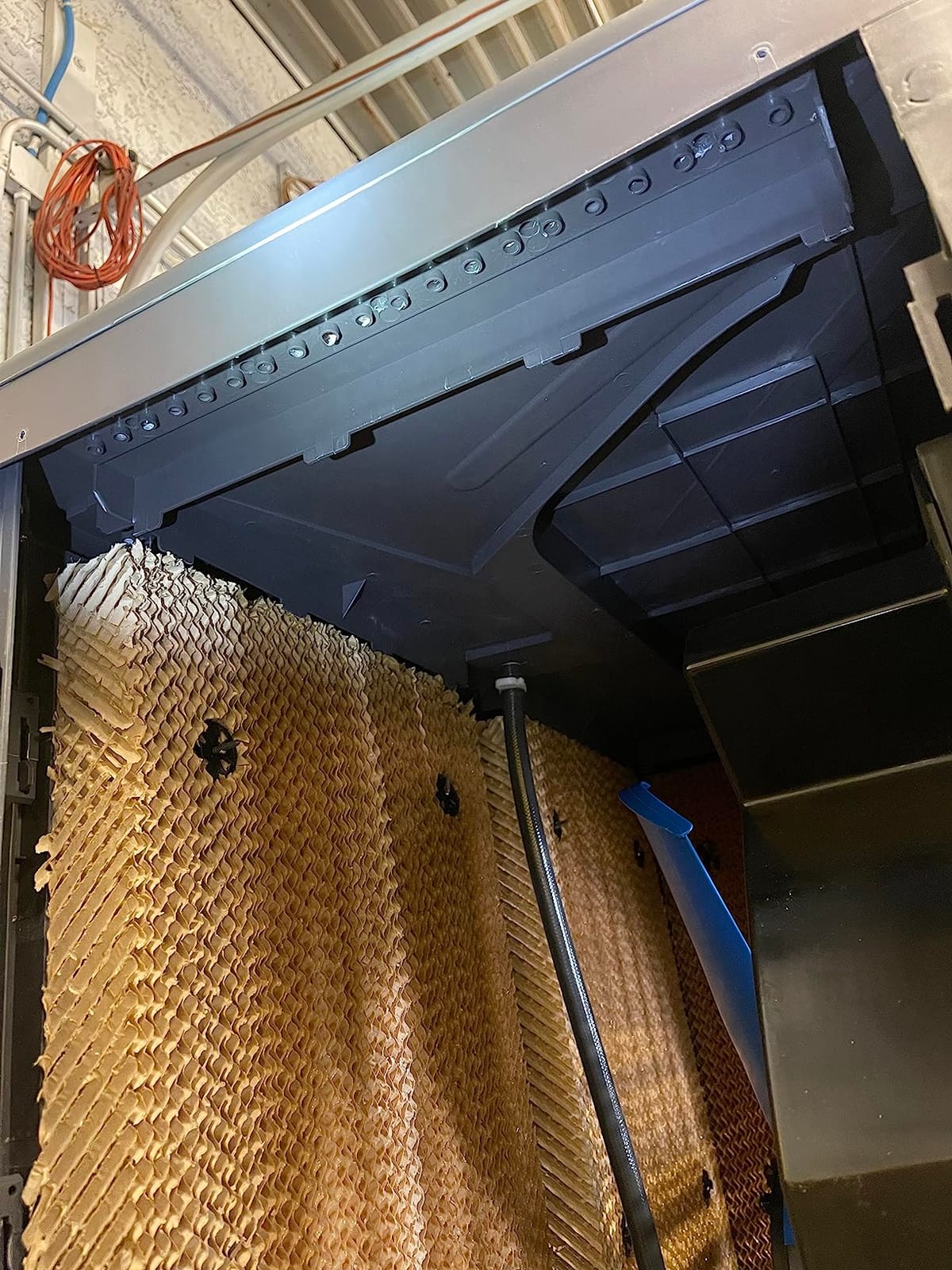
Durability is where the reviews get specific. The corrugated paper media distributes water unevenly, and owners report the far corners drying out until the weep holes are reamed clear. The open-housing motor is also described as prone to rust in damp environments, which matters if your shop already runs humid. At 126 pounds with flimsy casters, plan the position before you fill it rather than after.
The initial media smell is normal and fades after the first fill. Run the unit outside or with the door wide open for the first hour so that smell and the initial cool-down both happen outside your breathing zone.
Who the MC92V suits
Large shops, warehouses, pole barns and covered outdoor work areas over 1,500 sq ft in genuinely dry climates. It is the strongest airflow-per-watt option in this list and the easiest to leave running all weekend.
Who the MC92V does not suit
It does not suit small shops, where the size and 126-pound weight are pointless, and it is a poor match for damp coastal or Gulf climates because of the open motor housing. Owners also report a fill door that can detach and drop into the reservoir, so check it during the first fill.
3. Uthfy 40 Inch 4800 CFM: Best Value for Working Shops
Uthfy 40″ 4800 CFM Swamp Cooler, Large Evaporative Cooler with 11 Gal Water Tank, 3 Speeds, 120° Oscillation, 3 Ice Packs, Metal Frame Portable Air Conditioners for Outdoor, Patio, Shop, Yard, Factory
4800 CFM
Covers 970 sq ft
11 gal tank
50 dB
200 watts
3 ice packs
Pros
- 4800 CFM for a mid range build cost
- Three sided intake panels widen the evaporation area
- Three ice packs plus a composite ice curtain
- Four caster wheels with two lockable
- Quiet 50 dB for a unit this size
Cons
- Metal frame and casters add weight
- Cooling effectiveness drops in humid air
- Only a one year manufacturer warranty
The Uthfy sits in the gap most roundups miss: real industrial airflow without an industrial price tag. At 4,800 CFM it out-moves the typical 3,100 CFM shop unit by more than half, and the three-sided intake panels give it far more evaporation surface than the single-sided designs that dominate cheaper models. That extra surface is what makes the output air noticeably cooler rather than merely damp.
At 50 dB it is the quietest unit of its size here, which makes it a better neighbour than most 4,000-plus CFM machines. The 11 gallon tank with both manual top fill and continuous auto-refill means you can start it on a hose and walk away for the day.
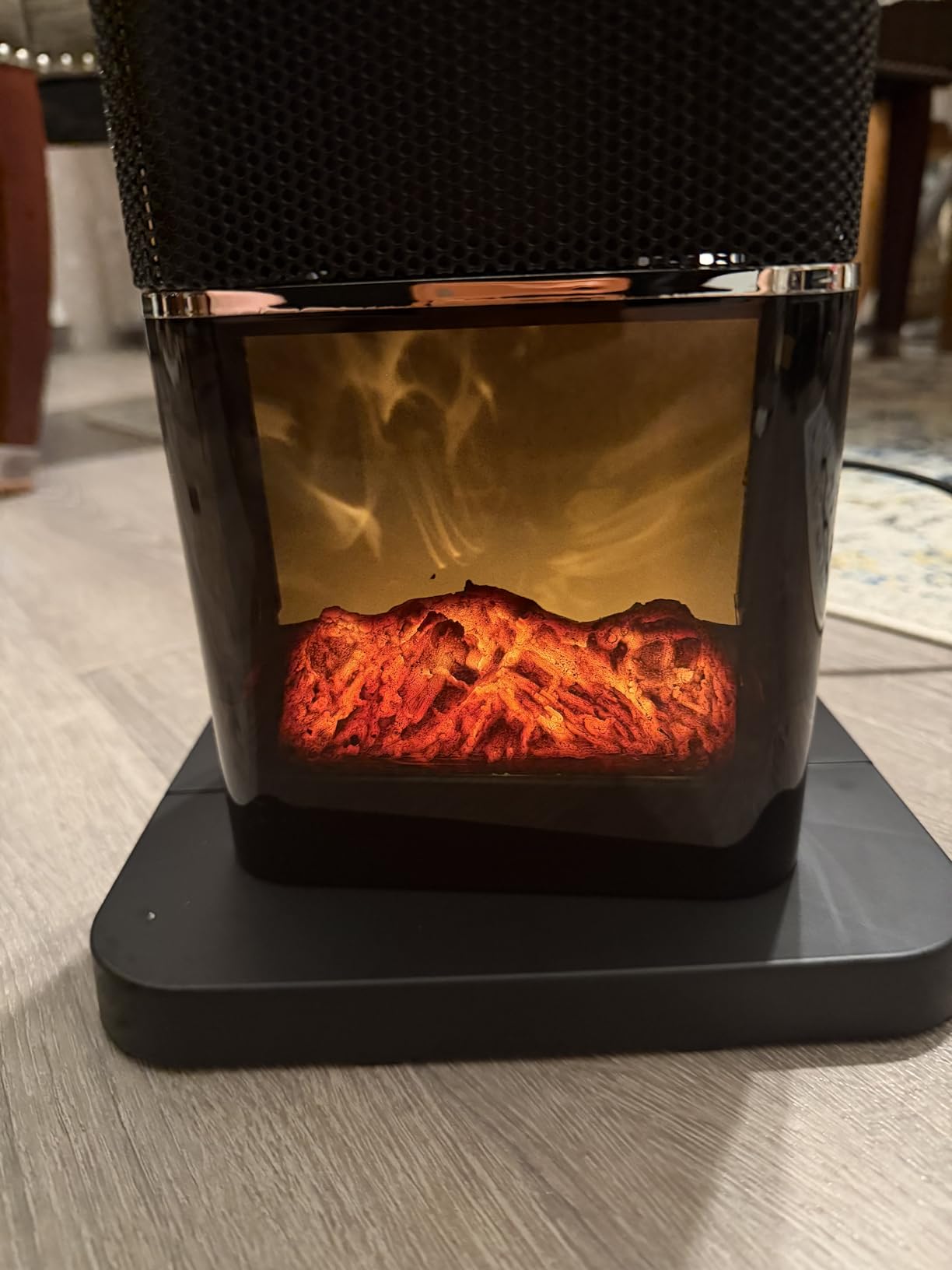
The ice pack setup is unusual at this airflow level. Three ice packs sit behind a 4-in-1 composite ice curtain, and users report that combination meaningfully chills the output air, which helps when you are working close to the unit during the hottest part of the day. Oscillation sweeps 120 degrees, so a single position covers a bench run rather than one square of floor.
The 39.7 pound weight comes mostly from the iron frame and four caster wheels. Two of the four lock, which is what you want when the unit is set up at the end of a rolling door and needs to stay put. Power draw is 200 watts on 120 volts, fine on a 15A circuit as long as it is not sharing with a welder.
Who the Uthfy suits
Anyone in a dry climate running a shop between roughly 500 and 1,200 sq ft who wants more airflow than a 3,100 CFM unit gives them. It is our pick for a two-car garage workshop with a planer and a dust collector running at the same time.
Who the Uthfy does not suit
It is a poor fit for humid summers, for the same physics reason as every other evaporative unit. The one year warranty is also thinner than the alternatives, and buyers who need serviceable long-term parts coverage should weigh that against a five year main fan warranty elsewhere in this list.
4. OEMTOOLS 23968: Best for Woodworking and Garage Shops
OEMTOOLS 23968 3-Speed Portable Swamp Cooler 3100 CFM 10.3-Gal. Water Tank
3100 CFM
950 sq ft
10.3 gal tank
68 dB
UL GFCI plug
tool tray
Pros
- Built in tool tray and casters made for garages
- UL GFCI plug suits shop electrical circuits
- High density media panels cool faster than standard density
- Simple knob controls that stay durable
- 1/5 HP three speed motor
Cons
- 68 dB is among the loudest here
- Only a one year limited warranty
- Single knob control has no timer
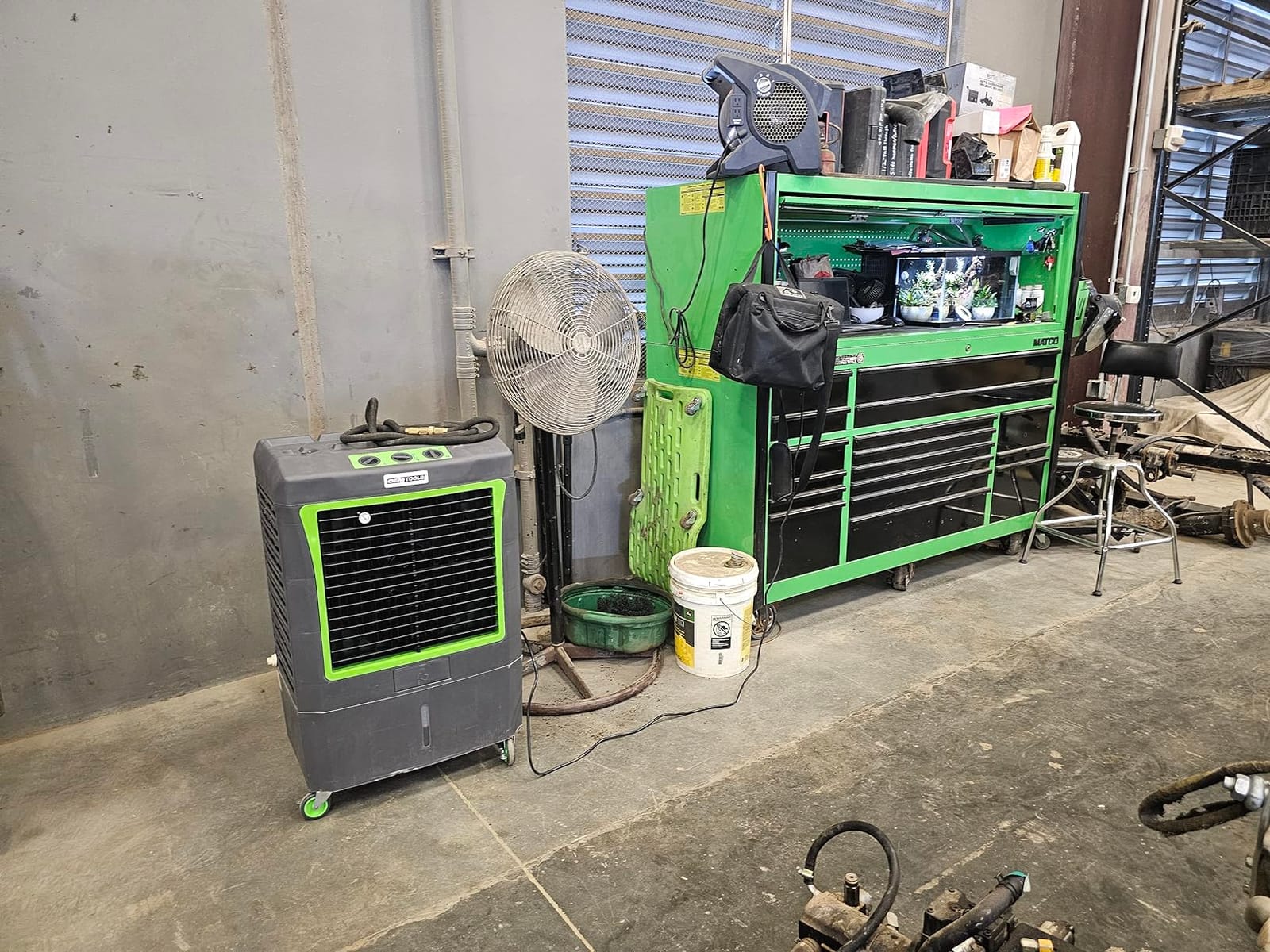
The OEMTOOLS is the most purpose-built shop unit here. It has an integrated tool tray on top and casters underneath, which sounds minor until you have dragged a full cooler across a concrete floor. At 41.3 pounds it is also the lightest of the high-airflow machines, and it stands 45 inches tall so you can aim the output above a bench without crouching.
Cooling performance is solid for its 3,100 CFM rating and 950 sq ft claim. The high-density media panels deliver roughly 80 percent more evaporation surface than standard density media, which shortens the time to a comfortable work temperature. The patented axial propeller with oscillation spreads that air across the room rather than concentrating it.
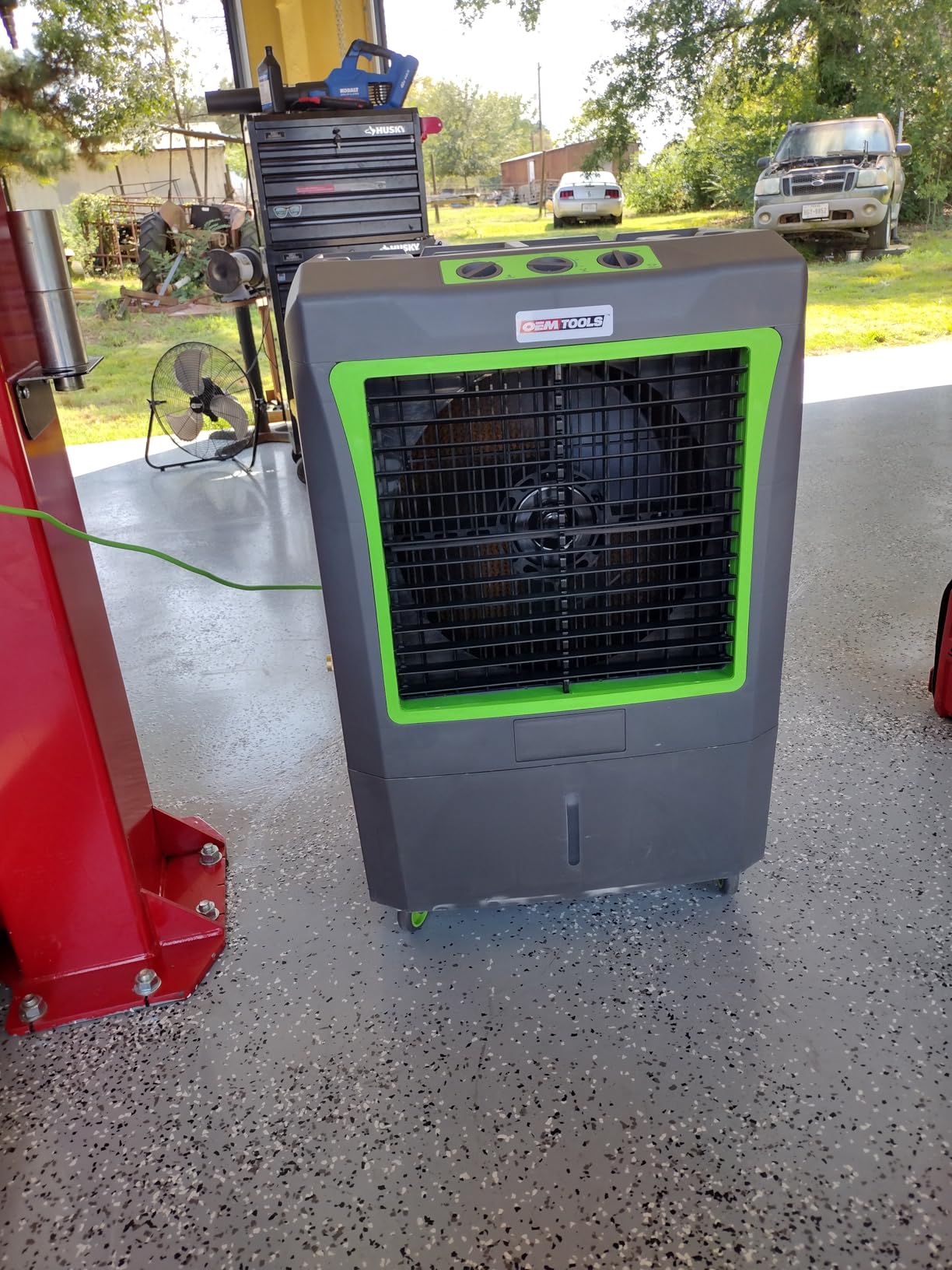
Two workshop-specific details matter more here than elsewhere. The UL GFCI plug is the correct choice for a shop with metal dust, wet saws and a concrete slab, and the UV-resistant resin body tolerates a door standing open to direct sun. A 1/5 HP three speed motor with knob controls gives you three real settings with no app and no touch panel to wipe clean with sawdust.
The trade-off is noise. At 68 dB this is among the loudest units we covered, particularly on high, so it suits a shop where you are wearing hearing protection anyway, not a shared studio. There is also no timer, which is a real gap for a full workday.
Who the OEMTOOLS suits
Woodworkers and garage tinkerers who want a cooler that lives in the shop rather than a unit that has to be carried. The GFCI plug, tool tray and casters are the details that show it was designed around a working garage.
Who the OEMTOOLS does not suit
It does not suit anyone sensitive to sound, since 68 dB on high is hard to work beside. The one year limited warranty is also the shortest we would consider comfortable for a unit expected to survive several summers in a dusty shop.
5. SereneLife 12000 CFM: Best for Long Shifts and Warehouses
SereneLife Portable Swamp Cooler with 12000 CFM Power – Industrial Evaporative Air Cooler for Large Indoor & Outdoor Spaces, 150 L Tank, 60° Oscillation, 12-Hour Timer, Wi-Fi & Remote Control
12,000 CFM
150 L detachable tank
Wi-Fi and remote
65 dB
12-hour timer
Pros
- 12000 CFM suits open industrial floors
- 150 liter detachable tank cuts refills
- Wi-Fi plus remote and touch panel control
- Twelve hour programmable timer
- Water shortage alarm and pump protection
Cons
- Lowest average rating here at 3.3 stars
- Cooling output drops sharply in humid air
- 65 dB is loud in a small shop
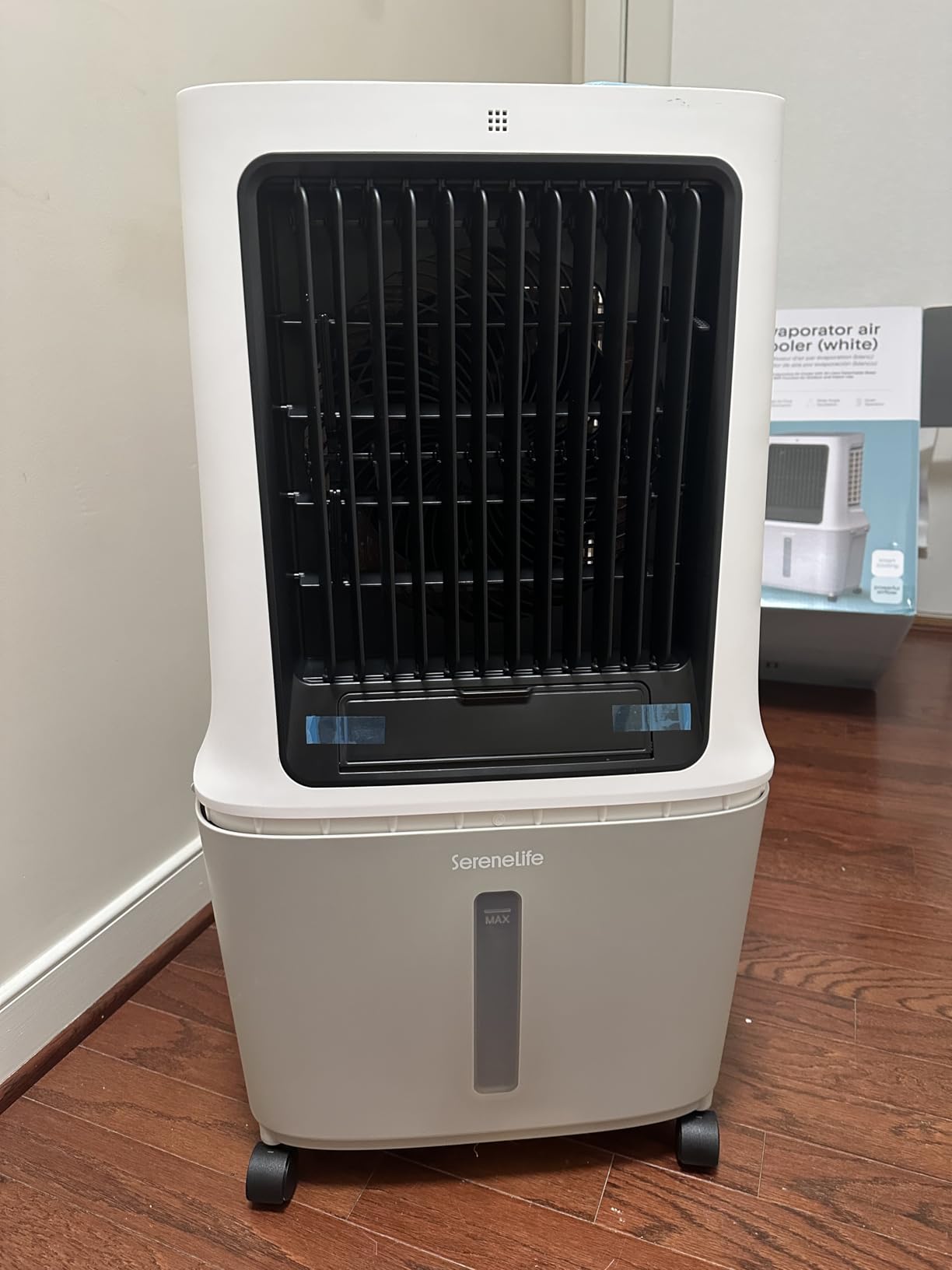
The SereneLife is the largest airflow number in this roundup at 12,000 CFM, and it is built for genuinely big spaces: warehouses, factories, gymnasiums and covered outdoor work areas. The 150 liter tank is the standout feature for a full shift. It detaches completely, so you carry it to a sink rather than tipping the unit, and a twelve hour programmable timer covers a long day without anyone touching the controls.
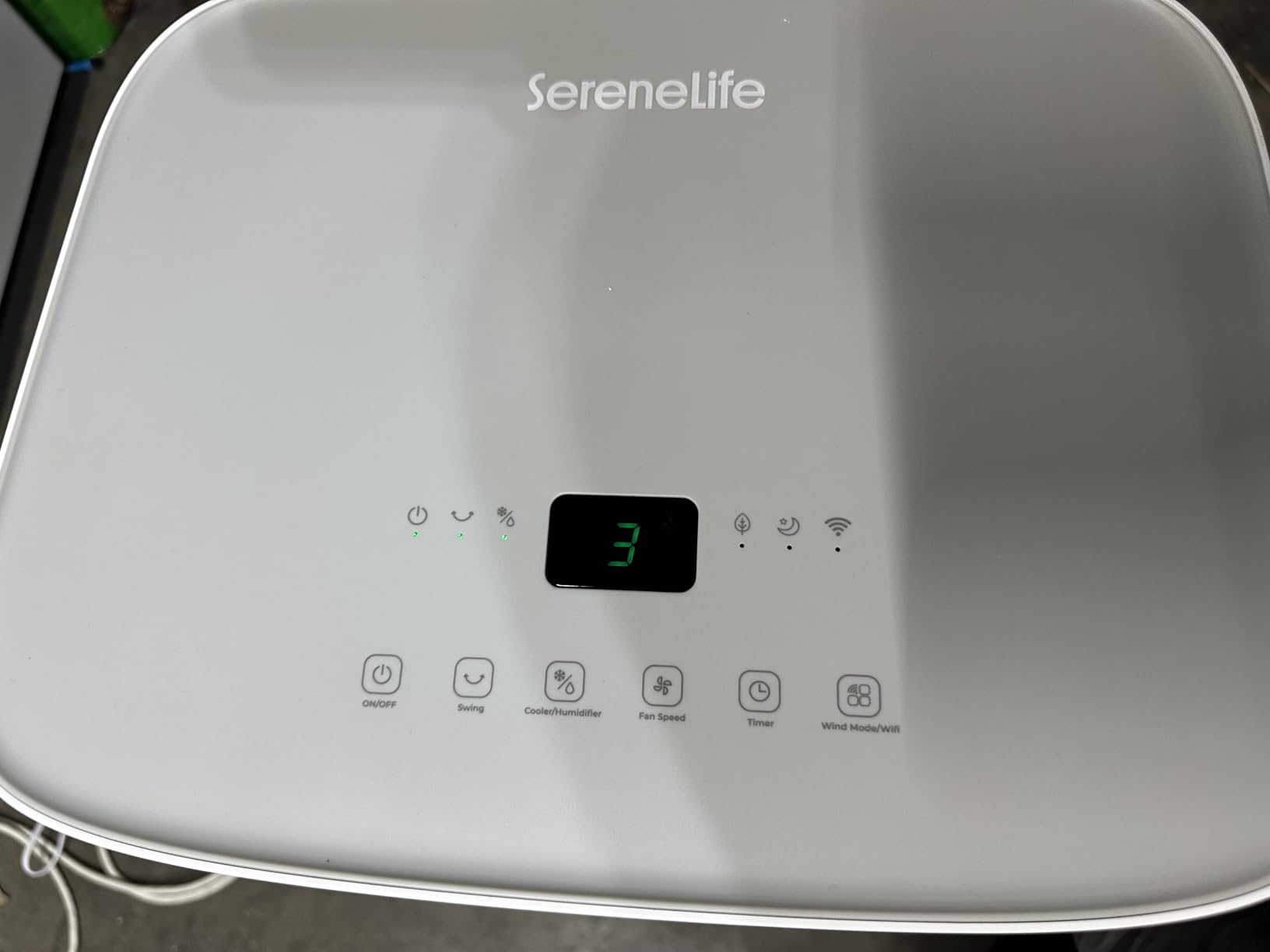
Control options are the most advanced here. Wi-Fi, a remote and a touch panel all reach the same two wind modes, three speeds and 60 degree oscillation, with the vertical vane adjustable on top. Rolling wheels are standard, which is what you want at 69.4 pounds.
Here is where we have to be direct: this is the lowest rated unit in the group at 3.3 stars across 139 reviews, with a meaningful share of one-star reports. Buyers consistently praise the tank size, the connectivity and the airflow in open spaces. The complaints cluster around real-world cooling in humid conditions and around noise, with 65 dB a real consideration in anything smaller than a warehouse bay.
Water shortage alarm and pump protection are genuine shop features. A dry-run pump in a dusty environment is a common failure point, and having the unit shut itself down beats a failed pump and a ruined media pad. Note also that the listed motor and voltage figures are inconsistent between sources, so verify the electrical rating on the unit label before you plug it into a shop circuit.
Who the SereneLife suits
Large commercial or semi-commercial spaces over 2,000 sq ft with an open door or a covered outdoor area. It is the right choice when refilling is genuinely inconvenient and you want remote start from a phone.
Who the SereneLife does not suit
It is a weak match for a home shop, where 65 dB and 12,000 CFM are more than you need and the 3.3-star average is the least reassuring in the roundup. If your climate runs humid, the large airflow number will not rescue the physics.
6. Big Ass Fans Cool-Space 300: Best for Small Shops with a Big Tank
Big Ass Fans – Cool-Space 300 – Portable Evaporative Swamp Cooler, 18 Inch Diameter Fan, Indoor Outdoor Use, Continuous or Fillable 16 Gallon Capacity, Variable Speed – Cooling for Workshops, Garages
700 CFM
1,200 sq ft claim
16 gal tank
63 dB
430 W
10 speeds
Pros
- 16 gallon reservoir with a garden hose feed
- Ten speed variable control with remote
- Eight inch resin treated cooling media
- Locking swivel casters and low water shutoff
- Five year warranty on the main fan unit
Cons
- Only 700 CFM airflow despite its 18-inch fan
- Heavy 99-pound unit is difficult to reposition
- Average 3.7-star rating indicates mixed satisfaction
What makes the Cool-Space 300 interesting is the water. A 16 gallon reservoir is the second largest here, and it can run about four hours on a fill, or indefinitely on a standard garden hose. For a shop where you would rather not think about water at all, that is the feature that matters most.
The 8-inch thick cooling media is treated with a thermosetting resin to resist unwanted growth, which is a real advantage in a shop with a lot of airborne dust. Variable speed control runs through ten settings with a remote, and automatic low-water shutoff plus an accessible drain plug handle the maintenance side well. The five year main fan warranty is the longest in this roundup.
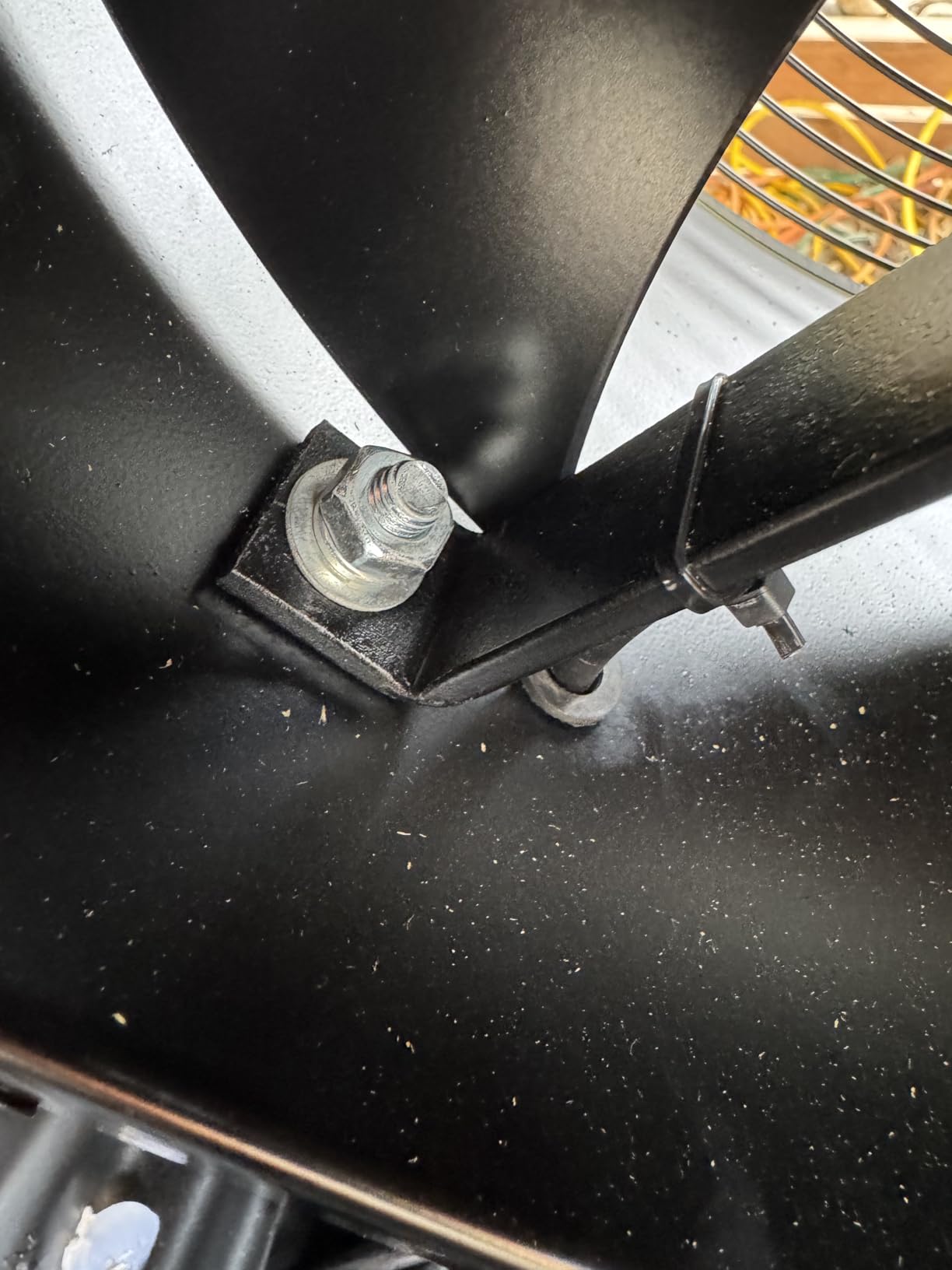
Be realistic about the airflow though. The rated figure is 700 CFM from an 18-inch fan, which is low for the size, and the 1,200 sq ft coverage claim assumes a wide open, well-ventilated space. At 430 watts and 3.58 amps, it also draws more than three times what the 11,000 CFM Hessaire pulls, which is an unusual trade for an industrial-looking unit.
The 3.7-star average across 29 reviews reflects that mismatch. Buyers like the tank, the variable control and the media treatment; airflow per watt is the recurring reservation. At 99 pounds with locking swivel casters, it is also one of the harder units to reposition once it is full.
Who the Cool-Space 300 suits
A small shop, a covered porch or a mobile setup where the five year warranty and the large tank matter more than raw airflow. It also works well as a spot unit near a single work position rather than a whole-room cooler.
Who the Cool-Space 300 does not suit
It does not suit a large shop trying to cool an entire floor, because 700 CFM will not move the volume. At 430 watts it is also an expensive watt for what it delivers, and the 99-pound weight is a problem if you want to move it between the shop and a job site.
7. DREO 40 Inch Tower: Best for Quiet Shops and Small Workrooms
DREO Evaporative Air Swamp Cooler, 40″ Cooling Fans that Blow Cold Air | 80° Oscillating Standing Fan for Bedroom with Ice Packs, Removable Water Tank, Remote Control, 4 Speeds, White and Black
35 dB
300 sq ft personal coverage
55 watts
4 speeds
80 deg oscillation
Pros
- Quietest unit in the roundup at 35 dB
- 55 watt draw keeps running cost low
- Removable tank and pad for regular cleaning
- Four speeds with remote control
- Largest review base here at 901 ratings
Cons
- Personal sized at 300 sq ft
- Adds humidity to whatever room it is in
- Supplied ice packs are small and melt quickly
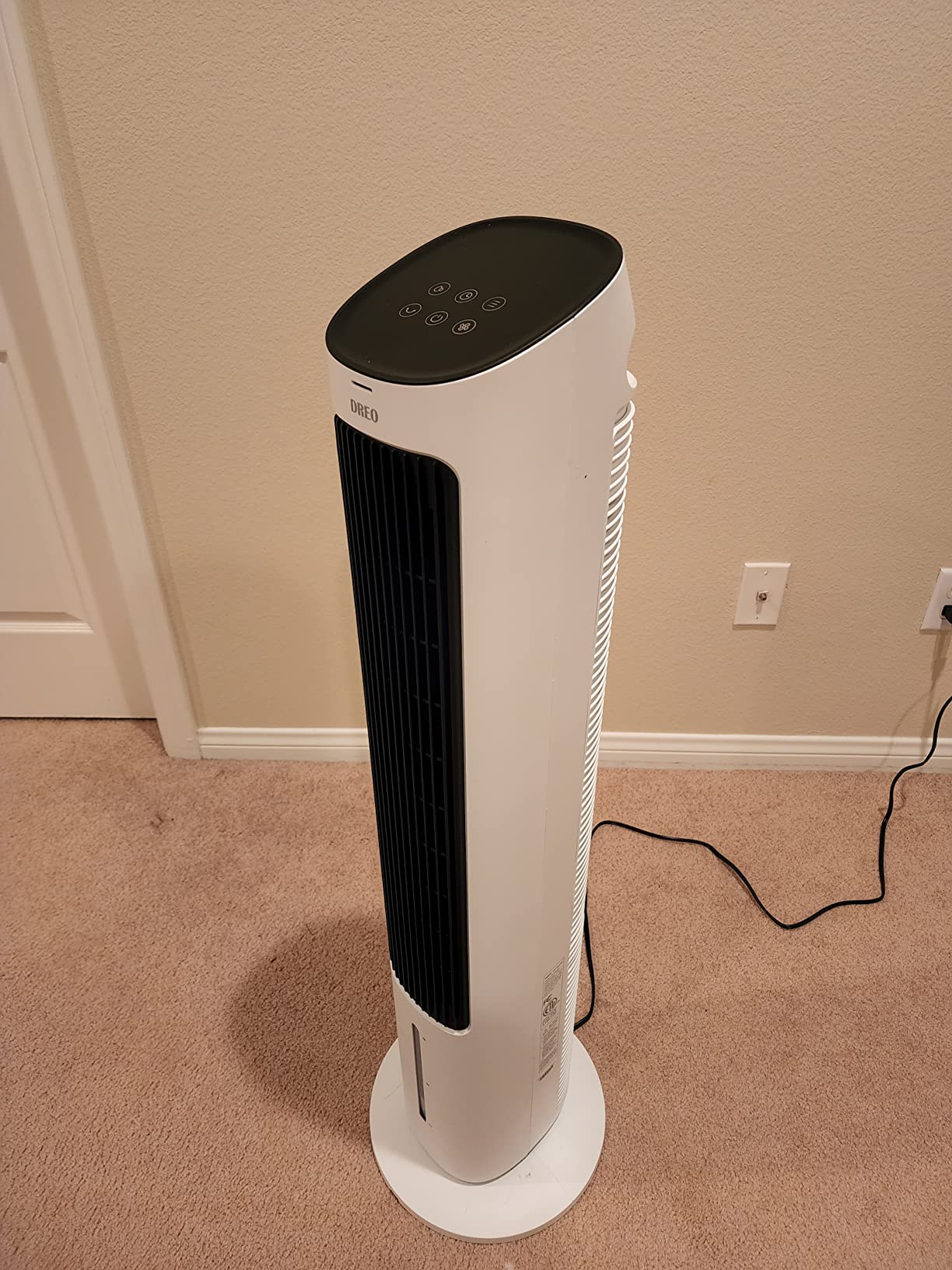
The DREO solves a problem the big units cannot: working in the same room as a running cooler. At 35 dB with a cross-flow impeller, it is quiet enough to sit a few feet from your bench. With 901 ratings behind it, it is also the most established product in the roundup, and that matters for replacement parts and firmware-free long-term support.
Be clear about what it does. Coverage is rated at 300 sq ft, airflow at roughly 1,017 CFM, and it delivers a personal breeze rather than space cooling. Loaded with ice packs and cold water it will beat a standard fan by a wide margin, and the 80 degree oscillation at 1,500 rpm spreads that over a desk or a small bench area. At 55 watts and 13.2 pounds it is trivially portable.
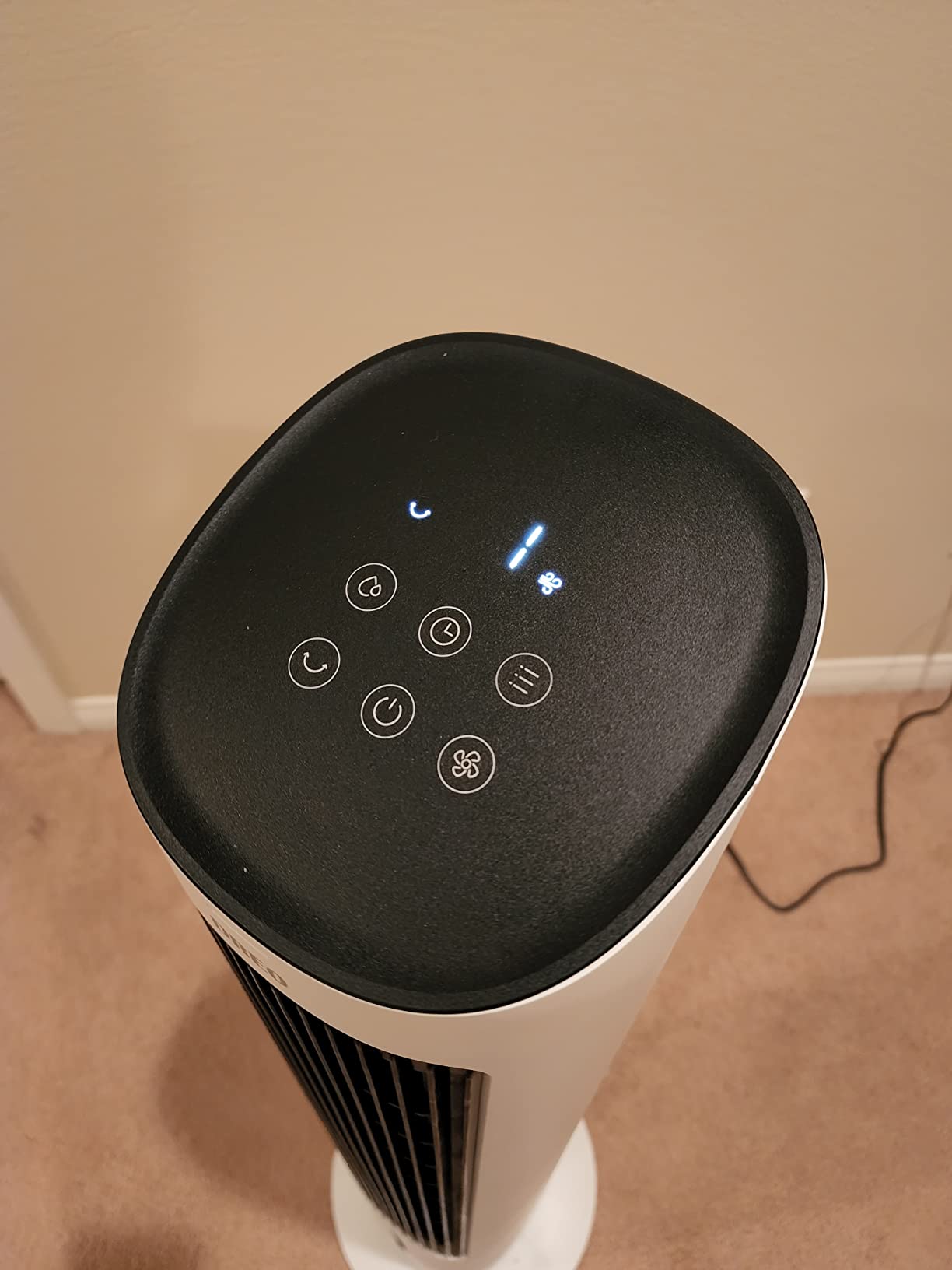
Maintenance is unusually straightforward for this category. The water tank, the cooling pad and the rear grille all come out for cleaning, which directly addresses the biofilm complaints we hear from owners of fixed-tank units. The warranty is 12 months and extendable to 30 months by registering the product, so register it.
Two caveats from the review data. The tank sensor can read empty while water remains, which leads to stagnant water that needs cleaning out, and the included ice packs are small and melt quickly in a hot shop. It also humidifies, so it is unsuited to an already-humid room.
Who the DREO suits
Anyone working at a bench, a desk or a hobby room who needs airflow they can barely hear. It is also a sensible companion unit for an office or break area attached to a shop, where a 57 to 68 dB industrial machine would be miserable.
Who the DREO does not suit
It will not cool a workshop floor. Reviewers are candid that this is not a room air conditioner, and buying it for a 900 sq ft shop is the most common mistake we see in this category.
8. Hessaire DC18: Best for Tool-Battery Shops and Mobile Work
Hessaire DC18 Mobile Evaporative Cooler
900 CFM
300 sq ft
2.8 gal tank
18V and 20V tool battery
AC adapter included
Pros
- Runs on any major 18V or 20V tool battery
- Also operates from the included 115V AC adapter
- Quiet relative to the air it moves
- Owners in auto shops report daily use
- Easy to set up and refill
Cons
- Battery is not included
- Effectiveness falls sharply in humid air
- Adapter output spec is inconsistent
- 42 pounds is awkward to move
The DC18 is the pick for a shop that already runs on tool batteries. It works with all major 18V and 20V platforms, so if you have packs on site you have power, and it also runs from the included 115V AC adapter for a stationary bench position. That flexibility is unusual in this category and it is the reason this unit exists.
At 900 CFM and 300 sq ft coverage, it is a spot cooler aimed at heat stress rather than a room cooler, and the manufacturer is upfront about that. Owners in automotive shops report using it daily without issues, and they note it works noticeably better when you run it on ice water rather than tap water.
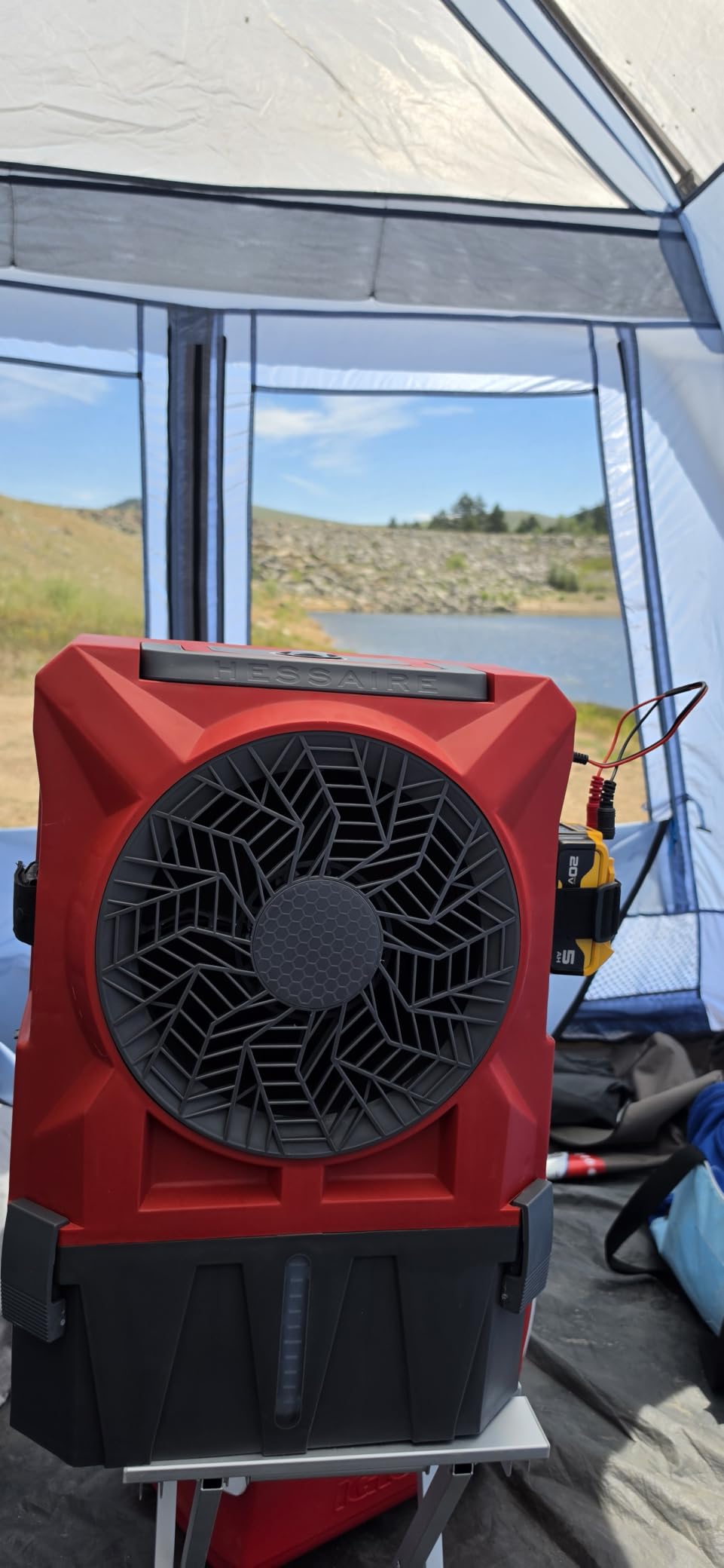
The specification you should check before buying is power. Reviewers report that the included AC adapter output and the voltage guidance in the manual are not consistent with each other, so confirm what your bench outlet delivers before relying on mains power. The battery is also sold separately, and the listed return and restocking costs for this listing are high enough that a sizing mistake is expensive.
At 42 pounds it is bigger and heavier than you would expect for the airflow, and 2.8 gallons of tank means frequent fills unless you keep it on ice. In humid air its output falls sharply, which is a physics limit rather than a defect.
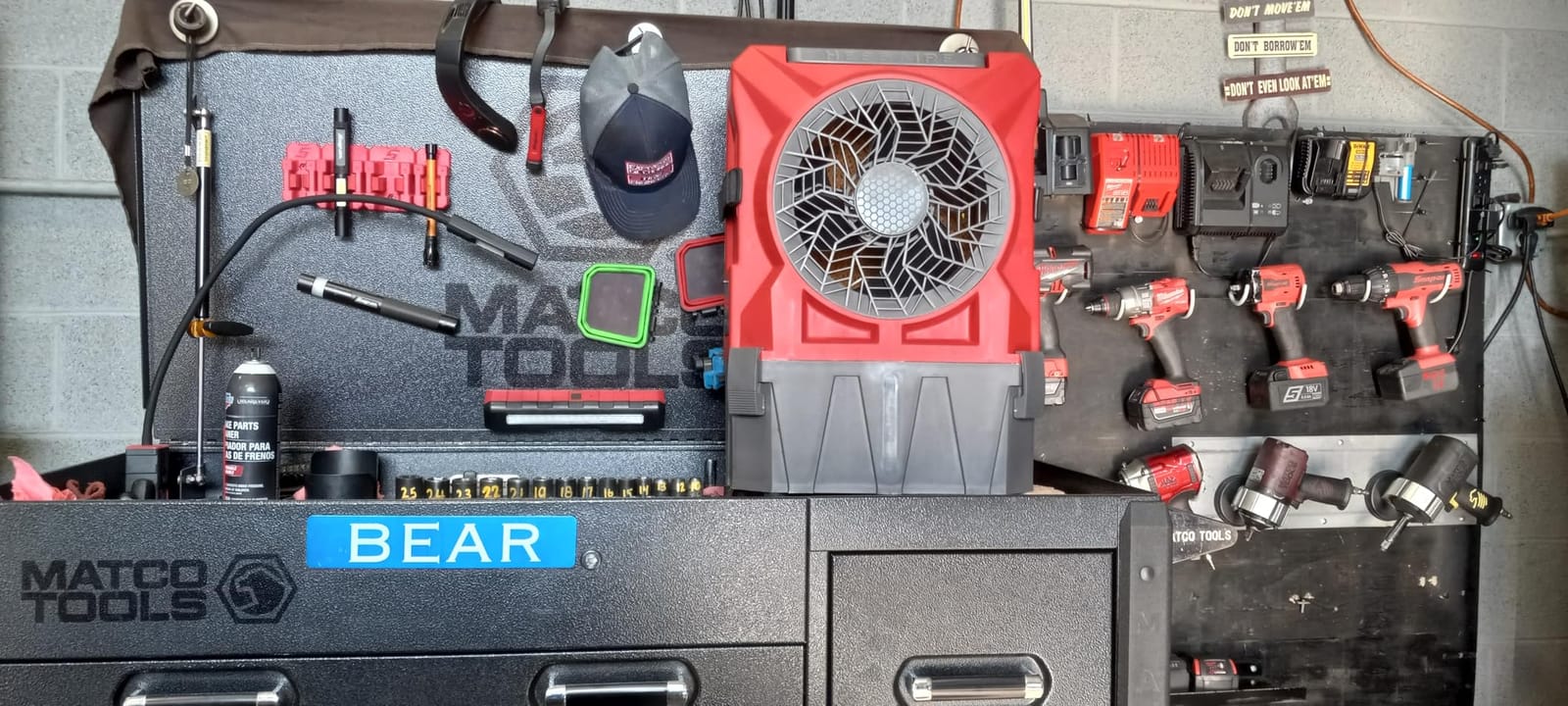
Who the DC18 suits
Automotive and mobile repair work where packs and chargers are already on hand, plus any shop position without a convenient outlet. The 4.3-star rating across 54 reviews reflects consistent everyday use rather than high performance.
Who the DC18 does not suit
It is the wrong purchase for a fixed workshop floor that needs whole-room airflow, and it adds no value if you already have AC outlets everywhere. The 2.8 gallon tank also makes it a poor choice for all-day unattended running.
9. VEVOR 1400 CFM: Most Versatile for a Small Workroom
VEVOR Evaporative Air Cooler,1400 CFM 11X31 inch Air Cooler,3 Speeds Cooler Portable Air Conditioner,Energy-Saved Swamp Cooler for party,pool and patio,5 Gal Water Tank & 550 Sq.Ft…
1400 CFM
550 sq ft
5 gal tank
60 dB
60 watts
hose continuous fill
Pros
- Only 60 watts of power draw
- 5 gallon tank with garden hose continuous fill
- Top lid refill needs no lifting
- Mechanical buttons stay legible
- Light 13.4 pound body is easy to reposition
Cons
- 3.7 stars with a share of one-star reviews
- One sided pad limits evaporation area
- Weak in enclosed or humid spaces
- Low water cutoff can trigger before empty
The VEVOR is the cheapest way into evaporative cooling, and for a small workroom, a covered porch or a single bench it does the job without drama. It draws 60 watts, weighs 13.4 pounds, and covers a claimed 550 sq ft, which makes it easy to move between the shop and a job site whenever the heat follows you.
Some design choices are better than they should be at this tier. The mechanical buttons stay legible after months of dust, unlike backlit touch panels, and the top-lid refill means you do not have to bend over or lift the unit to add water. The 5 gallon tank connects to a garden hose for continuous fill, with water shortage protection and a low-water indicator.
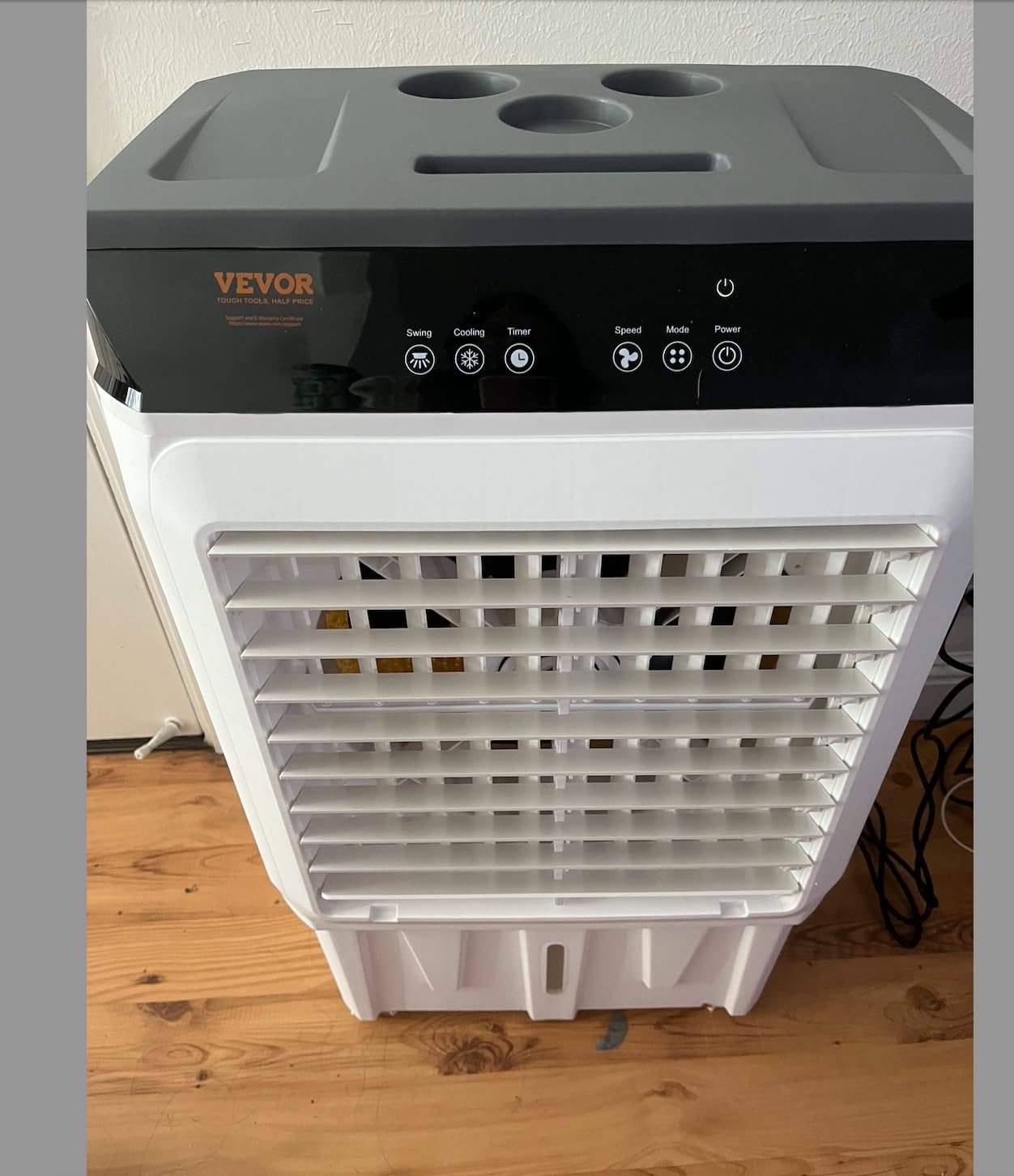
The single-sided rigid high-density cooling pad is the limitation. Compared with the three-sided panels on the Uthfy, the evaporation area is much smaller, so the output air is less cool for the same 1,400 CFM. The 3.7-star average across 175 reviews reflects that split: people like the mechanics of the unit and accept the cooling as modest.
Two more things to know. The manual is candid that the effect is better outdoors and that it is not intended for enclosed indoor spaces, and at 60 dB the top speed is audible. The low water cutoff can also trigger before the tank is actually empty.
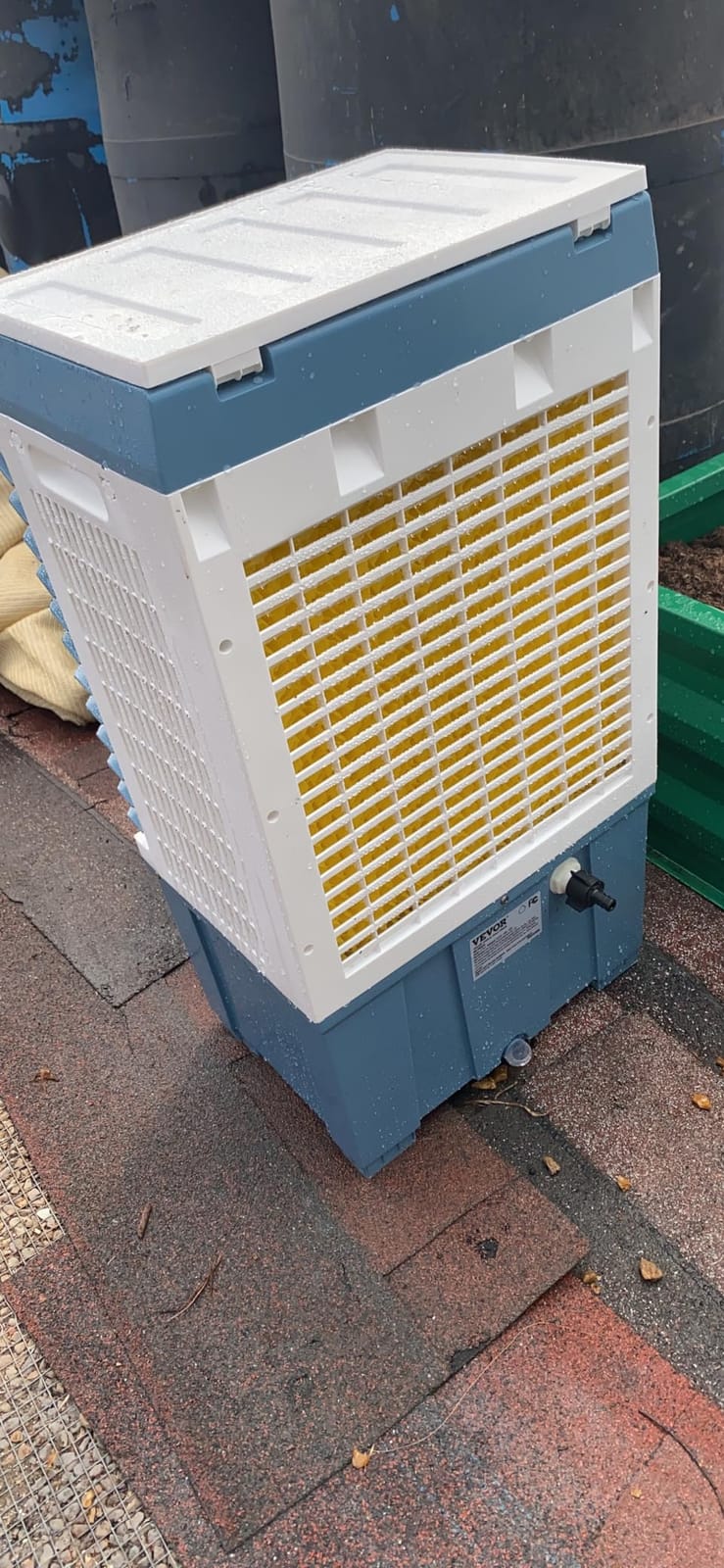
Who the VEVOR suits
A first-time buyer with a small space, a tight budget and a need for portability. It is also a reasonable second unit for a covered outdoor bench where a heavier machine is impractical.
Who the VEVOR does not suit
It will not cool a real workshop floor, and the one-sided pad means you get a breeze with some chill rather than genuinely cool air. If your goal is a comfortable afternoon of woodworking in a 900 sq ft shop, save up and buy more airflow.
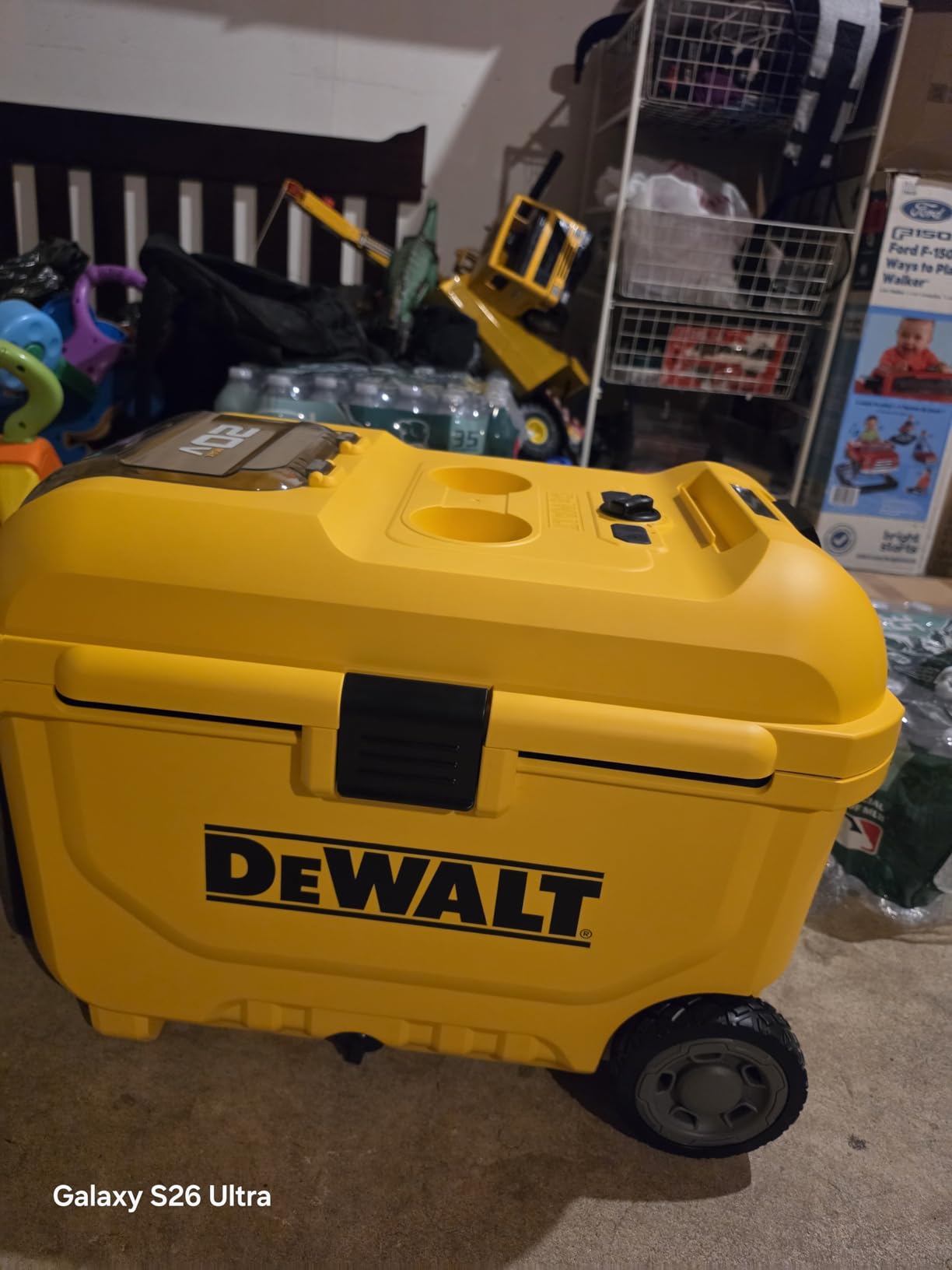
10. DEWALT DXACN01B: Best for Mobile Cooling and Job Sites
DEWALT Evaporative Air Cooler Portable Air Conditioner DXACN01B (Tool Only)
8 gal tank
Tool battery or 115V AC
120 min cordless
To 53.6F
3 year warranty
Pros
- Runs on DEWALT 20V tool batteries
- Also doubles as an 8 gallon ice chest
- Digital display reports output air temperature
- Turbo Cool mode reaches as low as 53.6F
- Accessories store inside the body
- Three year limited warranty
Cons
- Tool only listing means battery and charger sold separately
- Cordless runtime limited to about 120 minutes
- Only 21 reviews so durability data is thin
The DEWALT is a different machine from the other nine. It is an 8 gallon evaporative cooler that doubles as an ice chest, powered by a DEWALT 20V battery or the included 115V AC adapter. That makes it the pick for a job site, a trailer or a workbench where there is no outlet and no room for a 40-inch tower.
The digital display showing real-time output air temperature is unusually useful, because you can see whether the pads are saturated rather than guessing. Turbo Cool mode takes the outlet down to as low as 53.6F, which is far colder than any of the air-cooled towers here manage, because the ice path is doing the work. Wheels, a heavy duty handle, a cup holder, a phone tray and a USB port round out a genuinely portable design.
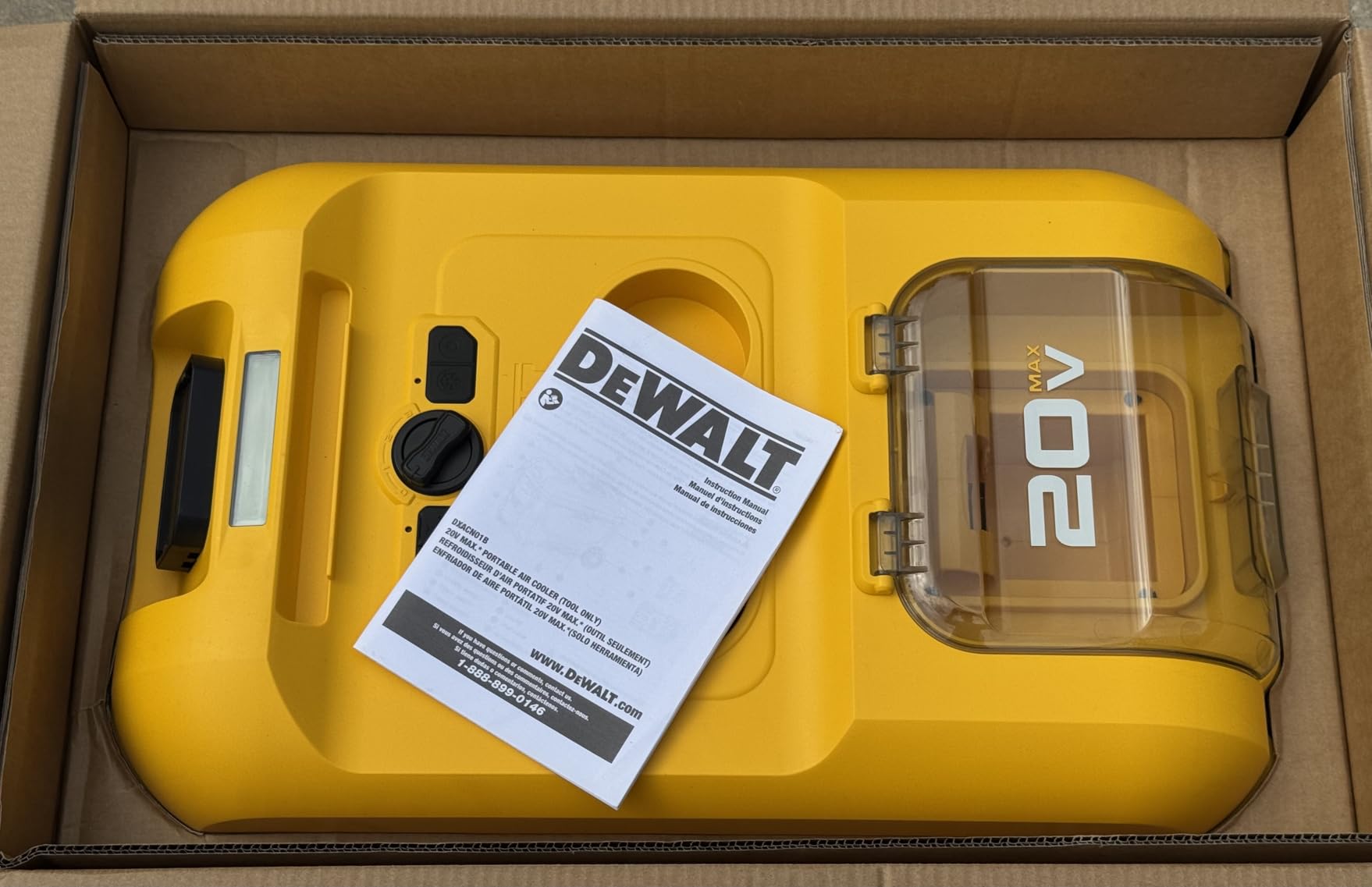
Everything that makes it useful in a workshop also defines its limits. Cordless runtime is about 120 minutes, so a full day of work means running it from mains or swapping packs. This is the tool-only listing, so a battery and charger are purchased separately, and with 21 reviews the long-term durability picture is thinner than anything else in this roundup.
The good news on parts is that the air hose connector, three air extension hoses, the 3-way connector and an ice pack all store inside the unit body, and the three year limited warranty is the second longest we saw. Setup is straightforward: fill with ice and water, connect the hoses, install the battery, choose a speed.
Who the DEWALT suits
Crews who already run DEWALT 20V packs, and anyone working away from a mains outlet. It is also a good fit for a vehicle or trailer, where the 8 gallon ice chest function is as useful as the cooling.
Who the DEWALT does not suit
It does not suit a fixed shop floor, since 120 minutes of cordless runtime and a small footprint rule out whole-room cooling. If you are not already in the DEWALT battery ecosystem, the cost of adding a pack and charger changes the value calculation quickly.
How to Size a Portable Evaporative Cooler for Your Workshop?
Start with floor area, then adjust. The working rule of thumb for an open, ventilated space is roughly 1 CFM of airflow per 3 sq ft of floor. A 600 sq ft one-car shop wants about 2,000 CFM, a 950 sq ft two-car shop wants about 3,200 CFM, and a 2,000 sq ft commercial shop wants 6,000 CFM or more. That is where the 11,000 and 12,000 CFM machines in this roundup start to make sense.
Now apply the two workshop penalties. If you plan to run with the garage door open, add roughly 30 to 50 percent to the figure, because the unit is fighting the flow of hot outdoor air coming back in. And add for equipment heat load: a dust collector, a welder, a compressor, a planer and shop lighting are all dumping heat into the same volume you are trying to cool. Sizing a cooler as if the shop were empty is the most common sizing error we see.
Next, check the electrical side. Most units here draw between 50 and 276 watts, so a 15A circuit handles them easily, but the 430-watt Big Ass Fans model and any welder on the same circuit add up. A GFCI-protected outlet, such as the one on the OEMTOOLS model, is the right call in a shop with metal dust and wet equipment.
The Four Prerequisites Before You Buy
Before comparing models, confirm these four conditions. If any one of them fails, a better evaporative cooler will not fix the problem.
1. Dry climate. Relative humidity under roughly 60 percent. Above that the evaporation rate collapses and output air is barely cooler than input air.
2. An open vent. A door, window or extraction fan on the opposite side of the room. A sealed shop cannot be cooled by an evaporative unit at all.
3. A water supply. A tap, a hose connection or a tank large enough for the shift. Shop owners report consumption above 5 gallons a night, so plan for a fill schedule or connect a hose.
4. A power circuit. A 15A outlet is enough for nearly everything in this roundup, and a GFCI outlet is the safer choice in a shop.
Cross Ventilation Setup: How to Get Real Cooling in a Shop
Here is the setup that shop owners actually use, and it is the difference between a 10 degree drop and a 25 degree drop. Carlos Alvarez, writing on the Sawmill Creek woodworking forum, describes placing the swamp cooler at one end of an open garage door blowing inward with a second fan at the other end blowing outward. He reports that raising moving air from roughly 10 percent to 40 to 50 percent is what makes the cooling land. He also warns explicitly against running a cooler 24/7 without sufficient outflow, because humidity builds until you are cleaning tool beds.
The layout in short: cooler at the door, outflow fan at the far end, doors and windows open. A cheap axial fan at the opposite end of the shop will outperform a more expensive cooler placed badly. If you cannot add an outflow fan, running with the door and one window open on opposite walls is the minimum acceptable arrangement.
Before you spend on a larger unit, deal with the door itself. Mark Blatter on the same forum reports that 2-inch solid foam insulation on a west-facing garage door made at least a 25 degree difference, and calls it the most important step of all. Bruce Lundgren reports a huge difference from rigid foam on the door in both a Florida block garage and a New Hampshire workshop. Insulating the largest opening in your shop is cheaper than any cooler in this roundup and it cuts the load before the unit starts working.
Maintenance, Dust and Water Treatment in a Workshop
Dust is the workshop-specific killer of cooling media. Sawdust and metal fines lodge in the pad and reduce the open surface area, and a clogged pad both cools less and restricts airflow across the whole unit. Rigid media handles a rinse better than cellulose. Check the pad weekly during heavy cutting seasons, and keep replacement media in the parts inventory rather than hunting for it in August.
Water is the second problem. Forum users report tank water turning milky within days from biofilm growth, and the recurring complaint is that nobody told them how to treat it. Empty and scrub the reservoir at the end of each working week, keep it dry over weekends, and add a manufacturer-approved tablet or a light bleach dose in hard-water areas to slow mineral scale. A unit with a drain plug, such as the Big Ass Fans model, makes this a five-minute job instead of a chore.
Buy a tank you can actually clean. Owners on r/Albuquerque call a non-removable reservoir a purchasing regret because there is no way to reach the corners. The DREO and the SereneLife both remove for cleaning, and that is worth more than a slightly higher CFM figure in a dusty shop.
Two features are worth paying for in a shop specifically: automatic low-water shutoff, so a dry pump is not the first thing to fail, and a water shortage alarm on larger tanks. Both appear in this roundup, and neither is standard across the category.
When an Evaporative Cooler Is the Wrong Purchase
There are three situations where a portable evaporative cooler is the wrong answer, and buying one anyway is the most common expensive mistake in this category.
If your region runs humid summers, the physics does not work. The same forum users who benefit from cross ventilation in dry climates say plainly that a swamp cooler would not work nearly as well in Florida. If the shop is sealed with no open door or window, you need a portable air conditioner instead, accepting its running cost and rear heat discharge.
If the space is already air conditioned seriously, the comparison changes shape. A 2-ton 23-SEER mini-split can pre-cool a 550 sq ft shop to 72F, but Joe Jensen on Sawmill Creek reports it struggles once tools start running and loses effectiveness above roughly 110F outdoor temperature. Scott McFarland reports spending 3,500 to 9,000 dollars installed for a 2-ton unit in a 550 sq ft Houston garage, which made summer woodworking viable, while Robert Zschoche reports reaching similar results in a 380 sq ft shop with an insulated door and a 1-ton unit. That is the gap you are weighing: a few hundred dollars and no installation against a four-figure installed system with a compressor.
And if you work somewhere a directional spot cooler fits the job better than a room unit, a spot cooler aimed at your bench will beat a big evaporative tower every time for a single person.
Frequently Asked Questions
Do portable evaporative air coolers really work?
They do, within clear limits. A portable evaporative cooler works by pushing warm air through water-saturated cooling pads so the water evaporates and pulls heat out of the air. In a dry climate with a door or window open, expect a realistic temperature drop of 10 to 25F. In humid air above roughly 60 percent relative humidity, the output is close to the input temperature and the unit behaves like an ordinary fan.
Will an evaporative cooler work in a garage?
Yes, provided four conditions are met: relative humidity under about 60 percent, an open door or window for the cooled air to escape, a steady water supply, and a 15A power circuit. A garage with a 15A outlet and an open door is close to an ideal setup. Insulating the garage door first makes a larger difference than buying a more powerful unit, because it reduces the heat load before the cooler starts.
Is there a difference between a swamp cooler and an evaporative cooler?
No. Swamp cooler, evaporative cooler and evaporative air conditioner are the same machine under different names, often from the same factory. Both push air through wet cooling media and remove heat by evaporation. The devices people sometimes confuse them with are portable air conditioners, which use a compressor and refrigerant, and spot coolers, which are directional units aimed at one person.
What is the best-rated portable evaporative cooler?
Among workshop-capable units, the Hessaire MC37M combines a 4.3-star average with 553 ratings, by far the deepest review base in its class, and 3,100 CFM of airflow covering up to 950 sq ft. In a workshop, airflow, tank size and the availability of replacement cooling media matter more than star count alone, so review volume deserves as much weight as the rating itself.
What size evaporative cooler do I need for my workshop?
A common rule of thumb is about 1 CFM of airflow per 3 sq ft of floor area, which puts a 950 sq ft two-car shop at roughly 3,200 CFM and a 2,000 sq ft commercial space at 6,000 CFM or more. Add 30 to 50 percent if the garage door will be open, and add further capacity for heat from a dust collector, welder, compressor and shop lights.
Can a swamp cooler work in 100 degree weather?
It can, if the air is dry. The limit is relative humidity, not temperature, so a dry climate at 100F outdoor temperature can still produce a meaningful indoor drop. In humid weather the same outdoor temperature produces almost no cooling at all, because the pads cannot evaporate moisture into air that is already saturated.
How long does an evaporative cooler run before refilling?
It depends on tank size and heat load. Workshop owners report consumption above 5 gallons a night, and a 10 gallon tank typically covers most of a working day in moderate heat while a 33 gallon tank covers a full shift. Units with a garden hose adapter, including the Hessaire MC37M and MC92V, can be connected for continuous operation and never need a manual fill.
How much electricity does an evaporative cooler use?
Less than almost anything else you can put in a shop. Coolers in this roundup draw between 50 and 276 watts for normal operation, with one higher-draw model at 430 watts. That is roughly the load of a couple of incandescent bulbs, which is why evaporative cooling costs so little to run compared with a compressor air conditioner or a mini-split.
The Bottom Line
The best portable evaporative cooler for workshop use is the Hessaire MC37M, with 3,100 CFM, a 10.3 gallon tank and the deepest review base in the category. For large shops and warehouses the Hessaire MC92V moves 11,000 CFM on 50 watts, and for the best airflow per dollar the Uthfy 40 inch unit adds three-sided pads and three ice packs at 50 dB.
Insulate your garage door, set up cross ventilation with an outflow fan, connect a hose, and your realistic payoff is 10 to 25F on a dry afternoon for a few watts of electricity. If your climate is humid or your shop is sealed, spend the money on a ducted mini-split instead, because no evaporative unit on the market changes that physics.