
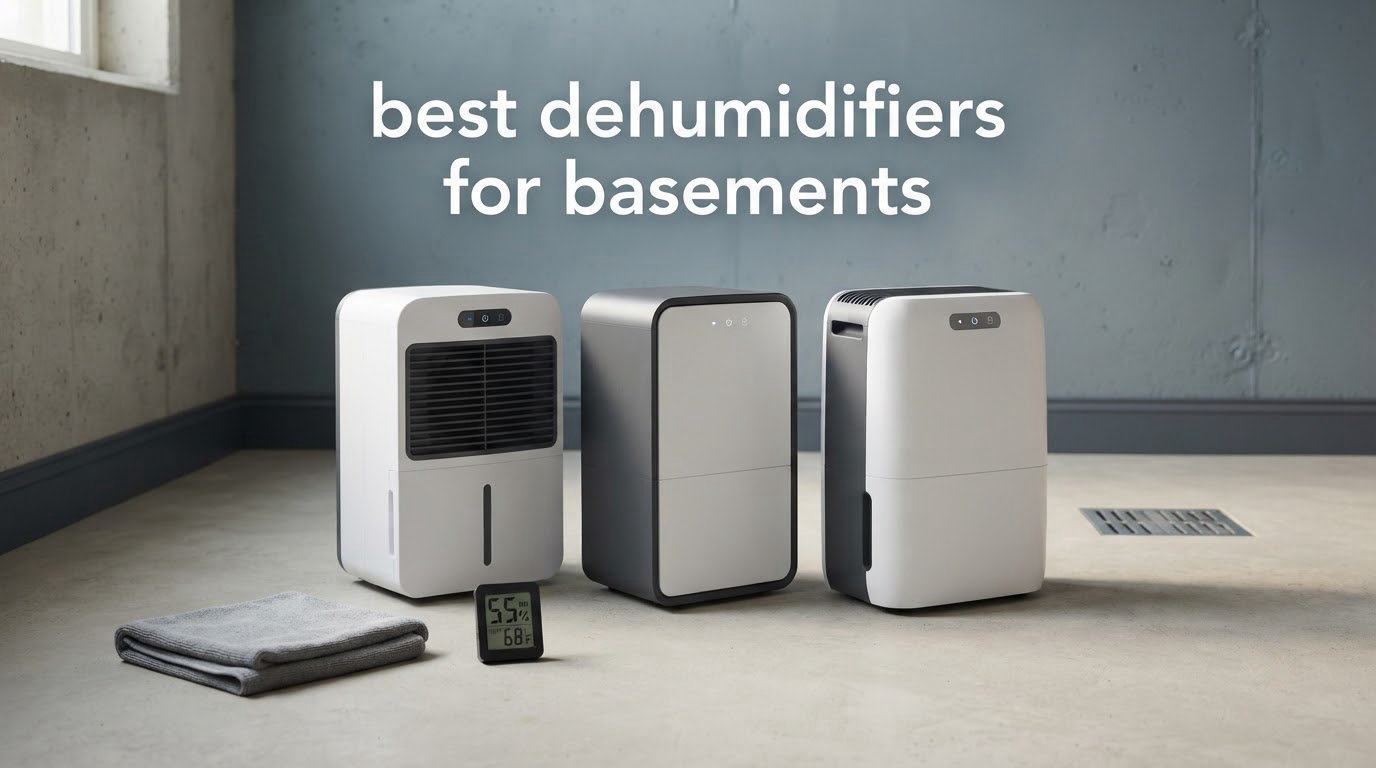
Basement humidity is one of those problems that never announces itself clearly. The walls look fine, the storage boxes feel normal, and then one spring you notice a musty smell in the back corner and a patch of black speckles along the baseboard. The best dehumidifiers for basements are the machines that hold relative humidity between 50% and 55% through real weather, not just on a mild afternoon in June.
Our pick for most homes is the Waykar 80-Pint. It moves serious water, runs at 42 dB, covers up to 5,000 sq. ft., and has 22,000+ reviews behind it. If your basement is cold, look at the AEOCKY 80-Pint instead, because it keeps working down to 65F. If you have no floor drain anywhere near the unit, the avylo 90-Pint with a built-in pump solves a problem most listings ignore.
We spent weeks reading spec sheets, warranty terms, and thousands of customer reviews for ten condensing dehumidifiers, then sorted them by the things that actually decide whether a basement stays dry. Capacity against real basement conditions, drainage setup, energy cost, and the weight you will be hauling around. Everything below is updated for 2026.
Table of Contents
Key Features to Look For in a Basement Dehumidifier
These three criteria matter more than anything else printed on the box.
Capacity: Choose a 50-pint or larger compressor model rather than a weak 20-pint unit. A 20-pint machine can lower the number on the display for a day, then run out of steam in a wet basement. Match pints per day to the square footage band below.
Drainage: Use a gravity drain hose if you have a floor drain, sink, or a lower-level drain nearby. Choose a built-in condensate pump if the water has to travel upward or the drain sits far from where the machine will sit. Bucket-only drainage is a treadmill you will regret.
Energy Star certification: Energy Star certification means efficient operation without spiking your electric bill. The Energy Star Most Efficient tier goes further and applies to only a small slice of certified models, so it is a real differentiator.
Two more things separate a good basement machine from a disappointing one. Auto-defrost matters if the basement is unheated, because the evaporator coil ices over below roughly 60F and the unit then removes nothing at all. And a washable pre-filter plus a restart-after-power-outage function saves you from walking into a flooded corner after a storm.
Our Top 3 Best Basement Dehumidifier Picks (October 2026)
These three cover the widest range of basement situations. The first is the one we would put in most homes, and the other two solve specific pain points that the first one does not.


Midea 22-Pint Smart Dehumid…
- Wi-Fi and voice assistant control
- 47 dBA
- ENERGY STAR 31% savings

All 10 Basement Dehumidifiers at a Glance (October 2026)
Every machine below is a compressor-based condensing dehumidifier, which is the only type that can pull a damp basement under 60% relative humidity. Peltier and thermoelectric machines cannot do it, and we did not include any.
| Product | Specs | Action |
|---|---|---|
| Waykar 80-Pint Basement Dehumidifier |
|
Check Latest Price |
 AEOCKY 80-Pint Energy Star Dehumidifier AEOCKY 80-Pint Energy Star Dehumidifier |
|
Check Latest Price |
| Midea 22-Pint Smart Dehumidifier |
|
Check Latest Price |
 Yaufey 150-Pint Dehumidifier With Pump Yaufey 150-Pint Dehumidifier With Pump |
|
Check Latest Price |
| Kesnos 80-Pint Dehumidifier |
|
Check Latest Price |
 Gasbye 115-Pint Dehumidifier Gasbye 115-Pint Dehumidifier |
|
Check Latest Price |
 VEAGASO 34-Pint Dehumidifier VEAGASO 34-Pint Dehumidifier |
|
Check Latest Price |
 Waykar 34-Pint Dehumidifier Waykar 34-Pint Dehumidifier |
|
Check Latest Price |
 LUKO 30-Pint Dehumidifier LUKO 30-Pint Dehumidifier |
|
Check Latest Price |
 avylo 90-Pint Dehumidifier With Pump avylo 90-Pint Dehumidifier With Pump |
|
Check Latest Price |
How We Picked These Basement Dehumidifiers?
We did not test these machines in a controlled chamber, and we want to be straight about that. Instead we read the rated specifications, warranty language, and customer review patterns for each model, then applied the criteria that decide outcomes in a real basement.
Capacity against real conditions came first. Most listings quote a headline number measured at 95F and 90% relative humidity, conditions you will never see in a finished basement. We only trust a model when the manufacturer also publishes a figure at 86F and 80% RH, because that is closer to a damp summer basement in most regions.
Drainage came second. A machine that stops pulling water when a 0.5 gallon reservoir fills is not solving your problem, it is scheduling it. We gave strong weight to the presence of a continuous drain port, a supplied hose, and a built-in pump with a stated lift height.
Third, we looked at energy draw in watts and energy certification, because a basement dehumidifier that runs 20 hours a day should not also be your second-largest power consumer. Fourth, we weighed warranty length and the realism of the stated low-temperature performance. Finally, we considered physical weight, since a 43-pound machine with a full tank is a genuine problem for anyone with a lifting limit.
For context on how this category behaves, forum threads on r/BuyItForLife and hvac-talk run to hundreds of posts about repeat failures across Midea, Honeywell, and Hisense units, with several owners on their third machine in three years. Those threads shaped our weighting of warranty length and repairability far more than any spec sheet did.
1. Waykar 80-Pint – Best Overall for Large Basements
Waykar 80 Pints 5000 Sq. Ft 2025 Energy Star Dehumidifier for Basement
80 pints/day
5,000 sq. ft.
270 watts
42 dB
31 lb
1.14 gal tank
Pros
- 80 pints per day covers basements up to 5000 sq. ft.
- 30% to 80% humidity control range
- 42 dB at the low fan speed
- ENERGY STAR certified
- includes a 3.3 ft drain hose
Cons
- 31 lb body is heavy to move between rooms
- wide footprint takes more floor space than compact models
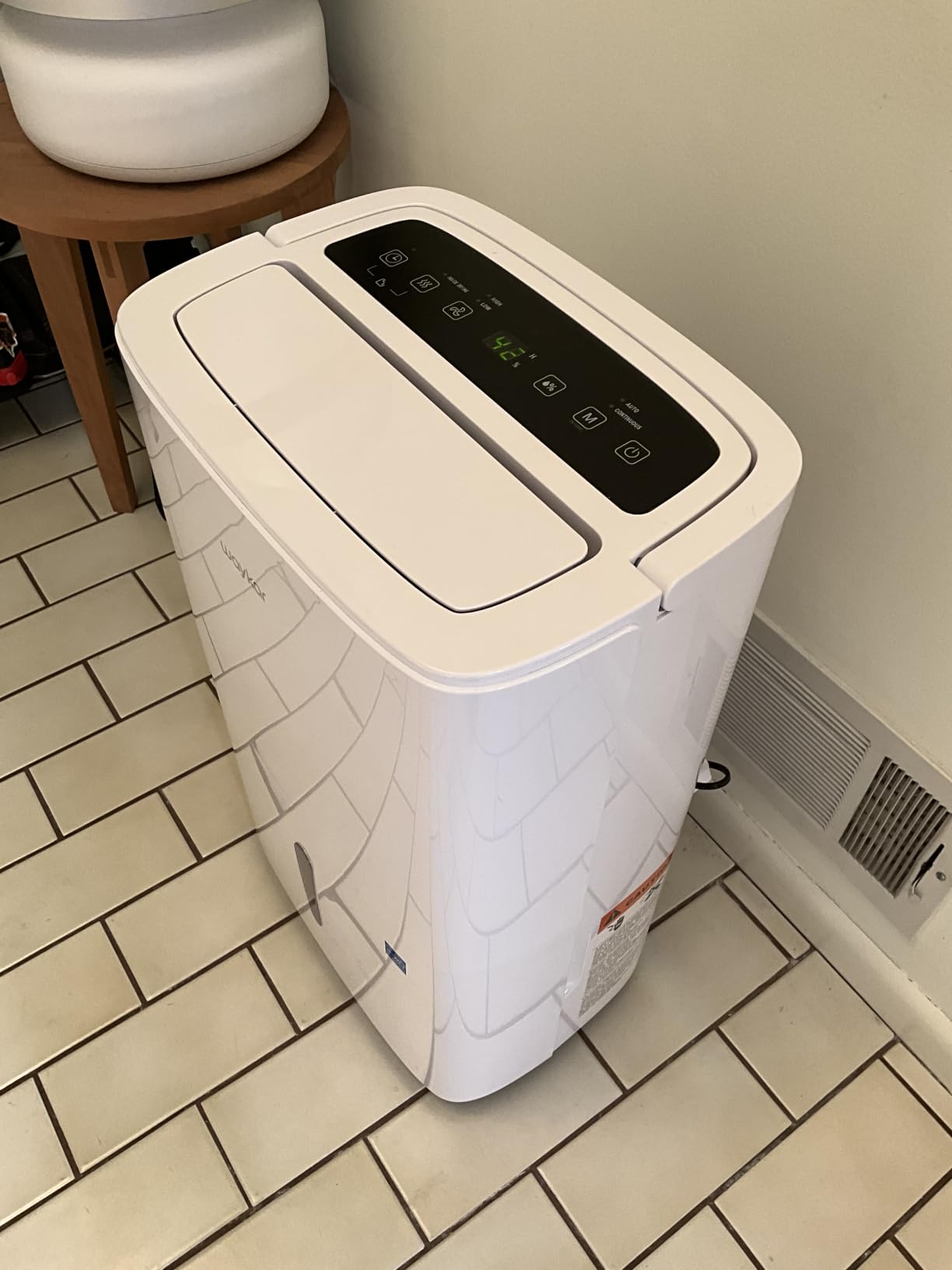
This is the unit we keep coming back to. The headline 80 pints per day figure is measured at 95F, but the compressor is a serious rotary unit with 7mm high-tooth pure copper tubing, and in practice it moves water fast enough to keep a mid-size basement in range through wet weeks. Owners running it around the clock report holding steady humidity in a space that used to smell musty within a few days of switching it on.
What impressed us most is the 30% to 80% humidity control range, which is wider than most machines in this group. That low end matters in spring when the outdoor air is saturated and you want the unit to keep working without cycling off constantly. The 90-degree auto swing louver pushes air across the room rather than straight at the wall, which matters in a wide basement with a single low ceiling.
Waykar lists a two-year warranty structure: one year of exchange coverage plus a second year when you register the machine. That is not generous by basement-appliance standards, where five years is the number to look for, and it is worth factoring into how you feel about a ten-year run.
The honest weakness is weight. At 31 pounds empty, and considerably more with a full 1.14 gallon tank in it, this is not a machine you drag up basement stairs once a week. Set it where it belongs on day one, hook up the drain, and leave it. A minority of reviews mention isolated compressor or refrigerant failures after extended use, though Waykar’s replacement service drew more praise than criticism.
Where the Waykar 80-Pint works well
This is the right pick for a 1,500 to 3,000 sq. ft. basement with moderate dampness, especially if the space is unfinished and you care more about dryness than silence. The 165 cfm airflow figure is generous, so a single machine can pull air from a wide, open area rather than just its own corner.
The 42 dB low-speed rating also makes it defensible for a finished basement that doubles as a storage or work area. It is not silent, and the fan is clearly audible at the highest setting, but on low it blends into background noise the way a refrigerator does.
Where the Waykar 80-Pint falls short
If your basement sits below 60F for long stretches, this is the wrong machine. The listing does not publish a verified low-temperature output figure, and owners in cold spaces report coil icing that stops moisture removal until the coil defrosts. Buy the AEOCKY for a cold basement.
It also offers no built-in pump. If your nearest drain is above the machine rather than below it, you will need a separate condensate pump and a place to put it, which adds cost and another failure point to a system you cannot always watch.
2. AEOCKY 80-Pint – Best for Cold Basements
AEOCKY 5500 Sq.Ft Energy Star Most Efficient 2025 Dehumidifier Max 80Pint/D
80 pints at 95F, 56 at 86F
5,500 sq. ft.
280 watts
44 dB
works to 65F
Pros
- Publishes a real 86F and 80% RH figure of 56 pints per day
- holds Energy Star Most Efficient certification
- operates down to 65F without heavy coil frosting
- 44 dB at the lowest fan speed
- 3-year coverage
Cons
- Tall 24 in vertical body needs shelf height
- marketing claims on the listing are hard to verify independently
Nearly every dehumidifier listing quotes a headline capacity measured at 95F and 90% RH, a lab condition that makes an ordinary damp basement look easy. AEOCKY publishes the number that matters, 80 pints per day at 95F but 56 pints per day at 86F and 80% RH, and that honesty is why this machine ranks near the top for most basements. It is the closest thing to a real-world rating we found in the whole group.
The cold-basement performance is the differentiator. This unit is rated to operate down to 65F, which is the threshold below which most residential evaporators start frosting up and stop removing water entirely. In an unheated basement that drifts to the low 60s in January, that difference decides whether the machine is useful or decorative.
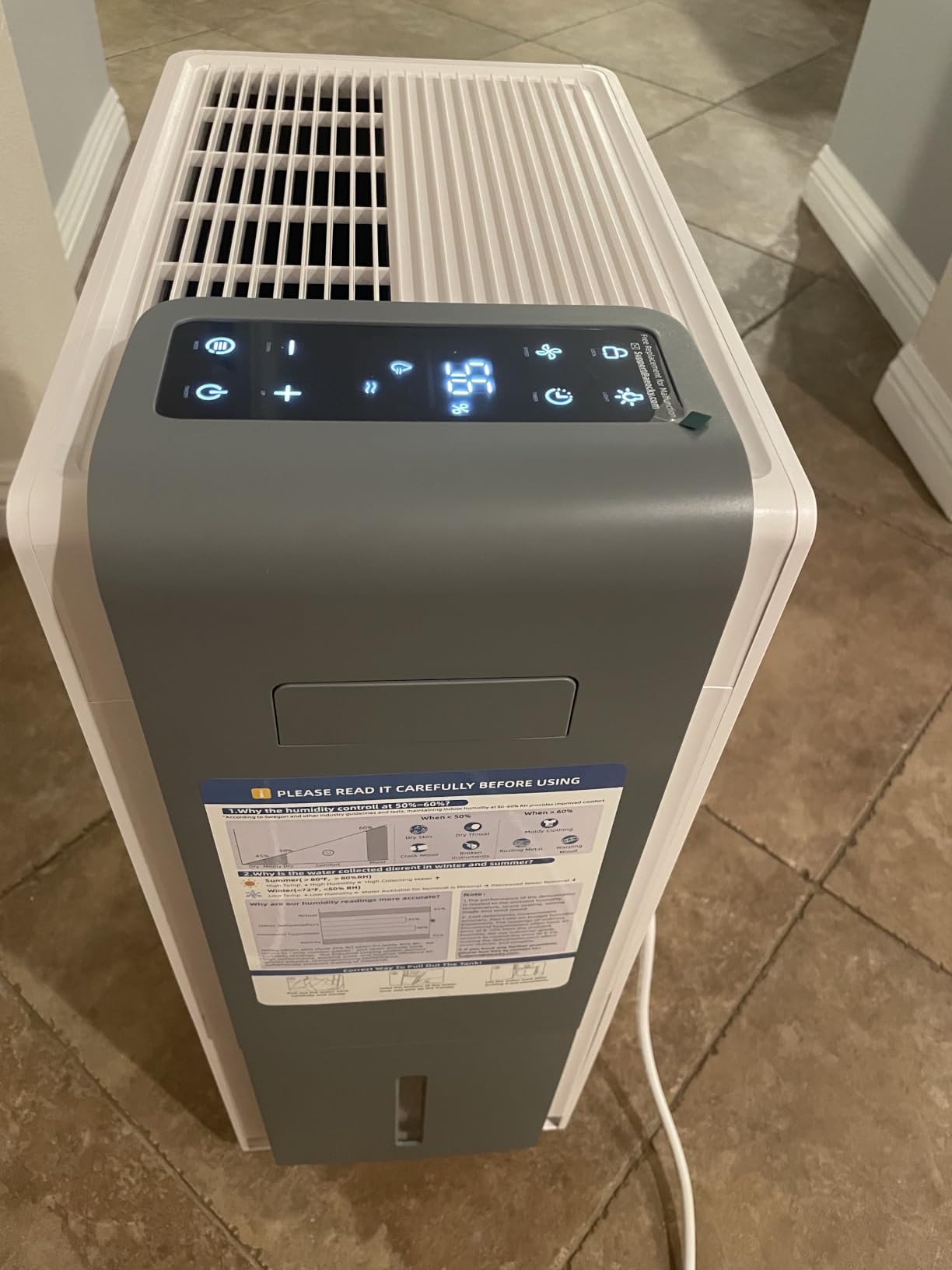
It also carries genuine Energy Star Most Efficient certification, a tier that covers only about 2.6% of certified models. Combined with millisecond-level humidity sensing and power-off memory, it holds a setpoint tightly and resumes where it left off after a power interruption, which matters if you run it off a smart plug or during storm outages.
The trade-offs are physical. At 24.09 inches tall and 8.66 inches wide, it is a vertical tower, so you need shelf or headroom clearance and a wall position where the intake is not blocked. Some critical reviews focus less on measured performance and more on how aggressively the listing compares the unit to competitors, which is a fair criticism of the marketing but not of the machine.
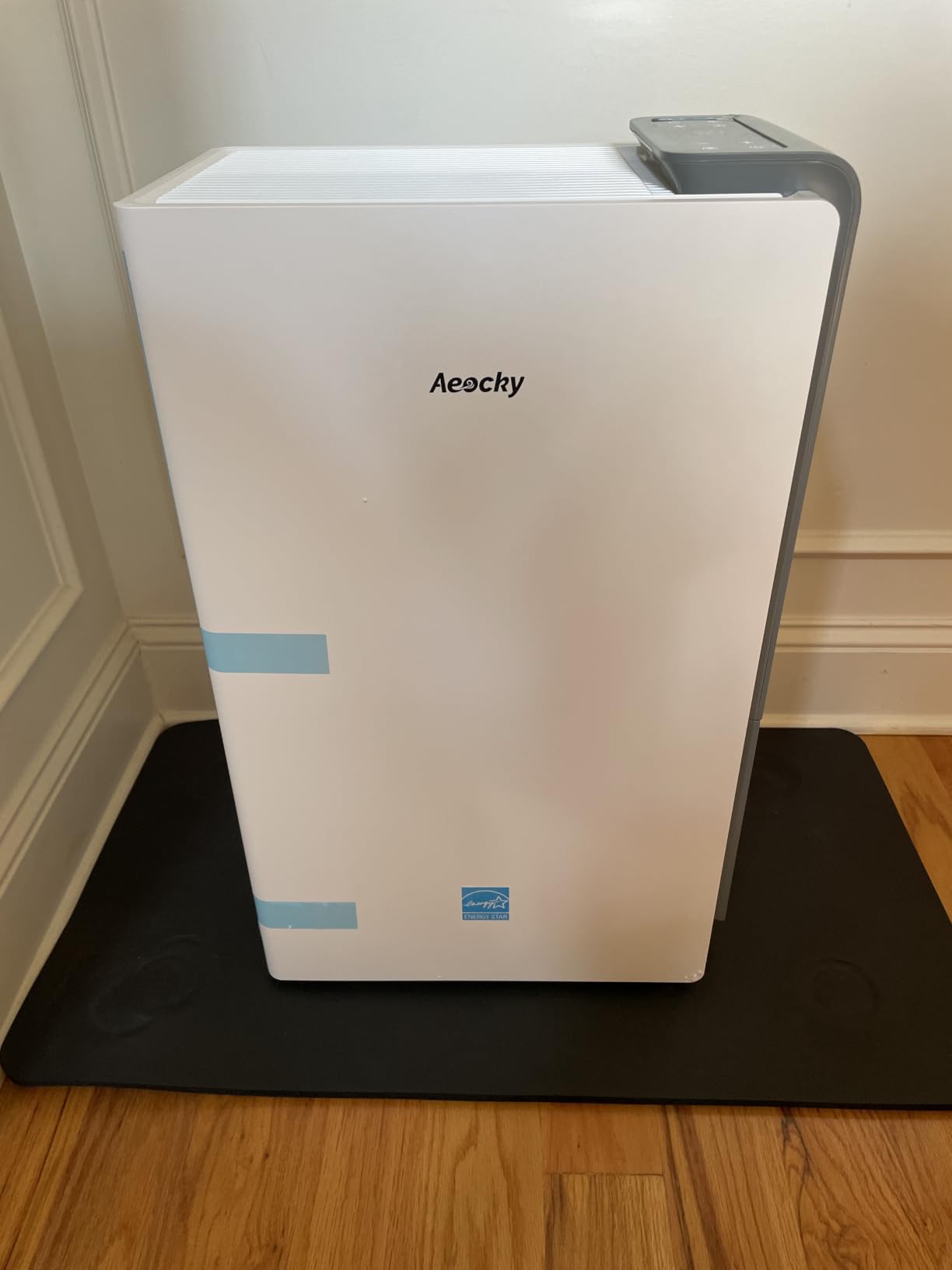
Best basement situations for the AEOCKY 80-Pint
Choose this one if your basement is unheated, sits below grade, or shows condensation on windows from October through March. The 65F operating floor and the auto-defrost system keep it extracting moisture in the conditions where most household units quit.
It is also a strong choice for anyone who watches their power bill closely. Reviewers repeatedly single out low operating cost as the reason they returned to this brand, and the included garden hose adapter makes a permanent drain connection straightforward.
Where it falls short
It has no built-in condensate pump, so upward drainage means adding your own pump. The 1.45 gallon reservoir is decent but not exceptional, so leaving it without a hose in a wet basement means multiple daily walks down the stairs.
And while 5,500 sq. ft. of stated coverage sounds generous, that figure assumes the laboratory condition. If your basement is genuinely wet with groundwater intrusion, expect the real number to look more like 56 pints per day, which is still strong but a different conversation.
3. Midea 22-Pint – Best for Small Basements With App Control
Midea 22 Pint Dehumidifier for Basement, 1,500 Sq. Ft, Energy star
22 pints/day
1,500 sq. ft.
295 watts
47 dBA
Wi-Fi enabled
Pros
- Only Wi-Fi enabled model here
- works with Alexa and Google Assistant
- ENERGY STAR certified with 31% energy savings
- auto defrost and auto restart after outages
- reusable air filter included
Cons
- 22 pint capacity suits only small spaces
- no drain hose included for continuous drainage
Midea is the brand forum buyers name when they talk about which compressor dehumidifiers actually last, and this 22-pint model is the most talked-about one. It is also the only unit here with real app support, which changes how you interact with a basement machine you cannot see from where you live.
The SmartHome app, Alexa, and Google Assistant support let you check the current humidity reading and change the setpoint from upstairs. For a finished basement or a storage room full of paper and clothing, that is more than a gimmick. You find out the compressor tripped before you come back to a wet floor, not after.
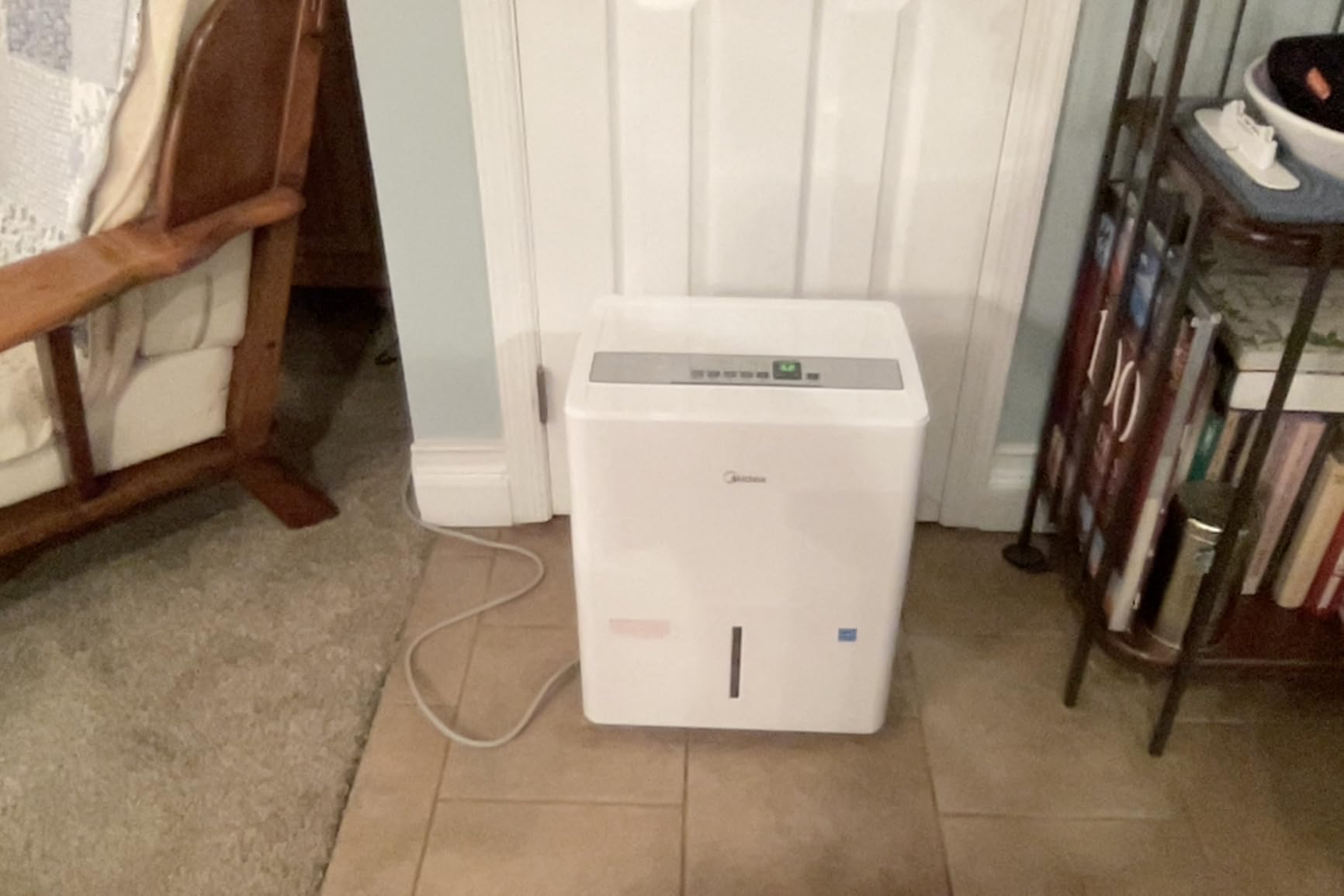
At 47 dBA and 1,500 sq. ft. of rated coverage, this is a small-space machine, and treating it as a whole-basement solution is the mistake we see most often. In a 600 sq. ft. storage basement it does a fine job. In a 2,000 sq. ft. wet space it will run continuously and never catch up, and owners report exactly that frustration in the reviews.
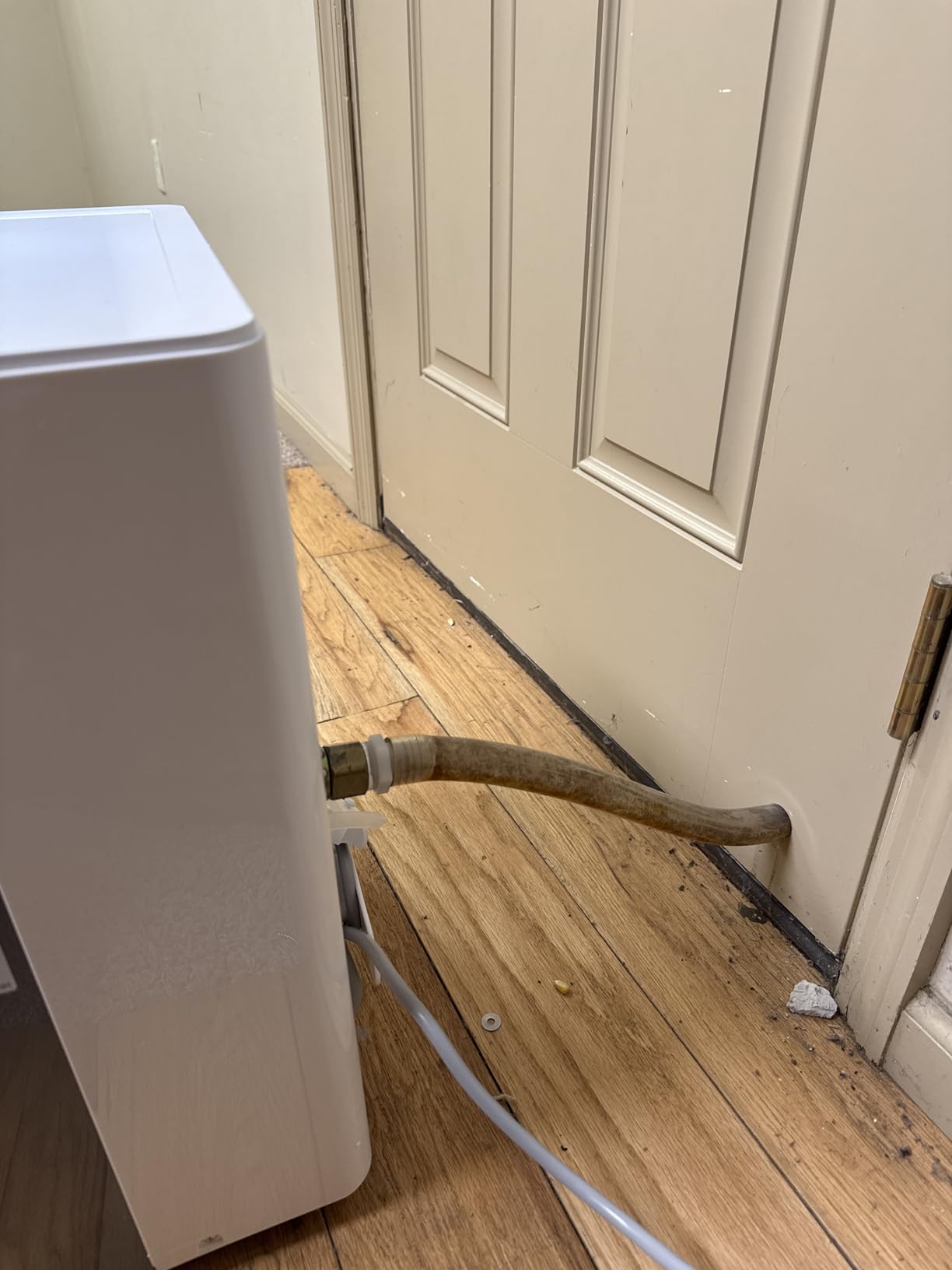
One practical note: the drain hose is not included. Every unit here that can run unattended should have a continuous line, and the small 0.8 gallon reservoir makes bucket drainage a twice-daily chore rather than a weekly one. The auto shutoff prevents overflow, which is the only reason bucket-only use is tolerable at all.
When the Midea 22-Pint is the right buy
It suits a small finished basement, a crawl space, a laundry room, or a closet-level storage area where humidity sits between 60% and 70% and you want it under 55%. The 35% to 85% adjustable range gives you fine control for a space that also holds clothing or electronics.
It is the only pick here you can monitor remotely, and for a rental property or a basement you cannot reach easily, that changes the practical calculus. A 71% five-star share across more than 7,000 reviews reflects solid long-term satisfaction rather than novelty.
When to choose something else
If your basement exceeds 1,200 sq. ft. or has a musty smell that returns within days of cleaning, this is undersized by a wide margin. The 22-pint rating is real, it is just rated for a much smaller space than most people are trying to dry.
The 33.5-pound body also works against the app convenience. You get smart monitoring for a machine that is heavy enough that you will set it once and leave it, and a single limited year warranty from the purchase date is thin for a machine expected to run continuously through a humid season.
4. Yaufey 150-Pint – Best for Very Large Wet Basements
Yaufey 150 Pint Dehumidifier with Pump for Basement 8500 Sq. Ft.
150 pints/day
8,500 sq. ft.
500 watts
1.85 gal tank
pump drain
Pros
- 150 pints per day is the highest capacity here
- three drainage options including an upward pump discharge
- 1.85 gallon tank cuts emptying frequency
- dedicated basement mode targeting 45% RH
- includes a 16.4 ft pump hose and 3.28 ft gravity hose
Cons
- 500 watt draw is the highest in the group
- 39.7 lb body is difficult to reposition
When a basement takes in water fast enough that a 50-pint machine runs nonstop and never gains ground, capacity stops being a preference and becomes the whole point. This 150-pint model is built for that scenario, and it is the machine we would look at first for a 3,000 sq. ft. space with active seepage.
The drainage flexibility is what separates it from other large machines. You get three options: an upward pump discharge, the 1.85 gallon reservoir, and a gravity drain. A 16.4 ft pump hose is included, which is long enough to reach a sump or a drain at a higher elevation without buying extra line.
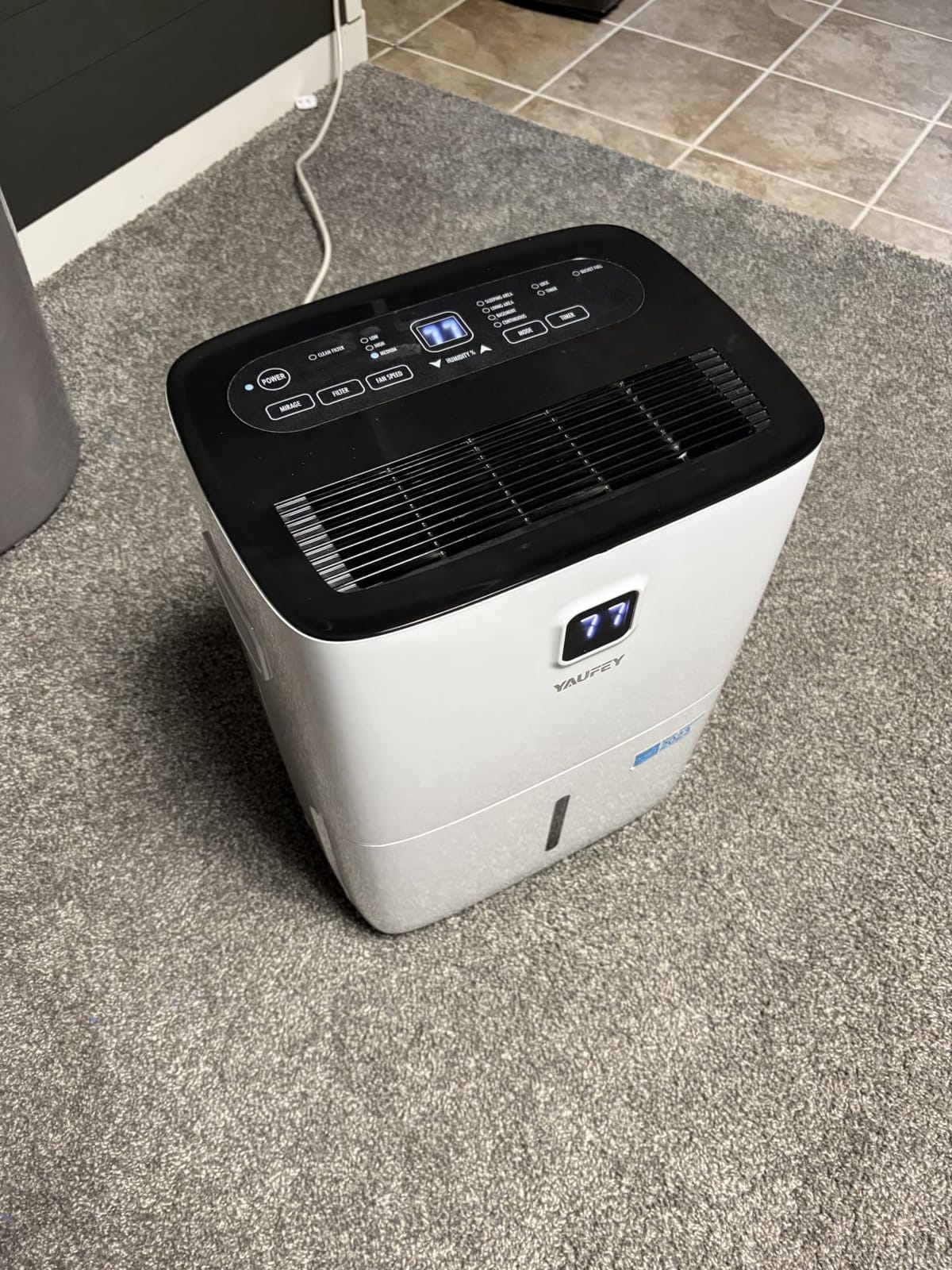
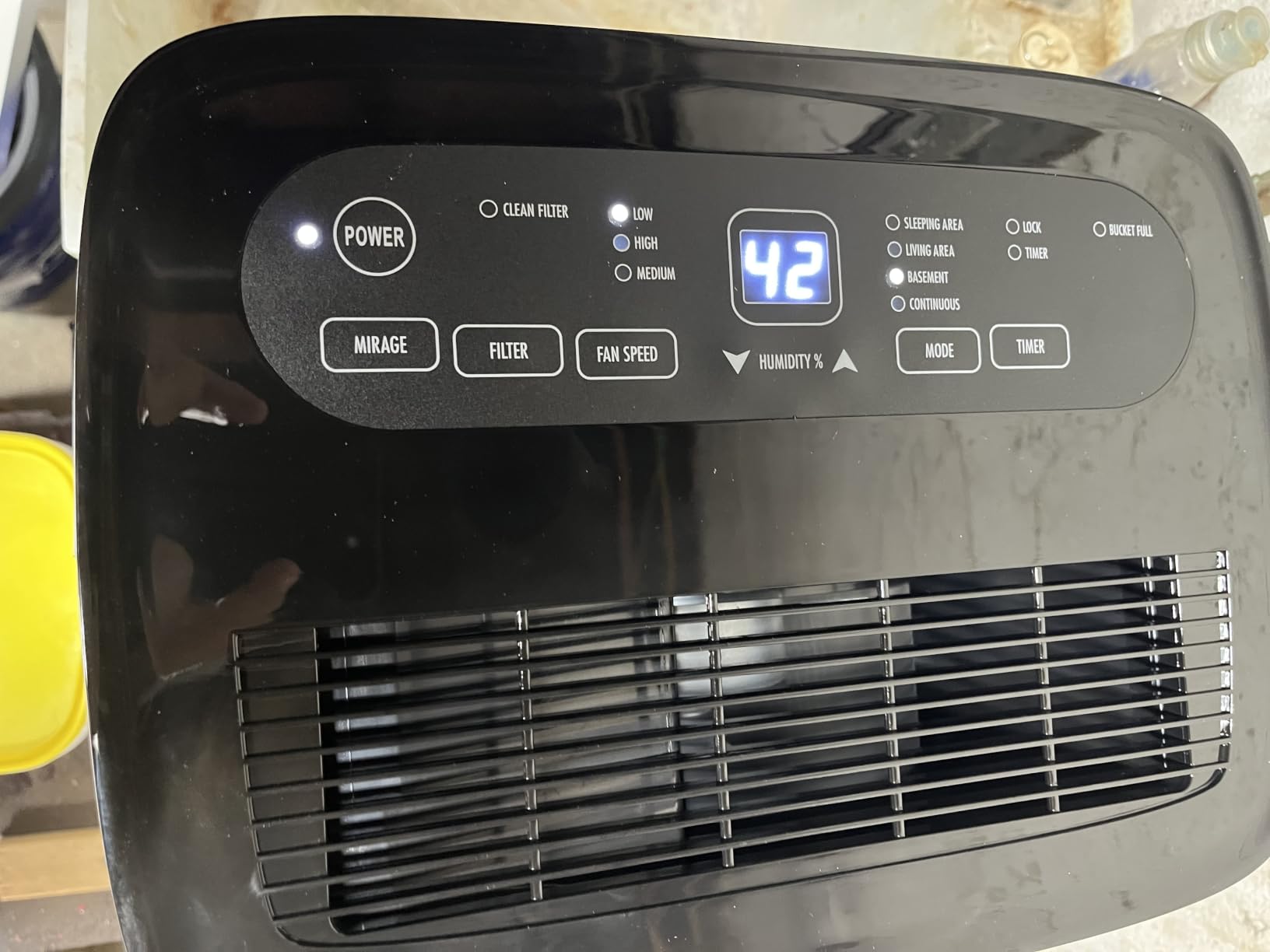
The dedicated Basement mode targets 45% relative humidity, which is more aggressive than the 50% to 55% band most people actually want for storage, and it is worth knowing that setting exists. For a room with a finished ceiling, drywall, or wood framing, holding the space below 50% pulls moisture out of the building materials themselves.
The catch is straightforward. At 500 watts it draws more power than anything else here, and at 39.7 pounds it is not a machine you reposition without thinking about it. Both numbers are the honest cost of the capacity, and for a genuinely wet basement most owners consider them fair.
Who should buy the Yaufey 150-Pint
Owners in large, wet basements point to the pump drainage flexibility and the 1.85 gallon tank as the two features that made the difference, and the 73% five-star share supports that. If your water problem is severe enough that you are bailing out a floor drain by hand on a weekly basis, this is the class of machine that changes the situation.
The three operating modes also make it adaptable. Living Area mode is gentler for a finished space, Basement mode is aggressive for storage, and Continuous mode keeps the compressor running rather than cycling on humidity alone.
When it is more machine than you need
If your basement is 1,000 sq. ft. and moderately damp, a 150-pint machine will pull the humidity down in a day and then spend the rest of the season cycling, which wastes energy and shortens compressor life. Oversizing has a cost even when capacity is not needed.
Positioning takes planning, as several reviewers note. At nearly 40 pounds with a large reservoir, decide where it lives before delivery day, because moving it down concrete stairs afterwards is a two-person job.
5. Kesnos 80-Pint – Best Value
80 Pints Energy Star Dehumidifier for Basement with Drain Hose, 6000 Sq. Ft
80 pints/day
6,000 sq. ft.
275 watts
106 cfm
1.06 gal tank
Pros
- Strong performance for its size class
- Energy Star certified for up to 45% less energy
- 30% to 80% humidity range with a front digital display
- 24-hour timer and two fan speeds
- 1-year warranty extends to 3 years with registration
Cons
- 1.06 gallon tank is small for the capacity class
- 106 cfm airflow limits distribution in very wide rooms
The Kesnos 80-Pint is the pick that makes the most sense when you want 80-pint capacity and you would rather not pay a premium for an unfamiliar brand name. It covers up to 6,000 sq. ft. on paper, runs 275 watts, and carries a warranty that extends to three years once registered.
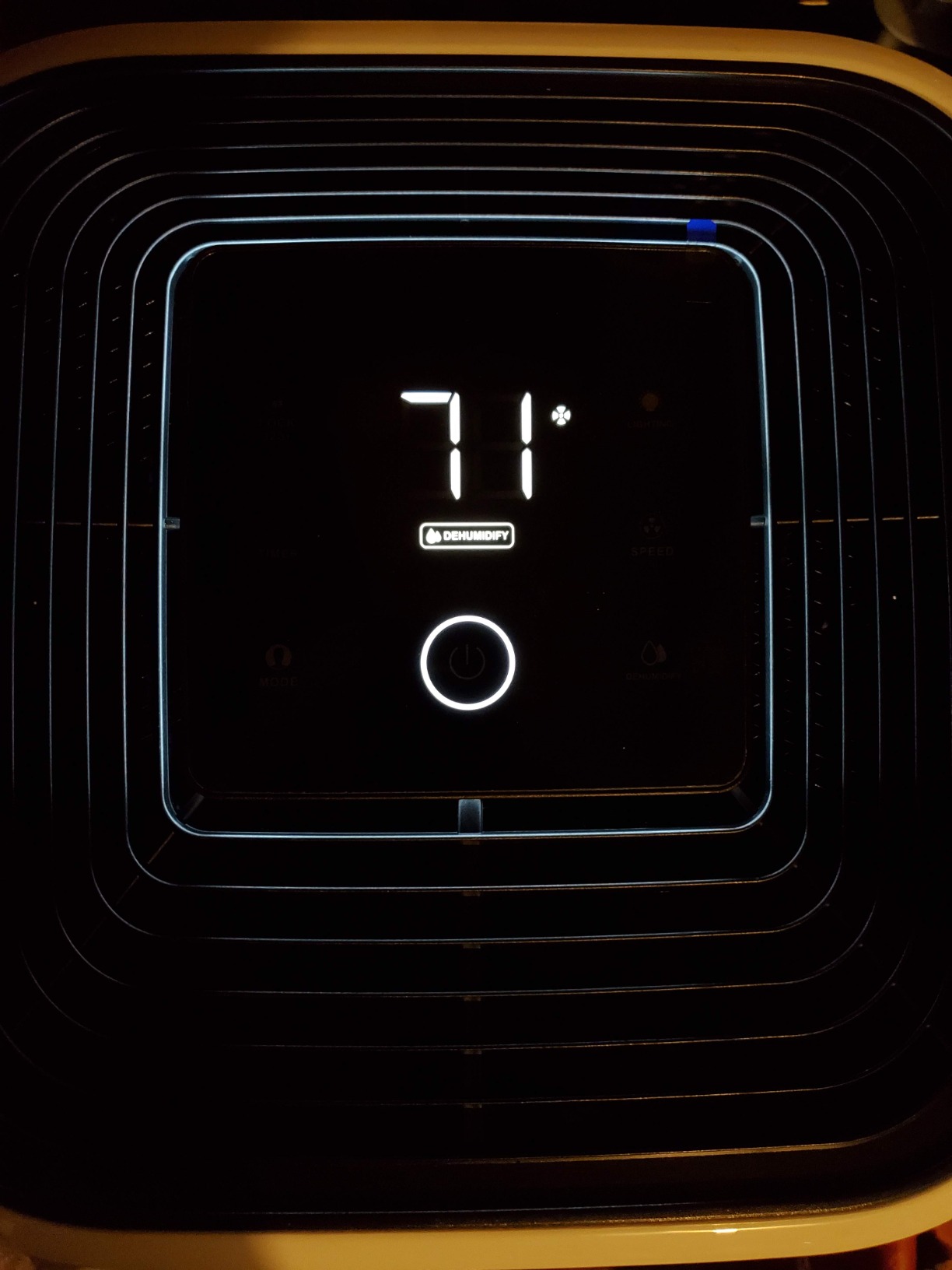
That warranty structure is better than several higher-profile models in this group. You get a one-year limited warranty, an additional two-year extension after registration, a 30-day satisfaction guarantee, and lifetime technical support. In a category where owners on forums are on their third machine in three years, the length and accessibility of coverage matters more than it used to.
Two design details stand out for a finished basement. The front digital humidity display means you can read the reading from the doorway without walking over to the machine, and the MIRAGE sleep mode blanks that display while the unit keeps running, so no glowing numbers in a dark room.
The reservation is airflow. At 106 cfm, this machine moves less air than the 165 cfm of the Waykar 80, so in a very wide, open basement with poor circulation, moisture removal will not be even across the space. In a rectangular 1,500 sq. ft. room it performs fine.
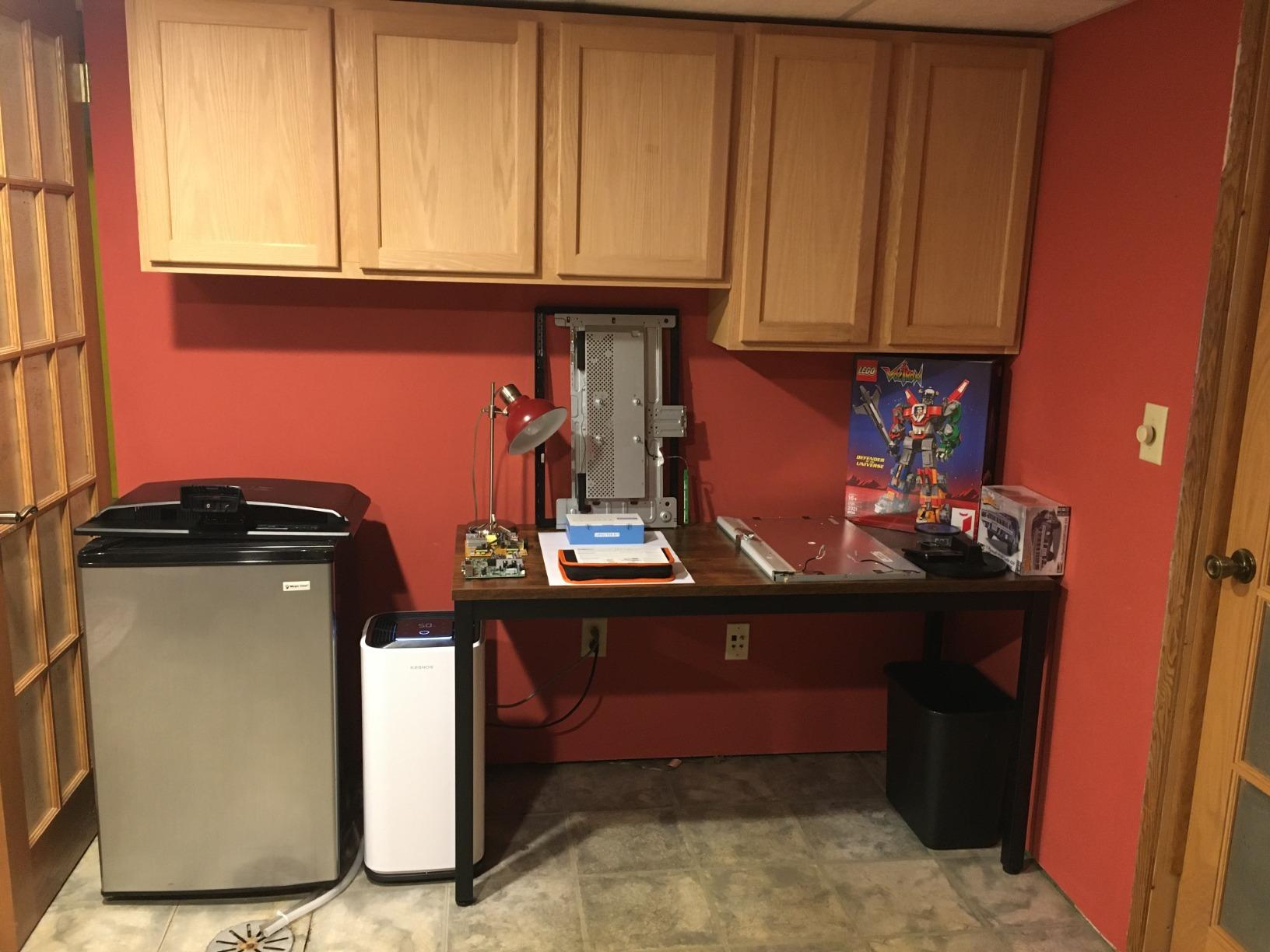
Where the Kesnos 80-Pint earns its place
It suits a mid-size basement where the goal is a straightforward moisture problem solved without extra features. The 30% to 80% range, the 24-hour timer, and the two fan speeds cover the settings most people adjust weekly, and nothing here is confusing.
Reviewers highlight the value and the drainage setup, and the 76% five-star share tells you the satisfaction level is high for the money. The included 3.3 ft drain hose with auto shutoff covers continuous drainage with a standard floor drain.
Where it falls short
The 1.06 gallon tank is small for an 80-pint machine, which means bucket-only use in a wet basement means emptying it several times a day. Set up a hose before you start.
The MIRAGE operating mode name on the spec sheet is also the only unusual thing about the listing, and the 106 cfm figure is the real limitation to plan around. Keep the machine centrally placed rather than in a corner, and leave clearance around the intake and discharge.
6. Gasbye 115-Pint – Best With Transparent Performance Data
Gasbye 4500 Sq.Ft. 2026 Energy Star Dehumidifier for Basement & Large Rooms with Drain Hose, Max 115 Pints/Day | 45dB Quiet Compressor | 1.7 Gal Water Tank | Auto Shut-Off & Restart, Black
115 pints at 86F, 50 at 65F
4,500 sq. ft.
500 watts
45 dB
43 lb
Pros
- Highest average rating in the group at 4.6
- publishes tested output at 86F and 80% RH and 65F and 60% RH
- ENERGY STAR certified
- 1.72 gallon tank plus a 5 ft drain hose and garden hose adapter
- 2-year U.S. support with replacement units
Cons
- Heaviest machine here at 43 pounds
- only one fan speed listed
This machine has the highest average rating of the ten we reviewed, at 4.6 stars, and an 80% five-star share with only 4% one-star. The reason we do not put it first is the review base: 919 ratings against more than 20,000 for some competitors. Good scores on a smaller sample tell you less about long-term durability.
What makes it worth your attention is the transparency. The listing publishes three separate tested figures: 115 pints per day at 86F and 80% RH, 73 pints per day at 80F and 60% RH, and 50 pints per day at 65F and 60% RH. That third number is rare to see. It tells you directly what this machine does in a cold basement, which is the single most useful figure most listings never provide.
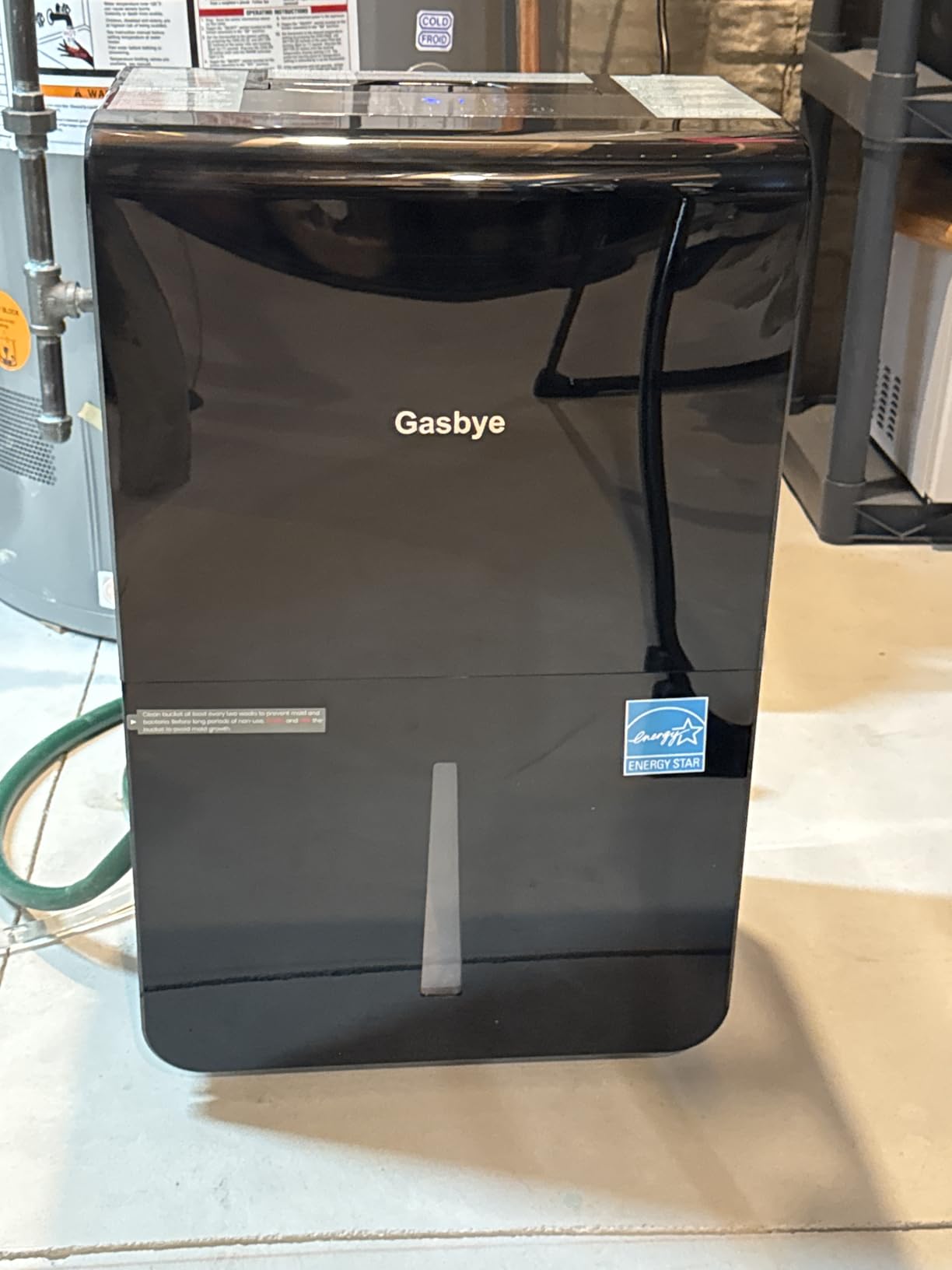
The build is heavier than anything else here at 43 pounds, with reinforced thickened copper tubing and a five-tier copper coil described in the materials. Energy Star certification with claimed efficiency gains up to 30% is a meaningful offset to a 500-watt draw when the machine runs many hours a day.
Drainage is flexible: a 1.72 gallon tank, a 5 ft drain hose, and a 3/4 inch garden hose adapter for a standard connection. Two-year U.S. support with brand new replacement units is a better service commitment than most no-name brands in this category offer, and reviewers mention it positively.
Who the Gasbye 115-Pint suits
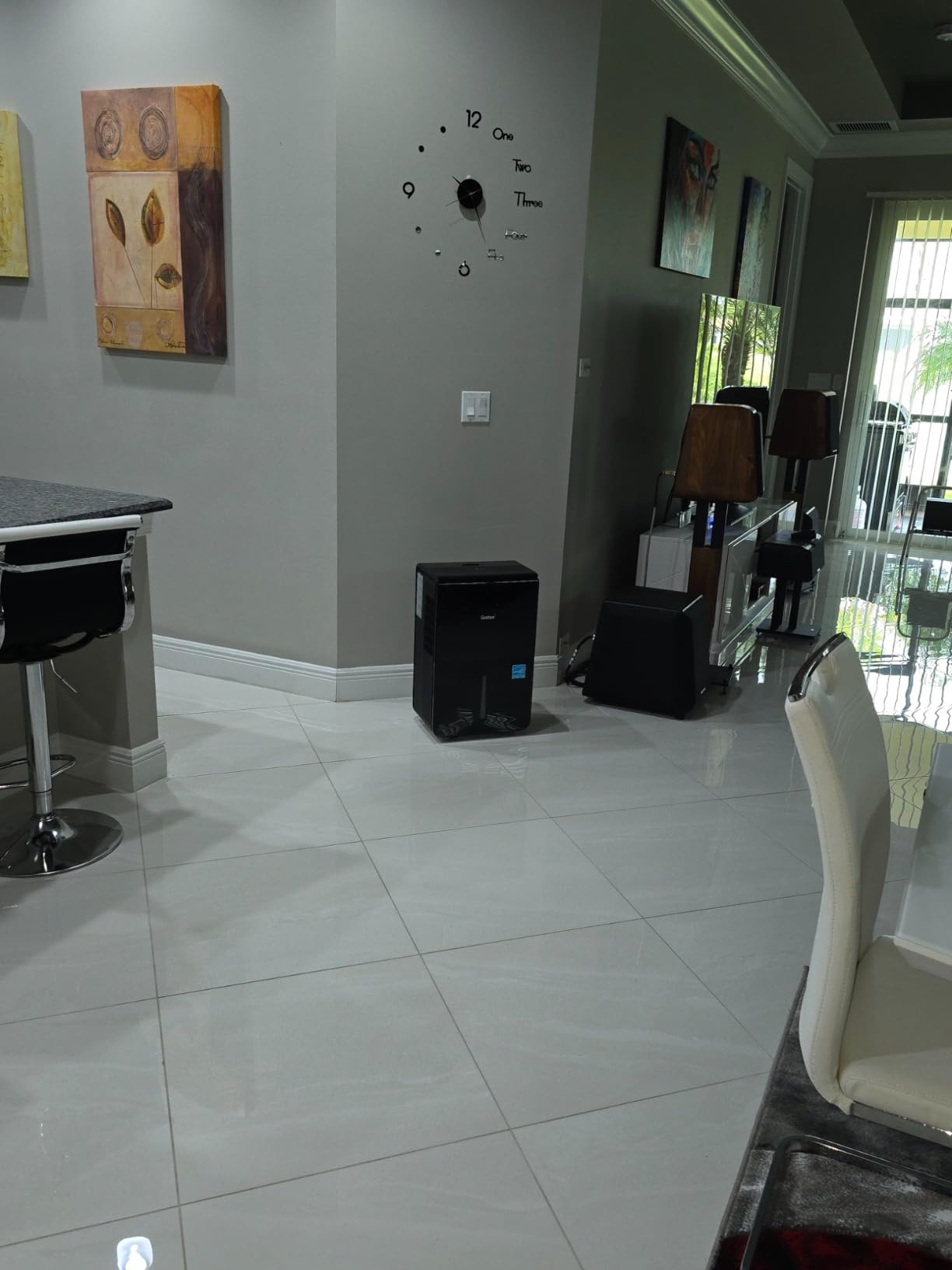
This is the pick for someone who wants the most transparent performance data available and a large machine that can handle 4,500 sq. ft. If you are buying based on verified output rather than a headline number, this is the only listing here that gives you the full curve.
The 45 dB compressor operation rating is respectable for a machine this size, and the 1.72 gallon tank means fewer trips than most 80-pint competitors require.
Where caution is warranted
At 43 pounds it is the heaviest unit in the group, and with a full reservoir you are looking at a genuinely awkward lift. Anyone with back or lifting restrictions should not plan to move this manually, which is exactly the situation a built-in pump exists to solve.
The single listed fan speed is also a limitation, since you cannot trade noise for output as conditions change. And the smaller review base means the durability record is still being written. Long-term reliability data on this model is still building, so treat the two-year support promise as the thing to verify before you commit.
7. VEAGASO 34-Pint – Most Versatile for Damp Rooms and Garages
VEAGASO 34-36 Pint/D, 2500 Sq.Ft Dehumidifier for Basement with Drain Hose
34 to 36 pints/day
2,500 sq. ft.
230 watts
40 dB low
0.53 gal tank
Pros
- Low wattage for the capacity class
- three smart modes including a continuous setting
- 40 dB or less on the low fan speed
- 360-degree swivel casters and a recessed handle
- 2-year warranty
Cons
- 0.53 gallon tank needs emptying several times a day without a hose
- louder at roughly 60 to 65 dBA on the high fan setting
- 2500 sq. ft. rating is optimistic for a wet basement
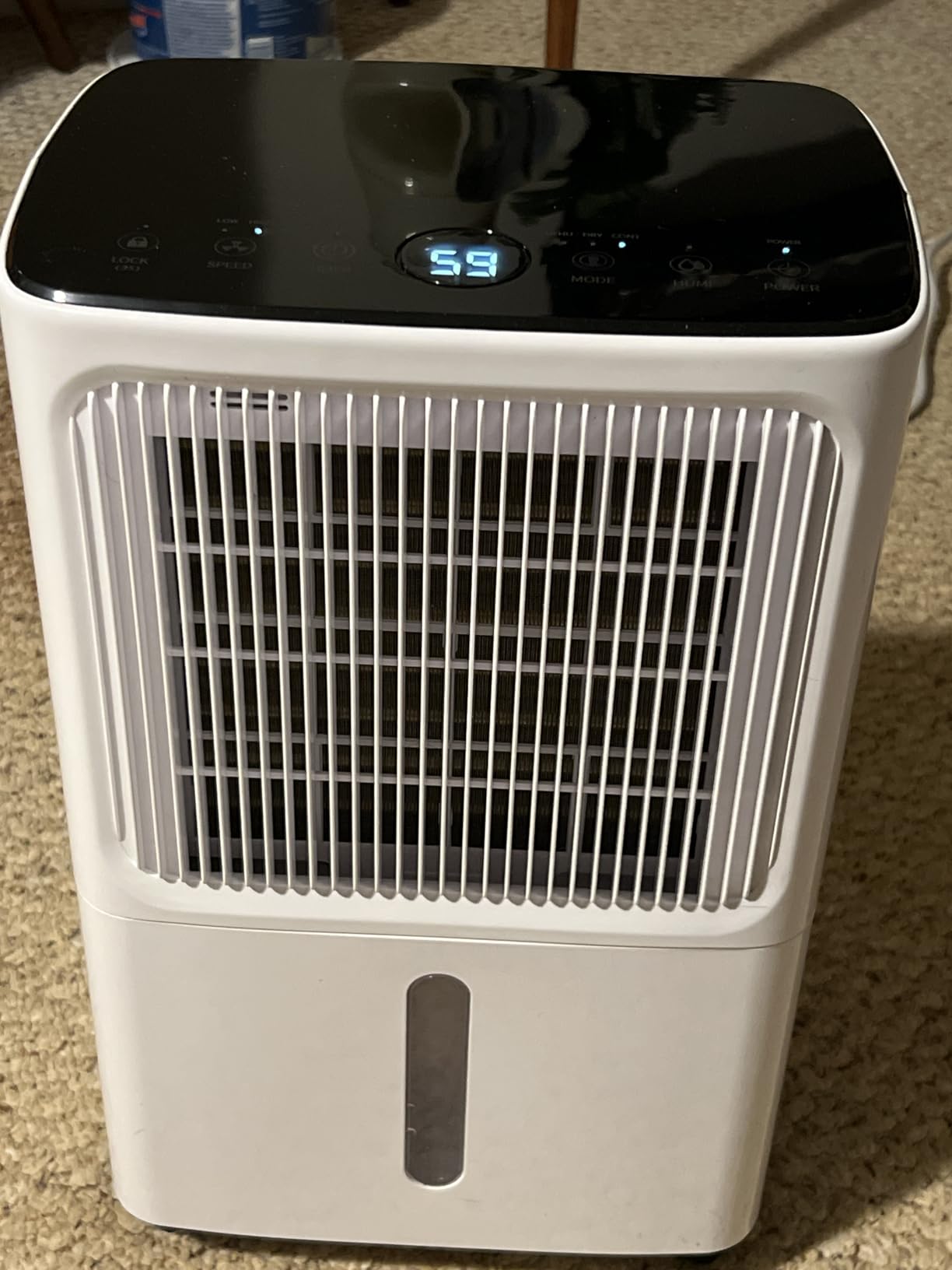
If your damp problem is a garage, a workshop, a closet, or a small storage room under 800 sq. ft., this is the sensible entry-level choice. It pulls 34 pints per day at 95F, draws only 230 watts, and carries a two-year warranty, which is unusual at this price point in the category.
Three modes cover the situations this machine actually suits. DEHU is the normal humidity target, DRY runs the compressor continuously for aggressive drying after a leak, and CONT keeps it running without a humidistat cutout, which is what you want when you are chasing down dampness after rain.
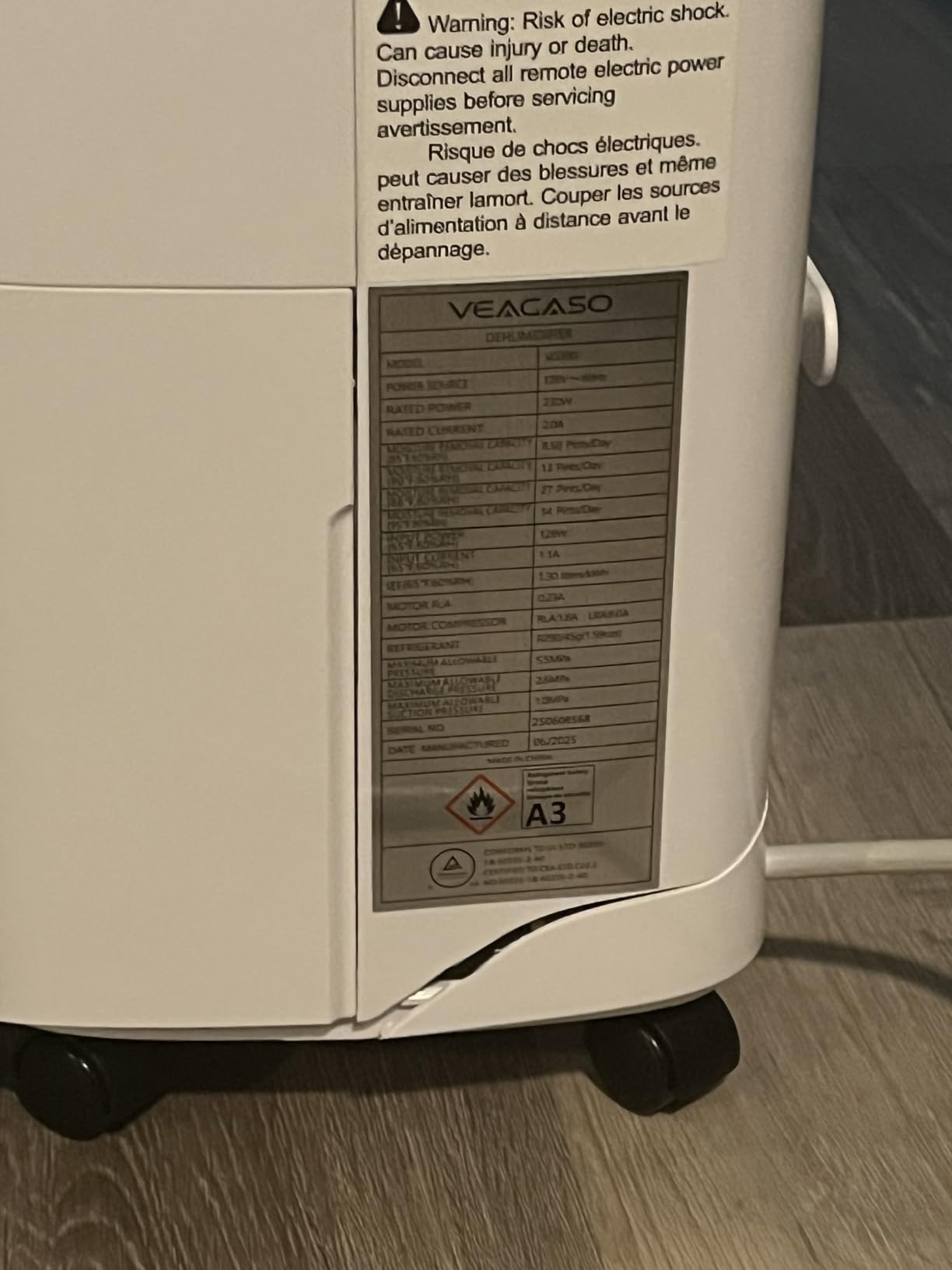
At 40 dB or less on the low fan speed it is quiet enough for a finished room. On high it reaches roughly 60 to 65 dBA, which is noticeable in a quiet space, so plan to leave it on low for storage and high only for drying sessions.
The 0.53 gallon tank is the problem. It is one of the smallest here, and without a hose it needs emptying several times a day in a damp room. Several reviewers specifically advise choosing a larger capacity than you think you need, which is sound advice given the optimistic 2,500 sq. ft. rating on the listing.
Where the VEAGASO 34-Pint makes sense
Owners in small basements, garages, and apartments praise the compact footprint, the quiet low-speed run, and the effective moisture pull for enclosed spaces. The 360-degree swivel casters and recessed handle make it the easiest machine here to move between rooms.
Power failure memory restores your previous settings, which is useful in a garage or outbuilding where power gets switched off at the panel. The LED touchscreen shows a real-time humidity number instead of a row of indicator lights.
When to step up a size
If the space is a true basement rather than a damp room, pick something larger. The 2,500 sq. ft. figure assumes favorable conditions, and reviewers who used it in a genuinely wet space report needing more capacity.
Do not buy it for a crawl space or a room below 60F, either. The spec sheet does not publish a low-temperature output figure, and a small unit that never reaches your setpoint is worse than a larger one that does, because you will keep raising the setting and getting nothing.
8. Waykar 34-Pint – Best for Quiet Rooms
Waykar 34 Pints 2025 Most Efficient Energy Star Dehumidifier for Home & Basement, Ideal for Spaces up to 2,000 Sq. Ft. with Auto or Manual Drainage, 0.62-Gallon Water Tank
34 pints/day
2,000 sq. ft.
190 watts
38 dB minimum
22.1 lb
Pros
- Lightest 34-pint machine here at 22.1 pounds
- lowest power draw at 190 watts
- Energy Star Most Efficient certified
- 38 dB minimum noise
- includes both a drain hose and a 0.62 gallon tank
Cons
- 0.62 gallon tank needs twice-daily emptying without a hose
- included 3.3 ft drain hose is short
- real-world performance weak below about 60F
This is the quietest machine in the group, at 38 dB minimum, and the most efficient, drawing 190 watts while rated at 34 pints per day. For a finished basement rec room, a media room, or a bedroom-level storage space where noise and power draw both matter, those two numbers decide it.
At 22.1 pounds it is also the lightest 34-pint unit here by a wide margin, and with a small 8.39 inch width it fits into tight spots along a wall or between joists where a 31-pound body would not. Waykar’s replacement service comes up repeatedly in reviews as responsive, which matters given the one-year base warranty.
The Energy Star Most Efficient certification is genuine here too, with claimed savings up to 50% against traditional models. Power-off memory, tank-full auto shutoff, and a child lock round out the safety features that make unattended running practical.
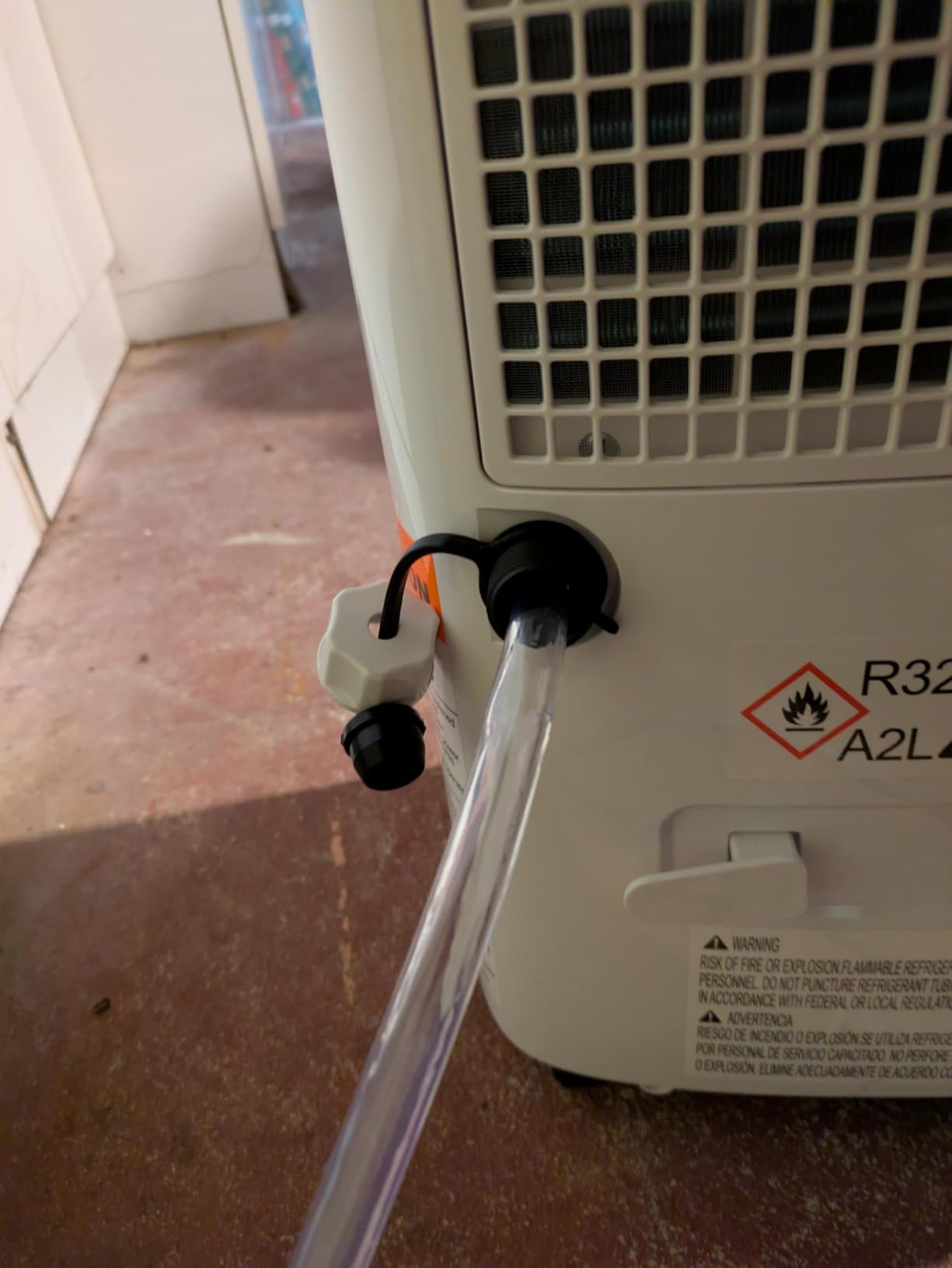
Two limitations show up consistently. The 0.62 gallon tank is the smallest of the 34-pint machines here and needs twice-daily emptying in a damp room, and the included 3.3 ft drain hose is short, with reviewers routinely asking for a longer length. Separately, owners report a gap between the manual’s stated 41F figure and real-world performance, which is effectively weak below about 60F.
Best uses for the Waykar 34-Pint
It fits a small finished basement, a laundry room, or a storage area where you want the machine to disappear acoustically. The 38 dB floor is comparable to a quiet refrigerator, and at low fan speed the compressor cycles in and out rather than running continuously.
The 2,000 sq. ft. rated coverage suits a small space well, and the low 190-watt draw means even 20 hours a day adds little to your monthly power use. It is the easiest machine here to move between two floors when the season changes.
When it is the wrong choice
Cold basements rule it out. A manual claim of 41F does not survive contact with a real unheated crawl space, and the mismatch between the manual and actual performance is a recurring complaint. If your basement drops below 60F, choose a unit with a published low-temperature output.
It is also not a mold remediation machine. At 34 pints per day rated, it is right for ongoing control in a small space rather than for pulling down a wet basement after a flood, where you need sustained output for days.
9. LUKO 30-Pint – Best for Light Duty Damp Spaces
LUKO 2000 Sq. Ft Dehumidifiers for Large Room and Basements, 30 Pints Dehumidifier with Drain Hose, Auto or Manual Drainage, 0.528 Gallon Water Tank, Auto Defrost, Dry Clothes Function, 24H Timer
30 pints/day
2,000 sq. ft.
270 watts
45 dB
4.3 lb
Pros
- Extremely light at 4.3 pounds with 360-degree wheels
- dedicated dry clothes mode
- 45 dB operation with a night sleep mode
- three-color humidity indicator lights
- washable detachable filter
Cons
- 0.528 gallon tank is the smallest here
- lowest rated airflow and extraction among 30-pint models
- lowest average rating in the group at 4.2
The LUKO 30-Pint is the odd one out in this list, and we include it because it solves a real problem that the other nine do not. At 4.3 pounds it is light enough to carry up basement stairs one-handed, which makes it the only realistic option for a basement where the machine must live somewhere you did not plan for it.
For renters, older homeowners, and anyone with a lifting limit, that weight is not a minor spec. The 0.528 gallon reservoir is still the smallest here, but a full lightweight tank is a fraction of the effort involved in lifting a 31-pound unit’s 1.14 gallon reservoir, and at 4.3 pounds you can also move the machine to catch a leak.
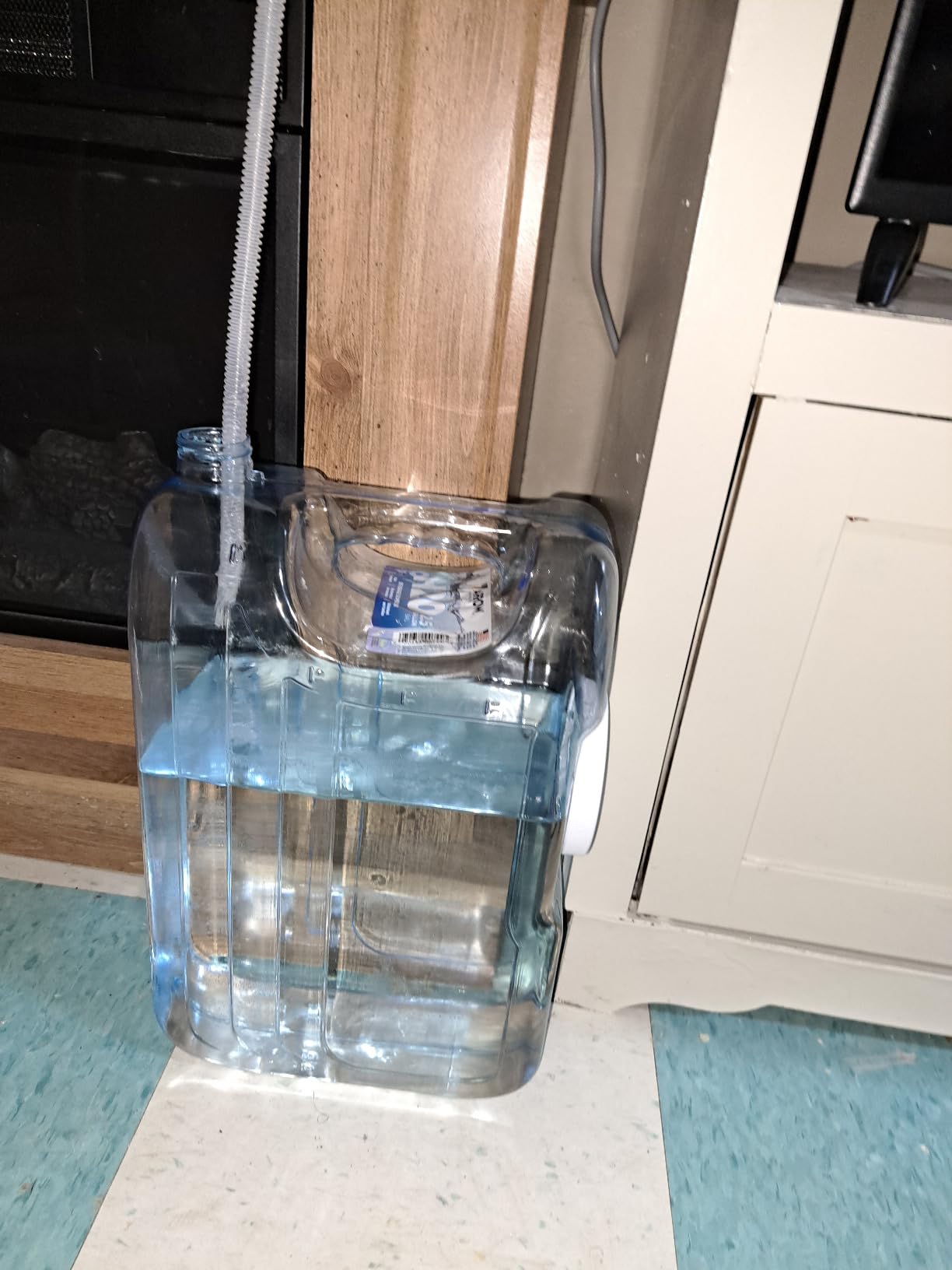
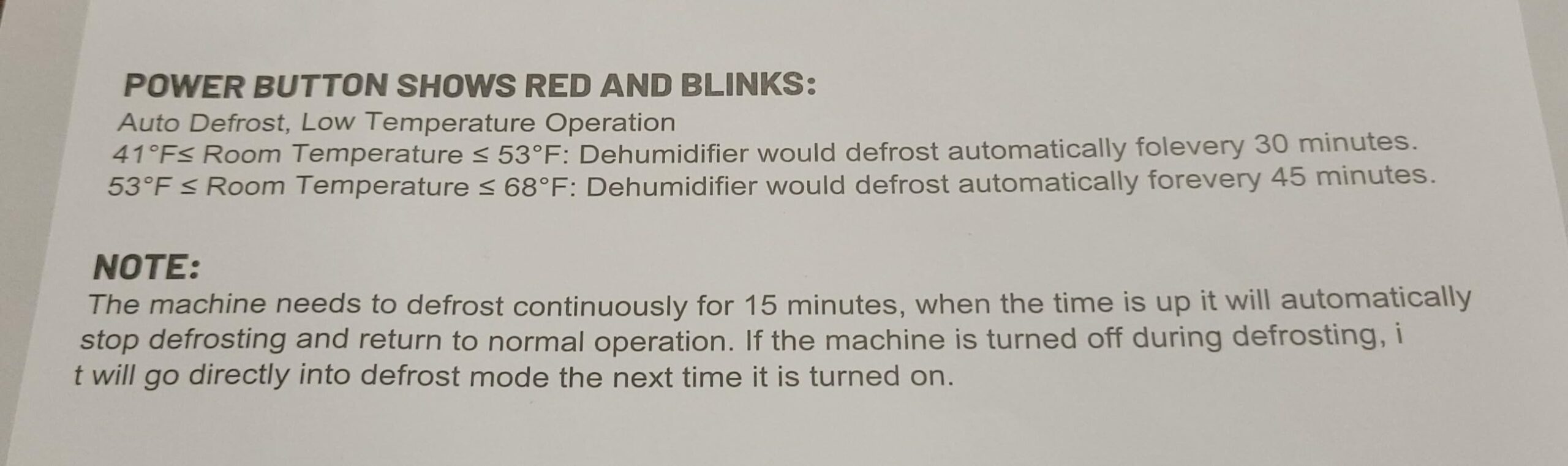
The dry clothes mode is genuinely useful in a basement with no dryer vent, and the three-color humidity indicator lights give you an at-a-glance reading without opening an app. A detachable washable filter and a 24-hour timer round out a sensible feature set for light duty.
Where it falls short is capacity and airflow. The 270-watt draw is high relative to its 30-pint rating, the rated extraction is the lowest among the 30-pint-class machines here, and the 65% five-star share is the lowest in the group. Reviewers treat it as a budget option for small damp rooms, closets, and laundry spaces rather than as a basement solution.
Where the LUKO 30-Pint works
It suits closets, laundry rooms, small crawl spaces above 60F, and finished rooms where you want a light machine you can move between several spaces on a rotating schedule. The 45 dB rating and sleep mode keep it acceptable in an occupied area.
Two fan speeds and the included drain hose let you set it up for continuous drainage in a small space where a floor drain is close by, which removes the tank size problem entirely.
When to buy something bigger
If you are drying a basement that is over 1,000 sq. ft., this will not keep up. Reviewers report buying it for a larger space and realising the machine never reached the setpoint, which is the clearest sign you need more capacity.
At 4.2 stars it also carries the lowest average rating in this roundup, mostly for the same capacity complaints. The light weight is the reason to buy it, and if that is not your reason, one of the 34-pint or 80-pint models will serve you better.
10. avylo 90-Pint With Pump – Best for Basements Without a Floor Drain
avylo Dehumidifier for Basement with Pump and Hose, Max 90 Pints/D, White
90 pints/day
15 ft pump lift
235 watts
41 dB
5-year warranty
Pros
- Built-in pump with 15 ft lift plus a 15 ft drain hose
- Largest tank in the group at 2.11 gallons
- Energy Star Most Efficient with an EER of 2.05 L/kWh
- 41 dB low with sound and light off
- 5-year manufacturer warranty
Cons
- Smallest review base in the group at 339 ratings
- no floor drain pipe included so pumped water needs a destination
- empty the tank once before switching to a drain line
This is the machine to buy when there is no floor drain within reach. A built-in pump lifts water 15 feet and sends it through the included 15 ft hose, so you can discharge upward into a sump, a wall drain, or a laundry sink instead of carrying buckets down a stairwell. That single feature solves the problem forum buyers ask about most often.
The efficiency pairing here is unusual. It delivers 90 pints per day while drawing only 235 watts, among the lowest figures in this group, and it carries Energy Star Most Efficient certification with a stated integrated energy factor of 2.05 L/kWh. For a machine that may run 20 hours a day, that is the number that decides the monthly bill.
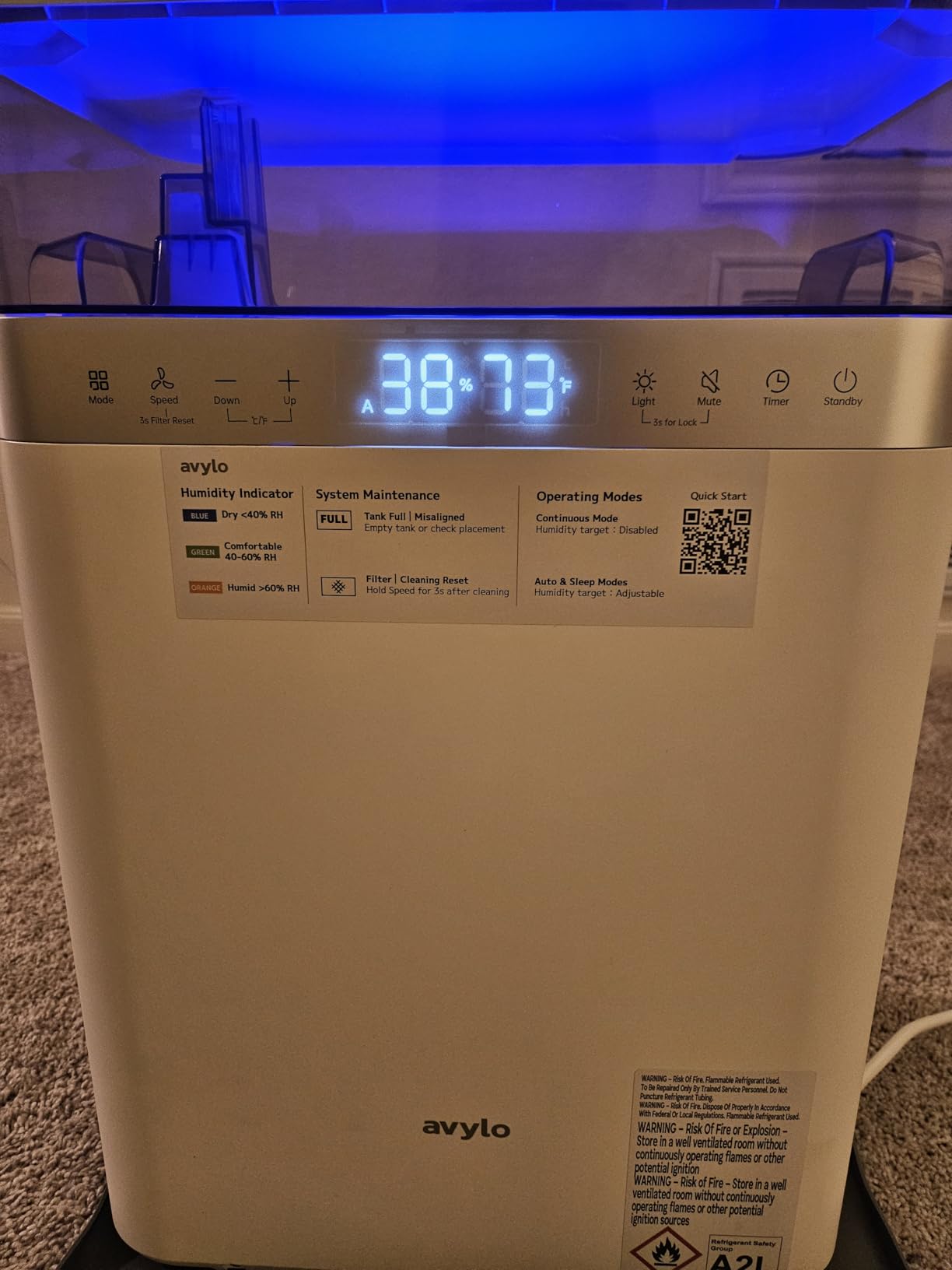
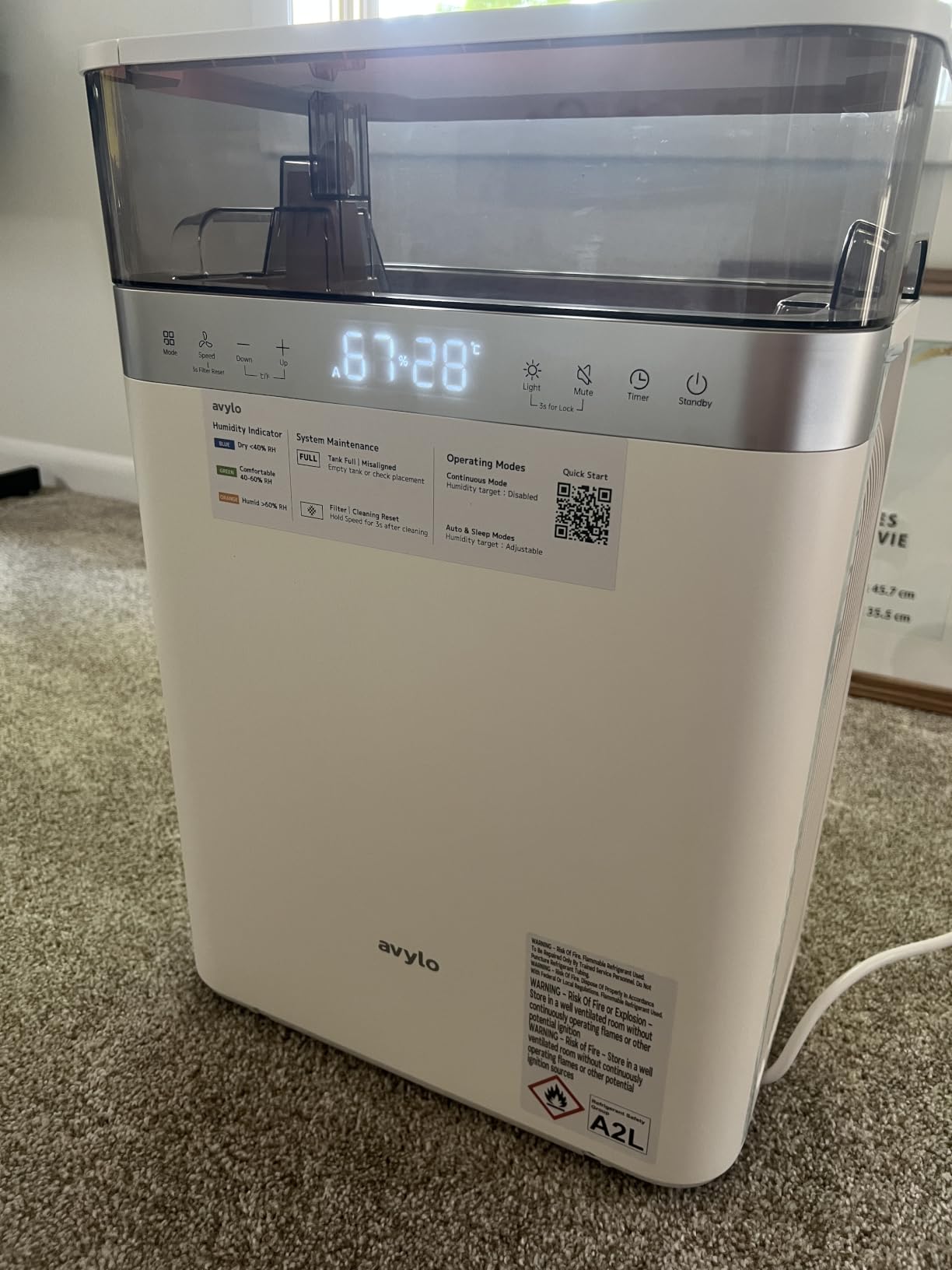
The 2.11 gallon reservoir is the largest here, and it mounts on top with a full-tank reminder, so you can see the level without crouching. Low noise of 41 dB runs with the display and light switched off entirely, which is useful in a finished room. The 5-year manufacturer warranty is the longest in this roundup, and in a category where forum users report repeat failures after about a year, that is a meaningful signal.
The honest caveats are about the setup and the track record. There are only 339 ratings, so long-term data is limited and the warranty promise carries more weight in the decision. The floor drain pipe is not included, so you need a destination for the pumped water, and the tank should be emptied once before you switch to a drain line to avoid an overflow on the first cycle.
Who should buy the avylo 90-Pint
It suits a basement where the nearest drain is above the machine’s outlet, or far enough away that a gravity hose will not reach. The 15 ft lift handles most finished-basement and crawl-space configurations without adding a separate condensate pump.
Reviewers rate the pump drainage setup highly for below-grade drains, and the 80% five-star share is among the strongest here. The long warranty and the efficiency figures are what justify buying a newer listing over a better-reviewed older one.
When to look elsewhere
If you have a floor drain within 15 feet and below the outlet, a gravity-drained machine runs at lower cost and has one fewer failure point. Internal pumps do fail, and a unit in an unattended location with a failed pump is a problem you will find out about too late.
It is also a heavy machine at 38.6 pounds with a 2.11 gallon tank on top, so plan its position before delivery. And if you want a long, well-documented reliability record, the 339-rating base is thin compared with the 22,000-plus reviews behind the Waykar 80.
Basement Size to Pint Capacity: A Sizing Guide
No competitor publishes this table, which is why we did. Match your basement square footage band and condition to a capacity range.
Under 500 sq. ft., mild dampness: A 20 to 30 pint unit will hold 55% to 60% RH in a storage closet or half-finished corner. Anything larger wastes energy.
500 to 1,000 sq. ft., typical dampness: A 34 pint unit is the minimum. Aim for 50% to 60% RH and choose a larger tank if you cannot run a hose.
1,000 to 1,500 sq. ft., standard basement: A 50-pint compressor class machine, or the 80-pint models in this roundup, handles this comfortably. This is the most common band.
1,500 to 2,500 sq. ft., or any finished basement below grade: An 80-pint machine is the right starting point. Add a second smaller unit for a separate finished room rather than one oversized machine.
Above 2,500 sq. ft., or active seepage: An 80 to 115 pint machine, or a 150-pint unit if the problem is severe. Below-grade and multi-level homes frequently need one machine per floor.
Post-flood mold remediation: Double the band above and run the machine in continuous mode. Space is not the constraint during remediation, extraction rate is.
Set your target to 50% to 55% relative humidity, not 35%. Relative humidity below about 40% pulls moisture out of wood framing, drywall paper, and hardwood floors, which causes its own damage. Buy a cheap hygrometer and check what the basement reads before and after a few days of running.
Rated Capacity vs Real Basement Performance
Headline capacity is measured at 95F and 90% relative humidity. A damp basement in summer is closer to 80F to 86F and 60% to 80% RH, and at those conditions output falls substantially. Expect roughly 60% to 70% of the headline number in a typical basement.
Two units here publish the honest curve. The AEOCKY rates 80 pints per day at 95F and 56 pints per day at 86F and 80% RH, which is a 30% drop. The Gasbye publishes 115 pints per day at 86F and 80% RH, 73 pints at 80F and 60% RH, and 50 pints at 65F and 60% RH, which is the most useful single set of figures we found.
This matters most for two decisions. First, if you are choosing between an 80-pint unit and a 50-pint unit, the real difference in a 78F basement is closer to 35 versus 50 pints per day than 50 versus 80. Second, cold basements lose the most capacity, so the low-temperature figure matters more than the headline number if your space is unheated.
Drainage Setups: Gravity Hose, Floor Drain, or Built-in Pump
Setting up passive drainage into a floor drain, sink, or sump is the most repeated piece of advice across every basement dehumidifier forum thread we read, and it is correct. It removes the tank size question entirely.
Gravity drain hose: The simplest and most reliable option. The machine outlet must sit higher than the drain, and the hose needs a continuous fall from end to end. Included hoses run about 3.3 ft, which is rarely enough. Buy 15 to 25 ft of reinforced hose.
Floor drain: Ideal if one exists within reach. Route the hose directly into it, secure the machine so it cannot be bumped, and check the connection monthly, because a disconnected fitting is the most common cause of water on a basement floor.
Built-in condensate pump: Needed when the drain is above the outlet or far away. The avylo and the Yaufey both include pumps with long hoses. Note that an internal pump is a wear item, and a machine pumping into an unattended location needs a secondary safety path.
External condensate pump: A separate pump on a wider drain hose is the repairable option, since you can replace the pump for a fraction of the cost of a new machine. This is the arrangement commercial-grade units rely on.
Routinely, most full reservoirs in this roundup weigh between 20 and 40 pounds once you add the machine’s own weight. For older homeowners or anyone with a lifting limit, continuous drainage is not a convenience, it is an accessibility requirement.
What a Basement Dehumidifier Costs to Run Each Month
Running cost is straightforward arithmetic, and no competitor in this space does it. Take the wattage, multiply by hours per day and 30, divide by 1,000 for kilowatt-hours, then multiply by your local rate.
A Waykar 80-Pint drawing 270 watts for 20 hours a day uses about 162 kWh in a month. An AEOCKY 80-Pint at 280 watts over the same schedule uses about 168 kWh. The avylo 90-Pint at 235 watts draws among the lowest power here for that output class, at roughly 141 kWh for 20 hours a day, which is the clearest efficiency story in the roundup.
The Gasbye and Yaufey both draw 500 watts, so at 20 hours a day they use around 300 kWh a month. That is real money in a space that runs continuously from May through September, and it is the argument for buying a slightly smaller, more efficient machine that still meets your square footage band rather than the biggest one available.
Set the setpoint to 50% to 55% and let the humidistat cycle the compressor. Running the machine in continuous mode when the space is already dry wastes electricity and wears the compressor for no moisture removal.
Fix the Moisture Source Before You Buy
Owners who fixed the source, through grading, a sump pump, vapor barrier work, or proper condensate discharge, report better results than owners who bought a bigger machine and left the leak in place. No dehumidifier can keep up with active water intrusion, and the compressor runs continuously trying.
Grade the soil away from the foundation. Six inches of slope over the first ten feet is the standard, and it costs far less than any machine.
Check gutters and downspouts. A downspout dumping at the foundation sends more water toward your basement walls than most people realize.
Inspect the vapor barrier. Poly sheeting or rigid foam on the foundation walls limits the moisture the soil is pushing into the space.
Install or repair a sump pump. A sump handles groundwater at the floor, which is a different problem from air humidity and outside a dehumidifier’s scope.
Seal air leaks. Ducts, rim joists, and plumbing penetrations bring humid outside air in. Tightening them reduces the load on the machine.
Run the clothes dryer and bathroom exhaust outside. Interior ducts add moisture to the basement every time they run.
Reliability, Warranties, and What to Avoid
Reliability complaints are the loudest signal in basement dehumidifier forums, ahead of any spec debate. Owners on r/BuyItForLife report being on their third machine in three years, with Midea, Honeywell, and Hisense each lasting about a year. That is a category problem, not a brand problem, and it is why warranty length deserves weight in the decision.
The warranty range here runs from a single year on several listings to five years on the avylo. The Midea carries one limited year, Waykar gives one year plus one on registration, Kesnos extends to three years with registration, AEOCKY lists three-year coverage, and Gasbye provides two years of U.S. support with replacement units. Longer terms usually signal that replacement parts will still be available, which matters more than the paperwork.
Ignore Peltier and thermoelectric units for basements. Forum consensus and lab testing agree they cannot pull a damp basement below roughly 60% RH, so they will run constantly while removing almost nothing. Every machine in this roundup is a compressor-based condensing unit.
Two failure patterns to know. Internal condensate pumps fail, and the machine becomes useless in an unattended location until someone notices the tank overflowing. And coils ice over below 60F on units without effective defrost, so a cold basement needs either a unit with a published low-temperature output or a heat source in the space.
When One Dehumidifier Is Not Enough
Four signs point to an undersized machine rather than a bad one. The bucket fills faster than you can empty it. The humidity reading climbs back above 70% within hours of switching it off. The compressor runs nonstop without ever reaching the setpoint. Water stains or musty odor return within a month of cleaning.
When you see those symptoms, you have three options. Add a second unit, which is often the cheapest and most reliable, and remember that airflow is local, so two smaller machines spread through a space beat one large machine in a corner. Upgrade capacity, if the space is large or the moisture load is heavy. Or address the source, if water is actively entering, because no capacity solves active intrusion.
Also check the basics before buying more hardware. A clogged filter, a kinked drain hose, or a unit set against a cold wall will all reduce output, and each takes a few minutes to rule out.
Basement Dehumidifier Buying Guide
Start by measuring the square footage and the relative humidity with a hygrometer, and hold the reading for a day, since a single reading after a rainstorm is not representative. Then decide on drainage, because that choice constrains everything else: a gravity hose needs a drain below the outlet, and upward drainage needs a pump.
Next, pick capacity from the sizing table above and bias toward the upper end of your band if you plan to store paper, clothing, or electronics. Set aside roughly 200 watts per 50 pints of rated capacity as your continuous power draw, and check that figure against your utility rate before you commit.
Then check the certification tier, where Energy Star Most Efficient is a real signal because it applies to only a small share of certified models. Verify low-temperature performance if your basement is unheated, and treat any claimed figure without a published test condition as marketing.
Finally, think about the machine you will live with. A quiet unit matters in a finished space, a light unit matters if you will move it, and a long warranty matters most of all. Plan for maintenance: clean the filter every one to three months in dusty basements, check the drain connection monthly, and keep the intake clear of stored boxes.
Frequently Asked Questions
What are the best basement dehumidifiers?
The Waykar 80-Pint is the best overall pick for most basements, covering up to 5,000 sq. ft. at 42 dB. The AEOCKY 80-Pint is best for unheated or cold basements because it operates down to 65F and publishes a real output of 56 pints per day at 86F and 80% RH. For basements with no floor drain, the avylo 90-Pint has a built-in pump with a 15 ft lift.
How do I choose a dehumidifier for my basement?
Measure the square footage and the relative humidity with a hygrometer, then decide on drainage before capacity. A gravity hose works if you have a floor drain below the machine outlet. A built-in pump is needed if the drain sits higher or far away. Choose capacity from your square footage band, biasing upward for stored paper or clothing, then check the Energy Star tier and the warranty length.
Is a 50 pint dehumidifier enough for basement?
A 50-pint compressor unit handles a basement of roughly 1,000 to 1,500 sq. ft. with moderate dampness. Real output in a typical basement is closer to 30 to 35 pints per day, because headline ratings are measured at 95F and 90% RH. For a space above 1,500 sq. ft., below grade, or with active seepage, choose an 80-pint machine or larger.
What is the best 50-pint dehumidifier with a pump for a basement?
Among compressor units with a built-in pump, the avylo 90-Pint is the strongest option, lifting water 15 ft with a 15 ft included hose and running at only 235 watts. The Yaufey 150-Pint is the higher-capacity alternative, with three drainage options, a 16.4 ft pump hose, and a 1.85 gallon tank for very large or very wet basements.
How fast should a 50 pint dehumidifier fill up?
In a moderately damp basement, a 50-pint unit may fill a 1 gallon reservoir every two to four hours during the first days of operation, and less often once the air is under control. Filling overnight in a wet basement is normal. A bucket that fills and never stabilises usually means active water intrusion rather than a capacity problem.
How long should a dehumidifier run in a crawl space?
Run it continuously rather than on a timer. Crawl spaces need steady humidity control below about 60% RH to prevent mold and rot, so set the humidistat to the target and let it cycle. Choose a unit with auto-defrost and a published low-temperature output figure, because crawl spaces often sit well below 60F and standard coils ice over there.
Final Verdict: The Best Dehumidifiers for Basements in 2026
The Waykar 80-Pint is the pick for most people, with the capacity, review history, and 42 dB noise floor to handle a typical 1,000 to 3,000 sq. ft. basement without drama. Cold, unheated spaces should go to the AEOCKY 80-Pint, which is the only unit here that publishes output at actual basement conditions and keeps extracting water down to 65F.
Two other situations have clear answers. Where drainage has to go upward or reach a distant drain, the avylo 90-Pint pumps 15 ft and runs on 235 watts with a five-year warranty. Where space is tight and smart monitoring matters, the Midea 22-Pint is the only pick you can read from your phone.
Whichever you choose, set up continuous drainage on day one, aim for 50% to 55% relative humidity, and fix the water source before you spend a cent on hardware. This roundup was reviewed and updated for 2026, and the picks are updated as specifications and review counts change.