
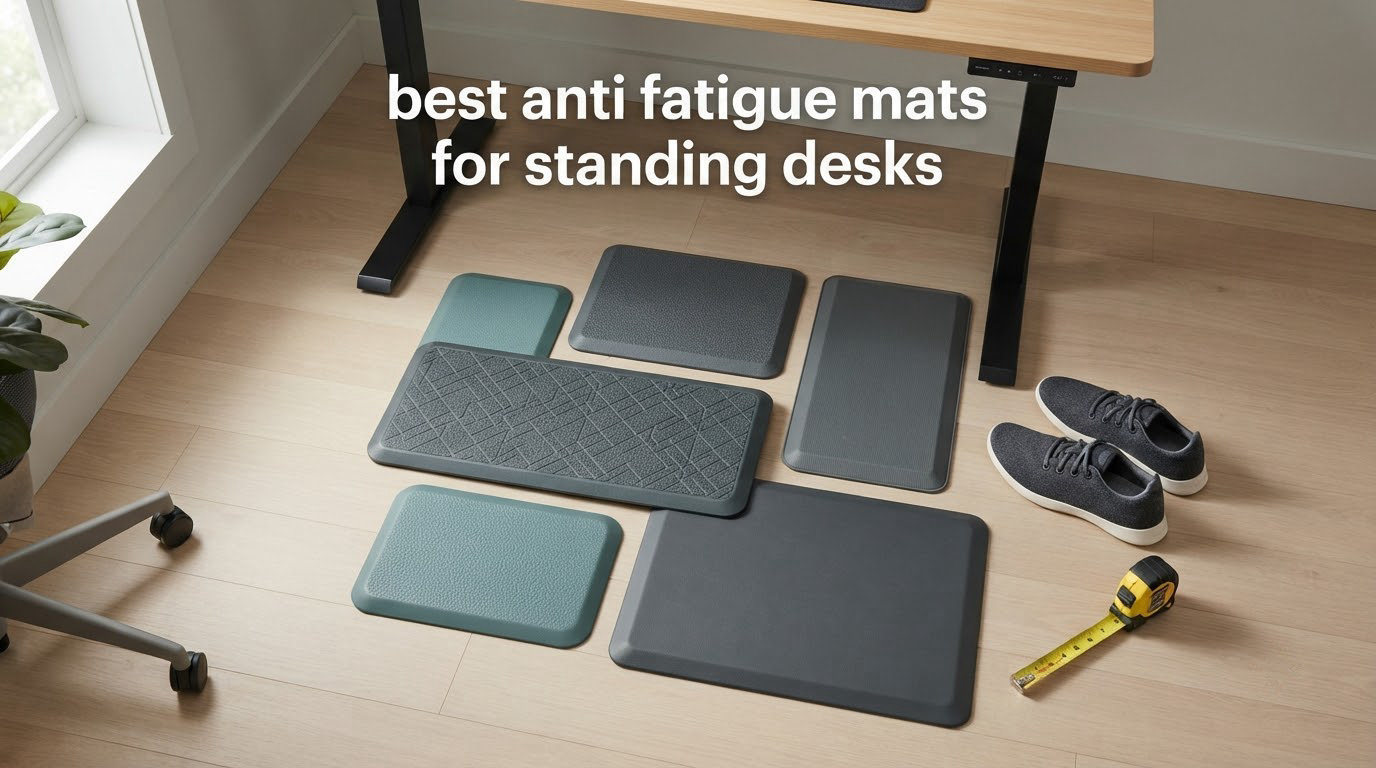
Standing at a desk sounds gentle until hour five. The ache usually shows up in the heels first, then the arches, then the lower back, and by the end of the day you have the sore feet and stiff calves that make sitting down feel like relief. Most people running a sit-stand desk in 2026 cycle between positions every thirty to forty-five minutes, and the standing half is where the damage accumulates.
The fix that works best is a properly specified floor mat, and picking the best anti fatigue mats for standing desks comes down to a handful of hard numbers: how thick the foam is, what it is made of, how much surface area you have to work with, and how much the thing weighs when you shove it aside ten times a day. We compared ten of the strongest options currently on the market across exactly those criteria, plus the ergonomics, the cleaning and the floor compatibility.
One note before we get into the picks. The category is crowded with cheap foam slabs that all look identical in a listing photo, and the gap between a well-made polyurethane mat and a thin PVC one shows up in month eight, not month one. Every product below lists its specifications from the manufacturer, and where reviewers report a specific failure we have named it rather than skipping it.
Quick picks first, so you can jump:
Best overall: the ComfiLife Anti-Fatigue Floor Mat, 3/4 inch high-density memory foam, beveled edges, non-slip base, the highest rated mat in this roundup.
Best value: the Amazon Basics Anti-Fatigue Standing Mat, 0.6 inch foam at 2.6 pounds, easy to drag aside when you sit.
Best for standing all day: the FEATOL Anti Fatigue Mat, 0.9 inch extra-thick high-density foam with a puncture-resistant PU leather top.
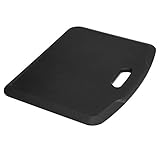
Best traditional flat mat: the Mount-It Anti Fatigue Floor Mat, firm rubberized gel foam that resists bottoming out over long sessions.
Best for contoured terrain: the Ergodriven Topo, 2.7 inches of PVC-free polyurethane shaped into calculated 3D terrain.
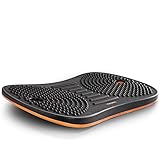
Best for fidgeters: the FEZIBO Balance Board, an 8.5-degree wobble board rated to 320 pounds.
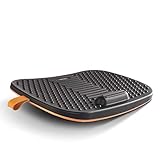
Best for foot relief: the FEZIBO Standing Desk Mat with Anti Fatigue Bar, a rocking board with a built-in foot bar.
Best for long counter runs: the Ophanie Anti Fatigue Mat, 20 by 48 inches of CP65 and GRS certified recycled PU foam.
Best for small spaces: the ergohead Portable Anti Fatigue Mat, 17 by 22 inches at 1.9 pounds with a built-in handle, the lightest mat here.
Best for garage and laundry: the Tyrot Extra Thick Anti Fatigue Mat, waterproof 0.9 inch foam that wipes clean.
We earn a commission when you buy through our links, at no additional cost to you. That never changes which products make this list.
Table of Contents
Top 3 Picks for the Best Anti Fatigue Mats for Standing Desks (October 2026)
ComfiLife Anti-Fatigue Floor Mat
- 3/4 inch high-density memory foam
- Beveled trip-free edges
- Non-slip stain-resistant base
Amazon Basics Anti-Fatigue Standing Mat
- 2.6 pounds easy to reposition
- Non-curling edges
- Textured stain-resistant foam
FEATOL Extra Thick Anti Fatigue Mat
- 0.9 inch high-density foam
- PU leather puncture-resistant top
- Low-angle beveled edges
All 10 Anti-Fatigue Standing Desk Mats at a Glance
Here is the whole shortlist in one place, with the specs that decide whether each mat fits your floor, your stance and your sit-stand schedule.
| Product | Specs | Action |
|---|---|---|
| ComfiLife Anti-Fatigue Floor Mat 20 x 32 |
|
Check Latest Price |
| Amazon Basics Anti-Fatigue Standing Mat 20 x 36 |
|
Check Latest Price |
| FEATOL Anti Fatigue Mat 20 x 32 |
|
Check Latest Price |
 Ergodriven Topo Standing Desk Mat Ergodriven Topo Standing Desk Mat |
|
Check Latest Price |
 FEZIBO Balance Board FEZIBO Balance Board |
|
Check Latest Price |
 FEZIBO Anti Fatigue Bar Standing Mat FEZIBO Anti Fatigue Bar Standing Mat |
|
Check Latest Price |
 Ophanie Anti Fatigue Cushioned Mat 20 x 48 Ophanie Anti Fatigue Cushioned Mat 20 x 48 |
|
Check Latest Price |
 ergohead Portable Anti Fatigue Mat 17 x 22 ergohead Portable Anti Fatigue Mat 17 x 22 |
|
Check Latest Price |
 Mount-It Anti Fatigue Floor Mat 18 x 22 Mount-It Anti Fatigue Floor Mat 18 x 22 |
|
Check Latest Price |
 Tyrot Extra Thick Anti Fatigue Mat 20 x 32 Tyrot Extra Thick Anti Fatigue Mat 20 x 32 |
|
Check Latest Price |
1. ComfiLife Anti-Fatigue Floor Mat – the Best Overall Standing Desk Mat
ComfiLife Anti Fatigue Floor Mat – 3/4 Inch Thick Kitchen Mats for Floor, Standing Desk Mat, Kitchen Rug – Comfort at Home, Office – Durable – Stain Resistant – Non-Slip Bottom (20″ x 32″, Black)
Type: flat foam mat
Material: memory foam, foam, rubber
Size: 20 x 32 inch
Thickness: 0.75 inch
Pros
- 3/4 inch high-density memory foam with lasting rebound
- Beveled edges taper to the floor with no trip lip
- Non-slip bottom holds position
- Arrives flat rather than rolled
- Wipes clean with a damp cloth
Cons
- Heavier than smaller mats when you move it daily
- Darker colorways show marks and stains
- Memory foam core can lose some rebound after several years
If you want one mat and you are not going to spend a week researching it, this is the one. It is a flat 20 by 32 inch rectangle of 3/4 inch high-density memory foam with a beveled edge all the way around, and it is the highest rated product in our set at 4.8 stars across 41937 reviews. That review volume matters as much as the star number: a long rating history reflects thousands of separate setups rather than one launch week.
The mechanism is the same one that makes any anti-fatigue mat work. Cushioning absorbs the heel and forefoot pressure that accumulates on a hard floor, and a slightly yielding surface keeps your calf and leg muscles firing tiny continuous contractions instead of holding static. The 3/4 inch depth is the sweet spot we keep coming back to: thick enough to take the edge off hard tile, thin enough that you still feel the floor and can move the mat with one foot.
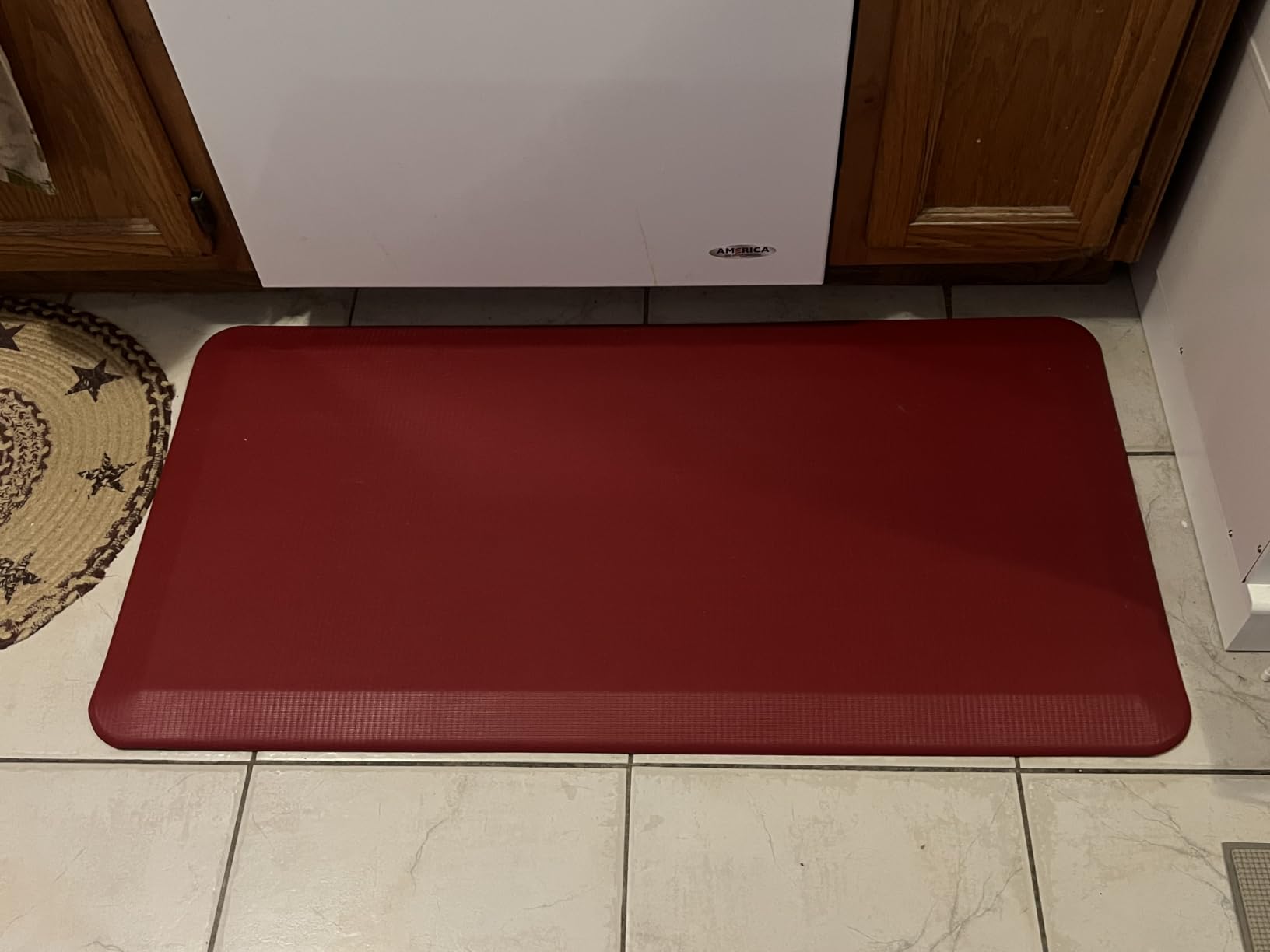
Fit and finishing details are where this one earns its place. The edges taper to the floor, so stepping on and off does not involve climbing a step, and the non-slip base means you can shift your weight without the mat creeping across hardwood. Care is a damp cloth, and the manufacturer lists it as BPA-free, latex-free, lead-free and phthalate-free, which matters if you are barefoot all day.
The honest limitation is weight. This is a full 20 by 32 inch mat, so on a sit-stand desk where you tuck the mat under the frame every cycle it becomes a chore rather than a gesture. Reviewers also note that dark colorways, brown in particular, show stains quickly, and that after several years of daily use the memory foam loses a little rebound. Neither is a dealbreaker at this thickness and this rating.
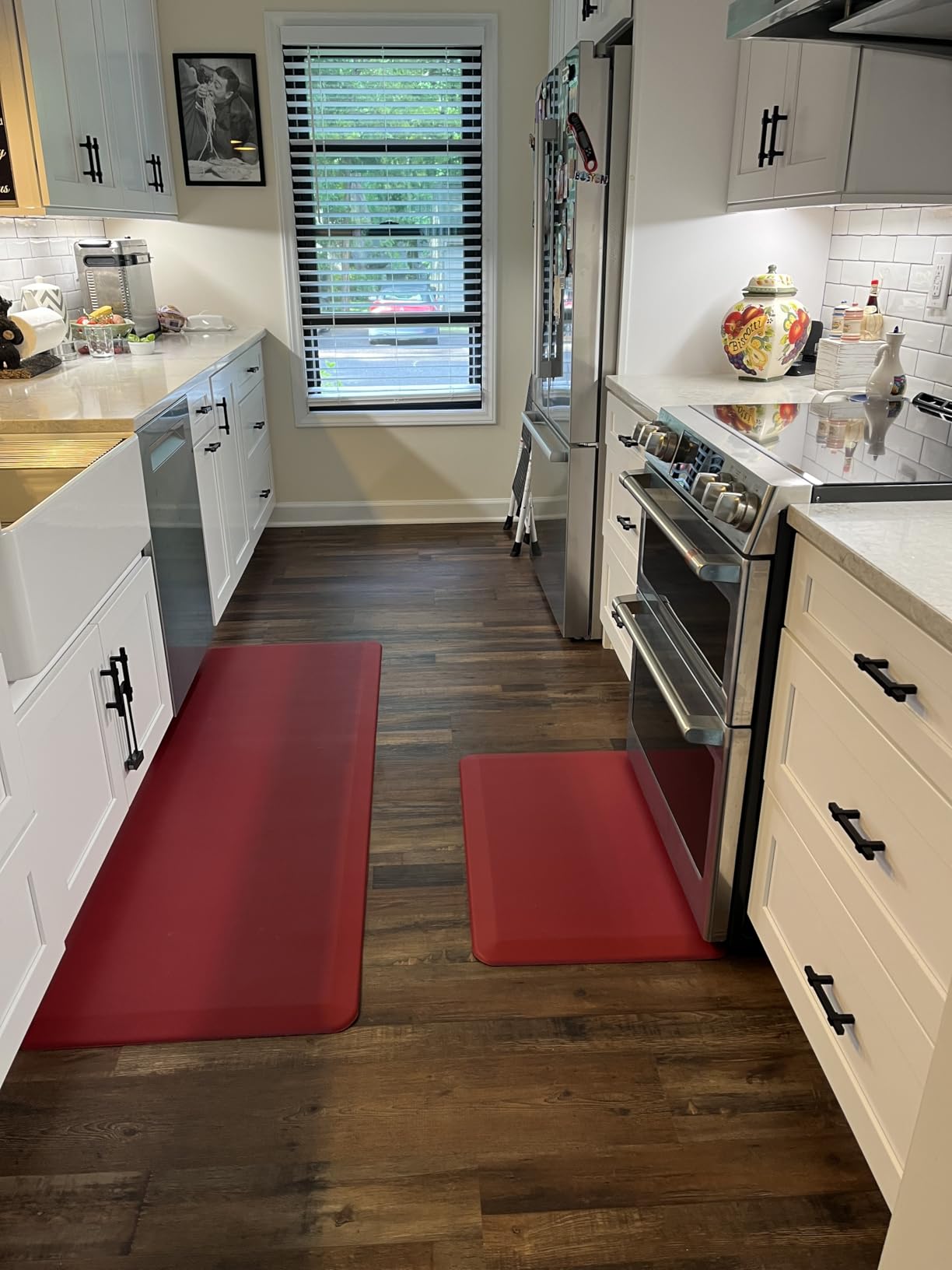
How the ComfiLife holds up over a workday
At a sit-stand desk set to a 45-minute standing interval, the mat gets stepped on roughly eight times a day. That is where the beveled edge earns its keep, because there is no hard lip to catch a socked heel mid-transition. If you stand barefoot, the surface is cool and slightly grippy without being abrasive, and if you wear shoes the foam still absorbs the impact rather than passing it straight up into your knees.
It is also the safest choice for shared spaces and mixed flooring. The backing grips well on hardwood, tile and vinyl, and reviewers running it in kitchens and workbenches report that spills wipe off without soaking in.
Who should skip the ComfiLife mat
Skip it if your standing zone is smaller than 20 by 32 inches, because you will be standing with one foot off the edge, which defeats the point. It is also the wrong pick for anyone who needs to roll a task chair over the standing area constantly; a thick foam mat plus a chair caster is a bad combination. If your priority is feeling the terrain actively move you, go with the contoured option further down instead.
2. Amazon Basics Anti-Fatigue Standing Mat – the Best Value Pick You Can Move One-Handed
Amazon Basics Anti-Fatigue Standing Mat, Non-Slip, Cushioned Comfort Mat for Home, Office and Kitchen, 20″ x 36″ x 0.6″, Black, 1-Pack
Type: flat foam mat
Material: foam
Size: 20 x 36 inch
Thickness: 0.6 inch
Weight: 2.6 lb
Pros
- Only 2.6 pounds so it slides under a desk easily
- Non-curling edges stay flat
- Stain and abrasion resistant surface
- Cleans with soap and water
- 36 inch length fits a desk front
Cons
- 0.6 inch is thinner than most picks here
- Manufacturer advises stopping use if edges curl
- Water under the mat creates a slipping hazard
This is the mat for people whose standing zone doubles as their sitting zone. At 2.6 pounds it is the easiest one here to kick aside or shove under the desk frame every time you drop back into the chair, which matters when you cycle eight times a day. Reviewers repeatedly describe exactly that routine as the reason the mat works for them.
The cushioning is textured foam at 0.6 inch, which is thinner than the rest of this list. That thinner profile is the trade for the low weight: you feel more of the floor, and over a very long session the difference in pressure absorption shows. For two to four hours of standing it is genuinely comfortable, and for an eight-hour standing role you would want more foam underneath you.
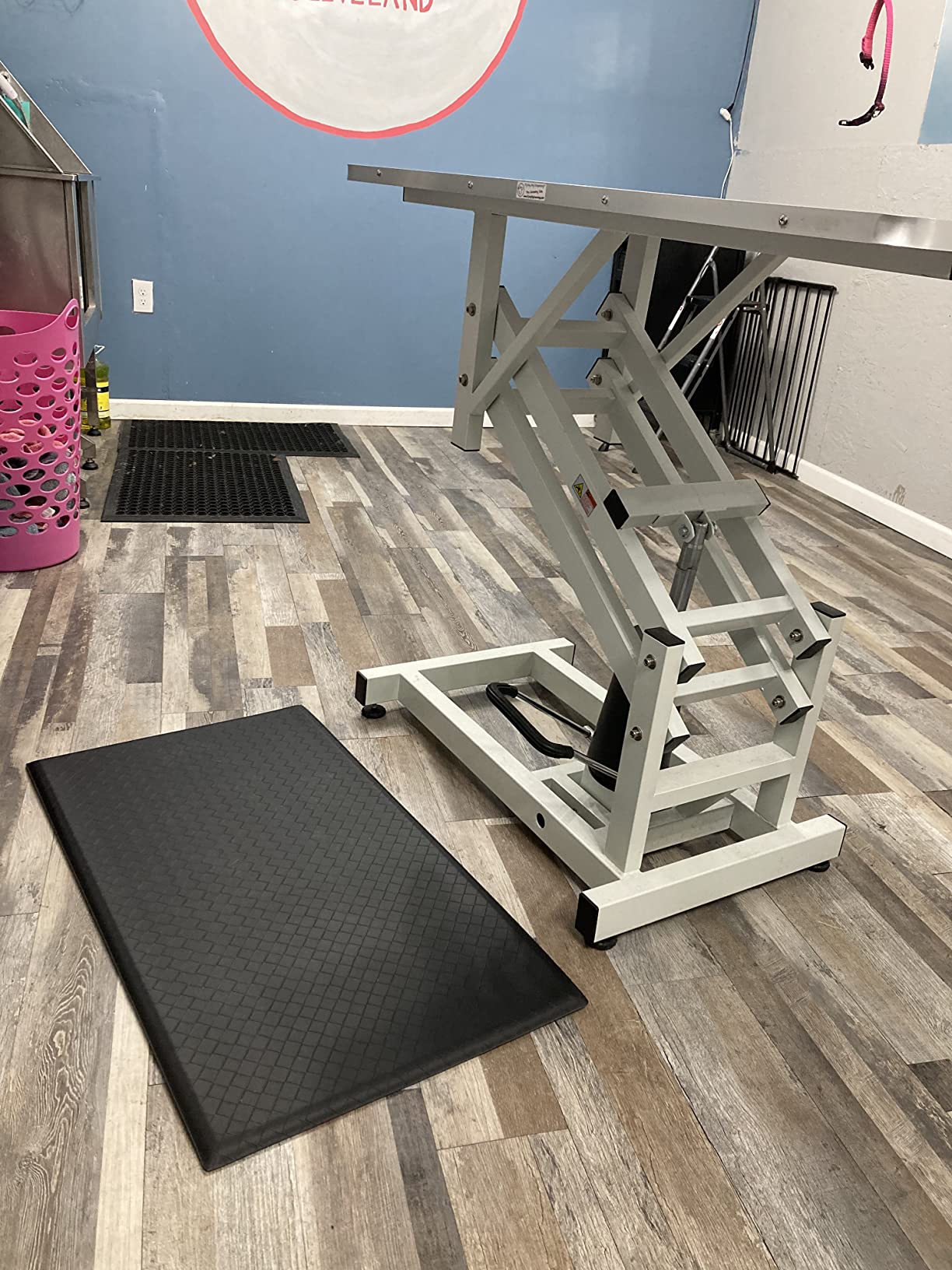
Two manufacturing notes worth knowing. The edges are designed not to curl, which is the single biggest durability failure in foam mats, and the listing explicitly says to stop using the mat if edges do begin to curl rather than fighting it. Reviewers also flag that water tracked under the mat turns it into a slipping hazard, so wipe the top and dry the floor underneath, not just the surface.
It holds a 4.5 average across 9285 reviews, which is a solid, well-established record rather than a launch spike. If you want something dependable, light and unremarkable, this is the pick.
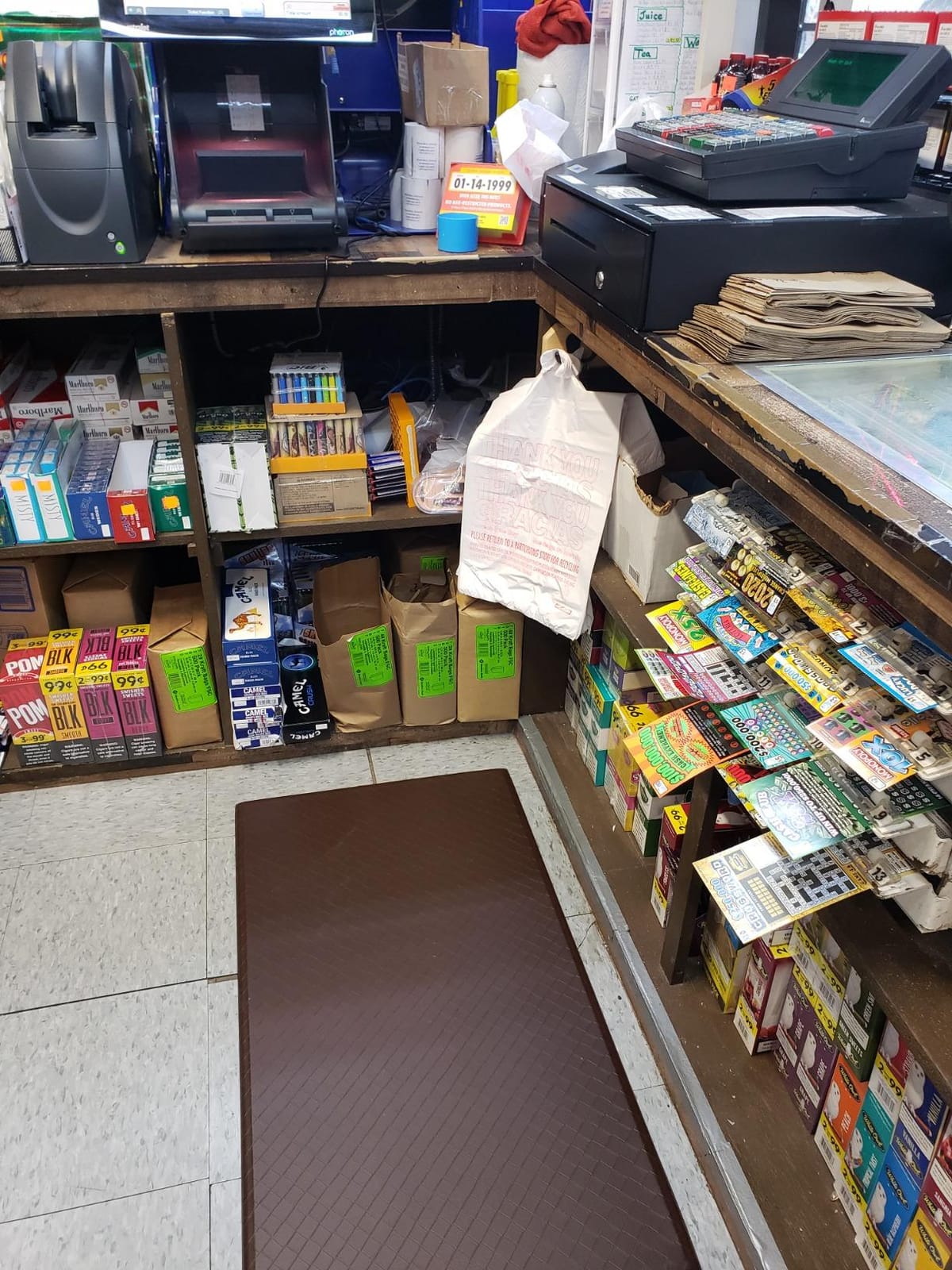
When 0.6 inch is enough and when it is not
Enough: soft floors like carpet or vinyl, standing intervals under three hours, and any setup where you must move the mat constantly. Also enough if you are pairing it with supportive footwear, since the footwear handles impact the mat does not.
Not enough: bare concrete, tile or hardwood for six-plus hour stretches, or any situation involving plantar fasciitis where maximum cushioning matters more than portability. In those cases step up to the 0.9 inch options in this roundup rather than compensating with a thinner mat and harder shoes.
Who should skip the Amazon Basics mat
Skip it if you weigh more than the mat is rated for indirectly by feel, or if you have foot conditions where any compression hurts. It is also a poor choice if you stand barefoot on very hard surfaces for most of the day, because there is not enough depth to spread plantar pressure. And if your floor is carpet, you get less benefit than you would from a textured-back mat designed for low pile.
3. FEATOL Anti Fatigue Mat – the Best Extra Thick Cushion for Standing All Day
FEATOL Anti Fatigue Mat for Standing Desk & Kitchen Floor, 9/10 Extra Thick
Type: flat foam mat
Material: high density foam, PU leather
Size: 20 x 32 inch
Thickness: 0.9 inch
Weight: 4.2 lb
Pros
- Extra thick 0.9 inch high-density foam cushion
- PU leather top resists punctures and stains
- Arrives flat so it is usable immediately
- Non-slip base holds under movement
- Low-angle beveled edges on all sides
Cons
- Raised edge profile can trip users with balance issues
- Underside wears through if dragged repeatedly
- PU leather top is not a breathable all-foam surface
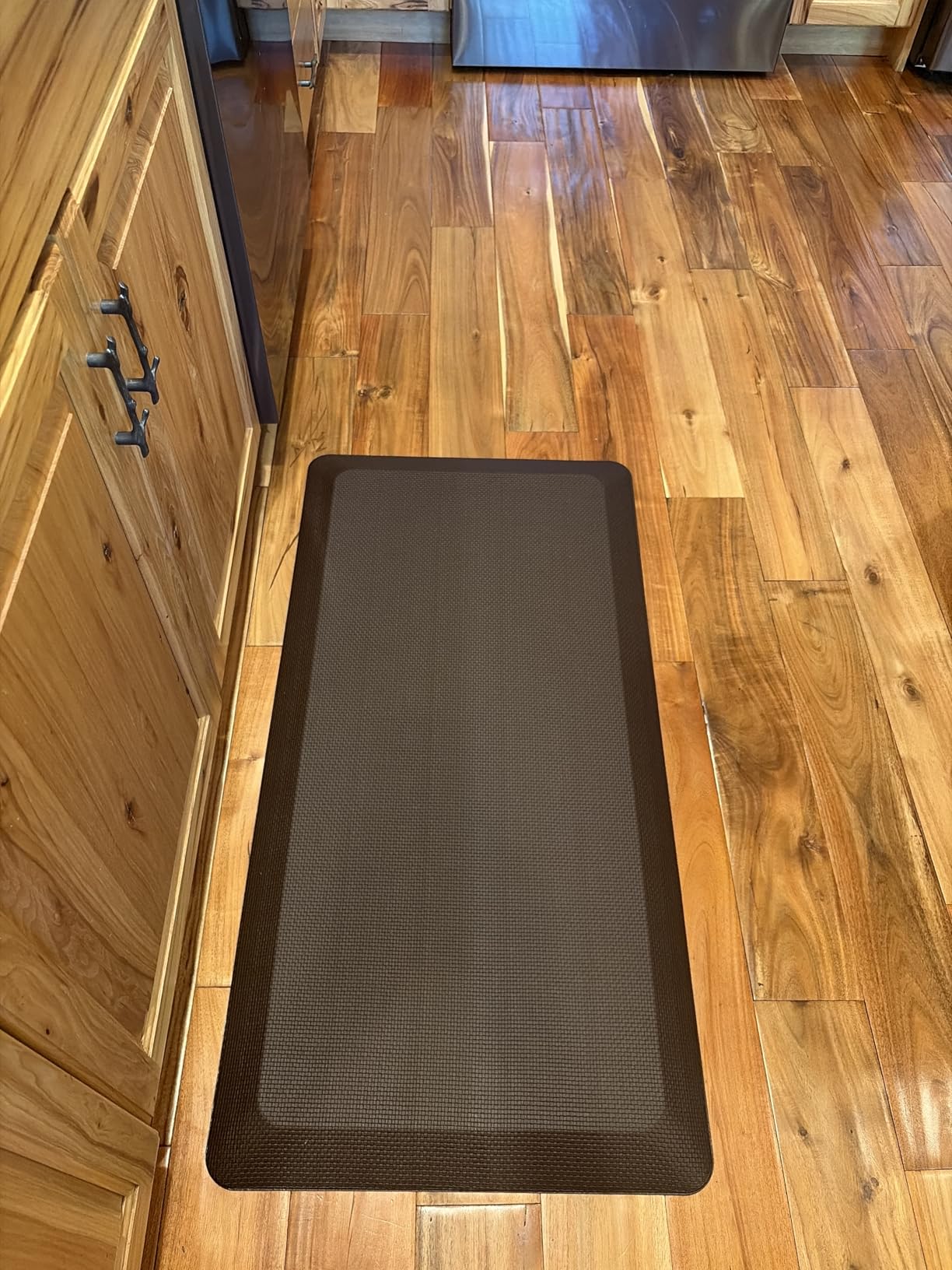
FEATOL solves the opposite problem from the Amazon Basics mat. It does not move easily and it is not trying to. At 0.9 inch of high-density memory foam with a PU leather top, it is one of the two deepest static cushions here, and reviewers single out that depth as the reason it reduces foot, knee and lower back fatigue over long sessions.
Depth is the whole mechanism. The 5 to 10 millimeter compression range where a foam mat stops cushioning and starts bottoming out is where heel and forefoot pain originates. More foam pushes that threshold further out, which is why this mat performs well for people standing six, seven or eight hours at a stretch rather than alternating between sitting and standing.
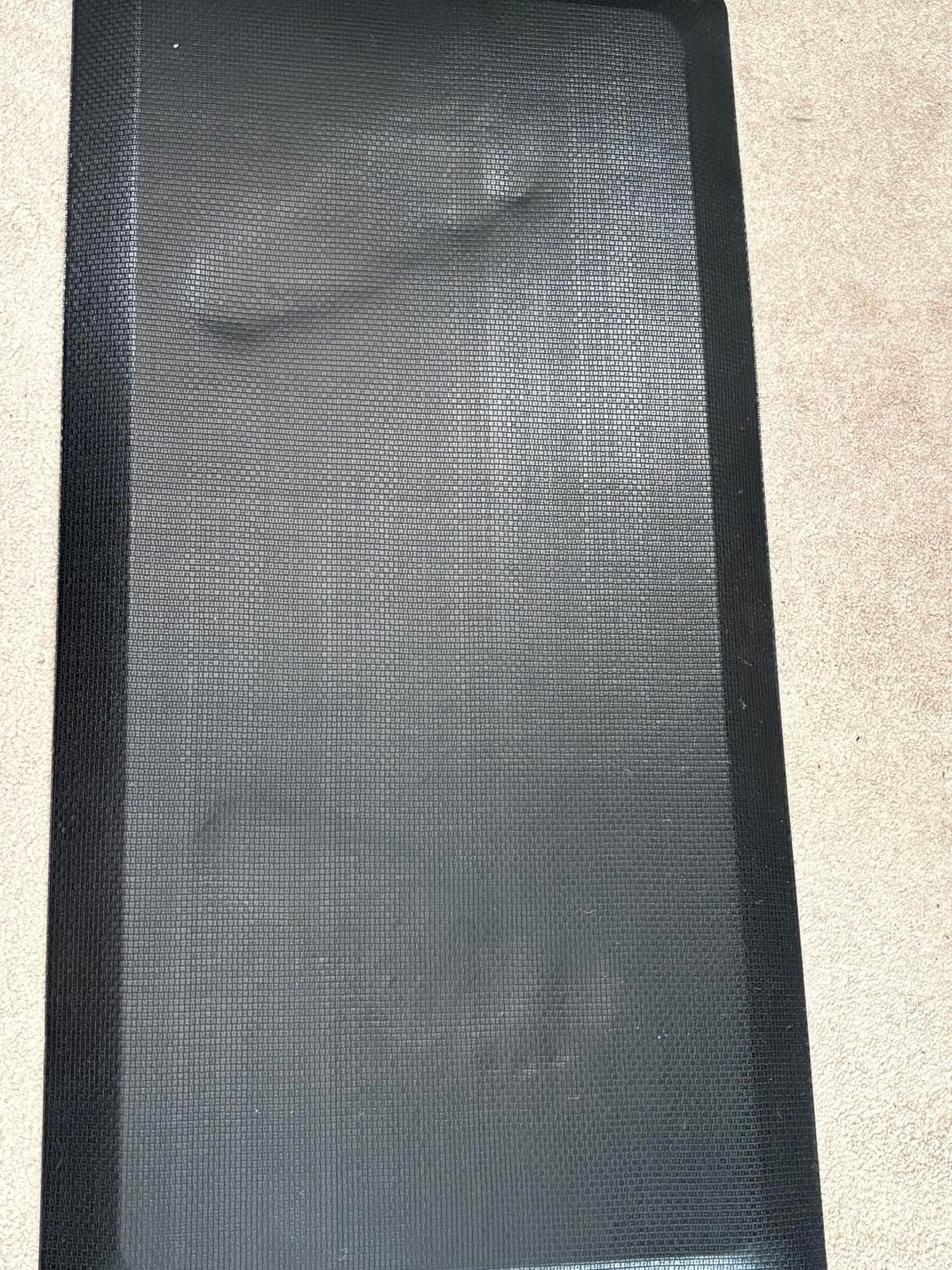
The PU leather top is a smart surface choice for a desk mat. Reviewers report it shrugs off punctures and tears, wipes clean, and resists stains in a way that bare foam does not. It arrives flat in the box rather than rolled or folded, so there is no curl to work out before your first session, and the size range runs up to 70 by 24 inches if you want to cover a whole kitchen run.
There is one caution that comes up repeatedly. At 0.9 inch the mat has a visible raised profile, and users with balance concerns can catch an edge they did not see. The bevel is low-angle, which helps, but it does not make the mat invisible. Plan the placement so nobody walks into it in the dark.
Barefoot, socks or shoes on this mat
Barefoot is the best case here. The PU leather surface is smooth and cool against skin, and the foam absorbs without any texture digging into your arch. In socks the surface is grippy enough not to skate. In hard-soled dress shoes you get the cushioning benefit but less of the terrain feedback, so this mat suits a bare or socked foot better than a contoured one would.
Cleaning is a wipe with a damp cloth for the top surface, though the manufacturer lists hand wash only, so keep the immersion to a minimum.
Who should skip the FEATOL mat
Skip it if your desk setup requires you to move the mat every time you sit. At 4.2 pounds with a raised edge, kicking it aside repeatedly is a real daily annoyance, and it also makes rolling a chair across the mat difficult. It is the wrong choice for anyone with balance issues or for a very tight standing zone where the 0.9 inch profile eats floor space.
4. Ergodriven Topo Standing Desk Mat – the Best Contoured Terrain Mat
The Standing Desk Mat – Topo by Ergodriven | Premium Not-Flat Anti-Fatigue Standing Desk Mat with Calculated Terrain | Ultra-Thick Deluxe Comfort Foam, Durable, PVC-Free | Accessories | Obsidian Black
Type: contoured terrain mat
Material: polyurethane foam, PVC-free
Size: 29 x 26.25 inch
Thickness: 2.7 inch
Weight: 8 lb
Pros
- Calculated 3D terrain promotes constant micro-movement
- Only mat here designed specifically for standing desks
- One-foot repositioning via the edge indentation
- Seven-year manufacturer warranty
- Wipes clean and debris does not cling
Cons
- Costs far more than foam competitors
- 8 pounds and rigid so it must be moved when sitting
- Initial rubbery new-plastic smell needs airing out
- Ridges can rotate out of position during use
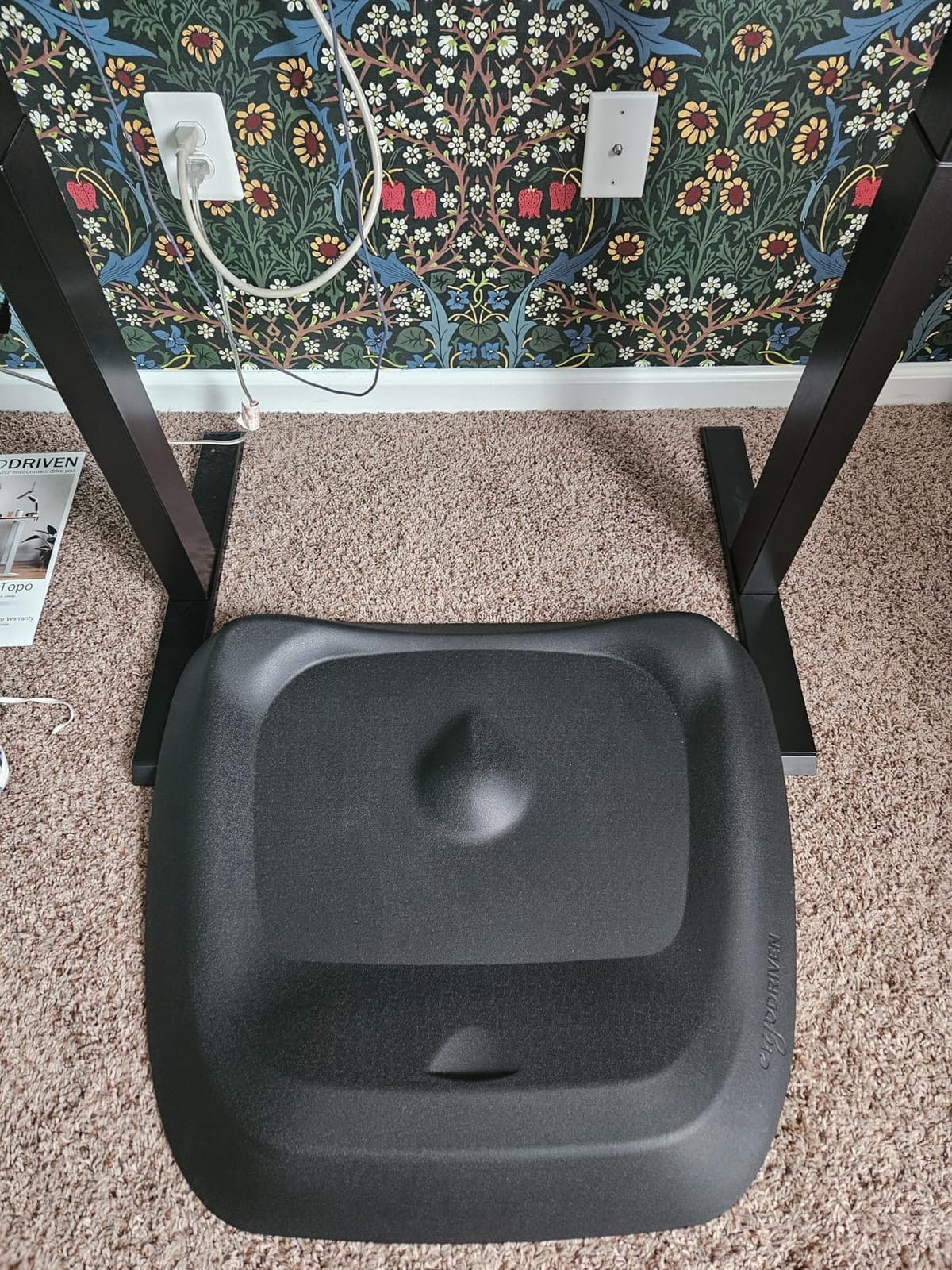
The Ergodriven Topo is the only mat in this roundup built from the ground up for a standing desk rather than adapted from a kitchen rug. It is 2.7 inches of non-toxic, PVC-free polyurethane foam shaped into calculated terrain with raised contours and angles, and owners report meaningful reductions in foot and lower back pain plus the ability to stand in several different stances rather than one locked posture.
That is a different design philosophy from everything else here. A flat mat works by absorbing pressure; a terrain mat works by making your feet keep working. The mounds, ridges and angled sections give your foot somewhere to roll, push and shift, which keeps calf and leg muscles active instead of static. It is a closer match to standing naturally on uneven ground.
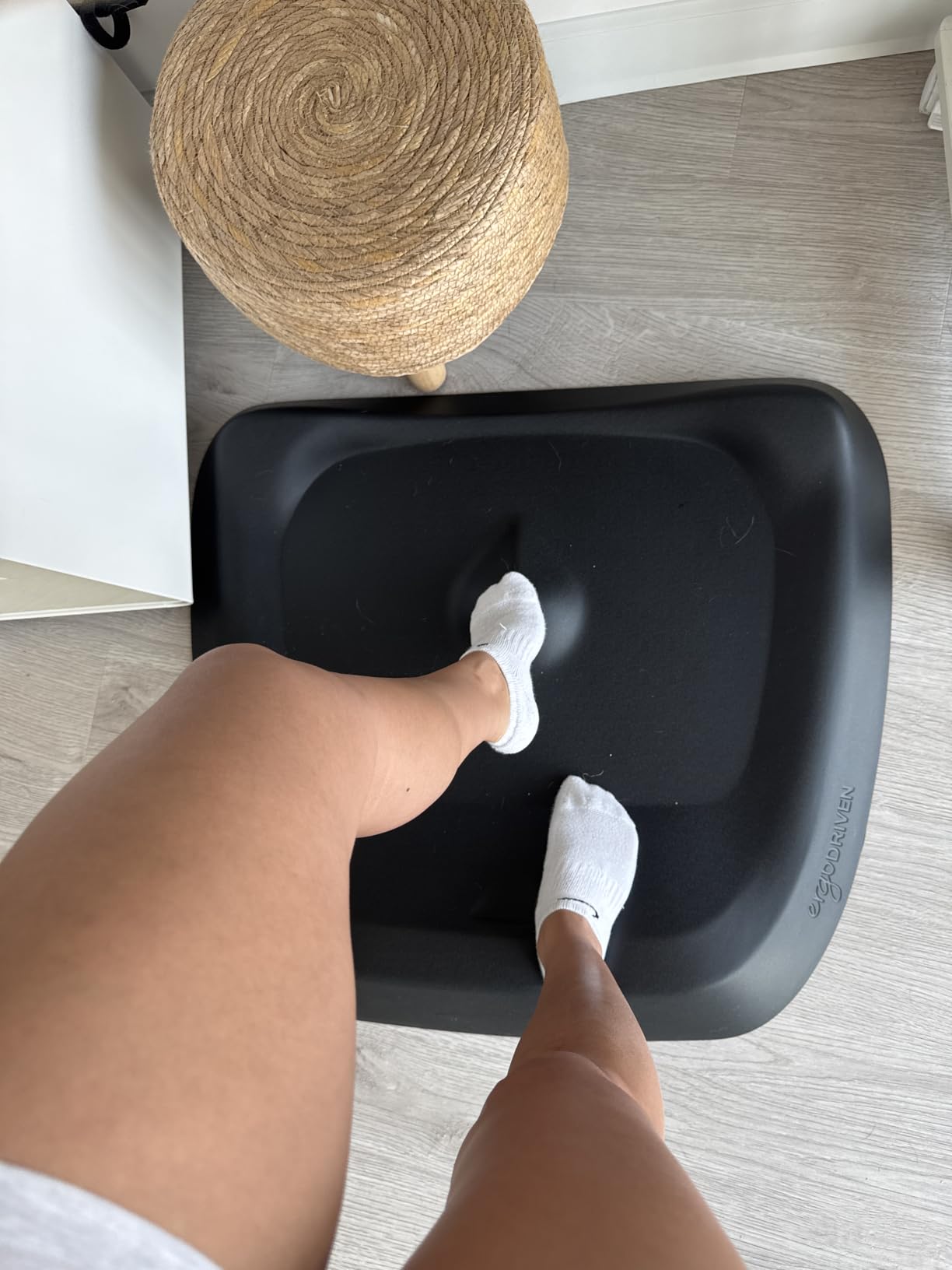
Standing desk owners notice two details fast. The edge indentation lets you slide the whole mat with one foot, which matters because at 8 pounds you are not lifting it by hand every session. And the surface wipes clean without debris clinging to the pebbled skin, which reviewers who work in kitchens and workshops appreciate more than expected. The warranty runs seven years with a full-refund satisfaction guarantee behind it.
Now the friction points, because they are real. Eight pounds is heavy and the mat is rigid enough that you have to slide it aside rather than tuck it, and the cost sits well above every foam competitor in this list. The rubbery smell on arrival is genuine and reviewers recommend airing it out before indoor use. Reviewers also report that ridges and back corners can rotate out of position over time, and that coming from a seated, flat-surface setup takes an adjustment period.
Who the terrain design suits and who it frustrates
It suits experienced standers who want the mat to keep them moving, people with lower back complaints tied to static posture, and anyone who likes to shift weight, stretch a calf or change stance through the day. Barefoot is where it works best, since the terrain is felt through the foot rather than through a shoe sole. It also works in socks if you are deliberate about it.
It frustrates users who want to stand completely still, who wear hard heels, or who have orthopedic footwear. The terrain under a rigid heel is an awkward fit, and anyone who spends long stretches in one fixed position will find the contours distracting rather than helpful.
Who should skip the Ergodriven Topo
Skip it if your desk setup is small. At 29 by 26.25 inches it needs real desk frontage, and in a compact home office it will dominate the floor space available. Skip it if you are sensitive to chemical odor and cannot air the room out, if you move your standing zone more than a couple of times a day, or if your priority is the softest possible cushion rather than movement. If budget is the deciding factor, the flat foam picks in this list deliver most of the comfort for a fraction of the outlay.
5. FEZIBO Balance Board – the Best Mat for People Who Cannot Stand Still
FEZIBO Standing Desk Mat Balance Board, Obsidian Black
Type: wobble balance board
Material: wood core, rubber top
Size: 20 x 12 inch
Height: 2.2 inch
Weight: 6.4 lb
Pros
- 8.5 degree tilt keeps typing stable while allowing 360 degree sway
- Raised foam knobs massage and stretch the soles
- Rated to support 320 pounds
- Doubles as a platform for push-ups and planks
- Portable between home and office
Cons
- Strong manufacturing odor on some units
- Rubber top can chip or peel from the wood core over time
- Foot can catch the edge and tip the board
- Top padding is thin for staying still
A balance board is the most different concept here. Instead of cushioning you, the FEZIBO board tilts on an 8.5 degree angle so your weight never sits perfectly still, and users report standing on it for longer with less hip, knee and foot pain because their body is constantly making small corrections. The rocking is engaging in a way a foam mat is not, and the same setup works for push-ups, squats and planks.
The design constraint that makes this usable at a desk is the tilt angle. At 8.5 degrees the board swings under you without making typing inaccurate, which is why it works for desk work rather than just for exercise between meetings. The raised foam knobs on top massage and stretch your soles as you shift, and the board is rated to support up to 320 pounds, one of the highest limits in this roundup.
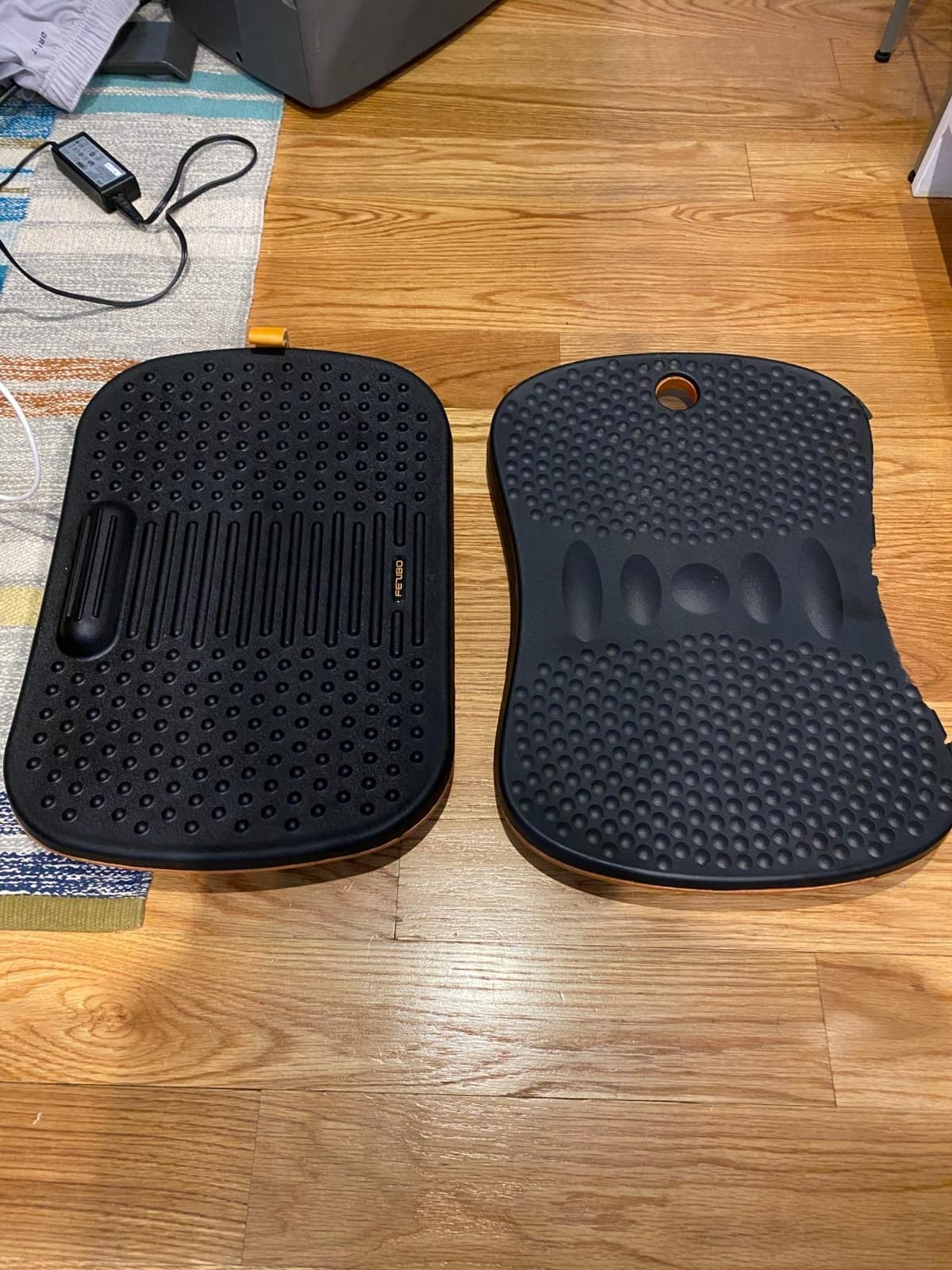
It is compact at 20 by 12 inches and light enough at 6.4 pounds to carry between home and office, which is a real advantage in shared workspaces. Materials are described as durable and non-toxic by the manufacturer.
The weak point is durability of the top surface. Reviewers report the rubber layer chipping, peeling or pulling away from the wood core within about a year, and some units arriving with a strong manufacturing odor that led to replacements. There is also a genuine safety consideration: a foot can catch the edge and tip the board, which several buyers mention as a near-fall. Wear flat, soft shoes or go barefoot, and do not rock in hard soles.
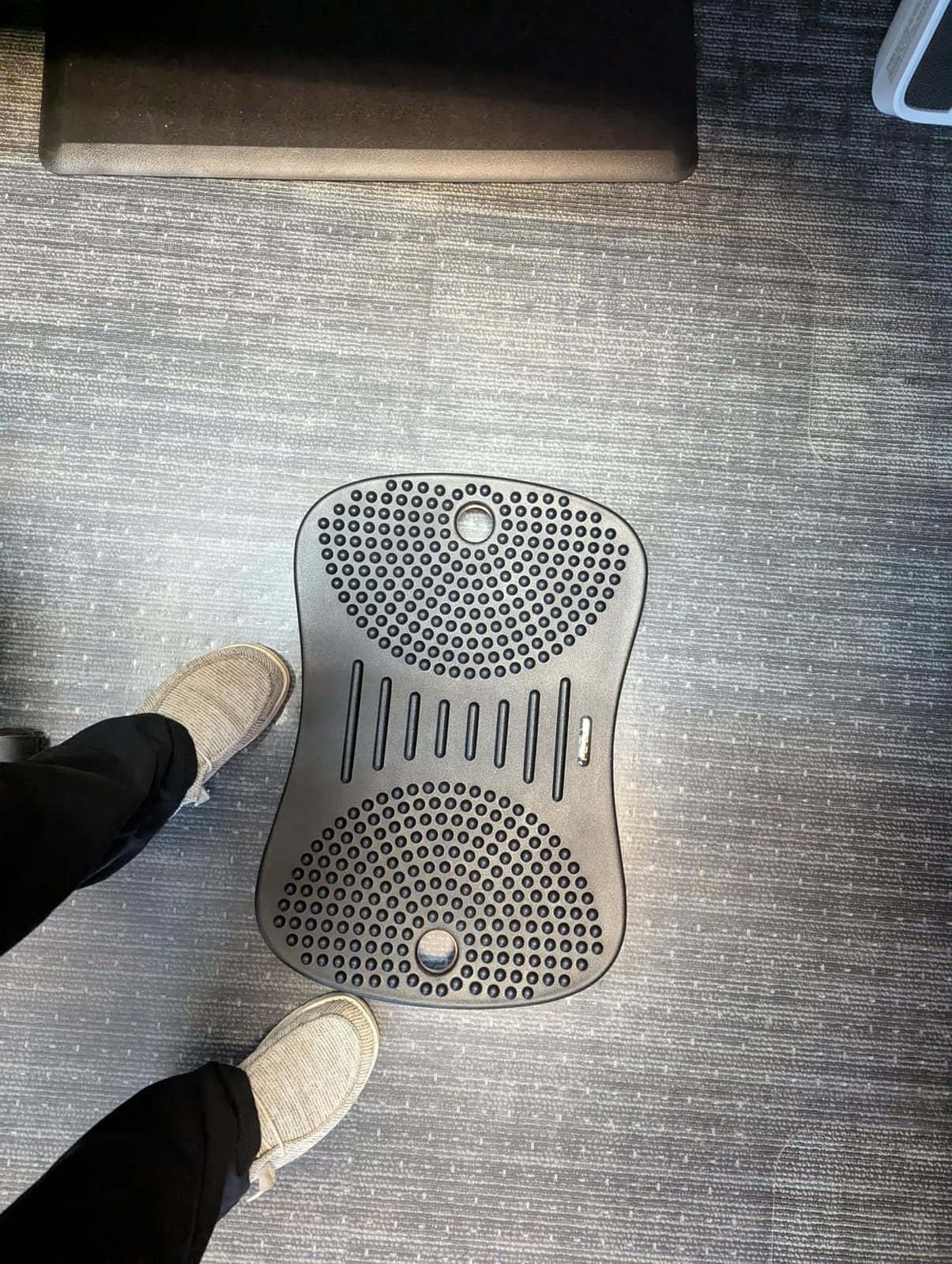
When a wobble board beats a foam mat
A wobble board wins when your problem is posture rather than pressure. If your lower back complains after an hour but your feet feel fine, the issue is static loading, and a surface that keeps you shifting addresses it directly. It also wins for people who fidget, who find standing still genuinely uncomfortable, or who want a mat that doubles as a small exercise platform.
A foam mat wins when the problem is pressure. Hard heels, plantar fasciitis and long hours on tile all respond better to depth than to motion, and a foam mat gives you a stable, quiet surface to stand on without thinking about it.
Who should skip the FEZIBO Balance Board
Skip it if you type with heavy precision, work at a counter where you must stand perfectly still, or have any balance or ankle concerns. The edge-catch tipping complaint is not theoretical for some users. It is also the wrong choice if you want a soft surface underfoot, because the top padding is thin, and it will not work for anyone who wants to stand in a rigid heeled shoe.
6. FEZIBO Standing Desk Mat with Anti Fatigue Bar – the Best Combo of Rocking and Foot Relief
FEZIBO Standing Desk Mat Balance Board with Anti Fatigue Bar, Black
Type: wobble board with foot bar
Material: wood core, rubber top
Size: 20 x 12 inch
Height: 2.2 inch
Rating: 320 lb
Pros
- Anti-fatigue bar gives targeted relief under the arch
- 8.5 degree tilt keeps typing accurate
- Compact and portable between workspaces
- Rated to support 320 pounds
- Non-toxic durable materials
Cons
- Less forgiving than a flat foam mat when standing still
- Wood is harder to wipe clean than foam
- 20 x 12 inch footprint leaves little room to change stance
This is the FEZIBO rocking platform with a dedicated anti-fatigue bar built across the standing surface. The bar is the difference: it gives you a defined edge to press the arch and forefoot against, which is where most of the relief comes from for people who stand with weight shifted forward. Buyers report standing longer and feeling fresher than on a purely static mat.
Everything that made the plain balance board work at a desk carries over, including the 8.5 degree tilt that keeps typing steady and the 320 pound rating. The bar adds a targeted element rather than general cushioning, so it works best when you know where your discomfort concentrates, most often the arch or the ball of the foot.
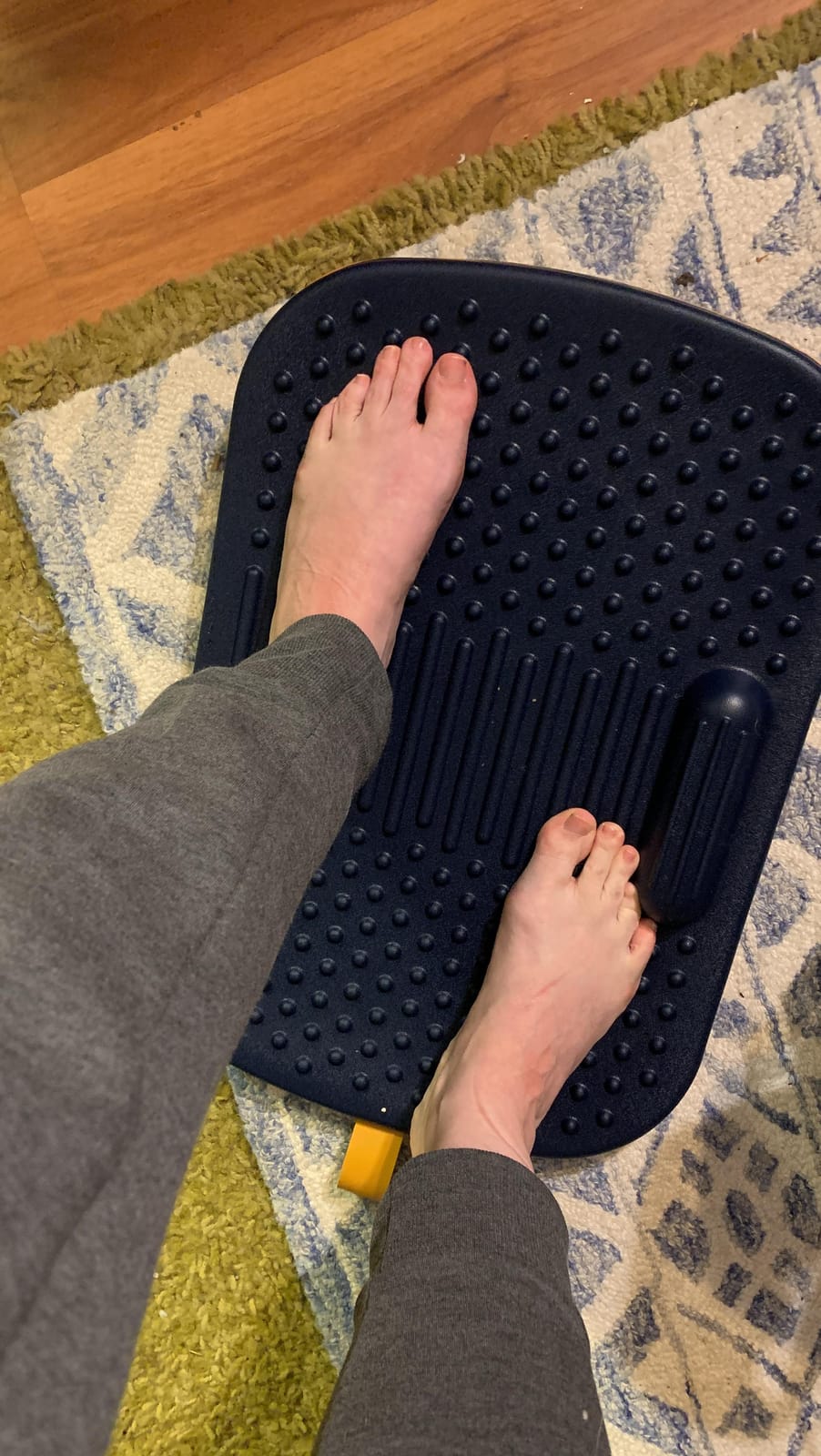
Compact and light enough to move between workspaces, which suits a shared desk or a hybrid week. Construction is wood with a rubber top, rated to 320 pounds, described by the manufacturer as durable and non-toxic, and covered by a 30-day risk-free return.
The trade-offs are the same class of trade-offs as the balance board. Wood is harder to wipe clean than a foam mat, so kitchen and workshop spills are more work. And at 20 by 12 inches, the standing area is small enough that you cannot shift your stance much, which is the opposite of what a terrain mat offers.
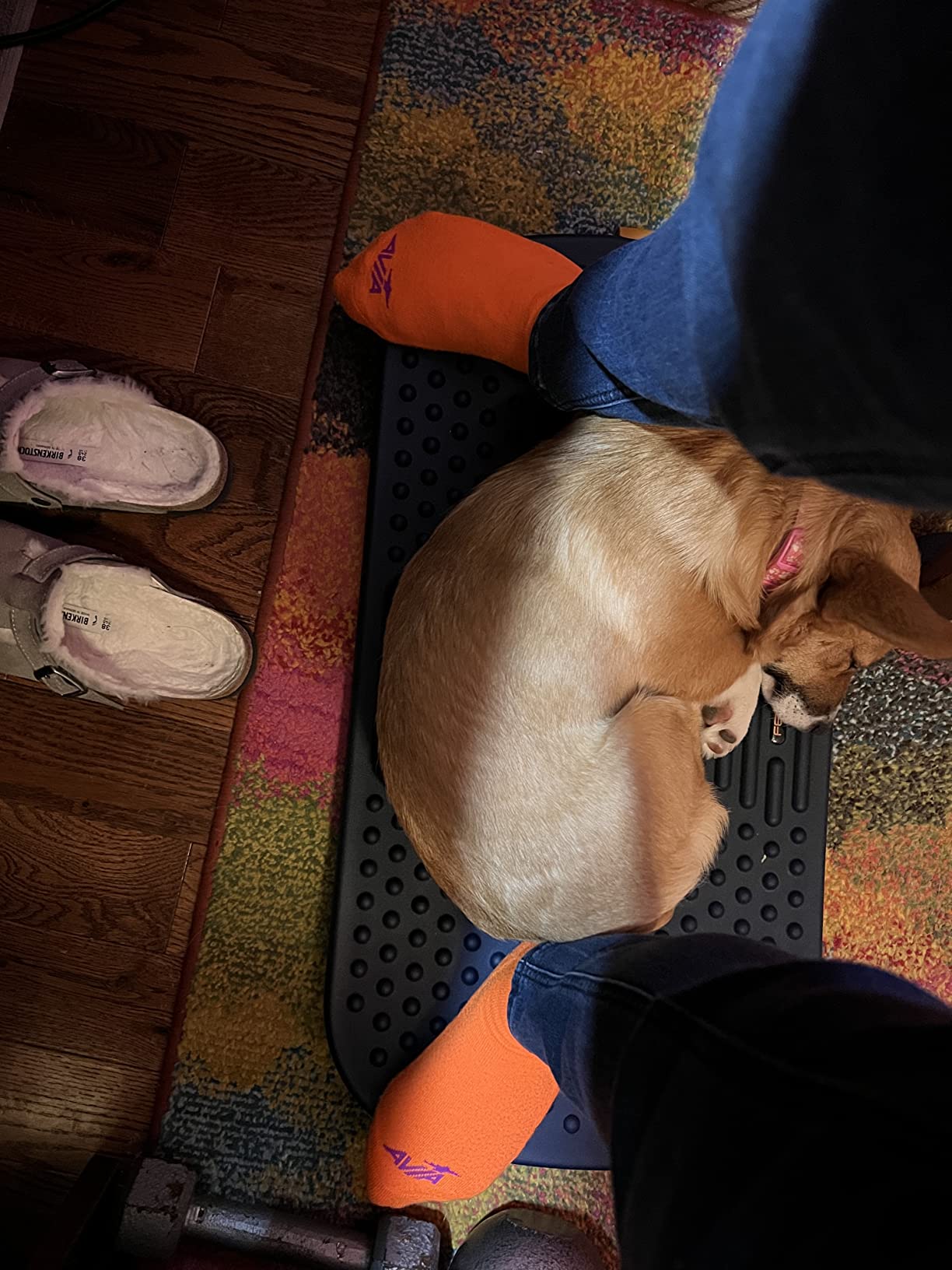
How to use the bar properly
Think of it as an active pressure release rather than something to stand on top of. Set one foot forward so the arch rests against the bar, let the pressure redistribute for thirty seconds, then switch sides. Alternating like this during a long session gives you the relief benefit without giving up the balance-board movement that keeps your legs active.
Go barefoot or in thin flat shoes. Hard soles bridge the bar and you lose most of the effect, and rocking in them is also where the tipping complaints come from.
Who should skip this board
Skip it if you want to stand motionless, if you need a wide area to move your feet around, or if cleaning is a priority in your setup. It is also a poor fit for anyone who works with a task chair rolled across the same zone, since the rocking surface and casters do not mix. For pure cushioning with no movement, the flat foam mats are a better use of your floor space.
7. Ophanie Anti Fatigue Cushioned Mat – the Best 20 by 48 Inch Mat for Long Counter Runs
Ophanie Anti Fatigue Cushioned Mat, 3/4 inch, 20×48 Anti Fatigue Cushioned Mat,Kitchen Rugs,Waterproof,Comfort Ergonomic Standing Mat for Office,Home,Sink with 99+ Pairs of Anti-Slip Bottom Ridges
Type: flat foam mat
Material: recycled PU foam, PVC leather
Size: 20 x 48 inch
Thickness: 0.8 inch
Certified: CP65, GRS
Pros
- 48 inch length covers a whole counter run or desk front
- 99 plus anti-slip bottom ridge pairs grip hard
- CP65 and GRS certified recycled PU foam
- Beveled progressive ramp edge
- Arrives flat with no curl on arrival
Cons
- 48 inch format is unwieldy in a small standing area
- PVC leather top is firmer underfoot than plush foam
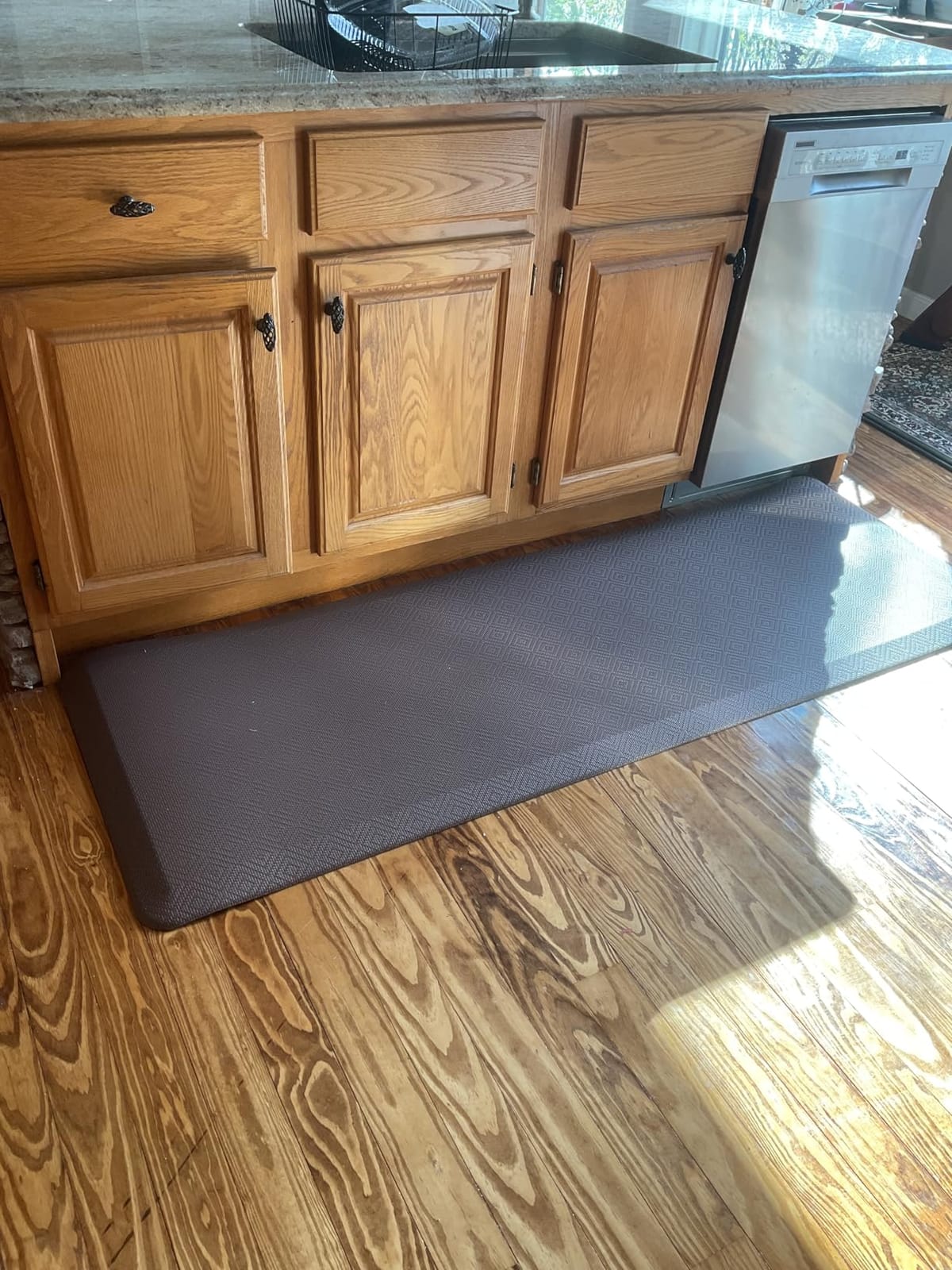
Length is the feature that matters here. At 20 by 48 inches this is one of the few mats that can cover an entire counter run, a long sink, or the full front of a wide desk in a single piece, and owners describe that as the reason they bought it rather than three smaller mats butted together. Gaps between mats are where you feel the floor, so one long mat genuinely changes the surface you stand on.
The cushion is 0.8 inch of high-density recycled polyurethane foam under a 1.2 mm PVC leather surface. That gives you a depth close to the extra-thick foam mats with a wipe-clean top, and the PVC leather layer is described as soft-touch and wear resistant. It is a good compromise for kitchen and laundry work where spills are constant.
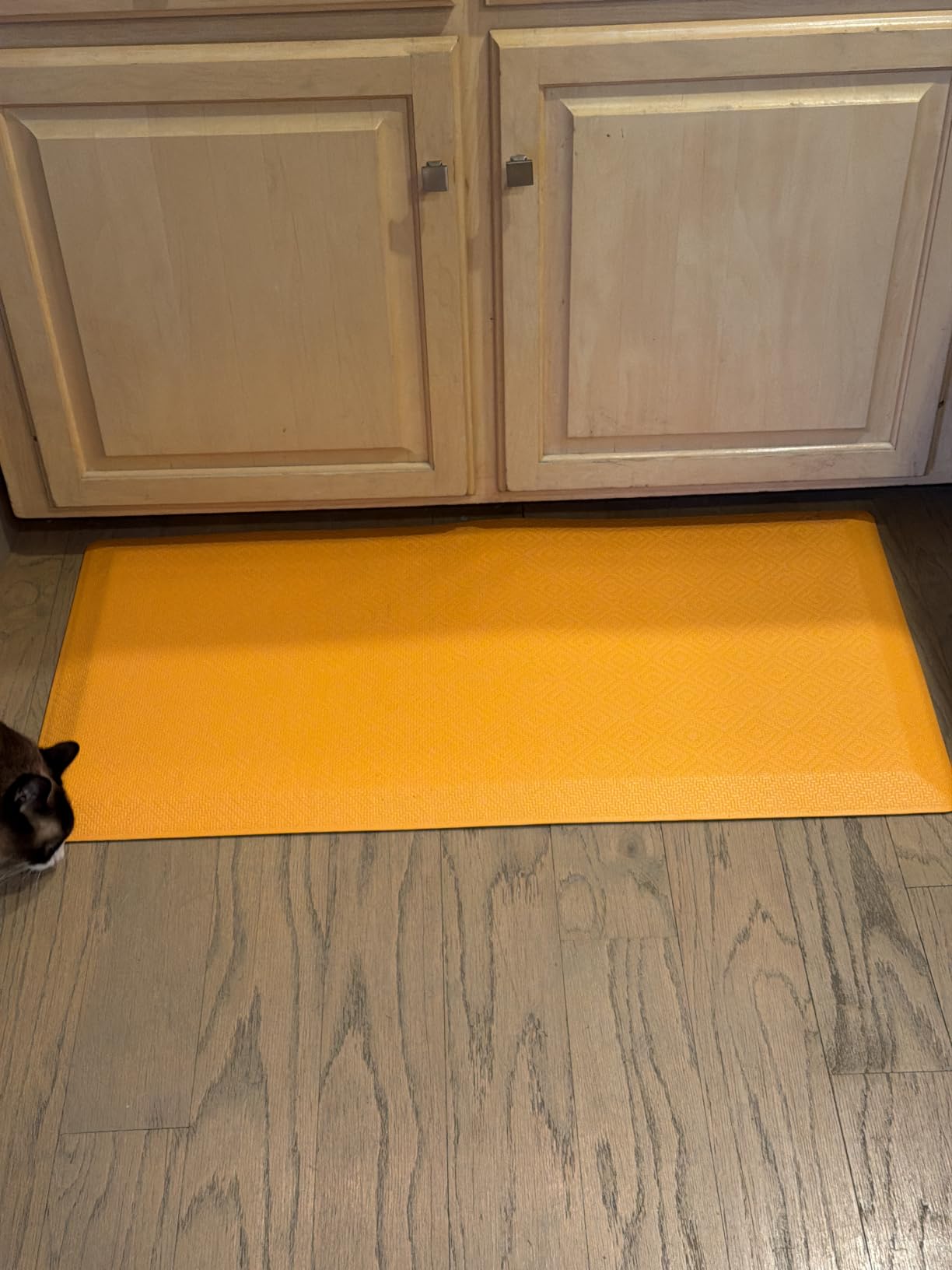
Grip is unusually well specified. The backing uses 99 plus pairs of anti-slip bottom ridges, which is a more aggressive texture than the smooth rubber base on most mats here, and reviewers report it holds on tile and hardwood. The edge is a beveled progressive ramp rather than a straight taper, so the transition up onto the mat is gradual. It arrives flat, so there is no curl to flatten on arrival.
The certification detail is worth a mention for anyone chemical-conscious. The materials are listed as CP65 and GRS certified, meaning the foam is recycled content meeting a recognized standard. It carries a 4.7 average across 2130 reviews, a smaller but very favorable record.
Why the long format changes your options
With 48 inches of continuous surface you can walk your stance along the mat over the course of a shift, which is one of the cheapest ergonomic habits there is. It also means one mat serves a kitchen sink, a range and a prep counter without any transition gaps. For a laundry room with a long folding surface, the same logic applies.
The catch is that 48 inches of mat is genuinely awkward to move and it will not fit a compact standing area. If your standing zone is a single desk in a small apartment, this format is overkill and you would be better served by a shorter mat you can actually reposition.
Who should skip the Ophanie mat
Skip it in small spaces or anywhere you need to move the mat frequently, because the length makes it a two-handed job. Skip it if you want the softest possible surface under bare feet, since the PVC leather top is firmer than plush foam. And if you stand on carpet, a mat this long with a ridged base can catch and lift at the edges rather than lying flat.
8. ergohead Portable Anti Fatigue Mat – the Best Small Mat with a Handle
Ergohead Anti Fatigue Kitchen Floor Mat Comfort Standing Mat, Portable Office Standing Desk Mat, Multi-Purpose Kitchen Rug, Built-in Handle with Massage Points Comfort Floor Mat (Black, 17″ x 22″)
Type: flat foam mat
Material: polyurethane memory foam
Size: 17 x 22 inch
Thickness: 0.75 inch
Weight: 1.9 lb
Pros
- Built-in handle lets you carry and store it with one hand
- Only 1.9 pounds
- Compact 17 x 22 inch footprint for shared desks
- Massage points promote circulation
- Curved edges sit flush with the floor
Cons
- Handle can split at the seam under heavy use
- Feel is thinner than 0.9 inch mats over very long sessions
- Small size limits how much you can vary your stance
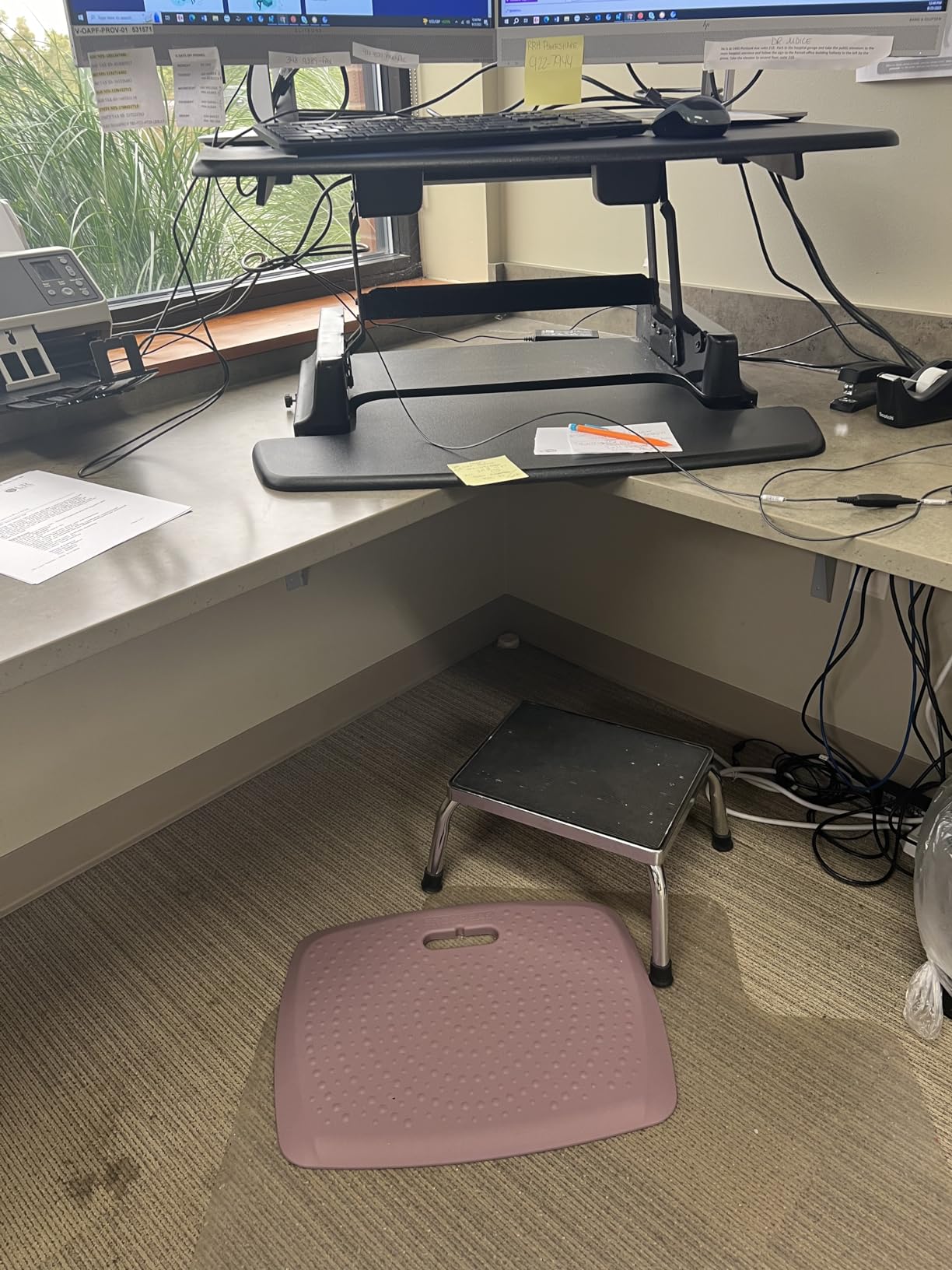
At 1.9 pounds, this is the lightest mat in the roundup, and the built-in handle is why. Instead of bending down and dragging, you lift it with one hand, carry it to wherever you are working, and hang it on a hook when you sit down. Buyers in shared workspaces and small apartments call the handle the feature that makes a mat viable at a sit-stand desk at all.
The cushion is 0.75 inch of polyurethane memory foam with massage points moulded into the top. Those points add a light massage effect and give your feet something to shift against, which helps keep you from locking into one static stance without turning into a full terrain mat.
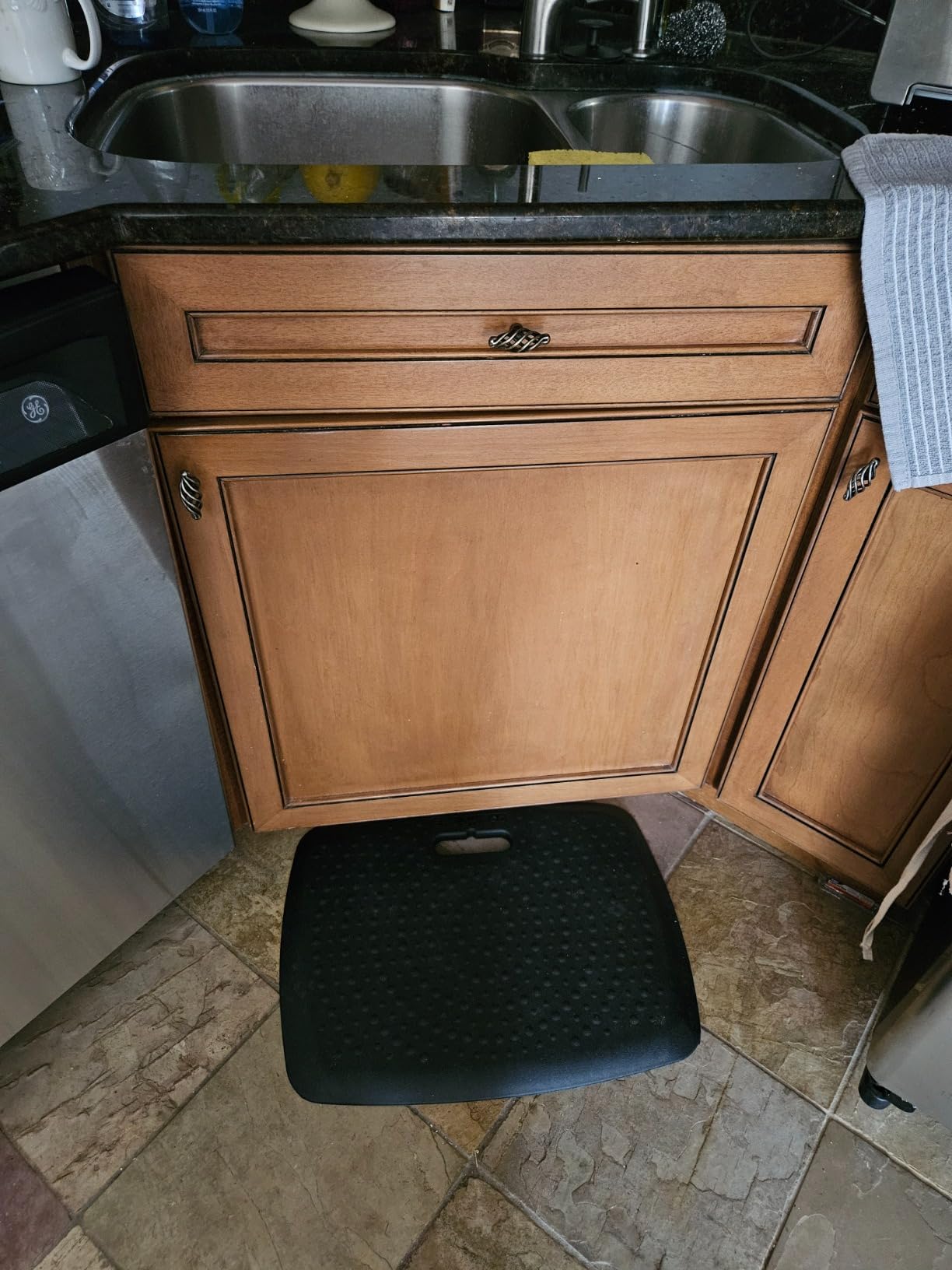
At 17 by 22 inches it is smaller than most, which is a genuine limitation and also the entire point. In a compact home office or a shared hot-desk setup, the difference between 17 by 22 and 20 by 32 is the difference between a mat that fits your standing zone and one that does not. Reviewers report buying repeats for coworkers for exactly this reason.
Several owners mention it made hard concrete or tile bearable almost immediately, and it is listed for kitchen, office, bathroom, laundry, garage, garden and workshop use. The non-slip bottom holds on hard floors and the curved edges sit flush enough to vacuum or wipe.
What a smaller mat gives up
Footprint is everything on this mat. At 17 by 22 inches you can shift your weight and change stance, but you cannot walk along the surface or take long stretches across it. For most desk work, where your standing zone is roughly that size anyway, that is fine and it stops you buying mat you will not use.
The cushioning is also honest rather than plush. Reviewers who expected a deep cushion say the floor becomes noticeable during very long sessions. It comes with a one-year manufacturer warranty, the shortest warranty among these picks, so treat it as a mat you may replace within a few years.
Who should skip the ergohead mat
Skip it if you want to stand on a long run of surface, if you share a large counter or bench, or if you are on your feet for eight hours and want maximum cushioning. The handle is also a weak point in harsh environments, where the seam can split under heavy use, so workshop buyers should weigh that risk. For a small apartment standing desk it remains the most practical pick on this list.
9. Mount-It Anti Fatigue Floor Mat – the Best Firm Gel Foam Mat
Mount-It! Anti Fatigue Floor Mat, 18×22, Black
Type: flat mat, firm gel foam
Material: rubberized gel foam
Size: 18 x 22 inch
Thickness: 0.75 inch
Pros
- Firm gel foam spreads pressure without bottoming out
- Anti-slip top and bottom surfaces with beveled edges
- Integrated carry handle for moving between work spots
- Water and stain resistant
- Comfortable enough to kneel on
Cons
- Firmer than plush foam mats
- Can drift on carpet even with a liner underneath
- Oily residue appeared on some surfaces before it was washed off
This is the firm option, and the firmness is the selling point rather than a compromise. The rubberized gel foam distributes pressure across the foot without the sinking feeling of plush memory foam, which means your muscles are not compensating for a surface that collapses under you. Users with long standing hours describe the firmness as the reason it holds up over a full shift.
There is a physiological argument for it. A very soft mat lets your foot sink in, then your ankle and calf work harder to stabilise on the way back up. Reviewers report the opposite experience here: a surface that stays responsive, so the foot keeps moving naturally rather than fighting the foam.
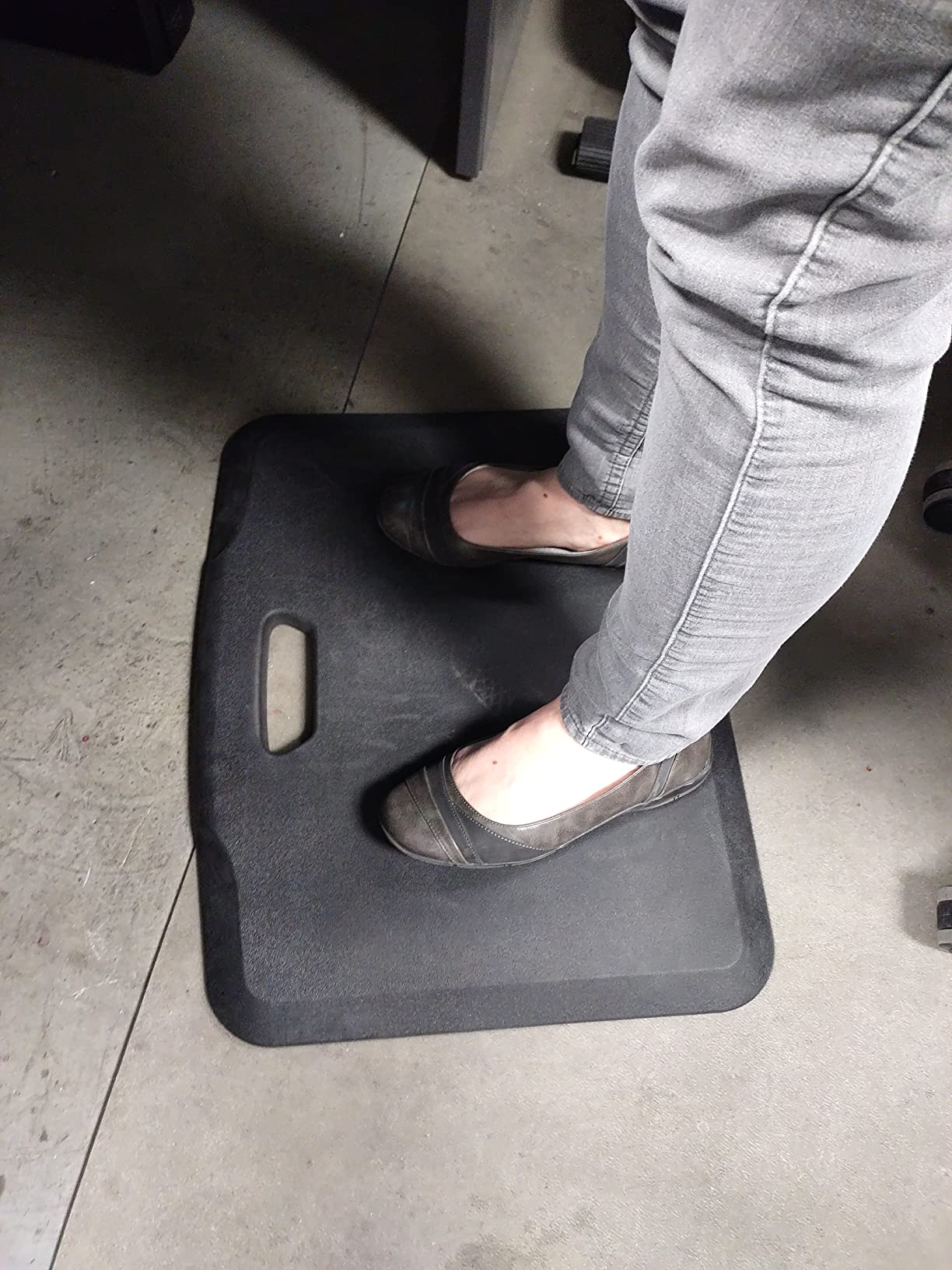
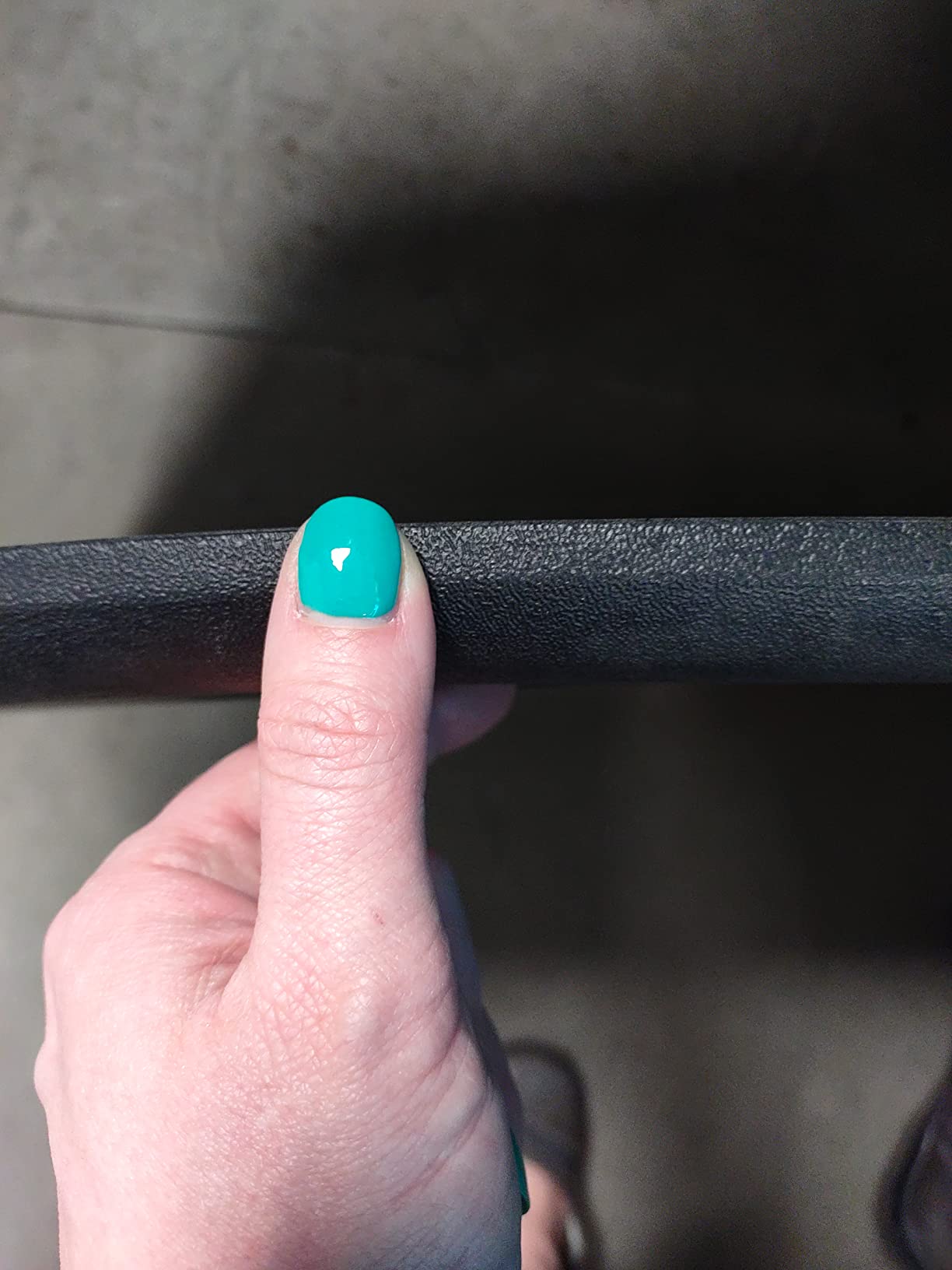
Build details are solid for a mat in this class. Beveled edges on all four sides, anti-slip on both the top and bottom surfaces, and an integrated carry handle so you can move it between the kitchen, a garage bench or a desk without bending down. It is water and stain resistant and can be vacuumed or wiped, which makes it workable in a workshop or a laundry room. Reviewers also note it is comfortable enough to kneel on for floor-level tasks.
Two complaints recur. It can drift on carpeted floors even with a liner underneath, which is a real issue if your standing zone is on low-pile carpet. And a few buyers report an oily residue appearing on some surfaces before it was washed off with soap and water, so wipe it before first use.
Firm or soft: which one your feet want
Choose firm if you are standing six-plus hours, if you have sensitive feet that dislike sinking, or if you dislike the wobble of an over-soft mat. Choose soft if you have joint or arch discomfort that responds to cushioning, or if your floor is already forgiving like carpet or vinyl.
The middle ground most people land on is a medium-firm foam at 0.75 inch, which is what several of the picks in this list use. Firmness is partly personal preference and partly habit; if you have never used a firm mat, the first week can feel harder than expected before it feels better.
Who should skip the Mount-It mat
Skip it if you want a plush cushion and have foot or arch pain that responds to softness, because this mat is deliberately not that. Skip it if your standing zone is on carpet, where the top and bottom grip surfaces do not hold it in place reliably. It is also smaller than the full-size desk mats at 18 by 22 inches, so it suits a chair-and-desk zone better than a long counter.
10. Tyrot Extra Thick Anti Fatigue Mat – the Best Waterproof Mat for Garage and Laundry Work
Tyrot Extra Thick Anti Fatigue Mat for Kitchen Floor, 20×32, Black
Type: flat foam mat
Material: 140D PU recycled foam
Size: 20 x 32 inch
Thickness: 0.9 inch
Pros
- 9/10 inch PU recycled foam with a high-density 140D core
- Waterproof and oil-proof surface wipes clean
- Arrives flat and uncreased in a box
- Non-slip bottom holds during foot movement
- Works on wood
- ceramic
- marble and other hard floors
Cons
- Thickness feels bulky in tight spaces and under a rolling chair
- Textured surface traps food particles and needs brushing
- Underside picks up dust and crumbs
- Costs more than some foam mats at this depth
The Tyrot mat is built for messy rooms. At 0.9 inch of high-density 140D recycled polyurethane foam it has the same depth as the extra-thick picks, and the waterproof, oil-proof surface means a spill wipes away with a damp cloth instead of soaking into open foam. Laundry, garage and utility room users get the cushioning without the staining anxiety.
The 140D density is the number worth understanding. A higher-density foam resists denting and bottoming out, so the cushion keeps its shape over years rather than months. Reviewers specifically note that the material feels safer and longer-lasting than PVC alternatives, and it arrives flat and uncreased in a box, ready to use with no flattening period.
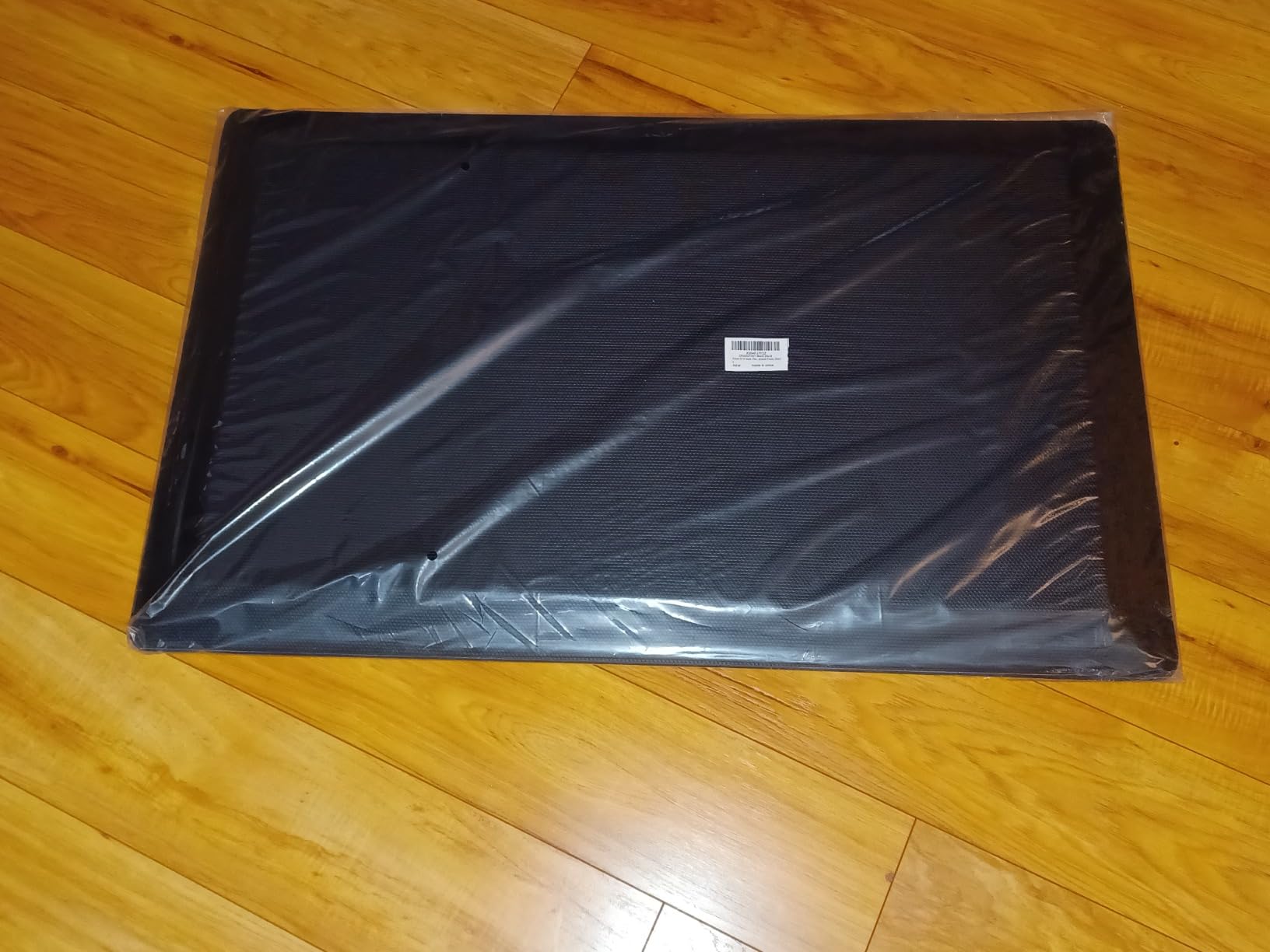
It is rated for use on wood, ceramic, marble and other hard surfaces, and the non-slip bottom keeps it in place through normal foot movement. It carries a 4.7 average from 836 reviews, a smaller sample than the leaders but a consistently strong one.
Maintenance is where the design asks a little more. The textured surface is good for grip but will lodge food particles, so a wipe alone is not enough in a kitchen and you need a brush. The underside collects dust and crumbs over time. And the 0.9 inch profile is bulky in a tight space or under a rolling chair.
Garage, laundry and utility room use
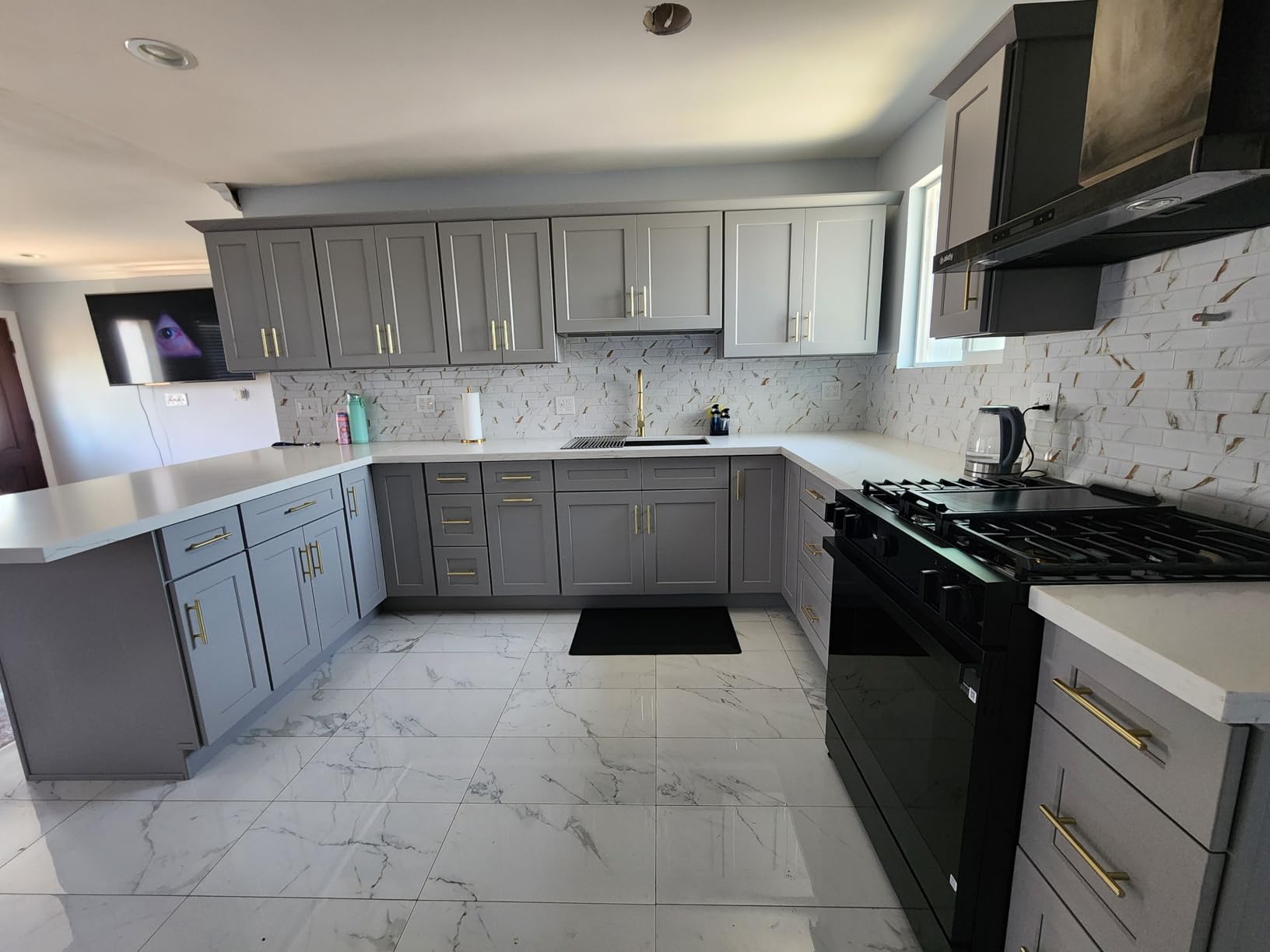
In these rooms the waterproof surface is the whole argument. Concrete and tile are unforgiving, spills are routine, and a wipe-clean top with a grippy base means you can keep the same mat for years without it looking wrecked. The extra depth also matters when you are standing still for long stretches, because there is more foam between you and the floor.
For flooring compatibility, note that the base grips best on smooth hard surfaces, which is exactly where these mats usually go. On carpet it has less to bite into.
Who should skip the Tyrot mat
Skip it if you are moving it daily, since the extra thickness makes it a two-handed job and it is awkward under a rolling chair. Skip it in a small standing area where 0.9 inch of profile eats usable floor space, and skip it in a kitchen where the textured surface will need brushing rather than wiping. If you want a thinner and lighter mat instead, the thinner flat picks elsewhere in this list serve the same purpose.
Flat vs Topographic Mats: Which One Suits Your Standing Desk
Flat mats and topographic mats solve different problems, and picking the wrong one is the most common mistake we see. A flat mat cushions pressure. A terrain mat creates movement. If your discomfort is in your heels and arches after long hours, you want depth and softness. If your discomfort is in your lower back and it arrives after an hour of standing perfectly still, you want a surface that keeps you shifting.
Balance boards sit at the far end of the same spectrum. They deliver the most movement and the least cushioning, which makes them excellent for fidgeters and for posture-driven problems, and a poor fit for anyone who wants to stand motionless or who wears a rigid heel.
The practical comparison in short: a flat mat is quiet, stable, easy to clean and works with any footwear. A terrain mat is engaging, keeps your legs working, works best barefoot, and has edges you need to be aware of. A balance board is the most engaging and the least forgiving.
The Downsides of Anti-Fatigue Mats
Nobody in this category advertises the drawbacks, so here they are plainly. Knowing them before you buy is more useful than a product page that only lists benefits.
Trip hazard on thick or contoured mats. A 0.9 inch foam edge or a 2.7 inch terrain profile has a visible drop-off. Users with balance concerns have reported catching an edge they did not see, which is why beveled ramps matter more than thickness.
Over-soft foam can make muscles work harder. When a mat sinks too far under your foot, your ankle and calf stabilise harder on the rebound. Several reviewers report foot cramps on very soft mats, and that is a real signal to move up to a firmer or thicker surface rather than softer.
Initial plastic or rubbery odor. Off-gassing is common in foam and rubber mats arriving sealed, and the Ergodriven Topo and some balance boards draw specific complaints here. Air the mat in a ventilated room before daily indoor use, especially if you are barefoot or chemical-sensitive.
Sliding and drifting. Smooth-backed mats creep on hardwood and tile, and some textured-top mats drift on carpet. The Opsonie’s ridged base is the most aggressive grip in this roundup precisely because this is such a common complaint.
Bulk that fights sit-stand cycling. Anything above 4 pounds has to be slid or lifted out of the way every time you sit. At 8 pounds the Ergodriven Topo is a deliberate object rather than an accessory, and that is a real daily friction cost.
Debris trapping in textured surfaces. Perforated and beaded surfaces collect crumbs, dust and pet hair that a damp cloth will not remove. This is a cleaning tax, and it is higher on the PU leather and textured-top mats than on smooth foam.
They do not last forever. Memory foam cores lose rebound over several years, and rubber surfaces on balance boards can chip or peel within about a year. Budget for a replacement cycle rather than assuming a one-time purchase.
Anti-Fatigue Mat vs Footrests, Insoles and Sit-Stand Intervals
The most common question in standing desk communities is not which mat. It is whether a mat, better footwear, insoles or simply standing less is the bigger lever. The honest answer is that these solve different problems, and the strongest setup combines them.
A footrest under the desk targets the sitting half of the job. It rocks your feet, keeps your ankles moving and takes pressure off your heels while seated, which matters if you sit for hours at a stretch. It does nothing for standing time, so it is a complement rather than a substitute.
Insoles and supportive footwear target the cause of the discomfort rather than the surface. If your feet hurt because of the shape of your arches, a mat that cushions evenly will not fix an arch that needs support. Reviewers on r/StandingDesk consistently report that supportive shoes solved their problem faster than any mat did, and that a mat plus decent shoes beat either one alone. Dedicated shoes can be hot and uncomfortable for hours, which is why a barefoot mat plus barefoot or socked standing is the preference in most of those threads.
Sit-stand intervals are the free lever. The 20-8-2 rule suggests 20 minutes standing, 8 minutes sitting and 2 minutes moving about, and its usefulness comes from the fact that no mat survives eight hours of static loading as well as a session of standing broken up by movement. If you only stand for two hours a day, the mat matters much less than changing position.
Our view: if you are on your feet three-plus hours a day on a hard floor, a mat is the highest-impact single addition. If you are under two hours, put the effort into intervals first.
How to Choose an Anti-Fatigue Mat for a Standing Desk?
Ten decisions, in the order we would make them:
Pick polyurethane over PVC. PVC is cheaper and off-gasses more; polyurethane foam is more durable, more resilient and easier to recycle. It is the single most consequential material decision you will make.
Target 3/4 inch, or 0.9 inch for full-day standing. Below 5/8 inch you lose much of the pressure benefit. Above 1 inch on a flat mat you gain bulk and balance risk without much extra comfort.
Check that it does not bottom out. Stand on it for a minute and press hard. If the foam compresses to a thin film under your weight, it is too soft for you and you need higher density.
Match the size to your stance and desk depth. You want both feet plus a step of movement room in each direction. At minimum the mat should be wider than your stance and deep enough that you can walk along it without stepping off.
Get beveled or ramped edges. Every pick here has them. A square-cut edge is a trip hazard, and it is the first thing to rule out.
Verify the base matches your floor. Smooth rubber grips hard floors; a textured or ridged grip handles carpet and low pile. Match the base to the floor rather than assuming one works everywhere.
Weigh it against your sit-stand frequency. If you cycle more than about six times a day, anything over 4 pounds becomes an annoyance. Under 2 pounds is the sweet spot for a shared or hybrid desk.
Read the warranty as a proxy for confidence. A seven-year warranty says the manufacturer trusts the foam. A one-year warranty says buy it expecting a replacement. Check whether a lifetime warranty means replacement only or a refund.
Check chair-caster compatibility. If you roll a task chair across the same floor zone, a thick foam mat and a caster do not mix. Choose a smooth thin mat or a separate floor protector for the chair zone.
Decide barefoot, socks or shoes first. Terrain mats and balance boards work best barefoot or in thin socks. Flat PU leather mats handle all three. Buying before you decide is how people end up unhappy with a mat.
Two supporting notes. For cleaning, wipe PU and PVC leather surfaces with a damp cloth and avoid soaking; open foam needs a brush for debris. For off-gassing, leave the mat in a ventilated room for a day or two after delivery, and keep it out of a closed bedroom while it cures.
A note on heavy use: mats in this roundup carry weight limits that come from manufacturer FAQs rather than independent testing. If you weigh above 230 pounds, the balance boards here are rated to 320 pounds and are the safest choices on paper, while deep foam mats should be checked with the manufacturer before committing.
Anti-Fatigue Mat Glossary
Anti-fatigue mat. A cushioned floor pad for standing work, usually 3/4 to 1 inch of foam or rubber, that reduces fatigue by absorbing foot pressure and by adding controlled instability that keeps leg muscles moving.
Topographic (topo) mat. A mat with a contoured, three-dimensional surface of mounds and angles. Unlike a flat mat it does not absorb pressure so much as keep your feet and posture shifting.
Polyurethane (PU) foam. A resilient, PVC-free foam that returns to shape and resists delamination. The preferred material in this category for durability.
PVC leather. A synthetic coated surface layer over foam. Wipe-clean and puncture-resistant, but firmer underfoot than bare foam and not a breathable surface.
Integral skin. A moulded outer layer fused to the foam core in a single piece, as opposed to a glued skin. One-piece construction is what separates a durable mat from a layered one that delaminates.
Beveled or no-curl edge. A tapered border that meets the floor without a lip. It reduces trip risk and stops the edge lifting over time.
Bottoming out. The point where foam compresses past useful thickness and stops cushioning. High-density foam and adequate thickness delay it.
Balance board. A rigid platform that tilts under your weight, generating constant small postural corrections. More movement and less cushioning than a foam mat.
Anti-fatigue chair mat. A flatter, harder-wearing mat sized to protect flooring under a rolling task chair, usually paired with a separate standing mat.
Frequently Asked Questions
What is the best anti-fatigue floor mat for a standing desk?
The ComfiLife Anti-Fatigue Floor Mat is the best all-round choice: 3/4 inch high-density memory foam, beveled edges that taper to the floor, a non-slip base, and a 4.8 average across 41937 reviews. If you stand eight hours a day on hard flooring, the FEATOL 0.9 inch mat gives you more depth. If you want the mat to keep you moving rather than cushion you, the Ergodriven Topo is the contoured option.
Do you need an anti-fatigue mat for a standing desk?
If you stand more than an hour a day on a hard floor, yes. A mat reduces heel and forefoot pressure and keeps leg muscles making small continuous movements. If you stand less than two hours a day, changing position on a 20-8-2 schedule will matter more than any mat. If you have arch or plantar problems, pair the mat with supportive insoles rather than expecting cushioning alone to fix the cause.
What thickness anti-fatigue mat is best?
Three-quarter inch is the sweet spot for most people. Below 5/8 inch you lose much of the pressure benefit, and above 1 inch on a flat mat you gain bulk and balance risk. Go to 0.9 inch if you stand six-plus hours on tile or concrete, and stay nearer 0.6 inch only if you need the mat to be light enough to move several times a day.
Should an anti fatigue mat be flat or contoured?
Flat if your pain is in your heels and arches, if you wear shoes or heels, or if you share the mat with someone who wants stability. Contoured if your lower back complains after an hour of standing perfectly still, if you are an experienced stander, or if you want the mat to keep you moving. A balance board goes further still, offering the most movement and the least cushioning.
What are the downsides of using anti-fatigue mats?
The main ones are trip hazards from thick or contoured edges, foot cramps from over-soft foam that makes muscles work harder, an initial plastic or rubbery odor, sliding on smooth floors or drifting on carpet, bulk that gets in the way during frequent sit-stand cycling, and textured surfaces that trap crumbs. Very soft mats can also leave your feet sore because your stabilisers have to work on every rebound.
Do anti fatigue mats work on carpet?
They work but not ideally. Most mats have a smooth rubber base meant for hard floors, and those drift on low-pile carpet. Choose a mat with a textured or ridged grip backing, or place a thin liner underneath. Avoid pulling the mat across carpet, since the backing can catch and lift the edges.
How long do anti fatigue mats last?
High-density polyurethane foam with a seven-year warranty should stay supportive for most of a working life. Open-cell memory foam loses rebound after several years of daily use, which is the most common wear pattern reviewers report. Rubber-topped balance boards are the weak link, with owners reporting the top layer chipping or peeling from the core within about a year.
What is the 20-8-2 rule for standing desks?
It is a suggested rhythm of 20 minutes standing, 8 minutes sitting and 2 minutes moving about. The movement minutes matter most, because changing position relieves static loading faster than any mat. No mat survives eight hours of standing the same way a schedule of short standing blocks with movement between them does.
Are anti fatigue mats worth it for standing all day?
For three-plus hours a day on hard flooring, yes, and the improvement in end-of-day foot and lower back discomfort is usually noticeable within days. The value comes most from depth and density, so a 0.75 inch high-density foam mat is a better buy than two thin mats. If you are under two hours daily, put the effort into sit-stand intervals first.
Should I wear shoes on an anti-fatigue mat?
Barefoot or thin socks is best on contoured terrain mats and balance boards, because you feel the surface through your foot. Flat mats handle all three. Hard-soled dress shoes bridge the terrain, reduce the benefit, and make rocking boards more likely to tip. Supportive footwear plus a mat works well, but shoes alone tend to solve pressure problems better than mats solve posture problems.
Final Verdict
The best anti fatigue mats for standing desks in 2026 come down to how you stand. Buy the ComfiLife 3/4 inch mat if you want one well-rounded choice with the strongest review record in this roundup. Add depth with the FEATOL if you are on your feet eight hours, keep it light with the Amazon Basics mat if you move it constantly, and go contoured with the Ergodriven Topo if your problem is posture rather than pressure.
Whichever you choose, get the thickness right for your hours, match the base to your floor, and pair it with position changes rather than expecting the mat to do everything.
Last reviewed and updated in 2026. If you are furnishing a pet area rather than a desk, our picks for dog kennel mats that resist scratching, outdoor playpens with mats and snuffle mats for bored dogs cover a different floor problem entirely.