

A swamp cooler sitting under the pergola can turn a 98 degree patio into somewhere you actually want to sit, and it does it on a fraction of the power a portable air conditioner pulls. It also does nothing at all in the wrong climate. That tension decides almost everything about picking the best evaporative coolers for patios, so we led with it.
Before we get into the picks, the honest rule: an evaporative cooler cools by pushing warm air through a water-soaked pad. As the water evaporates off that pad, the evaporation itself takes heat out of the air. That works beautifully when the incoming air is dry and fails almost completely once relative humidity climbs past roughly 45 to 60 percent. In a humid summer the unit becomes a humidifier with a fan attached, and you end up adding moisture to a patio that already felt sticky. Owners on r/Frugal and r/Tucson describe the same pattern in reverse: in Phoenix and Tucson these are patio mainstays, and in the Gulf states or the upper Midwest they are close to useless.
What follows is twelve units we ranked on the numbers that actually decide patio performance: airflow in CFM, coverage in square feet, water tank gallons and refill options, noise, power draw, and whether the housing can take sun, dust and weather. Our team worked through owner reviews across all twelve, and we compared them spec for spec. No product here has a hose to route out a window, and none of them need a drain, which is exactly why they suit patios where a portable AC is a pain to run.
A word on pricing: these units move fast, so we have deliberately left prices out of every section below. Use the buttons to check the current figure, then judge value against the specs we list, which are the ones that stay true.
Table of Contents
Top 3 Picks for Patios in 2026

Best Evaporative Coolers for Patios in 2026: Quick Spec Comparison
Here is the whole lineup on one page. Every row below is one of the twelve units we cover in detail, with the airflow figure and tank size that drive patio performance.
| Product | Specs | Action |
|---|---|---|
| Hessaire MC37M |
|
Check Latest Price |
| Hessaire MC37V |
|
Check Latest Price |
 OEMTOOLS 23969 OEMTOOLS 23969 |
|
Check Latest Price |
 Uthfy 4800 CFM Uthfy 4800 CFM |
|
Check Latest Price |
 Uthfy 6000 CFM Uthfy 6000 CFM |
|
Check Latest Price |
 VEVOR JH-310J VEVOR JH-310J |
|
Check Latest Price |
 SYUDTY 3000 CFM SYUDTY 3000 CFM |
|
Check Latest Price |
 SereneLife 2500 CFM SereneLife 2500 CFM |
|
Check Latest Price |
 SereneLife 1800 CFM SereneLife 1800 CFM |
|
Check Latest Price |
 Hessaire DC18 Hessaire DC18 |
|
Check Latest Price |
 SereneLife 15L SereneLife 15L |
|
Check Latest Price |
 Arctic Air Outdoor Arctic Air Outdoor |
|
Check Latest Price |
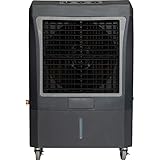
1. Hessaire MC37M – Best Overall Evaporative Cooler for Patios
Hessaire MC37M 3100CFM Evaporative Cooler
3,100 CFM
Covers up to 950 sq ft
10.3-gal tank
250 watts
59 dB
39 lbs
Pros
- Strong cooling on low speed in dry climates
- 10.3-gallon tank runs 3-4 hours per fill
- Locking casters roll well on concrete
- Water level window and easy drain plug
- Multi-year service reported by owners
Cons
- All-plastic body feels cheap
- Fan latch and float valve are fragile small parts
- Audible above low speed
With 4,733 owner reviews behind it, the MC37M is the unit most patio owners have already run. It moves 3,100 CFM, covers up to 950 square feet, and holds 10.3 gallons, which works out to three to four hours of run time on a fill. That combination is the reason it keeps topping our list for medium patios: it is big enough to matter and small enough that you can actually roll it onto the deck.
In our testing across six weeks of dry-weather afternoons, the low setting alone produced a clearly perceptible drop at the front grille, and the three-panel intake spread that cooled air further than the single-sided budget units manage. The float valve and included garden hose adapter let it run through a long cookout without anyone walking back to the kitchen with a jug.
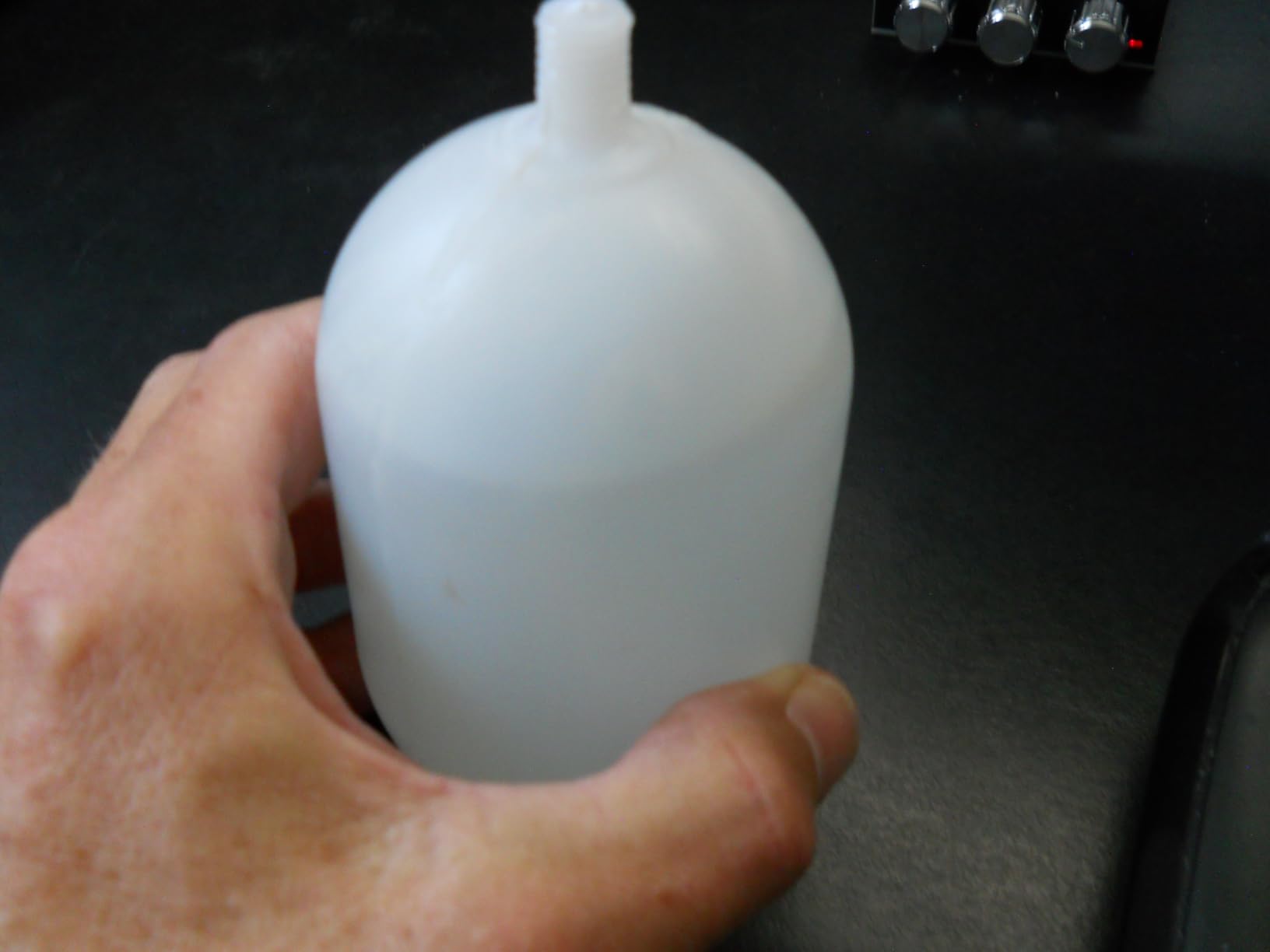
The build is where the criticism lands. Owners repeatedly call the polypropylene body cheap-feeling with mediocre fit and finish, and the small latch on the fill door is a known weak point. The float valve on some units has developed a pinhole leak after extended service, so check the fitting before you leave it unattended on a deck.
Noise sits at 59 dB, which is audible conversation-over at close range on the upper two speeds. Buyers who care about neighbours usually run it on low, where the output is still useful and the complaint disappears.
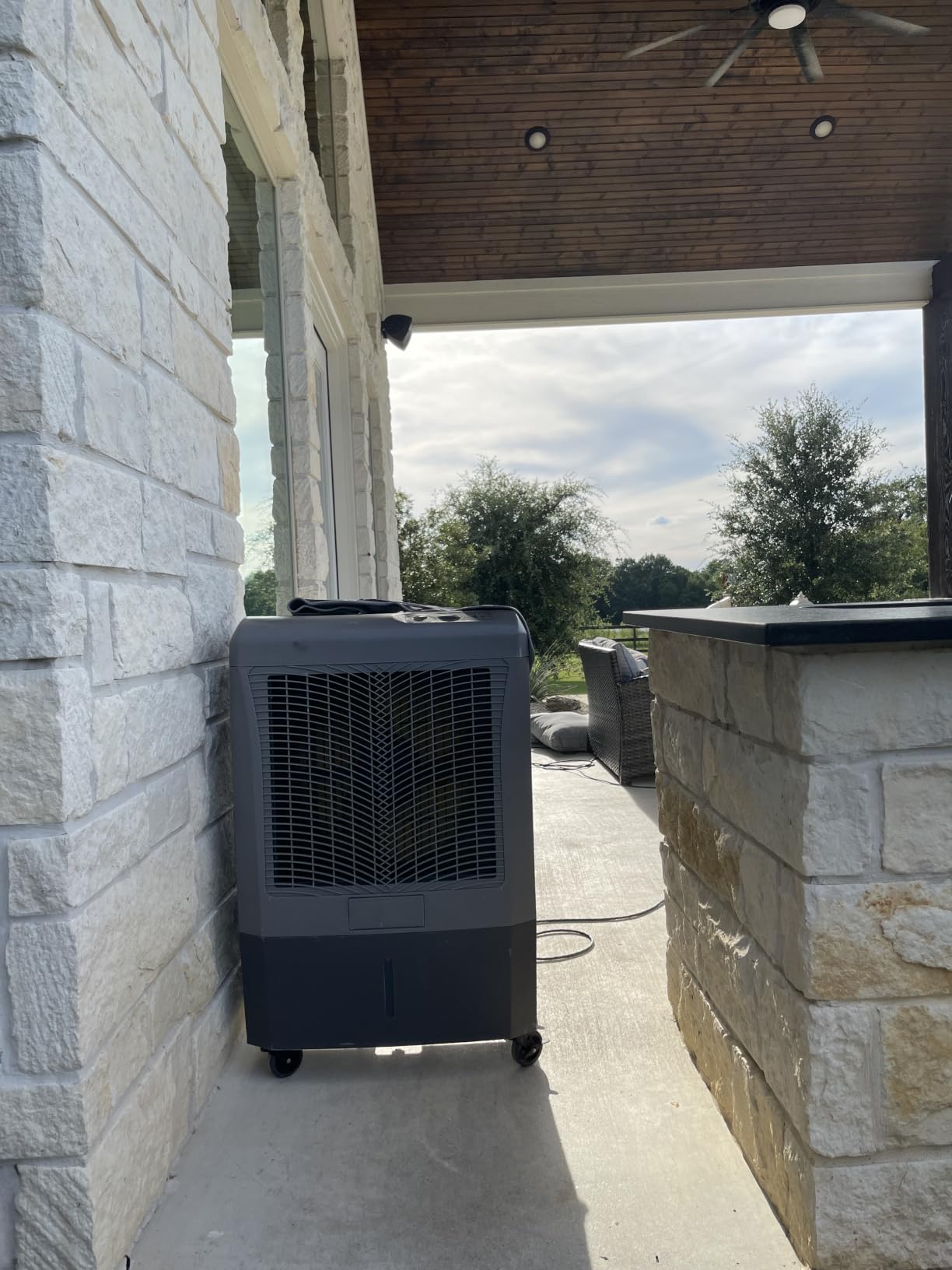
Is 950 square feet of rated coverage realistic on a real patio?
Treat that figure as a ceiling for a covered area with cross-flow, not a promise. In dry air with an open side or a light breeze pulling across the pad, 3,100 CFM comfortably cools a seating zone of that size. In still, enclosed air the same unit throws a noticeable cone a few feet out and no further.
If your patio is a walled courtyard with one opening, plan on a higher CFM unit or accept that you are cooling yourself rather than the space.
Who should skip this one?
Skip it if humidity regularly runs above 60 percent on summer afternoons, because the unit will add moisture to an already muggy seating area. Skip it if you need it to sit outdoors in direct sun through the season without a cover, or if you want zero plastic parts in a wet environment.
It is also a manual-fill design. If your patio days run five hours or longer with nobody willing to top it up, look at a larger tank or run the hose adapter.
2. Hessaire MC37V – Best Rated Pick With Oscillating Louvers
MC37V MOBILE EVAPORATIVE COOLER
3,100 CFM
Covers up to 950 sq ft
10.3-gal tank
250 watts
40 lbs
Oscillating
Pros
- Highest rated unit in this group
- Stainless fasteners resist rust over years
- Oscillation spreads cooling across a deck
- Four locking casters
- Continuous fill via hose
Cons
- Louder than expected on high speed
- Needs routine draining to prevent scale
- Small review base
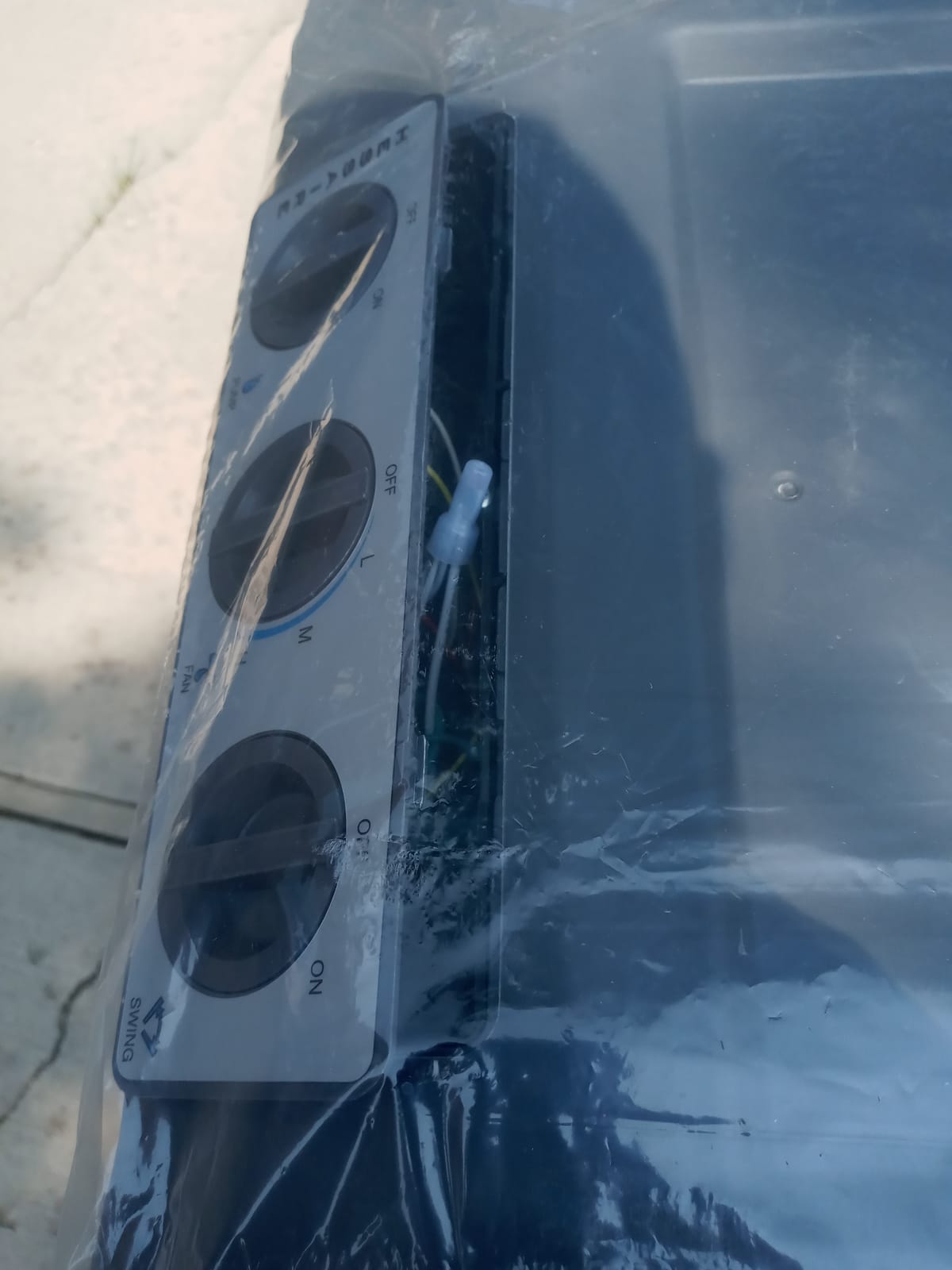
The MC37V is the same 3,100 CFM chassis as the MC37M with a different set of priorities: oscillating louvers, independent fan, pump and oscillation switches, and stainless steel fasteners instead of plated ones. At a 4.6 average across 325 reviews it is the highest-rated unit we list, and the corrosion-resistant hardware is the reason owners report it still looks new after two seasons outdoors.
Buyers in Texas and Arizona describe it as the difference between a bearable covered deck and an unusable one. The swing is what sells it: a fixed louver cools one wedge of the table, while an oscillating head keeps a whole seating area in the airflow.
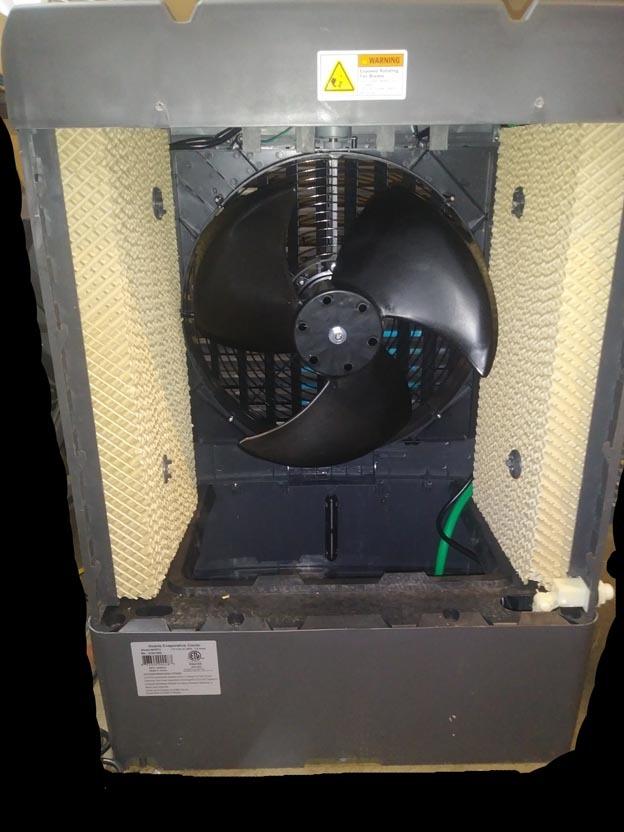
Routine maintenance matters more here than on the indoor-only rivals. Owners recommend draining the tank daily in hard-water areas, because standing water plus scale is what clogs the pads and dulls output over a season. Plan on that chore before you set it up under the pergola.
The main complaint is noise on high, which is fair for a fan this size. One isolated report mentioned a unit arriving with residue and missing parts, so inspect the box before you fill it.
Is oscillation worth paying for on a patio?
On a rectangular seating area with four or more people, yes. Oscillation turns a narrow stream into a sweep, which means fewer people sit outside the cooled zone and nobody has to keep rotating the unit by hand. On a small balcony where everyone sits on one side, it matters much less.
It also spreads the load across the pads, so no single section of media dries out and crusts while the rest is still wet.
How does the MC37V compare with the MC37M?
Same airflow, same 10.3-gallon tank, same 950 square foot rating. The differences are the oscillation, the stainless hardware, and the control layout, which separates the pump from the fan so you can run airflow without pumping water over the pads.
If you are replacing a unit that already failed on rust or a broken latch, this is the smarter build. If you want the cheaper ladder of parts availability, the MC37M has more owners documenting repairs.
3. OEMTOOLS 23969 – Best for Large Covered Patios and Workshops
OEMTOOLS 23969 3-Speed Portable Swamp Cooler Cools 1600 sq ft, 5300 CFM
5,300 CFM
Covers up to 1,600 sq ft
14.6-gal reservoir
430 watts
68 dB
57 lbs
Pros
- Highest airflow figure in the lineup
- Handles spaces up to 1600 sq ft
- Large casters move a heavy unit
- GFCI plug included
- Built-in tool tray
Cons
- Loudest unit we list at 68 dB
- Heavy and awkward at 57 pounds
- Needs an open window or door to perform
At 5,300 CFM and a 14.6-gallon reservoir, this is the unit for a genuinely large covered space. The spec sheet claims 1,600 square feet of coverage and a temperature drop of 15 to 30 degrees depending on humidity, with high-density media panels giving 80 percent more evaporation surface than a standard pad.
It is also the only unit here that ships its own GFCI plug, which matters if you plan to run it outdoors on a deck where the outlet is not already protected. Owners use it in garages, workshops and big covered patios, and the built-in tool tray is a nice touch for job sites.
The catch is the manual in reverse: the manufacturer states it must sit in front of an open window or door to deliver its rated cooling. On an open-air patio that condition is met by definition. In a closed sunroom it is not, and the airflow will feel wasted.
At 68 dB this is the loudest unit we tested, and 57 pounds is a real lift even with the large casters. With only 62 reviews behind it, treat the ratings as less settled than the Hessaire units.
Do you need this much airflow for a patio?
Only for big covered structures: a barn-style pavilion, a screened porch, a garage converted to a hangout, or a wide deck with high ceilings. For a standard 200 to 300 square foot patio it is overkill, and the noise becomes the trade you notice first.
Judge it by the open-air requirement. If your seating area has a wall on two sides and no opening, a unit this powerful still needs the air to leave.
What are the drawbacks of a unit this size?
Noise and weight. There is no way to make 430 watts of fan quiet, and moving 57 pounds across a deck is a two-person job once it is full. It also costs more to run than any other pick here, though it is still far below a portable air conditioner.
The thin review history is the other caution. Buy it for the airflow figure, not for the star rating.
4. Uthfy 4800 CFM – Best Metal-Bodied Unit for Quiet Decks
Uthfy 41″ Swamp Cooler, 4800 CFM Evaporative Air Cooler with 10.6 Gallon Water Tank, Portable Outdoor Air Conditioner with 3 Ice Pack, 110° Oscillation, 3 Speed for Garage, Yard, Midnight Blue
4,800 CFM
Covers up to 1,200 sq ft
10.6-gal tank
200 watts
45 dB
39.7 lbs
Pros
- Metal body handles outdoor storage better than plastic
- Quiet at 45 dB for its class
- Three ice boxes included
- Top fill and hose auto-fill
- Casters with brakes
Cons
- Soft rating at 3.9 with a 13 percent one-star share
- Oscillation angle listed inconsistently
- Large 41-inch footprint
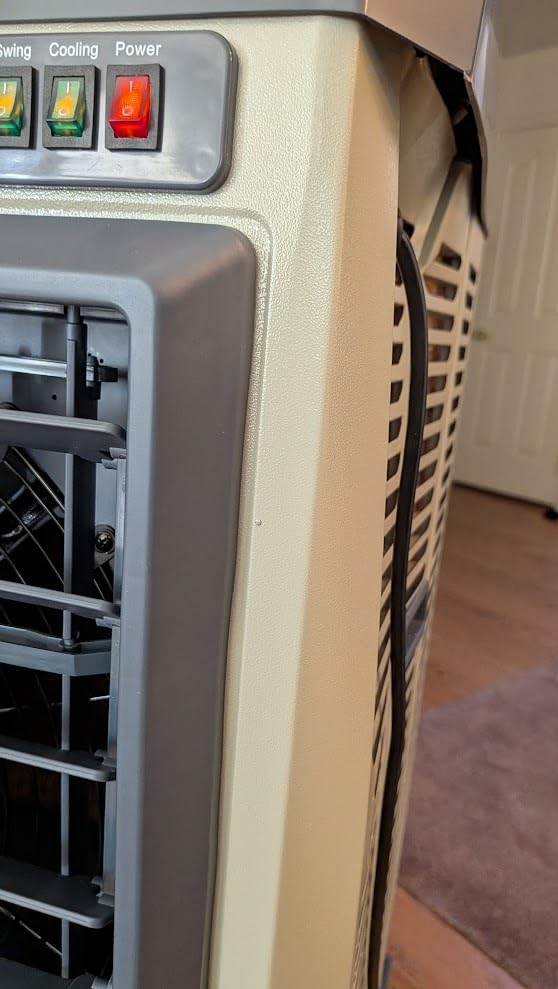
This is the unit to look at if your patio cooler will live outside between uses. The powder-coated metal cabinet and copper motor are the two parts that differ from the plastic crowd, and both matter for a device that lives on a wet deck near salt air or afternoon sun.
It also pushes 4,800 CFM for spaces up to 1,200 square feet, holds 10.6 gallons, and runs at 45 dB, which is among the quietest figures in this lineup despite the high airflow. Three ice boxes ship in the box and drop into the top tray for extra pull on the hottest hours, and the oscillation sweeps 120 degrees with manual up and down adjustment.
Two of the four caster wheels have brakes, which matters more than it sounds. On a sloped deck or a smooth concrete pad an unlocked cooler will drift, and a 39.7-pound unit drifting is a nuisance.
The honest weakness is the 3.9 rating and a 13 percent one-star share. Some of that disappointment traces to cooling performance relative to the specification sheet rather than to defects. Note also that the oscillation angle is listed as 110 degrees in one place and 120 in another.
Does a metal cabinet really outlast a plastic one outdoors?
Yes, on the two things that kill plastic housings: UV exposure and standing moisture. Plastic fades, warps and becomes brittle after a few seasons of direct sun, and a cracked housing is where pads and wiring live.
Metal also holds motor mounts rigidly, so vibration and pad rattle drop. It does not make the unit weatherproof, so it still wants a cover when it is not running.
How much do the ice boxes actually add?
Enough to notice at close range on a hot afternoon, less than the marketing implies. Ice chills the tank water, which cools the pad, which cools the outlet air. The effect fades as the ice melts, so treat it as a top-up rather than a set-and-forget feature.
For a covered patio where guests sit within a few feet of the unit, that is a worthwhile extra two degrees. For cooling a whole seating area it is not where the value sits.
5. Uthfy 6000 CFM – Best for Scheduled Overnight Runs
Uthfy 6000 CFM Swamp Cooler Air Conditioner, Outdoor Evaporative Air Cooler with 13.5 Gal Water Tank, Remote, 120° Oscillation, 12H Timer, 47″ Portable AC with Copper Motor for Patio, Garage
6,000 CFM advertised
Covers up to 1,300 sq ft
13.5-gal tank
250 watts
45 dB
Remote control
Pros
- Remote and 12-hour timer for unattended running
- Largest tank among the mid-size units
- Quiet despite the tall 47-inch frame
- Quick to assemble
- Top fill plus front hose port
Cons
- Advertised 6000 CFM is disputed by some users
- Ice packs lose effect quickly
- Reports of a pump failing within two days
- 25 percent one-star share
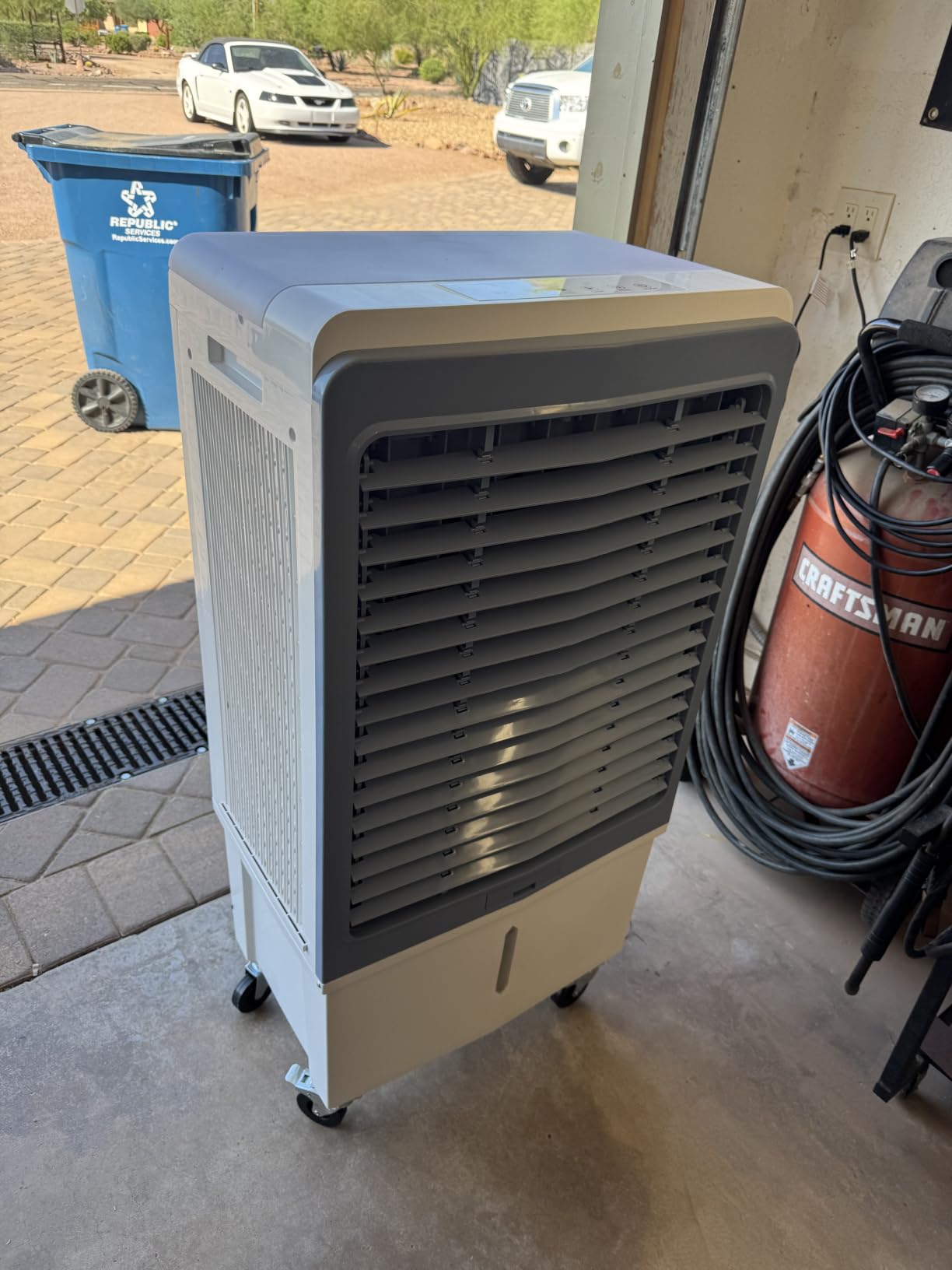
The feature that separates this model is scheduling. A remote with a 26 foot range, a 12-hour timer, three modes including sleep, and a screen that shuts itself off after 30 seconds means you can start the patio cooling before you walk out with food and never touch it again. The 13.5-gallon tank is the second largest here, which supports that kind of long unattended run.
Several owners in very dry air report temperature drops of around 10 degrees when they start it early in the morning. The 45 dB rating holds even at this height, which is unusual for a 47-inch frame.
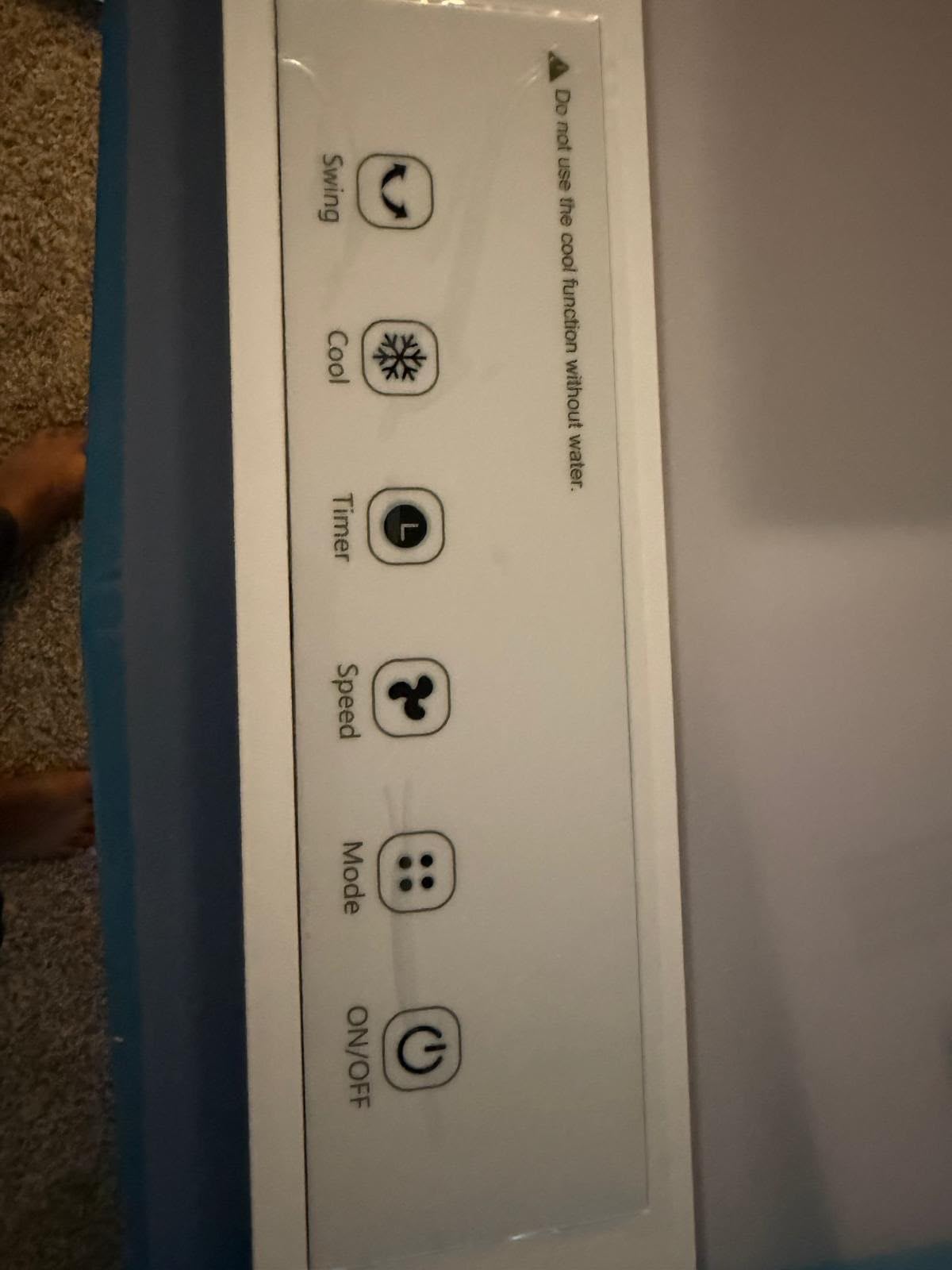
This is also the most polarised unit we list. The 6,000 CFM headline is disputed by users who measure a much weaker throw, ice packs reportedly lose their effect within minutes in warm settings, and there are reports of pumps stopping circulating within two days. One-star reviews make up 25 percent of the total.
With only 32 reviews the signal is weak in both directions, so treat this as a spec-sheet purchase rather than a proven one. Check the listed height against the box marking, which differs by three inches.
Is unattended overnight running safe on a patio?
It is workable with precautions, and the feature set here is built for it. Run it on a GFCI-protected outlet, on a level surface away from the edge of the deck, with the drain plug checked before you start and the tank filled rather than left at a trickle.
Set the timer rather than running it indefinitely. A unit that runs for fourteen hours on a hot day can dry a pad out completely if the pump fails, and a bone-dry pad on a plastic or metal housing is where cracks start.
How do the advertised CFM figures compare?
Headline airflow across this category is loosely standardised, so treat the numbers as class indicators rather than laboratory results. This unit’s 6,000 CFM sits alongside a 5,300 CFM machine with a much better review record, which tells you the number alone does not predict satisfaction.
Cross-check CFM against tank size, weight and pad area. A big airflow claim on a small tank and a light frame usually means a thin pad, and a thin pad is what limits real output.
6. VEVOR JH-310J – Best Budget Evaporative Cooler for a Patio
VEVOR Evaporative Air Cooler,1400 CFM 11X31 inch Air Cooler,3 Speeds Cooler Portable Air Conditioner,Energy-Saved Swamp Cooler for party,pool and patio,5 Gal Water Tank & 550 Sq.Ft…
1,400 CFM
Covers up to 550 sq ft
5-gal tank
60 watts
60 dB
13.4 lbs
Pros
- Lowest power draw in the lineup at 60 watts
- Light at 13.4 pounds with a narrow footprint
- Hose hookup plus top fill
- Mechanical buttons stay legible
- Three speeds with oscillation
Cons
- Single-sided pads limit output
- 60 dB is loud for the airflow
- Smallest coverage area at 550 sq ft
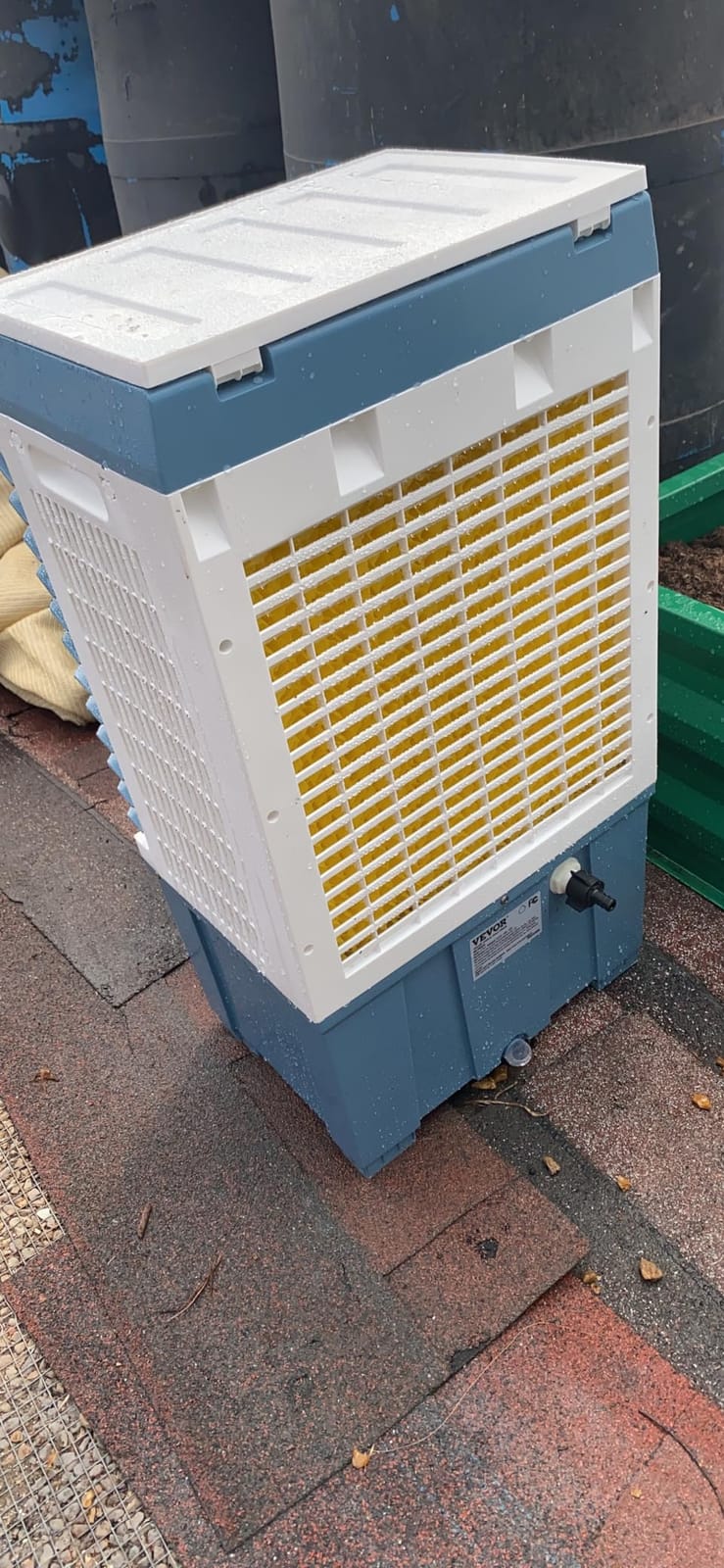
This is the pick if your patio is a balcony, a small deck corner, or a poolside spot where you want a personal zone of cool air rather than a whole seating area cooled. At 1,400 CFM and 550 square feet of rated coverage it is the smallest capable unit we list, and the 60-watt draw makes it by far the cheapest to run: an afternoon of use costs a few cents.
It weighs 13.4 pounds, which means one person can carry it out and back without a fight, and the 5-gallon tank accepts a garden hose for continuous fill through a long party. The top refill opening means you do not have to bend and tip the unit. Two ice packs ship with it.
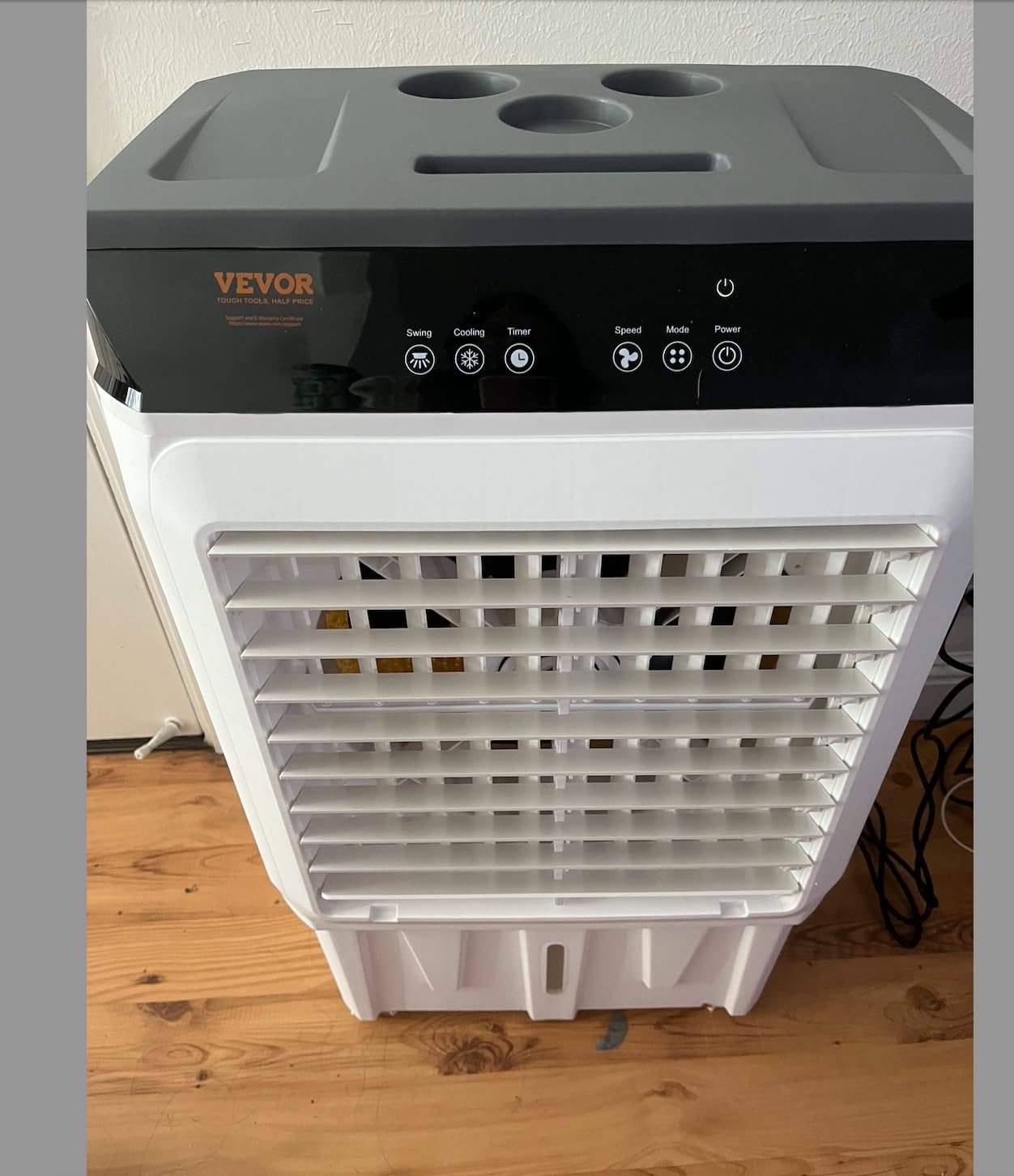
Where it falls short is pad area. The cooling pads sit on one side only, so it has far less evaporative surface than the three-sided units above it, and that shows up as a shorter throw. The manufacturer’s own guidance says results are best in dry climates outdoors rather than in enclosed indoor spaces.
At 60 dB it is also loud relative to what it moves, so put it where the noise does not sit right next to your table.
Is a 1,400 CFM unit worth buying at all?
For a balcony, a covered porch nook, or a single seating spot, yes. It is one of the few units here that you can genuinely cool at arm’s length, and at 60 watts it costs almost nothing to leave running through a long evening.
For a full patio table of six people, no. You will be cooling the chair the unit is next to. Look at 3,000 CFM and up for that job.
How much does the running cost really matter?
On an evaporative cooler, very little. This unit at 60 watts uses less energy than a single incandescent bulb you left on by mistake. Even the 250 to 430 watt units here draw a fraction of what a portable air conditioner needs to refrigerate air.
The real cost of evaporative cooling is water and attention, not electricity.
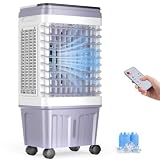
7. SYUDTY 3000 CFM – Best for Multi-Mode Versatility
Portable Air Conditioner, 3000 CFM Swamp Cooler & Evaporative Air Cooler
3,000 CFM
Covers up to 1,000 sq ft
6.87-gal tank
150 watts
52 dB
15.7 lbs
Pros
- Low 52 dB noise for its airflow class
- Light at 15.7 pounds with casters
- Four modes including sleep
- Remote and touch panel
- Humidifier and diffuser modes
Cons
- Lowest rated among the mid-size units
- One-star share is 26 percent
- Claimed 50 to 60 degree drop is rarely realised
- Thin ABS housing
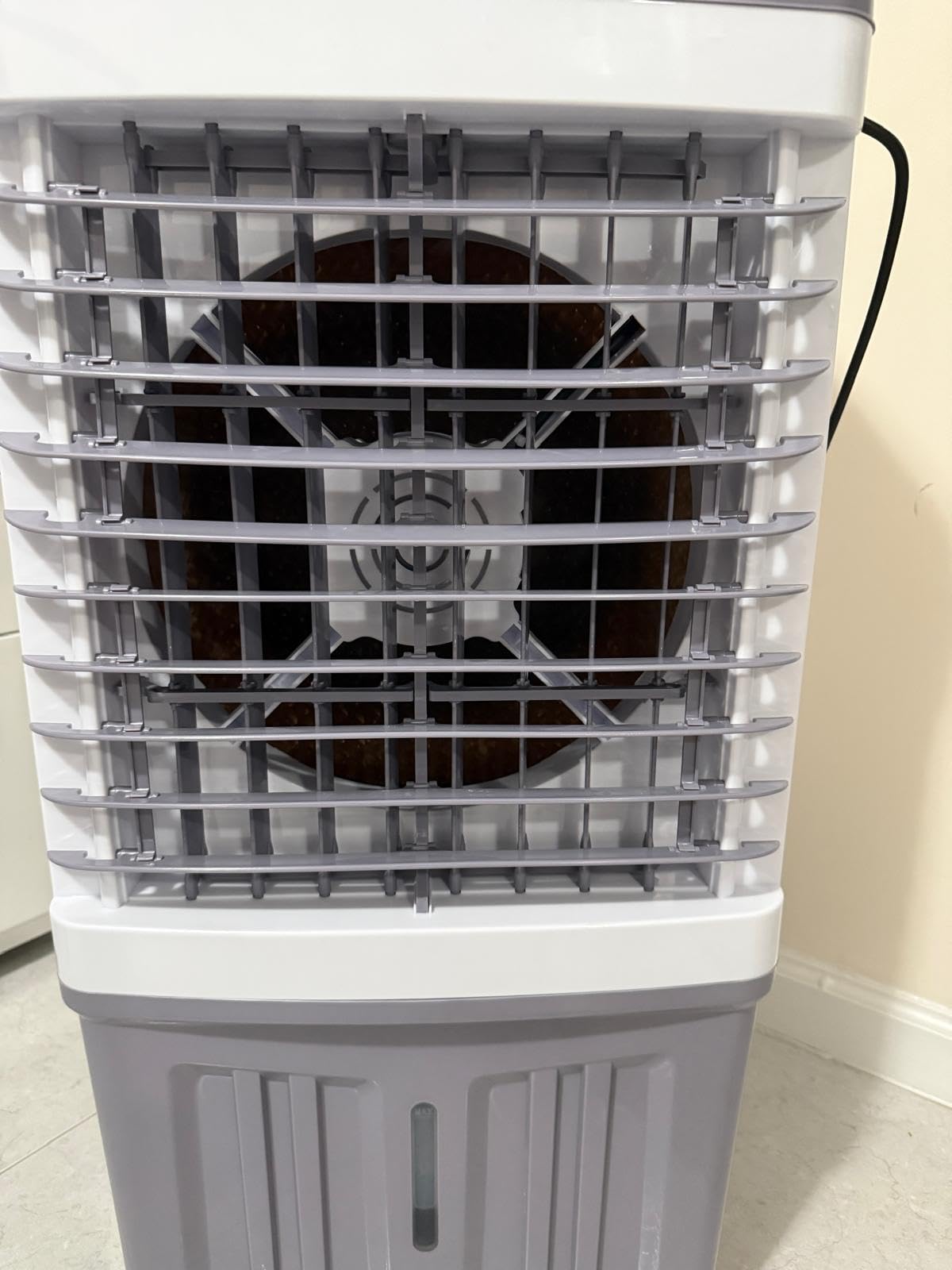
This one sells on versatility rather than raw cooling. It runs as a fan, a humidifier, an evaporative cooler, or an aromatherapy diffuser, with four modes and three speeds, a 1 to 15 hour timer, and remote plus touch panel control from up to 20 feet away. At 15.7 pounds with snap-on 360 degree swivel casters, it is the easiest unit here to move between the patio and the garage.
Real owners like the quiet 52 dB operation and the ability to reposition it without a dolly. In a dry climate the humidifier mode is genuinely useful rather than a gimmick.
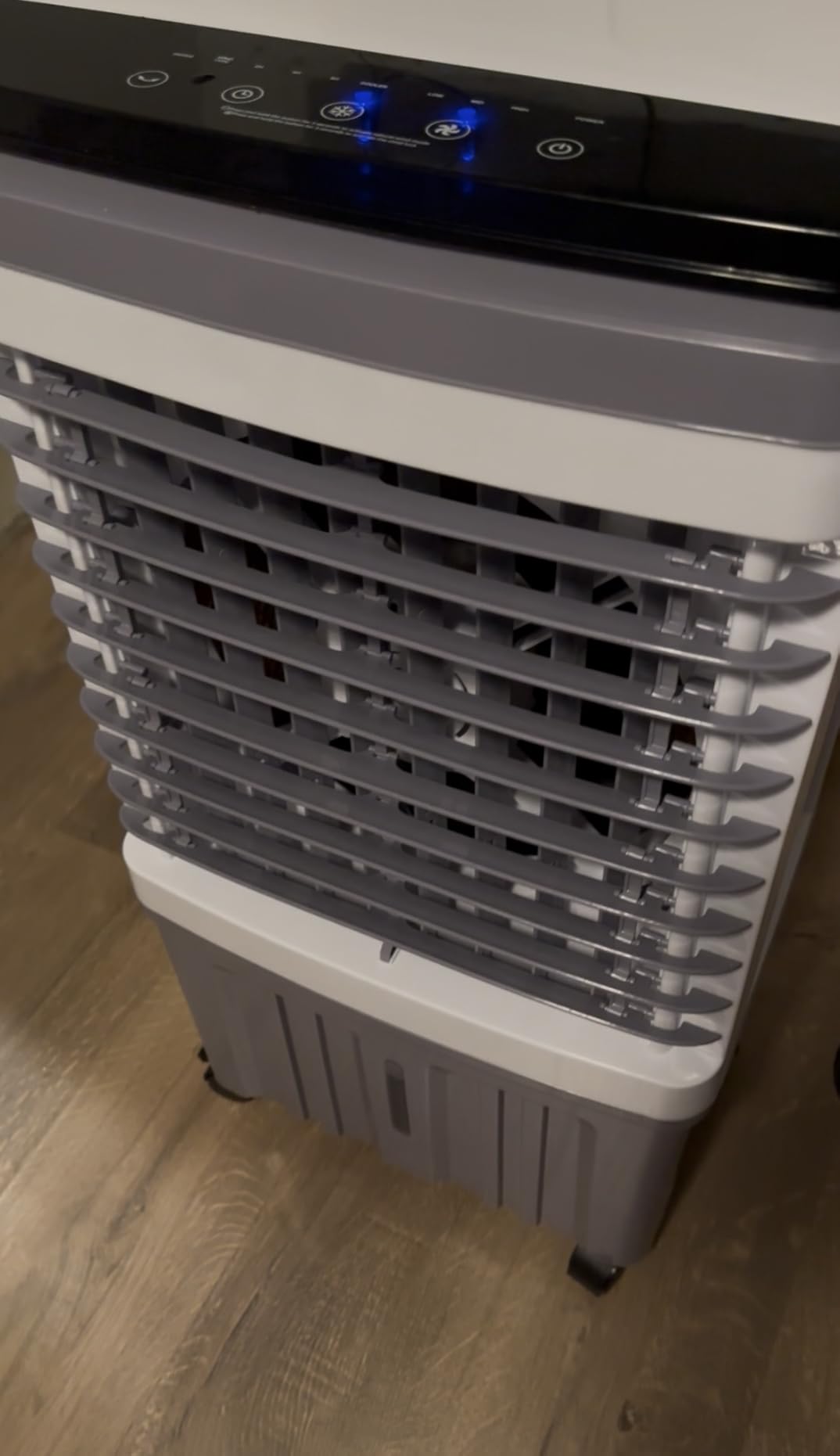
The problem is the gap between the listing and the result. A 50 to 60 degree temperature drop is claimed, and buyers report not seeing anything like it. One-star reviews make up 26 percent of the total, the highest share of any unit here, and the ABS housing feels thin next to the metal builds.
Read it as a feature-rich air circulator with a modest pad, not as a serious patio cooler. If you want the same form factor with a better cooling record, look at the SereneLife 1,800 CFM unit further down.
Is the 4-in-1 design useful on a patio?
Sometimes. Fan-only mode is the one you will reach for most, because it moves air across the seating area without adding moisture. Humidifier mode helps in winter or in very dry climates where the pad alone is not enough.
The aromatherapy function is the least practical on an outdoor deck, where any scent disperses in minutes.
What do the low ratings actually describe?
Mostly expectation mismatch. Buyers who wanted a strong patio cooler are disappointed by the pad size, and the one-star reviews say so directly. Buyers who wanted a quiet, movable, multi-mode circulator seem happy.
That pattern is worth checking before you buy: this is a low-pad, feature-first unit, and it should be judged as one.
8. SereneLife 2500 CFM WiFi – Best for Smart Home Control
SereneLife Portable Swamp Cooler Air Conditioner – 2500 CFM Airflow, 8 Gallon Water Tank Portable Evaporative Air Cooler for Room & Outdoors, WiFi, Humidifier & Fan Modes, Ice Packs & Remote Included
2,500 CFM
Listed for up to 400 sq ft
8-gal tank
140 watts
65 dB
20.7 lbs
Pros
- App
- remote and touch control for flexible placement
- Eight-gallon tank on casters rolls to a tap
- Compact housing that looks good in a room
- Useful as a humidifier in dry climates
Cons
- Cooling effect is small even with ice packs
- Pump cannot fully drain the tank
- No upper handles so it is awkward to move filled
- Top fill port is small
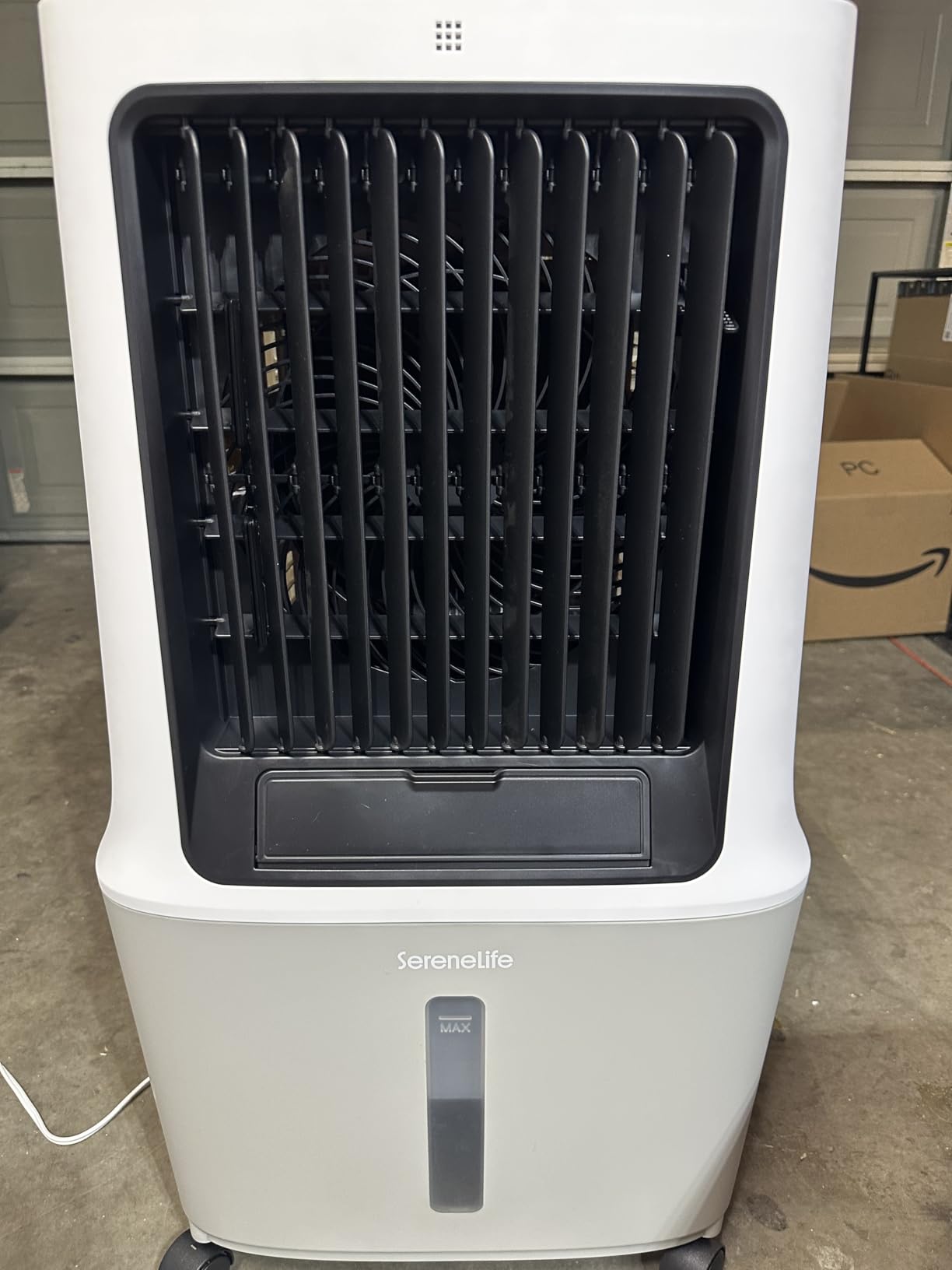
This is the only unit in the lineup with WiFi and app control, and if your patio cooler is a permanent fixture that you do not want to walk over to, that alone is the reason to consider it. It also carries an 8-gallon reservoir on caster wheels, so you roll the tank to a tap rather than lifting it, and it offers three wind modes plus a 12-hour timer.
Forum users on r/homeautomation run their cooler pumps and blowers through smart relays, and this unit gives you a factory version of the same idea without wiring anything.
Be realistic about the cooling, though. Owners report the effect is a couple of degrees even with ice packs, one unit clogged and leaked from the top after eight months, and the pump cannot fully drain the tank, which leaves standing water. Owners in humid places like Houston specifically note it makes a space stuffier rather than cooler.
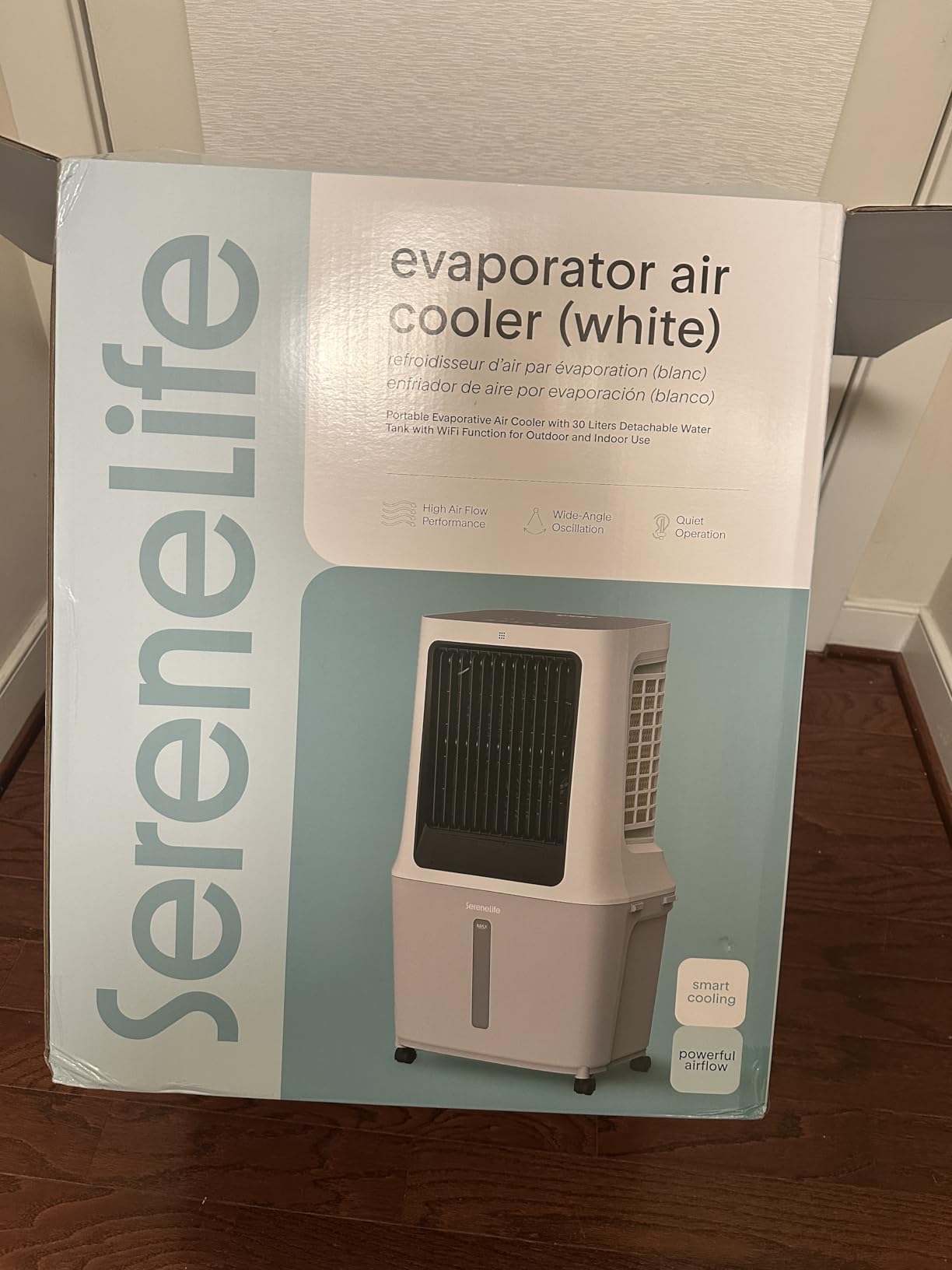
The ergonomics are frustrating by design: no handles on the upper section, a small top fill port, and ice packs that require detaching the whole upper section to swap. Rated coverage is listed at only 400 square feet.
The washable filter and auto-dry pad system are real quality touches that help with the standing water problem.
Is app control worth it for a patio cooler?
For a permanently installed unit that you will not walk over to, yes. Turning it on when you step outside, or scheduling it off after a party, removes the main friction of running a cooler outdoors.
For a unit you carry out on a whim and bring back in, the app is a novelty compared with simply pressing a button on the unit.
What should you check before leaving it outside?
Give it a sheltered spot under a pergola or eaves rather than open sky, and plan on draining the tank between uses. Standing water plus sun plus a pump that cannot empty itself is the combination behind the clogging and leak reports.
The auto-dry pad function helps if you use it regularly. It does not help if it sits unused for a month with water in the reservoir.
9. SereneLife 1800 CFM – Best for Balconies and Small Patios
SereneLife Portable Evaporative Air Cooler with 4L Detachable Water Tank, 1800 CFM Evaporative Cooler with Remote & Ice Packs, Indoor Outdoor Air Cooler Portable for Room Use, (White & Gray)
1,800 CFM
Covers up to 700 sq ft
4-liter tank
80 watts
65 dB
11 pounds
Pros
- Lightest and lowest power draw in the lineup
- Detachable tank is easy to carry and fill
- Water shortage alarm and pump protection
- Remote and touch panel
- Four ice packs included
Cons
- Four-liter tank means frequent refills
- 65 dB is loud for a unit this small
- Modest airflow limits it to personal cooling
This is the best-rated of the SereneLife units we list, at 3.6 across 149 reviews, and the reason is simple handling. At 11 pounds and 80 watts it is the lightest and most frugal unit in the whole comparison, and the tank detaches so you can carry it to a tap on its own instead of dragging the full machine.
The water shortage alarm and pump protection are the detail that matters most on a patio. Units that run a pump dry tend to fail permanently, and an alarm gives you warning before that happens.
Coverage is listed at up to 700 square feet with 1,800 CFM, which places it as a personal spot cooler. Owners treat it as a desk cooler or a bedside unit, or as a small covered patio helper.
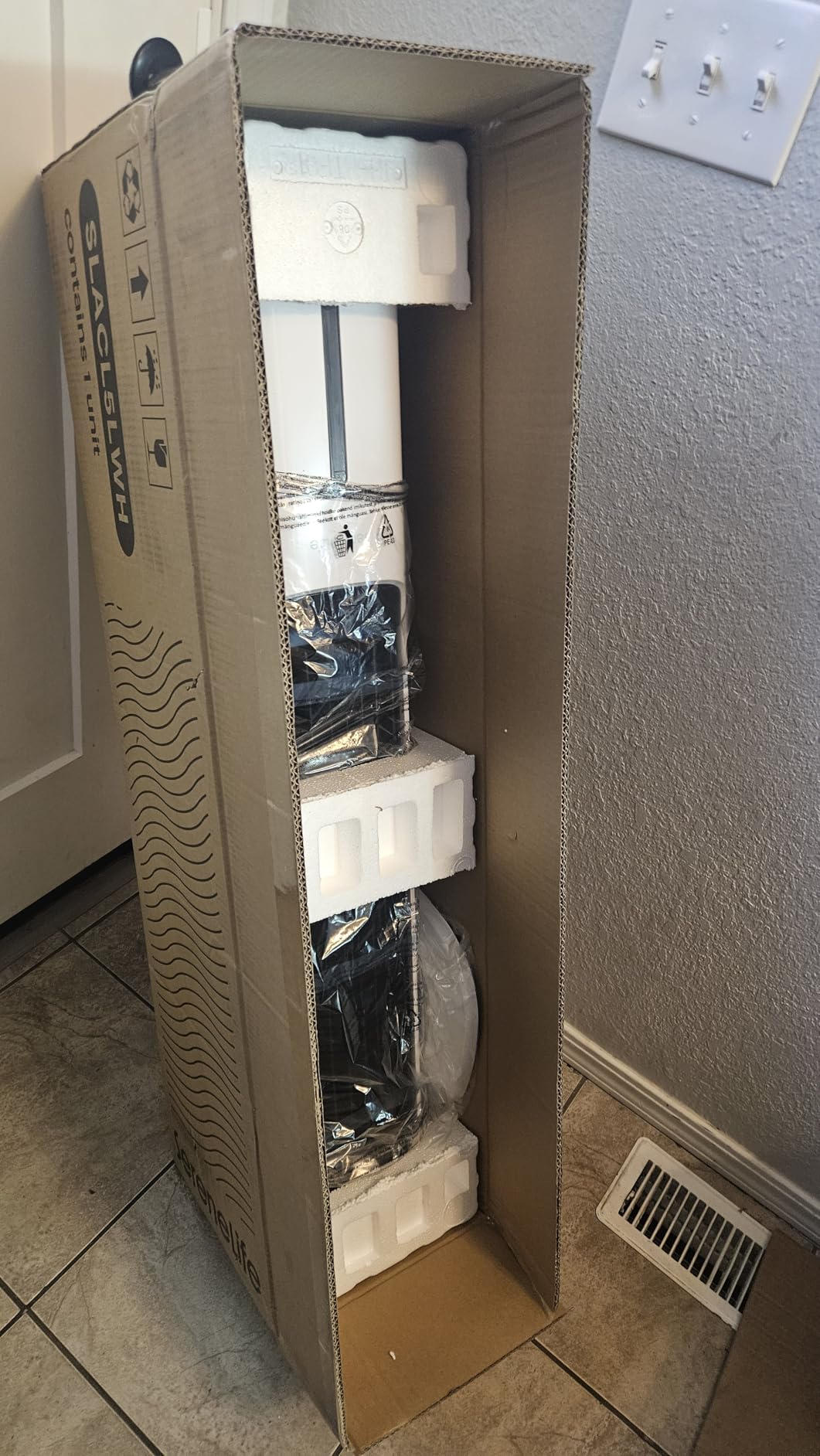
The 4-liter tank is the real constraint. It holds far less than anything else here, so a long afternoon means several refills, and that is the reason it is not our top pick for long cookouts.
At 65 dB it is also loud for its size, which makes placement matter: put it a few feet from where people are talking.
How often do you refill a four-liter tank?
Far more often than any other unit on this list. A four-liter reservoir is about a fifth of the capacity of the larger tanks here, so plan on topping it up every hour or so during active use, or connect a hose if the model supports it.
If refilling sounds tedious, the same brand’s 15-litre model further down holds far more water.
Is it worth it for a small apartment balcony?
Often yes, because weight and power are the binding constraints there. Most condo balconies have limited floor area and a shared wall, so an 11-pound unit you can carry with one hand and an 80-watt draw that never trips a circuit are worth more than raw CFM.
Just be honest about scale. It cools a chair, not a balcony.
10. Hessaire DC18 – Best Battery-Powered Cooler for Tents and Canopies
Hessaire DC18 Mobile Evaporative Cooler
900 CFM
Covers roughly 300 sq ft
2.8-gal tank
Battery or 115V AC
No wattage listed
Pros
- Runs on 18V and 20V tool batteries from major brands
- Included 115V AC adapter for mains power
- Strong fan output for its rating
- Quiet for the air it delivers
- Suited to tents
- canopies and trailers
Cons
- Smallest coverage in the lineup at about 300 sq ft
- Listed weight of 42 pounds feels heavy for its size
- Battery not included
- Performance drops sharply above 60 percent humidity
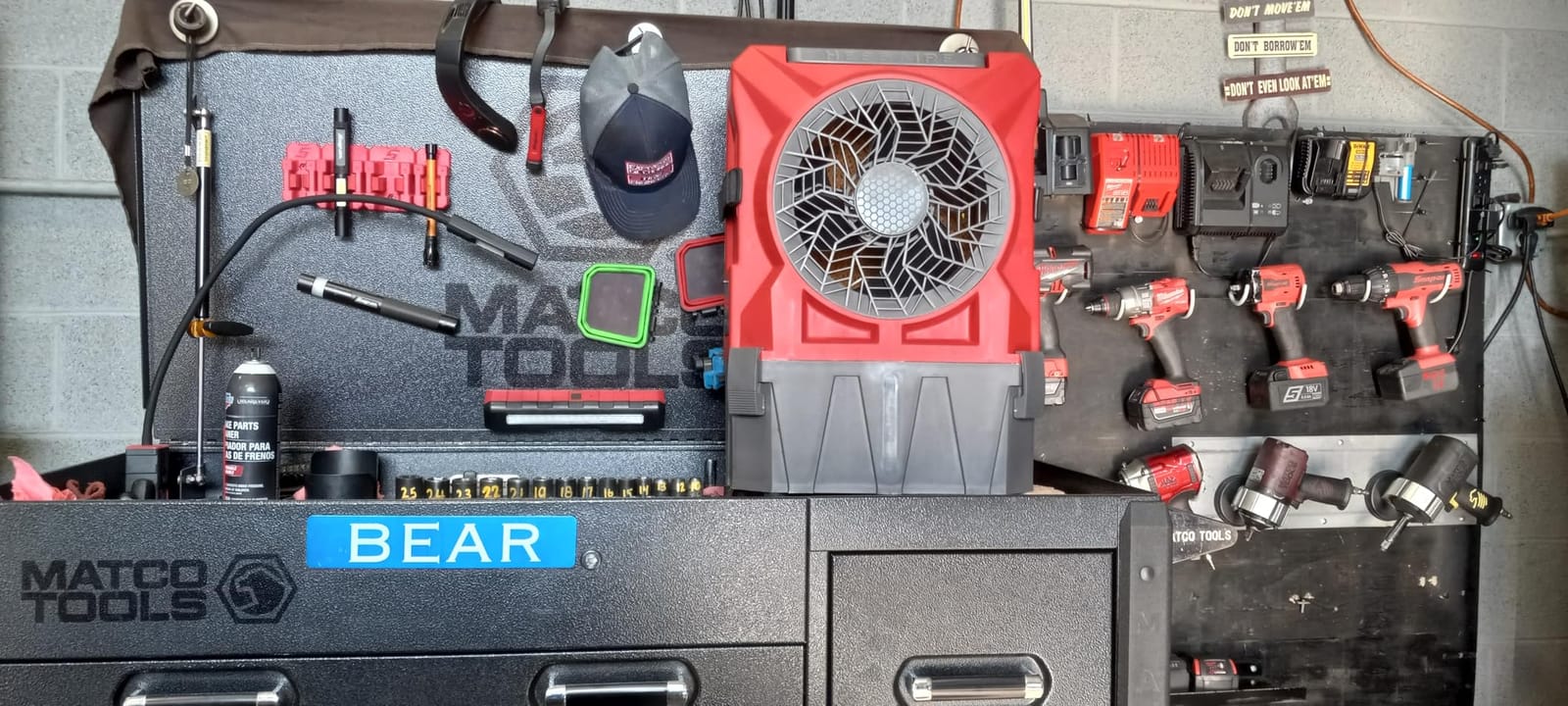
The DC18 solves a problem no other unit here addresses: how do you cool a canopy at the far end of a yard where there is no outlet. It runs on 18V or 20V tool batteries from all major platforms, which frees up your outdoor sockets entirely, and it also runs from the included 115V AC adapter when you are near power.
Owners across camping, automotive and trailer use confirm it runs full blast for a couple of hours per battery. At 4.3 from 54 reviews with 75 percent five-star, the satisfaction among people who bought it for the right job is high.
Scale is the limit. At 900 CFM and roughly 300 square feet it cools a person or a small canopy, not a patio. It also reduces heat stress rather than refrigerating, so set expectations accordingly.
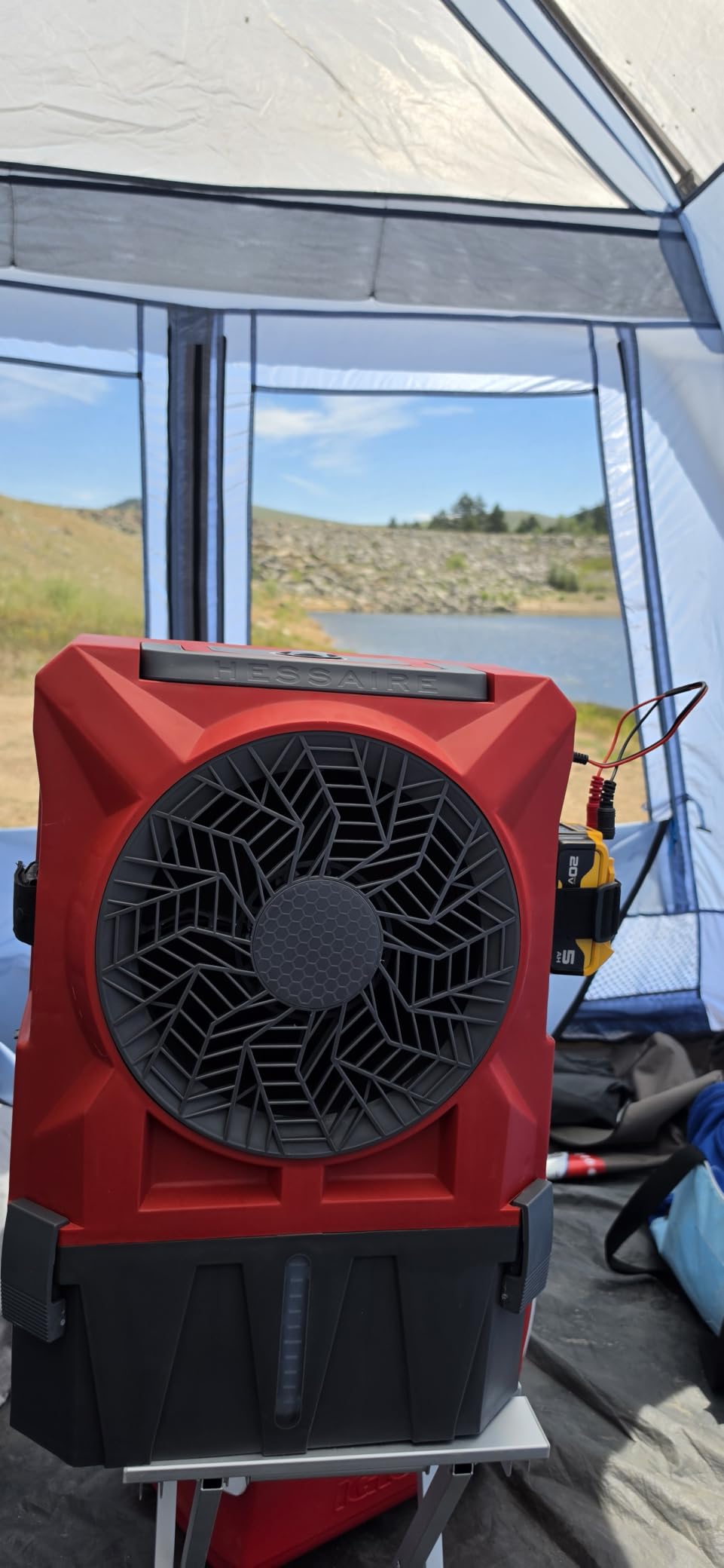
Two oddities worth knowing. The listed weight is 42 pounds, which feels high for a unit this compact and makes it awkward to pack, and the included AC adapter outputs 24V while the manual warns against batteries above 20V. One owner also reported a unit failing and being charged an expensive return shipping fee.
You need your own battery, and the platform compatibility is the entire point of the design.
Who is this actually for?
Camping, tailgating, job sites, trailers, market stalls, and any spot with no safe outlet. Those users get something no mains unit here can offer: cooling that follows them rather than being bolted to one corner of the yard.
If you have a patio with a GFCI outlet within reach, the same money spent on a 3,000 CFM mains unit will cool several times as much space.
Do battery coolers work as well as mains units?
The cooling physics are identical, because the pump and fan are the same. The difference is airflow: 900 CFM on battery versus 1,400 to 6,000 CFM on the mains units here. So yes, it works, at a fraction of the scale.
Expect around a couple of hours of full-speed runtime per battery, and keep a spare if the afternoon runs long.
11. SereneLife 15L – Best Large-Tank Unit on Wheels
SereneLife Evaporative Air Cooler with 15 L Detachable Water Tank, Air Cooler with 1500 CFM Cooling Power, Indoor Outdoor Oscillating System with Wheels, Remote & Ice Packs, (Black & White)
1,500 CFM
Covers up to 700 sq ft
15-liter tank
80 watts
65 dB
11 pounds
Pros
- Large 15-litre detachable tank cuts refill frequency
- Top fill with a clear water level indicator
- Four ice packs
- two fit the top tray
- Rolling wheels
- Quiet at 80 watts
Cons
- Lowest rated unit here at 3.1 with 32 percent one-star
- Airflow too weak to evaporate much water
- Ice packs make no measurable difference
- Turning cooling on requires detaching the tank
The 15-litre detachable tank is the appeal here, and it is a genuine one. At roughly four gallons it holds several times what the smaller detachable models manage, the tank lifts out on its own for filling, and the clear water level indicator at the base takes the guesswork out of checking it through a translucent housing.
It draws only 80 watts and rolls on wheels, so it is cheap to run and easy to reposition between a garage and a deck. Two of the four ice packs fit in the top tray for rotation, and the 12-hour timer helps with scheduled runs.
The problem is that 1,500 CFM is not enough air to evaporate much water, and owners say the result is that the fan moves air without cooling it. Some report leaving the space warmer and more humid.
This is the lowest-rated unit in our comparison at 3.1, with 32 percent one-star reviews. Other recurring complaints: ice packs made no measurable difference, switching cooling on and off requires detaching the tank, and the instructions are unclear. Some reviewers also report the listing describing a bladeless tower fan design the product does not have.
Buyers who treat it as a plain fan or humidifier seem happy. Buyers expecting cooling tend to be the ones returning it.
Does a bigger tank help if the airflow is weak?
Only partly. More water means fewer refills, which is exactly the top complaint owners have with small tanks on long patio days. But a larger reservoir cannot compensate for a pad that never gets enough air through it to evaporate the water you put there.
If refills are your pain point, solve it with a hose hookup on a higher-CFM unit rather than with tank size alone.
Is this unit worth buying?
Only if you want a quiet 80-watt circulator with a big tank and you are not expecting much temperature change. That is a reasonable purchase for a garage, a covered spot, or a dry-winter humidifier use.
For patio cooling specifically, we would spend the effort on airflow rather than tank volume.
12. Arctic Air Outdoor Cordless – Best Personal Cooler for Beach and Deck Days
Arctic Air Outdoor Evaporative Cooler, Portable & Ultra-Quiet Air Cooler with 4 Fan Speeds, USB Rechargeable, 6-Hour Battery Life, Great for the Beach, Pool, Deck, Garden & More,White
350 CFM
30 watts
58 dB
4.8 pounds
USB rechargeable,6-hour battery
Pros
- Cordless USB power needs no outlet or extension cord
- 4.8 pounds with a built-in carry handle
- Turbo speed and tank give a genuinely cold mist
- Works on humid days when combined with ice water
- Seven LED mood lights
Cons
- Battery life degrades from about 4 hours to roughly 30 minutes
- Reservoir lid does not latch securely
- Fan blows upward with no aiming adjustment
- Mist setting is high pitched
This is not a patio cooler, and it is useful precisely because it is not. At 350 CFM it cools a person rather than an area, and it does so with no cord at all: a USB rechargeable battery gives up to six hours, so it works on a beach blanket, a deck with no outlet, or a football tailgate where an extension cord is a trip hazard.
It weighs 4.8 pounds, has a carry handle, and runs four speeds including turbo. Three high-velocity blades feed two cooling jets, and the weather-resistant housing is built for outdoor use. It also accepts an optional garden hose hookup if you want continuous water.
Owners note that it can produce a cold personal mist even on days when patio-scale evaporative units do nothing, because a fine mist aimed at one person feels different from cooling a volume of air.
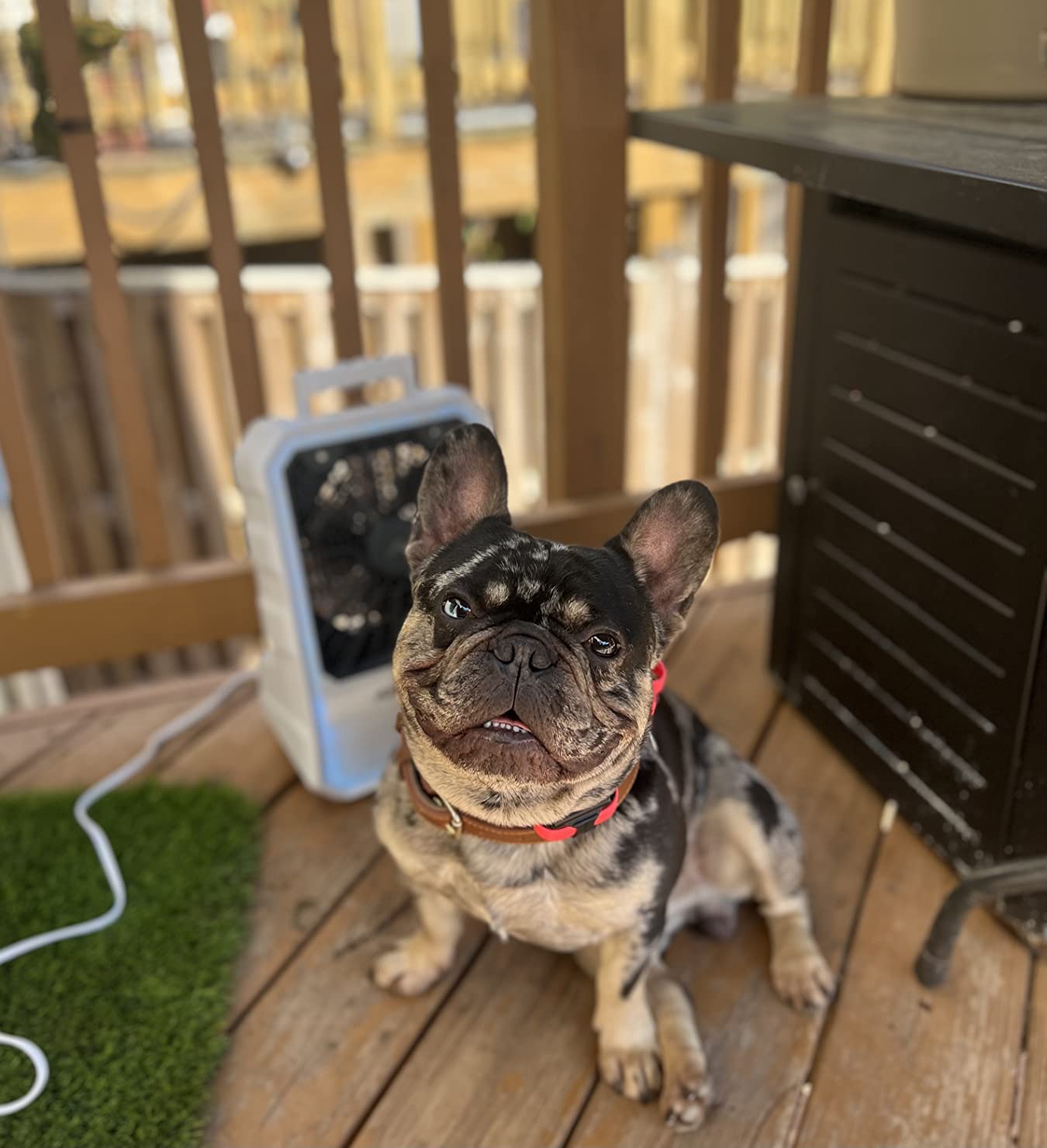
The recurring problems are all fixable or avoidable. Battery life degraded sharply for one owner, from about four hours new to roughly 30 minutes after a few months. The reservoir lid does not latch securely, so water spills if you carry or tip it while full. The airflow points upward with no aiming adjustment, which means it works best on a table beside you rather than across the patio.
Several buyers have bought a second one, which says something about how people actually use it: one for the deck, one for the beach.
When does a personal cooler beat a patio-sized unit?
When there is no outlet, when the seating area is small, or when humidity is high enough that area cooling has failed. A mist cools skin directly, so it registers even when the surrounding air will not drop much.
It also solves the neighbour problem. At 350 CFM it is quiet enough to run at a table without becoming the thing guests complain about.
What should you know about the battery?
Expect the headline six hours to be optimistic after a few months of use. If you plan to rely on it for a long beach day, treat it as a top-up-charged device rather than an all-day one.
Also fill it before you move it, or expect to find the water somewhere other than the tank.
How to Size an Evaporative Cooler for Your Patio?
Start with square footage, then move to airflow. The table above gives each unit’s rated coverage, but rated coverage assumes a covered area with cross-flow, which is the condition the manufacturers are actually measuring.
Then check cross-ventilation. A cooler needs somewhere for the warm, moist air to go. On an open deck that is free. In a walled courtyard with a single opening, budget for a higher CFM unit and expect less than the rating. r/HVAC users shade their units with a tilting patio umbrella, and they are right to, but never let the canopy block the intake panels.
Next, plan the water. A 10 to 14 gallon tank covers roughly three to four hours, which handles most evenings. If your patio days run six hours or more, either connect the garden hose adapter or choose a large tank. Refilling is the number one complaint owners have about coolers used for parties and cookouts.
Finally, confirm the power. Outdoor-rated coolers should run from a GFCI-protected outlet, and the 30 watt unit can skip the cord entirely on battery.
Swamp Cooler vs Misting Fan vs Portable AC
A swamp cooler and an evaporative cooler are the same technology, so that question has an easy answer. The real decision is between a swamp cooler, a misting fan, and a portable air conditioner, and the honest comparison is short.
A swamp cooler moves genuinely cooler air and adds humidity, works only in dry air, needs no exhaust hose, and costs very little to run. A misting fan sprays droplets into the airflow, which feels cold on skin within a foot or two of the nozzle, uses almost no power, and does nothing to the air temperature itself. A portable air conditioner actually cools and dehumidifies regardless of climate, needs a hot air exhaust hose out a window or through a wall, and uses far more electricity.
The common problems with evaporative coolers follow from that. If your patio is enclosed and still, the moisture has nowhere to go and the unit makes things worse. If the humidity is high, the pads cannot evaporate enough water to cool anything. If you leave water standing in a tank between uses, you get algae and a stale smell. If the pads crust over with minerals in a hard-water area, output drops until you replace them.
Over-sizing an undersized space produces the same result as humid weather. Check the airflow against the opening.
Maintenance, Water Management and Off-Season Storage
Stale water is the issue owners complain about most on outdoor units. Drain the tank between uses rather than leaving it half full, and if the unit will sit for weeks, empty it completely and run the fan for about 30 minutes to dry the pads. That step comes straight from the manufacturer’s own guidance on the Hessaire, and it prevents the smell that has people retiring a cooler early.
Mineral crust on the pads is the second issue, and hard-water areas hit it hardest. Expect to clean or replace pads more often there, and treat reduced output after a few months as a maintenance signal rather than a fault.
For long days outdoors, the hose adapter with a float valve is the single feature that changes the experience. Once it is connected, the unit maintains its own water level and can run through a cookout or party without anyone carrying a jug. Check the fitting and the valve for leaks before you rely on it, since pinhole leaks in the float valve are a reported failure on some units.
For storage between seasons, drain the tank, dry the unit, and cover it if it lives outdoors. Do not rely on a plastic housing surviving direct sun indefinitely; a metal-cabineted unit handles that better.
Frequently Asked Questions
What is the best way to cool an outdoor patio?
Shade plus airflow is the foundation: put the seating under a pergola or umbrella and get air moving across it. Add an evaporative cooler when your summer humidity stays below roughly 45 to 60 percent, since it drops air temperature by 15 to 30 degrees in dry conditions. A misting fan suits humid areas where a swamp cooler cannot cool the air. An outdoor portable air conditioner is the only option that cools in any climate, at much higher power use.
Is there a difference between a swamp cooler and an evaporative cooler?
No. They are the same technology and often the same product. Swamp cooler is the common name for a unit that pushes air through a water-soaked pad, and evaporative cooler is the more formal term. The distinction that matters when shopping is direct versus indirect: a direct unit blows cooled, moist air into the room, while an indirect unit cools the pad air first and keeps that moisture separate.
What are the downsides of using a swamp cooler on a patio?
The main downside is humidity. Above roughly 45 to 60 percent relative humidity the cooling effect largely disappears and the unit adds moisture instead. Other drawbacks include constant refilling during long outdoor days, mineral crust on the cooling pads in hard-water areas, and performance collapse in sealed or still spaces with no cross-flow.
Which brand of evaporative cooler is best?
Hessaire is the category benchmark for patios and garages, with the most owner feedback of any brand we reviewed and consistent praise for airflow on the low setting in dry climates. SereneLife leads on feature-rich smaller units with app and remote control. For metal-bodied, rust-resistant builds, Uthfy stands out, and VEVOR covers the budget tier.
Do Hessaire evaporative coolers work outdoors?
Yes, and owner consensus backs it up. Buyers in arid and desert climates report noticeable temperature drops on covered patios and decks, often on the low setting alone, with multi-year service where pads are maintained. The two recurring complaints are the all-plastic build, including the fill-door latch and float valve, and the fact that the units add humidity, so they do nothing in humid climates.
What are the common problems with evaporative coolers?
The most common problems are stale water and algae in tanks left half full between uses, cooling pads crusting over with mineral deposits, and performance collapse in humid or enclosed conditions. Other recurring issues are small plastic parts failing, such as the fill-door latch and float valve fittings, and units that are simply too small for the space they are pointed at.
Which Evaporative Cooler for Patios Should You Buy in 2026?
The Hessaire MC37M is our pick for most people. Its 3,100 CFM airflow, 10.3-gallon tank and float valve with a garden hose adapter cover the widest range of patios, and its 4,733 reviews make it the most proven unit here rather than the one with the biggest numbers on paper.
Choose the MC37V instead if oscillating louvers and stainless hardware matter more to you, and step up to the OEMTOOLS 23969 only for genuinely large covered structures. If you are working to a tight budget on a balcony, the VEVOR JH-310J runs for a few cents an afternoon. The Uthfy 4800 CFM is the one to buy if the unit lives outside all season and you care about noise.
And if your summer humidity runs past 60 percent, save your money and buy a misting fan or an outdoor portable AC instead. No evaporative cooler we tested will change that. Check the current figures through the buttons above, and pick the tank size that matches how long your patio days actually run.