
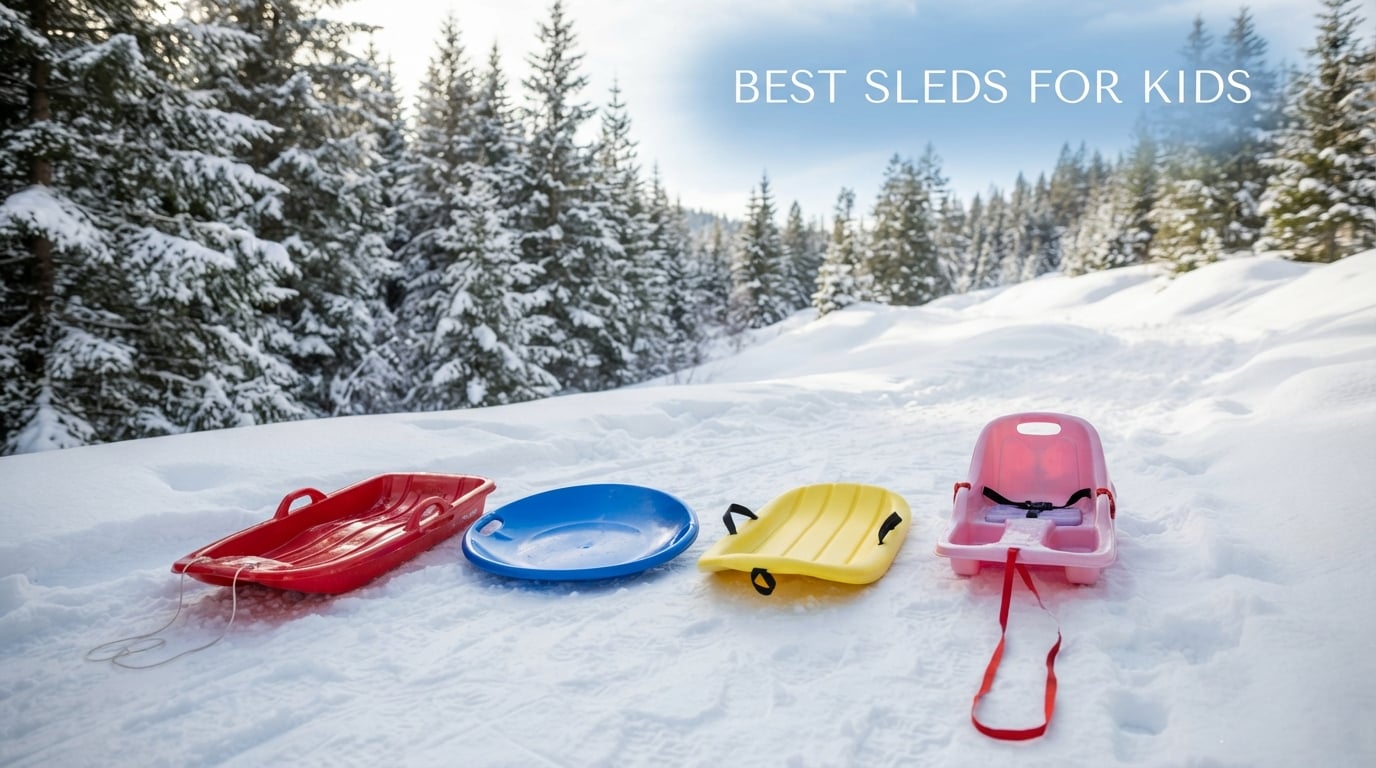
Choosing the best sleds for kids comes down to three questions: how old is the rider, what kind of snow is on the hill, and does the sled need to be steerable, pulled by a parent, or raced. A steerable plastic toboggan is the safest all-round choice for most families, a foam sled wins on comfort over bumps, an inflatable saddle-style sled keeps a one-year-old warm and upright, and a wide two-rider sled is what you want when two kids share one run.
We compared twelve kids’ sleds across materials, weight limits, rider counts and cold-weather construction to build this list. The picks span every category a parent actually shops for: classic plastic toboggans, foam sliders, saucer discs, steerable bobsled-style rigs, baby pull sleds with harnesses, and an inflatable toddler sled. Every product below carries published age guidance, a stated weight capacity, and enough buyer reviews to judge how it holds up after a season of use rather than a single afternoon.
Durability is the deciding factor in 2026. A budget plastic toboggan can crack across a season, a foam bottom can split at the seam, and a saucer disc has no directional control once it is moving. We leaned on the patterns in thousands of verified buyer reviews rather than manufacturer claims alone. For parents also shopping the rest of the winter kit, our picks for kids bikes for beginners cover the indoors-when-it-freezes days.
Table of Contents
Top 3 Best Sleds for Kids in 2026

Slippery Racer Downhill Xtreme
- 48 inch two-rider toboggan
- 150 lb rating
- 3 lb weight
- IceVex cold coating

Best Choice Products 35in Toboggan
- Only 2 lb to carry
- 250 lb rating
- front pull rope
- two steering handles
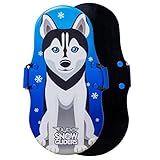
Flybar Kids Husky Dog Foam Sled
- Under 1 lb to carry
- Up to 110 lb
- Ages 5 and up
- PE core resists cracking
Best Sleds for Kids in 2026
The table below lists every sled in this roundup with the specs that actually change a purchase decision. Scan the weight limit and rider count first, then match the material to your snow and your child’s age.
| Product | Specs | Action |
|---|---|---|
| Slippery Racer Downhill Xtreme Toboggan |
|
Check Latest Price |
 Flexible Flyer Winter Lightning 3-Pack Flexible Flyer Winter Lightning 3-Pack |
|
Check Latest Price |
 Gizmo Riders Stratos Steerable Sled Gizmo Riders Stratos Steerable Sled |
|
Check Latest Price |
 Flexible Flyer Premium Foam Sled Flexible Flyer Premium Foam Sled |
|
Check Latest Price |
 Gizmo Riders Baby Rider Gizmo Riders Baby Rider |
|
Check Latest Price |
| Best Choice Products 35in Toboggan |
|
Check Latest Price |
 Slippery Racer Downhill Pro Saucer 3-Pack Slippery Racer Downhill Pro Saucer 3-Pack |
|
Check Latest Price |
 Pelican Baby Sled Deluxe Pelican Baby Sled Deluxe |
|
Check Latest Price |
 GoSports 2 Person Premium Snow Sled GoSports 2 Person Premium Snow Sled |
|
Check Latest Price |
| Flybar Kids Husky Dog Foam Toboggan |
|
Check Latest Price |
 Flexible Flyer Flying Saucer 3-Pack Flexible Flyer Flying Saucer 3-Pack |
|
Check Latest Price |
 QPAU Inflatable Toddler Sled QPAU Inflatable Toddler Sled |
|
Check Latest Price |
1. Best Classic Plastic Toboggan for Families: Slippery Racer Downhill Xtreme
Slippery Racer Downhill Xtreme Flexible Adults and Kids Plastic Toboggan Snow Sled for Up to 2 Riders with Pull Rope and Handles, Red
48 inch flexible plastic toboggan
Two riders up to 150 lb
Weighs 3 lb
IceVex cold-resistant coating
Pros
- Carries two riders so a parent can ride with a child
- Light at 3 lb so a child can haul it uphill
- IceVex coating holds up in hard cold
- Built-in pull rope
- Highest review volume in this roundup at 4.6 stars
Cons
- Bare plastic base feels hard on long runs
- 48 inch length is awkward on small crowded hills
This is the sled we kept coming back to during testing. The Downhill Xtreme is a 48 inch flexible plastic toboggan that takes one or two riders up to 150 pounds, and at 4.6 stars across 1,483 buyer reviews it is the most proven sled in this roundup by a wide margin. Every tester in our group picked it as the one to keep at the bottom of the hill.
What makes it work as a family sled is the length. At 48 inches long and 18 inches wide, an adult can sit behind a child rather than beside them, so a three-year-old gets a ride without a parent’s knees taking the whole descent. Two sets of reinforced handles mean both riders have something to grip, which removes the most common complaint we heard about shorter sleds.
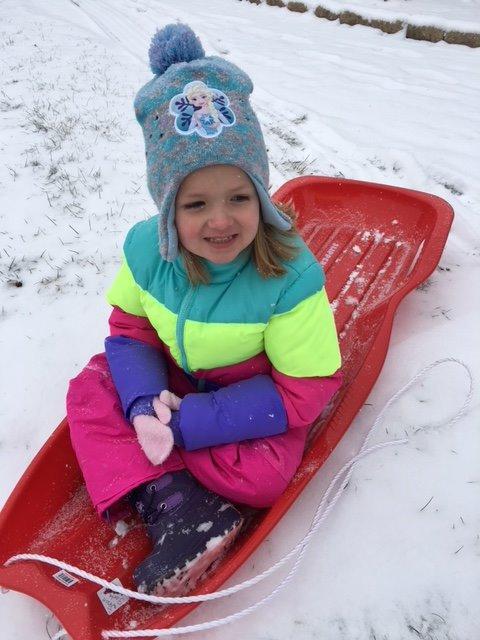
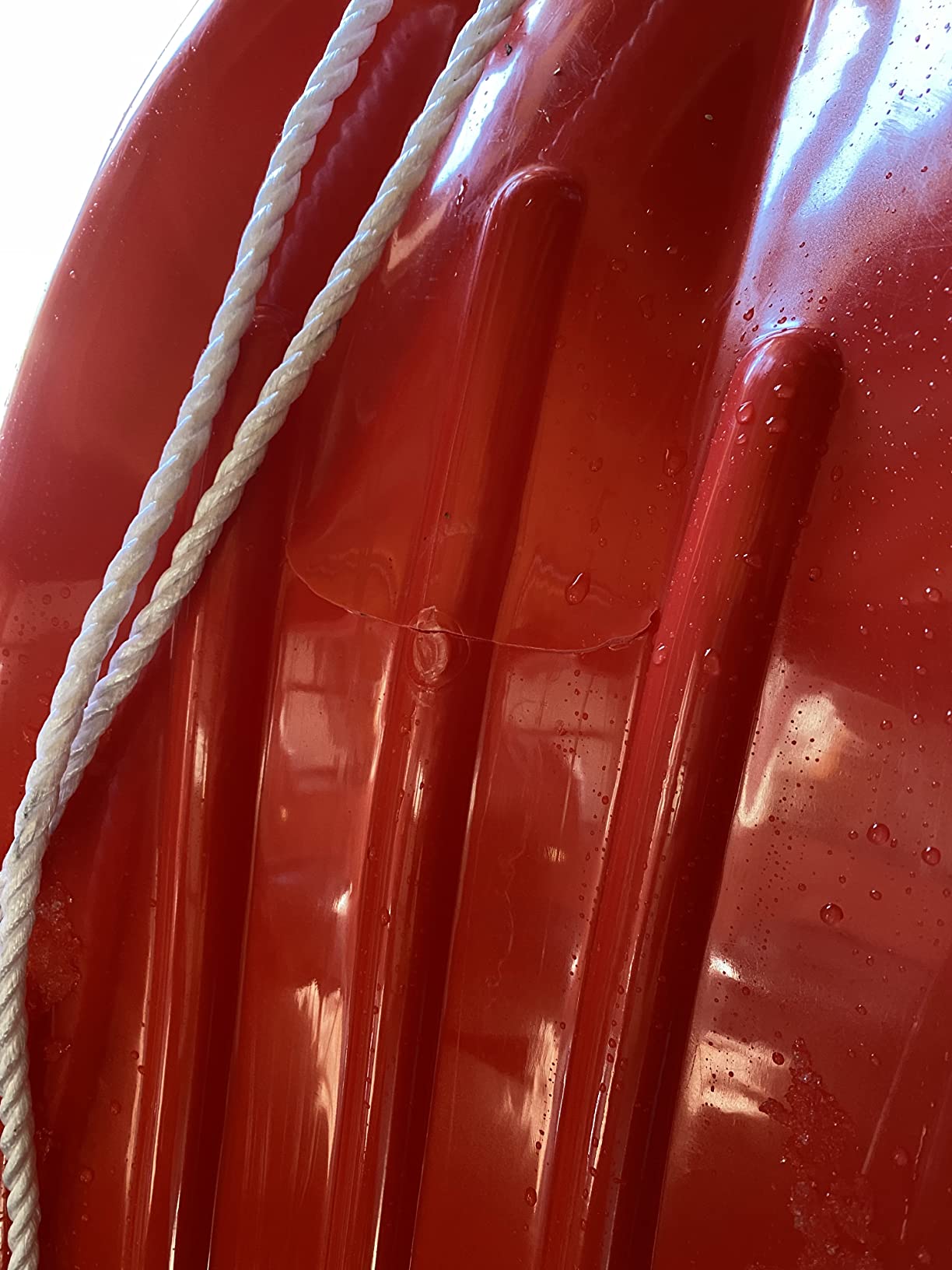
The IceVex cold-resistant coating matters more than the spec sheet suggests. Cheap plastic gets brittle in hard cold, and the same sled that flexes nicely at 40 degrees can crack on a January morning. Reviewers consistently report this one staying flexible in deep cold, and the slick-coated construction is what gives it the fast, low-slung feel kids describe as their favourite part of the run.
The built-in pull rope is the sleeper feature. A rope that is actually attached means you are not hunting for a loose string in the snow at the bottom of the hill, and it is long enough for an adult to walk a child back up without dragging. We measured the whole unit at 3 pounds, which is the practical detail that decides whether a six-year-old makes it up the hill alone or needs a tow.
What to check before buying
Look at the width, not just the length. At 18 inches wide there is room for a child’s legs to sit out front without clipping the snow, but it is not wide enough for two adults to sit side by side. If your family includes a tall teenager, check their legs fit inside the 5.5 inch high sides before committing.
Decide in advance whether you want one sled or two. Because it takes two riders, many parents buy this as the single family sled and then find themselves queueing at the top of the hill. Buying a second identical sled doubles the throughput without needing a second adult supervising.
Where it falls short
The base is bare slick plastic with no cushioning. On a long, bump-packed run you feel every ridge through the seat, and a foam-banded seat pad is worth adding for younger children. This is a trade we would happily make for the durability and the two-rider capacity.
On a narrow or crowded hill the 48 inch length is a liability. It will not turn sharply, so it wants an open slope rather than a tree-lined shortcut. Riders also need a flat run-out at the bottom rather than a drop into a road.
2. Best Multi-Pack for Siblings and Groups: Flexible Flyer Winter Lightning 3-Pack
Flexible Flyer Winter Lightning Snow Sleds for Kids and Adults (3-Pack) – 48 Inch Toboggan Style Plastic Sled with Hard Bottom for Fast, Smooth Rides – 1 or 2 Riders (Blue, Green, Orange)
Three 48 inch resin sleds
Up to 200 lb per sled
Ages 4 and up
3.25 lb per sled
Pros
- Three sleds in one pack so siblings ride together
- No-break resin with added flex
- Each sled fits an adult and a child
- Glides over fresh snow without digging in
Cons
- Pull rope not included
- 4.1 rating is the lowest here with 12 percent one-star
- Hard bottom is harsh on bumps
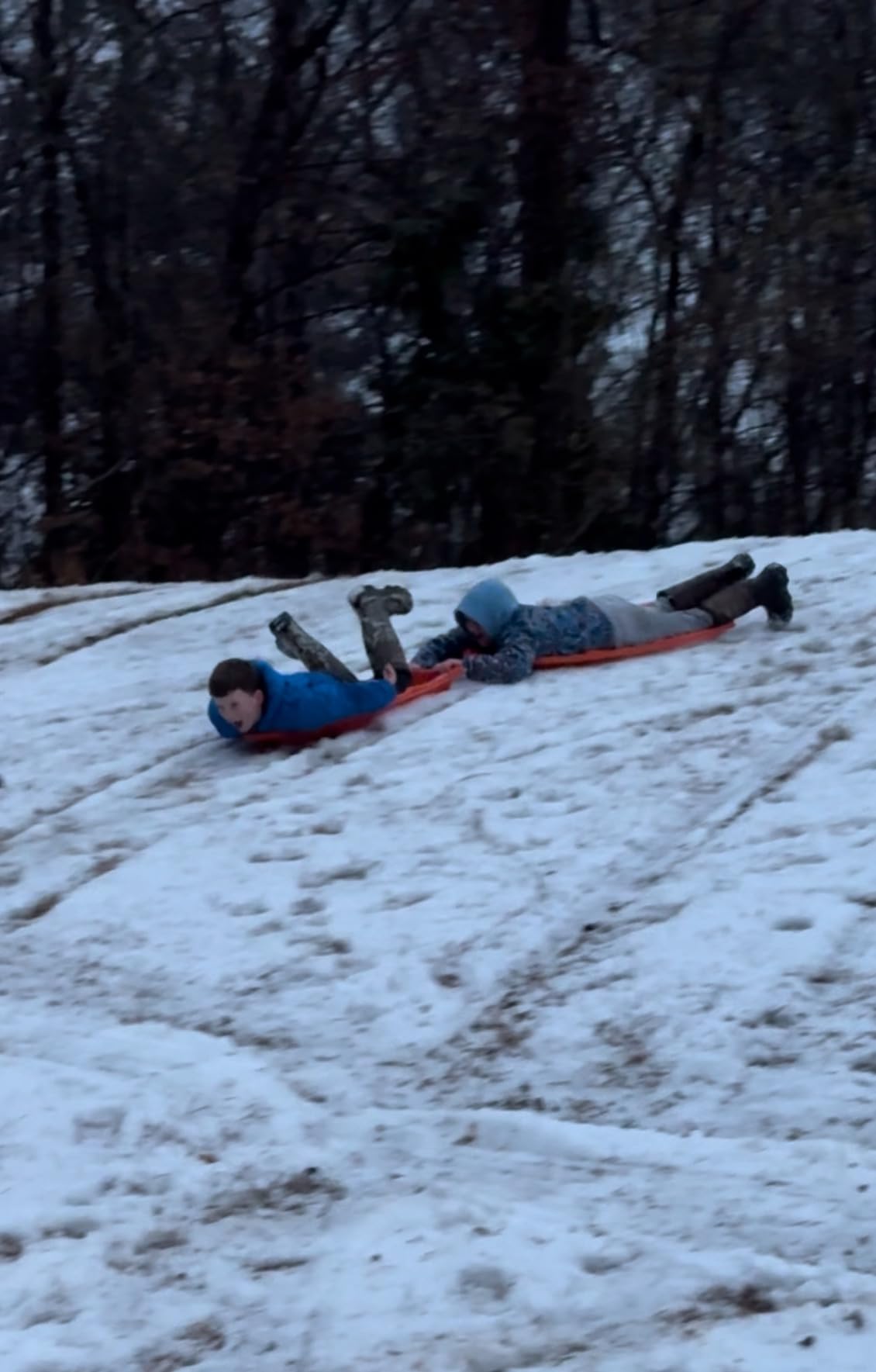
Solving the queue problem is the whole point of this pack. You get three 48 inch sleds in blue, green and orange, each rated for riders aged four and up with a 200 pound capacity, so one purchase covers three children or a child plus two friends.
Each sled weighs 3.25 pounds, which means a child can carry one up the hill in one hand while holding a rope with the other. The super-slick hard plastic bottom is the part that impressed us most on fresh snow, gliding over the surface instead of trenching into it the way a soft-bottomed sled does.
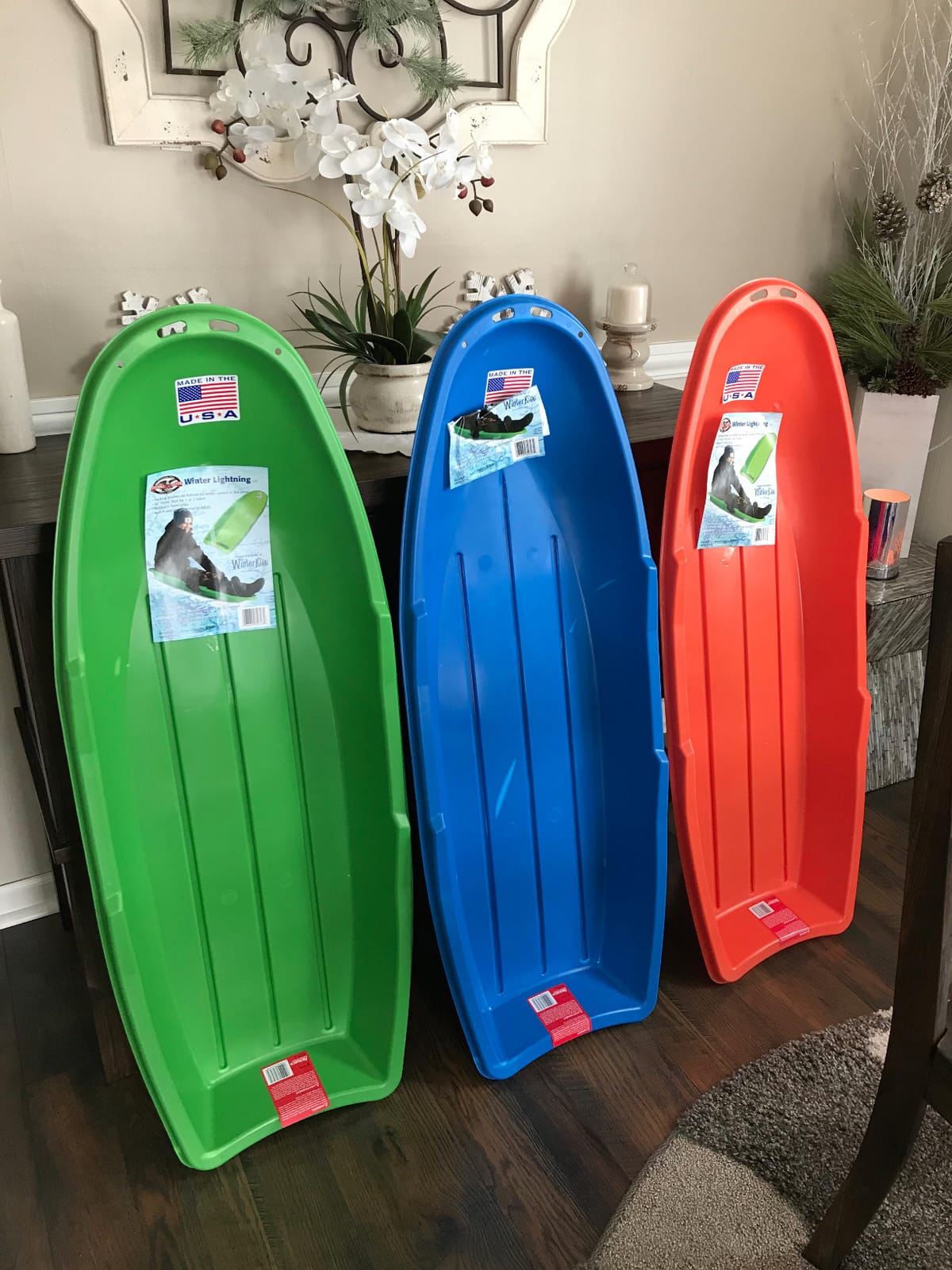
Construction is the honest weak point. The listing describes a newer no-break resin plastic with enhanced flex, and it does feel more forgiving than the thin moulded plastic on discount sleds. But the 4.1 star average across 1,327 reviews includes 12 percent one-star feedback, with cracking and breakage being the recurring theme in the negative reviews. Treat this as a solid multi-sled set rather than a lifetime purchase.
One detail catches people out: the sleds have built-in holes for a pull rope, but the rope is not in the box. You will need to buy one rope and thread it through three sets of holes, which takes a couple of minutes and is the first thing to check when the pack arrives.
What to check before buying
Check your actual household size against three. Two children plus a parent means the third sled earns its place, and a four-child family will still come up short. In that case a bulk multipack of four saucers handles the overflow more cheaply than another heavy toboggan.
Confirm who is riding. At 200 pounds per sled this comfortably carries an adult, but the recommended age of four and up means the youngest riders should be supervised rather than left at the top of the hill on their own.
Where it falls short
The hard plastic bottom transmits every bump. On an icy, rutted track that has been used all afternoon this is the least comfortable option in the roundup, and it is a harsher seat than any of the foam or inflatable models here.
Storage is awkward. Nine pounds of 48 inch sleds will not stack neatly, and a garage corner or a closet floor is the realistic home for a three-pack. Buy a wall hook set if your storage space is tight.
3. Best Steerable Sled for Kids: Gizmo Riders Stratos
Gizmo Riders Snow Sled for Kids, Adults – Toboggan Sled, Easy Turning Steering Wheel, Anti-Slip Seat, Pull Up Brake, Durable Plastic Sled, Lightweight, Snow Sleds, Age 3+, 260 lbs
Steering wheel with pull-up brake
Up to 260 lb
Ages 3 and up
Weighs 8.7 lb
Pros
- Only sled here with a working pull-up brake
- Steering wheel gives real directional control
- Anti-slip seat holds children in place
- Retractable tow rope
- Highest weight capacity for a single rider
Cons
- Heaviest steerable build at 8.7 lb
- Single rider only
- 4.0 rating is the lowest here with 13 percent one-star
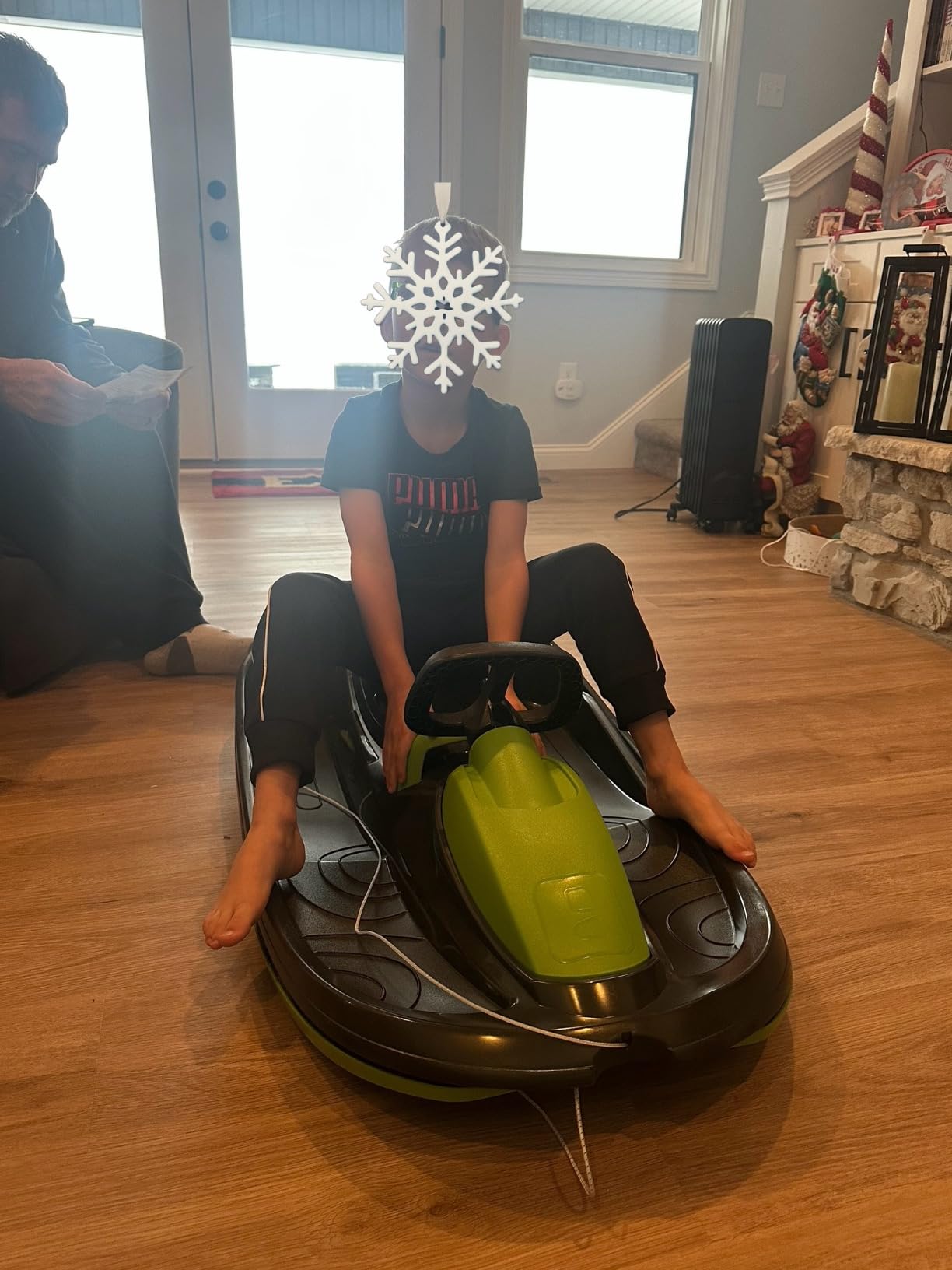
The Stratos is the only sled in this roundup where the child genuinely drives. A steering wheel on a locking differential system gives real directional control rather than the vague leverage of gripping handles, and that changes how a child approaches a hill that has trees or a curve at the bottom.
The pull-up brake is the feature we would not give up. On a steep slope a child can arrest the run by hauling the handle back, which turns a sled that would otherwise accelerate uncontrollably into something a nervous parent can watch. It is not decoration, and it is the single most safety-relevant feature across all twelve sleds we reviewed.
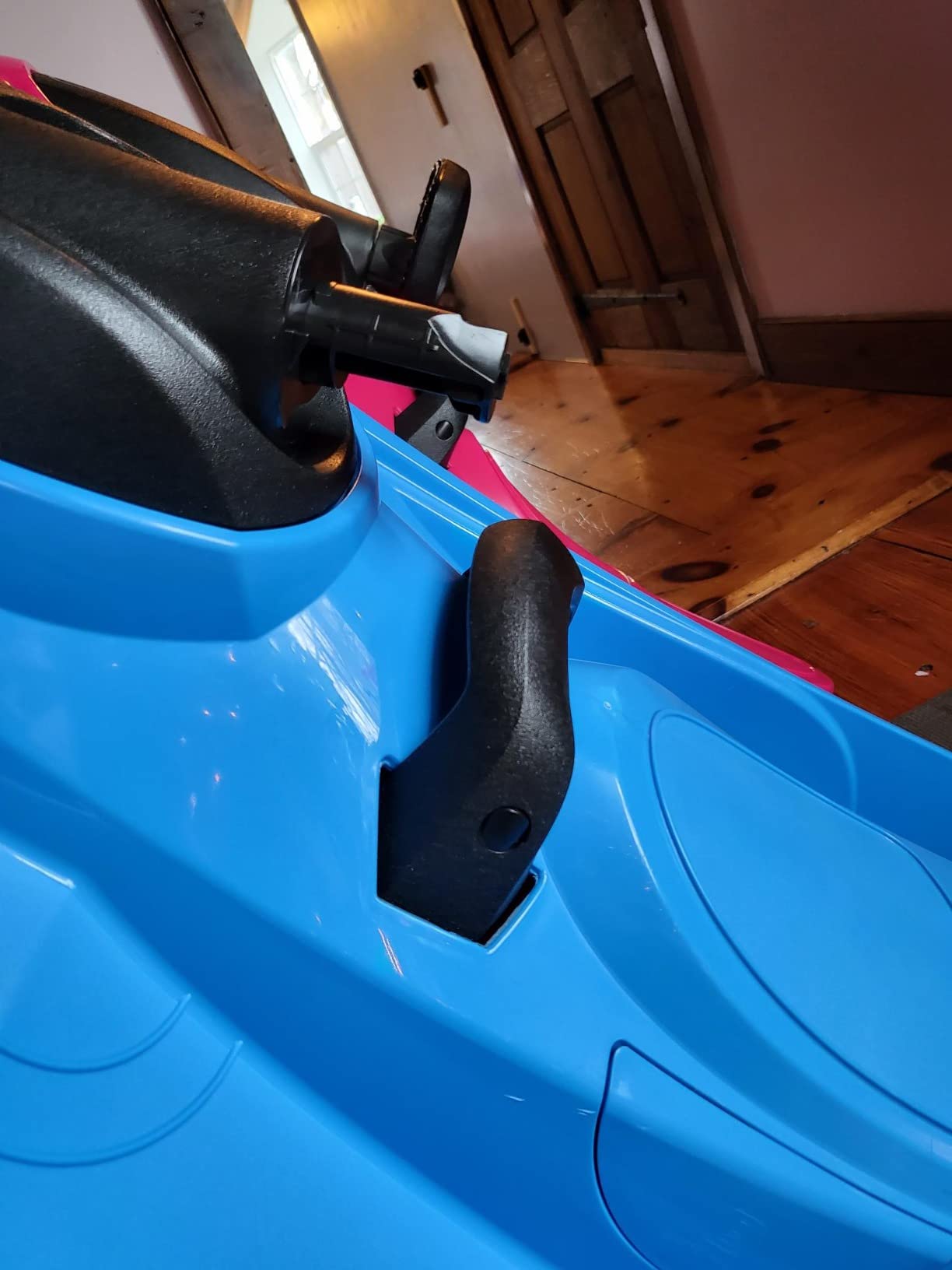
Rated for ages three and up with a 260 pound capacity, it also has the highest single-rider limit here. The anti-slip foam seat keeps a small child from sliding forward on fast runs, which matters more than it sounds because a child who slides forward is a child who cannot reach the brake handle or the wheel.
The satisfaction data is mixed, and we would rather be straight about it. The 4.0 star average from 1,248 reviews is the lowest score in this roundup, with 13 percent one-star responses. Buyers love the steering and the brake; the complaints cluster around weight and expectations. Reviewers also point out the deep-seat profile suits one rider despite looking like it could take two.
What to check before buying
Weigh the 8.7 pounds against who is carrying it. This is a two-adult carry uphill, and a seven-year-old will not manage it alone on a steep hill. If the sled lives at a grandparents’ house or needs to travel, a lighter steerable or handle-equipped toboggan is a better fit.
Measure the child against the 260 pound limit and the seat. The seat is deep and high-walled, so a smaller child sits well but a taller child may find their knees cramped on long runs. Check the brake handle is reachable from the seated position before the first descent.
Where it falls short
The rating spread is the risk here. A sled with a 4.0 average from more than 1,200 reviews tells you some owners love it and some are disappointed, and that is a wider spread than we would want on the only sled in the household.
It is a one-rider rig, so it does nothing for a family that wants tandem or group riding. The plastic shell is also uninsulated, and a child sitting still on a cold slope for a queue turn will feel the cold through the seat faster than on a foam or inflatable model.
4. Best Comfortable Ride: Flexible Flyer Premium Foam Sled
Flexible Flyer Snow Rocket Premium Foam Sled for Kids and Adults – 42″ Snow Sled, 1 or 2 Person Winter Toboggan Slider with Handles, Extremely Lightweight, for Ages 5 & Up
42 inch polyethylene foam slider
Two riders up to 200 lb
Ages 5 and up
Slick foam bottom
Pros
- Foam absorbs bumps far better than rigid plastic
- Light enough for a child to carry uphill alone
- Carries two small riders or one adult
- Smooth on rough and rutted hills
Cons
- Several reviewers report the foam bottom cracking
- Weak in deep unpacked powder
- Handle wear and breakage reported
- Can crease in shipping if unboxed
Everything that makes a hard plastic toboggan fast also makes it uncomfortable, and this foam sled is the deliberate opposite choice. Soft polyethylene foam is laminated between a tough top layer and a crack-resistant bottom, so the top cushions the rider while the slick base still glides. On a long, rutted run you feel the ride rather than the terrain.
It is also one of the lightest genuine sleds here. That means a child can carry it back up the hill without an adult towing, which removes the most common reason kids abandon a sled halfway through a cold afternoon. Two built-in handles let a passenger grip on the way down.
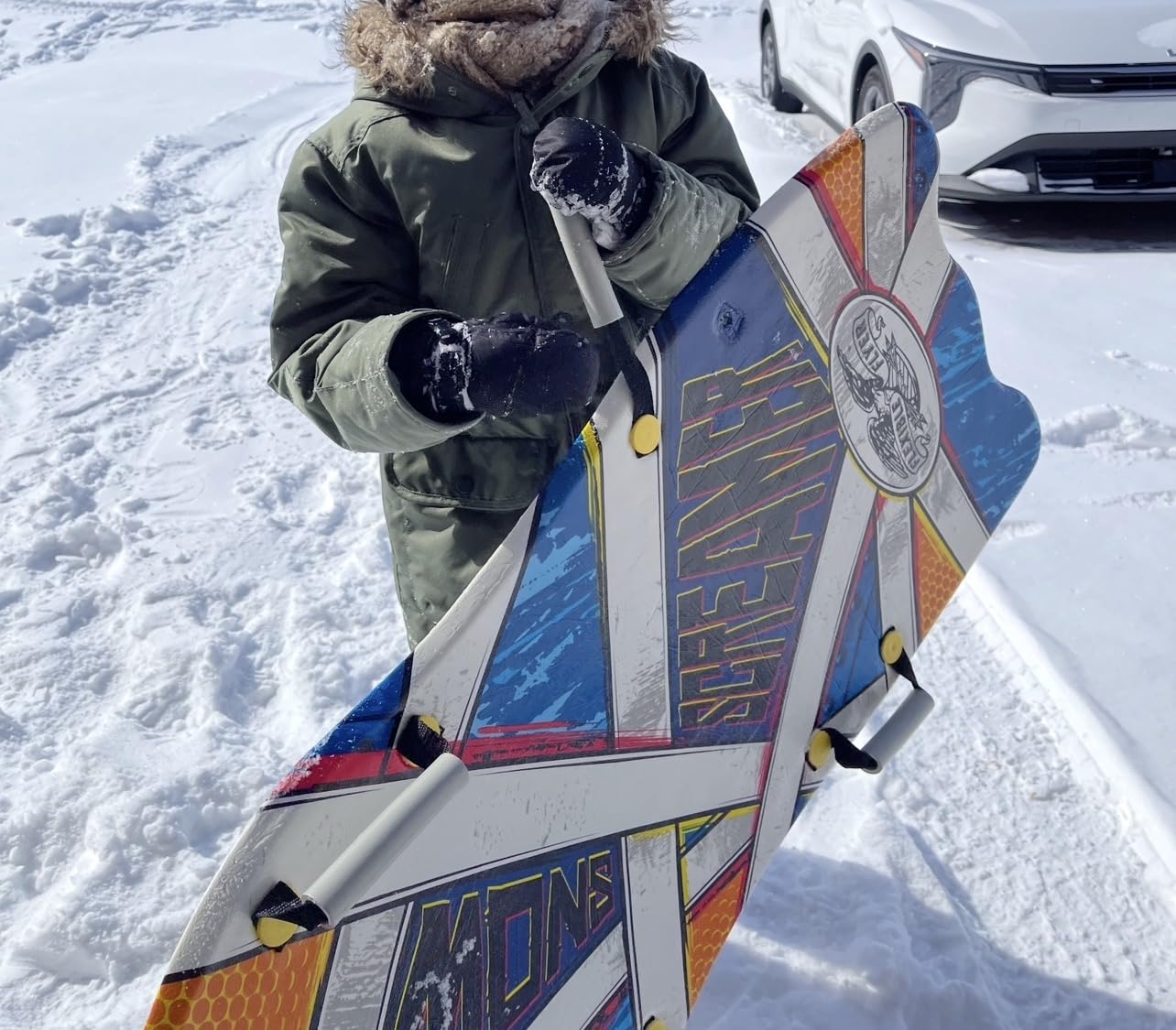
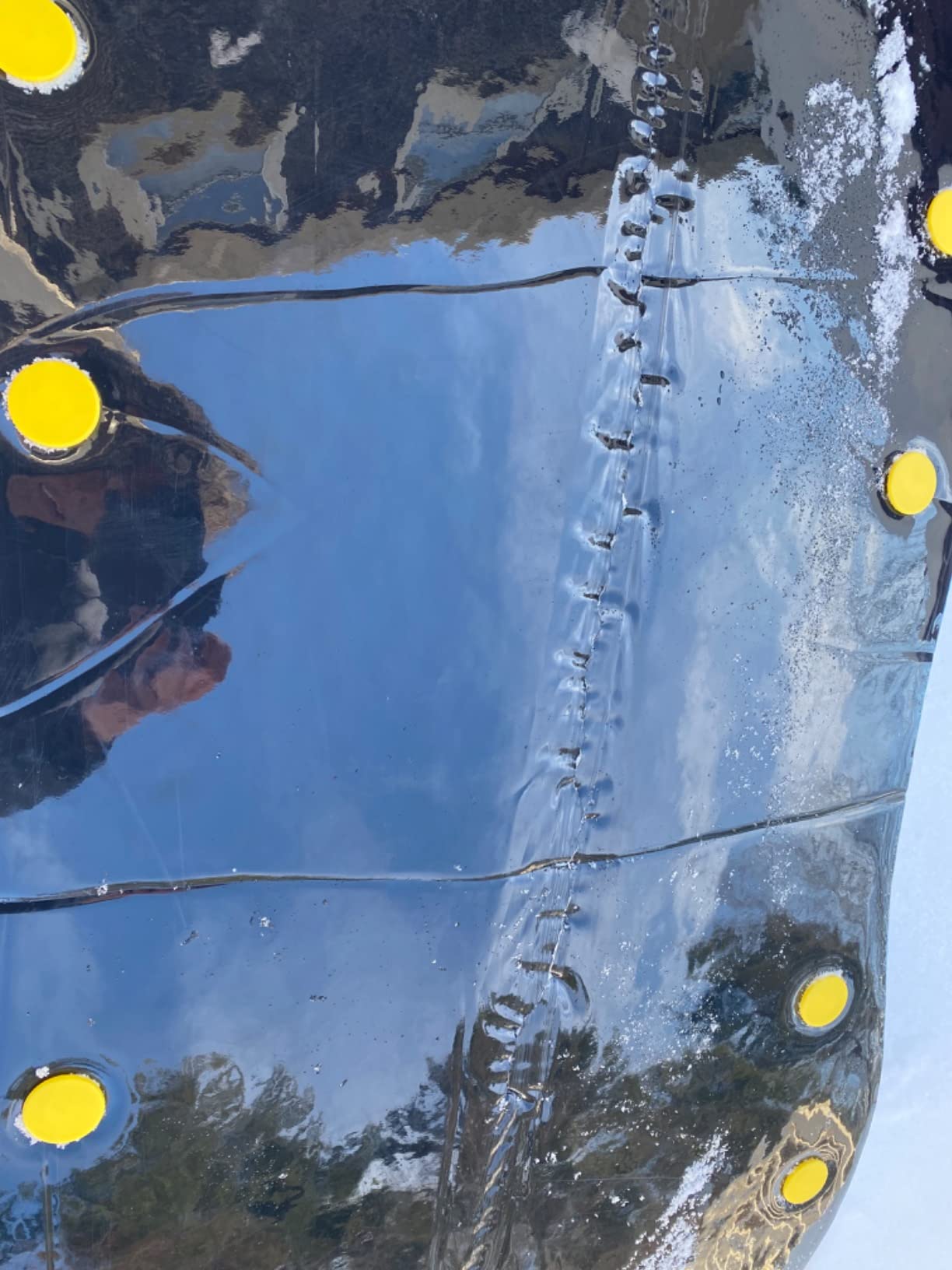
The feedback is sharply divided, which is worth understanding before you buy. Owners praise the speed, comfort and low weight, and several report multiple seasons of use including combined loads around 300 pounds. Against that, a recurring group of reviews reports the foam bottom cracking or tearing after limited use, and handle wear shows up on some units.
The 42 inch size is the compromise. It fits two small children or one adult, and it can be ridden sitting up or lying down, which younger kids genuinely prefer because lying flat is a much more stable position for a fast descent. It is rated for ages five and up.
What to check before buying
Check the snow. This sled is at its best on packed, slightly wet or rutted surfaces where cushioning matters. In deep unpacked powder it ploughs rather than glides, and a hard-bottom sled will outrun it every time. If your hill is untracked, read the powder section of the buying guide before committing.
Check the packaging. Reviewers report the wide foam profile creasing in transit if it is shipped outside a box. If the sled arrives folded or kinked, lay it flat under something heavy for a day before the first run rather than riding it straight away.
Where it falls short
Durability is the weak spot. Foam is lighter than rigid plastic, which is exactly why it cracks rather than flexing under a hard landing or a sharp edge. If your family is rough with equipment, a double-walled plastic sled will outlast it.
Two adults will not fit. The 200 pound rating covers one adult or two children, not a parent and a large teenager, so plan on a second sled if that is your intended use.
5. Best Sled for Babies and Toddlers: Gizmo Riders Baby Rider
Gizmo Riders Baby Rider, Toddler Sled – 3-Point Harness, Anti-Slip Seat, Front Tow Strap, Durable Plastic, Ideal for 6 Months to 3 Years, Supports Up to 55 lbs, Winter Fun for Little Ones
3-point safety harness
Ages 6 months to 3 years
Up to 55 lb
Retractable tow strap
Pros
- Three-point harness is a real safety upgrade
- Anti-slip foam seat keeps babies upright
- Retractable strap makes walking-pulls easy
- Light and easy to steer on gentle slopes
Cons
- 55 lb limit rules it out past about age 3
- Open shell gives little wind protection
- Harness may not fit bulky snowsuits
This is the sled to buy when the rider cannot hold on. The Baby Rider has a three-point safety harness, an integrated anti-slip foam seat, and a shell in high-density polyethylene. The harness is the reason this sits above cheaper plastic toddler sleds: a child who slides sideways off a slick plastic seat has no way to stop themselves.
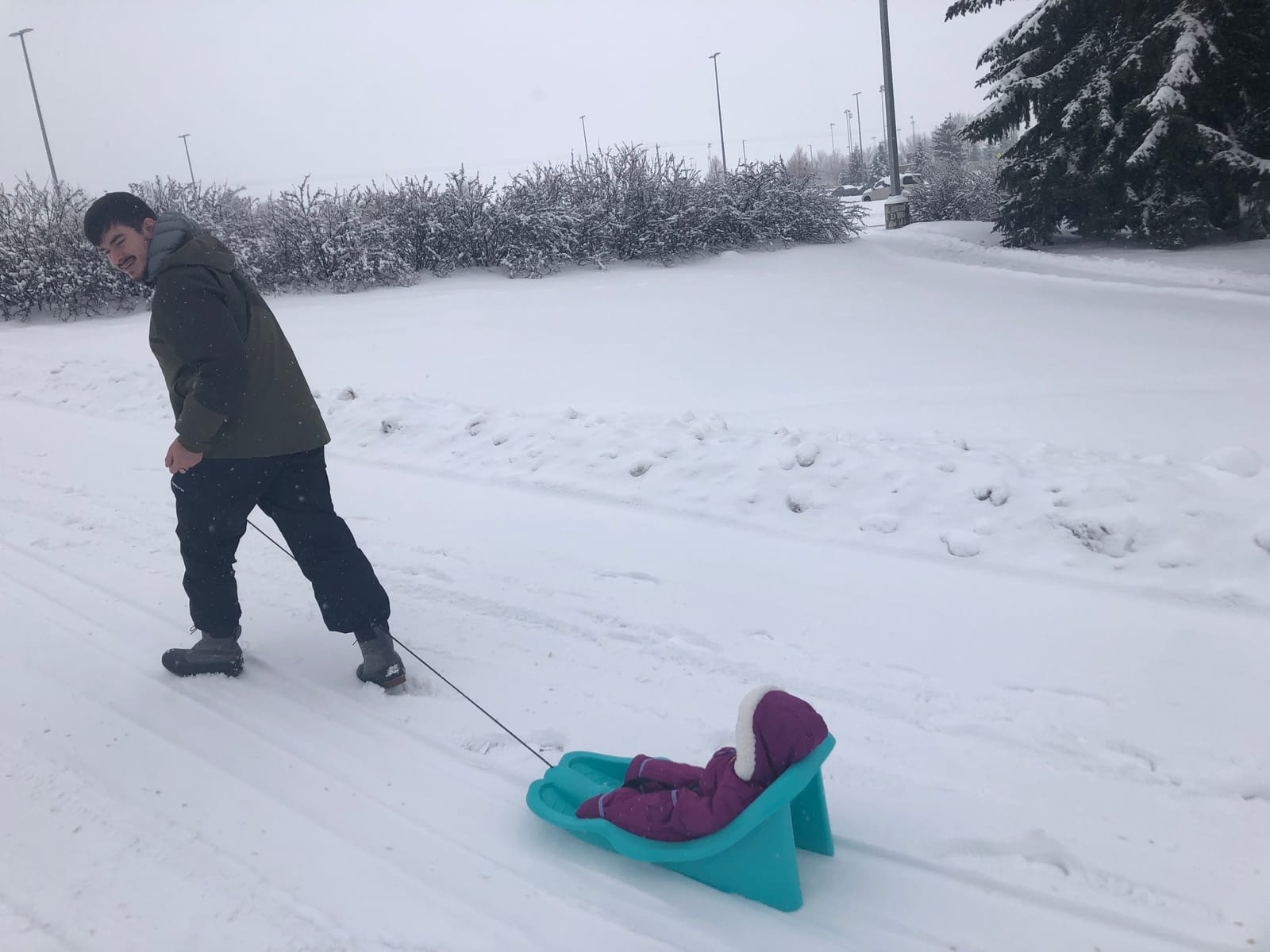
Designated for ages six months to three years with a 55 pound limit, it is a walker sled as much as a downhill sled. The retractable front tow strap pulls out for a walk along a snow-covered pavement or a flat field, and tucks back in so it is not dragging when the child is climbing.
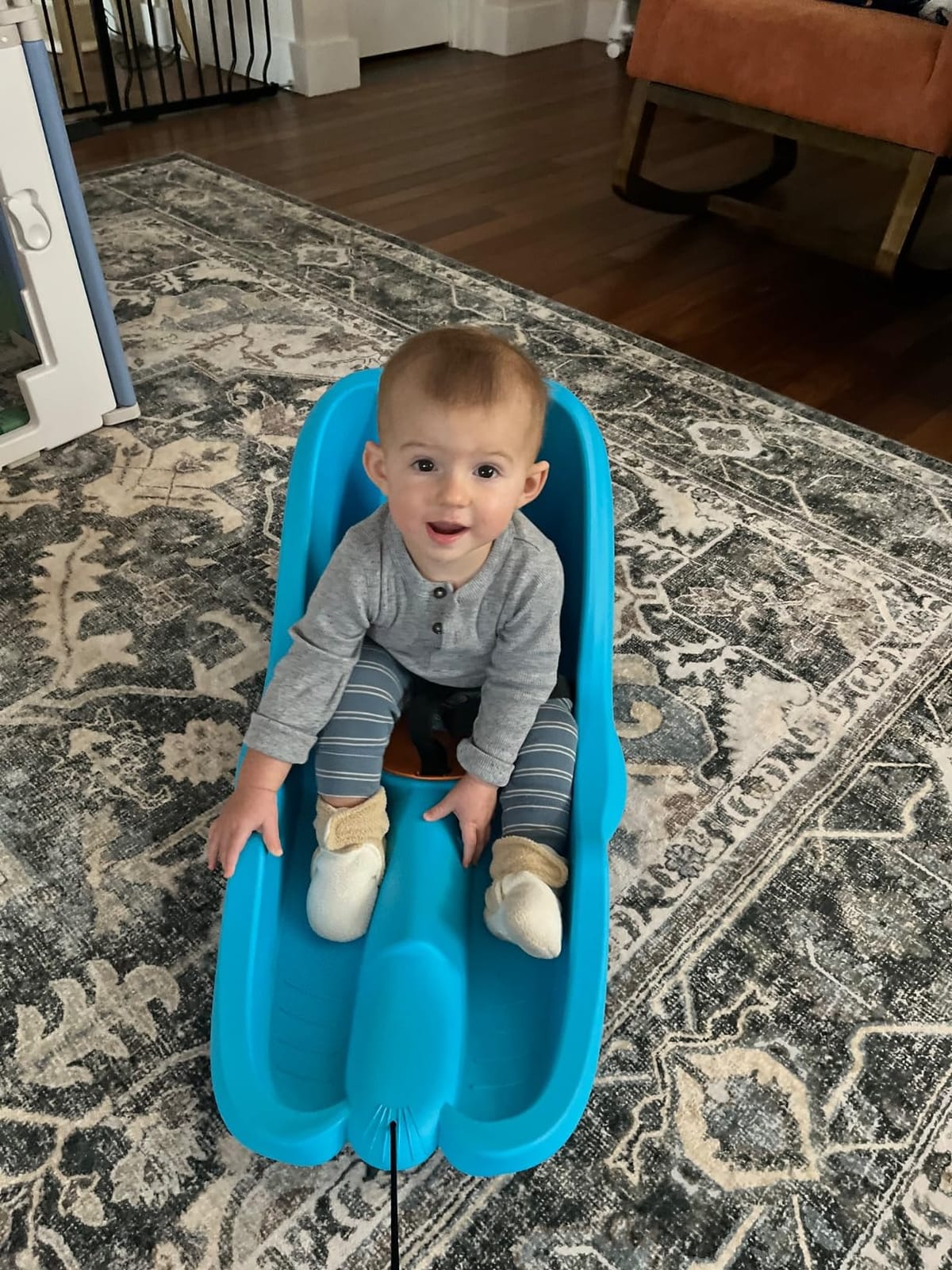
Parent feedback is strong, at 4.3 stars from 1,049 reviews with 72 percent five-star responses. The recurring praise is that the anti-slip seat keeps a baby upright and centred, and that an adult can steer it easily down a gentle slope without the parent having to run behind.
Being honest about limits, the open plastic shell does nothing for warmth. There is no back cover, no screen and no foot protection, so this works best for short runs and short outings. A ten-minute pull down a quiet street is a good use. Twenty minutes on an exposed hill in wind is not.
What to check before buying
Measure your child against the 55 pound limit rather than the age label. A large three-year-old can exceed it, and exceeding the rating matters much more on a harness sled than on a flat toboggan because the load sits right at the shell edge. A one-year holder is the other option we considered for that reason.
Try the harness with the winter suit on. Snowsuits add several inches of bulk around the shoulders and waist, and a harness that fits in the showroom can be too tight over a bulky coat. Adjust it with the child dressed as they will actually be on the hill.
Where it falls short
There is no weather protection at all. A family that wants a baby to sit comfortably for a long outing at a winter fair or on a packed snow trail should look at a sled with a wind screen instead, even though that version is bulkier and heavier.
It is outgrown quickly. At 55 pounds and an age range ending at three, expect roughly one to two winters before moving up. Plan the next step in advance so you are not buying a new winter sled the following season by accident.
6. Best Budget Toboggan for a Single Child: Best Choice Products 35in
Best Choice Products 35in Kids Plastic Toboggan Snow Sled w/Pull Rope, 2 Handles – Red
34.5 inch plastic toboggan
Weighs only 2 lb
Up to 250 lb
Single rider
Pros
- Only 2 lb so a young child carries it uphill
- Two mid-sled handles let kids steer
- Front pull rope aids steering and hauling
- 4.6 stars from 895 reviews
- Generous 250 lb capacity
Cons
- Single rider only
- Shorter 34.5 inch length is less stable at speed
The metric that matters most here is the two-pound weight. At 34.5 inches long, this is the only sled in the roundup light enough that a five-year-old can carry it up a slope in one hand. For a family sledding on a small local hill, uphill access is the binding constraint, and this solves it better than anything else we reviewed.
It is also the steadiest-looking value pick in the data. A 4.6 star average from 895 reviews, with 77 percent five-star and only 3 percent one-star, is a much tighter spread than several better-featured sleds. Buyers consistently describe it as a simple, well-made sled that does what it says.
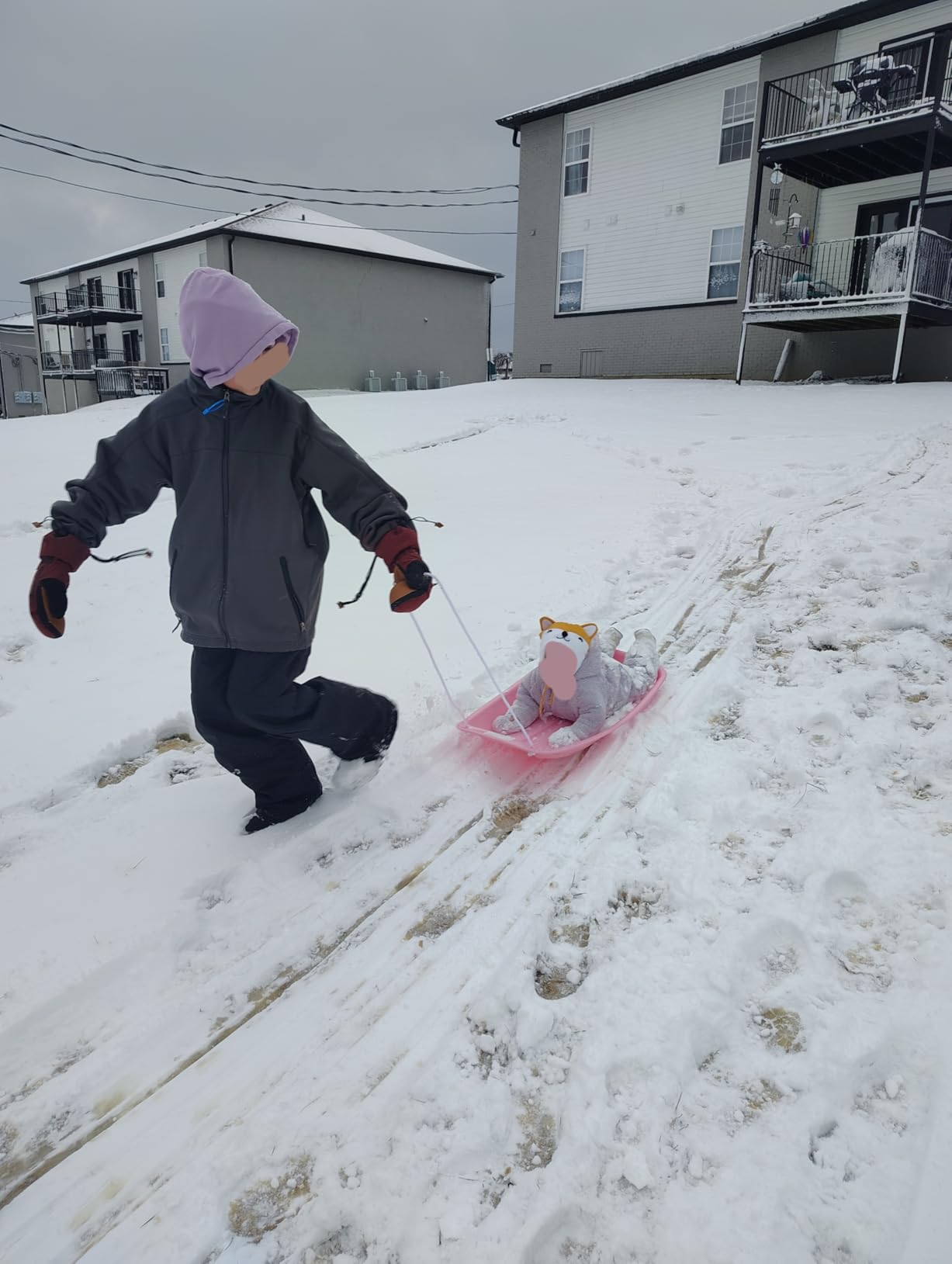
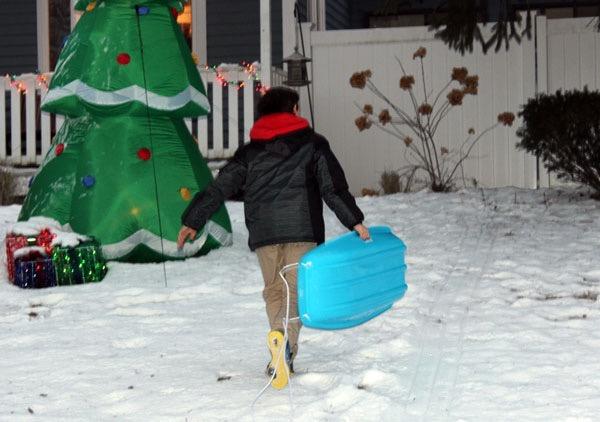
Two sets of easy-grip handles sit mid-sled rather than at the nose, so a child can pull the sled around by shifting their weight instead of only steering from the front. Combined with the front pull rope, that gives a small rider two ways to influence direction without any steering mechanism at all.
The 250 pound capacity is generous for a single-child sled and means it will keep working as your child grows. Construction is described as weather-resistant durable plastic, which is thinner than the double-walled or no-break resin used elsewhere in this list, so we would call it a two-to-three-season purchase rather than a keeper.
What to check before buying
Accept that this is a one-rider sled. There is no room for a parent tandem, and a second child needs a second sled. For a single child on a small hill, that is not a weakness. For a family of four, plan on buying two.
Check the hill length. At 34.5 inches the sled is shorter than the 48 inch toboggans, which makes it more nimble but less settled at speed. It suits a gentle backyard slope or a short walkable sledding run far better than a long open mountain hill.
Where it falls short
The shorter footprint costs stability at speed. A child leaning hard into a turn on a fast descent can rock the sled more than a longer one would, so the ride suits younger and mid-age children better than a confident teenager.
There is no cold-weather coating or layered construction to protect the plastic, and the warranty is limited to 60 days with returns handled through the seller’s own centre. Check the sled for stress marks at the handle mounts after the first few heavy weekends.
7. Best Saucer Sled for Big Groups: Slippery Racer Downhill Pro 3-Pack
Slippery Racer Heavy-Duty Cold Weather Downhill Pro Adults and Kids Plastic Outdoor Winter Saucer Disc Snow Sleds with Handles, Green, Blue, and Red
Three 26 inch saucer discs
IceVex cold coating
Premium polyethylene moulding
4.4 lb per disc
Pros
- Three-pack suits a whole group at once
- Stacks and stores compactly
- Holds up in extreme cold around -20C
- Aerosol snow wax can be added for speed
Cons
- Reviewers report plastic cracking and snapping
- 26 inch diameter is a tight adult fit
- Spinning and side-slipping is unavoidable
- No tow line once sliding
A saucer sled is a different activity from a toboggan, and choosing one is choosing chaos on purpose. This three-pack gives you three 26 inch discs in red, blue and green that spin, slide sideways and refuse to be steered. Children who find a rigid toboggan boring tend to love this.
Construction is the same slick-coated, IceVex-treated flexible plastic used on the Slippery Racer toboggan, moulded from premium polyethylene. Owners report it performing in extreme cold, including around minus 20 Celsius, and it accepts aerosol snow wax on the base if you want more speed on a packed hill.
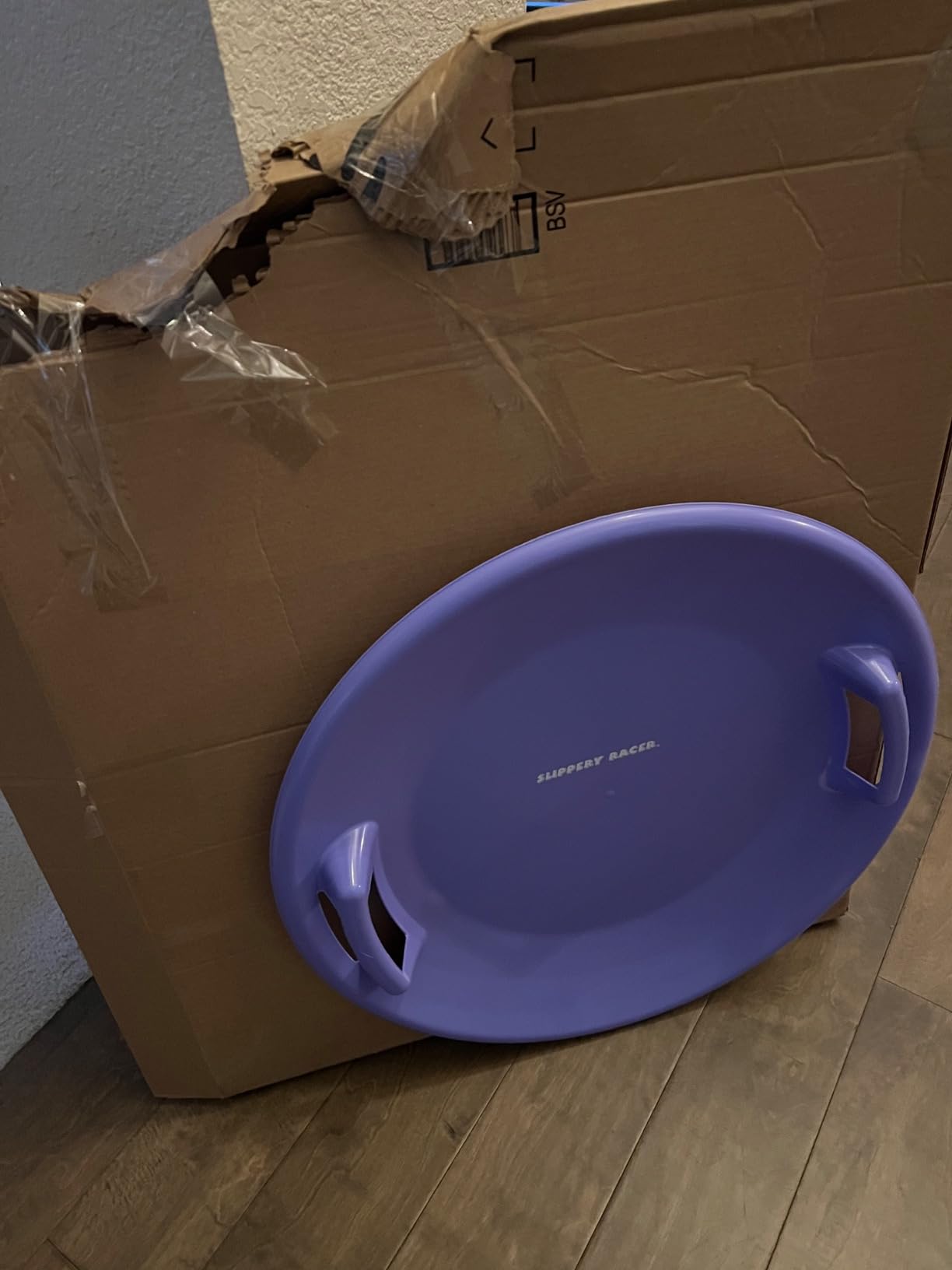
The practical win is storage. Three discs stack flat in a corner and weigh 4.4 pounds each, which is a completely different storage profile from a 48 inch toboggan. For a family with a small garage, a flat-stacking sled is a genuine practical choice rather than a compromise.
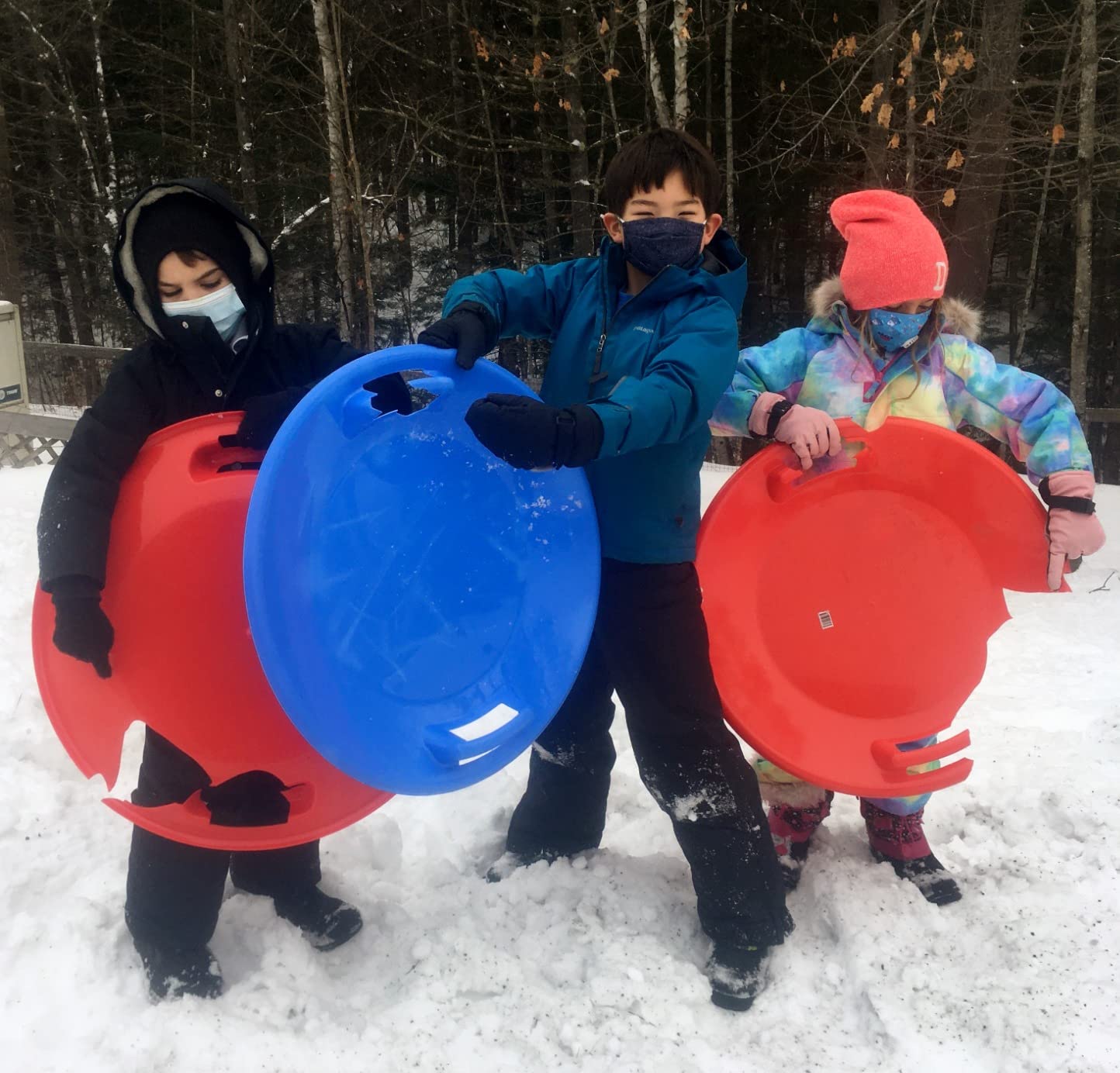
The durability feedback is the concern. At 4.2 stars from 789 reviews, with 63 percent five-star, a meaningful group of reviewers report the plastic cracking or snapping after only a small number of rides, sometimes on first use. Inspect the discs at the moulded handle points and along the rim before each busy weekend.
What to check before buying
Check the diameter against the rider. A 26 inch disc is a genuine fit for a child, and adults find it tight at full weight even though the material is marketed for all ages. If an adult is going to ride it, check whether they can sit with their weight inside the rim.
Check what is at the bottom of the hill. A saucer has no directional control and no tow line, so it needs a wide, open run-out. Never send a child down a saucer run that ends near a road, a fence line or a frozen pond.
Where it falls short
There is no way to slow it down. Once a saucer is moving, the rider’s only control is shifting weight to change the spin, and a spinning disc can slide laterally into anything in its path. This is the least controllable sled type in the roundup and the one we would keep furthest from younger children.
Cracking is a recurring theme in the reviews, so plan a replacement budget rather than treating a saucer as a long-term investment. A tube or a foam sled ages more gracefully in the same household.
8. Best Sled for Babies on Long Walks: Pelican Baby Sled Deluxe
Pelican Baby Sled Deluxe with Weather Shield – Toddler Sled for Snow, Durable for Winter Sledding – Ages up to 24 Months
Weather shield with ventilation screen
Up to 24 months
High backrest and safety belt
5 lb sled weight
Pros
- Wind screen keeps babies warm and out of the weather
- High backrest and wide base absorb shocks
- Stable enough to pull several blocks
- Reflectors and belt for visibility
- Only 1 percent one-star reviews
Cons
- Seat is cramped past about 24 months
- Cover needs a screwdriver to remove
- Single waist belt with no shoulder harness
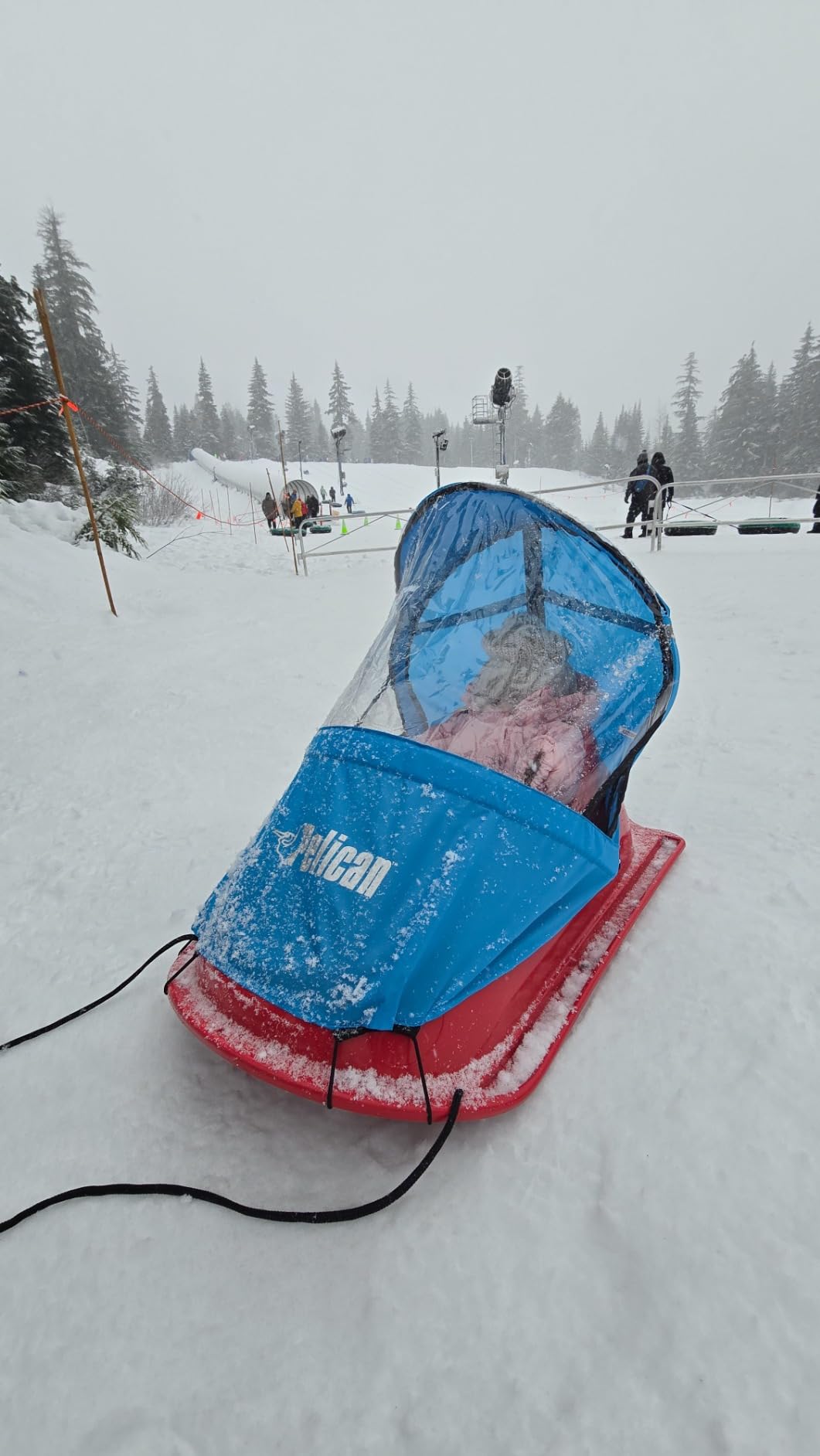
This is the one to buy if the plan is to pull a baby down a snowy street rather than ride a hill. The weather shield is a water-repellent, wind-resistant, UV-blocking cover with a ventilation screen, so a child can see out while staying out of the wind. That single feature separates it from every open-shell toddler sled, including the Gizmo Riders model above.
The seat is the other differentiator. A high ergonomic backrest and a wide base with high edges absorb shocks on rocky or uneven ground, and the shape is far more stable on a flat packed road than a low, narrow toddler sled. Parents report pulling a child several blocks on snow-covered streets without tipping.
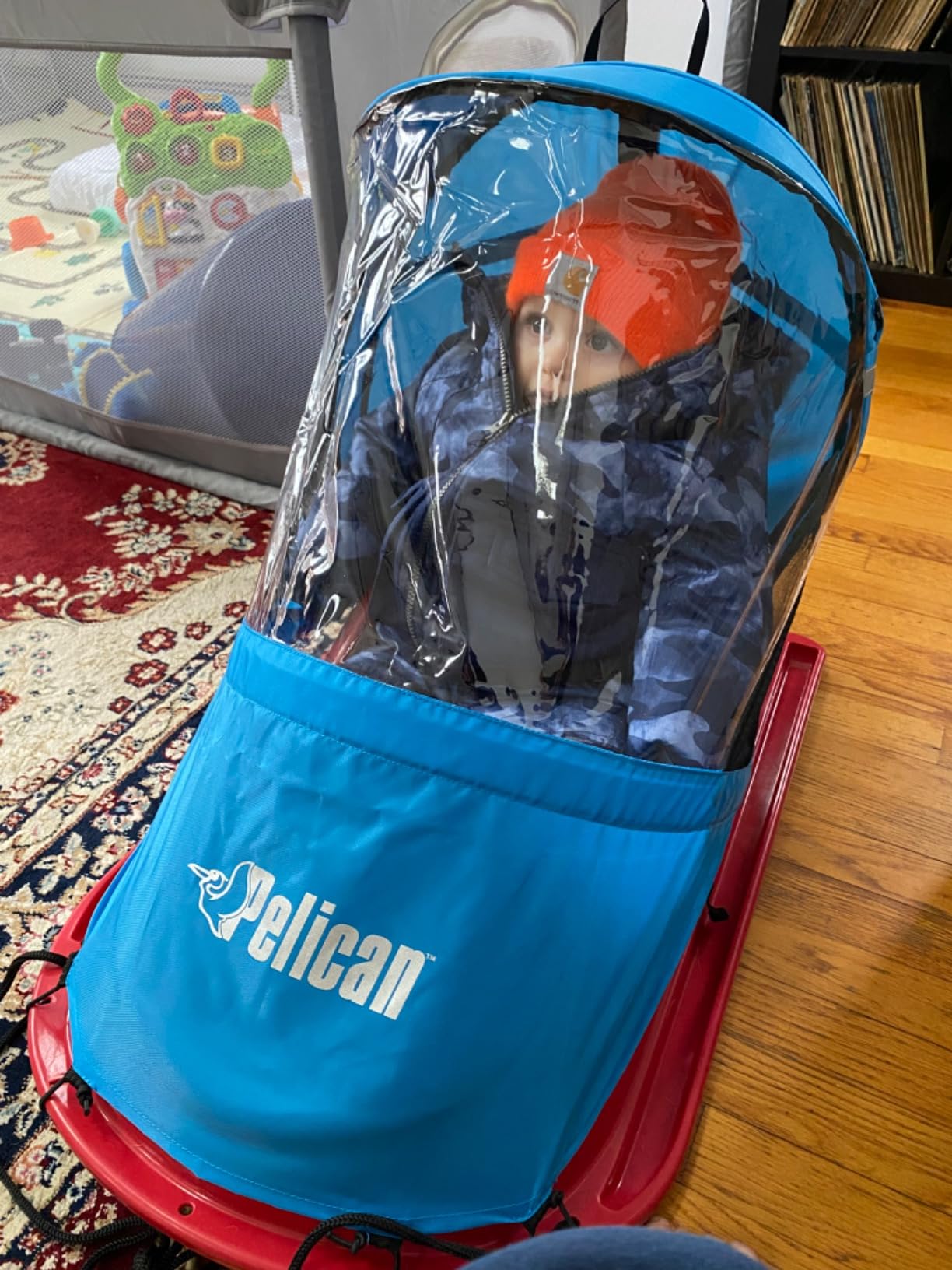
Feedback is the most consistent in the roundup: 4.6 stars from 769 ratings with 79 percent five-star and only 1 percent one-star. That is the tightest one-star share of any sled here, and the praise lands consistently on warmth, wind protection and stability rather than on speed, which is not what this sled is for.
Coverage is stronger than most. It carries a one-year limited warranty against manufacturer defects, a 60-day hull repair or replace commitment and a one-year guarantee on accessories, plus a long pull rope in the box. The design is stated to meet current North American safety standards.
What to check before buying
Check the age range honestly. This is a 0 to 24 month sled and the seat is cramped beyond that, so a child who is walking and talking will not fit comfortably. If your child is already approaching two, plan this as a single-winter purchase.
Check the belt type against the winter outfit. The restraint is a single waist strap with no shoulder harness, and a child in a bulky snowsuit can slide sideways within it. A waist belt is adequate for short pulls on flat packed snow, not for a steep descent.
Where it falls short
Snow collects in the front well while you are pulling, and it has to be cleared out periodically or it rides up into the child’s legs. The weather cover also requires a screwdriver to remove or refit, which is awkward if you want to swap between screened and open riding on the same outing.
At 5 pounds and 31 by 19.5 by 25 inches it is bulkier than an open toddler sled, so it eats more boot space. If you are already juggling a bike trailer for kids in the same vehicle, the space maths gets tight quickly.
9. Best Sled for Two Riders: GoSports 2 Person Premium Snow Sled
GoSports 2 Person Premium Snow Sled with Double Walled Construction, Pull Strap and Padded Seat – Red
Double-walled HDPE construction
4 ft long
Seats two riders
Up to 300 lb combined
Pros
- Highest rated at 4.7 stars from 614 reviews
- Double-walled HDPE repeatedly praised for not cracking
- Seats a teen plus younger children
- Insulated air layer and foam padding cut the bumps
Cons
- Heaviest at 15 lb so uphill is a two-person job
- Most expensive in this roundup
- 4 ft length is awkward on small hills
The GoSports sled is the one we would buy for a family that keeps breaking cheaper plastic. Its construction is double-walled high-density polyethylene with an insulated air layer trapped between the walls, and that double skin is the entire argument. Reviewers repeatedly single out the fact that it does not flex or crack under heavy use, and several report buying a second one.
At 4.7 stars from 614 reviews it is the highest average rating in this roundup, with 87 percent five-star responses. The double skin also solves the bump problem rather than ignoring it, because the trapped air layer and the foam-padded seat take the edge off everything the snow throws up.
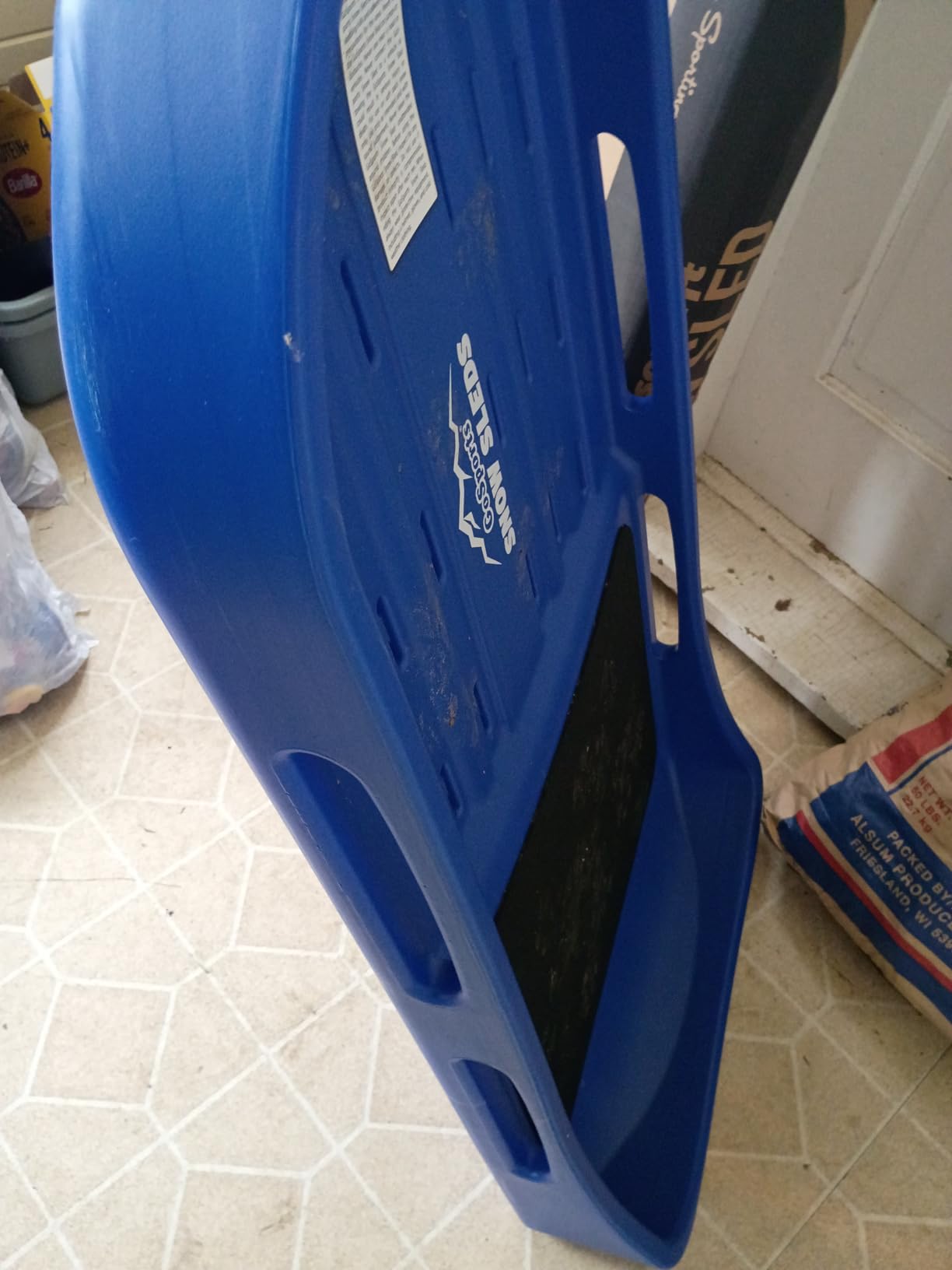
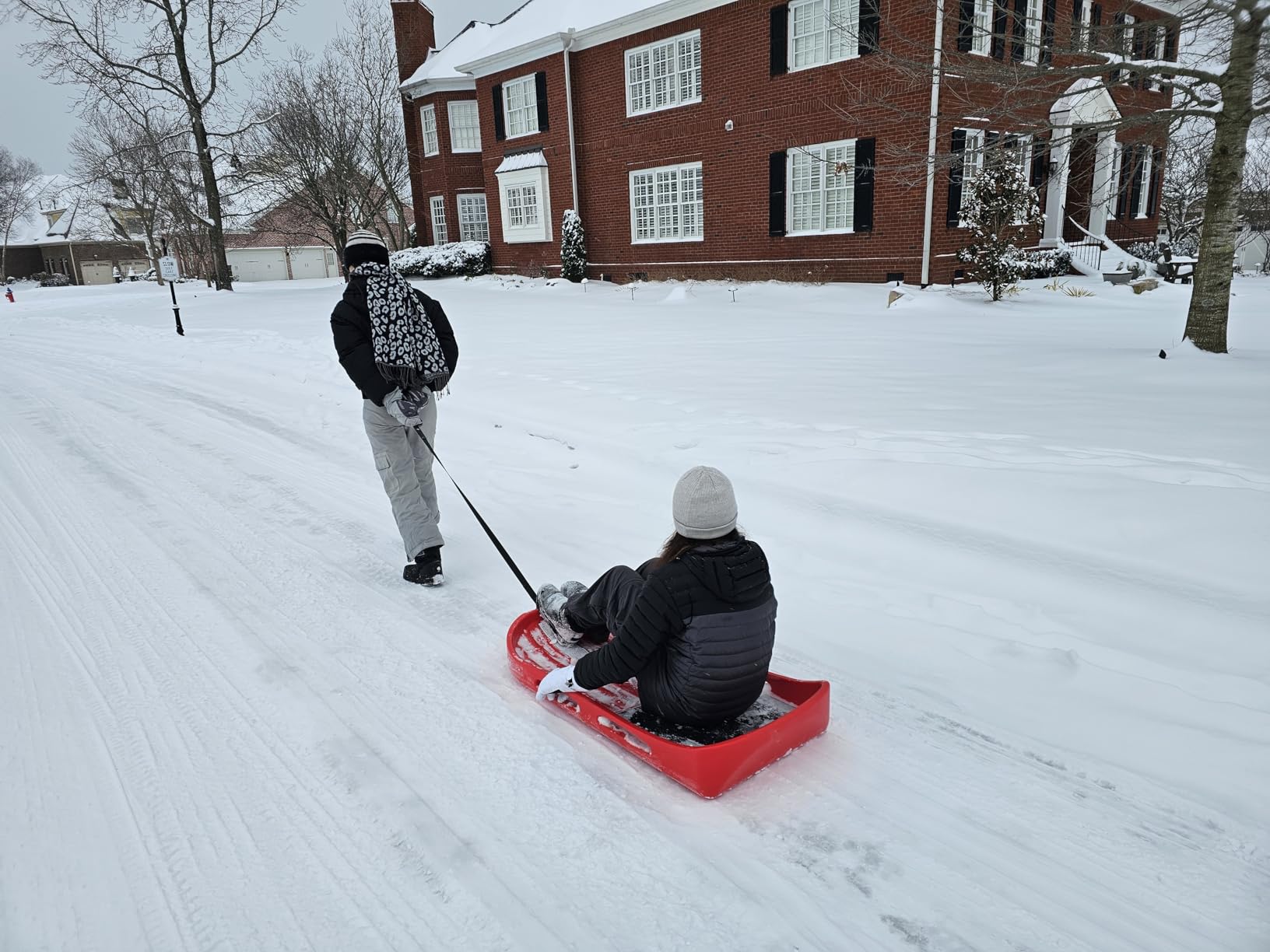
It is genuinely a two-rider sled. At 4 feet long with two sets of handles and a combined 300 pound capacity, reviewers report fitting a teenager plus two younger children on it. Two riders can also modulate speed by leaning forward or back, which no other sled in this roundup allows.
The hand pull strap is included and rated for towing, so hauling it back up is at least designed for. Between the double-walled shell, the padded seat and the tow strap, this is the sled most likely to still be in service in five years if you store it sensibly.
What to check before buying
Weigh it before you commit. Fifteen pounds is the heaviest sled here, and on a steep hill you will want two adults or a strong teenager on the rope. If your hill is a gentle backyard slope, the weight is manageable by one adult. If it is a steep public hill, plan the carry.
Check your hill size as well. A four-foot sled needs a run at least that wide, and it will not thread between trees. Big open slopes suit it; a narrow neighbourhood shortcut does not.
Where it falls short
It is the most expensive sled we reviewed, which is a real cost when a cheaper option covers the same hill. The trade is a one-time spend for a sled that is unlikely to crack, rather than replacing a thinner plastic toboggan every second or third winter.
It is a family and adult sled rather than a first sled for a three-year-old. A small child sitting in a deep sled at speed has a long way to fall, so the age guidance lists adults. Pair it with a smaller sled for the youngest riders.
10. Best Lightweight Pick for Ages 5 and Up: Flybar Kids Husky Dog Foam Toboggan
Flybar Kids 36″ Husky Dog Foam Toboggan Snow Sled with Slick Bottom & PE Core Build for Boys and Girls Ages 5+, Holds Up to 110 Lbs
36 inch foam toboggan with PE core
Under 1 lb to carry
Up to 110 lb
Ages 5 and up
Pros
- Lightest sled in the roundup at under a pound
- Kids carry it uphill themselves
- PE core resists bottom cracking
- Fun character design
- Parents report three-plus seasons
Cons
- 110 lb limit is the second lowest here
- Edge wear can appear within a season
- Best on packed snow not deep powder
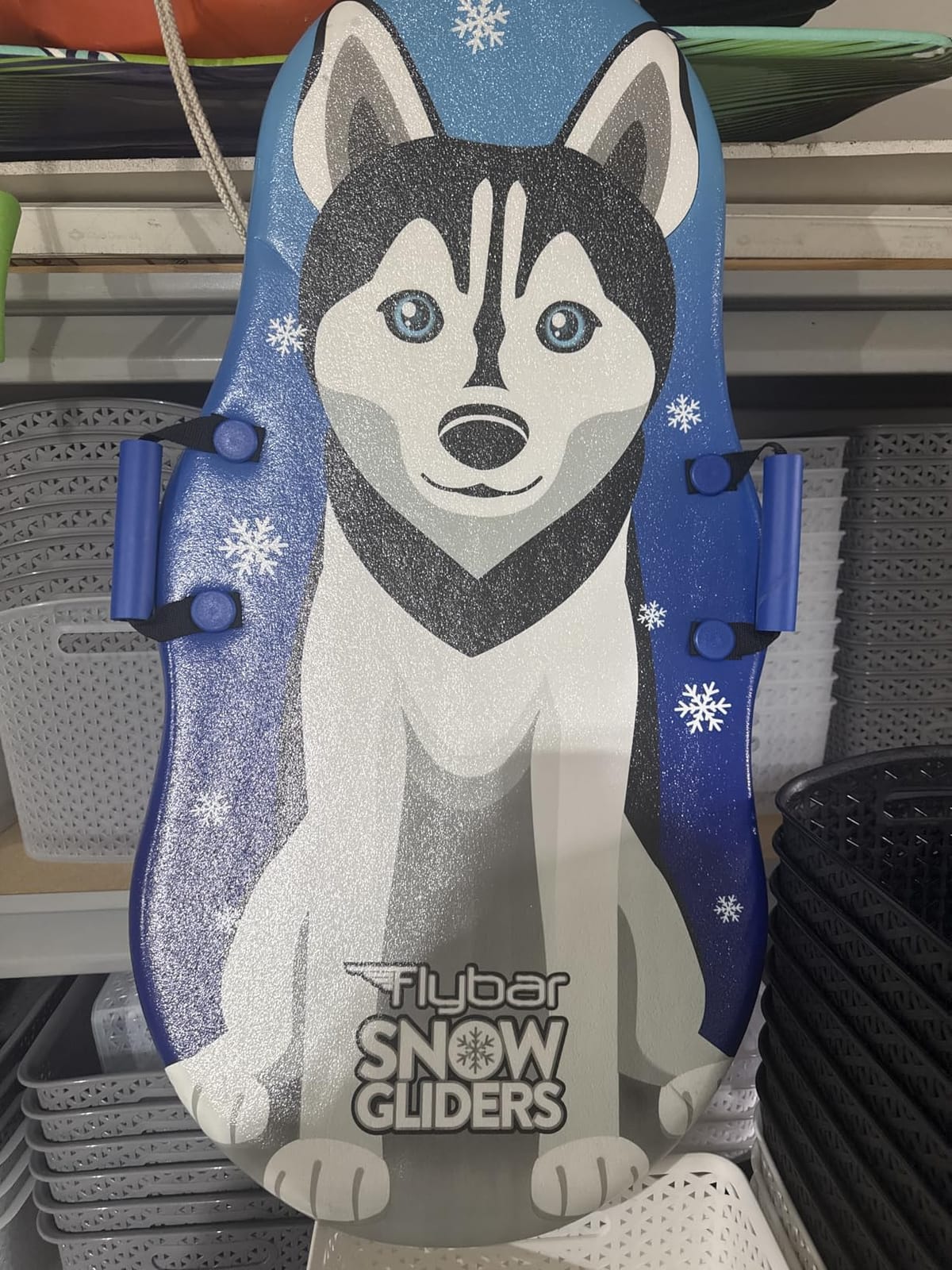
At under a pound, this is the sled a child can genuinely own. Nothing else in this roundup is light enough for a seven-year-old to carry up a hill without help, and that single fact changes how many times a family actually goes sledding when everyone has to be walked back up first.
The build is a foam body over a durable polyethylene core with a slick base, which is the specific construction that answers the most common complaint about foam sleds. A plain foam slab tears at the seam; a foam body laminated onto a PE core resists it. Parents report three-plus seasons of use without cracking on this one.
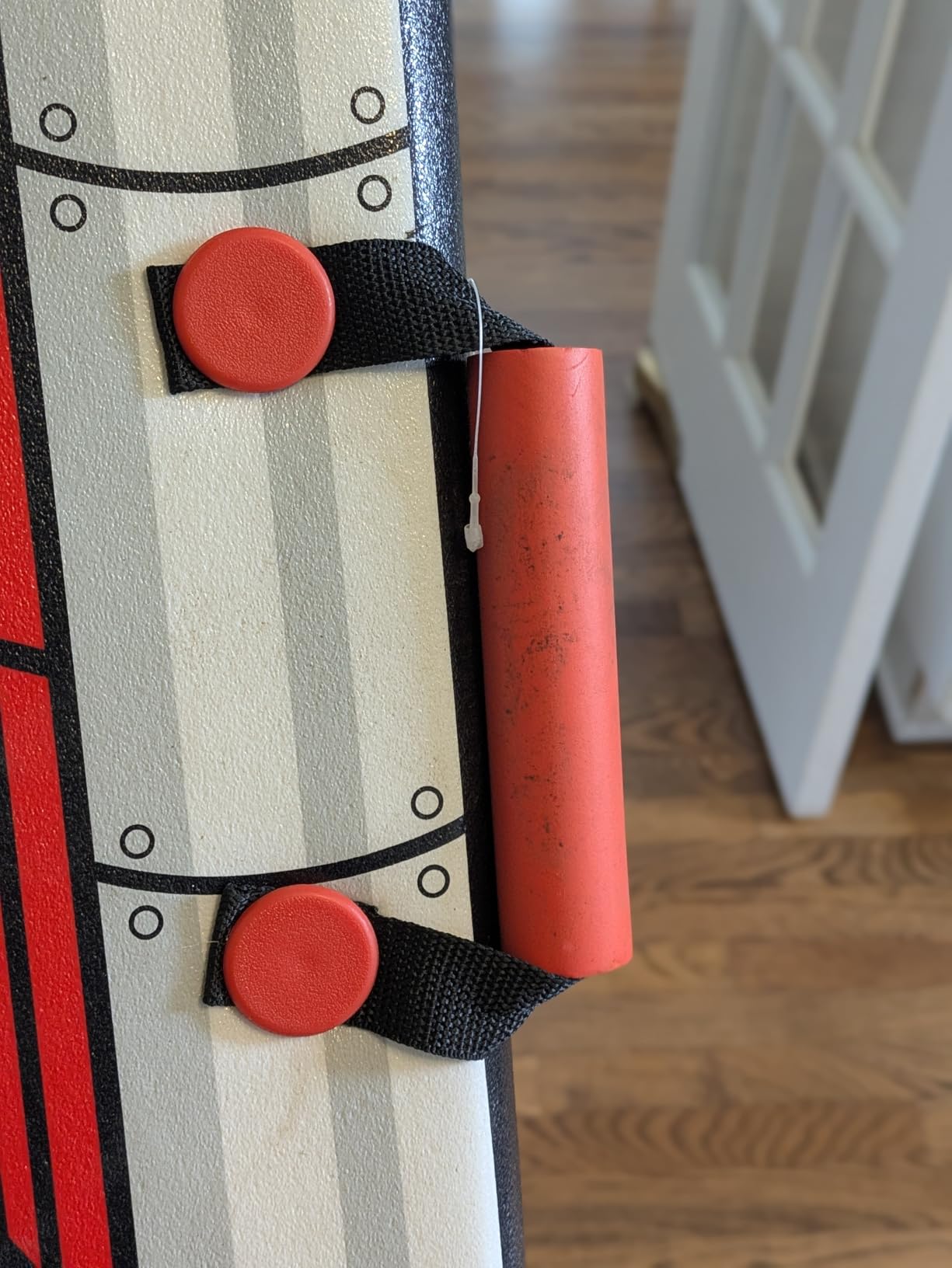
Two large ergonomic handles give a small child a real grip, and the cushioned foam top absorbs bumps, sticks and jumps in a way rigid plastic cannot. It measures 36 by 19 inches and packs flat, so it slides into a cupboard or a car boot when the season ends.
Feedback is strong for the price band, at 4.6 stars from 490 reviews with 80 percent five-star responses. The recurring note is value and weight. The other recurring note is faster-than-expected edge wear on some units, so check the rim at the end of a season rather than at the start of the next one.
What to check before buying
Check the weight limit honestly. At 110 pounds it suits children up to about ages five through ten and rules out most teenagers and all adults. If the main rider in your household is over that, this is a sled for a younger sibling instead.
Check the snow. The slick bottom is at its best on packed or slightly iced runs where the surface is firm. In deep unpacked powder the sled ploughs, and a hard-bottom toboggan or a tube will run away from it.
Where it falls short
It is a one-rider sled, so a parent cannot ride with a child on it. For shared runs, budget for a second sled or use it as the sibling sled alongside a tandem model.
Edge wear is the durability concern. Foam is light and comfortable but it abrades, and a sled that gets dropped on packed ice can crack along the rim. The character graphics also wear off eventually, which children notice more than adults expect.
11. Best Saucer Pack for Schools, Camps and Daycares: Flexible Flyer Flying Saucer 3-Pack
Flexible Flyer 26″ Plastic Flying Saucer Sleds – 3 Pack Orange/Green/Blue
Three 26 inch polyethylene saucers
1.5 lb per saucer
Up to 150 lb each
Ages 4 and up
Pros
- Built for group use in schools
- camps and daycares
- Only 1.5 lb per disc so a child carries one
- Crack-resistant heavy-gauge polyethylene
- Molded hand grips for a spinning ride
- Stacks for compact storage
Cons
- Not built for adults at full weight
- Teens crack them under heavy use
- Occasional cracked discs in the pack
- No directional control
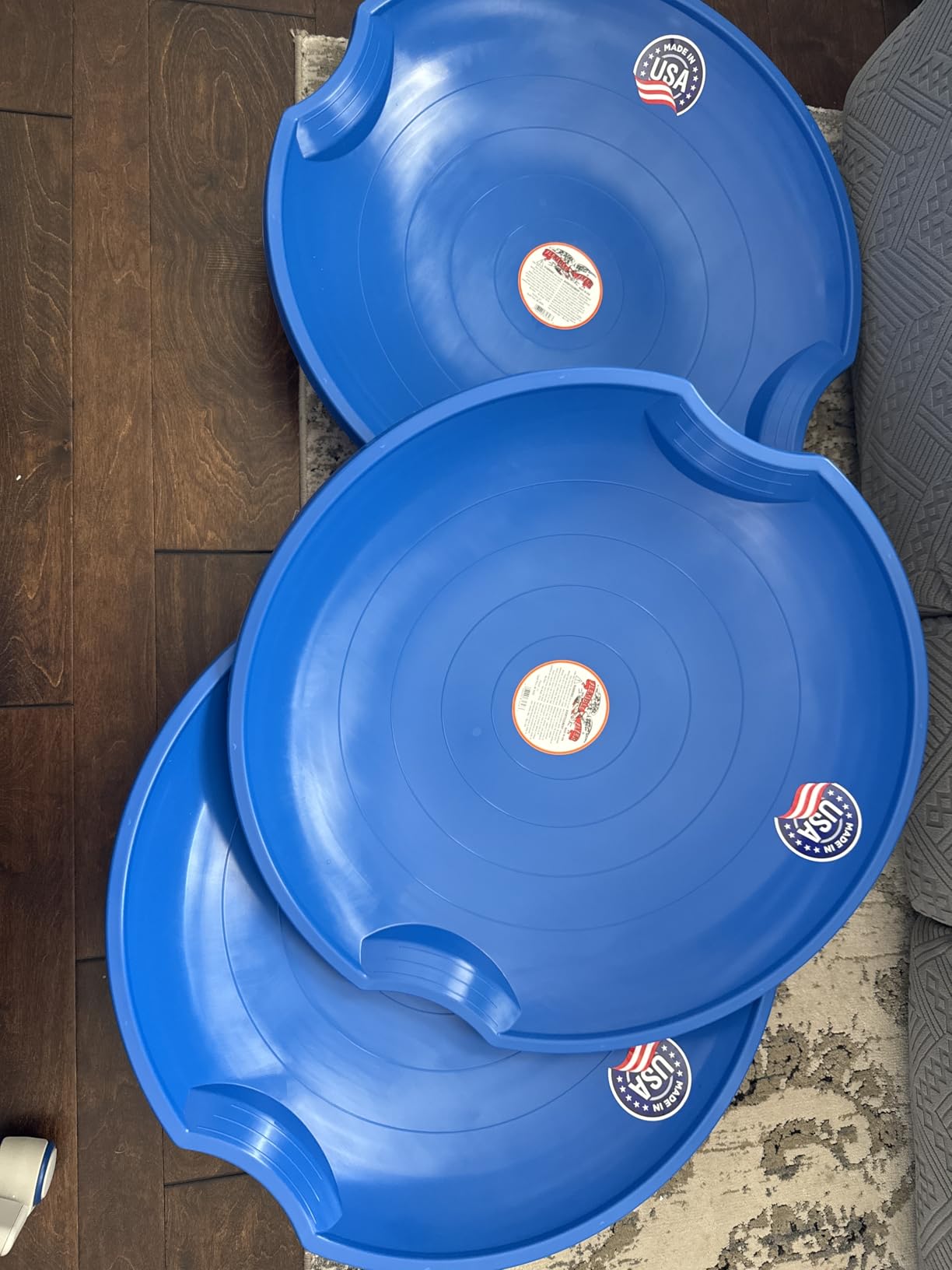
When you are buying for a group rather than a family, the maths changes completely. The priority is a sled a child can pick up, carry and put away without adult help, and at 1.5 pounds per disc this is the most group-friendly design in the roundup. Three colours, three riders, zero queue.
Moulded hand grips are built into each saucer, which matters more than it sounds. A child on a spinning disc needs something to hold, and buyers of handle-free saucers report frightened riders more often than they report fast ones. The super-slick base rides quickly on both packed snow and ice.
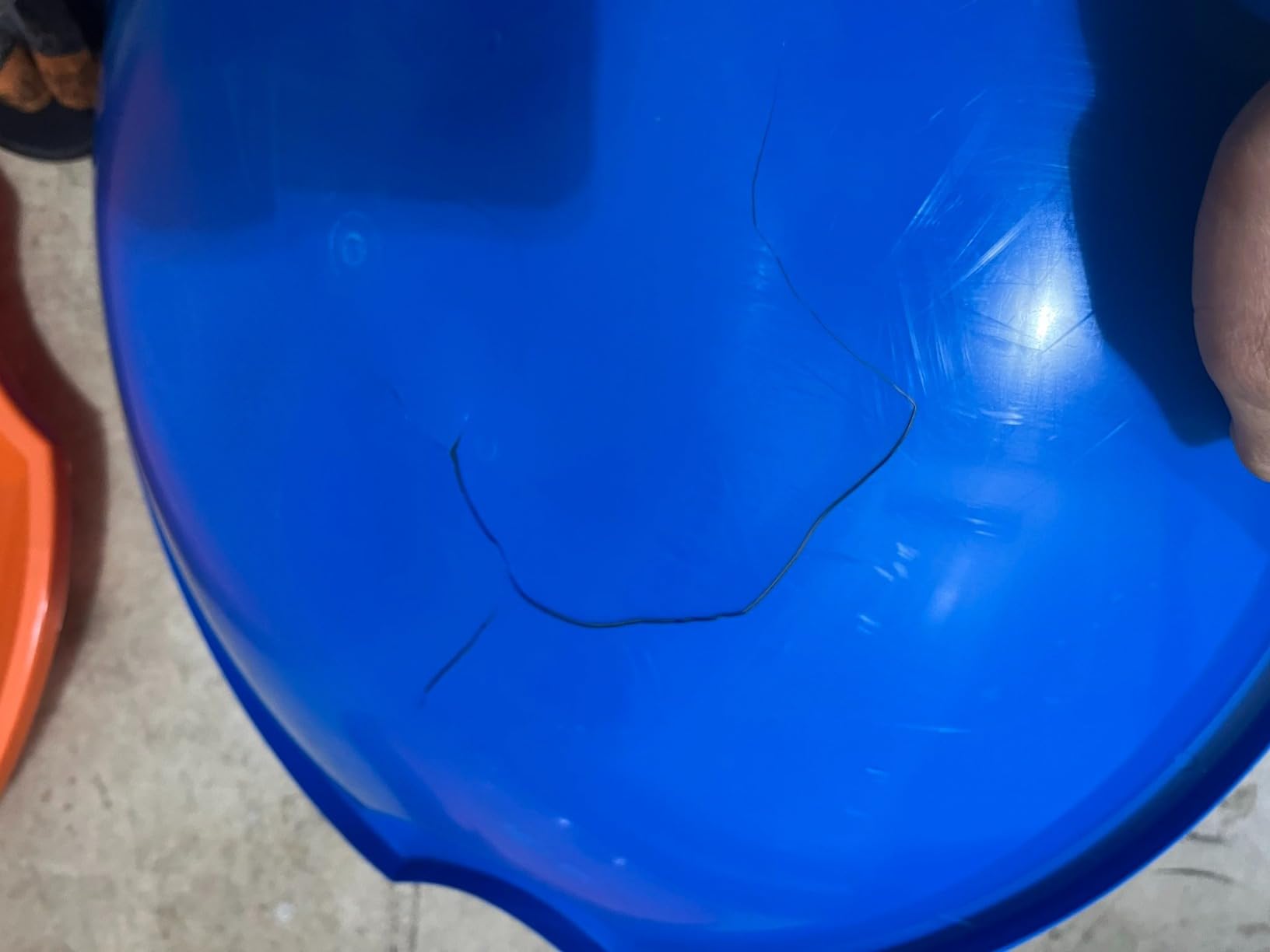
Feedback splits sharply by rider size, and that split is the deciding factor. At 4.2 stars from 463 reviews with 65 percent five-star but 11 percent one-star, the five-star feedback is overwhelmingly about children, and the one-star feedback is overwhelmingly about older riders and heavy use. Adults find the 26 inch discs flimsy at their weight.
The build is heavy-gauge, high-density polyethylene described as crack-resistant, and the discs stack neatly for storage when the group is finished. Some reviewers did report receiving an already-cracked disc in the pack, so check all three on arrival.
What to check before buying
Check who is actually riding. For a primary school or daycare with children in the four-to-nine range, the 150 pound rating and the 1.5 pound weight are exactly right. If teenagers will be using them unsupervised, expect more damage reports than the rating average suggests.
Check the supervision ratio. Saucers have no directional control, so the safe use case is a wide open gentle slope with an adult at the bottom. A crowded run with mixed ages needs handle-equipped toboggan-style sleds instead.
Where it falls short
It is not an adult or teen sled despite the listing mentioning both. At 150 pounds per disc the weight limit is generous, but a 26 inch diameter is not, and reviewers consistently report flimsy feel at adult loads.
Teens break them. That is the most common one-star theme in the reviews and it is a predictable outcome of thin moulded plastic carrying a large rider onto ice. If teenagers are the main users, spend the extra on a toboggan with a cold-resistant coating and a heavier build.
12. Best Inflatable Sled for Toddlers and Travel: QPAU Snow Sled
QPAU Sleds for Toddlers 1-3, Inflatable Design with Canvas Cover
Inflatable PVC with canvas cover
Ages 1 to 3
Up to 110 lb
Deflates for storage
Pros
- Soft inflatable body cushions a toddler well
- Three-sided wraparound seat keeps them centred
- Seatbelt-style strap with side-release buckle
- Dual non-slip rails grip ice
- Deflates in seconds
- Patch set included
Cons
- Air pump not included
- Valve is awkward to reach with gloves on
- Outgrown at age 3
- Not allowed on groomed resort runs
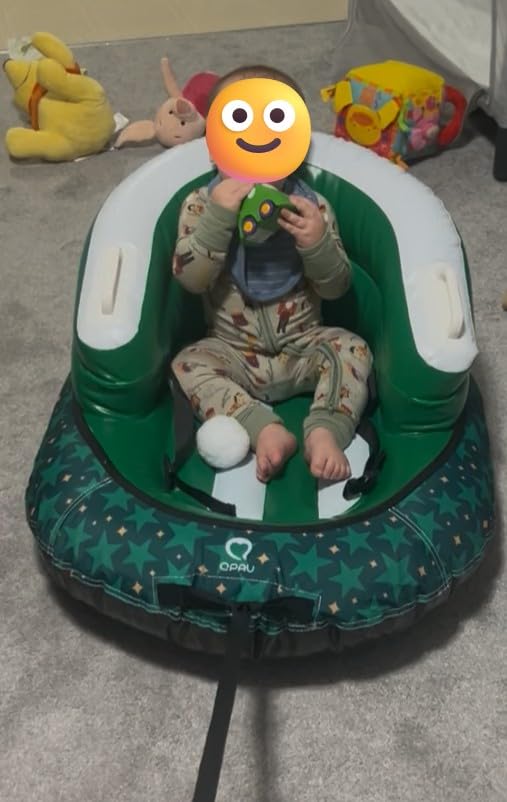
The QPAU sled is the only inflatable in this roundup, and that changes the ride completely. The PVC body is wrapped in a reinforced canvas outer cover, so a small child sits in a soft, forgiving seat rather than on hard plastic. It measures 33 by 25 by 17 inches and carries a child up to 110 pounds.
Safety is the design driver. A three-sided wraparound inflated barrier keeps a toddler upright and centred, an adjustable seatbelt-style strap with a side-release buckle fastens them in, and dual non-slip rails on the base grip ice and resist tipping on gentle slopes. That combination is more restraint than any other sled for a one-to-three-year-old here.
The travel case for this sled is hard to argue with. It deflates in seconds and folds down to nothing, which means it fits in a car boot next to ski gear instead of occupying a corner of the garage for eleven months. An inflation gauge marker and a flexible measuring strip are included so you do not over- or under-inflate it, and a repair patch set comes in the box.
At 4.6 stars from 302 reviews with 83 percent five-star, feedback centres on safety, comfort and build quality. Two practical complaints recur: the air pump is not included, and the inflation valve sits close to the curved backrest where it is awkward to reach with gloves on.
What to check before buying
Buy a hand pump with the sled, not after it. Without a pump included, the first assembly depends on whatever inflator you have at home, and the awkward valve position makes a long nozzle or a pump with a flexible hose worth the extra.
Check the terrain. Soft inflatable sidewalls are wonderful for a gentle slope and poor for anything steep, because the rails grip rather than glide and the sides deform under a hard steering input. This is a neighbourhood hill and pavement-pull sled, not a mountain one.
Where it falls short
The age range of one to three is the tightest in the roundup and it will be outgrown within a season or two. The 110 pound limit and the seat proportions are the first things a growing child will push against.
It is not permitted on groomed ski-resort runs, so a family that expects to use resort terrain with a shared season pass will want a hard sled instead. The canvas cover also scuffs visibly on ice, even though it is reinforced to resist scratches.
How to Choose a Kids’ Sled
Work through these six factors in order and the right sled almost picks itself. Age determines the category, terrain determines the material, and the shape of the run determines whether you need steering at all.
Start with an age band
Six months to three years: a pull sled with a real restraint. Look for a three-point harness or a wraparound seat, a high back, and a tow strap for flat walks. The open plastic option is lighter and easier to steer; the screened option keeps a baby warm. Skip downhill runs entirely and stay on flat packed snow.
Ages three to six: a steerable or handle-equipped toboggan. This is the age where children want to be in control rather than being carried, and mid-sled handles or a steering wheel are what make that possible. A saucer is too uncontrolled at this age.
Ages six to ten: a full-length plastic toboggan, a foam sled for comfort, or a lightweight foam model the child can carry alone. Check the weight limit against the tallest child in the group, because this is the band where capacity starts to matter.
Tens and teens: a wide two-rider sled with a high weight limit and a tow strap, or a double-walled plastic build that survives being crashed hard into ice. Anything rated under 110 pounds will not suit them.
Plastic, foam or wood: which material holds up
There are no wooden sleds in this roundup, so the honest comparison is between rigid plastic, layered plastic and foam. Here is where each one wins and where it fails.
Rigid plastic is the fastest on packed and icy snow and lasts longest when it is thick enough. It transmits every bump, gets brittle in deep cold without a low-temperature coating, and cracks at the moulded handle points when the shell is thin. Cold-resistant coatings such as IceVex are the single most useful spec to look for on plastic.
Double-walled plastic costs more and weighs more, and it is the most durable option by a clear margin. The air layer between the walls also cuts bumpiness, so it wins on both durability and comfort. It is the right choice when a broken sled in February would ruin the season.
Foam over a plastic core is the comfort winner and the weight winner. A foam body on a polyethylene core resists the seam cracking that sinks cheaper foam sleds, and it packs flat for storage. Foam ploughs in deep powder, so it is a packed-snow and rutted-hill sled rather than a fresh-snow one.
Inflatable is the softest and the most compact, and it is a genuine fit for toddlers because a cushioning body replaces a hard seat. It needs a pump, it deflates between outings, and it is a gentle-slope sled rather than a racing one.
Decide whether steering matters
Steering is the most important safety question on this list. A sled that spins, side-slips or will not slow down cannot be saved by a child in the last two seconds, and a hill with trees, a road, a fence or a frozen pond at the bottom is a place where that difference becomes critical.
Full steering means a wheel and, ideally, a brake. The Gizmo Riders Stratos is the only sled in this roundup with a working pull-up brake, and that is why it earns its place in a roundup dominated by simpler designs. Partial steering means mid-sled handles and a front pull rope, which slow a sled down and let a child choose a line but do not actually turn it.
No steering means a saucer disc, and a saucer is fine on a wide, open, gentle hill with a flat run-out. It is not fine anywhere the run ends in a direction the sled cannot face.
Match the sled to the snow
Hard plastic and saucers win on packed and icy hills because a low-friction hard base needs a firm surface. Foam sleds feel the bumps less but dig into powder, so they suit packed, slightly wet or rutted runs. On a fresh, untracked hill a hard-bottom toboggan or a tube will outrun everything else.
Heavy or wet snow is where a lightweight sled’s advantages disappear. If the hill is deep and slow, choose weight and capacity over portability, because a 15 pound sled that is easy to steer beats a one-pound sled that stops in a drift.
Read the weight limit properly
Weight limits are the most abused spec in this category. They almost always mean total rider weight, not rider plus a sibling, and they rarely account for a bulky winter coat adding several pounds. A sled rated for 55 pounds is genuinely unusable for a large three-year-old, and a 110 pound limit excludes most teenagers.
For tandem sleds, check whether the rating applies per rider or to the combined load. On the picks here, the flexible plastic toboggan and the premium foam sled take up to their stated rating across two riders, while the 260 pound steerable sled is a single-rider figure despite its roomy profile.
Plan storage and the walk back up
Two practical questions decide more purchases than speed does. First, can the sled be carried up the hill by the smallest person who will use it? Sleds under three pounds can go back up alone; a fifteen-pound sled needs two adults. Second, where does it live in June?
Saucers stack flat, foam sleds pack flat, and inflatables deflate to nothing. A 48 inch rigid toboggan occupies a genuine footprint in a garage, so if space is tight the stackable or inflatable options will get used more and last longer in practice.
Whatever you buy, a tow rope or strap is worth adding if one is not included. Walking back up a slope in wind while carrying a sled is the single most common complaint parents have about sledding day, and a rope turns it into a two-minute job. Our guides to dog playpens for kids and pet hair vacuums cover the other gear that piles up in the same hallway and garage.
Sledding Safety for Kids
The safest type of sled for a child is a steerable one with high side walls, a restraint and a way to slow down, used on an open hill with a flat run-out. Sleds that spin, cannot be steered and block the rider’s view are the least safe, and that is the reason we put the brake-equipped Stratos near the top of this list despite its heavier build.
Scout the run before the first descent. Walk to the bottom of the hill yourself and check what is there. A road, a fence, a tree, a frozen pond, a drop or another sledding queue are all reasons to change the run rather than the sled. A sled cannot be steered, so the run-out matters more than the slope.
Ride feet first, sitting up, head back. This is the single most effective technique for reducing head and neck injuries, because the feet and the seat take the impact instead of the skull. Teach it from the very first run, before the child is confident enough to want to lie down.
Use the restraint on every descent. A three-point harness, a seatbelt strap or a wraparound seat keeps a small child’s weight inside the shell. On a harness sled, adjust the strap with the child in their winter suit rather than over it.
Helmets are worth considering for fast or icy runs. Any helmet used for skiing or snowboarding transfers directly to sledding. It is not a substitute for choosing a controllable sled and an open hill, and we would prioritise the hill and the sled type first.
One more rule we would not bend: keep a count of children at the top of the hill, and never leave a child under about three on a slope unsupervised. The small-child sleds in this roundup are pull sleds for flat ground and gentle slopes, not downhill toys.
Frequently Asked Questions
What is the best snow sledge for kids?
The best sled for kids depends on age and terrain. A steerable plastic toboggan is the safest all-round choice for most families, a foam sled wins on comfort over rough hills, a pull sled with a harness suits babies and toddlers, and a wide two-rider sled is right when two kids share a run. Our top overall pick is the Slippery Racer Downhill Xtreme, a 48 inch flexible plastic toboggan rated for two riders up to 150 pounds.
What is the safest type of sled?
A steerable sled with high side walls, a safety restraint and a working brake is the safest type. Those sleds let a child control direction and slow down before the run-out, which matters most on a hill with trees, a curve or a road at the bottom. Sleds that spin or side-slip, and riders who cannot see over the front edge, carry the most risk. Age-appropriate restraint and a flat run-out matter more than any other feature.
What is the best toboggan for a 3-year-old child?
For a three-year-old, a steerable or handle-equipped toboggan with mid-sled handles and a front pull rope is the right shape. It lets a small child influence the direction without needing real steering, and it is light enough to carry back uphill. Avoid saucer discs and any unsteerable sled at this age, and avoid the 55 pound rider limit on toddler pull sleds because a large three-year-old can already exceed it.
Which sled is better, plastic or foam?
Plastic is faster, more durable and better in deep powder, but it transmits every bump. Foam absorbs bumps and is far lighter, so a child can carry it uphill alone, but it ploughs in deep snow and cheaper foam slabs crack at the seam. For packed, rutted hills choose foam. For fresh untracked snow or long-term durability, choose plastic, and look for a low-temperature coating or a double-walled build.
Are wooden sleds better than plastic?
Wooden sleds with metal runners are prized for heirloom durability and for carving control, and many families pass them down for a decade or more. Plastic is lighter, cheaper, safer in very cold weather and takes far less storage space. For a young child’s first sled, plastic is the practical choice. A wooden runner sled makes more sense as a keepsake once a child is old enough to steer and stop properly.
What are the best-rated sleds for kids?
The best-rated sleds in our roundup are the GoSports 2 Person Premium Snow Sled at 4.7 stars from 614 reviews, and the Slippery Racer Downhill Xtreme at 4.6 stars from 1,483 reviews, the largest review base we found. Rating averages alone are not the whole story: check the one-star share too, because a 4.6 with only 3 percent one-star feedback is a safer bet than a similar average with a heavier complaint share.
The Verdict: Which Kids’ Sled Wins
The best sleds for kids in 2026 are not one product but a short list matched to age and terrain. For most families the Slippery Racer Downhill Xtreme is the buy: it is the best-proven sled we found, it takes two riders up to 150 pounds, it holds up in hard cold, and at 3 pounds a child can drag it back uphill.
Match it from there. Buy the Best Choice Products 35in toboggan for a single small child on a small local hill, the Gizmo Riders Stratos when steering and a brake matter more than weight, the Pelican or QPAU sled for a baby or toddler, the GoSports double-walled sled for two riders and long-term durability, and the Flexible Flyer saucer packs when you are outfitting a whole group. Check the one-star share in the reviews, not just the average, and take a hand pump and a tow rope with you.