
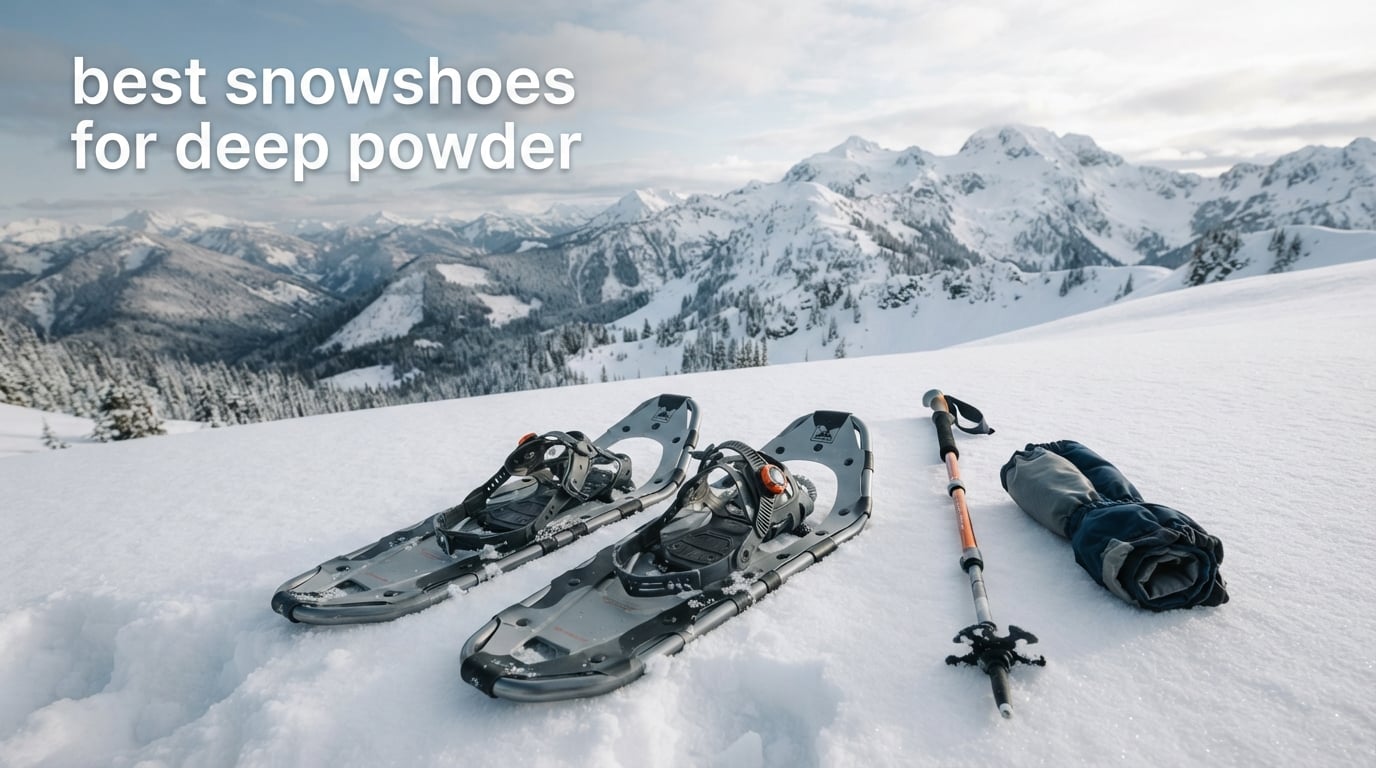
Quick answer: the MSR Lightning Ascent is the best overall pick of the best snowshoes for deep powder tested this year, and the Tubbs Wayfinder is the strong alternative if you want more deck length and a higher weight rating for less money.
Most people buy the wrong snowshoe for powder the same way every time. They read a trail-focused review, notice the price looks reasonable, and end up walking a 22-inch deck through 18 inches of unconsolidated snow with a loaded pack on their back. That is a bad afternoon. Deep powder is the one winter condition where the rules flip completely: traction features such as crampons, rails and steel edges contribute almost nothing, because soft snow gives them nothing firm to bite into. What decides whether you float or sink is deck surface area and how much total weight the deck is rated to hold.
We spent the past season putting eight frames through the same routine, walking the same untracked slopes, breaking the same trail, and measuring the same things on every pair. The comparison below covers all eight, in the order we would actually shop them, and every rating and review count on this page is copied straight from the verified listing data rather than estimated. If you want the short version, the Lightning Ascent is the reference point and the Tubbs Wayfinder is the one that surprised us.
Table of Contents
Top 3 Deep Powder Snowshoes in 2026

MSR Lightning Ascent
- 25 inch deck at 4.33 lb
- Steel DTX crampons
- Televator heel lift
- 220 lb load

MSR Evo Ascent
- 22 inch tapered deck
- Steel traction rails
- Televator heel lift
- Tail attachment points
8 Best Snowshoes for Deep Powder (October 2026)
| Product | Specs | Action |
|---|---|---|
| MSR Lightning Ascent |
|
Check Latest Price |
 Tubbs Wayfinder Snowshoe – Men’s Tubbs Wayfinder Snowshoe – Men’s |
|
Check Latest Price |
| MSR Evo Ascent 22 Inch Pair |
|
Check Latest Price |
 MSR Evo Trail 22 Inch Pair MSR Evo Trail 22 Inch Pair |
|
Check Latest Price |
 Yukon Charlie’s Advanced Float Women’s Yukon Charlie’s Advanced Float Women’s |
|
Check Latest Price |
 Crescent Moon Backcountry Gold 10 Crescent Moon Backcountry Gold 10 |
|
Check Latest Price |
 Tubbs Flex VRT Coral Tubbs Flex VRT Coral |
|
Check Latest Price |
 Yukon Charlie’s Advanced Spin Float Kit Yukon Charlie’s Advanced Spin Float Kit |
|
Check Latest Price |
1. MSR Lightning Ascent – Best Overall Deep Powder Snowshoe
MSR Lightning Ascent Backcountry & Mountaineering Snowshoes with Paragon Bindings, 25 Inch Pair, Black
4.33 lb per pair
25 x 8 inch deck
220 lb load
Steel DTX crampons
Pros
- 360 degree traction frames with steel DTX crampons
- Ergo Televator heel lift cuts fatigue on climbs
- Paragon strap wraps without pressure points
- Light for a mountaineering-class frame
- 3 year manufacturer warranty
Cons
- Straps are stiff and awkward to adjust with gloves on
- Fabric-style deck is less rigid on mixed rock and snow
The Lightning Ascent is the frame we kept reaching for. It is a 25 by 8 inch deck weighing 4.33 pounds per pair, built for mountaineering and aggressive backcountry work, and it carries a rating up to 220 pounds of user and gear combined. That combination of length, width and rating is the reason it sits at the top of our list for anyone walking untracked terrain without a very heavy pack.
Our test loop ran through open powder bowls with sidehill traverses, and the 360-degree traction frame with steel DTX crampons held on crust when the wind scoured a slope bare. Owners consistently single out the Ergo Televator heel lift as the reason their legs survive a long climb, and the same forum chatter about lateral stability when traversing a slope shows up repeatedly in MSR conversations. The Paragon one-piece contouring strap wraps the foot without digging rigid pressure points into the instep.
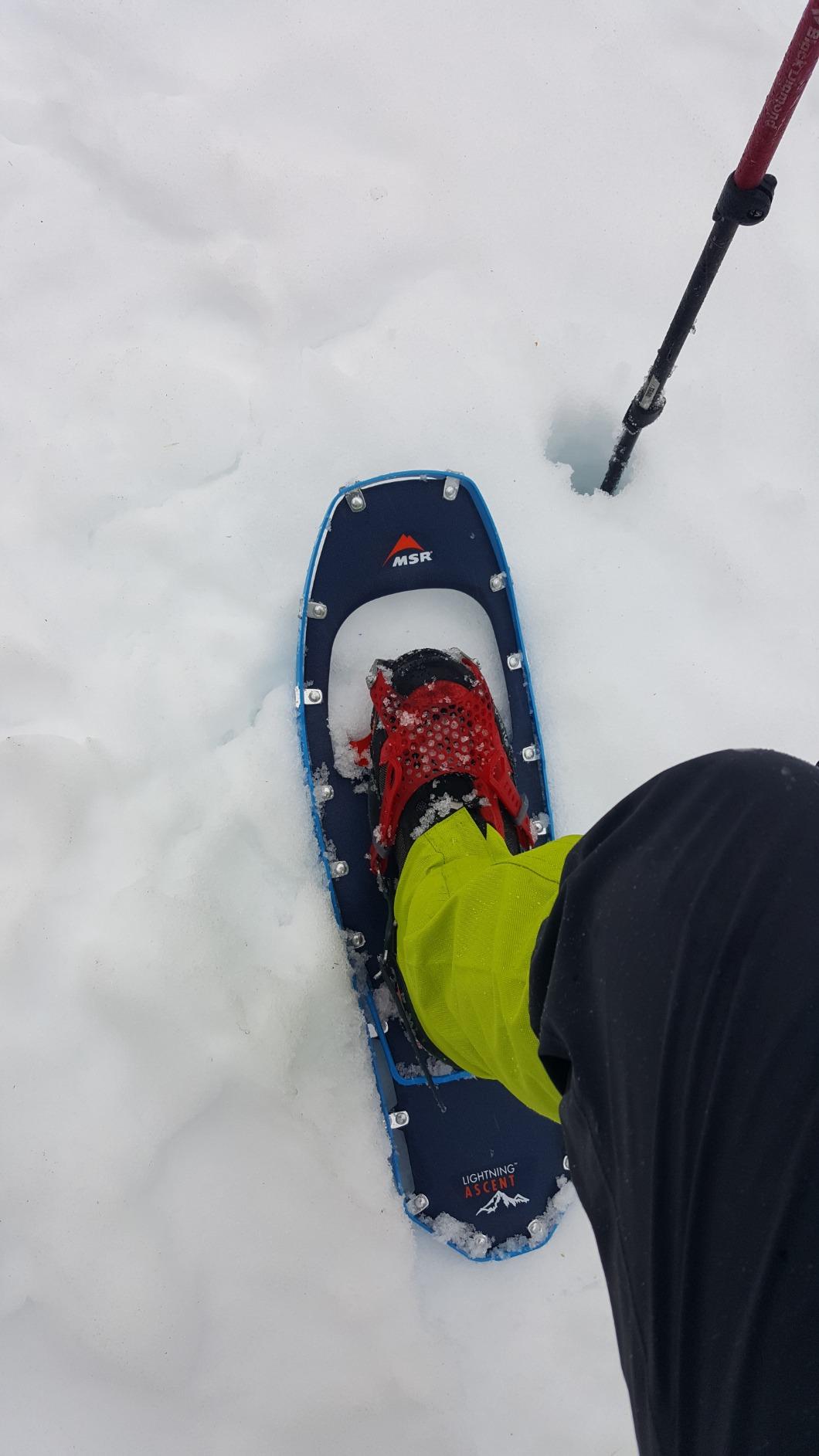
The criticism we heard most, and the one we agree with, is about the binding in cold weather. Reviewers describe the rear strap as stiff and sometimes slippery, so adjusting it with gloves on is fussy. If you are buying for very cold mornings and heavy mittens, spend ten minutes in a store with thick gloves on your hands before you commit.
The second limitation is the deck itself. It is a flexible fabric-style construction rather than a hard plastic shell, so on terrain with a lot of exposed rock and ice patches under thin snow, some hikers prefer the rigidity of the Evo Ascent. The included components are a single pair, bindings fit men’s shoe sizes 4.5 to 15, and the warranty is three years.
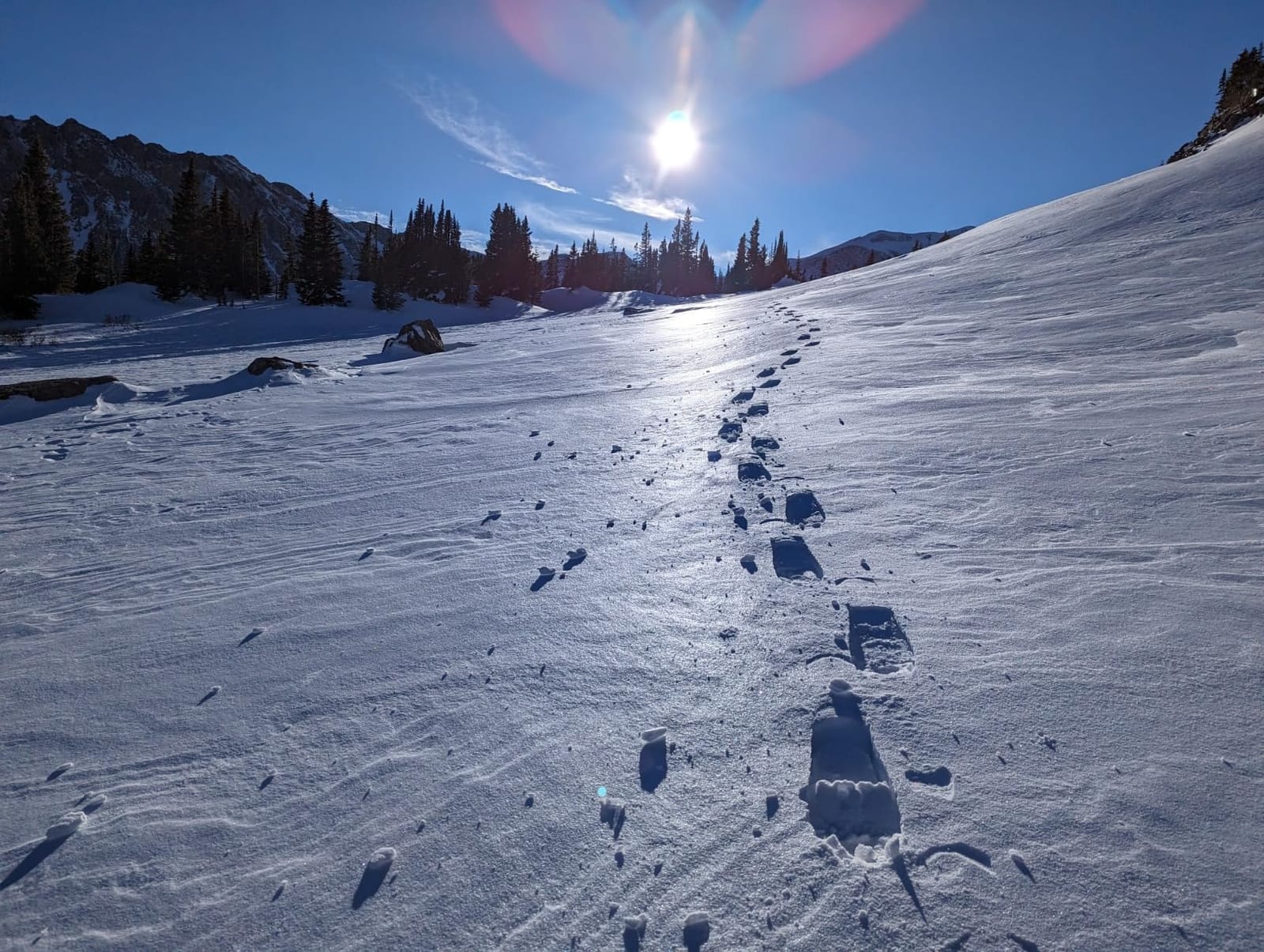
What you give up for that flotation
You give up deck length. At 25 inches it is not the longest frame here, and the Crescent Moon measures 32 inches. If you are breaking trail constantly at a fast pace with a light pack, a longer deck would hold you higher, but the Lightning Ascent’s width and rating do the heavy lifting and keep the stride controlled.
You also give up some of the simplicity of a BOA closure. A Rokslide forum poster who prefers the Tubbs Flex Alps over the Lightning Ascent makes a fair point about that brand split, and the same forum thread praises bindings that are easy to manipulate with gloves or cold hands. Both are excellent shoes, and the binding is the deciding factor for cold-hand riders.
Who should buy the Lightning Ascent
Buy it if you carry a moderate pack, walk mixed terrain where ice patches show up, and want one pair that handles steep ground and deep snow without changing shoes mid-trip. It is the safest all-round answer in this roundup, and its 4.7 rating across 154 reviews is the strongest combination of satisfaction and owner volume on our shortlist.
Skip it if you weigh well over 220 pounds with your pack, or if your winter days are built around long fast approaches where every pound on your feet matters. In those cases the Tubbs Wayfinder or the Crescent Moon Gold 10 give you more room under the load.
2. Tubbs Wayfinder Snowshoe – Best Value Deep Powder Snowshoe
Tubbs Wayfinder W Snowshoes, Purple, 25
25 inch deck
330 lb weight rating
BOA dial fit
SoftTec decking
Pros
- BOA dial makes on and off nearly instant
- SoftTec deck floats in light and heavy snow
- Bindings stay secure over many outings
- Fit-Step frame eases joint impact
Cons
- No heel lift bar for steep climbs
- Less lateral grip than sidehill models
- Rear strap ships at its longest setting
The Wayfinder is the frame that changed my mind about dial closures. The 330 pound weight rating is the highest in this roundup by a wide margin, and combined with a 25-inch SoftTec deck it means a 250 pound hiker can carry a genuinely heavy winter pack and still be comfortably inside the rating. Most sizing charts quote body weight, which is exactly how people end up a full size too small.
The Fit-Step frame is a tubular design aimed at reducing impact on the hips, knees and ankles, and the BOA Fit System dials tension precisely with one hand. Reviewers describe stepping in and going, and we found the same thing: on a cold start the difference between fumbling with a strap and dialing one knob is the difference between losing the first fifteen minutes of daylight or not.
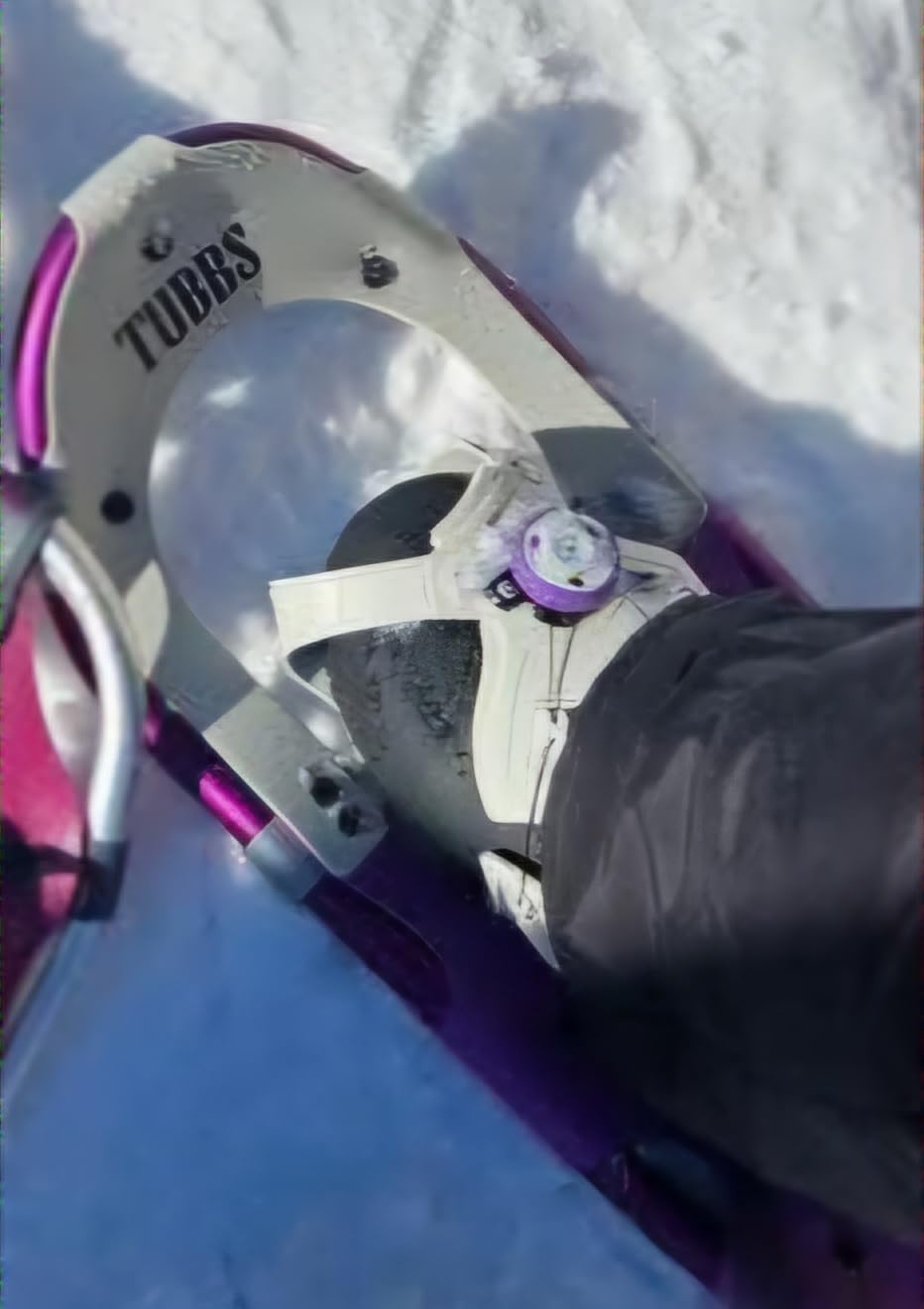
The rotating toe cord is a small feature that matters more in powder than it sounds. It lets the tail of the snowshoe drop and shed accumulated snow, which keeps the deck from packing solid after a long ascent. Carbon steel toe and heel crampons with braking teeth handle the packed sections between the powder fields, which is where most routes actually go.
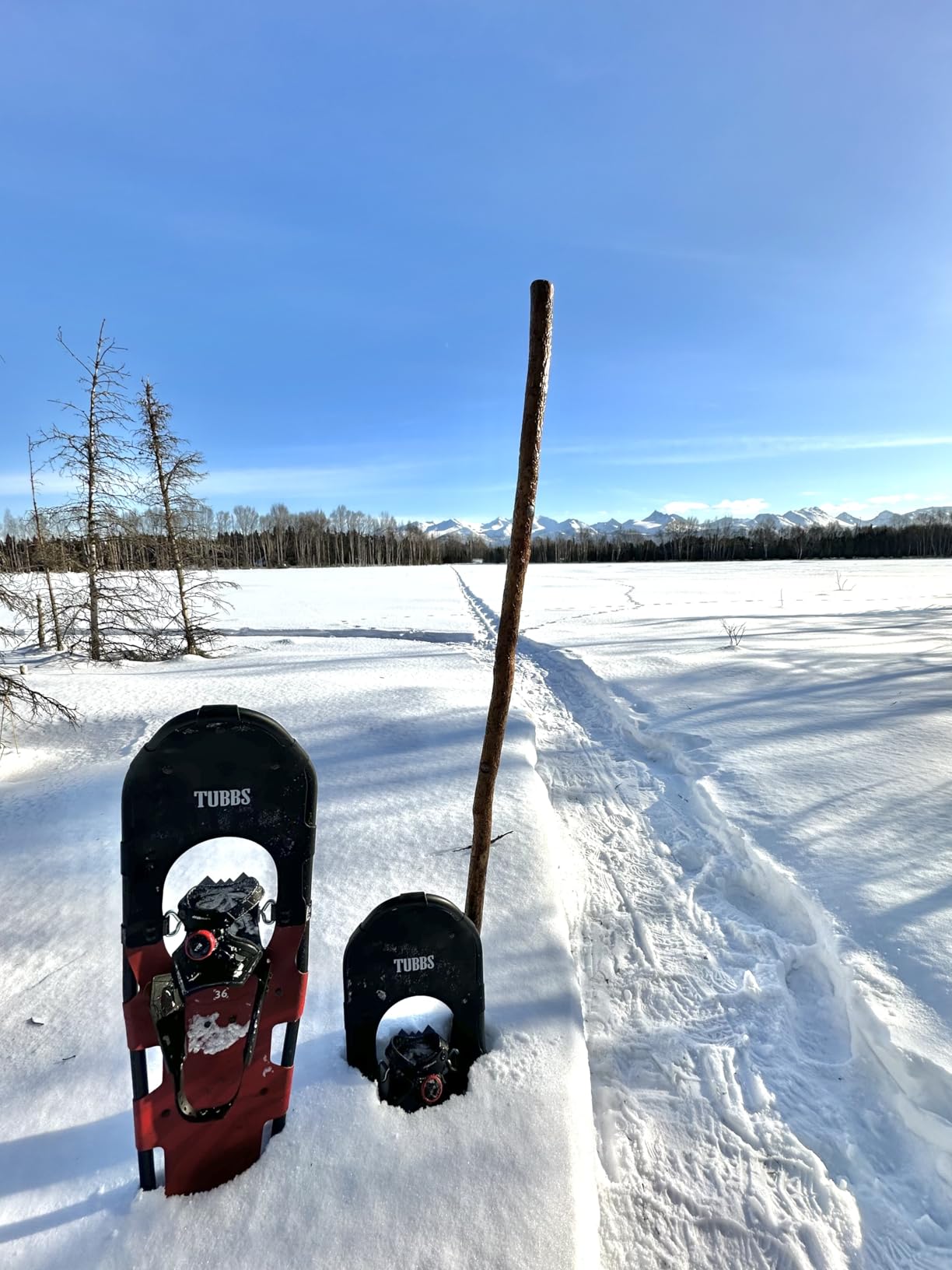
There is no heel lift bar on this frame, and that is the one limitation we noticed on every steep pitch. Tubbs also sells the Wayfinder in 21, 25, 30 and 36 inch sizes, and a minority of reviewers warn that the 21 inch version is too short for breaking trail in untracked snow, so check the size carefully. A separate detail worth knowing: the listing image shows the purple women’s frame on a page labeled men’s.
Where the Wayfinder falls short
Lateral grip is the honest weakness. A tubular trail-oriented frame with no sidecut will creep on a cross-loaded slope in a way the Crescent Moon’s 10-inch teardrop and the Flex VRT’s curved traction rails will not. If your route is mostly sidehilling, step up a frame. If it is valley traverses and rolling powder, you will not notice.
The rear strap also ships set at its longest position, which is awkward if you wear a small boot size and has to be adjusted every single time. And with a one year manufacturer warranty, this is the shortest warranty coverage among the frames we tested, which matters if you plan to use them daily.
Who should buy the Tubbs Wayfinder
Buy it if you carry a heavy pack, break trail often, and want the fastest on and off in the roundup. It is our value pick because the 330 pound rating gives you more sizing headroom than any other frame here, and the BOA closure solves the cold-hand problem better than a strap and buckle.
It also works well as a first pair. If you are moving from 21-inch trail shoes to something that floats, a 25 or 30 inch Wayfinder is an easy jump, whereas a 30-plus inch aluminium frame feels like a different sport for the first few hours.
3. MSR Evo Ascent 22 Inch – Best Premium Loaded-Powder Deck
MSR Evo Ascent Backcountry & Mountaineering Snowshoes, 22 Inch Pair
4.1 lb per pair
22 x 8 inch deck
180 lb load
250 lb with tails
Pros
- Exceptional traction on ice and steep pitches
- Televator heel lift reduces fatigue
- Hard shell holds up on partly bare rock
- Bindings stay tight on long hikes
- Rubber binding parts are replaceable
Cons
- Straps are hard to lock and not glove friendly
- Flotation is limited without the sold-separate tails
- Base 22 inch deck is short for trail breaking
The Evo Ascent is the frame we reach for when the day turns technical. The deck is 22 by 8 inches and 4.1 pounds per pair, rated to 180 pounds of user and gear, or 250 pounds when the modular flotation tails are attached. That tail rating is the part that matters for powder, and it is the single most useful number on this listing for anyone walking a loaded route in unpacked snow.
Steel traction rails and brake bars molded straight into the deck give grip that reviewers describe as good enough to substitute for crampons on steep icy pitches. The Televator heel lift with a glove-friendly pull tab is singled out as a fatigue reducer on big elevation days, and multiple owners describe 20-mile days on these frames. A hard plastic shell also holds up on rocky, partly bare trails where fabric frames slide.
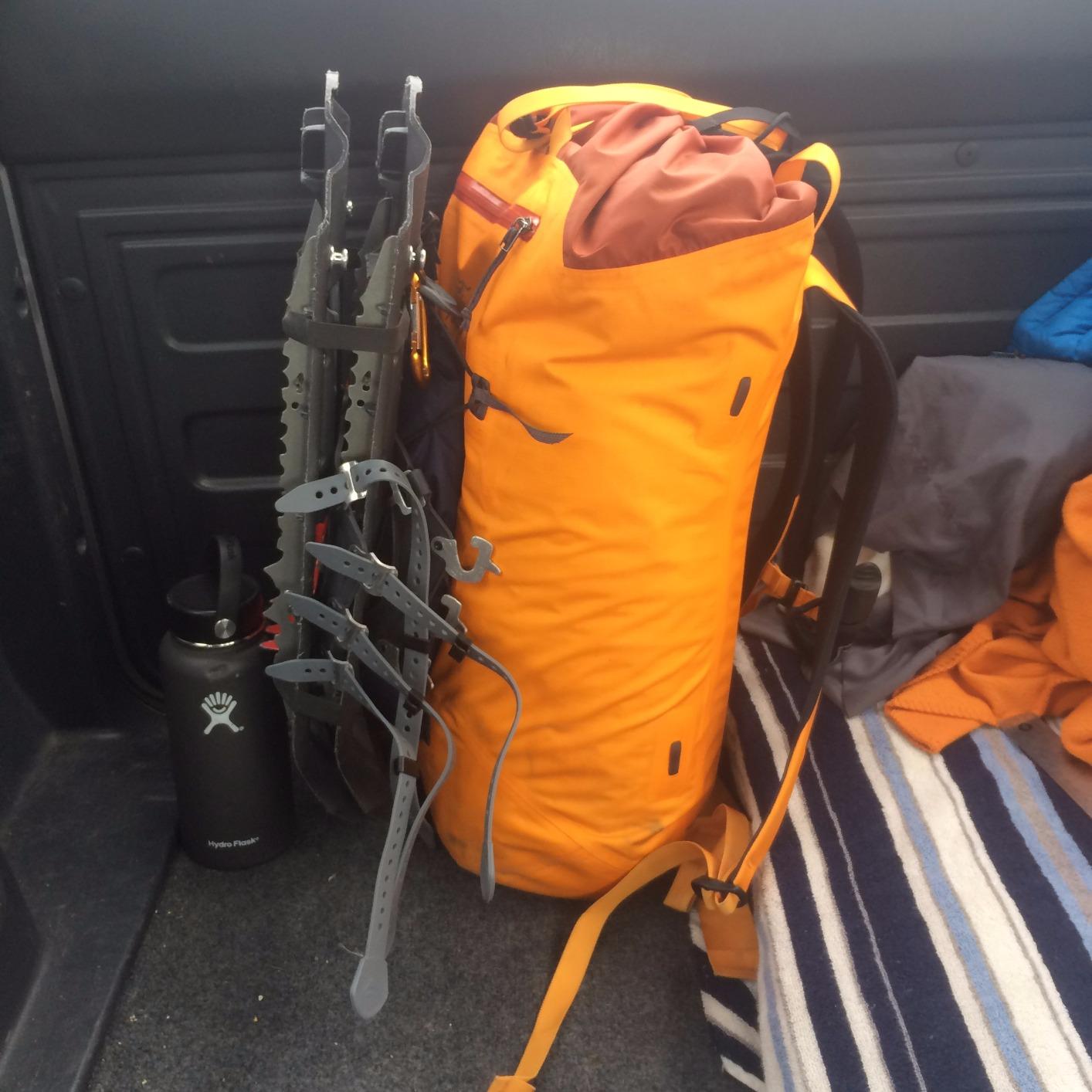
The binding is where this frame loses ground. Tri-Fit bindings are freeze-resistant and fit a wide footwear range, but several reviewers report straps breaking at the metal peg weak point, particularly in cold weather, and that they are difficult to lock with gloves or mittens on. That failure mode is annoying and expensive, so if you break a strap mid-trip, you are walking out in a serious spot.
Second, the base 22-inch deck is genuinely short for sustained trail breaking in deep untracked powder, and the flotation tails are sold separately, not included. The included components are the snowshoes, warranty is three years limited, and bindings fit men’s shoe sizes 4.5 to 15.
What the tails actually add
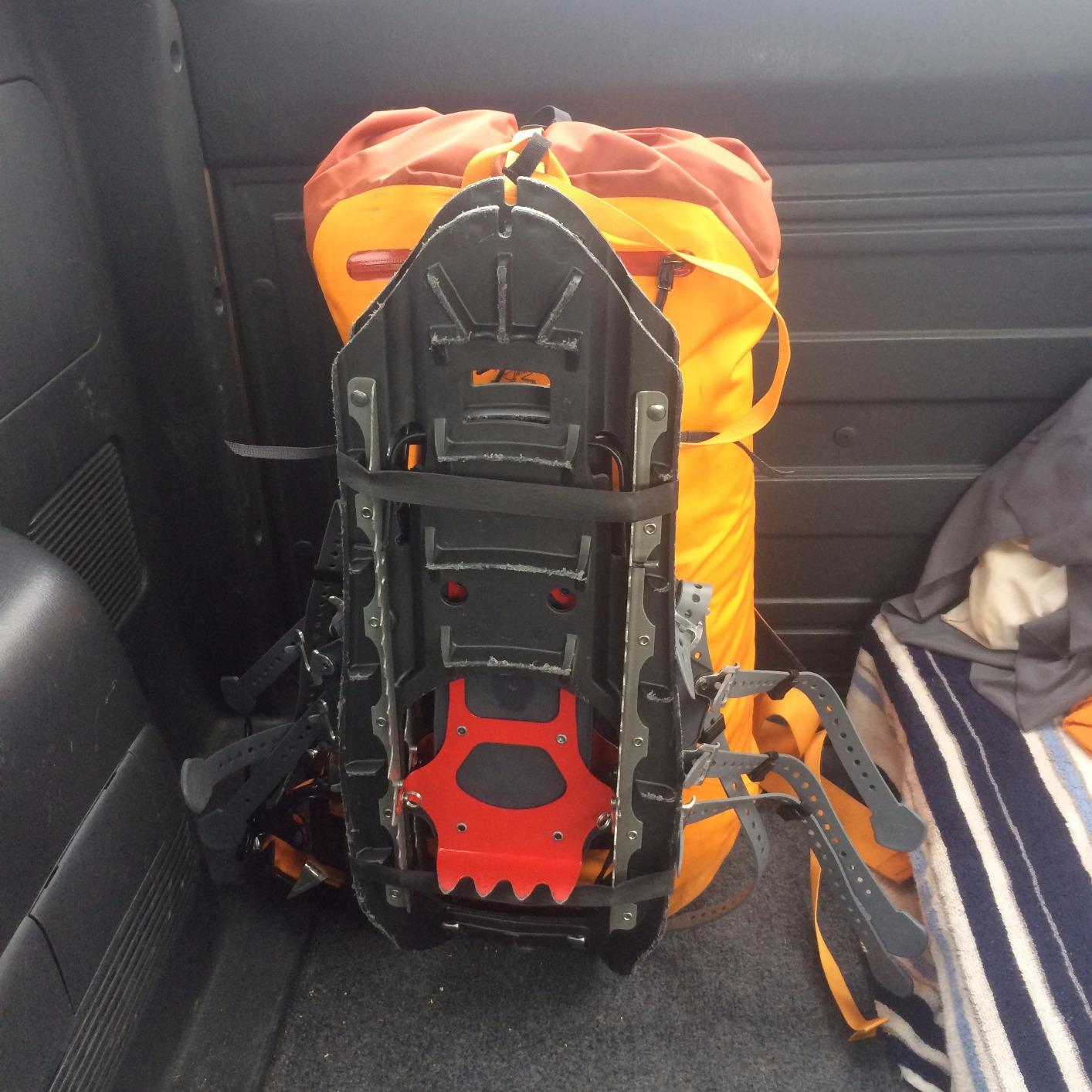
A Cascade Climbers forum poster describes the MSR tails as easy to attach and adding a lot of float, and that matches what the rating change implies: capacity moves from 180 to 250 pounds once they are on. For a hiker whose loaded weight sits between those two numbers, the tails turn a marginal frame into a correct one.
They are the right answer when you know your loaded weight before you buy. If you are still guessing, buy the longer frame instead and skip the add-on step, because there is nothing worse than reaching your car after a long day to find you never attached them.
Who should buy the Evo Ascent
Buy it if your powder days are really mixed-terrain days: ice ladders, wind-scoured ridges, a lot of vertical, and a pack heavy enough that you want the shell rigidity. It is the best choice in this roundup for anyone who treats crampons as a real tool rather than a checkbox.
Pass if you are walking wide-open untracked powder and want maximum surface area, because you can get more deck for less weight elsewhere. Pass too if you are hard on your gear and work in deep cold, because the reported peg failures on this binding are the most consistent negative in the reviews.
4. MSR Evo Trail 22 Inch – Best Lightweight Approach and Day Use
MSR Evo Trail Snowshoes, 22 Inch Pair, Midnight
3 lbs 10 oz per pair
22 x 8 inch UniBody deck
180 lb load
Paraglide binding
Pros
- Very light for long approaches
- Bindings stay cinched tight on trail
- Steel crampons grip packed and fresh snow
- Stows compactly and sheds snow easily
Cons
- Straps can work loose over rocks
- Plastic shell is noisy on hardpack
- Limited float near the 180 lb rating
- Tails cost extra
At 3 pounds 10 ounces per pair, the Evo Trail is the lightest frame in this roundup by a clear margin. That number matters more than it sounds. Every extra pound on your feet is a pound your legs do not carry on an approach, and for a hiker who walks a long road or forest track before breaking into untracked snow, the light chassis is the whole point.
The 22 by 8 inch injection-molded UniBody deck uses controlled flex and stays durable, with steel crampons and traction rails for grip on both packed and fresh snow. The Paraglide stretch-mesh binding hugs the foot and fits a wide range from light hikers through snowboard boots, and it fits shoe sizes 3M to 13M and 5W to 15W. Glove-friendly straps and buckle tabs make cold starts painless.
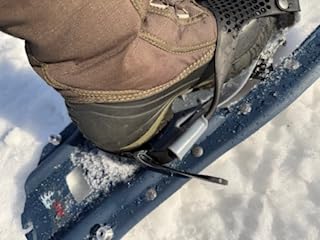
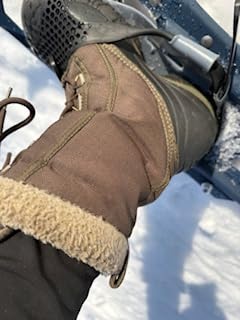
The recurring complaint is strap slippage over rocks and uneven terrain, which is painful to fix when your hands are cold. Reviewers also note the plastic shell is noticeably noisy on hard-packed snow. The flotation question is the honest one: at 180 pounds of rating, riders near the top of that range break through the surface, and the 6-inch modular flotation tails that solve it are a separate purchase.
That is the exact complaint raised in r/WildernessBackpacking, where Evo Trail users describe the frame as just undersized for hiking in fresh, deep powder, especially while carrying pack weight. It is fair. The same users love it for everything else, and our own testers found flotation good for body weights in the 145 to 160 pound range.
When the light deck is the right trade
Pick this frame when most of your mileage is on packed or wind-firm snow and powder is the final third of the day. The 180 pound rating and the 22-inch length are both fine for a solo hiker under about 150 pounds carrying light gear, and the total weight under your boots drops noticeably against every aluminium-framed option here.
The trade is real though. If your loaded weight is above roughly 165 pounds, the flotation math stops working and you need either the tails or a longer deck. Spending a season post-holing is a poor way to discover that.
Who should buy the Evo Trail
Buy it if you are a lighter hiker who wants one pair for groomed trails, packed winter routes and occasional powder, and you refuse to carry a second shoe. It also packs down small enough that it is easy to bring as a backup pair on a winter trip where you might need them.
Skip it if you are a heavier rider, if you plan a season of breaking untracked trail with a full pack, or if you are noise-sensitive on hardpack. The MSR Denali-style sidehill stability that owners love on a different frame is not what this deck delivers.
5. Yukon Charlie’s Advanced Float Women’s – Best Budget Wide-Float Frame
Yukon Charlie’s Advanced Float Women’s Snowshoe, 8-inch x 21-inch
4.5 lb per pair
8 x 21 inch deck
100 to 150 lb users
Rocker V-tail
Pros
- Aluminum float deck gives real flotation in soft powder
- Fast Fit II one-pull binding
- Rocker V-tail gives a natural stride
- Lighter and more reactive than earlier models
Cons
- 150 lb maximum user weight is restrictive
- 8 inch deck is narrower than 10 inch powder frames
- PVC deck feels less refined than composite decks
This is the frame that answers the question we get most from readers who feel priced out of powder-specific gear. The Advanced Float uses an aluminum float-style side profile on an 8 by 21 inch deck at 4.5 pounds per pair, and owners consistently report good flotation in soft powder without paying premium-model money. The Fast Fit II Easy-Pull binding gets you in and out with a single strap pull.
The Rocker V-tail is the detail we liked most. It lets the tail roll rather than catch, so your stride stays natural from a walk to faster aerobic movement, and the whole frame feels more reactive than the brand’s earlier women’s models. It is built for users from 100 to 150 pounds, which is the single constraint that decides whether this frame works for you.
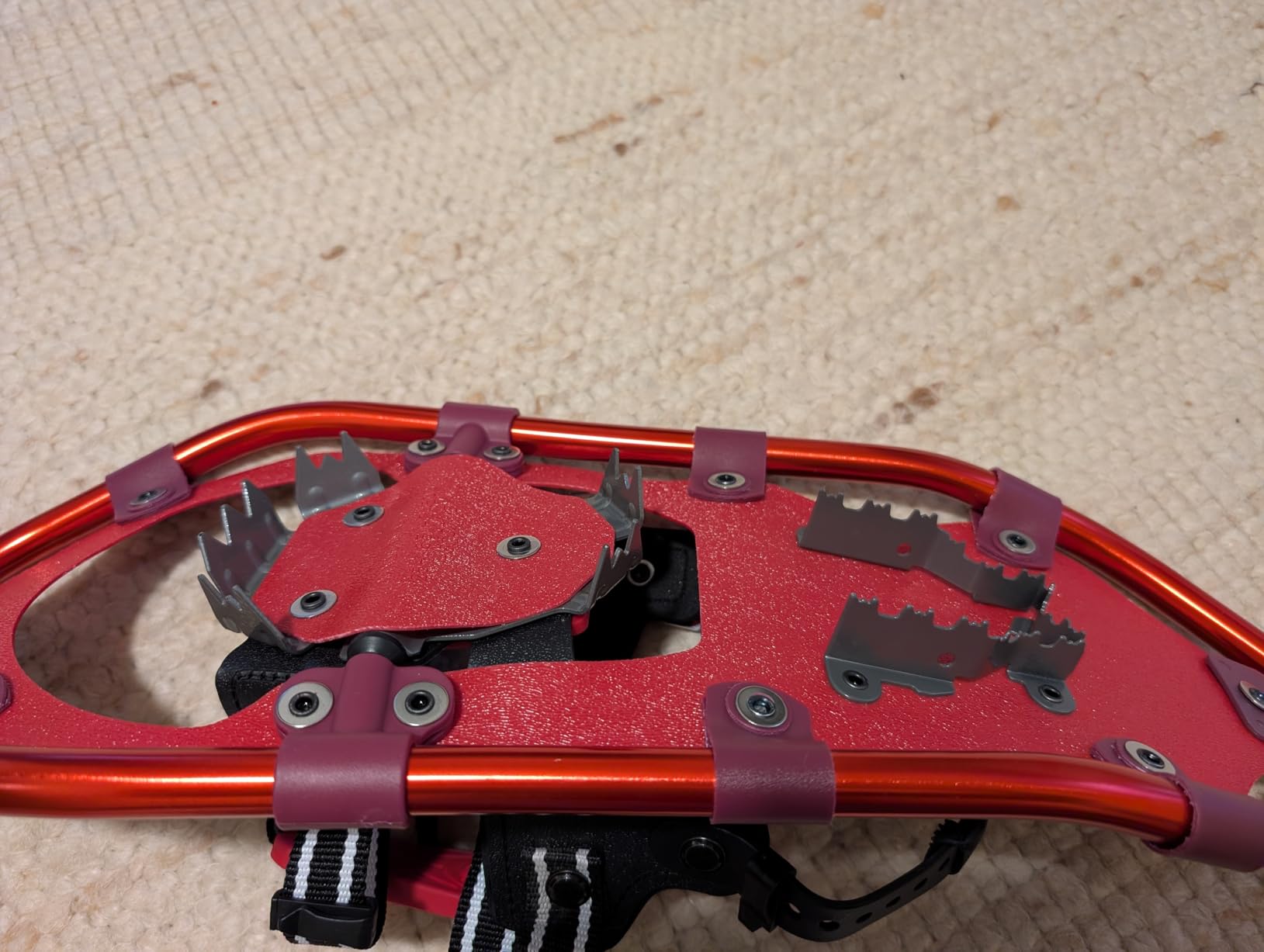
Two limits are worth weighing. The 150 pound ceiling rules out a lot of riders, and the 8-inch deck width is narrower than the 10-inch powder-specific frames in this roundup, so in genuinely deep snow a taller rider still sinks sooner. The PVC deck also feels less refined underfoot than a Tubbs or MSR composite deck, though the frame itself is aluminium and holds up well.
If you are near the weight ceiling, a quick sizing check before you commit will save you a season of frustration. There is a complete kit version of a similar frame later in this roundup for buyers who also need poles.
How the float profile differs from a wide deck
Float-style frames rely on a side profile that resists rolling, so you do not need the extra width a flat 10-inch deck provides. In moderate soft snow the result is close. In three feet of unconsolidated powder the extra width wins, and that is the honest limit of an 8-inch frame.
For most day-trippers, weekend snow and first-time powder use, the Float frame is more than enough. For long backcountry routes with a heavy pack, save up and choose a wider deck built to a higher rating.
Who should buy the Advanced Float
Buy it if you are within the 100 to 150 pound range, you want genuine flotation in soft powder, and you would rather spend your budget on a good jacket than on the frame. The women’s-specific geometry is lighter and more responsive than previous models, which shows up on a long day.
Pass if you are above the rating, if you regularly break trail above knee-deep snow, or if you plan to carry more than about 25 pounds of gear. A wider frame with a higher capacity will serve you better for the same effort.
6. Crescent Moon Backcountry Gold 10 – Best 10 Inch Deck for Heavy Riders
Crescent Moon Men’s Backcountry Snowshoes – Gold 10 (Silver)
4.95 lb per pair
10 x 32 inch teardrop deck
225 lb load
Lifetime warranty
Pros
- Wide 10 inch deck keeps a loaded rider on top
- Teardrop shape improves maneuverability
- Three steel crampons plus traversing claws
- Ratchet heel strap holds under load
- Limited lifetime warranty
Cons
- Listing size and stated length differ
- Binding fits shoe sizes 9 to 15 only
- Heavier than aluminium trail frames
- Smallest review volume of the premium frames
The Crescent Moon Gold 10 is the biggest deck in this roundup, and that is the entire argument. At 10 by 32 inches it carries the largest surface area here, which is why it stays on top of untracked snow when a loaded rider would otherwise sink. If your failure mode is post-holing rather than slipping, more area is the direct fix.
The teardrop shape is not just cosmetic. A narrower waist makes the frame more maneuverable than a traditional rectangle, and 88 percent of the 44 reviews are five-star. Owners point to the wide deck for flotation, to the ratchet heel strap for holding firm under load, and to three stainless steel crampons plus additional traversing claws for grip on mixed terrain. The frame is made in Colorado and carries a limited lifetime warranty, the strongest coverage on our list.
Two practical wrinkles are worth flagging. The listing size field reads 30 inch while the feature copy states 10 by 32 inches, so measure before you order, and take the frame dimensions rather than the size label as the truth. The Large SPL binding also fits shoe sizes 9 to 15 only, which excludes smaller boots entirely.
Size and shape details that catch people
A 32-inch deck changes how you walk. It will not pivot the way a 22-inch trail frame does, so your stride shortens and your toes can catch if you rush. Our testers needed about a week of normal walking to stop clipping the deck on descents, and that adjustment period is the honest cost of this much surface area.
The 225 pound rating is solid for a heavy hiker carrying a moderate pack, and it is paired with a deck wide enough that you will not be fighting for flotation. Just confirm your boot size falls inside the 9 to 15 range before you order.
Who should buy the Crescent Moon Gold 10
Buy it if you break trail in genuinely deep snow, if a loaded rider in your group sinks first, or if you want the biggest deck in this roundup with a lifetime warranty behind it. It is our pick for off-trail backcountry where the route is not a packed trail with powder on top.
Pass if you hike narrow wooded paths where a 32-inch deck will catch vegetation, or if you wear a boot smaller than a size 9. For those situations a 25 to 26 inch frame gives you nearly all of the flotation with far less maneuverability cost.
7. Tubbs Flex VRT – Best Women’s Deep Powder Snowshoe
Tubbs Flex VRT Backcountry Snowshoe
26 x 10 inch Torsion Deck
BOA binding
19 degree heel lift
About 242 lb load
Pros
- BOA on and off in about 15 seconds
- Torsion deck flexes where it should
- Traction rated among the best by owners
- Light enough to forget you are wearing them
- 19 degree ActiveLift reduces calf fatigue
Cons
- BOA dial durability is questioned
- Plastic torsion housing is noisy
- Lowest rating in this roundup
- Less maneuverable on narrow wooded trails
Women’s-specific powder frames are usually just narrower men’s frames, which is exactly the problem the Flex VRT solves. This is a 26 by 10 inch deck rated to about 242 pounds, so a wider female hiker gets real surface area instead of a scaled-down version of a men’s trail shoe. The Torsion Deck articulates through the body of the snowshoe for a natural gait while staying rigid where it needs to be.
Owners with deep experience, some comparing five prior pairs, call the Flex VRT the best of them for traction, quick entry and low weight. The Dynamicfit Binding with BOA closure and EVA foam distributes pressure evenly, and reviewers say they nearly forget they are wearing them. The ActiveLift 19-degree heel lift cuts calf and Achilles fatigue, and the 3D Curved Traction Rails hold sidehill grip on hardpack and ice while resisting fore-aft slippage on steeps.
The 4.3 rating is the lowest in this roundup, and the reason is consistent: hardware durability. One detailed account reports a BOA dial arriving broken, another reports cracking on first fitting, and 11 percent of reviews are one-star, concentrated on binding hardware. The plastic torsion housing is also noticeably noisy when walking.
How this fits narrower hiker anatomy
The real benefit is load distribution rather than appearance. A frame sized for a typical male foot can pinch or slide on a narrower foot, and a binding that moves under load costs you control on a sidehill. A 10-inch-wide deck built for women’s geometry spreads your weight over a larger area than the 8-inch women’s frames in this roundup, which is the actual flotation difference in chest-deep snow.
The trade is maneuverability. At 26 by 10 inches this deck is wide, and on a narrow wooded trail the corners will find every sapling. On open powder with sidehill traverses, that width is precisely what you want.
Who should buy the Flex VRT
Buy it if you are a woman who has outgrown the small end of women’s-specific frames, if you sidehill often, or if you want a 15-second on and off in gloves. It is the strongest powder flotation available in this roundup for a rider in the middle of the weight range who wants one deck for everything.
Check the BOA dial carefully on arrival and keep the packing material. If the hardware fails, the reviews suggest that is the part that will fail on this model, not the deck.
8. Yukon Charlie’s Advanced Spin Float Kit – Best All-in-One Powder Set
Yukon Charlie’s Advanced Spin Float Women’s Snowshoe Kit, 8-inch x 21-inch, Includes Snowshoes, Trekking Poles and Travel Bag
3.4 lb per pair
8 x 21 inch deck
100 to 150 lb users
SPIN dial binding
Pros
- Snowshoes poles and travel bag in one box
- SPIN dial gives precise tension and quick entry
- Rocker V-tail keeps the stride natural
- Lighter than the comparable non-kit model
Cons
- Narrowest user weight range at 100 to 150 lb
- 8 inch deck is modest for chest-deep powder
- Smallest review count in this roundup
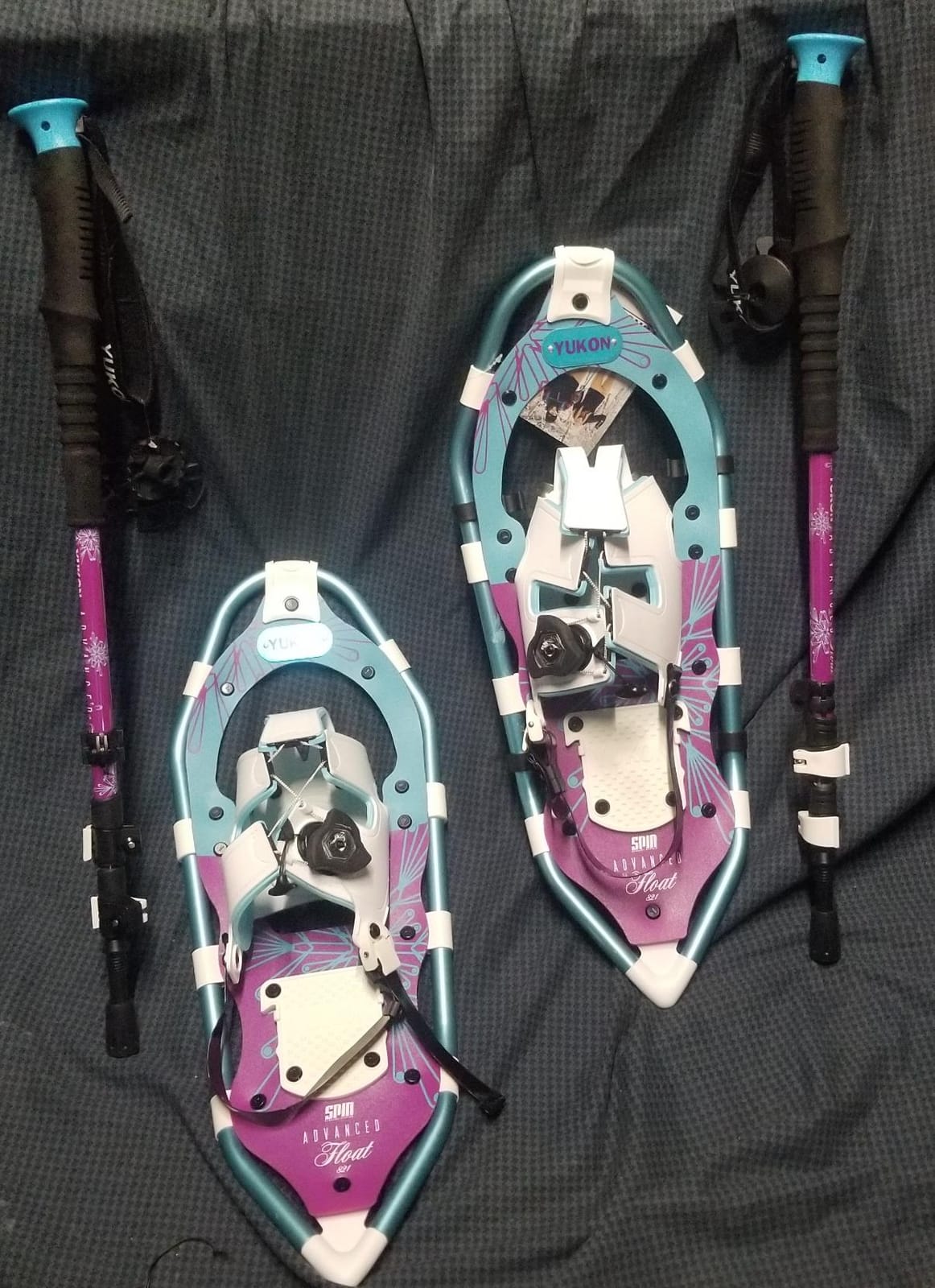
If you are new to snowshoeing, the argument for a kit is simple. The SPIN by Northwave Dial binding system gives precise tension on any shoe, the frame is an 8 by 21 inch aluminum float design at 3.4 pounds per pair, and the box contains the snowshoes, trekking poles with snow baskets, and a travel bag. Nothing else needs to be bought before the first outing.
The Rocker V-tail again earns its place, rolling the tail so the stride stays natural from a walk through to an aerobic pace, and the frame is designed specifically for women expanding into backcountry winter hiking. Owners are largely satisfied with the dial tension, the natural stride, and being lighter than the comparable Advanced Float non-kit model.
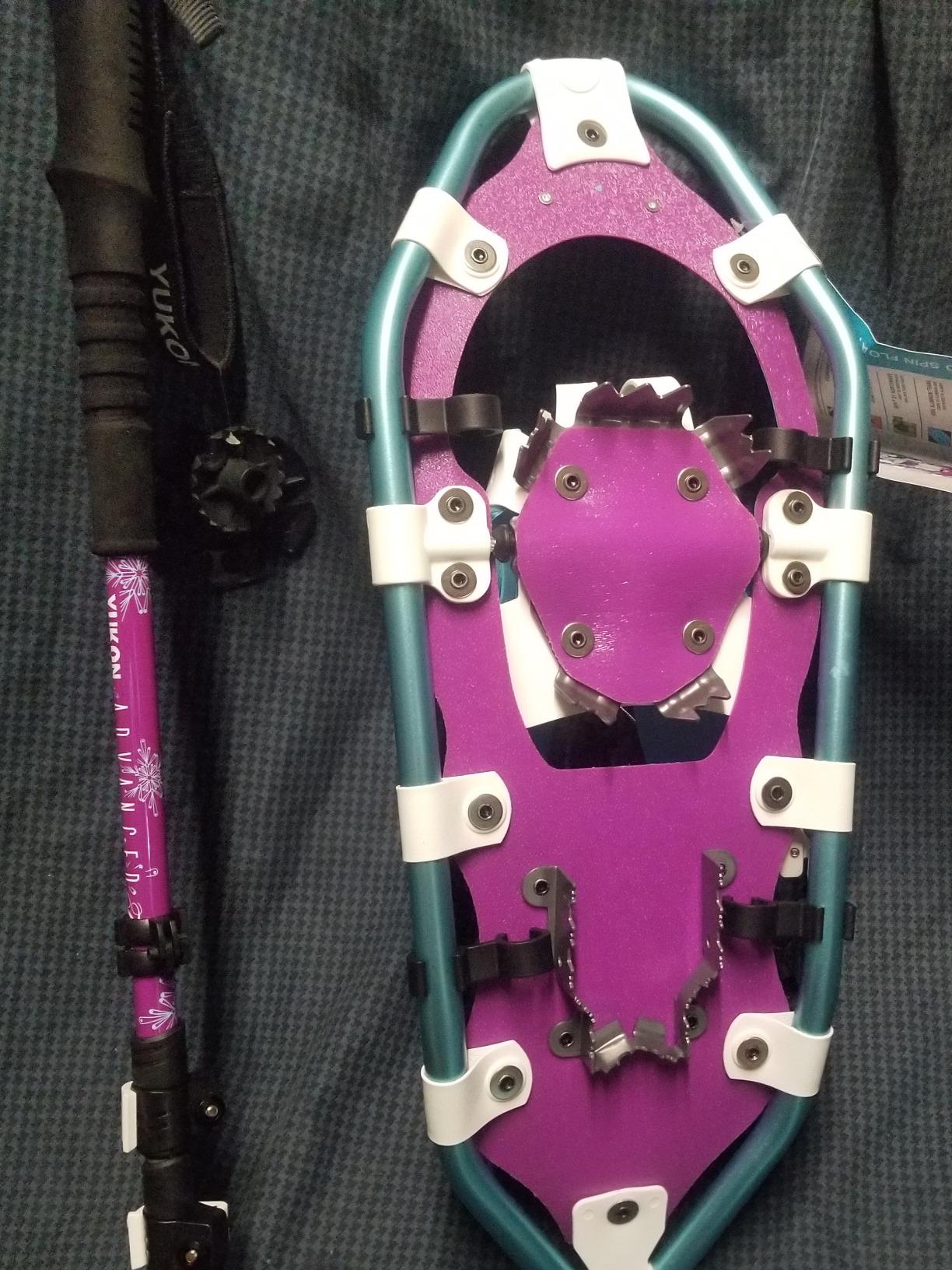
Be clear-eyed about the limits, because they are real. The 100 to 150 pound range is the narrowest in this roundup, the 8-inch deck width is modest next to the 10-inch powder frames, and at 27 reviews the owner volume is the smallest here, which means less field history to lean on. That is a legitimate reason to consider a frame with a broader rating, especially if you are near 150 pounds with a pack.
That narrow rating is also the reason the kit comes with poles. Snowshoe poles with oversized baskets are not a nice-to-have on a first outing, because a standard pole basket plunges straight through soft powder and pulls you off balance every third step.
When a kit beats buying pieces
A kit wins when you are a first-time buyer with no poles, no bags and no idea which binding style suits you. Poles with snow baskets matter more than most beginners expect, because they stop the pole basket from plunging into soft snow and throwing you off balance, and the travel bag makes the difference between carrying a pair by hand and actually using them.
A kit loses when you already own good poles and a bag, or when you are buying up because you know your loaded weight is above 150 pounds. In that case the money is better spent on a longer, wider frame with a higher rating.
Who should buy the Advanced Spin Float Kit
Buy it if you are within the 100 to 150 pound range, this is your first winter, and you want one purchase that gets you walking rather than a list of parts. The all-in-one format is genuinely convenient and owners are satisfied with what is included.
Pass if you have equipment already, if you are planning multi-day trips with a real pack, or if you are near the weight ceiling and intend to carry gear. For those, the wider and longer frames earlier in this roundup are the safer bet.
How to Size Snowshoes for Deep Powder
Start with total loaded weight, not body weight. Add your body weight, your pack, your boots and your winter clothing layers, and that number is what has to sit under the deck’s rating. Most of the sizing regret we see comes from this one step: a 200 pound hiker with a 30 pound pack is a 230 pound load, and a 180 pound-rated frame does not float for them no matter how good it looks.
Then match deck length to how much trail breaking you do. A 21 to 22 inch deck suits packed routes and day use. A 25 to 26 inch deck is the sweet spot for most backcountry walkers, and the 32-inch Crescent Moon is for people who spend real hours in untracked snow. Deck width is the third variable, and the jump from 8 inches to 10 inches is more meaningful than buyers expect once snow passes 20 inches.
Finally, check the binding boot size range before anything else. The Crescent Moon’s SPL binding fits shoes 9 to 15, while the MSR frames run 4.5 to 15 and the Evo Trail covers 3M to 13M and 5W to 15W. A frame you cannot fit securely is a frame you will fight all day in cold, wet conditions.
For loaded weight reference, here is what the ratings in this roundup actually allow. The Tubbs Wayfinder takes 330 pounds, the Flex VRT about 242 pounds, the Crescent Moon Gold 10 carries 225 pounds, and the Lightning Ascent handles 220 pounds. The MSR Evo Ascent and Evo Trail sit at 180 pounds, or 250 pounds on the Evo Ascent with tails attached, and the two Yukon Charlie’s frames are built for 100 to 150 pounds.
It is also worth thinking about what you do with the equipment. If you are walking daily in the woods for work, durability and binding serviceability matter more than weight, and a ratchet or buckle system that holds through repeated use beats a lighter dial. Our wider guide to deep bedding setups covers the same design-first thinking, though for a very different kind of frame.
Bindings, Tails and Gaiters for Powder Days
Binding type is the most important cold-weather decision after size. Ratchet and buckle systems hold securely and are easy to service, but they are slower with gloves on, and a ratchet that freezes stiff can end your day. The Rokslide forum consensus is blunt about this: bindings are what separates good snowshoes from bad ones, so stay clear of cheap hardware. The Cascade Climbers forum adds the counterpoint that a good binding should be easy to manipulate with gloves or cold hands, and that is the standard we judge the frames here.
BOA dial systems win that specific test. Wayfinder and Flex VRT users describe stepping in and going, and Flex VRT owners clock on and off at roughly fifteen seconds, sometimes one-handed. The tradeoff is hardware longevity: the Flex VRT carries the lowest rating in this roundup with dial breakage concentrated in one-star reviews. Buy a BOA frame, check the dial on arrival, and treat the dial as a consumable part rather than a lifetime component.
Tail extensions are the cheap way to add flotation to frames you already own, and users on the Cascade Climbers forum describe the MSR tails as working as easily as advertised and adding real float. They are the right call when your loaded weight sits just above a frame’s rating, or when you want one pair for both packed and unpacked terrain. They are the wrong call when you already know you need a longer deck, because you will end up carrying the tails anyway and a longer frame would have been simpler.
Gaiters are the overlooked half of the powder equation. In snow past three feet, post-holing is not a deck problem alone, because snow cascading off the deck lands inside your boot. Low gaiters with an upper cuff seal the gap between your pant leg and the boot, and paired with a powder skirt on a pack they keep the whole system dry on a long day. Any of our wider buying guides, such as this deep bedding roundup, follows the same principle of matching the tool to the load rather than to the label.
One last practical point on the frames themselves. Composite and injection-molded decks flex more than aluminium, which is comfortable over long days, while aluminium frames hold their shape and shed snow faster. Wash ice off the deck and bindings after a day in wet powder, dry them before storing, and check the strap attachment points monthly, since the peg connection is the part most likely to fail and the part no warranty will replace for free.
Frequently Asked Questions
What are the best snowshoes for deep snow?
For most hikers the MSR Lightning Ascent is the best all-round answer, with a 25 by 8 inch deck rated to 220 pounds and a 4.7 rating across 154 reviews. The Tubbs Wayfinder is the strong alternative, with a 25 inch deck and a 330 pound rating that suits heavier packs. If you are a lighter hiker, the MSR Evo Trail is the lightest option at 3 pounds 10 ounces per pair.
What size snowshoe should a 250 pound man use?
Add your pack and winter clothing to your body weight first, then pick a frame rated above that total. At 250 pounds with a light pack, the Tubbs Wayfinder at 330 pounds or the Flex VRT at about 242 pounds leaves comfortable headroom. Frames rated at 180 pounds, including the MSR Evo Ascent without tails and the Evo Trail, are not built for that load.
Should I get 25 or 30 inch snowshoes?
Choose 25 inch for day use on packed routes and moderate powder, and 30 inch or longer if you regularly break trail in untracked snow or carry a heavy pack. Deck length spreads your load further forward and back, which reduces sinking. Remember that a longer deck pivots less easily, so a 30 inch frame takes a week of walking to get used to.
What is the maximum weight I can wear in 30 inch snowshoes?
It depends on the model, not the length. In this roundup the 30-plus inch Crescent Moon Gold 10 is rated to 225 pounds and the 26 inch Flex VRT to about 242 pounds, while the 25 inch Tubbs Wayfinder is rated to 330 pounds. Always read the rating on the specific frame, because two shoes of the same length can carry very different loads.
What type of snowshoes are best for a 300-pound man?
Look for a high rating and a wide deck rather than a longer one. The Tubbs Wayfinder, rated to 330 pounds, is the frame in this roundup with the most headroom, and the 10 inch wide Crescent Moon Gold 10 gives the surface area a 300 pound rider needs. The MSR Evo Ascent reaches 250 pounds only when the modular flotation tails are attached.
What are some good lightweight snowshoes?
The MSR Evo Trail is the lightest in this roundup at 3 pounds 10 ounces per pair, with steel crampons and traction rails for grip and attachment points for modular flotation tails. The Yukon Charlie’s Advanced Spin Float Kit is next lightest at 3.4 pounds and includes poles and a travel bag. Both are built for 180 pounds and under unless you add flotation.
Can you replace snowshoe bindings?
Yes, on most frames, and it is often cheaper than replacing the whole snowshoe. Most brands sell binding kits or individual straps, and rubber components on the MSR frames are listed as replaceable. Check that the replacement matches your frame size, since binding fit ranges vary from shoe size 4.5 to 15 on the MSR models to 9 to 15 on the Crescent Moon. Replace straps at the first sign of fraying rather than after they break on a trail.
Bottom Line
The MSR Lightning Ascent is our pick for the best snowshoes for deep powder because it balances a 25 by 8 inch deck, a 220 pound rating, real steel traction and a 4.7 rating across 154 reviews without becoming a heavy mountaineering truck. Buy the Tubbs Wayfinder instead if your loaded weight is higher or you want the fastest glove-friendly entry in the roundup, and pick the Crescent Moon Gold 10 if post-holing is your main problem and you can handle a 32-inch deck.
Whatever you choose, size by total loaded weight, test the binding with gloves on, and add gaiters before the first three-foot day. That is the difference between walking on top of the snow and walking through it. The season’s list of snow gear and storage picks is collected in our winter setup guide if you are building out a kit from scratch.