
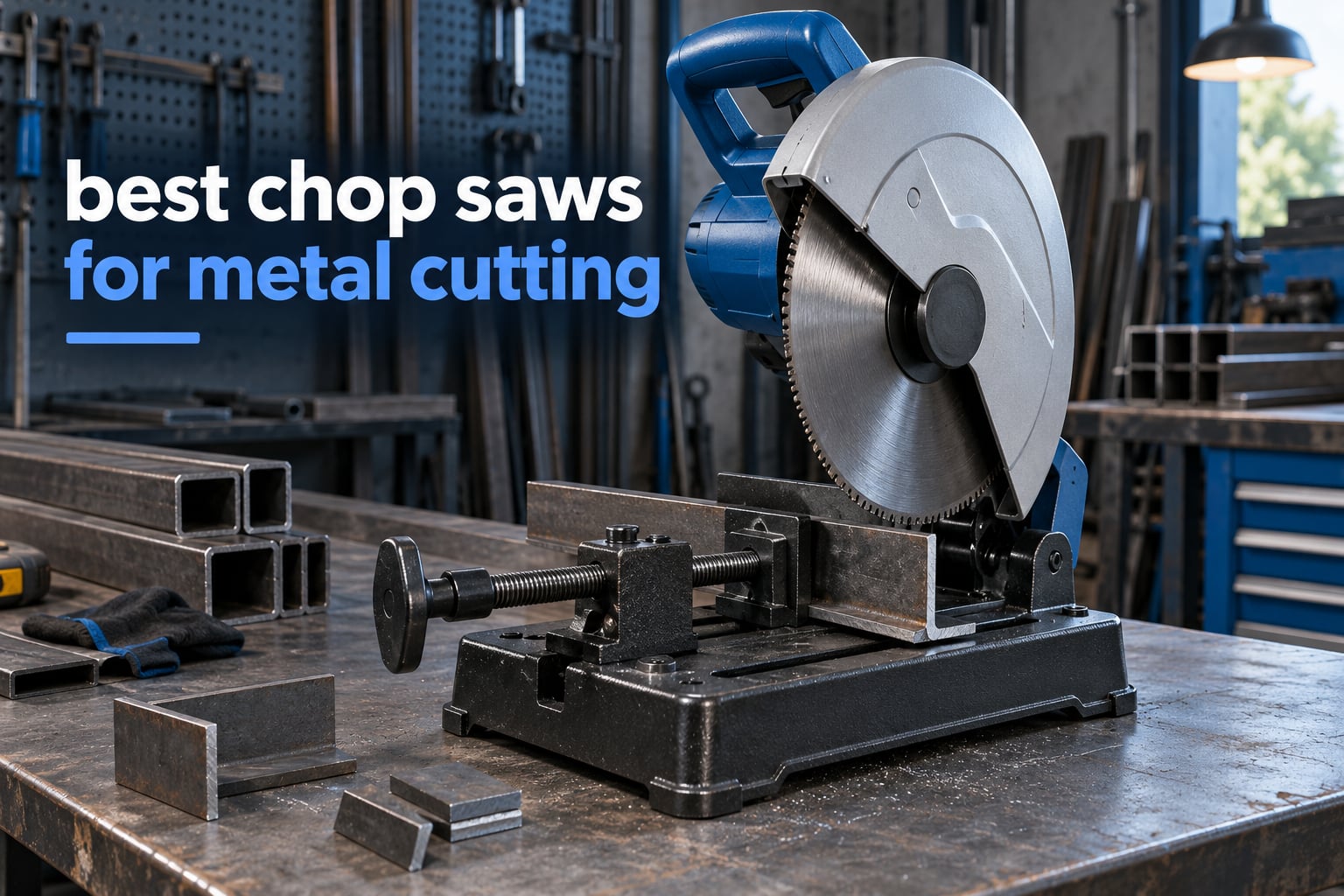
The best chop saw for cutting metal is a dedicated cold-cut machine with a carbide or cermet blade, not a woodworking miter saw with a metal blade bolted on. A purpose-built metal saw shears steel with a toothed blade instead of grinding it, so the cut comes out square, cool and almost burr-free, and it holds that accuracy for hundreds of cuts rather than a few dozen.
That distinction decides everything. The best chop saws for metal cutting in this guide are all bench saws with a fence and a single-jaw vise, because that is how you keep a pipe or an angle iron square while a blade drops through it. We lined up twelve of them, from heavy Evolution mitering chop saws to budget abrasive machines, and compared them on the things that decide whether a cut is weld-ready or whether you are going to grind it first.
We scored each saw on cut quality and edge condition, miter and angle accuracy, blade and wheel life, clamping security, chip and spark management, noise, and the amount of finishing work a cut needs before welding. We also read through thousands of owner reports, because the three things that ruin metal cuts – blade wobble, weak clamping, and a poor vise back stop – show up in real ownership long before they show up in a spec sheet. Our buying guide at the end covers blade types, saw types, angle-cut technique and the accuracy traps to watch for.
Table of Contents
Top 3 Metal Cutting Chop Saw Picks (October 2026)

Evolution S355CPSL 14 Inch…
- 14 inch tungsten carbide blade
- 15 Amp 1800W motor
- Dry-cut burr-free mild steel
- 0-45 degree miter with quick-release vise

Makita LC1230 12 Inch Cold Cut
- 12 inch 60-tooth carbide blade
- Cuts 50x longer than abrasive wheels
- Quick-release vise and fence
- 0-45 degree miter capability

Makita LW1401 14 Inch Cut-O…
- 15 Amp motor at 3800 RPM
- Adjustable spark guard
- Fence adjusts to 45 degrees in three positions
- Tool-less vise adjustment
All 12 Saws Compared in 2026
| Product | Specs | Action |
|---|---|---|
| Evolution S355CPSL 14 Inch Cold Cut Chop Saw |
|
Check Latest Price |
| Makita LC1230 12 Inch Metal Cutting Saw |
|
Check Latest Price |
| Makita LW1401 14 Inch Cut-Off Saw |
|
Check Latest Price |
 VEVOR 14 Inch Abrasive Chop Saw 2300W VEVOR 14 Inch Abrasive Chop Saw 2300W |
|
Check Latest Price |
 VEVOR 14 Inch Cold Cut Chop Saw 2800W VEVOR 14 Inch Cold Cut Chop Saw 2800W |
|
Check Latest Price |
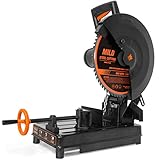 WEN CM1446 14 Inch Multi-Material Chop Saw WEN CM1446 14 Inch Multi-Material Chop Saw |
|
Check Latest Price |
 Evolution S14MCS 14 Inch Mitering Cold Cut Saw Evolution S14MCS 14 Inch Mitering Cold Cut Saw |
|
Check Latest Price |
 Yumark 14 Inch 2200W Abrasive Chop Saw Yumark 14 Inch 2200W Abrasive Chop Saw |
|
Check Latest Price |
 Evolution S15CPS 15 Inch Metal Cutting Chop Saw Evolution S15CPS 15 Inch Metal Cutting Chop Saw |
|
Check Latest Price |
 Bosch GCO15-14 14 Inch Abrasive Cut-Off Machine Bosch GCO15-14 14 Inch Abrasive Cut-Off Machine |
|
Check Latest Price |
 Yumark 14 Inch 2400W Abrasive Chop Saw Yumark 14 Inch 2400W Abrasive Chop Saw |
|
Check Latest Price |
 DJBL 14 Inch Brushless Cold Cut Saw 3500W DJBL 14 Inch Brushless Cold Cut Saw 3500W |
|
Check Latest Price |
1. Evolution S355CPSL 14 Inch Cold-Cut Chop Saw – Best Overall
Evolution S355CPSL – Heavy Duty 14 Inch Metal Cutting Chop Saw W/ 14 Inch Carbide-Tipped Blade | Dry Cut | Miter 45° | Chop Saw For Cutting Metal – Accurate. Powerful. Reliable
14 inch tungsten carbide blade
15 Amp 1800W at 1450 RPM
Dry-cut burr-free cuts
0-45 degree miter
Pros
- Cool burr-free cuts in mild steel with minimal heat and sparks
- 15 Amp motor handles thick mild steel sections
- Cast steel vise with quick release clamps firmly
- 0-45 degree miter with integrated fence
- Light pressed steel base and chip deflector aid cleanup
Cons
- Pressed steel base is lighter than a cast base
- Carbide blades are a recurring consumable cost
- Dry-cut carbide is not ideal for heavy stainless
The Evolution S355CPSL is the saw I put on a bench when someone asks me for one machine that does everything. It runs a 14 inch tungsten carbide-tipped blade at 1450 RPM on a 15 Amp, 1800 watt motor, and the dry-cut action means the finished edge is cool enough to handle straight off the saw. Owners consistently report that the edge comes off weld-ready without a grinding pass, which is the single biggest time saver a metal chop saw can offer.
It is also the saw most fabricators in the forums point to when angle cuts come up. The fence and cast steel vise adjust together across 0-45 degrees, so you set the angle once and both references move in sync. That removes the second-most-common cause of out-of-square metal cuts, which is a fence and a vise that end up at different angles because they were set independently.
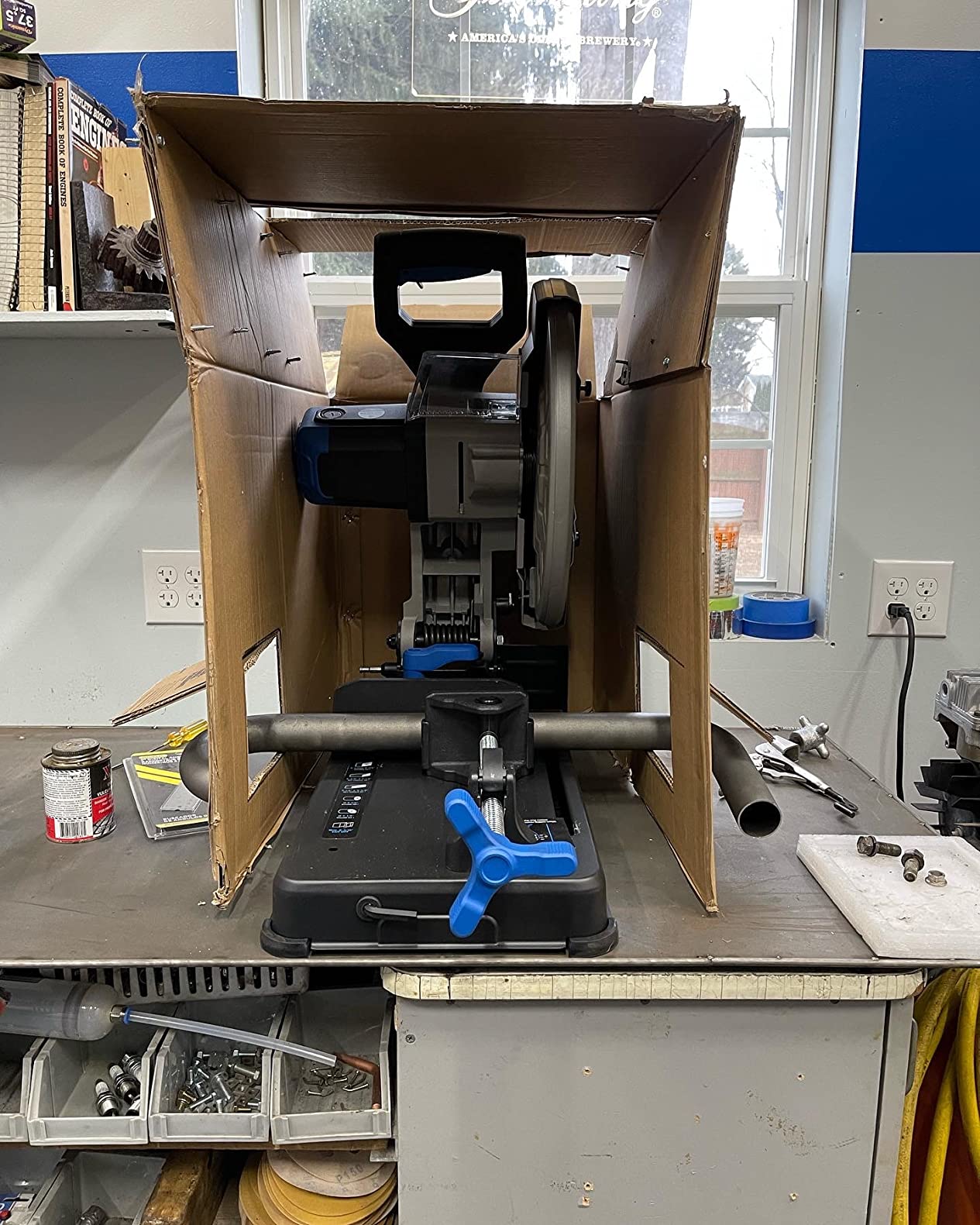
The quick-release vise is the other feature that shows up in every owner thread I read. You can clamp a piece of angle iron, cut it, and swap the next one without reaching for a wrench, which matters more than it sounds when you are cutting forty studs for a frame. There is an integrated chip deflector aimed away from the operator, and the whole chassis sits on a lightweight pressed steel base that makes it the easiest full-size saw on this list to carry to a job.
The honest weakness is that base. Pressed steel is lighter and less rigid than the cast bases on premium cold-cut saws, and it is the first thing owners question when a cut drifts slightly out of square. The second weakness is consumable cost: carbide blades are not cheap, and if you run stainless regularly the wear rate goes up fast. For mild steel, unistrut, square tube, angle iron and flat bar, this is the one I recommend to almost everyone.
Evolution backs it with a 3 year manufacturer warranty and US-based support, and the rating sits at 4.7 across 841 reviews with 84 percent five-star. That combination of rating and volume is why it takes the top spot here rather than the heavier Evolution machines further down this list.
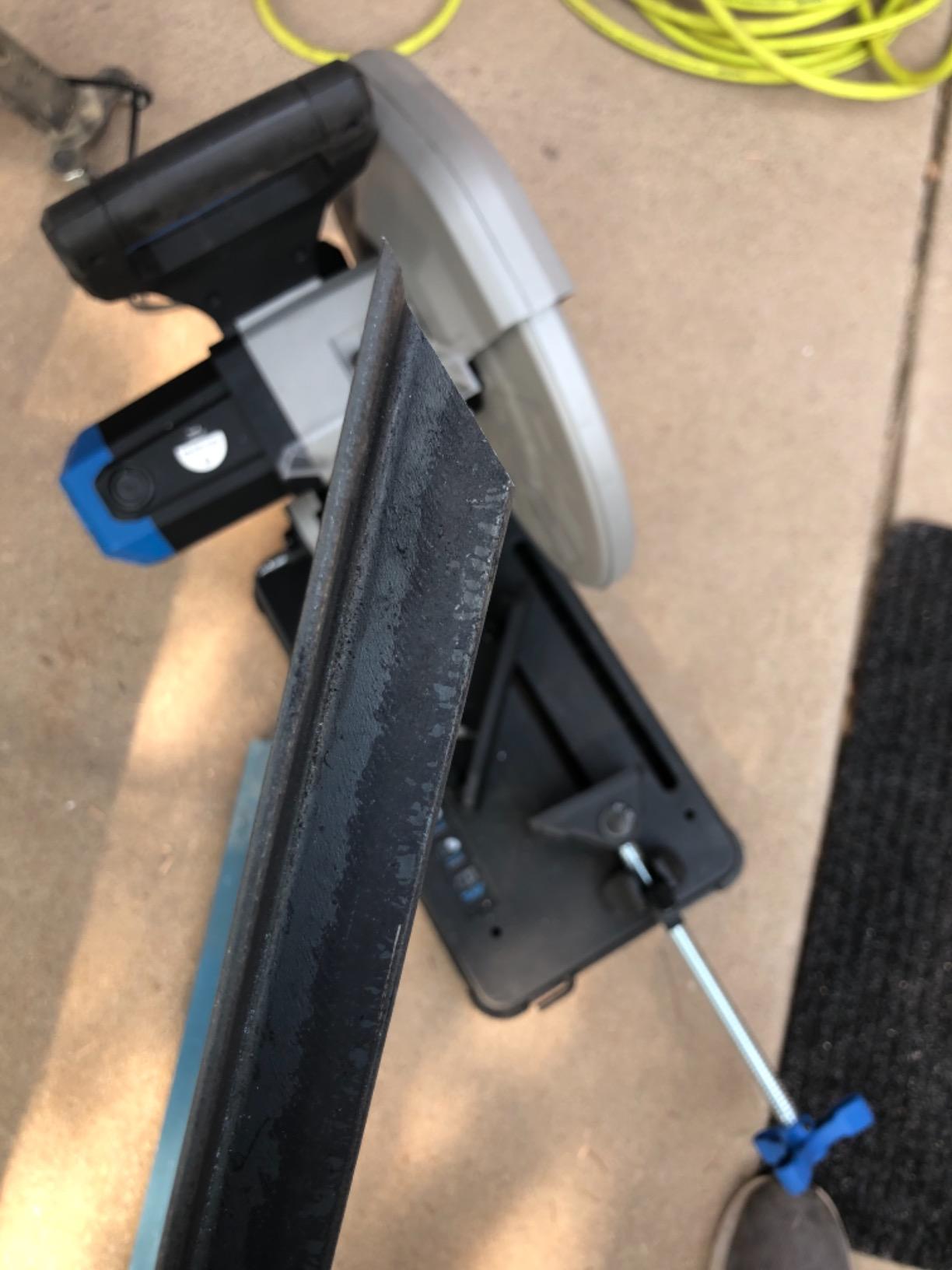
Who the Evolution S355CPSL suits
A welder or fabricator who cuts mostly mild steel, square tube, angle iron, flat straps and EMT conduit will get the most out of it. The dry-cut blade leaves an edge that passes straight through a grinder for a blend before welding, and the low spark output means you are not cleaning hot fragments off your clothes after every cut. It also handles thin steel and aluminum with the right blade fitted, which is why Evolution sells a range for each.
It is a good fit for a shop that cuts a lot of short pieces rather than long structural sections, because setup is fast and the machine is light enough to reposition. If you mostly saw heavy solid bar or thick plate, the heavier 14 and 15 inch Evolution machines further down will outlast it, and the S355CPSL is not the tool for hours of continuous duty.
Where the S355CPSL falls short
Stainless steel is the case to think about. Dry-cut carbide blades wear quickly on stainless, and the blade line for that material costs more than the abrasive wheels you would buy for a grinding saw. If stainless is your primary material rather than an occasional job, budget for replacement blades or choose a saw sold with a stainless-rated blade.
The pressed base is also the reason a few owners report slight drift after heavy use, and the 0-45 degree miter range is narrower than the detented plus or minus 46 degrees on the S14MCS. For straight cuts and moderate angles in mild steel, though, this is the saw that makes the fewest compromises, and it is the one I would put in a home shop first.
2. Makita LC1230 12 Inch Metal Cutting Saw – Premium Cold Cut
Makita LC1230 12″ Metal Cutting Saw
12 inch 60-tooth carbide blade
15 Amp at 1300 RPM
Quick-release vise and fence
0-45 degree miter
Pros
- Carbide blade cuts 50x longer than abrasive wheels
- Cuts cool and almost burr-free
- Rigid cast aluminum table and machined steel vise
- Tool-free quick-release vise and fence
- Long owner-reported service life
Cons
- Chip collector catches only part of the shavings
- Chain-style head lock is less convenient
- 12 inch capacity is below 14 inch competitors
The Makita LC1230 is the oldest design in this roundup and still the one owners report running without complaint for years. It is a 12 inch saw, which sounds small next to the 14 and 15 inch machines here, but the rigid cast aluminum table and machined steel vise hold an angle that lighter machines drift away from. The included 60-tooth carbide blade is the reason cuts come out cool, square and virtually burr-free.
Makita rates the carbide blade at 50 times the life of an abrasive wheel, and owners describe cutting mild steel tubing roughly ten times faster than they could with a grinding wheel. That combination changes the economics completely. An abrasive saw eats a wheel every few dozen heavy cuts; this one keeps working through stock without you ordering consumables.
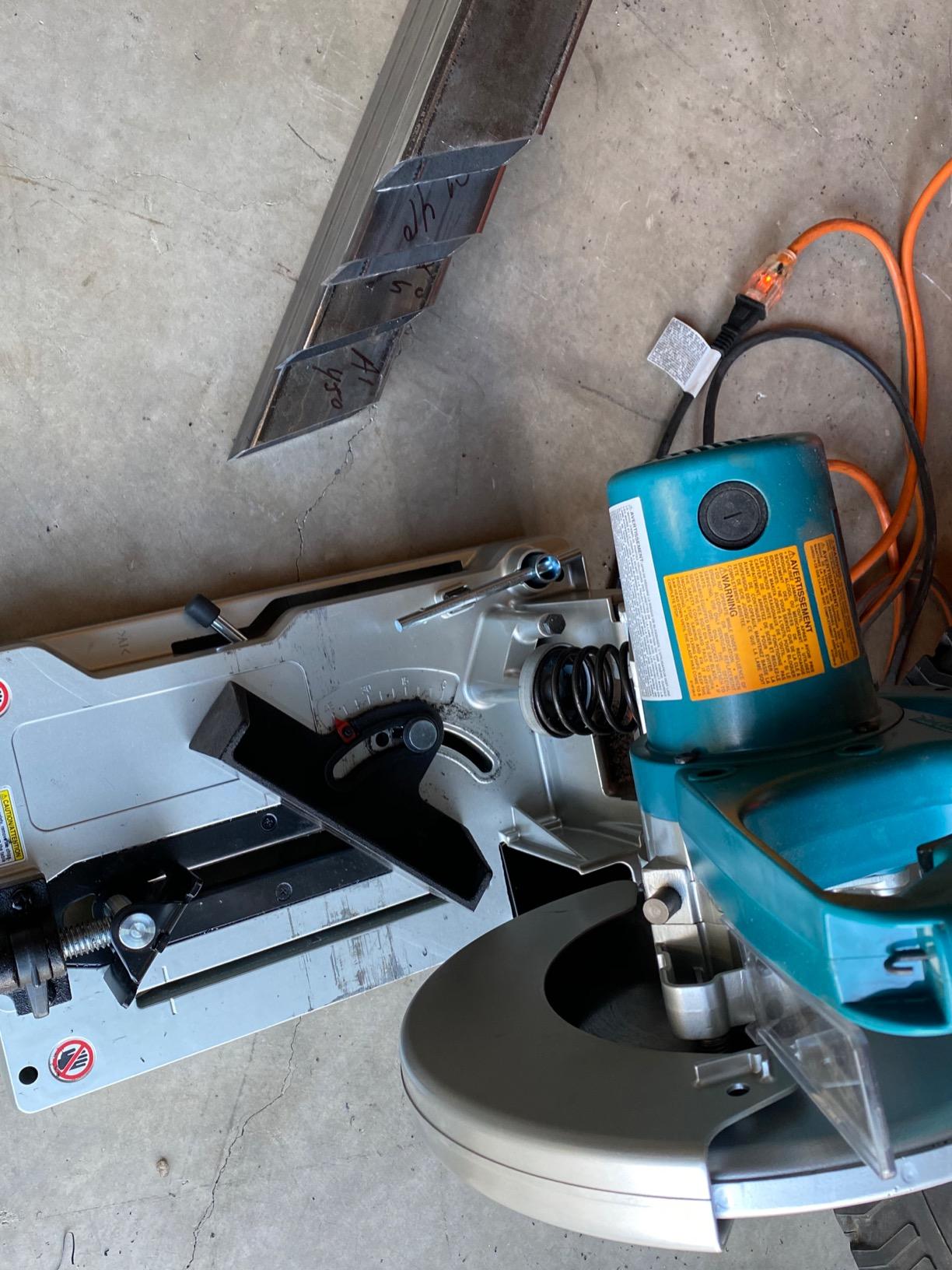
The quick-release vise and quick-release support fence are the parts that change the workflow. Both release with a lever, and the fence adjusts 0-45 degrees for miter work without tools, so moving from a straight cut to an angle is seconds rather than a wrench-and-hold-your-breath job. A lock-off button and a shaft lock that takes a single wrench make blade changes straightforward.
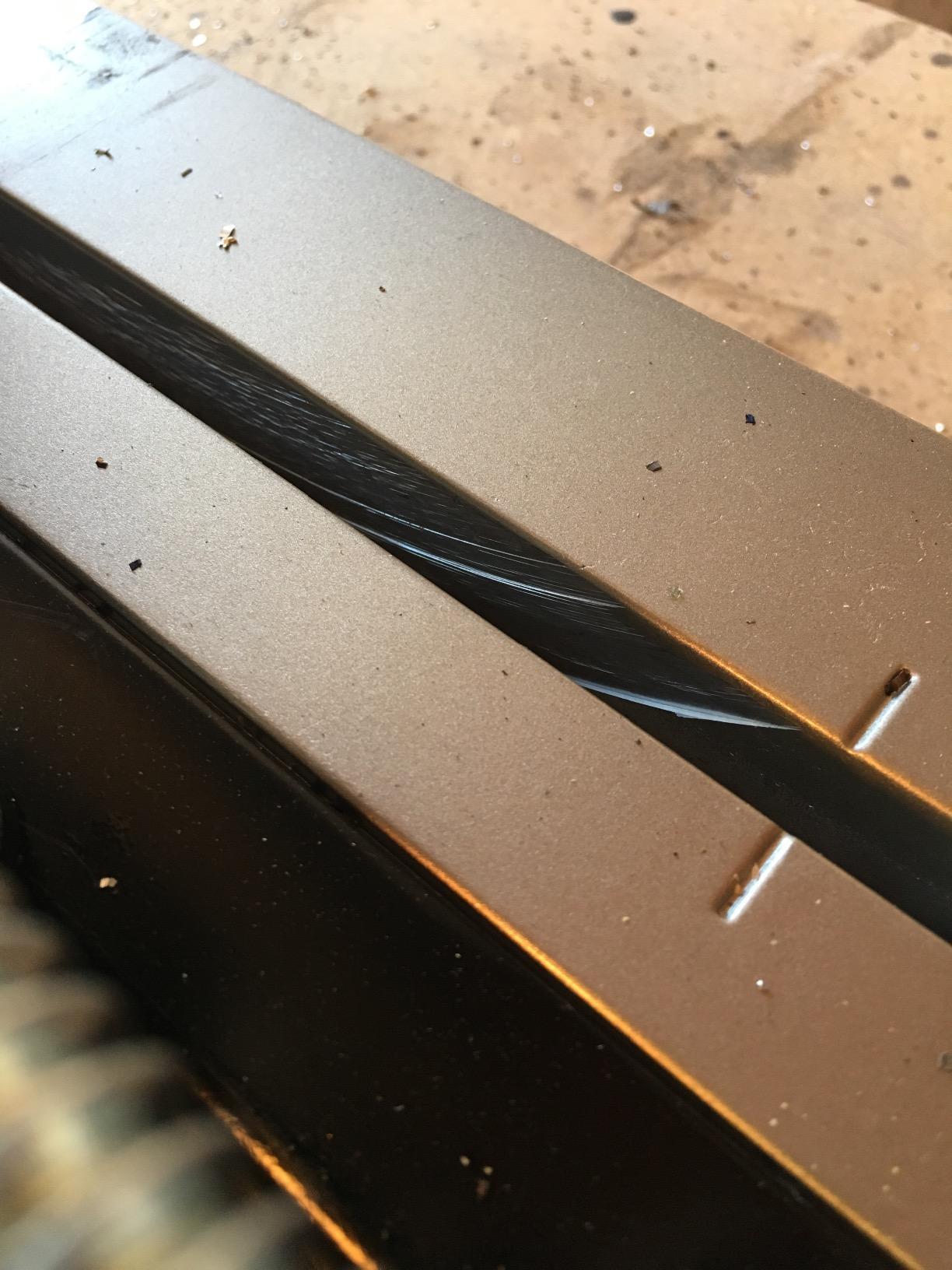
Where it falls down is housekeeping. The chip collector only captures a portion of the shavings, so a cold-cut saw still produces metal chips that need a shop vacuum, and Makita’s chain-style down-lock for the head is fussier than the pin locks used on many miter saws. The 12 inch capacity is also the honest limitation: bigger stock will not fit, and wider miters are harder to lay out on a 12 inch table.
Where the LC1230 earns its place
This is the saw for a shop that does repeat work on light and medium mild steel and wants a cut that goes straight to welding. Tubing, angle, small channel, flat bar and short structural pieces are its comfort zone, and the fact that owners report units still cutting after a decade makes it a good used-market target too. If you already run Makita tools, the fit with the rest of the shop is seamless.
It is also the best choice for anyone who is sensitive to noise and dust, because a cold-cut blade produces neither the shower of sparks nor the airborne abrasive dust of a grinding saw. That makes it far more pleasant to use in an enclosed garage or a shared workshop than a 4100 RPM abrasive machine.
Where the LC1230 falls short
Twelve inches is the constraint. If you regularly cut 14 inch square tube, large pipe, or need a wide miter on a tall workpiece, this is the wrong size and no amount of care will change that. The included blade is not intended for stainless steel, and stainless-rated carbide blades wear quickly enough to matter if that is your main material.
There is also no soft start, so a 15 Amp cold-cut machine can trip a lightly loaded household breaker on startup if something else is drawing current. And carbide replacement blades cost more than abrasive wheels, which is a fair trade for blade life but a real one on a tight budget. At 42.5 pounds it is heavy but still manageable compared to the 70-plus pound machines in this list.
3. Makita LW1401 14 Inch Cut-Off Saw – High-Output Abrasive Workhorse
Makita LW1401 Cut-Off Saw, 14″
14 inch abrasive wheel
15 Amp at 3800 RPM
Adjustable spark guard
45 degree fence in three positions
Pros
- 15 Amp motor at 3800 RPM chews through heavy stock
- Adjustable spark guard diverts sparks from the operator
- Fence adjusts to 45 degrees across three positions
- Tool-less vise adjustment for quick clamping
Cons
- Abrasive design produces more sparks dust and burr
- Cut edges usually need grinding before welding
- Abrasive wheels wear and need frequent replacement
The Makita LW1401 is the abrasive answer to the same question, and it is not a lesser tool – it is a different trade. The 15 Amp motor spinning a 14 inch wheel at 3800 RPM is a lot of energy per second, and owners report it chewing through rebar, angle iron and structural stock without bogging down. Where a cold-cut saw shears, this one grinds, and the difference shows up in the cut edge and the mess.
The feature that stands out for metal work is the adjustable spark guard. On a grinding saw the sparks are the hazard, and having a guard that can be repositioned to match the angle of the cut keeps the stream away from your hands and your face. The fence adjusting to 45 degrees across three mounting positions is also more useful than a single-position fence, because it lets you set the angle relative to different sized stock rather than only relative to the table.
Tool-less vise adjustment keeps cycle time down, which is the whole point of a production saw, and the two-stage lock-off button gives you a choice between a held-down trigger for batches and a controlled start for single cuts. Long-term owners report Makita abrasive saws running for years when fed the right wheels, and this model has 399 reviews averaging 4.6.
What the LW1401 does better than a cold cut
Grinding wheels do not care much about what a section is made of, and they keep working on rusty, painted or dirty stock where a carbide blade would load up immediately. They also cut faster on thick, hard material, and the consumable is an abrasive wheel rather than an expensive carbide blade. If you are cutting a lot of rebar, angle iron and demolition scrap, the LW1401 will outpace a cold-cut saw and cost less per hour of use.
It is also the easier tool to introduce to someone new. There is no speed-matching or feed-rate discipline to teach, the noise is loud but predictable, and the cut is obviously happening. For a rental or a shop that just needs metal to be shorter, that simplicity has real value.
Where the LW1401 falls short
The cut edge is the real compromise. Abrasive cuts leave a burr, and owners almost universally plan a grinding or deburring pass before welding, which adds a step the cold-cut saws do not have. Sparks, dust and noise are the other three: an abrasive saw is a loud, dirty saw, and anyone sensitive to that will feel it every cut.
There are two smaller catches. Stock can shift slightly in the vise when you clamp at 45 degrees, which is a repeatability problem on angle work, and abrasive wheels wear down and need replacing far more often than carbide. If most of your cuts have to be weld-ready the first time, spend up and move to a cold-cut machine.
4. VEVOR 14 Inch Abrasive Chop Saw – Budget Motor for Light Gauge
VEVOR Abrasive Chop Saw 14in/35cm Blade 2300W 3600RPM Steel Cutting Machine
14 inch 80-tooth abrasive blade
2300W at 3600 RPM
Tool-less 0-45 degree fence
Wrapping spark guard
Pros
- 2300W motor is strong for its class
- 80-tooth blade resists segment breakage
- Tool-less 0-45 degree miter adjustment
- Thick wave-pattern vise grips stock and limits wobble
- Wrapping spark guard improves protection
Cons
- Thin spot-welded base can sit out of square to the blade
- Abrasive cut leaves a burr needing deburring
- Some owners report motor brush failures
The VEVOR 14 inch abrasive saw is the one I would hand someone who wants to cut metal this month without spending much, and the 2,300 watt motor at 3600 RPM is more cutting force than the sticker suggests. The 80-tooth blade is rated to take grinding pressure without shedding segments, and the tool-less 0-45 degree fence means angle changes do not require finding a wrench.
Two details stand out for accuracy. The vise is a thick wave-pattern design that increases friction and clamping tightness, and the blade clamping is machined to fit the saw with less wobble than a typical budget machine. Owners specifically call out that it does not require assembly – the blade is fitted and it runs.
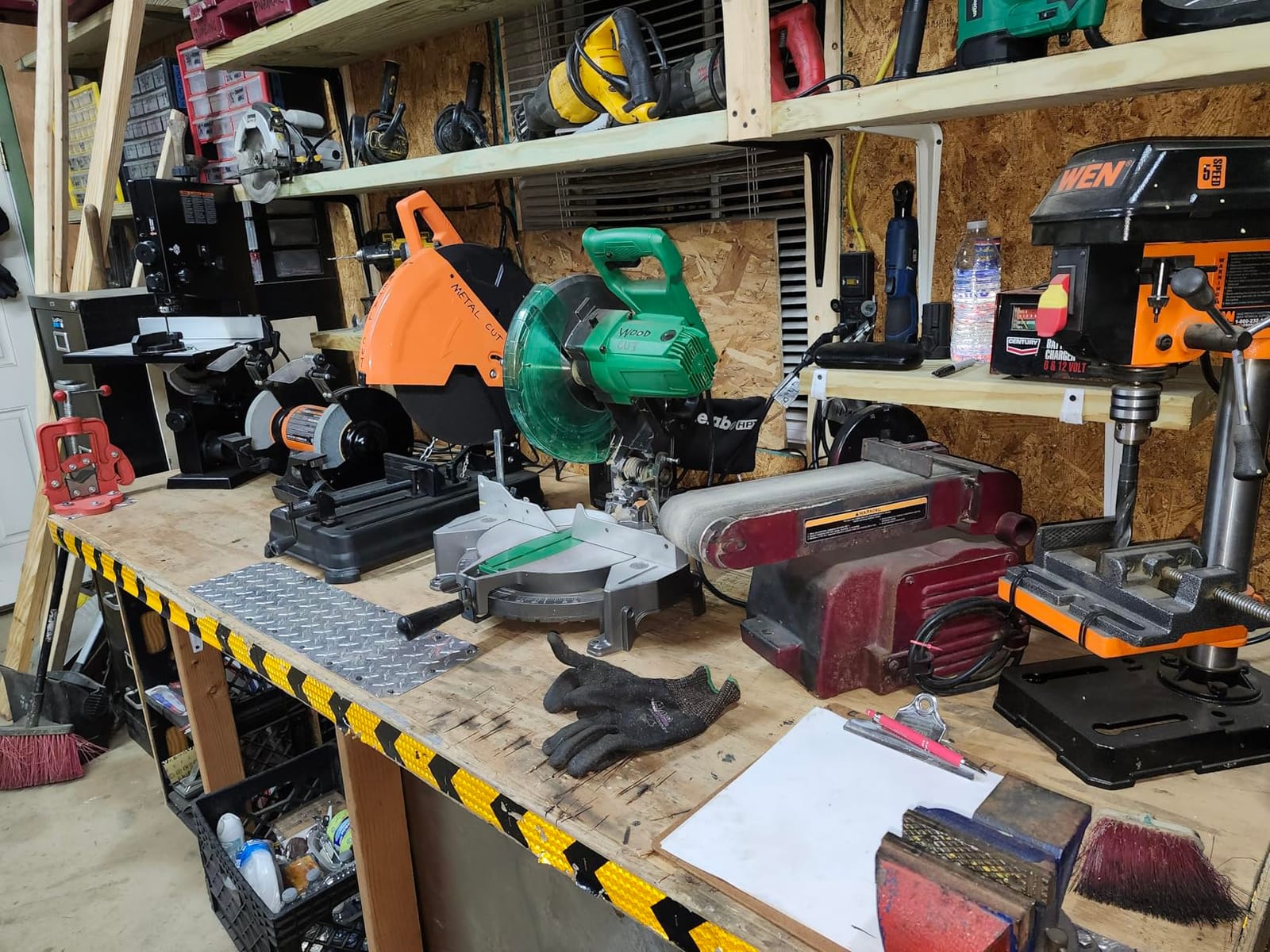
Where the reviews split is durability and squareness. A recurring complaint is a thin spot-welded base that was not square to the blade from the factory, and with a 4.1 average across 249 reviews and a 64 percent five-star share, this is a bargain tool with inconsistent quality control rather than a bad design. Several owners also report motor brush failures after moderate use.
The miter lever travel is also shortened by the hold-down chain, which makes angle changes awkward compared with a lever or screw vise, and the handle geometry suits working low to the ground rather than standing at a bench. Cutting thicker than a quarter inch of mild steel is slow enough to bog the motor, so treat it as a light and medium gauge machine.
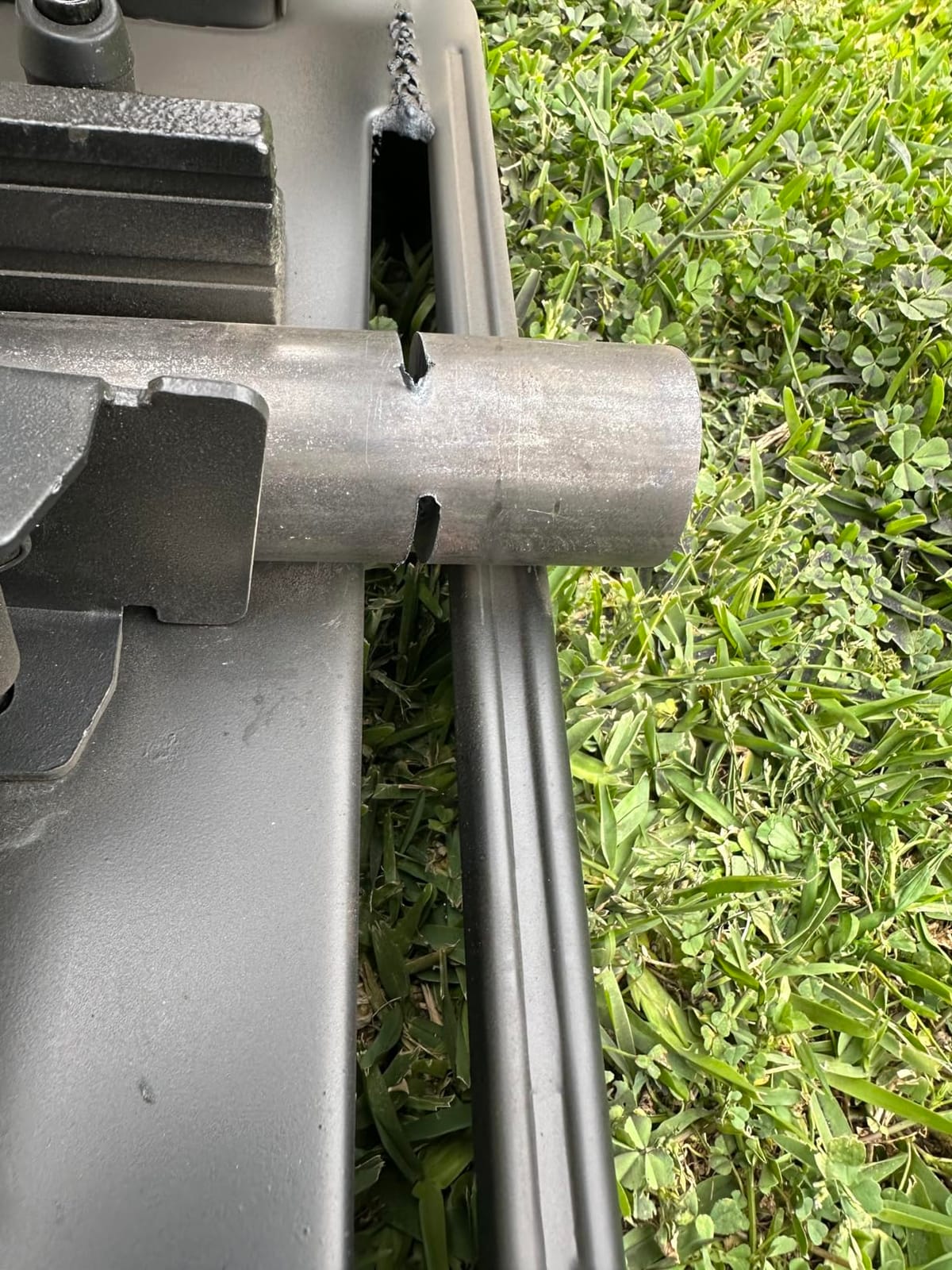
Who gets real value from the VEVOR
A home shop, a garage, or a student fabricator who cuts rebar, angle iron, light tubing and aluminum occasionally will find this saw capable and cheap to run. Replacement abrasive wheels cost little, and a fully wrapping spark guard is better protection than many machines twice the price. The 30 pound chassis is also one of the more portable options here.
It is a good fit for property maintenance, farm and land work, and any place where metal gets cut to length without needing a weld-ready edge. The instruction manual and a wrench are in the box, so the only consumable you need to source is wheels.
Who should look elsewhere
If your cuts have to hold a square enough to weld without adjusting, the out-of-square base reports are the reason to step up. The same goes for anyone planning to build handrails, cut thick plate, or run a fabrication business through this machine, because the base and motor will not take that kind of sustained load.
Nothing about the design is wrong – the wave vise, the 80-tooth blade and the wrapping guard are thoughtful choices for the tier. It is the consistency between units that falls short, so if you buy it, check that the fence is square to the blade before you cut anything you care about.
5. VEVOR 14 Inch Cold Cut Chop Saw – Cool Cuts Without the Premium
VEVOR Chop Saw, 14”/355mm Blade Diameter Cut Off Saw, 2800W 1200RPM Steel Cutting Machine, 0-45° Adjustable Dry Cut Chop Saw, Miter Saw for Cold Cut Saw for Steel/Iron/Aluminum, Black
14 inch ceramic-alloy cold-cut blade
2800W at 1200 RPM
Soft start motor
0-45 degree fence
Pros
- Ceramic-alloy cold-cut blade leaves a smooth flat spark-free surface
- Soft start reduces breaker trips and overheating
- 2800W motor and 51 lb base cut real steel
- Tool-less 0-45 degree fence adjustment
- Thick wave-pattern vise limits blade wobble
Cons
- Ceramic blade is not recommended for stainless steel
- 1200 RPM cold-cut speed means longer cycle times
- 51 pounds is awkward to reposition
- Spare parts support is a one-year replacement warranty
The second VEVOR in this list is a cold-cut saw, and that changes everything about the cut quality. The ceramic alloy blade and dry-cut technology leave a surface that is cool to the touch, almost spark-free and smooth enough to work immediately, which is exactly what you want when the offcut is going straight into a weld. At 2,800 watts with a 51 pound base, it has real authority on steel despite sitting in the budget tier.
Soft start is the feature that stands apart here. It brings the motor up gradually instead of slamming current through the circuit, which reduces the chance of tripping a breaker or overheating the motor on a cold start. Several owners single it out as a well-designed touch, and the thick wave-pattern vise gives the same clamping grip and wobble resistance as the abrasive model.
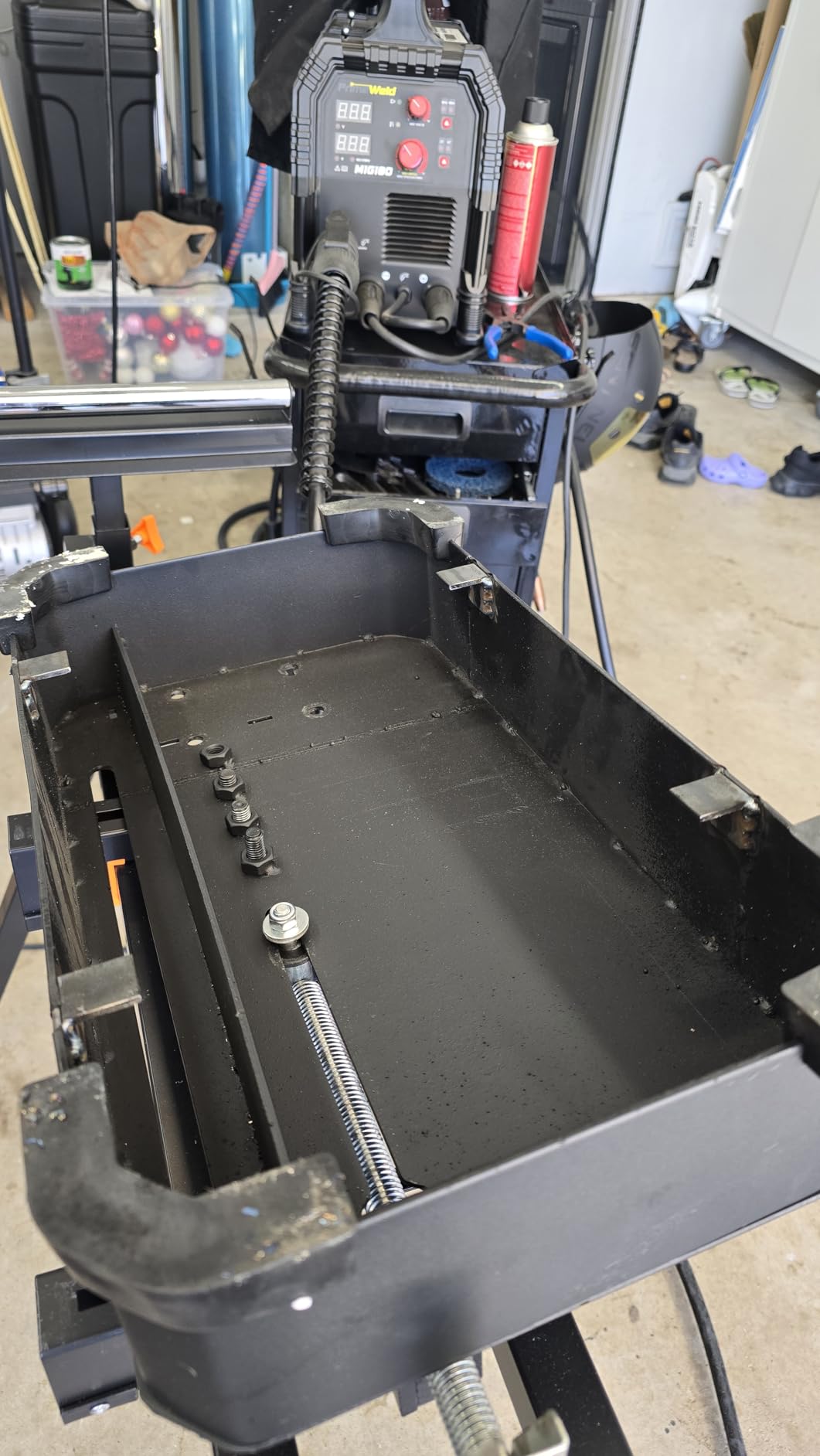
Two things temper the enthusiasm. The 1,200 RPM cold-cut speed is slow compared with abrasive designs, so cycle time on production work is longer, and the manufacturer explicitly does not recommend the ceramic blade for stainless steel. The 230 volt rating also matters if you are plugging into a North American shop, since that configuration is not straightforward.
At 51 pounds you will want a stand, because repositioning this by hand is unpleasant. Spare carbon brushes and wrenches come in the box, which is a nice touch, but parts support is limited to a one-year replacement warranty. The 4.2 average across 123 reviews and a 64 percent five-star share reflects a machine that cuts well and feels heavy.
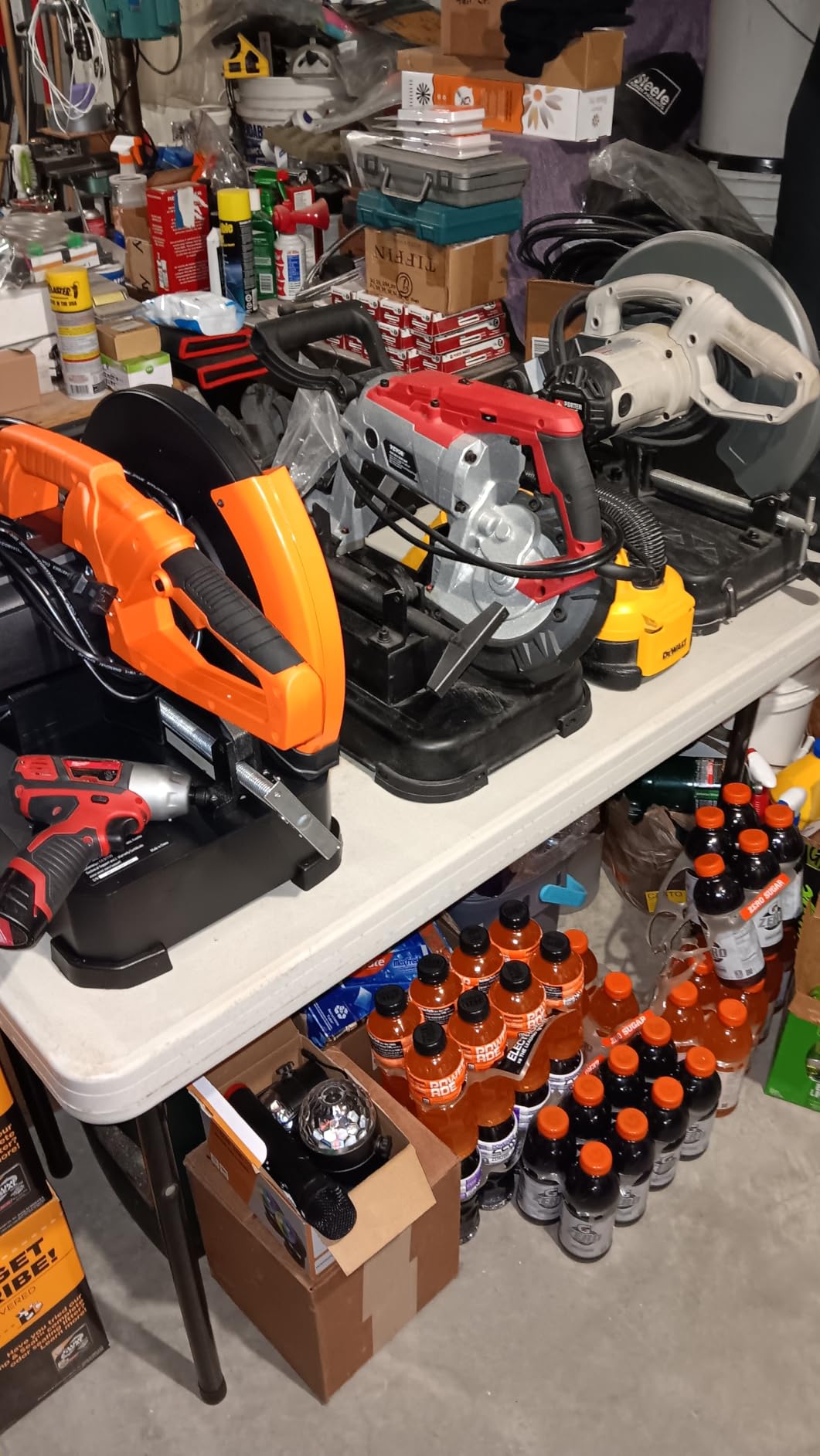
Why this is the budget cold-cut pick
The gap between a grinding cut and a cold-cut cut is the gap between a job that needs deburring and a job that does not, and this saw gives you the cold-cut edge without a four-figure machine. If you weld what you cut, that difference pays for the difference in price many times over. It handles steel bar, rebar, angle iron and aluminum according to the manufacturer, which covers most fabrication and construction stock.
It is a good fit for a small fabrication shop, a maintenance shop, or anyone upgrading from an abrasive saw who wants cleaner cuts without moving to a premium cold-cut brand. The tool-less 0-45 degree fence and the fully wrapping spark guard are sensible safety and setup features at this price.
Where it does not fit
Do not buy this as a stainless steel saw. The ceramic blade is specifically called out as not recommended for stainless, and running it on stainless would waste the blade and produce poor cuts. The 1,200 RPM speed also means it is the wrong tool for high-volume production where cycle time is measured in seconds.
The weight is the everyday inconvenience. Fifty-one pounds is fine bolted to a stand and unpleasant carried between jobs, and the one-year parts warranty means a failed component ends the machine’s life rather than being repaired cheaply. If your shop already has 120 volt power everywhere and light-gauge mild steel is your main material, this is a capable buy.
6. WEN CM1446 14 Inch Multi-Material Chop Saw – Blade Already Fitted
WEN CM1446 15-Amp 14-Inch Multi-Material Cut-Off Chop Saw with Carbide-Tipped Metal-Cutting Saw Blade
14 inch 66-tooth carbide blade fitted
15 Amp 1800W at 1450 RPM
0.5 inch plate capacity
Pros
- Carbide mild steel blade pre-installed and ready to cut
- Handles ferrous metal non-ferrous metal plastic and wood
- Generous capacity for the tier
- 45 degree adjustable fence supports miter work
- Two-year warranty with two years of spare parts
Cons
- Hold-down chain is less convenient than a lever vise
- Steel plate base is thinner than a cast base
- Multi-material positioning is not optimized for heavy fab work
The WEN CM1446 solves the problem that stops most people buying a metal saw: getting the wrong blade on the machine. It arrives with a 66-tooth carbide-tipped professional mild steel blade already installed, so you unbox it, set the fence and cut. That alone removes the most common setup error in this whole category, and it is why owners rate it well for its tier.
The capacity figures are unusually generous for the class: 3.75 by 7.25 inches rectangular stock, 5.125 inch round tube, and steel plate up to a half inch thick. The 15 Amp motor drives the blade at 1,450 RPM, which is the same speed as the Evolution cold-cut saw above it, and the 45 degree adjustable fence handles miter work.
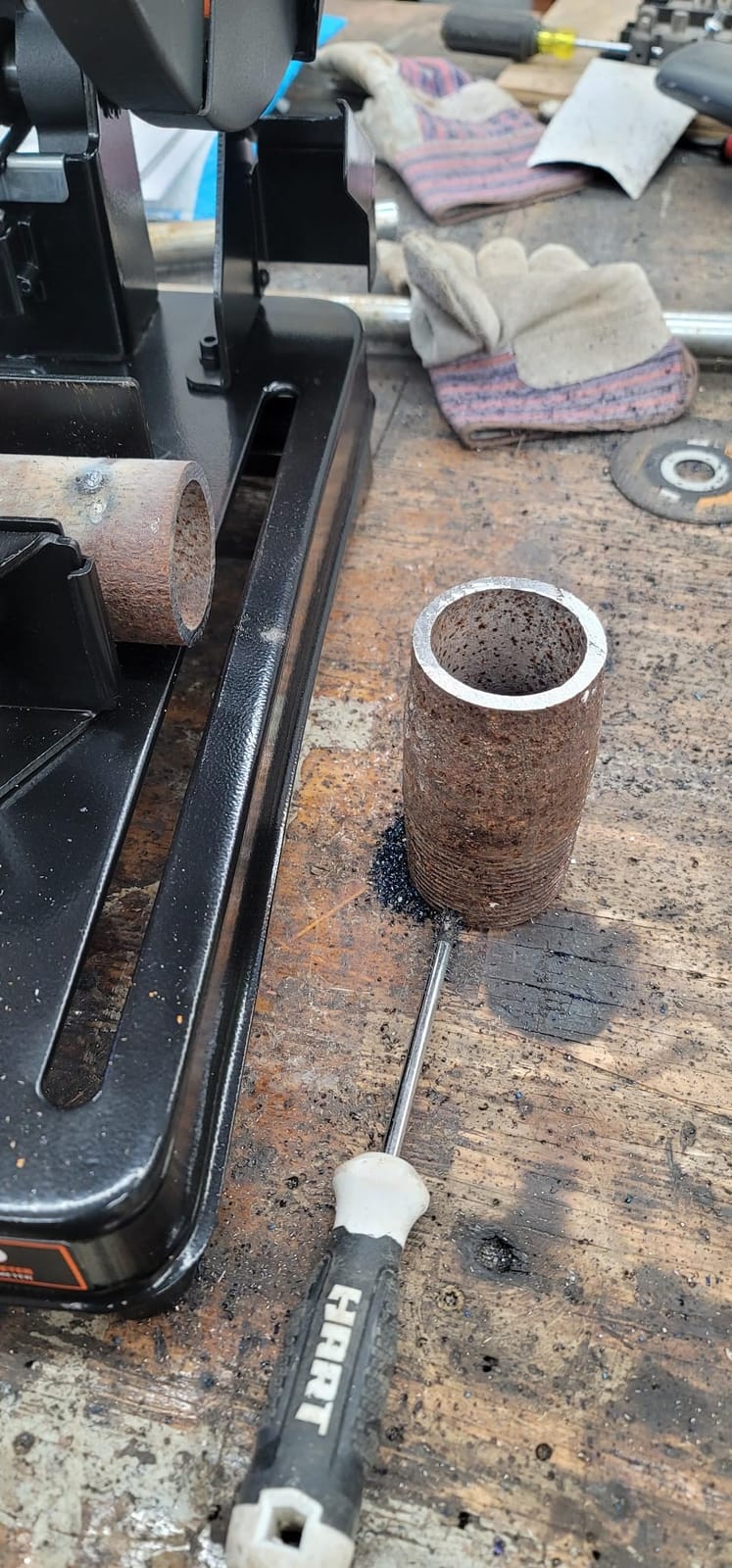
The catch is that multi-material positioning is not the same as metal-only optimization. A saw set up to cut wood, plastic and metal has compromises in its blade speed and motor design that a dedicated metal saw does not have, and owners note it is not a replacement for a professional cold-cut machine. The hold-down chain clamp is also less convenient than a screw or lever vise, and the steel plate base is thinner and less rigid than a cast base.
Still, the 4.4 average and 68 percent five-star share point to a machine that performs above its tier. The two-year limited warranty with two years of spare part availability is better coverage than several machines here, and that matters for a tool that will sit in a garage rather than a professional shop.
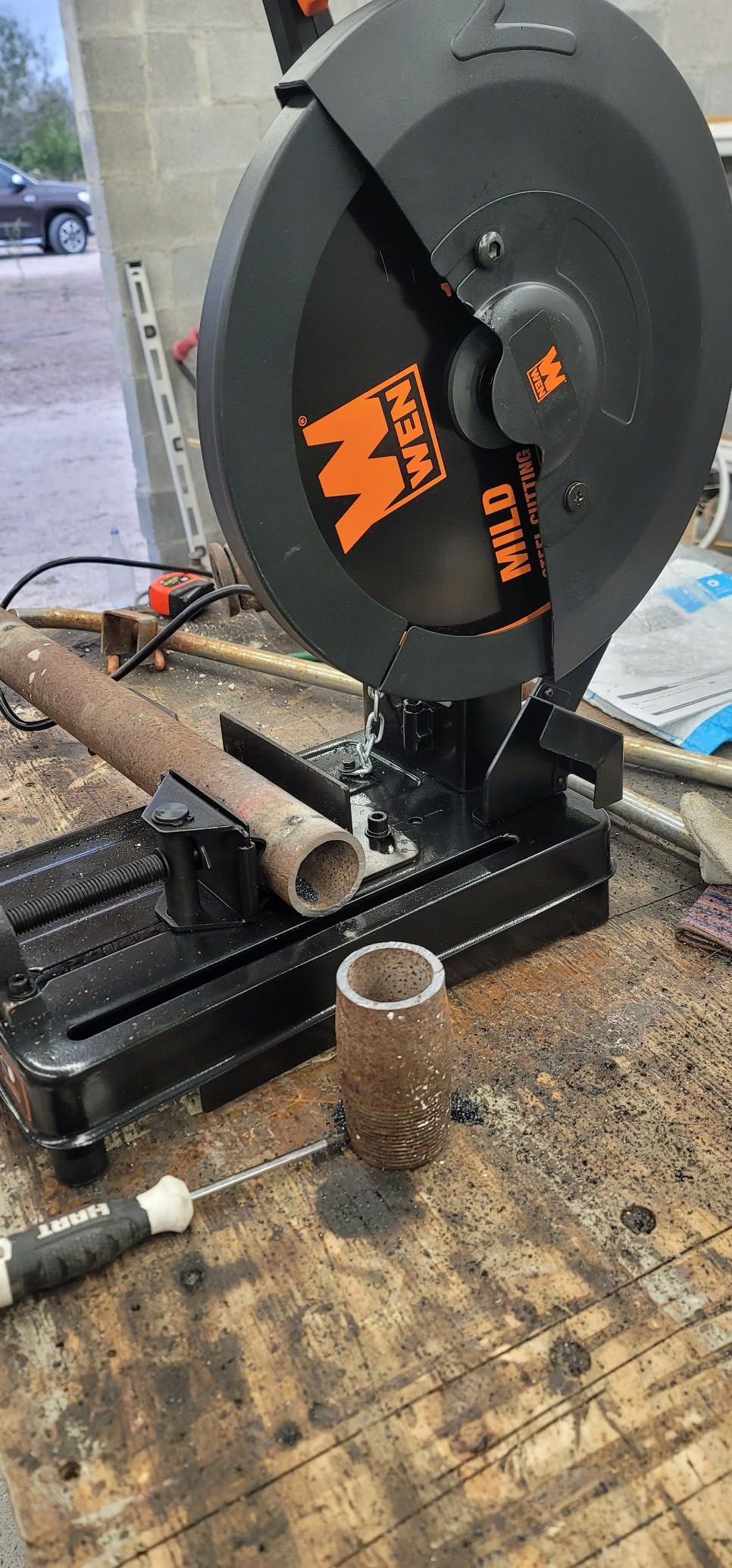
Best fit: mixed-material hobby and home shop
If you cut metal sometimes and other materials the rest of the time, this is the saw that avoids a second purchase. It handles ferrous metal, non-ferrous metal, plastics and wood, which covers trim, sheet goods, and small steel work in one machine. The pre-installed blade also means a beginner is not going to fit a wood blade and wonder why the motor is screaming.
The half inch plate and 5.125 inch tube capacity give it room for sheet metal, unistrut, small angle and light structural work, and the carbide blade leaves a cut that is much closer to weld-ready than any abrasive saw. It is a strong choice for a workshop that also builds furniture or does general repairs.
Where it falls short
Heavy fabrication is the limit. The thin pressed base will flex more than a cast base under a demanding cut, and a chain clamp gives you less control when you want to place a thin tube precisely. If accuracy is measured in fractions of a degree across a handrail run, use a saw with a cast or ribbed base and a detented fence.
Blade availability is also a factor. Multi-material carbide blades are a narrower range than standard cold-cut mild steel blades, so check that the blades you need exist before committing. For light to medium work in a mixed shop, though, this is an efficient, low-friction setup.
7. Evolution S14MCS 14 Inch Mitering Chop Saw – Best for Angle Cuts
Evolution S14MCS 14″ Mitering Chop Saw | Cold Cut Steel Saw | EVOMAX Intelligent Motor & Blade | 3500+ Blade Life | Burr-Free Finish | Shadow Guide | +/-46° Miter | Soft Start | Reinforced Base
Cermet blade rated 3500+ cuts
15 Amp EVOMAX motor at 1100 RPM
Soft start and e-brake
Pros
- Cermet blade rated for 3500+ cuts in mild steel
- Soft start prevents breaker trips and brake stops blade in seconds
- 4x faster than abrasive with no airborne dust
- Plus or minus 46 degree miter with detents and steel gauge
- Reinforced fence and ribbed alloy base resist flex
Cons
- 72.4 pounds makes a stand effectively mandatory
- Premium four-figure price versus lower-cost cold-cut saws
- 1100 RPM no-load speed is slow on heavy solid sections
- Manufacturer listing shows a limited warranty with no stated term
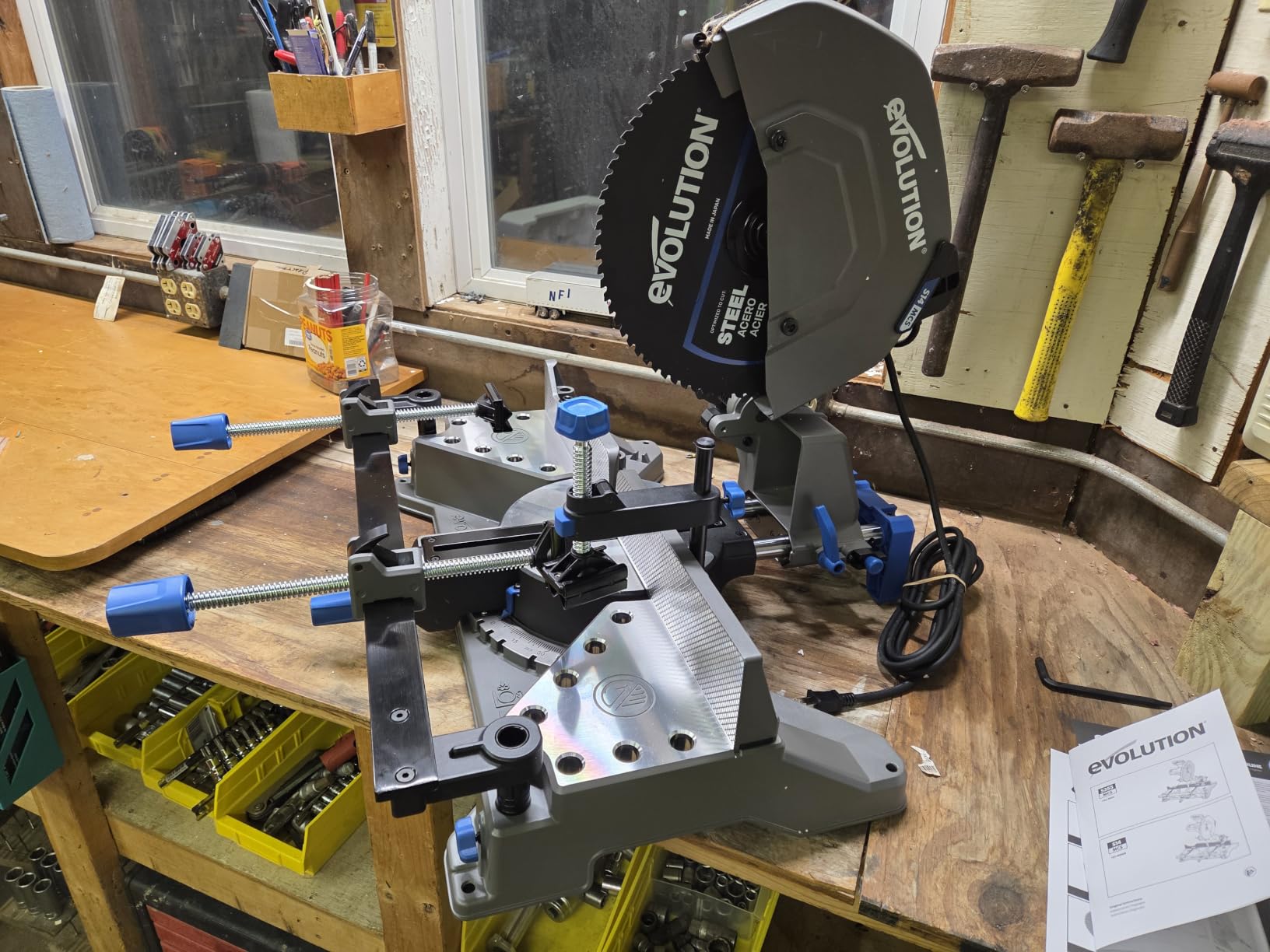
If angle work is your primary job, the Evolution S14MCS is the saw this whole category is built around, and forum owners doing handrails describe the mitering approach as the feature that makes metal chop saws worth having. The miter range runs plus or minus 46 degrees with detents and a stainless steel gauge, so you set an angle and it repeats, rather than measuring and adjusting by eye on every piece.
The EVOMAX cermet blade is rated by the manufacturer at more than 3,500 cuts in 4 inch mild steel, roughly 50 percent more than competing blades, and the 15 Amp intelligent motor at 1,100 RPM optimises speed to extend blade life. The result is a cut that is fast, cool and weld-ready, with none of the airborne dust that makes abrasive saws unpleasant in an enclosed shop.
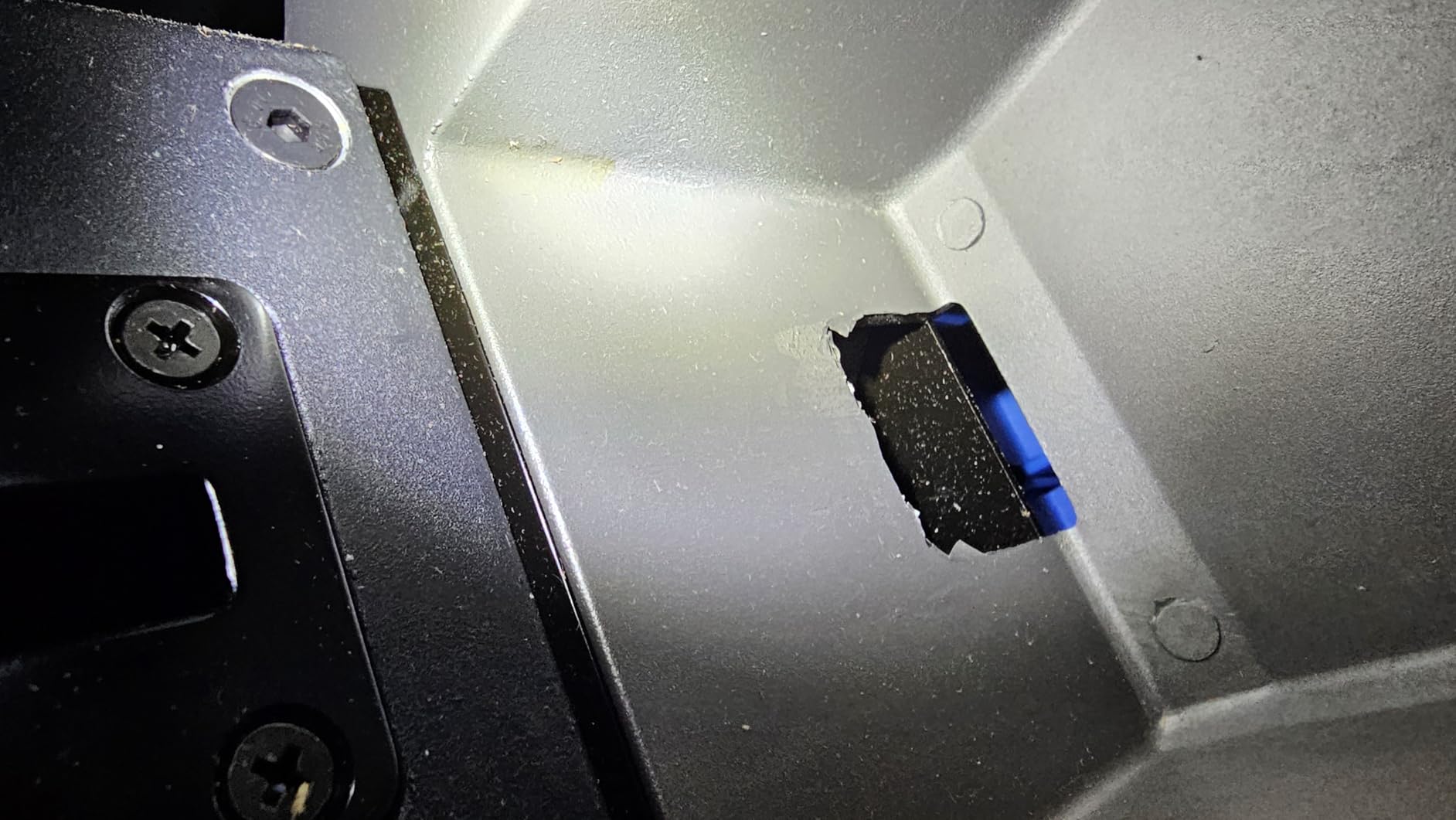
The structure is built for accuracy rather than convenience. A reinforced fence, a ribbed alloy base, dual sliding clamps and knurled surfaces work together to resist flex when a heavy section goes through, and the two-stage safety electronics – soft start and an electronic blade brake that stops the blade within seconds – are professional touches you rarely see in this price band.
The 4.7 rating with 89 percent five-star and only 3 percent one-star is the strongest distribution in this group, though it is built on 73 reviews rather than hundreds. The cautions are physical and financial: at 72.4 pounds it needs a bench mount or a dedicated stand, and it sits at the top of the price range for a reason.
Why handrail and fabrication people choose this
Angle accuracy is the whole game on a handrail job, and detented miter positions with a steel gauge give you a repeatable angle instead of a hopeful one. The factory guidance on blade use is also worth reading: let the blade reach full speed before contact, apply firm consistent pressure, and avoid a slow feed rate, because that is what causes sparking and heat buildup on a cermet blade.
It suits anyone cutting square tube, pipe, angle iron and solid bar to a pattern repeatedly. Because it runs cool with no dust, you can work indoors without a filtration setup, and the electronic brake means the blade is not coasting past the work when you release the trigger. For gates, frames, handrails and shop fixtures, this is the most complete package in the roundup.
Where the S14MCS is not the answer
Weight and price are the two hard limits. Seventy-two pounds cannot be moved to a job site by one person, and the four-figure price is a real cost for a shop that cuts a few pieces a week. The 1,100 RPM no-load speed also means heavy solid sections still take time, since cermet blades need feed rate to work properly.
If your cuts are mostly straight and your material is light gauge, the S355CPSL at position one gives you the same cold-cut approach at a fraction of the mass. Choose the S14MCS when angle work is the reason you are buying a metal chop saw at all.
8. Yumark 14 Inch 2200W Abrasive Chop Saw – Rebar and Angle Steel
Yumark Abrasive Chop Saw, 2200W 3800RPM Steel Cutting Machine, Metal Cutting Saw with 14in Blade for Rebar, Angle Steel, Hollow Pipe Cutting
14 inch abrasive wheel at 3800 RPM
2200W motor with air exhaust
Quick-release base clamp
Pros
- Lowest entry cost for a 14 inch metal cut-off saw
- 2200W motor with directional air exhaust for cooling
- Non-slip base and clamping device limit wobble
- Ergonomic handle reduces fatigue on longer sessions
- Handles rebar angle steel solid round and hollow tube
Cons
- Thin base twists under load so cuts are not straight
- Abrasive wheel wears quickly and may not ship with the saw
- Some deliveries arrive damaged from thin packaging
- Abrasive cuts leave burrs needing grinding before welding
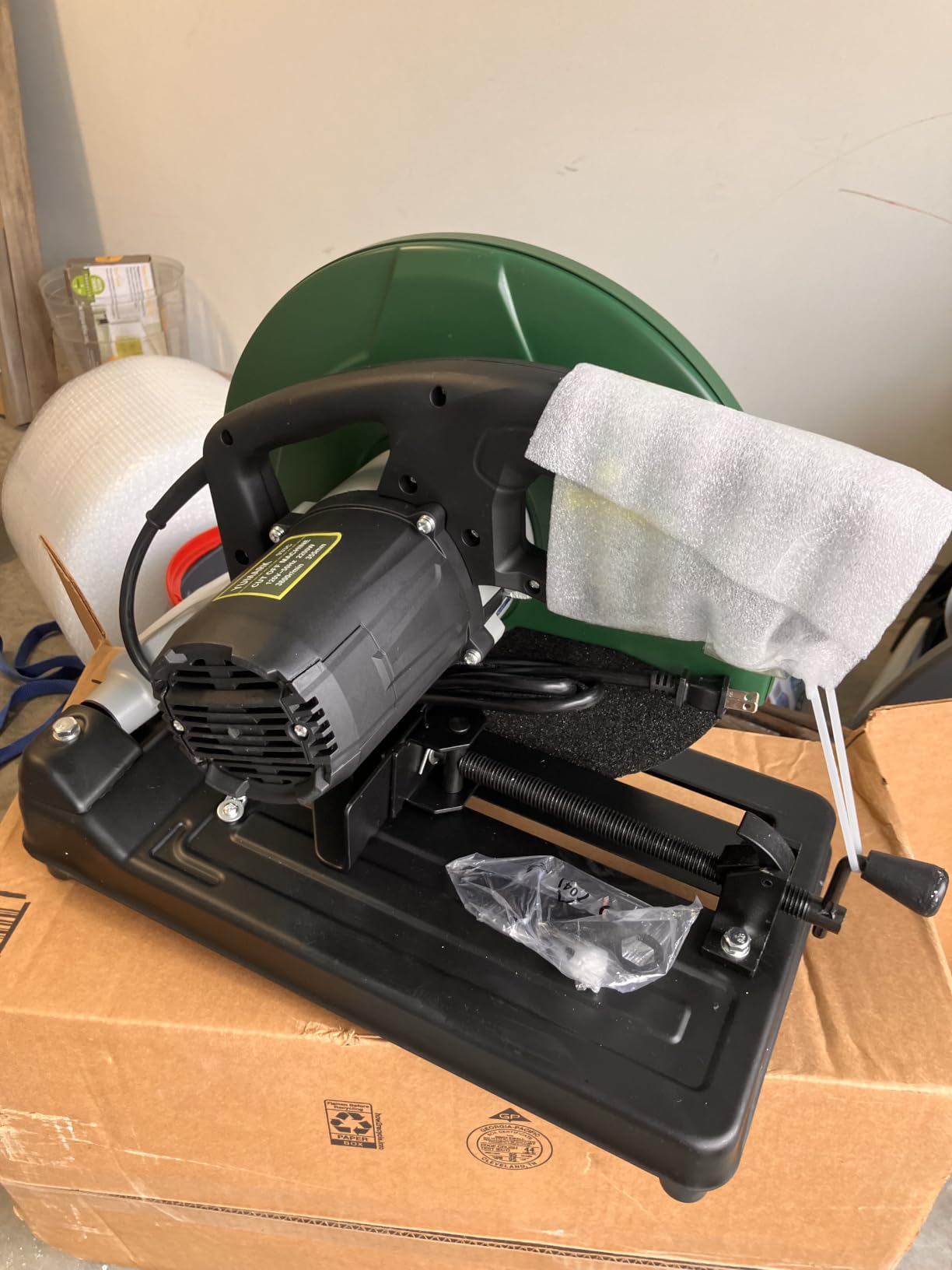
The Yumark 2200W saw is the cheapest way into a 14 inch metal cut-off machine, and for trimming rebar, angle steel, solid round and hollow tube in a home shop it does the job. The motor was upgraded from 2,000 to 2,200 watts with a directional air exhaust that improves heat dissipation and overload resistance, and at 3,800 RPM it cuts quickly for its size.
The ergonomic handle and simple layout are genuinely useful on a machine you might use for an afternoon of cleanup work, and the non-slip base with a stable clamping device keeps the saw from walking during a cut. A dual insulation structure is listed as a safety feature, and the saw is rated for steel bar, rebar, angle steel, hollow tube and iron.
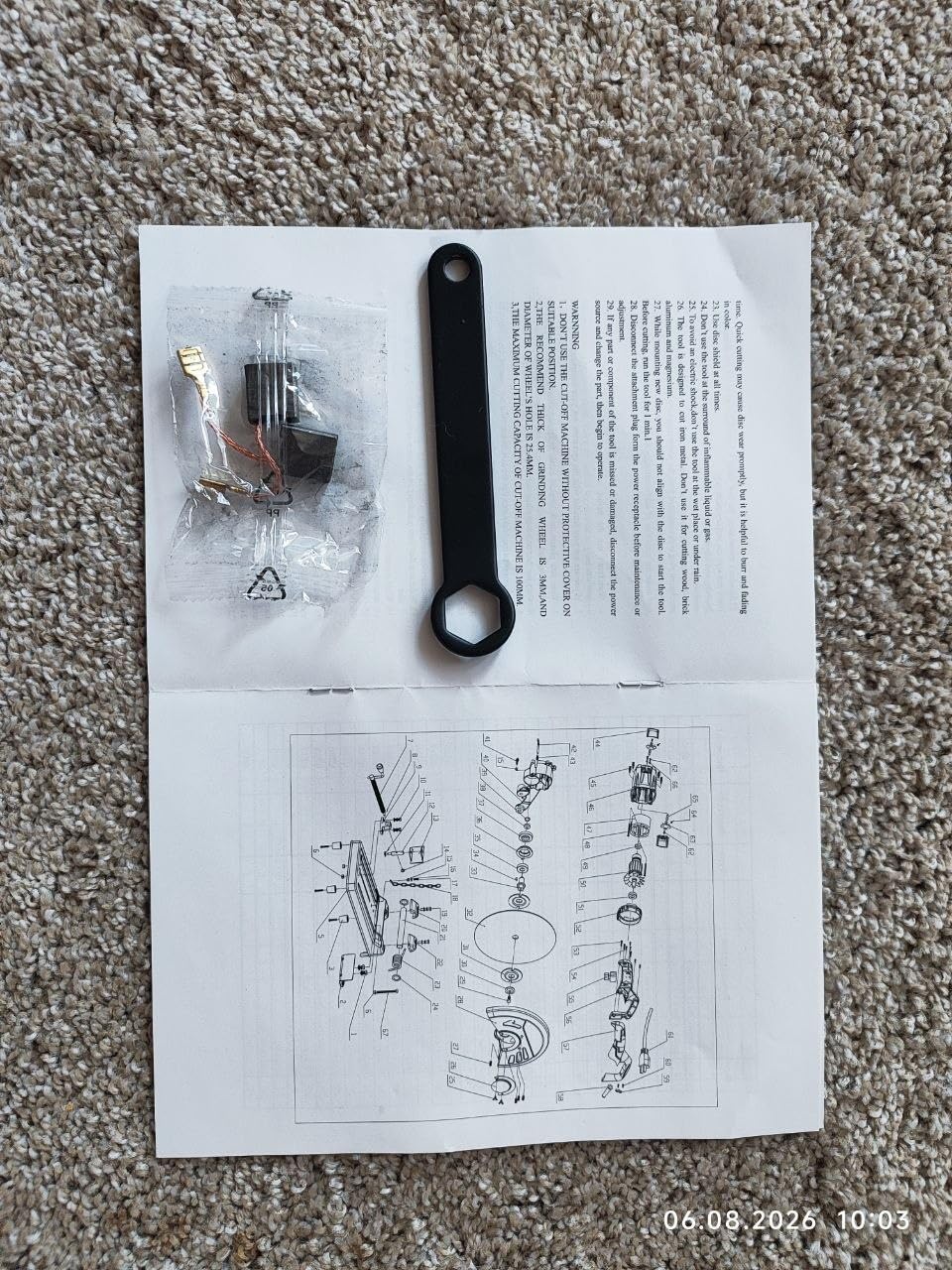
The recurring problem is structural, and owners are consistent about it. The base is thin and flimsy, twisting under load so cuts come out crooked, and a few buyers report damaged deliveries from inadequate packaging plus a missing wrench. The abrasive wheel also wears down quickly and may not be included depending on the shipment, which is a real cost when you have planned a project around it.
With 44 reviews averaging 4.4 and a 72 percent five-star share, this reads as a tool that performs adequately for DIY and light shop work and falls short for precision. Owners who want weld-ready cuts are told plainly to spend more on a heavier saw, and that is the correct advice.
Where this saw makes sense
Cutting down old rebar, trimming angle steel from a demolition pile, or cutting scrap pipe to length is exactly the job this machine suits. None of those cuts have to be square to a weld, and none of them justify a cold-cut blade. The quick, high-speed abrasive cut and the low entry cost are the two things you are actually buying.
It is also a reasonable garage or rental tool for occasional work, where the ergonomic handle matters because you will be gripping it through a whole session. If you already own abrasive wheels, the running cost per cut is the lowest in this roundup.
Where it will frustrate you
A twisting base is a hard limit for repeatability. If you make ten identical cut-offs and the lengths differ, you will lose trust in the machine quickly, and no amount of careful clamping fixes a thin base that flexes. Combine that with burrs that need grinding before welding and you have a tool for rough work only.
Buying notes worth checking: confirm the abrasive wheel is included with your unit, keep the wrench in the box with the saw, and inspect the base for flatness before the first cut. As a supplement to a real metal saw rather than a replacement for one, it is hard to argue with.
9. Evolution S15CPS 15 Inch Metal Cutting Chop Saw – Extra Cutting Height
Evolution S15CPS 15″ Heavy-Duty Metal Cutting Chop Saw | 3,500+ Cuts with EVOMAX14ST Blade | 15″ Blade Compatible | Industrial Power Saw, Soft Start Motor, E-Brake, Precision Shadow Line Guide
15 inch saw with 3500+ cut cermet blade
1800W EVOMAX motor
Shadow line guide with cast fence
Pros
- Long blade life from the EVOMAX cermet blade
- Shadow line guide and cast iron fence give repeatable accuracy
- E-brake and soft start improve shop safety
- Heavy-duty 71 lb cast construction
- Intelligent motor reduces mechanical stress at startup
Cons
- Heaviest unit in the group at 71 pounds
- Dedicated metal-only design with limited multi-material flexibility
The Evolution S15CPS is the answer to the question forum users ask constantly: is 14 inches enough, or do I need to step up. The extra inch of blade gives you more cutting height, which means larger rectangular stock, bigger pipe and taller sections fit in one pass instead of being flipped and cut twice. The trade is 71 pounds of cast construction and a larger footprint on the bench.
The accuracy hardware is the differentiator. A precision shadow line guide paired with a cast iron fence gives a visible cut line and a rigid reference, so the cut lands where you set it rather than where the blade wanders. Owners building frames and fixtures point to this as the feature that makes cuts repeatable across a long session.
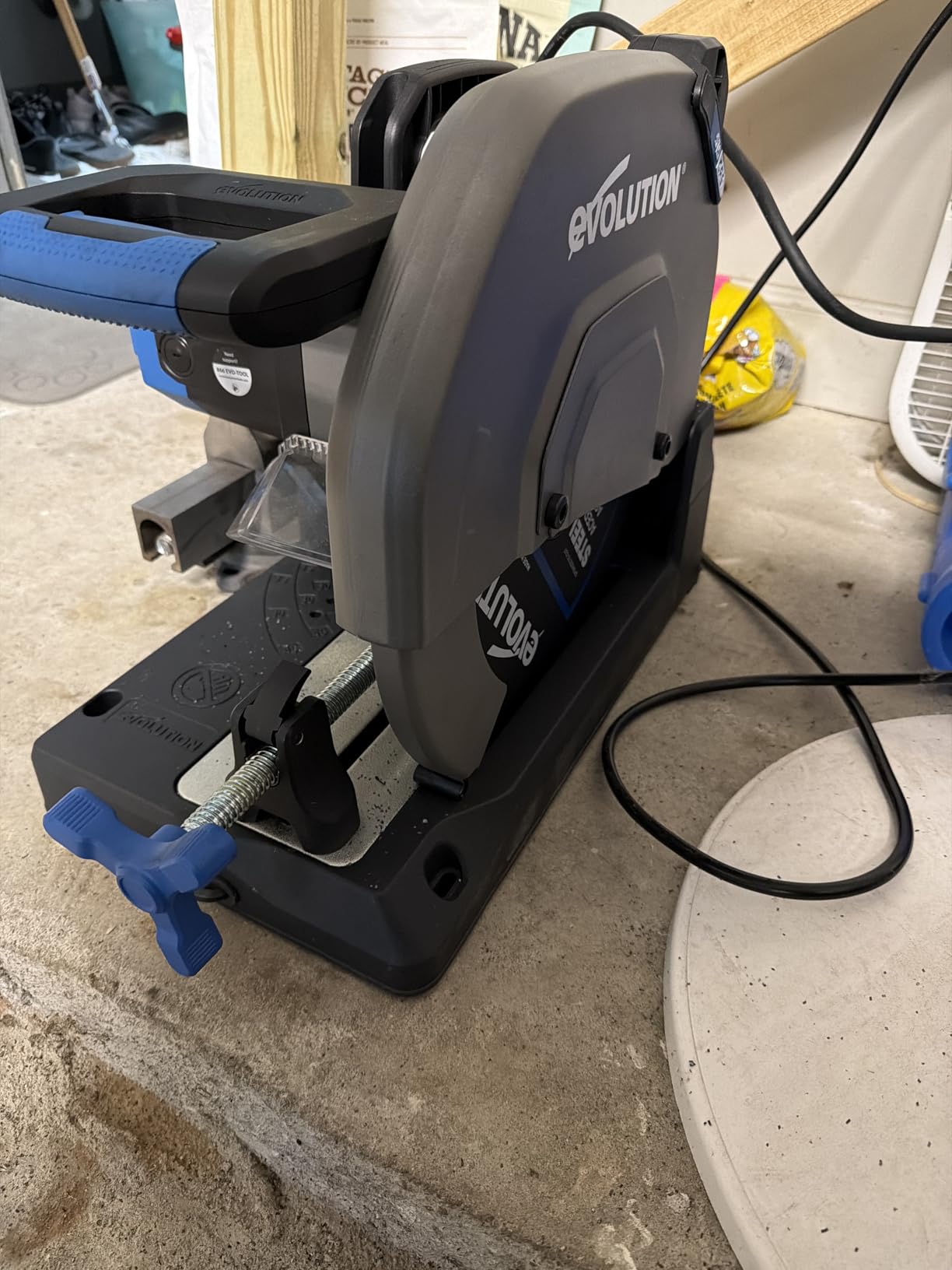
Safety electronics are the other selling point. The soft start motor reduces current surges and breaker trips, and the electronic brake stops the blade within two to three seconds of releasing the trigger, which matters on a machine this heavy. The 1,800 watt EVOMAX motor technology is designed to extend blade life and reduce mechanical stress during startup, and the cermet blade is rated for more than 3,500 cuts.
Its limitation is focus. This is a dedicated metal machine, so it does not offer the multi-material flexibility of the WEN further up this list, and at 71 pounds it is the heaviest saw here, which rules out job-site use. The 4.5 average sits on 45 reviews, so the owner base is smaller than the models above it, but the specification sheet is the strongest in the group for structural work.
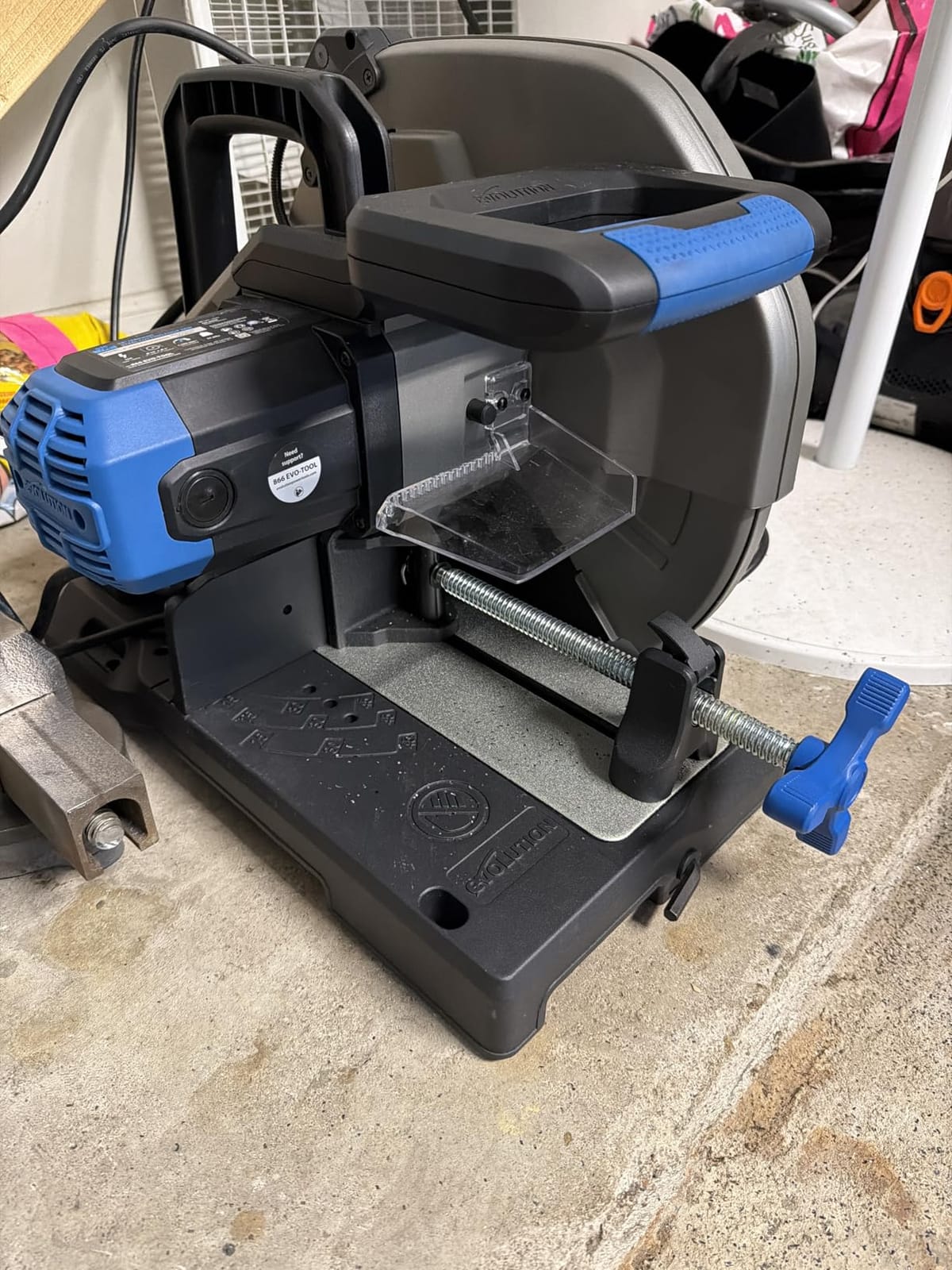
Who should buy 15 inches
Anyone cutting large rectangular tube, wide channel, solid bar or structural sections where a 14 inch saw would need a second pass will see the extra capacity pay off immediately. It is also a good fit for a production shop that runs the same cut all day, because the cast fence holds its position and the shadow line makes setup repeatable.
If your work involves cutting material you cannot easily turn over – long sections, wide plate, heavy angle – the 15 inch class removes an ergonomic problem as well as a capacity one. A cut that is finished in one pass with no flipping is a safer cut, because you are not reaching over a stopped blade to reposition stock.
When 14 inches is the smarter buy
If your material is tube, angle, unistrut, rebar and pipe in normal structural sizes, a 14 inch saw cuts everything you need and weighs twenty to thirty pounds less. The S355CPSL and the S14MCS both cover that range, and the S14MCS adds a much wider miter range than this saw offers.
Portability is the other factor. Seventy-one pounds is a permanent bench fixture, not something you load into a truck for a small job. Bolt this one down, give it a proper circuit, and run it on mild steel where its cermet blade is rated, and it will outlast most lighter saws on structural work.
10. Bosch GCO15-14 14 Inch Abrasive Cut-Off Machine – Compact Power
BOSCH GCO15-14 14 In. Abrasive Cut-Off Machine: Powerful 15 Amp Motor, Large Cutting Capacity, and Adjustable Fence for Quick and Accurate Cuts
15 Amp motor at 4100 RPM
5 inch cutting capacity
0-45 degree left miter
Spark guard
Pros
- Compact and portable for a 14 inch abrasive saw
- Quick-release vise and fast wheel changes with the included wrench
- Adjustable spark guard improves safety
- Cuts steel rebar and even masonry with a diamond wheel
- 1 inch arbor allows other blade types
Cons
- Very loud in operation with hearing protection advisable
- Several reports of motor brush arcing and motor failure
- 15 Amp motor can trip a 20 amp breaker on startup
- Short cord of roughly 6.5 feet with no cord storage
The Bosch GCO15-14 is the most portable saw in this roundup and it does not get there by cutting capacity. At 31 pounds with a folding feature, it moves between a truck and a bench without ceremony, and the 15 Amp motor at 4,100 no-load RPM is the highest blade speed here, which is why owners report fast, smooth cuts through steel and rebar. It is the one abrasive saw on this list I would actually consider carrying.
The adjustable fence supports 0-45 degree left miter across three mounting locations, so you can set the angle relative to different stock sizes instead of only to the table, and a 5 inch cutting capacity handles larger ferrous work pieces. The quick-release vise plus the included 8mm hex key make wheel changes fast, and the 1 inch arbor accepts diamond wheels for brick and rock if you need it to.
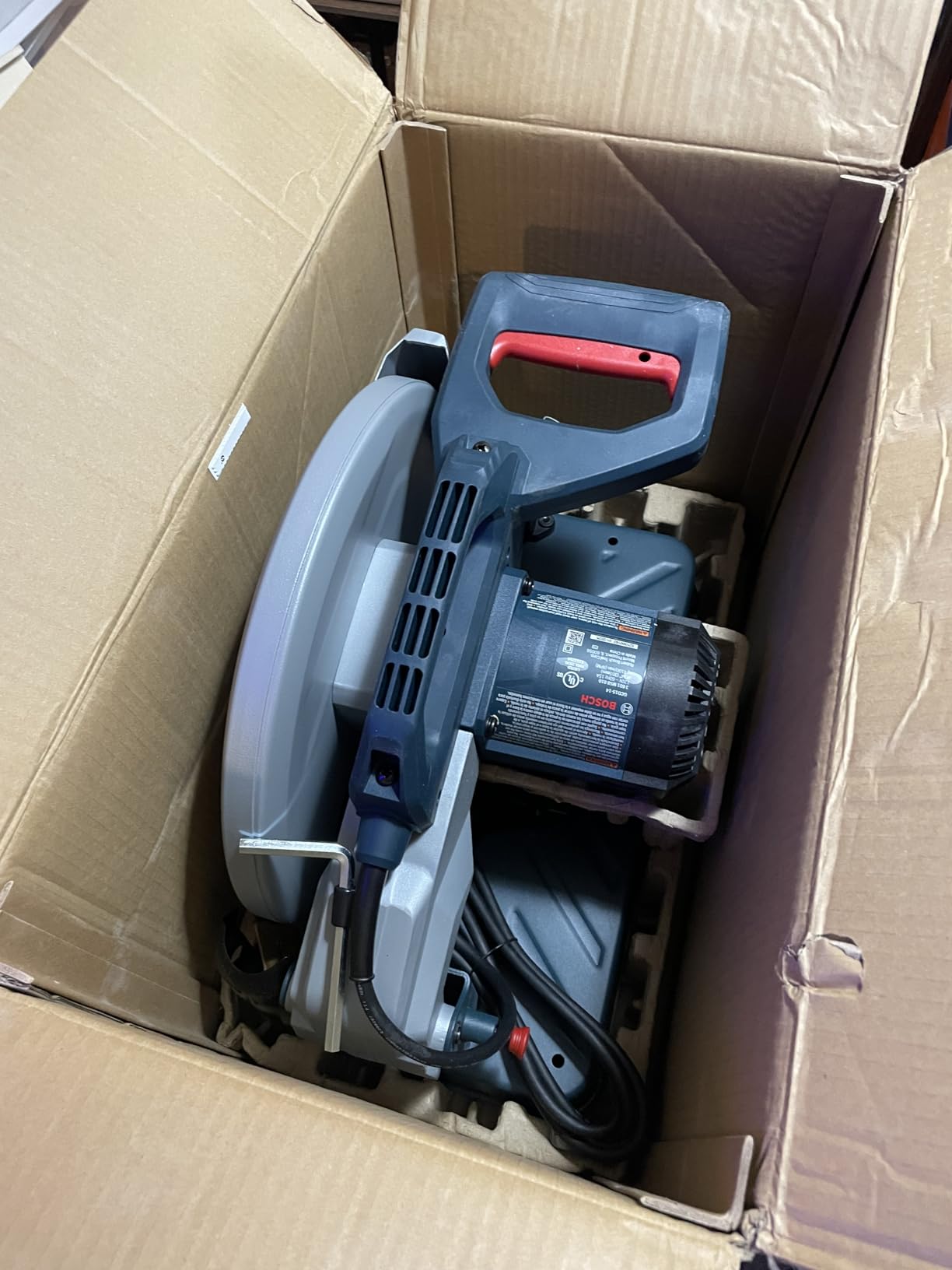
Two things hold it back. Operating noise is reported at around 107 dB, which is high enough that hearing protection is not optional, and several owners report motor brushes arcing with the motor failing within months. The 15 Amp draw can also trip a 20 amp breaker on startup, and the roughly 6.5 foot cord with no storage is a small irritation on a saw meant to be moved around.
With 24 reviews averaging 4.5, the feedback is thin but consistent: people like the power-to-size ratio and dislike the noise and the brush durability reports. The adjustable spark guard is a genuine plus on a grinding saw, where spark direction is the thing you most want to control.
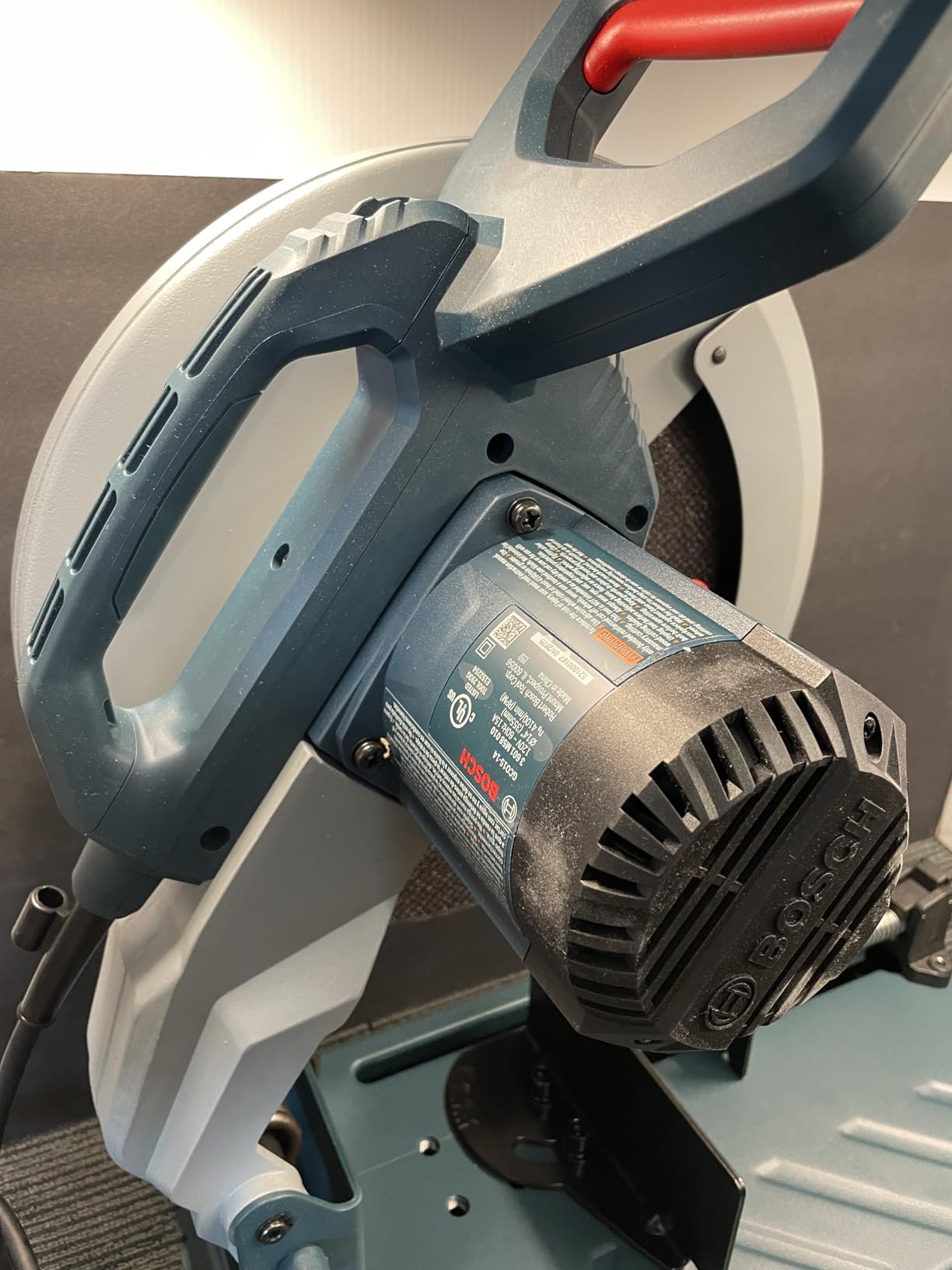
Best for the saw that has to move
Mobile repair work, field installation and site work where a 70 pound bench saw is impossible are where this machine earns its place. It handles rebar, structural steel and general ferrous cutting, and if you fit a diamond wheel it also covers masonry, which broadens what one tool can do. The folding design and 31 pound weight mean one person can reposition it.
It is also a good first metal saw for someone who wants to learn on an abrasive machine without a big cash commitment. Abrasive wheels are forgiving of rusty or dirty stock, and the cut is fast. Just plan on grinding the edge before you weld, because abrasive cuts leave a burr.
Where it is the wrong tool
Do not buy it for precision or for quiet shops. A 107 dB saw in an enclosed garage is unpleasant for everyone nearby, and the reported brush and motor failures mean you should budget for a possible motor replacement. Three-year and ten-year ownership reliability is not something the reviews support here.
Nor is it the saw for thin precision work or for anyone who needs a weld-ready edge straight off the cut. If your cuts mostly feed a welder, an abrasive saw is the wrong architecture. But if the priority is power you can carry, this is the most capable option on the list at that weight.
11. Yumark 14 Inch 2400W Abrasive Chop Saw – Power in a Small Package
Yumark Abrasive Chop Saw, 2400W 3800RPM Steel Cutting Machine, 45° Adjustable Angle Metal Cutting Saw with 14in Blade for Cutting Rebar, Angle Steel, Hollow Pipe
14 inch abrasive wheel at 3800 RPM
2400W motor with air cooling
0-45 degree angle
Pros
- Capable 2400W motor for an entry-level price
- Thickened non-slip base resists wobble during cuts
- Stable clamping device holds common steel shapes
- 0-45 degree angle adjustment for angled work
- Handles rebar angle steel solid round and hollow tube
Cons
- Abrasive wheel consumable rather than long-life cermet blade
- Semi-closed cover is basic guarding
- Generic brand with a small review base
This Yumark steps the motor up to 2,400 watts from the 2,000 watt version in the previous saw, which makes it the most powerful motor in the entry-level abrasive category and one of the strongest numbers-per-pound in this roundup. The directional air exhaust improves heat dissipation and overload resistance, and the 3,800 RPM 14 inch wheel cuts steel bar, rebar, solid round, angle steel and hollow tube quickly.
Unlike the cheaper abrasive machines, the thickened non-slip base and strong clamping device are specifically designed to resist wobble, and that is the difference that decides whether repeat cuts are the same length. The 0-45 degree adjustable angle covers most angled work, and the semi-closed safety cover gives basic protection around the wheel.
What you give up is blade economy and refinement. It uses a consumable abrasive wheel rather than a long-life cermet blade, so the running cost per cut is higher and the cut edge still needs deburring before welding. The semi-closed cover is a more basic guarding setup than the fully wrapping guards on the other abrasive saws here, and the brand carries a small review base, with only 20 reviews behind the 4.5 average.
At 14.2 kilograms it is lighter than most machines in this list, which helps on a job site, and the ergonomic design is aimed at longer sessions without fatigue. Feedback is thin overall, so treat the rating as encouraging rather than proven.
Where it fits
Light to medium gauge mild steel, rebar, angle steel and aluminum are its range, and the 2,400 watt motor has more headroom for thick sections than most machines at this level. A farm, a garage, or a small construction outfit that trims steel regularly will find it capable and inexpensive to run.
It is also a straightforward second saw: if you own a cold-cut machine for weld-ready work, this covers the rough, fast, dirty cutting that would dull a carbide blade and fill your vacuum. Separating the two jobs is how owners get good blade life out of an expensive cermet blade.
Where it falls short
Precision is the limit. An abrasive wheel and a basic guard setup will never give you the edge condition or the control of a cold-cut saw, and a semi-closed cover offers less protection when cutting at an angle. If you need square, burr-free, weld-ready cuts, this is the wrong architecture regardless of motor size.
With a small review base, long-term durability is unproven, and abrasive wheels need replacing on a schedule you should plan for. Buy it for capability and price, and expect to maintain it.
12. DJBL 14 Inch Brushless Cold Cut Saw – Quiet Cermet Power
DJBL 14″ Brushless Cold Cut Saw 3500w Metal Chop Saw with 66T Cut Blade
3500W brushless motor at 1300 RPM
66-tooth cermet dry-cut blade
Three speeds and soft start
Pros
- 3500W brushless motor in a closed aluminum housing
- 66-tooth cermet blade leaves burr-free low-spark edges
- Brushless motor and housing for longevity and lower noise
- Three cutting speeds plus soft start and quick stop
- On-board chip collection keeps the area cleaner
Cons
- Listed as a bare tool so accessories may be extra
- 29 kg is heavy for job-site transport
- 220 volt spec is unusual for a US 120V context
- Smallest review base of the saws compared
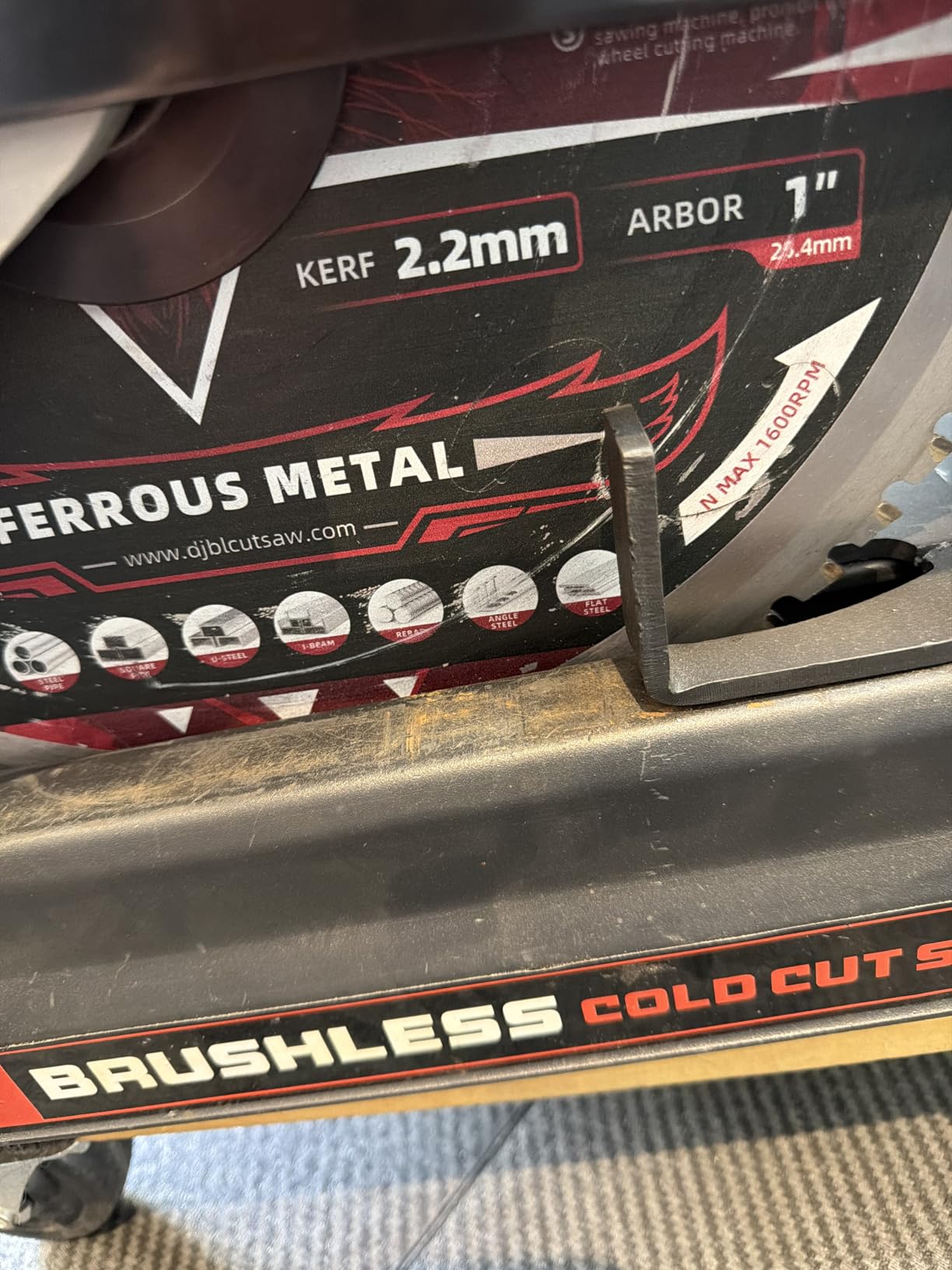
The DJBL is the only brushless cold-cut saw in this group, and the motor architecture is the reason. A brushless motor avoids the carbon brushes that wear and fail on brushed machines, and the closed-type aluminum housing is built for longevity and lower running noise, which in practice means a saw you can run indoors without the whine and dust of an abrasive machine. The 3,500 watt figure tops the wattage in this group.
The 66-tooth cermet blade is specified for burr-free, low-spark dry cutting of mild steel, and three adjustable cutting speeds plus a 1.5 second soft start and quick stop give you more control over the cut than most cold-cut saws offer. An on-board chip collection system keeps the work area tidier than an open chip tray, which matters when you are cutting all day.
The honest limitations are physical. At 29 kilograms it is a heavy saw to transport, and it is listed as a bare tool, so accessories may need buying separately. The 220 volt specification is also unusual for a 120 volt context and affects how you power it. With only 19 reviews, this is the least proven machine here, and the 4.3 average with a wider two and three star share reflects that rather than a design problem.
The 0-45 degree fence is conventional rather than detented, so repeat angle accuracy depends on your setup discipline and how square the fence is to the blade. Check that when you set it up.
Why a brushless cold cut is worth seeking out
Two reasons. The first is speed: a 3,500 watt brushless motor at 1,300 RPM has real authority on steel bar, angle iron and aluminum in a machine that is not a four-figure flagship. The second is the working environment, because a cermet cold cut produces almost no airborne dust and less noise than a grinding saw, and owners who switch from abrasive to cold cut rarely go back.
The three speed settings are useful when you change material. Aluminum and thinner steel do not want the same approach as solid mild steel, and having a lower speed available gives you a way to manage heat and blade wear instead of forcing one setting. Chip collection is a small feature that saves a real amount of sweeping.
Where to look elsewhere
If you need a proven track record, the four machines at the top of this list have review volumes in the hundreds with ratings at or above 4.6, and that matters when you are buying a shop machine. The bare tool listing and the 220 volt rating are the two practical frictions to resolve before you commit.
At 29 kilograms you will want it on a stand, and the conventional fence means you should verify squareness before trusting an angle. If you already know your power situation and you want cermet cold cuts with a brushless motor, this is a capable machine at a mid-range price – just check the accessory list first.
How to Choose a Metal Cutting Chop Saw?
Cold cut, abrasive or multi-material: which blade you actually need
The best chop saw blade for cutting metal depends entirely on what you do with the cut. A cold-cut blade, usually tungsten carbide or cermet, has teeth that shear the metal rather than grind it, so the cut is cool, flat and close to burr-free, and the edge can be welded immediately. A multi-material blade is a cold-cut tooth pattern designed to also handle wood, plastic and non-ferrous metal, which is convenient but trades some metal performance for range. An abrasive cut-off wheel grinds the metal with no teeth at all, cuts faster on hard or dirty material, and leaves a burr that usually needs grinding away.
A cold-cut blade is the right answer for anyone welding what they cut. You get a square, clean edge and you skip a finishing step on every single cut. Abrasive wheels make sense when you are cutting rebar, demolition scrap or rusty stock where nothing needs to be weld-ready.
Chop saw vs cut-off saw vs cold saw vs miter saw
Chop saw and cut-off saw are the same machine described from two angles: a chop saw is defined by its vise and fence, and a cut-off saw by the abrasive wheel it carries. A cold saw is a saw that shears material without generating heat from friction, which in practice means a toothed cold-cut blade. A miter saw tilts its head to make an angle cut, and that is exactly why a wood miter saw handles metal badly. A mini chop saw is simply a smaller version for light stock and thinner material.
Because metal chop saw blades cannot tilt, angled cuts on a metal saw are made by rotating the fence against the stock rather than tilting the head. That single fact explains the design of the mitering saws on this list and the two extra features that matter most for angle work: a detented fence and a gauge.
Angle cuts, miter range and how to cut angle iron
Angle iron is a frequent test of a metal chop saw because an L-section is hard to clamp flat and twists under a blade that pulls sideways. The first step is to make sure the longer leg is flat against the fence and the stock is fully seated against the back stop, because an L-section resting on two legs will rock. Second, clamp low and close to the cut line so the vise holds the section without crushing thin stock. Third, set the angle on the fence rather than on the vise, and confirm the fence is square to the blade with a machinist square before the first cut.
Fourth, let the blade reach full speed before contact and feed at a steady rate rather than forcing it. On a cermet blade, a slow feed rate generates the heat and sparking the blade is designed to avoid. If your work involves repeated angled cuts, a miter range beyond 45 degrees and detent positions are worth paying for, because that is the difference between an angle that repeats and one you re-measure every time.
Accuracy, clamping and the three reasons cuts go out of square
Forum complaints about metal chop saw accuracy almost always come back to three things. The first is blade wobble or runout, which shows up as a cut that wanders and an edge that is not flat; it comes from a poorly machined blade clamp or a bent blade and is fixed by checking the blade flange and arbor cleanliness. The second is clamping, because a stock that shifts in the vise mid-cut changes length; it is fixed by clamping close to the cut and checking the vise is square to the fence.
The third is the vise back stop, which is where many cuts actually drift. A fence that has been rotated to an angle and not re-squared, or a base that has twisted, means the two references no longer agree. Check squareness periodically with a square, keep the vise jaws clean of swarf, and lubricate the vise threads so the jaw applies force evenly. A cheap machinist square is the single most useful tool for accuracy on any of these saws.
Motor power, blade speed and cut capacity by material
Power on a metal saw is mostly about staying under the motor’s limit rather than about speed. Fifteen amps at 120 volts is the standard for this class, and machines in this roundup range from 1,800 to 3,500 watts. Blade speed tells you more about the saw’s character: abrasive machines here run 3,600 to 4,100 RPM for fast grinding, while cold-cut machines run 1,100 to 1,450 RPM because a toothed blade that shears metal is designed around a slower, controlled speed.
Match capacity to your material. If you cut thin wall, unistrut, small angle and EMT, a 12 inch saw is enough. Square tube, wide plate and structural shapes need 14 inches, and anything taller than a 14 inch saw can handle in one pass wants a 15 inch class machine. For stainless steel, remember that no saw in this roundup is a true stainless cutter – blade speed and blade grade matter more than motor power.
Chips, dust, safety and maintenance
Connect a shop vacuum to a cold-cut saw. Even a saw that produces no sparks still produces sharp metal chips, and several owners on this list specifically complain that their chip collector catches only a portion of what falls. Cold cuts are the easier cleanup; abrasive cuts produce both dust and hot sparks, and a fully wrapping spark guard plus an adjustable deflector is worth insisting on.
For safety, the rules are simple and non-negotiable: eye protection, hearing protection on any abrasive saw, gloves handled with care around a moving blade, and no hands anywhere near the cut line. Let abrasive wheels come to a stop before you pick up offcuts, because a hot wheel will cut you. Before every cut, check the clamp is tight, the area is clear, and the guard is moving freely.
Maintenance is mostly cleaning. Wipe swarf off the vise jaws and the fence weekly, because metal chips act as a cutting compound and will eat a fence. Check blade squareness every few months, keep the blade flange clean, and replace abrasive wheels long before the rim is thin. If you are unsure about sharpening a cold-cut blade, a replacement carbide blade costs less than a ruined workpiece.
For jobs that are not a clean cut-off, we have covered the alternatives in our guides to the [best cordless reciprocating saws](https://www.hdkkk.net/best-cordless-reciprocating-saws/) and the [best cordless angle grinders for metal cutting](https://www.hdkkk.net/best-cordless-angle-grinders-for-metal-cutting/), which handle demo and finishing work that a chop saw is not built for.
Frequently Asked Questions
What is the best chop saw for cutting metal?
The best chop saw for cutting metal is a dedicated cold-cut saw with a carbide or cermet blade, such as the Evolution S355CPSL. A cold-cut blade shears steel instead of grinding it, so the edge comes out square, cool and nearly burr-free, and it is weld-ready without a deburring pass. Abrasive cut-off saws cut faster and cost less per consumable but leave a burr and produce sparks and dust.
What is the best chop saw blade for cutting metal?
For mild steel, a tungsten carbide-tipped blade is the standard and a cermet blade lasts longest. Stainless steel needs a stainless-rated blade and controlled feed rate, and none of the blades in this roundup are true stainless cutters. Aluminum and other non-ferrous metals prefer a blade with a higher tooth count and no coated carbide. An abrasive cut-off wheel is the only correct choice for rusty, painted or heavily contaminated stock.
Which miter saw is best for cutting metal?
A woodworking miter saw is not the answer, because its tilting head cannot safely take a metal blade. Among metal chop saws, the Evolution S14MCS is the strongest choice for angle work because it offers a plus or minus 46 degree miter range with detents and a stainless steel gauge. Straight cuts in mild steel are handled best by the Evolution S355CPSL with its 0-45 degree cast steel vise and fence.
Are Evolution chop saws any good?
Yes, and they are the most owner-praised brand in this category. The Evolution S355CPSL holds a 4.7 rating across 841 reviews and the S14MCS holds 4.7 with 89 percent five-star feedback. Owners repeatedly praise the cool burr-free cold cuts, the mitering accuracy and the blade life, while the common cautions are the weight of the larger models and the cost of replacement carbide blades.
What are the common problems with Evolution metal saws?
The most cited issues are weight and cost rather than build quality. The S14MCS weighs 72.4 pounds and the S15CPS 71 pounds, so both effectively require a stand or a fixed bench. Replacement cermet and carbide blades are expensive compared with abrasive wheels, and the low 1100 RPM no-load speed on the mitering model means heavy solid sections still take time. Out-of-square cuts usually trace back to clamping and fence squareness rather than the saw itself.
What type of saw is best for cutting metal?
It depends on the material and the job. A cold-cut chop saw is best for steel that will be welded, a cut-off saw with an abrasive wheel is best for rebar, scrap and rusty stock, a band saw is best for curved profiles and long offcuts, and a cold saw is best for production volume and very precise repeat cuts. For most fabricators cutting angle iron, square tube and pipe to length, a cold-cut chop saw is the most versatile single choice.
Conclusion
After comparing all twelve machines, the Evolution S355CPSL is the best chop saw for metal cutting for most people. It cuts mild steel cool and burr-free on a carbide blade, clamps quickly and miter fence and vise together from 0 to 45 degrees, and at 841 reviews and a 4.7 rating it has the strongest combination of owner satisfaction and proven durability in the group.
Match the saw to the work. Buy the Evolution S14MCS if angle work or handrails are the reason you are shopping. Buy the Makita LW1401 or Bosch GCO15-14 if you mostly cut rebar and scrap and do not care about the burr. Buy the VEVOR cold-cut model if you want clean cuts without a premium price, the WEN CM1446 if you need one saw for metal and wood, and the Evolution S15CPS if your stock is taller than 14 inches.
Whichever one you pick, bolt it down, square the fence to the blade before the first cut, and clamp close to the cut line. Those three habits solve most of the accuracy complaints we found in owner reports, and they will make any of these saws cut better than it did out of the box.