
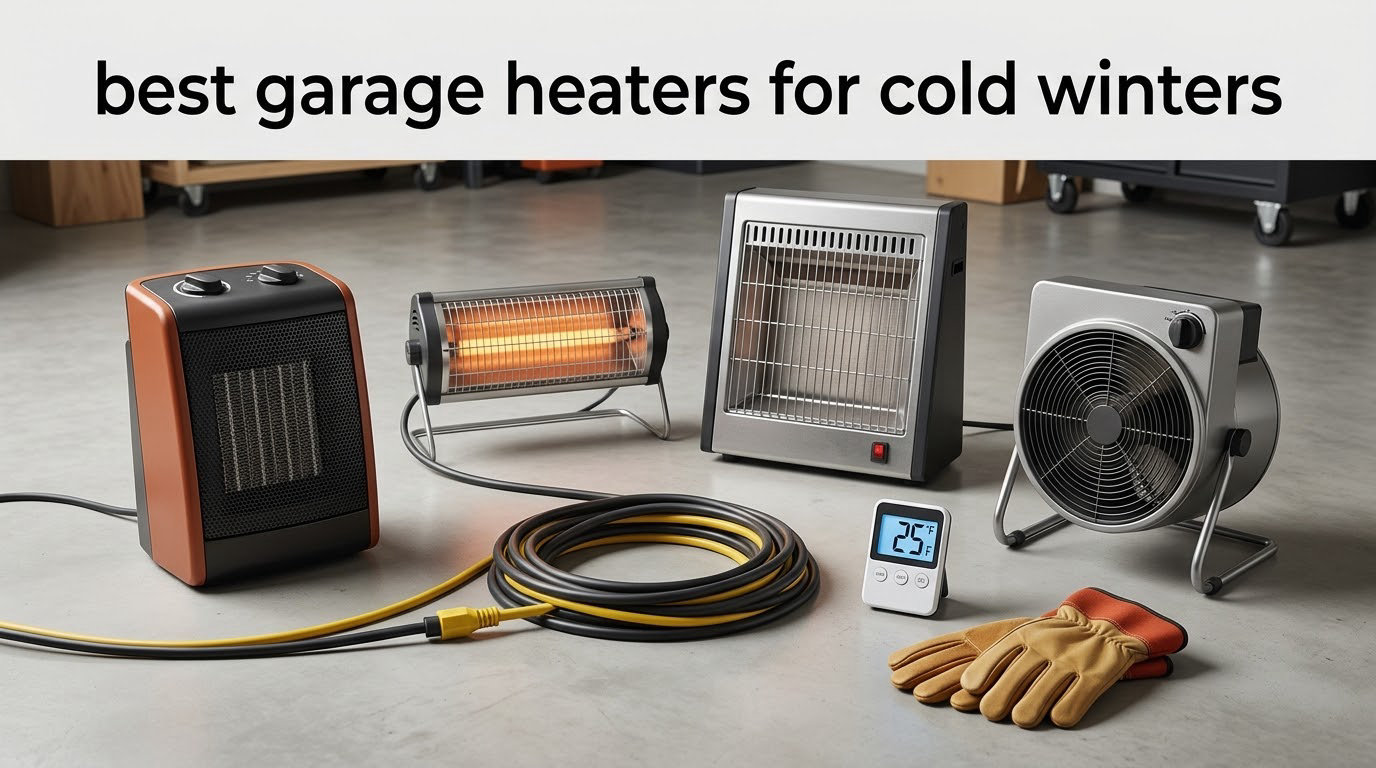
If you want the best garage heaters for cold winters, the single most important decision is matching the fuel type to how well your garage is insulated. Electric 240V forced-air heaters are the safest and cleanest option for enclosed and attached spaces, propane force-air models warm uninsulated rooms in minutes, and vented natural gas appliances are typically the cheapest to run over a full heating season once a gas line exists.
Our best overall pick is the Dr. Infrared DR-975, a 7500-watt 240V fan-forced cabinet with a remote thermostat and 800 square feet of rated coverage. It has the deepest review history of anything we looked at, at more than 4000 owner ratings, which tells you a lot about long-term reliability in a category where failures are common. For propane, the Mr. Heater 125000 BTU Quiet Burner Technology heater rated 4.6 stars across over 1000 reviews is the strongest all-round option we found. If you want the simplest path to a workable garage, the Comfort Zone CZ220 ceiling-mounted unit pairs 17065 BTU of output with a mechanical thermostat and overheat protection.
We spent several weeks working through the full category, reading manufacturer specifications, then cross-checking them against owner reviews and forum threads on r/woodworking and the garagejournal forums where cold-weather failures get discussed in detail. This guide is updated for 2026 and covers twelve heaters across electric, propane, and natural gas.
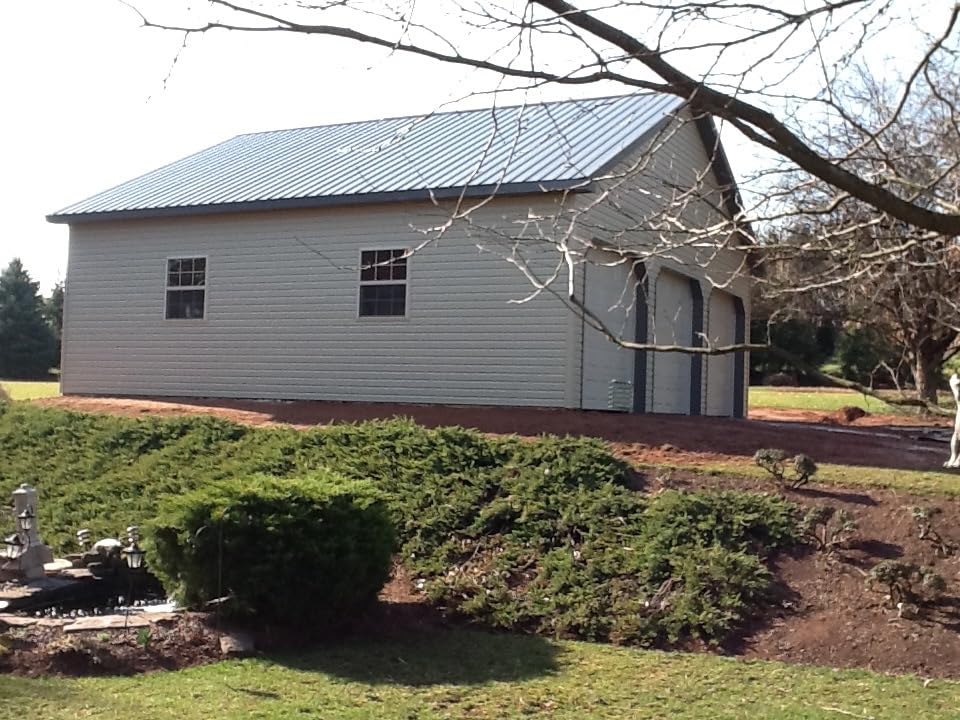
One note before we start, because it changes more than any purchase decision: garage doors are usually the largest uninsulated surface in the building. If you insulate the door and the walls first, a smaller and cheaper heater will do the job, and your fuel bill drops with it. Workshop owners say this more than anything else in the discussions we read.
Table of Contents
Top 3 Picks for Best Cold-Winter Garages in 2026

Dr. Infrared DR-975 7500W 240V
- 7500W fan-forced output
- Remote thermostat 50-85F
- UL/CUL listed
- 800 sq ft coverage

Mr. Heater 125000 BTU Quiet…
- 125000 BTU forced air
- Quiet Burner Technology
- 10 ft hose and regulator
- 17.3 pounds

Comfort Zone CZ220 5000W…
- 17065 BTU fan-forced
- Three heat settings
- Overheat protection
- ETL listed
Best Garage Heaters at a Glance in 2026
The table below covers all twelve heaters in this guide, with the fuel type, output, and mounting style that matter most at the moment of purchase.
| Product | Specs | Action |
|---|---|---|
| Dr. Infrared DR-975 7500W 240V |
|
Check Latest Price |
| Comfort Zone CZ220 5000W Ceiling Mount |
|
Check Latest Price |
 Comfort Zone CZ230ERBK 7500W Comfort Zone CZ230ERBK 7500W |
|
Check Latest Price |
 GASLAND Flame Jet 125000 BTU GASLAND Flame Jet 125000 BTU |
|
Check Latest Price |
 Mr. Heater 30000 BTU Radiant Propane Mr. Heater 30000 BTU Radiant Propane |
|
Check Latest Price |
 Mr. Heater 50000 BTU Unit Heater Mr. Heater 50000 BTU Unit Heater |
|
Check Latest Price |
| Mr. Heater 125000 BTU Quiet Burner |
|
Check Latest Price |
 Remington 60000 BTU Forced Air Remington 60000 BTU Forced Air |
|
Check Latest Price |
 Shinic 2-Pack 1500W Radiant Heater Shinic 2-Pack 1500W Radiant Heater |
|
Check Latest Price |
 InoKraft 7500W 240V NEMA 14-50P InoKraft 7500W 240V NEMA 14-50P |
|
Check Latest Price |
 Dyna-Glo 20000 BTU Blue Flame Dyna-Glo 20000 BTU Blue Flame |
|
Check Latest Price |
 Modine HD45 45000 BTU Natural Gas Modine HD45 45000 BTU Natural Gas |
|
Check Latest Price |
1. Dr. Infrared DR-975 7500W 240V Hardwired Heater – Best Overall
DR. INFRARED HEATER NEW Upgraded DR-975 7500-Watt 240-Volt Hardwired Shop Garage Electric Heater, Wall/Ceiling Mounted with Remote Controlled Thermostat White
7500W forced air
240V hardwired
800 sq ft
UL/CUL listed
Pros
- Remote thermostat with a 50-85F range
- Five adjustable louvers plus tilting head
- UL/CUL listed with overheat protection
- Wall or ceiling mounting clears the floor
Cons
- Hardwired only
- no power cord included
- Single-speed fan with no heat level selection
- Minimum thermostat setting of 70F
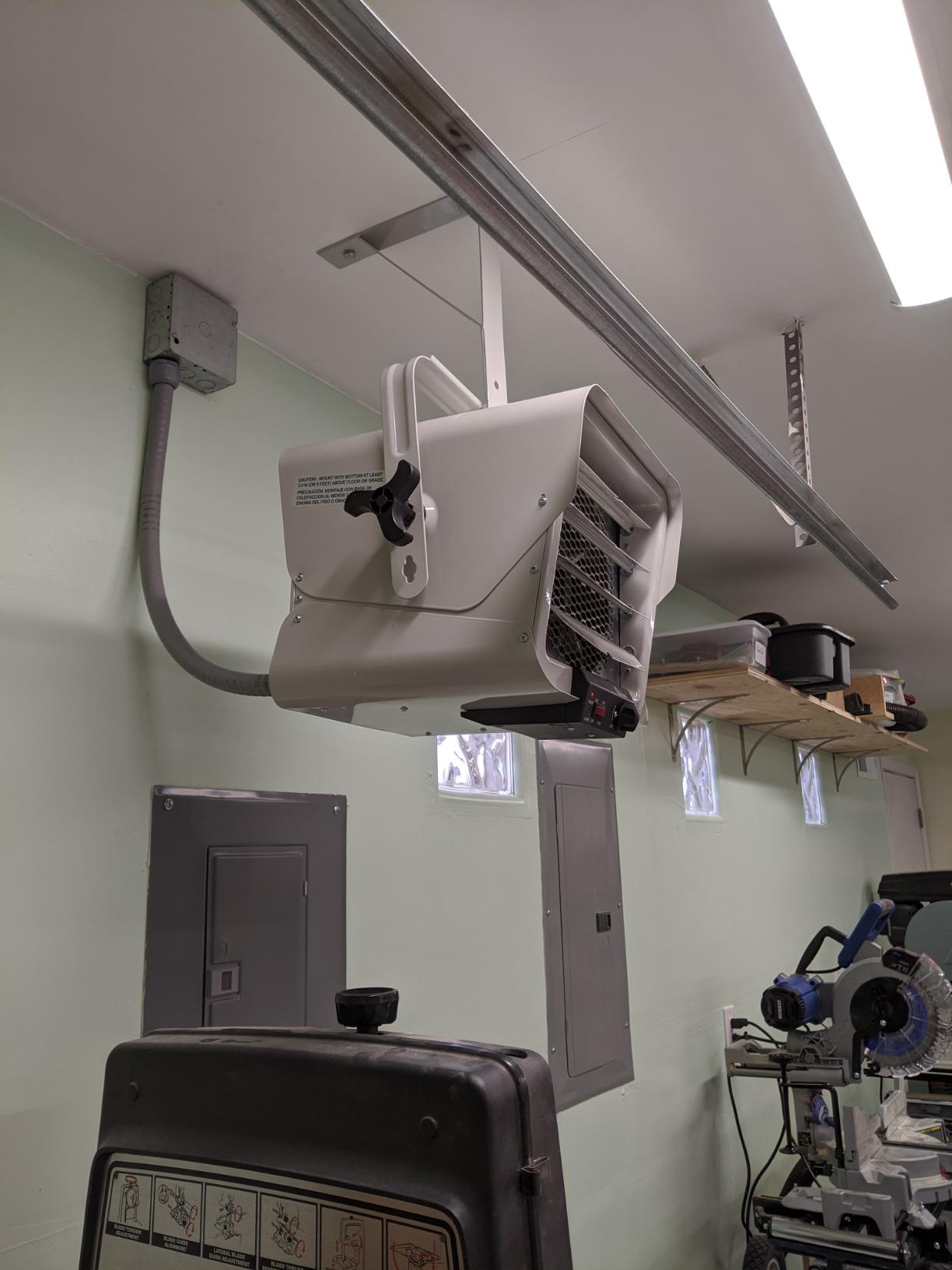
This is the heater we kept coming back to while working through the category. The DR-975 pulls ambient air through resistive elements with a high-CFM fan and pushes it back out through five adjustable louvers, which means it heats the air rather than heating a person standing in front of it. In a two-car garage on a freezing morning, that difference decides whether the whole space becomes usable.
Owners consistently report that once it is running the output is more than enough, and the recurring theme across reviews is not the heat but the install. The unit is hardwired only. It needs 8 AWG copper and a dedicated 240V circuit, and the power cord is not in the box, so plan for an electrician unless you already have a NEMA 14-50 circuit with capacity to spare.
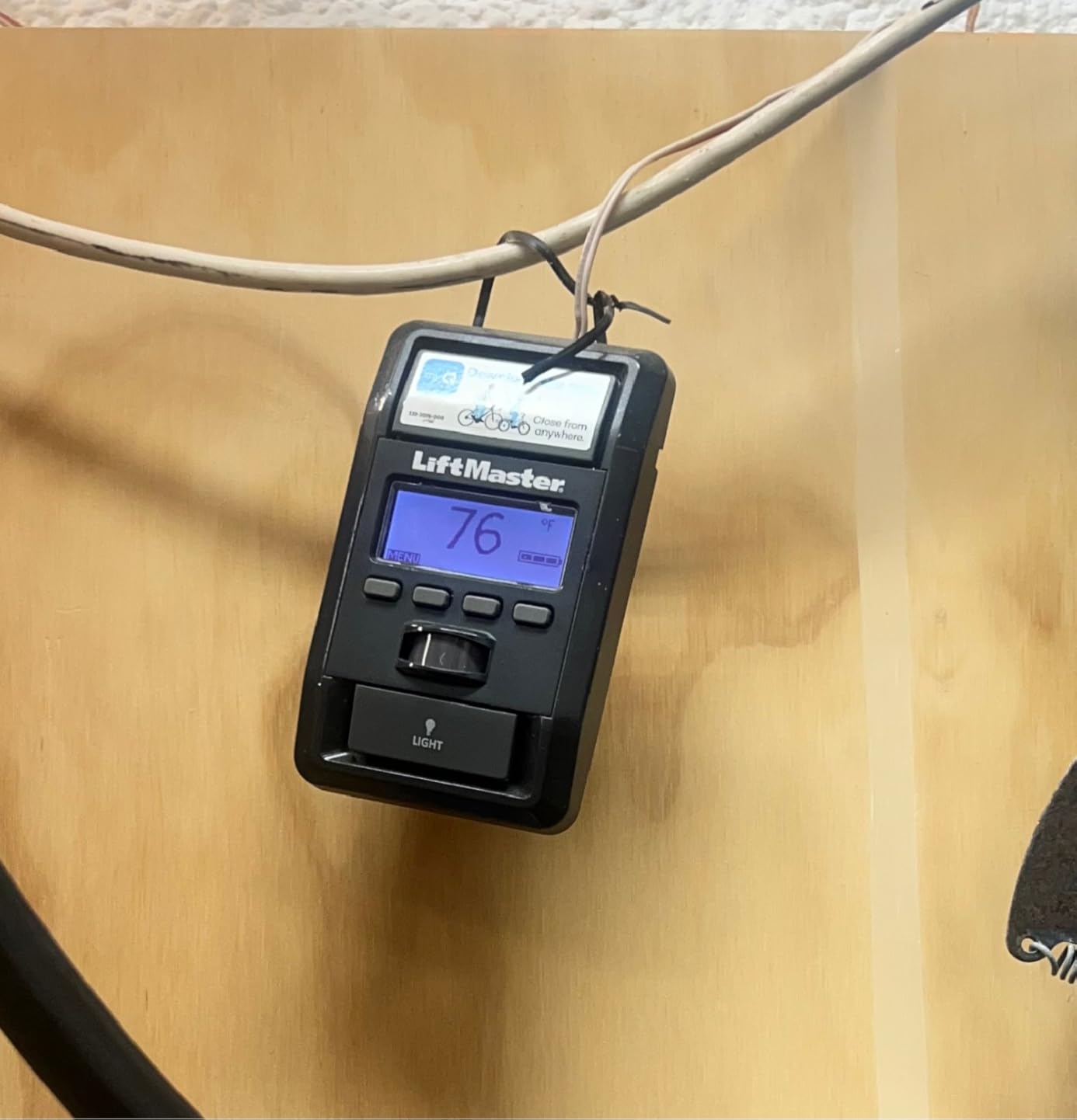
The remote-controlled thermostat is the feature that separates it from cheaper hardwired cabinets. It reaches down to 50F on the marketing spec, which matters in a garage that drops into the teens overnight, although a number of owners note the practical minimum sits closer to 70F. The single-speed fan is the trade-off: there is no low, medium, and high selection, so control happens at the thermostat rather than at the heat output.
At 26 pounds and 15 by 19 by 13 inches, it is compact enough for a low ceiling, and the enclosed heavy-duty motor plus UL/CUL listing are the reasons we are comfortable recommending it for an attached garage where air quality matters.
Why we picked it for cold winters
Roughly 4160 owner ratings give you a picture of long-term behavior that a new listing cannot. At 4.3 stars with about 69% five-star reviews, the failure rate is not zero, but the complaints are about installation and controls rather than the heater dying. For a device that gets fired up dozens of times a season, that consistency is the point.
It also runs at 31.25 amps, which means it will not share a circuit with anything else. If your panel has a spare 30-amp breaker slot, this is a clean addition. If not, budget for the electrical work before you buy.
When to choose something else
Skip it if you rent, if your garage has no 240V circuit and no budget to add one, or if you want to heat yourself rather than the room. A radiant propane heater such as the Mr. Heater F299830 warms your body in seconds and costs a fraction of the install to run.
The other reason to pass is mild winters. The 70F practical floor on the thermostat means this heater will cycle on and off more than you would like in a spring garage.
2. Comfort Zone CZ220 5000W Ceiling Mount – Best Value
Comfort Zone 5000W Ceiling Mounted Garage Heater – 240V Electric Shop Heater with 3 Heat Settings, Overheat Protection, Indoor Use, ETL Listed, Grey
17065 BTU fan-forced
240V hardwired
1000 sq ft
ETL listed
Pros
- Ceiling mounting frees up floor space
- Heavy-gauge steel body handles poorly insulated rooms
- Louvers plus adjustable mounting angle
- Dual knob thermostat with three settings
- Overheat sensor and power light
Cons
- Manual thermostat with no remote or digital display
- Hardwired 240V with no cord option
- Smallest capacity in the Comfort Zone ceiling line
For a one-car or small two-car garage that is reasonably tight, the CZ220 does the fundamentals well. At 20.83 amps it pulls about a third less than a 7500-watt unit, which means it can sometimes land on an existing 240V range circuit instead of needing a new one. That single electrical fact is where most of the value comes from.
The heavy-gauge steel cabinet is the part that matters in a cold-winter garage. Thin-gauge sheet metal on budget heaters warps and rattles when it cycles between a freezing attic space and warm air below, and this body was built for commercial spaces that never get insulated.
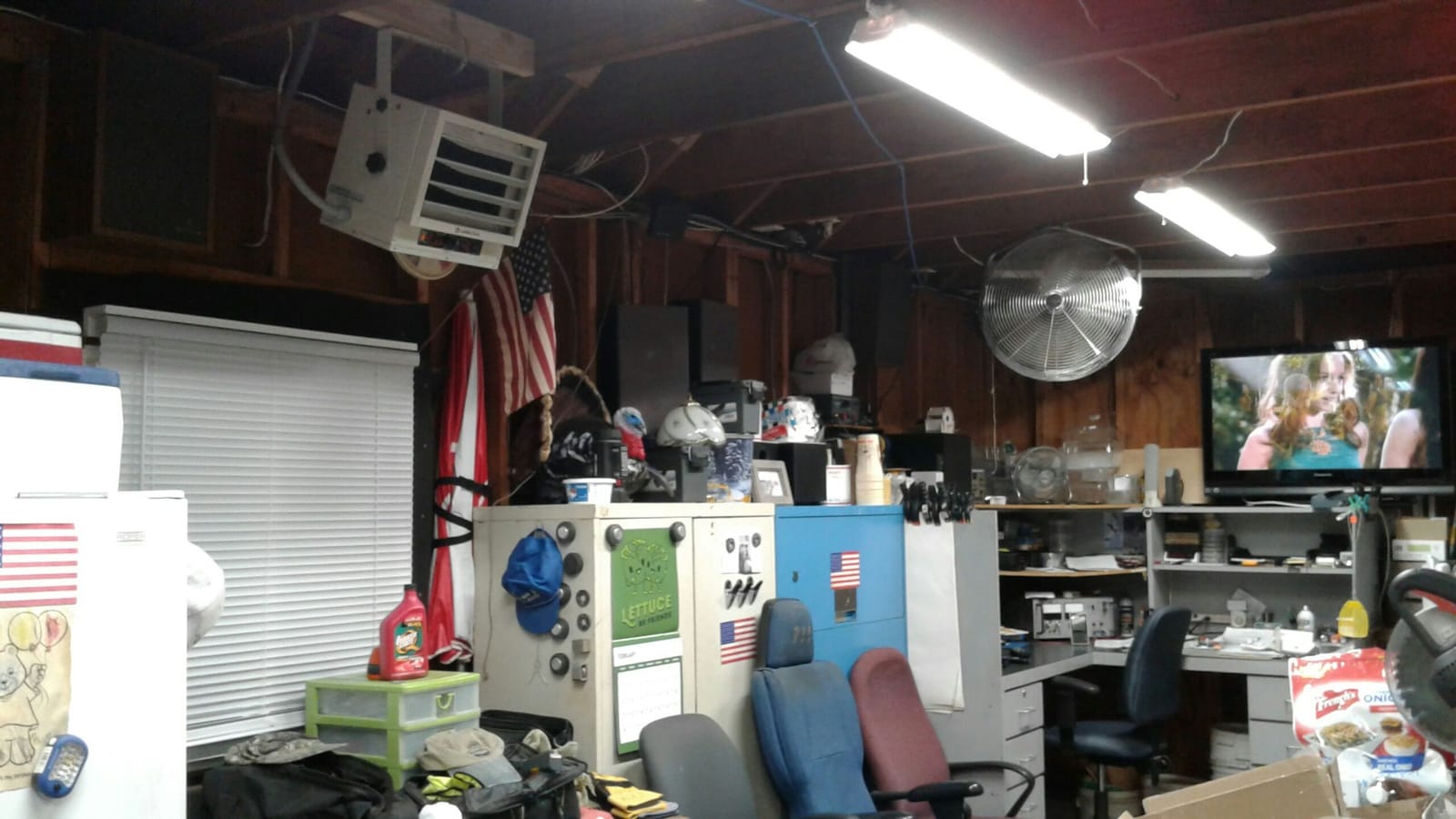
What you give up is control. The thermostat is a mechanical dual-knob dial with three heat settings and a quick on/off, and there is no remote, no display, and no timer. Owners like the simplicity and dislike having to walk over to the wall to trim the temperature by a few degrees.
Its rated 1000 square feet of coverage is a manufacturer figure, and in an uninsulated space in deep winter it will not reach the target temperature. Treat it as a two-car garage heater, not a pole barn heater.
Where this one earns its slot
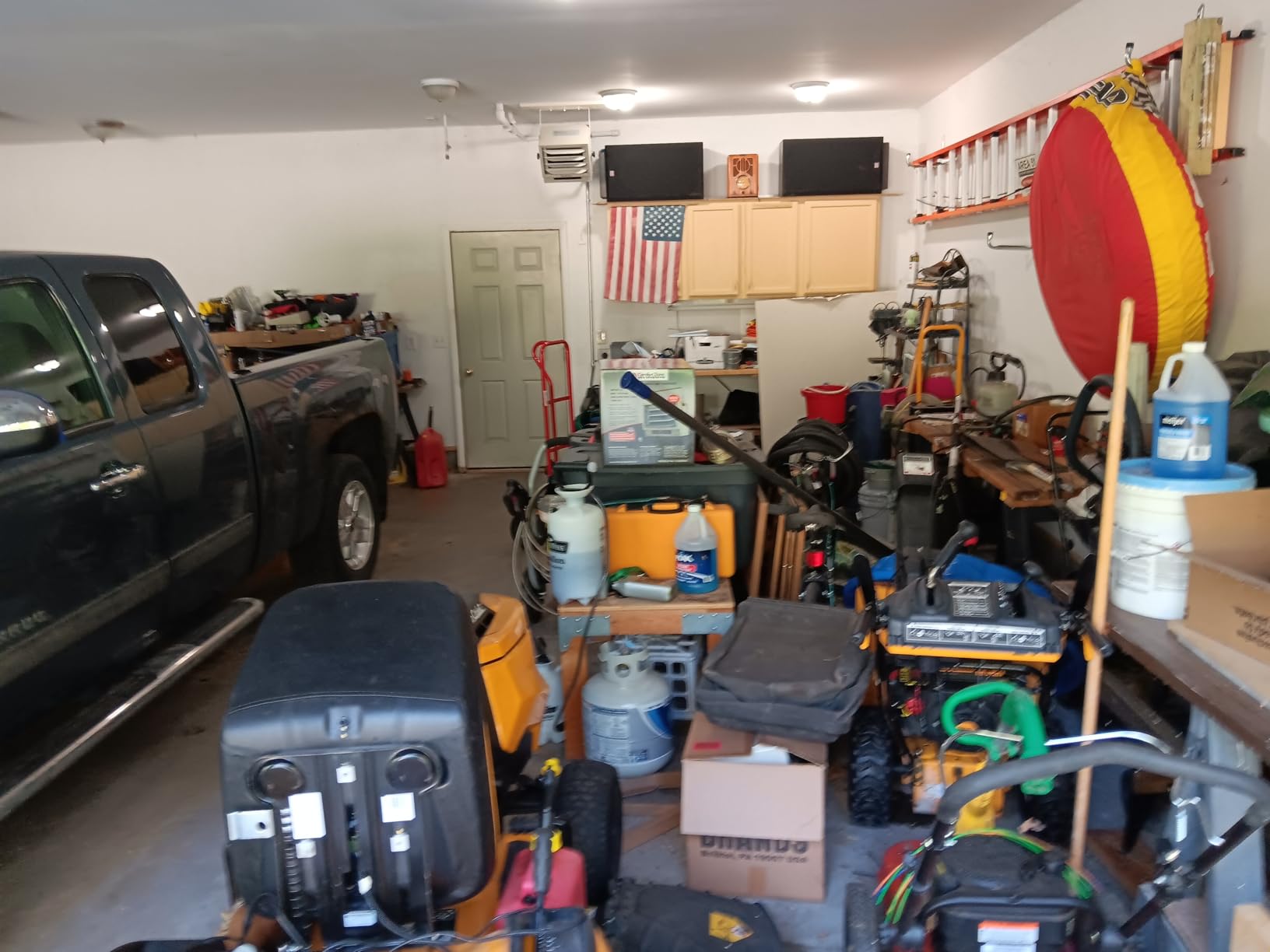
It is the pick for anyone whose garage is 400 to 600 square feet with a finished ceiling and no room on the floor. Mounting it above head height also keeps the heated air moving across the room at ceiling level, where cold air is not pooling.
With a 4.4 star rating across more than 3500 reviews and about 71% five-star ratings, the value claim is well supported by owners rather than by our opinion.
When to spend more instead
Move up to the CZ230ERBK if you want a digital thermostat and remote, or up to a 7500-watt model if your garage runs colder than 20F and you want recovery speed. It is also strictly hardwired, so a plug-in situation rules it out.
3. Comfort Zone CZ230ERBK 7500W – Best for Workshops
Comfort Zone Hard-Wired Ceiling Mount Garage Space Heater with Remote, 7,500 Watt, 240 Volt, Fan-Forced, Overheat Protection, Digital Thermostat, 12-Hour Timer, Ideal for Garage & Workshop, CZ230ERBK
25600 BTU fan-forced
Digital thermostat
12-hour timer
1250 sq ft
Pros
- Heats a 10x20 minimally insulated shed from 32F to 65F in about 10 minutes
- Digital thermostat with remote and 12-hour timer
- Quiet fan for its size
- Three settings with adjustable louvers and tilting mount
Cons
- Included lag bolt is too short for drywall
- Some units needed board sensor connectors replaced
- Fan motor is loud in an uninsulated space
- Customer support reported as unresponsive
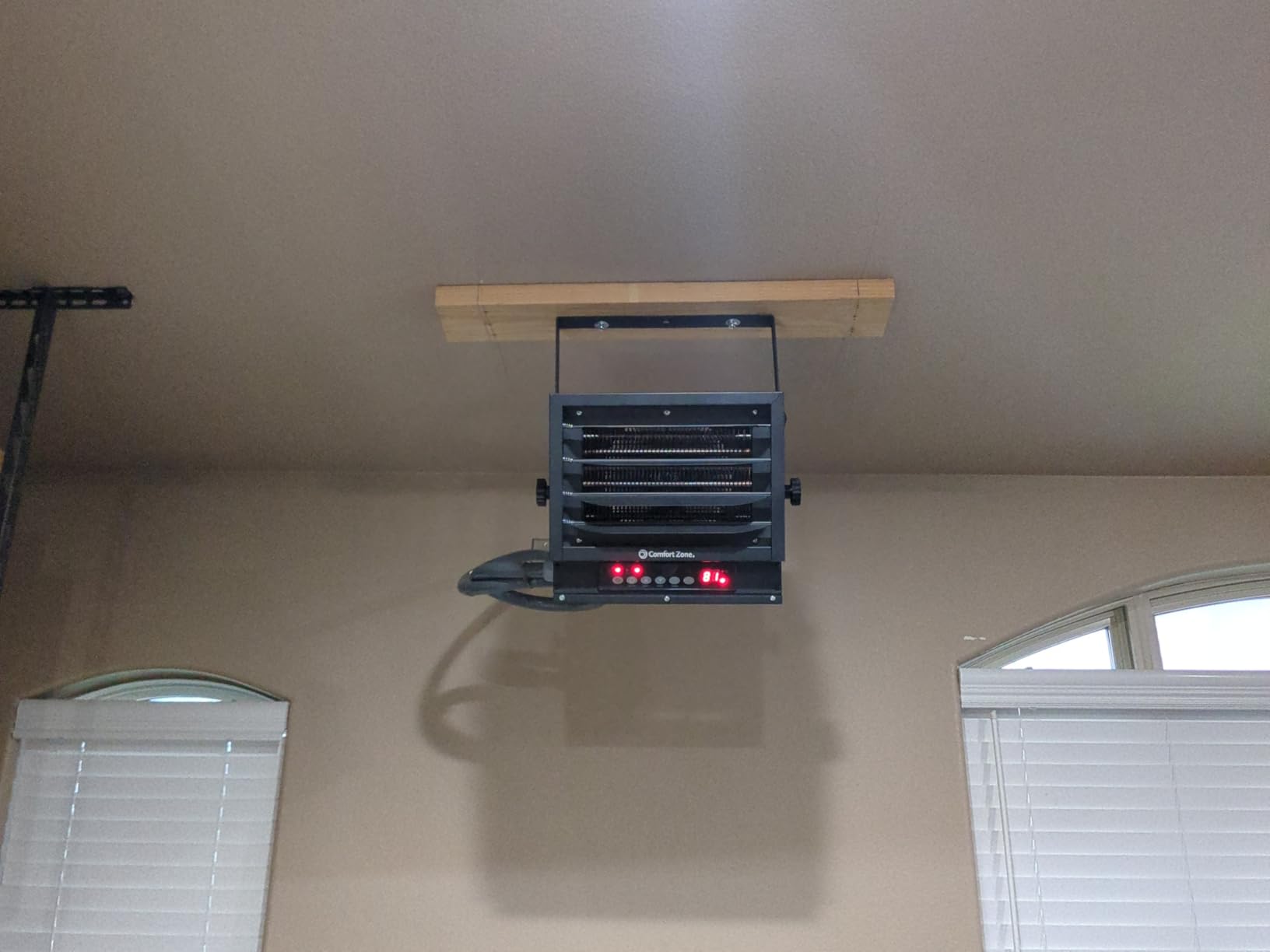
This heater puts out 25600 BTU and covers up to 1250 square feet, the highest rated coverage of any electric product here. Its digital thermostat spans 45F to 95F, which lets it hold a set point in a genuinely cold garage rather than only in mild weather.
Owners report taking a minimally insulated 10 by 20 shed from 32F to a workable 65F in roughly ten minutes. That is the number that matters if you have a deadline and a project that cannot be done in a parka.
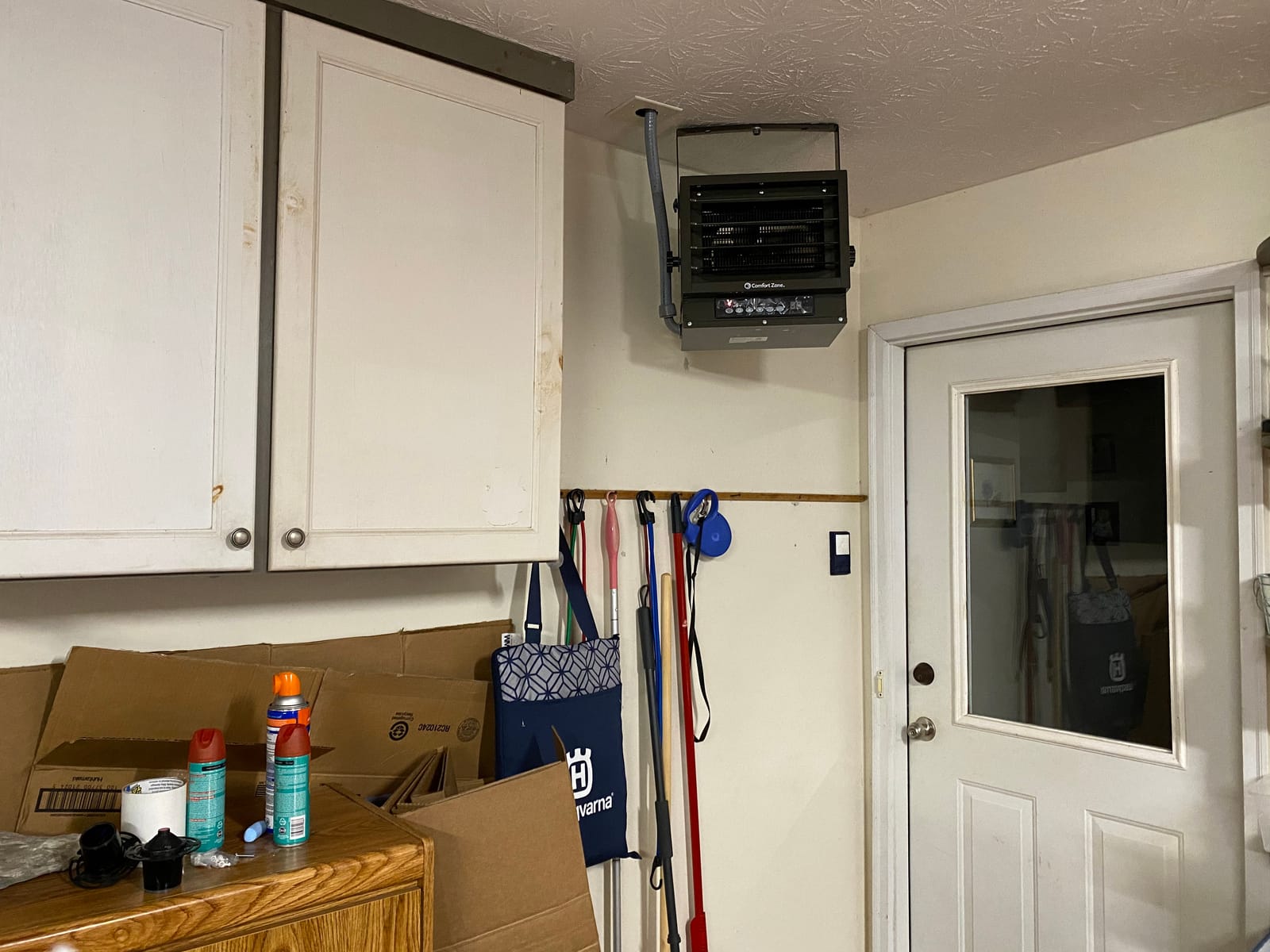
There are real wrinkles though. The included lag bolt is too short to secure the unit through drywall, so plan on buying your own fasteners. A minority of owners also report premature shutoff and temperature overshoot that needed the NTC sensor board connectors reseated, and clearing dust from the board with compressed air fixed some of those cases.
The fan is quiet for a fan-forced unit this size in a finished room, but reviewers are blunt about it being loud in an uninsulated space with bare walls. For a garage gym, see pick number 10 instead.
Why workshop owners keep it
The 12-hour on/off timer combined with the digital thermostat means you can warm the space before you walk out to it and shut it down at night without touching anything.
It is a reasonable risk for equipment that gets cycled hard.
At 23.5 pounds it is a one-person ceiling install if you have a ladder and a helper, and the heavy-gauge body again handles temperature swings better than thin steel.
When it is the wrong pick
Choose something else if you are mounting into drywall and do not want to source your own hardware, or if noise during a workout matters. The support experience is also a factor: several owners describe difficulty getting anyone to troubleshoot a fault.
4. GASLAND Flame Jet 125000 BTU – Best for Cold Starts
GASLAND 125,000 BTU Propane Force Air Heater for Garage, Heat Up 3100 Sq.Ft
75000-125000 BTU propane
3100 sq ft coverage
Hose and regulator kit
13 pounds
Pros
- CSA certified with electronic ignition and overheat detection
- Continuous electronic ignition with a thermo-electric safety valve
- Light 13 pound steel body
- 1 year warranty with lifetime customer support
Cons
- Requires a propane tank and hose hookup
- Single-speed fan with no timer or thermostat
- Needs ventilation when run in a garage
When a car will not turn over on a deep winter morning, output is the only argument. This unit runs from 75000 to 125000 BTU and is rated for 3100 square feet, and at 13 pounds you can drag it out to the driveway yourself.
The 10 foot hose and regulator are in the box, which removes the most common excuse for delaying a propane purchase. On low with a 20 lb tank, owners put runtime at about five hours.
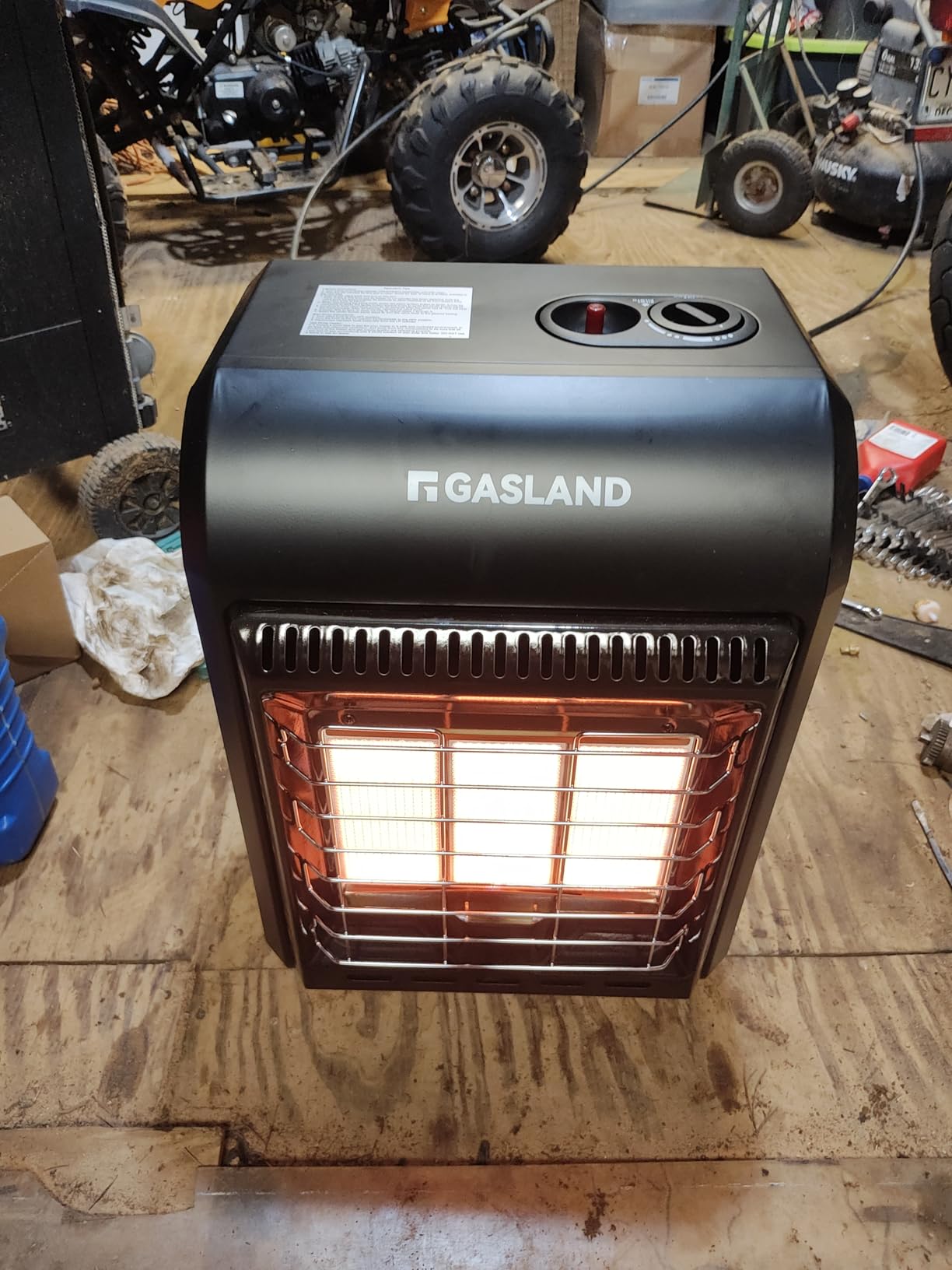
That tank math deserves a caveat that almost no guide mentions. Tanks labeled 20 lb frequently hold as little as 15 lb of actual propane, so budget roughly a quarter more refills than the label suggests, and plan for the tank to sit outside where the mass stays cold.
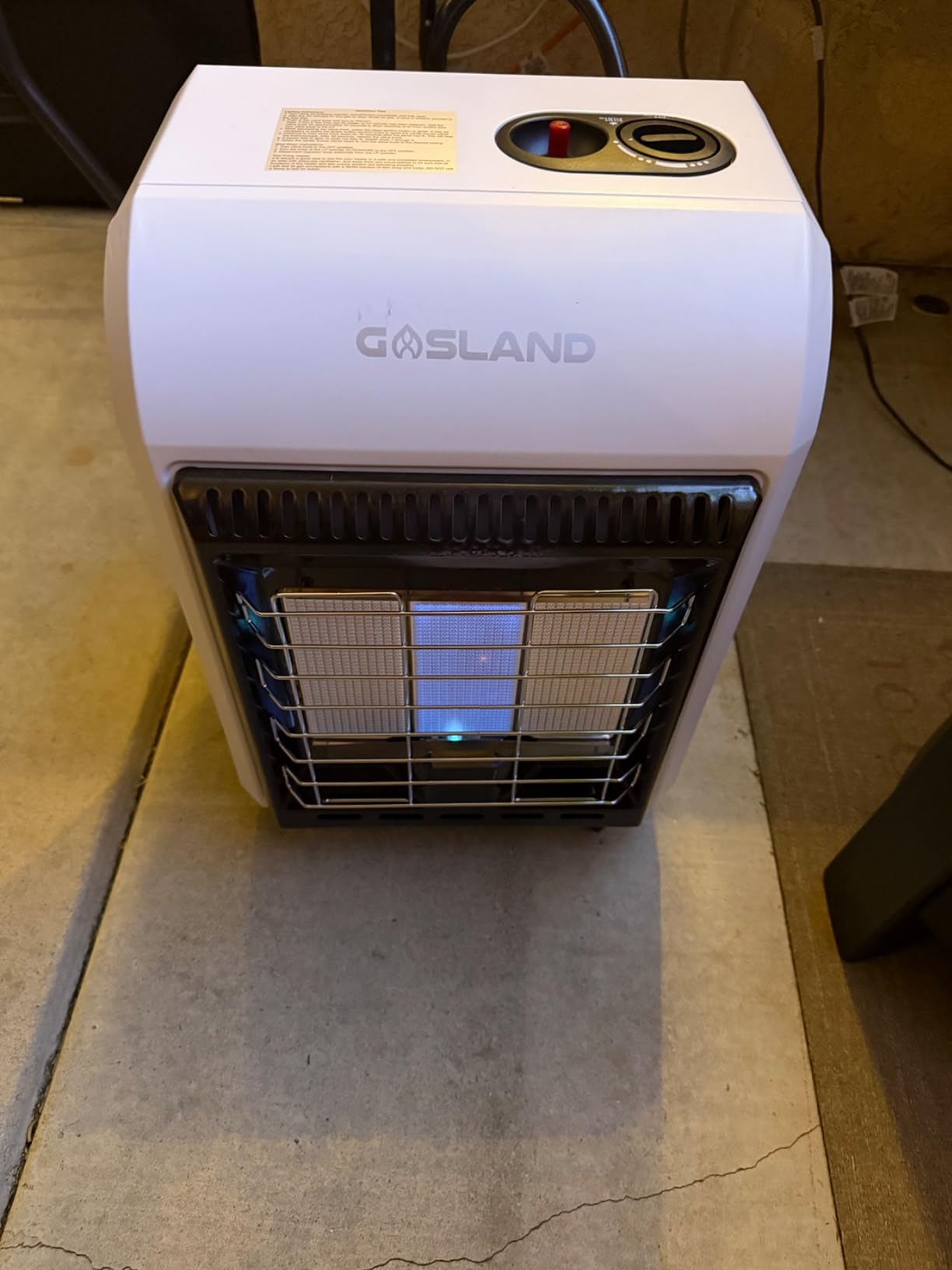
CSA certification, continuous electronic ignition, overheat detection, and a thermo-electric safety valve give it a solid safety profile for a combustion unit. The 1 year warranty comes with lifetime customer support, which is a fair signal.
Why it earns a place here
Combustion heat arrives fast. Owners on r/woodworking describe 30 minutes with a large propane heater producing noticeable warmth, which is something a 240V electric cabinet in a 20F space will not do. If the job is thawing a frozen truck or warming a shop for a short burst, this is the right tool.
Variable output also helps. Turning it down avoids the overheating complaints owners of oversized fixed-output heaters report.
When to pick something else
Do not run it in a sealed or attached garage without permanent ventilation. Combustion heaters put water vapor into the air, and in a cold space that vapor condenses on cars, windows, and frames. Multiple forum users describe sweating vehicles and frost forming on body panels within hours.
Also skip it if you want scheduled or temperature-controlled heat. There is no thermostat and no timer on this heater.
5. Mr. Heater 30000 BTU Radiant Propane – Best for Small Garages
Mr. Heater 30,000 BTU Vent Free Radiant Propane Heater
30000 BTU radiant
1000 sq ft rated
Battery ignition
Vent free
Pros
- Ceramic elements produce far less off-gassing than open-flame radiant
- Owners report warming a 1000 sq ft space to about 70F in 20F weather
- Battery electronic ignition needs no electricity and works at 7000 ft
- Vent free so no flue or roof penetration
- Built-in adjustable thermostat
Cons
- Vent-free combustion needs ventilation and should not run unattended
- One review reported an open flame flare-out
- No propane connector or hose included
- Mounting at an angle can trip the overheat sensor
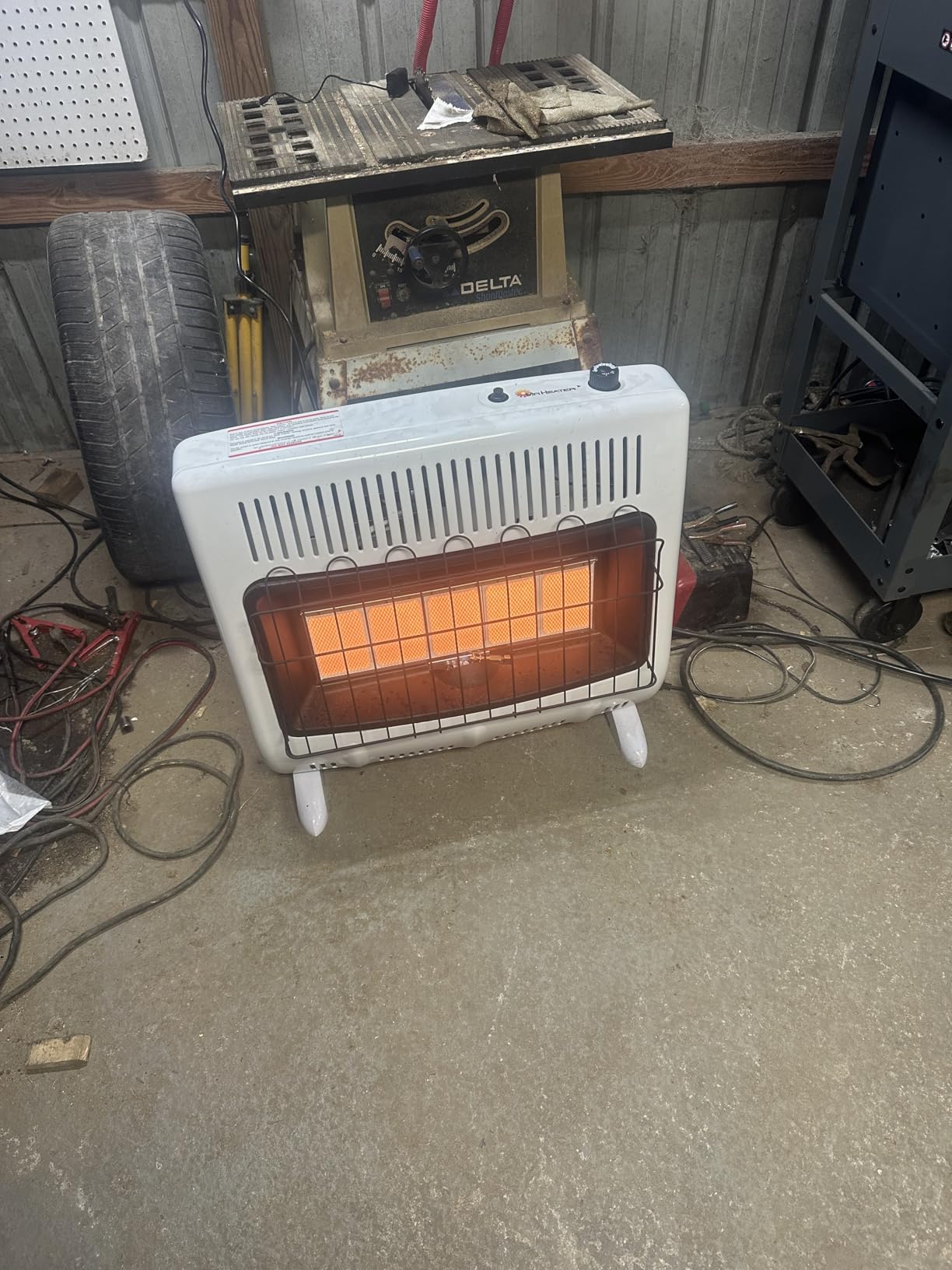
Radiant heat is the most misunderstood category here. This heater does not warm the air. It warms you, your tools, and the surfaces facing it, which is why people describe it as instant even in a garage sitting at 30F.
For working in a garage for an hour, that is usually the right trade. Multiple owners across forum threads make the same point: heating the person beats heating the space when you are stationary at a bench.
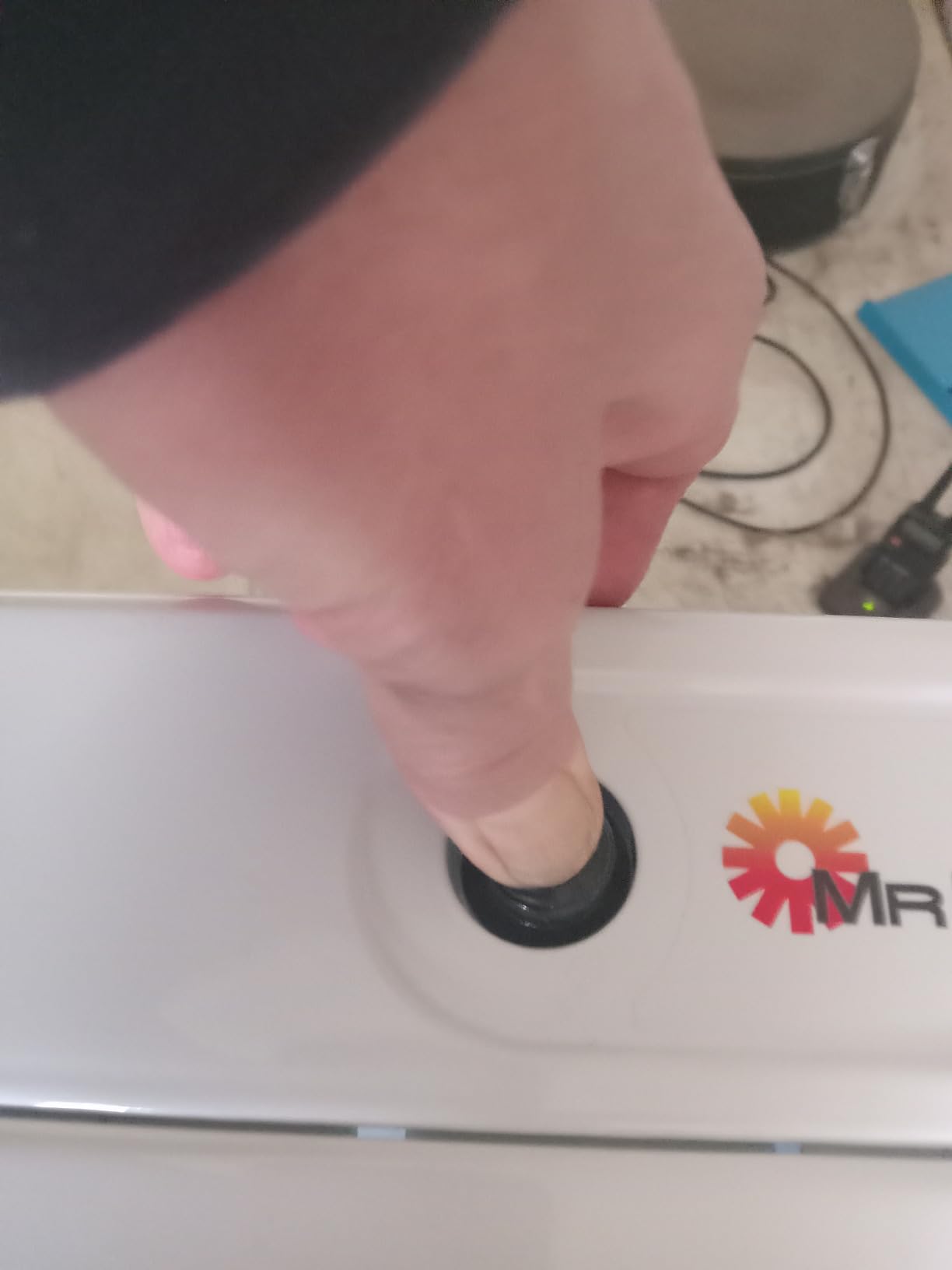
The ceramic element is a meaningful difference from open-flame radiant units, and owners single it out for producing far less off-gassing in an enclosed space. Battery-operated electronic ignition means it works with no electricity at all, which is useful in an outbuilding that has no power.
Rated 750 square feet and up to 1000 square feet, it handles a one-car garage or shop bay. Wall mounting keeps the floor clear, and the 4500 foot altitude restriction matters only in mountain states.
Where radiant wins
A garage gym, a workbench, or a spot where you stand still in gloves. Heat arrives on your skin in seconds, and you can leave the unit off entirely between sessions. The vent-free design also means no roof penetration and no permit for a flue, which is a real saving on a small space.
With a 4.5 star rating across more than 1400 reviews and about 78% five-star ratings, it holds up well against the other portable propane heaters in this guide.
What to watch out for
Being vent free, it needs ventilation and should not run unattended overnight. The connector and hose are not included, and the blower fan kit is sold separately, so budget for those before the first cold snap arrives.
One more quirk: mounting it at an angle can trigger the internal overheat sensor and shut it down. Keep it level and against the wall.
6. Mr. Heater 50000 BTU Forced-Air Unit Heater – Best for Three-Car Garages
Mr. Heater 50,000 BTU Forced-Air Unit Heater (Propane or Natural Gas)
50000 BTU forced air
Propane or natural gas
1667 sq ft
Ceiling mount
Pros
- Owners heat a 21x33 garage from 40F to 70F in about 2.5 hours with R15 walls
- Low profile ceiling design clears the work area
- Quiet blower compared with competing unit heaters
- NG to LP conversion kit and mounting brackets included
- High-temperature shutoff plus gas flame sensor
Cons
- Gas line and vent kit installation adds significant cost
- Vent instructions suggest pitching the duct upward into the heater
- Some heaters arrived with a loose fan set screw
- Thermostat and vent pipe sold separately
- Customer service hard to reach
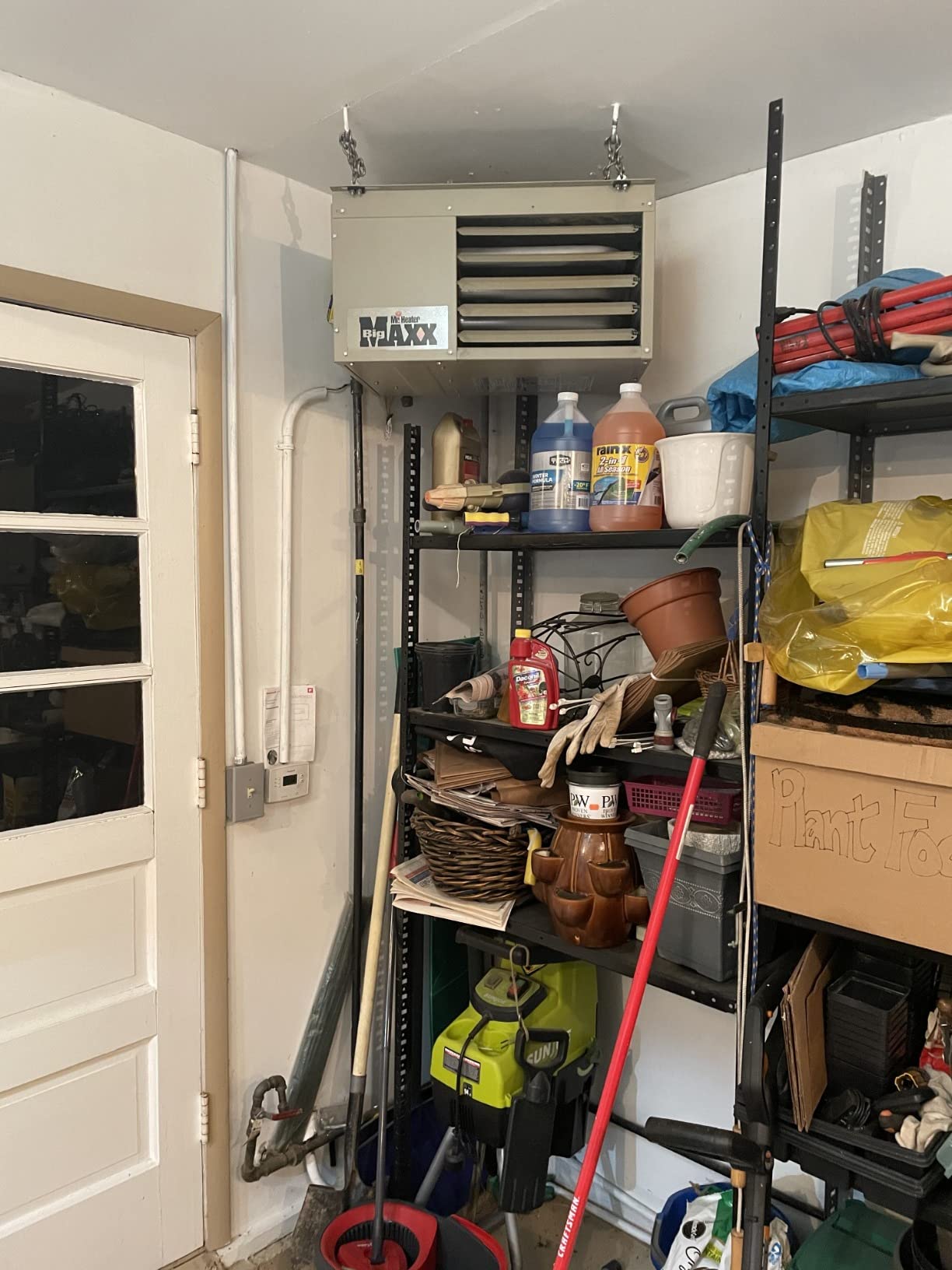
At 50000 BTU and a rated 1667 square feet, this is the lowest-output installed heater here that is still sized for a three-car garage or a workshop bay. One owner documented taking a 21 by 33 garage from 40F to 70F in about two and a half hours with R15 walls, which is a realistic figure rather than a marketing one.
It runs on natural gas out of the box and includes an NG to LP conversion kit, so you are not locked into one fuel. The low profile body needs a minimum 10 foot ceiling and 8 foot clearance from the base of the unit to the floor, so check your ceiling height before ordering.
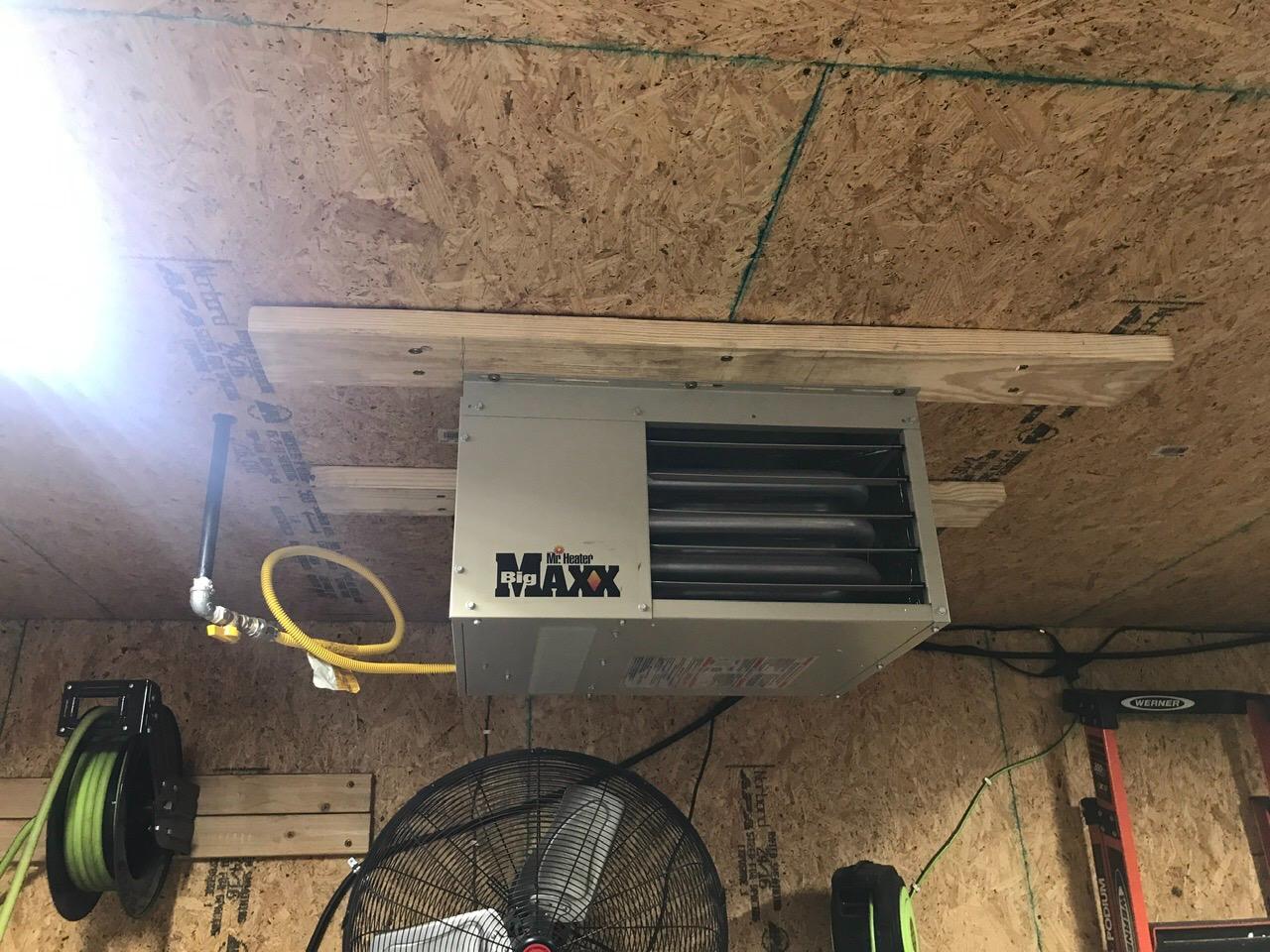
It accepts standard 24-volt or Wi-Fi enabled thermostats, sold separately. That is the cheapest route we found to real scheduled heating in a large space, because you are buying a commercial control rather than a mechanical dial.
Watch one installation detail closely. The instructions suggest pitching the vent duct upward, and owners report that doing so sends condensation back into the heater. Confirm the vent slope and drainage with whoever does the install.
Why serious shops choose it
At 60.3 pounds with a 24 by 25.5 by 13 inch body, it is a permanent installation, not a portable tool, and that is the point. The blower is quieter than most competing unit heaters, and long-term owners report years of service.
Over a full winter, gas is typically cheaper per BTU than electricity, and this is the tier where that difference starts to matter across a 1500-plus square foot space.
Where the cost hides
The gas line and vent kit are the real expense, and for a homeowner without an existing line they can exceed the unit cost. Thermostat and vent pipe are not included, and some heaters arrived with a loose fan set screw that produces a loud wobble until it is tightened.
7. Mr. Heater 125000 BTU Quiet Burner Technology – Best for Attached Garages
Mr. Heater 125,000 BTU Quiet Burner Technology Forced Air Propane Heater
125000 BTU forced air
Quiet Burner Technology
3125 sq ft
17.3 pounds
Pros
- Owners warm a 1400 sq ft attached garage from 30F to 60F in about 20 minutes on high
- Runs about 50 percent quieter than a standard propane heater
- Only 17.3 pounds so it moves easily
- 10 ft hose and regulator included
- Split barrel design simplifies servicing
Cons
- Only high and low heat settings with no modulating control
- Requires ventilation and owners report a noticeable running odor
- Arc starter keeps sparking after the unit lights
- Needs an electrical source for the fan
This rates among the highest in the group at 4.6 stars with about 79% five-star ratings, and the rating is not an artifact of a small sample. The Quiet Burner Technology design is the reason owners describe it as noticeably easier to stand next to than a standard propane unit.
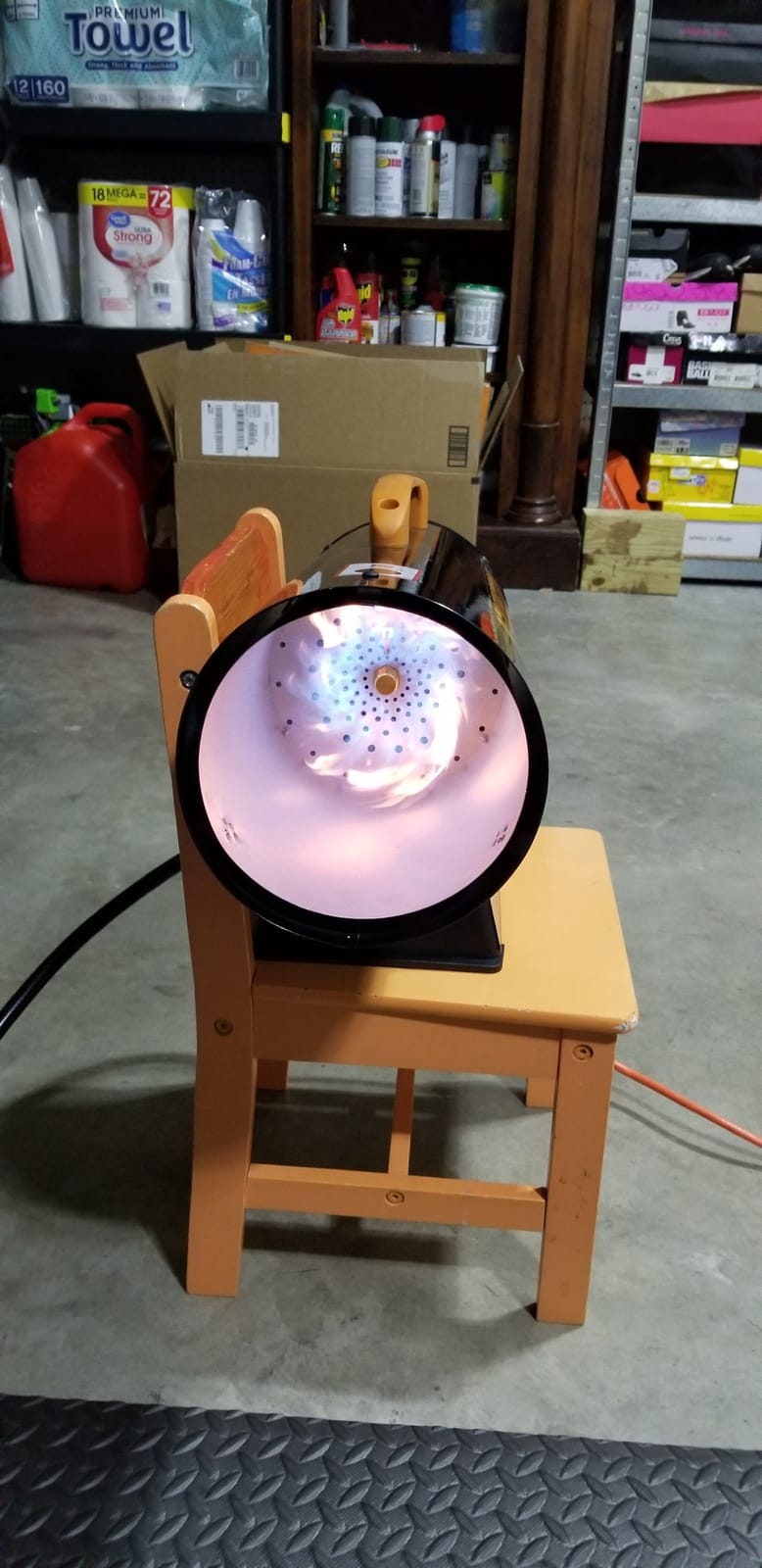
Performance is the headline: 125000 BTU, rated for 3125 square feet, and documented in reviews as moving a 1400 square foot attached garage from 30F to about 60F in twenty minutes on high.
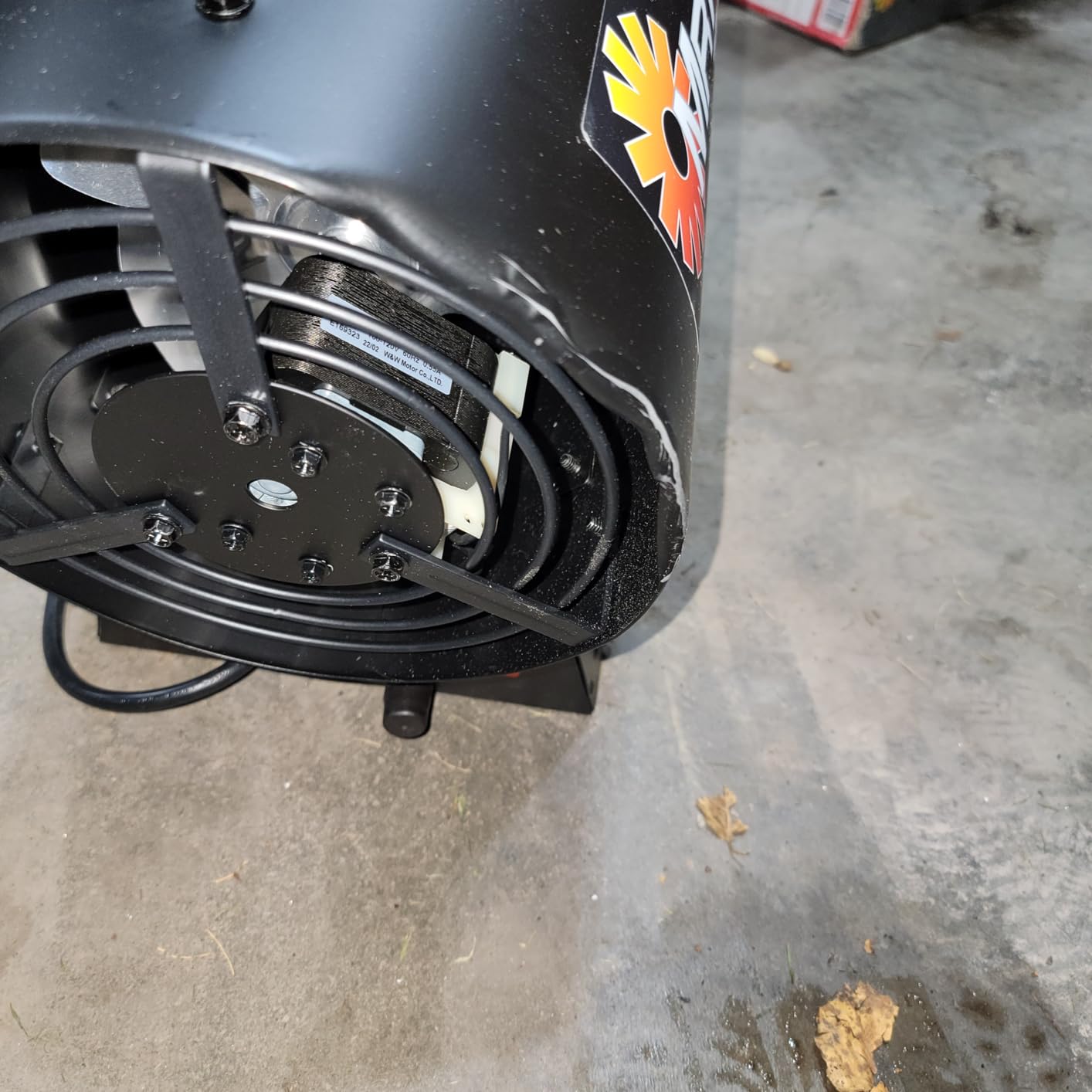
At 17.3 pounds with a heavy-duty handle, it is one of the few combustion heaters here you can realistically carry between a garage and a job site. The split barrel design makes servicing simple, and the 10 foot hose and regulator are included.
The high-temperature limit switch handles the safety side, and a 120 inch power cable for the fan means you need an outlet, not just a propane tank.
Why it is our propane pick
It is the best combination of output, weight, and noise among the propane heaters here, and those are the three things that decide whether you will keep using a portable propane heater instead of moving it to the corner. It also has a 1 year limited warranty.
For an uninsulated detached garage or a shop with frequent winter work, the twenty-minute warm-up is the feature that changes behavior.
When to choose differently
Control is limited to high and low, with no modulating option, so it will overshoot in a well-insulated space. Owners also report a noticeable propane odor while running, which is another argument for ventilation and another reason not to use it in an attached garage without openings.
And it needs power for the blower, so a garage with no outlet is out.
8. Remington 60000 BTU Forced Air Propane – Best for Job Sites
Remington LP Forced Air Heater, Portable 60,000 BTU Space Heater for up to 1500 Square Feet – Liquid Propane Gas Powered, Tank Not Included
60000 BTU forced air
1500 sq ft
11 pounds
Propane powered
Pros
- 10 ft LP hose and regulator included
- Heat-sensitive sticker shows when the tube is cool to touch
- Thermocouple plus high-temperature limit and flame-out fuel cut
- Electronic ignition
- 1 year limited warranty
Cons
- Very loud fan is the most common complaint
- Power cord is under one foot long
- Some heaters arrived broken or would not stay lit
Among the portable propane forced-air heaters here, the Remington pairs solid output with a low carry weight. At 60000 BTU it is rated for 1500 square feet, and owners report heating a two-car insulated garage in about ten minutes, which is fast for a unit that weighs 11 pounds.
The safety package is more complete than most at this output level: a thermocouple, a high-temperature limit shut-off, and a flame-out fuel cut. Electronic ignition starts it reliably once the tank is connected.
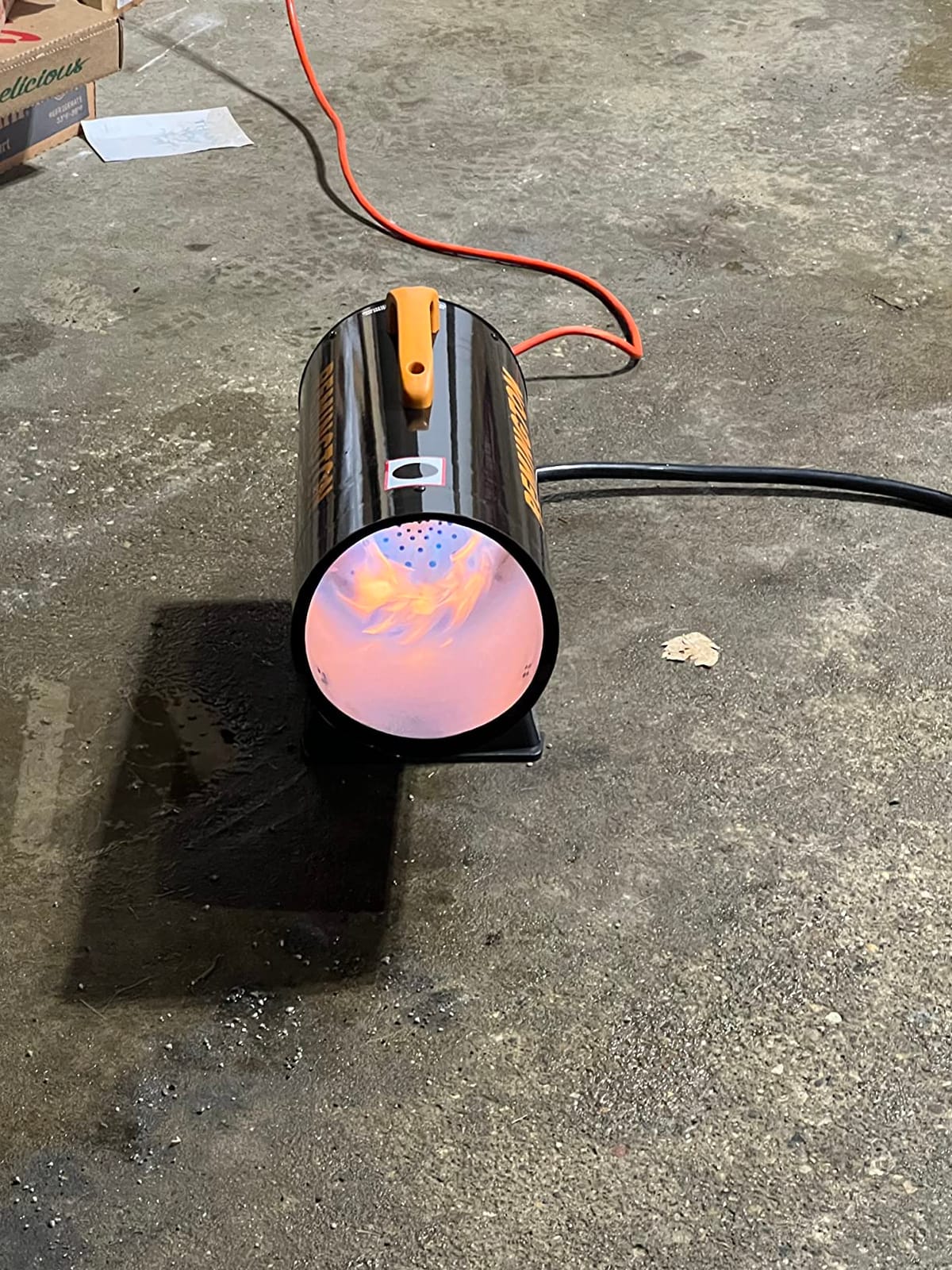
Variable heat settings and an adjustable height let you point the output where you are working rather than across the whole room. The heat-sensitive sticker on the tube is a small touch that tells you when the metal is cool enough to reposition.
Its weaknesses are practical ones. The fan is the loudest complaint across reviews, and the power cord is under a foot long, so you will need an outdoor-rated extension. The LP fitting also takes extra force to thread onto a standard grill cylinder.
When this is the right unit
Pick it when the heater lives in a truck and works on construction sites, or when you want a second heater for a second bay without spending much. Adjustable height and variable output are genuinely useful on uneven job-site ground.
The 1 year limited warranty is standard for the class, and the 4.5 star rating across more than 700 reviews holds up.
When to pass on it
Skip it for a garage gym, an attached garage, or any space where noise and combustion byproducts are a problem. There are also a few reports of units arriving broken or refusing to stay lit, so inspect it on arrival.
And budget for a propane tank and an extension cord; neither comes with the purchase in any meaningful sense.
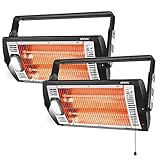
9. Shinic 2-Pack 1500W Radiant Heater – Best When You Have No Wiring
Shinic 2-Pack 120V Electric Garage Heater,1500W/750W Ceiling Mounted Heater
120V plug-in
1500W quartz radiant
400-600 sq ft
Work light
Pros
- Two ceiling-mounted radiant heaters in one pack
- Plugs into a standard 120V grounded outlet
- Built-in halogen work light for night work
- 90 degree adjustable ceiling mount
- Five pull-string heat and light settings
Cons
- Radiant heat only warms people and objects in front of it
- Lowest rated heater in the guide at 4.0 stars
- Coverage limited to 400-600 sq ft per heater
- Pull-string switch is not remotely controllable
This is the only electric heater in the guide you can put into service with an ordinary wall outlet. Both pieces plug into a standard 120V grounded socket, so there is no 240V circuit, no panel work, and no electrician. For a garage you rent, or a shop with no spare breaker capacity, that removes the single biggest barrier.
Each unit has dual quartz tubes rated 1500 watts, and the radiant throw means you feel heat the moment you are under it. The built-in halogen work light is a genuinely useful addition for evening projects.
Buy them as a pair, which is how they are sold, and mount them over two work zones rather than side by side. The 90 degree adjustable bracket and five pull-string settings, including a low 750W position, give you some control without a remote.
What you are actually buying
You are buying radiant heat for people. These pieces do not move air, so the garage will feel cold when you walk back into it after ten minutes away, and nothing in the room will have warmed up. That is the correct trade if you stand still, and the wrong one if you want to start a car in a 20F garage.
The 400 to 600 square feet figure is per unit at working distance, not room coverage.
Why the rating is lower than the rest
At 4.0 stars with about 57% five-star ratings and 11% one-star reviews, this is the weakest-reviewed product here, and the reason is predictable: buyers expect a radiant quartz heater to heat a room the way a fan-forced unit does. Overheat auto-off, a grounded three-prong plug, and ETL listing cover the safety basics.
Skip it if you need stored vehicles, batteries, or paintwork kept above freezing.
10. InoKraft 7500W 240V NEMA 14-50P – Best for Garage Gyms
InoKraft 7500W Electric Garage Heater, 240V with NEMA 14-50P Plug
7500W fan-forced
65 dB operation
Digital thermostat
NEMA 14-50P
Pros
- 7500W output covers 750 sq ft
- Quiet operation rated at 65 dB
- Digital thermostat from 40 to 99F with a 1-24 hour timer
- ECO mode modulates output
- 8.2 ft cord with NEMA 14-50P plug avoids hardwiring
Cons
- Requires a 31.25 A 240V NEMA 14-50 outlet and professional installation
- Newer listing with 286 reviews
- Only two speed settings plus ECO mode
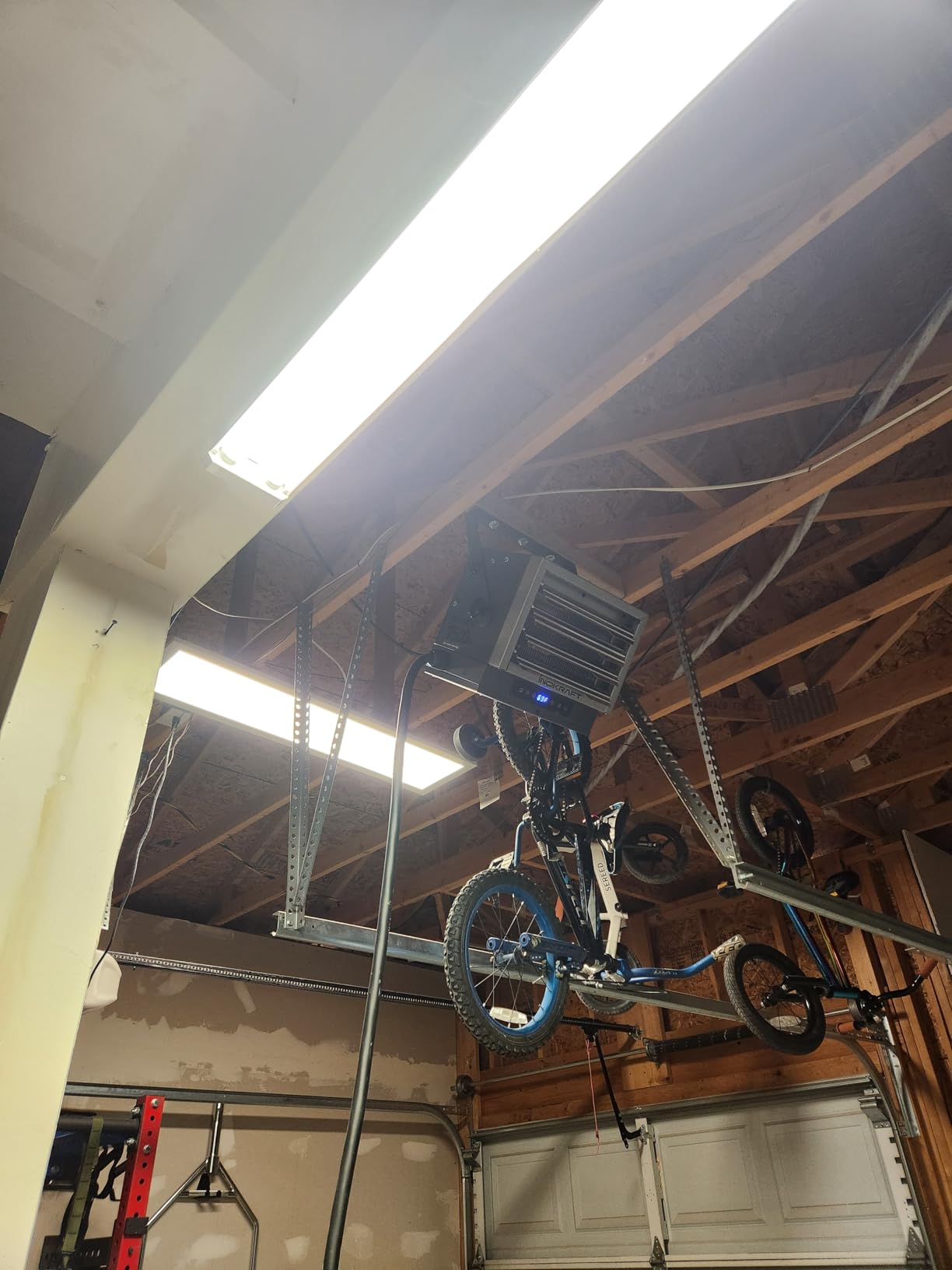
This is the only electric heater in the guide with a published noise figure, a stated 65 dB, and that number decides whether you can hold a conversation or follow a class in a converted garage. Forum complaints about budget electric heaters being too loud to work out near are the reason it is on the list.
The digital thermostat runs from 40 to 99F with one-degree control, paired with a 1 to 24 hour timer and ECO mode that modulates output and cuts power when it is not needed. That lower limit of 40F is better suited to cold winters than the 50F and 70F floors on some competitors.
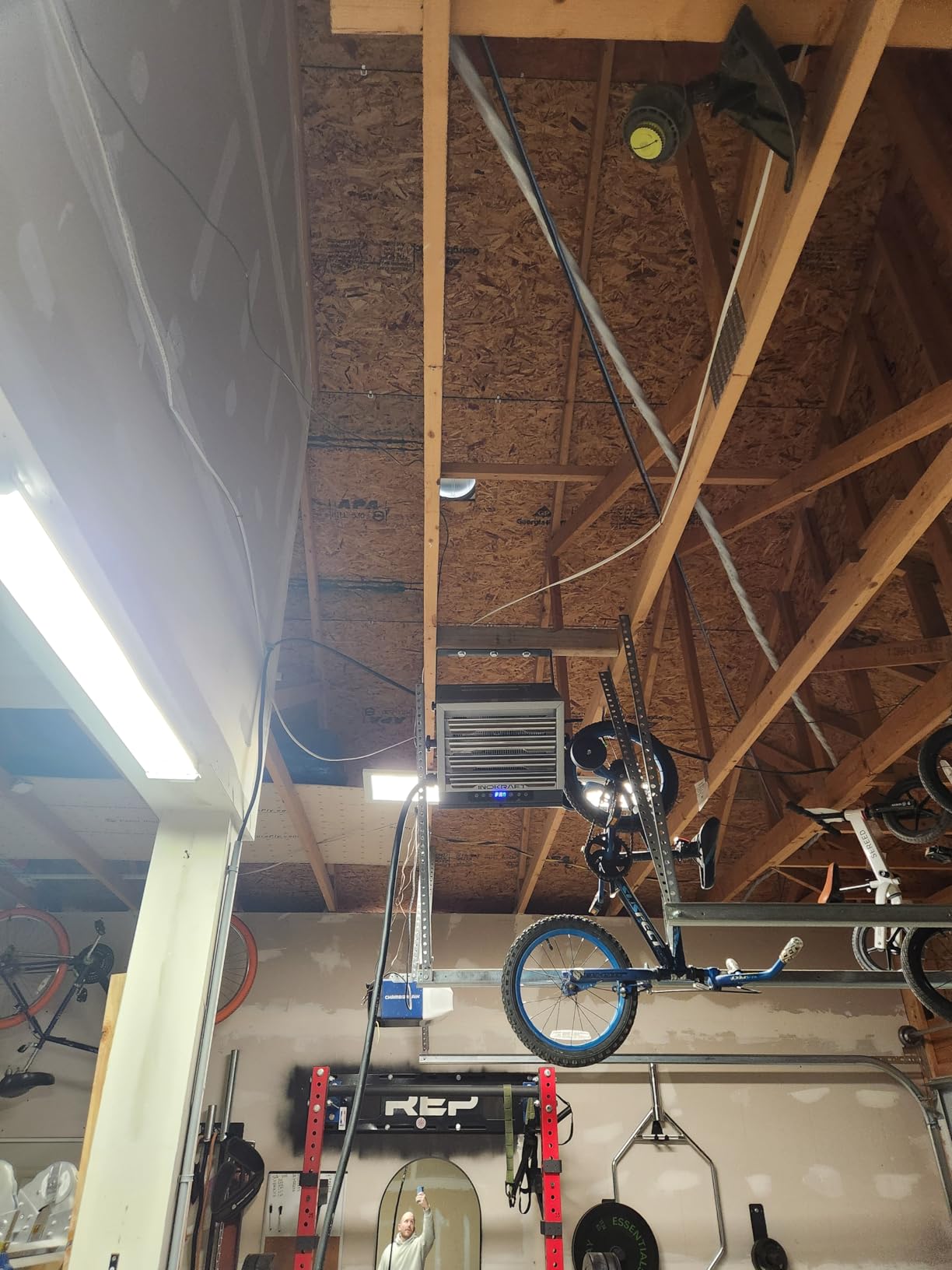
It ships with an 8.2 foot power cord and a NEMA 14-50P plug, so if you already have that receptacle you can plug in rather than hardwire. A hardwired variant is also offered. Five installation angle adjustments plus flexible louvers let you aim the airflow across the room rather than at the ceiling.
At 31.25 amps it still needs a dedicated 240V circuit, and the manufacturer recommends professional electrical installation. The wall or ceiling mounting keeps the floor clear for a mat and a rack.
Why it wins for a gym
It heats air rather than bodies, so the whole room reaches a workout temperature and stays there, and the timer plus thermostat means it warms up before you start instead of during your first set. ECO mode reduces the running load once the room is at temperature.
With a 4.6 star rating and about 82% five-star ratings, the satisfaction rate here is the strongest of the electric heaters we analyzed.
Honest limitations
This is a newer listing with 286 reviews, so its long-term track record is shorter than the DR-975, and the 4.6 star figure rests on a smaller sample. There are only two speed settings plus ECO mode, and the outlet requirement is the same as any 7500-watt unit.
11. Dyna-Glo 20000 BTU Blue Flame Natural Gas – Best for Natural Gas Homes
Dyna-Glo 20,000 BTU Natural Gas Blue Flame Vent Free Wall Heater
20000 BTU natural gas
Blue flame
700 sq ft
Vent free
Pros
- Constant steady heat rather than short-cycling
- Noiseless vent-free operation with a three-position knob
- No electricity required so it works as emergency heat
- Simple installation and easy ignition
- White wall-mounted design suits a finished room
Cons
- Only three preset levels with no fine adjustment
- Natural gas only and fuel conversion not permitted
- Not thermostatically controlled on this model
- Vent-free and requires ventilation plus clearances
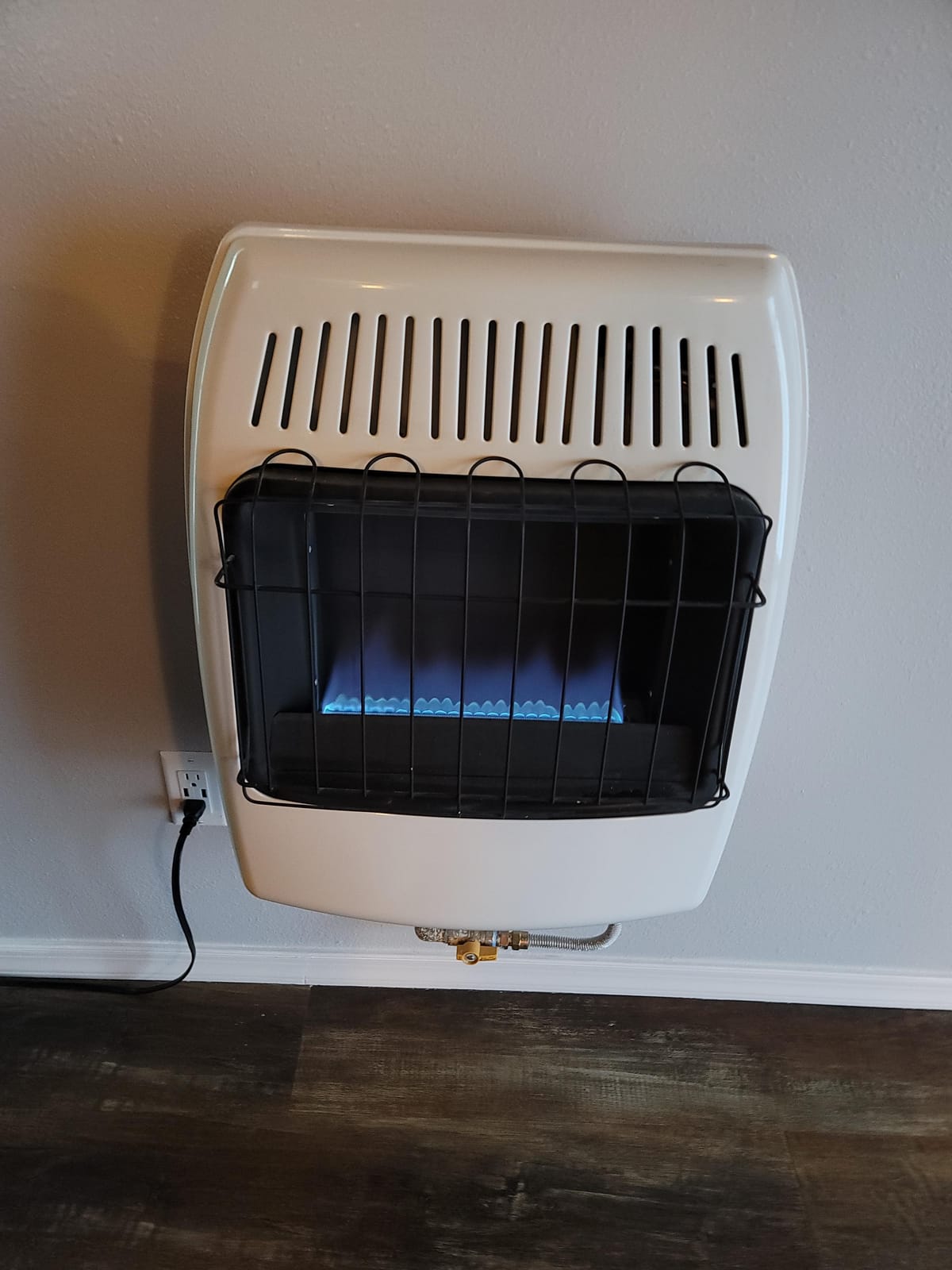
Blue flame heaters convert the heat of combustion into warm air rather than shooting infrared at you, which is why owners describe the output as constant and steady instead of the on-off blast of a typical space heater. At 20000 BTU it is rated for 700 square feet, so it fits a one-car garage or a finished room.
The 10,000 to 20,000 BTU range on the control knob is a welcome change from a single fixed output. And because it needs no electricity, it keeps working when the power does not, which owners value as emergency or backup heat.
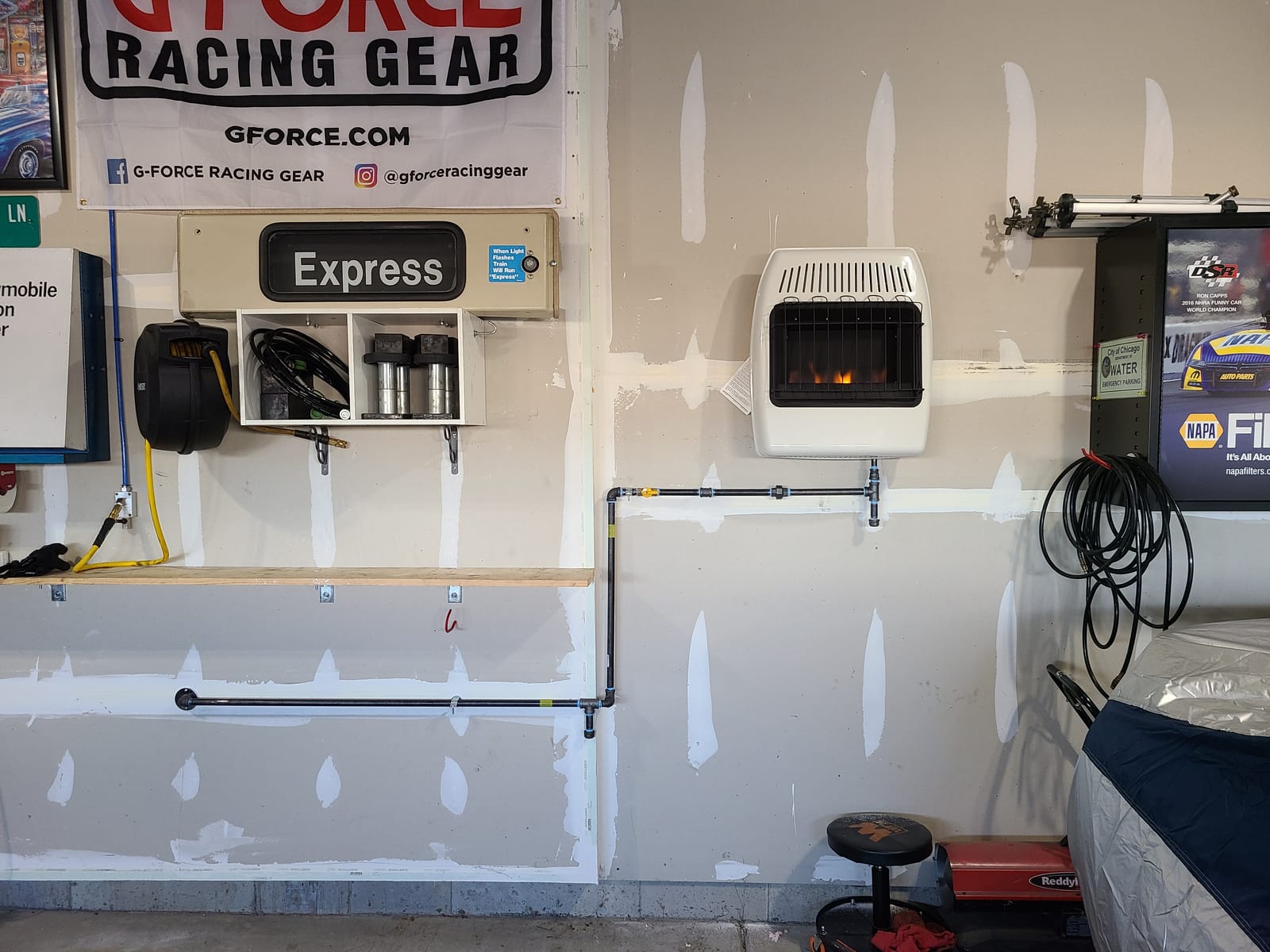
It mounts on a wall and runs quietly with no fan, so it is unobtrusive in a space you also use for something other than parking. The white cabinet looks like a household wall heater rather than shop equipment.
Be clear about the limits before you order. This model is natural gas only, and the manufacturer states fuel conversion is not permitted.
It is also manual-control rather than thermostatically controlled, so you set a level and leave it there.
When blue flame is the right call
It suits a home already on natural gas with a line close to the garage, a space up to 700 square feet, and anyone who wants steady room temperature without a fan running. The lack of electricity requirement is a genuine advantage in an outage.
It is a natural gas option rather than a propane one, so a garage heated by a 20 lb cylinder is not a candidate.
Limitations worth weighing
Three preset positions with no fine flame-size adjustment means the lowest setting may still be too much for a small space. Being vent-free, it requires ventilation and proper clearances, and one owner reported a unit catching fire after about a year of service.
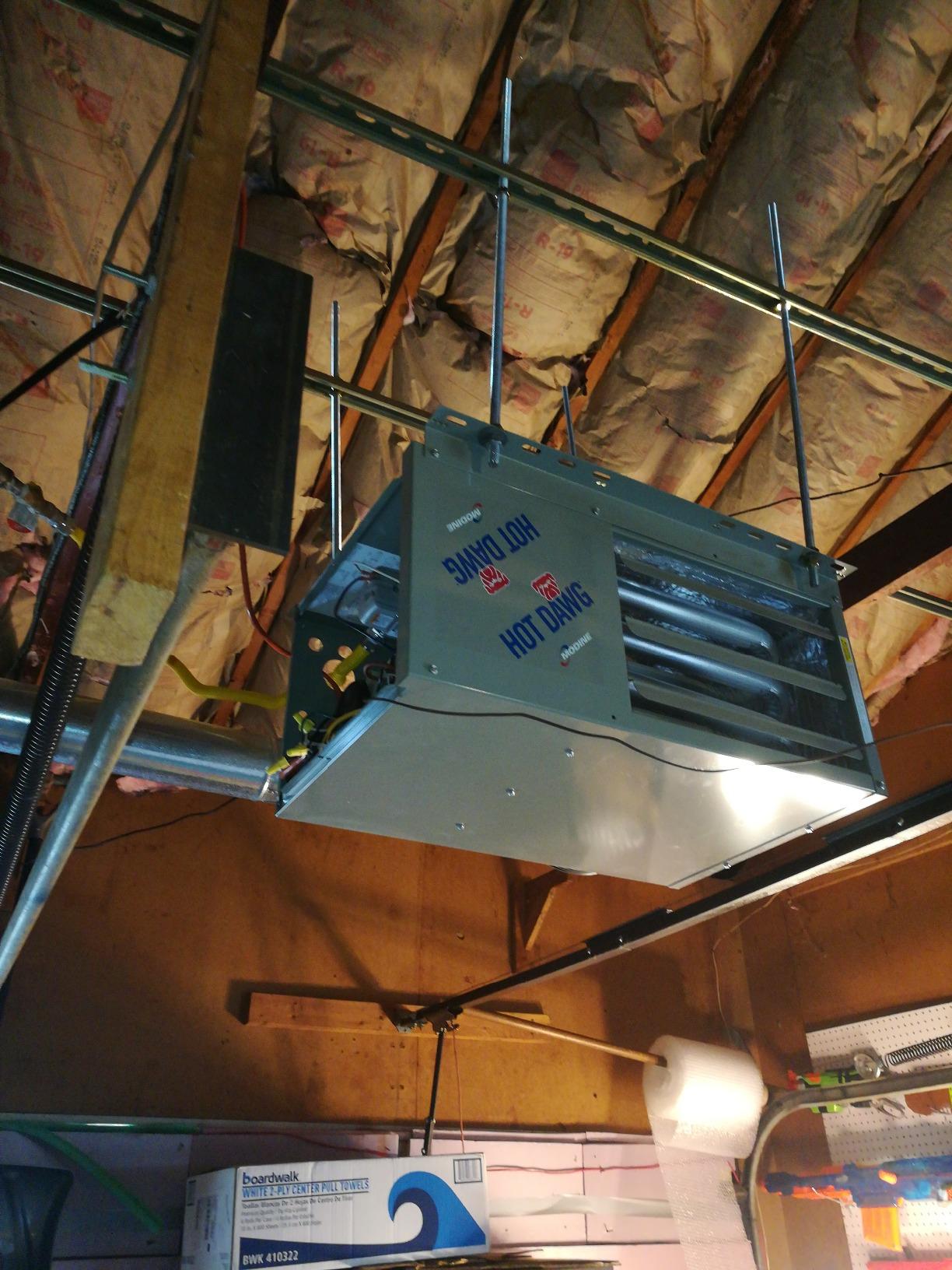
12. Modine HD45 45000 BTU Natural Gas – Best Efficiency
Modine HD45AS0111Natural Gas Hot Dawg Garage Heater 45,000 BTU with 80-Percent Efficiency Grey
45000 BTU natural gas
80 percent efficiency
Power exhaust
Quiet operation
Pros
- 80 percent efficiency lowers running cost versus older unit heaters
- Quiet operation for a 45000 BTU heater
- Power exhaust simplifies venting with small-diameter pipe
- Certified for residential commercial and industrial use
- Low profile cabinet installs quickly with field wiring connections
Cons
- Professional gas line and vent installation adds significant cost
- Only 150 reviews the smallest review base here
- 60 pounds with a ceiling bracket needs two people or a hoist
- 115V power needed for controls in addition to gas
The Modine is the pick if you are planning to heat the same garage for a decade rather than a season. At 80 percent efficiency, it converts more of the gas it burns into usable heat than the older unit heaters, and that gap shows up in every winter bill after the first.
It is also quiet for its output class, and the standard power exhaust lets you vent through a side wall or roof with small-diameter pipe rather than a large conventional flue. That single feature is often what makes a gas install practical in a garage with a tight ceiling.
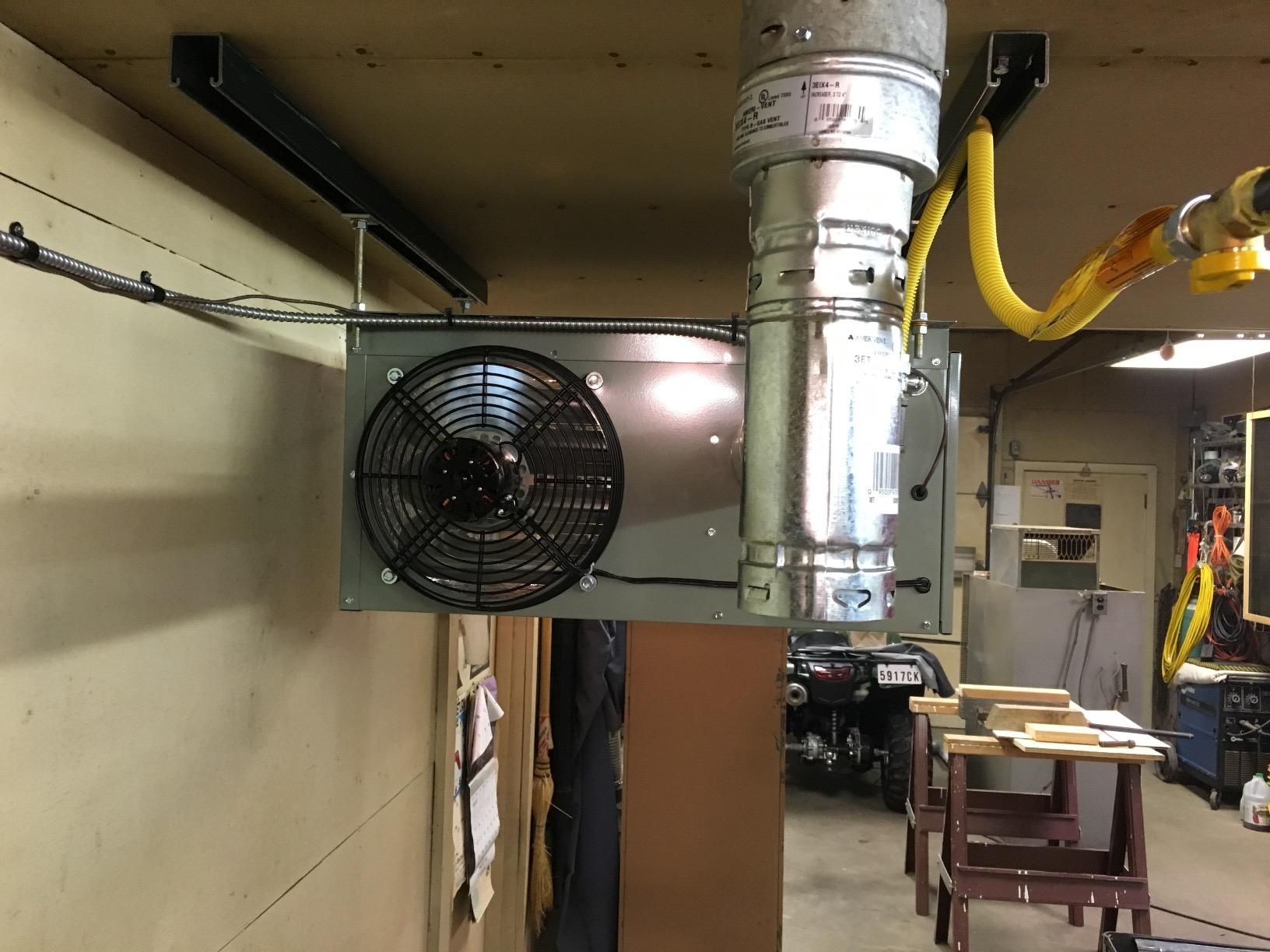
It is certified for residential, commercial, and industrial use, which matters if you ever convert the garage. Field wiring connections and knockouts for gas and electrical access make the install straightforward for a qualified tradesperson.
Rated coverage is 700 square feet at 45000 BTU, which is a lower coverage figure than the raw BTU would suggest, so size it on the manual rather than on the number alone.
Where the efficiency gain pays off
If you run a heater across a full heating season, the efficiency rating is the number that matters more than purchase price. The 80 percent figure also pairs well with a sealed and insulated garage, because the load per hour is lower when the space is not losing heat constantly.
For a long-term install, it is the one on this list we would most confidently buy again.
What stops us recommending it more widely
It sits at the top of the price range in this group, and professional gas line and vent installation adds to that. At 60 pounds with a ceiling bracket, it is a two-person or hoist install. It also needs 115V power for its controls, so an electrical circuit is required even though the fuel is gas.
With 150 reviews, it has the smallest review base here, so judge the long-term picture carefully.
How to Size a Garage Heater for Your Space?
Most oversized heaters are a sizing mistake, not a quality problem. Owners repeatedly report running 70000 BTU units in ordinary two-car garages and having to turn them down, which wastes fuel and shortens equipment life.
For a rule of thumb, use the rated coverage figures in this guide as your starting point, then adjust for insulation. A one-car garage near 200 to 300 square feet needs roughly 17000 to 30000 BTU. A two-car garage around 400 to 600 square feet sits in the 40000 to 60000 BTU range for propane, or a 5000 to 7500 watt electric heater. A three-car garage above 800 square feet wants 50000 BTU or more, or two smaller electric heaters.
Conversion matters if you are comparing an electric spec to a gas spec. One watt equals about 3.412 BTU, so 7500 watts is roughly 25600 BTU. That is why the 7500-watt electric units and the 30000 BTU propane radiant heater feel like different classes of machine even though their list pages read similarly.
Insulation level changes the number more than fuel type does. In a space with R15 walls and an insulated door, nearly every heater here will hit its rated coverage. In a bare pole barn with a one-inch steel door, plan on the low end of each range and expect to run longer to reach temperature.
Electric vs Propane vs Natural Gas vs Kerosene
Electric produces no combustion products, needs no venting, and gives you thermostat and timer control you cannot get from a portable gas heater. It also costs more per hour to run, and it is useless without a 240V circuit. For an attached garage, a garage gym, or any space where people work for hours, it is the safer default.
Propane delivers more heat per dollar and warms an uninsulated space in minutes, with no electrical work at all. The costs are real: a tank to refill, a hose and regulator, ventilation requirements, and water vapor that condenses on cold cars and windows. A tightly sealed insulated garage can also develop negative air pressure, which makes combustion appliances work harder and can pull exhaust back into the space.
Natural gas is the least expensive to run over a season, but it is only realistic if a gas line already reaches the building. A power-vented model like the Modine removes combustion products properly, while a vent free blue flame heater like the Dyna-Glo is acceptable only in a well-ventilated space.
We deliberately left kerosene out of this lineup. Owners who bought wick heaters report they gum up, need wick trimming, and cannot burn diesel fuel, and the safety profile is poor in an enclosed space. The same applies to unvented propane in a sealed room.
If your goal is the least expensive way to heat a garage, the honest answer is a radiant heater for personal warmth, or a well-insulated space with a modest electric unit. If the goal is protecting vehicles and batteries through deep winter, spend on a 240V circuit and a hardwired fan-forced unit. Our related guides on [heating a chicken coop through cold weather](https://www.hdkkk.net/best-chicken-coop-heaters-for-cold-climates/) and [koi pond heating in cold climates](https://www.hdkkk.net/best-koi-pond-heaters-for-cold-climates/) cover the small-scale version of the same problem.
Insulate the Garage Before You Buy the Heater
The highest-return hour you can spend on a cold garage is not spent shopping. Workshop owners say this constantly in forum threads, and the physics is simple: every unit of insulation you add shrinks the heat load, which means a smaller heater, lower fuel use, and faster recovery.
Start with the garage door. It is usually the largest uninsulated surface, and a kit with rigid foam or insulated panels makes the biggest difference. Then the walls, the ceiling above the heater, and any window you have. A weatherstripping pass on the door and jambs takes an afternoon.
Insulation changes the fuel decision as much as the sizing decision. An insulated garage makes a 5000-watt electric heater viable where a 125000 BTU propane heater was previously necessary, and it makes the Modine-style 80 percent efficiency gas heater pay back much faster.
It also makes radiant units more useful, because a smaller air volume with a well-sealed envelope holds the small amount of heat you do put in.
Installation: 120V Plug-In vs 240V Hardwired
Electric heating power is not trivial. A 7500-watt heater at 240V draws 31.25 amps, which needs a full 30-amp circuit on its own. Four of the products here pull more than 20 amps, and three of them arrive with no power cord in the box.
A NEMA 14-50P receptacle, like the one on the InoKraft, lets you plug in instead of hardwiring, but you still need the 240V circuit and a 30-amp breaker behind it. If your panel has no spare slots, that is a panel upgrade, and it is the surprise cost owners report most often.
Hardwired models like the Dr. Infrared DR-975 and both Comfort Zone ceiling heaters call for 8 AWG copper and a dedicated breaker. Use the lowest legal temperature rating for the run, and have a licensed electrician make the terminations if you are not experienced with 240V work.
Gas heaters need a licensed tradesperson as well. A propane model needs a regulator and hose and a safe cylinder location, while a natural gas appliance needs a gas line, a vent kit, and in many jurisdictions a permit. Check local rules before you buy, because they affect which models you can legally install.
Mounting is the easy part. Ceiling heaters need the clearance specified by the manual, and propane heaters should sit on stable ground with the exhaust pointed at open air, never into a closed ceiling cavity.
Safety: CO Detectors, Ventilation and Shutoffs
Any combustion heater in a garage needs permanent ventilation. The practical rule most codes follow is roughly one square inch of free opening per 1000 BTU of input, with openings high on one wall and low on the opposite wall so air moves through the space instead of pooling.
Run a carbon monoxide detector inside the garage regardless of fuel type, and another near sleeping areas if the garage is attached. A detector is cheap and it is the only thing standing between a burner that has gone out and a family.
Oxygen depletion sensors matter most on vent free appliances like the Mr. Heater F299830 and the Dyna-Glo BF20NMDG, which are rated to shut down when room oxygen drops. Do not defeat these systems with tape or a modified adapter.
On electric heaters, the protections are overheat auto cutoff and enclosed motors. Cheap fan motors are the most common failure mode owners report, and a failed motor can take the control board with it. ETL or UL listing is the marker to look for; the Comfort Zone, Shinic, and Dr. Infrared products here all carry third-party certification.
Finally, never leave a combustion heater running unattended overnight, and keep the cylinder outside the garage where possible.
Frequently Asked Questions
What is the cheapest way to heat a garage in the winter?
Insulate the garage door and walls first, then add a modest unit sized to the space. For personal warmth at a workbench, a radiant heater such as the Shinic 1500W 120V pair is the lowest-cost option because it plugs into a standard outlet. For whole-room heat, a 5000-watt 240V ceiling unit like the Comfort Zone CZ220 covers 1000 square feet on a 20.83 amp draw.
What size heater do I need for a 24×24 garage?
A 24×24 garage is about 576 square feet, which falls in the two-car range. Look at 40000 to 60000 BTU from propane or a 5000 to 7500 watt 240V electric unit. In an insulated garage, the Comfort Zone CZ220 at 17065 BTU is marginal, so most owners would choose a 7500-watt electric unit or a 60000 BTU propane heater.
What is the best way to heat an unheated garage?
An unheated or uninsulated garage needs a combustion heater with high output, because electric capacity is limited by the circuit you can install. A 60000 to 125000 BTU propane forced-air model such as the Remington or the Mr. Heater Quiet Burner warms the space in 10 to 20 minutes. Pair it with permanent ventilation and a carbon monoxide detector.
Which is better for my garage, a gas heater or an electric heater?
Electric is safer and cleaner with no venting, better controls, and the lowest air-quality risk, which makes it right for attached garages and garage gyms. Gas and propane deliver more heat per dollar and warm an uninsulated space in minutes, but require ventilation, produce condensation, and can be odor-producing. Choose gas for a large uninsulated detached space, electric for an enclosed one.
Is a blue flame or infrared propane heater better?
Blue flame heaters heat the air, so the whole room warms and a cold car comes up to temperature faster. Infrared or radiant heaters warm bodies and objects in line of sight almost instantly and cost far less to run for a person at a bench. Choose blue flame for whole-space heating and infrared for spot heating while working.
What are the pros and cons of an infrared heater for a garage?
The pros are instant heat on your skin, no warm-up time, low running cost for personal warmth, and often no electricity requirement. The cons are that the air stays cold, the rated square-foot coverage is far smaller than for fan-forced units, and there is no effect on stored vehicles, batteries, or paint finishes. They are working tools, not space heaters.
What is the best type of heater for heating a garage?
For an enclosed or attached garage, a 240V hardwired or NEMA 14-50P fan-forced electric heater is the best type because it is clean, controllable, and needs no venting. The Dr. Infrared DR-975 at 7500 watts is our best overall pick. For an uninsulated detached space, a high-BTU propane forced-air heater is the better tool.
What are the downsides of using infrared heaters?
Infrared heaters do not heat the air, so the space can feel cold when you step away from the heat path. Coverage is line-of-sight, meaning a single unit serves a bench and not a garage. They cannot protect vehicles or batteries from freezing, and vent-free propane versions still require ventilation and should not run unattended.
Conclusion: Our Best Garage Heaters for Cold Winters in 2026
The Dr. Infrared DR-975 is our pick for the best garage heaters for cold winters in 2026 because it combines 7500 watts of fan-forced output, a remote thermostat, and a 4000-plus review history that gives real confidence in long-term reliability. It is hardwired, so factor the 240V circuit into your decision before anything else.
Pick the Mr. Heater 125000 BTU Quiet Burner if your garage is detached and uninsulated and you want warmth in twenty minutes. Pick the Comfort Zone CZ220 for a small, tight, insulated space on an existing circuit, and the InoKraft 7500W if noise during a garage workout is the deciding factor. For a spot at a workbench, the Mr. Heater 30000 BTU radiant propane heater warms you in seconds without touching the air temperature.
Whatever you choose, insulate the door first, install a carbon monoxide detector, and size the heater to the space rather than to the largest number on the box. If you are keeping other outdoor spaces running through winter, our guides to [chicken coop heaters for cold climates](https://www.hdkkk.net/best-chicken-coop-heaters-for-cold-climates/) and [koi pond heaters](https://www.hdkkk.net/best-koi-pond-heaters-for-cold-climates/) cover the same cold-weather thinking at a smaller scale.