
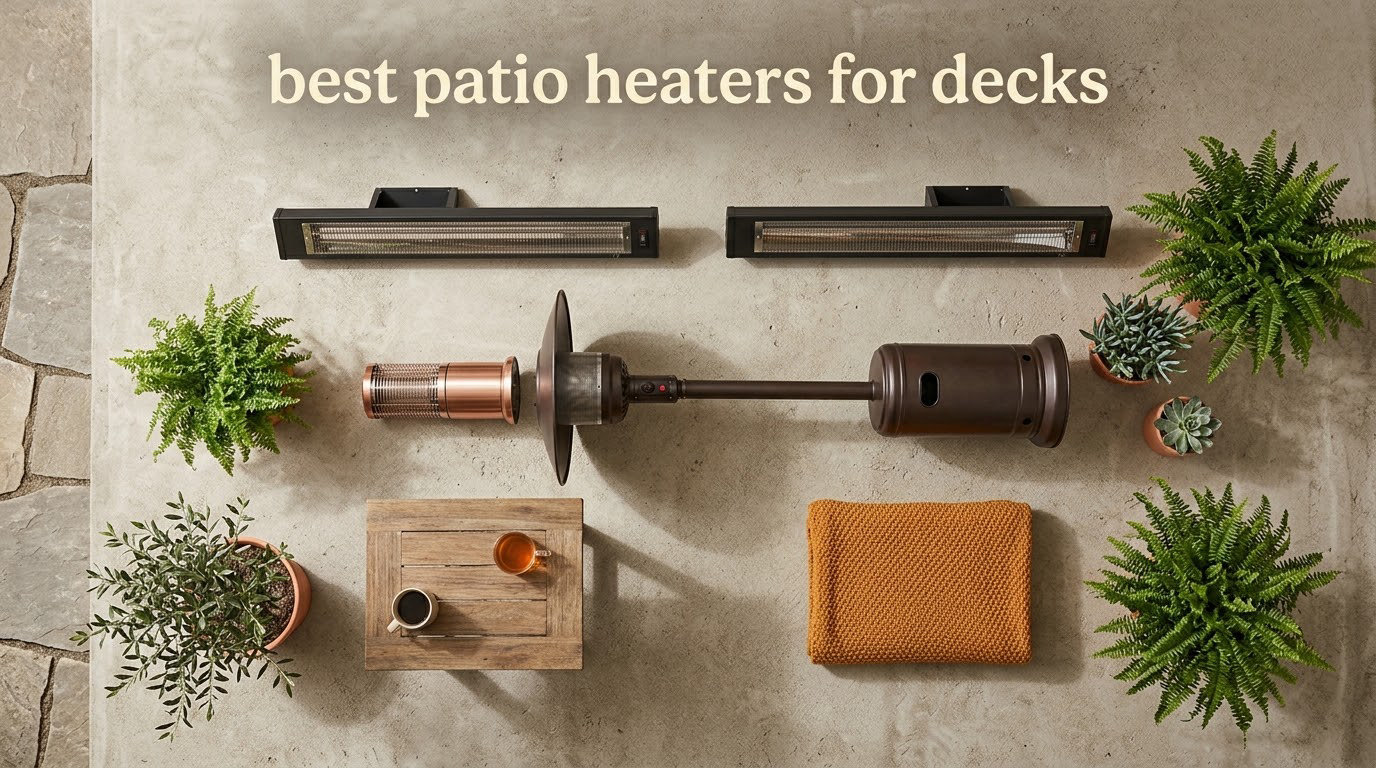
Deck owners ask me the same question every September: which heater will let us keep eating outside when the temperature drops into the fifties? I have compared ten freestanding, wall-mounted, ceiling-mounted and tabletop patio heaters for decks across the range of formats you will actually find on the market, and the honest answer is that the best patio heaters for decks are not one product but two very different families of machines.
The short answer: a high-BTU freestanding propane pyramid is the best overall patio heater for a deck, and a wall- or ceiling-mounted electric infrared unit is the best option for a covered or screened space. Propane units throw genuinely large amounts of radiant heat across open decking; electric units put out roughly one-eighth as much, warm a person rather than a deck, and earn their place by removing the fuel line, the tank and the open flame from the picture.
A deck is a harder environment than a patio, and that single fact drives every recommendation below. A ground-level patio lets you run a heater in a sheltered corner, out of the wind, on hard pavers. A deck puts you up in the air, often surrounded by a railing, frequently exposed on two or three sides, and always sitting on a surface that is a combustible material. Wind strips convective heat away almost instantly, so the direction and throw of radiant heat matter more here than anywhere else. Clearance to wood decking, to umbrella fabric and to pergola beams is not a footnote on a deck. It is the whole safety conversation.
How we evaluated: I worked through the published specifications for all ten units, then cross-read the customer review patterns for each one, focusing on the complaints that recur rather than the single glowing review. Everything below is drawn from manufacturer and retailer specification data and aggregated customer feedback. Where a product has a documented weakness, I say so plainly, because a list of patio heaters with no drawbacks is just an advertisement. If you are still prepping the structure itself, our framing nailer roundup for decks covers the framing and fastening side of the job.
Table of Contents
Top 3 Best Patio Heater Picks for Decks in 2026

Amazon Basics 46000 BTU…
- 46000 BTU propane heat
- 9-foot heating radius
- Built-in wheels and water tank
- Tilt safety auto-shutoff valve

Dr Infrared DR-238 Infrared…
- 1500W carbon infrared heat
- IP55 outdoor rated
- Wall and ceiling brackets included
- Remote control operation

Pamapic 89 Inch Pyramid…
- 48000 BTU radiant heat
- Coverage up to 15 feet diameter
- Quartz glass flame tube
- Wheels and cover included
Best Patio Heaters for Decks in 2026 at a Glance
All ten heaters, side by side, with the output and mounting style that matter most on a deck. Scroll past the table for the full write-up on each one.
| Product | Specs | Action |
|---|---|---|
| Amazon Basics 46000 BTU Portable Propane Patio Heater with Wheels |
|
Check Latest Price |
| Dr Infrared DR-238 Wall and Ceiling Infrared Heater with Remote |
|
Check Latest Price |
| Pamapic 89 Inch Pyramid Propane Patio Heater |
|
Check Latest Price |
 Hykolity 50000 BTU Propane Patio Heater with Table Top Hykolity 50000 BTU Propane Patio Heater with Table Top |
|
Check Latest Price |
 Legacy Heating 47000 BTU Mocha Patio Heater Legacy Heating 47000 BTU Mocha Patio Heater |
|
Check Latest Price |
 Paraheeter 1500W Infrared Patio Heater Paraheeter 1500W Infrared Patio Heater |
|
Check Latest Price |
 FOOWIN 48000 BTU Propane Patio Heater with Wheels FOOWIN 48000 BTU Propane Patio Heater with Wheels |
|
Check Latest Price |
 Pamapic 50000 BTU Round Table Propane Patio Heater Pamapic 50000 BTU Round Table Propane Patio Heater |
|
Check Latest Price |
 Encyclpo 1500W 36 Inch Infrared Tower Heater Encyclpo 1500W 36 Inch Infrared Tower Heater |
|
Check Latest Price |
 SereneLife 1500W Infrared Patio Heater with Remote SereneLife 1500W Infrared Patio Heater with Remote |
|
Check Latest Price |
1. Amazon Basics 46,000 BTU Portable Propane Patio Heater – Best Overall for Decks
Amazon Basics 46,000 BTU Portable Outdoor Propane Patio Heater with Wheels, Commercial & Residential with Water Tank, Adjustable Heat Output, 9-Foot Radius, Slate Gray, 32.1″L x 32.1″W x 91.3″H
46000 BTU propane
9-foot heating radius
37 lb with wheels
32.1 x 32.1 x 91.3 in
Pros
- Huge 46000 BTU output for a freestanding unit
- One-touch ignition and a simple heat knob
- Wheels plus a water tank for base weight
- Tilt auto-shutoff valve and tank chain
- Over 11000 reviews averaging 4.4 stars
Cons
- Propane cylinder sold separately
- Tall and wide footprint needs open deck space
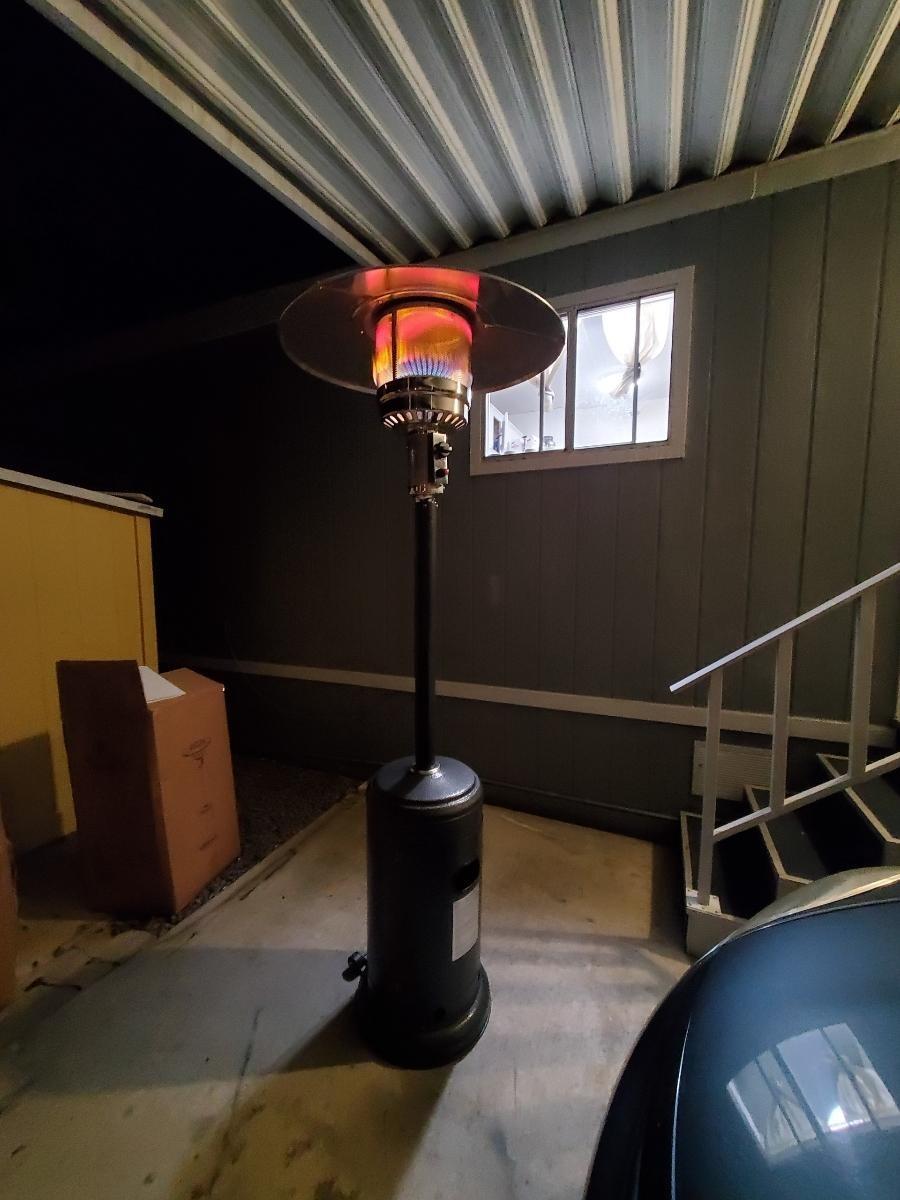
This is the unit I recommend to anyone with an uncovered ground-level deck and a group of four to six people around a table. At 46,000 BTU it delivers roughly the radiant output of the much larger commercial pyramid heaters, but it does it in a package that a single person can move, wheel and store. More than 11,000 reviews averaging 4.4 stars makes it the most thoroughly proven heater in this roundup, and that volume of long-term owner feedback is exactly what I wanted from a winner.
The build is the story here. A powder-coated Slate Gray finish handles a wet season without pitting, the wheels let you roll it to a new seating arrangement without tipping, and the base carries a water tank that adds ballast so a gust does not walk it across the decking. The tilt safety auto-shutoff valve is the feature I look for first on any gas heater used on a raised surface, because a deck is exactly where a bumped-and-tipped-over heater becomes a problem.
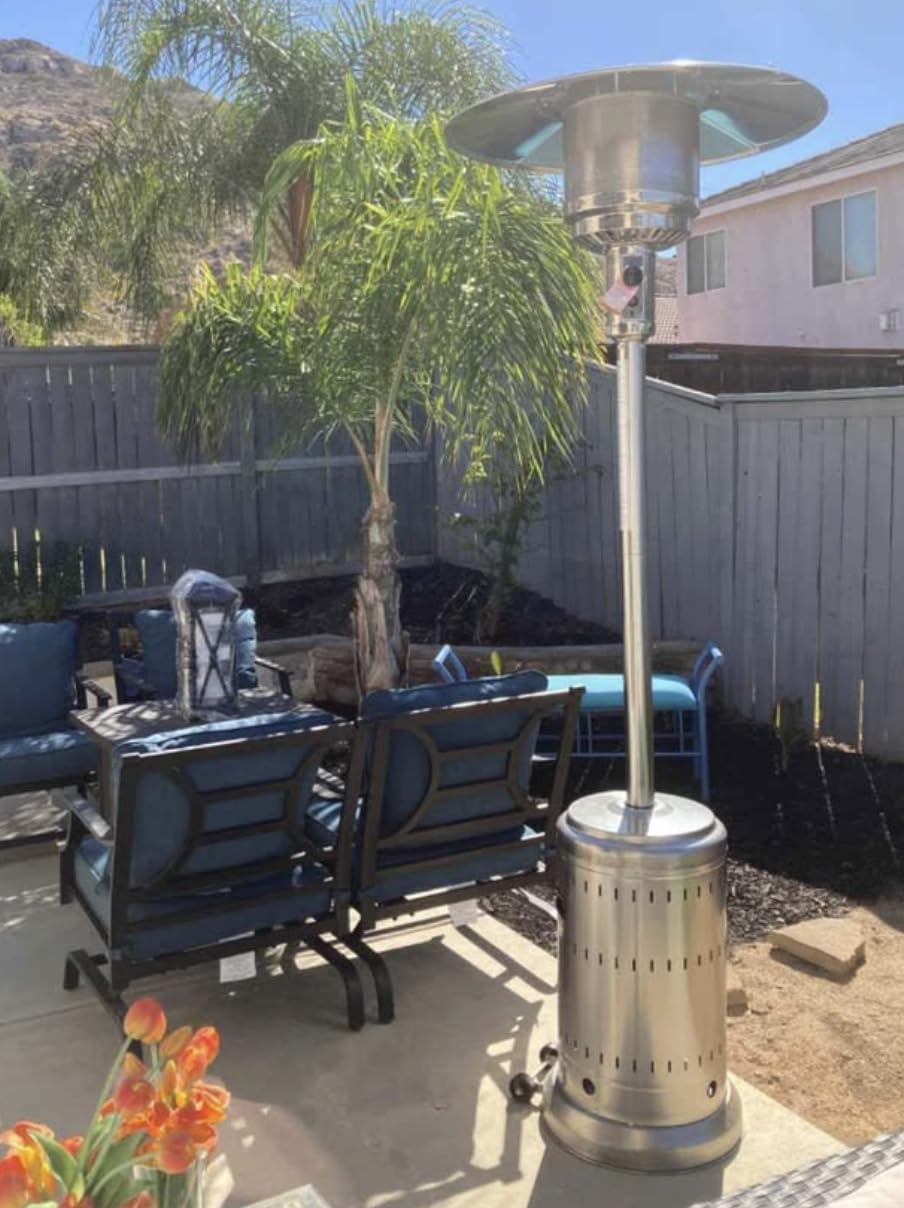
Real-world coverage is a 9-foot radius from the center of the reflector, which in practice means a comfortable zone roughly 12 to 15 feet across for seated guests. That is a round deck table and a few chairs, not a whole terrace. If your deck is larger than about 160 square feet and you want everyone warm at once, you are looking at a two-heater setup or one of the higher-output table-style units further down.
The honest limitations are simple. The 20 lb liquid propane cylinder is not included, and at 91.3 inches tall and 32 inches across the base this is a substantial object to have standing in the middle of a walkway. The 16.78 kg weight is fine when you are rolling it on its casters and awkward when you need it up two steps.
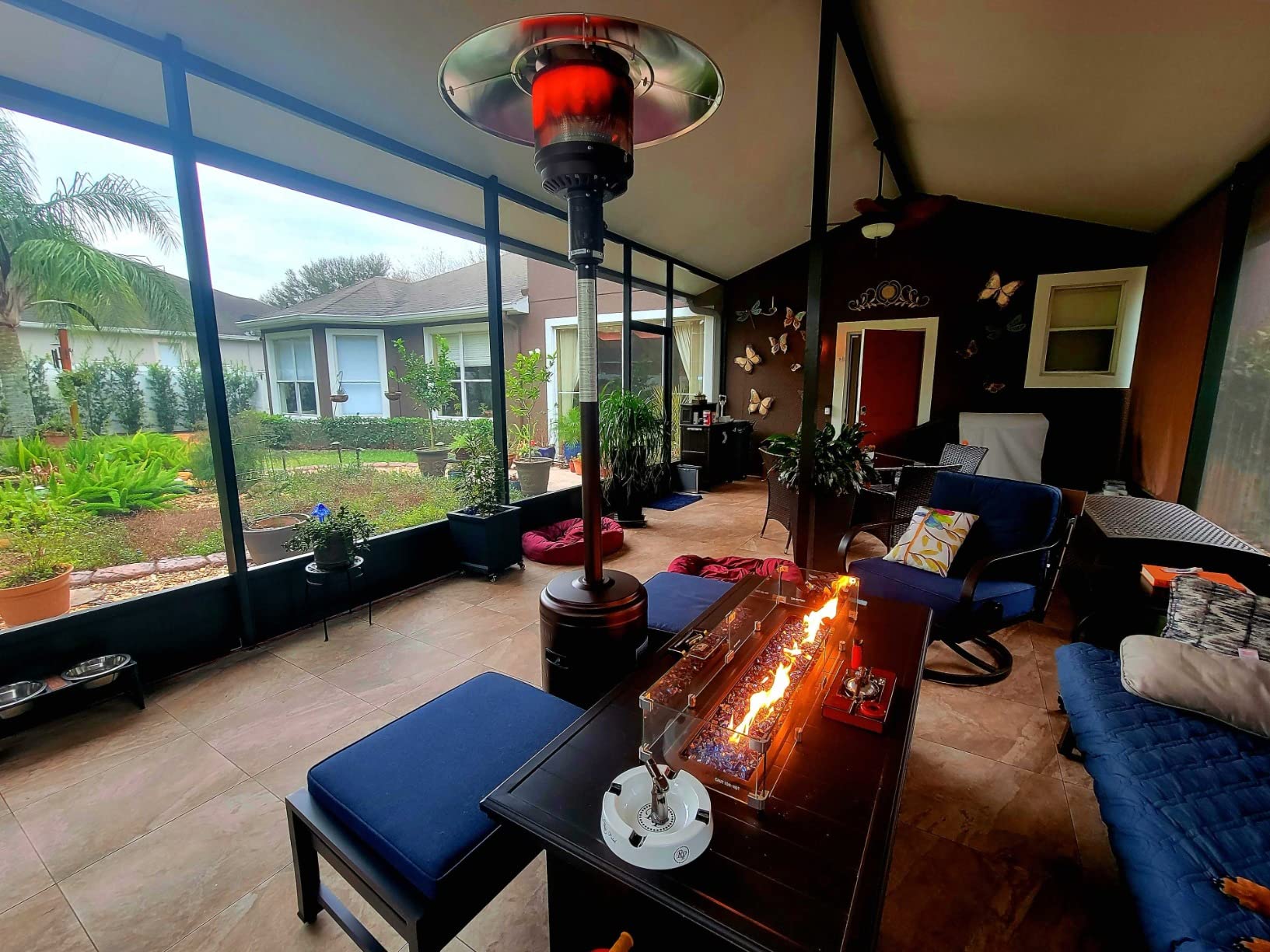
What 9-foot coverage really means at a deck table
Radiant heat falls off in a curve, not a straight line. Right in front of the reflector you are warm within a minute; at the edge of the stated radius you feel a breeze with a hint of warmth in it. Seat people inside roughly 6 feet of the unit and everyone is comfortable. Push the table to 10 feet out and the person at the far end will start putting on a jacket.
That is why heater placement beats heater size on most decks. Put the unit close to the people rather than far away, and angle any tilt or reflector you have toward the seating. The same 46,000 BTU that feels underpowered at 12 feet feels generous at 5 feet.
Where this unit disappoints
It is a bare-bones tower with no ambient light, no table surface and no remote. On a deck that is purely functional, where you want heat and nothing else, that is a feature. If you are hosting evening drinks and want the heater to be part of the atmosphere, one of the pyramid designs below does that job better.
Watch the clearances regardless of the safety valve. Keep the unit well away from the deck railing, from a fabric umbrella and from any pergola beam, and never run it in a fully enclosed screened space where combustion gases cannot escape.
2. Dr Infrared DR-238 Wall and Ceiling Infrared Heater – Best Mounted Option
DR. INFRARED HEATER Portable Infrared Indoor and Outdoor Space Heater for Patio, Garage, Commercial & Residential With Remote Control, Without Thermostat, Black
1500W carbon infrared
IP55 rated
35 x 8 x 4 in
8 lb with remote
Pros
- Instant odorless radiant heat with three power levels
- IP55 approved for patios decks and garages
- Wall and ceiling brackets included in the box
- Remote control for level changes
Cons
- Highly directional so you must sit fairly close
- No air heat at all in fully open windy areas
- Brackets ship without a drill template
This is the heater for a covered deck, a pergola with a solid roof or a screened porch where you have a wall or beam to hang from. Mounting it takes the unit completely out of your floor space, out of the walking path and out of the conversation, which is why forum readers who wanted a heater that would not tip over kept landing on this shape of product.
At 1500W with three selectable levels it delivers far less raw heat than a propane tower, and I want to be upfront about that. A 1500W electric element converts to roughly 5,000 BTU of heat, about one-eighth of what the propane unit above puts out. What you get in return is a 90 percent reflective mirror aluminum reflector that concentrates that heat into a narrow cone, a remote control, and zero combustion.
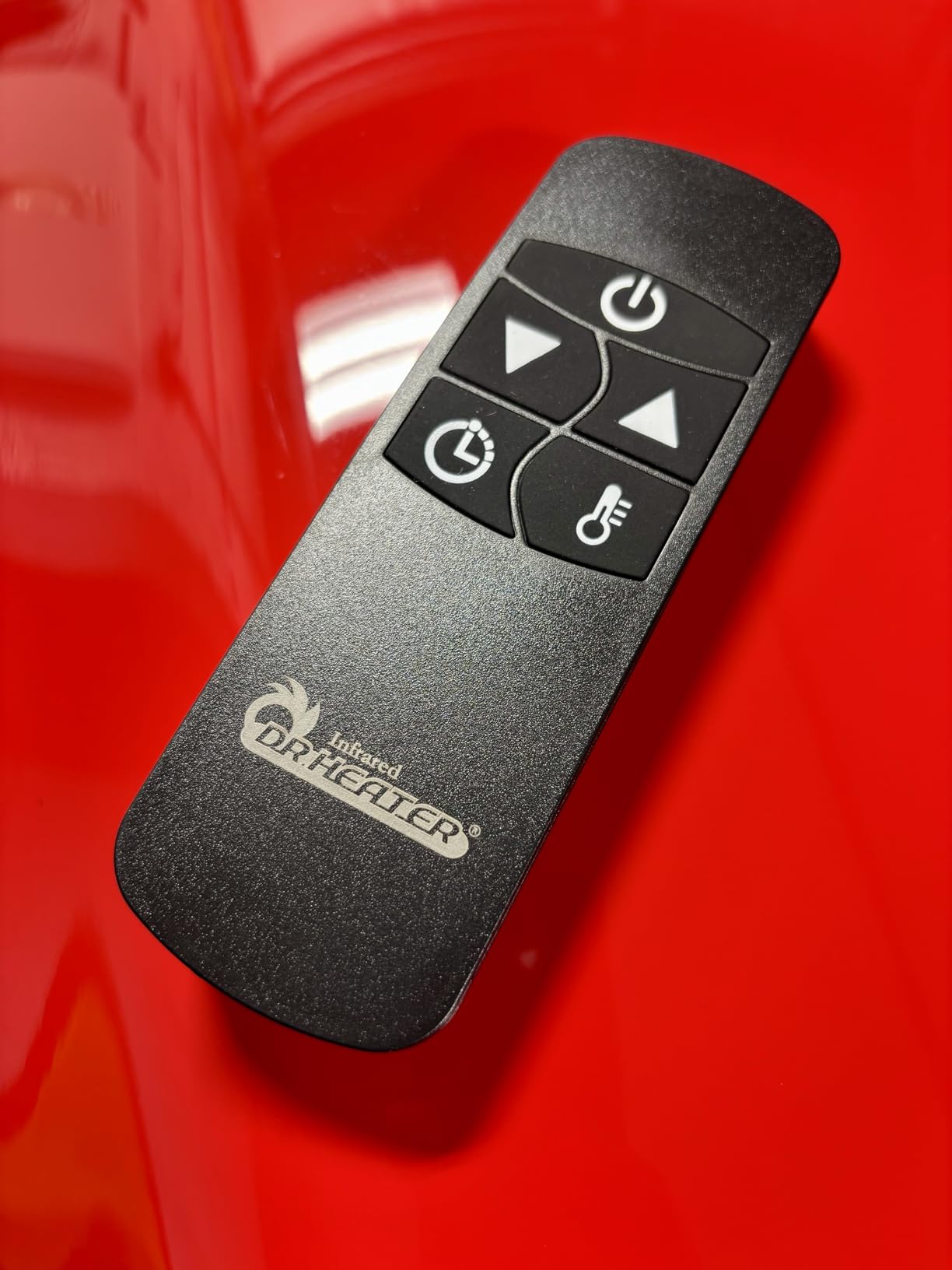
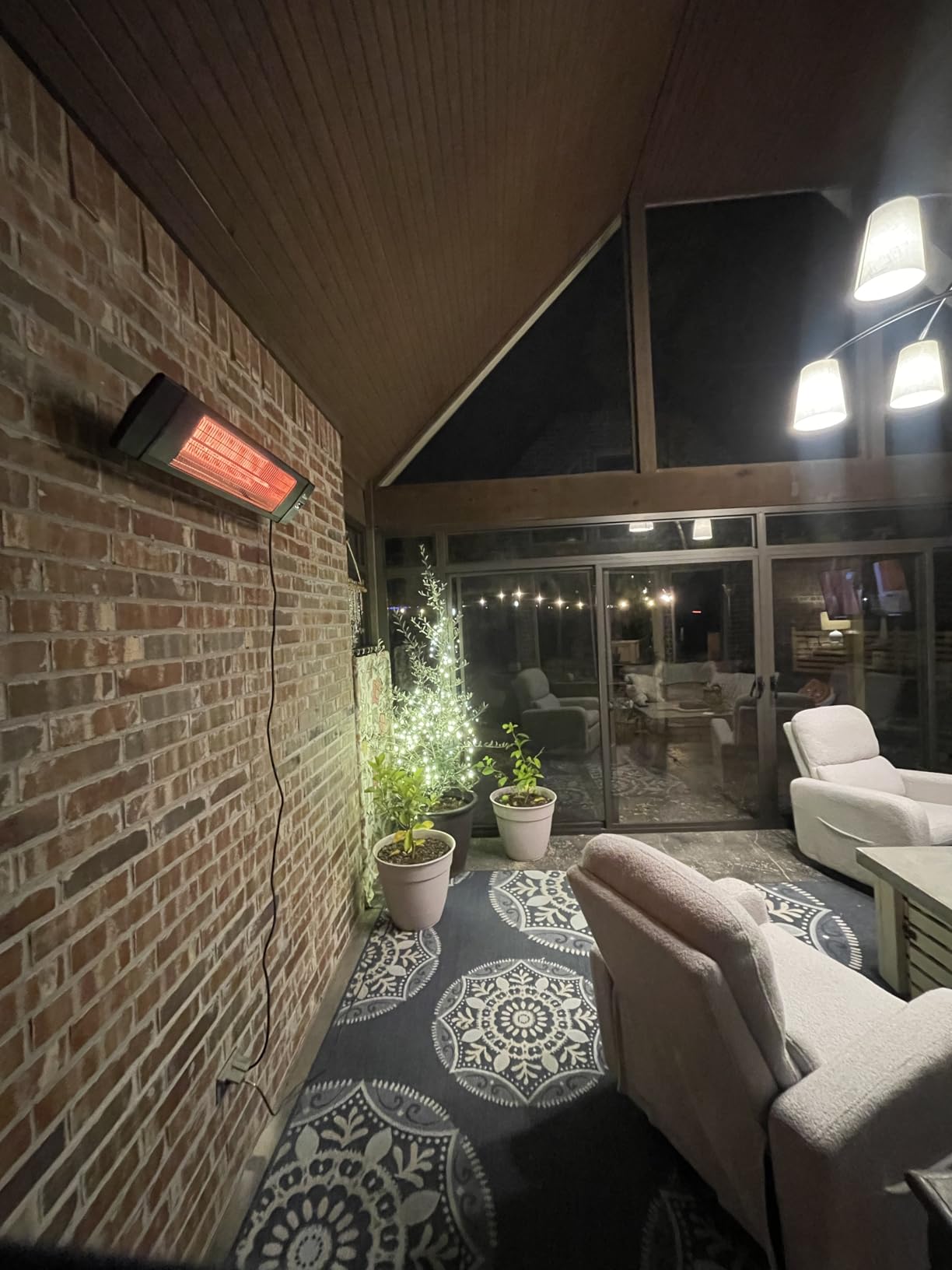
Owner feedback is consistent and worth repeating: this works best mounted high and close to where people sit. Deck owners in one r/HomeImprovement thread on a windy rooftop landed on infrared for exactly this reason, reasoning that a convection heater only warms the air right before that air is blown away. Radiant heat travels as energy, so wind has far less to work with.
IP55 approval means the housing is rated for dust and water ingress protection sufficient for permanent outdoor mounting. It draws 12.5 amps on 120 volts, which is a real constraint: it needs a properly grounded outdoor receptacle, and if you use an extension cord it has to be a heavy-gauge outdoor-rated type, not a household indoor cable.
How high and how far to mount it
The reflector is doing the aiming, and it wants the unit above and in front of the seated guests rather than across the room at them. Mounting it on an exterior wall or beam at roughly head height or higher, with the seating group a few feet out, produces the effect reviewers describe. Mount it too low or too far away and the same 1500W feels like nothing.
Plan the bracket position carefully before you drill. The included brackets do not include a drill-hole template, so the mounting holes are your responsibility to measure and mark. On a finished ceiling beam you will want to confirm what is behind the surface first.
Where this unit disappoints
This is a close-range heater pretending to be a room heater, and it is honest about that only in the specifications. Because it puts out no heated air at all, it does nothing for a large open area, and anyone standing further than about 6 to 8 feet away simply will not feel it. In a fully exposed deck with no wall to mount to, it is simply the wrong tool.
3. Pamapic 89-Inch Pyramid Propane Patio Heater – Best for a Pergola
Pamapic 89″ Pyramid Patio Heater Outdoor, Propane Flame Tower with Quartz Glass Tube, Outdoor Heaters with Wheels & Cover for Deck, Porch, Backyard, Garden, Hammered Bronze
48000 BTU propane
15-foot diameter coverage
61.7 lb
21 x 21 x 89.4 in
Pros
- Visible quartz glass flame doubles as patio ambience
- 48000 BTU across up to 15 feet diameter
- Wheels plus a protective cover in the box
- Hammered bronze finish suits upscale spaces
Cons
- At 89 inches the heat concentrates well above seated guests
- Heavy at nearly 62 pounds
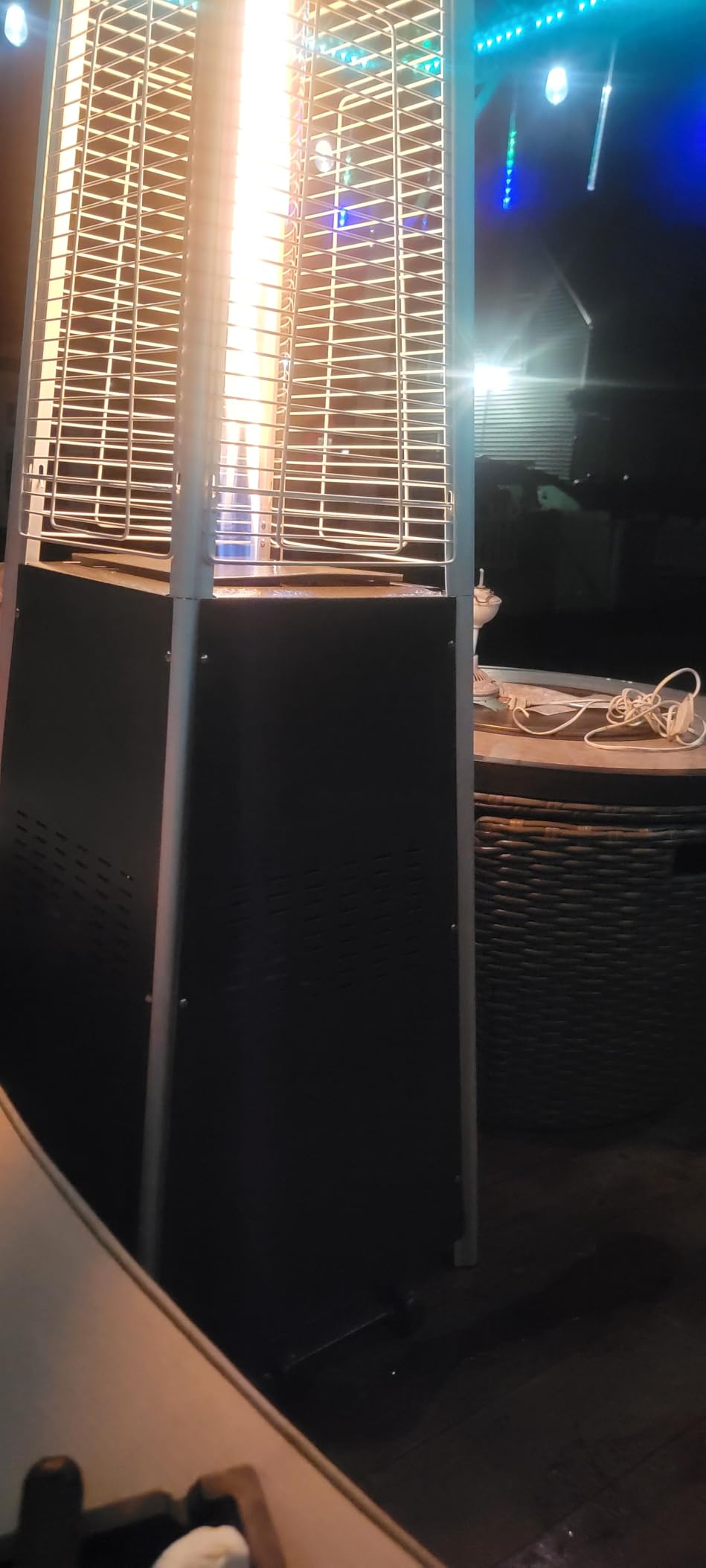
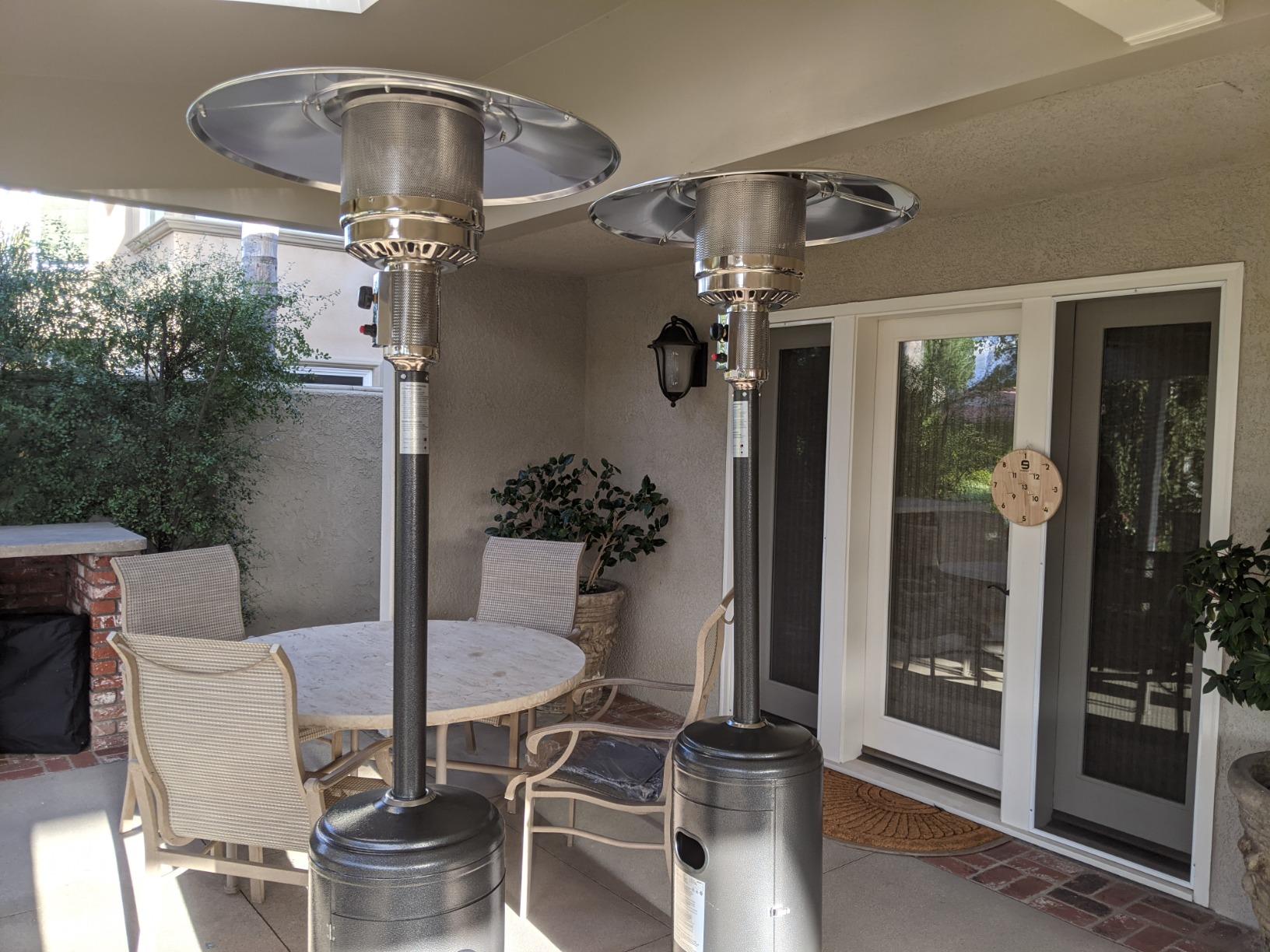
Functionally this is one of the strongest radiant heaters in the list at 48,000 BTU, but the reason to buy it is the quartz glass flame column. You can see it glowing through the glass tube, and buyers consistently describe choosing this model because it looks good on the deck rather than because it is merely functional. On a pergola where the heater is part of the evening, that matters.
The pyramid silhouette also throws heat outward and downward from a high point, which is a genuinely different pattern from the mushroom reflectors. The stated coverage of up to 15 feet in diameter is among the widest spreads in this group, and it gives you room to put a second seating group a few feet out.
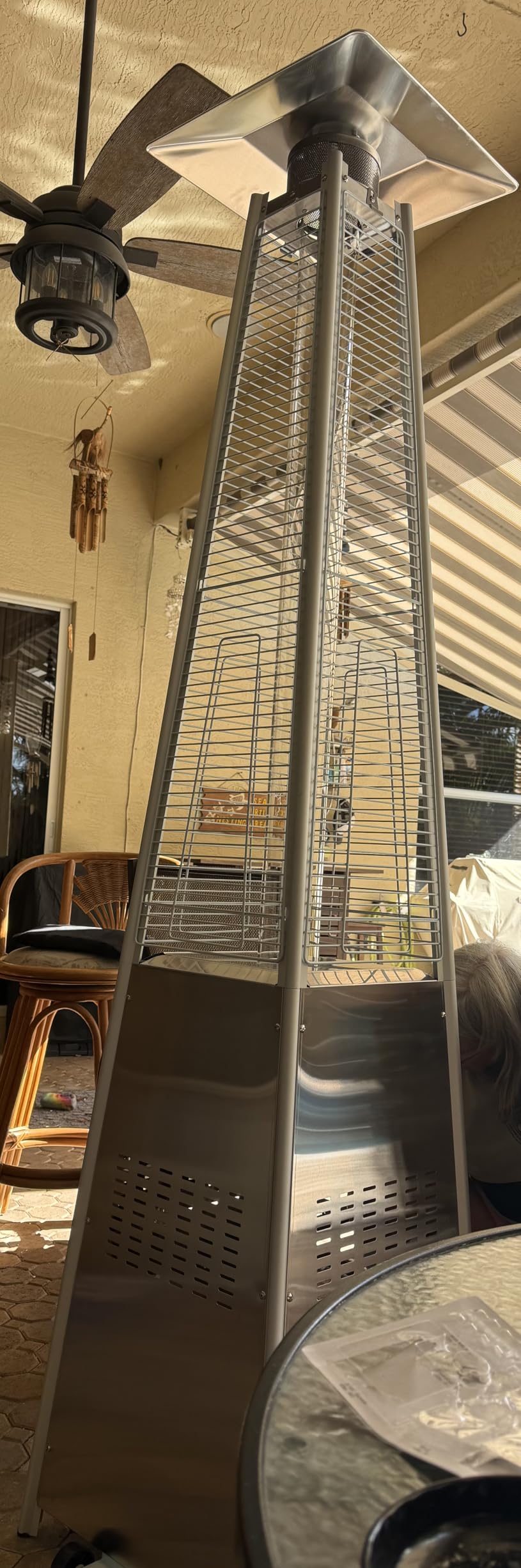
What you are accepting is weight and height. At 61.7 pounds and 89.4 inches tall, this is not a unit you shuffle between seatings while guests arrive. The wheels help with a hard surface, but rolling that much mass across wooden deck boards is a real chore, and on a soft or uneven surface the casters can dig in rather than roll.
That height is the second tradeoff. Reviews note a recurring theme that the heat concentrates near the top of the unit, which on a tall pyramid means seated guests at table height feel less of it than the specification suggests. If your seating is low, take that seriously before you commit.
When a pyramid design actually wins on a deck
It wins when the deck is a social space rather than a corner. The flame column gives you a light source and a focal point, the hammered bronze powder finish holds up outdoors, and 48,000 BTU with a 15-foot spread handles a seating group larger than most tower units manage. A pergola with open sides and a defined seating area is the ideal spot.
It loses when your seating is low-slung lounge furniture, when you need to move the heat to wherever the conversation moved, or when the deck surface is a soft composite that the wheels cannot handle well.
Where this unit disappoints
What you should check before assembly is the condition of the frame and the fastener quality, because this style of tower is held together by a lot of small hardware. Give every bolt a manual tighten and keep a spare set on hand, so nothing is left at the torque that came out of the box. Build it on a flat hard surface rather than on your finished deck, and you are not kneeling on the boards with a wrench.
4. Hykolity 50,000 BTU Propane Patio Heater with Table Top – Best for Small Balconies
Hykolity 50,000 BTU Patio Heater for Outdoor Use, Propane Patio Heater
50000 BTU propane
200 sq ft coverage
33 x 18 x 87.25 in
Piezo ignition
Pros
- Well reviewed at 4.5 stars with 76 percent five-star reviews
- 50000 BTU covering about 200 square feet
- Piezo ignition needs no battery or wiring
- Table top gives you a surface with the heat
- Wheels for repositioning
Cons
- Gas connection and assembly needed before first use
- Stated coverage is modest next to larger umbrella-style heaters
This one earns its place on a small balcony or a modest apartment terrace where floor space is the constraint. The table-style top is a genuine extra surface for drinks and snacks, and at 18 inches wide the footprint is narrow enough for a balcony with tight clearances. The stainless steel burner sits under an umbrella-style reflector that spreads the heat rather than shooting it in one line.
It carries a 4.5 star average with 76 percent of reviewers handing over five stars, and owner reports describe quick warm-up and one-button ignition as the things they notice first. Piezoelectric ignition is worth a mention because it means there is no battery, no wiring and nothing to fail in the cold.
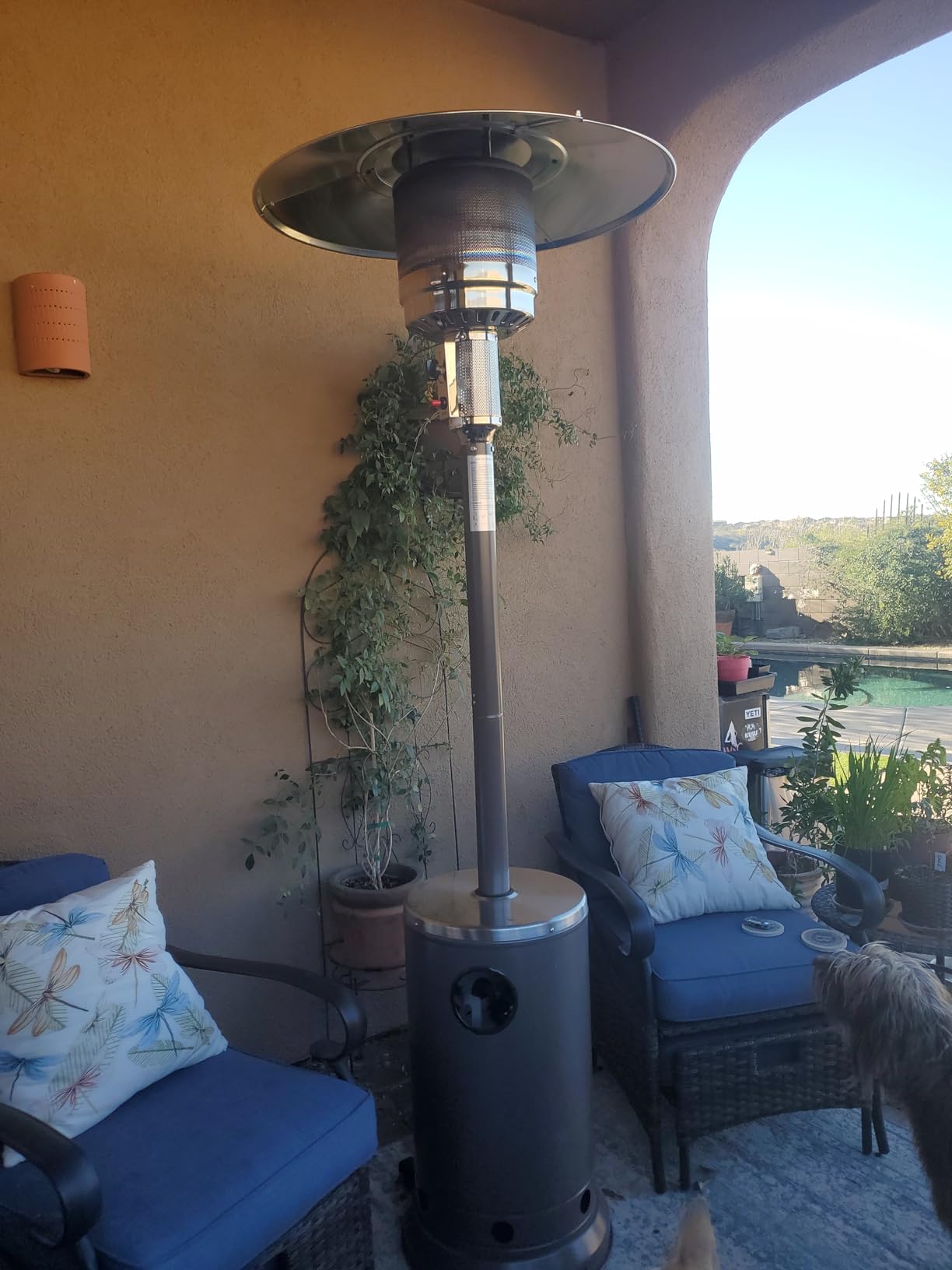
The triple protection system is the detail that matters on a deck. Waterproof and rainproof construction with an insulated switch means an unexpected shower is not an automatic end to your evening, which on an uncovered deck is the difference between a heater you keep running and one you panic-switch off.
Two things temper the recommendation. First, you have to connect the gas and complete assembly before the first use, so budget an afternoon rather than assuming it comes ready to light. Second, the 200 square feet stated coverage is honest but modest, and at 33 inches deep the base needs clearance on all sides.
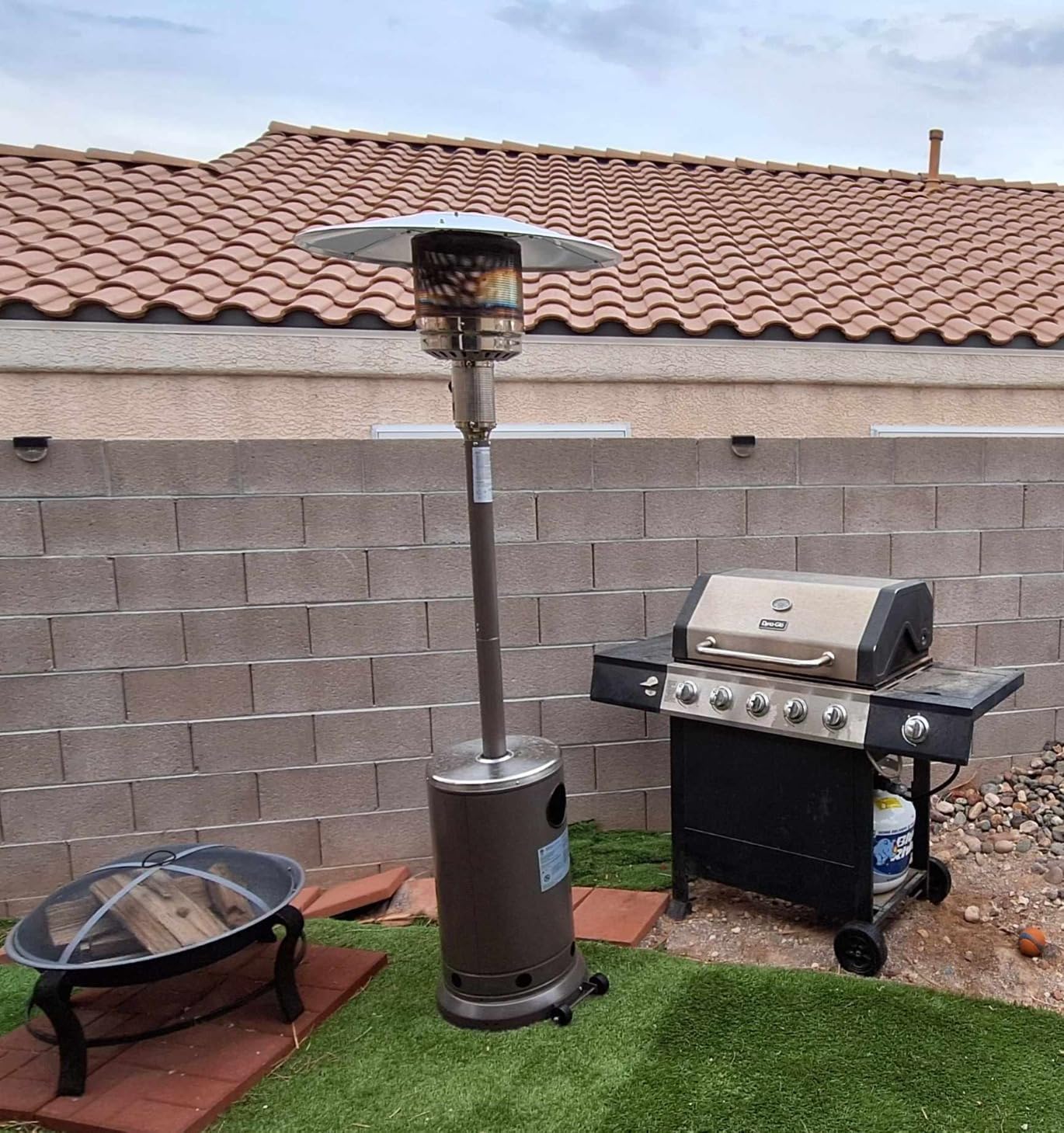
Why a 200 sq ft claim is not a downgrade
Radiant heaters are designed to warm people sitting in a zone, not to raise the air temperature of a footprint. A 200 square foot figure corresponds to a seating group of four to five around a small table, which on a balcony is exactly the use case. Judge a heater on whether everyone at the table feels warm, not on the square-foot number printed on the carton.
The narrow 18-inch base also makes this one of the easier propane units to place against a balcony railing without it protruding into a walkway, which is where a wider tower becomes a genuine obstruction.
Where this unit disappoints
Compare it against the umbrella-style reflectors used by larger commercial heaters and you will notice the heat distribution is less even across a wide area. It is a point-of-use heater. If you plan to expand your seating to eight or ten people, step up to a unit with a wider reflector or plan on a second heater.
5. Legacy Heating 47,000 BTU Mocha Patio Heater – Best Finish for a Covered Deck
LEGACY HEATING Patio Heater, Outdoor Heater, Mocha
47000 BTU propane
200 sq ft coverage
35.2 lb
30 x 88 x 30 in
Pros
- Highest average rating here at 4.6 stars with 80 percent five-star
- Domed reflector with radiating holes pushes heat down and out
- Tip-over plus flame-failure plus low-oxygen cutoffs
- Silent smooth wheels for one-person repositioning
Cons
- Assembly takes around 30 minutes even with hardware included
- Propane cylinder is a separate purchase
On pure satisfaction, this is the standout. A 4.6 star average with 80 percent of reviews at five stars is the highest rating of any unit here, and the compliment that recurs is not about raw output but about how the heat behaves: a domed aluminum reflector with radiating holes and a hood heating net that sends warmth downward and outward into the seating area instead of over your head.
It is also the unit I would pick for a covered deck or a porch where appearance counts. The mocha finish is understated and reads as furniture rather than equipment, and the safety package is the most complete in the group: tip-over cutoff beyond 15 degrees of tilt, flame-failure shutoff and a low-oxygen safety system all working together.
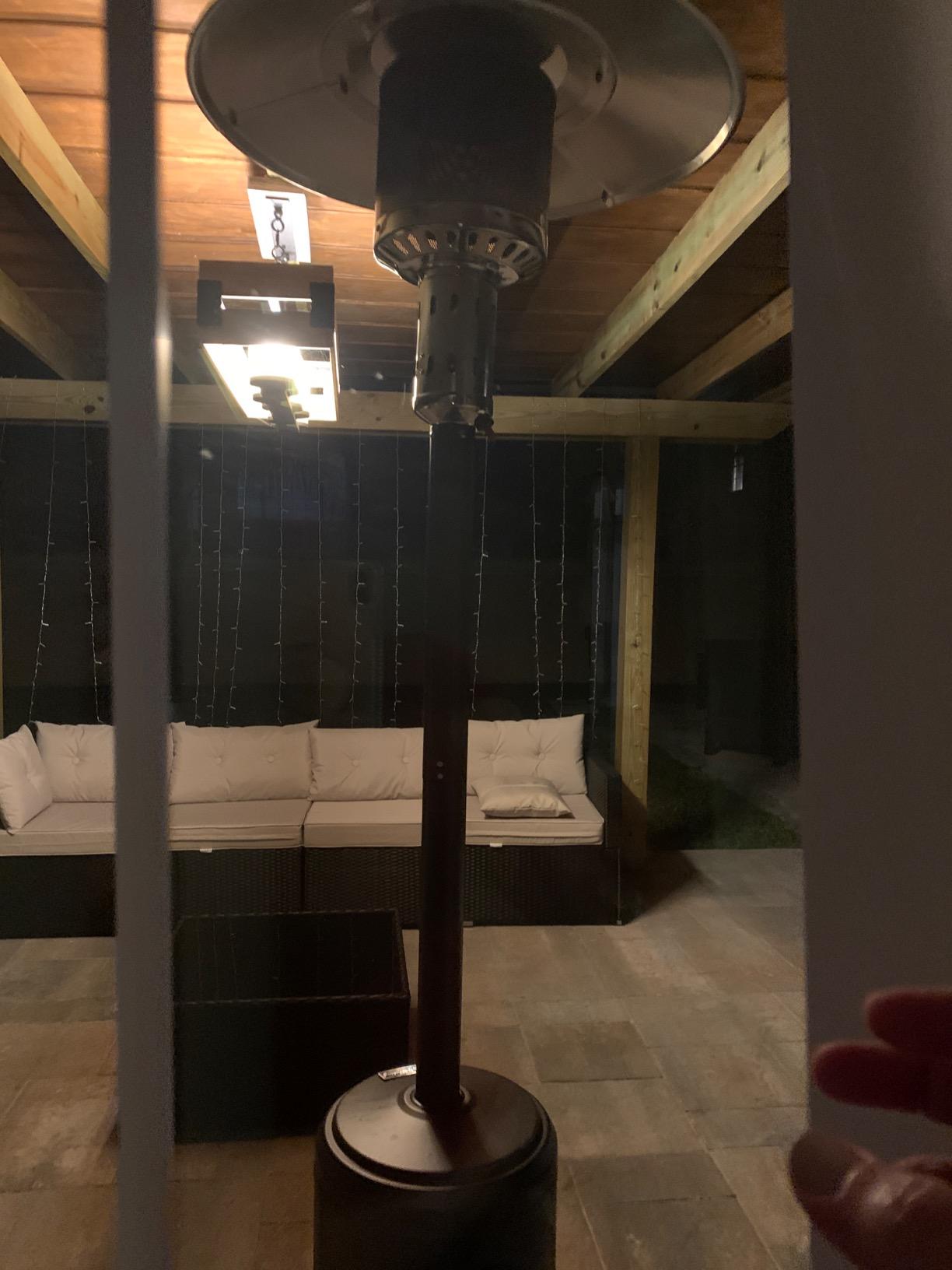
One-touch ignition with no pilot light means there is no standing flame to manage and nothing to extinguish when you finish for the night. At 35.2 pounds with smooth silent wheels, this is the propane unit in the roundup that a single person can genuinely reposition when the conversation moves, which is the quiet test of whether a heater belongs on a deck.
The 4.6 average comes from 331 reviews, one of the smaller samples here, and a smaller sample is inherently less proven over multiple seasons than the 11,000-review unit above. It is the best-rated heater, not the most proven one.
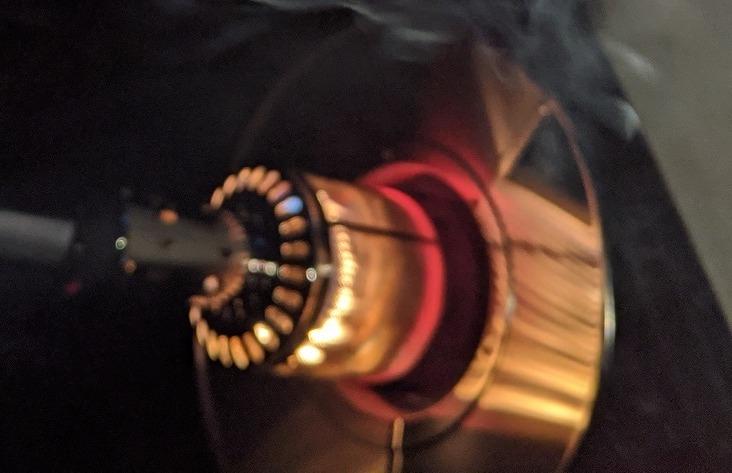
Why the safety triple matters on a raised deck
Every one of those three cutoffs is aimed at a specific deck failure mode. Tip-over protection covers a gust or a bump on a raised surface. Flame-failure shutoff stops gas flow if the flame dies, which on a windy deck happens regularly. Low-oxygen detection covers running a combustion heater in a semi-enclosed porch where fresh air is limited.
For anyone who has watched a flame get knocked out on a windy evening and had to relight it, that last set of protections is the practical difference between a heater you leave running and one you switch off.
Where this unit disappoints
Assembly. Owners consistently put it at around 30 minutes with all hardware included, which is a weekend-morning task rather than an after-work one. And the 88 inch listed width means you need to check the reflector clearance against any ceiling, soffit or pergola beam above the deck, not just the deck boards below it.
6. Paraheeter 1500W Infrared Patio Heater – Best for Roof Decks
Paraheeter Outdoor Electric Infrared Patio Heater, 1500W
1500W carbon infrared
IP65 rated
10-15 foot radius
18.8 lb with tripod
Pros
- Wall ceiling or tripod mounting in one package
- IP65 weatherproof with a 10000 hour carbon fiber tube
- No propane tank and no open flame
- Running cost roughly one-tenth of propane
Cons
- Foam protective pad must be removed before first use
- Radiant heat falls off fast so guests must sit close
Wind is the defining problem on a roof deck or a high terrace, and this is the heater that answers it best. The carbon fiber heating tube is rated for a 10,000 hour lifespan and the housing carries an IP65 weatherproof and dustproof rating, matching the tightest ingress rating of any unit here. Nothing about it depends on a flame surviving a gust.
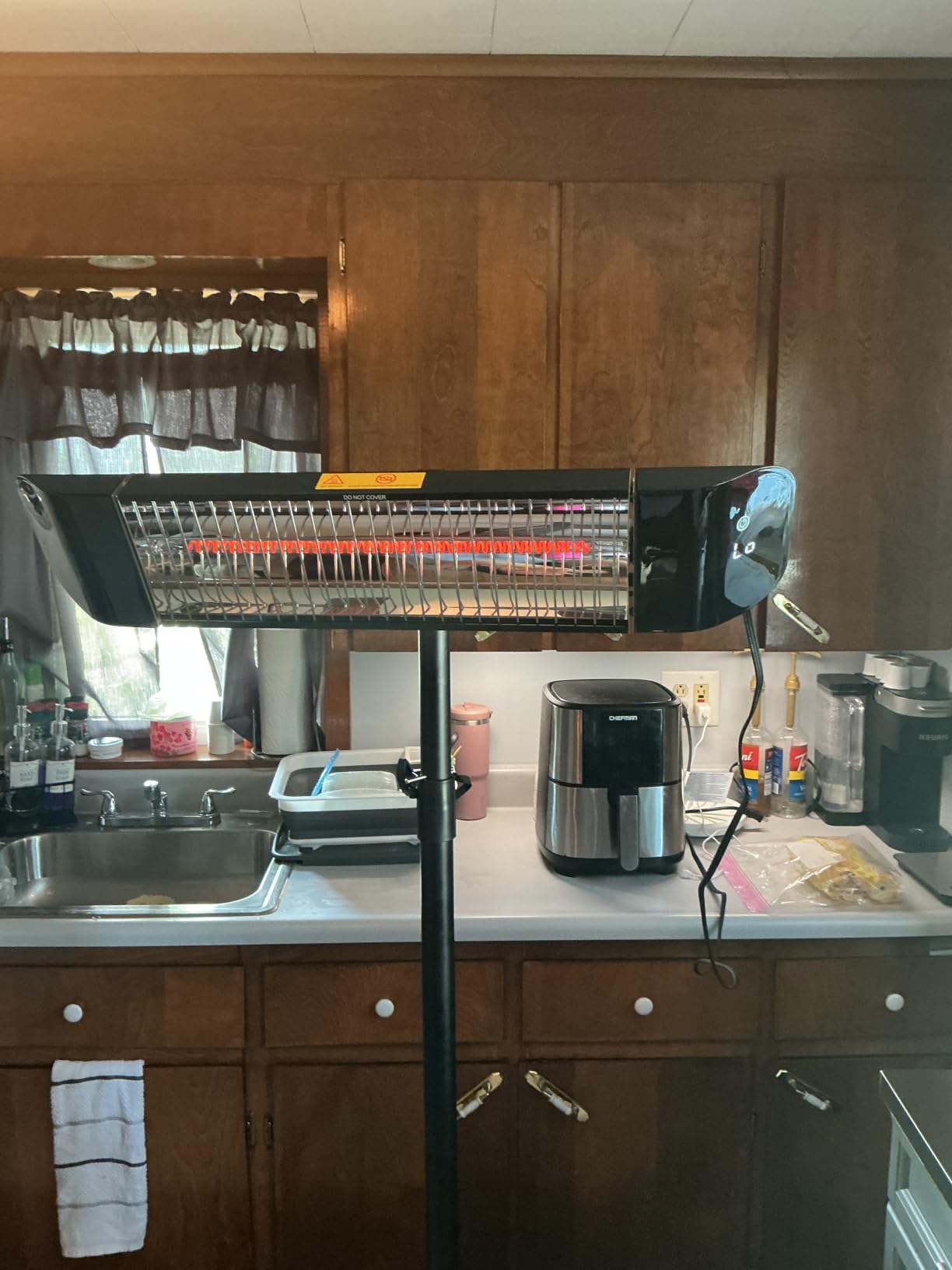
The three-way mounting is the feature that separates it from the wall-mounted options. Wall, ceiling and an included adjustable tripod stand ship in the same package, so you can hang it under a pergola roof in the afternoon, move it to a wall for the evening, or stand it on the deck when neither is available. Reviewers consistently single out that flexibility as the reason to buy it.
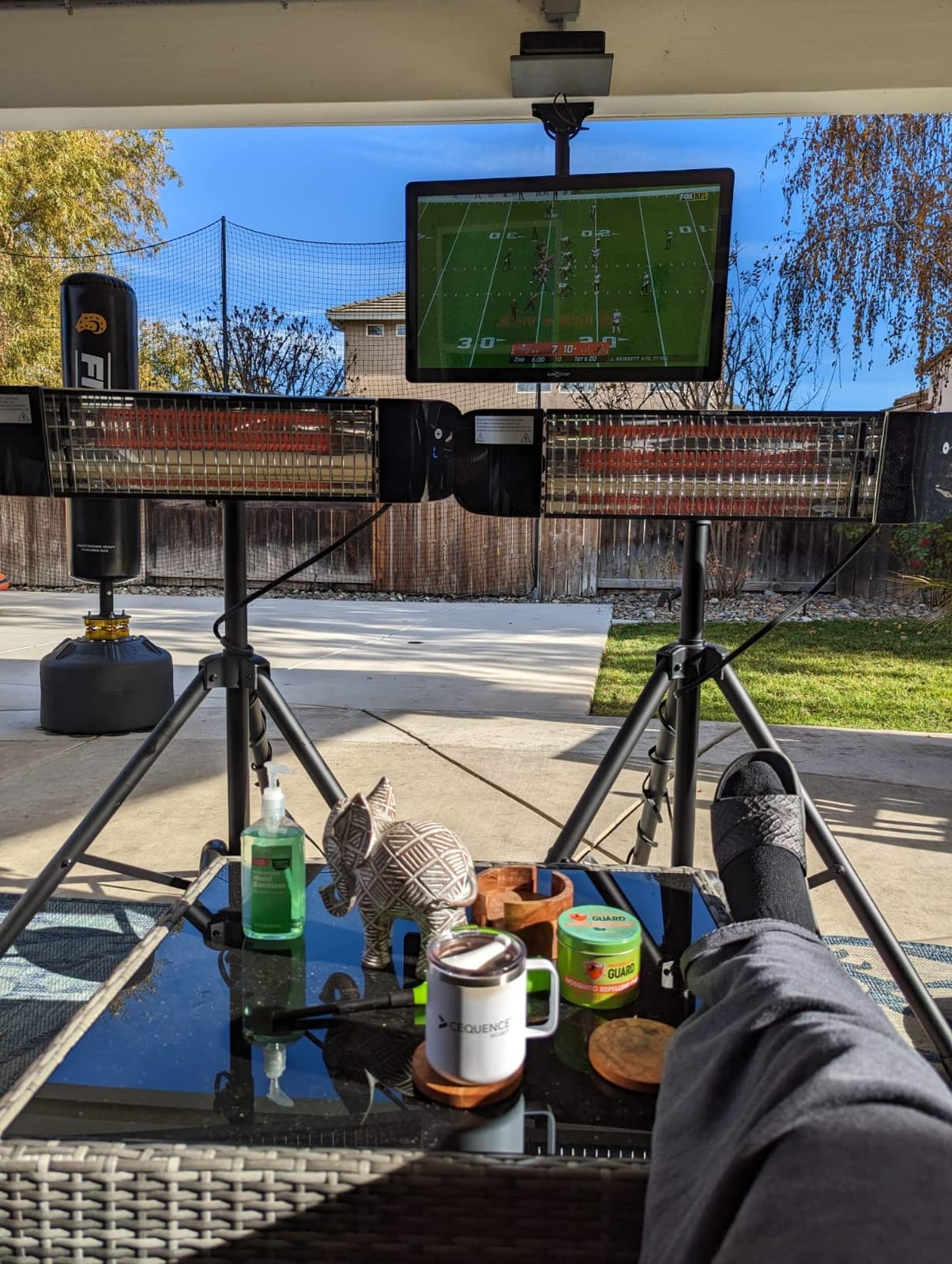
It also has the running-cost advantage in its favor. Owner estimates put the hourly cost at roughly one-tenth of a propane heater, and that gap compounds across a whole season of evening use. With no tank to refill, no fuel line to run and no combustion products to think about, it is the simplest deck heater to own over a long autumn.
Two practical notes before you order. There is a foam protective pad fitted over the heating tube that has to be removed before first use, and a tipped-over or overheated unit cuts out automatically. The tip-over auto shutoff, metal safety grille and grounded three-prong plug are all present, and the unit is CSA certified with a one-year warranty.
How to get the most from a 1500W infrared unit
Sit close. The stated 10 to 15 foot radiant radius is where you might detect warmth, not where you will be comfortable in cold weather. Mount it so the cone lands on the table rather than across the deck, and check back after ten minutes to confirm people can feel it. If they cannot, move the unit, not the expectation.
Reduce the wind instead of fighting it. A deck railing, a windbreak panel or the corner formed by the house wall blocks the breeze and lets a modest radiant heater do considerably more work than it would in the open.
Where this unit disappoints
It is not a deck-wide heater. A 1500W element cannot make a 200 square foot deck comfortable for a large group, and anyone expecting propane-level output from a plug-in unit will be disappointed. It is a heater for a defined spot, and it delivers on that promise only if you position it deliberately.
7. FOOWIN 48,000 BTU Propane Patio Heater – Best All-In-One Package
FOOWIN Patio Heater 48,000 BTU Outdoor Propane Heater with Wheels
48000 BTU propane
130 sq ft coverage
50.7 lb
18.11 x 20.4 x 81.4 in
Pros
- Quartz glass tube and pyramid profile look better than mushroom reflectors
- 48000 BTU spreading about 10 feet in all directions
- Wheels cover and operating gloves all included
- 10000 flame-out tests run on every unit
Cons
- Included machine screws strip easily during assembly
- Structural pieces sometimes arrive bent in transit
- At 81 inches warmth concentrates above seated guests
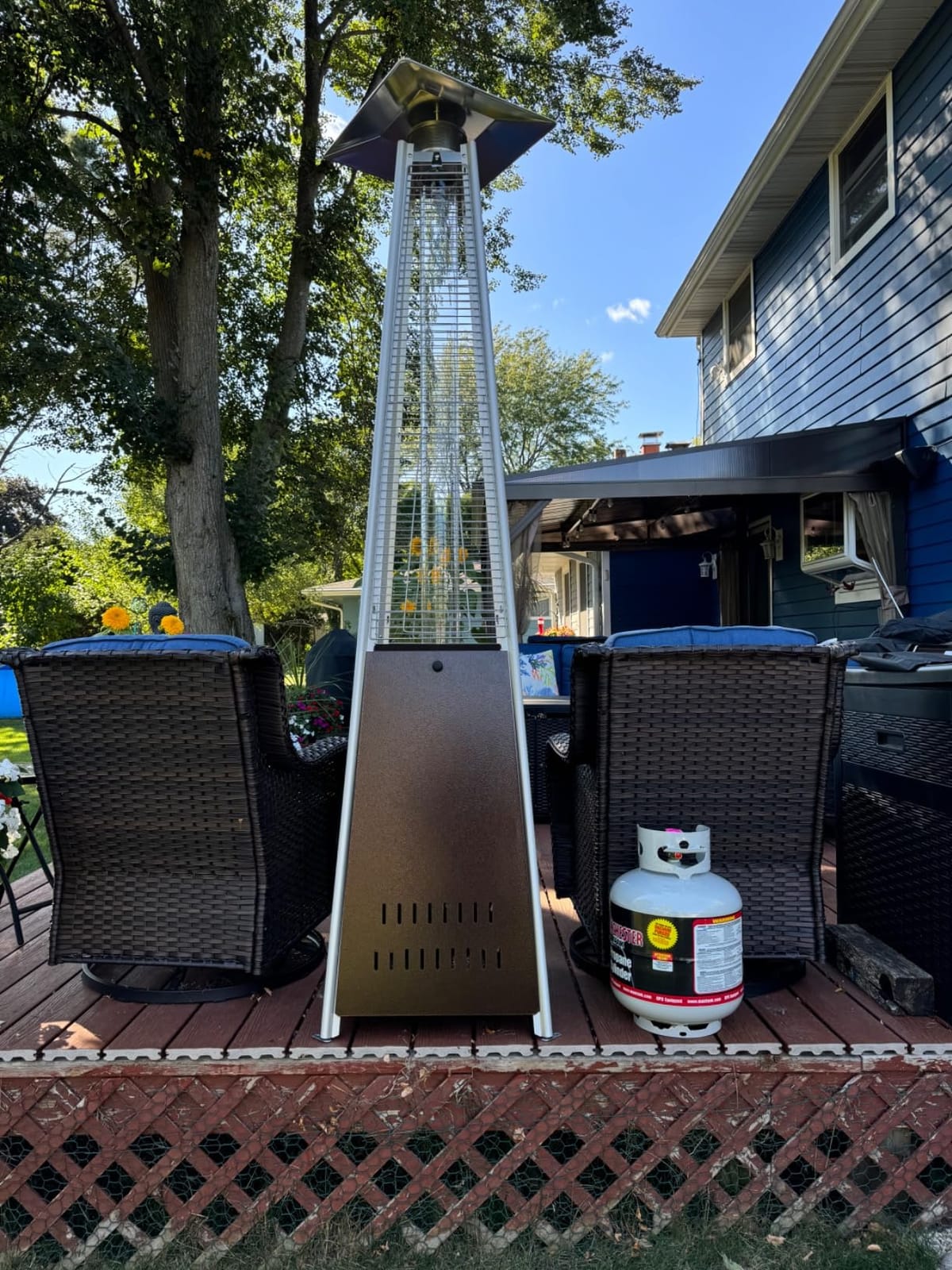
The strongest argument for this heater is the box contents. Most competitors sell you the heater and expect you to source a cover, gloves and a way to move it. This one arrives with wheels, a waterproof cover and operating gloves in the box, which removes the three follow-up purchases that most owners end up making anyway.
The output is solid at 48,000 BTU with an approximately 10-foot spread in all directions, warming about 130 square feet. That is a seating group of four to five, sized honestly. The aluminum and stainless steel construction with a quartz glass tube gives it a more decorative look than a plain mushroom reflector, and the bronze finish helps.
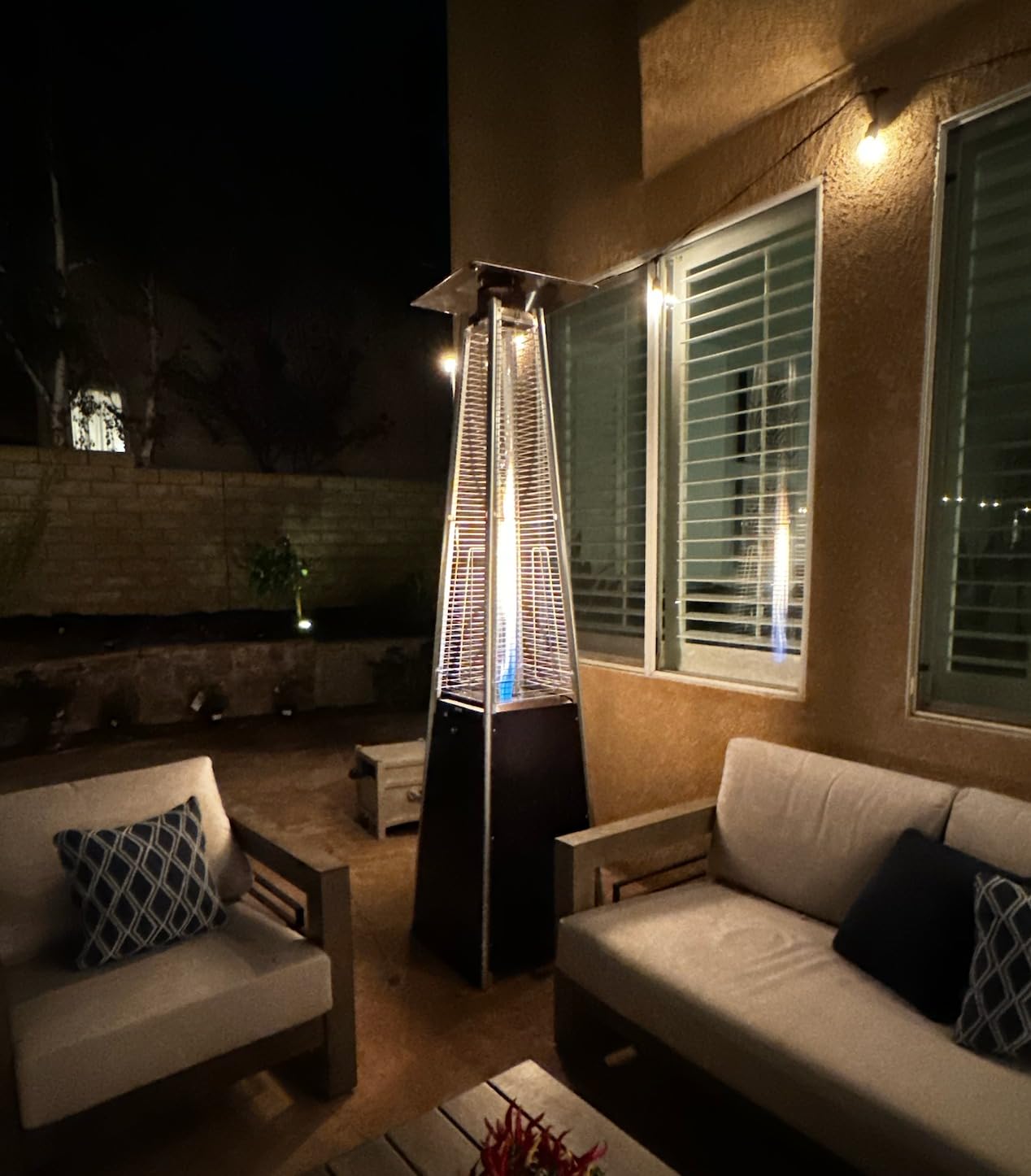
Safety engineering here is more thorough than the specification sheet suggests. Auto shutoff triggers above 45 degrees of tilt, there is an explosion-proof pipe and a protective net around the flame, and the manufacturer reports running 10,000 automatic flame-out tests per unit before it leaves the factory. A lifetime warranty is included as well.
Service matters too. Customers report fast, responsive replacement when a burner developed an issue, which counts for a component that lives permanently outdoors. The 50.7 pound weight and 81.4 inch height make it a two-person move at best, so plan where it will live before you unbox it.
How to deal with the assembly complaints
Two issues recur: the included machine screws are soft and can strip, and some structural pieces arrive bent in transit. Both have straightforward workarounds. Assemble on a flat hard surface, not on finished decking, and have a spare set of fasteners on hand so you are not fighting a stripped head with the supplied tool alone.
Once assembled, the 45-degree tip-over cutoff means a bump is survivable, but nothing replaces placing it on a level spot away from the walking route in the first place.
Where this unit disappoints
At 81 inches tall the warmth again sits above the heads of seated guests, and the reported 130 square feet of coverage is the smallest of the propane towers here. If you plan long evenings with people seated at table height, budget for a second unit or position this one carefully against the seating rather than at the center of the deck.
8. Pamapic 50,000 BTU Round Table Propane Heater – Best for Entertaining Groups
Pamapic Outdoor Heaters for Patio with Round Table Design, Premium 304 Stainless Steel Burner, Triple Protection System Propane Patio Heater for Porch Garden, Residential & Commercial Use
50000 BTU propane
314 sq ft stated coverage
27.5 x 27.5 x 87.8 in
304 stainless burner
Pros
- Integrated round table for drinks snacks and phones
- 50000 BTU stated coverage of up to 314 square feet
- Warm-up in about a minute
- CSA certified with magnetic locking tank door
Cons
- Larger and more fully equipped than the electric options
- Delivered in two boxes so assembly waits for both
- Some owners feel less heat than the BTU rating implies
The round table on top is the reason to look at this one. When guests are waiting for a deck to warm up, the surface holds drinks, a bottle, snacks and a phone charger without anyone crouching on the floor, and it turns the heater from a machine into a piece of furniture you actually use. Owners mention the table first in almost every review.
The heating side is a 304 stainless steel burner under an aluminum top cover designed to concentrate the output, with a claimed coverage of up to 314 square feet, a wider figure than the other towers in this group carry. Warm-up is quick: roughly one minute from ignition to useful heat, and one-touch ignition with an adjustable control knob.
The magnetic locking tank door is a small design decision that turns out to matter a great deal. Swapping a propane cylinder on most units means unlatching, lifting and holding a hatch while you wrestle a full tank. A magnetic catch holds itself open long enough for you to get both hands on the tank, which is the difference between a two-minute job and a fumble.
There is a full safety package too, with tip-over cutoff beyond 45 degrees and flame-failure gas shutoff, and the unit is CSA certified. At 27.5 inches square it needs a clear 27.5 inch footprint, so measure the deck before committing to a unit with a table on top.
How to read a 314 sq ft coverage claim honestly
Manufacturer coverage figures are measured under ideal conditions, and the real limit is usually seating arrangement. Even with 50,000 BTU, guests at the far end of a 314 square foot space will feel less than guests at the table. Treat the number as the theoretical footprint and plan your seating within the comfortable inner zone.
A minority of owners report the felt heat output being lower than the BTU rating suggests, which is a common pattern across combustion heaters. Practically, it means a larger table does not automatically mean a warmer group, and two smaller zones heated individually will outperform one large zone.
Where this unit disappoints
It is a large, fully equipped tower, and it arrives in two boxes, so assembly cannot begin until both have arrived. Plan for a short delay before you start unpacking, and for somewhere to keep a large flat-packed box. Both are small annoyances that are easy to avoid if you expect them.
9. Encyclpo 1500W 36-Inch Infrared Tower Heater – Best for Small Spaces
Encyclpo Patio Heater for Outdoor Use,1500W Infrared, 36 in Portable Tower Heater, 3 Levels, IPX5 Waterproof, Tip-Over&Overheat Protection for Garage, Indoor, Large Room, Backyard, Home
1500W carbon infrared
IPX5 rated
7.5 lb
8.1 x 12 x 36 in
Pros
- Near-instant quiet infrared warmth with no odor
- Slim 36-inch tower at only 7.5 lb moves easily
- Three heat levels with top-mounted controls
- Tip-over and overheat shutoff including pet knocks
Cons
- Small warm radius so you must sit close outdoors
- Manual knob is fragile and has cracked for some owners
- No remote and a short cord limits placement
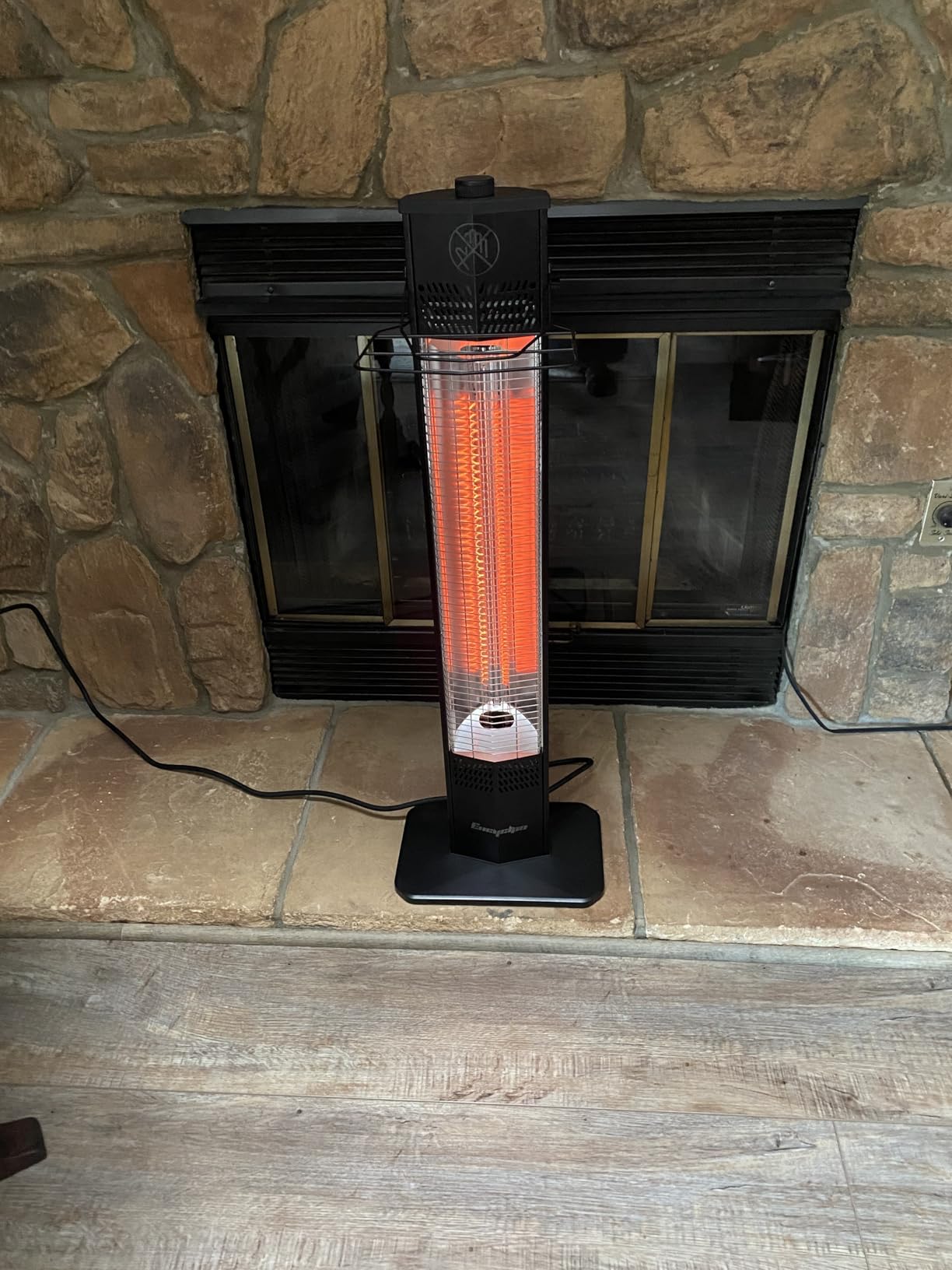
At 7.5 pounds this is the lightest heater in the roundup, and that single fact changes what you can do with it. You carry it out with one hand, reposition it between two chairs and two more seats, bring it back in when the rain starts and take it out again the next evening. That flexibility is worth more on a deck than raw output when your deck is small.
The heating is two high-efficiency carbon fiber wires with three selectable levels at 600W, 900W and 1500W, delivering near-instant infrared warmth with completely silent operation and no odor whatsoever. The IPX5 waterproof rating covers patios, porches, balconies and garages, and the temperature range runs from 40F to 140F.
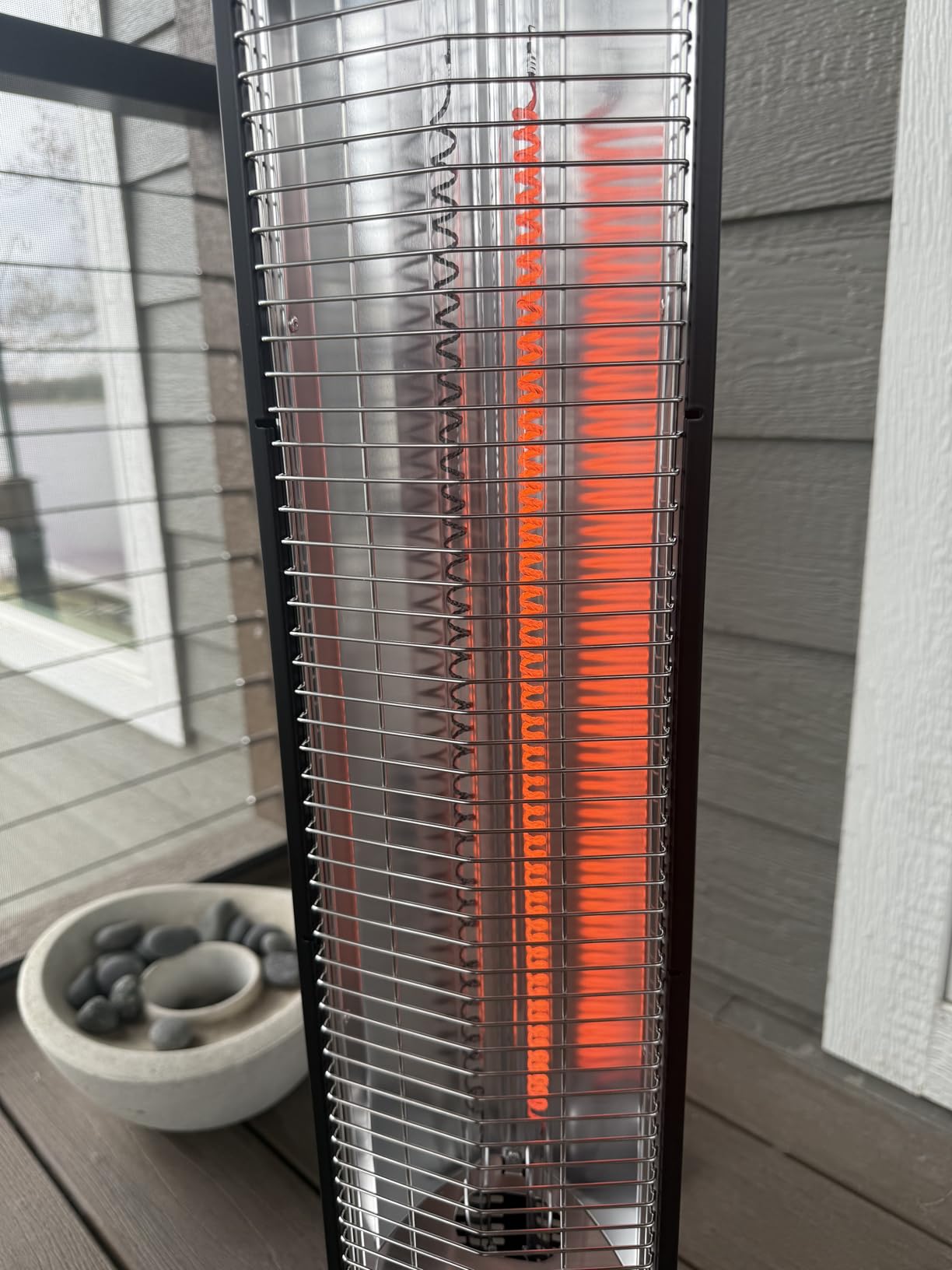
Safety is handled sensibly for a portable electric unit. Tip-over and overheat auto shutoff both trigger, the housing is flame-retardant, and reviewers specifically note that the tip-over cut-off has done its job when a pet or a foot catches the tower. That is a real-world scenario, not a specification-sheet one.
The recurring complaints are mechanical rather than thermal. The manual control knob is fragile and has cracked for some owners after a few weeks, there is no remote control, and the cord is short enough that you should plan the outlet position before deciding where the heater goes.
Where a 36-inch tower actually wins
A balcony, a small apartment terrace or a screened porch where the seating is within a few feet of the wall outlet. At that scale, a 1500W infrared unit with no fuel, no flame and no moving parts is the right answer, and a propane tower would be both oversized and unwelcome at that size.
It also works well as a supplementary heater for a garage or a workshop, which owners mention as a secondary use. The 600W low setting is genuinely useful on a cool evening when the full output would be uncomfortable.
Where this unit disappoints
Outside, the warm radius is small, and in genuinely cold weather you will be sitting close to it. Buyers expecting a 1500W tower to heat a deck come away disappointed; buyers who sit six feet away on a mild evening are happy. Know which one you are before you buy.
10. SereneLife 1500W Infrared Patio Heater – Best With Height Adjustment
SereneLife Infrared Patio Heater 1500W Electric Heater Indoor/Outdoor Use, Portable Stand with Remote Control, IP65 Approved, 360° Tip-Over Safety Switch for Restaurant, Patio, Backyard, Garage, Decks
1500W carbon infrared
IP65 rated
20 sq ft warm range
23.4 lb adjustable stand
Pros
- Height-adjustable stand aims radiant heat at seated guests
- Electric infrared with no tank no fumes and no odor
- IP65 waterproof and dustproof with a stainless steel base
- Remote control plus LED status indicator
Cons
- Lowest average rating here at 4.2 stars
- Only about 20 sq ft of stated warm area
- Cord length largely consumed by the vertical pole
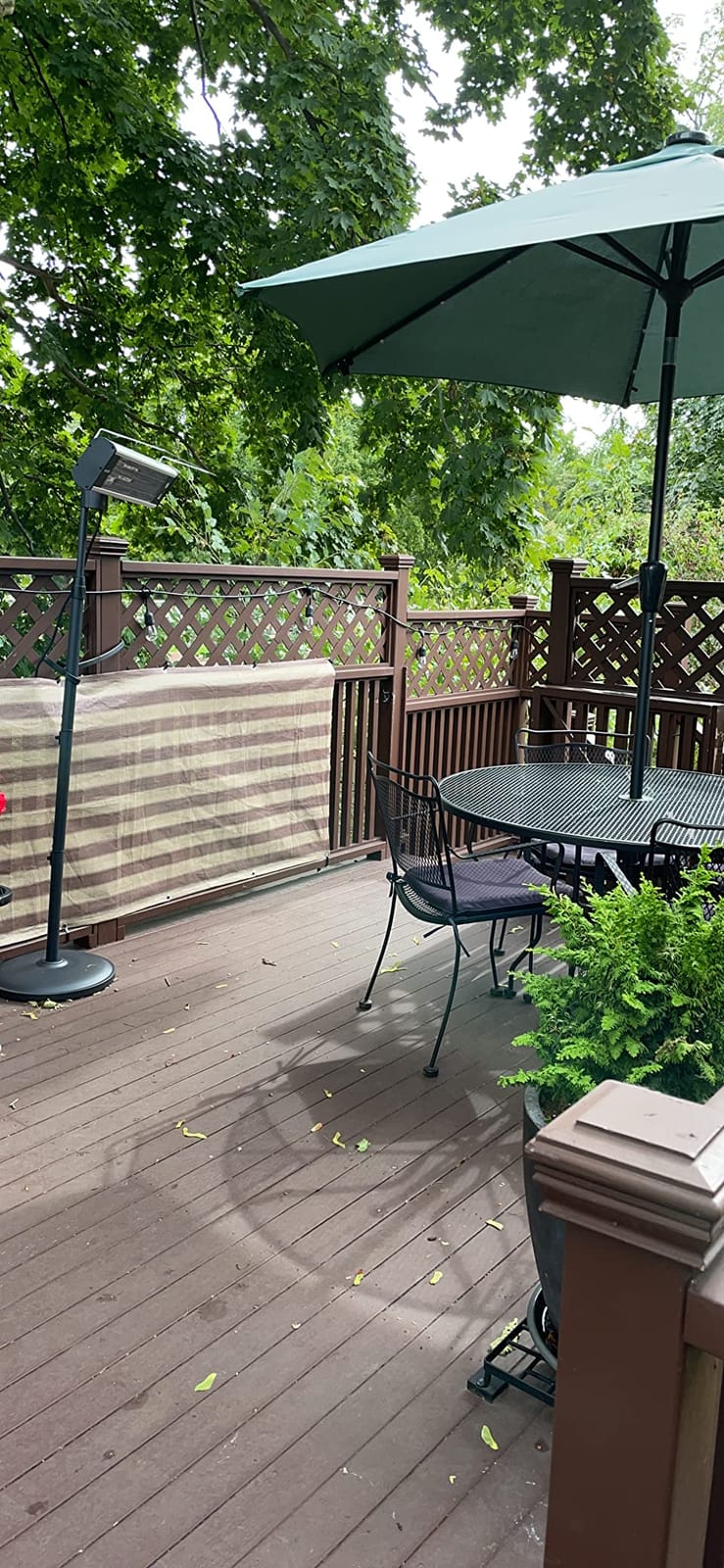
The height-adjustable stand is the feature that sets this apart from the fixed electric units. Once you know how much a few inches matter for where the radiant cone lands on seated guests, being able to raise or lower the head of the heater changes the result more than any wattage difference between 1500W models.
Construction is solid where it counts. An aluminum alloy frame, a stainless steel base cover that will not slide on decking, a mesh grille guard over the carbon fiber elements, a 360-degree tip-over safety switch and overheat protection. The IP65 rating covers both waterproofing and dust ingress, and the remote with an LED status indicator means you are not walking over in the cold to switch it off.
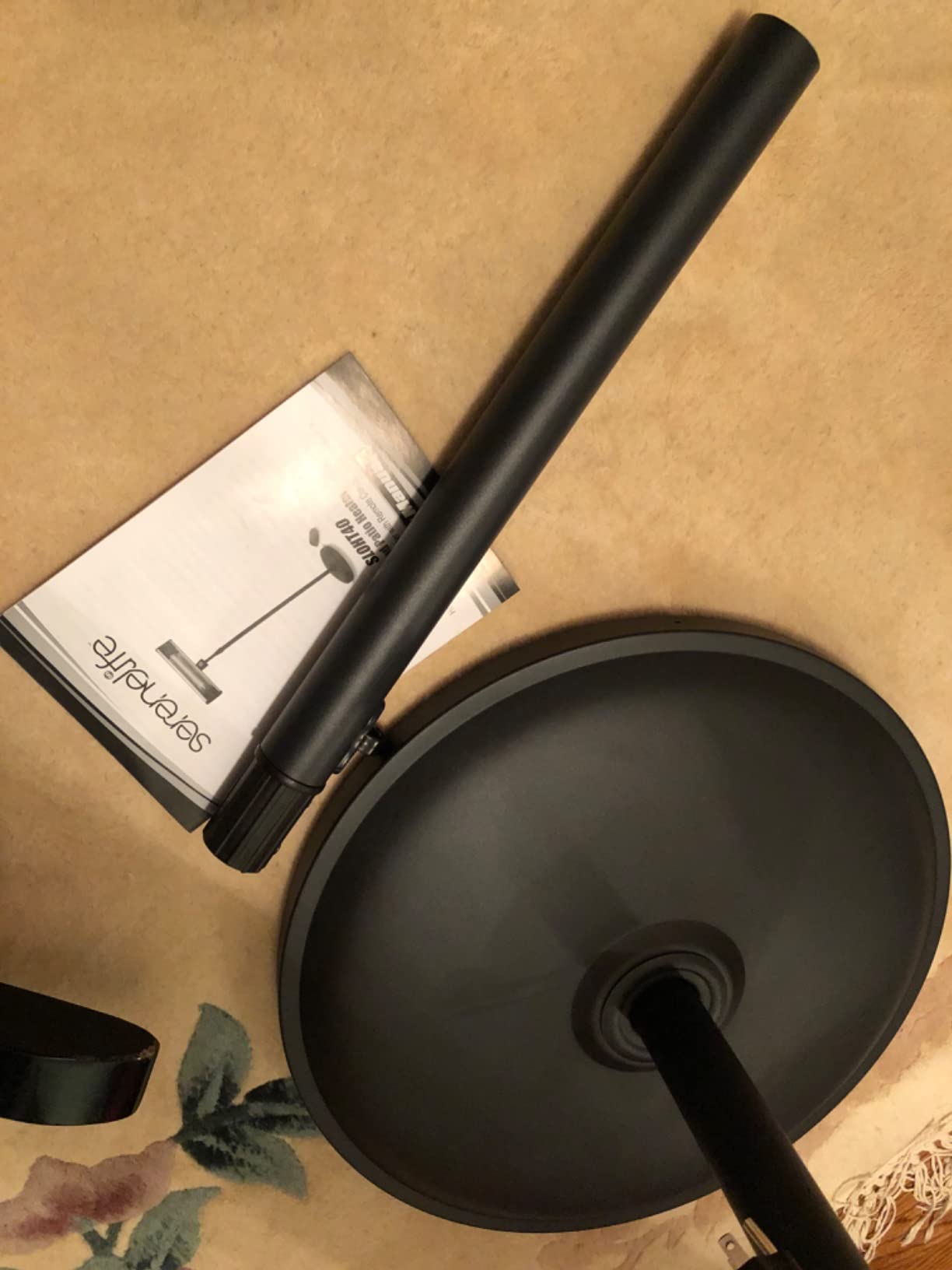
It draws 12.5 amps on 120 volts and reaches a maximum surface temperature of 360F, which means it needs a grounded outdoor receptacle and a heavy-gauge cord if you extend it. At 23.4 pounds the base is planted, which is good for stability and less good for carrying up deck stairs.
I want to be direct about the rating. A 4.2 star average is the lowest here, and reviews include scattered reports of units shutting off unexpectedly. The height adjustment and the build quality are real strengths, but this is the one in the group where I would pay close attention to the warranty terms and the seller before committing.
How to use the height adjustment properly
Set the head high enough that the cone clears the heads of seated guests and lands on their upper body and the tabletop, not down at your shins. Then test it from your actual seat, not standing. A heater adjusted by eye from standing height is usually aimed too high, because seated eye level is well below standing eye level.
The 20 square feet of stated warm area is honest and small. This is a heater for a two-person bistro set or a spot on a balcony, and for anything larger you would be better served by a mounted unit or a propane tower.
Where this unit disappoints
The cord length is the practical problem. Most of it is consumed running down the vertical pole, which leaves little usable length at the base, so a wall outlet that sits at the right height can still leave the heater short of where you want it. Measure before you buy, and plan on a properly rated outdoor extension if you need one.
How to Choose a Patio Heater for Your Deck?
Electric vs propane heaters: which one warms a deck better?
Propane, without close competition. A 46,000 to 50,000 BTU propane heater delivers roughly eight times the heat output of a 1500W electric unit, and it does so as radiant energy that reaches you directly rather than as warmed air that mixes with the atmosphere. For an uncovered or partially exposed deck in cold weather, propane is the only one of the two that will actually make the space usable.
Electric wins on everything that is not raw heat. There is no tank to refill, no fuel line to run, no combustion and therefore no carbon monoxide or odor, no flame for wind to extinguish, and the running cost is roughly one-tenth of the propane equivalent. A forum consensus that keeps coming up is that electric heats a person, not a deck, and that is the correct expectation to carry into the purchase.
How much heat output does your deck actually need?
Match the heater to the number of seated people, not to the square footage of the deck. A 47,000 to 50,000 BTU propane unit comfortably serves four to six people around a table. Beyond six, either place two heaters in separate seating zones or choose a high-output unit with a wide reflector, because one heater aimed at ten people warms the two nearest them.
For electric, 1500W is the practical ceiling for a 120-volt deck outlet, and it serves two to four people sitting close. Anything larger is a hardwired or 240-volt job, which is an electrician’s installation rather than a weekend project, and one that forum readers with large covered patios report being the setup that finally made their space usable.
Are patio heaters safe on decks?
Yes, with clearance, placement and the right safety features. A patio heater is safe on a wooden deck when it is a listed unit with tip-over and flame-failure cutoffs, set on a level surface, and kept at a proper distance from anything combustible. A Home Depot Q&A on a 48,000 BTU standing propane heater confirms the same point from owners: usable on a wood deck, provided you follow the safety precautions.
Clearance rules to hold to, whether the manufacturer states them or not:
At least 1 metre (about 3 feet) from any combustible surface, including deck boards, railings, siding and furniture.
At least 50 cm (about 20 inches) from walls and overhead structures such as pergola beams and soffits.
1.5 to 2 metres (5 to 7 feet) clear of the seating area, so no one is in the radiant heat zone at head height or leaning over the unit.
Never beneath a fabric umbrella, a pergola with dry vine cover, or any overhanging foliage.
Never inside a fully enclosed screened porch, where combustion gases have nowhere to go.
On a gas heater, confirm the tilt auto-shutoff, flame-failure shutoff and low-oxygen cutoff all function before your first gathering.
Keep a propane cylinder upright, secured with the tank chain, and stored outside when not in use.
On electric units, use a grounded outdoor-rated receptacle and a heavy-gauge extension cord. Never run a household indoor cord outdoors.
Covered or uncovered deck: where does the heater go?
Uncovered deck: freestanding propane pyramid or pedestal, positioned close to the seating with a clear path for the fuel line back to the tank, out of the prevailing wind, and on level boards. This is the case the 46,000 BTU tower above is built for.
Covered deck, screened porch or pergola with a solid roof: a wall- or ceiling-mounted electric infrared unit, mounted high and close to where people sit. It keeps the floor clear, removes the fuel line from a sheltered space where combustion gases accumulate more readily, and the roof overhead actually helps by blocking the wind that would otherwise disperse the heat.
Roof deck or high exposed terrace: electric infrared, mounted or on a tripod stand, because radiant heat travels as energy and survives wind that destroys convective output. A forum owner on a windy rooftop reached the same conclusion independently, choosing infrared because convection just heats the air right before that air is blown away.
Small balcony or apartment patio: a narrow pedestal with a table top, or a portable 1500W electric tower. Floor space and weight are the deciding factors long before output is.
Blue flame or infrared propane: which style heats a deck better?
For a deck, the reflector-style infrared cone wins. A blue flame heater heats the air and gives off a warm glow across a wide area, which is pleasant visually but dissipates quickly in moving air. The reflector and quartz-tube designs in this roundup focus output into a defined zone of radiant heat that survives wind far better.
Choose blue flame mainly for the ambience of a visible, crackling flame in a sheltered spot where you sit close. Choose infrared for output per unit of fuel and for anything outdoors where the wind is a factor. Many owners run the two together when they have room for both.
IP ratings, wind and the specs worth understanding
IP44 is the minimum sensible for anything mounted under cover. IP55 and IP65 mean protection against dust ingress plus water jets or dust-tight sealing, and they are the ratings to look for on an electric unit that will live outdoors permanently or be mounted on an exposed wall. An electric unit with no IP rating at all is an indoor heater that someone hopes will survive a shower.
On wind, understand the failure mode before it happens. A gas heater’s flame can be extinguished by a gust, and the flame-failure system will then shut off the gas, leaving you to re-ignite it. Units with piezo ignition and a one-button relight handle this in seconds; a pilot-light design can be fussier. Electric units have no flame to lose, which is their main argument in exposed locations.
On weight and rolling: a 50 to 62 pound heater on casters moves acceptably on pavers and struggles on wooden deck boards, where the gaps between boards catch small casters and the boards flex under that much mass. Lift rather than roll when crossing boards, and never drag a loaded cylinder unit across finished decking.
Off-season storage and year-round care
Store gas heaters upright, dry and disconnected, with the cylinder removed to its own safe location. A fitted cover keeps standing moisture off the burner and reflector, which is what causes the pitting and finish failure that shows up two or three seasons later. Electric units benefit most from a cover or a sheltered mounting position, since the emitter and reflector are the expensive parts to replace.
Before each season, check the gas connection for leaks with soapy water, confirm the tilt cut-off triggers, clear debris from the reflector, and inspect the power cord and plug on electric units for cracking or rodent damage. Our winter heating roundup for bird cages covers the same cold-weather preparation mindset for a much smaller space.
Frequently Asked Questions
What is the best outdoor heater for decking?
A high-BTU freestanding propane heater is the best outdoor heater for decking, ideally 46,000 to 50,000 BTU with a wide reflector and a tilt auto-shutoff valve. For a covered or screened deck, a wall- or ceiling-mounted electric infrared unit is the better choice because it clears the floor and stays out of the wind.
What is the most effective outdoor patio heater?
Effectiveness comes from matching the heat source to the number of seated people, not from buying the largest unit available. A 47,000 to 50,000 BTU propane heater serves four to six people at a table. Placement matters as much as output, so put the heater six feet from the group rather than twelve.
What type of patio heater is most efficient?
Electric infrared heaters are the most efficient per hour of use, costing roughly one-tenth of a propane heater to run and producing no combustion fumes. Propane units deliver far more total heat, however, so efficiency and effectiveness point in different directions. Choose by deck exposure and headcount rather than by running cost alone.
Are patio heaters safe on decks?
Yes, when the unit is a listed model with tip-over and flame-failure cutoffs, placed on a level surface and kept at least 1 metre from combustible surfaces, 50 cm from walls and overhead beams, and 1.5 to 2 metres from seating. Never run a combustion heater in a fully enclosed screened space.
What is the best outdoor heater for a covered deck?
A wall- or ceiling-mounted electric infrared heater is the best outdoor heater for a covered deck. Mounting it above and slightly in front of the seating keeps the floor clear, removes the fuel line from an enclosed space and lets the roof block wind that would otherwise disperse the heat.
Which is better, a blue flame or an infrared propane heater?
An infrared propane heater with a reflector is better for a deck because it concentrates radiant heat into a defined zone that survives wind. A blue flame heater warms the surrounding air and gives a pleasant visible glow, which makes it a good choice in a sheltered spot where people sit close.
The Best Patio Heaters for Decks: Final Word
After working through all ten, the Amazon Basics 46,000 BTU portable propane heater takes the Editor’s Choice for the best patio heaters for decks. It has the largest proven track record of any unit here, the safety hardware that matters on a raised surface, wheels and a water tank that solve the two problems deck owners complain about most, and a 9-foot radius that genuinely covers a table of six.
Match it to your deck. Propane tower for anything uncovered, wall- or ceiling-mounted electric infrared for a covered deck or pergola, a pedestal with a table top for a balcony, and a tripod-mounted infrared unit for a windy roof terrace. Buy the clearance, buy the safety cutoffs, and put the heater six feet from your guests rather than at the far end of the deck.
Outdoor season is closer than most people think. Pick your heater, clear the space, and you will still be eating outside in 2026.