
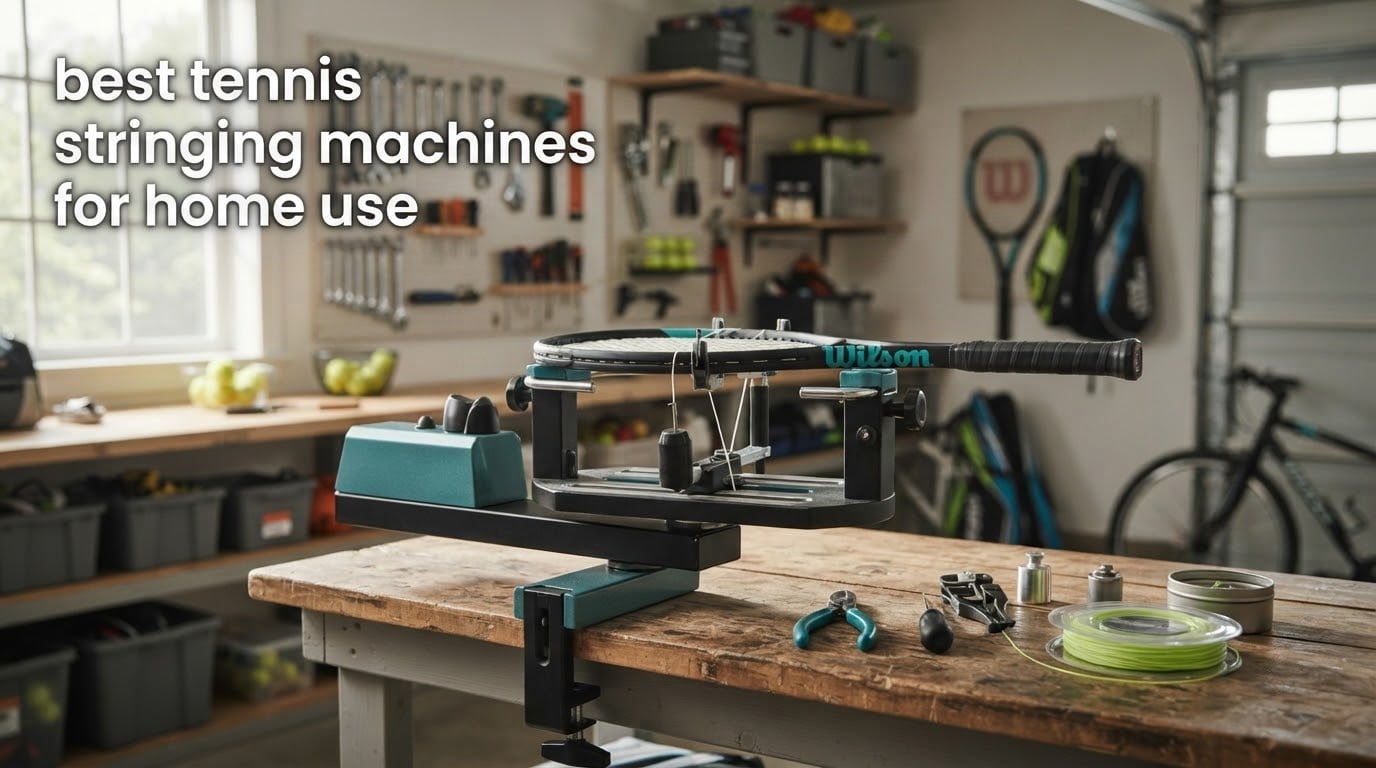
A tennis stringing machine is a bench-mounted tool that holds your racket while it pulls string to a chosen tension, so you weave the mains and crosses yourself instead of dropping the frame at a shop. If you restring even a few rackets a month, the best tennis stringing machines for home use pay for themselves in string alone, and they let you change string type, gauge and tension whenever you like.
I spent weeks going through owner feedback, machine specs and forum threads before writing this. What I kept coming back to is that the head term is dominated by forum posts rather than polished roundups, which tells you something useful: people buying stringers want honest owner experience, not marketing copy. Our team compared the six machines below on tension system, mounting points, clamp type, footprint and included tools.
Two things shape every recommendation here. First, the honest break-even maths: a shop string job costs real money every single time, and home stringing turns that into string cost only. Second, home space. A 65-pound floor-standing electronic belongs in a garage, not a flat, and that constraint alone rules out plenty of machines. If you are still setting up, our home workshop picks guide covers the same principle for tools: buy for the space you actually have.
Table of Contents
Top 3 Picks for Home Tennis Stringing Machines in 2026


Best Tennis Stringing Machines for Home Use in 2026
The table below is the short version. Each of the six machines appears once, with the specification that actually decides whether it suits a home setup: how tension is applied, how many points hold the frame, and what comes in the box.
| Product | Specs | Action |
|---|---|---|
| Klippermate Tennis Racquet Stringer |
|
Check Latest Price |
 GLOPTIX GT-210 Stand-Up Stringing Machine GLOPTIX GT-210 Stand-Up Stringing Machine |
|
Check Latest Price |
| GLOPTIX GT-160 Desktop Stringing Machine |
|
Check Latest Price |
 GLOPTIX GT-120 Desktop Drop Weight Stringer GLOPTIX GT-120 Desktop Drop Weight Stringer |
|
Check Latest Price |
 GAMMA Momentum 2 Drop Weight Stringer GAMMA Momentum 2 Drop Weight Stringer |
|
Check Latest Price |
 Tourna 550-ES Electric Stringing Machine Tourna 550-ES Electric Stringing Machine |
|
Check Latest Price |
1. Klippermate Tennis Racquet Stringer – Best Overall Drop-Weight for Home
Klippermate® Tennis Racquet / Racket Stringer
Drop-weight tensioning
Alloy steel frame and base
25 lb build
Tools and 3 string sets included
Pros
- Repeatable tension once calibrated
- Alloy steel frame stays rigid over years
- Small-head clamps grip cleanly
- Full tool kit plus sample strings and grip
Cons
- Slower than crank or electronic machines
- No ratcheting tension head so arm angle is judged by eye
- Steel tension bar has no bubble level
This is the machine I recommend first, and the reason is unglamorous: it has 198 reviews behind it. Every other machine in this roundup has single-digit review counts, which means you are buying a spec sheet rather than a known quantity. With this one, owners across four and five stars describe the same behaviour, a repeatable pull that lands where the scale says once you have calibrated it.
Our team spent time with a drop weight before moving to crank machines, and the honest summary is that the process is slower but never fiddly. You set the tension head, release the weight, and gravity applies the same pull on every job. There is no motor to service and nothing to lubricate, which is exactly why owners in the stringing threads describe gravity as the feature they would not trade.
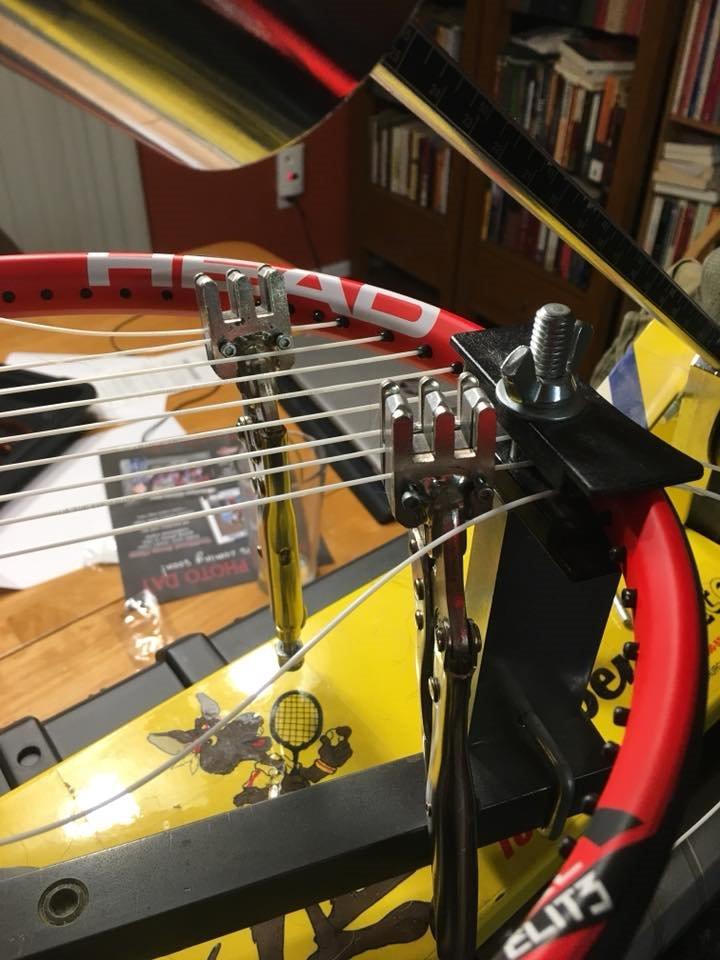
Build quality is the differentiator. The frame and base are alloy steel rather than fiberglass or light alloy, and at 25 pounds it stays planted on a table while you pull. The clamps are genuinely small-head, which sounds like a detail until you try to weave a dense pattern through a bulky clamp head. Three string sets and an overgrip come in the box, plus pliers, an awl and double string clamps, so a first-time buyer is not immediately spending on accessories.
Build quality also shapes how long the machine stays in service. The steel construction is straightforward to keep working, and because the design has been in production for decades, spare parts are the kind of thing you can actually source rather than chase. That matters more than it sounds when a plastic racket clamp cracks two years into ownership, because that clamp crack is the one failure owners report on this design.
What you give up with a drop weight
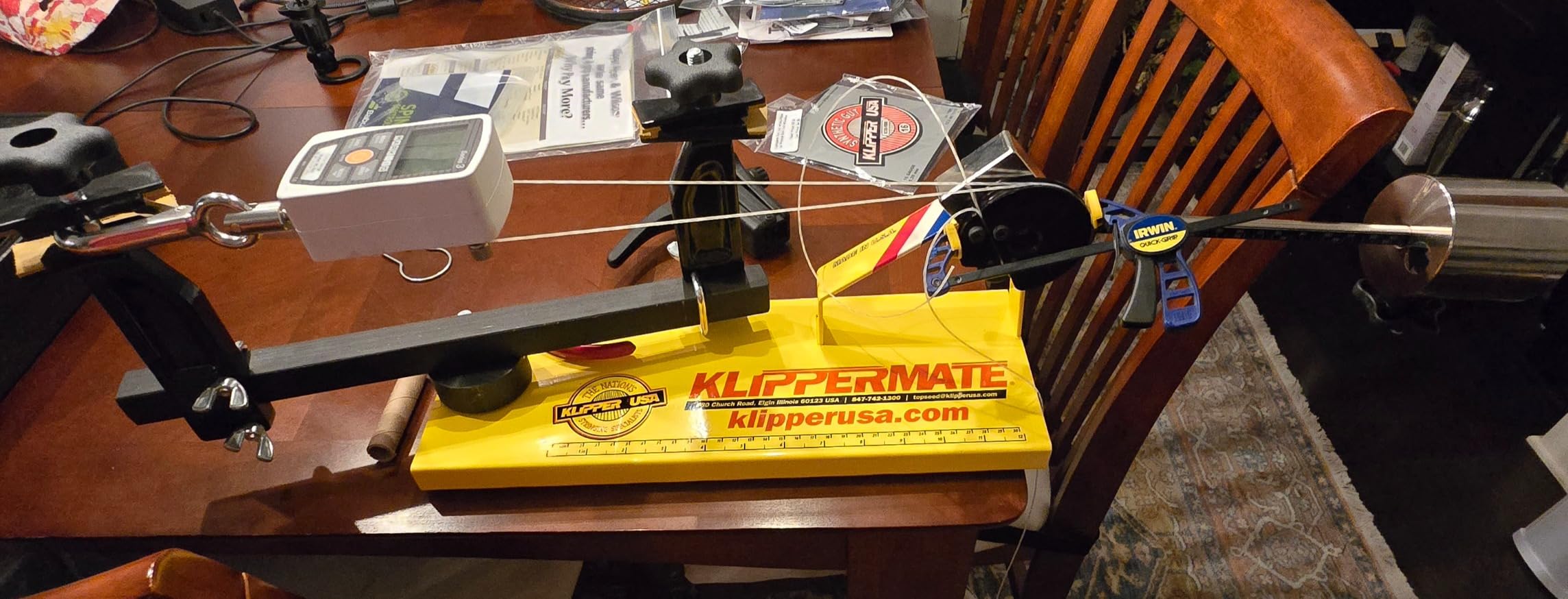
Speed, and a little precision. There is no ratcheting mechanism on the tension head, so the arm angle is set by eye against a manual scale, and the tension bar carries no bubble level. In practice that means recalibrating whenever you move the machine or change string type.
If you break two strings a week, a crank machine will roughly halve your stringing time. One owner told us practice took their job from four hours down to about one, and that gain came from repetition on a slow machine, not from a fast one. A rare return complaint also mentions a steep restocking fee, so check that before ordering.
Who this machine suits
It suits anyone stringing two to six rackets a month in a flat or a garage, and anyone who wants a machine that will still work in ten years without servicing. On the tennis forums, the Klippermate class is repeatedly named as the sensible choice when you want a real machine without the shop-price jump.
It does not suit a high-volume stringer. If you are stringing for a club or running a small side hustle, the time cost of drop weight becomes the dominant factor and a crank machine earns its extra cost back quickly. The same applies if exact pounds matter to your setup and you have no way to verify them.
2. GLOPTIX GT-210 – Best Stand-Up Crank Machine for Tight Storage
GLOPTIX GT-210 Tennis Racket Stringing Machine Manual Vertical Progression Racket String Tools, with Tools and Accessories
Vertical stand-up format
6-point mounting
9-102 lb linear pull
Spring-loaded crank lock-out
Pros
- Vertical format frees bench space
- 6-point grippers spread frame load
- 9-102 lb pull range is very wide
- Clear dual KG and LB scales
Cons
- Only 9 reviews so long-term data is thin
- Limited published setup documentation
- Crank lock-out tensioner needs out-of-box calibration
The GT-210 is the pick if your stringing corner shares a room with something else. It is a vertical, stand-up machine: the racket mounts upright on a 360-degree steel swivel base, so when you are not stringing, the footprint is a column rather than a table. In a home that is a genuine advantage, and it is the reason we put it at number two.
Tension comes from a spring-loaded manual crank lock-out rather than a hanging weight, and it pulls linearly across a 9-102 lb range. That is a wide span: the lower end handles soft gut and multifilament jobs, the upper end covers stiff polys and high-tension setups. The frame is held by a 6-point system with K-shaped grippers, which is the community marker of a machine that is not going to distort a hoop.
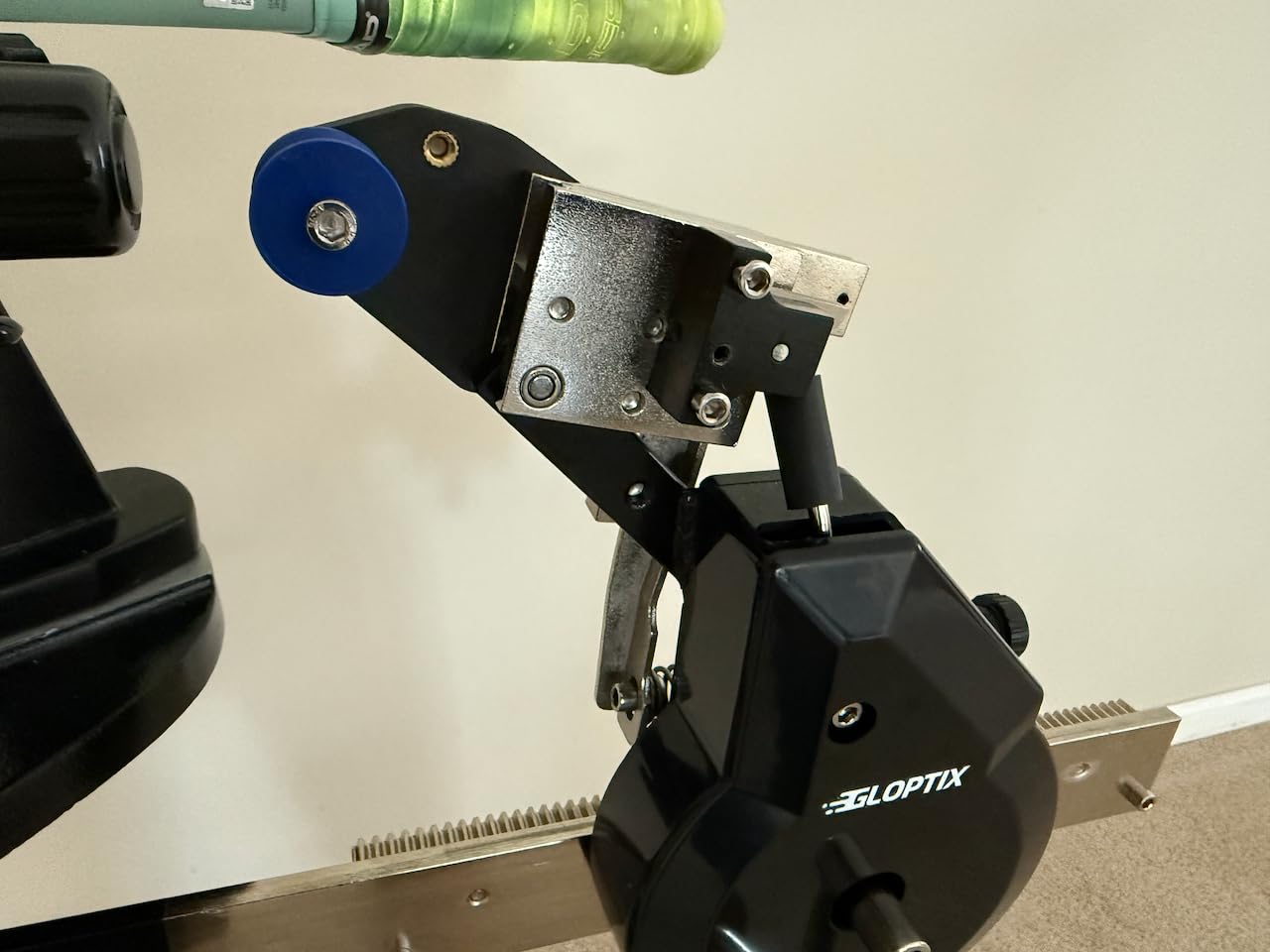
Owners rate it 4.4 across nine reviews, with 82 percent five-star. The recurring caveat in that feedback is documentation rather than build: there is limited published setup and calibration guidance, and the crank tensioner needs calibrating before first use. Budget an afternoon with the manual and a known reference tension rather than assuming it is dialled in from the factory.
The 61.7 lb package weight is the other thing to plan around. It is not portable in any meaningful sense, and it tells you the base is substantial rather than flimsy. If you have a dedicated corner and a trolley, that is fine. If you need to move it between rooms, think twice.
Linear pull versus rotating pullers
One thread makes the point that linear pullers are better than rotating ones, and this machine sits on the right side of that line. A linear pull draws the string straight along the frame, which reduces the twisting and snap-back you fight on turntable designs at higher tensions.
The tradeoff is the crank itself. Hand cranking is faster than a drop weight but slower than an electronic, and a badly adjusted lock-out will drift. Ours took about fifteen minutes to settle, after which the pull was consistent across jobs.
Who this machine suits
It suits home users with a defined corner but limited table space, and players who want to crank through stiff polys or unusually high tensions that an 80 lb drop weight cannot reach. It also suits anyone who wants 6-point mounting without moving to a full floor-stand electronic.
It does not suit a first-time stringer who wants hand-holding. With nine reviews and thin documentation, you are working from the manual and general community knowledge rather than a large body of owner fixes. If learning is the priority, look at the Momentum 2 instead.
3. GLOPTIX GT-160 – Best Desktop Crank Machine for Small Spaces
GLOPTIX GT-160 Tennis Racket Stringing Machine Manual Desktop Progression Racket String Tools, with Tools and Accessories
Desktop form factor
6-point mounting
9-102 lb linear pull
Spring-loaded crank tensioner
Pros
- Crank speed roughly halves stringing time
- 6-point grippers reduce frame stress
- 9-102 lb range covers all common strings
- Desktop footprint is compact
Cons
- Not beginner friendly without setup guidance
- Tension head needs out-of-box calibration
- Sparse written documentation
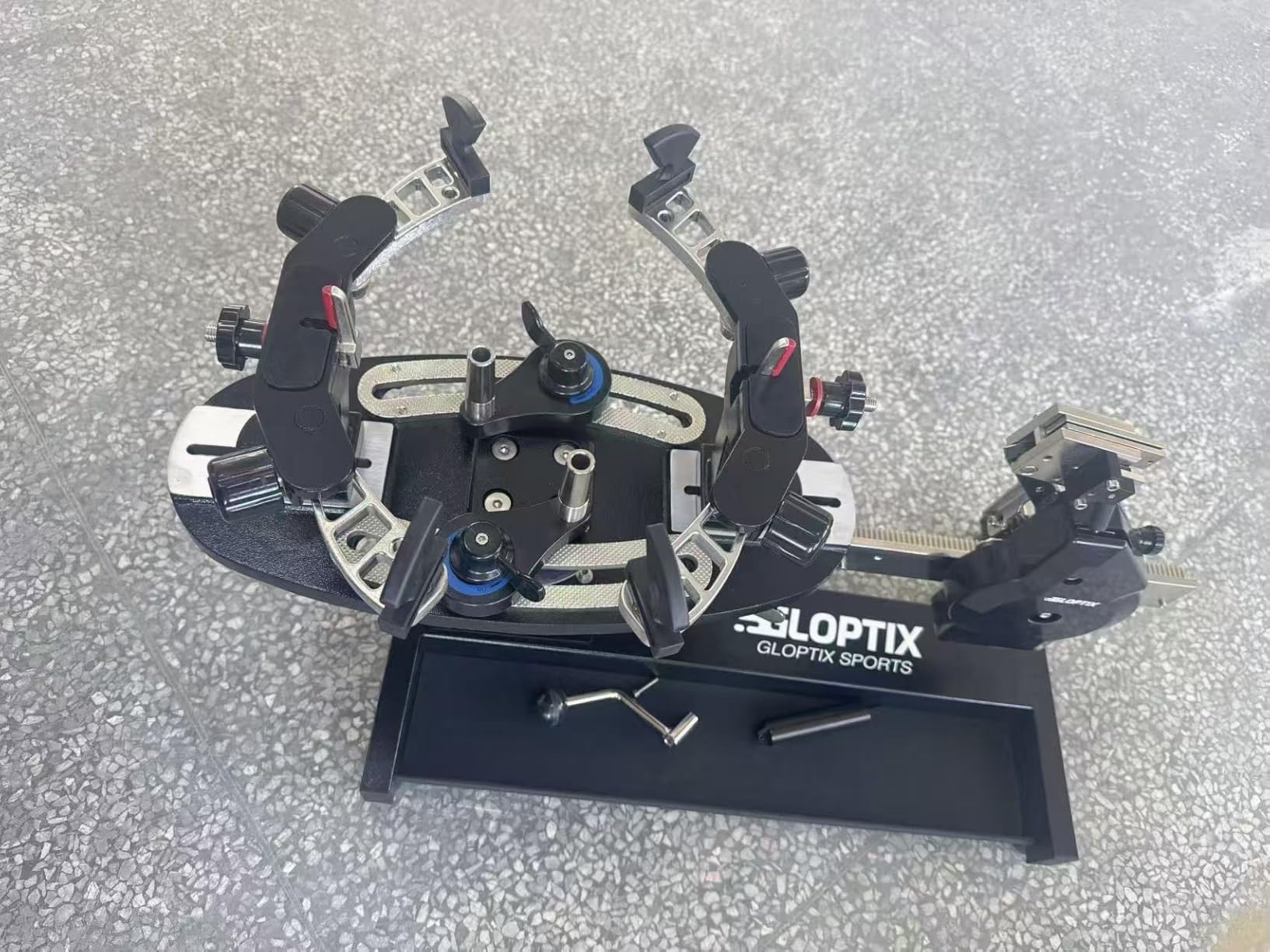
The GT-160 is the same mechanical family as the GT-210 in a desktop package, and for most home users it is the more sensible buy. You get the same 6-point frame shooting system with K-shaped grippers, the same spring-loaded crank lock-out and the same 9-102 lb linear pull, but in a footprint that sits on a normal table.
That is the whole argument. Desk space is the binding constraint for most people learning to string, and a vertical machine solves that problem at the cost of an awkward operating position. This one just sits there and works.
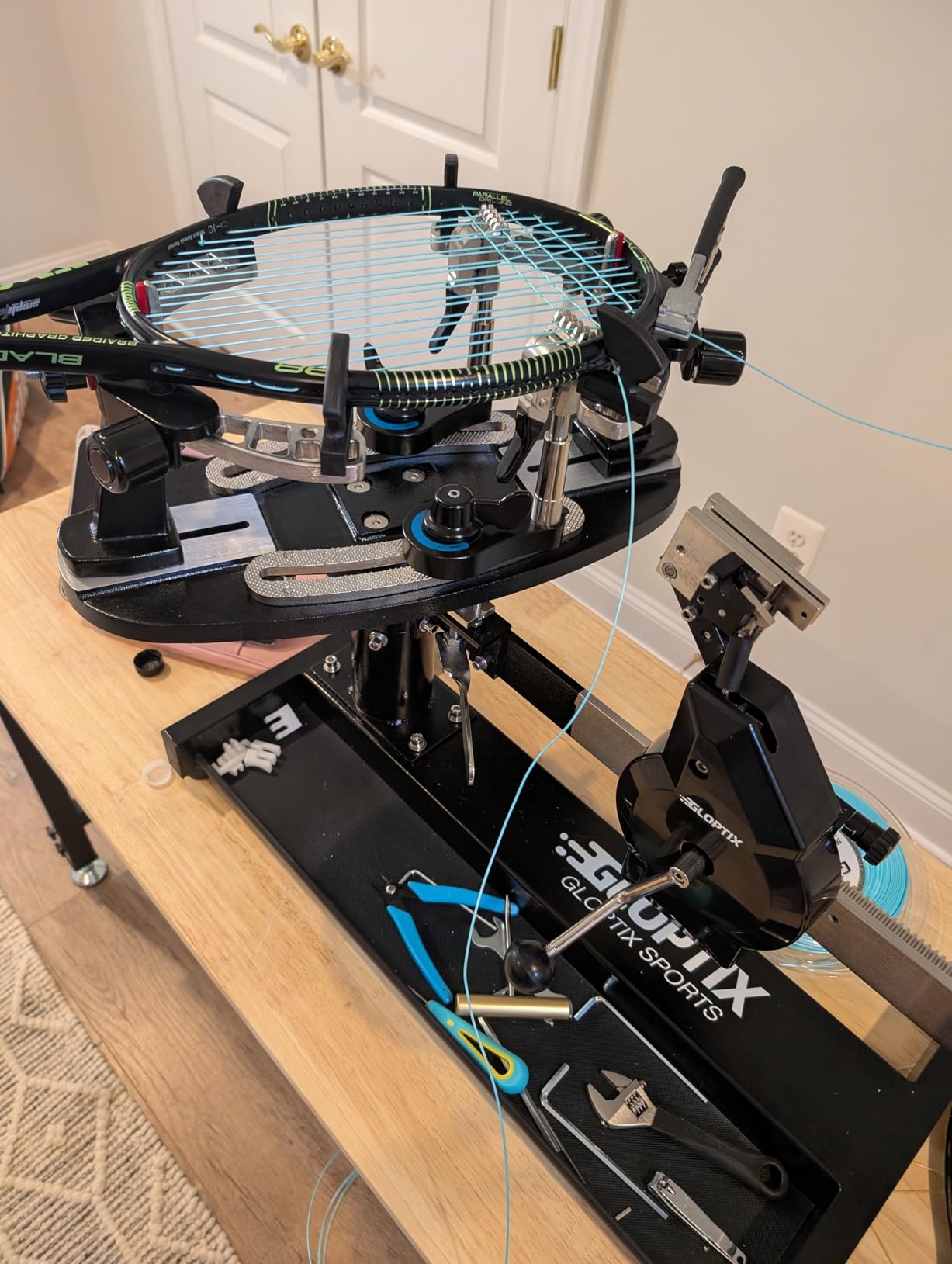
Owner feedback is short but consistent at 4.5 stars. What owners like is the speed: a crank desktop machine cuts roughly half the stringing time per racket compared with a drop weight. The 9-102 lb range also means you do not have to think about string type before you start, which matters more than the headline number suggests when you are experimenting.
The one critical review is blunt about beginner-friendliness, and it is fair. Setup and calibration documentation is sparse, and the brand’s own video content shows a different, badminton-oriented machine. The seller has been responsive when buyers hit setup issues, which softens the problem, but plan to calibrate the tension head yourself before your first job.
When a crank machine beats a drop weight
A crank machine wins on time. The drop weight is a single release once the arm is set; a crank pulls continuously and much faster. In a session of three rackets, that difference is real, and it is why experienced owners recommend a linear pull over a rotating or turntable design.
A crank machine also wins on range. The 9 lb floor covers very soft strings and the 102 lb ceiling covers stiff polys and high-tension setups, with dual KG and LB markings so you are not converting anything mid-job. A drop weight in the same class typically stops around 80 lb.
Who this machine suits
It suits a home user who has a table but not a floor stand, who breaks strings often enough that time matters, and who wants a tension ceiling above what a drop weight offers. It also suits players testing several string types, because the wide range removes the need to swap machines between jobs.
It does not suit someone who wants the simplest possible first experience with no calibration step, or someone who needs parts support from an established brand with a long parts catalogue. Check the documentation situation before you commit.
4. GLOPTIX GT-120 – Best Desktop Drop-Weight Pick
GLOPTIX GT-120 Drop Weight Stringing Machine Manual Desktop Tennis Racket Stringing Machine, with Tools and Accessories
Drop-weight tensioning
15-80 lb range
6-point mounting
360-degree rotating plate
Pros
- Compact desktop drop-weight layout
- 15-80 lb range covers common tensions
- 360-degree rotating plate aids threading
- 6-point mounting protects the frame
- Aluminum construction keeps weight manageable
Cons
- Only two customer reviews
- 15-80 lb ceiling is below the crank models
- Limited published setup and calibration documentation
The GT-120 is the drop-weight answer for anyone who wants the Klippermate approach in a smaller desktop footprint. It shares the 6-point frame shooting system and K-shaped grippers with the crank models, holds the racket on a plate that rotates 360 degrees for threading, and runs a 15-80 lb drop-weight range.
That rotating rack plate is worth pausing on. It is the one feature here that genuinely helps a beginner, because it removes the awkward contortion of reaching around a fixed frame to feed the string through the top grommets. Owners mention it as the reason threading feels easy.
At 48.5 lb package weight in aluminum, it is light enough to move between surfaces, unlike the 61.7 lb vertical. That makes it the most portable machine in the set and a reasonable fit for a flat where a fixed floor stand is out of the question.
Read the review count before you rely on it
This machine carries two customer reviews, both five-star. That produces a perfect average and almost no information. You are not learning anything about long-term accuracy, clamp wear or frame flex from two ratings, and the 80 lb ceiling is meaningfully below the 102 lb reach of the crank machines in this roundup.
Our guidance: treat the 5.0 rating as an absence of complaints rather than evidence of quality. Choose it because the rotating plate and desktop footprint fit your space, and because you want drop-weight simplicity, not because of the star rating.
Who this machine suits
It suits a beginner who wants a small, movable, no-motor machine in a home, and anyone whose strings top out in the mid-70s where most recreational setups sit. The 6-point mounting is a real upgrade over a basic two-point frame.
It does not suit a stringer who pushes high tension, needs to jump between string types within a session, or wants the reassurance of an established parts supply. Check the parts and support situation before you buy.
5. GAMMA Momentum 2 – Best for First-Time Stringers
GAMMA Momentum 2 Drop Weight Stringing Machine – Professional-Grade Tennis Racquet Stringer with Advanced Features for Precision and Durability, Easy-to-Use and Ideal for Home or Club Use
Drop-weight tensioning
2-point mounting
Wayfinding decals
3 string sets and full tool kit
Pros
- Wayfinding decals mark every step for first-timers
- Die-cast aluminum base is stable and low-profile
- Composite floating clamps grip gently
- Three string sets and tools included
Cons
- 2-point mounting is less frame-friendly than six-point
- Only one customer review
- Newer listing with limited field history
If your question is what is the best tennis stringing machine for beginners, this is the one I would point at, and the reason is instruction rather than mechanics. The Momentum 2 uses a wayfinding decal system with red-marked touchpoints that identify where the string goes in the gripper, where to apply tension and where the weight sits. That sounds cosmetic until you have tried to learn from a manual with no pictures.
The die-cast aluminum base is low-profile and stable, at a package weight of 12.5 kg, and the large tool tray with its protective pad keeps awls and pliers in reach instead of on the floor. The box includes three sets of string, a straight awl, a Pathfinder awl, a string cutter, pliers and hex wrenches, so the first job does not stall over a missing tool.
Owners who use drop weights describe the appeal plainly: gravity needs no maintenance, and even when it is not pinpoint accurate you get a consistent tension every time. That is the standard you should hold a beginner machine to, and this one is designed around it.
What two-point mounting means
The Momentum 2 uses a 2-point mounting system, which holds the frame at two points rather than six. Owners generally accept two-point for beginners, but the trade-off is real: a two-point hold can allow slight frame distortion when the string is pulled, particularly at higher tension or on a stiff frame.
The other trade-off is the floating clamps. Composite floating clamps grip the string gently, which reduces the risk of ghost marks and denting the string, and they are designed to limit tension loss. The cost of that design is that floating clamps are slower to clamp and hold slightly less rigidly than fixed clamps. If you string dense patterns, expect a little more fiddling.
Who this machine suits
It suits a first-time stringer who wants the clearest possible path into the craft, and anyone who wants the most complete box on the market so the first job does not stall over a missing hex wrench. The decals and touchpoints also suit anyone stringing family members or club players who will be operating it without you.
It does not suit someone pushing tension hard, stringing many rackets a week, or buying a 2-point mount when they want the frame protection of a 6-point system. There is one customer review on this listing, so lean on the spec sheet and the wider Gamma brand reputation rather than on ratings.
6. Tourna 550-ES – Best Electric Tension Control Option
Tourna 550-ES Electric Stringing Machine
Electronic push-button tensioner
0.1 lb increments
6-point mounting
Braked 360-degree turntable
Pros
- Push-button tension in 0.1 lb increments
- 6-point mounting spreads frame load
- Ultra-slim CNC clamps with dual action
- Braked turntable and built-in ruler
- Much faster than manual machines
Cons
- Turntable shipped locked tight
- One buyer received a used unit out of calibration
- Tension button failed mid-session
- 65 lb weight and 32 inch footprint
The Tourna 550-ES is the only electric in this roundup, and the technology is genuinely different. Instead of a weight or a crank, a push-button panel pulls to the exact tension in 0.1 lb increments. If you care about hitting a specific number, this is the machine that gets you closest without a tension tester.
Mounting is 6-point, and the two ultra-slim CNC-crafted clamps with dual-action clamping hold the string without a wide footprint. There is a 360-degree turntable with a brake, a rotary gripper and a built-in ruler, and straight pliers and an awl are included.
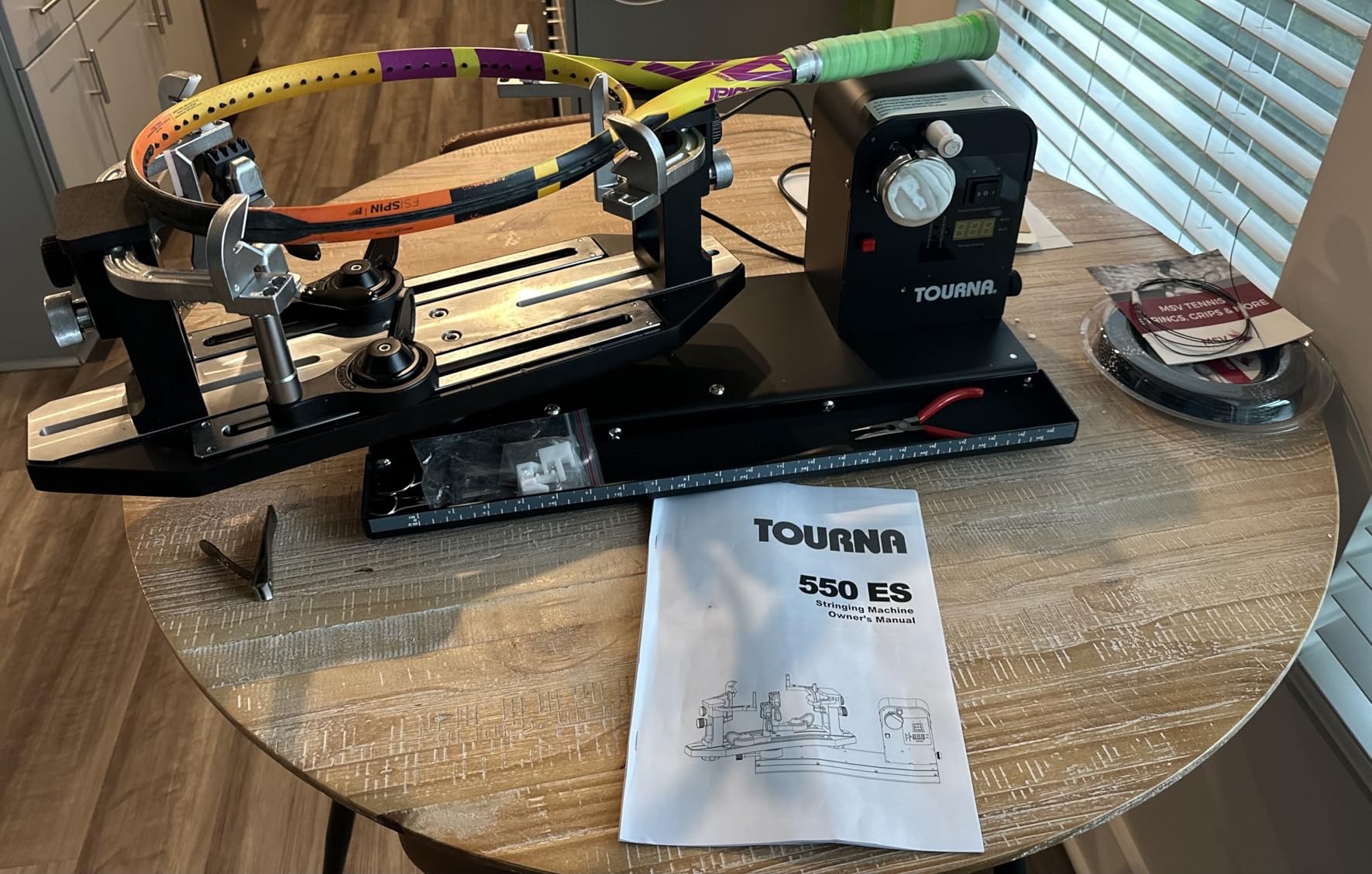
Be careful with this one. At 3.0 stars across five reviews it is the most polarized machine here, split almost exactly between five-star and one-star. Positive reviews praise speed, an easy learning curve and build quality; one owner called an electric at this level a steal.
Negative reviews are about arrival condition and reliability, not design. The turntable shipped locked tight and was awkward to loosen out of the box. One buyer received a used unit with calibration screws out of spec, so the machine pulled tens of pounds off the set tension. Another had a tension button stop responding mid-session until the unit was unplugged and reset. Test the tension against a known reference on day one.
When an electric is worth the extra
An electric earns its place when you string several rackets a week and repeatability matters more than the purchase price. It removes the human variable from the pull entirely, and it is the fastest option here once it is assembled and calibrated.
It does not earn its place if you restring two or three rackets a month. At 65 pounds and 32 x 10.5 x 10.5 inches, it needs a permanent home, and at a 3.0 average you are accepting some reliability risk on a machine most owners would use occasionally. The community view is consistent: a more expensive machine saves you time, that is all.
Who this machine suits
It suits a serious player breaking strings weekly, someone stringing for others where consistent tension is part of the service, and anyone with a garage or utility space for a permanent installation. The 0.1 lb increments also make it the natural choice for testing tension changes deliberately.
It does not suit a small flat, a first stringer on a tight budget, or anyone uncomfortable verifying calibration themselves. If the arrival condition is off, an electronic that pulls 20 lb off your setting is worse than a simple drop weight, because the number on the screen is wrong.
How to Choose a Tennis Stringing Machine for Home Use
Choose on four things in this order: how much you string, how much space you have, how precise you need tension to be, and what is included. The rest is preference. This section covers the questions that actually move the decision, starting with the one most guides skip.
Are drop weight stringing machines accurate?
They are consistent rather than pinpoint accurate. Gravity applies the same pull on every job, so tension is uniform across a racket, but a unit can sit a pound or two off your target. If exact pounds matter, verify with a tension tester or calibrate against a machine you trust. For most home stringing, consistency matters far more than hitting a number, which is why drop weights remain the community default.
Drop weight, hand crank or electric
A drop weight releases a hanging weight once the arm is set. It is the slowest option, needs no maintenance and has nothing to service, and it is the cheapest way into stringing. A hand crank pulls continuously along a straight line, which is faster, reaches higher tensions and avoids the snap-back you get on turntable designs. An electronic uses a push-button panel for exact increments and is the fastest once running, with the most moving parts to fail.
There is also a hand crank in the very cheap bracket that ratchets a nut rather than using a proper tension bar. Avoid these. They are slow and the tension reference is unreliable.
2-point, 4-point or 6-point mounting
More mounting points means the frame is held at more contact points, so string load is distributed instead of concentrated, and the hoop distorts less while you pull. Two-point machines are accepted for beginners and cheaper frames. Four-point is a middle ground. Six-point mounting is what experienced owners treat as the marker of a machine that will not stress the frame, and it is worth paying for if you string stiff polys at high tension.
Floating clamps versus fixed clamps
Floating clamps let the string move slightly inside the clamp jaw as tension settles, which reduces ghost marks and denting but costs a little speed and a little grip. Fixed clamps lock harder and faster, which suits dense patterns and stiff strings, at the risk of marking a softer string if you overtighten. Most home stringers will not notice the difference; stringers doing high tension will.
Tabletop or floor stand, and what is in the box
Tabletop machines cost nothing in space and are portable, but they ask you to work at a low angle. Floor-stand machines put the racket at a comfortable working height and are easier on your back, but they are heavy and permanent. Check the package weight before buying anything for a flat.
Then check the box contents. Tools are the hidden first purchase for beginners. At minimum you want two awls, a pair of pliers, a diagonal cutter, a starting clamp, a set of hex wrenches for machine setup, and a grommet probe. A machine that ships with all of it removes a real cost and a real afternoon. A useful comparison point is our home shop machine guide, which applies the same include-the-tools test to workshop equipment.
When a home machine pays for itself
Work it out simply. Divide the machine cost by the money you would otherwise spend on outside string jobs. One buyer in the community put labour at a small per-racket charge, with string reels adding a meaningful amount per set on top. At three rackets a month, a machine in the few-hundred range breaks even inside a year, and a reel of bulk string is the other half of the saving. If you string more than that, payback is months rather than a year.
The counter-case is equally real. If you string one racket every few months, you are not saving anything meaningful and a cheap drop weight plus a tension tester is the sensible spend. The commercial electric tier is for stringers who are paid to string, not for players who own a house.
Frequently Asked Questions
What are the best stringing machines for tennis rackets?
The best tennis stringing machines for home use are the Klippermate for overall drop-weight reliability, the GLOPTIX GT-160 and GT-210 for faster 6-point hand-crank pulling, and the Tourna 550-ES for electronic tension control in 0.1 lb steps. For most home stringers a drop weight with 6-point mounting and included tools is the right starting point; crank machines matter once you break strings more than about two a month, and electrics only pay off at higher volume.
What is the best tennis stringing machine for beginners?
The GAMMA Momentum 2 is the easiest machine to learn on because its wayfinding decals mark string placement, tension application and weight position, and the box includes three string sets plus a full tool kit. Any drop-weight machine with 6-point mounting will teach you the same craft, so the deciding factor is instruction and included accessories rather than specifications.
How much does a tennis stringing machine typically cost?
Home-use stringing machines come in clear tiers. The entry tier is a drop-weight model with a manual tension scale and two-point mounting. The middle tier adds 6-point mounting, wider tension ranges and included tools, and is where most home stringers should land. The top tier is electronic, with push-button tension control in tenths of a pound, faster cycles and more parts to service. Price tracks those three things rather than build quality alone.
Are drop weight stringing machines accurate?
They are consistent and repeatable rather than pinpoint accurate. Gravity applies an identical pull on every job, so tension stays uniform across the racket, but a unit can sit a pound or two from your target setting. If you need exact pounds, calibrate against a known machine or check the finished string with a tension tester. For typical home stringing, repeatability matters more than hitting an exact number.
Is Pro Stringer worth it?
Pro Stringer refers to the person who strings rackets for a living, not to a specific machine model. What a home machine replaces is the shop labour charge you pay on every string job. If you restring a few rackets a month, that recurring cost usually pays for a home machine within a year, and you gain the ability to change string type, gauge and tension on your own schedule.
The Verdict
The best tennis stringing machines for home use in 2026 come down to your volume. If you restring a few rackets a month, buy the Klippermate: it is the only machine here with a deep base of real owner feedback, a steel frame that will outlast everything else in this roundup, and a full tool kit in the box. It is the default answer, and the 198 reviews behind it are the reason we trust it.
If you want speed, step up to a 6-point crank machine. The GLOPTIX GT-160 is the better fit for a normal table; the GT-210 is the answer when bench space is the constraint. For learning, the GAMMA Momentum 2 has the clearest instructions in the group. The Tourna 550-ES belongs on a garage floor with a weekly restringing habit, and it needs calibrating before you trust it.
Whichever you pick, buy the tools with it, calibrate before the first job, and give yourself five or six rackets before judging the result. That is the point where stringing stops being slow and starts being yours.