
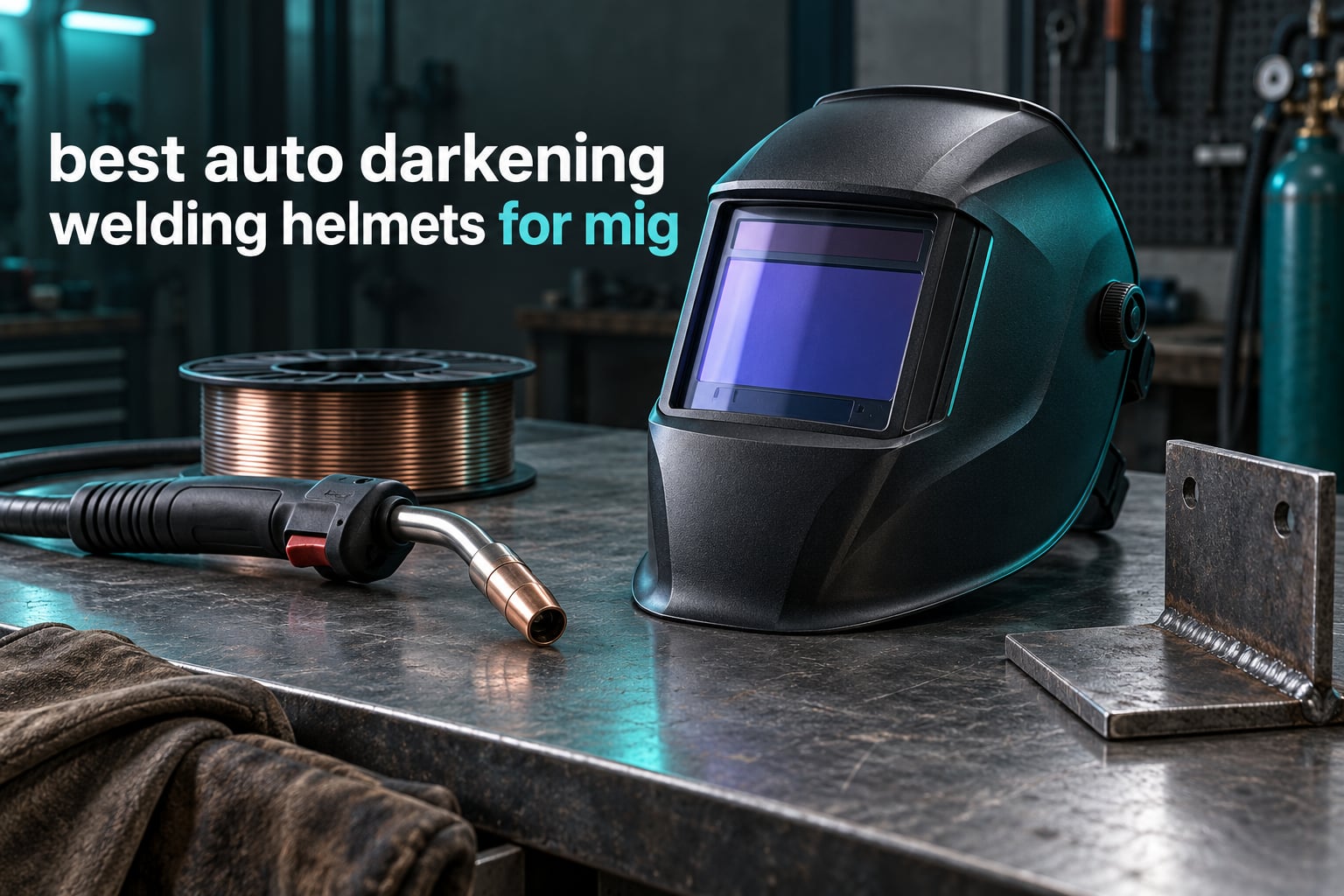
Most people pick a welding helmet by price, and that is exactly how they end up with a hood that flickers, fogs up, or fails to darken when the gun is angled down over a flange. MIG welding is the process where that matters most, because the arc is bright, steady, and usually the first thing a new welder learns. The best auto darkening welding helmets for MIG work share a short list of traits: four arc sensors, a genuinely clear color view, a viewing area big enough to see the joint edges, and a lens that darkens fast enough that you never see the flash.
We compared ten of the highest-rated auto darkening welding helmets for MIG across the categories that actually show up in the shop, from solar-powered budget hoods to a lightweight ultralight shell and a premium-brand classic. Every helmet here was picked on measured specifications first, then on how owners describe living with it after months of use. We have also mapped amperage to shade directly, because that is the question most beginners actually ask and the one most spec sheets dodge.
If you are still choosing between brands, our notes on the best bike helmets for commuting cover the same protective-gear basics we use here: certification first, fit second, features last. That is the order that matters for a helmet you trust with your eyesight.
Table of Contents
Short Answer: The Best Auto Darkening Welding Helmet for MIG Welding
The YESWELDER LYG-L600A is the best auto darkening welding helmet for MIG welding overall. It delivers 1/1/1/1 true color optical clarity across a 3.64 x 1.67 inch viewing area, darkens in 1/30000 of a second, and covers shade 3/7-13 for TIG, MIG, arc and grind work. It runs on solar power with a replaceable CR2450 battery, carries ANSI Z87.1 and CSA Z94.3 certification, and weighs just 16 ounces.
If you want a wider window on the work instead, the YESWELDER LYG-M800H pairs the same 1/1/1/1 optics with a much larger 3.93 x 3.66 inch viewing area and four arc sensors. That is the model to look at if you spend your days on pipe, heavy plate, or wide-pass tacking.
Top 3 Best Auto Darkening Welding Helmets for MIG (October 2026)

YESWELDER LYG-L600A
- 1/1/1/1 true color optics
- 1/30000s switching
- 2 arc sensors
- Shade 3/7-13 MIG TIG and grind
YESWELDER LYG-M800H
- 3.93 x 3.66 inch viewing area
- 1/1/1/1 true color optics
- 4 arc sensors
- Shade 3/5-9/9-13
All 10 MIG Helmets Compared Side by Side
Every helmet below is rated for MIG work and is listed in the order we would hand them to a shop. Use this table to narrow the field, then read the full review for the model you are considering.
| Product | Specs | Action |
|---|---|---|
| YESWELDER LYG-L600A |
|
Check Latest Price |
| YESWELDER LYG-M800H |
|
Check Latest Price |
 ARCCAPTAIN Auto Darkening Helmet ARCCAPTAIN Auto Darkening Helmet |
|
Check Latest Price |
 YESWELDER LYG-Q800D YESWELDER LYG-Q800D |
|
Check Latest Price |
 TRQWH Solar Helmet with Light TRQWH Solar Helmet with Light |
|
Check Latest Price |
 Hobart 770890 Hobart 770890 |
|
Check Latest Price |
 Jackson Safety Insight Jackson Safety Insight |
|
Check Latest Price |
 Miller Classic Series ClearLight Miller Classic Series ClearLight |
|
Check Latest Price |
 ESAB Savage A40 ESAB Savage A40 |
|
Check Latest Price |
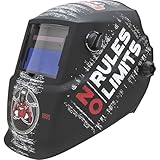 Lincoln Electric K4983-1 Lincoln Electric K4983-1 |
|
Check Latest Price |
1. YESWELDER LYG-L600A – Best Overall for MIG
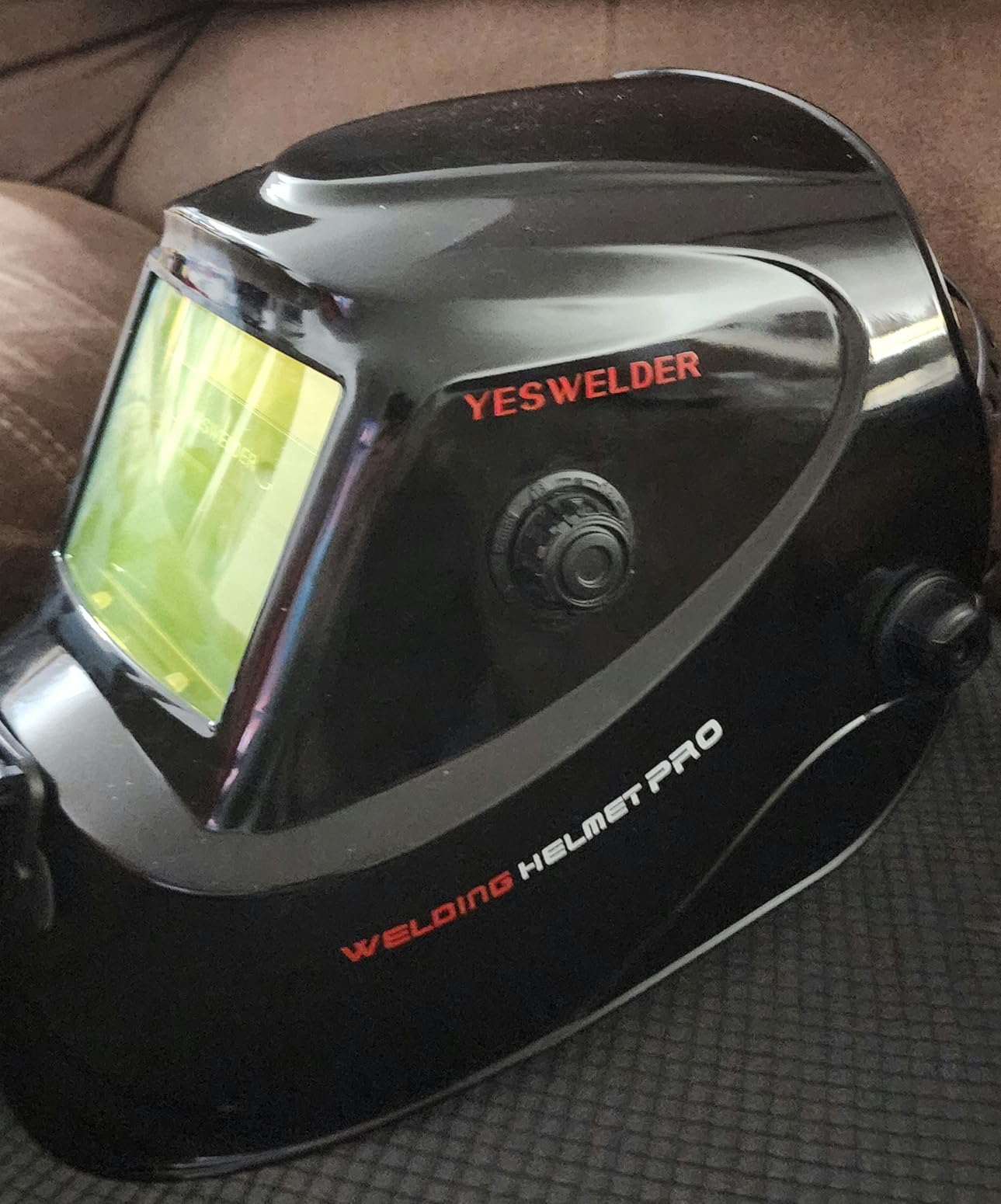
YESWELDER Auto Darkening Welding Helmet 1/1/1/1 True Color, LYG-L600A
True color 1/1/1/1 lens
2 arc sensors
1/30000s response
Shade 3/7-13
16 ounce shell
Pros
- 1/1/1/1 true color view of the puddle and plate
- 1/30000s switching with adjustable sensitivity and delay
- External shade knob is quick to operate in gloves
- Solar power plus replaceable CR2450 battery with a spare included
- Plenty of clearance to wear a respirator underneath
Cons
- Viewing area is small next to panoramic style hoods
- Shell and headgear feel lighter duty than professional grade hoods
- Inner lens is a separate proprietary insert rather than a standard lens
This is the hood I keep coming back to for people who are new to MIG and unsure what they actually need. The 1/1/1/1 clarity rating is not a marketing flourish here, it is the whole point. The green tint that most budget filters throw on a puddle is gone, and once you can see the wire and the leading edge of the bead clearly, your travel angle and standoff correct themselves much faster.
The lens switches in 1/30000 of a second, which is fast enough that a tack strike never registers as a white flash. Two arc sensors is the one specification here that gives me pause, and I will come back to it below, but on standard MIG work running in the 100 amp range the detection has been unremarkable in our use.
Shade 3/7-13 covers TIG, MIG, arc and grind from a single knob, and the adjustment is on the outside of the shell so you can change it while wearing gloves. At 16 ounces it is one of the lighter shells here, which matters if you are welding overhead or in and out of a position all day.
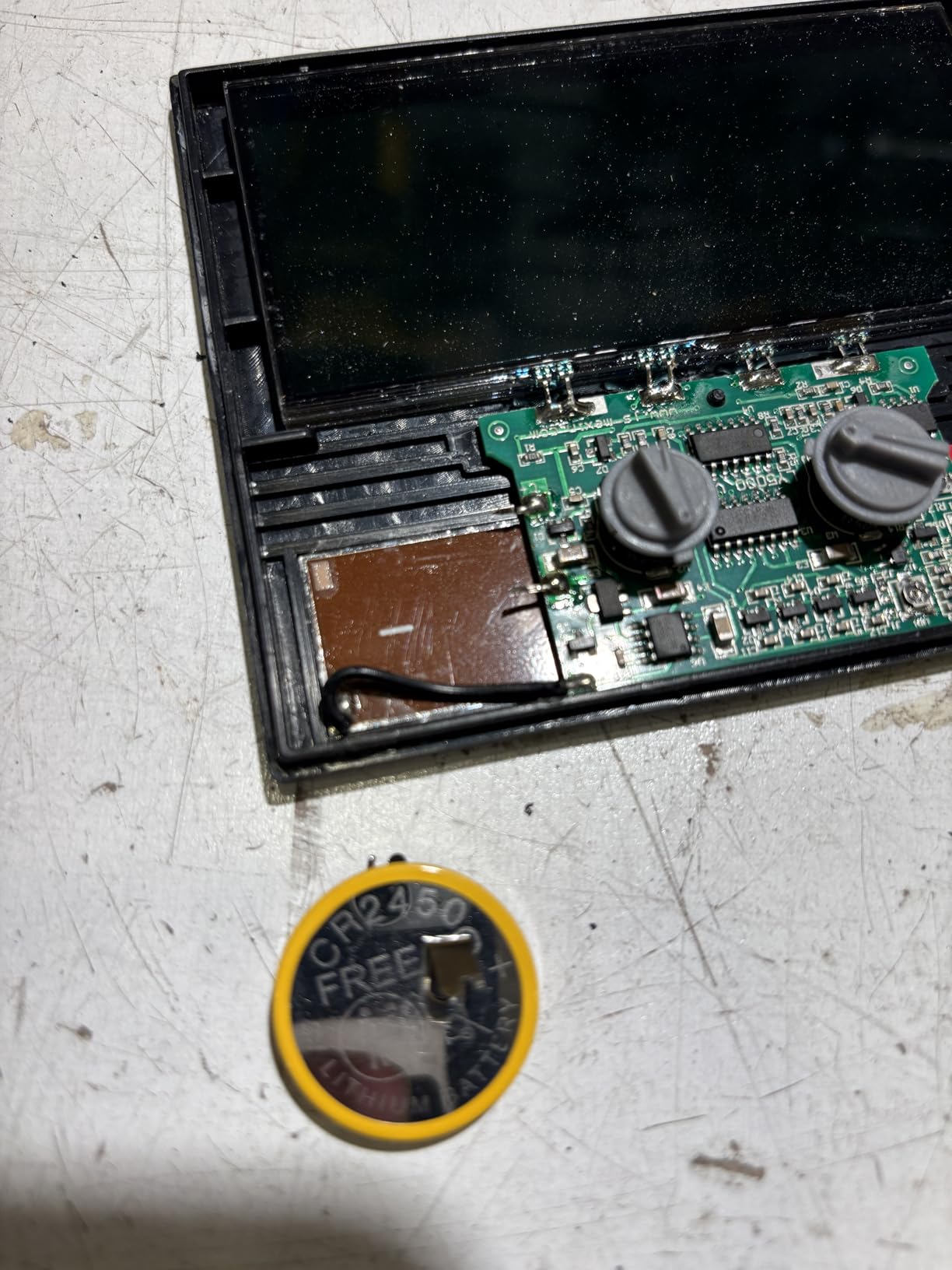
Power is solar plus a replaceable CR2450 button cell, and a spare battery is included in the bag. That combination solves the most common complaint welders raise about solar-only helmets, which is that a unit left in a dark truck bed for a few weeks stops responding when you need it.
What you will notice in the first week
The view is wide enough to see both sides of a butt joint even though the rectangle itself is compact, and the color rendering makes the puddle look like metal rather than a green blob. Most new welders describe the first few beads as a step change once they stop guessing at what the arc is doing.
The blue light blocking outer lens is a real comfort feature on long sessions. Reviewers consistently point out reduced eye strain compared with cheaper green-tinted lenses, which is exactly what you want if you are welding several nights a week after a full day of work.
Where it falls short
Two arc sensors is the real limitation. If you do a lot of out-of-position work with your hand or gun sleeve crossing the sensor area, a four-sensor hood is less likely to miss the arc, and that is the single clearest reason to step up to the LYG-M800H instead.
The shell and headgear are also lighter duty than the professional-brand models here, and the inner lens is a proprietary insert rather than a cheap standard replacement. Owners also report an occasional hood arriving with the button battery seated incorrectly, which takes thirty seconds to fix but is worth knowing before you strike an arc on your first weld.
2. YESWELDER LYG-M800H – Best Large Viewing Area for the Money
YESWELDER Auto Darkening Welding Helmet, Large View, LYG-M800H
3.93 x 3.66 inch viewing area
1/1/1/1 true color
4 arc sensors
1/30000s response
Pros
- Exceptionally large viewing area for the money
- 1/1/1/1 optics show the whole area around the arc
- Four arc sensors darken reliably on lower amperage work
- All controls on the outside of the shell
- Cheater lens compatible with CR2450 battery
Cons
- Shell and headband feel thin and can need over-tightening
- Headgear slips forward when the head is tilted down
- Inner lens is awkward to remove and the battery is hard to extract
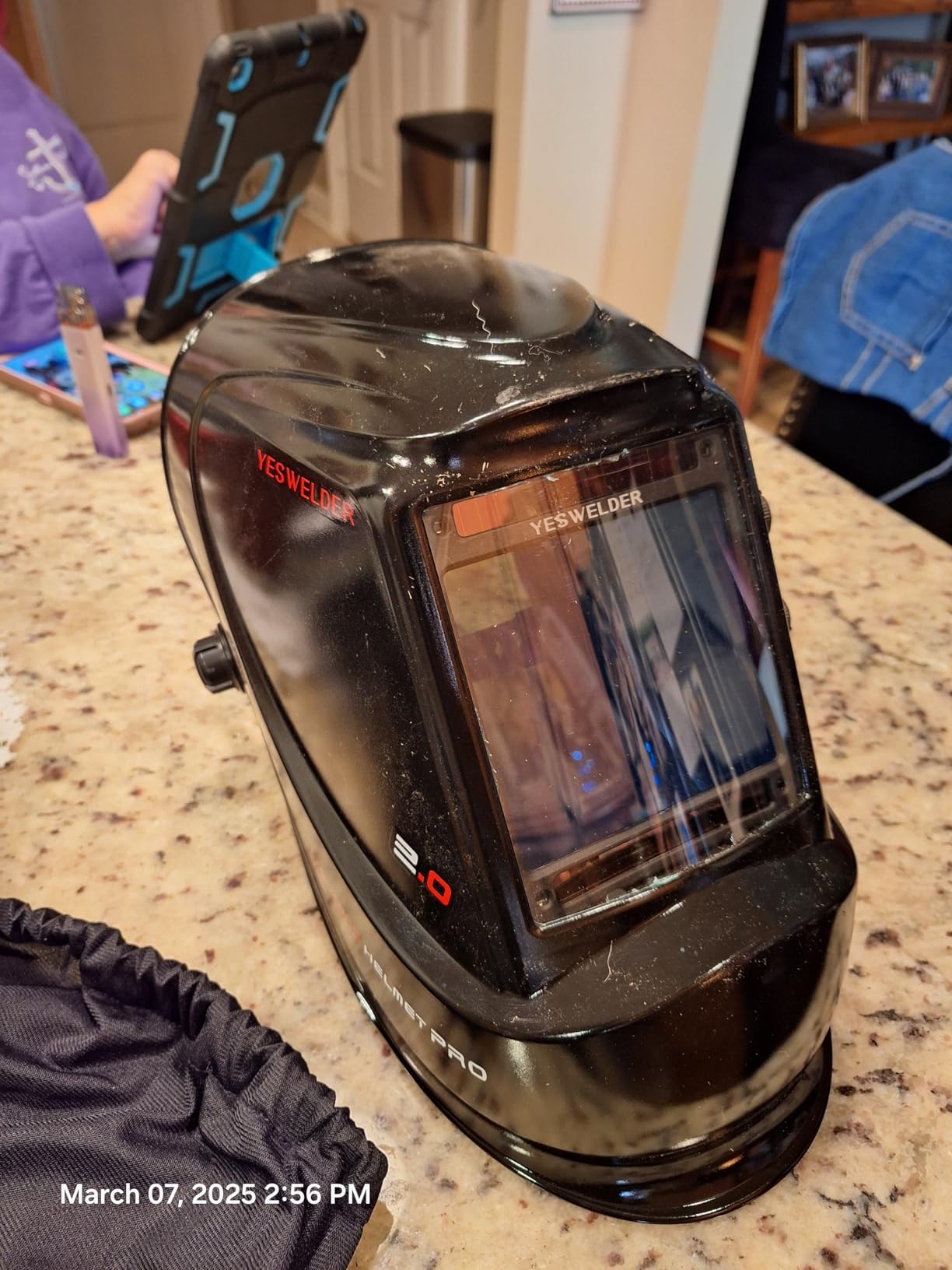
The reason this hood shows up on so many MIG lists is the rectangle. At 3.93 x 3.66 inches the viewing area is enormous next to most of the field, and for someone welding pipe, plate, or anything with a wide bead, that is the difference between guiding the gun with your eyes and guiding it by feel.
Everything about the filter is the same high standard as the LYG-L600A. You get 1/1/1/1 true color clarity and a 1/30000 second switch, but you also get four arc sensors instead of two, which is the specification we would want on a hood that gets used outdoors, on a sawhorse, or anywhere the arc is not square in front of your face.
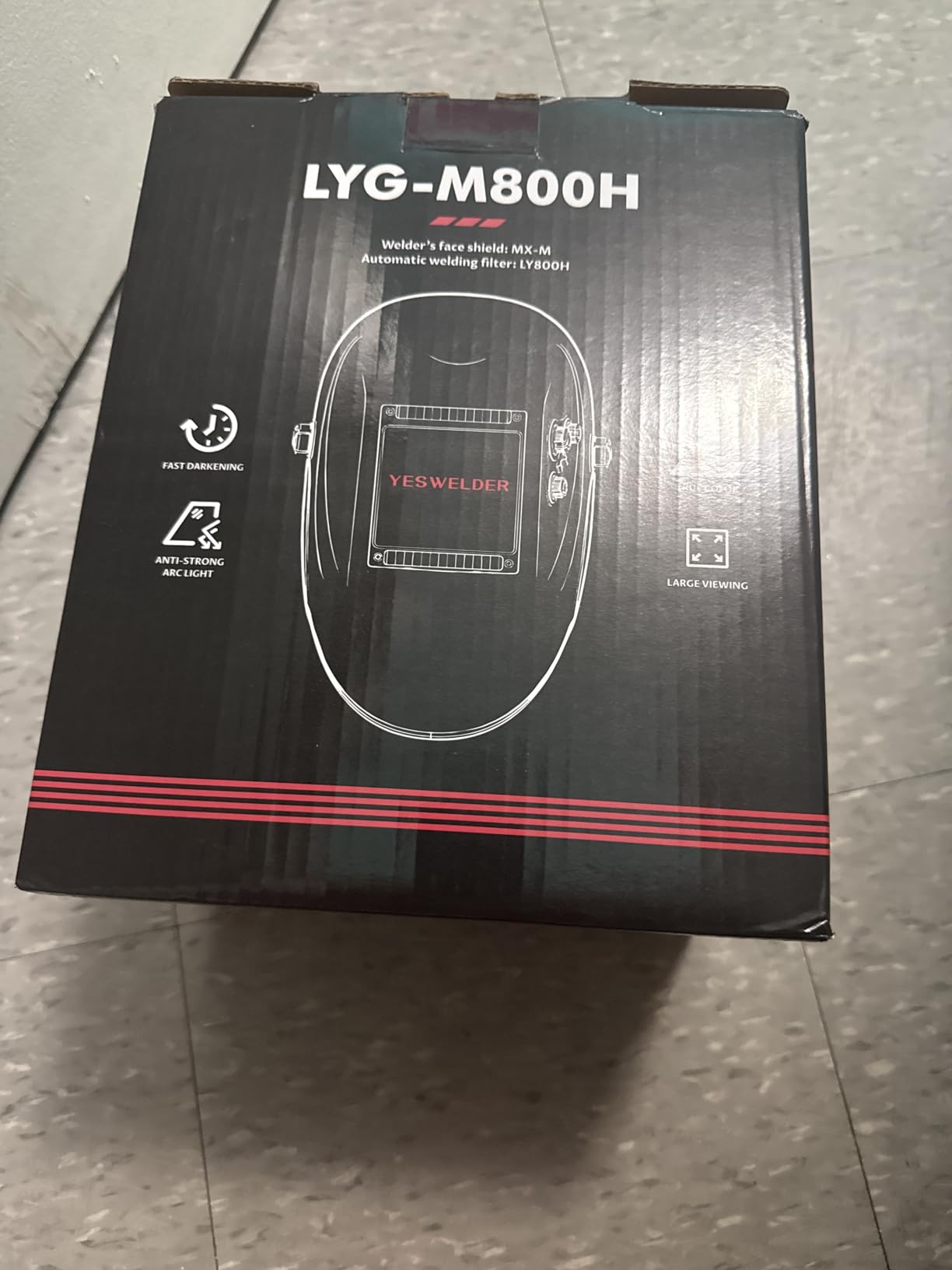
Shade 3/5-9 and 9-13 cover weld, cut and grind modes, so one hood handles MIG, TIG, stick, plasma cutting and grinding without a swap. Two outer lenses and an inner lens are in the box, and the ratchet closure, reinforced hinge and strengthened connection points are a step up from the plastic on the cheapest hoods, though owners still describe the fasteners as thin.
It stays comfortable through a long shift, and the ratchet headband holds better than a simple strap when you are working under a hard hat. The external controls mean you can adjust sensitivity and delay without pulling the hood up and breaking your setup.
What you will notice in the first week
The wide field means you can see the torch angle, the edge of the joint and the land of the previous pass all at once. Beginners report that this is the feature that makes the biggest difference, because you can correct a crooked bead while you are still welding it rather than after grinding it out.
The external control layout is the other thing people mention first. Shade, sensitivity and delay are all reachable through the shell, so a mid-job change between a thin 24 gauge pass and a heavier structural weld takes a few seconds rather than a full helmet removal.
Where it falls short
Owners are candid that the headband and tightening knobs feel thin and sometimes need to be over-tightened to hold position. Tilt your head down to check a puddle on flat plate and the headgear can creep forward, which is annoying but not dangerous.
Two smaller practical issues come up repeatedly: the inner lens module is awkward to remove, and the CR2450 battery is tucked in a spot that is fiddly to reach. If you plan to swap lenses often, factor in the extra minute. Sensitivity settings may also need tuning out of the box before the hood behaves the way the manual implies.
3. ARCCAPTAIN Auto Darkening Helmet – Most Versatile with Four Sensors
ARCCAPTAIN Welding Helmet Auto Darkening, 1/25000s Response, Shade 4/9-13
4 arc sensors
1/25000s response
Shade 4/9-13
3.86 x 1.69 inch view
1 lb shell
Pros
- Clear lens gives unusually sharp visibility of the weld area
- Effective grind mode means you rarely take the helmet off
- Lightweight 1 lb PA shell with padded adjustable headband
- Solar power plus replaceable CR2450 battery
- Three replacement lenses included in the box
Cons
- Some hoods report slow response where initial arc light leaks through
- A few buyers report the lens failing after months of use
- Build quality reads as inexpensive up close
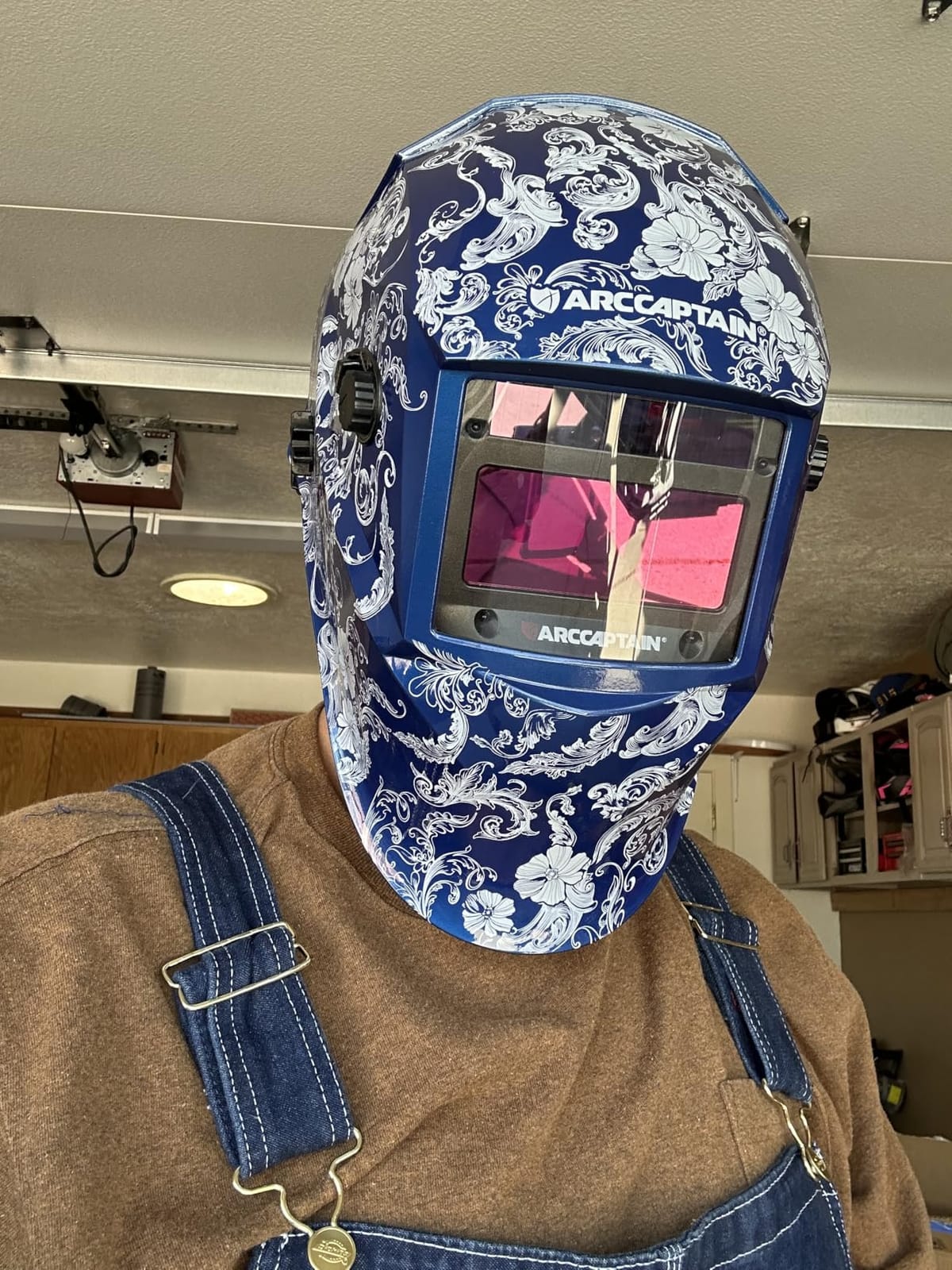
This is the one we recommend when someone on a tight budget refuses to give up four arc sensors. Several budget helmets in this class ship with only two sensors, and on MIG work that means a higher chance of the lens staying light when the arc is partly blocked by your gun neck or your forearm.
The 1/1/1/1 true color filter across a 3.86 x 1.69 inch viewing area is genuinely good, and the slight blue tint that reviewers mention reads as sharper rather than tinted once you are used to it. Switching is 1/25000 of a second, a fraction slower than the 1/30000s options above, and in practice that difference did not show up on normal MIG work.
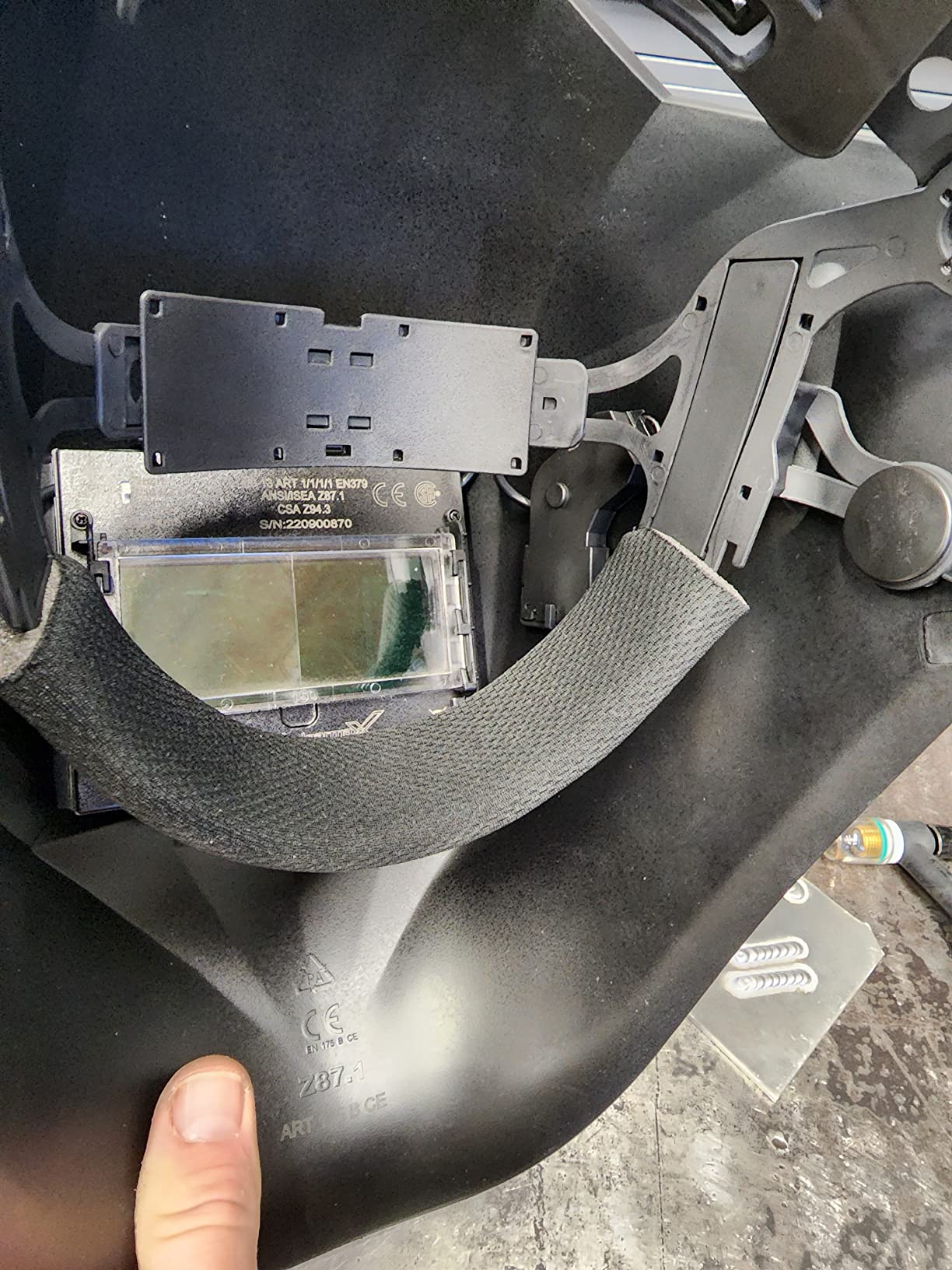
Certification is unusually thorough for the price, with ANSI Z87.1, CSA Z94.3, DIN EN 175 and DIN EN 379 all listed, plus a 12-in-1 smart filter claiming automatic DIN 16 UV and IR protection. Shade 4/9-13 handles MIG, TIG, stick and grind, and the filter accepts a cheater lens for close work.
At 1 lb with an adjustable padded headband it disappears on your head, and solar cells backed by a replaceable CR2450 mean the dark truck problem is solved. Three replacement lenses are included in the box, which is more than most competitors offer.
What you will notice in the first week
The view is bright and the arc detection is immediate. Most buyers who expected to compromise on a budget hood report the opposite, and the grind mode is cited often as the feature that removes the habit of flipping the visor up for every cleanup pass.
Weighing 1 lb, it is comfortable for overhead and out-of-position work in a way that most plastic shells in this class are not. The adjustability on the headband is generous enough to fit under a hard hat brim or over a respirator strap.
Where it falls short
Durability is the honest weak point. A small number of buyers report lenses cutting out or failing after several months, and the 80 percent five-star share suggests long-term reliability is where it loses ground to the brand-name hoods.
A few owners also report slow response on the first moments of an arc, where light leaks past the filter before it settles. The listed 180-day warranty is the shortest we saw, and the PA shell, while light, does not feel as rigid up close as a nylon or reinforced PP shell.
4. YESWELDER LYG-Q800D – Best for Dark Shops and Panoramic Work
YESWELDER Auto Darkening Welding Helmet with LED, 180° View, LYG-Q800D
Integrated LED work light
3.94 x 3.23 inch view with side window
1/1/1/1 clarity
4 arc sensors
Pros
- Panoramic large view plus a fixed DIN5 side window widens the field
- Built-in LED work light for dark shop environments
- True color 1/1/1/1 lens reduces the usual green tint
- Four arc sensors and 1/30000s handle low amperage work
- Reinforced PP shell with a substantial feel
Cons
- Side window is a fixed DIN5 lens and does not darken when welding
- LED module adds bulk to the shell
- Heavier than the smaller YESWELDER models
Garage welders usually fight the same battle: the shop is too dim to lay out a joint properly, but flipping the visor up and down to check your work is worse. The integrated LED on this shell handles the first problem without a separate headlamp bouncing around your forehead.
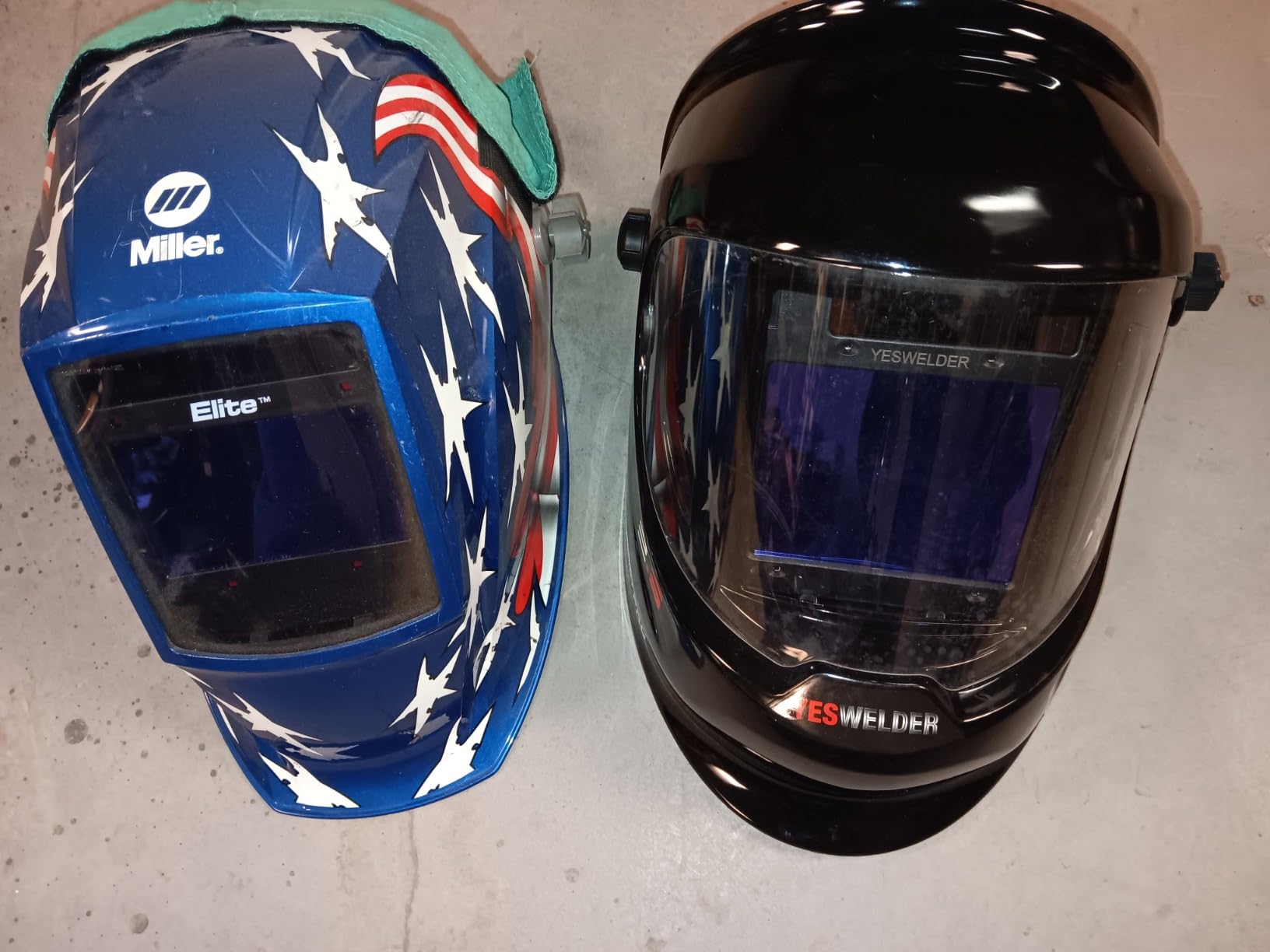
The viewing area is 3.94 x 3.23 inches with a side window, so you get roughly a 180 degree field rather than a forward-only rectangle. That wider peripheral view genuinely helps with out-of-position MIG work and with tracking the wire and the edge of the puddle at the same time.
Underneath, the filter is the same high-grade package as the rest of this lineup: 1/1/1/1 true color, four arc sensors, 1/30000 second switching, and adjustable sensitivity and delay. Shade 3/5-9 and 9-13 covers TIG, MIG, MMA, cut and grind, and the outer lens blocks high-energy blue light.
Solar plus a replaceable CR2450 lithium battery means no charger to keep track of, and three replacement lenses come in the box. The pivot-style headgear and reinforced PP shell feel more substantial than the lighter models in this range.
What you will notice in the first week
You notice the side window first, usually on vertical or overhead passes where your head is not square to the work. Being able to glance at the joint edge and the gun angle without turning your whole head is the difference between comfortable and tiring on a long vertical seam.
The LED is genuinely useful for layout and for cleaning up spatter, and it removes the loose headlamp strap that welders constantly complain about. Sensors handle low amperage MIG and TIG work without hesitation in our use.
Where it falls short
The side window is a fixed DIN5 lens, which means it does not darken when you strike an arc. That is a safety consideration rather than a comfort one, and it is the single most important thing to understand before buying this for a shop where other people are working nearby.
At 2.2 lb it is one of the heavier shells here, and the LED module adds bulk to the front. The extra weight is the tradeoff for the wide view and the light, so anyone welding overhead for hours every day may find the lighter options more comfortable.
5. TRQWH Solar Helmet with Light – Best Built-In Work Light
TRQWH Welding Helmet with Light True Color Auto Darkening Welding Helmets for Men Solar Powered Welding Hood with 2 Arc Sensor Wide Shade 4/9-13 for TIG MIG ARC Cool Welder Mask
Rechargeable USB LED light
1/1/1/2 true color clarity
2 arc sensors
1/20000s response
Pros
- Rechargeable USB LED work light for dark shop environments
- True color lens reduces eye fatigue
- Comfortable headband with sponge padding
- Replaceable batteries and extra lenses included
- External shade and grind knob is simple to operate
Cons
- Only 2 arc sensors
- fewer than most in this class
- Thin lenses wear quickly and replacements are not sold separately
- Shell and headgear feel fragile
- Hood does not lock in the raised position
This is the most budget-conscious pick on the list, and the rechargeable USB light on the shell is the feature that sets it apart. Most competing helmets in this class use solar power for the filter and leave the work light to something you strap on separately, which is why this one is worth a look if your shop is dark.
The lens is rated 1/1/1/2 for optical clarity, a step below the 1/1/1/1 group, and switching is 1/20000 of a second. On steady MIG work that is perfectly serviceable, but it sits at the slower end of what we tested and you should know that going in.
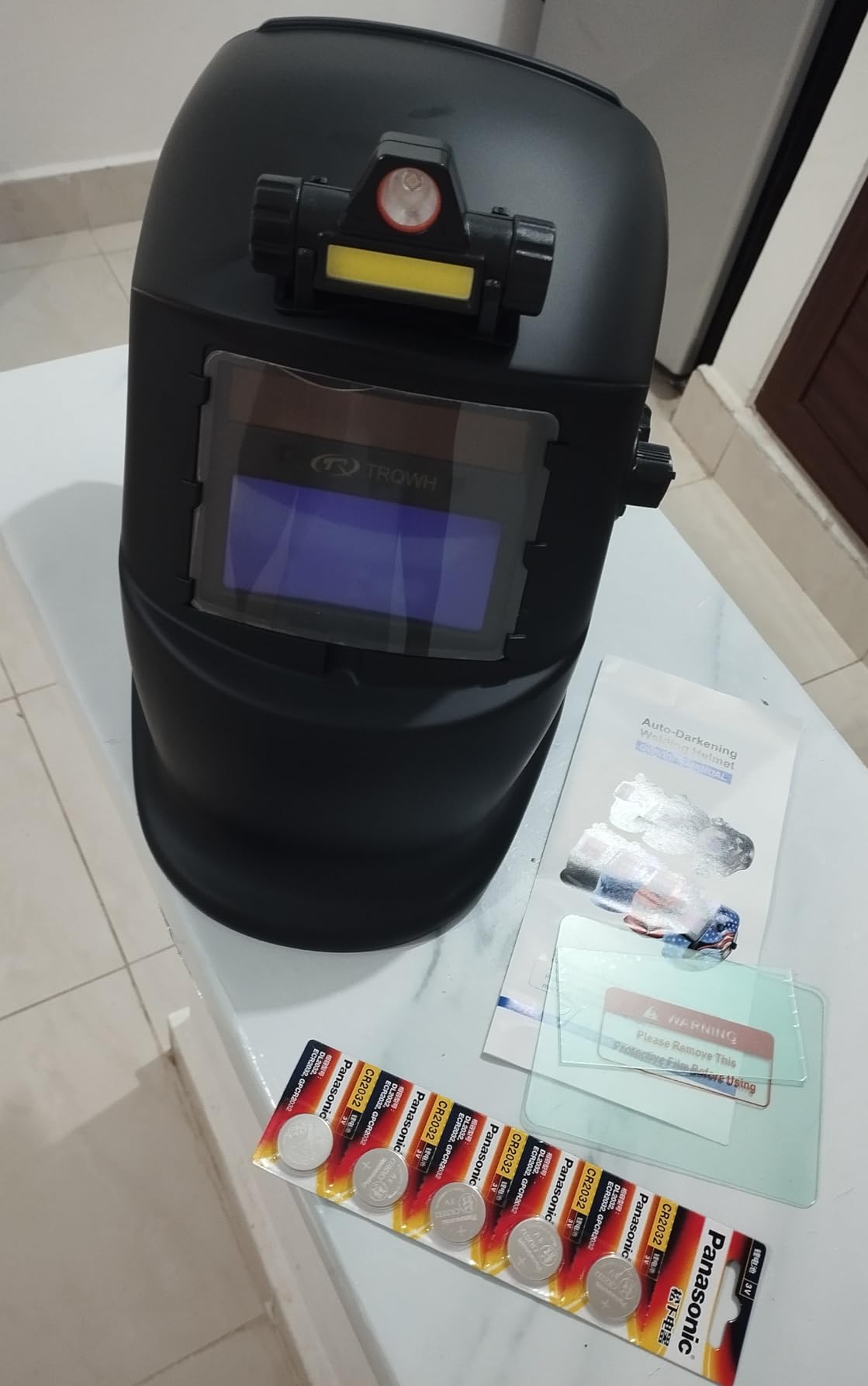
Certification is broad for the price, listed as ANSI Z87.1, EN 379 CE and CSA Z94.3, and the filter runs DIN 4 light state to DIN 9-13 dark state. Solar cells sit alongside two replaceable CR2032 lithium batteries, and the liquid crystal filter is coated to resist 99 percent of harmful light.
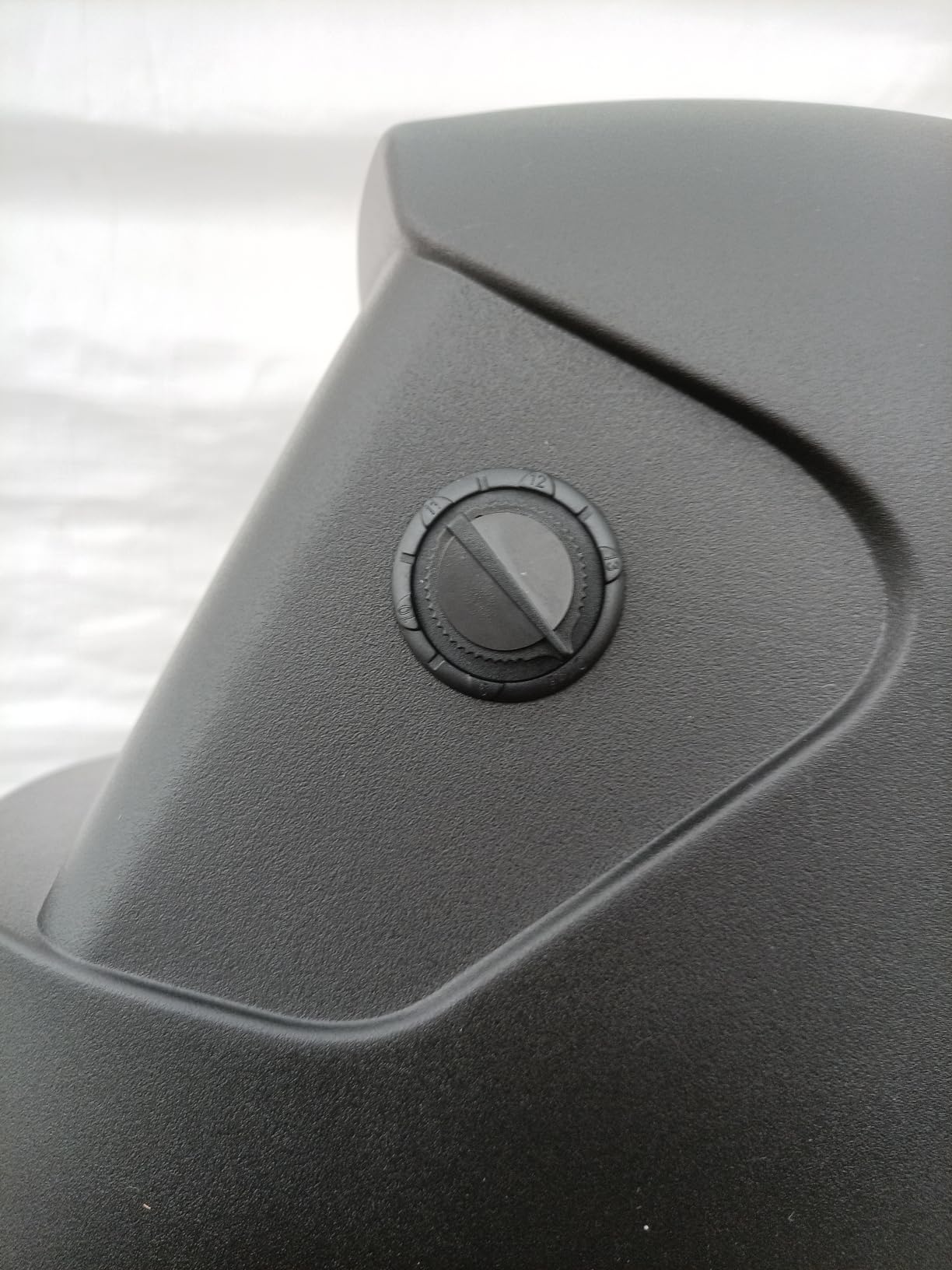
Side angle knobs and rear headband tightness knobs handle fit, with thickened sponge padding at the forehead and ears for sweat absorption. The stated process range covers plasma cutting, abrasive cutting and grinding, DC TIG, AC TIG, MIG and MAG, and MMA stick.
What you will notice in the first week
The light is the story here. It charges over USB, and it sits high enough on the shell to throw light where you are looking instead of into your eyes. Owners also like the padded headband, which is more comfort than most hoods in this class provide.
The true color view still lets you follow a puddle and the seam clearly, and the external shade and grind knob is straightforward to operate with gloves on. For a first helmet, the feature set is longer than the spec list suggests.
Where it falls short
Two arc sensors is the significant compromise, particularly for out-of-position MIG work where your arm crosses the sensor field. It is also the slowest switching in this group, and the hood does not lock in the raised position, so it drops when you move your head.
Lens longevity is the other issue. The thin lenses wear quickly in heavy shop use and replacement lenses are not sold separately, which adds up over years of daily grinding work. One owner reported the shell coming apart and the headgear not staying tightened, so treat it as a light-duty unit rather than a shop-lifetime one.
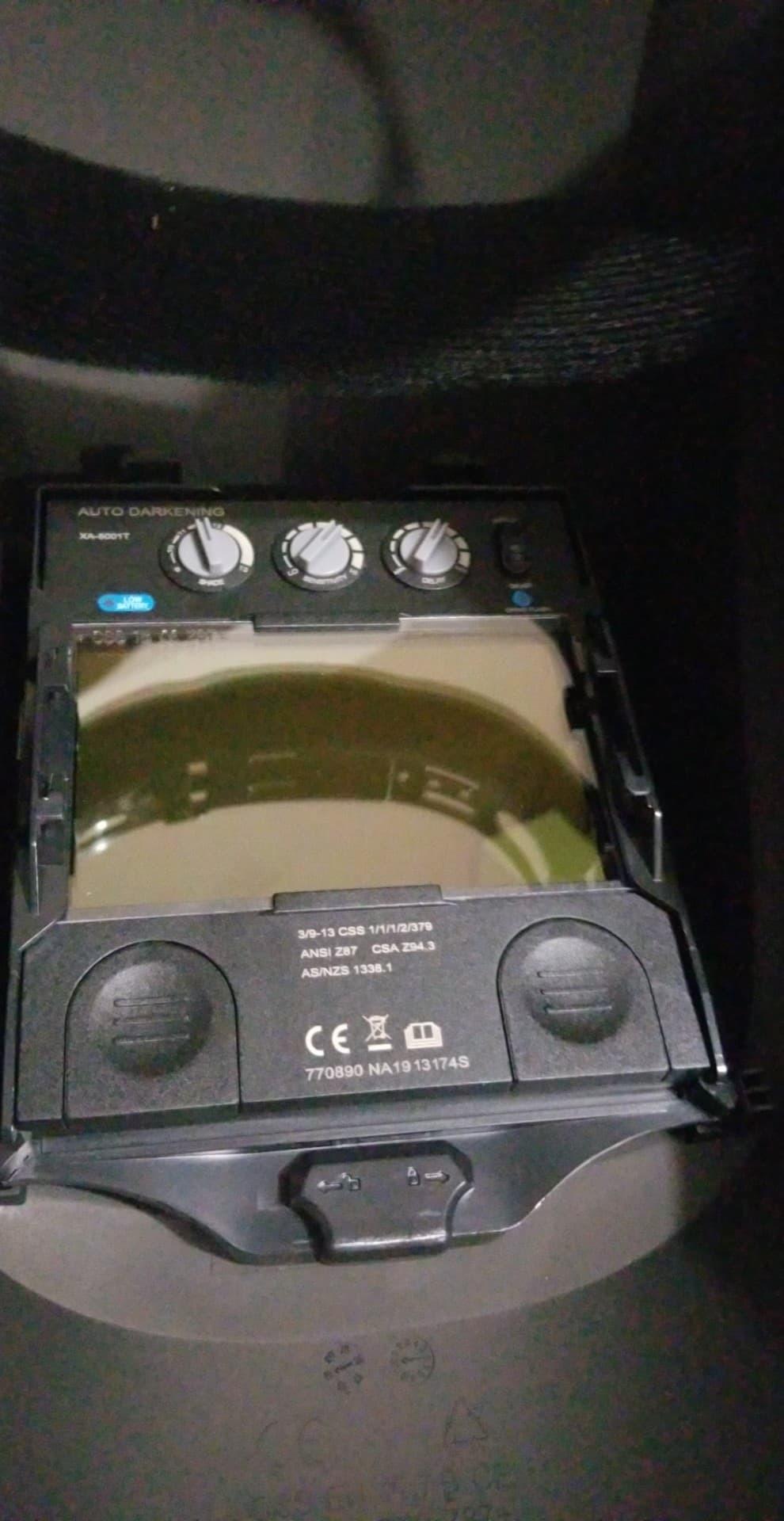
6. Hobart 770890 – Best Widescreen View
Hobart 770890 Auto-Darkening Welding Helmet, Large, Black
PureColor lens
9.3 inch widescreen view
4 arc sensors
Weld to grind switching
Pros
- Large widescreen viewing area with accurate PureColor rendering
- Four independent arc sensors for consistent detection
- One knob weld to grind change without removing the helmet
- Simple analog controls for shade sensitivity and delay
- Backed by a limited two year warranty and lens kit
Cons
- Auto-on power control drains the battery when the hood is not in use
- Analog knobs are less precise than digital controls
- Design targets a higher build tier than budget models
The Hobart 770890 is the hood to look at when the single biggest frustration in your welding is not seeing enough of the work. Its PureColor lens and 9.3 inch widescreen viewing area give the largest single viewing window in this group, and owners coming up from a budget hood consistently cite clarity and build quality as the reason to move up.
Four arc sensors handle detection reliably, and the auto-on power control triggers the lens the moment the arc strikes, so there is no switch to remember before you weld. Continuous UV and IR protection is a useful thing to have specified explicitly rather than assumed.
The controls are analog, which means a turn of a knob for shade, sensitivity and delay. Some welders prefer this because it is faster to operate with gloves on, others want the precision of digital step controls. Weld to grind mode switching happens without removing the helmet, which is the daily-use feature that saves the most time.
At 1.25 lb the polyamide nylon shell is light and holds up well in shop conditions, and a limited two year manufacturer warranty plus a protective lens kit is included. A single CR2 lithium battery powers the filter.
What you will notice in the first week
The PureColor rendering is what you notice, because the colors look right rather than green. On a coated or galvanized surface, or when you are checking whether a stainless bead has bled into the base metal, an accurate view stops you guessing.
The widescreen area changes how you move your head. Less time craning to find the puddle, more time holding a consistent angle, and the 83 percent five-star share reflects how much owners value that once they have used it.
Where it falls short
Auto-on power control has a downside: the battery still drains when the hood is sitting unused, so if it lives in a locker for a couple of weeks you may find it slower to respond on the first strike until the CR2 cell is changed.
Analog knobs are a real downgrade for anyone who likes to dial a specific sensitivity for 30 amp aluminum and return to it later, and moving up to a brand of this class is a step up in build as well as optics. It is a better hood, not a different category of product.
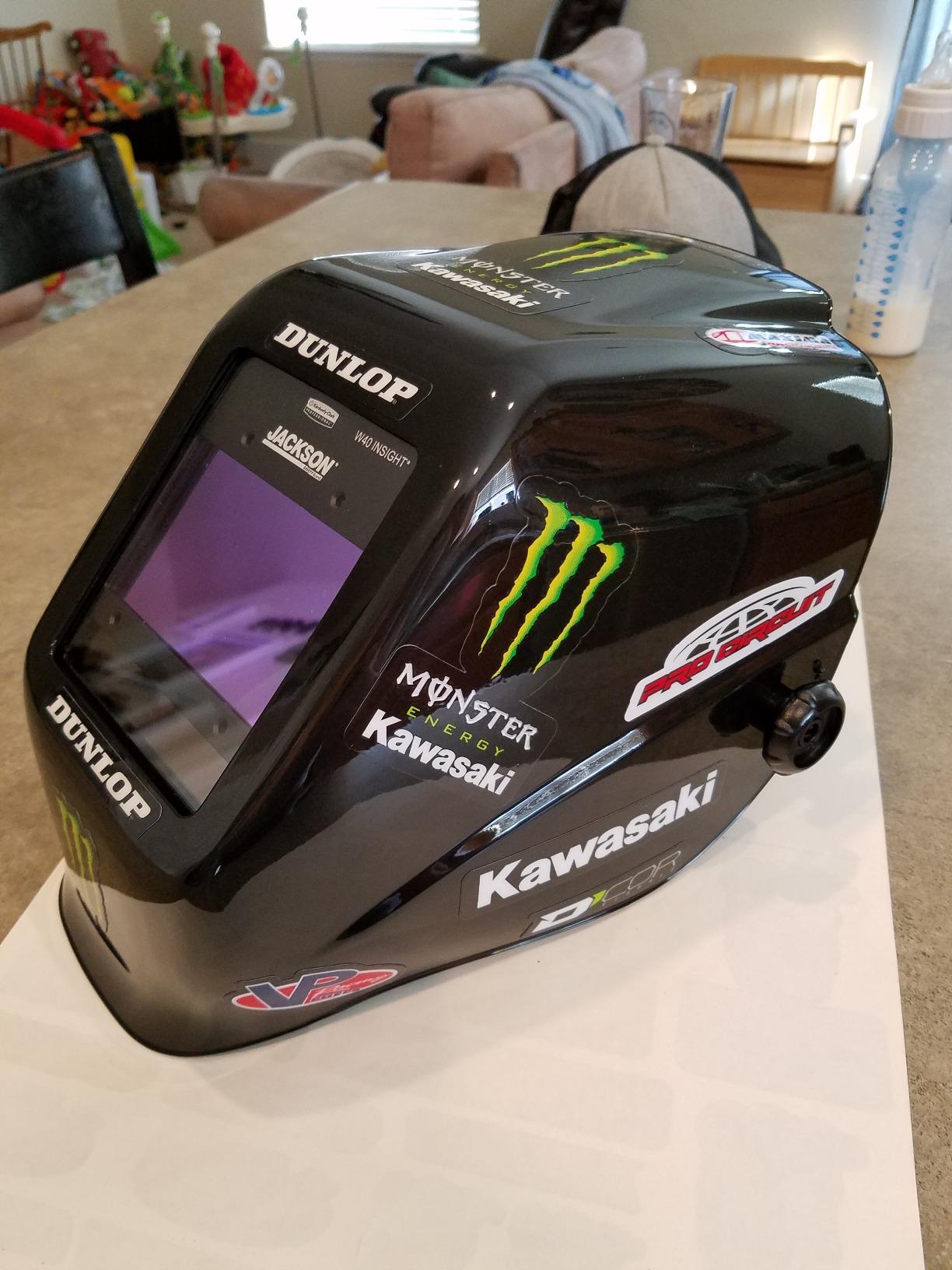
7. Jackson Safety Insight – Best Lightweight Shell
Jackson Safety Insight Auto Darkening Welding Helmet, ADF Hood – ANSI Z87.1
6 ounce HLX ultralight shell
3.94 x 2.36 inch view
1/1/1/1 clarity
Shades 9-13
Pros
- Extremely light shell reduces neck tension on long jobs
- Low profile hood fits into tight spots
- Four sensors switch reliably on inverter machines
- Ratcheting headgear holds position up or down
- Tight cover lens seal keeps spatter off the shade lens
Cons
- Light state can feel dark for bright shop lighting at some settings
- Sensitivity tuned too high causes false triggers on aluminum
- Not as rugged as higher-end premium hoods over long daily use
At 6 ounces for the shell, this is the lightest auto darkening helmet in the roundup by a wide margin, and for long pipe and structural jobs that is not a gimmick. Neck fatigue accumulates quietly over a full shift, and a hood you forget you are wearing is worth a lot at the end of a long day.
It does not achieve that weight by compromising the filter. You get 1/1/1/1 optical clarity with true color technology, variable shades 9 to 13, digital sensitivity and delay controls, weld, torch and grind modes, and four arc sensors.
The 370 Speed Dial ratcheting headgear with a Qwik-Fit rear swivel headband holds position up or down and adjusts for head size and shell angle, which solves the loose-headgear problem that plagues cheaper helmets. The low profile also lets you get the hood into tight spots where a bulkier shell simply will not fit.
It is certified to ANSI Z87.1 and CSA Z94.3, and the tight cover lens seal keeps weld smoke and spatter off the inner shade lens. Long-term owners report multi-year reliability on original batteries.
What you will notice in the first week
The first thing is that you can work in a genuinely tight position without the front of the helmet catching on the work. On pipe work and inside a frame, that flexibility is as valuable as the low weight.
Clarity is high for such a small shell, and the four sensors switch reliably even on inverter machines, which produce a faster-starting arc than a transformer. The headgear ratchets firmly and stays where you put it.
Where it falls short
The light state can read as a little dark under bright shop lighting at some settings, which is mildly annoying when you are setting up and not welding. Sensitivity also needs tuning down if you weld bright aluminum, or reflected shop light can trigger a false darkening.
It is not as rugged as the higher-end premium hoods over years of daily use, and it is less forgiving of a hard knock than the nylon and reinforced PP shells elsewhere on this list. For full-time shop work every day, the extra weight of a sturdier shell is usually worth it.
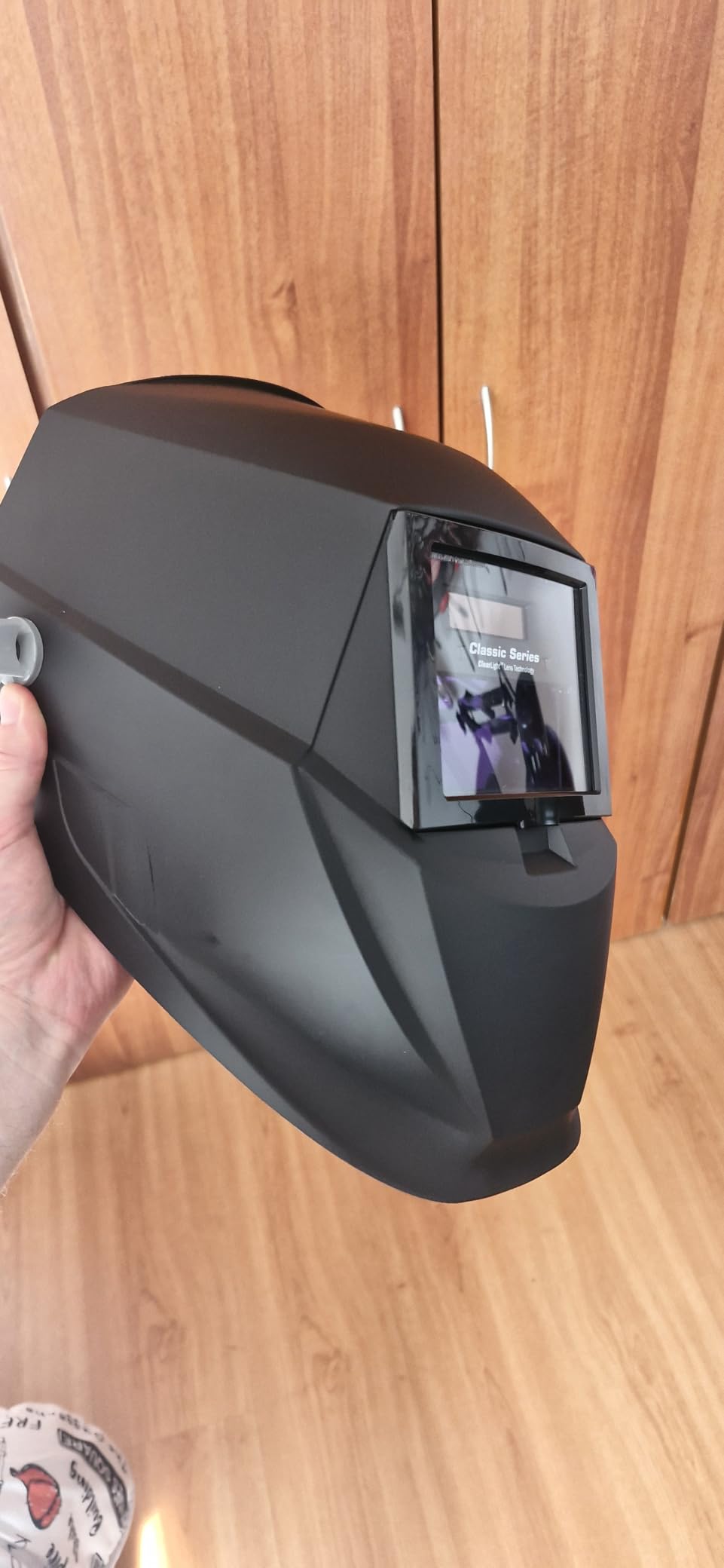
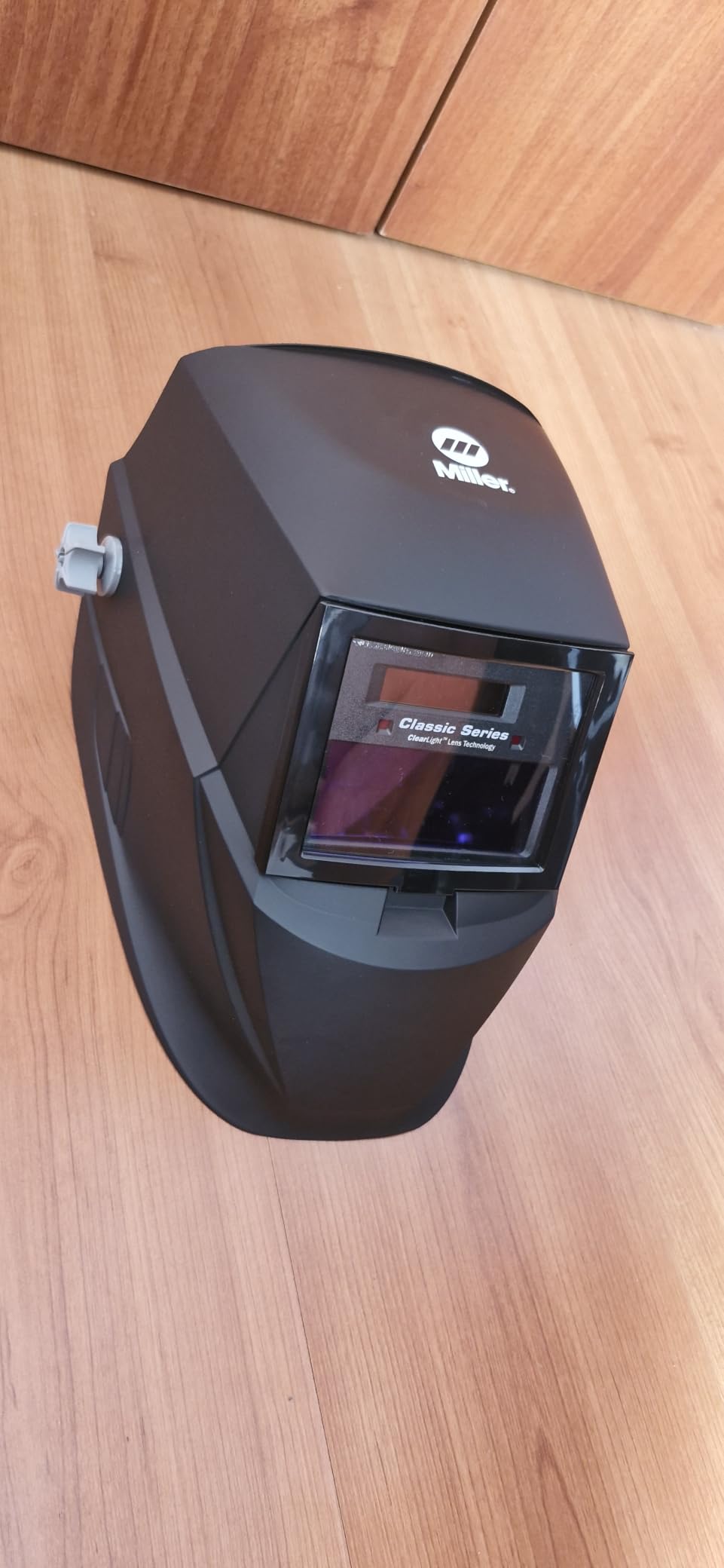
8. Miller Classic Series ClearLight – Best Optical Clarity
Miller Classic Series Welding Helmet, ClearLight™, Shade 8-13, Black
ClearLight lens
6 square inch viewing area
Weld shades 8-13
Digital controls
3.0 light state
Pros
- ClearLight optics give high-definition rendering of the puddle
- 3.0 light state lets you keep the hood down between welds
- Digital controls make shade delay and sensitivity changes precise
- Ratchet headgear is comfortable for long sessions
- Three year warranty with three year spare part availability
Cons
- Two arc sensors is fewer than competing premium hoods
- 6 square inch viewing area is modest next to panoramic helmets
- Cut shades start at 5 so low shade plasma cutting is not covered
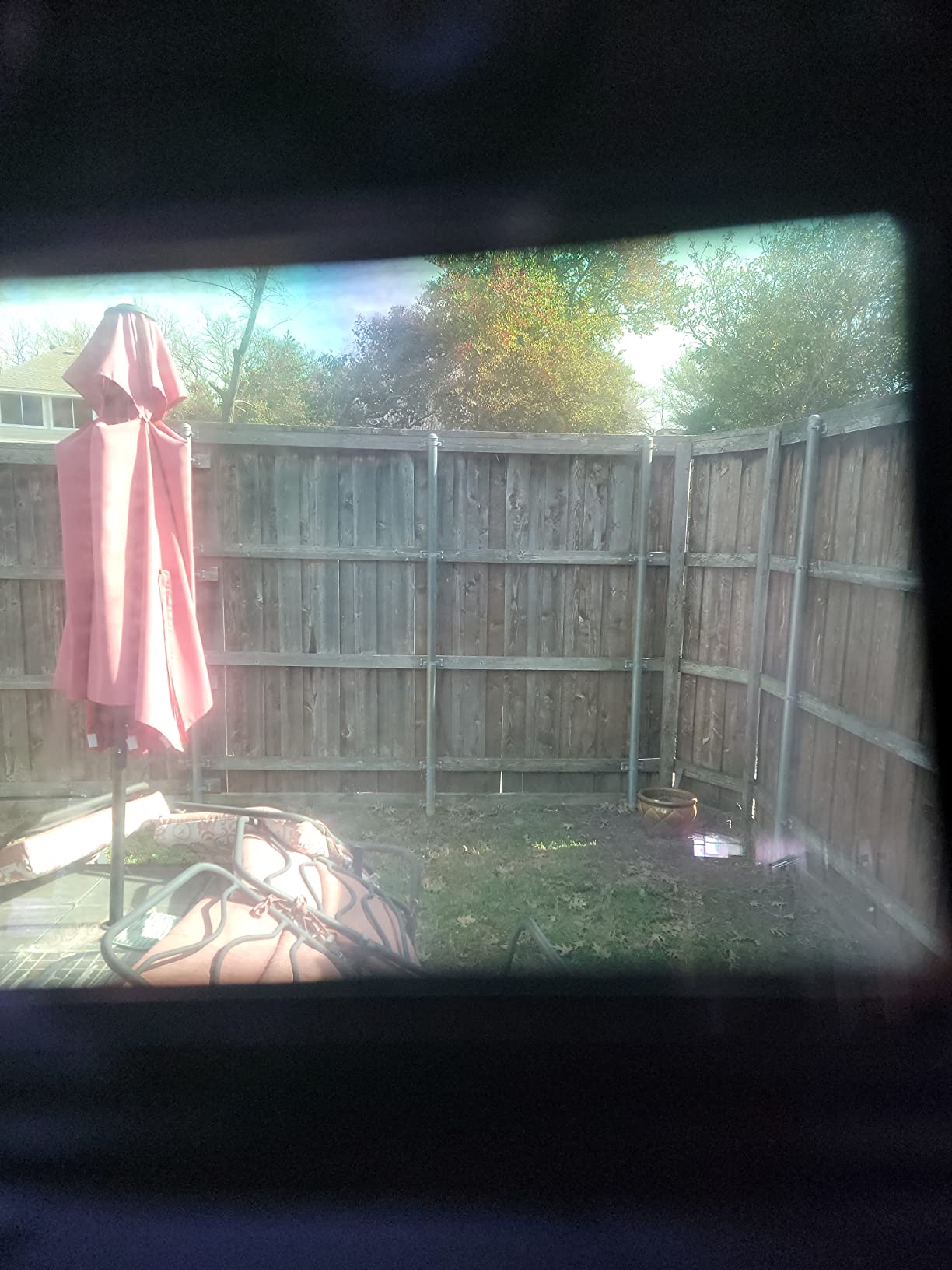
Miller calls the lens technology ClearLight and it is the reason this hood is on the list. The color rendering is high definition rather than simply accurate, and with an 86 percent five-star share the optics are the single most praised thing owners report.
The 3.0 light state is the sleeper feature. Because the lens is bright enough to see the workpiece in its light state, you can keep the helmet down between welds instead of flipping it up, which saves a surprising amount of time over a day and stops you from waving your hand in front of the lens.
Digital controls handle shade, delay and sensitivity with real precision, and the ratchet headgear holds a comfortable fit for extended sessions. Auto-on power control activates at the strike of an arc, so there is no power switch to forget, and it is rated down to welding at five amps or below.
Shade coverage is 8-13 for weld, 5-8 for cut and 3 for grind. Certification runs to ANSI Z87.1+, CSA and CE, and it carries a three year warranty with three years of spare part availability behind it, the longest published support commitment of the brand-name hoods here.
What you will notice in the first week
The image quality is immediately obvious on thin material. On 20 gauge steel or 24 gauge sheet you can see the edge of the puddle and the wire position without straining, and the light state is bright enough to keep the hood down for most of your setup.
The precision of the digital controls is what professional welders notice. Dialing sensitivity down for a 20 amp aluminum pass and back up for a 200 amp structural weld takes seconds and is repeatable, which an analog knob cannot match.
Where it falls short
Two arc sensors. On a premium hood that is an unusual choice, and owners do report that low amperage work can take a moment longer to trigger, particularly on a machine that ramps up slowly.
The 6 square inch viewing area is modest next to the panoramic and widescreen options here, and cut shades begin at 5, so very low shade plasma cutting is not covered. If wide-pass MIG on big plate is your main work, a larger field is the specification to prioritize instead.
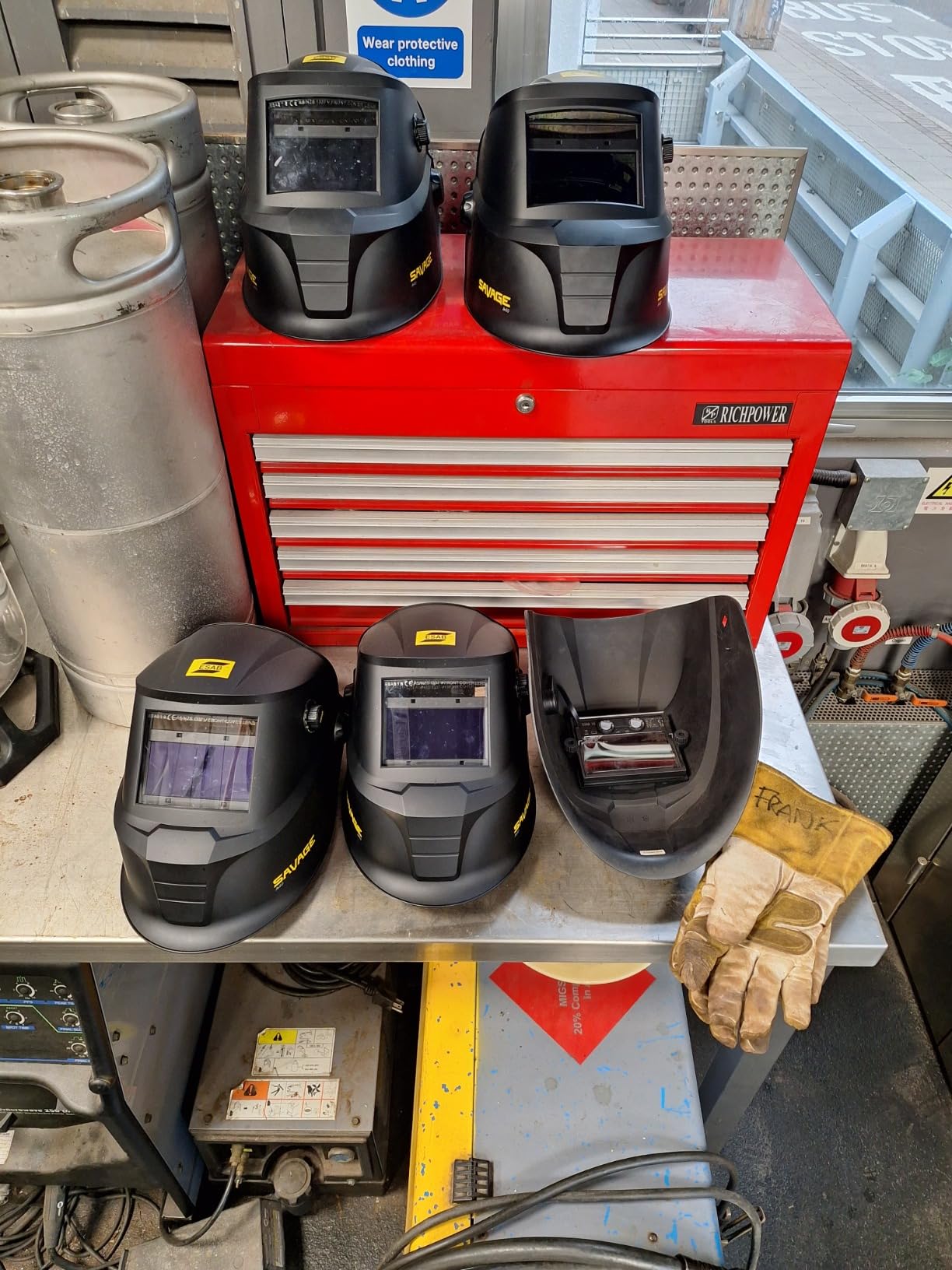
9. ESAB Savage A40 – Best Multi-Process Shop Helmet
ESAB 0700000480 Black Savage A40 Welding Helmet
4 arc sensors
Adjustable delay and sensitivity
Exterior grind mode button
True color lens
Pros
- Very clear true color view that reviewers describe as HD
- Light enough at about a pound to reduce fatigue
- Grind mode engages from a single exterior button
- Delay and sensitivity controls suit tacking and heavy passes
- Long battery life with some owners going years between changes
Cons
- Lens is smaller than premium models such as the Lincoln Viking
- Shade knob on the exterior can be knocked to an extreme in tight spaces
- Some users report double vision with a cheater magnifying lens
The Savage A40 is the pick for someone who does not do only MIG. Four arc sensors, adjustable delay, and a sensitivity control tuned for the low range on TIG make it a genuinely multi-process hood, and the exterior grind button means you can switch modes with a gloved hand.
Owners upgrading from budget models consistently credit it with making learning and production welding possible, largely because the view is clear enough to see what you are doing. The true color lens is described as HD quality by several reviewers, which is high praise for a hood in this tier.
Delay control is more useful on MIG than people expect. Shortening it means the lens clears almost immediately when the arc stops, which suits tacking and short passes, while lengthening it keeps the lens dark for a beat longer when you are doing a long weave and need to follow the puddle after the arc ends.
It weighs about a pound, which reduces head and neck fatigue on long jobs, and a single CR2 lithium battery powers it. Some owners report going years before changing the battery, and the build sits below the premium-brand tier while staying noticeably more substantial than the cheapest shells.
What you will notice in the first week
The delay control is the feature that changes your workflow. If you have finished a pass and found yourself waiting in a dark lens trying to see your bead, setting a shorter delay fixes that immediately.
Grind mode on the exterior button is the other one. It is a small thing that adds up across a shift, because you stop taking the helmet off for every cleanup pass and keep the whole job flowing in one process.
Where it falls short
The lens is smaller than the premium panoramic models, so on wide-pass work you will move your head more than you would in a larger viewing area. That is the trade-off for the low weight and the clear optics.
The shade knob sits on the exterior upper corner and can be knocked to an extreme when you are working in a tight space, which is a genuinely annoying failure mode if your last pass was set correctly. A few users also report double vision when using a cheater magnifying lens, so test that combination if close-up work is central to your job.
10. Lincoln Electric No Rules No Limits K4983-1 – Best Hard Hat Compatibility
Lincoln Electric No Rules No Limits Welding Helmet K4983-1, Auto Darkening, Lightweight Weld Headgear, Shade 7-13, Grind Mode, Use for Stick, TIG, Pulsed TIG, MIG, Pulsed MIG, Flux Core, Gouging
4.33 x 3.54 inch viewing area
17.5 oz nylon shell
Shade 7-13 plus grind mode
Hard hat compatible
Pros
- Large viewing area in a very light 17.5 oz shell
- Solar powered with AAA battery backup so no dedicated pack is needed
- Ratchet headgear and oversized sweatband stay comfortable
- Variable shade 7-13 plus a dedicated grind mode
- Hard hat compatible and two spare lens sets included
Cons
- No sensitivity or delay controls for fine tuning low amperage work
- TIG capability is rated for 5 amps and above
- Lower review volume than the rest of this list
This is the Lincoln option for site work and hard hat environments, and its headline number is 17.5 ounces with a 4.33 x 3.54 inch viewing area. That is a large window in a very light shell, and the ratchet headgear with an oversized absorbent sweatband is designed for wearing a hard hat over the top.
It is solar powered with AAA battery backup, so it works without a dedicated battery pack. Shade runs 7-13 with a separate grind mode, and the listed process coverage is broad: stick, TIG, pulsed TIG, MIG, pulsed MIG, flux core and gouging.
Two extra inner and outer impact resistant clear lenses come in the box, which is more generous than most. The shell is nylon, the fit is a ratchet closure, and it is ANSI Z87.1 safety certified with a stated TIG rating of 5 amps or greater.
At 85 percent five-star, satisfaction among owners is high, and the recurring theme is the combination of a big view and a light shell without stepping up to the brand’s professional flagships.
What you will notice in the first week
The 4.33 x 3.54 inch area is one of the largest rectangles here, and it makes wide-pass MIG on plate noticeably less head-intensive. Flux core and pulsed MIG, both on the supported process list, benefit from a field that wide because the spray and the puddle edges are easier to track.
Fitting it over a hard hat is straightforward, and the absorbent sweatband keeps the forehead dry across a hot shift. Not needing a dedicated battery pack simplifies a truck-mounted setup considerably.
Where it falls short
There are no sensitivity or delay controls listed, so you cannot tune it the way you would a four-control hood. That matters if you do a lot of low amperage work or if you weld bright aluminum where false triggering is a problem.
The TIG rating is 5 amps or greater, so it will not cover the very low amperage end. Review volume is also lower than the rest of this list, so there is less long-term owner data behind it, and a shell this light trades some rigidity for the weight saving.
What Shade Do I Need for MIG Welding?
Start at shade 10 for MIG welding mild steel at roughly 100 amps, then adjust one number darker for thicker plate and one number lighter for thin material. Most helmets in this roundup cover shade 7 or 8 through 13, so you have adjustment either way. The full range is only useful if your machine can hold the amperage you are asking it to.
The reference below is the starting point we use. Treat it as a first setting, not a rule, because the correct shade depends on your machine, your wire, your gas and how much of the arc you can see as bright detail rather than a white blob.
MIG shade by material and amperage:
Thin steel, 24 to 20 gauge, 30 to 60 amps: shade 8 to 9. Thin material throws very little heat, and a dark shade here just makes it harder to see the puddle.
3/16 inch steel, 90 to 130 amps: shade 10. This is the most common structural setting and a good default for a new helmet.
1/4 inch and heavier plate, 150 to 250 amps: shade 11 to 12. Heavy spray and flux give you more to look through, so a darker shade reads better.
Stainless steel, 90 to 150 amps: shade 10 to 11. Stainless produces a hotter, more concentrated arc than mild steel at the same amperage.
Aluminum MIG, 100 to 200 amps: shade 11 to 12. Aluminum needs more amperage and throws a bright, concentrated arc, and reflective surfaces can trigger sensors set too sensitive.
Flux-cored wire, 100 to 200 amps: shade 10 to 12 depending on wire diameter. Flux-cored is smokier and dirtier than solid wire MIG, so a slightly darker shade usually keeps the puddle readable.
Pulsed MIG, any material: shade 9 to 11. The pulse keeps the arc from getting as visually intense, so one number lighter than solid wire at the same amperage is typical.
Grinding with the same helmet: shade 3 to 5 through grind mode, not the weld range.
With a brand new helmet, set the sensitivity control in the middle of its range before you strike an arc. Then turn the shade down one number at a time until you can clearly see the wire, the puddle edge and the joint, rather than judging brightness alone. If your helmet is set correctly you should see a bright center with visible detail around it, not a flat white disc.
If the lens fails to darken when the arc starts, that is a sensitivity or sensor-position problem, not a shade problem. Lowering the shade will not fix it and will leave you exposed, so adjust the sensitivity control or check that your arm and gun are not blocking the sensors.
How to Choose an Auto Darkening Welding Helmet for MIG
An auto-darkening filter, or ADF, is the lens element that switches from a clear light state to a dark shade when an arc is struck. Photo sensors and electromagnetic arc sensors detect the arc, signal the filter, and a liquid crystal element changes state in roughly 1/25000 to 1/30000 of a second, then returns to light state after a delay you set. That switch time is what stands between you and a flash burn, and it is the first thing to check on any spec sheet.
1. Arc sensor count, and why four beats two. This is the fastest way to separate a serious MIG helmet from a toy. Sensors look for the arc to decide when to darken, and with two sensors there is a good chance one of them is blocked by your forearm, the gun neck, or the workpiece itself when you are welding out of position. The lens then stays light while you are looking straight at a live arc. Four sensors cover far more angles, which is why most of the hoods we recommend here use four.
2. Optical clarity and what 1/1/1/1 actually means. The four numbers are optical class, visible light transmission, infrared transmission and ultraviolet transmission, each graded 1 to 3 where 1 is best. A 1/1/1/1 rating means the filter passes maximum light in every band while still blocking the dangerous wavelengths, which is what lets you see true color. A 1/1/1/2 rating is a small step down. On MIG the difference shows up on the puddle, where a tinted filter hides the wire and makes it harder to judge travel angle, and on aluminum and stainless, where color accuracy is the only way to judge the bead.
3. Switching speed. Anything at or above 1/25000 of a second handles MIG properly. Faster is not dramatically better once you are past that point, so do not pay a premium for 1/30000s over 1/25000s. The genuinely important pairing is switching speed with sensor count, because a fast lens with two blocked sensors is still a slow lens.
4. Viewing area. The most common sizing mistake is buying a compact rectangle when your work is wide-pass MIG on plate or any kind of pipe work. Aim for at least 3.5 x 1.7 inches as a floor, and prefer 3.9 x 3.6 inches or a widescreen format if you weld out of position. A larger window means less time craning your neck, and the wide-area helmets here also tend to have the headgear to keep the view level.
5. Shade range. For MIG you want roughly shade 8 to 13 available, with a lighter cut range and a grind mode. Shade 7 to 13 is enough for most jobs, and anything that reaches shade 13 handles the thick plate work that lighter ranges cannot. Check where the cut range starts too, because if you plasma cut as well as weld, cut shades beginning at 5 leave a gap at the low end.
6. Headgear and long-shift comfort. Ratcheting or speed-dial headgear that holds position up and down, a rear swivel band for a secure fit, and an absorbent sweatband are what separate a comfortable helmet from a tiring one. Weight matters more than people expect: the shells here range from 6 ounces to 2.2 pounds, and that difference is very obvious by hour eight. Forum welders mention headgear that pinches or creeps forward more than any other comfort complaint.
7. Power source. Solar plus a replaceable button cell is the practical combination. Solar alone leaves you with a dead helmet after a few weeks in a dark truck bed, which is the most common complaint aimed at otherwise capable budget models. A CR2450 or CR2032 cell costs very little and takes seconds to swap, so a replaceable battery should be a hard requirement.
8. Grind mode and external controls. If you grind as much as you weld, a dedicated grind mode reachable from a button on the shell saves real time. The same applies to the shade, sensitivity and delay controls: if they are inside the shell, you are lifting the hood for every change. Test for glove operation before you buy.
9. Certification. Look for ANSI Z87.1 in the US, CSA Z94.3 in Canada, and EN 379 or EN 175 for European and international use. A helmet that does not carry one of these should not be on your list at any price. Certification is cheap to add and tells you the filter was tested, not just marketed.
10. Brand and support. Miller, Lincoln, ESAB and Hobart back their helmets with warranties of two to three years and keep spare parts, cover lenses and headgear available for years. Budget brands give you strong optics for less money but thinner shells and shorter warranty coverage. Our decision rule is simple: if you weld full shifts, buy the warranty. If you weld a few nights a week, buy the optics.
One brand question comes up constantly in forums, so it is worth answering directly. Miller and Lincoln differ less in the filter than the packaging. Miller leads on optics technology, with ClearLight on the Classic Series giving the best color rendering in this roundup, while Lincoln leads on weight and large viewing area, with the K4983-1 putting a 4.33 x 3.54 inch window in a 17.5 ounce shell. Both are backed by multi-year warranties. ESAB sits between them on multi-process controls, and Hobart is the widescreen specialist. For a full-time welder buying one hood for the next several years, we would take the warranty over any single lens feature.
Running costs get overlooked, too, and they are where our approach to ongoing gear costs applies just as much here. On a welding helmet the recurring spend is the outer cover lens, which takes spatter and eventually scratches, plus a button cell every year or two. Both are trivial next to the helmet itself, and worth budgeting for rather than discovering at the worst moment.
Common Mistakes to Avoid With a MIG Welding Helmet
Ignoring arc sensor count. Two sensors is the most common reason a helmet that works fine on a bench flickers and stays light during real out-of-position MIG work. If you weld anything other than flat plate at a comfortable angle, buy four sensors.
Leaving sensitivity at the factory default. The default is set for ideal conditions. Bright aluminum and reflective stainless trigger false darkening at moderate settings, and a dim shop can fail to trigger at all, so spend five minutes tuning sensitivity and delay on your own machine.
Setting the shade too dark. A darker shade always feels safer and always sees less. Start lighter than you think and step darker until the puddle is a bright center with visible detail around it, not a white disc.
Skipping the grind mode. A dark grinding lens is unpleasant and slow, and it wears the filter faster. If you grind regularly, use the grind mode rather than sitting in shade 10 with a wheel.
Ignoring cover lens spatter and fogging. MIG spatter pits the outer cover lens quickly, and scratched or foggy lenses reduce clarity and cut sensitivity. Clean the lens with a proper wipe rather than a shirt, and replace the cover lens on the first sign of pitting.
Wearing a solar-only helmet through a dark spell. If your helmet is solar with no replaceable battery backup, it can stop responding after a few weeks in a toolbox or truck bed. Most of the picks in this roundup pair solar with a replaceable button cell for exactly that reason.
Buying a narrow view for wide work. Pipe, plate and long seams punish a small viewing area all shift. If your work is wider than about 3.5 x 1.7 inches, size up.
Forgetting headgear fit under a hard hat or respirator. Test the fit with the layers you will actually wear before you commit, and check that a respirator strap clears the headband rather than pressing into it.
Frequently Asked Questions
Which is the best auto darkening welding helmet?
The YESWELDER LYG-L600A is the best overall for MIG welding, with 1/1/1/1 true color optics, 1/30000 second switching, shade 3/7-13 coverage and a 16 ounce shell rated to ANSI Z87.1 and CSA Z94.3. If your priority is a wider view instead, the YESWELDER LYG-M800H offers a 3.93 x 3.66 inch viewing area with four arc sensors.
What shade should my welding helmet be for MIG welding?
Start at shade 10 for MIG welding mild steel around 100 amps. Go one number lighter for thin material near 30 to 60 amps, and one or two numbers darker for plate at 150 amps and above, stainless, aluminum, and flux-cored work. Pulsed MIG usually runs one number lighter than solid wire at the same amperage.
What ADF rating should a beginner welding helmet have?
Look for 1/1/1/1 optical clarity, four arc sensors, and a switching speed of at least 1/25000 of a second. A 1/1/1/1 rating means the filter passes maximum visible, infrared and ultraviolet light while blocking the dangerous wavelengths, so you see true color in the puddle. Two sensors is workable but noticeably less reliable out of position.
How important is the viewing area size on a welding helmet?
It matters a great deal on pipe work, wide-pass MIG on plate, and anything overhead or out of position, because a small window forces constant head movement to find the puddle. Treat 3.5 x 1.7 inches as a minimum and prefer 3.9 x 3.6 inches or a widescreen format if you weld larger joints regularly.
Can I trust an auto darkening welding helmet?
Yes, provided it is certified and it has at least two, ideally four, arc sensors. Modern filters switch in around 1/25000 of a second, which is faster than human reaction time and fast enough to prevent a flash burn. The real risks come from untuned sensitivity settings, blocked sensors, and a solar-only helmet that has died in a dark storage space.
Do I need a grind mode for MIG welding?
Only if you grind regularly. A grind mode gives you shade 3 to 5 through a button on the shell, so you can clean up a bead without lifting the helmet and without wearing a dark lens while you work. It also reduces wear on the filter, and it removes the most common habit complaint we hear from shop welders.
How does an auto darkening welding helmet work?
Photo sensors and electromagnetic arc sensors detect the arc, send a signal to a liquid crystal filter, and the lens switches from a clear light state to your preset dark shade in roughly 1/25000 to 1/30000 of a second. It returns to the light state after a delay you set, which is what lets you keep the helmet down and see the finished bead.
Conclusion
The best auto darkening welding helmets for MIG welding in 2026 are not as close together as the spec sheets suggest. If you want one recommendation, take the YESWELDER LYG-L600A: 1/1/1/1 true color optics, 1/30000 second switching, shade 3/7-13 coverage, and a 16 ounce shell with a replaceable battery.
For wide-pass work and pipe, step up to the YESWELDER LYG-M800H for its 3.93 x 3.66 inch window and four sensors. Budget shoppers who refuse to give up four sensors should look at the ARCCAPTAIN S800. Dark shops call for the YESWELDER LYG-Q800D with its LED and side window, and the TRQWH for a rechargeable USB work light. Long shifts and overhead work suit the 6 ounce Jackson Safety Insight, the biggest viewing window belongs to the Hobart 770890, and the best color rendering is the Miller Classic Series ClearLight. Multi-process shops get the ESAB Savage A40, and hard hat work gets the Lincoln Electric K4983-1.
Whatever you pick, set the sensitivity on your own machine before you run a production weld, and start at shade 10. That single afternoon of setup will save you a year of second-guessing.