

The best pin nailer for cabinet making is the DeWalt DCN623B, a 20V cordless 23-gauge pinner rated 4.7 out of 5 across 928 reviews with tool-free jam release and a tool-free depth adjust. If you already run a compressor, the Metabo HPT NP35A is the value pick, and the DeWalt DWFP2350K covers the longest pin range in this group at up to 2 inches.
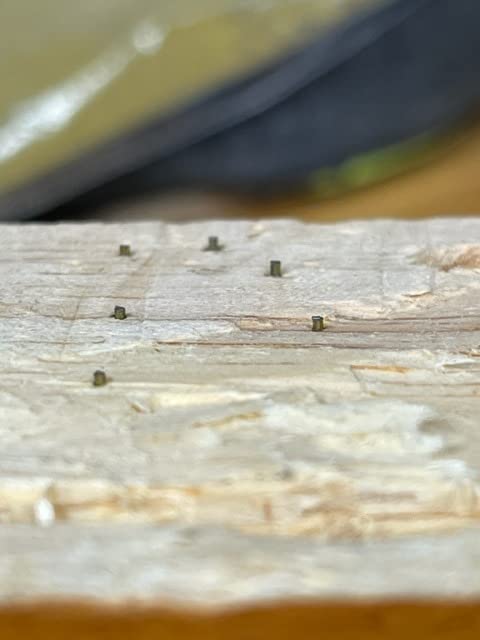
That matters because cabinet stock is thin. Face frames, drawer boxes, cabinet backs and door rails are usually 1/2 inch or 3/4 inch plywood, and a 15-gauge finish nail or an 18-gauge brad will either split the edge or blow out the back face. A 23-gauge headless pin sinks almost flush and leaves a hole so small that a dab of filler and one coat of paint makes it disappear.
Our team has spent years watching this tool get used in real shops, from one-person custom cabinet businesses to two-man installation crews working out of vans with no power for a compressor. We compared all ten options below on the only things that decide a cabinet job: whether the pin sets flush, whether the tool jams mid-assembly, whether you can clear a jam without a hex key, and how the tool feels after a hundred face-frame joints. We also weighed each one against the jobs it should never handle, because several very good pin nailers on the market are simply too short for cabinet work.
If you are still setting up a shop and making other calls first, our guide to basic home maintenance habits for new homeowners is a better read for beginners. For cabinetry, keep reading here.
Table of Contents
Top 3 Pin Nailers for Cabinet Making in 2026
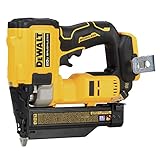
DeWalt DCN623B Cordless 23 Ga.
- Brushless 20V cordless
- 5/8 to 1-1/2 in. pins
- Tool-free jam release and depth adjust

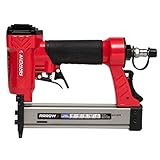
Three quick reads before the full list. The DCN623B wins for anyone without a compressor and for anyone who wants zero tool-free adjustments forgotten on a bench. The NP35A wins on weight, at 2.0 pounds, which matters when you are overhead on a valance or crown return. The PT23G wins for a shop that only needs pins up to 1 inch for beadboard and small return trim.
All 10 Pin Nailers Compared for Cabinet Work in 2026
| Product | Specs | Action |
|---|---|---|
| DeWalt DCN623B Cordless 23 Ga. Pin Nailer |
|
Check Latest Price |
| Metabo HPT NP35A Pneumatic Pin Nailer |
|
Check Latest Price |
| Arrow PT23G Pneumatic Pin Nail Gun |
|
Check Latest Price |
 Makita AF353 23 Gauge Pin Nailer Makita AF353 23 Gauge Pin Nailer |
|
Check Latest Price |
 DeWalt DWFP2350K 2-Inch Pin Nailer DeWalt DWFP2350K 2-Inch Pin Nailer |
|
Check Latest Price |
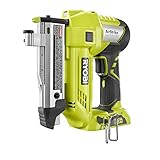 Ryobi P318 18V ONE+ Pin Nailer Ryobi P318 18V ONE+ Pin Nailer |
|
Check Latest Price |
 Metabo HPT NP50A Pro Pin Nailer Metabo HPT NP50A Pro Pin Nailer |
|
Check Latest Price |
 CRAFTSMAN CMCN623B Cordless Pin Nailer CRAFTSMAN CMCN623B Cordless Pin Nailer |
|
Check Latest Price |
 Valu-Air H625 Micro Pin Nailer Valu-Air H625 Micro Pin Nailer |
|
Check Latest Price |
 meite P630C Pneumatic Micro Pin Nailer meite P630C Pneumatic Micro Pin Nailer |
|
Check Latest Price |
1. DeWalt DCN623B 20V Cordless Pin Nailer
ATOMIC 20V MAX Lithium Ion Cordless 23 Gauge Pin Nailer Tool Only
Brushless 20V cordless
5/8 to 1-1/2 in. pins
4.45 lbs
About 2000 nails per charge
Pros
- Tool-free jam release and tool-free depth adjust
- Brushless motor drives 5/8 to 1-1/2 in. pins
- LED reload indicator with low nail lockout
- No hose compressor or gas cartridge
Cons
- Battery and charger sold separately
- Drive depth less consistent than pneumatic on hardwood
- Stops at 1-1/2 in. pins
This is the tool we hand to a new cabinetmaker first. The DCN623B weighs 4.45 pounds, drives 23-gauge pins from 5/8 inch to 1-1/2 inch, and fires roughly 2,000 pins on a charge. For a full day of drawer box glue-ups, cabinet back attachment and face frame assembly, that is one battery and a spare.
What sold us is the tooling. Jam release and depth adjustment both work without a hex key, which means a 2 inch pin that goes halfway into a face frame does not cost you a screwdriver while glue is open. The low nail lockout uses an LED reload indicator, so the tool tells you it is getting light rather than letting you dry-fire at a finished door.
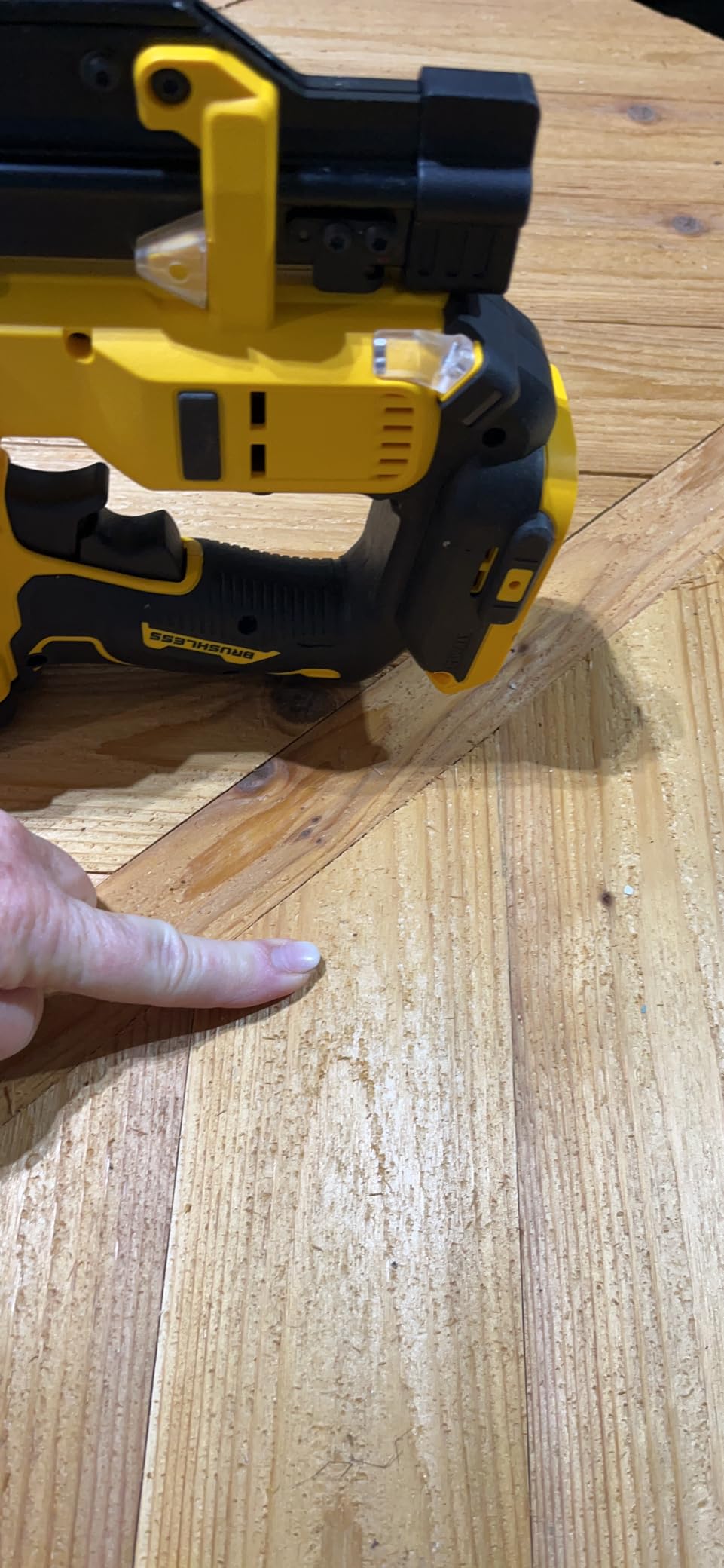
The trade-off is honest. This is a bare tool, so if you do not already own 20V MAX packs you are buying batteries and a charger on top of the tool. Drive depth on solid hardwood is also less repeatable than a good pneumatic, which shows up on white oak face frames where you want every pin at the same height.
Owners mention the near-invisible holes more than anything else, and one user comment described the 23-gauge holes as nearly impossible to see without raking light across the surface. At 1-1/2 inches maximum, you cannot reach 2 inch pins for recessed fastening, but most cabinet parts do not ask for more than that.
When this is the right pin nailer for your shop
Choose the DCN623B if you install cabinets in buildings without a reliable power point for a compressor, or if you are done dragging a hose. It also makes sense if you already committed to 20V MAX for other tools, since the packs carry over.
When to pick something else
Skip it if your main work is 3/4 inch solid hardwood face frames and you want identical depth on every pin from a stationary shop bench. A pneumatic tool wins on consistency in that scenario, and if you already own a compressor the cordless advantage disappears entirely.
2. Metabo HPT NP35A 23 Gauge Pneumatic Pin Nailer
Metabo HPT 23 Gauge Pin Nailer, Pneumatic Lightweight, NP35A
Pneumatic
5/8 to 1-3/8 in. pins
2.0 lbs
5-year warranty
Pros
- Lightest tool in the group at 2.0 lbs
- Automatic adjustment across five pin lengths
- No-mar tip and rear exhaust keep the face clean
- Case glasses spare tip and oil included
Cons
- Needs a compressor and hose
- Two-stage trigger feels clunky at first
- Some 2 in. pin brands feed unreliably
At 2.0 pounds, the NP35A is the tool we reach for on overhead work. When you are standing on a ladder pinning a crown return or holding a valance overhead, the difference between a 2 pound tool and a 4 pound tool is the difference between finishing the day and losing your grip on the last joint. It also carries 4.6 stars across 1,844 reviews, the largest review base in this group.
The magazine adjusts automatically across 5/8 inch, 3/4 inch, 1 inch, 1-3/16 inch and 1-3/8 inch pins, so you are not swapping magazines between a 1/2 inch drawer box and a 3/4 inch face frame. The no-mar tip on the nose and the rear exhaust both matter on show-face parts: the tip keeps a steel driver from denting a face frame, and the rear exhaust sends oil and debris away from the workpiece instead of across it.
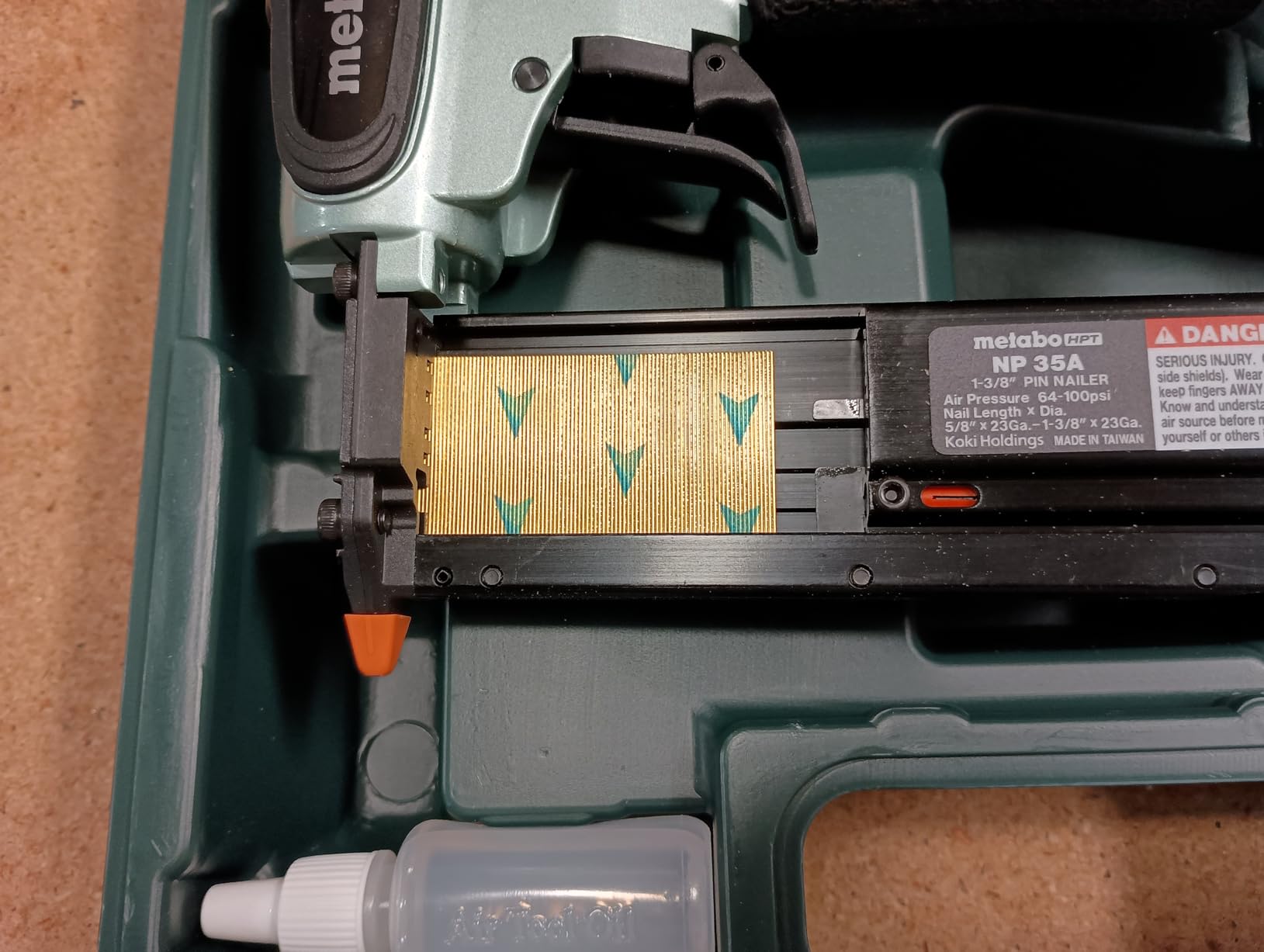
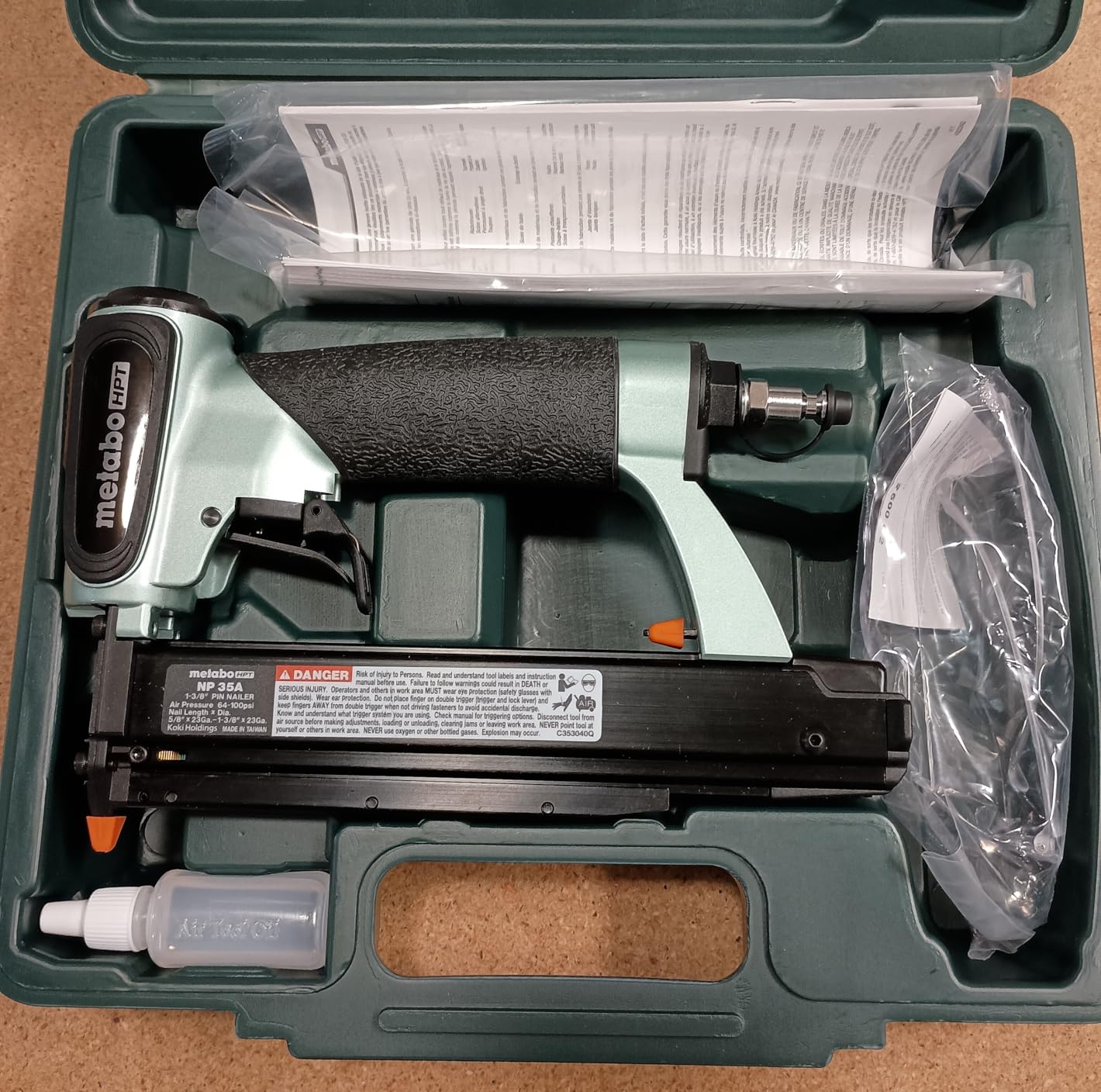
What arrives in the case is unusually complete: a carrying case, two no-mar tips, safety glasses, a 1/4 inch NPT male plug and a hex bar wrench. The 5-year professional warranty is the longest coverage in this group alongside the Metabo NP50A.
The complaints cluster in two places. The dual trigger feels clumsy until your hand learns it, and because it is pneumatic you are committed to a compressor. A few owners report rare misfires and one reported an internal seal failure that leaked air continuously, so keep a backup plan if this becomes your only driver.
Why cabinetmakers keep coming back to it
Reviewers repeatedly describe the pin holes as virtually invisible and the operation as quiet, and the tool has been named a Pro Preferred Nailer for nine years running by Builder and Developer Magazine. The accessory kit alone would cost more than a competitor tool at the checkout.
Where it falls short
It is not a site tool. If your cabinet work happens in a house with no compressor, or in a remodel where power is unreliable, the hose is a daily annoyance. It also cannot reach 2 inch pins, so deep fastening into thick stock is out of reach.
3. Arrow PT23G Compact Pneumatic Pin Nail Gun
Arrow PT23G 23 Gauge Compact Pneumatic Pin Nail Gun, Oil-Free
Pneumatic and oil-free
3/8 to 1 in. pins
Die-cast aluminum
Side-load magazine
Pros
- Lowest cost of the full-size pneumatics listed
- Oil-free design leaves no oil film on finished faces
- Die-cast aluminum body with overmold grip
- Side-load magazine for fast loading and jam clearing
Cons
- Maximum pin length of 1 in. is short for cabinet stock
- 1-year limited warranty
- Needs consistent air pressure
The PT23G earns its place as a second tool rather than a primary one. It is oil-free, which is a genuine advantage when you are pinning into a painted or stained part and cannot afford an oil film on the face, and the die-cast aluminum body survives being dropped in a truck bed. It runs on any home compressor up to 100 PSI.
Loading is the best part. The side-load magazine opens from the side instead of over the top, so you can check a jam without trying to fish a pin out of a narrow channel with the tool upside down. The two-step safety trigger prevents misfires, and an exhaust cover directs airflow away from your workpiece.
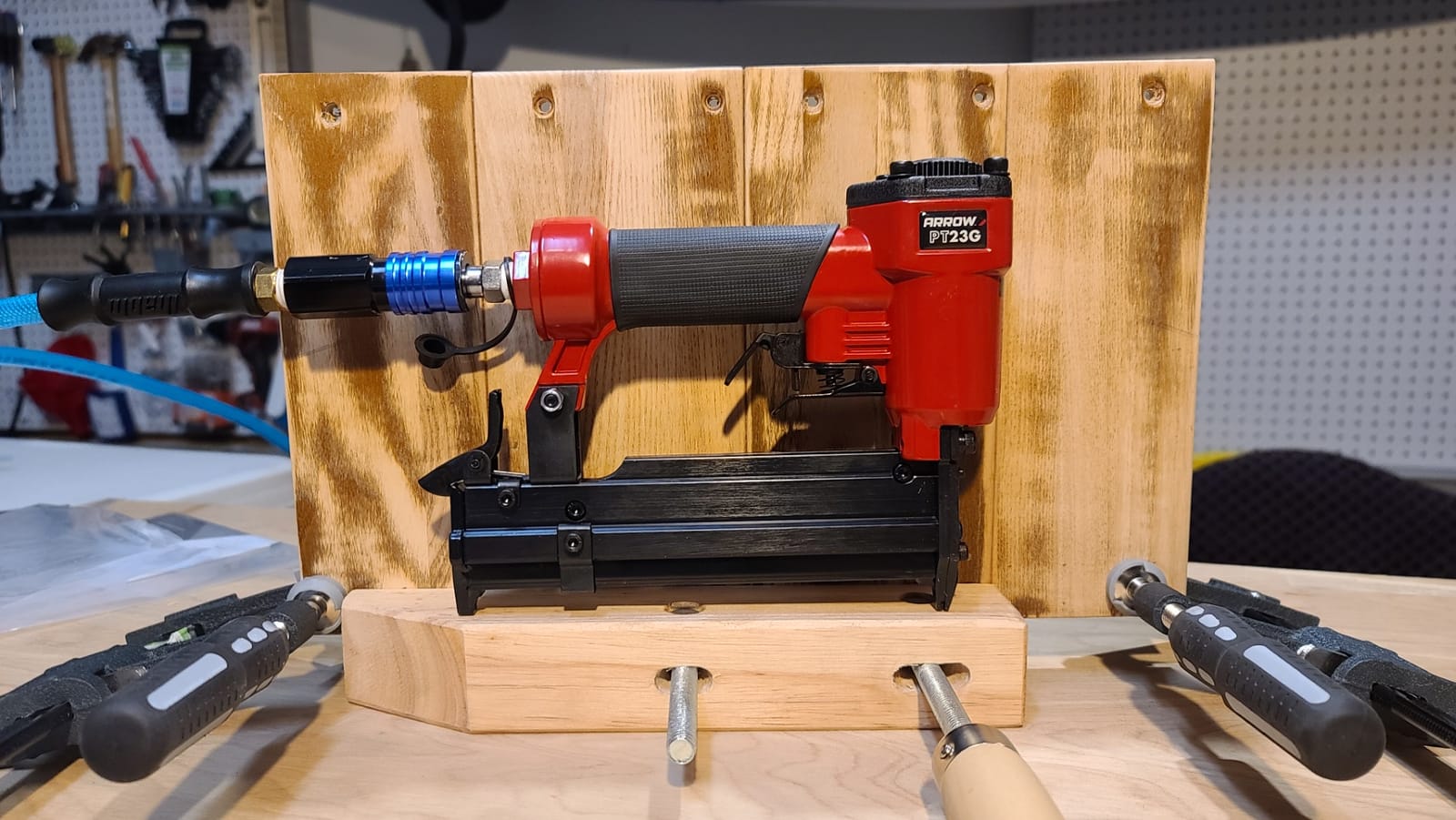
The 1 inch ceiling is the whole story. Cabinet stock at 1/2 inch wants 5/8 inch pins, and 3/4 inch stock wants 1 inch or longer, so this tool is right at the edge of usefulness for a full-size face frame. For beadboard returns, small trim, crafts and light shop use it is dependable and it carries 4.4 stars from 1,520 reviews.
Air pressure consistency is the other thing to watch. Owners who run this tool off a small compressor report stalling and misfires when pressure drops, so a receiver tank with some reserve helps more than you would expect.
Where it earns its keep
Pair it with a longer-range tool for glass retainers, muntins and small return trim where 3/8 inch to 1 inch pins are exactly right. A shop that builds a lot of face frames will leave it in the drawer most days.
Know the limits before you buy
The 1-year limited manufacturer warranty is the shortest in this group, and the 1 inch maximum rules it out as a sole cabinet pinner. If your only cabinet work is 1/2 inch stock, though, it is hard to argue with an oil-free die-cast body that loads from the side.
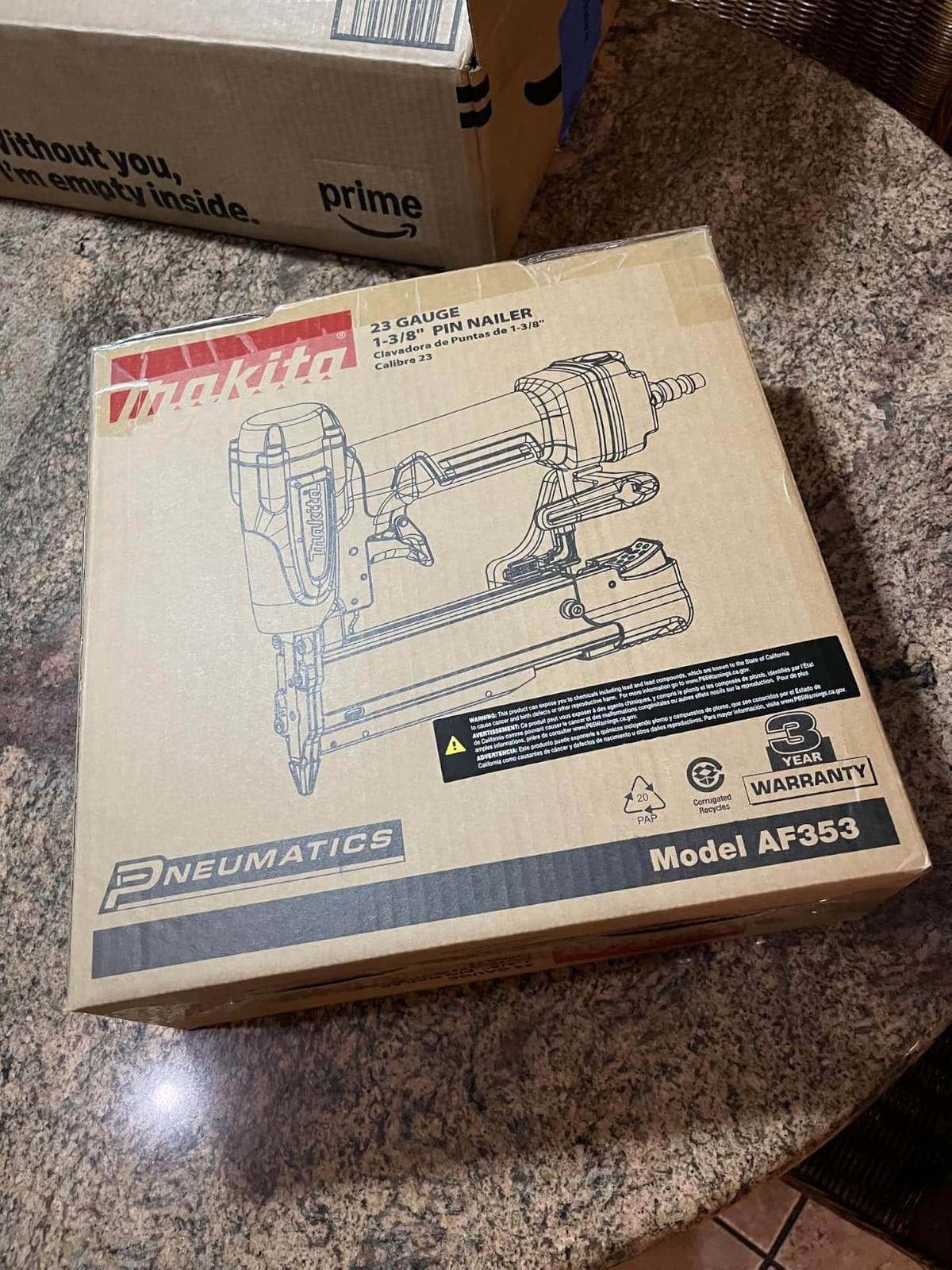
4. Makita AF353 23 Gauge Pin Nailer
Makita AF353 23 Gauge, 1-3/8″ Pin Nailer,
Pneumatic
5/8 to 1-3/8 in. pins
2 lbs
130-pin drop-in magazine
Pros
- Long-term owners report thousands of shots without a jam
- Aluminum body magazine and cylinder
- 130-pin side drop-in magazine
- Built-in air duster and two no-mar tips
Cons
- Needs regular oiling and correct air pressure
- One installer reported a plastic magazine cracking
- Does not drive 2 in. pins or brads
The AF353 has the most interesting reliability story in this group. Professional finish carpenters report it running for thousands of shots without a single jam, and it holds 4.3 stars across 616 reviews with 71 percent at five stars. The aluminum body, magazine and cylinder are the reason, and at 2 pounds it stays light for overhead pinning.
The magazine is the standout feature. It holds 130 pins and drops in from the side, which means a reload takes seconds rather than the tip-out gymnastics on lighter tools. A nail lock-out prevents blank fires, and the built-in air duster is genuinely useful for blowing dust out of a cabinet carcass before you close the back.
It is not oil-less. Owners who oil it and run it at the correct air pressure report years of service, and several negative reviews read like a maintenance confession, blaming user error for failures that came down to skipping oil drops. If you buy this, put a drop of oil in the cylinder weekly.
One professional installer reported the plastic magazine cracking after two months of daily use, and one owner had a total pressure failure just after the return window. The box also carries two no-mar tips, an air fitting, a hex wrench, oil, safety glasses and a case.

Best fit for a working installer
For someone installing cabinets daily, the 130-pin magazine and jam-free reputation make this a strong second machine or a first machine if you service your tools properly. It also holds up in cold and humid conditions, according to owners in several countries.
Where it will frustrate you
It will not drive 2 inch pins or any brad, and it needs both air pressure and oil to behave. If your shop neglects maintenance, that is a liability rather than an advantage.
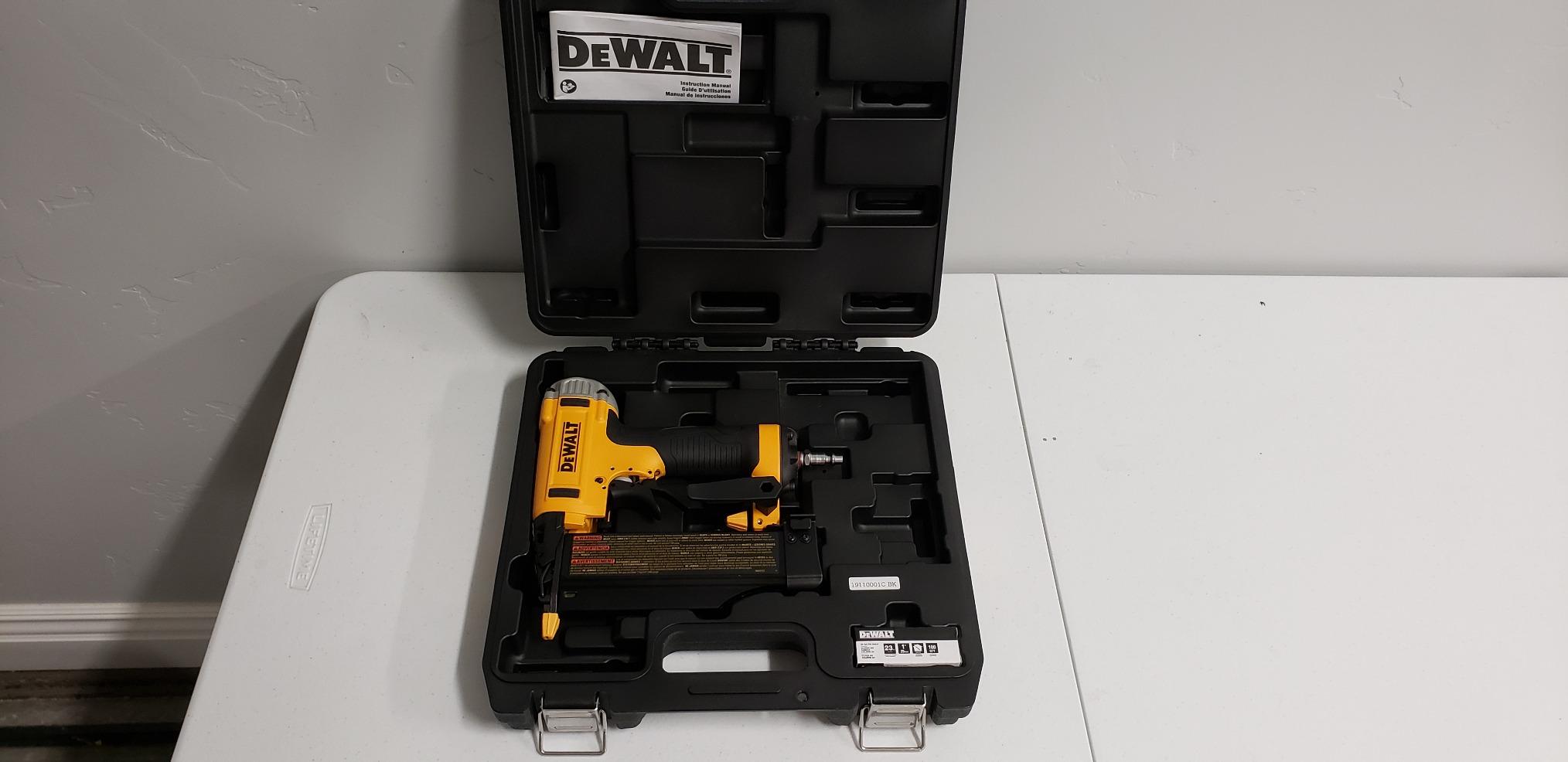
5. DeWalt DWFP2350K 23 Gauge 2-Inch Pin Nailer
DEWALT Pin Nailer, 23 Gauge, 2-Inch (DWFP2350K)
Pneumatic
5/8 to 2 in. pins
Tool-free jam release
Oil-free operation
Pros
- Longest pin range here at 2 in. for recessed fastening
- Tool-free jam release and tool-free depth adjust
- Oil-free so no stain risk on finished cabinetry
- Case and two no-mar tips included
Cons
- Requires a compressor and hose
- Heavier feel than 2 lb ultra-compact pneumatics
- Listed item weight does not match a full pneumatic tool
The DWFP2350K is the tool for recessed fastening. It drives 23-gauge headless pins from 5/8 inch all the way to 2 inches, and the manufacturer lists 2 inch pins recessed into oak as the headline use. Nothing else in this list reaches that length on pneumatics, and it matters when you are pinning through face frame stock into a solid header or pulling trim tight into a thick door rail.
It is also the first 23-gauge pin nailer with a tool-free jam release, and the depth adjustment is tool-free as well. Reviewers single out both as the reasons to choose this model over cheaper pneumatics, because the two operations you do most in cabinet work happen constantly.
Oil-free operation is a quiet but real cabinet advantage. On a painted or stained show face, an oil-cushioned pneumatic can leave a film you find after the first coat of finish. A low nail lockout with bypass and a reload alert keeps dry-fires off the workpiece, and the reversible belt hook is handy on a ladder.
Two cautions. It has a heavier feel than the 2 pound ultra-compacts, which adds up overhead. And the listed item weight of 8 ounces is clearly not the whole tool, so verify the specification before you plan around it.
Why length beats everything else here
If you build face frames in solid hardwood or attach cabinet backs over thick stock, a 2 inch pin gives you penetration a 1-3/8 inch tool cannot offer. At 4.5 stars from 453 reviews with 79 percent five-star ratings, the driving is consistently well regarded.
When a lighter tool is smarter
For valances, crown returns and long overhead trim runs, weight wins over pin length. This is also a stationary shop tool by design, since the hose rules it out of install work.
6. Ryobi P318 18V ONE+ Cordless Pin Nailer
Ryobi 18-Volt ONE+ Lithium-Ion Cordless AirStrike 23-Gauge 1-3/8 inch Headless Pin Nailer (Tool Only)
18V ONE+ cordless
1/2 to 1-3/8 in. pins
3.9 lbs
LED work light
Pros
- No hose cord or compressor to drag up a ladder
- Sequential driving with a double-action trigger
- LED light and GRIPZONE overmold grip
- Long runtime on ONE+ 18V lithium-ion packs
Cons
- Battery and charger not included
- Some units stop feeding with pins still in the magazine
- No depth adjustment
- 30-day limited warranty
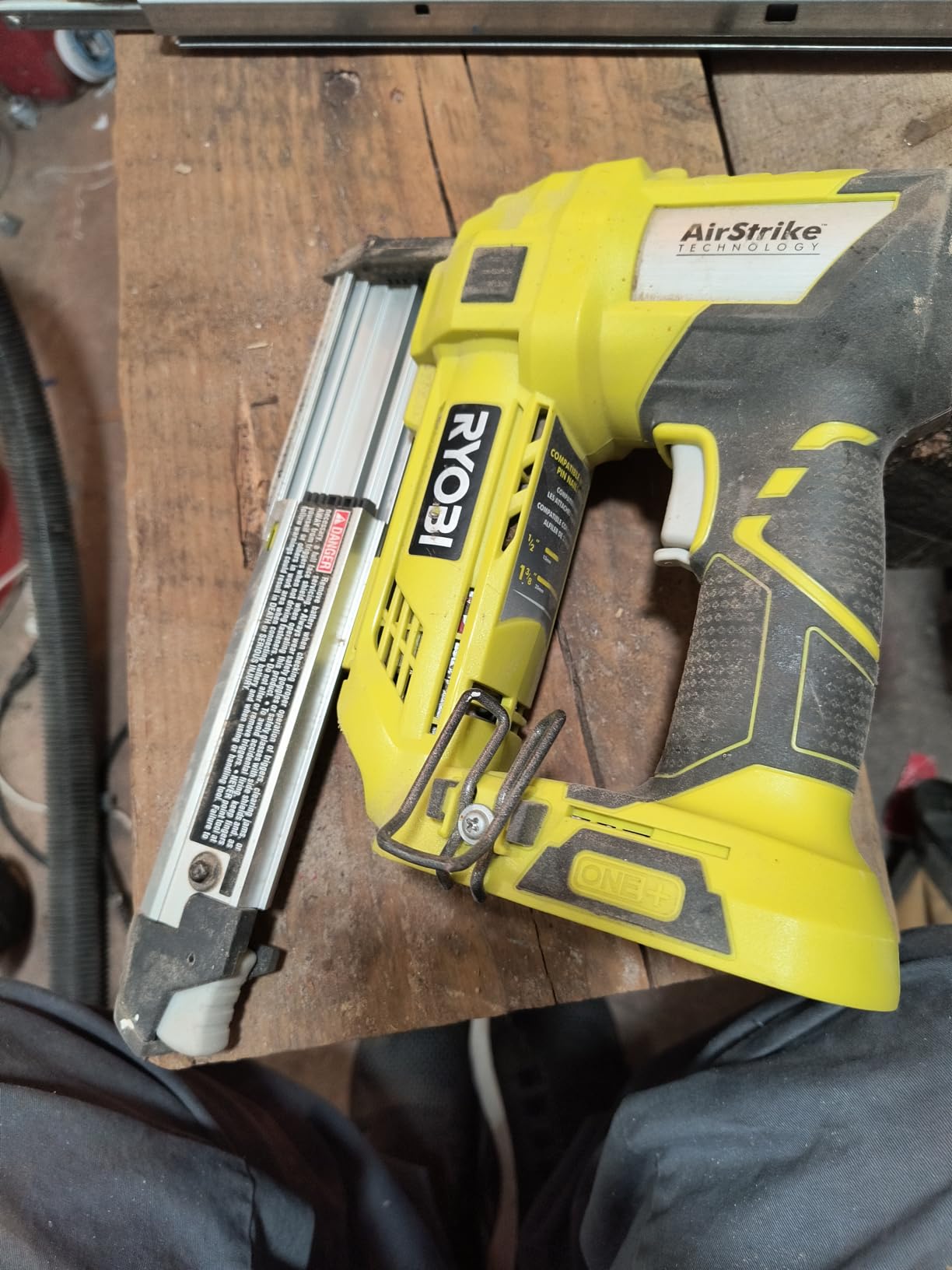
The P318 is the cordless option with the widest owner appeal among finish carpenters, who like taking drops from a tool belt and keeping firing. It runs 1/2 inch to 1-3/8 inch pins at 3.9 pounds, with sequential driving from a double-action trigger, a dry-fire lockout that extends tool life, and an LED light for dark cabinet interiors.
Reviewers say pins sit flush enough that holes need only a dab of putty, and the GRIPZONE overmold adds comfort on long days. Battery adapter options also exist for owners on other platforms, which softens the usual platform lock-in problem.
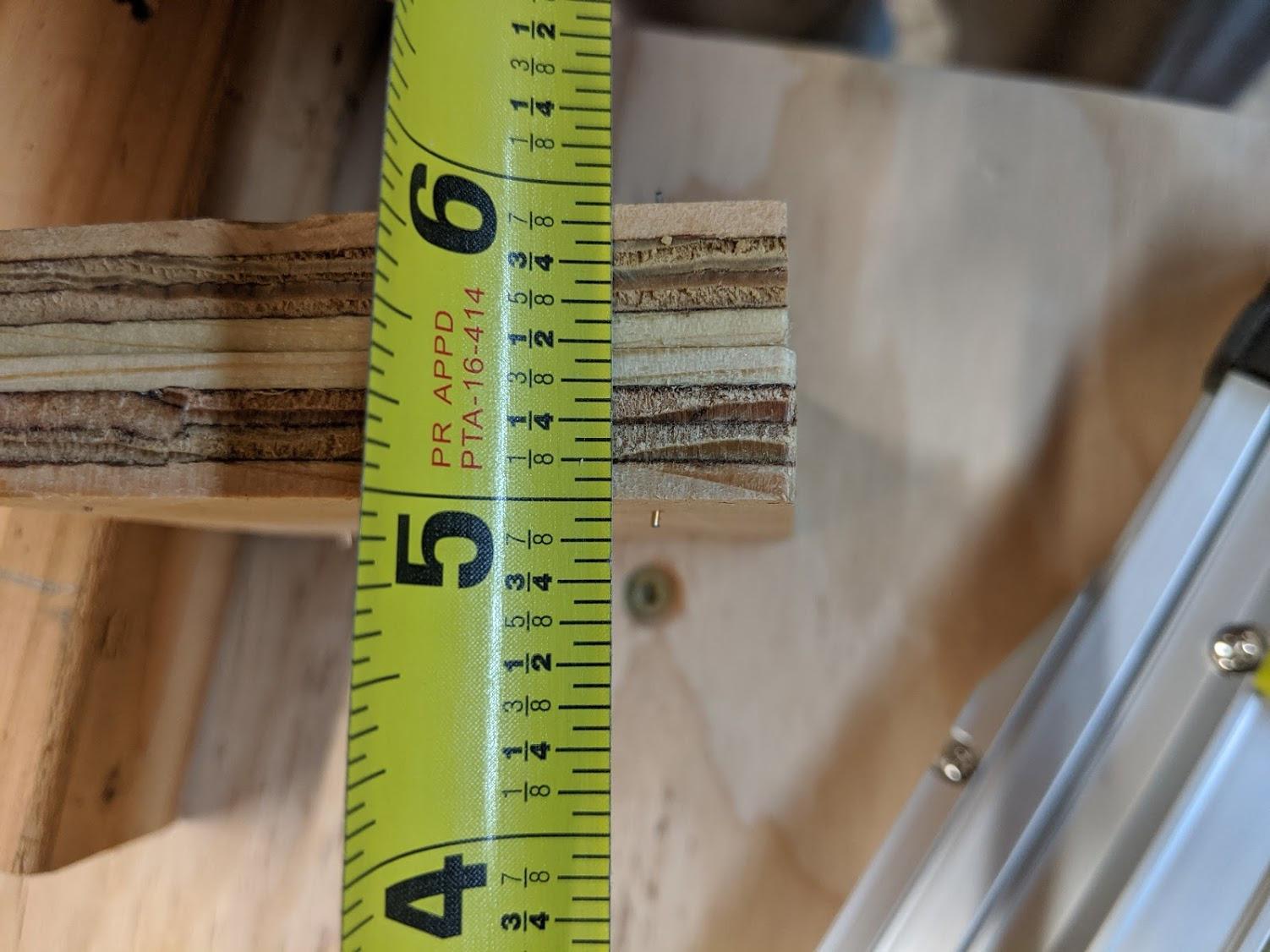
Here is the honest part. Several owners report the tool stops feeding with 5 to 8 pins still in the magazine, and a few units will not fully countersink in solid hardwood, leaving pins proud, which is the fastest way to end a cabinet job badly. There is no depth adjustment to correct for it.
The warranty is 30 days, the shortest coverage in this group, and the edge guide shown in the listing photos is not included. At 4.4 stars from 366 reviews, sentiment is positive but thinner than the leaders.
Where it works well
Site-installed built-ins, trim package work and anywhere without a compressor. If you are already deep into the ONE+ 18V platform, the economics are hard to argue with.
Where it will hold you back
Solid hardwood face frames that need every pin at the same height, and any production work where a mid-assembly stoppage costs you glue time. The proud-pin complaints are the deal breaker, not the cordless convenience.
7. Metabo HPT NP50A Pro 23 Gauge Pin Nailer
Metabo HPT Pin Nailer Kit, 23 Gauge Fine Trim Aluminium Magazine, NP50A
Pneumatic
1/2 to 2 in. pins
3.3 lbs
Aluminum magazine
Pros
- Handles 1/2 in. micro pins and 2 in. pins in one tool
- Aluminum magazine resists jams
- Trigger lock switch and automatic dry-fire lockout
- 2 in. pins do not curl out of line
Cons
- 2 in. pin compatibility is brand specific
- Locked trigger feels stiff until unlocked
- Heavier than the 2 lb NP35A for overhead work
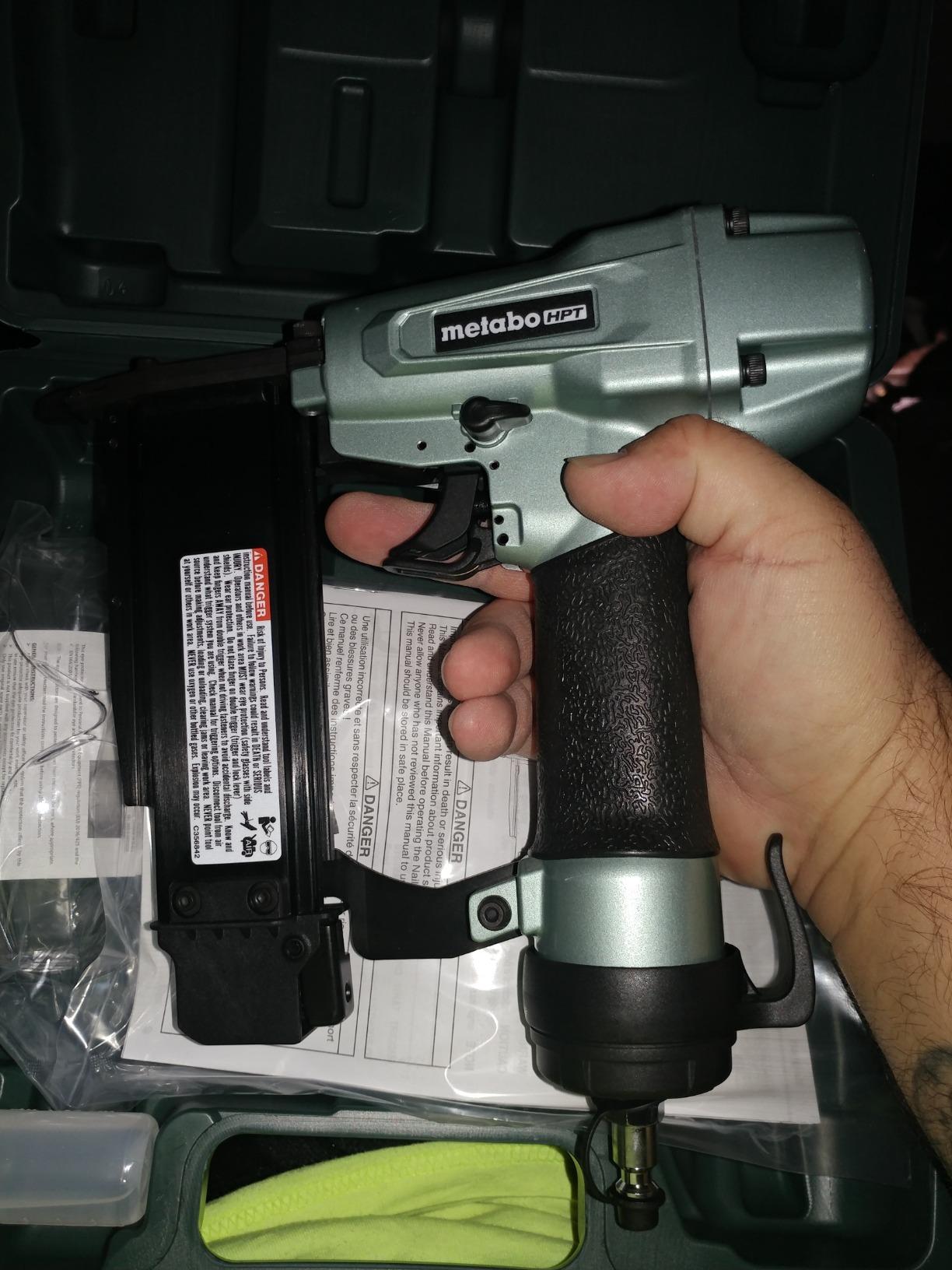
The NP50A is the only tool here that covers both ends of the range in one body: 1/2 inch micro pins for small retainer molding and 2 inch pins for recessed fastening into thick stock. If your shop does frameless cabinets with edge banding and also builds traditional face frames, that single range removes a decision.
At 3.3 pounds with a high-grade aluminum magazine, it feels like a shop tool rather than a hobby tool. The depth of drive adjustment lets you countersink or drive flush across different materials, and the automatic dry-fire lock-out stops the tool at 6 nails or fewer in the magazine. Owners with a Senco report comparable performance here at a fraction of the outlay.
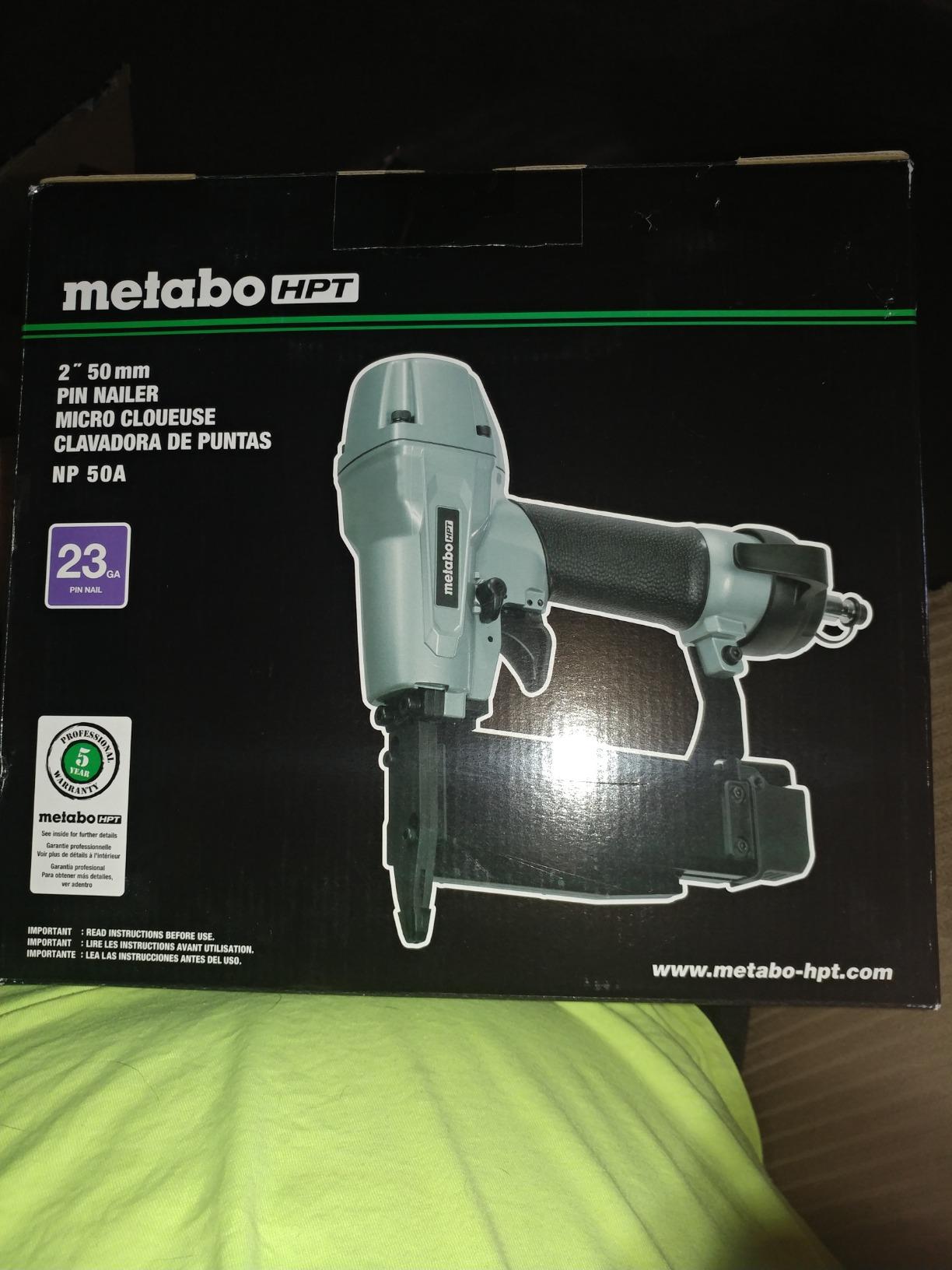
Two details to plan around. Two-inch pin compatibility is brand-specific, so some 2 inch pin brands will not feed, and the trigger lock selector makes the trigger feel stiff until you switch it off. Owners also report the no-mar tip detaching with some regularity, so order a spare.
The case includes safety glasses, two no-mar tips, a case and lubricant oil, and the 5-year warranty matches the NP35A. It has been named a Pro Preferred Nailer for 12 years running by Builder and Developer Magazine.
Best for a mixed shop
Cabinets that mix frameless panels with framed stock, or shops that build furniture alongside casework. Reviewers consistently praise that 2 inch pins do not curl out of line the way they do in some competing magazines.
When to choose the lighter sibling
Overhead work is where the NP35A wins, at 2.0 pounds against 3.3. If your day is mostly valances and crown, weight beats range every time.
8. CRAFTSMAN V20 CMCN623B Cordless Pin Nailer
CRAFTSMAN V20 RP Pin Nailer, Nail Gun, 23GA, For 5/8-1-3/8 inch Pin Nails, Bare Tool Only (CMCN623B)
V20 brushless cordless
5/8 to 1-3/8 in. pins
Tool-free jam release
LED light
Pros
- Brushless motor aimed at longer runtime and consistent driving
- Tool-free jam release cuts downtime
- LED light for alignment in dark cabinet interiors
- Cordless workflow with no compressor
Cons
- Bare tool so V20 battery and charger sold separately
- Smallest review base in the group
- Pin range tops out at 1-3/8 in.
The CMCN623B is the cordless budget route. The brushless motor is the reason to consider it, since brushless motors are what separate the current generation of cordless nailers from the brushed ones that underpowered early attempts at this job. It supports 23-gauge pins from 5/8 inch to 1-3/8 inch, with a tool-free jam release and an LED light that helps alignment inside a dark cabinet box.
Sentiment is 79 percent five-star, and the 3-year limited warranty is stronger than the 30-day coverage on some competing cordless tools. The cordless format also removes the compressor and hose entirely, which is the deciding factor for install work.
What holds it back is data, not design. At 109 reviews this is the smallest base in the group, so long-term reliability is genuinely unknown. It is a bare tool, so the V20 battery and charger come separately, and an 11 percent one-star share is the highest of the cordless models here.
Who should buy it
Someone already invested in the V20 platform who wants a brushless 23-gauge pinner without committing to a pro brand. The jam release and LED cover the two things that frustrate you most in cabinet interiors.
Who should wait
Anyone whose work depends on long pins, and anyone who needs proven longevity. With 109 reviews we cannot tell you how it holds up at year three, and the 1-3/8 inch ceiling rules out recessed fastening.
9. Valu-Air H625 23 Gauge Micro Pin Nailer
Valu-Air H625 23 Gauge Pneumatic Micro Pin Nailer/Pinner – 1/2-Inch to 1-Inch
Pneumatic
1/2 to 1 in. pins
2.2 lbs
140-pin capacity
Pros
- Dedicated micro pin tool for short fasteners
- Length selector covers 1/2 to 1 in. pins
- Removable nose cover for straightforward jam clearing
- Runs from 60 to 100 PSI on a small compressor
Cons
- 1 in. maximum is too short for most cabinet casework
- No depth adjustment listed
- Limited accessory options
The H625 is a specialist. Its nail length selector adjusts to 1/2 inch, 5/8 inch, 3/4 inch, 7/8 inch and 1 inch, and the headless pins leave no mark, which makes it useful for decorative pinning where even a small hole would show. At 2.2 pounds with a 140-pin capacity it reloads less often than most tools this size, and 60 to 100 PSI means a small shop compressor is enough.
The removable nose cover is the feature we like most. Lifting it off gives direct access to the driver path, so a jam is a visible problem with a visible fix rather than a fishing expedition. A carry case is included.
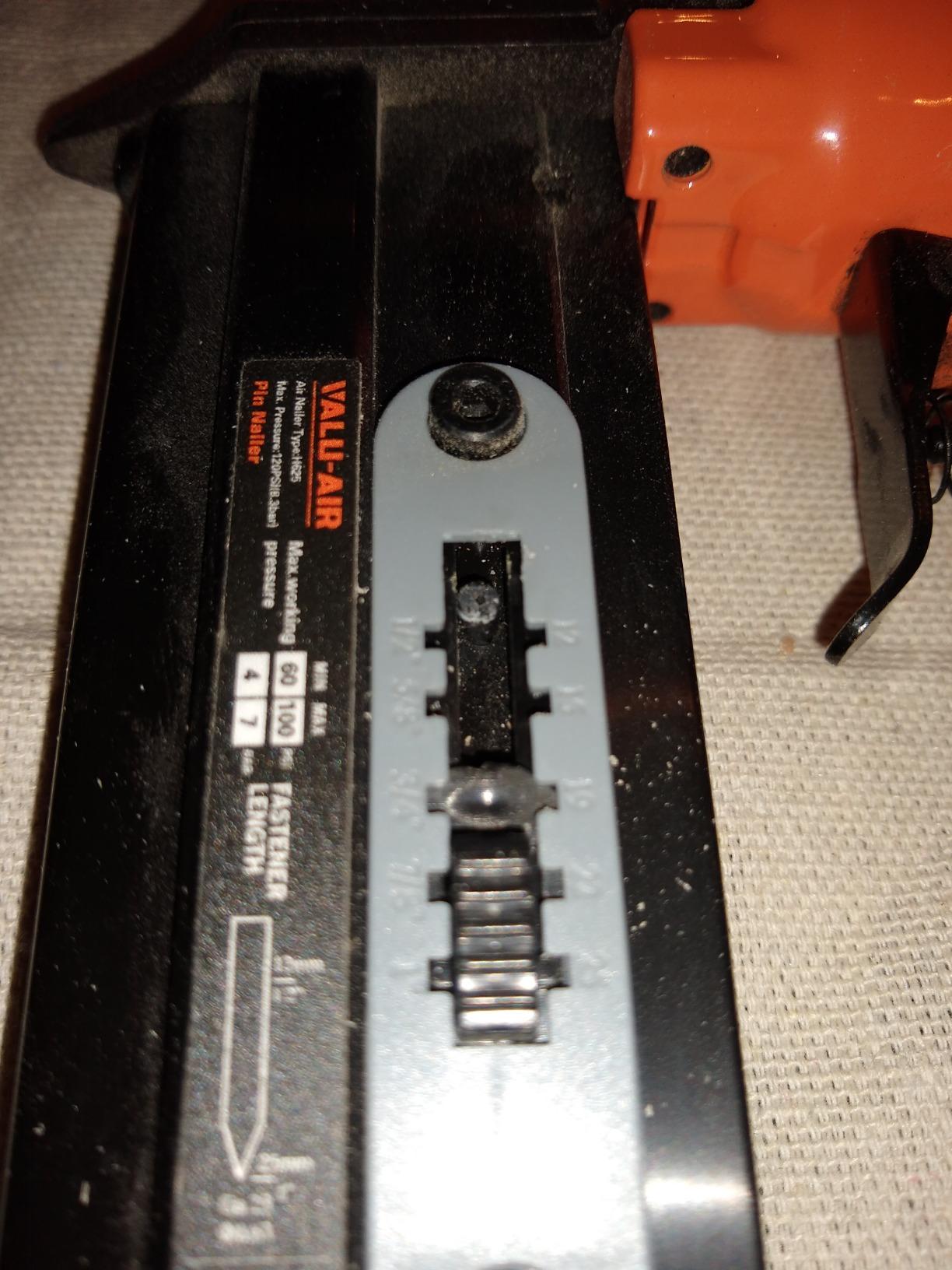
The 1 inch ceiling keeps it out of main cabinet casework. Most buyers treat it as a secondary tool for light decorative and hobby work, and 67 percent five-star at 4.3 stars across 190 reviews reflects that narrower role. No depth adjustment is listed, so flush driving takes practice on hard stock.
Its real job
Small trim, craft panels and decorative work where a short pin is exactly right. For a shop that already has a proper pin nailer, this is a cheap second opinion for delicate parts.
Its hard limit
One inch will not hold a 3/4 inch face frame joint properly, so do not let the low cost pull it into primary cabinet duty. Heat-treated steel at this tier also reports inconsistent durability over the long haul.
10. meite P630C Pneumatic Micro Pin Nailer
meite P630C Pin Nailer, Pneumatic Micro 23 Gauge Pin Nailer Gun, Accept 3/8-Inch to 1-3/16-Inch 23Ga Pin Nails, Ideal for Cabinets, Paneling, Crafts, Picture Frames
Pneumatic
3/8 to 1-3/16 in. pins
2.02 lbs
150-pin visible magazine
Pros
- Very light at 2.02 lbs for detail and overhead work
- Aluminum body feels solid for the money
- Chisel-tip pins resist splitting and jamming
- Silenced exhaust and a visible magazine
Cons
- Safety trigger can fire if the tool is bumped or dropped
- Owners report jams when the trigger is pulled too quickly
- Larger pin holes than premium micro nailers
The P630C is the quiet one. The exhaust includes a silencer, which matters in a small shop or an apartment-based cabinet business where a pneumatic nailer is otherwise the loudest thing in the room. It runs 23-gauge headless pins from 3/8 inch to 1-3/16 inch at 70 to 100 PSI, with a 150-piece capacity and a visible magazine so you can check the pin level at a glance.
At 2.02 pounds with an aluminum body, it is light without feeling disposable. Owners like that the chisel-tip pins pass through wood without splitting or jamming, which is exactly the failure mode that ruins small cabinet parts, and several report smaller holes than costlier premium micro nailers.
The safety trigger is the caution. It prevents firing unless fully engaged, but owners report the tool can still fire if bumped or dropped when not engaged, so do not set it on a bench nose-first. Several owners also report jams when the trigger is pulled too quickly, and one had a firing pin bend after about three months.
What it does better than expected
Light weight, a full accessory-level feel in the hand and a silenced exhaust. At 4.3 stars from 90 reviews with 75 percent five-star, the sentiment is good, and the build quality surprises people at this level.
Where caution is warranted
The less-protective trigger, occasional jams and that bent firing pin report are real. Treat it as a light-duty detail tool rather than the machine that builds your face frames.
Pneumatic vs Cordless Pin Nailers for Cabinet Work
Choose pneumatic when your work happens in one place with a compressor. Drive depth stays repeatable shot after shot, which is what you want on a face frame where every pin should be the same height, and a 2 lb pneumatic costs you nothing in battery weight. The hose is the price you pay for that consistency.
Choose cordless when your work moves. Installers working from a van with no power for a compressor will get more done with a bare battery tool, and 2,000 nails per charge on the DCN623B covers most of a day. The trade is depth consistency, which is why cordless tools on this list top out at 1-1/2 inch pins while pneumatics reach 2 inches.
One middle path exists for site work without a compressor: a propellant tank with a regulator. Carpenters on forums discuss it as a workable stopgap, though we would rather see you standardize on a cordless tool for repeat work.
Pin Nailer vs 18-Gauge Brad Nailer for Cabinet Doors
This is the loudest argument in cabinetry forums, and the honest answer is that many woodworkers buy the brad first. An 18-gauge brad is more versatile: it handles trim, molding, furniture and casework, and experienced members on home improvement forums push beginners toward an 18-gauge as the smarter first purchase.
For cabinet doors specifically, the pin wins on appearance. A 23-gauge pin leaves a hole so small it is close to invisible once filled, while an 18-gauge brad leaves a mark you can spot across a painted door. A woodworking forum user described the pin holes as nearly invisible to the naked eye, and that is the entire reason cabinetmakers reach for these tools.
A brad will go through plywood and hold better, and 18-gauge brads also come in slight-head versions if you need a head to catch the fastener. If you can only own one tool and your work is more than half cabinets, though, the pin is the one that makes finished doors look finished.
How to Keep Pin Holes Invisible on Show-Face Cabinet Parts
Most visible pin marks are not caused by the gauge, they are caused by a bare steel driver. A Woodworkers Journal reviewer found a steel tip left pock marks on both pine and maple, while tools with a plastic no-mar tip produced blemish-free results on hardwood and softwood. Six of the ten tools here include no-mar tips, so fit one before you start.
Second, set depth to countersink rather than drive flush. A proud pin head is the other common complaint in reviews, and it is the one defect that cannot be sanded away. On a painted door, drive the pin slightly below the surface.
Third, choose the pin for the stock. For 1/2 inch cabinet stock use 5/8 inch pins, and for 3/4 inch face frames use 1 inch pins. When a hole does show, fill it with a dab of putty or cabinet filler, sand flush after dry, then prime and paint as you would the rest of the panel. Nobody sees a filled pin hole on a finished door.
How We Chose the Best Pin Nailers for Cabinet Making
We built this list around cabinet work, not general trim work, and the criteria reflect that. First, pin range and drive consistency, because a tool that cannot set a pin flush in 3/4 inch plywood is not a cabinet tool. Second, jam clearance without tools, since a jam during a glue-up costs production time.
Third, weight, because overhead work on valances and crown returns decides how the tool feels after 200 joints. Fourth, no-mar tip availability, which is what actually keeps a show face clean. Fifth, warranty and review volume, since a tool with 100 reviews cannot be called reliable no matter what the listing claims.
We excluded anything that could not reach at least 1 inch of pin length as a primary pick, which is why several very popular budget pinners appear here as secondary tools rather than recommendations.
Frequently Asked Questions
What is the best nail gun for cabinet making?
The DeWalt DCN623B is our pick for most cabinetmakers. It drives 23-gauge pins from 5/8 inch to 1-1/2 inch on a brushless 20V motor, with tool-free jam release and tool-free depth adjustment, and it rates 4.7 out of 5 from 928 reviews. If you run a compressor and build solid hardwood face frames, the Metabo HPT NP50A covers a wider pin range.
Who makes the best pin nailer?
For cabinet work, DeWalt, Metabo HPT and Makita build the strongest pin nailers on the market today. The DeWalt DCN623B leads on cordless drive and tool-free adjustments, the Metabo HPT NP35A and NP50A lead on weight and pin range, and the Makita AF353 is widely reported to run for thousands of shots without a jam. Pick on power source and pin length first.
Are pin nailers worth it?
Yes, for any work where the fastener shows. A 23-gauge headless pin leaves a hole small enough to disappear under filler and paint, which no 15-gauge finish nail or 18-gauge brad can match on a show-face cabinet door. For hidden connections like cabinet backs and drawer box bottoms, a brad nailer holds better and costs less, so many cabinetmakers own both.
Will a brad nailer go through plywood?
Yes. An 18-gauge brad will drive through 1/2 inch and 3/4 inch plywood without difficulty, and it holds a joint better than a 23-gauge pin. The catch is appearance: the brad leaves a visible hole roughly three times the diameter of a pin hole. Use brads where the fastener is hidden and a pin nailer anywhere the surface stays visible.
What PSI should a pin nailer be?
Most pneumatic pin nailers in this group specify a working range of roughly 60 to 100 PSI, with the Arrow PT23G rated up to 100 PSI and the meite P630C rated from 70 to 100 PSI. Running below spec causes stalls and misfires, while running above the maximum on long pins can bury a pin too deep or damage the driver. Set the regulator to the middle of the stated range.
Is a pin nailer strong enough for cabinet doors?
For attaching trim, retainers, muntins and glass to a door frame, yes, and the pin leaves a near-invisible hole. For structural joints such as attaching a door to a face frame, or pinning through hardwood, use 1 inch pins in 3/4 inch stock and consider a brad instead. Match pin length to stock thickness: 5/8 inch pins for 1/2 inch stock, 1 inch pins for 3/4 inch stock.
What pin length do I need for a 3/4 inch face frame?
Use 1 inch pins for 3/4 inch plywood face frames, which gives you roughly a quarter inch of penetration into whatever is behind the joint. Move to 1-3/8 inch pins when you are fastening into solid hardwood, and reach for a 2 inch pin only when you need to recess deeply into thick stock. Tools limited to 1 inch, such as the Arrow PT23G, cannot do face frames properly.
Why does my pin nailer leave divots and visible holes?
Most divots come from a bare steel driver tip contacting the surface. Fit a plastic no-mar tip, which testers credit with blemish-free nailing on both pine and maple. Proud pin heads come from driving flush instead of countersinking, and correcting depth requires a tool with a depth adjuster. Finally, confirm your pin length matches the stock so the pin is not over-driven into thin material.
Final Verdict for 2026
The DeWalt DCN623B is the best pin nailer for cabinet making in 2026 for most shops, because tool-free jam release, tool-free depth adjustment and roughly 2,000 nails per charge remove the two things that slow a cabinet assembly line down. Shop owners with a compressor should look at the Metabo HPT NP35A for its 2.0 pound weight, or the NP50A when you need 1/2 inch to 2 inch pin range in one tool.
Whichever you choose, fit a no-mar tip, countersink rather than drive flush, and match pin length to stock thickness. Check the current price and read the newest reviews before you order, since this category turns over fast.