
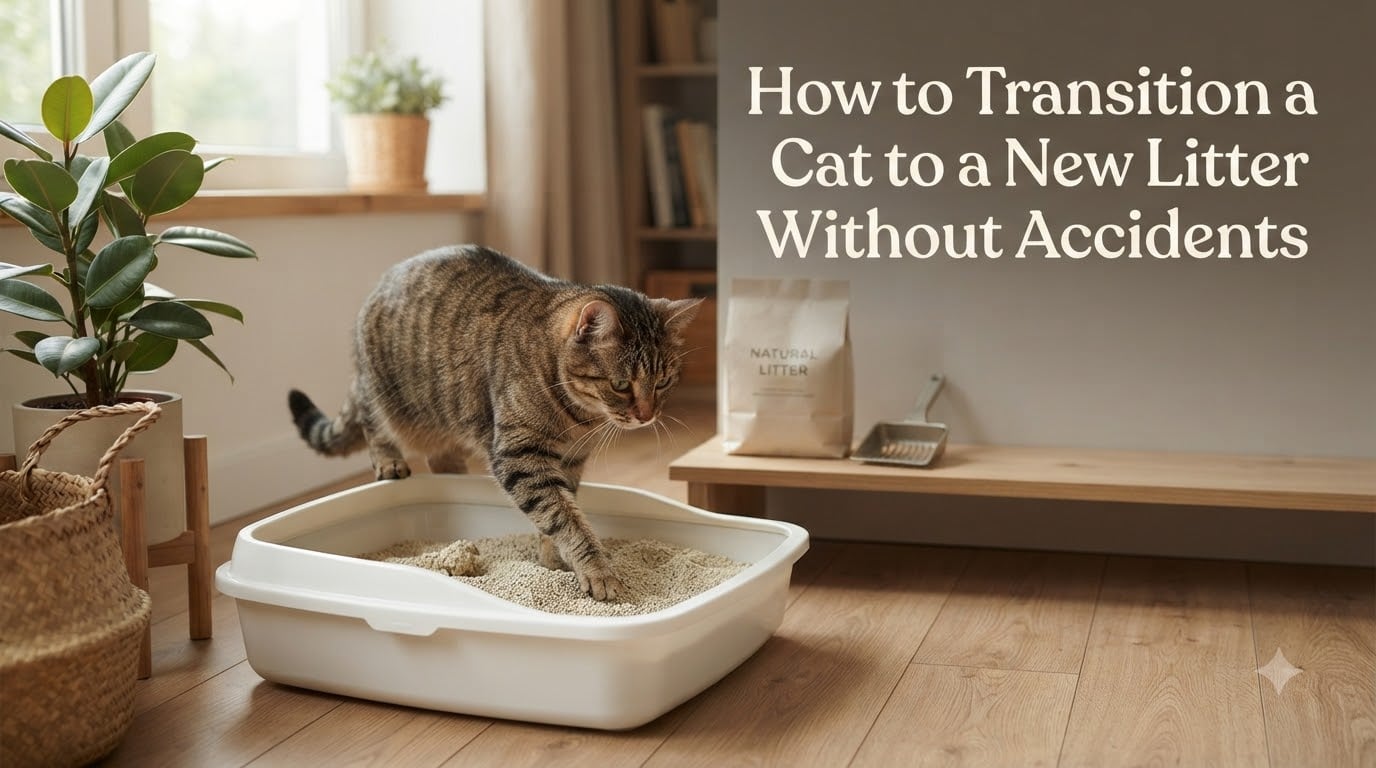
Switching your cat’s litter can feel like a small thing, until your cat decides the new box is unacceptable and starts leaving surprises on your bathroom floor. I’ve fostered and worked with cats for over 8 years, and litter transitions are one of the top reasons owners call our behavior hotline. The good news: learning how to transition a cat to a new litter without accidents is straightforward once you understand why cats care so much in the first place.
This guide walks you through a veterinarian-recommended 7-to-10-day transition plan, the exact ratios to mix each day, the 9 rejection signs to watch for, and what to do if your cat flat-out refuses the new litter. I’ll also cover special cases like kittens, senior cats, and multi-cat households, because one-size-fits-all advice tends to fail those groups.
Table of Contents
Why Cats Resist Litter Changes?
Cats resist litter changes because of sensory shock. Their nose, paws, and routine memory all flag the new texture or scent as “wrong,” even when you and I see no difference at all. A cat’s sense of smell is roughly 14 times more sensitive than ours, and the paw pads have dense nerve endings that pick up on grain size, texture, and even temperature.
Cats are also creatures of habit. They use the same mental map every day: walk to box, scratch, cover, leave. When something in that map changes suddenly, many cats interpret it as a threat to their safety. That’s why a “harmless” litter swap can trigger full-on litter box aversion in a matter of hours.
Dr. Liz Bales, a feline veterinarian, often describes litter changes as “asking your cat to use a different toilet overnight without warning.” When you frame it that way, the strong reactions make a lot more sense.
Three Triggers Cats Hate Most
Texture shifts moving from fine clumping clay to coarse pellets, or vice versa.
Scent changes switching from unscented to lavender-scented, or even between two “unscented” brands that use different base materials.
Sudden replacement dumping the old litter and refilling 100% with new at once.
The 7-to-10-Day Step-by-Step Transition Method
The safest way to transition a cat to new litter is by gradually blending the new litter with the old over 7 to 10 days. This slow mix lets your cat’s nose and paws adjust to the change without triggering an avoidance response. The American Association of Feline Practitioners (AAFP) and the International Society of Feline Medicine (ISFM) recommend this gradual approach as the standard of care.
Here’s the core method I use with my own three cats and recommend to fosters:
Step 1: Keep your cat’s current litter box in the same location. Do not move the box at the same time you change the litter. Cats link behavior to place, so changing two variables at once stacks the deck against you.
Step 2: Pour fresh new litter into a clean container. You’ll be adding scoops from this container to the existing box over the next week.
Step 3: On day one, add about 25% new litter to 75% old litter. Stir gently so the textures blend at the bottom of the box.
Step 4: Every 2 to 3 days, increase the new litter ratio by about 25%. So day 3 or 4 hits 50/50, day 6 or 7 hits 75/25, and day 9 or 10 lands at 100% new litter.
Step 5: Scoop waste at least twice daily throughout the transition. A dirty box is the #1 reason cats reject new litter, because the new scent competes with their own scent markers.
Step 6: Watch for any signs of rejection (covered in the next section). If you spot them, freeze the ratio where it is for an extra 2 to 3 days before moving forward.
Day-by-Day Transition Schedule
This is the at-a-glance version of the method above. Most healthy adult cats do fine on a 7-day plan; picky or anxious cats often need the longer 10-day version.
| Day | Old Litter | New Litter | Notes |
|---|---|---|---|
| 1-2 | 75% | 25% | Stir gently, scoop twice daily |
| 3-4 | 50% | 50% | Watch for hesitation at the box |
| 5-6 | 25% | 75% | Resume normal litter depth (2-3 inches) |
| 7 | 0% | 100% | Final swap, keep box in same spot |
| 8-10 | 0% | 100% | Hold here if cat is still hesitant |
Tip from our team: if your cat finishes the 7-day schedule with no issues, you’re done. If you see even mild hesitation, extend each phase by 2 days. We’ve had cats who needed a full 4-week transition, and that’s perfectly normal.
9 Signs Your Cat Is Rejecting the New Litter
Cats rarely reject new litter without warning. They send signals first. The trick is knowing what to look for, because the early signs are subtle and easy to miss.
Perching on the edge of the box instead of stepping inside.
Scratching the box walls or floor frantically before or after eliminating.
Eliminating right next to the box rather than inside it.
Spending unusual time sniffing the litter and walking away.
Shaking paws after stepping in the box, as if the litter feels “dirty.”
Going less often holding urine, which can lead to urinary issues.
Vocalizing at the box meowing or yowling before or after use.
Tracking litter everywhere because they’re trying to exit the box fast.
Returning to old elimination spots like the bathtub, rug, or closet corner.
Any one of these signs means slow down the transition. Two or more signs together usually mean your cat is actively rejecting the new litter and needs the strategy in the next section.
What to Do If Your Cat Refuses the New Litter?
If your cat is rejecting the new litter, go back to the last ratio they accepted and hold it there for 3 to 5 extra days before trying to advance. This is not failure; it’s how gradual transitions actually work for sensitive cats.
Beyond freezing the ratio, here are the four moves that consistently help stubborn cats:
Add a litter attractant. Products like Cat Attract use herbal scents that signal “safe toilet” to cats. A light sprinkle on top of the new litter can reset the association.
Try a second box. Place a fresh box with 100% old litter next to the new-litter box. Let your cat choose. Many cats will start using the new box once they see the old one as “the other option.”
Reduce stress in the home. Pheromone diffusers like Feliway can lower baseline anxiety and make cats more accepting of changes. Plug one in near (not inside) the litter area.
Use positive reinforcement. When you see your cat use the new litter, immediately offer a high-value treat. The timing matters: within 3 seconds of finishing.
Forum users on Reddit’s r/CatAdvice and thecatsite.com consistently report that going slower than 7 days works better than rushing, especially with senior or recently adopted cats. If your cat had a clean box record before the litter change, persistence with the gradual method almost always wins.
Transitioning to Pellet Litter and Other Types
Switching between similar litter types (clumping clay to clumping clay) is the easiest transition. Switching between very different types (clumping clay to pine pellets, or pellets to silica crystals) needs more patience and a few extra precautions.
Pellet litter has one unique safety concern: kittens sometimes eat the pellets. Pellets are not digestible, and clumping-pellet variants can expand in the stomach. If you’re transitioning a kitten under 4 months old, use only non-clumping pellet litter or wait until they’re older.
When moving from clumping clay to pine pellets, expect the transition to take 14 to 21 days, not 7. The texture jump is significant. Many cat owners in forum discussions report success by adding a layer of pellets on top of the clay blend first, then removing the clay from the bottom layer once the cat is comfortable.
Going from clumping to non-clumping litter also requires scooping strategy changes. Non-clumping litter means you’ll need to fully replace the box contents every 3 to 5 days. If your cat is used to a clean scooped box, this swap can feel like a step backward.
Special Considerations: Kittens, Seniors, and Multi-Cat Homes
The 3-3-3 rule for new cats helps you set realistic expectations. New cats need 3 days to decompress, 3 weeks to learn your routine, and 3 months to feel fully at home. During that first 3-week window, don’t switch their litter if you can avoid it. They’re already adjusting to a new environment, new humans, and possibly new animal housemates.
Senior cats (age 11 and up) have a more rigid routine and more sensitive paws. They also tend to develop arthritis, which can make stepping into high-sided boxes painful. When transitioning an older cat, combine the gradual litter blend with a low-entry box if you haven’t already. Going from a covered box to an open one (or vice versa) at the same time as a litter change is a common mistake.
Multi-cat households need one more box than the number of cats, plus one. So 2 cats = 3 boxes, 3 cats = 4 boxes. When you transition, change the litter in all boxes on the same staggered schedule. If one cat rejects the new litter and uses an inappropriate spot, the other cats may start avoiding the “tainted” box too. Clean thoroughly with an enzymatic cleaner, not bleach, since bleach can leave an ammonia-like scent that draws cats back to the same spot.
Quick Checklist by Cat Type
Kittens under 4 months: avoid clumping litter and pellets entirely, use non-clumping paper or wood.
Adult cats, no issues: standard 7-day blend works for most.
Anxious or rescued cats: extend to 14 to 21 days, add a pheromone diffuser.
Senior cats: pair the litter transition with a low-entry box if needed.
Multi-cat homes: transition all boxes on the same schedule and add an extra box.
When to Call the Vet
Call your vet if litter box avoidance continues for more than 2 weeks after a fully completed transition, or if your cat shows any of these red flags: straining to urinate, blood in urine, crying while eliminating, or going more than 24 hours without urinating. These can signal a urinary tract infection, bladder stones, or feline idiopathic cystitis, which require medical treatment and cannot be solved with litter adjustments alone.
Sudden litter box avoidance in a cat who previously had no issues is also worth a vet visit, especially in male cats. Male cats are at higher risk for urinary blockages, which become life-threatening within 48 hours. Litter rejection isn’t always behavioral, and a quick vet check can rule out the dangerous causes first.
Behavioral causes tend to be the answer when the cat is otherwise eating, playing, and eliminating (just in the wrong place). Medical causes usually come with other symptoms: appetite changes, hiding, lethargy, or visible discomfort. When in doubt, your vet can run a quick urinalysis to tell you which category you’re dealing with.
Frequently Asked Questions
How long does it take for a cat to adjust to new litter?
Most cats adjust within 7 to 10 days when you follow a gradual transition method. Sensitive cats, seniors, and recently adopted cats may need 14 to 28 days. If your cat still hesitates after 4 weeks, the litter type may not be a good fit and you may need to try a different brand or formula.
What is the 3-3-3 rule for new cats?
The 3-3-3 rule describes how long a new cat needs to settle into a home: 3 days to decompress from the move, 3 weeks to learn the household routine and feel safe, and 3 months to feel fully at home. During the first 3 weeks especially, avoid unnecessary changes like a litter switch. Wait until your cat is comfortable before introducing new litter, new boxes, or new locations.
Can I just switch my cat’s litter cold turkey?
You can, but it often leads to litter box aversion and accidents. A sudden switch changes the scent, texture, and feel of the box all at once, which cats interpret as a problem with the box itself. A gradual 7-to-10-day blend avoids this by letting your cat’s senses adjust in small steps.
How do I get a stubborn cat to use a new litter box?
Place a second box with the old litter next to the new one, let your cat choose, and reward any use of the new box with a treat within 3 seconds. Add a litter attractant, plug in a pheromone diffuser nearby, and extend your transition timeline to 14 to 21 days. Never punish accidents, which makes avoidance worse.
Is pellet litter safe for kittens?
Non-clumping pine or wood pellets are safe for kittens over 4 months old. Avoid clumping pellet litter for kittens under 4 months because the pellets can expand in the stomach if eaten. Use non-clumping paper-based litter for the youngest kittens until they’re past the chewing phase.
The Bottom Line
Learning how to transition a cat to a new litter without accidents comes down to three habits: go slowly, watch for early rejection signals, and adjust the timeline to your individual cat. The 7-to-10-day blend is the foundation, but the cats who struggle need 14, 21, or even 30 days, and that’s fine.
Start your transition today by adding 25% new litter to the existing box, and bookmark this page so you can refer back to the day-by-day schedule as you go. If your cat finishes the week with no hesitation, you’ve nailed it. If they show any of the 9 rejection signs, drop back a step and slow down. Patience, not speed, is what makes a litter transition stick.