
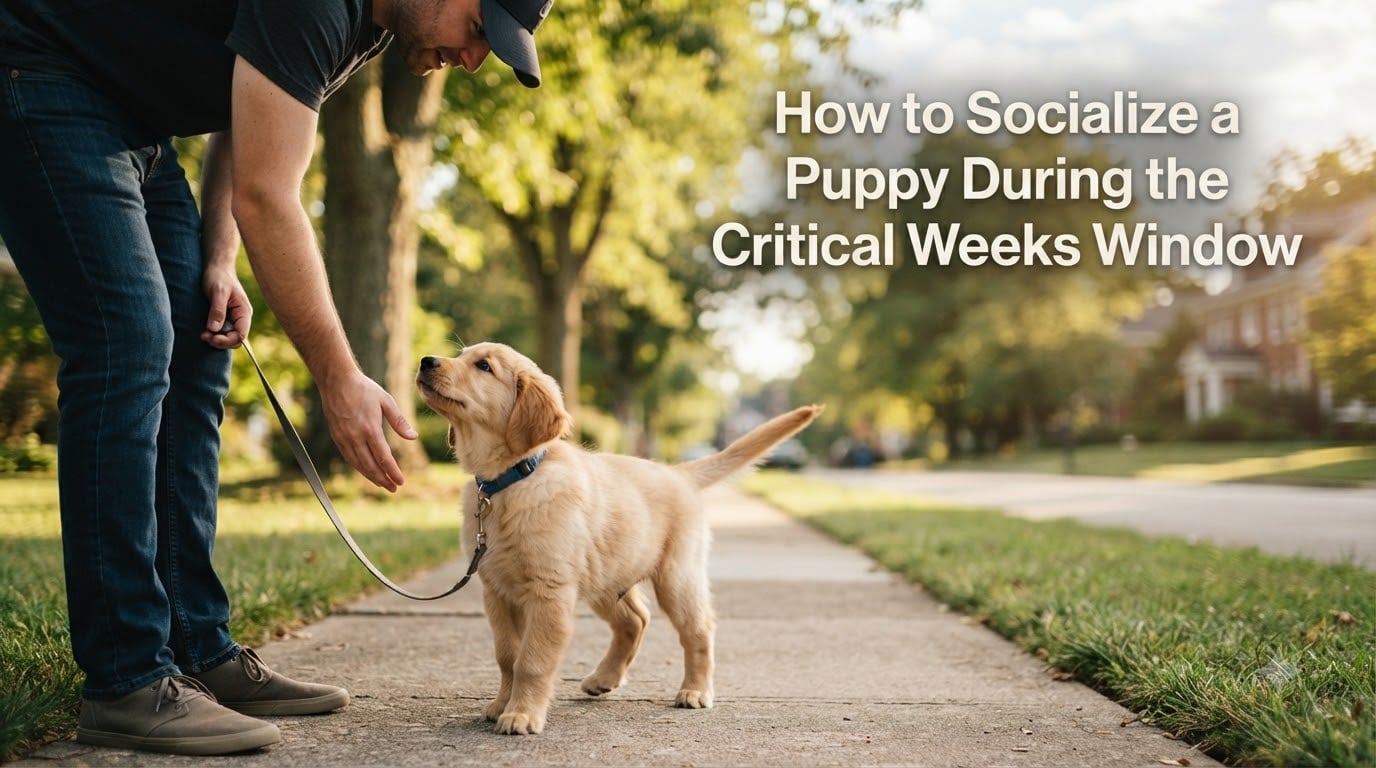
I brought home my first puppy at eight weeks old and made the classic mistake of waiting until her vaccinations were complete before exposing her to the world. By the time I finally took her to the dog park at sixteen weeks, she cowered behind my legs at every passing stranger. That mistake taught me how to socialize a puppy during the critical weeks window the right way, and it is the single most important lesson for any new puppy owner.
The American Veterinary Society of Animal Behavior (AVSAB) calls behavioral issues the leading cause of death in dogs under three years old. That statistic alone reframes socialization from a nice-to-have into a life-saving priority. In this guide, I will walk you through what the critical window actually is, why it matters, how to socialize your puppy safely, and the practical rules like the 7-7-7 and 3-3-3 that experienced trainers rely on.
Table of Contents
What Is the Critical Socialization Period for Puppies?
The critical socialization period for puppies spans approximately 3 to 16 weeks of age. During this window, your puppy’s brain is uniquely receptive to new experiences, people, animals, sounds, and environments.
According to the American Kennel Club, puppies who miss this window are statistically more likely to develop fear, anxiety, and aggression in adulthood. The AVSAB position statement on socialization confirms that early positive exposure during this phase shapes neural pathways that influence behavior for the rest of your dog’s life.
Here is the science in plain terms. Between 3 and 12 weeks, puppies enter a primary socialization phase where they learn to identify their own species and build foundational social skills. Between 5 and 16 weeks, the secondary socialization phase opens them up to other species, environments, and stimuli. Once that window closes, new experiences become harder to process and more likely to trigger fear responses.
Why Socializing Your Puppy Matters More Than You Think?
Behavioral problems are the number one cause of death for dogs under three years of age in the United States. That is not a typo. Euthanasia due to behavior issues outranks infectious disease, accidents, and genetic conditions combined.
I have watched this play out in real life. My neighbor adopted a Labrador who never met children during his first sixteen weeks. At eighteen months, he nipped a toddler who simply walked past his food bowl. The family surrendered him. None of that had to happen.
Proper socialization prevents the most common issues veterinary behaviorists see: fear-based reactivity, separation anxiety, resource guarding, and aggression toward strangers or other dogs. It also builds a confident, adaptable dog who can handle car rides, vet visits, grooming, and busy households without stress.
How to Socialize a Puppy During the Critical Weeks Window: Step by Step
Follow these steps from week one home. I have tested this approach with three puppies now, and the results speak for themselves.
Step 1: Set Up a Safe Home Base Before Anything Else
Before you expose your puppy to the world, give them a predictable home environment. Puppies who feel safe at home absorb new experiences faster. Designate a crate area, set feeding schedules, and establish a small potty zone.
Your home should also expose your puppy to sounds and textures: dishwashers, vacuums, hardwood floors, tile, rugs, and textured mats. Many owners forget that indoor socialization counts just as much as outdoor exposure.
Step 2: Introduce One New Experience Per Day
Quality beats quantity. Pick one new stimulus per day and pair it with treats and praise. Examples include meeting one new person, walking on a different surface, hearing a thunderstorm recording at low volume, or riding in the car for a short trip.
Watch your puppy’s body language. Loose tail wag, relaxed ears, and curious sniffing mean the exposure is working. Tucked tail, lip licking, or hiding means you have pushed too far.
Step 3: Use Positive Reinforcement Every Single Time
Treats, praise, and play are your three tools. The moment your puppy notices something new, mark the moment with a happy “yes” and deliver a treat. This builds a positive association that sticks for life.
I keep small soft training treats in a fanny pack during every socialization outing. My current puppy, a Border Collie named Pepper, now actively looks at me when she sees something new because she knows good things happen.
Step 4: Meet a Variety of People
Introduce your puppy to men, women, children, elderly people, people in hats, people with beards, people in wheelchairs, and people wearing sunglasses. Each builds a different association.
Ask strangers to offer your puppy a treat rather than reaching over the head. Hand sniffs from toddlers teach your puppy that small humans are safe and fun.
Step 5: Expose Your Puppy to Other Healthy Dogs
Only after your veterinarian gives the all-clear should you introduce your puppy to unknown dogs. Start with fully vaccinated, friendly adult dogs who will teach gentle play. Avoid dog parks until vaccinations are complete and your puppy shows confident social signals.
Enroll in a puppy class that requires proof of first vaccinations. These classes are gold mines for safe, structured socialization.
Step 6: Introduce Sounds, Surfaces, and Environments
Make a checklist and work through it: skateboards, motorcycles, thunder, fireworks recordings, rain on an umbrella, grass, gravel, metal grates, and slippery floors. The goal is exposure without forcing interaction.
The 7-7-7 Rule for Puppies Explained
The 7-7-7 rule is a simple framework used by trainers to ensure puppies get well-rounded socialization. By the time your puppy is 7 weeks old, they should have experienced 7 different environments, met 7 different people, and tried 7 different types of food. By 7 months, the numbers scale up to 77 of each category.
Here is how I apply it in real life. Weekend one with Pepper, I took her to the front yard, the back porch, the garage, the car, and the vet’s waiting room. Five environments in one weekend, plus two more the following week. For people, I introduced her to the mail carrier, my sister, a friend with a beard, a toddler nephew, and three neighbors.
The 7-7-7 rule works because it turns a vague goal (“socialize more”) into a measurable checklist. Seven is a small enough number that you can hit it within the first week, but varied enough to cover the bases most puppies miss.
Understanding the 3-3-3 Rule When Bringing Your Puppy Home
The 3-3-3 rule describes what your puppy needs to decompress after adoption. Give them 3 days to settle in, 3 weeks to feel safe in your home, and 3 months to feel fully secure as part of your family.
During the first 3 days, expect accidents, crying, and hiding. Resist the urge to take your puppy to thirteen places in three days. Let them adjust. During the first 3 weeks, slowly introduce house rules, routines, and gentle socialization. By 3 months, your puppy should trust you, respond to their name, and feel safe in their environment.
Combine the 3-3-3 rule with the 7-7-7 rule for a complete framework. The 3-3-3 builds the foundation at home. The 7-7-7 scales socialization outward into the wider world.
Navigating Fear Periods in Your Puppy’s Development
Fear periods are short windows during development when puppies suddenly become scared of things they previously ignored. They typically occur at 8-11 weeks and again around 6-14 months.
During a fear period, your puppy may bark at familiar objects, hide from people, or refuse to walk on surfaces they crossed confidently yesterday. Do not panic. This is normal neurological development.
When you see fear signals, do not coddle or scoop your puppy up. That rewards the fear. Instead, be calm, keep your body language relaxed, and use treats to lure your puppy past the scary object. If they refuse treats, increase the distance and try again later.
Most fear periods last 2-3 weeks. Continue all socialization work during these phases, just at a lower intensity. Avoid forced interactions and major traumatic events like surgery or boarding during peak fear windows.
Safety First: Balancing Socialization and Vaccinations
Many owners delay all socialization until vaccinations complete at 16 weeks. That is a dangerous mistake because the socialization window closes before vaccine schedules finish.
The AVSAB position statement explicitly says the risk of behavioral problems from under-socialization outweighs the small risk of disease in low-risk environments. Safe early socialization includes your home, friends’ homes with vaccinated dogs, puppy classes requiring first vaccines, and car rides to neutral locations.
Avoid dog parks, pet stores with unknown dogs, and high-traffic public areas until your veterinarian confirms full vaccine protection. Carry your puppy in busy areas like sidewalks and parks to limit ground contact.
Talk to your vet about your specific vaccine schedule. Distemper and parvovirus are the main concerns, and your vet can advise on safe socialization by age and dose received.
Puppy Socialization Week-by-Week Timeline
Use this week-by-week breakdown to structure your efforts from the day you bring your puppy home.
Week 8 to 9
Focus on home environment, household sounds, gentle handling by immediate family, and short car rides. Begin introducing your puppy to one new person per day.
Week 10 to 11
Add new surfaces, low-volume sound recordings, and the first puppy class. Introduce puppies to vaccinated adult dogs in controlled settings. Continue meeting diverse people.
Week 12 to 13
Many puppies receive their first vaccines around this age. Continue puppy classes, expand outdoor environments like fenced yards, and practice gentle handling for grooming and vet exams.
Week 14 to 16
The final stretch of the critical window. Expose your puppy to busy environments, different weather, varied flooring, and as many positive new experiences as possible. Most puppy classes complete by this age.
Beyond Week 16
Socialization does not stop at 16 weeks. Continue exposure for the first year, adjusting intensity based on your puppy’s confidence and any emerging fear periods.
Frequently Asked Questions
What is the 7 7 7 rule for puppies?
The 7-7-7 rule is a trainer’s framework that sets measurable socialization goals. By 7 weeks old, a puppy should have experienced 7 different environments, met 7 different people, and tried 7 different foods. By 7 months, the goal scales up to 77 of each category, ensuring well-rounded exposure during the critical socialization window.
What is the critical period for puppy socialization?
The critical period for puppy socialization is approximately 3 to 16 weeks of age. During this developmental window, puppies are most receptive to new experiences, and positive exposures shape their temperament for life. Missing this window increases the risk of fear, anxiety, and aggression in adult dogs.
What are the hardest weeks with a puppy?
The hardest weeks are typically 8-12 weeks (adjustment to new home, teething, first fear period) and 6-14 months (adolescence, second fear period, boundary testing). The early weeks are challenging because puppies have not yet learned bite inhibition or house training, while adolescence brings hormonal changes and increased independence.
What is the 3 3 3 rule for puppies?
The 3-3-3 rule describes how long a puppy needs to adjust to a new home. They need 3 days to decompress, 3 weeks to feel safe in your home, and 3 months to feel fully secure as part of your family. This rule helps owners set realistic expectations during the early adjustment period.
Final Thoughts on Socializing Your Puppy the Right Way
Learning how to socialize a puppy during the critical weeks window is one of the highest-impact investments you will make as a dog owner. The window is small, but the payoff is enormous: a confident, calm, well-adjusted dog who handles life without fear or aggression.
Start today, even if your puppy is already past 8 weeks. Pair every new experience with treats, follow the 7-7-7 rule for variety, give your puppy 3-3-3 time to settle, and respect the fear periods. Talk to your vet about safe exposure, enroll in a reputable puppy class, and stay consistent. Your future adult dog will thank you for the work you do now.