
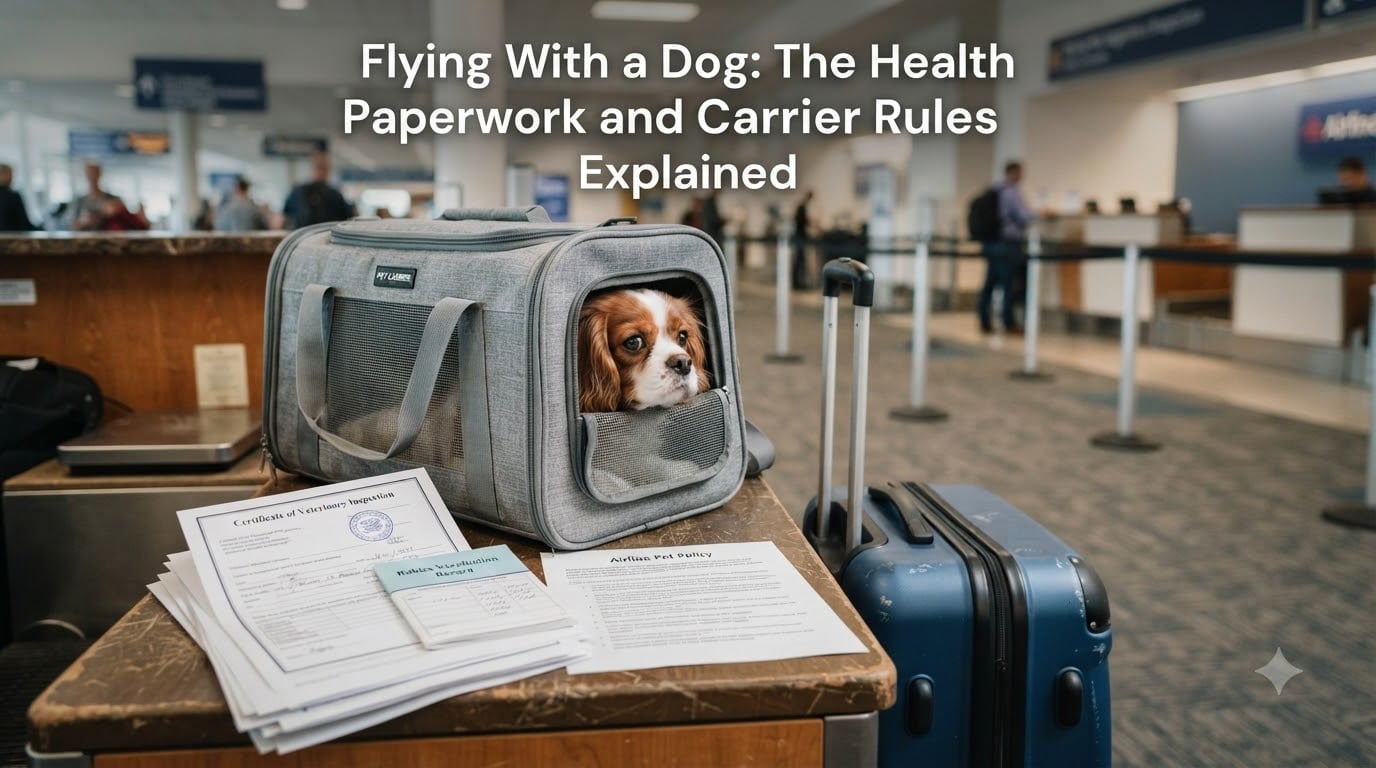
Flying with a dog in 2026 starts long before you reach the airport. The paperwork, vet visits, and carrier choices you make today decide whether your dog boards the plane or stays home. I have helped friends and readers prepare for both domestic and international flights, and the same lesson comes up every time: the health certificate is the single document that can ground your trip.
This guide covers every requirement for flying with a dog, from the Certificate of Veterinary Inspection to airline carrier dimensions, USDA endorsement, and TSA checks. You will get a clear timeline, the exact forms your vet needs to sign, and answers to the questions I hear most often from pet owners preparing to fly.
Table of Contents
What Is a Dog Health Certificate and Why Do Airlines Require One?
A dog health certificate is an official document signed by a USDA-accredited veterinarian that confirms your dog is healthy, free of contagious disease, and fit to travel by air. Airlines require it because federal and state laws treat animals as regulated cargo, and the certificate is the only proof that your dog will not introduce disease into another state or country.
The certificate is also called a Certificate of Veterinary Inspection (CVI). For domestic flights, the CVI is usually enough. For international flights, the same certificate must also be endorsed by USDA APHIS before it becomes legally valid at the destination border.
Direct answer: Yes, your dog needs a health certificate to fly on virtually every commercial airline, even on short domestic routes. The certificate must be issued within 10 days of your departure date, and your dog must be re-examined if travel is delayed past that window.
Two government agencies care about this paperwork. The U.S. Department of Agriculture (USDA) regulates animal movement between states and countries. The Centers for Disease Control and Prevention (CDC) sets rules for dogs entering or re-entering the United States. Airlines layer their own rules on top, which is why a “domestic” flight can still require international-grade documentation depending on the route.
Types of Health Certificates: Domestic vs International
There are two main certificate types, and they are not interchangeable. A domestic CVI is the simpler of the two and is signed only by your accredited vet. An international health certificate includes the same exam plus USDA APHIS endorsement and may need a rabies titer test depending on the destination country.
Domestic flights within the United States only require the CVI. Some states, like Hawaii and Guam, have stricter entry rules that mirror international requirements, so always check destination-specific rules before booking.
International flights require an APHIS-endorsed certificate. APHIS stands for Animal and Plant Health Inspection Service, the USDA branch that verifies your vet’s work for foreign governments. Without that endorsement, your international health certificate is just a piece of paper at the destination border.
Here is how the two compare at a glance:
- Domestic CVI: Signed by USDA-accredited vet, valid 10 to 30 days depending on state, no USDA endorsement needed, accepted by all U.S. airlines.
- International Health Certificate: Signed by USDA-accredited vet, then endorsed by APHIS, valid 10 days for most countries, often requires rabies titer test and ISO microchip.
Step-by-Step Process for Getting Your Dog’s Health Certificate
Getting the certificate is a six-step process. Start at least six weeks before international flights and two weeks before domestic flights to leave room for delays, vet availability, and APHIS processing time.
Step 1: Confirm your airline’s pet policy first. Call the airline or check its website before booking the vet appointment. Some airlines have banned certain breeds, restricted cabin pets to specific routes, or stopped offering cargo service entirely. Your health certificate is useless if the airline will not accept your dog on board.
Step 2: Find a USDA-accredited veterinarian. Not every vet can sign a CVI for air travel. Use the USDA’s National Veterinary Accreditation Program search tool to find an accredited vet in your area. For international certificates, you must also use a vet who has completed the APHIS endorsement training module.
Step 3: Schedule the exam within 10 days of departure. The certificate is dated the day of the exam, and most airlines and states require it to be issued within 10 days of the flight. Schedule the visit close to your travel date, not weeks in advance.
Step 4: Bring vaccination records to the exam. Your vet needs proof of current rabies vaccination, and the rabies certificate must be valid for the entire trip. For international travel, also bring microchip documentation showing an ISO 15-digit chip number.
Step 5: Complete any required tests. Rabies titer tests (FAVN or RNATT) are required for countries classified as rabies-free or high-risk. The blood draw happens before the certificate exam, and results take 3 to 4 weeks from an approved lab.
Step 6: Submit for APHIS endorsement if flying internationally. Your vet submits the certificate to your local USDA APHIS Veterinary Services office, either by mail or through the online VEHSS system. Endorsement turnaround is typically 2 to 5 business days but can take longer during peak travel seasons.
How Long Is a Dog Health Certificate Valid?
A dog health certificate is valid for 10 days for most airline and state entry requirements, though some airlines accept certificates up to 30 days old for domestic travel. For international travel, the 10-day window is enforced strictly because the destination country wants recent proof of health, not a snapshot from weeks ago.
The exam date on the certificate is what counts, not the issue date or the endorsement date. If your flight is delayed by more than a day or two past that 10-day window, you will need a new exam and a new certificate.
For connecting flights, the rule is the same. Your certificate must be valid on the date you arrive at your final destination, not on the date you take off. A flight with a 14-hour layover is fine. A flight with a 3-day stopover is not.
Forum insight: One frequent flyer on r/TravelWithPets shared that their certificate expired mid-trip during a schedule change, and the only fix was a new vet visit at the destination city. Plan for backup time on both ends of your trip.
USDA-Accredited Veterinarian: Who Can Legally Sign the Certificate?
A USDA-accredited veterinarian is a licensed vet who has completed additional federal training and holds an active accreditation through the National Veterinary Accreditation Program (NVAP). Only accredited vets can sign a CVI for interstate transport, and only vets with Category I or II accreditation can sign international health certificates that will be endorsed by APHIS.
Your regular neighborhood vet may be accredited, or may not be. Accreditation is voluntary and must be renewed every 3 years. Always confirm by asking for the vet’s NVAP number before booking the exam.
To find one near you, visit the USDA APHIS website and use the “Accredited Veterinarian Search” tool. You can search by ZIP code, state, or name. Many large animal hospitals and airport-area clinics have at least one accredited vet on staff.
For international certificates, your vet must also be authorized to use the online Veterinary Export Health Certification System (VEHCS). Not every accredited vet has this access, so confirm it specifically when you book the appointment.
Airline Carrier Rules: Cabin, Checked, and Cargo
Airlines offer three ways to fly with a dog: in the cabin with you, as checked baggage in the cargo hold, or as cargo shipped through a third-party pet transport service. Each option has its own size, weight, and carrier rules.
Cabin travel is the easiest and most common option for small dogs. Your dog rides under the seat in front of you in a soft-sided carrier that fits within the airline’s under-seat dimensions. Most airlines cap cabin pets at around 20 pounds including the carrier, though the exact limit varies.
Checked baggage means your dog rides in a hard-sided kennel in the pressurized, temperature-controlled cargo hold of the same plane you are on. This option is for medium and large dogs that exceed cabin size limits. The dog is checked at the ticket counter and picked up at baggage claim on arrival.
Cargo shipping uses the same aircraft hold but is booked through a freight or pet transport company. This is the only option for very large dogs or for itineraries where no passenger cabin space is available. It is also the most expensive and the most stressful option for the dog.
Common carrier rules across major U.S. airlines include:
- Soft-sided cabin carriers: Must fit under the seat in front of you. Typical max dimensions are 18 x 11 x 11 inches, but check your specific aircraft because some economy seats have less under-seat space.
- Hard-sided kennels for checked pets: Must be airline-approved, ventilated on at least three sides, and labeled with your name and contact information. The kennel must be large enough for your dog to stand, turn, and lie down comfortably.
- Weight and breed limits: Most airlines cap checked pets at around 70 pounds combined weight of dog and kennel. Brachycephalic (short-nosed) breeds are restricted or banned from cargo travel during hot months.
TSA and Airport Check-In: What Really Happens With Pet Paperwork
TSA does not check your dog’s health certificate at the security checkpoint. TSA agents focus on screening passengers and bags for security threats, not on verifying veterinary documents. Your health certificate is reviewed by the airline at check-in, not by TSA at the security line.
You will, however, need to remove your dog from the carrier at the TSA checkpoint so the carrier can go through the X-ray machine. Your dog walks through the metal detector with you on a leash. No paperwork is checked at this point.
Where the certificate matters is at the airline counter when you check in. The gate agent will confirm that your dog has a valid health certificate on file, that the carrier meets size rules, and that you have paid the pet fee. If your certificate is expired or missing, the airline can refuse to let your dog board, and you will need to rebook or find last-minute cargo options.
Forum insight: Multiple travelers on r/unitedairlines report that TSA agents have never asked to see a health certificate, but airline gate agents always check. One user noted, “Three international trips later, the USDA certificate has never been asked for at TSA, but the airline counter always wants to see it.” Plan for the airline check, not the security line.
Vaccination and Microchip Requirements for Flying With a Dog
Rabies vaccination is the only universally required vaccine for flying with a dog. Your dog’s rabies certificate must be current at the time of the health certificate exam and remain valid through the entire trip. Puppies under 12 weeks generally cannot fly because they are too young for a rabies vaccine.
For domestic flights, no other vaccines are federally required, though airlines and destination states may ask for proof of distemper, parvovirus, and bordetella. Bring your full vaccination history to the exam so your vet can confirm everything is current.
For international flights, an ISO-compliant 15-digit microchip is required by most countries. The microchip must be implanted before the rabies vaccine is given, so if you are planning international travel, get your dog microchipped well in advance. A rabies titer test is also required for many destinations to prove your dog’s immunity.
Common vaccination and microchip requirements by destination type:
- Domestic U.S. flights: Rabies certificate required. Microchip recommended but not federally required.
- International flights to EU or UK: ISO microchip, rabies vaccine, and rabies titer test required. EU pet passport strongly recommended.
- Flights to rabies-free countries (Australia, New Zealand, Japan): Extended quarantine, microchip, two rabies titer tests, and CDC-style import permits usually required.
- Returning to the U.S.: CDC requires a microchip, current rabies vaccine, and a CDC Dog Import Permit for entry as of recent rule changes.
Brachycephalic and Breed-Specific Restrictions
Brachycephalic dogs (short-nosed breeds like pugs, French bulldogs, Boston terriers, and boxers) face travel restrictions on most airlines because their flattened airways make them prone to respiratory distress in cargo holds. Many airlines ban these breeds from checked baggage and cargo service during summer months or year-round.
Some airlines also restrict “bully breeds” including American Pit Bull Terriers, American Staffordshire Terriers, and Staffordshire Bull Terriers from cargo travel. Each airline publishes its own list, so confirm breed rules before booking.
If your dog is on a restricted breed list, your only option is cabin travel. That means the dog plus carrier must fit under the seat and stay under the airline’s weight limit, typically 20 pounds.
International Travel: CDC, USDA APHIS, and Destination Rules
International pet travel is governed by three layers of rules: the destination country’s import requirements, USDA APHIS export rules for leaving the United States, and CDC rules for dogs re-entering the United States.
For outbound flights, you need an APHIS-endorsed international health certificate. The certificate format and required tests vary by country, and the USDA publishes country-specific requirements on its pet travel page. Some countries require a 180-day waiting period after a rabies titer test before your dog can enter.
For flights returning to the United States, the CDC requires all dogs to have a microchip, current rabies vaccine, and a CDC Dog Import Permit as of recent rule updates. The permit is a new requirement that applies even to dogs that previously traveled internationally without one.
Country-specific quirks to watch for include the United Kingdom’s six-month wait after the rabies titer, Australia’s 180-day import program, and the European Union’s pet passport system. Always check the destination country’s official agriculture or customs website for the most current rules, because these change frequently.
Cost Breakdown and Common Mistakes to Avoid
Here is what you can expect to pay in 2026 for the paperwork side of flying with a dog:
- Domestic CVI exam: $50 to $150, depending on your vet and region.
- International health certificate exam: $150 to $400, often higher for complex destinations.
- USDA APHIS endorsement fee: $150 to $200 for the first signature, less for additional pets on the same certificate.
- Rabies titer test: $150 to $300, plus shipping to an approved lab.
- CDC Dog Import Permit: A new fee structure under recent rule changes, typically $50 to $300 depending on the dog.
The most common mistakes I see from first-time pet flyers are fixable with better planning:
- Booking the vet exam too early. A certificate issued 30 days before the flight is expired by departure day. Schedule within 10 days of takeoff.
- Forgetting to confirm the airline’s pet policy before paying the vet. A perfectly executed health certificate is useless if the airline banned your breed on your route.
- Skipping the microchip for international travel. Without an ISO microchip, your dog can be turned away at the foreign border even with a valid certificate.
- Assuming TSA checks pet paperwork. The airline checks at the counter, not TSA at security. Plan for the airline check.
- Not budgeting for the APHIS endorsement turnaround. Plan for 2 to 5 business days, longer during summer and holidays.
Frequently Asked Questions
Does TSA check pet health certificates?
No, TSA does not check pet health certificates at the security checkpoint. TSA agents screen passengers and bags for security threats. Your dog’s health certificate is reviewed by the airline at check-in, and you may also need to show it at the destination gate or upon arrival at a foreign country.
Does my dog need a health certificate to fly?
Yes, virtually every U.S. airline requires a health certificate for dogs, whether they fly in the cabin, as checked baggage, or as cargo. The certificate must be issued by a USDA-accredited veterinarian within 10 days of the flight date for most airlines and destination states.
How long is a dog health certificate valid?
A dog health certificate is valid for 10 days for most airline and state entry requirements. Some airlines accept certificates up to 30 days old for domestic travel, but the 10-day window is the safest standard. For international flights, the 10-day rule is enforced strictly by destination countries.
Can my dog fly without a health certificate?
In almost all cases, no. Airlines require a valid health certificate for any dog traveling by air, and most states require one for entry. Flying without a certificate can result in denied boarding, fines, or quarantine at the destination. The only rare exceptions are emotional support animals on certain legacy policies, which most airlines have phased out.
What does a vet check during a health certificate exam?
During a health certificate exam, your USDA-accredited vet will check your dog’s overall health, listen to the heart and lungs, examine the eyes, ears, and skin, verify the rabies vaccination, confirm the microchip number for international travel, and confirm the dog is free of signs of contagious disease. The exam typically takes 20 to 30 minutes.
Which airlines require a health certificate for pets?
All major U.S. airlines require a health certificate for pets traveling in cargo or as checked baggage. For cabin travel, most airlines still require a certificate within 10 days of departure, though enforcement varies. Always check your specific airline’s pet policy before booking.
Why are pet travel certificates so expensive?
Pet travel certificates cost more than regular vet visits because the USDA-accredited vet performs a more detailed exam, fills out multi-page federal forms, and submits them for APHIS endorsement on international trips. The vet’s office fee, the APHIS endorsement fee, and any required tests like rabies titer all add up. Total costs for international paperwork typically range from $300 to $600 per dog.
What makes a dog carrier TSA approved?
TSA does not approve pet carriers specifically, but the carrier must pass through the airport security X-ray machine while your dog walks beside you on a leash. Soft-sided carriers work best because they collapse flat for screening. The carrier must also meet your airline’s size rules for the cabin or cargo hold.
Final Thoughts on Flying With a Dog
Flying with a dog in 2026 comes down to two things: the health certificate and the carrier. Get those right, and the rest is logistics. Start the paperwork at least six weeks before international flights and two weeks before domestic flights, confirm your airline’s pet policy before booking the vet exam, and budget for both the certificate costs and the airline pet fee.
If you remember nothing else, remember this: the airline checks your paperwork at the counter, TSA does not. Your certificate must be valid on arrival day, not just departure day. And for international trips, your dog needs a USDA-endorsed certificate, an ISO microchip, and a current rabies titer before boarding.
For the most accurate and current rules, check the USDA APHIS pet travel page, your specific airline’s pet policy, and the CDC dog import requirements before you finalize any booking. The rules change often, and the source-of-truth is always the official government site, not a forum post.