
Last spring, my neighbor’s Labrador, Max, waddled across the yard and I realized something was off. His ribs had disappeared under a thick layer of fat, his waist had vanished, and he panted after just a short walk. His owner had no idea Max was overweight until our vet mentioned it during a routine checkup.
If you’ve ever wondered whether your dog carries a few extra pounds, you’re not alone. According to the Association for Pet Obesity Prevention, more than half of adult dogs in the United States are overweight or obese. Learning how to tell if your dog is overweight and how to slim them down safely is one of the most important things you can do for their long-term health.
In this guide, I’ll walk you through a quick body condition check, explain the Body Condition Score (BCS) vets use, and share five vet-approved steps to help your dog reach a healthier weight without crash dieting. I’ve pulled advice from veterinary sources like Cornell’s Riney Canine Health Center and AAHA, plus practical tips from real owners on Reddit’s dog forums.
Table of Contents
How to Tell If Your Dog Is Overweight: The 7 7 7 Quick Check
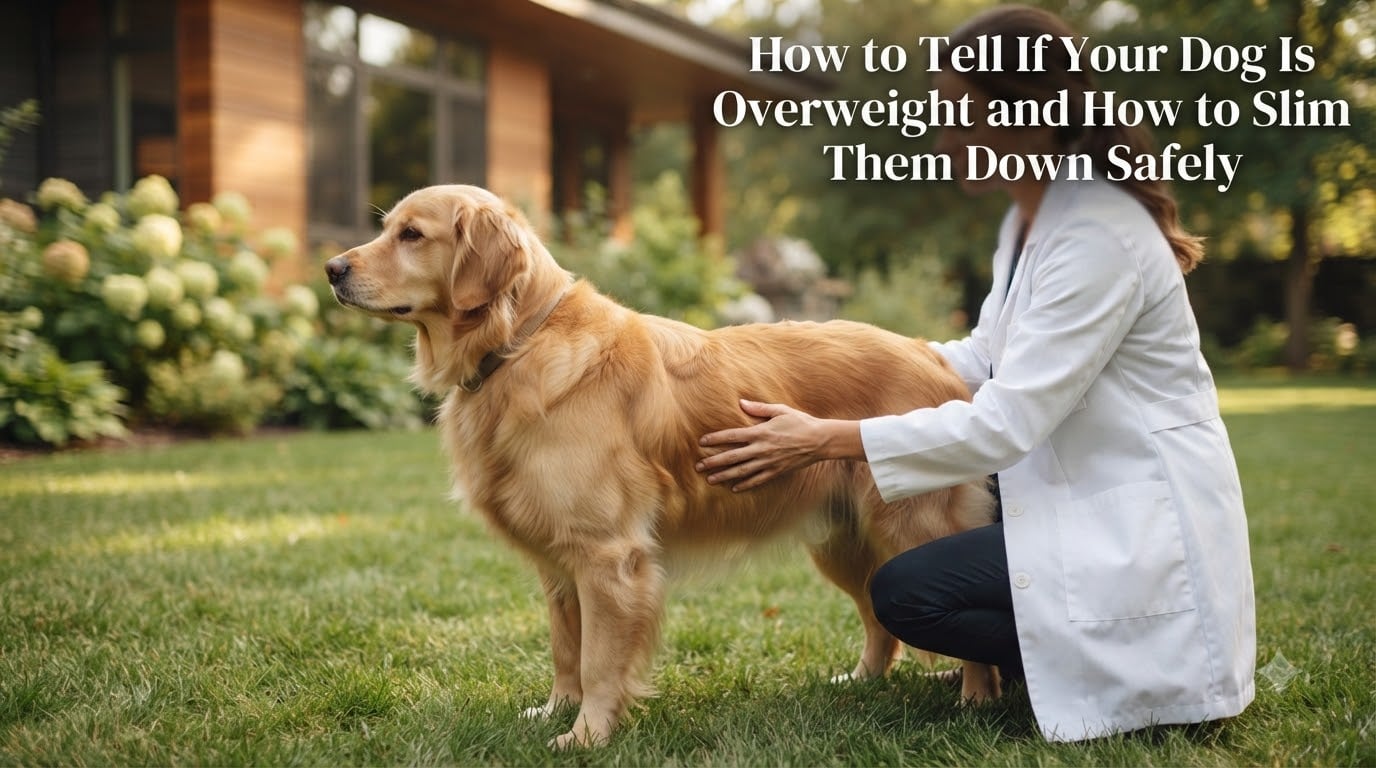
You can perform a basic body condition check at home in under a minute. The 7-7-7 rule is a simple memory trick: spend 7 seconds feeling for ribs, 7 seconds looking at the waist, and 7 seconds checking the abdominal tuck from the side.
Rib check (7 seconds): Place your thumbs flat on your dog’s spine and spread your hands across the ribcage. You should feel the ribs like the back of your hand, with a thin layer of fat covering them. If you have to press hard to find them, your dog is likely overweight.
Waist check (7 seconds): Look at your dog from above while they stand. A healthy dog has a visible waist behind the ribs that tapers toward the hips. If the body looks like a straight tube or a rounded barrel, extra weight is hiding the curve.
Abdominal tuck (7 seconds): Look at your dog from the side. The belly should tuck upward behind the ribcage. A sagging belly, a flat line from ribs to hips, or even a swayed back all signal extra fat.
If all three checks suggest your dog is overweight, your next step is a more precise assessment using the Body Condition Score.
What Is a Body Condition Score (BCS) and How Do Vets Use It?
The Body Condition Score is a 9-point scale vets use to estimate body fat. A score of 4 or 5 is ideal. Scores of 6 or 7 mean overweight, and 8 or 9 mean obese. Vets also assign a Muscle Condition Score to check for hidden muscle loss, especially in senior dogs.
Each point above ideal represents roughly 10 to 15 percent excess body weight. So a dog rated 7 out of 9 is carrying 20 to 30 percent more fat than they should. That sounds small until you realize a 50-pound Beagle at a healthy 30 pounds is 67 percent overweight.
Ask your vet for an honest BCS assessment at your next visit. Bring a recent photo of your dog standing from above and from the side so you can compare at home later. Many clinics use the Purina BCS chart, which gives visual references for every score.
Why Dog Obesity Matters: Health Risks You Should Know
Excess weight in dogs is not a cosmetic issue. It shortens lifespan and increases the risk of painful, expensive conditions. Research published by the AAHA shows that overweight dogs live on average 2.5 years shorter than their lean counterparts.
Common health risks include arthritis and joint stress, type 2 diabetes, breathing difficulties, skin infections, and a higher risk under anesthesia. Overweight dogs also tire faster on walks, which makes it harder to lose weight, creating a frustrating cycle for owners.
If your dog has any of these issues plus extra pounds, weight loss could improve their quality of life faster than almost any other change you make.
Step 1: Talk to Your Veterinarian Before Starting a Weight Loss Plan
Never start a diet without talking to your vet first. Some conditions like hypothyroidism or Cushing’s disease cause weight gain that no diet will fix. Your vet can rule out medical causes and give you a specific target weight and calorie goal.
At the visit, ask for your dog’s ideal weight, the daily calorie amount to reach it, and the recommended weight loss rate. Most vets aim for a 3 to 5 percent loss of body weight per month, which is safe and sustainable. Bring a list of everything your dog currently eats, including treats, table scraps, and any medications given with food.
Step 2: Adjust Your Dog’s Diet and Portion Sizes
The biggest contributor to dog weight gain is overfeeding. Many owners follow the bag’s feeding guidelines, but those are usually for unneutered, active dogs and often run high by 20 to 30 percent. Switch to measured feeding using a kitchen scale for accuracy, especially for small dogs where a few extra kibbles add up fast.
To reduce calories safely, your vet will usually recommend cutting the daily ration by 20 to 25 percent, or switching to a prescription weight loss food. These diets are higher in protein and fiber so your dog feels full on fewer calories. Avoid free-feeding (leaving food out all day) because it removes your ability to track intake.
Calculate your dog’s resting energy requirement using the formula 70 times their ideal weight in kilograms to the 0.75 power. For an average adult dog, multiply that by 1.4 to estimate daily calories at a healthy weight. Reducing that number by 20 to 25 percent gives a safe starting point, but always confirm with your vet.
Step 3: Manage Treats, Begging, and Table Scraps
Treats should make up no more than 10 percent of your dog’s daily calories. For a dog eating 400 calories a day, that means less than 40 calories of treats, which is roughly two small training treats or a few pieces of carrot. Treats given “just because” are usually where the hidden calories hide.
Swap high-calorie treats for low-calorie options like baby carrots, green beans, sliced cucumber, or small pieces of apple (no seeds). Many dogs love these crunchy alternatives once they realize food is coming, and the fiber helps them feel full. Save high-value training treats for actual training sessions.
Begging is a learned behavior, not a sign of hunger. Dogs beg because it has worked in the past. Ignore begging completely, never give in “just this once,” and feed your dog before your own meals so they are less interested in your plate. If you have multiple dogs, feed the dieting dog separately so others cannot finish their food.
In multi-pet households, the guilt of treating pets equally is real. One owner on Reddit’s r/DogAdvice solved it by giving the slim dog a few pieces of kibble from his daily ration when the overweight dog got a carrot. Both dogs felt included, and calories stayed controlled.
Step 4: Increase Exercise and Daily Activity Safely
Exercise alone rarely causes weight loss in dogs, but combined with diet, it speeds results and builds muscle. Start slow, especially if your dog is very overweight, senior, or has joint issues. Two short walks a day, each 10 to 15 minutes, is a safer starting point than one long weekend hike.
Low-impact activities are best for overweight dogs. Walking on flat ground, swimming, and gentle fetch on soft grass protect the joints while burning calories. Avoid high jumps, hard running on pavement, or any activity that causes limping or heavy panting.
Mental stimulation matters too. Puzzle feeders and slow feeders force dogs to work for their kibble, which slows eating, extends mealtime, and burns mental energy. A dog that eats a meal in 90 seconds will often beg again within an hour. A dog that works 15 minutes for the same meal stays satisfied longer.
To naturally support your dog’s metabolism, build muscle through regular movement. Muscle tissue burns more calories at rest than fat does, so even short daily walks help over time. Aim to add 5 to 10 minutes per week until you reach 30 to 60 minutes of total daily activity.
Step 5: Track Your Dog’s Weight and Body Condition Score
Weigh your dog at least every two weeks. Use the same scale each time, ideally at the same time of day. At home, weigh yourself, then weigh yourself holding your dog, and subtract. For small dogs, a baby scale works well.
Keep a simple log of weight, body condition, and any food or activity changes. Photos from the same angle every month help you see progress that gradual weight loss can hide day to day. If your dog loses less than 1 percent of body weight per month, talk to your vet about adjusting the plan.
Most dogs reach their ideal weight in 6 to 12 months. Plateaus are normal. If weight stalls for more than a month, your vet may suggest a different food, a slight calorie cut, or a check for medical issues.
What’s a Safe Weight Loss Rate for Dogs?
A safe rate is 3 to 5 percent of current body weight per month. Faster weight loss in dogs can cause muscle loss, nutrient deficiencies, and a dangerous liver condition called hepatic lipidosis, especially in overweight cats but also reported in dogs.
For a 40-pound dog, that means losing 1.2 to 2 pounds per month, or roughly 0.3 to 0.5 pounds per week. Losing 2 pounds in 2 weeks for a small dog is achievable, but losing 2 pounds in 2 weeks for a toy breed can be dangerous. The rule of thumb is slow and steady wins the race.
Which Dog Breeds Are Most Prone to Obesity?
Some breeds are genetically more prone to weight gain. Labrador Retrievers, Beagles, Dachshunds, Pugs, Basset Hounds, and Cocker Spaniels top most lists. Labradors in particular often carry a gene mutation that affects satiety, so they feel hungry even when full.
Breed predisposition does not mean obesity is inevitable. Measured feeding, daily activity, and limiting treats prevent weight gain in any breed. If you have a high-risk breed, talk to your vet about prevention early, ideally during the puppy stage.
Frequently Asked Questions
What is the 7 7 7 rule for dogs?
The 7 7 7 rule is a quick at-home body condition check. Spend 7 seconds feeling for ribs (you should feel them under a thin fat layer), 7 seconds looking at the waist from above (a healthy dog has a visible taper), and 7 seconds checking the abdominal tuck from the side (the belly should tuck up behind the ribs). If all three checks suggest extra fat, your dog may be overweight.
What dog breed is most prone to obesity?
Labrador Retrievers are the most prone to obesity, partly due to a common gene mutation that affects satiety. Beagles, Dachshunds, Pugs, Basset Hounds, and Cocker Spaniels are also high-risk breeds. Measured feeding and daily exercise prevent weight gain in any breed.
How to speed up a dog’s metabolism?
Build muscle through regular daily activity, since muscle tissue burns more calories than fat at rest. Feed a high-protein diet in measured portions, avoid free-feeding, and use puzzle feeders to slow eating and increase mealtime activity. Switch to scheduled meals instead of leaving food out all day.
How do I get my dog to lose 2 pounds in 2 weeks?
Losing 2 pounds in 2 weeks is safe for medium and large dogs but risky for small breeds. The safe rate is 3 to 5 percent of body weight per month, so a 40-pound dog can lose about 1.2 to 2 pounds per month total. Cutting calories by 20 percent, cutting treats, and adding daily walks usually produces steady loss over 6 to 12 months, not 2 weeks.
Final Thoughts: Helping Your Dog Reach a Healthy Weight
Knowing how to tell if your dog is overweight and how to slim them down safely comes down to three habits: a weekly body check, measured meals, and daily activity. There is no single trick that works without the others.
Be patient with the process and with yourself. Most dogs need 6 to 12 months to reach their goal, and plateaus are normal. Talk to your vet whenever you feel stuck, and celebrate small wins like feeling ribs more easily or seeing the waist return.
A lean dog is a happier dog. Fewer aches, more energy on walks, and a longer life to share with you. That is worth every measured cup.