
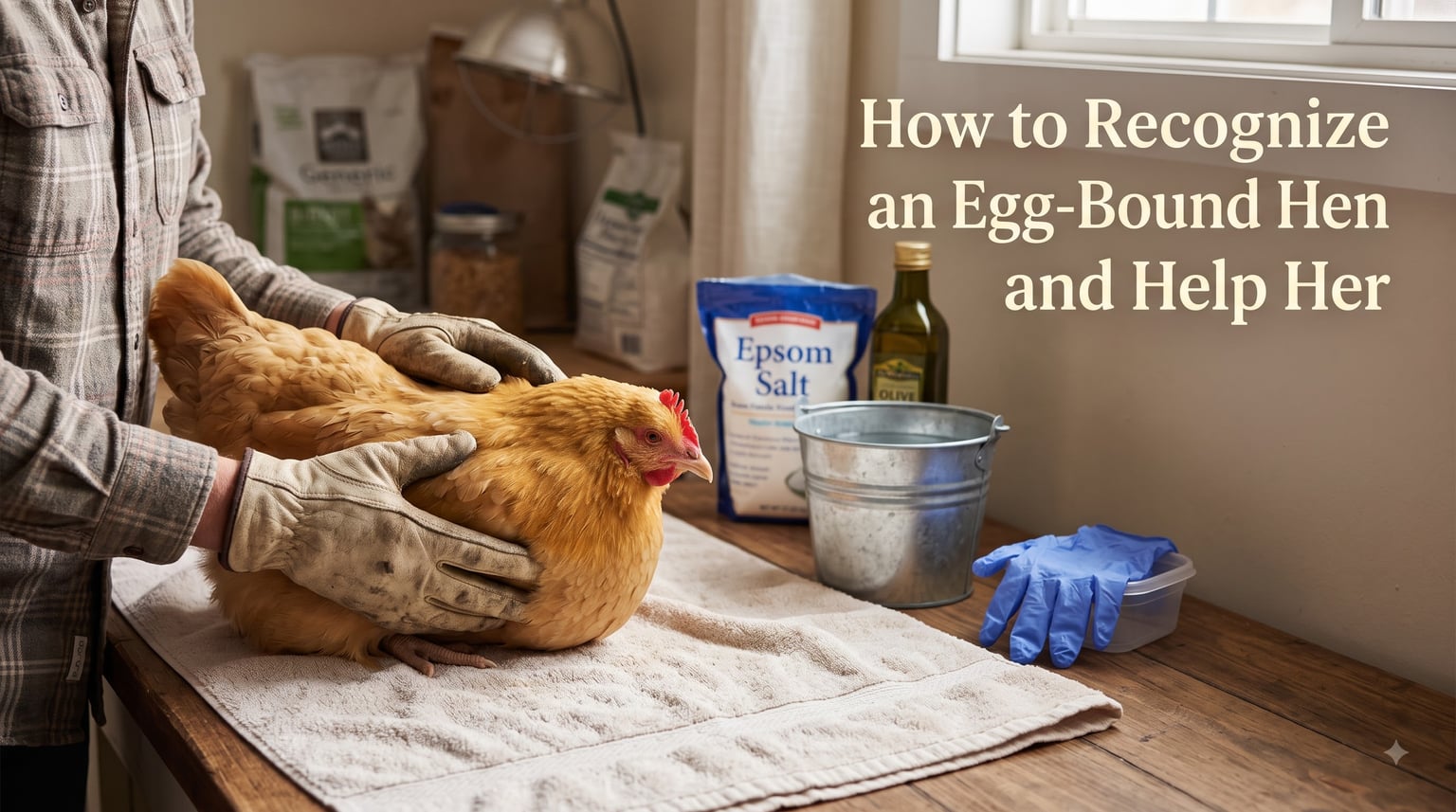
When a hen is egg-bound, she has an egg stuck in her oviduct that she cannot pass. This is a true emergency. Without intervention, an egg-bound hen can die within 24 to 48 hours from shock, infection, or pressure on her internal organs.
I have raised laying hens for years, and egg binding is the one condition that scares me the most because the window for action is so narrow. In this guide, I will walk you through exactly how to recognize an egg-bound hen, what to do in the first critical hours, and how to lower the odds it ever happens in your flock.
You will learn the full symptom checklist, a step-by-step Epsom salt bath routine, how to safely perform an internal exam, clear signs you need a vet, and the nutrition and management fixes that prevent egg binding long-term.
Table of Contents
What Is an Egg-Bound Hen?
An egg-bound hen is a laying hen whose reproductive tract is holding an egg she cannot pass. The egg can become stuck anywhere along the oviduct but most often lodges in the lower uterus, the shell gland, or just inside the cloaca, also called the vent.
Egg binding is also known as dystocia or oviduct impaction. It is not just an inconvenience; it is a life-threatening blockage. As the hen strains and cannot lay, the egg presses on nerves and blood vessels, toxins build up behind it, and the hen can go into shock.
Understanding the Reproductive Tract
An egg’s journey through a hen takes about 24 to 26 hours and passes through five main structures. The yolk is released in the infundibulum, then layers of albumen (the egg white) are added in the magnum. The isthmus adds the inner and outer shell membranes. The uterus, sometimes called the shell gland, lays down the calcium carbonate shell over about 20 hours. Finally, the egg passes through the cloaca and out the vent.
Egg binding happens when something interrupts this journey. Common interruptions include a weak shell gland, a too-large or oddly shaped egg, muscle fatigue, or low blood calcium. The hen’s contractions slow or stop, and the egg stays put.
Common Causes of Egg Binding
Egg binding rarely has a single cause. It is usually the result of one or more stressors hitting a hen at a vulnerable point in her laying cycle. Here are the triggers I watch for in my own flock.
Calcium deficiency: Without enough calcium, the hen’s muscles cannot contract properly to push the egg out.
Oversized or double-yolk eggs: Young pullets laying their first eggs often produce large or double-yolk eggs that can jam the oviduct.
Obesity: Overweight hens have fat deposits around the reproductive tract, making egg passage harder.
Genetics and breed: Production breeds like ISA Browns and heavy dual-purpose breeds such as Orpingtons and Cochins are over-represented in egg-binding cases.
Lack of exercise: Confined hens with little room to move are at higher risk.
Stress: Predator attacks, heat waves, and sudden coop changes can briefly halt laying and trigger binding.
Old age or reproductive exhaustion: Older hens and chronic layers sometimes lose muscle tone in the oviduct.
Symptoms of an Egg-Bound Chicken
Catching egg binding early is the single biggest predictor of survival. A hen that has been stuck for less than 12 hours has a strong chance of recovery with simple home treatment. After 24 hours, the odds drop sharply.
Physical Signs to Look For
Swollen, hot, or pulsing vent area: The cloaca often looks puffy and red.
Pale, shrunken comb and wattles: Loss of blood flow to the face is an early shock sign.
Penguin-like walk: A wide, waddling stance with a slightly upright body is a classic sign.
A bulging lower belly: You may feel or see a firm, rounded mass low on the abdomen.
Visible egg bulge near the vent: In late stages, you can sometimes see the outline of the egg pressing against the vent.
Watery droppings or foul-smelling diarrhea: Buildup behind the egg causes fluid and mucus to leak out.
Behavioral Changes That Signal Trouble
Lethargy and isolating herself: An egg-bound hen often retreats to a quiet corner and refuses to move.
Repeated straining: She may squat and push for many minutes, then give up.
Loss of appetite and thirst: A bound hen usually stops eating within hours.
Crop that does not empty: When a hen stops drinking, food sits in her crop undigested.
Fluffed feathers and closed eyes: This is the classic “sick hen” posture.
Tail bobbing or pumping: Repeated up-and-down tail motion with each breath.
Conditions That Mimic Egg Binding
Not every lethargic hen is egg-bound. A misdiagnosis wastes critical time. These conditions often look similar at first glance.
Broodiness: A broody hen sits, fluffs up, and refuses to leave the nest — but she is alert, still eating when bribed, and not straining.
Internal laying or egg yolk peritonitis: Yolk spills into the belly, causing a swollen abdomen and pale comb, but no egg in the oviduct.
Egg peritonitis and infection: Bacterial infection of the reproductive tract can mimic shock symptoms.
Impacted crop or sour crop: A blocked crop sits high on the chest and produces sour breath.
Vent gleet or pasty butt: Local infection around the vent can look similar but involves no internal egg.
If you feel no egg during an internal exam within 12 hours of symptom onset, suspect one of these conditions and call a vet.
Emergency Timeline and First Steps
Time matters. An egg-bound hen can survive about 24 to 48 hours without help before irreversible damage sets in. Once she stops eating and her comb turns pale, your window is roughly half that. Begin treatment the moment you suspect egg binding — do not wait until morning to “see if she improves.”
Here is the action checklist I run through the moment I suspect a hen is egg-bound.
Isolate the hen in a quiet, dim, warm space at roughly 80 to 85°F.
Bring a clean bucket, towel, Epsom salts, lukewarm water, and disposable gloves.
Prepare calcium — crushed calcium citrate or calcium-rich soft food.
Set a 30-minute timer for the first warm bath; do not exceed 45 minutes.
Note the time she last passed droppings or an egg to share with a vet if you call one.
How to Help an Egg-Bound Hen: Step-by-Step Treatment
The treatment that has worked best for my flock and the flocks described on backyard chicken forums is a layered approach: warm bath, lubrication, gentle exam, calcium support, and repeat observation. Work calmly and quietly. A stressed hen is harder to handle and more likely to go into shock.
Step 1: Set Up a Warm Epsom Salt Bath
Fill a clean bucket or small tub with lukewarm water about hip-deep on the hen. Test the temperature with your inner wrist — it should feel comfortably warm, not hot. Add about half a cup of Epsom salt per gallon and stir until dissolved. Epsom salt relaxes the oviduct muscles and reduces swelling around the vent.
Hold the hen securely with both hands around her wings and lower her gently into the water up to her vent. Most hens quiet down quickly. Soak for 20 to 30 minutes, keeping the water warm by adding small amounts of hot water as needed. Never leave her unattended — a panicked hen can drown in just a few inches of water.
Step 2: Dry and Lubricate the Vent
Lift her out and towel-dry her thoroughly, especially around the vent and belly. A damp hen chills fast and chill delays laying. Once dry, apply a generous dab of olive oil, coconut oil, or KY jelly around and just inside the vent opening. This reduces friction and softens the surrounding tissue. Many backyard keepers report success switching from Epsom salts to a plain olive oil soak when Epsom salts do not work.
Set her in a warm towel-lined box with a heat lamp or a warm water bottle wrapped in cloth.
Step 3: Perform a Gentle Internal Exam
Wash your hands, put on a disposable latex or nitrile glove, and lubricate your index finger. Hold the hen belly-up in your lap, supporting her back. Gently insert a lubricated finger about an inch into the vent.
You are feeling for a hard, rounded shape just inside the cloaca. If you feel it, you have confirmation. If you feel nothing within an inch, the egg is likely higher in the oviduct — do not push further or you risk rupturing the tract. In that case, repeat the bath and try again in an hour.
Never try to break the egg inside the hen unless it is a confirmed last resort, supervised by a vet. A broken egg can cause infection and scarring that ends her laying life.
Step 4: Offer Calcium and Hydration
Calcium drives the muscle contractions that push the egg out. Crush a calcium citrate tablet into a spoonful of yogurt, scrambled egg, or wet feed and offer it within 15 minutes of finishing the bath. If she refuses, dribble a small amount of unflavored calcium-fortified electrolyte solution along her beak using a syringe, never forcing it down her throat.
Hydration matters just as much. Offer cool water with electrolytes every 30 minutes. A dehydrated hen cannot mobilize calcium properly.
Step 5: Monitor and Repeat
Many hens pass the egg within 2 to 6 hours of the first bath. If no egg appears after the first bath and exam, wait 30 minutes in a warm recovery box, then repeat Steps 1 and 2. Up to three baths over 24 hours is reasonable for a stable hen.
If after 24 hours of careful home treatment she has not passed the egg, her comb has gone darker or purple, or she is breathing with her beak open, you are now in vet territory.
When to Call the Vet
Home treatment has a real ceiling. Move to a vet — ideally an avian vet or a livestock vet comfortable with chickens — if any of the following apply. Finding a chicken-friendly vet can be hard, so calling a horse vet is often a workable fallback; many horse vets have avian experience.
The egg has not passed after 24 hours of repeated home treatment.
The hen’s comb is dark purple, blue, or shrinking rapidly.
She is gasping, holding her wings out, or has cold legs.
You smell a foul, sulfurous odor — this suggests infection or a broken egg inside.
There is a prolapse (red tissue sticking out of the vent) along with the egg.
The egg is visibly cracked or leaking.
A vet can give a calcium injection that works within minutes, prescribe antibiotics if infection has set in, sedate the hen for safe egg removal, or in the worst case, perform a humane spay (salpingectomy) or euthanasia.
Recovery and Aftercare
Once the egg passes, your hen is not out of the woods. The oviduct is inflamed and exhausted, and she is at higher risk of re-binding for the next few weeks.
Keep her separated in a warm, dim space for 24 to 48 hours.
Continue offering calcium-rich soft food and electrolyte water daily.
Watch for re-binding, prolapse, or infection over the next 7 days.
A successful recovery takes 2 to 4 weeks before she resumes normal laying; some hens retire early after a bad binding episode.
If she lays again, expect a soft-shelled or shell-less first egg — that is normal and not a new binding episode.
How to Prevent Egg Binding in Your Flock?
Prevention is not just cheaper than treatment — it is the only real way to keep egg binding rare in your coop. The most reliable strategy combines nutrition, lighting, body condition, and breed awareness.
Calcium and Nutrition
Offer free-choice oyster shell in a separate dish from layer feed; hens self-regulate calcium intake when given the chance.
Feed a complete layer ration with at least 3.5 to 4% calcium.
Provide vitamin D3 — either via sunlight exposure or a D3 supplement — so calcium can be absorbed.
Avoid extra treats, scratch grains, and kitchen scraps when birds are in peak lay.
Limit dark leafy greens with oxalates (spinach, beet greens) — they bind calcium.
Lighting, Exercise, and Body Condition
Provide 14 to 16 hours of light per day during laying season; sudden drops in light can disrupt laying cycles.
Keep hens at a healthy body condition — you should feel the keel bone with a thin layer of fat over it, not a thick pad.
Encourage foraging and scratching with a run of at least 10 square feet per bird.
Reduce stress from predators, heat, and overcrowding — all known triggers of binding episodes.
For high-risk breeds, schedule a once-monthly vent and belly check during peak lay.
Frequently Asked Questions
How to relieve an egg-bound hen?
Start with a 20 to 30 minute warm Epsom salt bath to relax her oviduct, then dry her thoroughly and apply olive oil or KY jelly around the vent. Offer crushed calcium citrate mixed into soft food, and perform a gentle internal exam with a gloved finger to confirm the egg’s location. Repeat the bath up to three times in 24 hours, and call a vet if no egg has passed within that window or if her comb turns purple.
What can be mistaken for an egg-bound chicken?
Broodiness, internal laying or egg yolk peritonitis, impacted or sour crop, and vent gleet all look similar to egg binding at first glance. The fastest way to tell them apart is a gentle internal exam — if you cannot feel a hard egg inside the vent, suspect one of those other conditions. A brood hen is alert and still eats when bribed; an impacted crop sits high on the chest rather than low on the belly.
Can a chicken recover from being egg-bound?
Yes, and most hens do recover fully if treatment starts within the first 24 hours. After the egg passes, she needs 2 to 4 weeks of warmth, calcium support, and isolation before returning to normal laying. Hens that bound repeatedly, or that had a broken egg inside, often retire from laying early and may need a low-stress retirement coop.
How long can a hen survive being egg-bound?
Without any treatment, an egg-bound hen typically dies within 24 to 48 hours from shock, infection, or pressure damage to her organs. Once she stops eating and her comb goes pale, the realistic survival window drops to under 12 hours. Prompt home treatment extends that window significantly, but veterinary care is still the safest option whenever it is available.
Final Thoughts on Caring for an Egg-Bound Hen
An egg-bound hen is one of the most stressful emergencies a backyard keeper can face. The good news is that quick action, a calm warm bath, generous lubrication, and plenty of calcium resolve most cases within hours. The hard truth is that some hens do not recover even with the best care, and that is part of keeping chickens honestly.
Your three best tools are observation, preparation, and prevention. Know the symptoms by heart. Keep Epsom salts, calcium citrate, and olive oil in your coop kit before you need them. And run your flock on a solid layer diet with free-choice oyster shell, plenty of light, and enough room to roam.
The more calmly and quickly you respond to a hen that is egg-bound, the better her odds — and yours — of getting her back to the flock.