
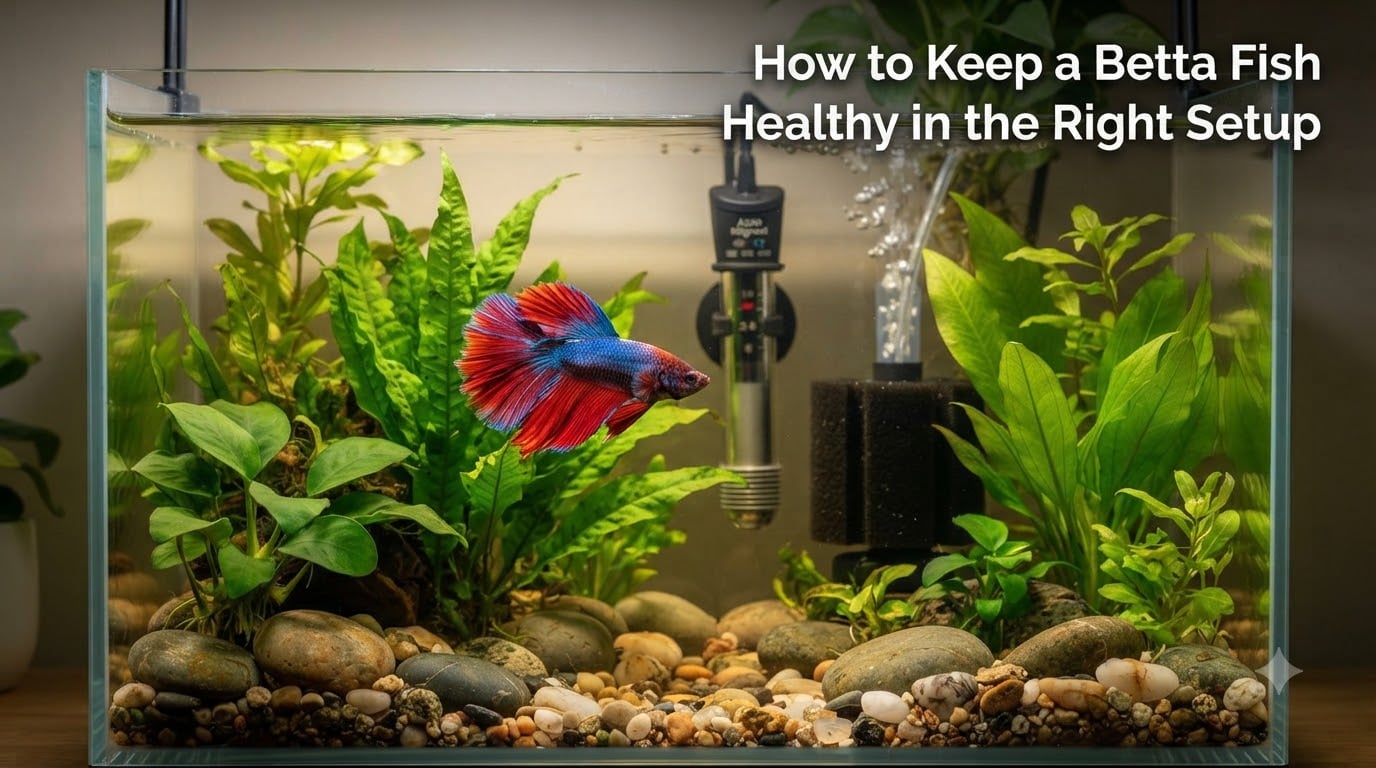
Betta fish are one of the most popular freshwater pets in the world, but most new owners get the basics wrong. Pet stores sell them in tiny cups, marketing them as low-maintenance bowl fish that need almost nothing to survive. The reality is very different. Learning how to keep a betta fish healthy in the right setup means understanding their biology, their tropical water needs, and the specific conditions that help them thrive rather than just survive.
I have kept bettas for over a decade, and the difference between a fish in a heated, filtered 10-gallon tank and one in an unheated bowl is staggering. A properly cared-for betta can live 3 to 5 years. The same fish stuck in a half-gallon bowl without a heater or filter typically lasts 18 months to 2 years at most. That is not opinion — it is what experienced hobbyists across r/bettafish, FishLore, and TFH Magazine have documented over and over.
This guide covers everything from the science of the labyrinth organ to exact feeding schedules, water change routines, and disease warning signs. Whether you are setting up your first tank or fixing a setup that is not working, you will find clear, actionable steps here. Every recommendation comes from real aquarium care practices that experienced keepers rely on every day.
Table of Contents
Understanding Betta Fish: The Labyrinth Organ
Betta fish (Betta splendens) are tropical labyrinth fish native to the shallow, warm waters of Southeast Asia. What sets them apart from most aquarium fish is a specialized breathing structure called the labyrinth organ. This organ sits just above their gills and lets them gulp air directly from the water’s surface.
In the wild, bettas live in rice paddies, slow streams, and flood plains where water is warm but often low in dissolved oxygen. The labyrinth organ evolved as a survival tool for these oxygen-poor waters. It lets bettas breathe atmospheric air when their gills alone cannot pull enough oxygen from the water around them.
This is exactly why bettas can survive in small bowls and cups. Survive is the key word, not thrive. Just because a betta can gulp air from the surface does not mean it is healthy in stagnant, unheated, unfiltered water. The labyrinth organ is a backup system, not a replacement for clean, oxygenated, warm water.
Because bettas must surface to breathe, tank depth matters less than surface area. A betta in a very tall, narrow tank has to swim a long way for every breath. That said, standard aquarium depths of 12 to 18 inches are perfectly fine. What really matters is having enough horizontal swimming space and easy access to the surface.
Bettas are also strictly carnivorous. In the wild they hunt insects and insect larvae at the water’s surface. This matters for feeding — more on that later — but it also tells us something about their energy needs. They are active hunters when healthy, not sedentary decoration.
How to Keep a Betta Fish Healthy: Tank Size Requirements
The single most damaging myth in the aquarium hobby is that bettas belong in small bowls. Let me be direct: the minimum tank size for a healthy betta is 5 gallons, and 10 gallons is what I recommend to anyone who will listen.
Here is why tank size matters so much. Small volumes of water are chemically unstable. In a 1-gallon bowl, ammonia from fish waste spikes within hours. In a 10-gallon tank, that same waste is diluted across a much larger volume, giving your filter time to process it before it reaches toxic levels. Stability is the foundation of fish health.
Temperature stability works the same way. Small bowls heat up and cool down rapidly with room temperature changes. A larger tank holds thermal mass, meaning the water stays closer to your target temperature even when the room shifts. Every degree of temperature swing stresses your fish’s immune system.
Do betta fish like shallow or deep tanks? They prefer long, shallow tanks over tall, narrow ones. A 20-gallon long tank gives a betta far more usable territory than a 20-gallon tall tank. The standard 5-gallon and 10-gallon aquariums sold at most pet stores work well because they are already proportioned correctly.
The lifespan difference tells the whole story. Experienced keepers report bettas living 3 to 5 years in properly sized, heated, filtered tanks. Bettas kept in unheated bowls typically live 1 to 2 years. The tank size is not about giving your fish a mansion — it is about giving the water enough volume to stay clean and stable.
Temperature and Water Conditions
Betta fish are tropical fish. They need water between 78 and 80 degrees Fahrenheit to be healthy. This is not optional, and it is the number one thing I see new owners get wrong.
Without a heater, most room-temperature water sits around 68 to 72 degrees. At those temperatures, a betta’s metabolism slows dramatically. Their digestion becomes sluggish, their immune system weakens, and they become lethargic. Cold water bettas are more susceptible to fin rot, Ich, and velvet disease because their bodies cannot fight off pathogens effectively.
A small submersible aquarium heater with a built-in thermostat is essential. For a 5-gallon tank, a 25-watt heater is usually sufficient. For a 10-gallon tank, look at 50-watt models. The key is consistent temperature — fluctuations of more than 2 degrees in a day cause measurable stress.
Water chemistry matters too. Betta fish do best at a pH between 6.5 and 7.5, which covers most tap water. What matters more than hitting an exact number is keeping the pH stable. Test your tap water before setting up the tank, and avoid products that promise to rapidly change pH unless you know exactly what you are doing.
The metabolic effects of temperature are real and well-documented. At proper tropical temperatures, a betta digests food efficiently, maintains vibrant coloration, heals quickly from minor injuries, and shows active hunting and exploring behavior. Below 74 degrees, all of these processes slow down. A betta in cold water is essentially in a state of low-grade metabolic stress at all times.
Filtration: Gentle Flow Is Essential
Betta fish need filtration, but they need the right kind. Their long, flowing fins make them poor swimmers in strong currents. A filter that creates a rushing flow across the tank will exhaust your betta, damage their fins, and stress them constantly.
The best filter for a betta tank is a sponge filter. It runs on an air pump, provides gentle water movement, and offers massive surface area for beneficial bacteria. Sponge filters are cheap, reliable, and nearly silent. For a 5 to 10-gallon betta tank, they are hard to beat.
If you prefer a hang-on-back filter, look for one with an adjustable flow rate. Turn it down to the lowest setting. You can also baffle the output by placing a sponge or a plastic water bottle modification over the return spout to spread and slow the water. Many keepers do this successfully.
Bio-wheel filters and trickle-style filters also work well because they provide excellent biological filtration with moderate flow. The key with any filter is watching your betta’s behavior. If your fish is being pushed around the tank or hiding constantly near the bottom, the current is too strong.
The real reason filtration matters is the nitrogen cycle. Your filter houses beneficial bacteria that convert toxic ammonia from fish waste into nitrite, then into much less harmful nitrate. Without a cycled filter, ammonia builds up rapidly and poisons your fish. A filter is not just about water clarity — it is the biological engine that keeps your betta alive long-term.
Step-by-Step: Setting Up Your Betta Tank
Setting up a betta tank properly takes a little patience, but getting it right from the start saves you from sick fish and frustrating problems later. Here is the process I use every time.
Step 1: Choose your tank. Get a 5-gallon tank at minimum, 10 gallons if you have the space. Avoid bowls, vases, and anything under 5 gallons regardless of what the pet store tells you.
Step 2: Add substrate and decor before water. Use 1 to 2 inches of aquarium gravel or sand. Add live or silk plants — never plastic plants with sharp edges, as they tear betta fins. Include at least two hiding spots like caves or dense plant clusters.
Step 3: Fill and dechlorinate. Add room-temperature water treated with a water conditioner that removes chlorine and chloramine. Never use untreated tap water — chlorine kills the beneficial bacteria your tank needs.
Step 4: Install the heater and filter. Place the heater near the filter output for even heat distribution. Set it to 78 to 80 degrees. Start the filter running immediately.
Step 5: Cycle the tank before adding your betta. This is the step most people skip. Tank cycling means building up that colony of beneficial bacteria in your filter. Add a pure ammonia source or use fish food to start the process, and test your water daily. The cycle is complete when your test shows zero ammonia and zero nitrite with some detectable nitrate. This typically takes 2 to 6 weeks.
You can speed this up by using bottled bacteria products or filter media from an established tank. But do not rush it by adding your fish before the cycle is done — that is how new bettas get sick in their first week.
What NOT to put in a betta tank: sharp plastic plants, jagged rocks, painted gravel with flaking coating, mirrored decor that causes constant flaring, and any container too small to maintain stable conditions. Also avoid strong air stones that create heavy surface turbulence, since bettas need calm surface access to breathe.
Feeding Your Betta Fish
Betta fish are carnivores, and their diet needs to reflect that. In the wild they eat insects and larvae. In captivity, they need protein-rich foods — not the generic tropical flakes that many owners default to.
A feeding routine that experienced keepers recommend looks like this: feed a high-quality betta formula like Bug Bites or New Life Spectrum Betta pellets five days a week. Offer frozen bloodworms, brine shrimp, or daphnia once a week as a treat. Fast your betta one day per week to support healthy digestion and prevent bloating.
Feed only what your betta can eat in about 2 minutes. For most adult bettas, that is 2 to 4 pellets per feeding, once or twice a day. Overfeeding is one of the most common causes of health problems in bettas. Uneaten food decays and spikes ammonia, and bettas will eat themselves sick if given the chance.
Live foods like daphnia and brine shrimp are excellent for variety and stimulation. Frozen foods are nearly as nutritious and far more convenient. Freeze-dried bloodworms are popular but should be soaked before feeding to prevent digestive issues. Rotate your foods to provide nutritional variety.
A well-fed betta has a clean body line — no bloated belly, no sunken stomach. If your betta’s belly looks swollen after feeding, you are giving too much at once. Cut back the portion, not the frequency.
Signs of a Healthy vs Unhealthy Betta
One of the most valuable skills you can develop is recognizing the difference between a healthy betta and one that needs help. Here is what to look for.
Signs of a healthy betta: Active swimming and exploring, especially at feeding time. Vibrant, consistent coloration. Fins held open and flowing, not clamped tight against the body. Strong appetite — your betta should react when you approach the tank. Regular surfacing to breathe, but not constant gasping. Flaring at their reflection occasionally, which is normal territorial behavior.
Signs of an unhealthy betta: Clamped fins held against the body. Lethargy — sitting at the bottom or floating listlessly for long periods. Faded or patchy coloration. Loss of appetite. Visible damage to fins. White spots on the body or fins. A cotton-like or velvety coating on the skin. Rapid gill movement or gasping at the surface constantly.
Three diseases account for most betta health problems. Fin rot shows as fins that look ragged, melting, or shrinking with black or red edges. It is usually caused by poor water quality. Ich appears as tiny white spots resembling salt grains on the body and fins. Velvet disease creates a gold or rust-colored dusty coating that is easiest to see under a flashlight in a dark room.
All three are treatable, but all three are preventable with clean, warm, stable water. Stress is the trigger — a betta living at the wrong temperature or in dirty water has a depressed immune system that lets these pathogens take hold.
One note on normal behavior: it is completely normal for a betta to rest on leaves or near the bottom between active periods. Bettas are not constantly in motion. The concern is when resting becomes all they do.
Water Quality Maintenance
Even with a cycled filter, you still need to perform regular water changes. The standard practice is a 25 to 30% water change once a week. This removes accumulated nitrates and replenishes minerals without disrupting the bacterial colony in your filter.
Always treat new water with a dechlorinator before adding it to the tank. Match the temperature of the new water to the tank water as closely as possible to avoid thermal shock. Gravel vacuums let you clean waste from the substrate during water changes.
Test your water regularly with a liquid test kit. You want to see zero ammonia, zero nitrite, and nitrates below 20 ppm. If ammonia or nitrite shows up in a cycled tank, something has disrupted your biological filter — usually from cleaning the filter media in tap water, which kills the bacteria. Always rinse filter media in old tank water during a water change, never under the tap.
Tank Mates and Social Behavior
Male bettas are territorial and solitary by nature. A single male betta in his own well-maintained tank is perfectly happy and not lonely. The idea that fish need companions is human projection, not betta biology.
If you want a community tank, a 10-gallon or larger setup can work with carefully chosen tank mates. Good options include snails like nerites or mysteries, peaceful shrimp like cherry shrimp, and small non-nippy fish such as ember tetras or corydoras catfish. Avoid fin-nipping species like tiger barbs and any fish with long, colorful fins that might trigger aggression.
Female bettas can be kept together in what is called a sorority, but this requires a larger tank — 20 gallons minimum — with heavy plant cover and at least 5 females to spread out aggression. Sororities are an advanced setup and not recommended for beginners.
Never keep two male bettas together. They will fight, often to the death. The flaring you see when a betta spots his reflection is territorial display behavior, not play.
Tannins, Indian Almond Leaves, and Natural Enrichment
One trend in betta care that has solid science behind it is the use of tannins. Tannins are natural compounds released by certain woods, leaves, and seed pods that tint the water a light tea color. In the wild, bettas live in tannin-stained blackwater habitats.
Indian almond leaves, also called catappa leaves, are the most popular way to add tannins to a betta tank. They release humic and tannic acids that mildly lower pH, have mild antibacterial and antifungal properties, and create an environment closer to what bettas evolved in. Many experienced keepers keep a leaf or two in the tank at all times.
Live plants do double duty as enrichment and water quality support. Plants like Java fern, Anubias, and floating Salvinia give your betta places to explore, rest near the surface, and establish territory. A bare tank is a bored betta. Add structure, add cover, and you will see more natural, active behavior.
Common Mistakes to Avoid
After helping countless new betta owners troubleshoot their setups, the same mistakes come up over and over. Here are the ones that cause the most damage.
Keeping a betta in a bowl or vase. This is the number one killer of bettas. Bowls cannot hold stable temperature or water chemistry, cannot support a proper filter, and cannot house the bacteria needed to process waste. No bowl, no vase, no matter how decorative.
Skipping the nitrogen cycle. Adding a betta to an uncycled tank means the fish is swimming in its own ammonia from day one. This causes what the hobby calls New Tank Syndrome — fish that get sick or die within the first few weeks. Cycle first, fish second.
Using a strong filter. Bettas cannot handle strong currents. If your fish is getting pushed around or hiding near the bottom, the filter flow needs to be reduced or baffled.
Overfeeding. More food does not mean a healthier fish. Overfeeding causes bloating, digestive problems, and ammonia spikes from decaying waste. Stick to small portions.
Skipping the heater. Room temperature is not warm enough for a tropical fish. Every betta tank needs a heater set to 78 to 80 degrees.
Using sharp decor. Plastic plants with rigid edges, rough rocks, and sharp ornaments tear betta fins, opening the door to infection. Use silk plants or live plants instead.
Frequently Asked Questions
How to set up a healthy betta tank?
Start with a minimum 5-gallon tank, add 1 to 2 inches of aquarium substrate, and include silk or live plants plus hiding spots. Install a gentle sponge filter and a submersible heater set to 78 to 80 degrees Fahrenheit. Fill with dechlorinated water, then cycle the tank for 2 to 6 weeks until ammonia and nitrite read zero. Only add your betta after the cycle is complete.
What not to put in a betta tank?
Avoid sharp plastic plants that can tear fins, jagged or rough rocks, painted gravel with flaking coating, mirrored decor that causes constant stress flaring, and any tank under 5 gallons. Also avoid strong air stones that create heavy surface turbulence, since bettas need calm water at the surface to breathe through their labyrinth organ.
What makes betta fish the happiest?
Betta fish are happiest in a heated, filtered tank of at least 5 gallons with stable water between 78 and 80 degrees Fahrenheit. They thrive with live or silk plants for cover and resting spots near the surface, a protein-rich diet fed in small portions, gentle water flow, and clean water maintained through weekly 25 to 30 percent water changes.
Do betta fish like shallow or deep tanks?
Betta fish prefer long, shallow tanks over tall, narrow ones because they need easy access to the surface to breathe air through their labyrinth organ. Standard 5-gallon and 10-gallon aquariums work well because they are already proportioned for this. Avoid very tall tanks that force the fish to swim long vertical distances for every breath.
Conclusion
Knowing how to keep a betta fish healthy in the right setup comes down to respecting what these fish actually need rather than what pet store marketing claims. A 5-gallon or larger tank, a heater holding 78 to 80 degrees, a gentle filter supporting a cycled biological system, and a protein-rich diet fed in moderation — these are the non-negotiables.
When you get these fundamentals right, your betta will show it. Active behavior, vibrant color, flowing fins, and a strong appetite are the rewards of proper care. A betta given this kind of setup can live 3 to 5 years, compared to 1 to 2 years in a neglected bowl.
Start with the tank size, get your temperature stable, cycle the filter before adding fish, and maintain weekly water changes. Everything else builds on that foundation. Your betta is counting on you to get the setup right — and now you know how.