
If your rabbit just stopped eating, stop scrolling and read this page carefully. Rabbit GI stasis kills rabbits within 24 hours when it goes untreated, and the first 12 hours are the window where at-home care can actually save your rabbit’s life.
I have watched rabbit owners on r/Rabbits lose their pets because they waited “just one more morning” to see if the bunny would eat. I have also seen rabbits bounce back fully because their owner recognized the warning signs at hour two and started a simple at-home protocol. The difference between those two outcomes is what this guide is about.
This is a complete hour-by-hour action plan for the first 12 hours of suspected GI stasis. You will learn the exact symptoms to watch for, the safe at-home treatments that work (simethicone dosage by weight, tummy massage, syringe feeding Critical Care), what to put in a stasis emergency kit before this ever happens, and the clear red flags that mean you stop home treatment and rush to the emergency vet.
One critical rule before we begin: a rabbit that has not eaten or produced feces for 12 hours is in an emergency. If your rabbit is already past that mark, call an exotic vet right now. The at-home steps below run alongside veterinary care, not instead of it.
Table of Contents
What Is GI Stasis in Rabbits and Why It Is a True Emergency
Rabbit GI stasis (also called ileus) is when the normal muscle contractions of a rabbit’s digestive tract slow down or stop completely. Those contractions, called peristalsis, are what move food, liquid, and gas through the gut. When peristalsis shuts down, everything inside the rabbit stops moving.
Unlike humans and dogs, rabbits cannot vomit. There is no physical sphincter that allows it. So when food, hair, and gas back up in the stomach and intestines, there is no relief valve. Gas builds, the gut distends, pain increases, and the rabbit stops eating even more which slows the gut further. This is the dangerous feedback loop that makes stasis spiral fast.
Left untreated, the slowdown lets harmful bacteria (especially Clostridium species) multiply in the cecum. Those bacteria produce gas and toxins that can damage the liver, kidneys, and other organs. The rabbit goes into shock. The House Rabbit Society and virtually every exotic veterinarian agree: GI stasis is fatal within 24 hours if untreated.
The 12-hour rule exists because early intervention almost always reverses stasis before the bacterial overgrowth and organ damage set in. Past 12 hours, you are fighting a medical crisis that often needs prescription motility drugs, pain medication, subcutaneous fluids, and sometimes hospitalization.
So treat any rabbit that has stopped eating and pooping as a ticking clock. The clock resets when normal appetite and fecal output return, not when the rabbit “looks a little better.”
The 12-Hour Warning Rule: When a Rabbit Not Eating Becomes an Emergency
Rabbits are grazers. A healthy rabbit eats almost continuously, producing 200 to 300 fecal pellets per day. That constant throughput is what keeps the gut moving. Any break in that pattern is a red flag.
Here is the rule I want every rabbit owner to memorize: if your rabbit has not eaten anything for 12 hours, or has produced no feces for 12 hours, you are in an emergency. Not “wait and see.” Not “try a carrot.” Emergency.
The window is tighter than many people think. Rabbit advocates and exotic vets commonly reference a related concept sometimes called the 3-3-3 rule: 3 hours of not eating is unusual, 3 hours of not pooping plus not eating is a warning, and anything stretching toward 12 hours without food or feces is a true emergency. The exact numbers vary by source, but the message is consistent: do not wait.
Many owners tell the same heartbreaking story on rabbit forums. They noticed their rabbit was off its food in the morning, decided to “watch it through the day,” went to bed, and found the rabbit collapsed or gone by morning. The 12-hour clock started the moment food intake dropped, not the moment they noticed.
The other trap is partial stasis. A rabbit that eats a little, produces a few tiny or misshapen poops, or only eats treats but refuses hay is already in early stasis. Do not let the fact that the rabbit ate one raisin convince you everything is fine. Small, dark, or linked fecal pellets signal the gut is already slowing.
Early Signs of GI Stasis: Symptoms You Cannot Afford to Miss
GI stasis rarely announces itself with a single dramatic symptom. It shows up as a cluster of small changes that, taken together, tell you the gut is slowing down. Here is the full checklist I run through any time one of my rabbits looks “off.”
Appetite changes: Refusing hay, ignoring favorite greens, or only accepting sugary treats. A rabbit that turns down a banana slice is a rabbit in trouble.
Fecal changes: No feces at all, small hard fecal pellets, feces strung together with hair (a “poop necklace”), or mucus-covered poops. Any of these is a warning sign.
Posture and body language: A hunched, tense posture with the rabbit pressing its belly to the floor. The rabbit may sit in a corner and refuse to move when approached.
Teeth grinding: Loud, slow tooth grinding (bruxism) is a rabbit pain signal. Soft purring-style grinding is contentment; loud crunching grinding is pain.
Lethargy: The rabbit does not greet you, does not explore, and does not react to sounds that normally get attention. A normally active rabbit that sits still for an hour is cause for concern.
Bloating and gurgling: A visibly rounded or firm belly. You may hear loud gurgling, or you may hear absolutely nothing when the gut should be active.
Dehydration signals: Skin tenting when you pinch the scruff, sunken eyes, or dark concentrated urine. Dehydration makes stasis worse because the gut needs water to move contents along.
Cecotrope issues: Uneaten cecotropes stuck to the rabbit’s bottom, or the rabbit producing none at all. The cecum is part of the digestive tract, and cecal shutdown often precedes full stasis.
Temperature drop: A rabbit with ears that feel cold to the touch may be going into shock. Normal rabbit body temperature is 101 to 103 degrees Fahrenheit. Below 100 degrees is a vet emergency.
Any one of these in isolation is worth watching. Two or more together, especially appetite loss plus reduced feces, means start the at-home protocol below and call the vet.
Your 12-Hour At-Home Action Plan: Hour by Hour
This is the section I wish every rabbit owner had bookmarked before they needed it. No major competitor publishes a true hour-by-hour timeline, which is exactly why I built one. Print this, save it, keep it near the cage.
Hour 0 to 1: Confirm and Stabilize
The moment you suspect stasis, confirm it. Offer a favorite treat (a small piece of banana, a pellet of dry food, a fragrant herb like cilantro). If the rabbit refuses, assume stasis and start the clock.
Get the rabbit warm. Cold rabbits have slower guts. Place the rabbit on a heating pad set to low, with a towel between the pad and the rabbit, and let the rabbit move off if it wants. Do not overheat. Check ear temperature every 15 minutes.
Call your exotic vet to give them a heads-up that you may be coming in. Even if you plan to treat at home, the vet needs to know. If it is a weekend or holiday, locate the nearest emergency exotic vet now, not later.
Hour 1 to 3: Attack the Gas
Gas pain is what makes a stasis rabbit stop eating, which makes the stasis worse. Breaking that loop is the priority. Give liquid infant simethicone (baby gas drops, 20 mg per 0.3 mL concentration) by mouth.
Standard dosing: 1 mL (about 20 mg of simethicone) every hour for the first three hours, then 1 mL every three to six hours as long as symptoms last. Simethicone is safe and cannot be overdosed in practice, which is why rabbit rescues universally recommend it.
Start gentle tummy massage. Lay the rabbit in your lap on a towel, ears toward you, and use flat fingers to stroke firmly but gently from the bottom of the ribs down toward the tail. Two to three minutes at a time, several times per hour. You will often feel gas bubbles pop and move.
Encourage movement. A rabbit that walks or hops gets its gut moving. Set the rabbit in a small safe area and gently encourage exploration. Even a few minutes of activity helps.
Hour 3 to 6: Start Nutritional Support
If the rabbit has not started eating on its own by hour three, you must start syringe feeding. A rabbit with an empty gut is a rabbit whose gut bacteria are starving, which makes stasis worse.
Mix Oxbow Critical Care (or a similar herbivore recovery food) with warm water to a pancake-batter consistency. Draw it into a 1 mL or 3 mL oral syringe. Wrap the rabbit in a “bunny burrito” (a towel wrapped snugly around the body, leaving the head free) to limit kicking.
Place the syringe tip in the corner of the mouth, behind the incisors, and squeeze a small amount at a time. Wait for the rabbit to chew and swallow before giving more. Never shoot food into the back of the throat; aspiration can kill a rabbit faster than stasis.
Aim for 10 to 15 mL of mixed Critical Care per kilogram of rabbit body weight, spread across several small feedings in this window. Stop immediately if the rabbit coughs, gags, or resists violently.
Continue simethicone on the every-three-to-six-hour schedule. Continue massage and gentle exercise. Check the litter box for new feces.
Hour 6 to 12: Assess and Decide
By hour six you should see signs of improvement: the rabbit is more alert, the belly feels softer, ear temperature is normal, and you may see a few small fecal pellets. If yes, continue the protocol. If the rabbit is starting to nibble hay on its own, you are winning.
If there is no improvement by hour six, or if symptoms are worse (more lethargic, belly more distended, ears cold, still no feces), stop home treatment and go to the vet. The rabbit likely needs prescription motility drugs like metoclopramide (Reglan) or cisapride, pain medication like meloxicam or Banamine, and subcutaneous fluids.
If symptoms are stable but not improving, call the vet and describe what you have done. Many exotic vets will advise you to continue home care through hour 12 and reassess, but only they can make that call.
At hour 12, the rule is firm. If the rabbit has still not eaten voluntarily and produced feces, you need veterinary intervention. Stasis past 12 hours untreated becomes a medical crisis with mortality rates that climb fast.
Building Your Rabbit Stasis Emergency Kit
The most common thing I read on rabbit forums after a stasis scare is “I wish I had this stuff ready before it happened.” Stasis usually strikes on weekends, holidays, and late at night when stores are closed. Build the kit now.
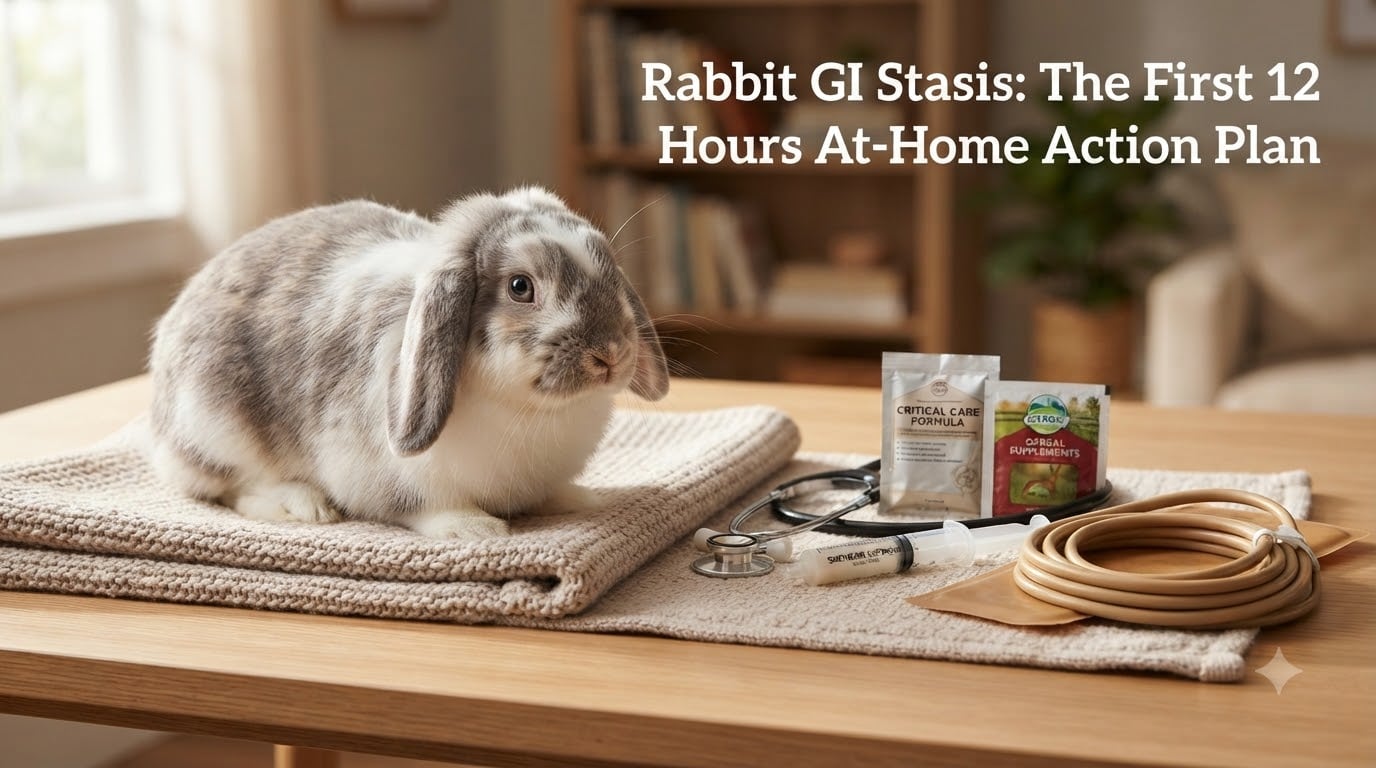
The essentials: Liquid infant simethicone (gas drops, 20 mg per 0.3 mL brand such as Mylicon), a package of Oxbow Critical Care (apple-banana or papaya flavor), several 1 mL and 3 mL oral syringes, a digital kitchen scale to track weight, a digital thermometer for rectal use, a low-setting heating pad, soft towels for bunny burritos, and a syringe or two of plain oral rehydration solution (unflavored Pedialyte works in a pinch).
Vet-supplied items to ask about: Many rabbit-savvy vets will send you home with a small supply of meloxicam (for pain) and metoclopramide (for gut motility) if you have a relationship with them. These should only be used under veterinary instruction, but having them on hand can save hours when stasis strikes at 2 AM.
Contact list: Your regular exotic vet’s number, the nearest 24-hour emergency exotic vet, and a backup exotic vet in another town. Program all three into your phone now.
Check the kit every six months. Replace Critical Care by its expiration date. Test your heating pad. Replace syringes if the rubber plungers have stiffened. Five minutes of maintenance twice a year can save your rabbit’s life.
Safe At-Home Treatments: Simethicone Dosage, Massage, and Force Feeding
Three at-home treatments do the heavy lifting in the first 12 hours: simethicone for gas, massage for motility, and syringe feeding for nutrition. Each has a right way and a wrong way. Here is the right way.
Simethicone Dosage by Rabbit Weight
Use liquid infant simethicone drops at the standard 20 mg per 0.3 mL concentration. The dosing below is the widely accepted rabbit rescue protocol. Simethicone physically breaks gas bubbles; it is not absorbed into the bloodstream, which is what makes it safe.
Small rabbits (under 2 kg / 4.4 lb): 0.5 mL per dose
Medium rabbits (2 to 4 kg / 4.4 to 8.8 lb): 1 mL per dose
Large rabbits (over 4 kg / 8.8 lb): 1.5 mL per dose
For the first three hours of treatment, give a dose every hour. After that, dose every three to six hours until the rabbit is eating and pooping normally and the belly feels soft. You can safely continue simethicone for 24 to 48 hours.
Tummy Massage Technique
Wrap the rabbit in a towel if it is squirmy. Sit with the rabbit on your lap, head facing your non-dominant hand. Use the flat pads of three or four fingers of your dominant hand.
Start just behind the ribs on the left side of the belly. Press gently but firmly downward and stroke toward the rabbit’s hindquarters in a slow, deep motion. Repeat on the right side. Two to three minutes of stroking, then pause and let the rabbit relax.
You will often feel or hear gas bubbles pop and shift. That is good. Stop immediately if the rabbit flinches, kicks hard, grinds its teeth loudly, or tries to bite. Pain during massage can mean a more serious blockage and you should call the vet.
Repeat massage every hour during the active treatment phase. Several short sessions beat one long one. Rabbits tolerate this well when they are wrapped and warm.
Force Feeding (Syringe Feeding) Critical Care
Use Oxbow Critical Care or an equivalent herbivore critical nutrition formula. Avoid grain-based or dog-and-cat recovery foods; rabbits need fiber, not starch. Mix one part powder to two parts warm water, stir to a smooth pancake-batter consistency, and let it sit for a minute to thicken.
Load a 1 mL syringe for small rabbits or a 3 mL syringe for larger ones. Wrap the rabbit in the bunny burrito. Slide the syringe tip into the side of the mouth, behind the incisors, pointing toward the back teeth (not straight down the throat). Deliver 0.5 mL at a time and wait for chewing and swallowing.
Target volume is roughly 10 to 15 mL of mixed formula per kilogram of body weight, divided across multiple feedings every four to six hours. A 2 kg rabbit should get roughly 20 to 30 mL over the course of an hour, in small amounts.
If you do not have Critical Care, you can soak your rabbit’s regular plain timothy pellets in warm water until they are mushy and syringe-feed that slurry. It is less ideal but works in a pinch.
Hydration Support
Dehydration makes stasis worse. Offer water from a bowl (rabbits drink more from bowls than bottles), offer unsweetened herbal teas like chamomile or fennel to encourage drinking, and offer water-rich vegetables like cucumber or romaine if the rabbit will eat.
If the rabbit will not drink, you can gently syringe small amounts (1 to 2 mL at a time) of water or unflavored oral rehydration solution into the side of the mouth using the same technique as Critical Care. Do not force large volumes.
When to Rush to the Emergency Vet (Stop Home Treatment)
Some symptoms mean home care is no longer enough. If you see any of the following, go to an exotic vet or emergency clinic immediately.
The rabbit has not eaten or produced any feces for 12 hours.
The rabbit is limp, unresponsive, or unable to stand.
Body temperature is below 100 degrees Fahrenheit.
The belly is visibly distended and feels hard or tight.
The rabbit is grinding its teeth loudly and continuously (severe pain).
There is diarrhea, especially with blood or foul-smelling mucus.
The rabbit is breathing rapidly or with open mouth (a true emergency).
Symptoms are getting worse despite two to three hours of home treatment.
When you call the vet, tell them exactly how long since the rabbit last ate, when it last produced feces, what you have given (simethicone dose, Critical Care amount), and the rabbit’s current temperature if you can take it. That information lets them triage faster.
The weekend and holiday problem is real. Vets that handle rabbits are often closed when stasis strikes. Find your nearest 24-hour emergency clinic that sees exotics now, before you need it. Not all emergency clinics treat rabbits; confirm ahead of time.
Recovery Timeline: How Long Until Your Rabbit Is Out of the Woods
With early at-home treatment started in the first few hours, many rabbits bounce back within 24 to 48 hours. You will see improvement in stages rather than all at once.
The first good sign is usually more alertness and warmer ears within a few hours of starting simethicone and massage. Next, you may see a few small fecal pellets, often strung together or smaller than usual. Then appetite returns, usually for favorite foods first.
Full recovery to normal hay intake and normal fecal output can take anywhere from one day to a week. Keep up supportive care (simethicone, hydration, encouraging hay) until the rabbit has produced normal feces for 24 straight hours.
Watch for relapse. A rabbit that recovers, then stops eating again within a few days, often has an underlying cause that was never addressed: dental disease, a urinary tract infection, an abscess, or chronic dehydration. A post-stasis vet check is always worth it, even if home treatment worked.
Signs it is getting worse instead of better: the rabbit becomes more lethargic, the belly gets more distended, fecal output stops again, or the rabbit goes back to loud tooth grinding. Any of these means back to the vet.
Preventing the Next Episode: Diet and Stress Management
Stasis is almost always a symptom of something else. Fix the root cause and the rabbit is far less likely to repeat the cycle.
Hay first, always: At least 80 percent of a rabbit’s diet should be grass hay (timothy, orchard, or brome). Unlimited, available 24 hours a day. Pellets should be limited to about 1/4 cup per 2.5 kg of rabbit per day. Greens and a small amount of fruit round it out.
Water: Offer water in a heavy bowl, not just a bottle. Rabbits drink significantly more from bowls, and dehydration is a primary stasis trigger.
Exercise: A rabbit that does not move enough has a sluggish gut. Several hours of out-of-cage time daily, in a safe rabbit-proofed area.
Grooming during shed: Rabbits cannot vomit hairballs, so during heavy sheds they ingest large amounts of fur. Brush daily during a molt to reduce swallowed hair.
Stress reduction: Changes in routine, new pets, loud construction, or a bonded partner’s death can all trigger stasis. Minimize stress and watch closely during transitions.
Regular vet checkups: Annual exams catch dental spurs, urinary issues, and other hidden causes before they become a stasis trigger.
Frequently Asked Questions
What can I do at home for GI stasis in rabbits?
Start by giving infant simethicone (baby gas drops) at 1 mL per hour for the first three hours, then every three to six hours. Keep the rabbit warm with a low heating pad. Offer favorite foods and water. Begin gentle tummy massage using flat fingers stroking from ribs to tail. If the rabbit has not eaten by hour three, start syringe feeding Oxbow Critical Care mixed with warm water. Call an exotic vet immediately if there is no improvement by hour six or if the rabbit has not eaten or pooped for 12 hours.
What is the 3 3 3 rule for rabbits?
The 3 3 3 rule is a rough guideline for rabbit digestive warning signs: 3 hours of not eating is unusual and worth watching, 3 hours of not eating combined with not pooping is a warning to start treatment, and symptoms stretching toward 12 hours without food or feces are a true emergency requiring veterinary care. The exact numbers vary by source, but the message is consistent: do not wait once appetite and fecal output drop.
How long does a rabbit usually take to get better from GI stasis?
With treatment started in the first few hours, most rabbits show improvement within 24 to 48 hours and fully recover within one week. The first good signs are usually warmer ears and more alertness, followed by small fecal pellets, then a return of appetite. Full recovery to normal hay intake and normal fecal output can take several days. Keep up supportive care until the rabbit has produced normal feces for 24 straight hours.
Can you reverse GI stasis?
Yes, GI stasis can often be reversed when caught early. Rabbits treated within the first 12 hours with simethicone, hydration, warmth, massage, and syringe feeding of Critical Care frequently recover fully. The key is speed: stasis is driven by a feedback loop where pain and an empty gut make the rabbit stop eating, which worsens the stasis. Breaking that loop early with gas relief and nutritional support reverses the process in most cases.
What is the best medicine for GI stasis in rabbits?
The safest and most widely recommended at-home medicine is infant simethicone (baby gas drops). It physically breaks up gas bubbles and is not absorbed into the bloodstream, making it very safe. For prescription treatment, exotic vets commonly prescribe metoclopramide (Reglan) or cisapride as gut motility drugs, meloxicam or Banamine for pain relief, and subcutaneous fluids for dehydration. Never use human pain medications like ibuprofen or acetaminophen; they are toxic to rabbits.
How to cure stasis in rabbits?
Curing stasis requires a step-by-step approach in the first 12 hours: confirm by offering a favorite treat, warm the rabbit, give simethicone for gas, massage the belly, encourage movement, start syringe feeding Critical Care if the rabbit will not eat by hour three, and keep the rabbit hydrated. If there is no improvement by hour six, or if 12 hours pass with no eating or feces, seek veterinary care immediately. Long term, address the root cause through proper diet, hydration, exercise, and dental care to prevent recurrence.
Final Word on Rabbit GI Stasis: The First 12 Hours
Rabbit GI stasis is the most common true emergency rabbit owners face, and it is also one of the most survivable when you act fast. The 12-hour rule is the single most important number on this page. A rabbit that has not eaten or pooped for 12 hours is in crisis, and every hour before that mark is an hour you can use to turn it around.
Keep an emergency kit stocked, learn the symptoms by heart, and have your exotic vet’s number saved before you ever need it. The at-home protocol in this guide (simethicone, warmth, massage, Critical Care, hydration) works because it breaks the feedback loop that drives stasis. Use it early, use it correctly, and call the vet the moment you are past your comfort zone.
Your rabbit depends on you to notice the small changes. Now you know exactly what to do with the first 12 hours.