
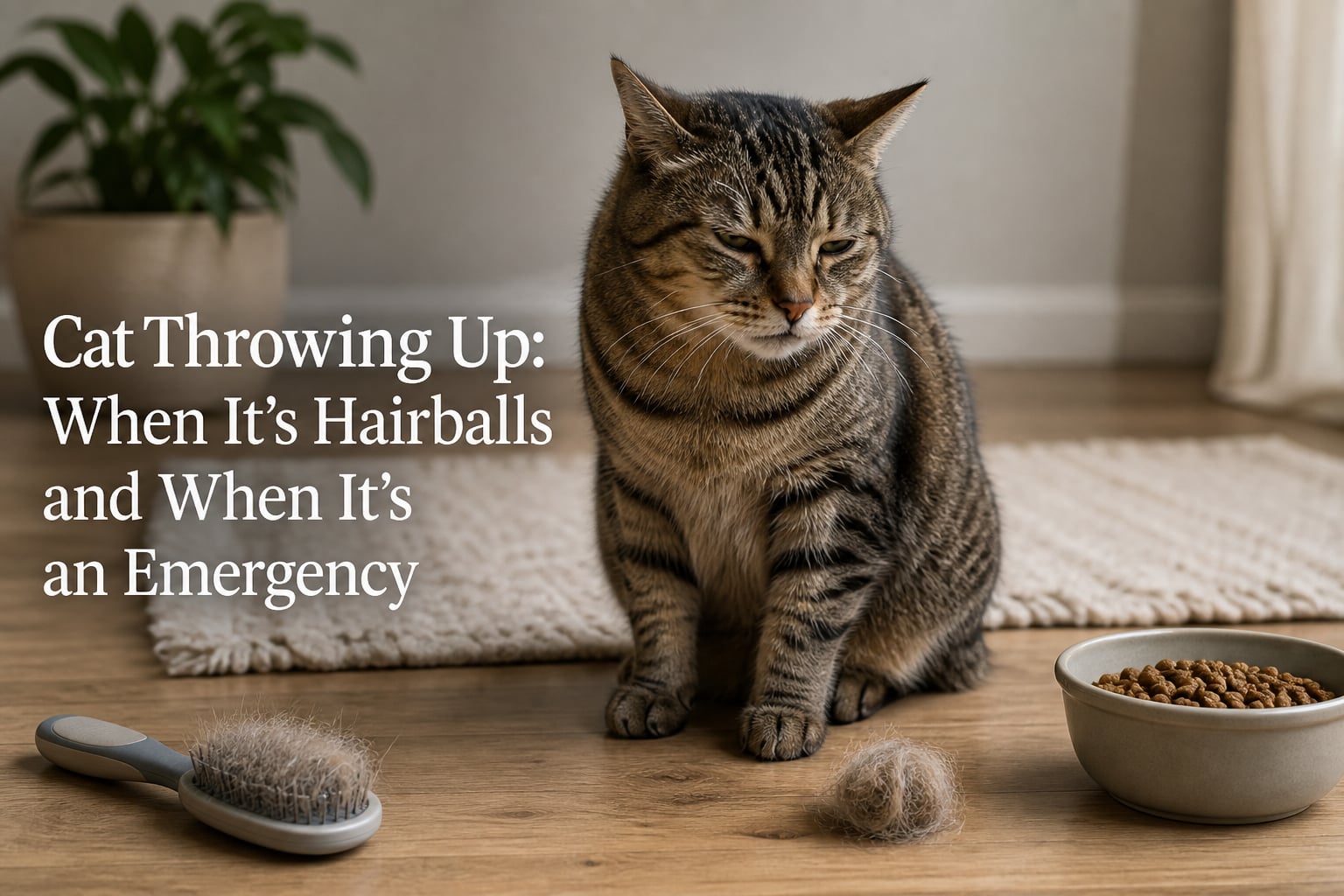
Hearing your cat hack and retch at 3 a.m. is one of those sounds that instantly snaps you awake. If you have a feline companion, you already know the feeling. The question racing through your mind is always the same: is this just a hairball, or something serious?
That distinction matters more than most cat owners realize. A single hairball on the rug is rarely cause for panic, but cats are masters at hiding illness. What looks like routine vomiting can sometimes be the first sign of a blockage, a metabolic disorder, or a gastrointestinal emergency that needs same-day treatment.
This guide walks you through everything you need to know about a cat throwing up: when it’s hairballs and when it’s an emergency. You will learn how hairballs form, what normal hairball vomit looks like compared to dangerous vomit, which warning signs demand an immediate vet visit, and how to reduce the frequency of hairballs at home.
Our team combed through veterinary sources from Cornell’s Feline Health Center, PetMD, and emergency clinics, plus thousands of real owner experiences from cat communities on Reddit. The goal is simple: give you a clear, calm decision framework so you know exactly when to wait and when to act.
Table of Contents
What Are Hairballs and Why Cats Get Them?
A hairball, medically called a trichobezoar, is a compacted clump of undigested hair that builds up in a cat’s stomach. Despite the name, it is usually shaped more like a thin cylinder or sausage than a ball, because it forms inside the narrow passage of the stomach and comes up through the esophagus.
Cats swallow hair every time they groom. A cat’s tongue is covered in tiny backward-facing hooks called papillae, made of keratin (the same protein in human fingernails). These papillae act like a built-in comb, stripping loose fur off the coat and pushing it toward the back of the throat.
Most swallowed hair passes harmlessly through the digestive tract and exits in the litter box. But some hair stays behind in the stomach, where it mats together with digestive mucus into a dense wad. When that wad gets large enough, the cat’s body triggers the gag reflex to expel it.
Long-haired breeds like Persians, Maine Coons, and Ragdolls are far more prone to hairballs simply because they have more fur to swallow. Cats who overgroom due to stress, allergies, or fleas also produce more hairballs than average.
Occasional hairballs (think once or twice a month) are considered a normal part of being a cat. The problem starts when hairballs appear far more often, when they fail to come up, or when what comes up is not actually hair at all.
What Normal Hairball Vomit Looks Like
Before you can tell what is abnormal, you need a clear picture of what a typical hairball episode looks like. A genuine hairball vomit has a fairly recognizable pattern once you know the signs.
The hairball itself usually appears as a tubular, sausage-shaped mass of matted fur, often wet and slightly slimy from stomach mucus. It may be the same color as your cat’s coat, or darker if it has been sitting in the stomach for a while. You will typically see a small amount of clear or yellowish fluid around it.
The retching that precedes a hairball is usually brief. Most cats make hacking, gagging sounds for under a minute before producing the hairball. Some cats will eat grass first to help trigger the expulsion, so a few blades of grass in the mix is also normal.
Afterward, a healthy cat typically goes right back to normal. She may walk away, ask for food, groom herself, or curl up for a nap. That rapid return to normal behavior is one of the strongest signals that what you just witnessed was a routine hairball, not an emergency.
If the retching goes on and on with nothing coming up, if your cat looks uncomfortable afterward, or if what comes up contains food, foam, or blood, you are likely looking at something other than a simple hairball.
Cat Throwing Up Hairballs vs an Emergency: The Quick Comparison
This is where most cat owners get stuck. The hacking sounds similar whether your cat is bringing up a harmless hairball or trying to expel something more serious. Use the comparison below to tell them apart.
Here is a side-by-side breakdown of hairball vomiting versus signs of an emergency:
Hairball vomiting (usually normal): tubular mass of fur in the vomit, small amount of clear or yellow fluid, brief retching, cat returns to normal behavior immediately afterward, happens once or twice a month.
Emergency vomiting (call your vet): repeated vomiting with no hairball produced, vomit containing blood (red or dark like coffee grounds), vomit that is large volumes of food or water, lethargy or hiding afterward, refusal to eat or drink, abdominal swelling or tenderness, concurrent diarrhea.
The single biggest red flag is frequency combined with behavior change. A cat who hacks up one hairball and trots off to the food bowl is almost certainly fine. A cat who vomits four times in an afternoon and then disappears under the bed is not.
Another key distinction: regurgitation versus vomiting. Regurgitation is passive, undigested food coming back up almost immediately after eating, with no retching. It often points to esophageal problems rather than stomach issues. Vomiting involves active abdominal heaving and produces partially digested material. Knowing which one is happening helps your vet narrow down the cause.
When in doubt, snap a photo of the vomit. Your vet can learn a surprising amount from what it looks like, and you will not have to rely on memory during a stressful phone call.
Vomit Color Guide: What Each Color Means
Color is one of the fastest diagnostic clues you have at home. Different colors point to different underlying causes, and some demand immediate attention.
Clear or yellow liquid: Yellow fluid is bile, which means the stomach is empty. A small amount around a hairball is normal. Repeated bile-only vomiting, especially on an empty stomach, can indicate inflammation or acid buildup and warrants a vet check.
White foam: Often a mix of stomach mucus and air. Occasional white foam with a hairball is not concerning by itself. Repeated white-foam vomiting, especially in a cat who is not eating, can signal gastritis or a foreign body.
Brown or food-colored: Usually partially digested food. If it happens once after your cat ate too fast, it is likely harmless. Repeated brown vomiting suggests the food is not moving through the digestive tract properly.
Green: May indicate your cat ate grass, which is usually harmless. However, green vomit can also mean bile is backing up from the intestines into the stomach, which is more concerning and worth a vet call if it persists.
Red or pink: This means fresh blood is present, and it is always a reason to contact your vet the same day. Small pink streaks can come from minor throat irritation during retching, but larger amounts of red blood suggest stomach ulcers, poisoning, or a serious gastrointestinal issue.
Dark, grainy, or coffee-ground appearance: This is digested blood and is a medical emergency. It points to bleeding in the upper digestive tract and should never wait until morning.
Emergency Warning Signs You Should Never Ignore
Some symptoms override any thoughts of waiting and watching. If you see any of the following alongside vomiting, treat it as an emergency and contact your vet or the nearest emergency clinic right away.
Call your vet immediately if your cat shows any of these signs:
Vomiting three or more times in a single day, or multiple episodes over 24 hours
Blood in the vomit, whether bright red or dark and coffee-ground-like
Severe lethargy, unresponsiveness, or collapse
A swollen, hard, or painful abdomen
Repeated dry heaving with nothing coming up (possible obstruction)
Vomiting accompanied by diarrhea, especially with blood
Suspected toxin ingestion (lilies, antifreeze, human medications, cleaning products)
A known foreign object swallowed (string, rubber bands, toys)
Refusal to eat or drink for over 24 hours
Signs of dehydration: sunken eyes, sticky gums, skin tenting when you pinch the scruff
Vomiting in a kitten, a senior cat, or a cat with known health conditions
Cats dehydrate quickly because of their small body size. What looks like a manageable situation in the morning can become critical by afternoon. When the warning signs above appear together, the window for safe, effective treatment starts shrinking fast.
One specific scenario to highlight: a cat who is repeatedly trying to vomit but producing nothing. This “unproductive retching” can signal an intestinal blockage, and in some cases it can also be a sign of a dangerously enlarged stomach. Either way, it is not a wait-and-see situation.
How Often Is Too Often? Frequency Guidelines?
One of the most common questions in cat forums is simply: how much vomiting is normal? The honest answer surprises many owners, because “cats just throw up” is a myth that has caused a lot of delayed diagnoses.
For hairballs specifically, most veterinarians consider one to two episodes per month to be within the normal range for a healthy adult cat. Long-haired cats may produce hairballs slightly more often during heavy shedding seasons in spring and fall.
If your cat is throwing up hairballs weekly or more, that crosses into abnormal territory. More than one or two hairball episodes per month may point to underlying medical problems such as inflammatory bowel disease, food allergies, or excessive grooming from skin conditions.
For non-hairball vomiting, the bar is much lower. Any cat who vomits more than twice in a week, or who has two or more vomiting episodes in a single day, deserves a veterinary evaluation. Acute vomiting that persists for more than 24 hours is a clear reason to call your vet.
Chronic vomiting, meaning vomiting that recurs over weeks or months even if it is infrequent, should never be dismissed as “just a cat thing.” It almost always has an underlying cause that can be diagnosed and treated.
Nighttime Vomiting in Cats: What It Means
If your cat seems to throw up mostly at night, you are not alone. This is one of the most frequent concerns raised by owners in cat communities, and it has several plausible explanations.
The most common reason is timing around meals. Cats who eat dinner early and then go many hours without food may vomit bile in the early morning hours because their stomach is empty and acid builds up. Splitting dinner into two smaller servings a few hours apart often resolves this.
Nighttime hairball episodes tend to happen because cats groom more during quiet, inactive periods. The hair that accumulates through the day can come up overnight as the cat rests. Long-haired cats are especially prone to this pattern.
However, if nighttime vomiting becomes a nightly or near-nightly event, it is no longer something to brush off. Persistent nighttime vomiting can point to inflammatory bowel disease, food intolerances, or metabolic issues like hyperthyroidism, especially in older cats. A vet visit and some basic bloodwork can rule these in or out quickly.
Step-by-Step: What to Do When Your Cat Is Throwing Up
When the hacking starts, having a clear sequence of steps prevents panic and helps you give your vet useful information. Follow this plan each time.
Step 1: Stay calm and observe. Watch the episode without interrupting. Note how long the retching lasts, what comes up, and how your cat behaves immediately afterward.
Step 2: Document what you see. Take a photo of the vomit before cleaning it up. Note the color, the presence of hair, food, foam, or blood, and the time of day. This record is invaluable if the vomiting continues.
Step 3: Check your cat’s overall condition. Is she alert and interested in food, or dull and hiding? Check her gums (they should be pink, not white, blue, or bright red). Gently feel her abdomen for swelling or pain.
Step 4: Withhold food for 2 to 4 hours. Give the stomach time to settle. Keep fresh water available in small amounts. If your cat is prone to scarfing water and vomiting that, offer ice chips instead.
Step 5: Offer a small, bland meal. After the resting period, offer a teaspoon of plain boiled chicken or a small portion of her regular food. If she keeps it down and acts normal, you can gradually resume normal feeding.
Step 6: Call your vet if warning signs appear. If vomiting continues, if any red-flag symptoms from the list above appear, or if your cat is very young, very old, or has existing health conditions, skip the wait and call your vet.
Step 7: Do not give human medications. Never give your cat Pepto-Bismol, Tylenol, ibuprofen, or any over-the-counter human remedy. Many are toxic to cats and can turn a minor problem into a fatal one.
How to Prevent Hairballs in Cats?
Prevention is far easier than dealing with midnight cleanup. A few simple habits can dramatically reduce how often your cat produces hairballs.
Brush your cat daily during shedding seasons. The more loose fur you remove with a brush, the less your cat swallows during grooming. For long-haired cats, daily brushing makes a measurable difference. Many cats come to enjoy the routine once they are used to it.
Feed a hairball-control formula or add fiber. Many cat food brands offer hairball-control kibble and wet food with added fiber that helps move hair through the digestive tract. You can also add a teaspoon of plain canned pumpkin to your cat’s food as a natural fiber boost.
Increase moisture with wet food. Hydration keeps the digestive tract moving. Cats naturally have a low thirst drive, so feeding wet food or adding water to kibble helps hair pass through instead of accumulating in the stomach.
Use a hairball gel or lubricant. Malt-based pastes and petroleum-based hairball gels coat swallowed hair so it slides through the digestive tract more easily. Most cats accept them readily, especially the malt-flavored varieties, and they are available over the counter at any pet store.
Address overgrooming at the source. If your cat is grooming excessively, find out why. Fleas, food allergies, stress, and boredom can all drive overgrooming. Treating the root cause reduces both hairballs and skin damage.
Encourage exercise and reduce stress. Active, engaged cats tend to have healthier digestion. Interactive play, climbing surfaces, and a stable routine all contribute to a calmer digestive system.
If you have tried all of the above and your cat still produces hairballs several times a week, talk to your vet. There may be an underlying condition worth investigating rather than just managing symptoms.
Frequently Asked Questions
When should I worry about my cat throwing up hairballs?
Worry when hairballs appear more than twice a month, when vomiting includes blood, when your cat becomes lethargic or stops eating, or when retching produces nothing. Three or more vomiting episodes in a day, abdominal swelling, or signs of dehydration are all reasons to call your vet immediately.
How do I stop my cat from puking up hairballs?
Brush your cat daily during shedding seasons, feed a hairball-control diet or add fiber like canned pumpkin, increase moisture with wet food, and use a malt-based hairball gel. Treating overgrooming caused by fleas, allergies, or stress also reduces hairball frequency.
What are signs of a serious hairball blockage?
Signs of an intestinal blockage include repeated unproductive retching, vomiting, loss of appetite, lethargy, a swollen or painful abdomen, constipation, and weight loss. A blockage is a medical emergency that can require surgery, so contact your vet right away if you notice these symptoms.
When to bring a cat to the ER for vomiting?
Go to the ER if your cat vomits three or more times in a day, if the vomit contains blood (red or coffee-ground), if the abdomen is swollen and painful, if you suspect a toxin or foreign object was swallowed, or if your cat is collapsed, severely lethargic, or showing signs of dehydration.
Conclusion
Understanding the difference between routine hairballs and a genuine emergency can literally save your cat’s life. Most of the time, a single tubular hairball followed by normal behavior is nothing to fear. The danger lies in the patterns: frequent vomiting, behavior changes, blood, and unproductive retching.
Keep the emergency warning signs handy, learn what normal hairball vomit looks like, and never dismiss persistent or chronic vomiting as just part of being a cat. The next time your cat throws up, you will know exactly what to do and when to act.