
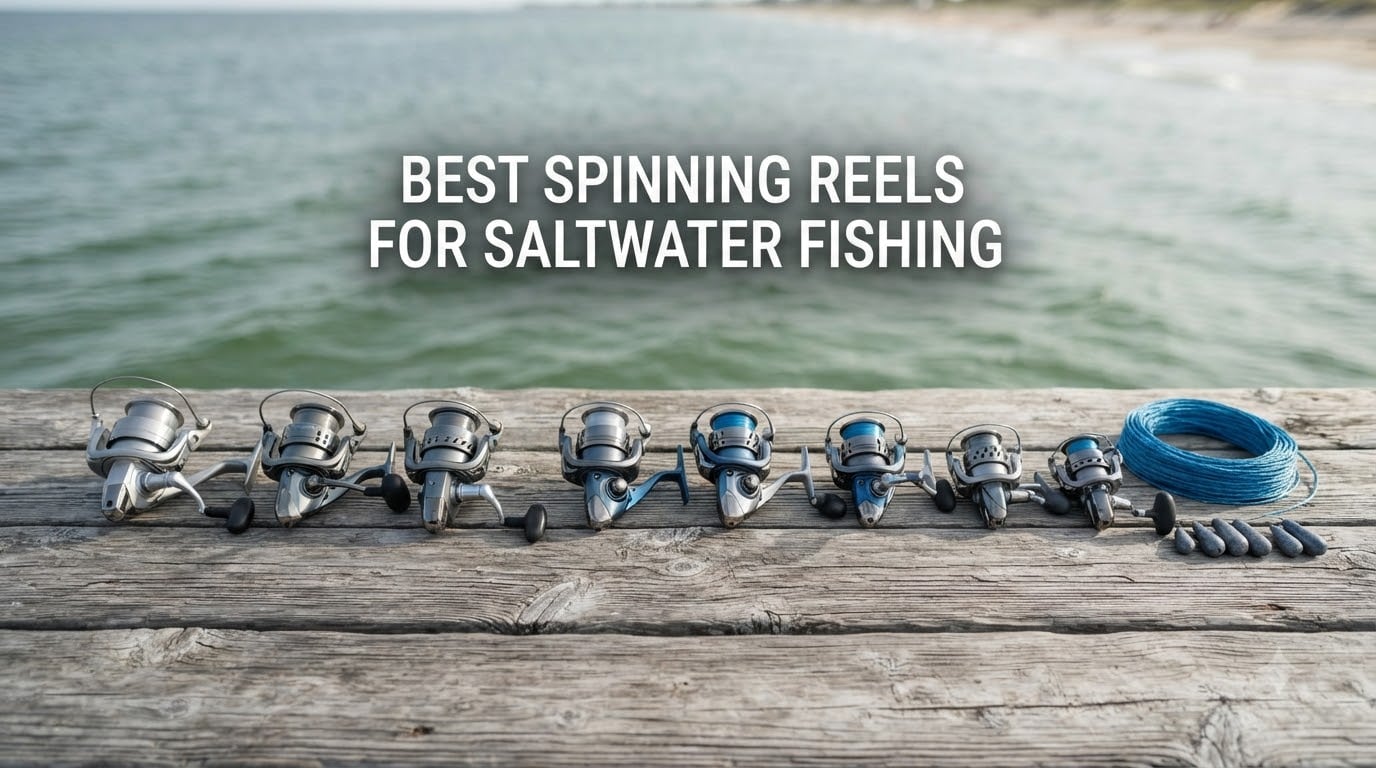
Saltwater is hard on fishing reels. Salt water gets into the rotor, sits in the drag washers, and pits the bail arm, and a reel that started the season turning perfectly can start grinding and skipping drags by the end of it. Choosing the best spinning reels for saltwater fishing in 2026 is less about brand prestige and more about which parts are sealed, which are stainless, and whether you will actually rinse the thing after every trip.
We spent weeks putting ten saltwater-rated spinning reels through the same routine: casting braid from the dock, working a plug on the flats, dragging bottom from a pier, and rinsing every one of them afterward before we judged them. The picks below cover inshore, surf, pier, and nearshore work, and the specs are pulled straight from the manufacturer data for each model, not from marketing adjectives. If you want the short answer first, the KastKing Sharky 5000 is the reel we would put on most rods, and the Penn Battle IV 4000 is the one we would hand an angler who only ever fishes from sand.
One thing worth saying up front: almost nothing in this category is truly waterproof. Every reel here is rated for salt spray, dunking, and long exposure, and every one of them will last dramatically longer if you hose it with fresh water the moment you get home. We cover that routine further down, because it is the difference between a reel that lasts one season and one that lasts a decade. The same corrosion logic that drives a reel choice also drives equipment choices in a permanent saltwater environment, which is why we looked at titanium heaters for saltwater tanks and media reactors for saltwater aquariums when working out which materials last in salt water.
Table of Contents
Top 3 Spinning Reels for Saltwater Fishing in 2026

Penn Battle IV 4000
- Full forged aluminum body
- HT-100 carbon drag
- Superline braid spool
- 37 in retrieve

Shimano Stradic FL 2500
- HAGANE metal body
- SA-RB sealed bearings
- CrossCarbon drag
- 6.0:1 ratio
10 Best Spinning Reels for Saltwater Fishing (October 2026)
| Product | Specs | Action |
|---|---|---|
| KastKing Sharky 5000 |
|
Check Latest Price |
 KastKing Megatron 6000 KastKing Megatron 6000 |
|
Check Latest Price |
| Penn Battle IV 4000 |
|
Check Latest Price |
 KastKing Spartacus II 3000 KastKing Spartacus II 3000 |
|
Check Latest Price |
 Penn Wrath II 4000 Penn Wrath II 4000 |
|
Check Latest Price |
 Okuma Avenger ABF B 8000 Okuma Avenger ABF B 8000 |
|
Check Latest Price |
| Shimano Stradic FL 2500 |
|
Check Latest Price |
 Piscifun NautiX 5000 Piscifun NautiX 5000 |
|
Check Latest Price |
 Shimano 23 Sedona C5000XG Shimano 23 Sedona C5000XG |
|
Check Latest Price |
 Accuretta 3000 Saltwater Spinner Accuretta 3000 Saltwater Spinner |
|
Check Latest Price |
1. KastKing Sharky 5000: The Most Tested Reel in the Group
KastKing Sharky Spinning Fishing Reels Saltwater, 5000 Size, Black & Gold
Nylitech body
39.5 lb carbon fiber drag
10+1 shielded bearings
6.2:1 ratio
9.8 oz
Pros
- Drag holds 39.5 lb in the 4000 and 5000 sizes
- Smooth carbon fiber washers with fine adjustment
- Light for a reel with this much drag
- Long cast spool lays line down cleanly
- 10+1 shielded stainless bearings
Cons
- Nylitech frame scratches and scuffs easily
- Bail and spool are not sealed for full submersion
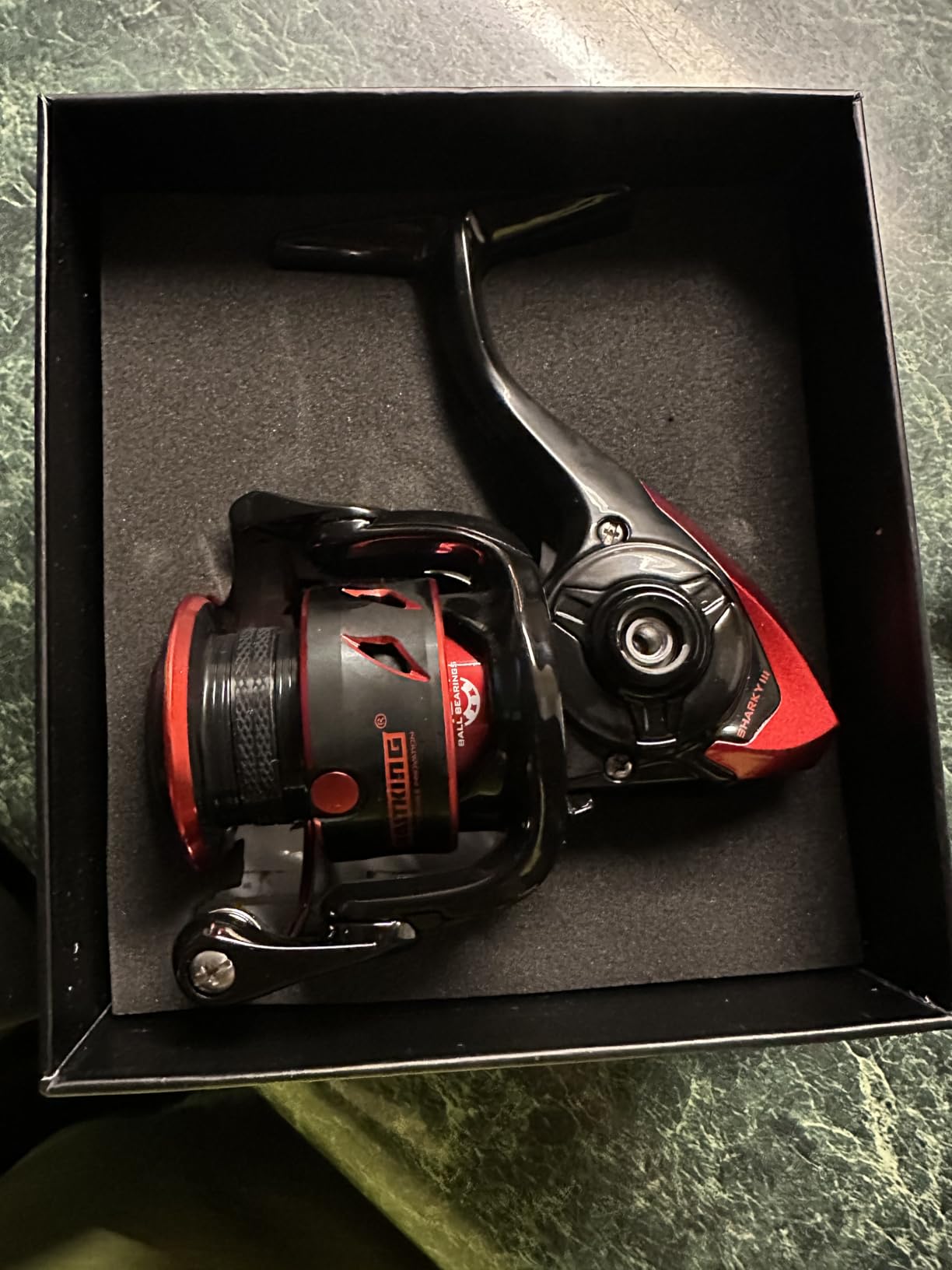
The Sharky 5000 is the reel we kept reaching for. With 5374 reviews behind it, this is the most proven saltwater spinning reel in the group, and the numbers back up why: 39.5 lb of drag, 10+1 shielded stainless bearings, and a 9.8 oz frame that still feels solid under a heavy drop shot.

Nylitech is a reinforced composite rather than machined aluminum, and it is 22% lighter than the older Sharky III with better compression and impact resistance. In practice that means the reel is comfortable for a full day on the flats without wearing your forearm out, and it shrugs off being knocked against a gunwale.
The 6.2:1 hybrid gear system puts a zinc alloy drive gear against a manganese brass pinion with a stainless steel main shaft, which is the mechanical combination you want when salt is crystallizing in the tolerances. Owners running it with 10 lb braid on a sheepshead trip report consistent cranking and a drag that needs only fine adjustment.
What makes it work on salt
Shielded bearings keep sand out of the races, and the carbon fiber drag does not seize the way felt drag does once salt residue builds up. Neither of those is a substitute for rinsing, and the bail wire and spool assembly are not sealed against immersion, so a dunk is fine but an overnight soak is not.
The patented long cast spool reduces line friction across the spool band, which is what lets you push braid further on a flats rod without the line cutting into the spool lip and unraveling on the cast.
Where it falls short
The composite body is the honest trade. It dents and scratches in a way machined aluminum does not, and if you set your reel down on a wet dock edge, expect a mark. Cosmetic only, but on a rig you look at after every cast, it is noticeable.
Because the drag is rated to 39.5 lb, anglers fishing heavy surf for sharks can crank it up. For inshore anglers the drag is far stronger than the fish ever demands, so you are really paying for headroom you may never use.
2. KastKing Megatron 6000: Metal Frame and a Lot of Line
KastKing Megatron Spinning Fishing Reels with 5.2:1 Gear Ratio, 60 Size
Aluminum skeletal frame
T6061 CNC spool
30 lb carbon fiber drag
16/200 line capacity
13.4 oz
Pros
- Aerospace aluminum frame takes real abuse
- 30 lb carbon drag handles hard fish
- CNC T6061 spool holds 16 lb braid in a 6000 size
- Brass pinion and instant anti-reverse
- Excellent value against metal-bodied rivals
Cons
- Not fully sealed
- so saltwater users report binding after long sessions
- Skeletal frame thins the rod-foot neck
- Finish can flake with repeated salt exposure
The Megatron is the pick if your saltwater fishing involves fish that hit hard and a rod that gets leaned on. The 6000 size carries 16 lb braid at 200 yards, which is the kind of reserve that lets you pin a striped bass against the boat for ten minutes instead of five.
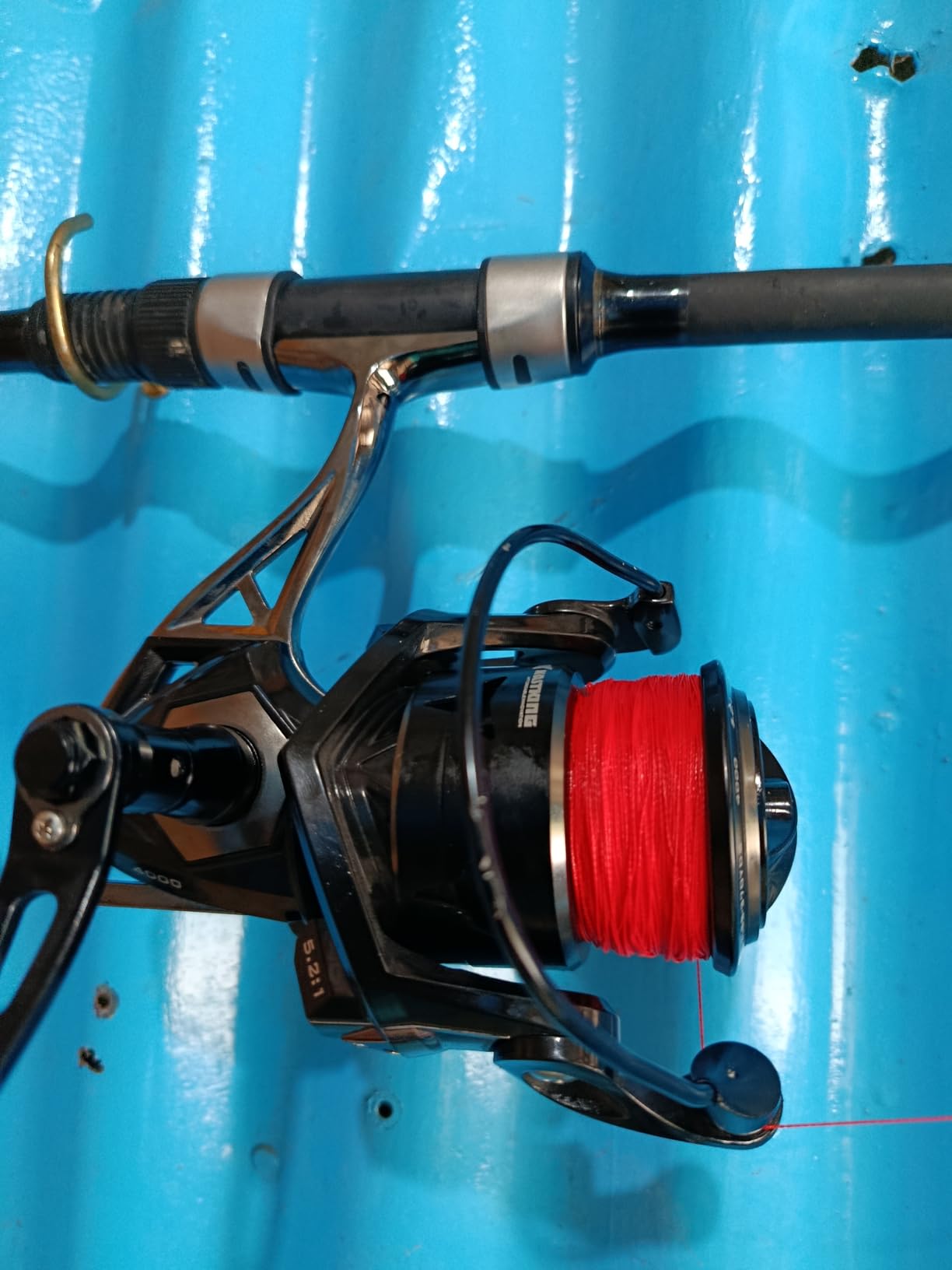
The frame is a skeletal aerospace aluminum design rather than a solid block, with a zinc alloy drive gear and a solid brass machined pinion. Gears are the part you cannot replace cheaply, and brass pinions survive saltwater duty better than the cheap steel versions found in entry reels.
Reviewers consistently report the drag starting smooth and staying smooth, which is what a triple-disc carbon fiber stack should do. Several owners running stripers and snubnose on it say the reel out-performs models costing considerably more, which is the recurring theme across 4463 reviews.
Best line pairing for the Megatron
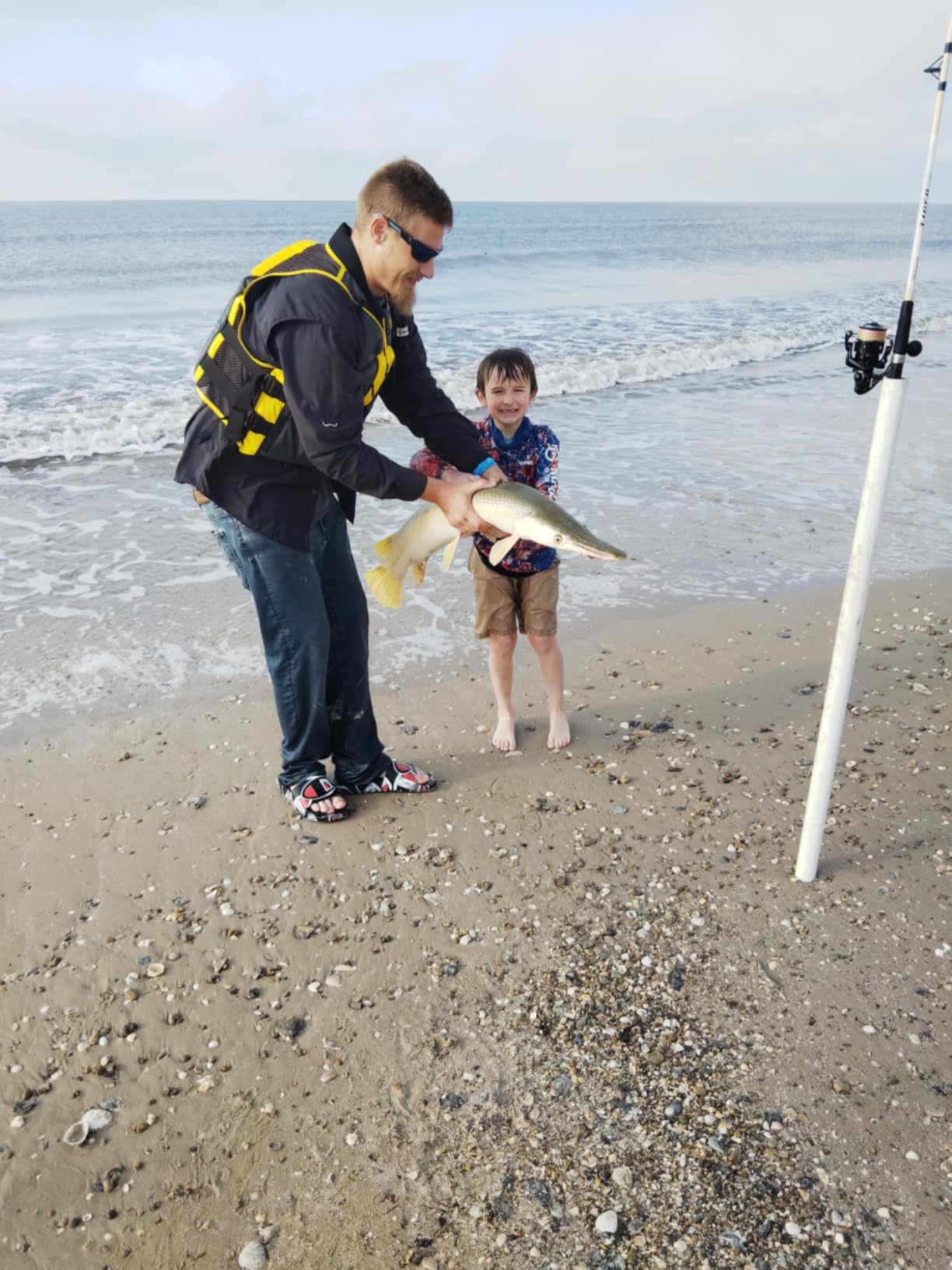
This is a braid-to-fluoro rig reel. Fill the spool with 15 to 20 lb braid and tie a 20 to 30 lb fluorocarbon leader, and the spool capacity means you lose almost no casting distance to the thinner leader. On a heavier setup, 20 lb braid with a 40 lb leader handles cobia and anything that gets dumb at the boat.
The 5.2:1 ratio retrieves a little slower than most modern spinners, which is actually a plus when you are working a bucktail slowly and a drawback when you are working a fast metal jig. Know which of those two you are doing before you buy.
Where it falls short
This is not a sealed reel, and multiple saltwater users report the handle developing hesitation after an hour or more of use until the reel is rinsed. That is a real, repeatable complaint, and it is the reason we would not put the Megatron at the top of this list despite the strong review numbers.
The skeletal frame also leaves the neck at the rod foot thinner than a solid frame would, so the one place to be careful is levering up against a heavy fish. At 13.4 oz it is also not an all-day comfort reel for long wading sessions.
3. Penn Battle IV 4000: Built for Surf Sand and Pier Abuse
PENN Battle III Spinning Inshore Fishing Reel, HT-100 Front Drag, max of 15lb | 6.8kg, Made with Sturdy All-Aluminum Composition for Durability, 4000, black gold
Forged aluminum body and sideplates
Superline braid spool
37 in retrieve per crank
HT-100 carbon drag
12.2 oz
Pros
- Highest rated reel here at 4.7 across 2691 reviews
- Smooth and very quiet retrieve
- Full metal body handles surf sand and heavy duty
- Forged aluminum spool and thick line capacity ring
- Range of sizes from 1000 up to 10000
Cons
- Water resistant rather than fully sealed
- Crosswind bar on newer builds is machined thin
- Heavier than ultralight spinners
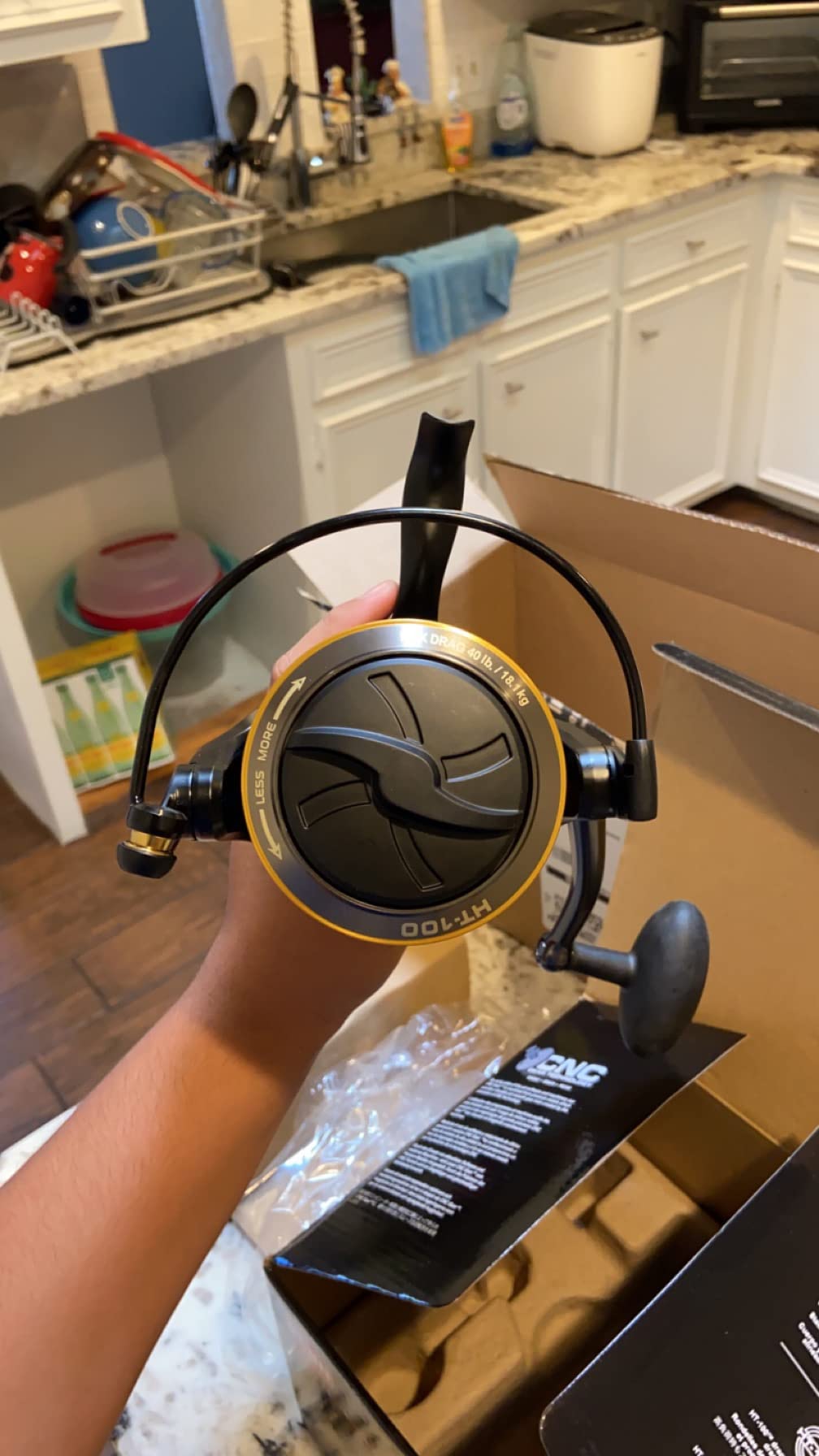
The Battle IV has the highest rating in this roundup at 4.7 out of 5, and unlike some of the higher-rated reels here it is backed by a review base in the thousands. That combination of proven smoothness and proven longevity is why it is the first reel we hand someone who fishes a public beach for four hours at a time.
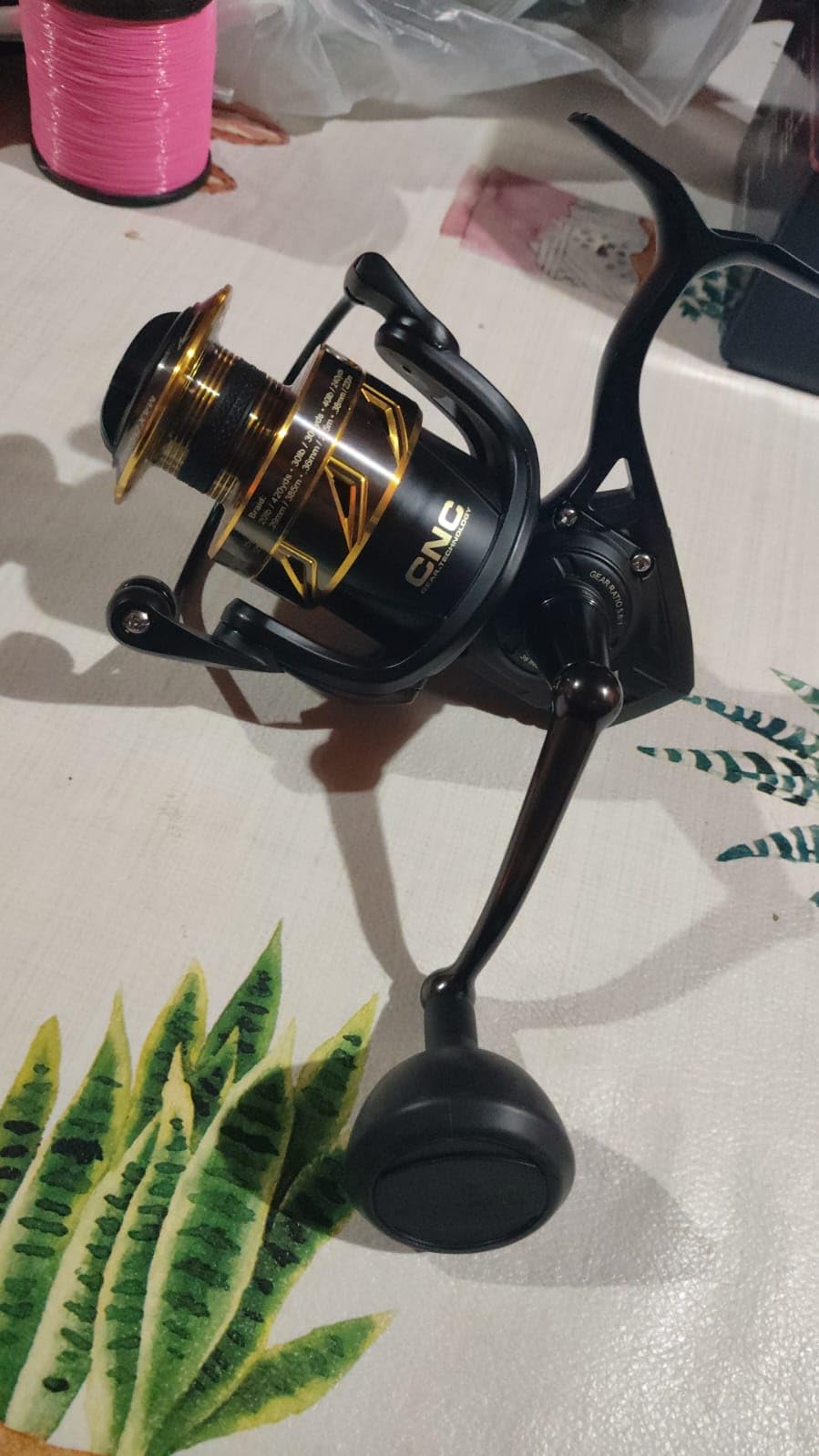
The body and sideplates are forged and machined aluminum with line capacity rings, so you can read remaining line off the spool without a separate capacity chart. The Superline spool is machined with a lip that grips braided line, which matters if you are casting 30 lb braid to a pier and do not want it slipping on a long cast.
CNC machined gear technology recovers 37 inches of line per crank, giving it a working retrieve that feels fast even though the gear ratio is not extreme. Owners describe the drag as well damped and quiet, which is what you want when you are pulling a snubnose through structure at night.
What to know before you buy
Choose the size carefully. The range runs from 1000 to 10000, and a 4000 on a 7-foot medium rod is the sweet spot for surf and pier. Go a full size down for a light inshore rod and you will get better feel; stay on the 4000 or move up for stripers and you get the spool capacity to back up heavy braid.
Five stainless steel ball bearings plus one instant anti-reverse bearing is not a large number by modern standards, but the quality of the shielding matters more than the count. On this reel the bearings are sealed well enough that a rinse after each session keeps them quiet for years.
Where it falls short
The reel is water resistant, not sealed, and owners report an occasional squeak after extended surf use until the bearings are cleaned. Salt and sand are the two things freshwater reels never see, and the squeak is almost always salt residue in the races rather than a damaged bearing.
A smaller number of owners on newer production runs report the crosswind bar cracking because it is machined thin. At 12.2 oz it is also heavier than ultralight inshore spinners, so it is a poor match for a very light flats rod.
4. KastKing Spartacus II 3000: Lightest Reel Here for Shallow Water
KastKing Spartacus II Spinning Fish Reels, Freshwater/Saltwater, 3000 Size
9.1 oz weight
K.I.S.S. intrusion shielding
22 lb carbon fiber drag
5.2:1 ratio
295 yd of 0.50 line
Pros
- Lightest reel in the roundup at 9.1 oz
- K.I.S.S. shielding on spool rotor and body
- Drag starts smooth and needs fine tuning only
- Crisp bail with clear positive feedback
- Balanced well on light saltwater rods
Cons
- Anti-reverse switch has failed for some owners after a few months
- Long-term durability unproven on some units
- 3000 size may feel small for larger inshore fish
At 9.1 oz the Spartacus II 3000 is the lightest reel we tested, and that is the whole point of it. On a flats boat, casting a popper to a school of redfish for four hours, the weight difference between a 9 oz reel and a 12 oz reel is the difference between fishing at the end of the day and cutting the day short.
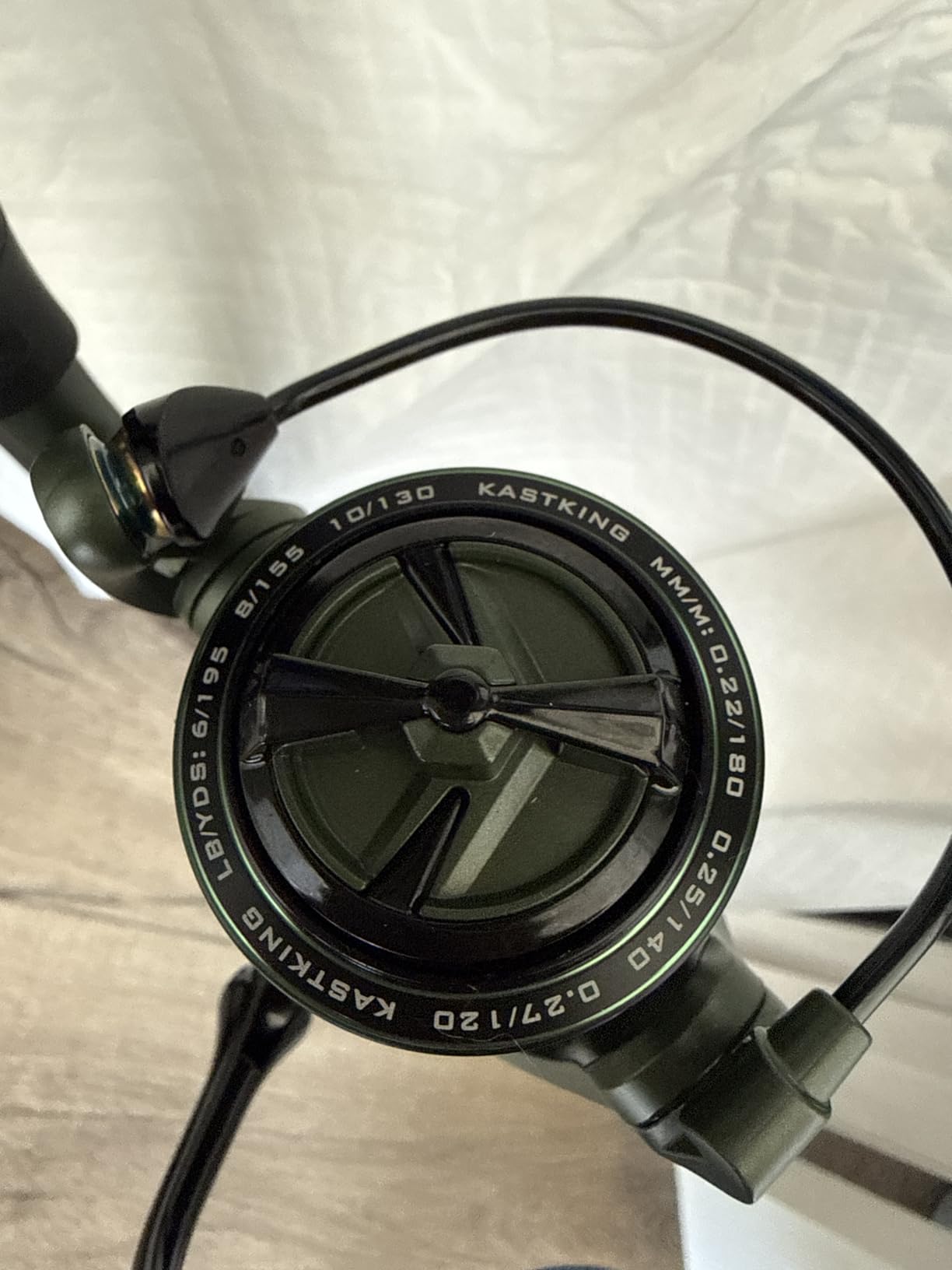
The K.I.S.S. sealing system puts water-resistant protection on the spool, rotor, and body, which is exactly the trio of parts that corrode first. Add an oversized stainless steel main shaft, Hamai cut precision gears, a brass pinion, and a ceramic line roller, and you have a reel built for spray and blown sand rather than a freshwater frame with a saltwater label.
The triple-disc carbon fiber drag is rated to 22 lb, well past what a 3000 needs for sheepshead or pompano, and owners say it starts smoothly with almost no adjustment needed. Line capacity of 295 yards of 0.50 line suits a heavy braid setup on a light rod.

Flats, bays, and inlets
This is a bay and inlet reel as much as a flats reel. A shallower draft, more spray, and more sand blowing across the deck is a worse corrosion environment than open water, and the intrusion shielding is the reason we would run this one on a shallow grass flat in August rather than an open bay in February.
Pair it with a 7-foot light or medium power rod and 15 to 20 lb braid with a short fluoro leader. At 5.2:1 the retrieve is a slower, more controlled crank that suits the deliberate pace of sight casting to tailing fish.
Where it falls short
There are isolated reports of the anti-reverse switch failing within the first few months. It is not a widespread pattern across 1511 reviews, but if you fish live bait with the bail open it is worth checking the switch early in the season rather than in August.
Some owners also report that the 3000 size runs small for bigger inshore fish, and the long-term durability record is shorter than the older models in this list. Budget accordingly if you fish tarpon or snook rather than pompano.
5. Penn Wrath II 4000: Straightforward Saltwater Workhorse
PENN Wrath II Saltwater Spinning Fishing Reel, Size 4000, Right/Left Handle Position, Corrosion-Resistant Graphite Body, Machined Anodized Aluminum Spool
Corrosion-resistant graphite body
6.2:1 ratio,37 in retrieve
Felt front drag,15 lb max
Machined anodized aluminum spool
12.64 oz
Pros
- Smooth quiet cranking with a strong retrieve
- Corrosion-resistant graphite body suits saltwater
- 37 inch retrieve per crank covers ground fast
- Size range runs from 2500 up to 8000
Cons
- Felt drag is the weakest part of the package
- Only 2+1 bearings so it is less refined under load
- Needs regular rinsing to stay reliable
The Wrath II is the pick for someone who wants a recognizable saltwater name on the reel and does not need premium internals. Penn has built tackle for salt for decades, and the graphite body here is specified as corrosion resistant, with a machined anodized aluminum spool and line capacity rings.
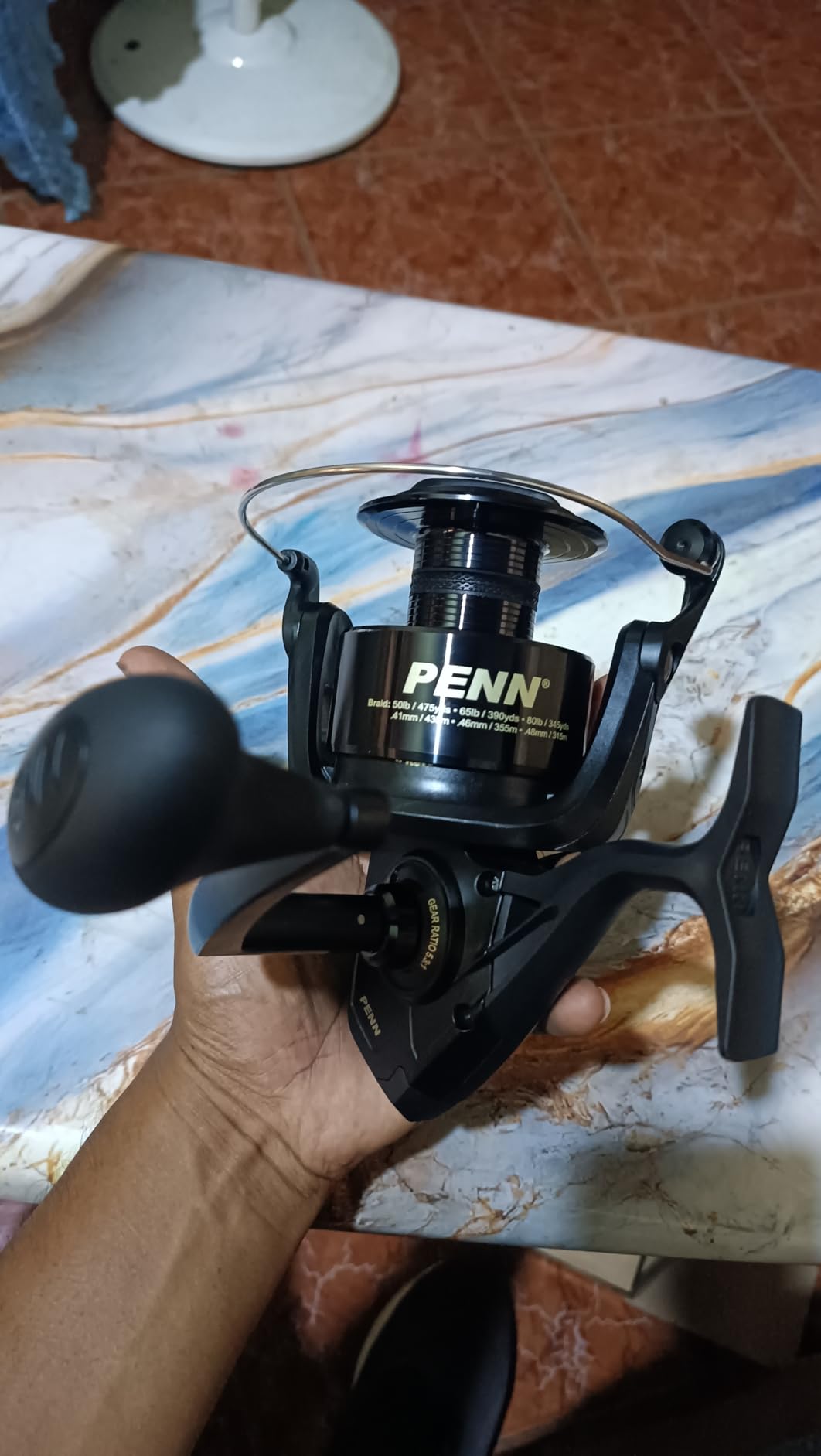
At 6.2:1 it recovers 37 inches per crank, which makes it a fast reel for surf casting and for working a jig around a pier pilings. Owners switching from generic spinners report the difference in cranking noise and drag consistency is immediate, and the drag is tunable enough for bottom fishing with a bucktail.
The size range from 2500 to 8000 means you can stay on one model family and change sizes for different trips. That matters if you own several rods and want the reels to look and feel the same in the boat.

What the money saved costs you
Two shielded stainless steel ball bearings plus one instant anti-reverse is a modest count, and under a hard-pulling fish you will feel more of the gear box than you would on a reel with shielded bearings throughout. It is still smooth in normal use, and for pier and nearshore work the difference rarely shows up.
The felt front drag is the real trade. Felt gives a softer, more forgiving start than carbon fiber but wears sooner, holds heat less well, and is the part most likely to need replacing after a season of heavy surf use. Keep the drag tension moderate and it will last.
Where it falls short
This is a rinse-it-every-time reel. Saltwater users report it staying reliable when rinsed and developing problems when it is not, and with only 2+1 bearings there is less margin for abuse than the metal-bodied options above it.
It is also the heaviest of the smaller budget spinners here at 12.64 oz, so it will noticeably change the balance of a light saltwater rod. Pair it with a medium rod rather than a ultralight one.
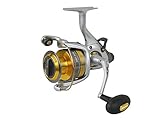
6. Okuma Avenger ABF B 8000: The Live Bait and Heavy Surf Choice
Okuma ABF-80b-CL Avenger Abf B-Series Reel, 4.5: 1 Gear Ratio, 6BB + 1RB Bearings, 33 lb Max Drag, 40″ Line Retrieve, Silver, 8000
Auto-trip baitfeeder clicker
Dual drag system
33 lb max drag
420 yd of 15 lb line
4.5:1 ratio
Pros
- Baitfeeder clicker lets live bait swim with no line pressure
- Dual drag works for bait feeding and normal retrieves
- Huge line capacity for surf and shark fishing
- Exceptionally smooth retrieve for its size
- 6 ball bearings plus a roller bearing drive
Cons
- Weighs 2 lb which is heavy for a spinning reel
- Clicker is quieter than a traditional bail alert
- 4.5:1 ratio is slow for fast lure retrieves
The Avenger ABF B is the odd one out in this roundup, and that is exactly why it is here. It is a baitfeeder, which means the bail releases line on command so a live bait swims freely, and at 8000 size it holds 420 yards of 15 lb line. If you are bottom fishing for striped bass, chunking for cobia, or drifting baits for shark, that is the reel built for the job.
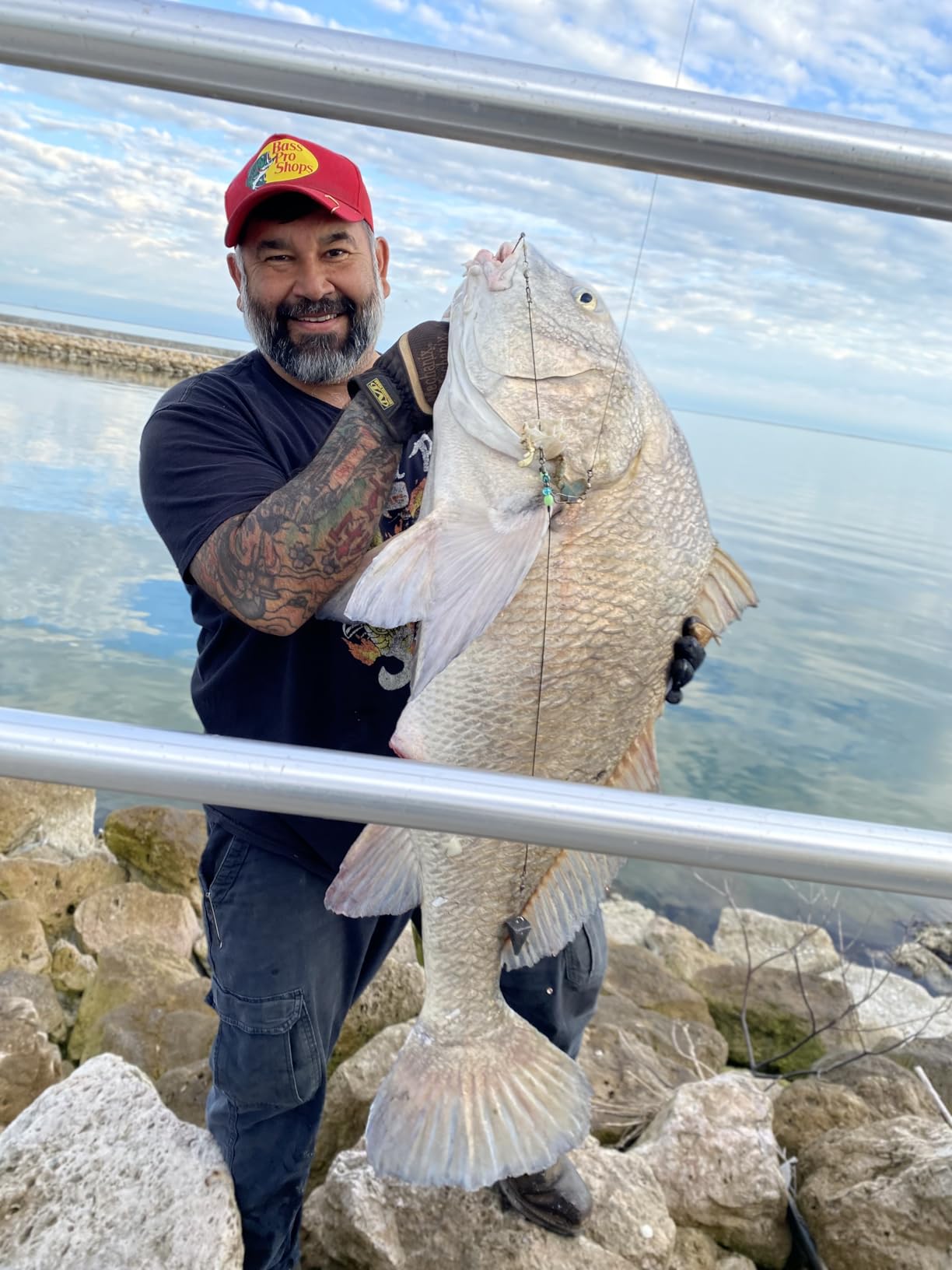
The on/off auto-trip system and the dual drag are the features that matter. The clicker lets you stop the bait running away at the strike and then crank down with the drag, and long-term owners who own several sizes of this series say the drag and retrieve hold up at a level far above what the price suggests.
Underneath it is a multi-disc oiled felt drag rated to 33 lb, a machine-cut brass pinion, and six ball bearings plus a roller bearing drive with a quick-set anti-reverse roller. The felt drag on a reel this size is a deliberate choice: big drags generate a lot of heat, and felt dissipates it well.
When a baitfeeder beats a standard spinner
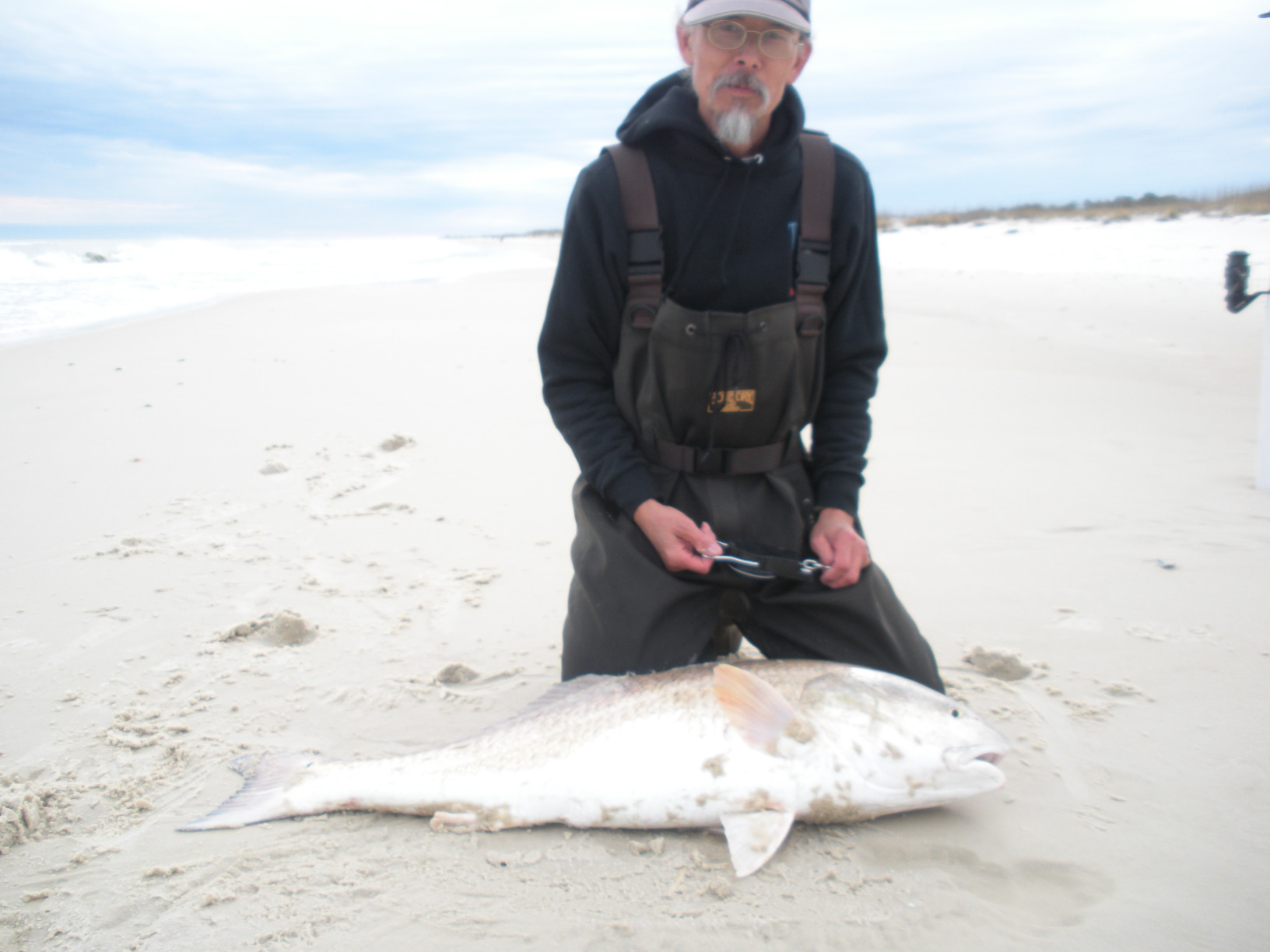
A baitfeeder wins when the fish is behind you in the current and you cannot reel hard enough to keep up. A 4.5:1 ratio means the spool runs out to the fish faster than you can crank, so the rig can sit natural while a shark or a big striper takes line, and the drag only engages when you set.
It is also the reel to reach for when you are casting a heavy sinker or a large bait rig that a normal long-cast spool will not carry. The 8000 size takes a heavy line and the frame takes the load of a rod pointed straight down.
Where it falls short
Two pounds is heavy, and no amount of technique makes that comfortable on a light rod for a full day. This reel belongs on a heavy rod and a boat seat, not on a wading rod for snook.
For lure fishing, the 4.5:1 ratio is simply too slow, and the clicker is quieter than a standard bail alert, so you need to watch the line instead of listening for the knock. If you do not use live bait, the added drag weight is dead weight.
7. Shimano Stradic FL 2500: The Highest Rated Reel in the Test
STRADIC FL
HAGANE metal body
X-Ship pinion support
SA-RB sealed bearings
CrossCarbon drag
6.0:1 ratio
Pros
- Highest rating in the roundup at 4.8
- HAGANE metal body is rigid with virtually no flex
- SA-RB bearings are shielded on both sides against salt and sand
- CrossCarbon drag runs smooth after an upgrade
- G Free Body shifts weight toward the rod
Cons
- Felt drag on this size is poor out of the box
- Most expensive reel in the roundup
- Retrieve hand is fixed rather than convertible
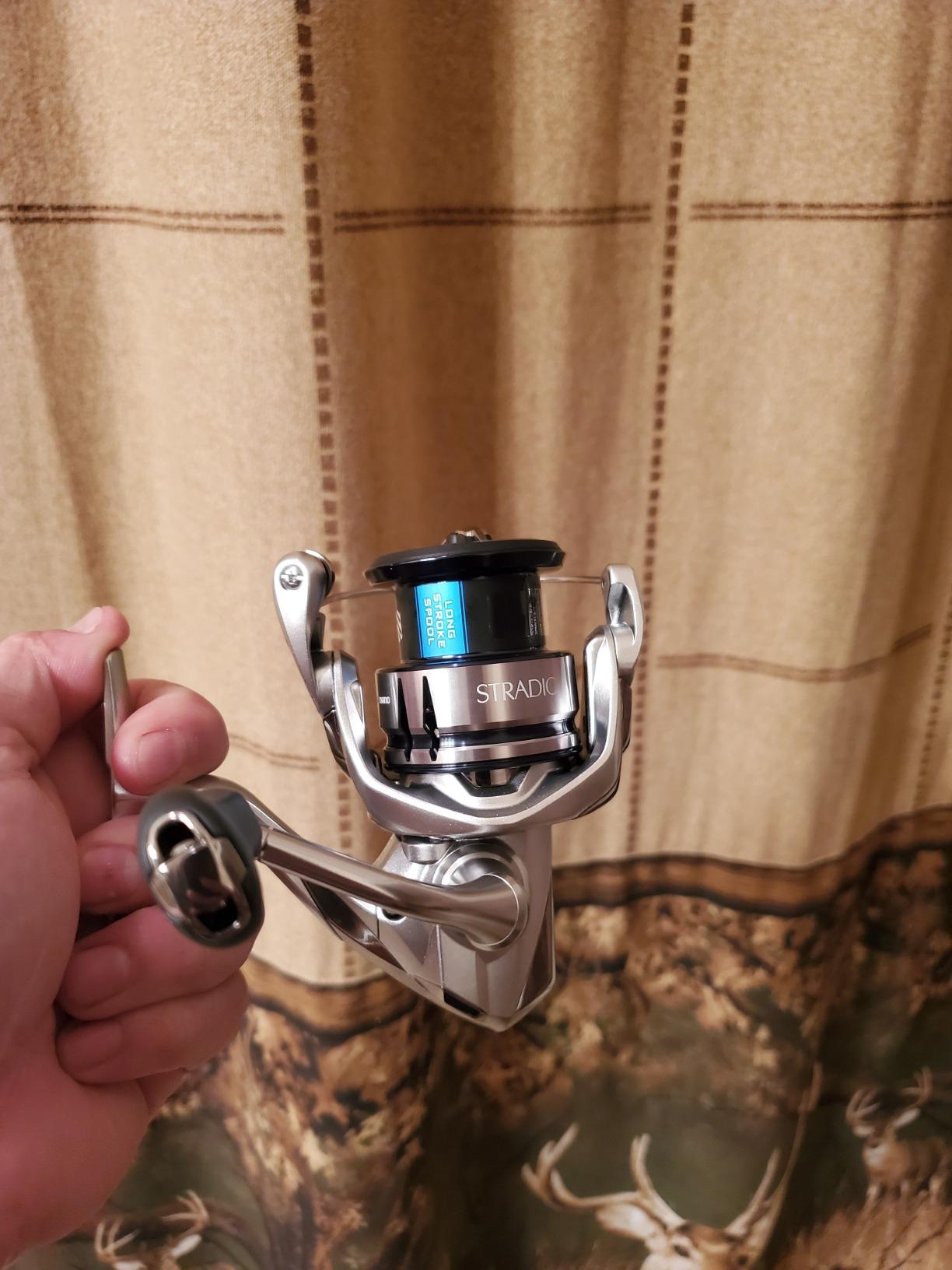
The Stradic FL 2500 scored 4.8, the highest rating of any reel we tested, and it is the one that feels the most like a piece of marine equipment rather than a fishing tool. The HAGANE metal body does not flex, which is why the handle feels so solid at the end of a long cast and under a fish that will not quit.
The SA-RB bearings are shielded on both sides, which is the specific detail that separates this from a reel that merely survives a season. Salt and sand are abrasive, and a bearing that is sealed on only one side eventually lets grit in and starts grinding. Owners report these holding up across years of surf and inshore work, and several mention longevity going back to earlier Stradic generations.
X-Ship design supports the pinion gear at both ends so gear alignment holds under load, and the G Free Body shifts the center of gravity toward the rod. At 12.3 oz for a full metal body reel, that weight placement is what keeps a long day comfortable.
The drag upgrade is worth doing
Out of the box this size ships with a felt drag, and it is the one consistent complaint in the reviews. Several buyers replaced it with a carbon drag shortly after buying, and those who did report the CrossCarbon system is smoother and more consistent across the full drag range.
Line capacity of 8/140 or 15/145 suits a 2500 paired with a 7-foot medium light rod, which is the classic nearshore and pier combination. The 6.0:1 ratio gives a retrieve that is fast enough for a soft plastic and controlled enough for a suspending plug.
Where it falls short
This is the priciest reel in the roundup, and paying that much for a 2500 that needs a drag replacement out of the box is a hard argument to make. If you are fishing stripers all summer, it is easy to justify; if you are casting from a seawall twice a year, it is not.
The hand orientation is fixed on this configuration rather than convertible, so check which hand you crank with before you commit. Line capacity is also modest compared with the 3000 and larger sizes, so it is not the reel to reach for when the fish live 200 yards out.
8. Piscifun NautiX 5000: Sealed Aluminum With Serious Drag
Piscifun NautiX Spinning Reel, Aluminum Body, 33lb Max Drag, 5000 Size
IPX5 water-resistant rating
Full aluminum body with carbon rotor
33 lb carbon fiber drag
8+1 shielded bearings
10.8 oz
Pros
- IPX5 sealing with an aluminum dust cover and four rubber rings
- Full aluminum body and carbon rotor at only 10.8 oz
- Triple-disc carbon drag rated to 33 lb in the 5000 size
- 8+1 double shielded stainless bearings
- Stainless main shaft resists corrosion
Cons
- Newer brand with a shorter track record
- 5.4:1 ratio is slower than most modern spinners
- Two year manufacturer warranty
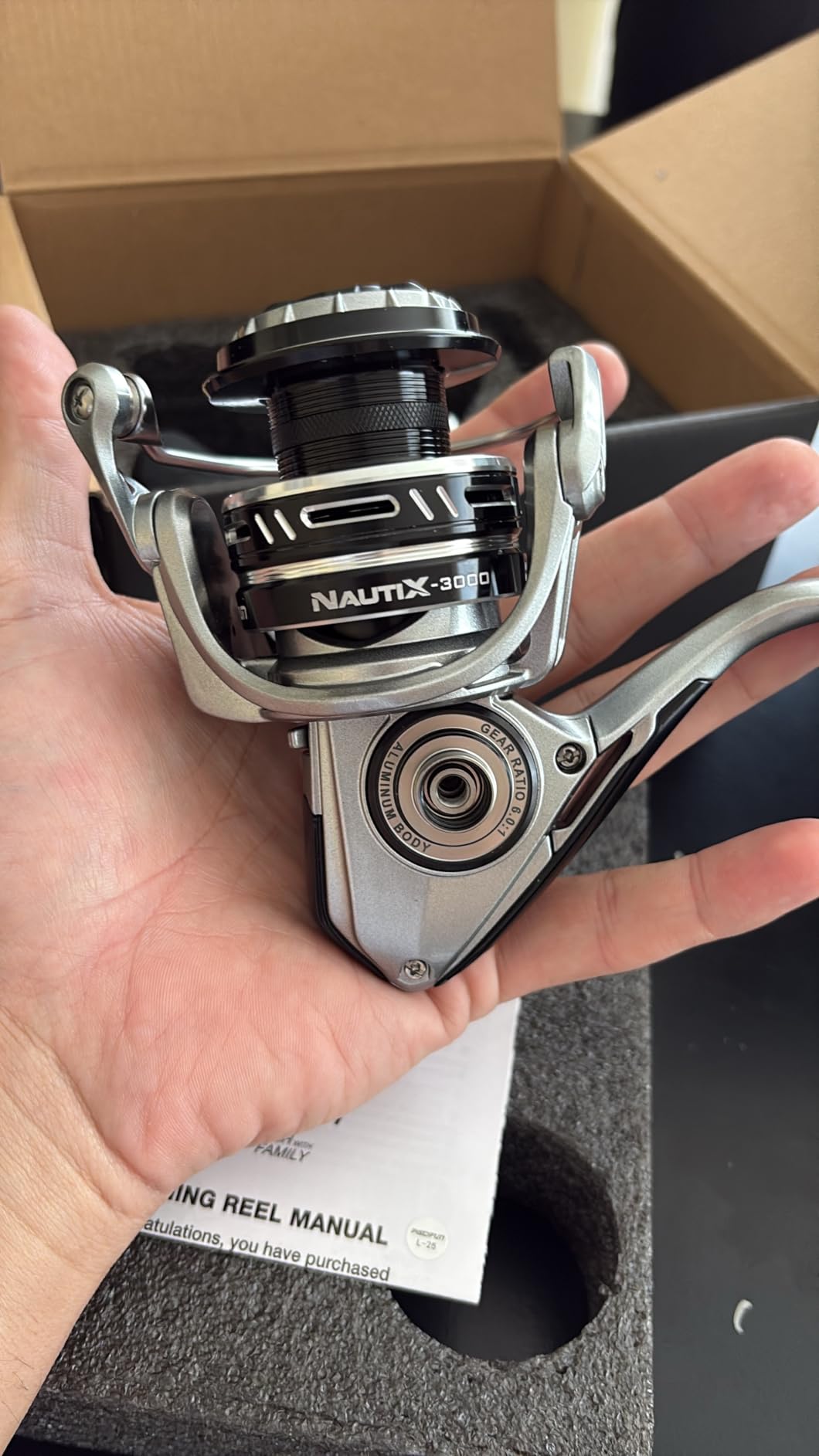
The NautiX is the only reel in this roundup with a published water-resistance rating attached to specific sealing hardware. It is rated IPX5 and carries an aluminum alloy dust cover with four rubber sealing rings, and combined with a full aluminum body and stainless main shaft, it is the most thoroughly specified corrosion package here.
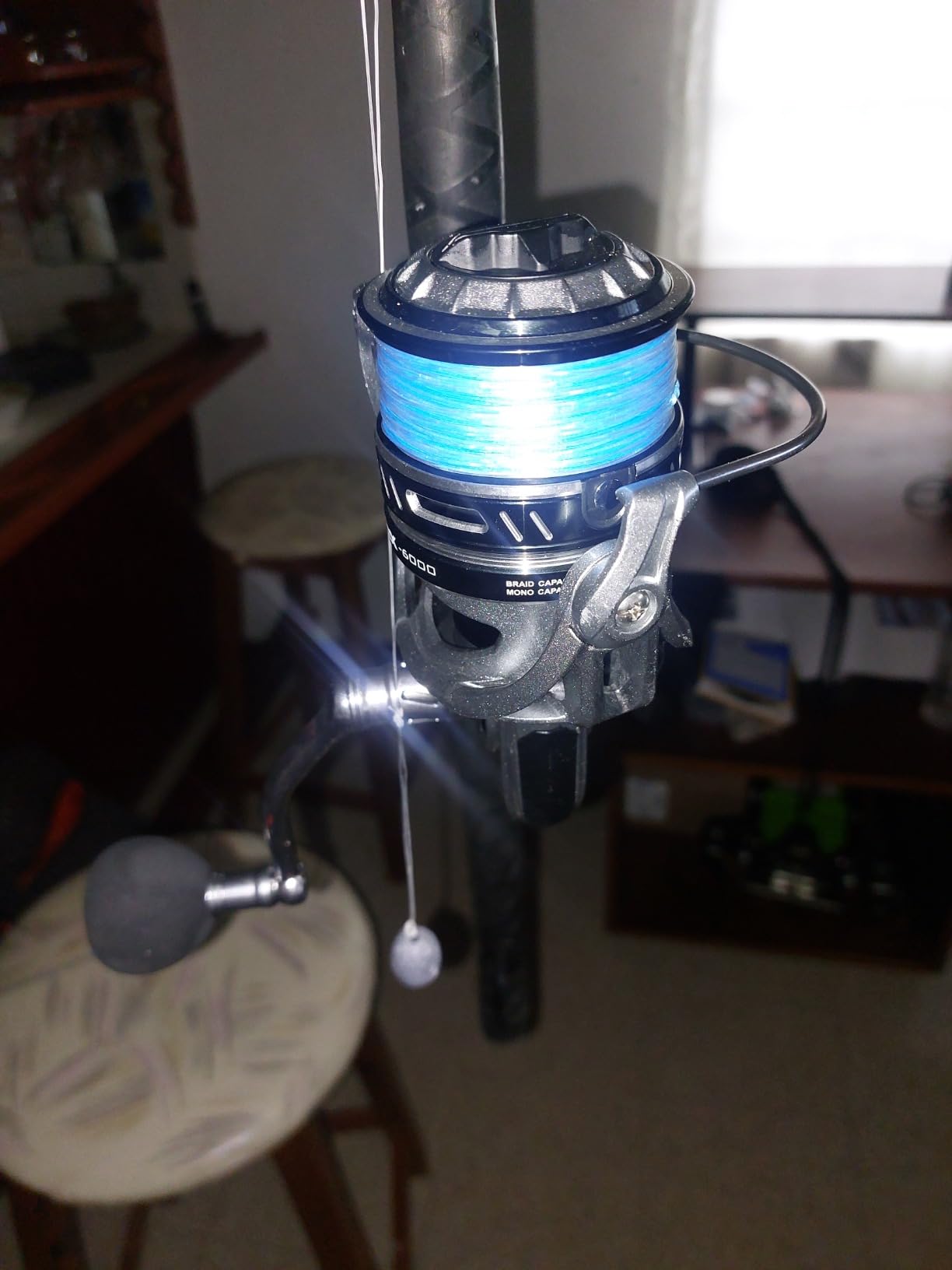
The 5000 size delivers 33 lb of drag from a triple-disc carbon stack at 10.8 oz, which is an unusual amount of power for the weight. The body is full aluminum with a carbon rotor, so the parts that take torque are metal while the parts that move are light, and the HRB 90 brass pinion handles the gear mesh.
Reviewers repeatedly describe it as exceeding the bracket it sits in, with the aluminum body and carbon drag as the two features they call out most. Line capacity is listed at 0.29 mm over 120 yards or 0.33 mm over 100 yards, which works well for 20 to 30 lb braid on a nearshore rod.
What IPX5 actually means for a reel
IPX5 means protection against water jets from any direction, which in reel terms means spray, rain, a dunk at the boat ramp, and washing the reel under a hose. It does not mean the reel can sit submerged, and it does not mean you can skip the freshwater rinse. Higher ratings such as IPX8 mean continuous immersion, which is a level most manufacturers do not claim for a reel with an exposed bail and rotor.
The practical reading is this: the NautiX tolerates a wet, sandy deck better than an open-drag reel does, and it forgives you on a trip when you cannot get to a hose. It is not a license to stop rinsing.
Where it falls short
The 5.4:1 gear ratio is slower than most modern spinners, and owners note it as the main trade-off. That ratio is a genuine advantage for bottom fishing with a slow retrieve and a genuine disadvantage for working a fast lure.
With 311 reviews, the long-term durability record is still thin compared with the 5374-review Sharky or the 2691-review Battle IV. A two year warranty is also shorter than some competitors offer, so this is a bet on the engineering rather than on a decade of field reports.
9. Shimano 23 Sedona C5000XG: The Easiest Reel to Learn On
Shimano C5000XG Sedona Spinning Reel 23
Silent Drive technology
6.2:1 ratio
24.3 lb maximum drag
11.2 oz weight
Accepts mono fluoro and PE braid
Pros
- Silent Drive keeps cranking quiet
- Large round drag knob is easy to grip
- Accepts nylon fluorocarbon and PE braid
- Light enough for longer sessions without fatigue
- Casts smoothly for its class
Cons
- Only 3 ball bearings plus 1 roller bearing
- Some users find the retrieve not perfectly smooth
- Less casting distance than higher end spinners
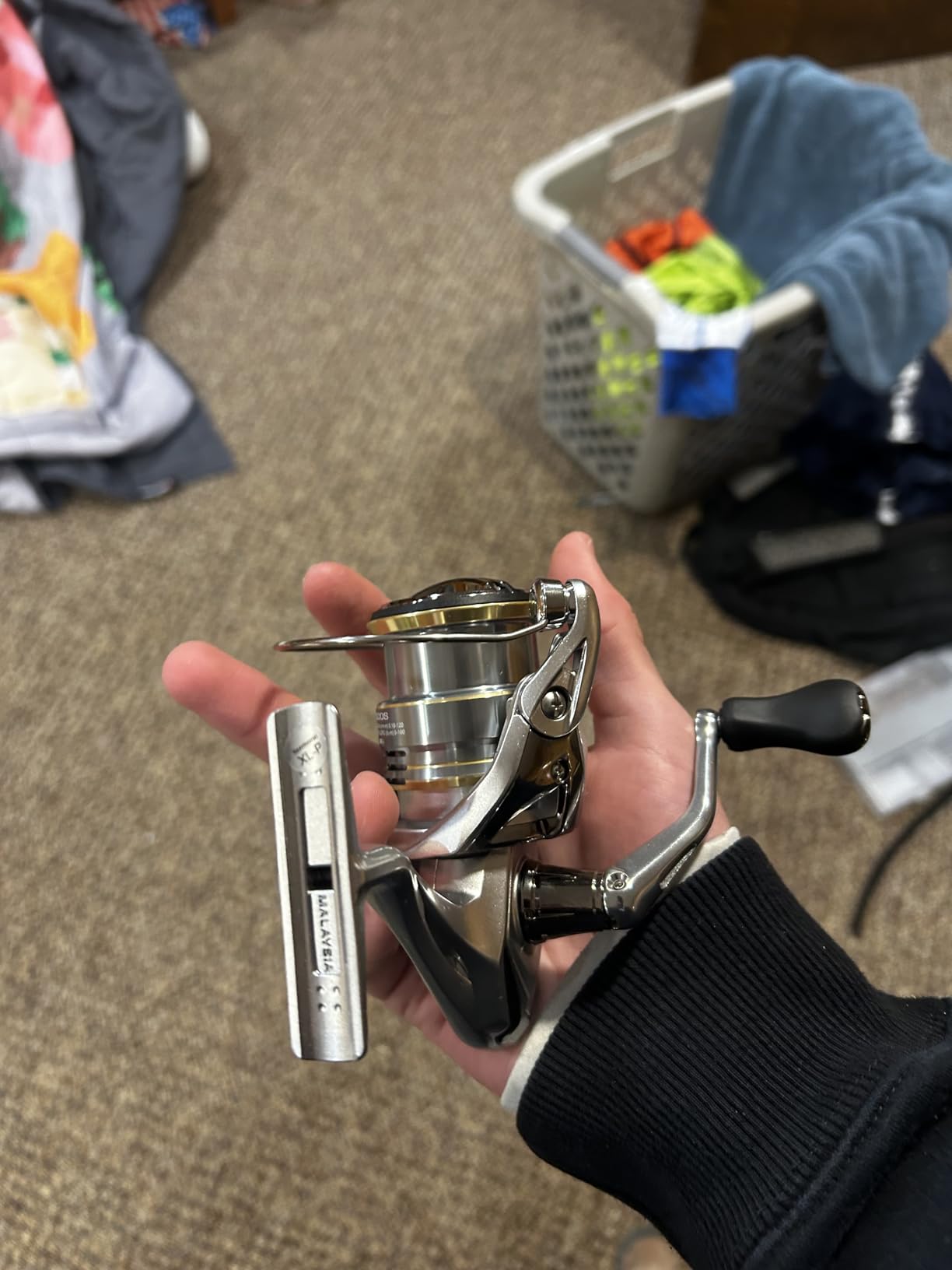
The Sedona C5000XG is the recommendation for someone picking up a saltwater spinning reel for the first time. It is not the most refined reel here, and that is the point: Silent Drive technology keeps the cranking quiet, the drag knob is a large round handle you can find without looking down, and it accepts nylon, fluorocarbon, and PE braid on the same spool.
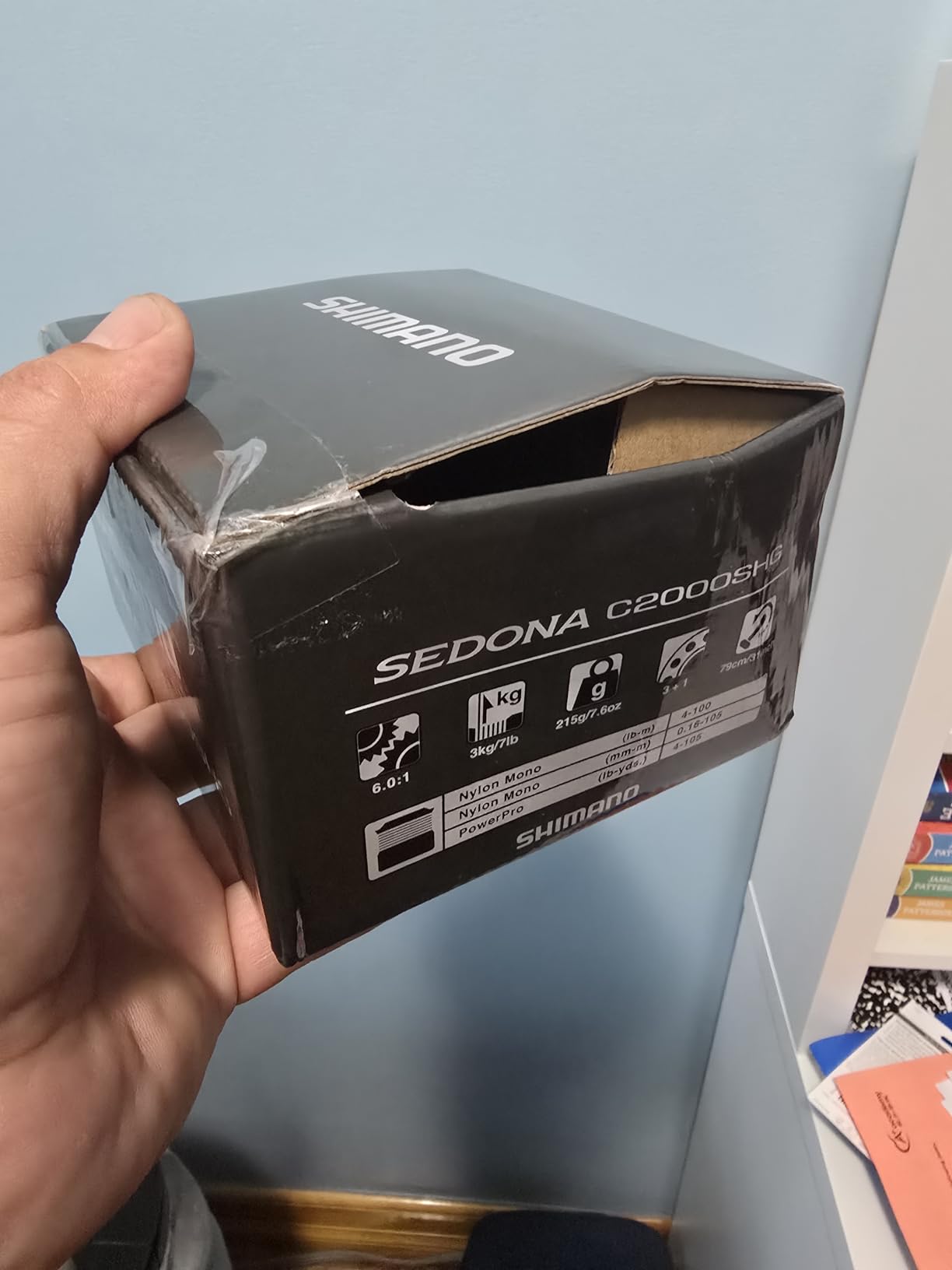
Specifications are straightforward for an angler learning what line capacity means. Line capacity is listed as nylon 4-190, 5-150, or 6-125 yards, fluorocarbon 4-170, 5-135, or 6-115, and PE braid 1.5-400, 2-300, or 3-200, so you can pick a setup from the spool and move up a size as you learn.
At 11.2 oz it stays light on a long saltwater rod without adding fatigue, and the 6.2:1 ratio gives enough speed to work a soft plastic. Owners report it handling sea spray and sand well when rinsed after each trip, and a few have bought a second one after the first held up.
Why beginners land on this one
Three ball bearings plus one roller bearing is a modest count, but on a reel that is not being asked to drag 40 lb through a shark, smoothness at the handle matters more than bearing total. The practical drag is around 13 lb with a maximum of 24.3 lb, so the drag range is wide enough to fish properly without stripping washers.
The spool diameter of 2.1 in and stroke of 0.6 in give a long, thin spool that lays braid down evenly, which reduces the amount of line you have to trim off when you spool new line onto it later.
Where it falls short
A minority of owners find the retrieve is not perfectly smooth, and several note that casting distance is shorter than higher-end spinners in the same size. Both are fair complaints if you are used to a metal body reel, and neither matters much if you are fishing from a dock.
The 268-review base is the smallest of the well-known-brand reels here, so the long-term field record is thinner than the 4.7 and 4.8 ratings suggest. Treat it as a capable starter reel and a place to learn what you actually need next.
10. Accuretta 3000 Saltwater Spinner: Most Bearings in the Roundup
Saltwater Spinning Reel, 13+1BB Smooth Saltwater Fishing Reels, Carbon Drag
13+1 sealed stainless bearings
Silicone waterproof rings at 6 positions
Triple-disc carbon drag to 26 lb
Machined anodized spool
10.69 oz
Pros
- 13+1 is the highest bearing count in the roundup
- Silicone waterproof rings at six key positions
- Anodized aluminum spool casts well and resists line slip
- Carbon drag rated to 26 lb
- Handles braid fluoro mono and wire line
Cons
- 5.2:1 ratio is slow for lure fishing
- Best suited to bait-and-wait rather than fast retrieves
- Unknown brand with a limited long-term record
The Accuretta 3000 is the value pick at the bottom of this list, and the reason is the hardware count. Thirteen stainless steel sealed ball bearings plus an instant anti-reverse, silicone waterproof rings at six positions, and a machined anodized aluminum spool is a lot of specification for a reel at this cost point.
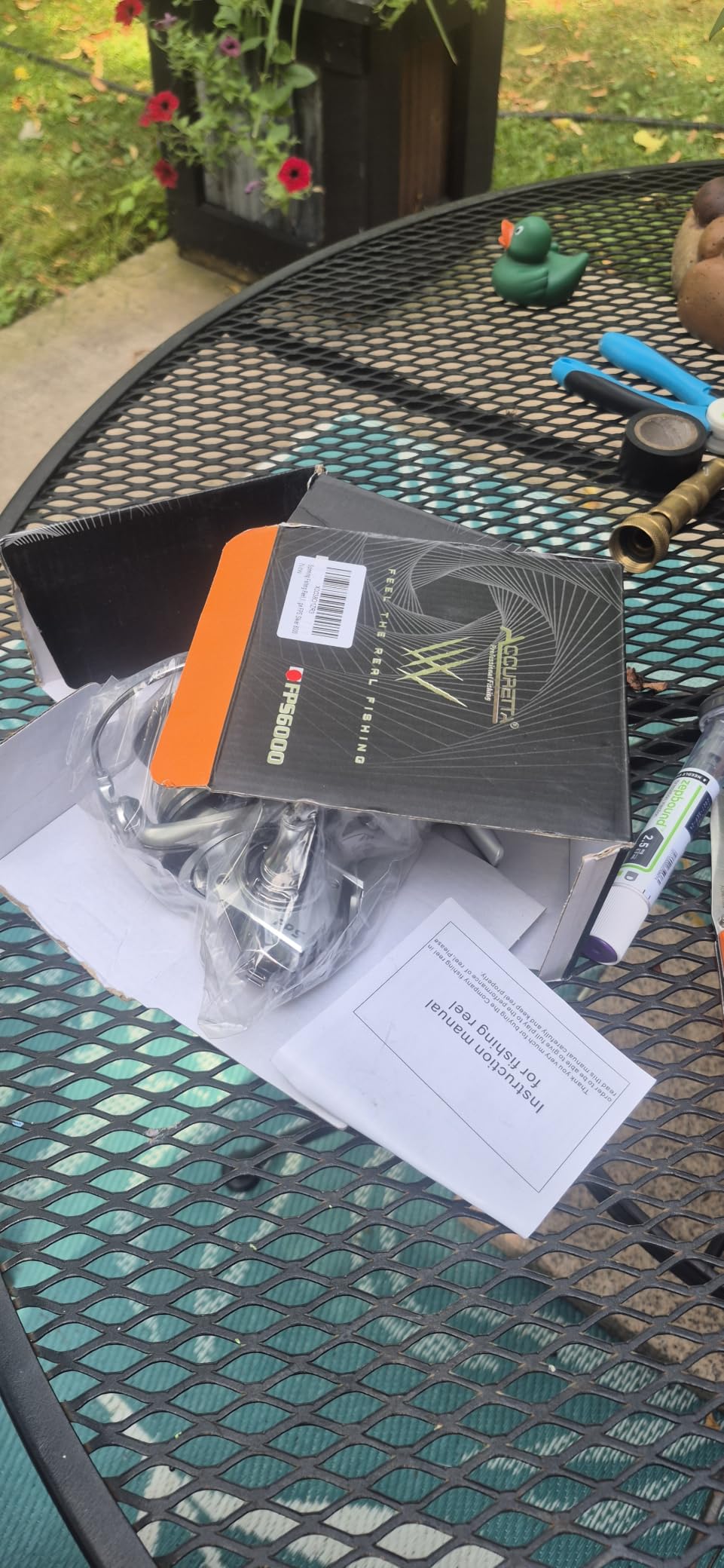
Underneath it is a precision machined zinc alloy tooth plate with a brass tooth bar and a CNC aluminum handle with a screw-in rocker arm. The triple-disc carbon fiber front drag is rated to 26 lb, well past what a 3000 needs for pier and shore fishing, and owners report running it with 30 lb braid in inshore and shore saltwater without complaint.
Reviewers say the smoothness of the crank, bail, and drag repeatedly comes as a surprise, and that the sealed stainless bearings and the anodized spool are what separate it from other reels at the same level.
Bait-and-wait versus lure fishing
At 5.2:1 this is a slow retrieve, and that is the honest limitation. A slow ratio is a benefit when you drop a bait to a fish under a pier and want to reel it back at the speed of the fish, and a liability when you are working a jerkbait or a metal jig with a hard stop and retrieve.
Buyers who are bait-and-wait anglers seem happy with the outcome. Those who expected a fast lure spinner find the reel fine but the gearing wrong for the job, which is a buying mismatch rather than a quality problem.
Where it falls short
The brand carries little reputation and its long-term record is thin, which matters more in salt than in freshwater because you cannot inspect inside a sealed bearing once it starts to go. Budget for the possibility of a bearing service sooner rather than later.
At a 4.4 rating it is the lowest-rated reel here, and that reflects the finish and general refinement rather than the component list. If you want the smoothest possible cranking, step up one reel; if you want the most bearings per dollar and you rinse it every trip, it does the job.
How to Choose a Saltwater Spinning Reel
Start with the water, not the brand. Salt spray, sand, and constant humidity attack an open drag, an unsealed main shaft, and plain steel bearings in that order, so the three questions that narrow your list are how much of the reel is sealed, what metal the rotor and gear are made of, and whether you will rinse it. Every reel on this page survives spray and dunking. None of them survive a season in a truck bed without a rinse.
If you are new to the category, the most common mistake is buying a reel that is too small for the fish and then blaming the drag. A reel that is undersized runs out of spool before the fish gives up, and you end up cranking with a slack line. A reel that is oversized is worse in one specific way: you lose the feel of a bite. Both directions of error cost you fish, but only one of them is obvious while you are fishing.
Size, species, and where you fish
Match the size to the water and the target. The table below maps the common sizes to the jobs they handle, and every reel in this roundup comes in at least one of these sizes.
1000 to 2000 – Bays, estuaries, light tackle for sea trout, pompano, and panfish. Pair with a 6 to 7 foot ultralight rod.
2500 – The all-purpose inshore size. Snook, redfish, sheepshead, Spanish mackerel, and light surf. A 7 foot medium light or medium rod is the match.
3000 – Where most of the variety lives. Flats, nearshore structure, redfish, snook, and schoolfish up to tarpon. A 7 foot medium rod is the safe pairing.
4000 – Surf, pier, and bigger inshore fish. Striped bass, cobia, and heavier bucktails. A 7 foot medium or medium heavy rod.
5000 – Heavy surf and nearshore bottom work. Cobia, shark, and heavy sinker rigs. A 7 foot medium heavy rod or heavier.
8000 and above – Live bait, chunking, and shark work. These are baitfeeder sizes with dual drag, not general-purpose lures reels.
Readers coming from freshwater often ask which is better, a 2500 or a 3000 size spinning reel. The short answer is that a 3000 is the safer default for saltwater because salt water anglers more often encounter a fish larger than expected than a fish smaller than expected, and the extra spool capacity also lets you step up line weight without losing cast distance.
A 2500 is the better call only when you are on a genuinely light rod or chasing small fish in shallow water where spool capacity does not matter. The next question after size is gear ratio, and a 5.2:1 retrieve gives roughly 30 to 40 inches of line per crank while a 6.2:1 gives closer to 40 to 47, depending on spool diameter. Higher ratio means faster lure work and more cranking when a fish runs. Lower ratio means more torque per turn and easier bottom fishing.
Drag is the last specification and the one anglers set wrong most often. Use about a third of the maximum rated drag for the species you expect, which on these reels means setting the 39.5 lb-capable Sharky somewhere near 12 to 15 lb rather than winding it to the stop. Carbon fiber drag holds up better than felt in salt over time, which is why the carbon-equipped reels in this roundup are the ones we would own for multi-season use.
Finally, line. Braid plus a fluorocarbon leader is the standard saltwater pairing because braid cuts through the water column, has near-zero stretch for setting hooks, and resists abrasion on structure, while the fluorocarbon leader provides the invisibility and shock absorption where the fish can see it. Match the reel’s spool capacity to the braid you plan to run before you buy the reel, not after.
There is one situation where a spinning reel is the wrong tool. If you are fishing heavy cover, big structure, or live bait offshore where you need to put a heavy rod tip down and apply constant pressure, a baitcasting reel or a conventional gives you more control and far more cranking power per turn. Beginners are regularly steered to baitcasters for offshore work and give up on them. Spin first, move up when the fish force you to.
Saltwater Reel Sizes Explained
Reel sizes are a naming convention, not a measurement, and the numbers scale roughly with spool diameter, line capacity, and body weight at the same time. A 2500 holds less line, weighs less, and has a smaller spool than a 4000, which means it holds less line, weighs more, and casts further. That single relationship explains almost every sizing mistake beginners make.
The practical rule is that the size should follow the rod and the water. A reel that is one size too large for its rod makes the rod tip-heavy and kills sensitivity, and a reel that is one size too small will not hold the line weight the rod is built to throw. Because rods and reels are sold in matching size families, the number on the reel and the number on the rod blank usually already agree if you keep the pair in the same family.
If you are undecided between two sizes, step up. Saltwater anglers consistently report the reel that is slightly too large is more recoverable than the reel that is slightly too small, because you can add a shim and a heavier rod later, but you cannot add spool capacity in the middle of a fight with a striper.
What Actually Makes a Reel Saltwater Rated
Saltwater damage happens in three places. Water gets into the rotor and dissolves the ball bearings, which then grind and skip. Salt crystallizes in the drag washers and makes the drag sticky and inconsistent. Salt pits the bail arm, the rotor, and the body, and eventually seizes the moving parts against each other. Sealing, stainless or shielded bearings, sealed drag washers, and a freshwater rinse after every trip block all three.
Water resistance ratings exist on some reels and not others. A rating of IPX5 means protection against water jets from any direction, which covers rain, spray, and a hose rinse. IPX8 means continuous immersion. Neither rating tells you anything about sand, which is often more destructive than water, so the sealed drag and the shielded bearings matter more in practice than the rating printed on the box.
Manufacturers also use phrases like sealed and maintenance free, and that language is worth reading carefully. A sealed drag that can never be serviced is a sealed drag that cannot be fixed when it needs cleaning. A sealed main shaft with removable drag washers is the arrangement most experienced anglers ask for, because it blocks salt on day one and still opens up for maintenance in year three.
Aluminum versus composite body is the other question. Aluminum is stiffer, resists flex, and survives knocks, and it can dent. Composite bodies are lighter and will not dent, and they scratch. Neither material is disqualified by salt, but the forum consensus is clear that a metal rotor, a metal gear, and a metal main shaft matter far more for longevity than the body shell, and that a composite body on a reel with a stainless shaft and a carbon drag is a perfectly good saltwater build.
Inshore vs Offshore: Which Reel Do You Need
Inshore means shallow, sheltered water, and the constraints are different in every direction. Sand and spray are heavier on the reel than wave action, the fish are often sight-cast at close range, and the effort is spent holding a rod all day. Offshore means deeper water, more spray, heavier fish, and reels that need to carry heavier line with room to spare.
For inshore flats and bays, weight and feel are the priorities. A reel in the 9 to 10 oz range, like the Spartacus II, keeps the rod sensitive and the arm comfortable, and a slow-ish 5.2:1 ratio suits the deliberate pace of sight casting. Spray protection matters more than drag capacity, because nothing you catch in 2 feet of water is going to reach 20 lb of drag.
For nearshore structure, pier, and surf fishing, you move up to a 4000 with a faster ratio and a braid-friendly spool. Sand abrasion on the spool and the line capacity ring is the constant enemy here, so a machined aluminum spool and a thicker line capacity ring are the details to look at, not the bearing count.
For true offshore work and live bait, capacity and drag take over. A 5000 with 30 lb of drag and a 4000 with 15 lb are both legitimate offshore tools depending on the species and the line, and the 8000 baitfeeder is the correct answer for chunking and shark work because it lets bait swim without a taut line. Matching the reel to the size of the fish is what separates an offshore setup that works from one that loses fish at 150 yards.
How to Stop a Saltwater Spinning Reel From Rusting
The maintenance routine is not optional, and it is the single most cited thing experienced anglers do that beginners do not. The Saltwater Fishing subreddit and forum threads on this topic return to the same point: most early reel failures are preventable with five minutes of work after a trip.
Rinse with fresh water immediately. Hold the reel under a gentle stream of fresh tap water with the spool open and the bail open. Never use a pressure washer or a blast of force, because it forces water past the seals you paid for.
Pull the spool off and rinse separately. Salt collects in the gap between the spool and the body and in the spool band, where it crystallizes and then scores the spool. Separating them is the step that most people skip.
Let it dry completely before storage. Set the reel and spool on a towel out of direct sun. Storing a damp reel in a closed boat locker is the worst case for corrosion, because humidity with no airflow is what pits aluminum.
Lubricate the spool and the handle, not the drag washers. A light high-pressure reel oil on the spool, the bail arm, and the handle screw is right. A drop of reel oil on a carbon fiber drag washer is not, and it will contaminate the drag. Never use WD-40 on bearings or on a drag.
Check the drag for grit before every trip. Spin the drag knob and watch the spool. If the start-up is gritty or the drag pressure is inconsistent, clean the washers with warm fresh water and a soft brush while they are still apart.
Rinse more often than you think you need to. On a multi-day offshore trip, a rinse every evening is the difference between a reel that lasts a decade and one that needs service in year two. Salt does not stop working on your reel because you stopped noticing it.
Beyond the rinse, a few habits extend reel life. Loosen the drag before storing, so the washers are not compressed against each other. Do not leave a reel in direct sun on a dashboard. And if you own a saltwater rod and reel combination, keep the reel off the rod for long-term storage so stress in the seat does not creep into the drag washers. The same discipline of separating a part, cleaning it, and letting it dry fully before reassembly is why our auto top-off guide for saltwater tanks insists on flushing fittings on a schedule rather than waiting for a failure.
Related gear care matters in the same way. If you also maintain aquarium equipment, the same rinse-and-lube discipline carries over: our guide to refractometers for saltwater aquariums covers salinity measurement and cleaning routines for equipment that lives in salt water permanently, which is an even harsher environment than a fishing reel.
Frequently Asked Questions
What size spinning reel is best for saltwater fishing?
A 3000 size is the best default for most saltwater anglers because it balances sensitivity with enough spool capacity to step up line weight. Use a 2500 on light rods for bays and small fish, a 4000 for surf and pier work, and a 5000 or larger for offshore bottom fishing and shark work. Match the size to the rod and never over-size a reel for a light rod, because it kills sensitivity.
What is better, a 2500 or 3000 size spinning reel?
The 3000 is the safer choice for saltwater because anglers more often meet a fish larger than expected than one smaller than expected, and the larger spool capacity lets you run heavier braid without losing cast distance. Choose the 2500 only when you are on a genuinely light rod or targeting small fish in shallow water, where spool capacity does not matter.
What is the best spinning reel for sea fishing?
The KastKing Sharky 5000 is our overall pick for sea fishing, with 5374 reviews, a 39.5 lb carbon fiber drag, 10+1 shielded bearings, and a 6.2:1 retrieve in a 9.8 oz frame. For surf and pier sand the Penn Battle IV 4000 holds up best, and for premium inshore work the Shimano Stradic FL 2500 has the highest rating in the group.
What is the best value-for-money saltwater spinning reel?
The Penn Wrath II 4000 is the best value pick, offering a corrosion-resistant graphite body, a machined anodized aluminum spool, and a fast 6.2:1 retrieve at an entry-level cost. The KastKing Megatron 6000 is the better value for big fish, with a metal frame and 30 lb of carbon fiber drag. Both need a freshwater rinse after every trip.
Can I use a freshwater spinning reel in saltwater?
You can, but expect a shorter life. A freshwater reel has unsealed bearings and often a felt drag with no corrosion protection, so salt will grind the bearings and crystallize the washers within a season. Rinse it thoroughly after every use, keep the drag clean, and replace it within a reasonable timeframe. Buying a sealed saltwater-rated reel costs less than replacing a reel every twelve months.
How do I stop my saltwater spinning reel from rusting?
Rinse the reel with fresh water right after every trip with the bail and spool open, remove the spool and rinse it separately, and let both dry fully before storage in a closed locker. Add a light drop of reel oil to the spool, bail, and handle, never to the drag washers, and never use WD-40. On multi-day trips, rinse every evening rather than at the end of the trip.
Conclusion
The best spinning reels for saltwater fishing in 2026 are the ones whose sealed parts you can trust and whose drag you can actually set, so start from the water you fish and the size of the fish that lives there. The KastKing Sharky 5000 is the pick we would put on most rods for its proven drag, bearing count, and light frame, and the Penn Battle IV 4000 is the safer bet when sand and heavy surf are the constant.
Everything else in this roundup earns its place for a specific job: a lighter reel for the flats, a faster one for lure work, a baitfeeder for live bait, and a sealed aluminum option for anglers who want published water resistance figures. Whatever you choose, run the freshwater rinse before it goes in storage. The maintenance routine does more for reel life in salt than any specification on the box.