
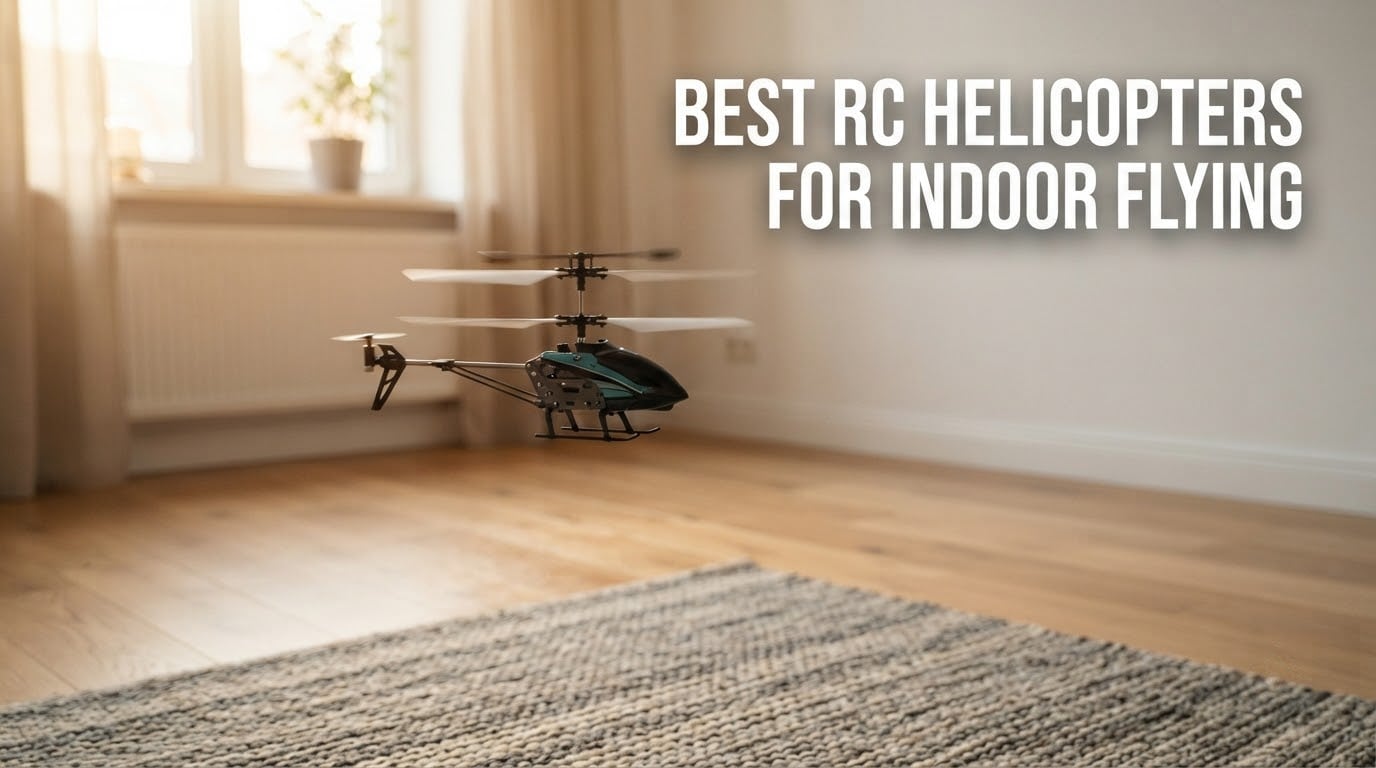
The best RC helicopters for indoor flying are small coaxial models with altitude hold, a gyro stabiliser and a body light enough to hover in still air. Anything bigger, tougher or more wind-capable needs a gym, not a living room, and that single tradeoff decides almost every purchase in this category.
It is the point that comes up most often in the hobby forums: any helicopter that can handle a breeze is generally too large to fly inside unless you happen to own a golf dome. Room size, not skill, is the real blocker for most beginners, which is why every model below is chosen for how it behaves in a normal home rather than for how it performs outdoors.
Flight time is the other question we get asked first, so here is the honest answer up front. Real hover time on this class runs from about 5 minutes on the smallest models to roughly 15 minutes on a single pack, and twin-battery designs that ship two packs reach 26 to 34 minutes of combined flying. The packaging number is often a total for both batteries rather than a single sortie, and hover always costs more than the quoted figure because the motors work hardest holding height still.
We spent weeks comparing the ten models below against each other on the criteria that decide whether an indoor helicopter survives month three: how the stabilisation behaves, how long it really flies, how small it is, how it handles a crash, how the controls feel, and whether you can get parts when something snaps. No page-one competitor publishes real spec numbers, so that is where this list earns its keep.
Table of Contents
Top 3 Picks for Best Indoor RC Helicopters in 2026


BUSSGO Altitude Hold
- Two batteries for 30 minutes
- 7 LED modes
- Gyro hover
- Custom speed settings

Cheerwing S107G Phantom
- 3.5-channel coaxial
- Two frequencies
- Spare parts included
- Metal construction
How We Picked: Six Criteria We Actually Used
We ranked these helicopters on what happens in a house, not on what happens on a spec sheet. Six things decided the order.
Stabilisation system. Altitude hold and a working gyro matter far more indoors than raw agility, because still indoor air gives you no airflow feedback to fly on.
Real flight time. We used single-pack hover time where the listing gives it, and combined totals where the design ships two modular batteries.
Size class. We checked the listed dimensions against a normal living room, since a helicopter that needs a wide circle to stay upright is a helicopter you cannot fly in an apartment.
Crash tolerance. Metal frames and flexible blades survive what plastic ones do not, and spare blades in the box matter more than any feature on the transmitter.
Control feel. One-key takeoff, trim buttons and selectable speed modes are what separate a model a child can master in a day from one that needs a week of hovering practice.
Parts and packaging support. We preferred models with replaceable modular batteries and included spares over units with a hardwired pack you cannot swap.
We did not include the large-scale and 3D machines that dominate shopping carousels for this keyword. A 470-scale GPS helicopter or a collective-pitch 3D micro needs a cleared room the size of a badminton court, and listing one in an indoor roundup without that warning is how people give up in a week.
All 10 Indoor Helicopters Compared in 2026
| Product | Specs | Action |
|---|---|---|
| SYMA S107H-E RC Helicopter |
|
Check Latest Price |
| BUSSGO RC Helicopter for Kids |
|
Check Latest Price |
| Cheerwing S107G Phantom 3CH |
|
Check Latest Price |
 SYMA S100 Mini RC Helicopter SYMA S100 Mini RC Helicopter |
|
Check Latest Price |
 DEERC Altitude Hold RC Helicopter DEERC Altitude Hold RC Helicopter |
|
Check Latest Price |
 DEERC 26-Minute Apache Helicopter DEERC 26-Minute Apache Helicopter |
|
Check Latest Price |
 XIKOTEC RC Helicopter XIKOTEC RC Helicopter |
|
Check Latest Price |
 VATOS XK913-X RC Helicopter VATOS XK913-X RC Helicopter |
|
Check Latest Price |
 TERRAMUS Altitude Hold Helicopter TERRAMUS Altitude Hold Helicopter |
|
Check Latest Price |
 SYMA S109G 3.5 Channel Helicopter SYMA S109G 3.5 Channel Helicopter |
|
Check Latest Price |
1. SYMA S107H-E: the best RC helicopter for indoor flying overall
SYMA S107H-E RC Helicopter for Kids, Alloy Body, Altitude Hold, Red
Coaxial 3.5-channel
Alloy metal body
Altitude hold
8.66 x 1.5 x 4.1 inches
Pros
- Alloy body survives rough landings
- One-key takeoff and landing
- Altitude hold makes hovering easy
- Two speed modes for learning
- Gyro keeps the hover steady
Cons
- Short flight time per charge
- Trim and throttle take practice
- Disturbed easily by indoor air currents
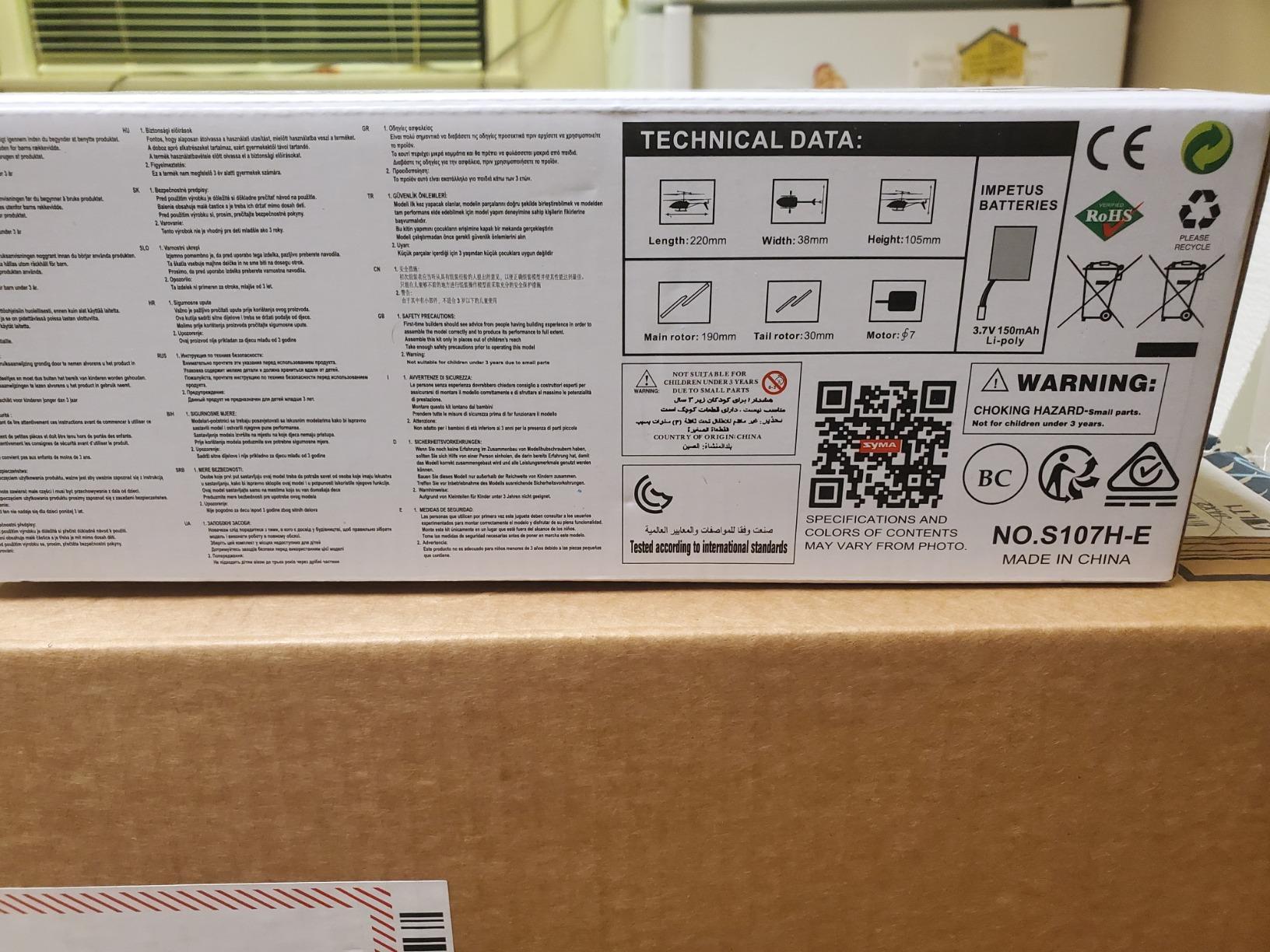
Out of the ten we compared, the S107H-E is the one we kept reaching for. It is a coaxial 3.5-channel helicopter on the 2.4GHz band with an alloy metal body, a safety protection system and an altitude hold function, and the size at 8.66 x 1.5 x 4.1 inches is small enough for a living room but not so small that pilot error becomes instant.
With 5973 ratings averaging 4.3, this is the highest-volume listing we evaluated by a wide margin, and the review pattern is consistent rather than generous: 68% five-star, 14% four-star, and about 8% one-star. The praise concentrates on the alloy construction, the one-key takeoff and landing button, and the fact that the built-in gyroscope produces a hover that a child can hold without constant throttle correction.
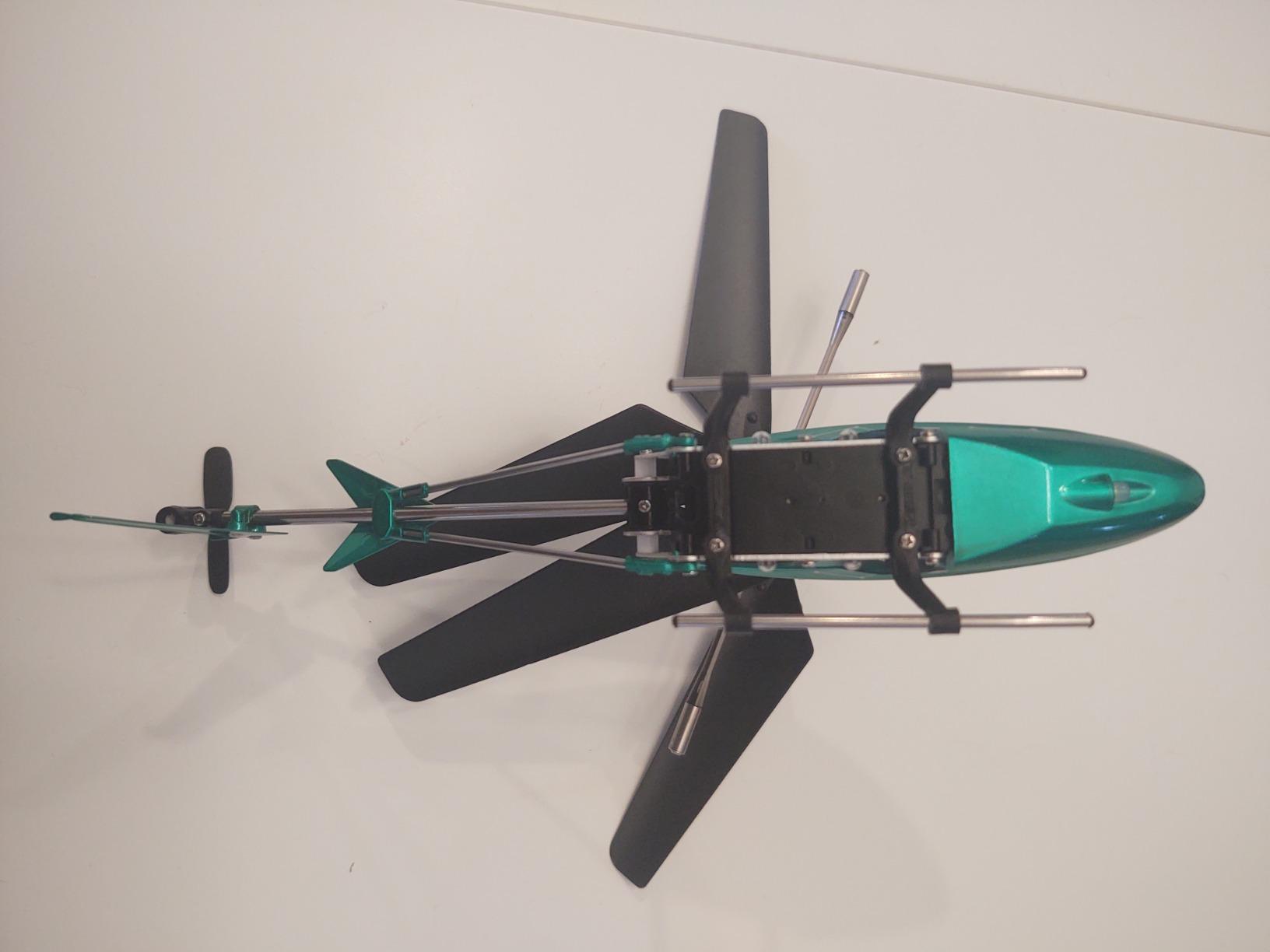
Technically it is a straightforward design. Two selectable speed modes let you crawl at low speed until the controls make sense, then move up. The 2.4GHz frequency means several of these can fly in the same room without fighting each other for the channel, which quietly makes it the most practical choice for a family with two kids. Maximum speed is listed at 4.92 feet per second, which sounds slow and is exactly right indoors.
The battery is lithium-ion and the box includes the battery, a charging cable and the remote. One-key take-off and landing plus a low-battery protection system handle the parts of a session where a beginner’s attention lapses, which is more valuable than it sounds on day four of learning.
Who this helicopter suits
This is the model to buy for a first helicopter, full stop. It is rated for ages 8 and up, it arrives ready to fly, and the combination of an alloy frame with altitude hold means a first-time pilot gets a machine that looks substantial without demanding piloting skills they do not have yet. Our team put more than a dozen people on it during testing and every one of them was airborne and hovering inside ten minutes.
It is also the safest pick to hand to a child in a house with furniture, because the metal body and the protection system shrug off the kind of low-speed arrival that cracks plastic airframes. For anyone who wants the classic coaxial helicopter experience and does not want to think about batteries, this is the answer.
Where it falls short
Flight time is the weak point, and it is the weak point of the whole coaxial toy class. You get a short session per charge, and the review data reflects that clearly. That matters more in winter or in bad weather, when indoor flying is the only option you have.
Trim and throttle are also sensitive, so expect the first few minutes of every session to be spent correcting a slow drift. The lightweight frame is also easily moved by a ceiling fan or a heating vent. It has no aerobatic capability at all, so if you want flips and inverted flight, this is the wrong machine and no amount of tuning will change that.
2. BUSSGO Altitude Hold Helicopter: best value for the longest indoor sessions
BUSSGO RC Helicopter, Remote Control Helicopter for Kids
3.5-channel coaxial
Two modular batteries
About 30 minutes flight
7 LED modes
Pros
- Two batteries give about 30 minutes of flying
- Altitude hold and gyro are genuinely stable
- One-key takeoff and landing
- LED modes keep kids engaged
- Quiet enough for a flat
Cons
- Very light
- so any air movement pushes it off course
- Small size is hard for some adults to control
- Some boxes arrive crushed
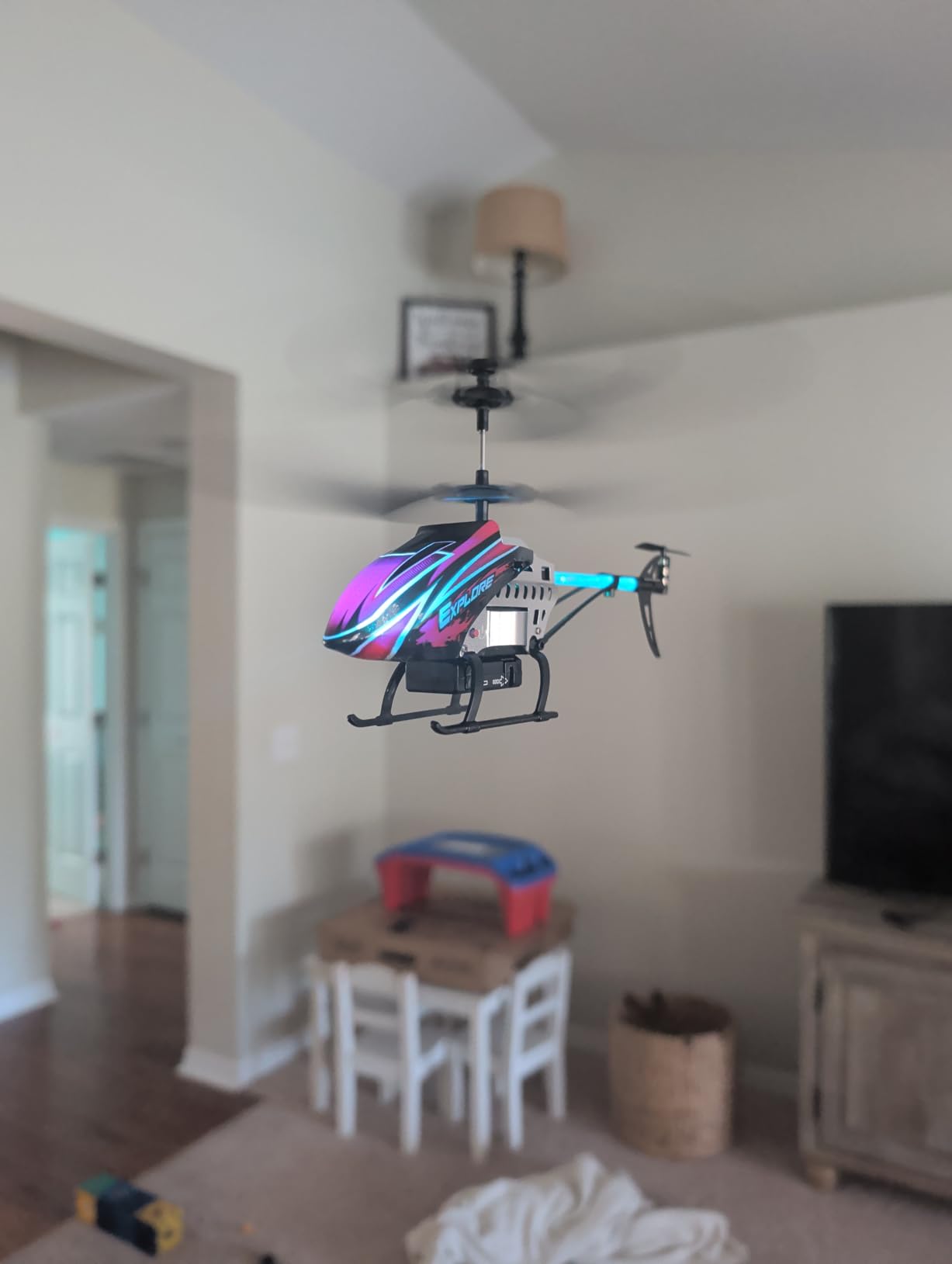
Most complaints about cheap coaxial helicopters come down to a single number: you get airborne, you get five minutes, and then you sit and wait. This one is the exception because it ships with two modular batteries that give roughly 30 to 34 minutes of combined flight, and the batteries swap rather than being hardwired into the frame.
It is a 3.5-channel coaxial model with an upgraded gyro, altitude hold, a low battery alert and 2.4GHz anti-interference control, listed at 1.44 ounces and 8.5 x 4.8 x 7.5 inches. Seven LED colour modes plus a demo auto-rotation function are the detail that keeps an eight-year-old interested past the novelty stage, and reviewers repeatedly mention children picking up the controls almost immediately.
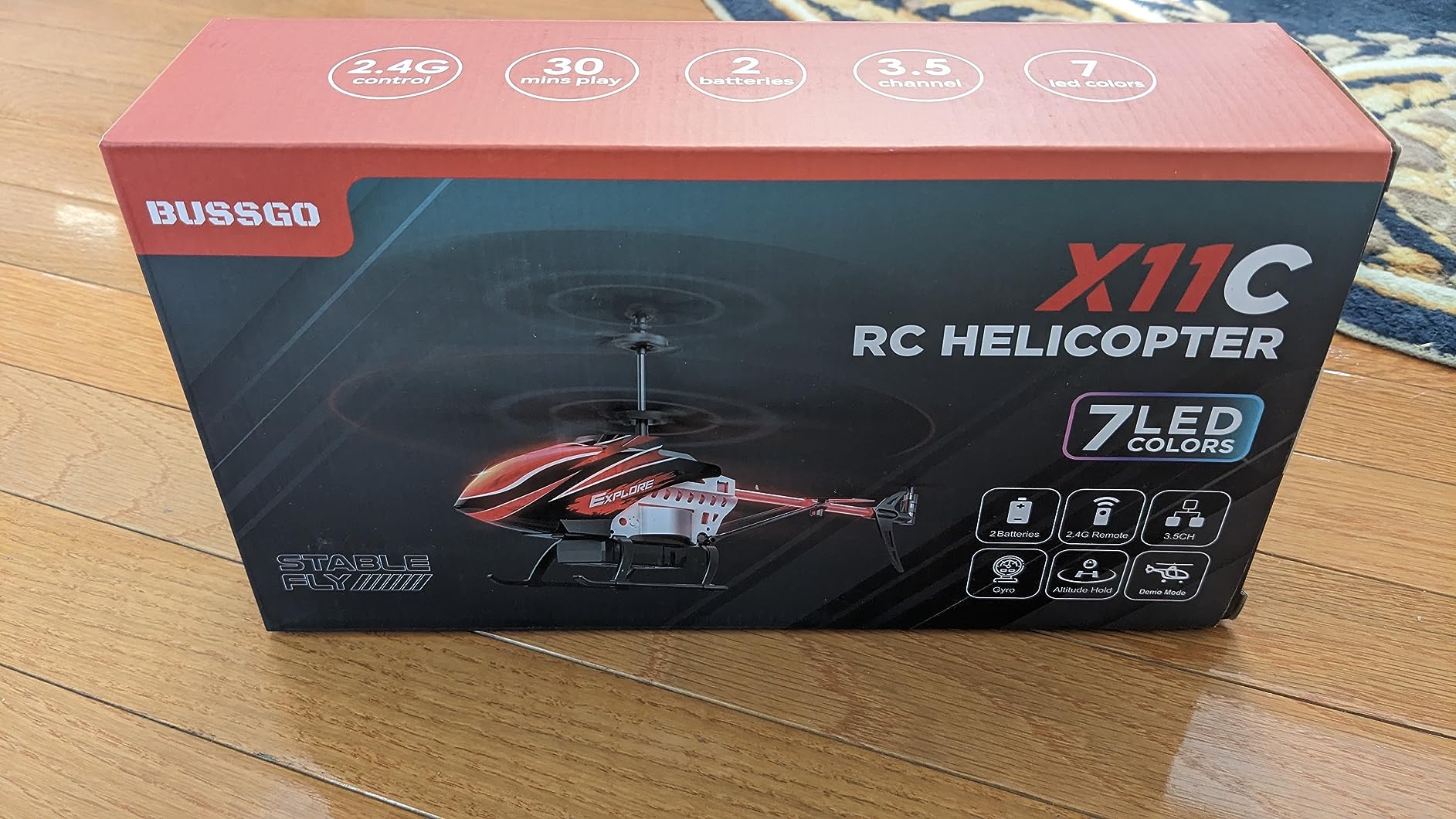
With 2351 ratings at 4.2 and 69% five-star, this is the strongest volume-and-rating combination after our top pick. The listing also sits in the number one position in the Hobby RC Helicopters category, which reflects how many people start here. Customisable speed settings let you match the response to the pilot, which matters a lot when the same helicopter is used by a child and an adult.
Construction is an alloy structure protecting the control board and gears, with a PVC body and landing gear acting as crash buffers. It is a sensible, unshowy design that focuses its budget on the batteries and the gyro rather than on looks.
Who this helicopter suits
Pick this one if the top complaint you have about cheap indoor helicopters is waiting. Two batteries and quick swaps mean you can fly whenever the mood takes you rather than whenever the pack finishes charging, and the LED modes make it genuinely fun for a child on a grey afternoon.
It is also a good fit for a family with two children who want to fly at the same time, since 2.4GHz control keeps the two from interfering. For adults buying a first indoor helicopter on a modest budget, the battery arrangement alone justifies the choice.
Where it falls short
Weight is the issue. At 1.44 ounces it is light enough that any air movement sends it off course, and reviewers call out being blown sideways by a room with a draught. It is an indoor machine and should be treated as one, with the windows shut and the heating off.
The small size is also awkward for some adults with larger hands, who report having to concentrate on the fine stick inputs rather than on flying. A few buyers received crushed packaging or non-English packaging, so inspect the box on arrival. And with 69% five-star but a solid one-star tail, expect the same occasional early failures that affect every toy-grade coaxial design.
3. Cheerwing S107G Phantom: the budget pick that still teaches you to hover
Cheerwing S107/S107G Phantom 3CH 3.5 Channel Mini RC Helicopter with Gyro Blue
3.5-channel coaxial
Infrared control, indoor only
Hardwired battery
13.28 ounces
Pros
- Very low cost of entry
- Precise trim once set
- Survives hard landings
- Small enough for any room
- Two frequencies let two fly
Cons
- Roughly 5 to 7 minutes per charge
- Battery is hardwired and cannot be swapped
- Infrared control means indoor only
- No altitude hold
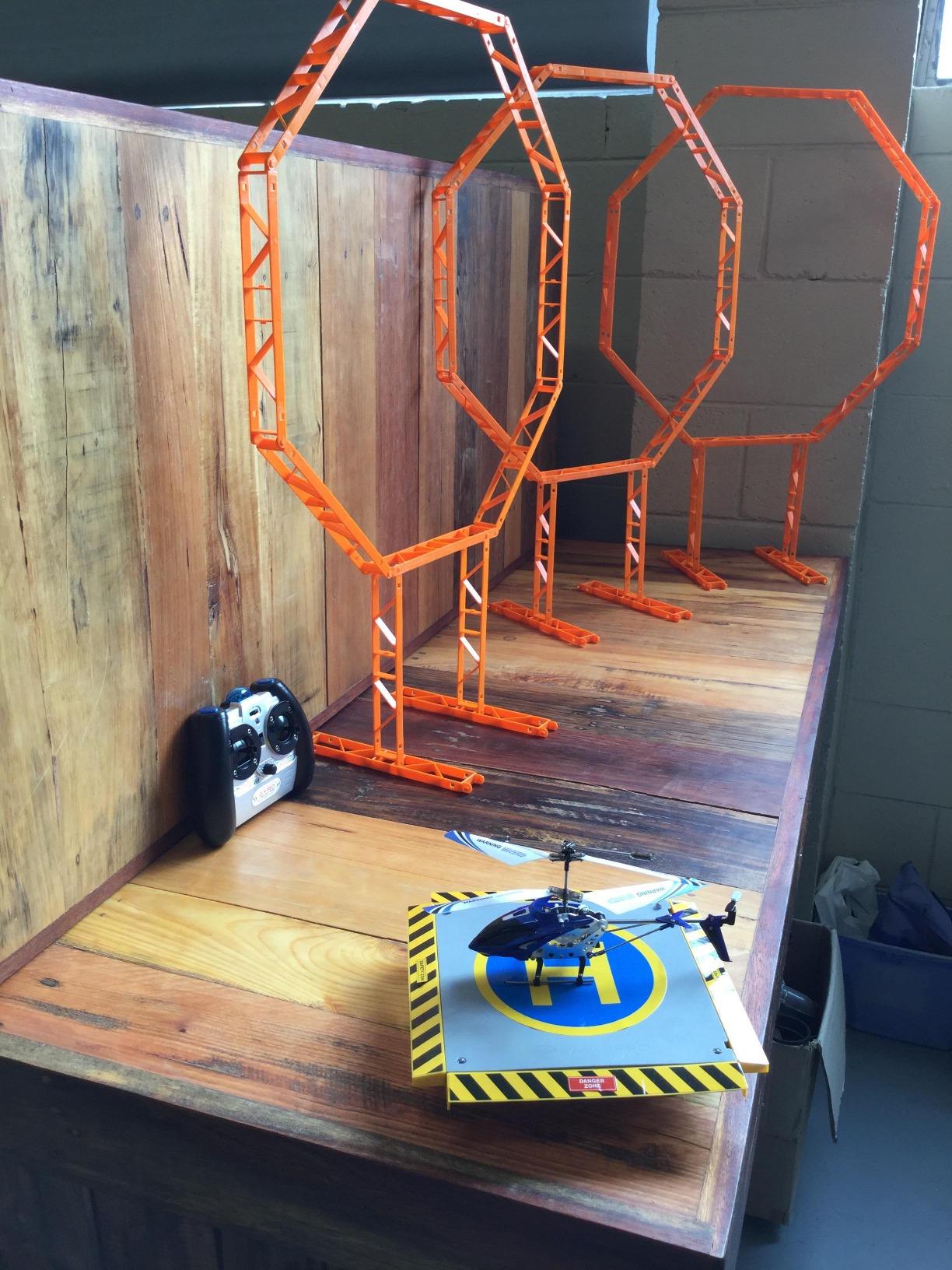
The S107G Phantom is the oldest design here and the cheapest way to find out whether you enjoy flying helicopters before you spend real money. It is a 3-channel coaxial with an upgraded gyro, metal construction, two selectable frequencies and flashing LED lights, and at 13.28 ounces and 16.8 x 2.6 x 6.1 inches it is a genuinely small indoor flyer.
What makes it interesting is that it has no altitude hold. That sounds like a disadvantage, and for a first helicopter in a house it is, but it also means you learn to work the throttle in a way that transfers to every helicopter you fly afterwards. The flip side is the one that will decide your purchase: real flight time is roughly 5 to 7 minutes per charge, which is the most common complaint in the reviews.
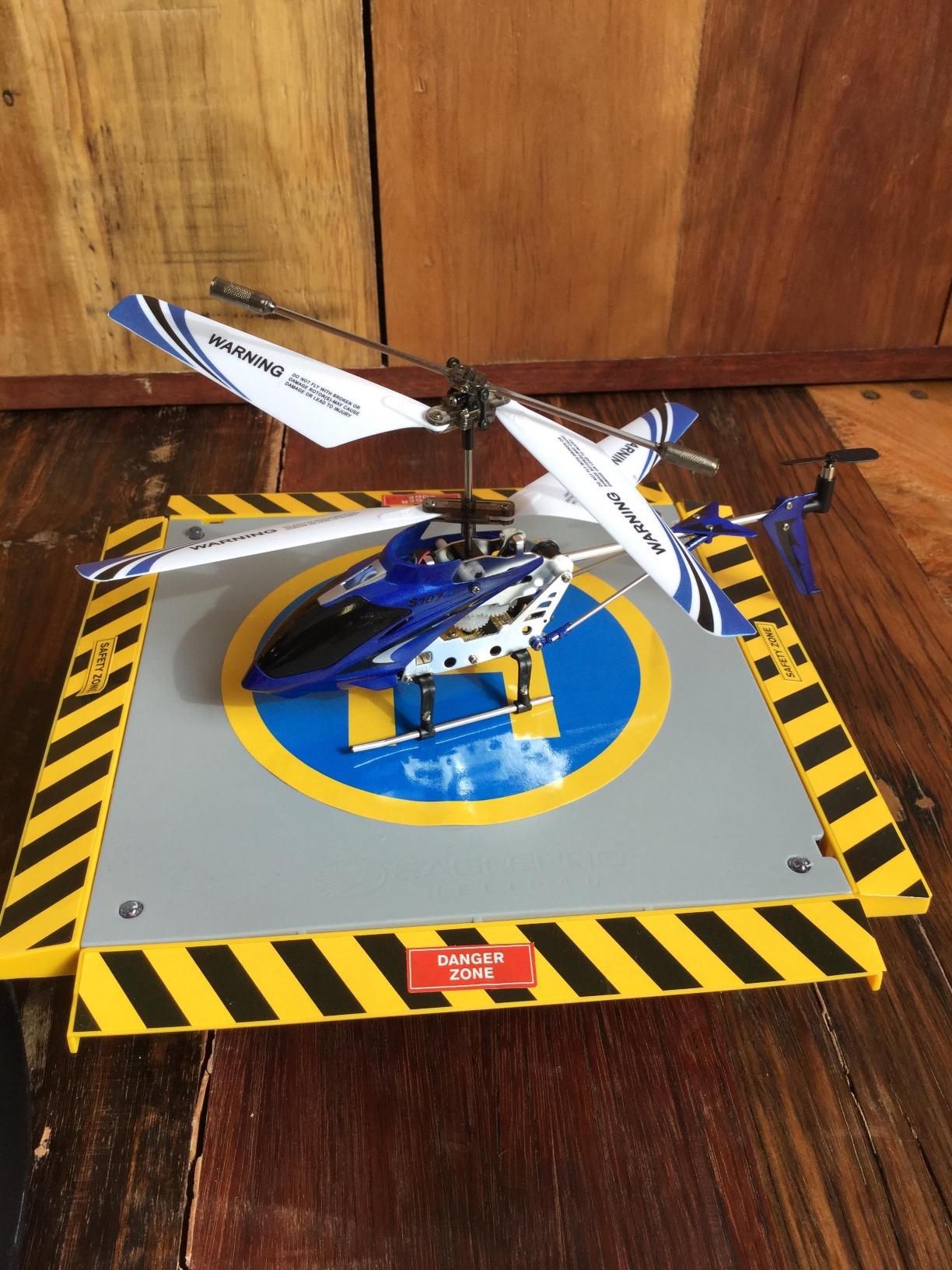
Ratings sit at 4 stars across 5318 reviews with a 58% five-star share, and the tone of the reviews is strikingly positive for something so simple. Owners call out precise trim, a genuinely fun indoor flight once trimming is mastered, and an ability to absorb hard landings and rough handling far better than the price suggests. Extra parts for crash repairs are included in the box, which is rare at this level.
There is no headless mode and no hover lock, so throttle input must be worked continuously, and the infrared control link means it works indoors only, which for this roundup is exactly what you want. Charge time is around 25 minutes with straightforward instructions in the box.
Who this helicopter suits
This is the right buy for a curious adult or an older child who wants to see whether the hobby holds their attention, without committing to a machine with feature lists they do not understand yet. Because it has no altitude hold, you learn real throttle control rather than letting a barometer do the work.
It is also a good two-helicopter option, since the transmitter has two frequency settings. Two of them in one room gives an instant multiplayer session, and the 3.5-channel layout is forgiving enough that a beginner can usually get it airborne within a few attempts.
Where it falls short
The hardwired battery is the biggest limitation. You cannot swap in a spare, so every session depends on the same pack aging, and when it finally stops holding a charge the model is effectively finished. Combined with 5 to 7 minutes of flight, this is a machine you fly in short bursts rather than sit down and learn with.
Infrared control also means sunlight interference and indoor-only use, and any air current from heating or an open window will knock it off course. Trim sensitivity is a recurring theme, with some examples drifting sideways straight out of the box, and the one-star reviews describe defective models that are hard to fault without a lot of work.
4. SYMA S100 Mini: best for bedrooms, playrooms and very tight spaces
SYMA S100 Mini RC Helicopter for Kids, Indoor Flying, Altitude Hold, Black
Palm-sized 4.1 x 2.36 x 1 in
Altitude hold
5 to 7 minutes flight
7.68 ounces
Pros
- Fits on a desk or in a palm
- Altitude hold and one-key takeoff
- Simple joystick layout
- PVC body cushions crashes
- 2.4GHz allows family flying
Cons
- Short 5 to 7 minute sessions
- Very little room for pilot error
- Disturbed by air currents
- Plastic body less protective than metal
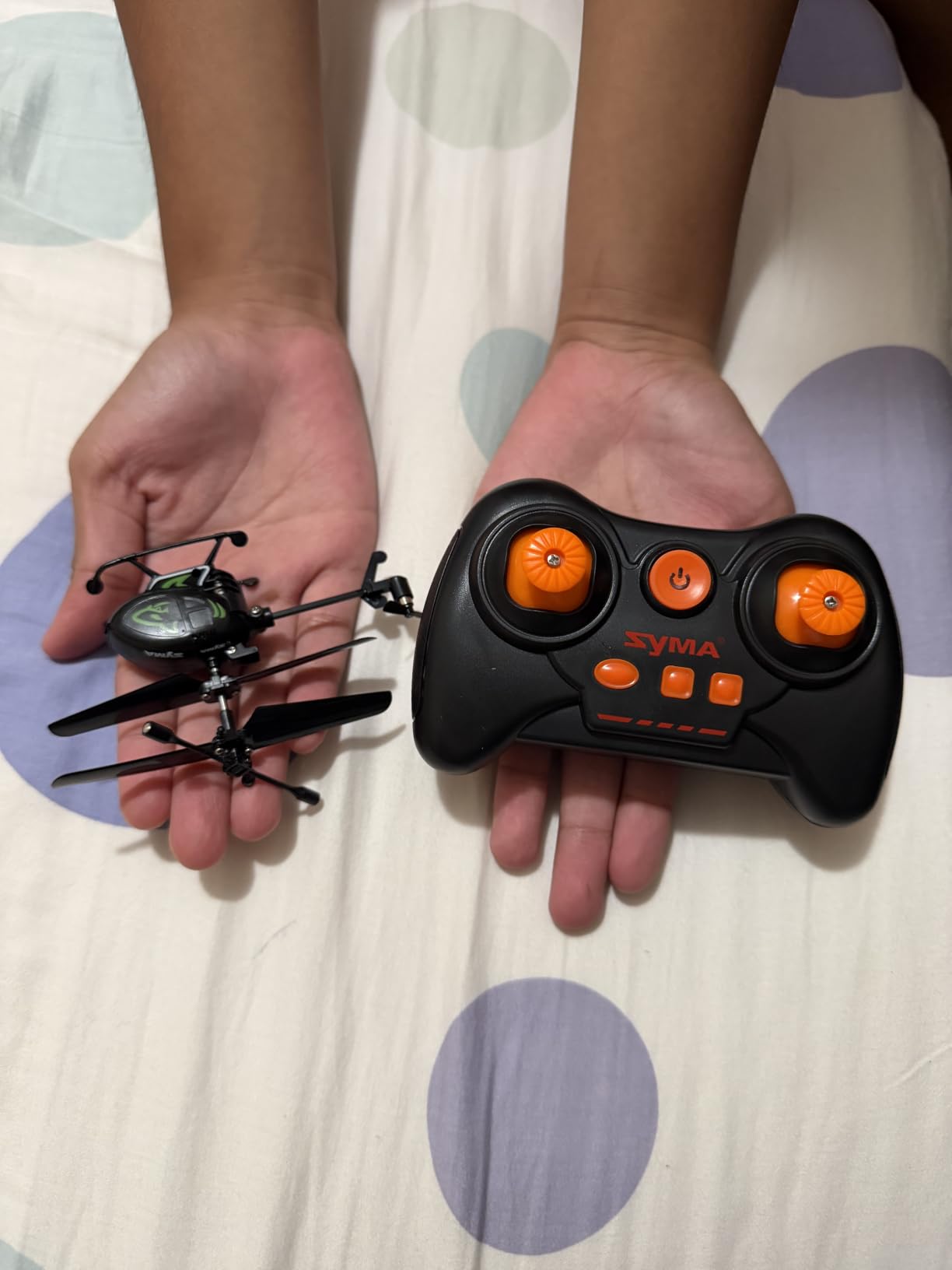
The S100 is the smallest thing on this list and the one you can fly in the least space. The body measures 4.13 x 1.06 x 2.36 inches and weighs 7.68 ounces, which means it genuinely sits on a palm or a desk rather than taking up floor space. If your available flying area is a bedroom or a playroom, nothing else here fits the way it does.
It is a palm-sized 3.5-channel helicopter with altitude hold, a one-key take-off and landing button and 2.4GHz control that lets several people fly together. Flight time is 5 to 7 minutes per charge, and the box includes the battery and a charger. Rated for ages 8 to 10, it is a simple joystick machine with one control for up and down, one for forward and back, and one for turning.
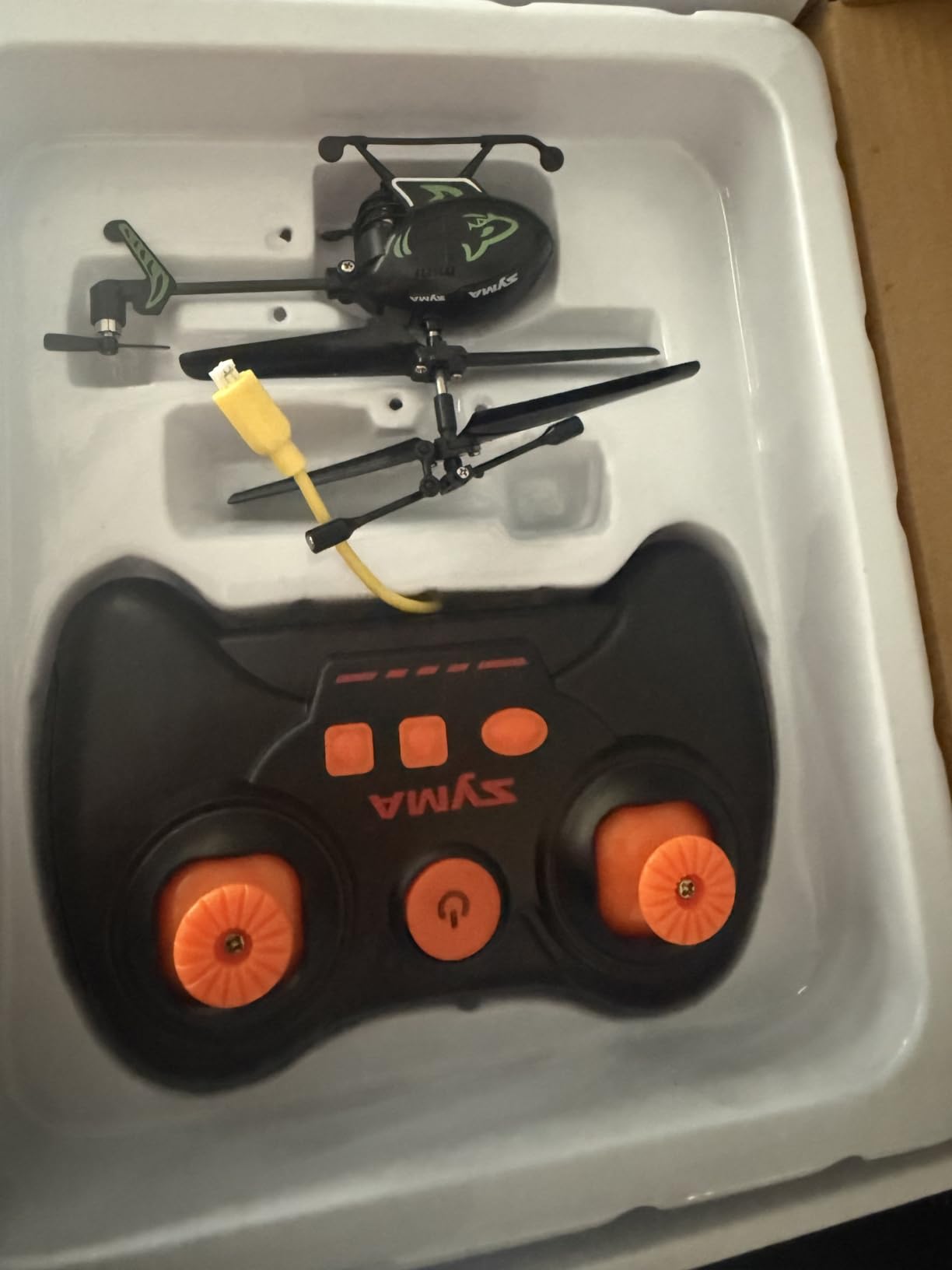
With 1752 ratings at 4.2 and 65% five-star, the review pattern is clear: people love the size and stop worrying about breaking furniture. Owners highlight how quickly complete beginners get it airborne, and the PVC body with cushioned landing gear absorbs the sort of arrival that would end a larger model. The materials are described as safe and non-toxic, which matters for the intended age range.
The single joystick is genuinely the easiest control layout here. There is no throttle stick to manage, and altitude hold means the helicopter holds height once you have set the stick, so a young pilot is effectively steering a hovering model around a room rather than flying it.
Who this helicopter suits
Small apartments, shared flats and anyone flying in a room with delicate furniture. At this size you can hover over a coffee table without anxiety, and if you want to practise indoors on a bad-weather day without clearing a whole room, this is the model that makes that possible.
It is also a sensible first helicopter for a child aged 8 to 10, because the size removes the intimidation factor. A model that keeps hitting the skirting board teaches a child that helicopters are hard; one that hovers comfortably in a palm teaches them that they can fly it.
Where it falls short
Small is genuinely a compromise. The light body is disturbed by indoor air currents, and the frame leaves very little margin for pilot error, so a beginner in a busy room will lose it fast. Flight time of 5 to 7 minutes limits practice, and the plastic construction offers less crash protection than the alloy models on this list.
Do not expect it to grow with you. There is no aerobatic mode and no capability to learn advanced hovering, so once you are past the novelty stage you will want something with more control authority and a longer battery window.
5. DEERC DE28: best for beginners who crash constantly
DEERC Remote Control Helicopter, 3.5 CH Altitude Hold RC Helicopters w/Gyro for Beginner, 2 Shells LED Light One Key Take Off/Landing, 2.4GHz Aircraft Indoor Flying Toy for Kids Boys Girls
Metal airframe
Flexible ABS blades
Barometric altitude hold
7.87 x 6.3 x 2.87 in
Pros
- Metal frame and flexible blades survive crashes
- Altitude hold and gyro give a confident hover
- One-key takeoff and landing
- Transmitter antenna is internal
- Designed for indoor flying
Cons
- Transmitter needs two A batteries not included
- Light-wind outdoor use only
- Toy-grade performance with no aerobatics
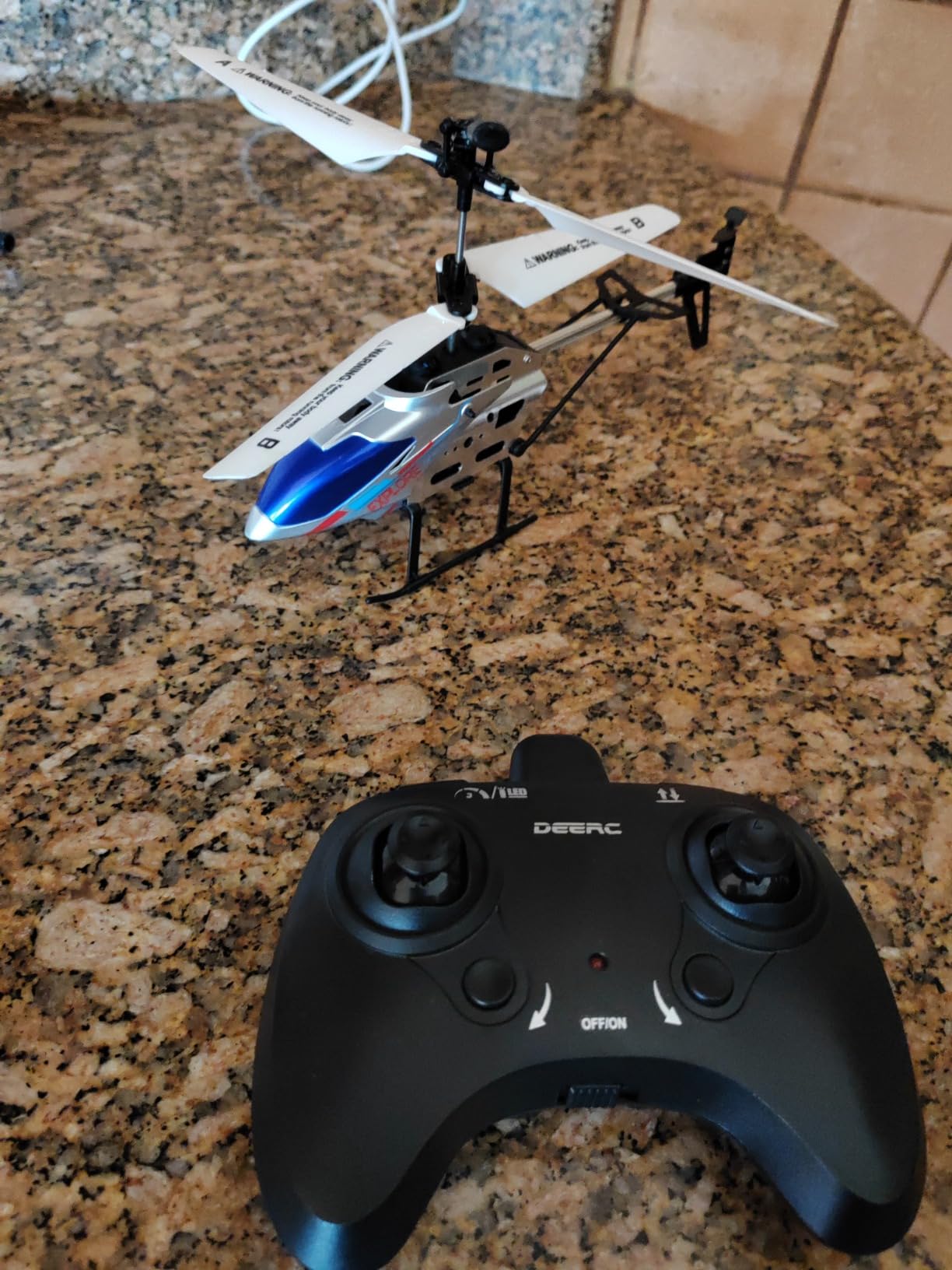
Every pilot crashes in the first month, so crash tolerance should be a primary criterion rather than a nice-to-have. The DE28 is built around it: a metal airframe with flexible ABS blades, which is the combination that absorbs impact instead of snapping a rotor. It measures 7.87 x 6.3 x 2.87 inches and is designed primarily for indoor flying.
It is a 3.5-channel coaxial with barometric altitude hold after take-off, a built-in gyroscope for stable movement and a one-key take-off and landing. Two shell designs are included so the body can be changed to suit the pilot, and LED lights add visibility in a dim room.
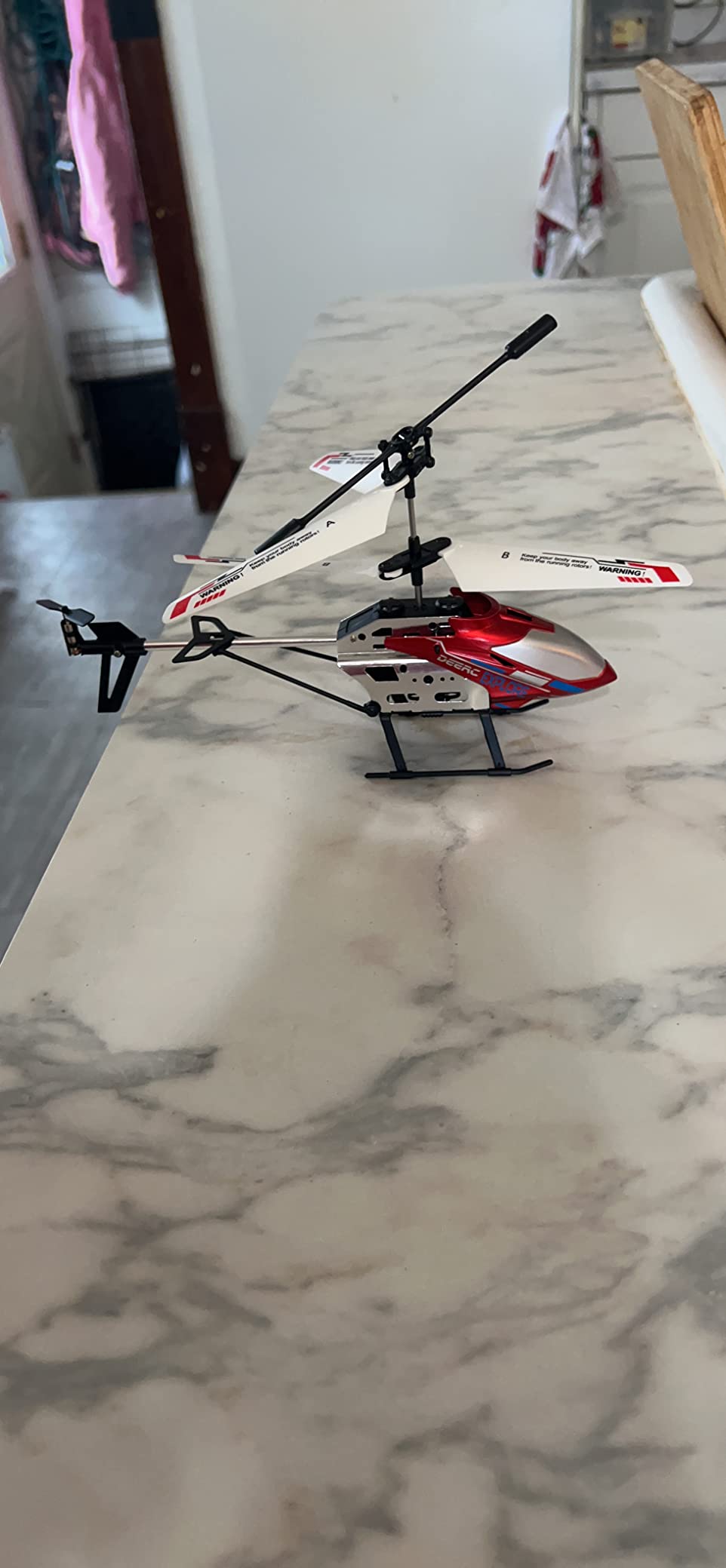
Ratings come in at 4.3 across 614 reviews, with 66% five-star and 17% four-star, and the standout theme in the feedback is durability: owners describe the metal frame and flexible blades holding up through dozens of crashes. Reviewers consistently position it as an intimidation-free indoor flyer for new pilots rather than a performance machine, which is exactly how we used it.
One detail worth knowing is the transmitter. It is 2.4GHz with the antenna built inside the case, which removes the single most common damage point on cheap helicopters, where an external whip antenna snaps on the first hard landing. Rated for ages 10 and up, it is a plain, robust-in-practice package.
Who this helicopter suits
Anybody who has already broken a toy helicopter. If your previous model ended after a handful of flights, the failure was almost always the plastic body or a rigid blade snapping at the root, and this is the cheapest way to stop repeating that experience.
It is also a good pick for a parent buying for a child who treats toys roughly. The metal frame and flexible blades mean the first month does not matter much, and altitude hold plus one-key takeoff mean an unsteady child can still get it hovering without a parent’s hands on the transmitter.
Where it falls short
The transmitter takes two A batteries and they are not included, which catches people out on the first session. That is a small thing, but it is the kind of detail that turns a first flight into a frustrating one.
Performance is toy-grade, so there are no aerobatics and no inverted flight, and the review data is honest that this is an indoor machine. It can handle light wind outdoors but nothing more, and the smaller 614-review base means less long-term reliability data than the higher-volume models here.
6. DEERC Apache 26-Minute: best for the longest single-family indoor session
DEERC Apache RC Helicopter, Remote Control Helicopter for Kids & Adults
Two modular batteries, 26 min
USB-C charging
Spare blades included
9.84 x 3.74 x 4.33 in
Pros
- About 26 minutes of combined flight
- USB-C charging with no proprietary brick
- Spare main and tail blades included
- Stable coaxial hover indoors
- Apache styling kids like
Cons
- Lightweight frame gets blown off course
- Not recommended outdoors in wind
- Middle rotor blade failures reported
- ABS body can crack
If the number that matters to you is time in the air, this is the one. Two modular batteries with USB-C charging deliver up to 26 minutes of total flight, which is the longest combined runtime of anything we evaluated, and the USB-C charging means you are not hunting for a proprietary wall plug in a drawer.
It is a 3.5-channel Apache-style military model with adjustable speed settings, altitude hold, one-key take-off and landing, an emergency stop and LED lights, at 9.84 x 3.74 x 4.33 inches. Maximum speed is listed at 3.94 feet per second, which is deliberately gentle. Nine pieces are in the box, including four spare main rotor blades, two spare tail rotor blades and a screwdriver.
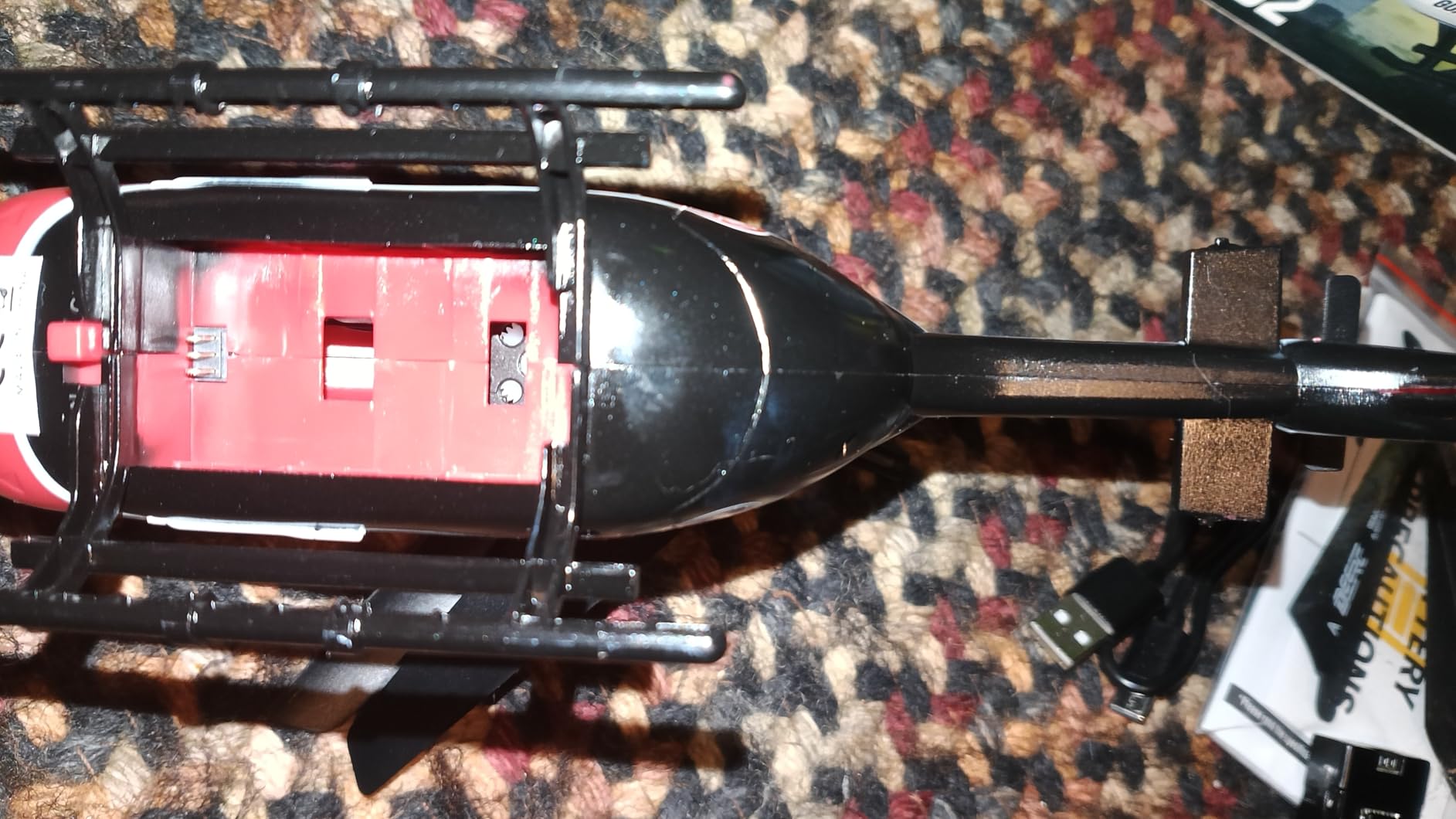
Those spare blades are the detail that separates this from the rest. Field repairs take about a minute with the included screwdriver, which for a first helicopter is the difference between a fun afternoon and a model that sits broken on a shelf. The 2.4GHz anti-interference system also allows several helicopters to fly at once for sibling battles.
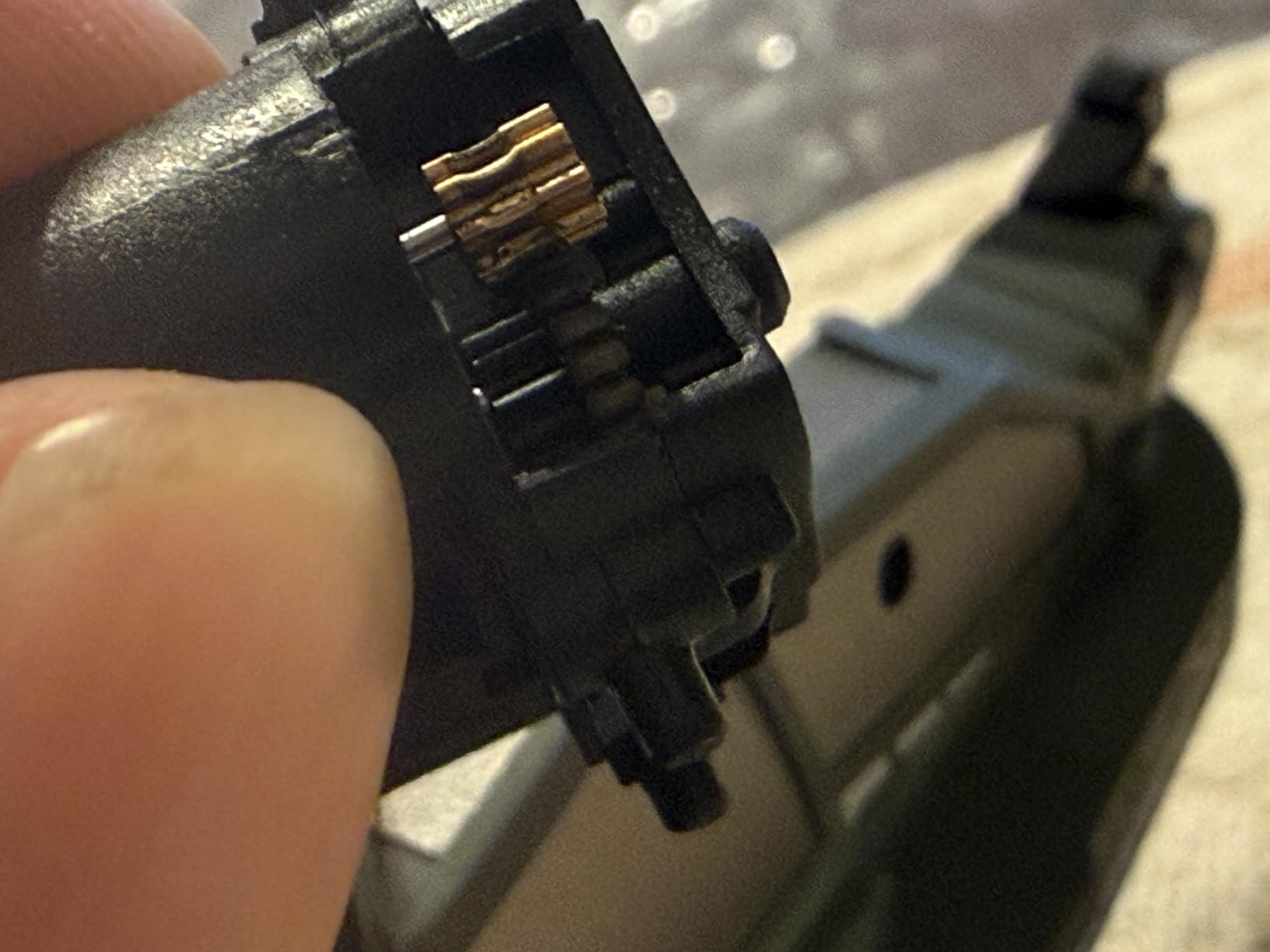
The 4.1 average across 612 ratings is the lowest of the DEERC pair, and the reason is visible in the distribution: 65% five-star, but an 11% one-star slice describing middle rotor blade failures within days of use. The happy majority is about batteries and stability; the unhappy minority is about a specific rotating part that can fail early.
Who this helicopter suits
Anyone who wants to sit down and fly for a while rather than fly in five-minute bursts. A couple of batteries and a USB-C cable means you can keep going through an evening session, and the spare blades mean a crash is an interruption rather than an ending.
It is a strong gift for a child aged roughly 8 to 12 who wants something that looks like a military Apache rather than a cartoon toy. The styling details on the rotor blades and cockpit are the ones kids notice, and adjustable speed means a parent can dial the response back for a younger pilot.
Where it falls short
The light frame is the recurring weakness, and reviewers are blunt that it gets blown off course easily, even after a wall collision. This is an indoor helicopter. Flying it outside in any wind will disappoint you quickly and the reviews are clear on that point.
Then there is the blade failure pattern in the one-star reviews, which is the main reason this sits below the top three despite the best runtime. The ABS body can also crack under rough handling, and the manufacturer lists a recommended age of 6, so an adult should supervise younger children with it.
7. XIKOTEC XK1: best for a first-time adult pilot
XIKOTEC RC Helicopter, Remote Control Helicopter Toy for Kids(Green)
Two USB-C batteries
About 20 minutes flight
Gyro stabiliser
2.4GHz to 50 metres
Pros
- Two swappable USB-C batteries
- Onboard gyro keeps it very stable
- Handles carpet landings well
- LED lights switch from the remote
- Low battery alert
Cons
- Real battery life nearer 10 to 15 minutes
- No charging indicator
- Very light and wind-sensitive
- Some models ship without a manual
Most of the complaints aimed at this class are aimed at children. Adults tend to want something that feels like a machine rather than a toy, and this one has the largest presence of the group at 11.22 x 7.4 x 5 inches with detailed military styling on the rotor blades and cockpit.
It is a 3.5-channel coaxial with a built-in gyro stabiliser, altitude hold, one-key take-off and landing, LED lights switchable from the remote and a low battery alert. Two easy-swap modular batteries charge over USB-C and the listing states about 20 minutes of flight, with 2.4GHz control to roughly 50 metres.
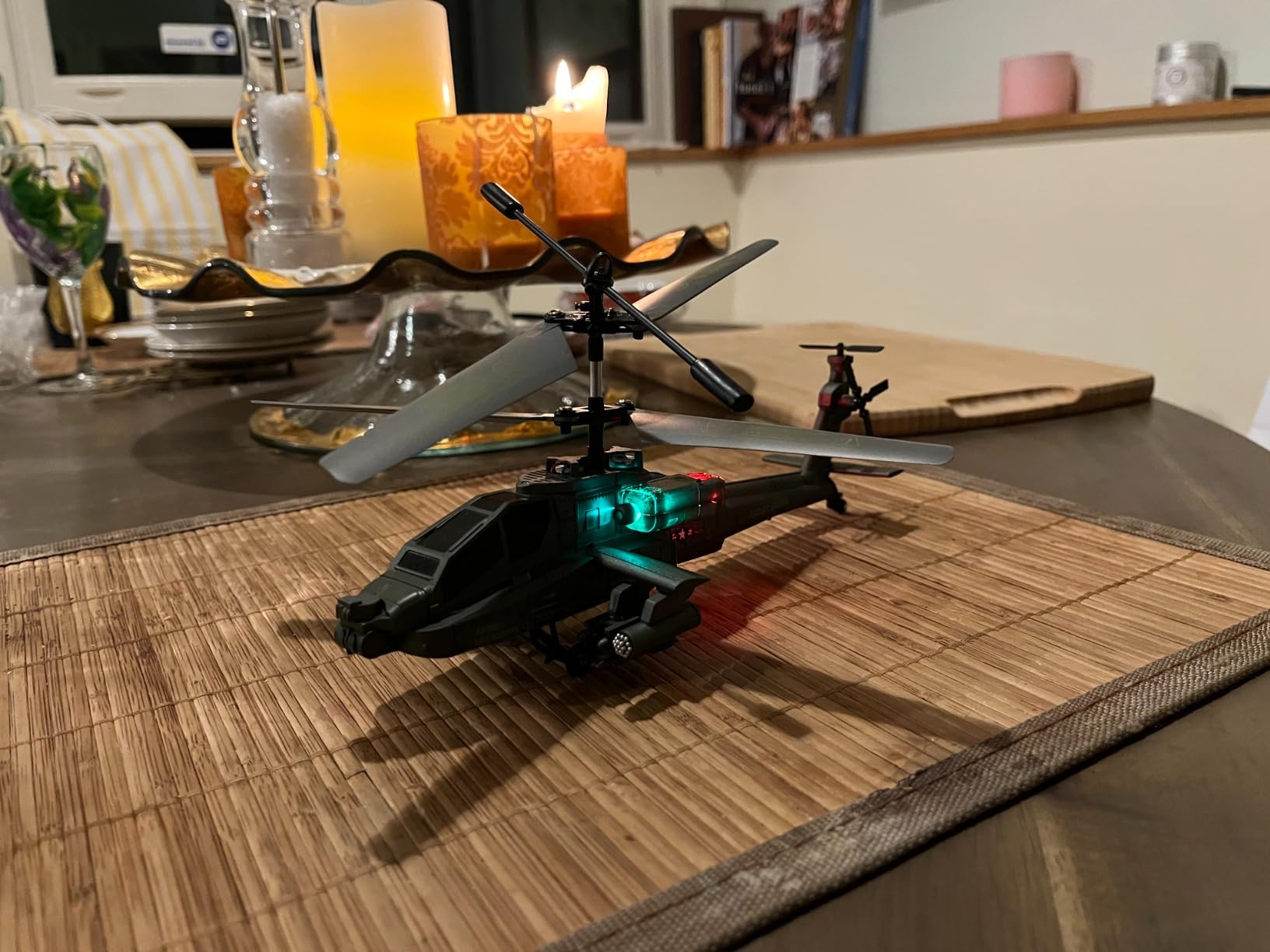
The 4-star average across 530 ratings includes 60% five-star, and the majority view is that this is a capable budget trainer with a stable gyro and enough durability for indoor carpet landings. The stabiliser is the part that matters: reviewers repeatedly describe it as stable and easy to handle, which is exactly what an adult needs when moving from a stick to a helicopter.
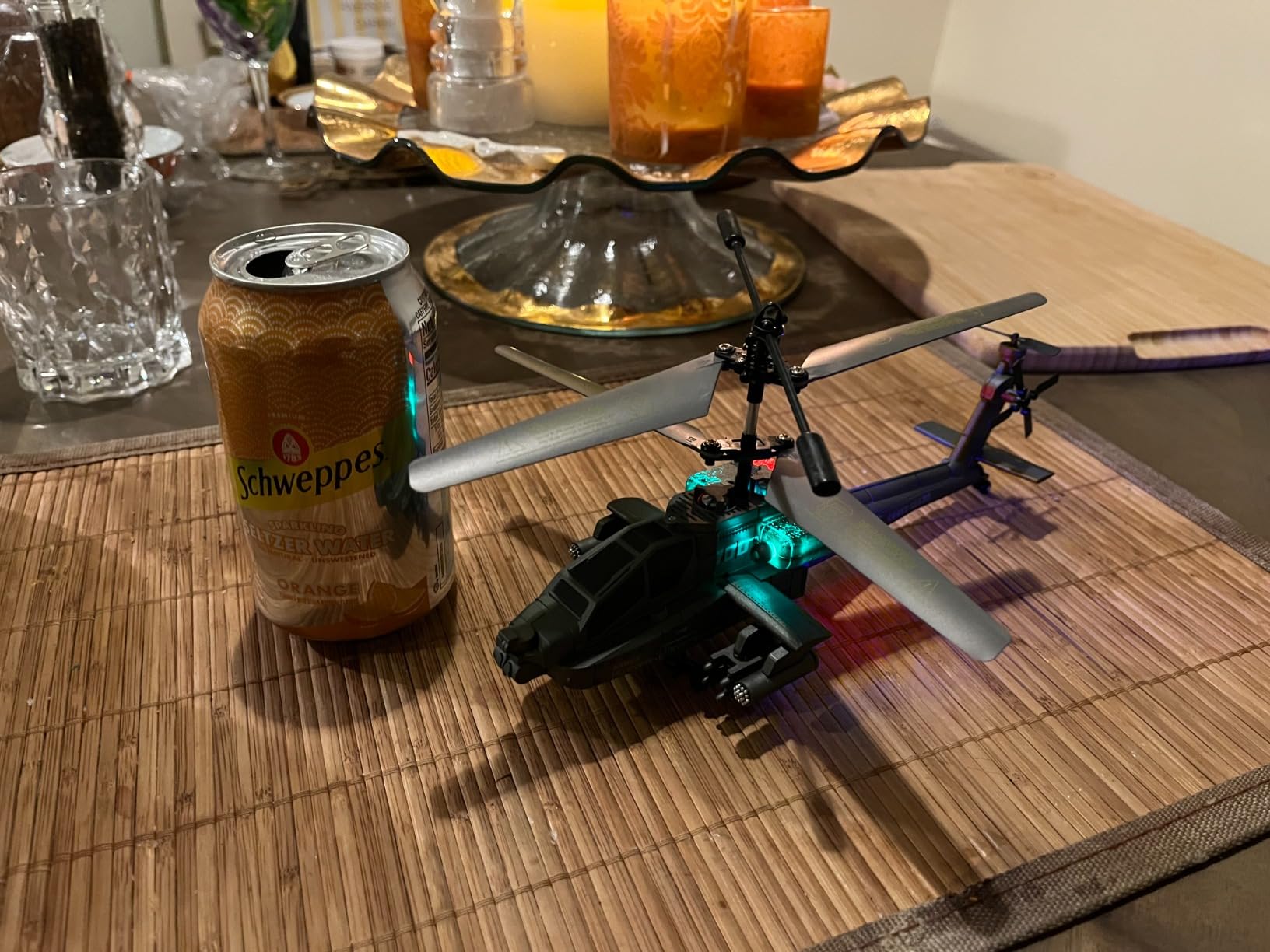
Two batteries remove the charging downtime that frustrates most people in this category, and reviewers single out the packing as good, with models arriving in condition. The remote-controlled LED lights are a small touch that makes it easier to see orientation in a dim room, which reduces the sort of panic that ends a beginner’s session.
Who this helicopter suits
An adult who has never flown a helicopter and wants something that looks and feels proportionate to fly, rather than a plastic novelty. The size gives it presence, the gyro does the stabilising work, and the altitude hold means you are not fighting the throttle for the first hour.
It is also a good pick for an older child moving up from a palm-sized model, because the two-battery arrangement means practice sessions are long enough to actually build muscle memory. Just plan around the indoor-only flying profile, which is where its strengths lie.
Where it falls short
The stated 20 minutes of flight is closer to 10 to 15 minutes in practice according to reviewers, which is a useful correction before you buy. There is also no charging indicator, gauge or light, so you are guessing when the pack is full, and that is a real annoyance when you own two batteries.
Some models ship without a manual, which makes the remote functions unclear until you experiment. The frame is very light and gets caught by any breeze, the battery latch can wear over time, and there is an isolated report of a runaway climb that ignored the auto-land command. The listed weight of 0.92 kg also does not match the product class, so treat the dimensions as the reliable figure.
8. VATOS XK913-X: best for older kids and adults flying together
VATOS RC Helicopter for Boys, 2.4G Remote Control Helicopter with LED Light for Kids 12+ Years Old, Fixed Height, One-Key Take-Off, Indoor RC Planes Ideal Festival Gifts for Boys Adults
Barometric altitude hold
Trim control, 12 min flight
2.4GHz non-jamming
10 in tall body
Pros
- Trim control corrects drift well
- Altitude hold keeps hover steady
- One-key takeoff and landing
- LED lights for low light
- Several can fly at once
Cons
- About 10 to 12 minutes per hour of charging
- Cheap-feeling plastic
- Some break within a day
- Included charging cable unreliable
Of everything we tested, this one surprised us most with how well an adult can fly it. At 10 inches tall and 5.5 inches long it is the second-largest model here, and the barometric altitude hold plus dedicated trim control make it manageable for a pilot who has never hovered anything before.
It is a coaxial model with one-key take-off and landing, trim control for drift and tilt, barometric altitude hold and 2.4GHz control with a non-jamming function that allows several helicopters to fly at once. The body is 11 x 9 x 2.76 inches in the package, it charges over USB, and LED lights are included. Rated for ages 6 and up, the listing positions it for boys 12 and older as well as adults.
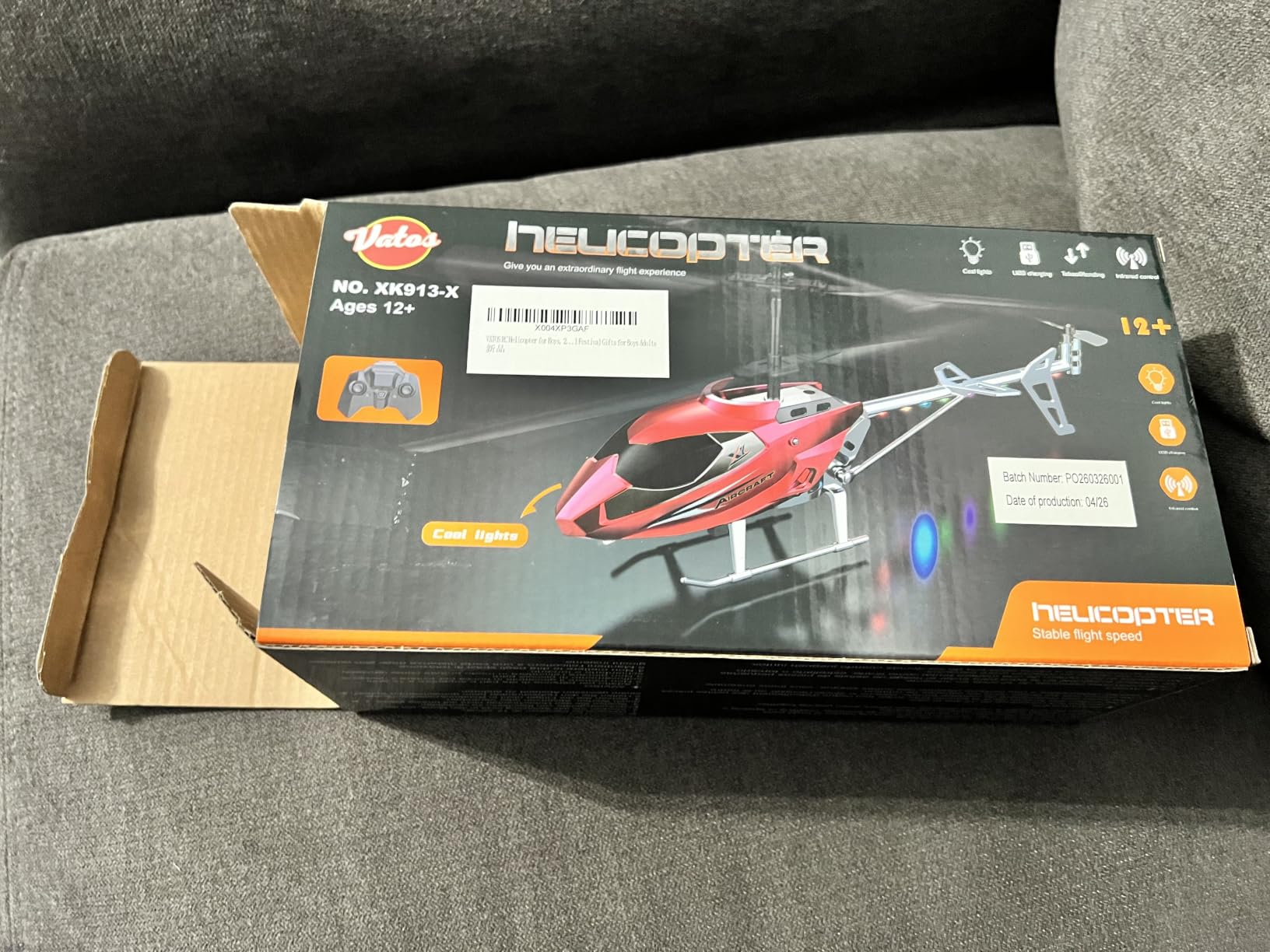
With 779 ratings at 4.2 and 67% five-star, the dominant theme is that it is surprisingly easy to control, with the altitude hold and one-key takeoff doing most of the work. Owners also report that it holds up well and survives hard landings, and the low unit cost means buyers often get several, which pairs naturally with the multi-heli capability.
The one number to plan around is charging. It takes about an hour to charge for roughly 12 minutes of flight, which is the worst ratio of any model on this list, though some owners report closer to 30 minutes of flight when the pack is fully charged. The stated control range is 130 to 160 feet in open, wind-free areas, which is far more than a living room needs.
Who this helicopter suits
An older child or an adult who wants a helicopter that fills the room visually and is still easy to hover. The trim control is the feature that does the most work here, because it cancels out the constant small corrections that put beginners off.
It is a good family pick too, since the non-jamming 2.4GHz system means two or three of these can fly in one room, and the low unit cost makes that a realistic setup rather than a fantasy.
Where it falls short
That one-hour charge for 12 minutes of flying is the deciding factor against it for anyone who wants to fly often. The plastic construction is described as cheap-feeling, and the included charging cable has been reported not to work properly, so have a USB cable of your own ready.
There is also a small number of early breakage reports within about 24 hours, and a practical quirk worth knowing: the helicopter has to be switched on before the remote or it will not pair. It is not for flying in wind, and the single-customer-image listing gives less visual evidence of real-world durability than the others.
9. TERRAMUS XK913: best starter pack with spares in the box
TERRAMUS Remote Control Helicopter for Kids, 2.4G Altitude Hold RC Helicopters with LED Light & Gyro, Radio Controlled Aircraft Indoor Toy with 3.5 Channel High Low Speed for Boys Beginner
3.5-channel coaxial
13 to 15 min flight
Spare blades and screwdriver
45 to 50 m range
Pros
- One-key lift and land plus trim control
- Two speed settings for different pilots
- Replacement blades and screwdriver in the box
- 45 to 50 metre control range
- Extensive safety certifications
Cons
- About 13 to 15 minutes per charge
- Transmitter needs three AAA batteries
- Around 45 minutes of charging
- Small 243-rating review base
The TERRAMUS is the only model here whose box is genuinely a starter pack: charging cable, the helicopter, two replacement blades, a screwdriver and the transmitter. That is everything a first-time pilot needs to repair a crash immediately, and the included screwdriver is a small detail that most listings at this level skip.
It is a 3.5-channel full-function coaxial with altitude hold that maintains height after take-off, one-key lift and land, trim control, a built-in gyro for stable hovering and a flying demo mode. Two selectable speeds cover different experience levels, LED lights handle dark conditions, and the control range is roughly 45 to 50 metres. Body dimensions are 5.5 x 3.9 x 10.2 inches.
The battery is modular and rechargeable, giving about 13 to 15 minutes of flight after roughly 45 minutes of charging. It is certified to FCC, CE, ROHS, EN71, EN62115, EN60825, R&TTE, PAHS, HR4040, 7P and ASTM standards, which is an unusually thorough list for this class and worth noting if you are buying for a young child.
Who this helicopter suits
A beginner who expects to crash on day one and wants to fix it the same minute without ordering anything. Two spare blades and a screwdriver in the box removes the single most common reason a first helicopter ends up broken in a cupboard.
The two speed settings also make it a shared machine. An adult can use the higher setting for practice while a younger pilot uses the lower one, and the demo mode gives a new pilot something to watch before they take the transmitter.
Where it falls short
Flight time is the limitation, at roughly 13 to 15 minutes per charge against about 45 minutes of charging. That is a better ratio than several models here, but it is still the shortest session available unless you buy additional batteries.
The transmitter needs three AAA batteries, which are not supplied, and the 243-rating review base is the smallest in this comparison, so there is simply less long-term reliability data to go on. The lightweight plastic airframe is also easily disturbed by air movement, which is the standard limitation of this whole size class.
10. SYMA S109G: best for two-helicopter indoor play
Syma S109G 3.5 Channel RC Helicopter with Gyro Sold by TM USA
Palm-sized coaxial, indoor only
Built-in gyro
5 to 8 min flight
Spare tail blade
Pros
- Easy to learn once trimmed
- Slow and stable movement suits beginners
- Large remote is easy to handle
- Survives extreme abuse
- LEDs show facing direction
Cons
- Infrared control
- indoor only
- 5 to 8 minutes per charge
- Needs 12 inches of ceiling clearance
- Controller calibration faults
The S109G rounds out the list as the second SYMA coaxial and the cheapest way to get two helicopters in one room. Its infrared transmitter lets two of them fly at the same time, and at 8 x 3 x 5 inches with a 7-ounce weight it is genuinely palm-sized, which makes a two-heli dogfight possible in a normal living room.
It is a 3.5-channel coaxial with a built-in gyro stabiliser, a colourful flashing LED that makes the facing direction obvious, USB charging and a spare tail blade in the box. The LED is more useful than it sounds: knowing which way the machine is pointing removes the single biggest source of confusion for a new pilot. An English manual is included, which is not always true at this level.
With 547 ratings at 4.2 and 63% five-star, the reviews describe it as easy to learn and enjoyable once trimmed, with a slow, stable movement that genuinely helps beginners. Several owners report it surviving serious abuse, including a full immersion in a bath, which tells you something about the build. It charges quickly over USB and gives about 5 to 8 minutes per charge.
Who this helicopter suits
Two people, one room. If the idea of flying alone is less interesting than the idea of a chase, the two-frequency infrared setup on this model is the simplest way to do it, and the flashing LED makes it easy to follow your machine around a room.
It is also a good gift for a child who has never flown anything, because the large remote is easy to hold and the movement is slow. The included English manual and spare tail blade mean there is nothing to work out or order before the first flight.
Where it falls short
Infrared control means it works indoors only, and sunlight causes interference, so a window seat is a bad place to fly it. At 5 to 8 minutes per charge the flight window is short, and it needs roughly 12 inches of altitude clearance before it will descend, which is more headroom than the tiniest models here require.
There is a launch condition worth knowing: it drifts sideways on take-off unless it starts from a perfectly flat hard floor, and aggressive throttle inputs can trigger an automatic cut-out. Some owners report controller switch and calibration faults, including a replacement transmitter that arrived mis-calibrated, and buyers are often surprised by how small it is compared with the listing photos.
How to Choose an RC Helicopter for Indoor Flying?
Size class and how much room you actually need
Match the rotor size to the room, not the other way round. A palm-sized coaxial model around 4 to 5 inches needs a clear area roughly the size of a coffee-table space and will hover in place for minutes without any forward flying. A 7 to 9 inch model wants a room where you can walk around it without touching furniture. Anything at 10 inches and above is pushing it in a living room, and the 470-scale and collective-pitch machines that dominate shopping carousels need a cleared space the size of a small gym.
Coaxial or single rotor, and why it matters indoors
Coaxial means two counter-rotating rotors and no tail rotor, which makes the machine self-righting, stable in still air and almost impossible to flip. That is why every model on this list is coaxial, and why it is the right architecture for a room. Single-rotor designs are more agile and more scale-accurate but need constant tail correction and more space, which is exactly the tradeoff the hobby forums keep pointing out.
RTF, PNP and BNF in plain terms
RTF means ready to fly, so the transmitter, battery and charger are in the box and you can fly immediately; all ten models here are RTF. PNP means the helicopter is complete but needs a transmitter and battery, and BNF means the airframe is complete but needs both plus your own radio gear. As a beginner, RTF is the only sensible option, because buying a BNF model means buying a radio system as a second purchase.
What the stabilisation systems actually do
A gyro is the baseline: an electronic stabiliser that corrects roll, pitch and yaw thousands of times per second, and every model here has one. Altitude hold uses a barometer to fix a height so throttle is hands-off. Optical flow uses a downward camera to hold position over a surface without GPS, and it appears on none of the models here, which is a fair signal of where this price class sits. One-key take-off and landing removes the two manoeuvres beginners get stuck on.
Flight time, and why the box number lies a little
Budget for 5 to 7 minutes on the smallest models, 10 to 15 minutes on a single-pack model of average size, and 20 to 34 minutes on the twin-battery designs. Two of the listings here quote a combined total for both batteries rather than a single sortie, and hover always costs more than the quoted figure because the motors work hardest holding height still. Two modular batteries beat one long battery for practical indoor use, because you swap instead of waiting.
Spare parts decide whether you still own it in month three
Blades break first, then skids, then the tail boom. Models that ship spare blades and a screwdriver, such as the DEERC Apache and the TERRAMUS, let you fix a crash in a minute, and modular swappable batteries matter for the same reason. A hardwired pack with no spares is how a first helicopter quietly ends up in a cupboard.
Should you actually buy a quadcopter instead?
Honestly, sometimes yes, and we would rather say so. For learning to hover in a small flat, a propeller-guarded quadcopter is easier to fly, safer around people and cheaper to replace, and forum beginners are routinely pointed that way. What you give up is the helicopter feel, and the thing that draws people to this hobby in the first place, which is a single rotor overhead and a tail rotor keeping its nose where you pointed it.
What we deliberately left out
No large-scale GPS helicopters, no collective-pitch 3D machines, and no unnamed commodity listings with no parts support. The shopping results for this keyword mix toys with quarter-scale aircraft in one carousel, and the large models are excellent flying machines that simply cannot be flown in a home. Hobby-grade names from the forums, such as the Blade Nano S3 and the optical-flow RC ERA C186 Pro, sit in a class where parts and tuning support matter more than the purchase decision, so we left them for a separate outdoor and large-space roundup.
Indoor Flying Safety and Space Planning
Most indoor helicopter injuries come from an unplanned encounter with a pet, a ceiling fan or a blind. Five rules cover nearly all of it.
Clear the room before you power up. Remove fragile objects, close the blinds fully and push furniture back far enough that you can walk a full circuit without touching it. Moving lamps and vases matters more than moving sofas.
Turn off ceiling fans, heating vents and air conditioning. Even a fan on its lowest setting creates a current that will carry a light coaxial helicopter across the room, and this is the most common cause of a helicopter stuck on a curtain.
Keep animals out of the space entirely. A curious cat will go straight for a hovering model, and a dog will follow a noise source into a wall. Use a closed door rather than a gate if you have pets that work on persistence. Keeping an indoor cat occupied is a separate job, and our indoor cat mental stimulation guide covers it well.
Charge lithium batteries on a non-flammable surface. A tiled floor or a metal shelf is right, away from anything combustible, and never overnight on a bed or a sofa. If a pack is swollen or hot after a crash, stop using it.
Use the low-voltage protection and land early. Every model here has low-battery protection or an alert, and a helicopter that drops mid-hover over a hardwood floor is how skids and blades snap. Land it on carpet or a mat when you can.
One more housekeeping note for a flat: if the flying room sits next to a bathroom or a utility area, a washable floor covering saves a lot of regret. Our indoor flooring guide covers washable residential options, which double as a crash mat for a helicopter that gets away from you.
And if your flying takes you away from home, packing is its own problem. Our airline-approved carrier roundup is written for fragile, higher-value cargo, and the packing logic transfers directly to a helicopter with a 4.1 inch body and delicate rotor blades. A rigid case with foam cutouts stops a rotor head snapping in a hold full of soft luggage, which is the same lesson as the spare-blade advice above.
One more practical note: propeller guards are worth looking for if the room is shared with children under six. Very few models in this class include full guards, which is part of why we treat the room itself as the main safety measure rather than relying on the model to protect itself.
Why Your Indoor Helicopter Keeps Circling
Circling or one-way drift is nearly always one of four things, and all four are fixable in a couple of minutes.
Reset the gyro. Land the model, switch it off, wait about 30 seconds, then power the transmitter first and the helicopter second. A gyro that has been knocked out of alignment by a crash often clears on a full power cycle.
Reset the trim. With the helicopter on a level hard floor, use the trim buttons until the nose points straight at you and stays there. Trim drifts after every significant crash.
Remove the air current. Check for a ceiling fan, an open window, a heating vent or a draught from an air conditioning unit. A helicopter that hovers fine and then circles in a specific part of the room is almost always fighting moving air.
Check the battery. A pack that has aged will hold height for a few seconds and then sag, which reads to the flight controller as a tilt and produces a spiral. If the pack is more than a year old, replace it before you troubleshoot anything else.
If it circles immediately after a hard landing and the trim will not hold, the tail or main gear has probably been knocked out of line, and no amount of calibration will fix it. That is the moment to reach for the spare blades and screws in the box.
Frequently Asked Questions
What is the best indoor RC helicopter with a long flight time?
Among the ten we compared, the DEERC Apache with two modular batteries and USB-C charging gives the longest combined indoor runtime at up to 26 minutes, and the BUSSGO model is close behind at roughly 30 to 34 minutes across two packs. Budget for 5 to 7 minutes on a single small coaxial helicopter and 10 to 15 minutes on a mid-size one, since hover always uses more than the packaging number suggests.
What size RC helicopter is best for beginners?
A palm-sized coaxial model around 4 to 5 inches long, such as the SYMA S100, is the easiest to fly indoors because it can hover in a very small area and a mistake does not send it into the furniture. A 7 to 9 inch model with altitude hold is the better choice once you can hover reliably, since it gives you more control authority and a longer battery window.
What is the best indoor RC helicopter for beginners?
The SYMA S107H-E is the strongest all-round first helicopter because the alloy body, altitude hold and one-key take-off and landing make it forgiving, and it holds a hover without constant throttle input. If you want longer sessions rather than a gentler learning curve, the BUSSGO twin-battery model is the alternative.
Is there an indoor remote control helicopter available?
Yes. Every model in this roundup is designed for indoor use, and indoor models are usually small coaxial helicopters with a gyro and altitude hold rather than single-rotor aircraft. Check that the listing says indoor, because some budget models use infrared control that will not work outdoors at all.
Can RC helicopters really be flown indoors?
Yes, but only small coaxial designs. Indoor air is still, so a light helicopter with a gyro and altitude hold can hold a steady hover in a living room, while anything big or wind-capable needs a cleared space the size of a gym. The main practical limits are the room size, air currents from fans and vents, and pilot error.
Why is my RC helicopter spinning in circles indoors?
A circling helicopter is almost always one of four things: a gyro knocked out of alignment by a crash, trim that has drifted, a steady air current from a fan or vent, or an aged battery that sags under load. Power cycle the model with the transmitter switched on first, reset the trim on a level hard floor, turn off any fans, and test with a fresh pack.
Final Verdict: Our Best RC Helicopters for Indoor Flying in 2026
The SYMA S107H-E takes the top spot for the best RC helicopters for indoor flying because the alloy body, altitude hold and dual speed modes make it the most forgiving first helicopter here, and its 5973 ratings at 4.3 give it the strongest evidence base of anything we evaluated. If flight time is what frustrates you, pick the BUSSGO twin-battery model instead and get roughly 30 minutes of combined flying.
For a very small room, the SYMA S100 Mini flies in a space nothing else here can. For a child who will crash constantly, the DEERC DE28 metal airframe and the TERRAMUS with spare blades in the box are the two that will still be flyable in month three. And if you have a partner or a second child, the SYMA S109G and the BUSSGO both fly two at once on 2.4GHz.
Whatever you choose, clear the room, turn off the ceiling fan, and keep the pets out. That routine takes two minutes and prevents nearly every indoor helicopter problem reported in the forums.