
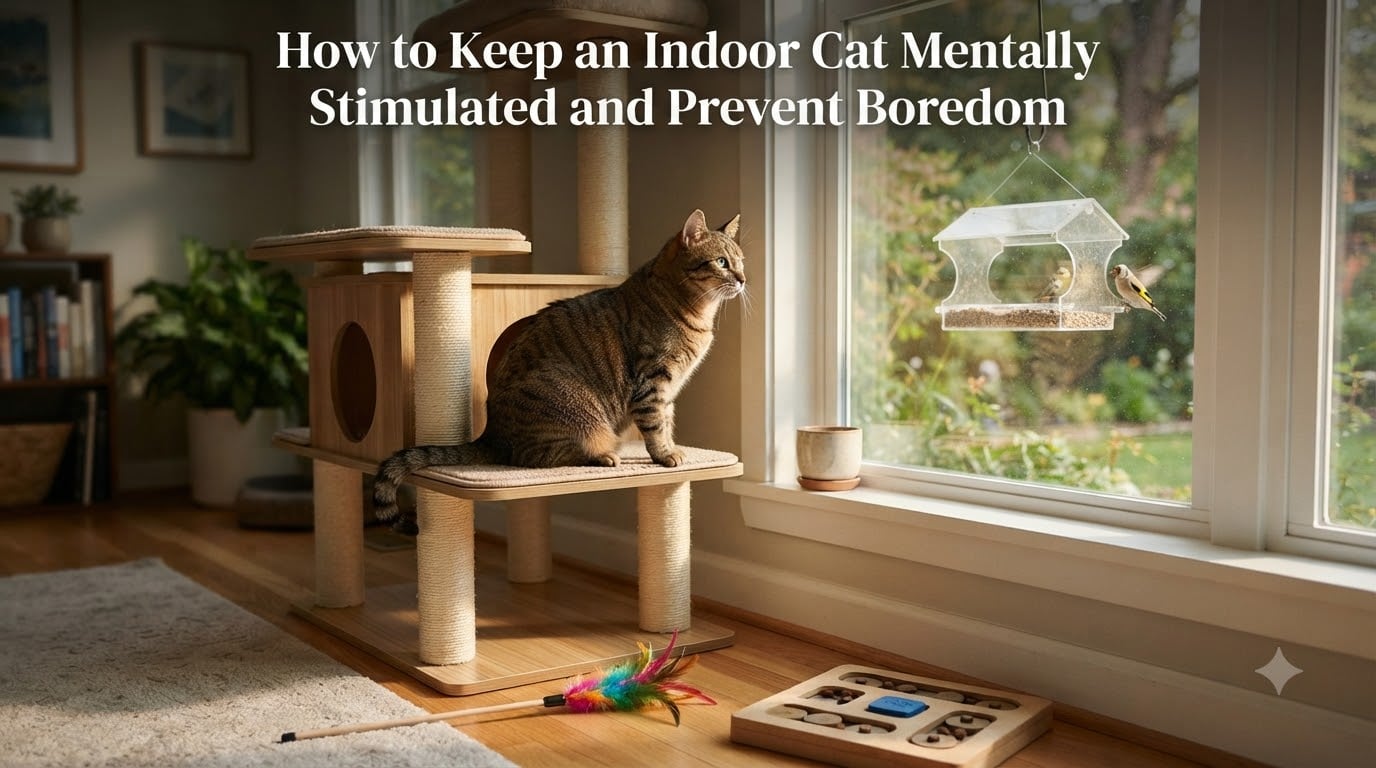
Indoor cats live longer, healthier lives than outdoor cats. That is the good news, and it is well-documented by veterinarians. The trade-off is that indoors, there are no birds to stalk, no fences to climb, and no mice to chase down hallways at 2 a.m. The same environment that keeps your cat safe can also become monotonous, and a bored cat is not just an unhappy cat. It is a cat on a path toward weight gain, destructive behavior, and stress-related health problems.
Our team has spent years working with cat owners, shelter volunteers, and feline behavior resources to understand what indoor cat mental stimulation actually looks like in practice. The answer is not one magic toy or a single afternoon project. It is a combination of interactive play, environmental enrichment, food-based challenges, and a daily routine that gives your cat something to look forward to.
This guide covers how to keep an indoor cat mentally stimulated and prevent boredom using practical, field-tested techniques. You will learn to recognize the behavioral signs of boredom, structure play sessions that satisfy your cat’s hunting instincts, set up vertical spaces and window perches that transform your home into an engaging territory, use food puzzles and slow feeders to make mealtime mentally demanding, build DIY enrichment on any budget, and create a consistent daily routine that keeps boredom from creeping back.
Whether you live in a studio apartment with a single cat or share a multi-story home with three, the strategies here scale to your space and your cat’s personality. Let us start with the signs that tell you enrichment is overdue.
Table of Contents
How to Tell if Your Indoor Cat Is Bored?
Cats are masters at masking discomfort, which means boredom often goes unnoticed until it turns into a behavioral problem. The sooner you spot the signs, the easier it is to intervene before bad habits become ingrained.
Here are the most common signs your indoor cat is bored and under-stimulated:
1. Destructive behavior. Scratching furniture, shredding curtains, knocking items off shelves, and chewing on plants or cords are all classic outlets for pent-up energy. Cats do not act out of spite. They act because they have energy and nothing to do with it.
2. Excessive vocalization. If your cat has started meowing persistently, especially at night or early morning, boredom is a likely cause. Cats learn that vocalizing gets your attention, and attention is a form of stimulation, even if it is just you shooing them off the counter.
3. Zoomies and FRAPs. Frenzied Random Activity Periods, or FRAPs, are those sudden sprints from room to room with no apparent trigger. Occasional zoomies are normal. Frequent, intense zoomies, especially at night, signal that your cat has unspent energy from a lack of daytime activity.
4. Overgrooming and excessive licking. When cats are stressed or bored, they may groom compulsively, sometimes creating bald patches or skin irritation. This behavior is self-soothing and often points to environmental under-stimulation.
5. Lethargy and excessive sleeping. Cats sleep a lot, that is normal. But if your cat sleeps through play opportunities, shows no interest in toys or food, and seems generally flat, boredom may have crossed into mild depression.
6. Changes in eating or litter box habits. Stress from boredom can manifest as overeating, food refusal, or litter box avoidance. These can also indicate medical issues, so consult your veterinarian if changes persist.
7. Attention-seeking and clinginess. Following you from room to room, pawing at your hands, or refusing to let you work are all ways cats say they need more engagement.
If you checked off three or more of these signs, your cat needs more enrichment across the board. The good news is that small, consistent changes produce visible improvement within a week or two.
Interactive Play Techniques That Mimic the Hunt
Interactive play is the single most effective form of indoor cat mental stimulation. It directly engages your cat’s prey drive, provides cardiovascular exercise, and strengthens the bond between you and your cat. A wand toy in your hand for fifteen minutes does more for your cat’s wellbeing than any autonomous toy left on the floor.
The goal of interactive play is not just to tire your cat out. It is to simulate the complete hunting sequence: stalking, chasing, pouncing, and capturing. A play session that skips any of these steps leaves your cat unsatisfied, which is why some cats seem wound up after a laser pointer session rather than relaxed.
Choosing the Right Interactive Toy
Wand toys with flexible rods and interchangeable attachments are the gold standard for interactive play. Feather wands simulate birds. Ribbon or fabric attachments simulate snakes. Small mouse attachments at the end of a string simulate rodents. Rotate attachments weekly to keep the experience novel.
Many cat owners on forums report that their cats ignore laser pointers but go wild for wand toys they can actually catch. This tracks with feline behavior research. Cats need the satisfaction of gripping and biting their catch at the end of a hunt. A laser dot that disappears under your hand offers no payoff and can leave cats frustrated.
How to Structure a Play Session
A good interactive play session lasts 10 to 15 minutes and follows a predictable arc. Start by dragging the toy slowly along the floor to trigger stalking behavior. Let your cat crouch, wiggle, and watch. Do not rush this phase. The stalk is mentally demanding and satisfying for your cat.
Gradually increase the speed and unpredictability of the toy’s movement. Make it dart behind furniture, disappear under a rug, and reappear. Mimic the erratic movement of prey. Let your cat catch the toy several times during the session, and always end with a successful capture followed by a small treat or a meal.
Ending on a catch followed by food mirrors what happens in the wild: hunt, catch, kill, eat, groom, sleep. This sequence is deeply satisfying and often results in a calm, sleepy cat afterward.
How Often Should You Play?
Aim for two structured play sessions per day, each 10 to 15 minutes long. Morning and evening sessions align with the natural dawn and dusk activity peaks of crepuscular cats. For high-energy breeds like Bengals or Abyssinians, add a third session or extend playtime to 20 minutes.
Kittens under one year need more frequent, shorter sessions. Their attention spans are shorter but their energy is boundless. Four to five play sessions of 5 to 10 minutes each spread throughout the day works well.
For senior cats, keep sessions shorter, around 5 to 8 minutes, and choose low-impact movements. Tossing a toy mouse across the floor for a slow chase is plenty. Do not encourage jumps that stress aging joints.
Play Techniques for Cats Who Seem Uninterested
A common frustration is the cat who is clearly bored but refuses to play. Our forum research surfaced this repeatedly, and the solution usually comes down to technique. Try these adjustments:
Play in a different room where your cat feels more predatory confidence. Reduce distractions and turn off the TV. Try different prey attachments, some cats only respond to feathers, others to fur. Play when your cat is naturally active, typically dawn and dusk. Finally, try play before meals rather than after, when your cat’s hunting motivation is higher.
Environmental Enrichment: Vertical Spaces and Window Perches
Cats are three-dimensional creatures. In the wild, they climb trees to survey territory, spot prey, and avoid predators. A home that only offers floor-level living is a home that ignores half of your cat’s natural instincts. Environmental enrichment, especially vertical space, is the foundation of round-the-clock indoor cat mental stimulation.
Why Vertical Space Matters
Height gives cats confidence, security, and a vantage point. A cat perched on a tall shelf can observe everything happening in the home without feeling vulnerable. This observational satisfaction is a form of passive mental engagement that works even when you are not actively playing with your cat.
In multi-cat households, vertical space is especially important. Cats manage social tension by establishing vertical territory. More vertical options mean fewer territorial disputes and less stress.
Setting Up Cat Trees and Wall Shelves
A sturdy, multi-level cat tree is one of the best investments you can make for an indoor cat. Place it near a window for maximum engagement. The combination of height, scratching surfaces, and a view checks multiple enrichment boxes at once.
If floor space is limited, wall-mounted cat shelves are an excellent alternative. You can create a vertical pathway around a room using floating shelves at staggered heights. Ensure shelves are securely anchored and wide enough for your cat to sit comfortably. Carpet or sisal coverings add scratching value.
Cats prefer routes that allow them to move upward and across without dead ends. Design the shelving pathway so your cat can circle the room or reach a favored high perch without having to jump down and start over.
Window Perches and Outdoor Views
A window perch gives your cat access to the single best free entertainment available: the outside world. Birds, squirrels, passing cars, falling leaves, and changing weather provide hours of visual stimulation that no toy can replicate.
Forum users consistently report that window perches placed near bird feeders are the most engaging setup they have tried. If you can hang a bird feeder outside a window your cat frequents, you have created a daily nature documentary that runs all day.
Suction-cup window perches are affordable and easy to install. For cats that prefer warmth, look for perches with padded surfaces that catch sunlight. Ensure windows have secure screens if your cat is the type to press against the glass.
Catios: The Ultimate Outdoor Enrichment
If you have outdoor space, a catio (cat patio) provides the richest enrichment available to an indoor cat. Catios range from simple window-box encusions to full backyard runs with multiple levels, ramps, and shelters.
A catio lets your cat experience fresh air, natural smells, temperature changes, and the sights and sounds of the outdoors, all while staying safe from cars, predators, and disease. Even a small window-mounted catio that extends two feet from the house gives your cat a meaningful change of environment.
If a permanent structure is not an option, look into portable outdoor enclosures or harness training. Some cats take well to leash walks, and the sensory experience of being outside, even briefly, is powerful enrichment.
Food Puzzles and Slow Feeders for Mental Enrichment
In the wild, cats spend a significant portion of their waking hours hunting, catching, and eating multiple small meals throughout the day. A bowl of kibble delivered twice a day requires zero mental effort. Food puzzles and slow feeders bridge this gap by making your cat work for its food, turning mealtime into a problem-solving activity that satisfies natural foraging instincts.
Food enrichment is one of the most underused forms of indoor cat mental stimulation, and it is also one of the easiest to implement. You do not need expensive equipment or hours of training to get started.
Types of Food Puzzles
Roll-and-dispense puzzles are hollow balls or cylinders with small holes. Your cat bats and rolls the toy to release kibble piece by piece. These are great entry-level puzzles for cats new to food enrichment.
Sliding and flip puzzles have compartments covered by sliders, lids, or pegs that your cat must manipulate to reach the food underneath. These require more problem-solving and are ideal for cats who have mastered simpler puzzles.
Slow feeders and licking mats are textured surfaces that slow down eating. You spread wet food across the texture, and your cat must lick it out of the grooves. Licking is naturally soothing for cats and can reduce stress and anxiety.
Treat-dispensing tunnels and mats hide kibble within fabric strips or tubes that your cat must fish out using paws. These mimic the experience of pulling prey out of a burrow or crevice.
How to Introduce Food Puzzles
Start easy. The biggest mistake cat owners make is introducing a complex puzzle and expecting their cat to figure it out immediately. Many cats give up when the task feels too hard, and owners assume the cat does not like puzzles.
Begin with a simple roll-and-dispense ball filled with your cat’s favorite treats. Show your cat how it works by rolling it yourself a few times. Once your cat understands the concept, gradually increase difficulty by switching to harder puzzles or smaller dispensing holes.
For cats who are hesitant, place a few loose treats next to the puzzle alongside treats inside it. This builds positive association without requiring immediate effort. Over a week or two, phase out the loose treats as your cat gains confidence.
Making Meals Last Longer
One of the best reasons to use food puzzles is that they slow down eating. Cats that gulp their food in two minutes are more prone to vomiting and weight gain. A food puzzle that stretches mealtime to fifteen or twenty minutes provides sustained mental engagement and better digestion.
You can also split your cat’s daily food allowance across multiple puzzles hidden in different rooms. This creates a foraging experience that encourages exploration and movement throughout the day, which is especially valuable when you are at work.
DIY Enrichment Ideas You Can Build Today
You do not need to spend a fortune to provide excellent cat enrichment. Some of the most engaging activities cost nothing and use materials you already have at home. Here are DIY enrichment ideas that forum users and shelter volunteers swear by.
Toilet paper roll treat dispenser. Take an empty toilet paper roll, fold one end closed, fill it with a few treats or kibble, and fold the other end closed. Poke a few small holes in the sides. Your cat will bat, chew, and roll it to get the treats out.
Egg carton puzzle feeder. Place kibble or treats in the cups of a cardboard egg carton and close the lid. Your cat must figure out how to open it or fish the food through the gaps. For added difficulty, place a ping pong ball in some cups as an obstacle.
Muffin tin ball puzzle. Put treats in the cups of a muffin tin and place a tennis ball on top of each treat. Your cat must remove the balls to access the food. This puzzle is reusable and easy to clean.
Cardboard box maze. Cut holes in several cardboard boxes of different sizes and stack or arrange them in a maze. Hide treats or toys inside different boxes. Cats love exploring enclosed spaces, and the treasure hunt adds mental challenge.
T-shirt cat tent. Bend a wire hanger into a dome shape, cover it with an old t-shirt, and place a cushion or blanket inside. This creates a cozy hideaway that smells like you, which is comforting for anxious cats.
Paper bag and box rotation. Never underestimate the power of a paper grocery bag or an empty delivery box. Cats are drawn to enclosed spaces, and rotating new boxes in every week keeps the environment novel.
Building a Daily Routine That Prevents Boredom
Cats are creatures of habit. They thrive on predictability, and a consistent daily routine provides a sense of security that reduces stress and anxiety. A well-structured routine also ensures that enrichment happens regularly rather than only when you happen to remember.
Sample Daily Enrichment Schedule
Here is a framework you can adapt to your schedule. The key is consistency, not perfection.
Morning (6 to 8 a.m.): 10 to 15 minutes of interactive wand play, followed by breakfast in a food puzzle or slow feeder. This satisfies the hunt-eat-groom-sleep cycle and sets a calm tone for the day.
Midday (12 to 2 p.m.): If you are home, a 5-minute play session or a treat hide-and-seek game. If you are at work, leave a food puzzle or treat-dispensing toy out. Ensure window perches are accessible for bird watching.
Evening (5 to 7 p.m.): Another 10 to 15 minutes of interactive play. This is especially important for cats whose owners are away during the day. Vary the prey attachment and play style from the morning session.
Night (8 to 10 p.m.): A calm wind-down period. Offer a final small meal or treat in a licking mat. This mimics the natural evening meal and helps your cat settle for the night.
Toy Rotation Strategy
Cats lose interest in toys they see every day. Toy rotation is the simplest way to keep play sessions exciting without buying new toys constantly. Here is how to do it effectively.
Divide your cat’s toys into three or four groups. Keep only one group out at a time and store the others out of sight. Every four to five days, swap the active group for a different one. By the time a group cycles back around, the toys feel new again.
Apply the same principle to wand toy attachments. Having three or four different attachments that you rotate weekly keeps the prey experience varied.
Enrichment for When You Are Away
If you work outside the home, focus on passive enrichment that does not require your presence. Window perches, cat trees, food puzzles, and solo toys like kickeroo-style plush toys provide hours of engagement. Cat TV on YouTube, specifically videos designed for cats with birds and squirrels, can keep some cats entertained for extended periods.
Place enrichment items in different rooms so your cat moves through the house during the day rather than sleeping in one spot. Hiding small portions of food or treats around the house creates a foraging trail that encourages exploration and activity.
For cats with separation anxiety or extreme boredom during the day, consider an automatic toy that activates on a timer. These can simulate the unpredictability of live prey and kickstart activity during otherwise quiet hours.
Enrichment for Multi-Cat Households
If you have multiple cats, enrichment must be multiplied and distributed. Competition for toys, food, and vertical space creates stress that undermines the benefits of enrichment. Ensure each cat has access to its own food puzzle, resting spots, and vertical pathways.
Play with cats individually when possible, especially if one cat is more confident and tends to dominate interactive sessions. Individual play ensures every cat gets adequate stimulation and bonding time.
Training as Mental Stimulation
Cats can learn tricks, and training sessions are powerful mental enrichment. Teaching your cat to sit, high-five, spin, or jump to a target provides focused problem-solving that tires the brain as much as play tires the body.
Use clicker training with small treats as rewards. Keep sessions short, 3 to 5 minutes, and always end on a success. Training also strengthens communication between you and your cat, making everyday interactions more rewarding for both of you.
Frequently Asked Questions
How do I keep my indoor cat entertained, stimulated, and happy?
Keep your indoor cat entertained with a mix of interactive wand play (two 10-15 minute sessions daily), vertical spaces like cat trees and window perches, food puzzles that make meals mentally challenging, and a consistent toy rotation system. Catios and bird feeders outside windows provide excellent passive enrichment.
What is the 3 3 3 rule for cats?
The 3 3 3 rule is a guideline for adjusting a newly adopted cat to a new home. It suggests cats need 3 days to decompress, 3 weeks to learn the routine, and 3 months to feel fully at home. During this adjustment period, provide calm, consistent enrichment without overwhelming your cat.
How do I stop my indoor cat from being bored?
To stop boredom in indoor cats, establish a daily routine with structured play sessions, provide vertical spaces and window perches for passive stimulation, introduce food puzzles to make mealtime engaging, rotate toys weekly to maintain novelty, and add DIY enrichment like treat-dispensing puzzles and cardboard box mazes.
How to fix an understimulated cat?
Fix an understimulated cat by adding two daily interactive play sessions of 10-15 minutes using wand toys that mimic prey, switching to food puzzles for meals, installing vertical spaces and a window perch, starting a toy rotation system, and introducing short clicker training sessions for mental problem-solving.
Conclusion
Keeping an indoor cat mentally stimulated and preventing boredom comes down to combining interactive play, environmental enrichment, food-based challenges, and a consistent daily routine. Start with one or two changes, like a morning wand play session and a window perch, and build from there. Your cat will be happier, healthier, and more relaxed, and you will have a stronger bond with a companion who has something to look forward to every single day.