
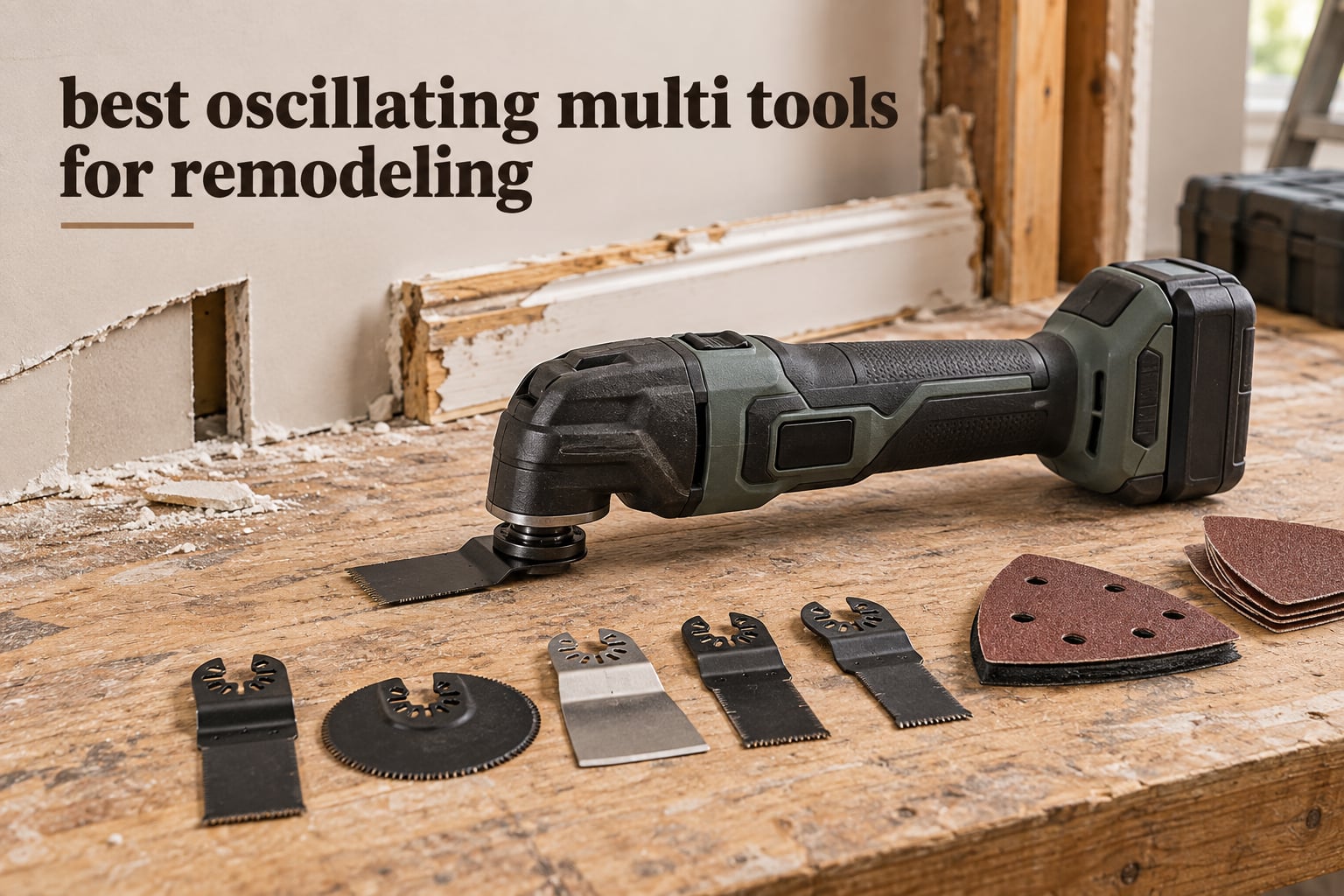
If you want one line, here it is: the DEWALT DCS356C1 is the best oscillating multi tool for remodeling overall, the Milwaukee 2626-20 is the one to buy if you already live in the M18 platform and hammer it hard, and the AVID POWER ACMT326 is the value pick for light and medium duty weekend work. We put ten of the most-reviewed oscillating tools through the jobs a remodeler actually hits on a job site, and in 2026 the field is closer than the spec sheets suggest.
An oscillating multi tool is a handheld power tool whose head sweeps side to side rather than spinning, driving an interchangeable blade, scraper or sanding pad at up to roughly 23,000 oscillations per minute. Because the blade sweeps instead of rotating, it does not kick back or bind, which is why it can plunge straight into a sheet of drywall or trim laminate flush against a wall where a circular saw, jigsaw or reciprocating saw would be dangerous or impossible.
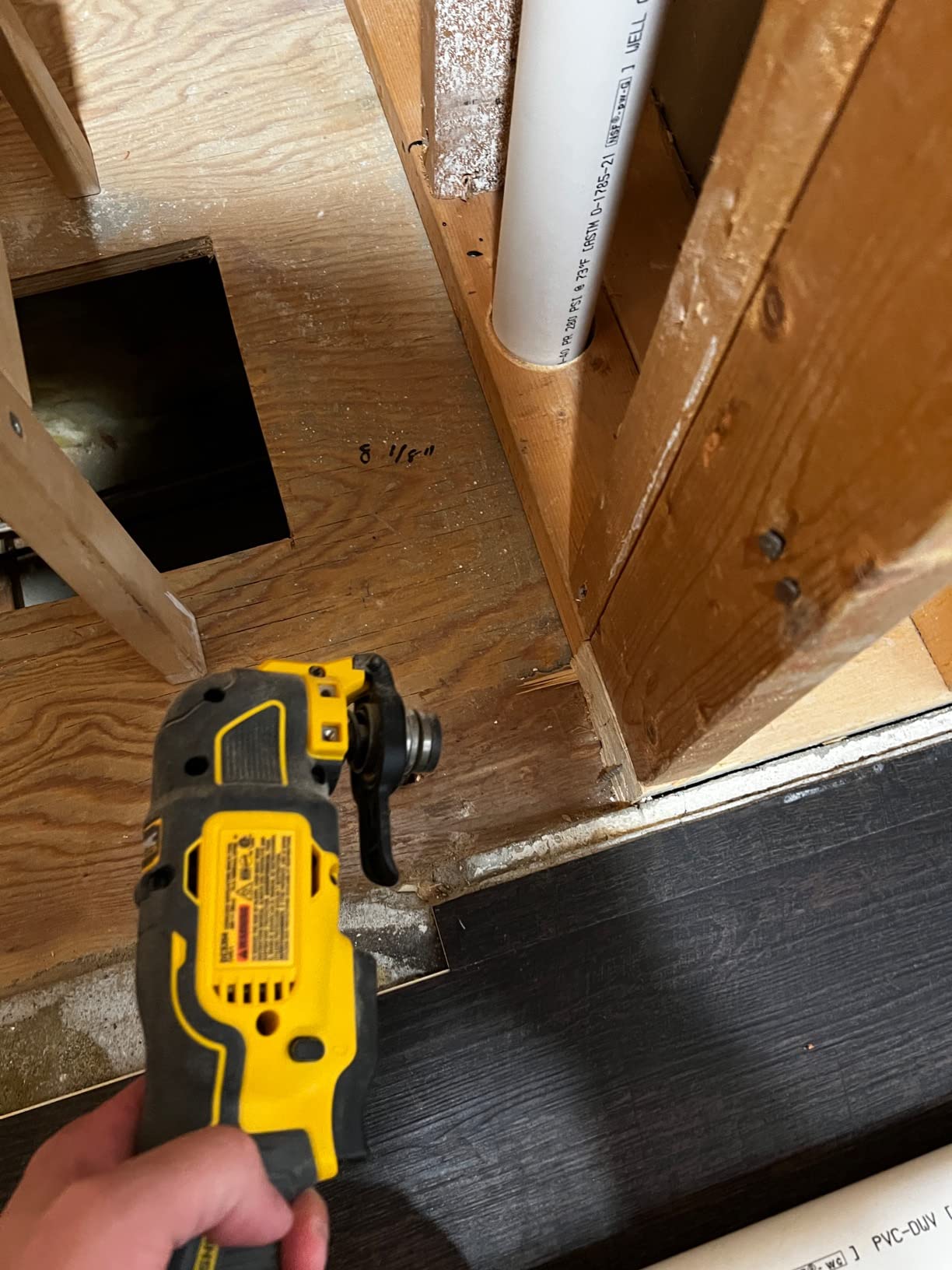
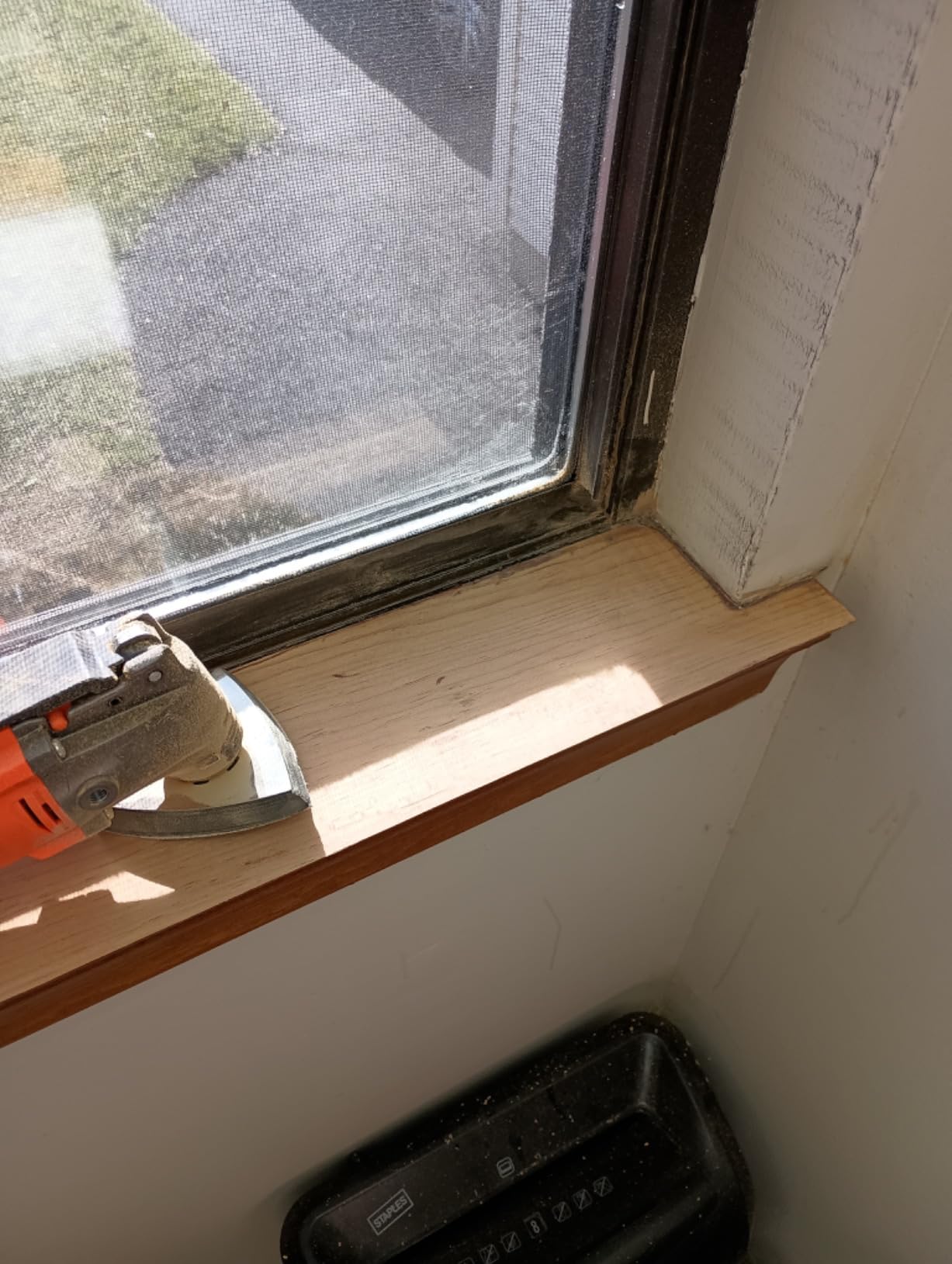
On a remodel, this tool quietly replaces four separate tools: a jigsaw for flush cuts, a reciprocating saw for demo, a scraper for caulk and adhesive, and a detail sander for tight corners. The two jobs it speeds up most are the ones that are miserable by hand, which is cutting outlet and switch boxes into drywall, and trimming baseboard, casing and flooring tight to a wall.
What follows is a ranked breakdown of the ten best oscillating multi tools for remodeling, organized by the part of the remodel the tool fits rather than by brand. We also cover corded versus cordless, why your battery platform matters more than the tool itself, the blade starter kit a remodeler actually needs, and the jobs where an oscillating tool is the wrong answer.
Table of Contents
Top 3 Oscillating Multi-Tools for Remodeling in 2026

DEWALT DCS356C1 20V MAX XR
- Brushless 20000 OPM
- 3 speed selector
- Dual-grip variable trigger
- LED
- battery and charger in kit

Milwaukee 2626-20 M18
- 12 speed settings
- All-metal gear case
- Rubberized overmold grip
- Onboard LED panel
- 5 year warranty

Makita DTM52Z 18V LXT
- Anti-Vibration Technology
- 3.6 degree oscillation angle
- Variable speed dial
- Starlock and Starlock Max
Best Oscillating Multi-Tools for Remodeling at a Glance in 2026
Every tool below earned its place on real renovation work, not on a spec sheet alone. The quick view: the top four are full-size cordless models for people who already have a battery ecosystem, the next three are corded or kit-based value options, and the last three cover tight-corner, corner-sanding and budget needs.
| Product | Specs | Action |
|---|---|---|
| DEWALT DCS356C1 20V MAX XR Kit |
|
Check Latest Price |
 DEWALT Atomic DCS354B 20V MAX DEWALT Atomic DCS354B 20V MAX |
|
Check Latest Price |
| Milwaukee 2626-20 M18 18V |
|
Check Latest Price |
| Makita DTM52Z 18V LXT Brushless |
|
Check Latest Price |
 WORKPRO 3.0 Amp Corded Kit WORKPRO 3.0 Amp Corded Kit |
|
Check Latest Price |
 CRAFTSMAN CMCE501D1 V20 Kit CRAFTSMAN CMCE501D1 V20 Kit |
|
Check Latest Price |
 AVID POWER ACMT326 20V Cordless AVID POWER ACMT326 20V Cordless |
|
Check Latest Price |
 GALAX PRO 86225 2.4 Amp Corded GALAX PRO 86225 2.4 Amp Corded |
|
Check Latest Price |
 KIMO L23Q3B 20V Brushless KIMO L23Q3B 20V Brushless |
|
Check Latest Price |
 ENERTWIST ET-OM-500 4.2 Amp Corded ENERTWIST ET-OM-500 4.2 Amp Corded |
|
Check Latest Price |
1. DEWALT DCS356C1 20V MAX XR Kit – the Best Overall Pick
DEWALT 20V MAX XR Oscillating Tool Kit with Blades, 3 Speed Cordless Brushless Multitool, Up to 20,000 OPM, LED Light, Battery and Charger Included (DCS356C1)
Brushless 20000 OPM
3 speed selector
Dual-grip variable trigger
3 lb tool body
LED light
Pros
- Brushless motor rated at up to 57% more runtime than brushed designs
- Three-speed selector plus dual-grip trigger for start-and-stop control
- Tool-free quick-change accessory system
- Universal accessory adaptor accepts most brands
- Battery
- charger and starter blades in the box
Cons
- Heavier feel than compact cordless models such as the DEWALT Atomic
- Three-speed selector is coarser than the dials on some competitors
This is the kit I hand to a remodeler who has never owned an oscillating tool, because it removes the three things that stop people buying one. There is no battery to source, no charger to find and no decision to make about speed control, because the trigger and the three-position selector handle both ends of the range.
The evidence behind it is unusually deep for a power tool. It carries a 4.8 rating across more than 12,500 reviews, and it holds the number one sales rank in the oscillating power tools category. One DeWalt DCS356 owner told a forum that they have probably cut 100 holes for outlets and switches with it in drywall and plywood, which is exactly the demo-to-finish cycle this tool is built for.
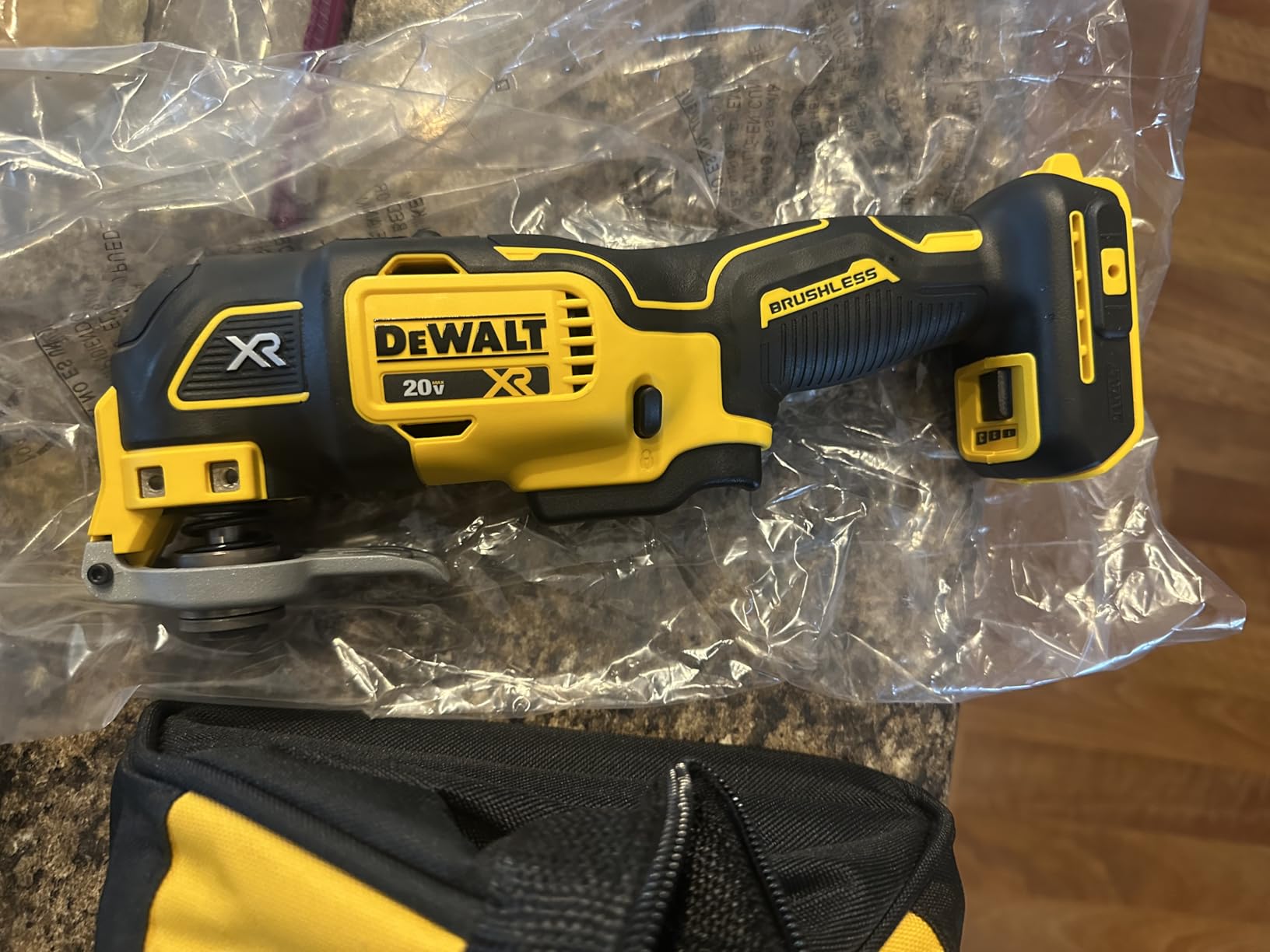
Mechanically it is a brushless motor rated up to 20,000 OPM with a quick-change accessory system that needs no wrenches, plus a universal accessory adaptor so most blades from other brands clamp on. The three-speed selector is genuinely useful on a remodel, because grout removal wants the top setting, drywall cutouts want the bottom one, and finish sanding wants the middle.
The fair criticisms are about size and fineness of control rather than capability. At 3 pounds it feels heavier in the hand than the 2.3 pound Atomic, and a three-position selector cannot do what the twelve settings on the Milwaukee 2626-20 do. If you are trimming laminate at a wall for six hours straight, that difference shows in your wrist.
Who the DEWALT DCS356C1 suits best
It suits the general contractor who runs a mix of 20V MAX tools and wants one more that shares the batteries already on the truck. The kit ships with a 20V MAX lithium ion battery, a DCB107 charger, a wood cutting blade, a wood and metal blade and the universal adaptor, so you can start cutting the day it arrives.
It also suits anyone who underestimates how much they will use the LED. The head-mounted light illuminates dark work surfaces, and on a bathroom or a closet demolition where your headlamp is already occupied, that is a real productivity gain rather than a gimmick.
Who should skip the DEWALT DCS356C1
Skip it if you own no 20V MAX battery platform and do not plan to build one, since the economics only work when the battery and charger are shared with other tools, and also skip it for overhead work, because cutting ceiling drywall for a can light with a three-pound tool held above your head is tiring. A commenter on a tool forum also noted the kit omits a depth guide and a sanding attachment, and DEWALT does not sell the full starter box separately.
2. DEWALT Atomic DCS354B – the Best Compact Tool for Overhead Work
DEWALT atomic 20V MAX* Oscillating Tool, Cordless, Oscillating, Tool only (DCS354B), 1 item package quantity, Color Multi
2.3 pound compact body
Brushless motor
Variable speed trigger
LED light
Tool only
Pros
- Compact and light at 2.3 pounds for tight spaces and overhead cuts
- Trigger based variable speed for precise control at start and end of a cut
- Quieter and lower vibration than many corded multi-tools
- Tool-free blade changes
- Shares the widely owned DEWALT 20V platform
Cons
- Tool only
- so battery and charger must be bought separately
- No multi-speed selector
- speed comes only from the trigger
The Atomic is the same size class as a fat marker pen, and that is not a marketing line. At 2.3 pounds it is the lightest full-featured cordless model here, which changes how you hold it when the work is above shoulder height or your other hand is occupied holding a scraper, a vacuum hose or a piece of trim.
Owners migrating up from older corded Dremel-style tools consistently describe the Atomic as narrower, quieter and far easier to control. It carries a 4.8 rating across roughly 6,100 reviews, so this is not a niche compact tool that struggles when it meets a nail.
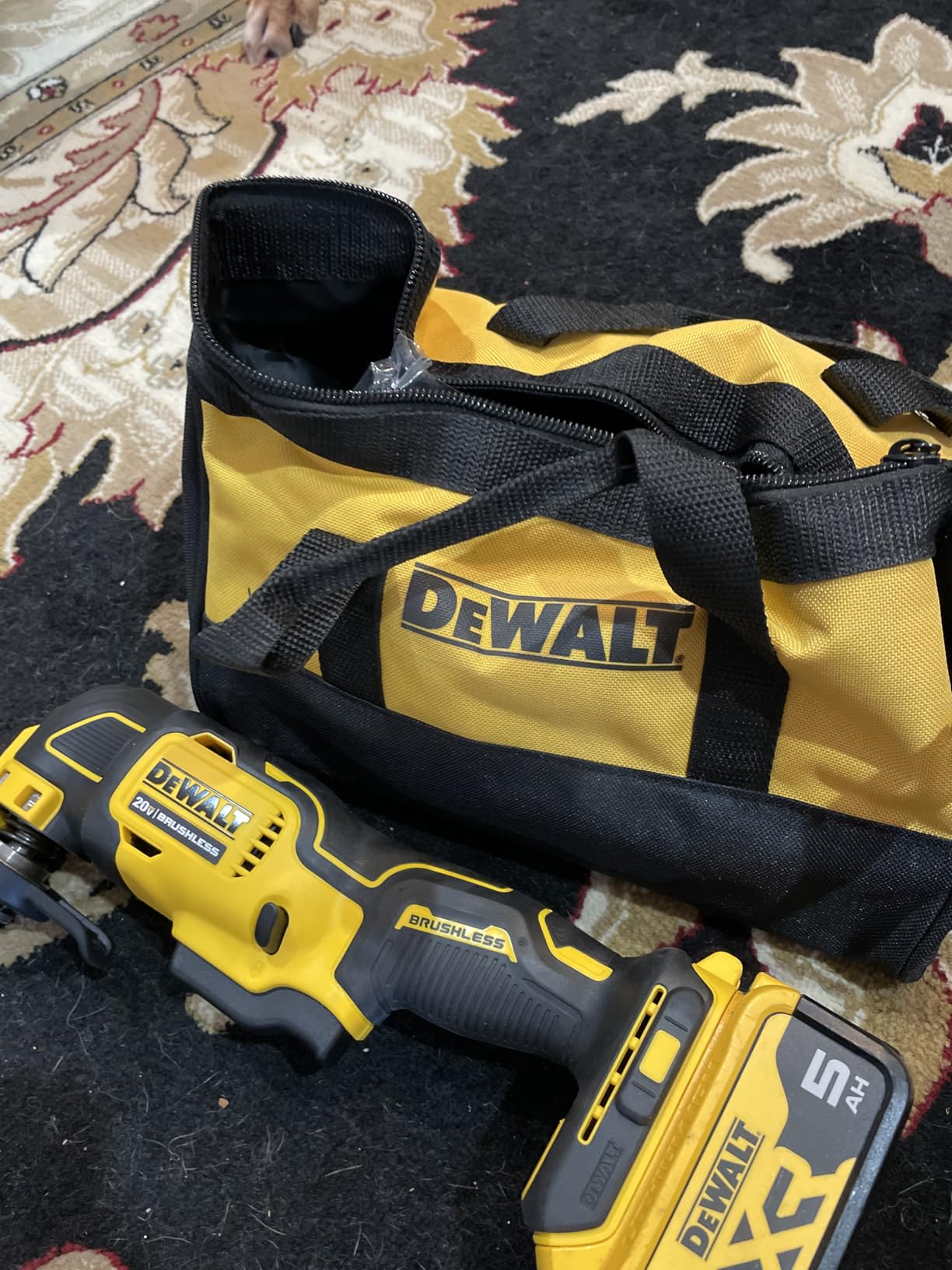
Under the shell it is a brushless motor with a dual-grip variable speed trigger, a quick-change accessory system that needs no wrenches, a universal accessory adapter and an LED light. You get a wood with nails blade, a fast-cut wood blade and the universal adapter in the box. Measured at 12 by 4.5 by 3.06 inches, it genuinely disappears into a tight cavity or a tool bag side pocket.
The single biggest practical drawback is that there is no speed selector at all. Speed is controlled only through the trigger, so holding a steady setting means holding steady pressure, and on long cuts that is tiring and inconsistent. A commenter on a tool forum made exactly this point about a competing variable-trigger tool, and the lesson generalises to any trigger-only design.
Who the DEWALT Atomic suits best
It suits the electrician or trim carpenter whose list is dominated by overhead and in-cavity work. Cutting a box for a ceiling can light, trimming a soffit, cutting back around an awkward pipe, all of these reward a short, light tool that you can steer with one hand while the other hand steadies the material.
It also suits a 20V MAX owner who already has batteries and does not need a second charger. Because the Atomic runs on the same 20V MAX packs as the flagship, the correct purchase is the bare tool and nothing else, which is the most economical route into the platform for a second or third function.
Who should skip the DEWALT Atomic
Skip it if you need to rip out a tiled shower wall or cut construction lumber all day, because the compact format exists to save weight, and the trade-off is that sustained heavy work leaves it working harder than a full-size model. Skip it too if you are starting from zero, since a tool-only listing means you still have to buy a battery and a charger, which makes the DCS356C1 kit the more sensible entry point at a similar total outlay.
3. Milwaukee 2626-20 M18 18V – the Most Durable Jobsite Option
Milwaukee 2626-20 M18 18V Lithium Ion Cordless 18,000 OPM Orbiting Multi Tool with Woodcutting Blades and Sanding Pad with Sheets Included (Battery Not Included, Power Tool Only)
12 speeds 11000 to 18000 OPM
All-metal gear case
2.9 pounds
Onboard LED panel
5 year warranty
Pros
- Twelve speed settings give the finest control in this group
- All-metal gear case resists jobsite impacts
- Rubberized overmold grip stays secure with gloves on
- Onboard LED panel lights the work from any angle
- Five-year tool warranty
- Includes a wood cutting blade
- sanding pad and sheets
Cons
- Battery and charger not included
- Speed changes require cycling the trigger rather than using a dedicated dial
The Milwaukee is the one I would put in the hands of someone who drops tools. Its all-metal gear case is the reason. Plastic gearboxes crack when a multi-tool falls off a ladder or lands in a bucket of debris, and a cracked gearbox ends the tool’s life regardless of how good the motor is.
Control is the other story. Twelve discrete speed settings from 11,000 to 18,000 OPM is the widest adjustment range of the ten tools here, and it is the reason it handles everything from delicate detail sanding to grout demolition without a separate tool. It rates 4.7 across roughly 5,650 reviews, and owners frequently call it the one tool in the shop they never reach for past.
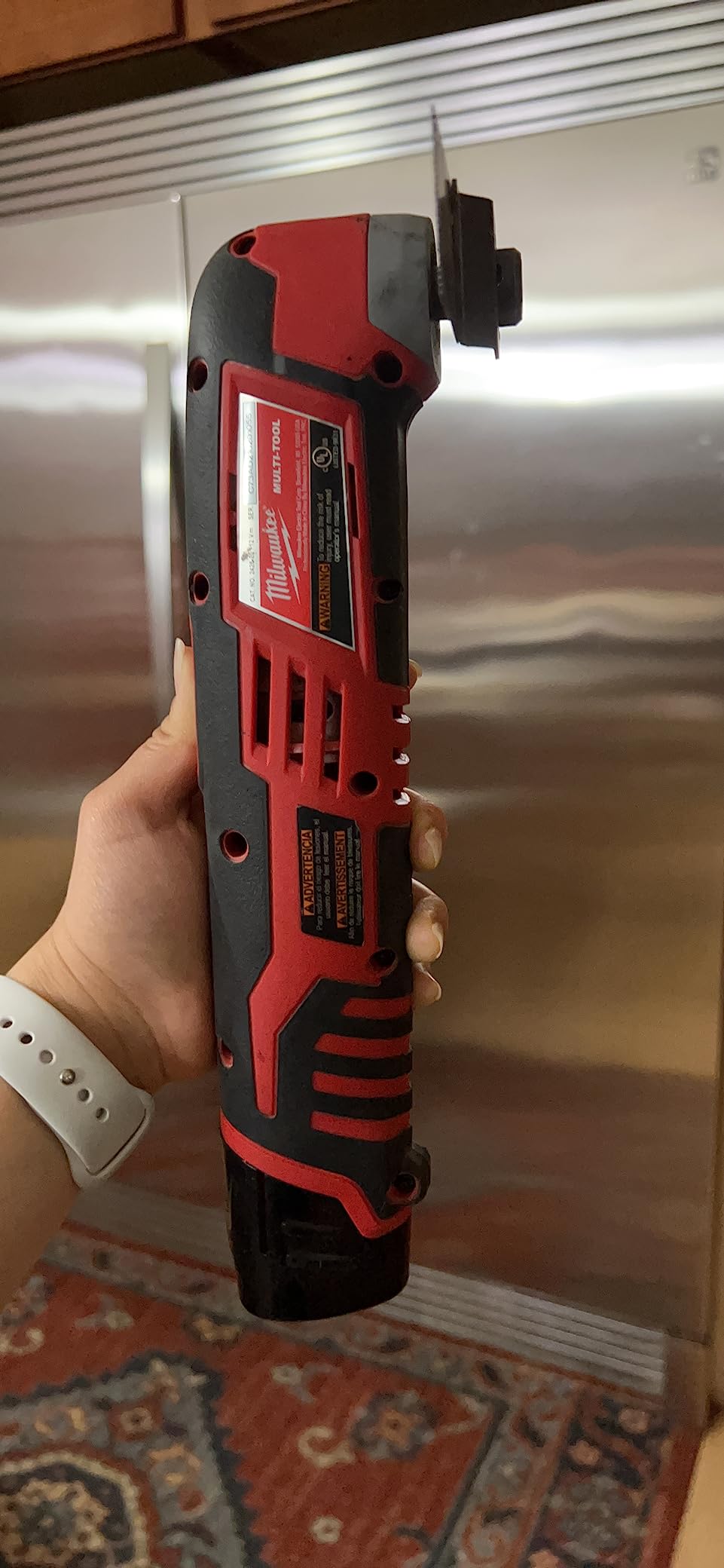
The rest of the package is designed for a wet, dusty, gloved site. A rubberized overmold handle keeps your grip when your hands are dusty, an LED panel sits at the head of the tool so it lights the work from any angle, and REDLINK battery cross-communication lets the pack and tool manage heat together. The tool weighs 2.9 pounds and measures 11-7/8 inches long.
What arrives in the box is worth noting because it is more than most bare tools give you: the multi-tool, an adapter, a wood cutting blade, a sanding pad and assorted sanding sheets. The five-year tool warranty is the longest in this lineup and covers the gearbox, which is exactly where competitors tend to fail.
Who the Milwaukee 2626-20 suits best
It suits a remodeler who already owns M18 packs, and that group is large. The M18 platform covers drivers, impacts, saws and lights, so if you have any of those, adding this tool costs you the bare tool and nothing more. Buying into a second platform purely for the oscillating tool is the single most common money mistake we see in buyer forums.
It suits people who work in gloves, in the rain, in crawl spaces and on demolition. The grip, the LED panel and the metal gearbox are not spec-sheet extras in that environment, they are the difference between a tool that lasts a season and one that lasts a decade. A forum commenter put the value proposition plainly, saying they would rather buy one good tool that lasts them the rest of their life than replace a cheap one twice.
Who should skip the Milwaukee 2626-20
Skip it if you have no M18 batteries, since the listing is a bare tool and a first-time buyer pays for the whole platform from zero. Skip it if you mostly work overhead too, because at 2.9 pounds it is fine for a full day of demo at waist height but the 2.3 pound Atomic is more comfortable for one-handed cuts above your head. And note that the Milwaukee changes speed through the trigger rather than a physical dial, which is its one recurring ergonomic complaint.
4. Makita DTM52Z 18V LXT – the Lowest Vibration
Makita DTM52Z Li-ion LXT Brushless Multi-Tool – Batteries and Charger Not Included, Blue, 18 V
Anti-Vibration Technology
3.6 degree oscillation angle
Variable speed dial
Starlock and Starlock Max
1.3 kg
Pros
- Anti-Vibration Technology measurably reduces hand fatigue on long cuts
- Brushless motor that does not bog down in hardwood
- drywall or metal trim
- Tool-less Starlock clamp with a slip-free fit
- Variable speed dial with soft start and constant speed control
- Anti-restart lockout adds safety on a live site
Cons
- Batteries and charger not included
- Some US buyers report Makita does not warranty this listing
- Head is a little bulky
- Not compatible with Makita G-Series batteries
There is an entire active thread on r/powertools devoted to a single question: which oscillating tool has low vibration. That question matters more than most buyers expect, because vibration is transmitted straight through your hand and forearm for the entire length of a cut, and an eight-hour demo day compounds it. The Makita DTM52Z is the answer I would give.
Makita’s Anti-Vibration Technology, combined with a 3.6 degree oscillation angle, is designed to move the tool through the cut with less shock than a conventional drive. Owners point to the smoothness of the cut and the reduction in hand fatigue as the two advantages they notice first, and several used it to extract built-in cabinetry and cut three-eighth-inch plywood in spots no circular saw could physically reach.
Mechanically it runs from 10,000 to 20,000 OPM with a soft start, a variable speed dial and constant speed control, so unlike a trigger-only design you can set a speed and forget about it. It also has twelve accessory angle settings at 30 degree intervals around the full circle, which lets you angle a blade to reach a bevel or a tight inside corner without rotating your wrist. Starlock and Starlock Max compatibility opens up the widest accessory ecosystem in the category.
Weight is 1.3 kilograms, roughly 2.9 pounds, and it measures 12.5 by 3.5 by 4.5 inches. The box contains the tool and a bottle of anti-rust oil, and nothing else, so plan on buying a battery, a charger and at least a couple of Starlock blades separately. The soft start and anti-restart function are genuinely useful when you are cutting in a house that still has live power somewhere in the wall.
Who the Makita DTM52Z suits best
It suits tile setters doing demolition, finish carpenters doing long trim runs and anyone whose day is measured in hours of tool-on-material rather than minutes. The AVT system is the reason, and there is a 4.7 rating across about 1,450 reviews backing up how the owners describe the feel.
It also suits Makita LXT owners who have a deep accessory habit. If you already own Starlock or Starlock Max accessories from another Makita tool, this body runs them, and the tool-less accessory clamp with the 12-position angle system lets you reuse the whole ecosystem rather than rebuilding it.
Who should skip the Makita DTM52Z
Skip it if vibration was not your concern, because AVT comes with trade-offs elsewhere: the head is bulkier than the compact models, and it does not accept G-Series batteries, so a Makita owner on the G line is locked out. Also weigh ownership carefully, since several US buyers report that Makita does not warranty this particular listing, and at about 1,450 reviews it carries the smallest sample of the three premium tools here. If you want low vibration on a brand-new platform with a full warranty, the Milwaukee 2626-20 is the steadier bet.
5. WORKPRO 3.0 Amp Corded Kit – the Best Corded Starter Set
WORKPRO 3.0 Amp Corded Oscillating Multi-Tool Kit
3.0 amp corded motor
7 speeds to 23000 RPM
3 degree angle
17 piece bundle
Tool-less accessory change
Pros
- Top speed of 23000 RPM
- the highest in this lineup
- Seven speed settings give finer control than most entry multi-tools
- Tool-free flip-button accessory change with a universal interface
- 17 piece accessory bundle plus a carrying bag
- Handles pipes
- nails
- screws
- wood and low-hardness metal
Cons
- Corded design means no battery and no cordless freedom
- Heavier at 5.2 pounds than most compact oscillating tools
- Some durability complaints appear in the low star reviews
A corded tool is not a compromise, it is a different answer to a different question. If you are doing a full gut renovation in a house with power on site, a 3.0 amp corded motor never waits for a battery, never slows as the pack drains, and never leaves you holding a dead tool halfway through a bathroom floor.
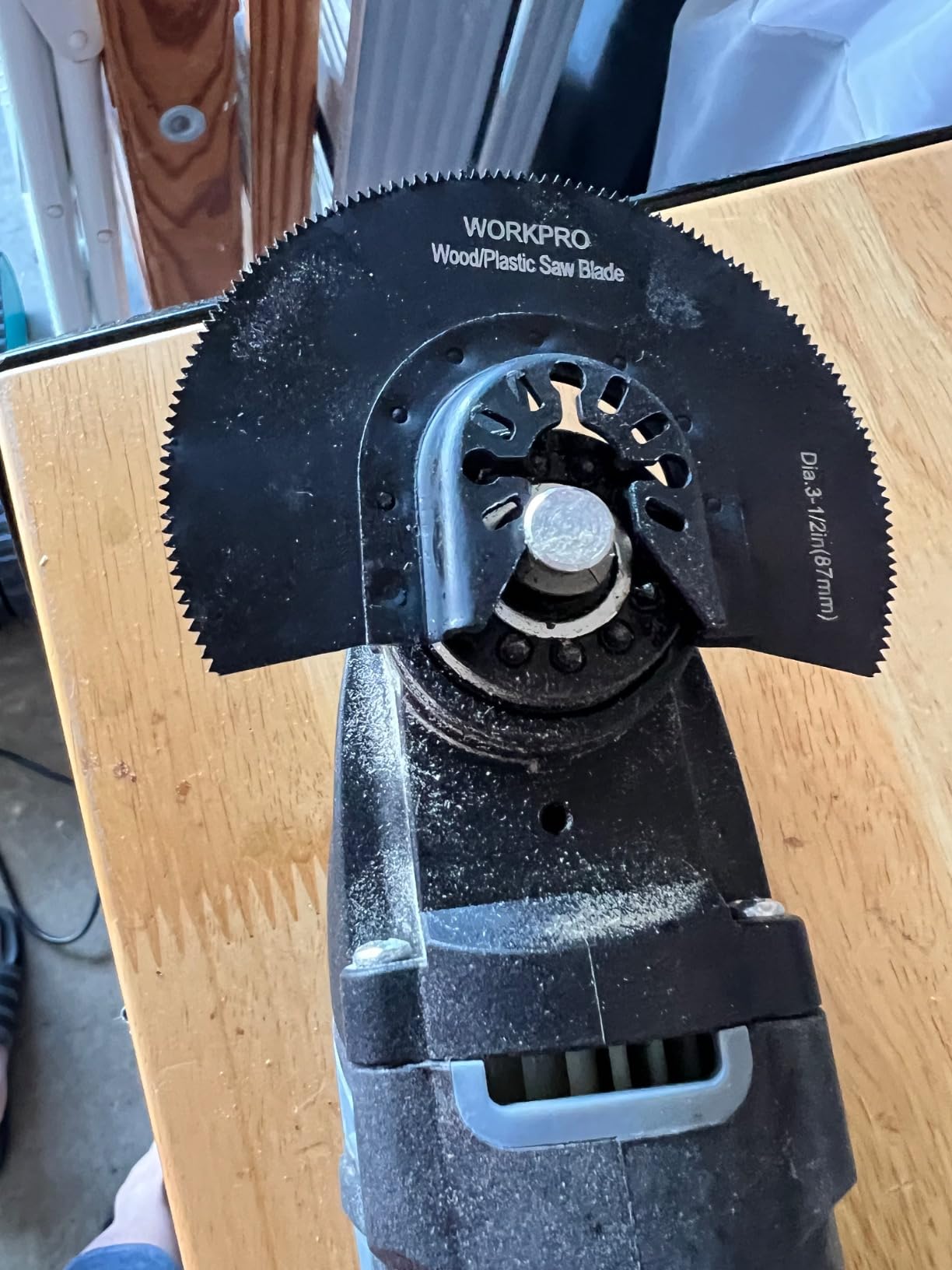
The WORKPRO is the strongest of the three corded kits here on raw speed. It runs to 23,000 RPM, the highest top speed in this lineup, across seven settings from 15,000 to 23,000, with a 3 degree oscillation angle. A top-mounted on and off switch and an ergonomic design the manufacturer positions for vibration control make it easy to run for a full demo day. It rates 4.7 across a modest but clearly positive sample of about 930 reviews.
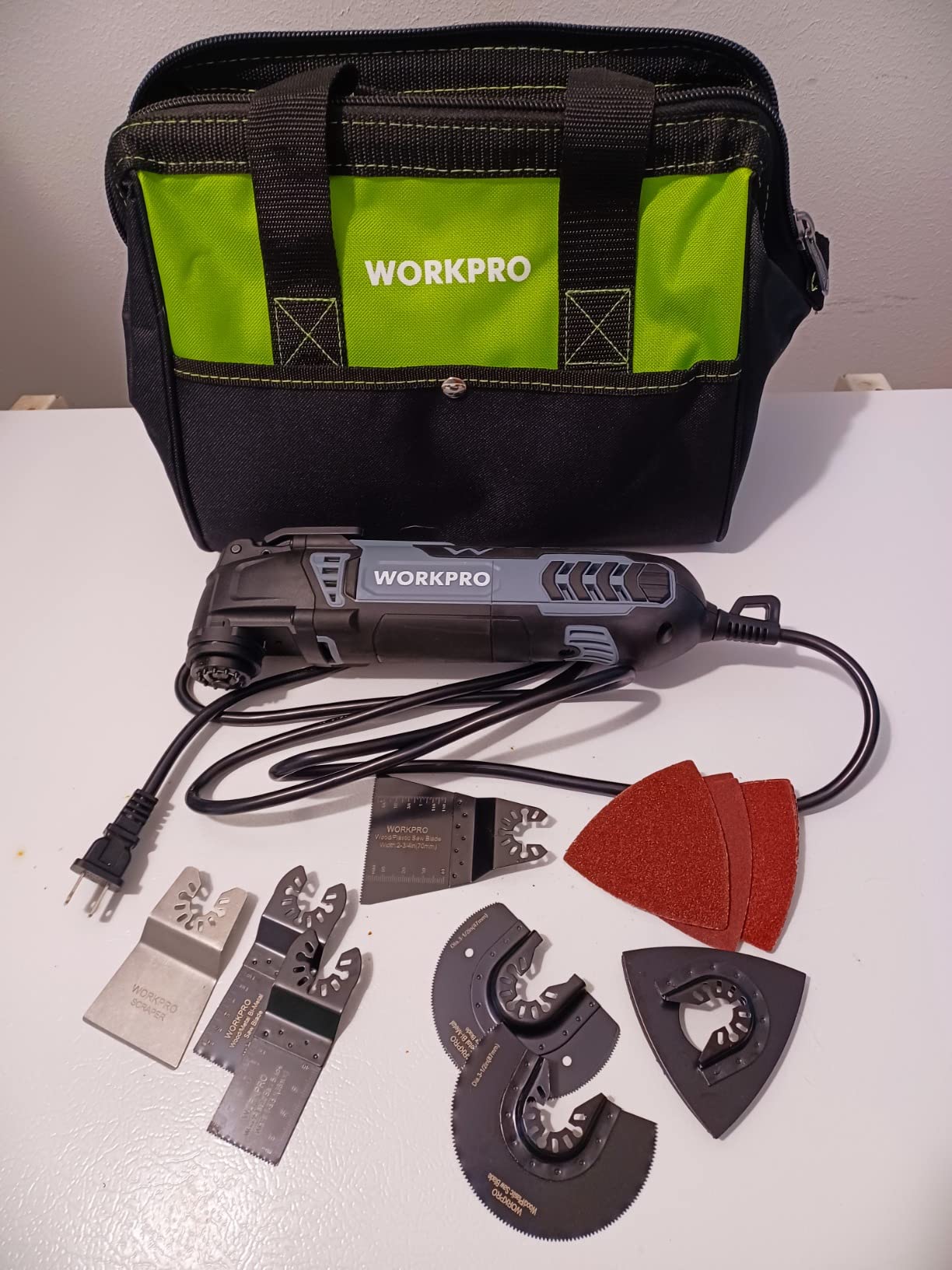
The bundle is unusually generous for the tier. You get the tool, two wood and metal blades, three wood and plastic saw blades, a scraper, a sanding pad, ten sanding sheets, a manual and a carrying bag, seventeen items in total. The accessory interface is universal, so blades from other brands clamp on without an adapter, and the tool-less flip-button change means you are not hunting for a hex key with dust-covered hands.
The physics you accept with any corded tool is weight. At 5.2 pounds this is one of the heavier bodies here, and the cord itself is a second thing to manage in a confined space. It is a workbench and jobsite tool, not a one-hand overhead tool, and treating it that way avoids disappointment.
Who the WORKPRO kit suits best
It suits the remodeler with a house under renovation, a reliable circuit within reach and no interest in accumulating batteries. The seventeen-piece bundle means you can hand a new apprentice a complete kit on day one and they can cut, scrape and sand without a single extra purchase.
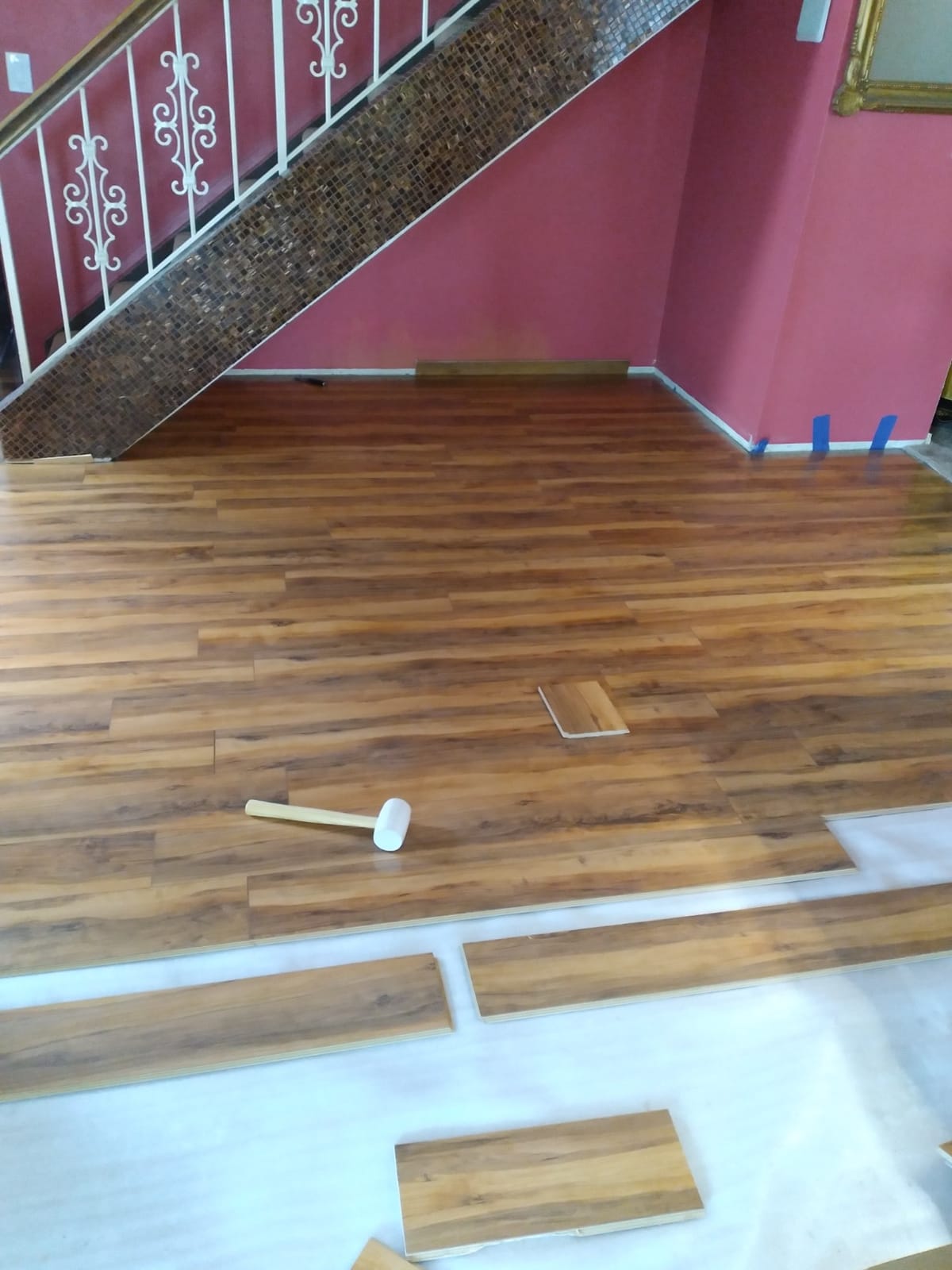
It suits demolition. Nails, screws, low-hardness metal, PVC and wood are all inside what a 3.0 amp motor can chew through, and the seven speed settings let you back off for finish work in the same session rather than swapping tools. Several owners on forums report using an oscillating tool to cut damaged tongue-and-groove hardwood flooring sections, which is exactly this tool’s strength.
Who should skip the WORKPRO kit
Skip it if your work takes you to a roof, a ladder, an attic or a finished room with no outlet nearby, since corded tools are unbeatable with a power source in reach and useless without one. Skip it for overhead work for the same reason, plus the 5.2 pound weight, and note that the low-star reviews in this listing point at durability, which is a reasonable trade if you replace tools every few years but a poor one if you want a single purchase that lasts.
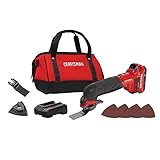
6. CRAFTSMAN CMCE501D1 V20 – the Most Complete Kit in the Box
CRAFTSMAN V20 Cordless Oscillating Tool Kit Multi-Tool with Blades, Sand Paper, Battery and Charger Included (CMCE501D1)
Variable speed dial
LED work light
Tool-free universal attachment
Battery, charger and bag included
VERSATRACK compatible
Pros
- Kit includes battery
- charger
- blades
- sanding platen
- sandpaper and a storage bag
- Variable speed dial gives real control during a cut
- Tool-free universal attachment for quick blade swaps
- LED work light improves visibility in tight work areas
- Three-year limited warranty
- VERSATRACK clip compatible for job box organisation
Cons
- Less raw power than premium-brand brushless competitors
- V20 ecosystem is far smaller than 18V or 20V MAX systems
- Only four sheets of sandpaper and a single sanding platen included
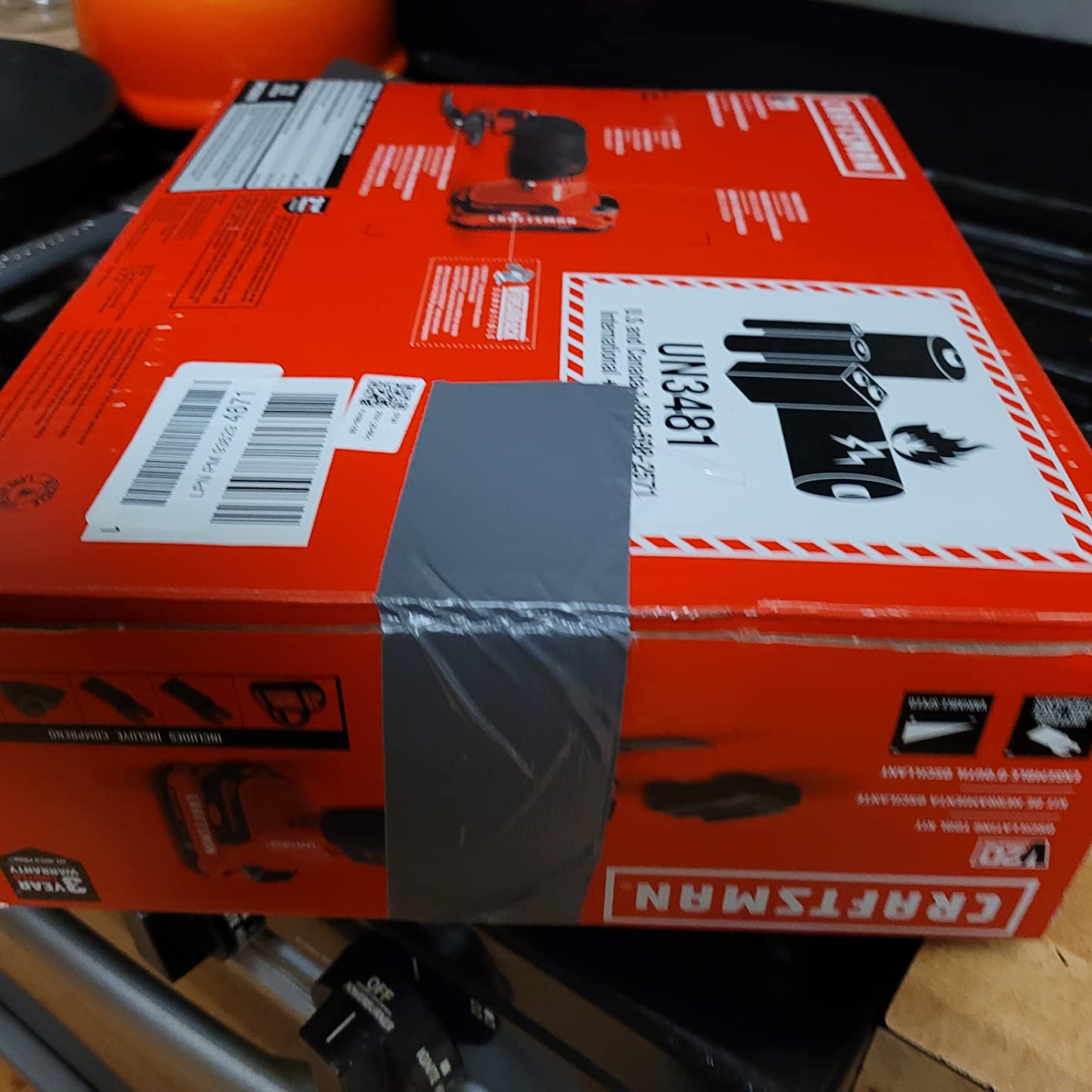
The CRAFTSMAN is the answer when someone asks which oscillating multi tool comes with everything and does not want to make a second purchase. The box holds the oscillating tool, a 20V MAX 2.0 Ah lithium ion battery, a charger, a wood blade, a wood and metal blade, a sanding platen, four sheets of sandpaper and a storage bag.
That completeness is the whole pitch, and buyers treat it that way. The listing rates 4.7 across about 915 reviews with a strong five-star share, and the praise centres on the variable speed dial, the LED and the quick attachment changes rather than on any single headline spec. For a remodeler outfitting a crew or a new apprentice, that completeness has real value.
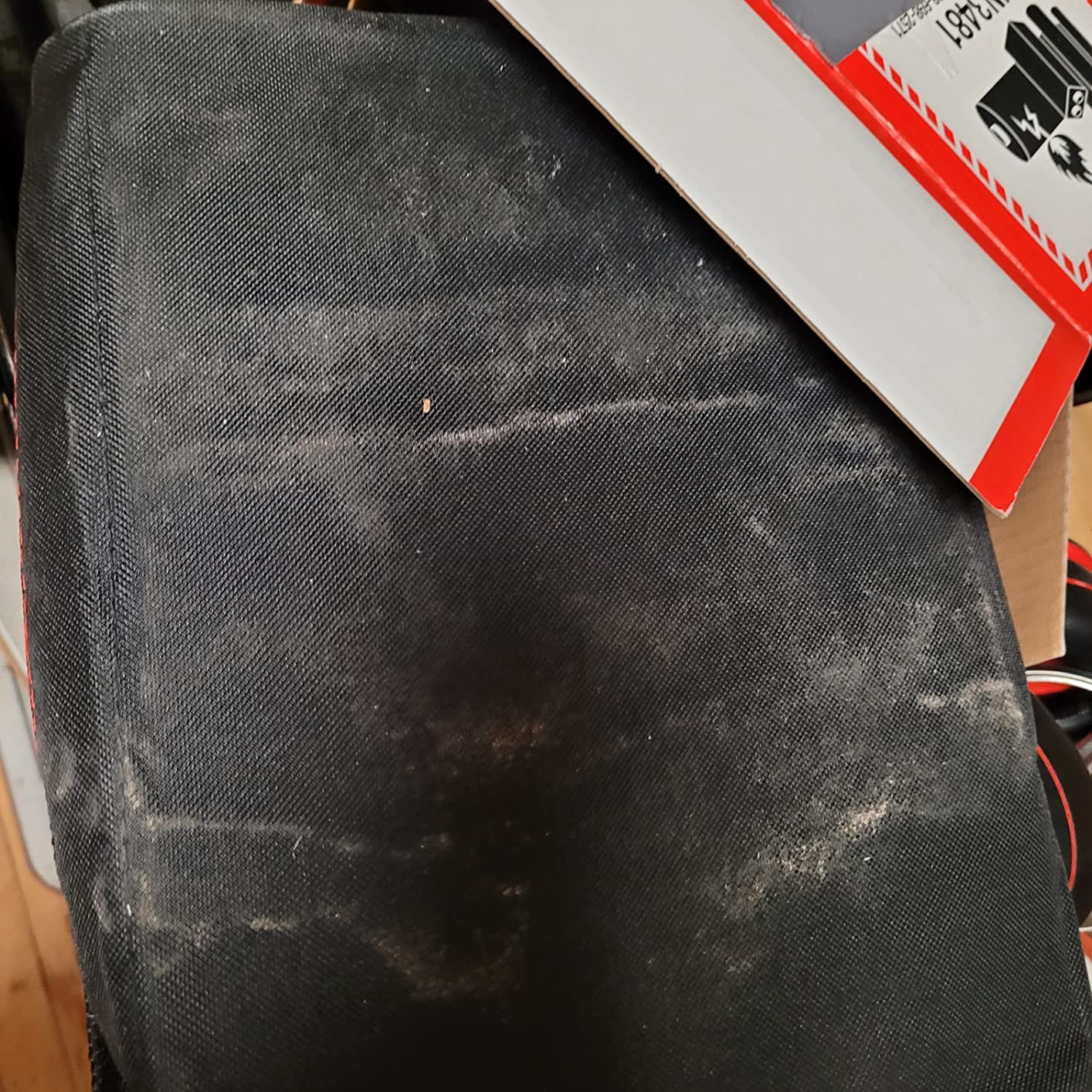
Mechanically it uses a variable speed dial for application control, an LED work light, and a tool-free universal attachment system for quick blade changes. It is part of the V20 cordless system and carries VERSATRACK compatibility, so the storage bag hangs on the same clip rail as the rest of your CRAFTSMAN gear. The tool carries a three-year limited warranty, which is respectable if unremarkable.
The honest weakness is power. Owners compare it unfavourably to premium brushless competitors on sustained hard work, and the V20 ecosystem is much smaller than 18V or 20V MAX, which means fewer battery and accessory options as you expand. The accessory bundle is also thin on consumables, four sandpaper sheets and one platen is a starting point rather than a working supply.
Who the CRAFTSMAN CMCE501D1 suits best
It suits a buyer who wants one box to open and a full day of work immediately after, without a second delivery. The storage bag and VERSATRACK clip mean it lives on the job box rather than in a drawer, which matters more than it sounds on a remodel where you are moving between rooms and sites.
It suits existing V20 owners. If your drill, driver and circular saw are already V20, this kit slots into a platform you have paid for. The variable speed dial is also the right control method if you prefer setting a speed to sweeping grout or scraping adhesive rather than modulating a trigger by feel.
Who should skip the CRAFTSMAN CMCE501D1
Skip it if your battery platform is 18V or 20V MAX, because the V20 packs are not interchangeable with those, and in that case the DCS356C1 kit gives you a comparable bundle on a platform you already own. Skip it for heavy demolition as well, because two Ah of battery plus a motor owners describe as less raw than the premium brushless options is a combination that feels slow on a subfloor full of nails or a wall of old grout.
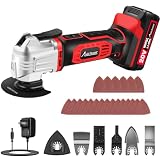
7. AVID POWER ACMT326 – the Most Versatile
AVID POWER Cordless Oscillating Tool 20V Battery Powered Oscillating Multitool with 2.8° Oscillation Angle, Variable Speed Oscillating Saw w/ 28 Pcs Accessories for Scraping/Cutting & Sanding
6 speeds 8000 to 18000 OPM
2.8 degree angle
28 piece accessory kit
20V 2.0 Ah battery and charger
LED light
Pros
- Very large accessory count for a mid-range price
- Six speed settings spanning 8000 to 18000 OPM
- Light at 2.7 pounds with a narrow oscillation angle for corner work
- Battery
- charger and LED light included
- Triangular finger sanding pad reaches tight corners on frames and trim
Cons
- Marketed for light to medium duty only
- 20V 2.0 Ah battery needs 4 to 5 hours to charge
- Manufacturer recommends a 30 minute on
- 15 minute off duty cycle
- Smallest oscillation angle here so slightly slower cutting
Twenty-eight pieces of accessories in the box is the headline here, and it is a real advantage rather than a gimmick. You get a segment saw blade, a diamond tipped segment blade, a scraper, three plunge-cut saw blades, a full sanding pad with fifteen sheets, a triangular finger sanding pad with six sheets, the 20V 2.0 Ah battery and a charger.
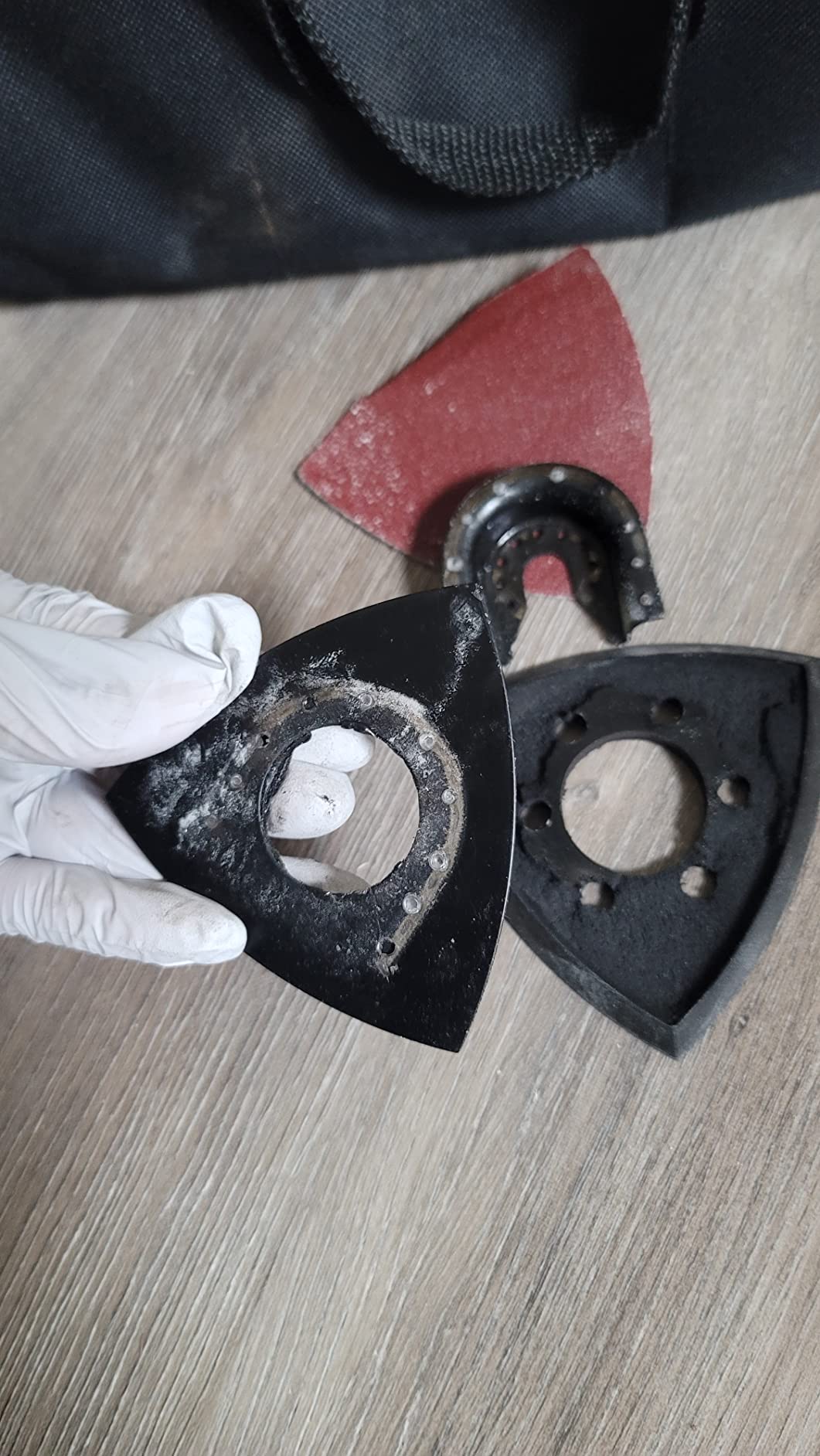
That finger sanding pad is the sleeper feature for remodelers. A triangular pad gets into the inside corners of window frames and trim where a round pad cannot reach, and on a bathroom or a window replacement it saves you the fiddly hand-sanding nobody enjoys. The tool itself runs six speeds from 8,000 to 18,000 OPM, weighs 2.7 pounds and carries a front LED, rating 4.5 across roughly 4,000 reviews.
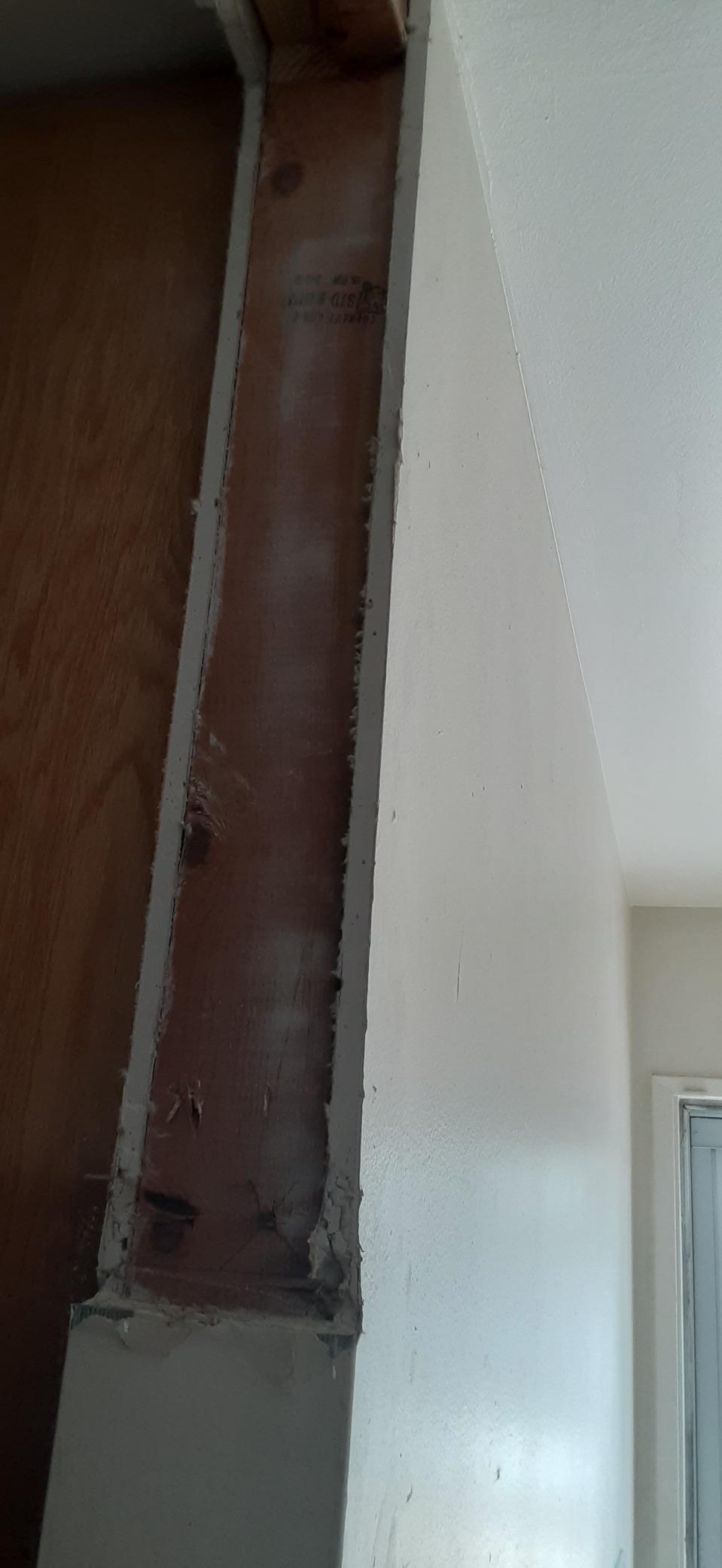
The 2.8 degree oscillation angle is narrow, which makes it precise in corners and slightly slower in heavy material, and that is a deliberate trade. The six-speed range covers delicate detail sanding at the bottom, general wood, drywall and paint scraping in the middle, and metal cutting at the top, which is a smarter spread than a single-speed tool offers.
The limitations are documented and worth reading before you commit. The manufacturer markets it for light to medium household work rather than heavy professional jobs, the 2.0 Ah pack takes four to five hours to charge, and the recommended duty cycle is 30 minutes on followed by 15 minutes rest. The 4.5 average includes a larger share of three-star and one-star reviews than the premium tools, concentrated in durability and battery complaints under sustained use.
Who the AVID POWER ACMT326 suits best
It suits the homeowner or handyman whose projects are weekends rather than job sites. Scraping paint, cutting drywall openings, trimming laminate in a bathroom, detail sanding around a window frame, all of these are squarely inside what a light to medium duty cordless tool handles well, and the accessory bundle means you can do all of them on day one.
It suits anyone already holding a 20V 2.0 Ah battery and charger of a compatible design, since that removes the largest single cost of entry. The narrow angle and the 2.7 pound body also make it a comfortable one-handed tool for work above shoulder height or inside a cabinet.
Who should skip the AVID POWER ACMT326
Skip it for a full gut renovation, because the stated duty cycle and the light-duty positioning mean you will spend your time waiting during rests, and a 2.0 Ah pack is a short-lived way to spend a demo day. Anything involving a lot of grout, tile, concrete or structural lumber will test the motor beyond what it is positioned for, and if you are hard on batteries, four to five hours of charge time for a small pack is the most common source of frustration in reviews.
8. GALAX PRO 86225 – the Best Corded Tool for Tile and Corners
GALAX PRO Oscillating Multi-Tool Corded 2.4A, 28pcs Accessories
2.4 amp corded 288 watts
Up to 21000 OPM
4 degree angle
Tool-free quick-lock lever
Compact aluminium head
Pros
- Minimal vibration allows genuinely precise and delicate work
- Tool-free quick-release lever changes blades in seconds
- Six speed settings to 21000 OPM cover sanding through grout grinding
- Compact aluminium head reaches cabinet corners
- window jambs and behind toilets
- Large accessory assortment plus a carrying case
Cons
- Several included blades wear out quickly on precision laminate work
- The quick-release lever pin can work loose and go missing
- Sanding pads can fly off if you push rather than let the tool work
- 2.4 amp motor is the least powerful corded option here
Owners of this tool repeatedly name one thing first, and it is not power: vibration. Several describe the GALAX PRO as having minimal vibration, which is what allows genuinely delicate, precise work rather than work that merely gets done. That single trait is why it appears in this ranking despite a 2.4 amp motor that trails the other two corded options.
It is also the strongest of the corded group for grout. Six speeds from 11,000 to 21,000 OPM with a 4 degree oscillation angle give it a usable top end for grinding out grout, and it ships with both triangular and semi-circle carbide blades, which is exactly the pair you want for grout removal. It rates 4.5 across roughly 2,640 reviews, with owners reporting performance at or above Porter Cable class tools for the money.
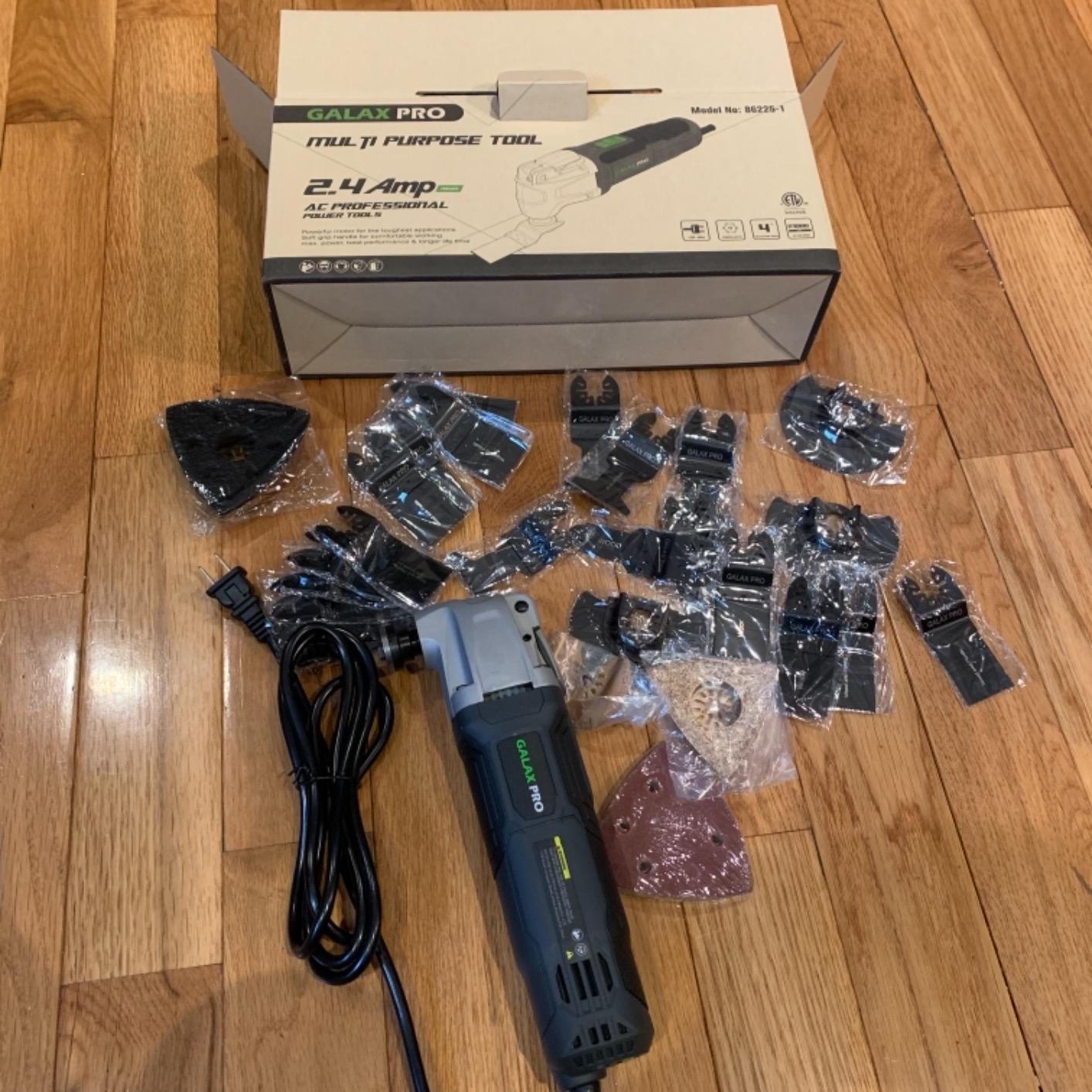
The compact aluminium head is the other differentiator. Its slim profile reaches into cabinet corners, window jambs and behind toilets where bulkier tools do not fit, which on a bathroom remodel is where a surprising amount of the work actually is. The patented tool-free quick-lock lever swaps blades, scrapers and pads in seconds without tools.
The accessory list is long: triangular and semi-circle carbide blades, a triangular sanding pad, HCS wide and narrow segment wood blades, a semi-circle bi-metal blade, HCS and bi-metal saw blades, sanding paper, a manual, a warranty card and a storage bag. At 5.37 pounds with 288 watts of 120-volt corded power, it is a bench-side and jobsite tool rather than an overhead one.

Who the GALAX PRO 86225 suits best
It suits a tile setter or a bathroom remodeler who is removing grout all day. The carbide blades in the box, the six-speed range reaching 21,000 OPM and the low vibration combine into a tool that stays controllable on a vertical shower wall, which is where a heavier, buzzzier tool makes the job miserable.
It suits anyone cutting in genuinely tight spaces, because the compact head is a physical advantage no setting can replicate. And for a buyer who has already run a corded multi-tool and knows they will keep using it on a powered site, the accessory assortment means the common blades are on hand from the first job.
Who should skip the GALAX PRO 86225
Skip it if the main job is long cuts in thick lumber or structural demolition, because the 2.4 amp motor trails the other two corded options and will bog down, making the WORKPRO 3.0 amp and the ENERTWIST 4.2 amp better buys for those materials. Also weigh the consumables, since several included blades wear out quickly on precision laminate work, the quick-release lever pin is a known failure point, and the sanding pads can detach if you push into the material. A buyer who treats blades as a consumable budget rather than expecting them to last will get much more out of this tool.
9. KIMO L23Q3B 20V – the Best Cordless Tool for Roofs and Ladders
KIMO 20V Cordless Oscillating Tool, Brushless Oscillating Power Multi-Tools
6 speeds 5000 to 21000 OPM
3 degree angle
Dual-position auxiliary handle
Anti-vibration grip
20V battery and fast charger
Pros
- Very lightweight and well balanced for a cordless multi-tool
- Cordless freedom suits rooftops
- ladders and outdoor job sites
- Quick tool-free blade change
- Auxiliary handle mounts on either side for different postures
- Anti-vibration grip plus an LED that stays on briefly after shutdown
- Battery and fast charger included
Cons
- 2.0 Ah battery runs out in roughly 30 minutes of continuous use
- Aluminium motor housing runs hot during extended work
- Some semi-circle blades from other brands will not fit the holder
- Customer service reported as slow to respond
The KIMO solves a problem no other tool on this list addresses: working away from an outlet. If your remodel involves soffits, exterior trim, a shed, a fence line or anything on a ladder, a cordless tool is not a convenience, it is the only option, and the dual-position auxiliary handle is the detail that makes it usable up there.
Because the handle mounts on either side, you can set it to match your grip and the angle you are cutting at, which is the difference between a controlled cut and a twisted wrist at head height. The anti-vibration soft rubberized grip and an LED that stays lit briefly after you release the switch both point at the same design intent, and the whole package stays manageable overhead. It rates 4.3 across about 2,280 reviews.
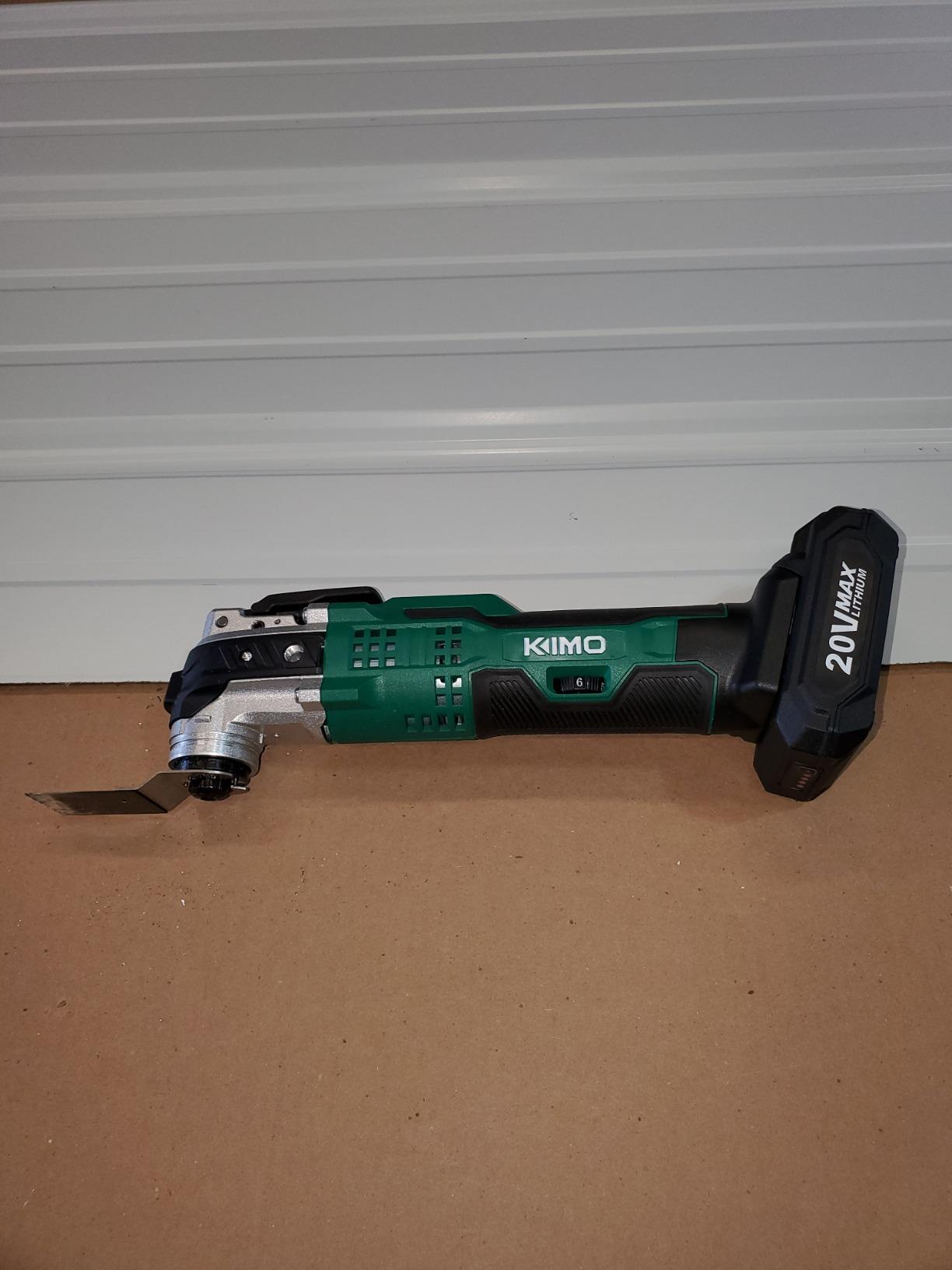
On paper the specification is the most ambitious in the value tier. It is a brushless motor reaching 21,000 OPM across six speeds from 5,000, with a 3 degree oscillation angle, a tool-free change the manufacturer rates at three seconds, a reinforced dual-locking blade holder designed to stop wobble, an LED with an on-board battery gauge in 25 percent increments, and a 2.0 Ah pack that reaches full charge in about an hour. The bundle runs to 26 pieces including a depth guide ring and a scraper.
The honest problems are battery and heat. The 2.0 Ah pack gives roughly 30 minutes of continuous use before it needs a swap, so outdoor work means carrying a second battery or working in short bursts. The aluminium motor housing runs hot during extended sessions, and the one-star share of 8 percent is the highest in this lineup, with slow support responses a repeated theme.
Who the KIMO L23Q3B suits best
It suits the remodeler doing exterior and elevated work, where cord is not an option. Six speeds covering 5,000 to 21,000 OPM handle the range from fine sanding and polishing at the bottom through wood, plastic and drywall in the middle to metal pipe, nails and screws at the top, and the auxiliary handle gives you two-handed control on a ladder.
It suits buyers who want a modern brushless motor and a full accessory set without committing to a major tool platform. The battery and 60-minute charger are included, the battery is interchangeable with other KIMO 20V tools, and the one-year warranty comes with lifetime repair service, which is an unusual commitment from a value brand.
Who should skip the KIMO L23Q3B
Skip it if your day is demo rather than trim, because thirty minutes of runtime per pack, a hot motor housing under load and the highest one-star share of any tool here add up to a poor experience for sustained heavy removal. Skip it if you rely on mixing accessory brands as well, since some semi-circle blades from other manufacturers will not fit the reinforced holder, and for a low-vibration, buy-it-for-a-decade tool on a major platform the Milwaukee 2626-20 or the Makita DTM52Z is the safer purchase.
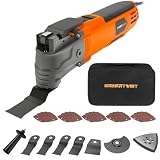
10. ENERTWIST ET-OM-500 4.2 Amp Corded – the Fastest Cutting Corded Option
ENERTWIST 4.2 Amp Oscillating Multitool Kit with 33 PCS Accessories
4.2 amp pure copper motor 500 watts
5 degree oscillation angle
6 speeds 8000 to 16000 OPM
33 piece kit
ETL listed
Pros
- 5 degree oscillation angle is the widest of the ten tools here
- 4.2 amp pure copper motor handles nails
- bolts
- tile
- concrete and hardwood
- Blades attach easily and securely with a finger-safe latch
- Low vibration and relatively quiet running
- Tool-free quick change accepts blades from major brands
- 33 piece kit with an auxiliary handle and organised carry bag
Cons
- Sanding pad hook-and-loop wears out quickly and lets paper drift
- Requires a washer to fit some universal third-party blades
- Carrying bag pouch frayed on one unit
- Customer service reported as slow
The angle of the blade’s sweep is the least discussed spec in this category and the ENERTWIST leans into it hardest. Its 5 degree oscillation is the widest of the ten tools here, and a wider sweep means more material removed per stroke, which is why owners report cutting through a pine board in three to four seconds on a middle speed with very little pressure.
Underneath sits a 4.2 amp pure copper motor rated at 500 watts, which is the most capable corded motor in this ranking, and the manufacturer lists nails, bolts, tile, concrete, wood, plumbing pipe, drywall cutouts, old paint, grout, door casings, floor stripping and sealant removal as fair game. It is ETL listed for electrical safety and carries a 4.4 rating across about 2,000 reviews.
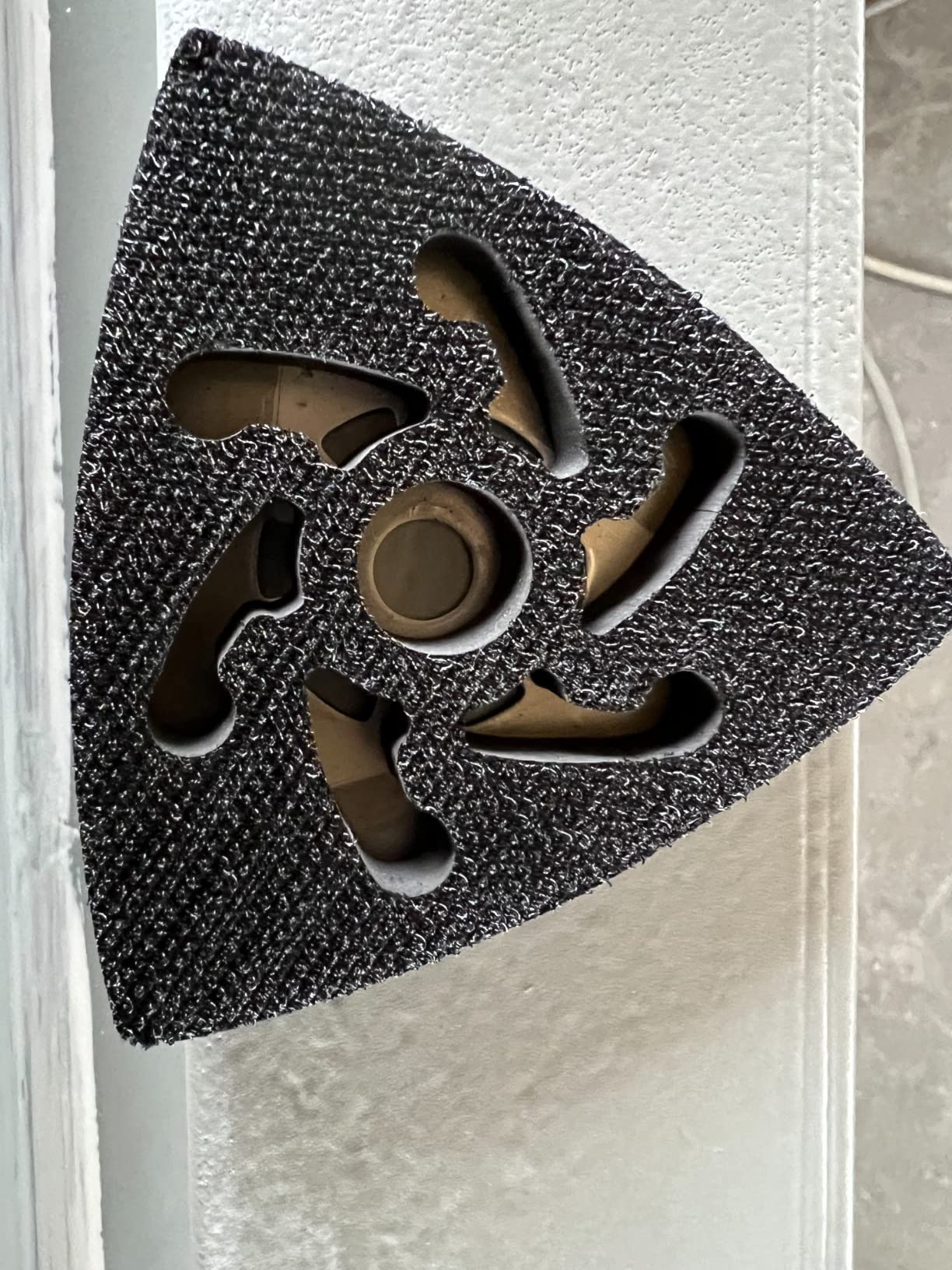
There is a thoughtful safety detail in the accessory system. Blades attach by twisting a knob, inserting and pushing down, with a finger-safe safety latch that keeps your hand away from the cutting edge, and the quick-change system accepts blades from major brands through the included multi-brand adaptor. An auxiliary handle is in the box, which matters on a 2 kg tool.
The accessory bundle is the largest here at 33 pieces: three fast-cut wood blades, a wood with nails bi-metal blade, a semi-circle blade, a sanding pad, 25 sheets of sandpaper, a rigid scraper, the multi-brand adaptor, the auxiliary handle, a nylon bag with interior dividers, a manual and a service card. At 2 kg and 11 by 2.5 by 3.5 inches, it is also the most compact of the three corded tools.
Who the ENERTWIST ET-OM-500 suits best
It suits the remodeler doing serious demolition on a powered site. Nails, bolts, tile, concrete and thick trim are the listed strengths, and a 500 watt pure copper motor has the thermal headroom for a long plunge cut where a 2.4 amp motor would stall.
It suits buyers who already know the oscillating multi-tool category and want the fastest cut per stroke rather than the lightest tool. At 2 kg it is the least punishing corded body here for overhead work, and the low-vibration, relatively quiet running is the opposite of what most users expect from a 4.2 amp machine.
Who should skip the ENERTWIST ET-OM-500
Skip it if you will use it for finishing work rather than demolition, because the top speed of 16,000 OPM across six settings is lower than both other corded tools here, and the sanding pad hook-and-loop wears out quickly and lets paper drift off mid-sanding. Skip it if you want a brand with a service department you can rely on, since customer service response times are a repeated complaint in reviews and warranty type is listed as seller rather than manufacturer. If the tool is your primary remodel investment rather than a site consumable, a name-brand platform with a long warranty is the better long-term purchase.
Corded vs Cordless: Which Should a Remodeler Buy?
Corded wins on uninterrupted power, and cordless wins on everything else. A 4.2 amp corded motor such as the ENERTWIST’s never slows as the job goes on, because the power comes from the circuit rather than a cell. On a full gut renovation in a house with power, that continuous output is genuinely valuable.
Cordless wins because the jobs that make an oscillating tool essential are rarely next to an outlet. Soffits, attics, garages, basements, exterior trim and every stage of a bathroom after the walls are opened are cord-shaped problems. The gap in cutting performance between the two classes has also narrowed, which it never used to be.
The exception that settles most cases: if you already own batteries for one platform, buy into that platform. Battery platform lock-in is the single biggest source of buyer anxiety in tool forums, and it is a solvable problem. Adding a second system to own one more tool is how people end up with half-charged batteries and two chargers in the truck.
Battery Platform Matters More Than the Tool
Almost every platform on the market is well made. The platforms are not equally well owned. The tool you choose should be a tool on the platform you already have, because the marginal cost of a new tool on an existing platform is the tool and nothing else, while a new platform means a battery, a charger and future friction.
Two specific notes. Makita sells across 18V LXT and the smaller G-Series, and the DTM52Z here is 18V LXT only, so a G-Series owner is locked out. Milwaukee splits into M18 full-size and M12 compact, and the 2626-20 is the M18 body, so an M12 owner would be looking at a different machine entirely. Both are recurring questions in the forums, and both have the same answer: check the platform label before anything else.
For people who already own a large platform and want a lighter tool for overhead work, the compact class is worth a second purchase. That is exactly the reasoning one buyer gave in a forum thread, choosing a compact Milwaukee M12 FUEL model specifically so they would not have to carry a second battery and charger system for one tool. The same logic applies to the DEWALT Atomic at 2.3 pounds.
Brushless vs Brushed, and Trigger vs Dial Speed Control
A brushless motor has no carbon brushes to wear out or generate heat inside the tool. In exchange it costs more up front. DEWALT states its brushless 20V motors deliver up to 57% more runtime than brushed designs, and that is the single clearest runtime benchmark in this category, so on any long job the brushless tools here will run noticeably longer per charge.
Variable speed trigger versus speed dial is the oldest argument in the category, and both camps have a real point. A trigger gives instant, infinitely variable response and precise control at the start and end of a cut, which is why the DEWALT DCS356C1 and the Atomic both use one. A dial lets you set a speed and hold it without thinking, which is why the Makita DTM52Z, the CRAFTSMAN and the three corded tools use one instead.
Where the trigger loses is in awkward positions. An oscillating tool spends much of its life on its side, overhead, or with the body rotated so your index finger is not on the natural part of the trigger. That is when a trigger becomes awkward to modulate, and it is the most common ergonomic complaint in owner reviews. A user on r/Tools made the opposite point about a competing tool, calling the variable speed trigger a huge advantage. Both experiences are real, and which one dominates depends on the jobs you actually do.
What to Look for When Buying an Oscillating Multi-Tool
- Motor type and oscillation range. Brushless motors run longer per charge, and a wider OPM range from roughly 8,000 to 21,000 lets one tool cover fine sanding through grout grinding.
- Speed control method. A dial sets a repeatable speed for grout and scraping, while a variable trigger gives finer control starting and ending a cut in drywall or trim.
- Tool-free blade change. Blades change constantly on a remodel, and a lever or flip button with no hex key saves real minutes across a day of swapping between cut, scrape and sand.
- Blade interface type. Starlock and Starlock Plus open the widest accessory ecosystem, while a universal-fit interface lets you use blades from other brands on a tighter budget.
- Weight and balance. Under 3 pounds matters for one-handed and overhead work, while a rubberized grip and an auxiliary handle matter for long demolition sessions.
- Vibration control. Vibration travels straight into your hand and forearm, and a full demo day compounds it, so an anti-vibration system or a low-vibration gearbox is a comfort decision worth making.
- Battery platform and pack size. Match the platform you already own, and note that a 2.0 Ah pack gives roughly 30 minutes while a 5.0 Ah pack gives considerably more before a swap.
- Accessory bundle and light. A kit with blades, a scraper, a sanding pad and paper saves a second order, and a head-mounted LED makes interior demo and closet work far less frustrating.
Blade Guide: Which Blade for Which Remodel Job
Blades decide the quality of the cut more than the tool does. One owner writing on The Garage Journal put it plainly: a good blade in a cheap saw usually makes a great cut, and the same forum’s experience is that premium blades cost more but last considerably longer. Budget for blades as a consumable, not an accessory, and your total cost of ownership changes completely.
For a plunge cut into door jambs or a flush cut into baseboard, you want a wide, flat segment wood blade with a fine tooth count, so the cut stays flat against the material. For cutting through drywall to form a box around an outlet, a plunge-cut blade with a sharpened tip lets you start the cut in the middle of the sheet without drilling a starter hole. For wood generally, bi-metal is the right upgrade over HSS when you are near nails, and more teeth means a slower but cleaner cut with less tear-out.
For MDF, tooth count is the whole game. A fine-tooth blade in the forty-plus range cuts slowly but leaves an edge you can fill and paint without reworking it, and that matters because MDF edges are the ones that show. For hardwood flooring, use a bi-metal blade with a flush-cut tip geometry so the blade can slide under the tongue and groove and trim the last section flat to a wall without damaging the finished face.
For grout and tile, you want a carbide or diamond-grit blade, semi-circle or triangular depending on the reach you need. For scraping adhesive, caulk and old paint, a rigid scraper blade is a different tool entirely and far more effective than a saw blade. For sanding, match the pad shape to the work, since a triangular finger pad reaches inside corners that a round pad will not.
Which Remodel Phase Each Tool Fits Best
Demo day, from ripping out carpet underlay to pulling door casing, is where the full-size brushless cordless tools earn their keep. The DEWALT DCS356C1 and the Milwaukee 2626-20 both have the power and the speed range to keep moving through nails and built-up material, and a DCS356 owner told a forum he has probably cut 100 outlet and switch holes in drywall and plywood with his.
Tile demolition, particularly grout and shower surrounds, favours wide oscillation angles and low vibration. The ENERTWIST’s 5 degree sweep and the GALAX PRO’s low-vibration corded body both suit vertical grout work, and the Makita DTM52Z is the answer for anyone whose hands suffer on a long tile job.
Finish carpentry and trim work is the compact-tool phase. Overhead cuts, undersink and toe-kick work, and trimming flooring flush to a wall all reward a light body you can steer with one hand, which makes the 2.3 pound DEWALT Atomic and the 2.7 pound AVID POWER the more comfortable choices. A user on a tool forum reported cutting damaged tongue-and-groove hardwood flooring sections with an oscillating tool, and that is a compact-tool job.
Exterior and elevated work is where only cordless applies. Soffit repair, exterior trim, fence and shed work, anything on a ladder, points to the KIMO with its dual-position auxiliary handle, because a tool you can hold two-handed at head height changes the outcome.
When an Oscillating Multi-Tool Is the Wrong Tool
Do not use an oscillating tool to rip up long runs of flooring. A circular saw or a flooring saw cuts square to the subfloor in one pass; a multi-tool cutting a tongue-and-groove board edge by edge will take several times as long.
Do not use one to cut long sheet goods or dimensional lumber. A circular saw or a track saw gives a straight, square, fast cut, and a multi-tool blade will wander and the cut will take much longer than the setup time you saved.
Do not use one for heavy structural demolition or for concrete and masonry work in quantity. A reciprocating saw or a rotary hammer is built for that, and the multi-tool is a finishing tool that happens to be very good at getting into corners. Nor is it a replacement for a proper plunge saw when you need a large, square, accurately sized opening in a wall.
And do not buy one for a single job. If you need to hang one shelf, you need a stud finder. The oscillating multi tool pays for itself the first time you cut a box into drywall or trim a baseboard flush to a wall by hand, and not before.
Frequently Asked Questions
What is the best multitool for a handyman?
The DEWALT DCS356C1 is the best all-round choice for a handyman because it ships with a battery, charger and starter blades, has a brushless motor rated to 20,000 OPM, and a three-speed selector plus variable trigger so one tool covers cutting, scraping and sanding. If you already own 20V MAX batteries, buy the lighter DEWALT Atomic instead. If you have no platform and only weekend work, the AVID POWER bundle gives you the accessories without the commitment.
Which brand has the best oscillating multi-tool?
There is no single best brand, but the brands worth shortlisting for a remodel are DEWALT, Milwaukee, Makita and Bosch, because each has a deep blade ecosystem and a broad range of other tools sharing the same battery platform. The deciding factor is usually not the brand name but whether you already own that brand’s batteries. An oscillating tool on a platform you already pay for is worth more than a better tool on a new one.
Which oscillating multi-tool is the best value?
The AVID POWER ACMT326 is the best value for light and medium duty work, because 28 accessories including a battery, charger, blades and sanding pads are included in the box, and it offers six speeds from 8,000 to 18,000 OPM with a narrow 2.8 degree angle for corner precision. Among corded options the WORKPRO 3.0 Amp kit gives a 17-piece bundle and 23,000 RPM top speed. Remember that blade spend dominates the running cost either way.
Who makes the highest quality multi-tool?
At the premium end, Makita and Fein build the most refined oscillating tools, with the Makita DTM52Z here offering Anti-Vibration Technology, a 3.6 degree oscillation angle and a tool-less Starlock Max clamp. In practice most pro remodelers run Milwaukee or DEWALT, because the all-metal gear case and five-year warranty on the Milwaukee 2626-20 survive knocks that end lesser tools. Quality is real at the top, but the platform you own matters more.
What should I look for when buying an oscillating multi tool?
Check eight things: brushless motor and OPM range, the speed control method you prefer, a tool-free blade change, the blade interface type, weight and balance, vibration control, battery platform and pack size, and what the accessory bundle includes. The two most common regrets are buying a tool on the wrong battery platform and buying a tool-only listing when you have no battery and charger. Spend the extra on blades, since blade quality drives cut quality more than the tool does.
Can I use Starlock blades on any multi tool?
No. Starlock and Starlock Plus blades generally require a Starlock-compatible tool, and universal-fit blades are a looser standard that many budget tools accept. Some tools solve this with an included universal accessory adaptor, as the DEWALT DCS356C1, DEWALT Atomic and ENERTWIST all do, letting you mount most other brands blades. Always check the interface before buying blades in bulk, because a few semi-circle blades from other brands will not clamp into every holder.
The Verdict for Remodelers in 2026
The best oscillating multi tools for remodeling in 2026 come down to one question: which battery platform are you already in. If it is 20V MAX and you want everything in one box, the DEWALT DCS356C1 is the pick, with a brushless motor, a three-speed selector and a kit that includes a battery, charger and blades. If it is M18 and you work hard, the Milwaukee 2626-20 is the more durable machine, with a metal gear case and a five-year warranty.
If you are buying your first platform, do the honest maths first and add the battery and charger to the tool price. If your projects are weekends, the AVID POWER bundle or the WORKPRO corded kit gives you the accessories and the performance without that entry cost. And if vibration is the thing you worry about most, the Makita DTM52Z is the answer that gets the least attention.
Whichever you pick, buy good blades. A good blade in an ordinary saw makes a great cut, and that is where the quality of the work actually comes from.