

Most people shopping for a jigsaw focus on the wrong number. They compare amps, they read sticker speeds, and they walk away with a saw that is technically powerful and practically unpleasant to use on a curved line through plywood. The truth is simpler: a jigsaw is judged on control, blade deflection and how cleanly it follows a pencil line.
That is the standard our team applied when we put these eight jigsaws for woodworking through real shop work, from scroll cuts in birch to bevels in cabinet-grade ply. We cut the same material with each one, watched the cut line, and wrote down what made the work easier or harder. Last updated for October 2026.
Below you will find a category winner for every kind of buyer, a full review of each pick, and the buying decisions that actually change your results. If you already know your platform, jump to the review that matches your battery system. If you are still undecided, the at-a-glance list is the fastest way in.
Table of Contents
Top 3 Picks for the Best Jigsaws for Woodworking in 2026
These three cover the widest range of shop situations. One is the all-round cordless workhorse, one is a corded option with the largest owner base in the category, and one completes a battery platform many owners already own.


Best Jigsaws at a Glance In 2026
Every jigsaw in this list has a distinct job. Here is the fastest way to find yours, with the reason each one earned the label.
DEWALT DCS334B – best overall cordless jigsaw, with a brushless motor, 3200 SPM and a 4.2 lb body that stays controllable on curves.
BLACK+DECKER BDEJS600C – best value corded jigsaw, pairing four curve settings with a clamp that accepts both T-shank and U-shank blades.
DEWALT DCS335B – best barrel grip jigsaw for curves, coping cuts and tight scroll work, with a thumb switch and low centre of gravity.
Makita XVJ03Z – best jigsaw for Makita 18V LXT owners, with a heavy gauge machined base plate and three orbital settings.
SKIL JS314901 – best corded jigsaw for mixed blade collections, because the tool-free clamp takes T-shank and U-shank blades and the roller guide fights blade flex.
BLACK+DECKER BDEJS300C – best budget corded jigsaw for occasional DIY work, at 4.4 amps with unlimited runtime and a tool-free quick clamp.
WEN 33606 – best corded jigsaw for laser guided cutting, with 6.6 amps, 0 to 3300 SPM and a four-position orbital knob.
Hammerhead HAJS048 – best first jigsaw for hobby woodworking, with six speed settings, four orbital stages and a tool-free T-shank change.
Each of those picks also appears in the comparison table below with the specs that separate them.
| Product | Specs | Action |
|---|---|---|
| DEWALT 20V MAX XR DCS334B |
|
Check Latest Price |
| BLACK+DECKER BDEJS600C |
|
Check Latest Price |
| Makita XVJ03Z |
|
Check Latest Price |
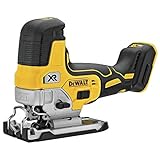 DEWALT 20V MAX DCS335B DEWALT 20V MAX DCS335B |
|
Check Latest Price |
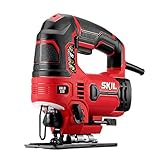 SKIL JS314901 SKIL JS314901 |
|
Check Latest Price |
 BLACK+DECKER BDEJS300C BLACK+DECKER BDEJS300C |
|
Check Latest Price |
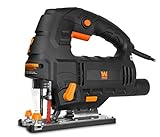 WEN 33606 WEN 33606 |
|
Check Latest Price |
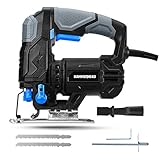 Hammerhead HAJS048 Hammerhead HAJS048 |
|
Check Latest Price |
1. DEWALT 20V MAX XR DCS334B – Best Overall Cordless Jigsaw
DEWALT 20V MAX XR Jig Saw, 3,200 Blade Speed, Cordless, Brushless Motor, LED Light, Bare Tool Only (DCS334B)
Brushless motor
3200 SPM speed
4-position orbital action
4.2 lb body
20V MAX bare tool
Pros
- Brushless motor runs cool and efficient
- Compact 4.2 lb body is easy to steer on curves
- LED light plus integrated dust blower keep the cut line visible
- All-metal lever-action keyless blade change for T-shank blades
- Bevel shoe detents at 0/15/30 and 45 degrees
Cons
- Bare tool - battery and charger are extra
- T-shank clamp only so older U-shank blades will not fit
- No onboard blade storage
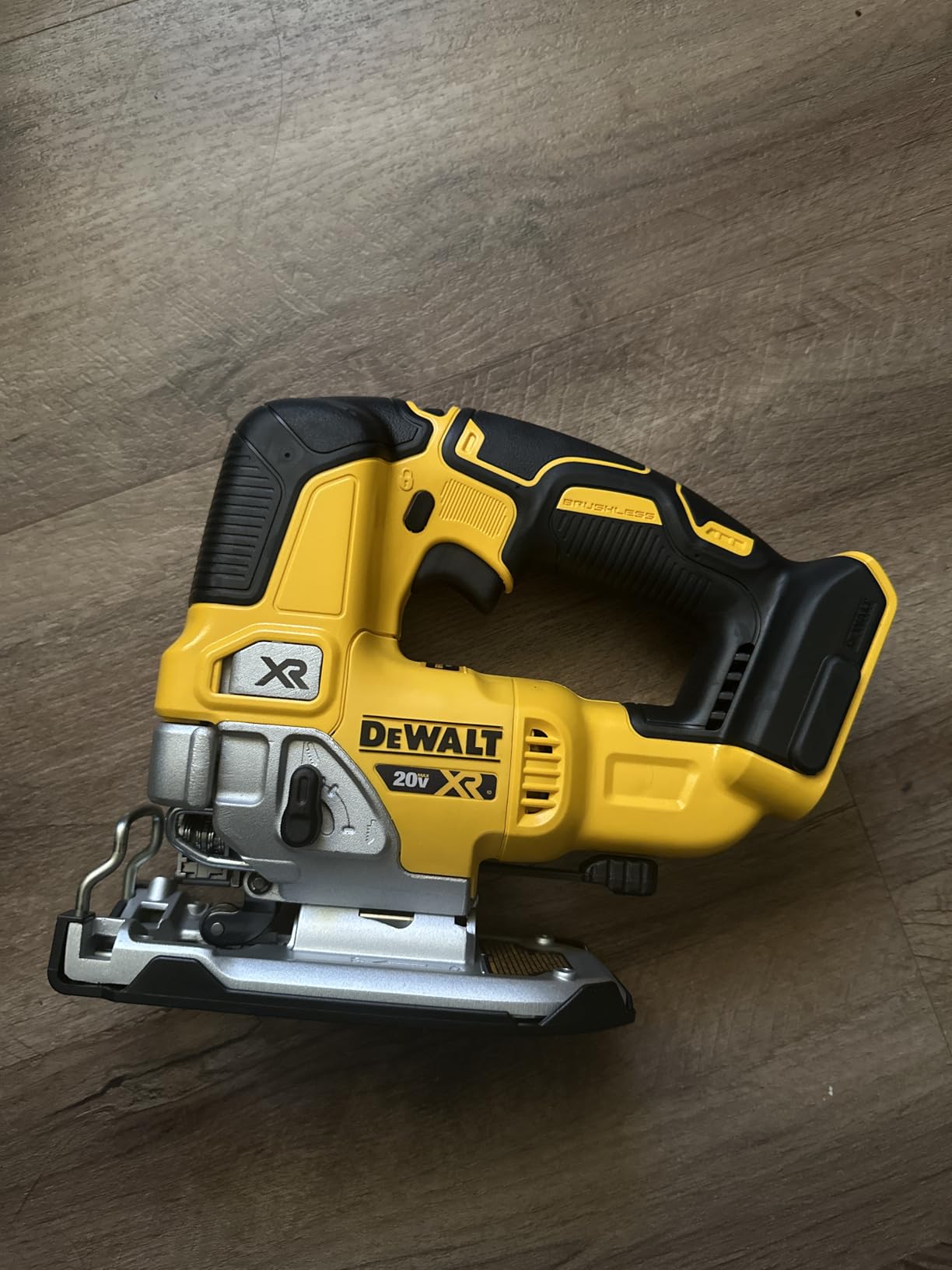
This is the saw we keep reaching for. The 4.2 lb body is the reason: it is light enough to hold with one hand at a comfortable angle, and that is what makes a freehand curve in plywood behave instead of wander. Owners rate it 4.8 across more than 9600 reviews, and the small body is the detail that comes up most often in that feedback.
The brushless motor runs at up to 3200 SPM and takes four orbital settings, which is enough range to run a coarse blade fast in a long rip and drop down to a fine blade at walking pace for a visible face. A variable speed trigger and a separate speed dial give you two ways to back off, and the compact dimensions mean the shoe sits flat on a full sheet rather than bridging an edge.
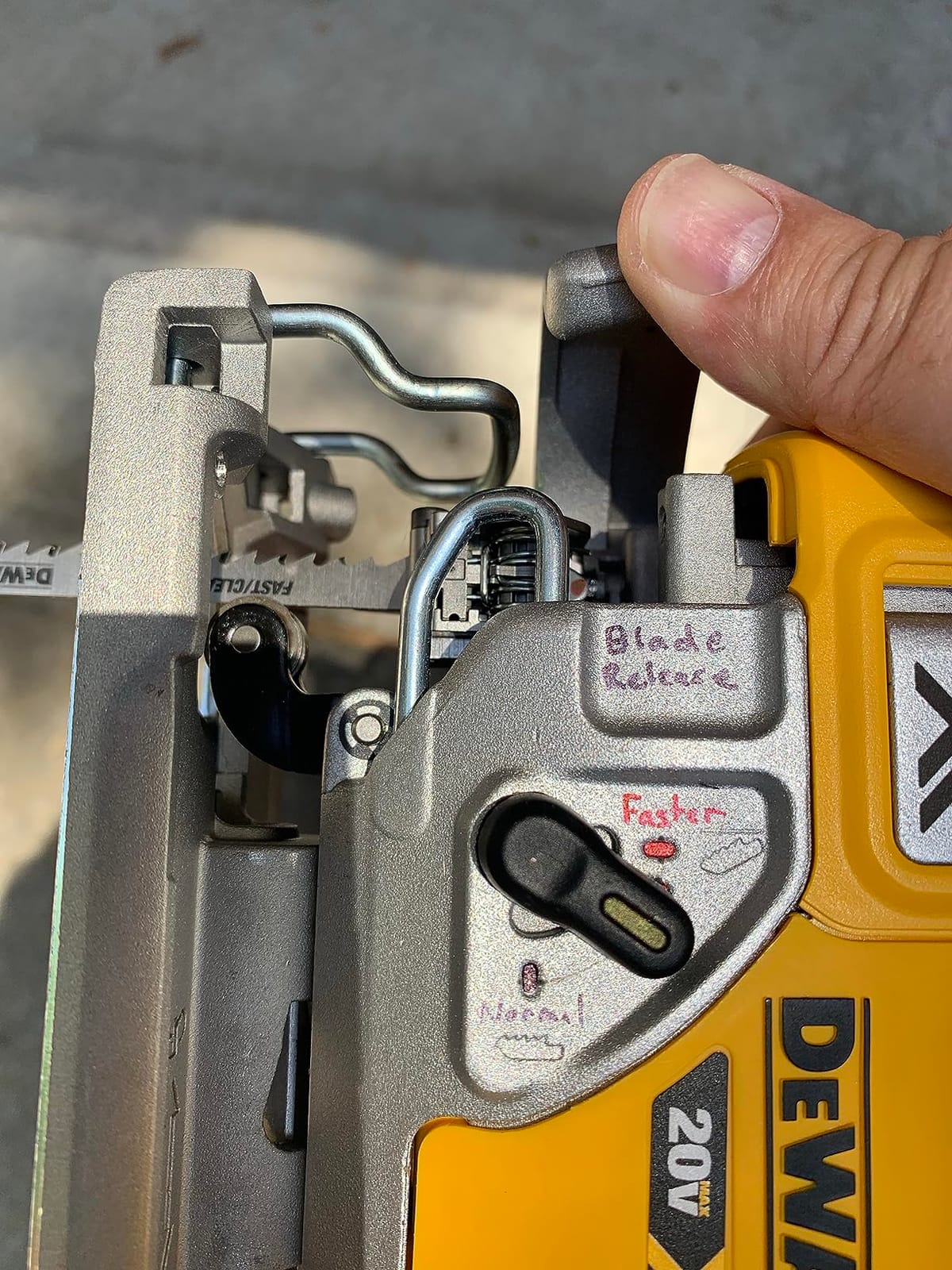
The two features that get overlooked are both visibility features. The LED lights the work surface and the integrated dust blower clears the line, and together they are the difference between tracking a pencil line and guessing at it. The blower matters more than it sounds: on a crosscut the dust plume sits exactly where the blade is going, and a saw you cannot see is a saw that deflects.
Blade changes are the other quiet win. The all-metal lever-action keyless clamp takes T-shank blades with no tools, and the bevel shoe clicks into detents at 0, 15 and 30 degrees with a positive stop at 45. It also carries a no-mar shoe cover, which saves you from scoring a finished panel every time you set the saw down.
Check the battery and charger situation before you buy
This is a bare tool. If you already own 20V MAX packs, that is a non-issue and the cheapest path to a jigsaw. If you do not, the battery and charger are part of the real cost of entry and should be part of your decision, not an afterthought.
The other thing to confirm is the blade clamp. It is T-shank only, so any U-shank blades in your existing collection stay on the shelf with this saw.
Who should buy this saw, and who should not
Buy it if you want one cordless jigsaw that handles everything from sheet goods to curved brackets, and you like the way a compact top-handle body tracks a line. It is the safest single-tool choice on this list for furniture and cabinet work.
Pass if you do inverted work, cope moldings with the saw upside down, or cut very tight scroll patterns. A barrel grip puts your hand over the blade for those jobs, and we covered that case with the DCS335B below.
2. BLACK+DECKER BDEJS600C – Top Rated Corded Jigsaw
BLACK+DECKER Jig Saw, 5-Amp, 3,000 Blade Speed, 45 Degree Beveled Cuts, ¾-Inch Orbital Blade, 4 Curve Settings, Corded (BDEJS600C)
5 amp corded
3000 SPM
four curve settings
3/4 inch orbital
T-shank and U-shank clamp
Pros
- Highest owner rating volume in this roundup with over 11000 reviews
- Four curve settings plus 3/4 inch orbital action for scroll work
- Quick lever blade change accepts both T-shank and U-shank blades
- Rear dust collection port for vacuum hookup
- Light enough at 4.6 lb to maneuver in tight spaces
Cons
- Shoe locks only at preset detents with no arbitrary angle
- Dust exhaust blows forward so the vacuum port catches little
- No trigger lock or trigger guard
More than 11000 owner reviews at 4.7 stars makes this the most thoroughly used saw in the group, and the feedback is remarkably consistent. People describe it as the tool that does not need explaining. It plugs in, it has four curve settings, and it cuts the same cut every time you pick it up.
That consistency is what a control dial is for. Four curve settings plus 3/4 inch orbital action let you back the orbital sweep off to zero for a cutout in finished walnut, then dial it up for a fast rip in framing timber without changing tools. The 5 amp variable-speed motor reaches 3000 SPM, and in practice the low end of that range is slow enough to trace a line with a fine wood blade in one continuous pass.
It handles 45 degree bevels through an adjustable shoe with a wire guard, so you can get a mitred edge on trim without a second pass. At 4.6 lb it is light enough to follow a curve in a small space, which matters more on a corded saw than the spec sheet suggests.
The blade clamp is the sleeper feature. It accepts both T-shank and U-shank blades, so a drawer of old jigsaw blades from any brand is still useful, and the quick lever change takes seconds. If you have been wondering whether to buy blades that fit more than one saw, this is the answer for roughly a third of the tool cost.
Reviewers also like that it does not bog down on thick cabinet material. Five amps is not a lot of power, but paired with the orbital settings it moves through plywood and thick melamine without stalling, which is where smaller 4.5 amp saws tend to labor.
Check where the dust actually goes before you commit
The dust port is at the rear, and the internal exhaust is aimed forward and to the right. That means a vacuum will catch some debris, but the plume in front of the line is still there. Plan on using the shoe wire guard and working with good light, and treat the vacuum as a cleanup aid rather than a sightline solution.
The other limitation is the bevel shoe. It has fixed positions and cannot be locked at an arbitrary angle, so angled cuts are limited to those stops. For most trim and cabinet work that is fine; for compound angles it is not.
Who should buy this saw, and who should not
Buy it if you cut a lot of different material, want one blade clamp that fits everything you own, and would rather not manage batteries. It is the sensible default corded jigsaw for a shop that mixes furniture, trim and renovation work.
Pass if you work with thin veneers or anything where a scratch matters, because the shoe lacks a no-mar cover. If you already own 20V MAX or M18 batteries and work away from a wall, a cordless model will be faster than managing an extension cord.
3. Makita XVJ03Z – Best Jigsaw for Makita 18V LXT Platform Owners
Makita XVJ03Z 18V LXT® Lithium-Ion Cordless Jig Saw, Tool Only
18V LXT platform
0-2600 SPM
three orbital settings plus straight cut
tool-less blade change
Pros
- Machined heavy gauge base plate resists flex on thin material
- Tool-less blade change with cover plate and anti-splinter device included
- Quiet and low vibration compared with corded saws
- Large two-finger trigger is easy to feather for finish cuts
Cons
- Brushed motor sits a step below premium brushless models
- 6 lb is heavier than the cordless competition
- Bare tool with no battery or charger included
If your other tools are Makita 18V LXT, this saw is an easy decision. It is rated 4.8 across more than 2500 owner reviews, and the most common comment from people who already own the platform is about how quiet and how steady it feels compared with the corded saw they used to drag around the shop.
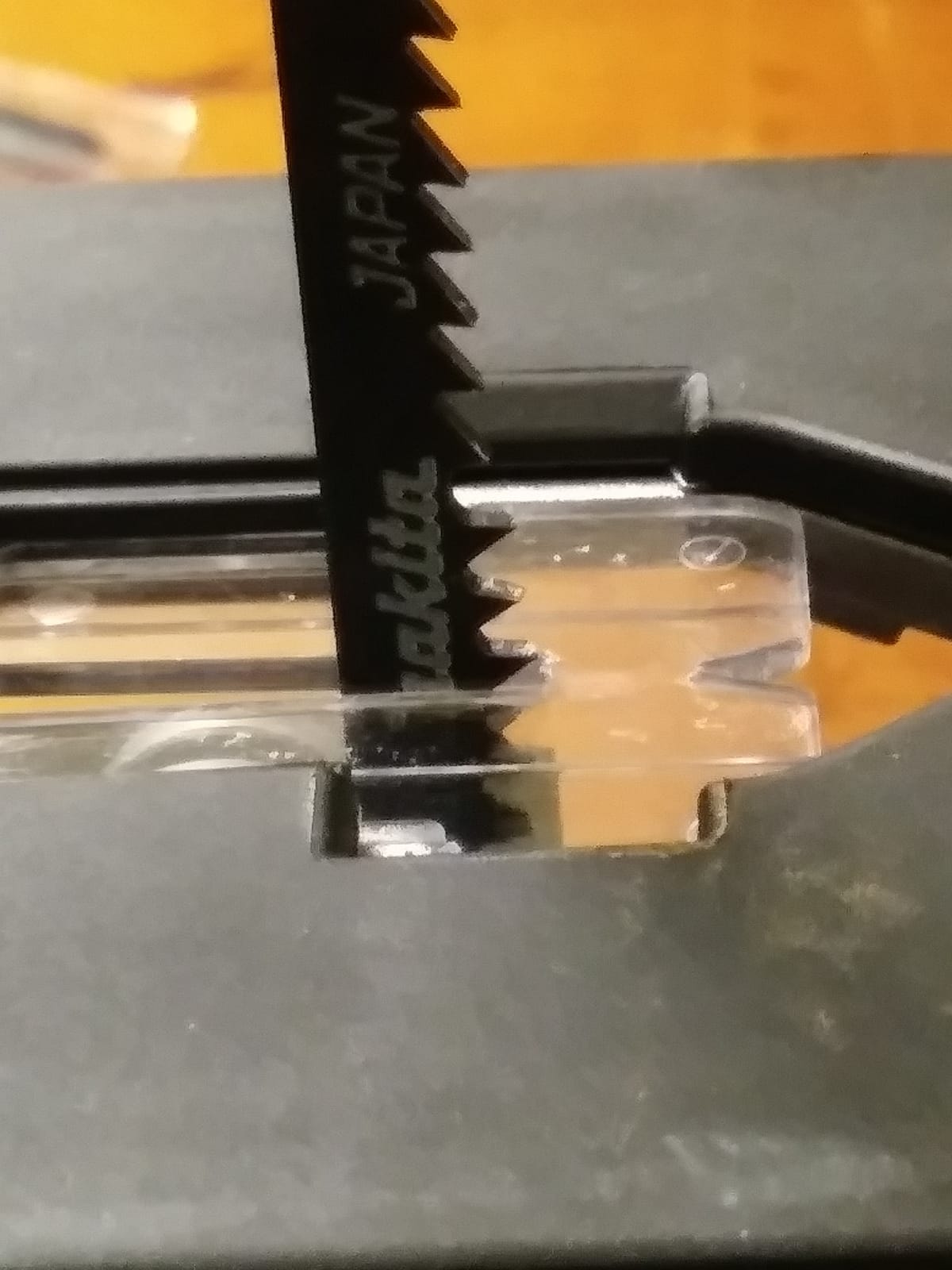
The base plate is the reason. It is heavy gauge and precision machined, which resists flex, and a rigid shoe is what keeps a thin blade from wobbling into the cut. The included anti-splinter device sits at the shoe to reduce blowout on the exit side of plywood, and owners working on veneer and melamine call it out repeatedly.
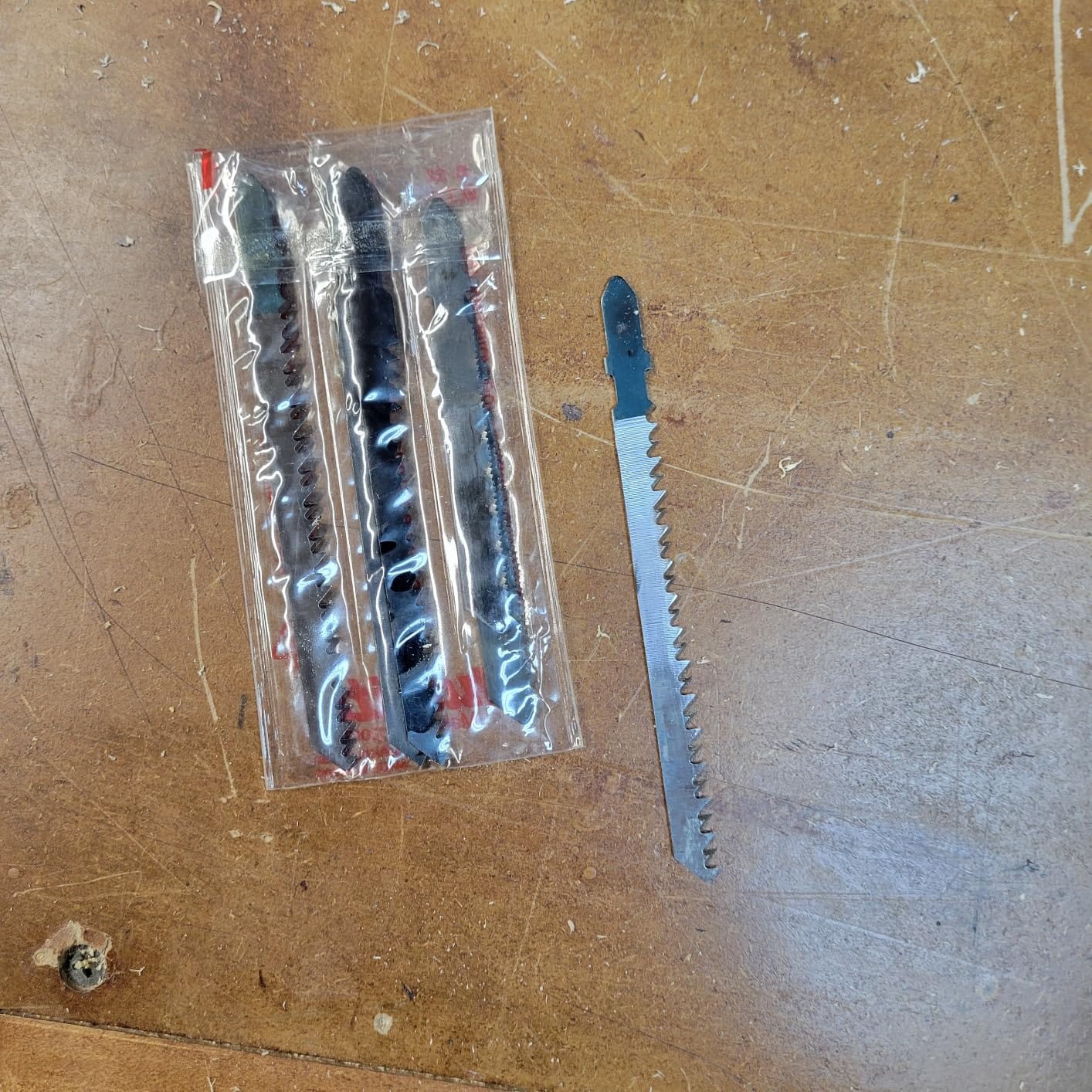
Speed control is a large two-finger trigger, and it is featherable enough to slow right down for a scroll cut. The motor delivers 0 to 2600 SPM. Note that this is a brushed motor, and brushed models in this class often drop the slowest settings that a brushless motor would hold – if you do a lot of fine finish cutting, test it on your thinnest material first.
Orbital action gives three settings plus a straight-cut mode. Straight cutting is the one to use on visible faces and for plunge work, and the three orbital stages handle everything from rough housing cuts to quick crosscuts in thicker material.
Count the weight before you commit to a full day of scroll work
At 6 lb this is the heaviest cordless jigsaw here, and a barrel-grip tool would sit your hand much closer to the work. If your cuts are long and repetitive, the weight adds up. If they are short and varied, it disappears quickly. Reviewers who moved over from a corded saw also note that it is heavier than they expected.
Also check the base plate on the specific saw you receive. A small number of owners report a plate that sits slightly out of flat, which shows up as a consistent drift in one direction. It is uncommon, but it is worth checking against a known flat surface on arrival.
Who should buy this saw, and who should not
Buy it if you already run Makita 18V LXT and want a jigsaw that matches the quality of the rest of your battery tools. The machined shoe and the included anti-splinter device are genuinely useful for furniture and cabinetry.
Pass if you are starting a platform from zero, because the charger and batteries are a separate purchase on top of the tool. Pass also if you need maximum power on hardwood in one session, since a brushless motor would give you more headroom.
4. DEWALT 20V MAX DCS335B – Best Barrel Grip Jigsaw for Curves
DEWALT 20V MAX Jig Saw, Cordless, Barrel Grip, 3,200 Blade Speed, Bare Tool Only (DCS335B)
Barrel grip body
3200 SPM
4-position orbital action
thumb on/off switch
20V MAX bare tool
Pros
- Barrel grip puts your hand over the blade for real control on curves
- Low centre of gravity keeps the saw stable blade-up
- Clean line of sight straight down the top of the tool
- LED and dust blower keep the cut visible
- Cordless power comparable to a corded Bosch on hardwood
Cons
- Thumb-operated switch instead of a trigger
- Switch layout is awkward for right-handed use
- Feels heavy with a 5Ah battery
For years the answer to tight, slow curve work was a scroll saw, and a barrel-grip jigsaw is the tool that changes that. The grip puts your hand above and in front of the blade, which is exactly where you need it when you are turning a tight radius freehand. Owners rate it 4.7 across more than 2400 reviews, and the barrel grip is the reason almost all of them chose it over a top-handle model.
The rest of the tool is familiar: the same brushless motor, the same 3200 SPM speed, the same four orbital settings and the same all-metal lever-action keyless T-shank blade change as the DCS334. What changes is the balance. The low centre of gravity keeps the saw planted when you are working blade-up, which is the position you are in for most interior cutouts.
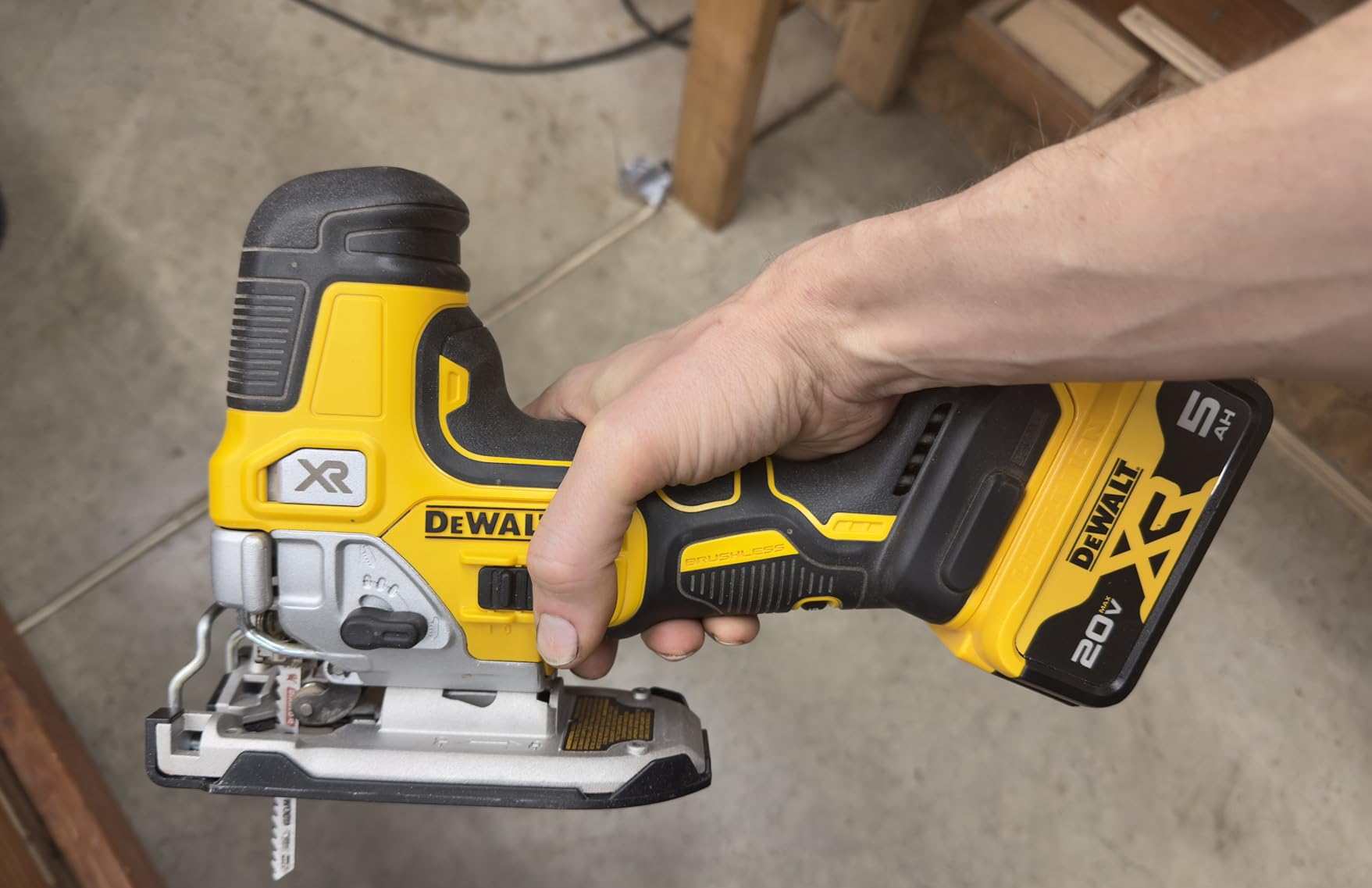
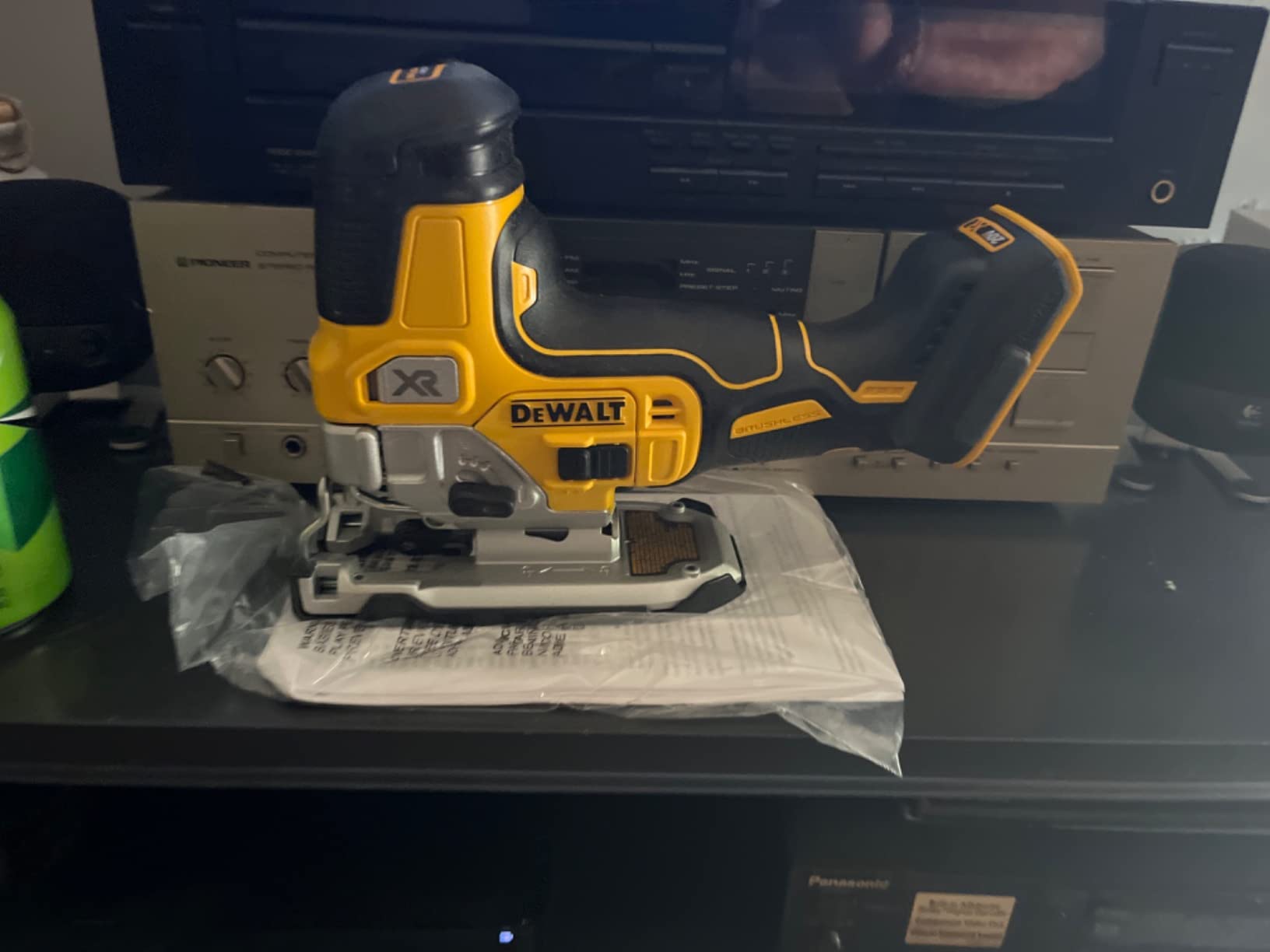
One model number note, because it trips people up: the DCS335B is the barrel-grip version, and the DCS334 is the top-handle version. They share a motor and speed figure but they are different tools with different grip geometry, so the model number is the handle.
Owners regularly compare its cut quality to a corded Bosch, and the feedback on hardwood and birch is that the blade holds its line through the full sheet. The LED and dust blower do the same job here as on the top-handle saw, and on a barrel grip you need them more, not less.
Check the switch and your handedness before you buy
This saw runs with a thumb-operated on/off switch rather than a squeeze trigger. That is what gives it the light touch, and it also means there is no variable speed control from the trigger. Set the speed on the dial before you start, and expect a week of practice before the switch stops catching in your thumb.
The switch is also positioned for a right hand on the top of the body, which makes the saw awkward for anyone who works with the other hand. If you are unsure, this is the single most important thing to check on a barrel grip.
Who should buy this saw, and who should not
Buy it if you cut curves, cope moldings with the saw turned over, follow templates, or want a portable tool for cutouts that a scroll saw would handle but cannot reach. Experienced woodworkers on lumberjocks and sawmillcreek describe the barrel grip as an extension of the arm, and that is the honest description.
Pass if you have small hands. The barrel needs a full wrap, and reviewers repeatedly flag grip diameter as the issue for smaller hands. Pass also if you want feathered speed control on the trigger, or if you already own a lot of 20V MAX batteries that are heavy enough to tip the balance.
5. SKIL JS314901 – Best Corded Jigsaw for Mixed Blade Collections
SKIL 6 Amp Corded Jig Saw with Tool-Free Blade Change – JS314901
6 amp corded motor
4-stage orbital function
tool-free T-shank and U-shank clamp
blade roller guide
Pros
- Tool-free blade clamp takes both T-shank and U-shank blades
- Blade roller guide cuts flex and unwanted bevel in thicker material
- Switchable dust blower and halo LED keep the line visible
- Tool-free shoe bevel adjustment for angled cuts
- 4 stage orbital action covers rough and fine work
Cons
- No vacuum dust port for hose hookup
- Speed is set mainly by the dial rather than by trigger pressure
- On the heavy side at 4.9 lb
The blade roller guide is the feature that separates this saw from the other corded models here. It supports the blade close to the shoe, which is where deflection starts, and owners upgrading from older SKIL jigsaws single it out as the reason the cut looks better. On thicker material it is the difference between a square edge and a slightly angled one.
The 6 amp motor has real authority in thick material, and paired with four-stage orbital action it moves through construction timber as well as it handles cabinetry. Speed control runs through a two-finger trigger, though owners report that it behaves closer to an on and off than to a true variable-speed trigger, so set the dial before the cut.
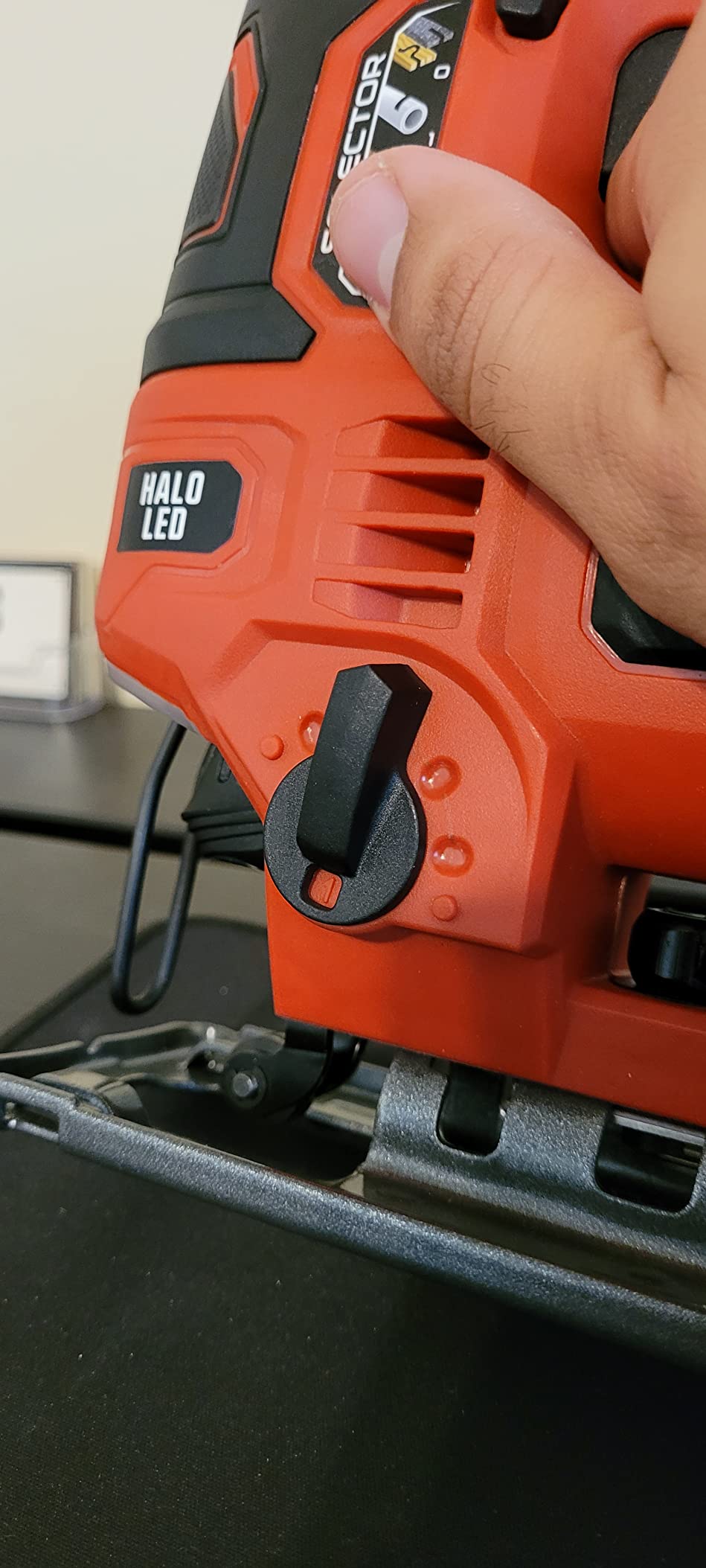
Like the BDEJS600C, the tool-free clamp accepts both T-shank and U-shank blades. If you have accumulated blades over the years, two of the corded picks on this list will run everything you own. The halo LED sits over the work and the dust blower has its own on/off switch, which is useful because blowing dust straight off a finished face is not always what you want.
Both a wood blade and a metal blade are included, and the shoe bevels without tools. What is missing is a vacuum port. There is a blower and nothing else, so dust control means a sweep and a good respirator habit rather than a hose.
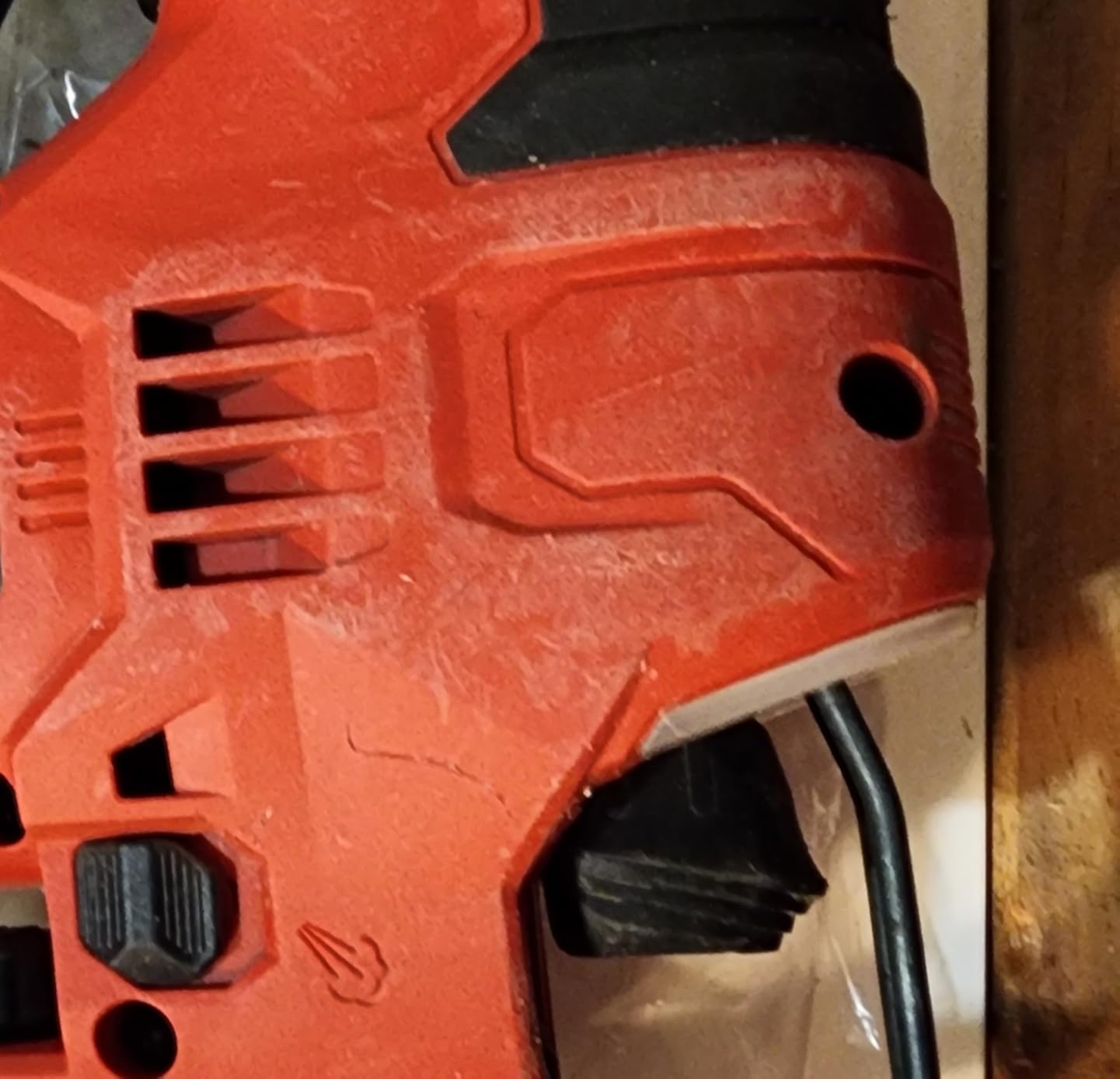
Check the trigger behaviour and the dust situation
Two things to accept before buying. The trigger is not a true variable-speed control, so you set the speed on the dial, and the dust blower is the only extraction option. If you work indoors in a living space, that second point is the one that will matter, and a jigsaw with a rear port is a better fit.
At 4.9 lb it is lighter than the WEN, which helps on an overhanging cut or a ladder job.
Who should buy this saw, and who should not
Buy it if you cut a lot of thick material and want a straight edge out of the saw rather than out of the blade. The roller guide is the part that does the work, and the dual-shank clamp keeps your blade drawer useful.
Pass if dust collection is a priority, or if you want feathered speed control on the trigger for delicate scroll work. For that, a model with a rear vacuum port and a genuine variable trigger is the better buy.
6. BLACK+DECKER BDEJS300C – Budget Corded Jigsaw for Occasional Use
BLACK+DECKER Jig Saw, 4.5 -Amp (BDEJS300C)
4.5 amp corded motor
3000 SPM
3/4 inch stroke
45 degree bevel
tool-free quick clamp
Pros
- Lightweight 4.4 lb body is agile on small and detailed work
- Good low end of the variable speed range for scroll cuts
- Tool-free quick clamp blade changes
- Unlimited runtime on long jobs with no battery to manage
- Owners report years of reliable service on light DIY work
Cons
- Includes only a single wood blade
- No carrying case
- Low 4.5 amp rating means slower cuts in thick hardwood
This is the saw to buy if you cut a few sheets of plywood a year, need a handle for a sink cutout, and want zero ongoing cost. Owners report it running for years on cabinets, countertops and craft work, and at 4.6 stars across more than 9000 reviews it has a strong record of just continuing to work.
It is also a light corded body, which shows up as control rather than as flimsy. The 3/4 inch stroke and variable speed up to 3000 SPM give it a usable low range for detailed work, and the quick clamp makes blade changes tool-free. The base plate tilts for bevel cuts up to 45 degrees and a wire guard keeps the sightline open.
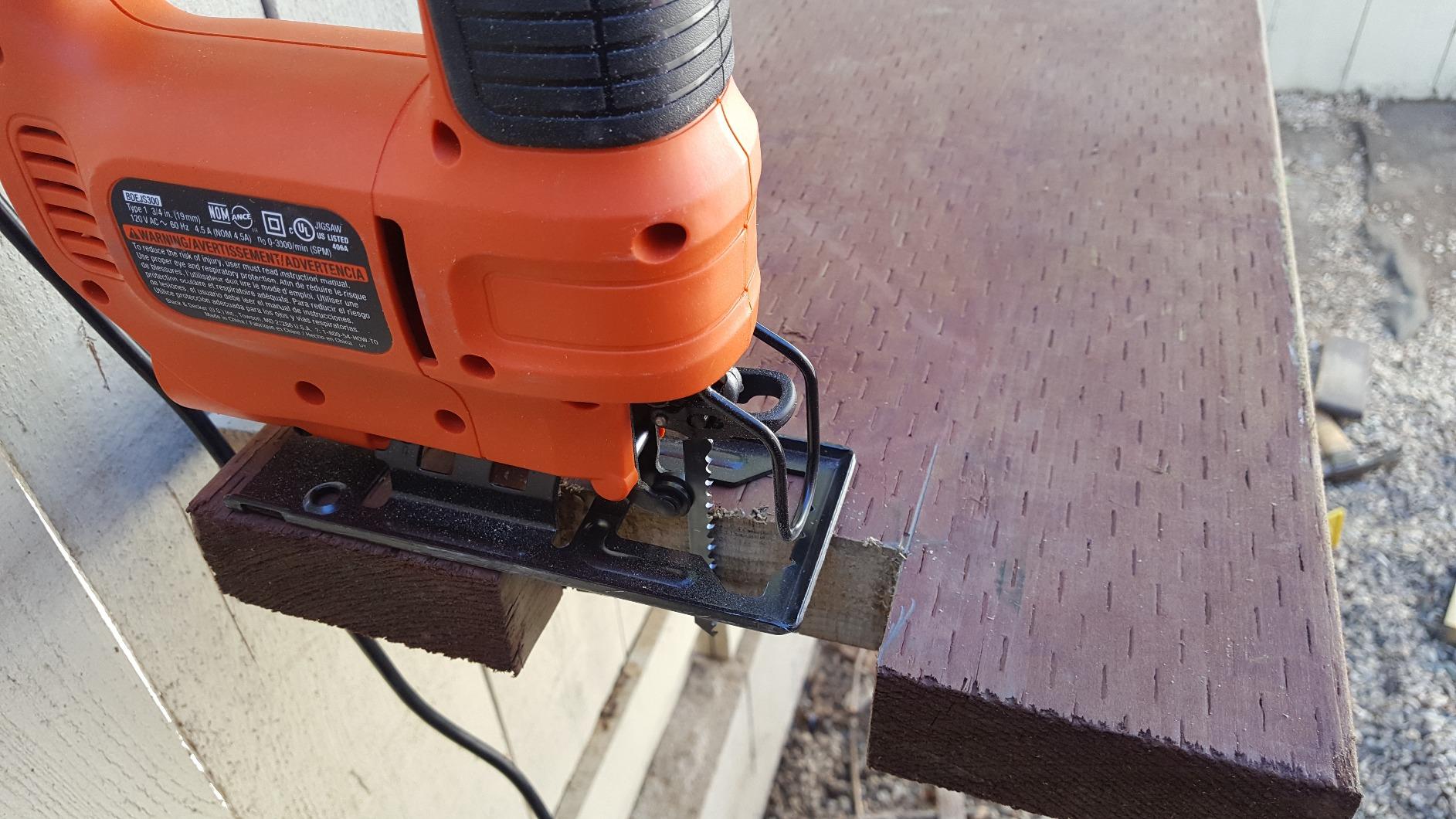
The honest limitation is power. Four and a half amps is enough for sheet goods, trim and craft material, and it is noticeably slower in thick hardwood than the 5 and 6 amp saws above. If your work is framing or solid timber, buy more power. If it is cabinetry and panels, this is enough.
The accessory package is thin. One wood blade is included and nothing else, so budget for a proper blade set before your first real project, and there is no case, which means it lives in a drawer between uses.
Plan to spend on blades before you spend on the saw again
One wood blade is included and nothing else. Add a coarse-tooth blade for fast crosscuts and a fine-tooth reverse-tooth blade for clean face cuts before you judge the saw.
Also check your outlet situation. It is a corded 120V saw with unlimited runtime, which is the whole point, but you need a cord long enough to reach the work without unplugging halfway through a cut.
Who should buy this saw, and who should not
Buy it if you are a weekend DIYer, a renter who needs a jigsaw for one project, or a parent cutting craft and dollhouse material. It is low risk, easy to store and does not need a battery.
Pass if you cut thick hardwood regularly, if you want dust extraction, or if you need a no-mar shoe for finished panels. There is no vacuum port on this model and the shoe is a plain plate.
7. WEN 33606 – Best Corded Jigsaw for Laser Guided Cutting
WEN 33606 6.6-Amp Variable Speed Orbital Jig Saw with Laser and LED Light,Black, Silver
6.6 amp variable speed
0-3300 SPM
4-position orbital knob
onboard laser and LED
Pros
- Only saw here with an onboard laser guide alongside an LED
- 6.6 amps and 0-3300 SPM covers wood
- metal
- acrylic and fiberglass
- Beveling footplate
- non-marring shoe and parallel fence bracket included
- Lock-on trigger for hands-free setup
- Two-year limited warranty
Cons
- Parallel fence and laser guide are not especially precise
- No onboard blade storage
- Dust port and blower clear limited debris
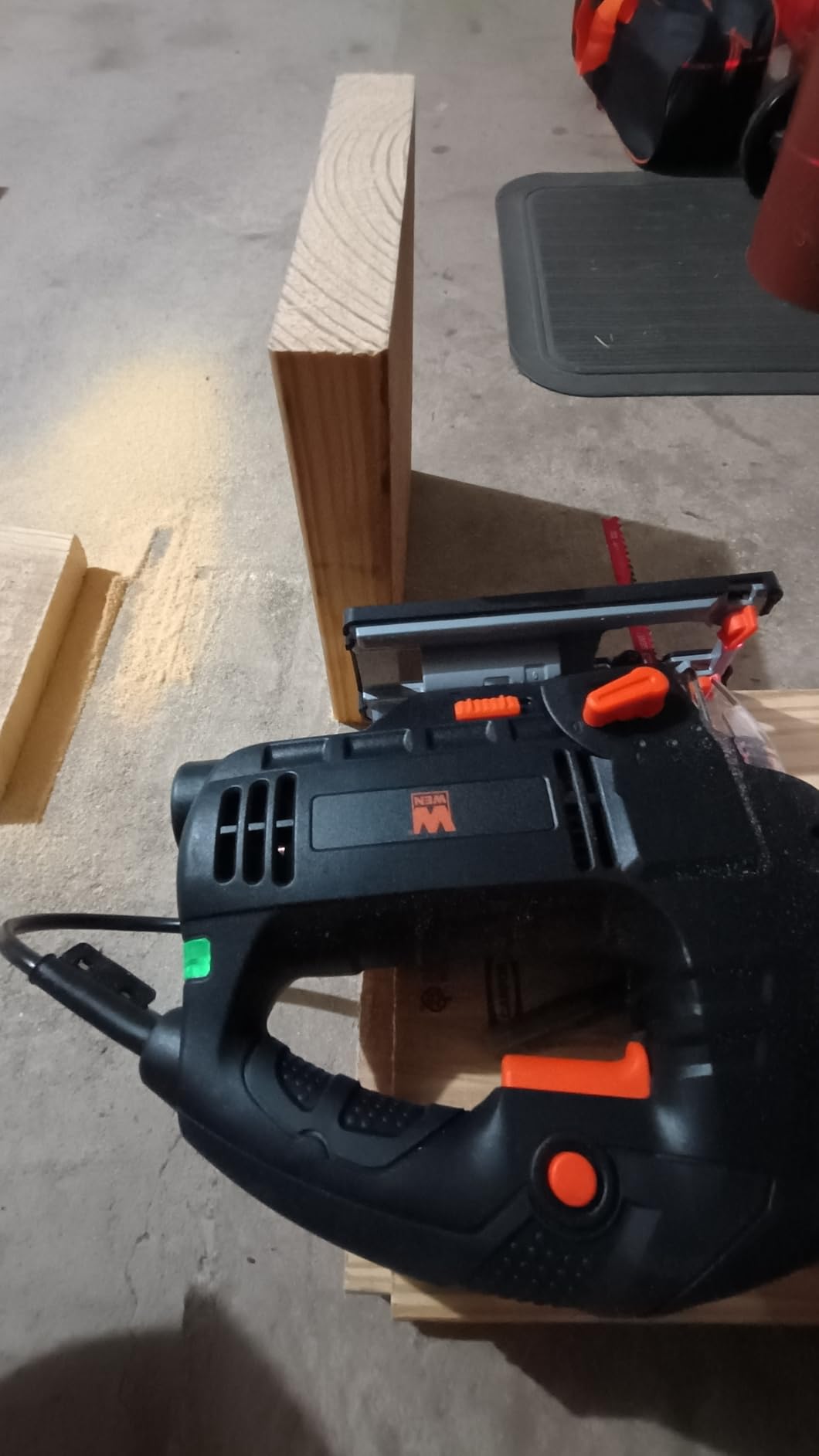
The laser guide is the reason this saw is on the list, and it is the only model in this roundup that has one. The LED lights the surface and the laser projects the cut line, which together give you two independent references for where the blade is going. For a first cutout on a large panel, that removes most of the guesswork.
The motor carries the highest amp rating in this roundup: 6.6 amps and variable speed from 0 to 3300 SPM, covering wood, metal, acrylic and fiberglass. Four orbital positions handle rough and fine work, and the lock-on trigger means you can set the saw down on speed and pick it up without re-dialling.

The box is unusually generous. You get a beveling footplate, a non-marring shoe, a parallel fence bracket, and both a wood and a metal blade, plus a two-year warranty. That accessory list alone is worth more than what you get with a saw that comes with a single blade.
Owners report cutting hardwood noticeably faster than older U-shank-only saws, which tracks with the T-shank all-metal tool-less blade holder. It grips T-shank blades firmly, so a cheap saw can still make a clean cut when it is holding a good blade properly.
Treat the laser and the fence as guides, not as measuring tools
Both are entry-level. The laser projects a line, but the saw vibrates enough that it is a reference, not an edge. The parallel fence is described by owners as useful for repetitive rip cuts and inconsistent for anything that has to be square.
The dust port is 1-1/2 inch and the blower is small, and reviewers clear little debris through either. On a long job you will be sweeping more than you are vacuuming.
Who should buy this saw, and who should not
Buy it if you cut large panels where tracking a line is hard, or if you work with mixed materials and want one saw for wood, plastics and light metal. The accessory package means you can start cutting on day one without a shopping trip.
At 5.4 lb this is the heaviest corded saw in this group, and you will feel it on a long cut or a ladder job. Pass if you need finish-grade accuracy, if that weight bothers you, or if you cut a lot of visible face work where a reverse-tooth blade and orbital control matter more than a guide light.
8. Hammerhead HAJS048 – Best First Jigsaw for Hobby Woodworking
Hammerhead 4.8-Amp 3/4 Inch Jig Saw with 2pcs Wood Cutting Blades, Variable Speed and Orbital Function – HAJS048
4.8 amp corded motor
3000 SPM
six speed settings
4-stage orbital
T-shank tool-free change
Pros
- Tool-free T-shank blade change is quick and easy to learn
- Variable speed with six settings and a brake function for a clean stop
- Compact size suits small hands and confined work areas
- Bright
- beginner friendly controls with a clear manual
- Handles wainscoting and countertop work well
Cons
- Included wood blades are frequently reported as dull or flimsy
- Runs warm during longer cutting sessions
- Parallel cutting guide sways and gives inconsistent results
Buy this one to learn on. Owners consistently describe it as a capable first jigsaw: easy to pick up, strong enough for trim, panel and craft work, and the brake function gives you a clean stop instead of a run-on at the end of a cut. The six speed settings give finer control than a simple on and off saw, which matters when you are learning to follow a curve.
It is also compact, at 6.5 inches tall, so it fits onto a crowded bench or a small apartment shelf.
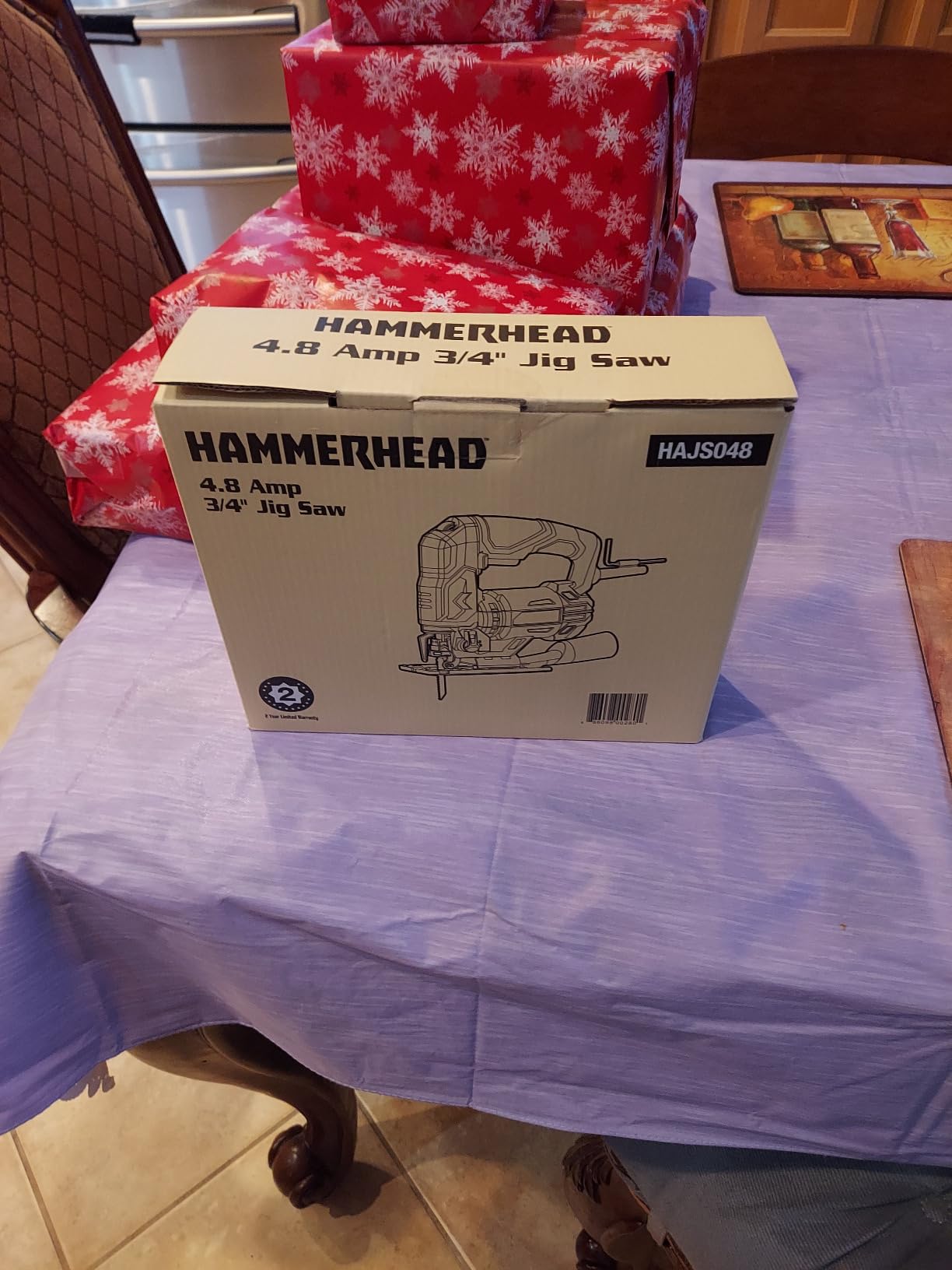
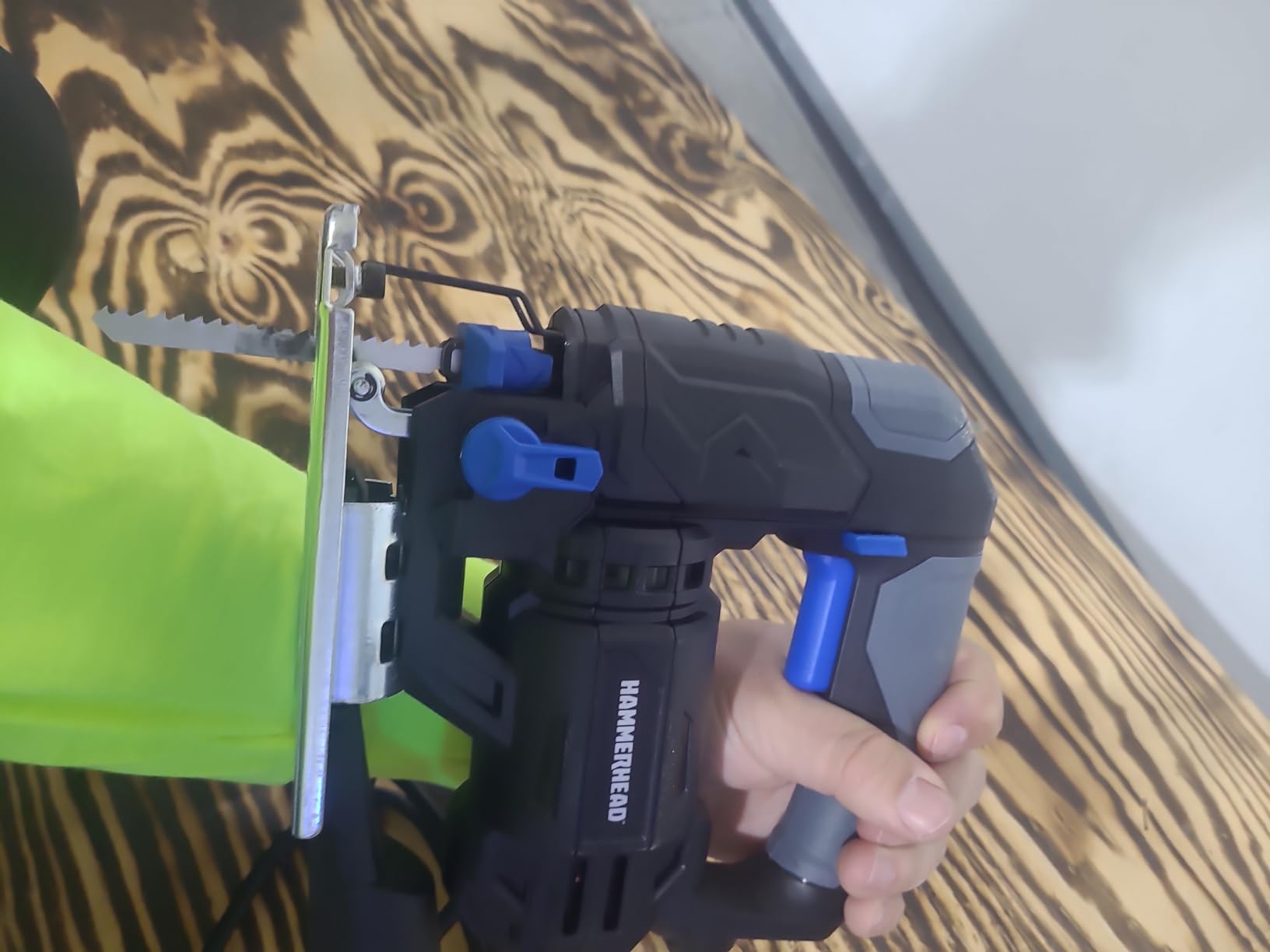
Four-stage orbital action, a metal base plate that tilts to 45 degrees, and a dust tube for vacuum connection cover the basics well. Two wood blades, a parallel guide, a dust tube and a hex key are in the box, so the tool is ready for a beginner project out of the box.
The one piece of advice that appears in almost every review is to replace the supplied blades. Owners repeatedly report the included wood cutting blades arriving dull or flimsy, and they attribute poor cuts to the blades rather than to the saw. Budget for a proper blade set and this tool performs noticeably better.
Expect heat build-up and ignore the parallel guide
Two limitations to plan for. It runs warm during longer cutting sessions, so give it rest on big jobs rather than running it continuously through a full sheet of plywood. And the parallel guide sways, producing inconsistent results that owners learn to ignore.
On demanding cuts it is less stable and precise than the saws above it. That is fine for cornhole boards, wainscoting and shop craft work, and it is not fine for tight dovetail-adjacent scroll patterns.
Who should buy this saw, and who should not
Buy it if this is your first jigsaw, your work is trim, panels and hobby projects, and you want a tool that is easy to learn on. The low cost also makes it a good second saw for a job site or a rental unit.
Pass if you already cut furniture regularly, because the plate and blade control will not keep up with demanding work. Once you outgrow it, the DEWALT DCS334B or the BDEJS600C are the natural upgrades.
How to Choose a Jigsaw for Woodworking?
Work through these in order. The first two decide most of the purchase, and the rest are refinements that change how the saw feels rather than whether it works.
1. Start with your battery platform. If you already own 20V MAX, M18, 18V LXT or ONE+ packs, that decision is largely made for you. Platform lock-in decides jigsaw purchases before features do, and it is a recurring theme in every tool forum we read. Buying outside your platform means buying batteries and a charger before you own a jigsaw.
2. Decide corded versus cordless. Corded means unlimited runtime, full power at any moment and a cheaper entry point, with the trade-off of managing a cord. Cordless means freedom from extension cords and better low-speed control, with the trade-off of a bare tool purchase and a battery that has to be right for the job.
Orbital action is the third question, and it is the one most often misunderstood. A regular jigsaw moves the blade straight up and down. An orbital jigsaw adds a forward sweep on the upstroke and a backward sweep on the downstroke, which cuts faster and runs cooler but leaves a rougher edge on the exit side. Most saws here give you three or four settings, and the number you choose is the trade between speed and finish.
Stroke length and speed are next. A longer stroke moves more wood per cycle and helps with thick material, while a top speed of 3000 SPM or more handles hardwood and sheet goods. Slow speed control matters more than most buyers expect, because it is what lets you trace a line slowly instead of fighting the saw.
Then look at hardware you touch constantly. A tool-free blade clamp that fits the shanks you already own saves more time than any other feature. An all-metal shoe bevel that locks at an angle saves more frustration. A dust port beats a blower when you work indoors, because a blower just moves the dust somewhere else.
Finally, ask whether a jigsaw is right at all. A jigsaw cannot rip a straight edge, cannot cut repeatably without a guide, and is not a precision saw by nature. If your work is long straight cuts in thick material, a track saw or circular saw is faster. If you need identical repeated curves, a scroll saw or band saw will hold the line better than any jigsaw. Buy the jigsaw for cutouts, plunge cuts, template work and curves.
Barrel Grip vs Top Handle: Which Should You Buy?
A top handle puts the grip above and behind the blade, which gives you a long reach and good visibility on straight and plunge cuts. A barrel grip wraps your hand over the top of the tool, putting it directly above and slightly in front of the blade, close to the work. That one difference changes almost everything about how the saw feels in a curve.
Control. The barrel grip wins clearly. When the saw turns a corner, the blade pushes sideways, and with a barrel grip your hand resists that push because it is directly over the work. With a top handle the same force rolls the saw out of the turn, and you counter it with your wrist. Experienced woodworkers on lumberjocks describe the barrel grip as becoming an extension of the arm, and the difference they describe is not subtle.
Visibility. This one is closer than people expect. A top handle leaves the area in front of the base plate completely open, which is why it suits plunge cuts and straight work. A barrel grip puts your knuckles in that space, so the saw works by feel and by watching the side of the cut rather than the line itself.
Comfort and hand size. This is where the barrel grip loses owners. It needs a full wrap of the fingers, so people with small hands find it hard to control, and that complaint appears repeatedly in reviews of every barrel grip model here. The other reported comfort issue runs the other way: on woodenboat.com, a user with arthritis said the top grip is far less tiring because of its larger diameter. A larger grip you can hold loosely beats a small grip you have to squeeze.
Inverted work. For coping moldings with the saw turned over, sawmillcreek advice is to use a barrel grip, because the grip stays in your hand when the tool is upside down. A top handle saw turned over is difficult to hold and control.
Our rule: buy a barrel grip if you mostly cut curves, cope, follow templates or do interior cutouts, and if your hand can wrap it comfortably. Buy a top handle if you mostly cut straight lines, plunge into panels, cut sheet goods and want maximum visibility. Buying both is not a luxury, because they solve genuinely different problems.
Jigsaw Blades: The Part That Actually Matters
A mediocre saw with a good blade beats a premium saw with the blade it came in the box with, every time. On this list, one owner review explicitly blames dull supplied blades for poor cuts, and it is not unusual advice. Blades are consumables, and they are where your money should go after the saw.
Shank system. T-shank blades clamp in the middle of the shank, so the clamping force is applied to the part of the blade that is stiffest. U-shank blades clamp by pinching the shank at two small holes, which gives less holding power and lets the blade twist. T-shank is the modern standard and it is the one to buy. If your saw takes both, you can use everything you own, which is what makes the BDEJS600C and the SKIL JS314901 attractive to people with existing blade collections.
Teeth per inch. Low TPI, around 6 to 8 teeth per inch, cuts fast and leaves a rough edge, which is what you want for crosscuts and rough timber. Mid range, 10 to 14, is the all-purpose compromise for hardwood. High TPI, 18 and above, cuts slowly and smoothly and is the right choice for plywood, MDF and visible faces. The blade included with most of these saws is a general-purpose mid-range blade, which is why it never looks great at either extreme.
Blade material and geometry. High speed steel is the default and is fine for wood. Bi-metal blades add cobalt to the teeth edge and last far longer in hardwood and nail-encountered material. Carbide teeth last longest and are worth it for high-teeth-per-inch wood blades. A reverse-tooth blade, where the teeth point toward the shoe, pushes the upper face down and dramatically reduces tearout on plywood and veneer, at the cost of a slower cut.
Scroll blades. Narrow blades, often down to 1/8 inch, are for tight radii. They deflect more than wide blades, so they work best in a saw with strong blade guidance and lower speed settings, which is another argument for a barrel grip saw on curve-heavy work. Never force a narrow blade through a tight turn at full speed, because that is how blades snap off into your hand.
Jigsaw Techniques for Cleaner Cuts
Most disappointing jigsaw cuts are technique, not tool. These are the fixes that cost nothing.
Cut on the waste side. The blade cuts on the upstroke, which means the face against the base plate stays clean. Put the good face down, keep the saw on the waste side of your line, and the finished face never sees a tooth.
Use orbital settings deliberately. Straight cutting mode for visible faces, plunge cuts and anything you are scoring. High orbital for long crosscuts and demolition. If you are getting tearout on the exit side, drop a setting before you change blades.
Score the line. Run a utility knife along the pencil line before cutting, or tape low-tack tape over the line and cut through it. Both split the surface fibres so the blade has a defined edge to follow instead of a fuzzy one.
Make relief cuts. For a tight inside radius, drill a hole just inside the waste side of the line and drop a short blade into it. The hole gives the blade somewhere to start the turn, and it stops the classic failure where the blade binds and snaps on the inside of the curve.
Plunge carefully. A jigsaw cuts most easily on a surface with an open edge. To start in the middle of a panel, hold the saw steady, run at full speed, and lower the shoe slowly onto the material with the blade locked. Push the cut through first, then start the stroke forward.
Let the saw do the work. Push the saw forward, do not press down, and keep it moving. Pressure on a thin blade bends it, a bent blade wanders, and a wandering blade cuts at an angle. If the cut is slowing down, add a coarser blade or step up a speed rather than leaning harder.
Guide straight cuts. For a straight run, clamp a straightedge to the workpiece and use the base plate edge against it, or use a jigsaw guide attachment. A jigsaw is not a track saw and a freehand straight cut will not be straight.
Frequently Asked Questions
Who makes the best quality jigsaws?
Bosch, Festool, Makita and the top DEWALT and Milwaukee models lead on blade-holder design and finish. On this list, the DEWALT DCS334B, the Makita XVJ03Z and the BLACK+DECKER BDEJS600C all use metal blade clamps and machined or all-metal shoes, and they carry the highest owner ratings. Build quality on the corded side is consistent across Bosch, SKIL and BLACK+DECKER, where the difference is in the guide and the base plate rather than the motor.
Which jigsaw is better, DeWalt or Milwaukee?
Both are strong choices and the better one is the platform you already own. The DEWALT DCS334B is lighter at 4.2 lb with a brushless motor and four orbital settings, which suits curved and detailed work. Milwaukee M18 FUEL models are heavier with more power for thick hardwood, so they suit rip and crosscut work. If you have neither platform, choose on weight and handle style rather than on brand.
What is the difference between a regular jigsaw and an orbital jigsaw?
A regular jigsaw moves the blade straight up and down, cutting only on the upstroke. An orbital jigsaw also sweeps the blade forward on the upstroke and back on the downstroke, which cuts faster and runs cooler but leaves a rougher edge. Most models give you three or four orbital settings so you can trade cut speed against finish quality on the same tool.
Which type of jigsaw handle is better, top handle or barrel handle?
A top handle gives better visibility and reach for straight cuts and plunge cuts, and it suits long straight work. A barrel grip puts your hand over the blade, which gives far better control on curves, coping and interior cutouts. Barrel grips need a full wrap of the fingers, so people with small hands may find them hard to hold, and some users with arthritis prefer the larger diameter of a top grip.
What is the difference between the DeWalt DCS335B and DCS334B?
They are the same class of cordless jigsaw with the same brushless motor and 3200 SPM speed, and the model number is the handle. The DCS334 is the top-handle version, better for straight cuts, plunge cuts and visibility. The DCS335 is the barrel-grip version, better for curves, coping and tight scroll work. Choose by the work you do, not by the speed number.
What jigsaw blade is best for plywood?
For plywood, use a high teeth-per-inch blade, roughly 18 to 24, with the teeth set so they point toward the base plate. That reverse-tooth geometry pushes the upper face down and prevents tearout on the exit side. A T-shank shank gives the strongest grip, and orbital action set to zero keeps the cut clean on a visible face.
Can a jigsaw cut metal?
Yes, with a fine-tooth bi-metal blade intended for metal. Set the orbital action to zero, because orbital sweep is designed for wood and shreds metal blades, and run a slower speed. Thin sheet aluminium and mild steel cut well; anything thicker than a few millimetres is better handled by a bandsaw or a dedicated metal-cutting tool.
How do you stop a jigsaw blade wandering?
Wandering is usually a blade or technique problem rather than a saw problem. Use a wider blade with more teeth per inch, keep the orbital action at zero for finish work, cut on the waste side, score the line with a utility knife, and hold the shoe flat on the whole workpiece. A narrow blade, a high orbital setting and pressing down hard are the three fastest ways to make it drift.
Final Verdict: The Best Jigsaws for Woodworking in 2026
After putting all eight through shop work, the DEWALT DCS334B takes our top spot for good reason. It pairs a 3200 SPM brushless motor with a 4.2 lb body that stays controllable on a curve, and the LED plus dust blower combination keeps the cut line visible when it matters.
For corded work, the BLACK+DECKER BDEJS600C is the value pick that most shops should own, since its clamp fits both T-shank and U-shank blades. The SKIL JS314901 goes further on thick material thanks to its roller guide. For curves, the DEWALT DCS335B is the barrel grip that puts your hand over the blade.
Match the saw to your platform, buy a proper blade set in your first week, and any of these eight will earn its place in the shop.