
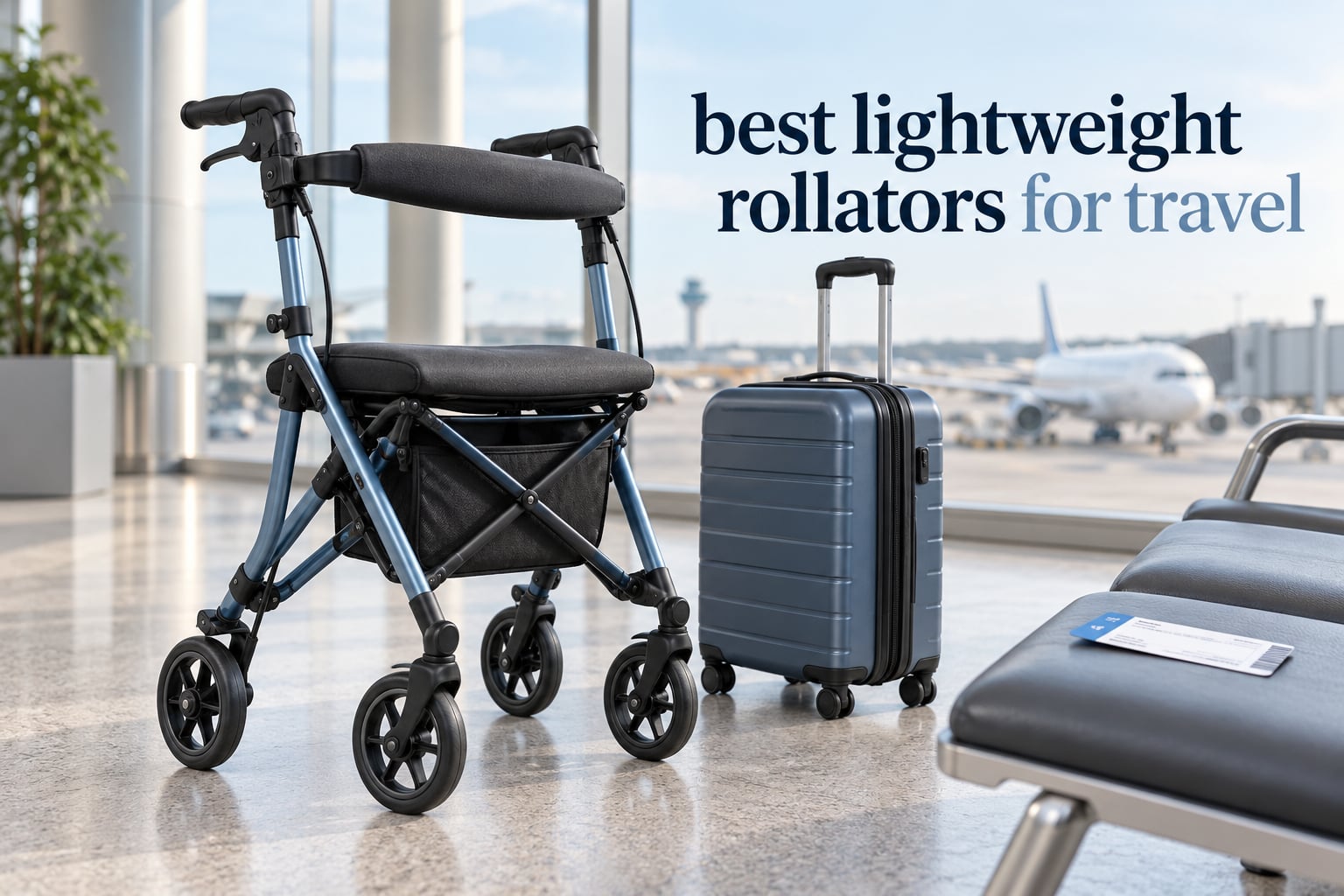
A lightweight rollator is the difference between a mobility aid that goes with you and one that stays behind in the hallway. Most four-wheel rollators land somewhere around 18 pounds, heavy enough that plenty of travelers cannot get one into a car by themselves, and a Sunrise Medical blog post about its own carbon model named exactly that as the number one reason people cannot travel with the rollator they already own. A travel-focused rollator gets that figure down to 10 or 11 pounds and folds flat enough to carry up a staircase with one hand. That is the bar we set for the best lightweight rollators for travel in 2026.
Getting there takes more than reading a weight number off a listing page. Folded dimensions decide whether a rollator fits your trunk, your cruise cabin or an overhead locker. Whether it stands up on its own decides whether you can fold it on a crowded jet bridge without holding it. Wheel diameter decides whether the small rubber wheels keep moving on airport carpet and cobblestone instead of catching on every seam. We spent weeks reading spec sheets, review patterns and traveler forum threads before ranking the ten models below.
One thing to say up front: four of the ten picks here are three-wheel walking aids rather than seated rollators. We kept them in on purpose. For cruise-ship corridors, airport terminals and short sightseeing routes, a narrow three-wheeler turns faster and passes through doorways a four-wheel frame never will, and several travelers on mobility forums describe deliberately owning two devices, a featherweight one for flights and a fuller rollator for everyday local trips. What you give up is obvious and worth stating plainly: there is no seat to sit on.
Last updated for 2026. If you have a balance condition, a recent fall, or a weight-bearing restriction, ask a physical therapist or occupational therapist to confirm the fit before you buy. That advice is free and it prevents most returns.
Table of Contents
Top 3 Picks for Lightweight Rollators For Travel in 2026

PLANETWALK 3-Wheel Rollator
- 11 lb aluminum frame
- 253 lb capacity
- 7.5 inch wheels
- one-second fold
Vive Mobility 3 Wheel Walker
- 11 lb frame
- wide cross-brace stability
- folds nearly flat
- lifetime guarantee

The PLANETWALK sits at the top because it is the rare travel rollator that is both genuinely light and genuinely well reviewed, with more than two thousand ratings behind it. The byACRE is the ultralight enthusiast pick and the only one here with a carbon fiber frame, though its seat is a separate purchase. If you need a seat and a capacity rating above 300 pounds, the HOMLAND in the full list below is the one to buy.
10 Best Lightweight Rollators for Travel (October 2026)
| Product | Specs | Action |
|---|---|---|
| PLANETWALK Premium 3 Wheel Rollator |
|
Check Latest Price |
| Vive Mobility 3 Wheel Walker |
|
Check Latest Price |
 HOMLAND Foldable Rollator with Seat HOMLAND Foldable Rollator with Seat |
|
Check Latest Price |
 PLANET WALK Super Lightweight Rollator PLANET WALK Super Lightweight Rollator |
|
Check Latest Price |
| byACRE Carbon Ultralight Rollator |
|
Check Latest Price |
 Stander Space Saver Rollator Stander Space Saver Rollator |
|
Check Latest Price |
 HOMLAND Foldable 3 Wheel Walker HOMLAND Foldable 3 Wheel Walker |
|
Check Latest Price |
 Lumex 3 Wheel Cruiser Lumex 3 Wheel Cruiser |
|
Check Latest Price |
 Helavo 2 in 1 Walker Wheelchair Combo Helavo 2 in 1 Walker Wheelchair Combo |
|
Check Latest Price |
 Vive Ultra Lightweight Rollator with Seat Vive Ultra Lightweight Rollator with Seat |
|
Check Latest Price |
Weights run from 10.4 pounds to 21.2 pounds across this group, which is the whole point. Anything under about 12 pounds can usually be managed by one person at an airport or in a parking garage. Anything over 17 pounds is a two-hand job, and the 21 pound Helavo is realistically a load for a caregiver or a porter.
1. PLANETWALK Premium 3 Wheel Rollator – The 11 lb Pick That Handles Crowded Corridors
PLANETWALK Premium 3 Wheel Rollator Walker for Seniors – Ultra Lightweight Foldable Aluminum Mobility Aid with Height Adjustable Handle and 7.5 Inch Wheels, Brilliant Red
11 lb frame
253 lb capacity
7.5 inch wheels
Folds to 12.5 inch wide
Pros
- Easy one-handed lift at 11 lb
- One-second spring-latch fold
- Turns on a dime in tight spaces
- Large rubber wheels roll smoothly
- Five handle height levels
Cons
- No seat so it is a walking aid only
- Some frame flex reported under heavier loads
- Brakes add to the overall width
This is the model we recommend to most people asking about the best lightweight rollators for travel, and the reason is unglamorous: 2,303 ratings at 4.5 stars is the largest installed base in the group. Buyers describe loading it into a car one-handed before restaurant visits, clinic appointments and airport runs, and that repeated small win is what a travel aid has to deliver.
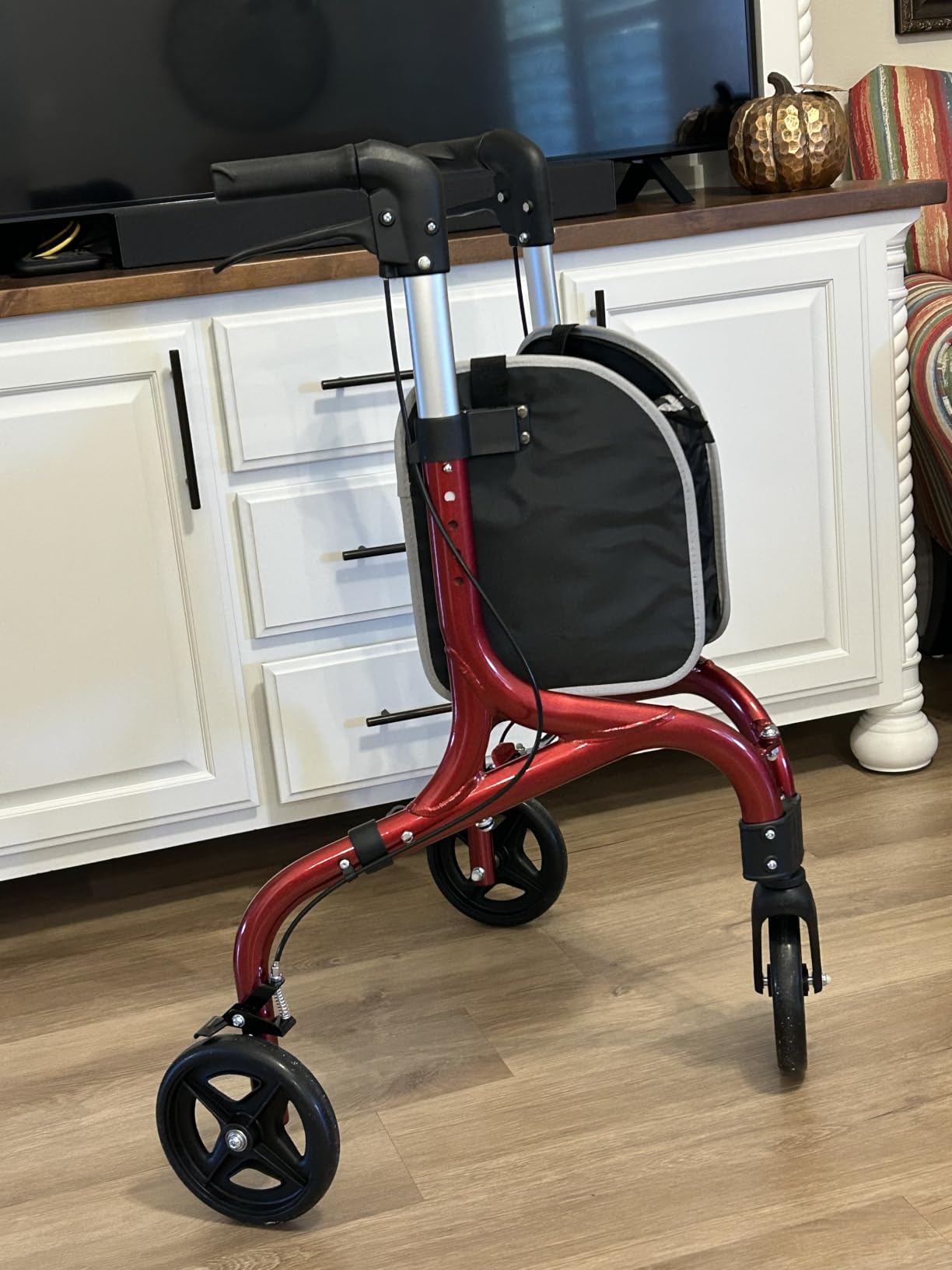
The frame is 11 pounds of aluminum rated to 253 pounds, with three 7.5 inch rubber wheels and 360-degree rotating front casters. Overall size is 22.8 by 27 by 32.7 inches, and it folds to a width of 12.5 inches. The handle adjusts across five levels from 32.7 to 36.7 inches, which fits users between roughly 4.8 and 5.8 feet tall.
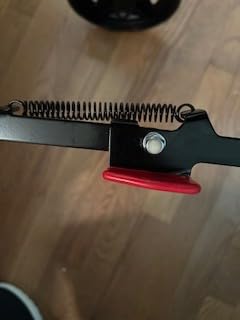
Two details separate it from most three-wheelers. The self-locking spring latch folds and unfolds in about a second, so you are not fighting a latch with numb hands at a jet bridge. And the two-way parking brake gives you real control on ramps and gangways rather than a brake that only locks one way.
The 7.5 inch rubber tires are larger than the 6 inch casters you see on the budget four-wheelers, and reviewers repeatedly mention how much better they behave on concrete, tile and airport carpet. On rough cobblestone sightseeing streets, expect some resistance. Three wheels will always feel less planted than four, and that trade is the price of the narrow footprint.
Where the PLANETWALK 3-Wheel works best
It is built for movement, not for sitting. Airport terminals, cruise-ship corridors, hotel lobbies, restaurants and short walking tours are exactly the environments where a narrow three-wheeler with a tight turning radius outperforms a heavier four-wheel rollator. Reviewers who use it for doctor visits describe it as noticeably less cumbersome than the four-wheel models they replaced.
For anyone who tires on their feet and needs an actual seat to rest on, this is the wrong tool, and we will not pretend otherwise. The same is true for larger users who feel the frame flex.
Where the 253 lb rating leaves you
A 253 pound capacity is fine for a great many travelers, but it is the second-lowest figure in this roundup and it is worth checking against your own weight with a margin to spare. Users on the r/Huntingtons mobility forums describe the opposite approach, keeping a lighter single-point aid for flights and a higher-capacity device for local outings, and that is a sensible pattern if you need more support than this model gives.
2. Vive Mobility 3 Wheel Walker – The Narrowest-Looking Frame With A Lifetime Guarantee
Vive Mobility 3 Wheel Walker for Seniors – Foldable Narrow Rollator Walker
11 lb frame
Height adjustable handles
Wide back-wheel track
Lifetime guarantee
Pros
- Top-rated at 4.6 stars from 1598 ratings
- Folds very flat for storage
- Cross-brace design feels stable in daily use
- Deep pouch between the frame rails
- Backed by a Vive lifetime guarantee
Cons
- No seat to rest on
- Three-wheel geometry feels less secure for bigger users
- Can be squeezed tight in very narrow doorways
The Vive 3 Wheel Walker carries the highest average rating of the ten models we reviewed, at 4.6 stars from 1,598 ratings. It also weighs 11 pounds, matching the lightest conventional options here, and it ships with a removable storage pouch and a lifetime guarantee, which is unusual coverage in this price bracket.
Unlike the PLANETWALK, Vive leans on frame geometry rather than wheel size. The two rear wheels sit on a wide track with a cross-brace, and the height-adjustable handles are positioned to give a natural hand angle and easy brake access. The listed dimensions are 28.74 by 16.14 by 8.27 inches, and buyers describe it folding flat enough to lie almost completely horizontal.
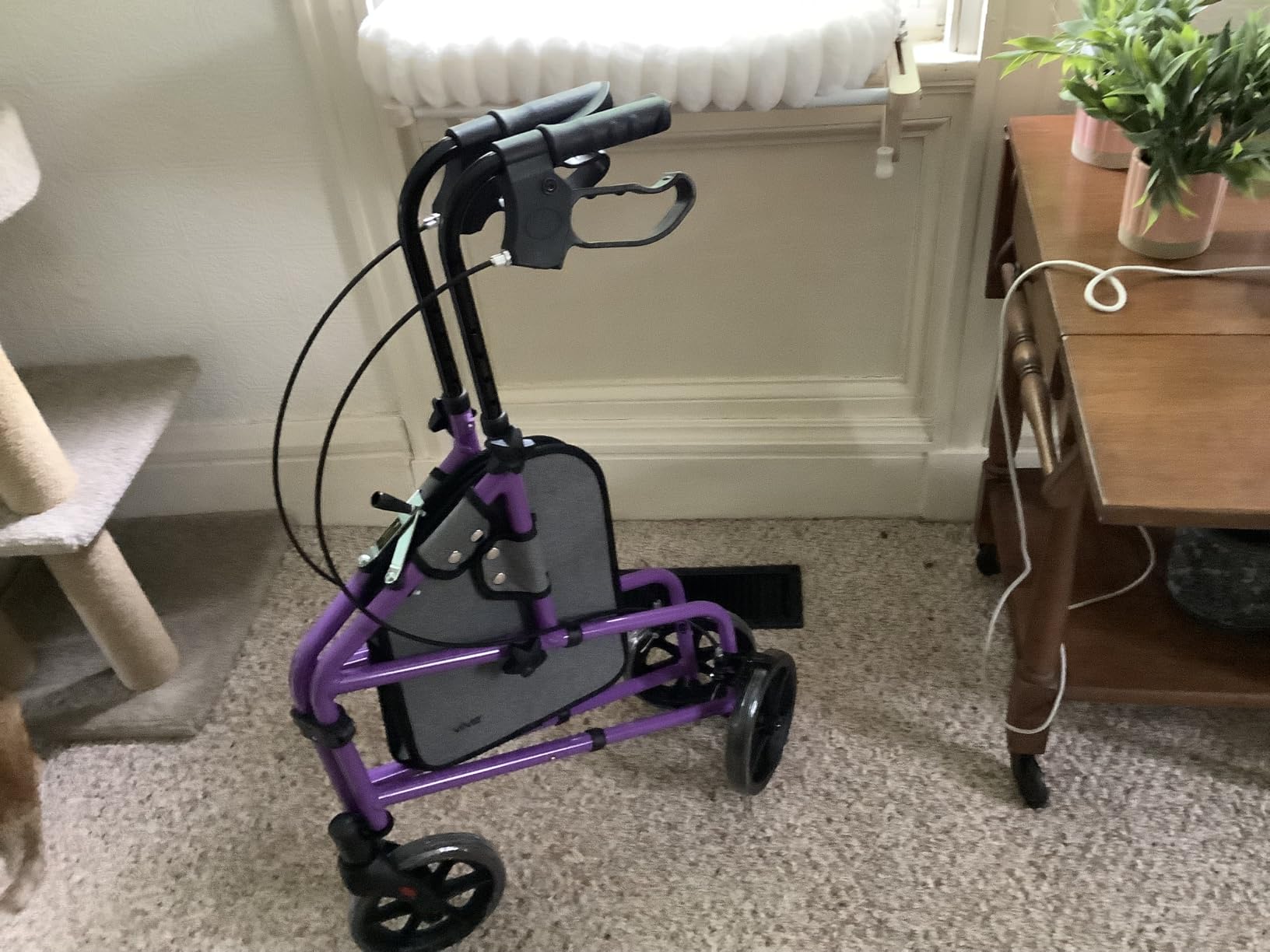
Buyers consistently point at two things: how little room it takes in a restaurant or a rental car, and how the cross-brace holds up over months of daily use. The pouch between the frame rails is deeper than most and carries a purse and a drink container without swinging into the wheels.
The honest drawback is geometry. A three-wheel base has a smaller support polygon than a four-wheel rollator, and reviewers with a larger frame report feeling less secure. If you are heavier, or if uneven ground is your normal terrain, the four-wheel HOMLAND or PLANET WALK models below are steadier choices.
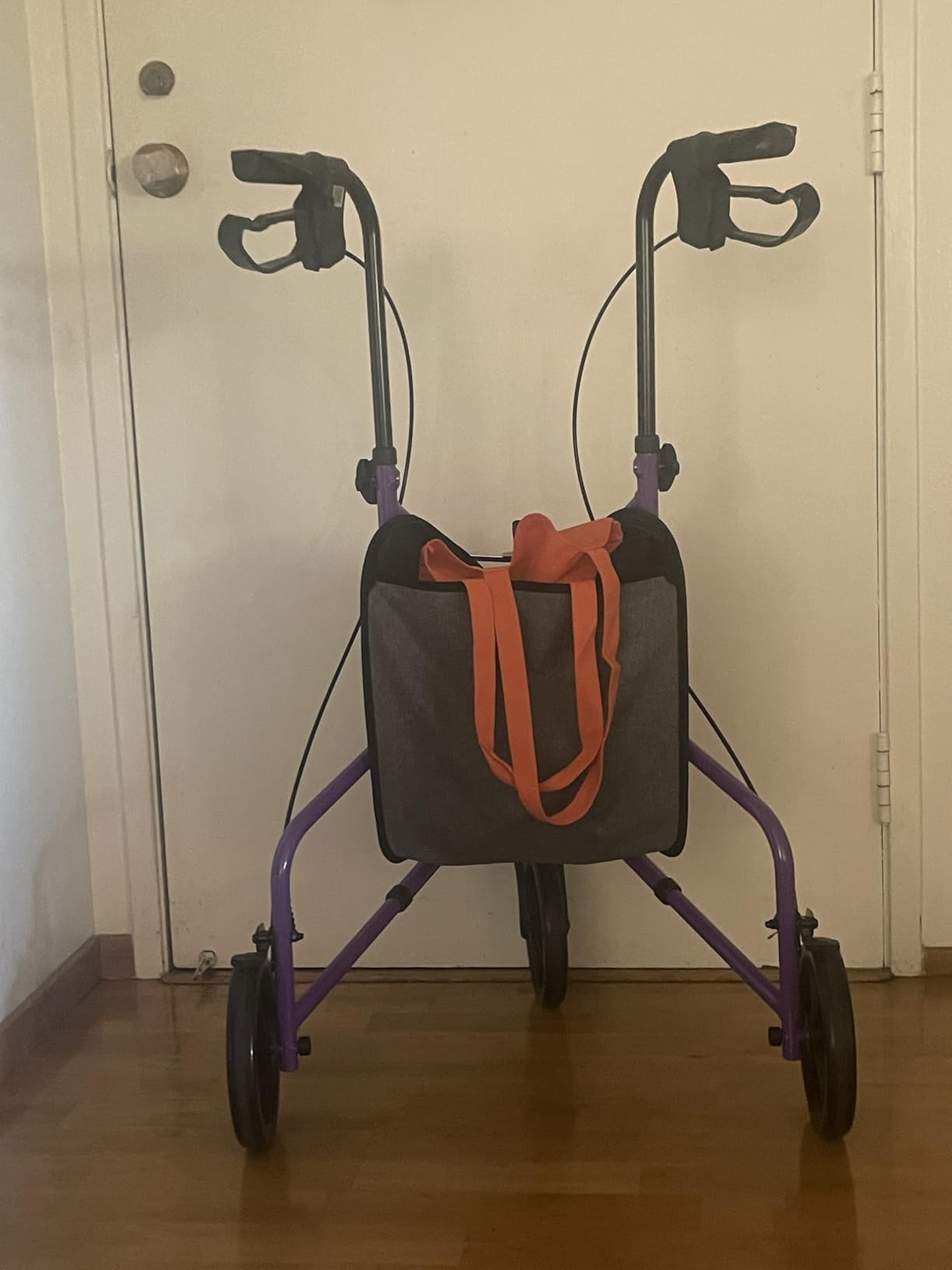
Why the cross-brace matters on a travel day
Rigid bracing is what stops a light frame from feeling wobbly, and this is the part of the design that shows up in the reviews. Over cobblestones, uneven ferry decks and sloping museum floors, a braced 11 pound frame holds its line better than an unbraced ultralight of the same weight. The handles also raise high enough that you can walk upright rather than stooped, which matters over a long terminal corridor.
What to know before you commit
There is no seat, so treat this as a walking aid and never attempt to sit on the frame. And if your doorways are extremely narrow, note that reviewers sometimes need to squeeze the folded frame to clear a tight opening. A lifetime guarantee covers the frame, so durability is not the concern here, weight and stability are.
3. HOMLAND Foldable Rollator With Seat – The 350 lb Capacity Pick With A Full Seat
HOMLAND Foldable Rollator Walkers for Seniors with Seat, 17 lb Lightweight
17.6 lb frame
350 lb recommended
8 inch wheels
Seat height 20-23 inch
Pros
- Ties for the highest rating in the group at 4.6
- Only 350 lb recommended capacity in the roundup
- Extra-wide memory foam seat and wide backrest
- Three-second fold with reflective strips
Cons
- Heaviest seated model here at 17.6 lb
- Handle range tops out at 40 inches
- Seat and handle ranges may not suit very tall users
If you need a real seat and a capacity rating above 300 pounds, this is the pick. It carries a 4.6 rating across 1,144 reviews, ties for the highest score in the roundup, and it is the only model in the group with a 350 pound recommended maximum. The frame is reinforced aluminum with double support bars, and at 17.6 pounds it is far heavier than the three-wheel options in this roundup.
The comfort details are unusually well thought out for a long travel day: an extra-wide memory foam seat, a widened breathable backrest, and a seat height that adjusts from 20 to 23 inches. The handle adjusts from 33 to 40 inches, which covers users from about 4 feet 7 inches to 6 feet 6 inches, and eight inch premium rubber wheels handle both indoor floors and outdoor paths.
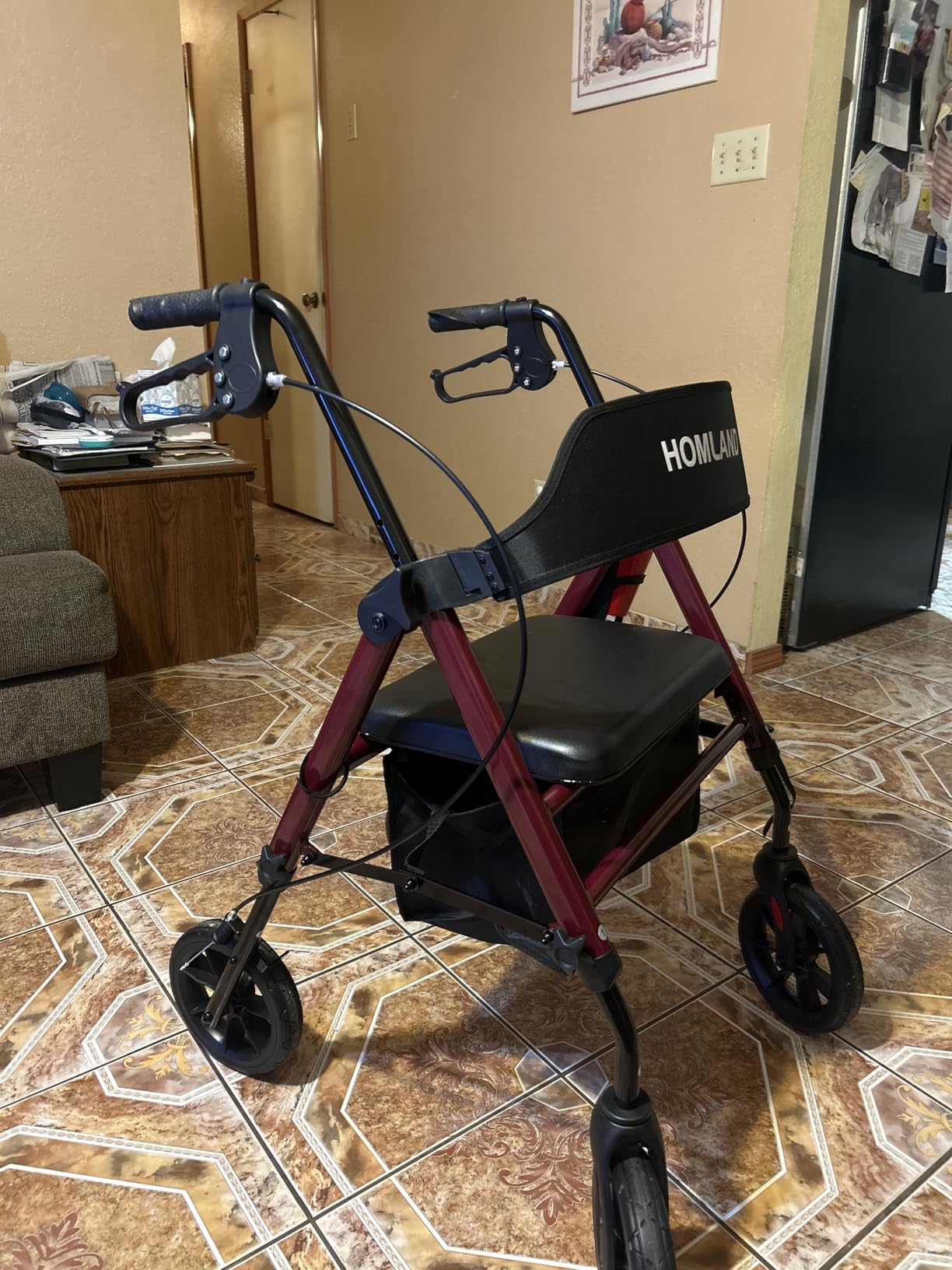
The fold is the strongest argument for travel. It collapses in three seconds and the review consensus is that it goes into a trunk without fuss, which is more than can be said for many lighter frames that fold but leave a wide, awkward shape behind. You also get a removable cup holder, a large storage pouch and multi-reflective strips for evening walks around a resort.
HOMLAND backs the metal frame with a lifetime warranty and offers a one-year extendable warranty on non-metal parts, with US-based support. That is a meaningful comfort when you are buying something to use a continent away from home.
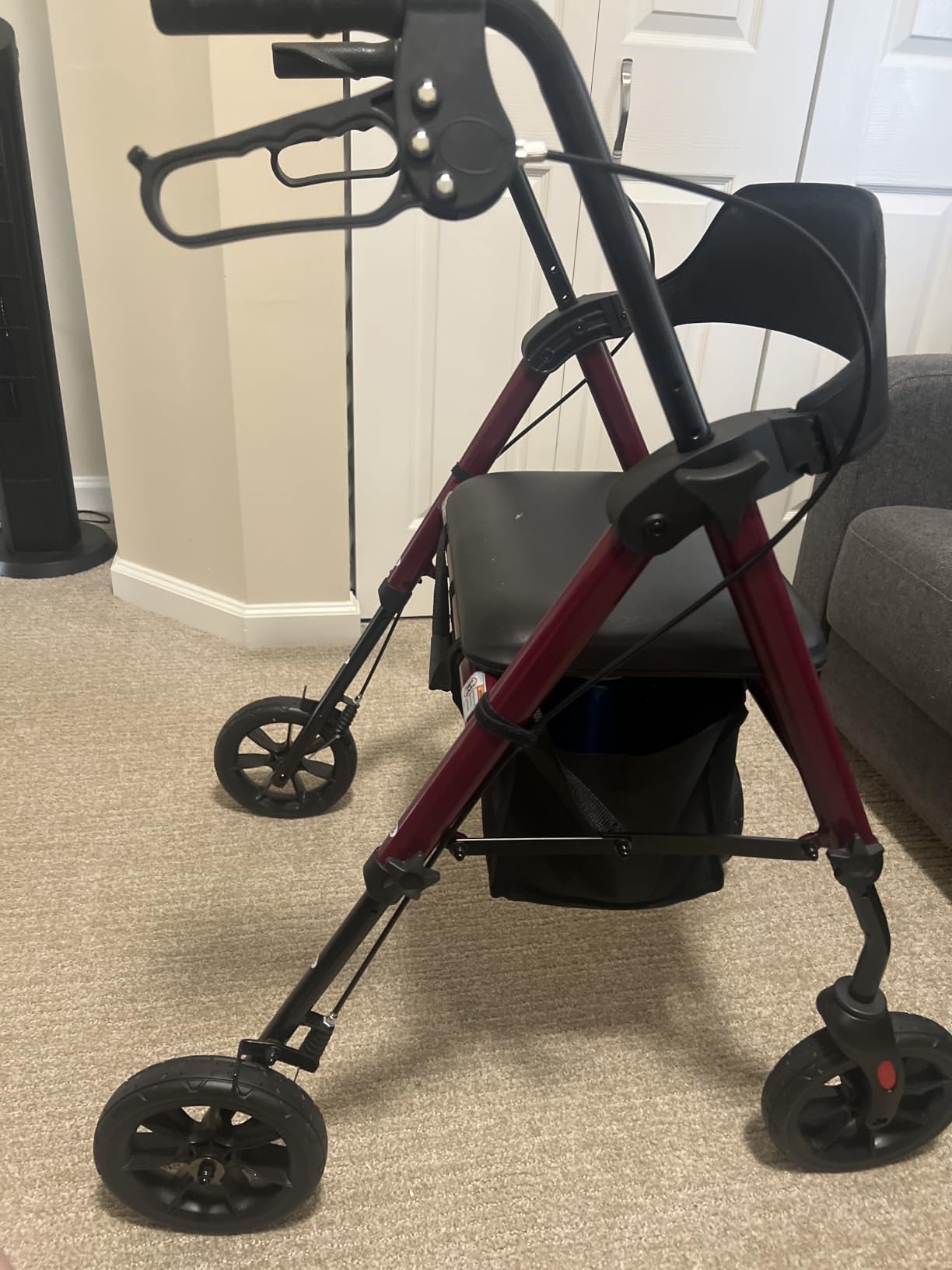
Is 17.6 lb light enough to travel with?
Honest answer: it is at the edge. Caregivers routinely load it into a trunk, and 17.6 pounds is well under the 18 pound threshold that Sunrise Medical identifies as the point where standard rollators become a struggle. But it is not a one-hand carry, and if you plan to move it through an airport alone without a second person, a lighter three-wheeler will serve you better.
Who this is not for
Users above roughly six feet six inches may find the 40 inch handle ceiling restrictive, and the extra-wide seat is not sized for very large frames. Reviewers also flag that the folded package is bulky in a small sedan. Measure your trunk before you order.
4. PLANET WALK Super Lightweight Rollator – The 13 lb Model That Stands Up When Folded
PLANET WALK Super Lightweight Rollator Walker for Seniors, Foldable Rolling Walker with Seat and 8″ Rubber Wheels for All Terrain, Unique Design Aluminium Frame Sturdy Walkers for Traveling – Red
13 lb frame
300 lb capacity
Folds to 10.9 inch wide
Stands upright folded
Pros
- Only 13 lb with a full seat and backrest
- Stands upright on its own when folded
- Four 8 inch anti-skid rubber wheels
- Breathable waterproof 18.5 inch seat
- Reflective strips on wheels and bag
Cons
- Folded length of 35 inches is bulky for a sedan trunk
- Wide frame suits very short users poorly
- Smooth wheels can still slide under braking
This is the rollator we would put in the hands of someone who insists on having a seat but cannot manage more than about 15 pounds. At 13 pounds with a 300 pound capacity, a padded waterproof seat and four eight inch anti-skid rubber wheels, it occupies a spot almost nobody else in this roundup does.
It folds to 26.5 by 10.9 by 35 inches and then stands upright on its own. That self-standing property matters more than it sounds: on a ferry deck, a cruise gangway or a narrow apartment hallway, a folded rollator that tips over is a trip hazard, and this one does not.
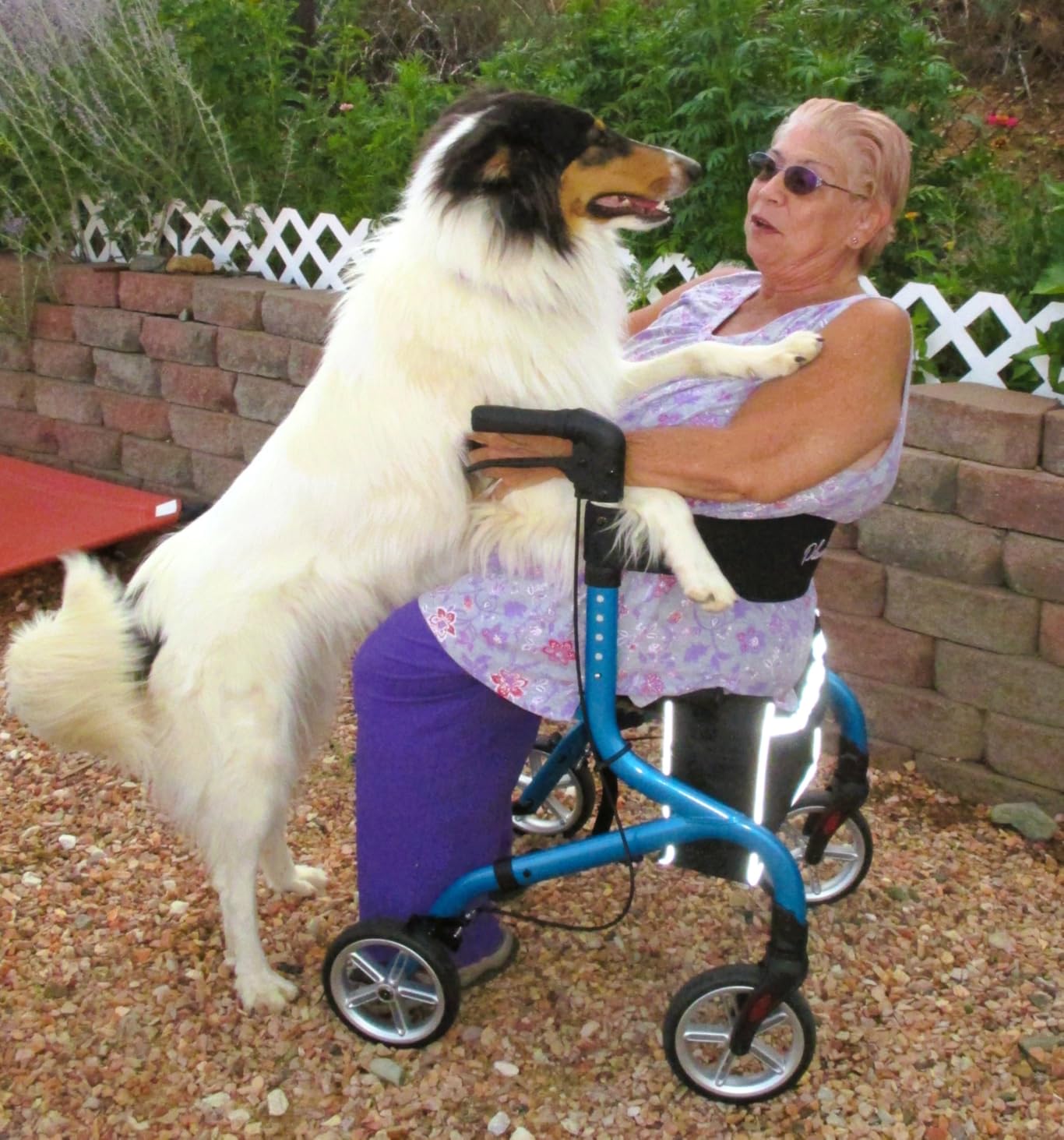
Reviewers describe the weight as the defining feature, repeatedly contrasting it with the 20-plus pound rollators they used before. The 8 inch wheels take bumps and rougher terrain better than the 6 inch casters on most budget models, and the front pair rotates 360 degrees. A two-way parking brake plus reflective strips on the wheels and the storage bag cover evening use.
Handle height adjusts across five levels from 35 to 39 inches, and the listed range covers users between 4.8 and 5.8 feet. The seat is a breathable waterproof 18.5 inch width with a widened backrest, which is a genuine step up from the strap-style perch seats on compact models.
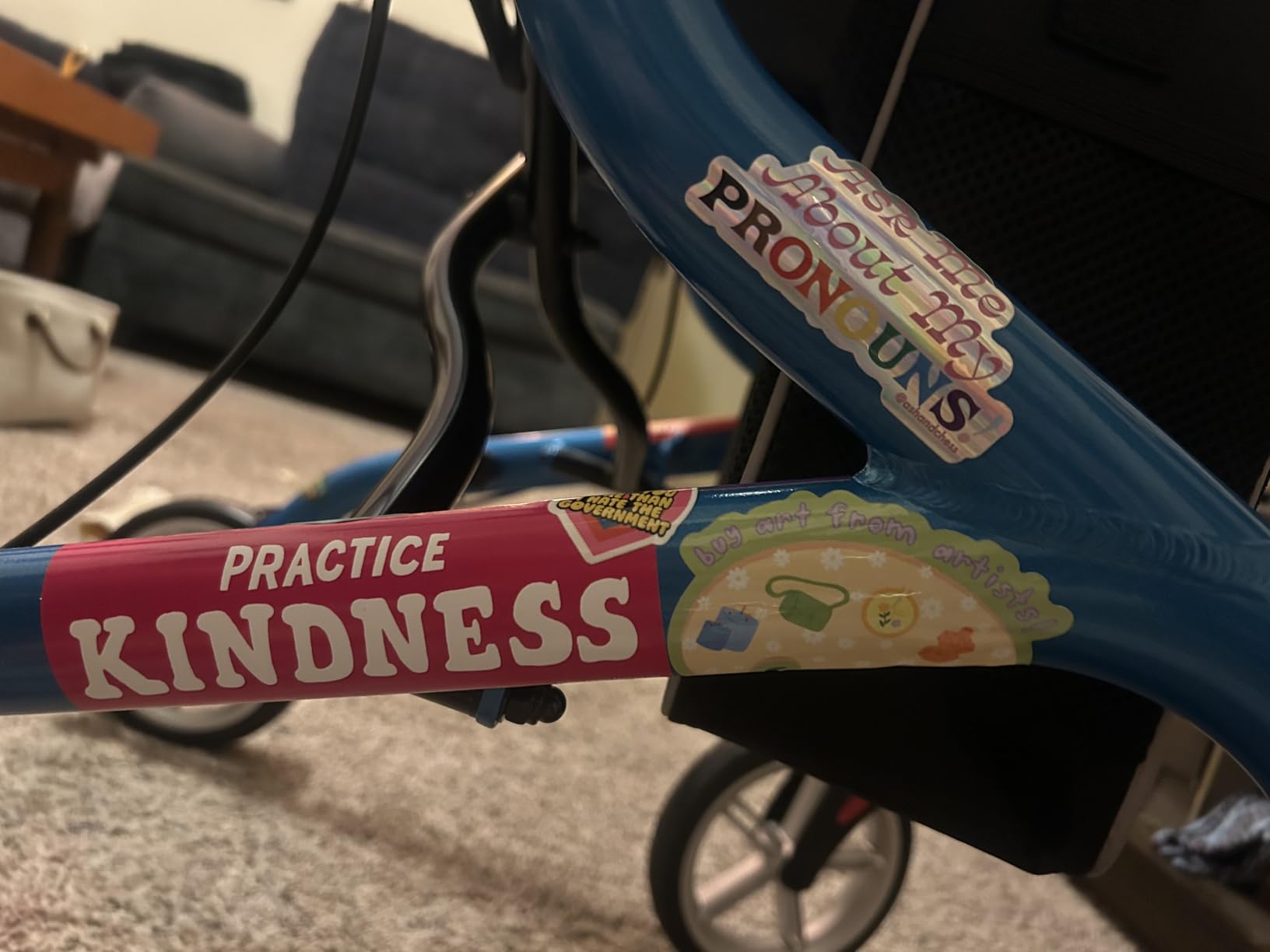
How this folds and stores
The one-hand quick fold and the 10.9 inch folded width make it easy to slide into a hall closet or behind a hotel room door. Standing upright when folded also means you can park it in a corner of a cabin without it rolling away. This is a genuinely travel-shaped design rather than a full-size rollator that happens to be light.
The honest drawbacks
At 26.5 by 10.9 by 35 inches, the folded package is long, and multiple reviewers report that it fills much of a sedan trunk unless you remove the handles. The wide frame does not suit very short users or small bathrooms, the soft backrest is not supportive for everyone, and a handful of buyers have reported a side handle separating from the frame over time. Keep a hex key in your travel kit.
5. byACRE Carbon Ultralight Rollator – The 10.58 lb Carbon Frame Pick
byACRE Carbon Ultralight Rollator Walker with Organizer Bag, Wide Track, Oyster White
10.58 lb frame
285 lb capacity
Carbon fiber construction
Arrives assembled and folds flat
Pros
- Lightest carbon frame at 10.58 lb
- Frame is stiff despite the low weight
- Reversed handles support better posture
- Push-button height adjustment
- Arrives fully assembled
Cons
- Seat and accessories sold separately
- Most expensive model in the roundup
- Reversed handles are not to every taste
An ALS News Today forum user described this model as something they can carry upstairs with one hand or swing straight into the car, and that single sentence captures the entire category. At 10.58 pounds, the byACRE Carbon Ultralight is the lightest frame here that can carry a seat, and the 917 ratings behind it give it real staying power.
The frame is carbon fiber, which the manufacturer rates as five times stronger than steel while weighing a fraction as much. Carbon does not flex the way thin aluminum tubing can, so the 10.58 pound figure does not translate into a wobbly push. The listed capacity is 285 pounds, and the model arrives fully assembled and folds flat for transport.
Handle height adjusts by push button from 31.1 to 35.8 inches, with no loose pin to lose in an airport. The reversed handles position your palm over your fingers, which some users find easier on arthritic hands and which pushes you into a taller posture than a conventional rollator. A small organizer bag is included.
This is also the only carbon frame here, and the material explains both the weight and the price. If you are deciding between this and a mid-weight aluminum model, the question is whether you will use it often enough for the difference to matter on every lift.
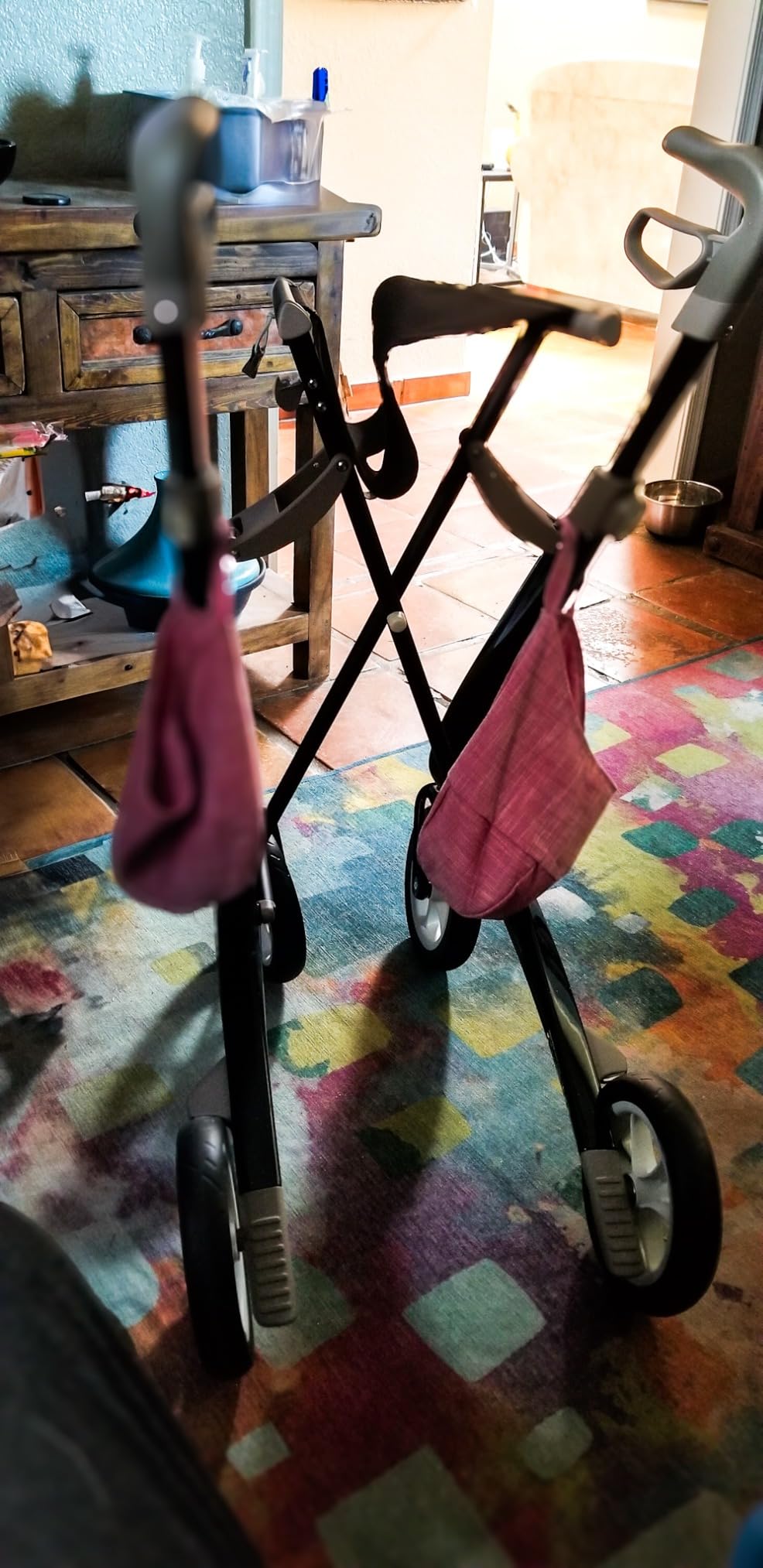
What you have to add separately
The seat is not included. The organizer bag is, but a padded seat, backrest and any other accessories are separate purchases, which raises the real total and means you should confirm the seat arrives before a trip rather than after landing. Set aside a few minutes at home to fit it, because the unit ships ready to roll but not ready to sit.
Who should pay the premium
If you lift your rollator unaided, frequently, and want a rigid frame that will not develop a wobble over years of travel, this is the model. If you are buying a second device strictly for flights and you already have a comfortable rollator at home, the combination of accessories and cost makes one of the aluminum models a more rational purchase. Reversed handles also suit some people far better than others, so try a similar frame in person if you can.
6. Stander Space Saver Rollator – The Smallest Folded Footprint In The Group
Stander Space Saver Rollator, Lightweight Folding Rolling Walker with Seat for Seniors & Adults, 4-Wheel Mobility Aid with 6-inch Wheels, Locking Brakes & Padded Seat with Backrest, Cobalt Blue
14.5 lb frame
Folds to 10 x 11 inch
250 lb capacity
6 inch wheels
Pros
- Folds into a 10 x 11 inch footprint
- No assembly needed out of the box
- Compact enough for a small closet
- Padded adjustable handles
- Perch seat for quick rests
Cons
- Six inch wheels struggle on rough outdoor ground
- Perch seat is strap-style rather than a padded bench
- 250 lb is the lowest capacity here
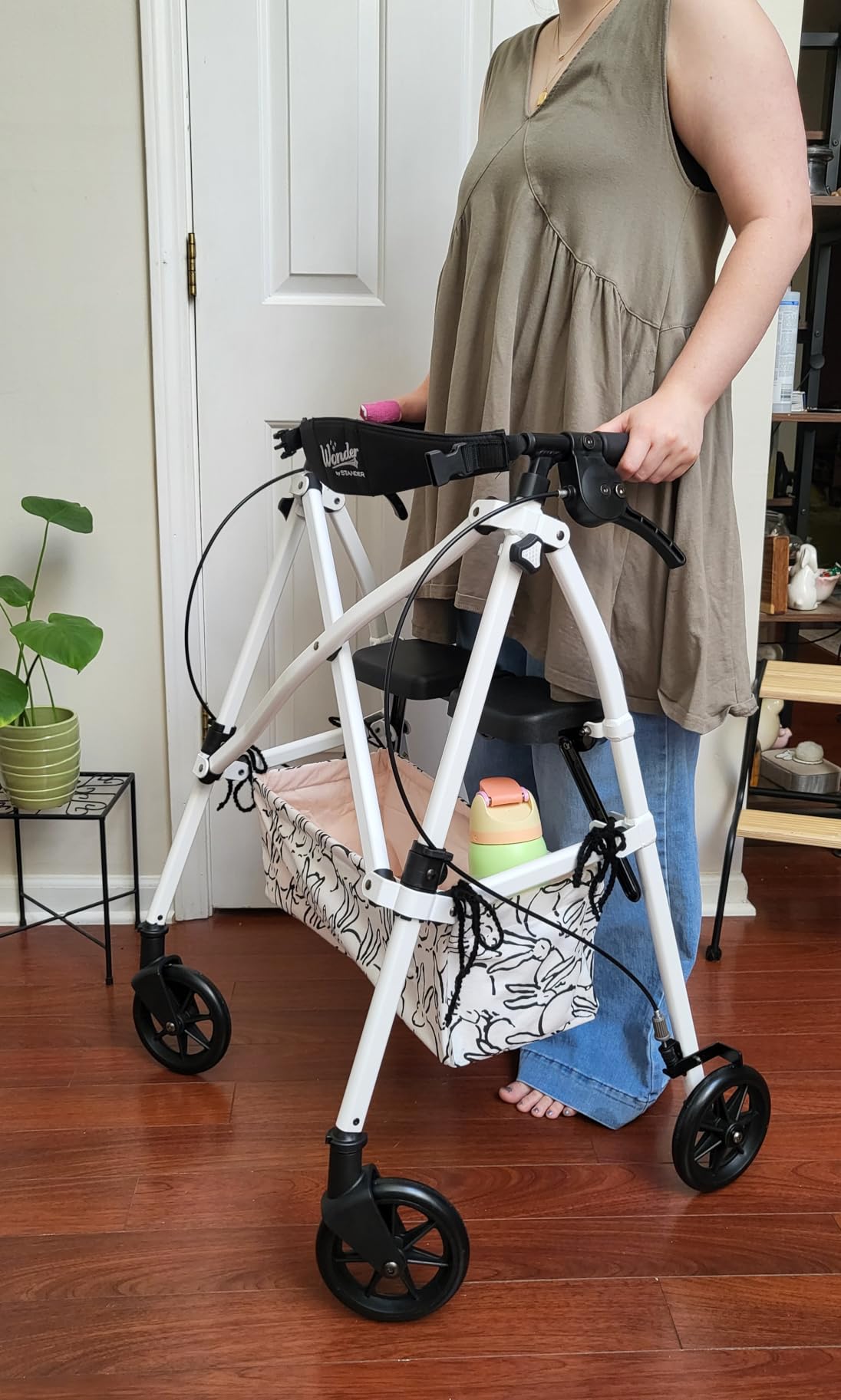
Folded dimensions are the number one factor in travel suitability, and the Stander Space Saver wins it outright. Its patented EZ Fold-N-Go design collapses into a 10 by 11 inch footprint, which is a fraction of the package size of every other seated model we reviewed, at 14.5 pounds.
It needs no assembly at all, arrives ready to use, and has padded handles that adjust from 33 to 36 inches. The seat is an 18.5 by six inch non-slip perch rather than a full bench, which is enough for a two-minute rest in an airport concourse and not enough for a long afternoon.
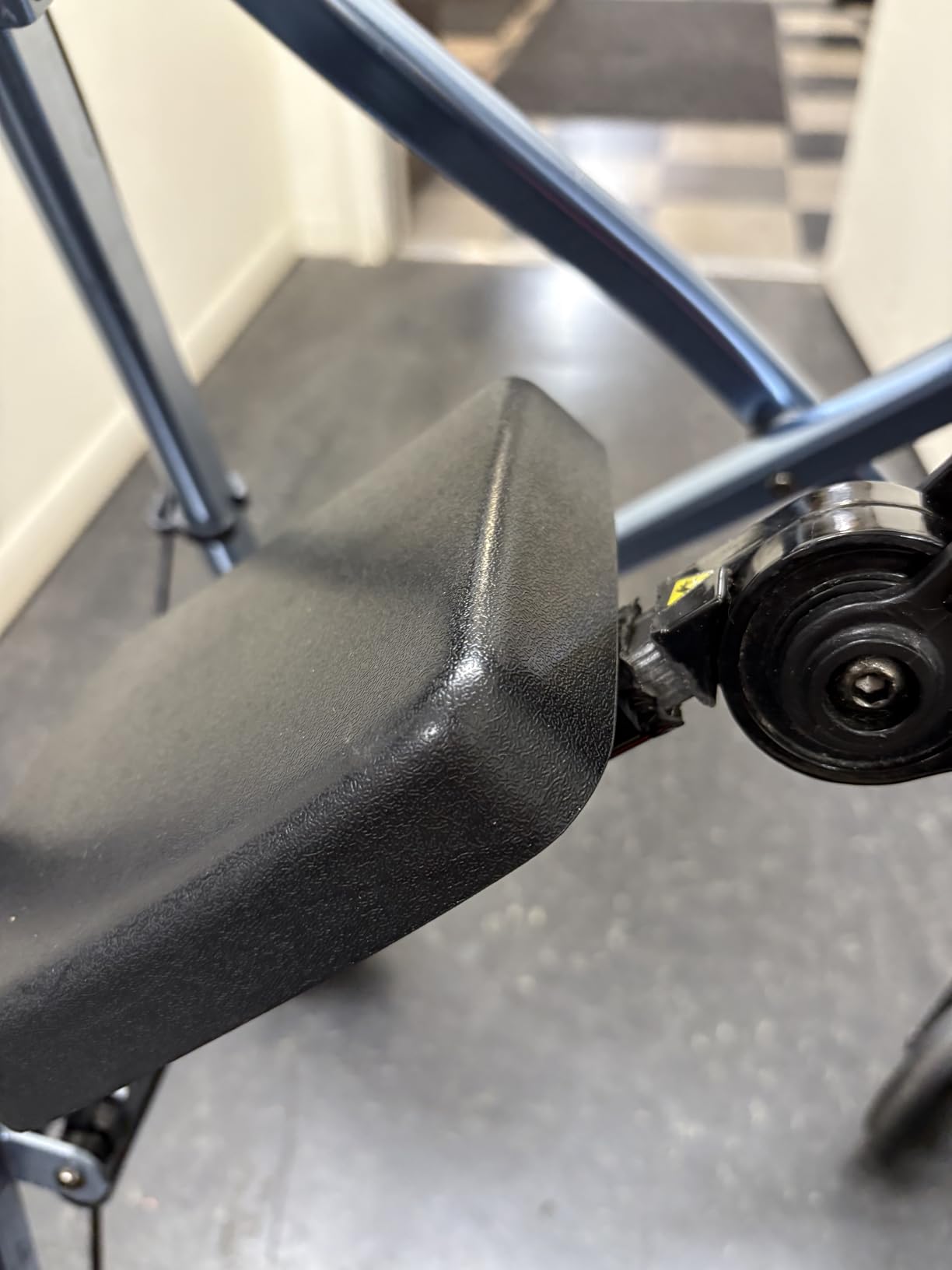
Reviews focus on the same two things every time: how small it goes and how little fuss there is out of the box. It fits in a hall closet, a small apartment entry or a cruise cabin locker where a conventional rollator simply will not go. Rear locking brakes give you direct control when you sit down.
One Home Depot review of this model noted that it feels a little heavy in the hand and described patching a cracked rear skid with heavy duty tape. Small plastic and rubber parts are the weak point on compact travel aids generally, so it is worth checking the skids and brake levers before a trip rather than after.
Where a 10 by 11 inch fold changes the trip
That footprint is what makes this the practical choice for a cruise cabin, a hotel room with a narrow wardrobe, or a car where the boot is already full of luggage. You can also carry it onto a shuttle or into a rideshare without the awkward overhang a longer frame leaves. For anyone who plans to move between two countries, that compactness is often worth more than a slightly better wheel.
Where it falls short
Six inch wheels are the compromise, and reviewers say so directly. On smooth airport floors and carpet they roll fine; on cobblestone, gravel or uneven park paths they are noticeably less smooth than the eight inch casters on the HOMLAND and PLANET WALK models. The 250 pound capacity is also the lowest figure in the group, and the perch-style seat is not a real rest.
7. HOMLAND Foldable 3 Wheel Walker – The Featherweight 10.4 lb Pick
HOMLAND Foldable 3 Wheel Walkers for Seniors, Lightweight 10.4 lb
10.4 lb frame
260 lb capacity
Folds one-handed and stays standing
8 inch casters
Pros
- Lightest frame in the roundup at 10.4 lb
- 260 lb capacity in an ultralight design
- Slips through doors and hallways a four-wheeler cannot
- Steers on a fingertip
- Thumb rests help arthritic hands
Cons
- No seat so nowhere to rest
- Included cup holder and cane holder are seen as useless and fragile
- Hard to collapse after assembly
At 10.4 pounds, this is the lightest frame in the entire roundup, and the only one that pairs that weight with a 260 pound capacity rather than the 253 or 250 pound figures most ultralights carry. It is a three-wheel walking aid, so there is no seat, and that is the deal.
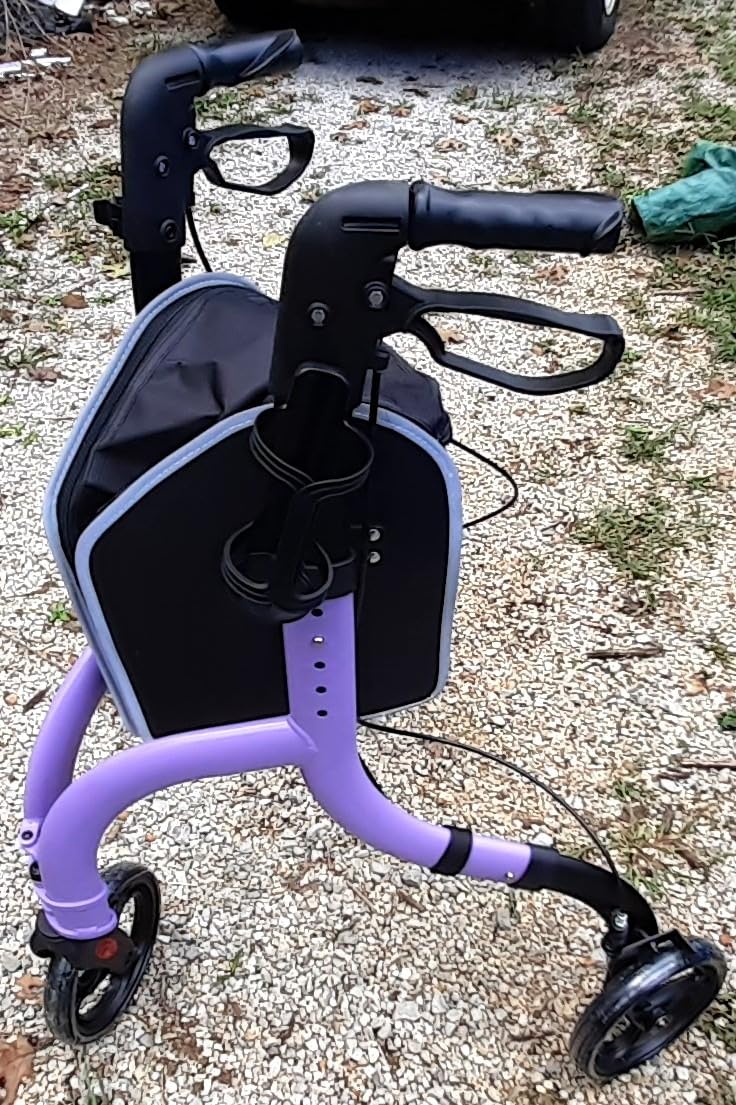
What you get for the weight is unusual hardware: eight inch premium casters, a two-sided one-hand fold that leaves the walker standing in a corner, a push-up brake, a push-down wheel lock, and thumb rests on the handles that users with arthritic hands specifically mention. Height adjusts from 34 to 38 inches for users between 4 feet 8 inches and 6 feet 1 inch.
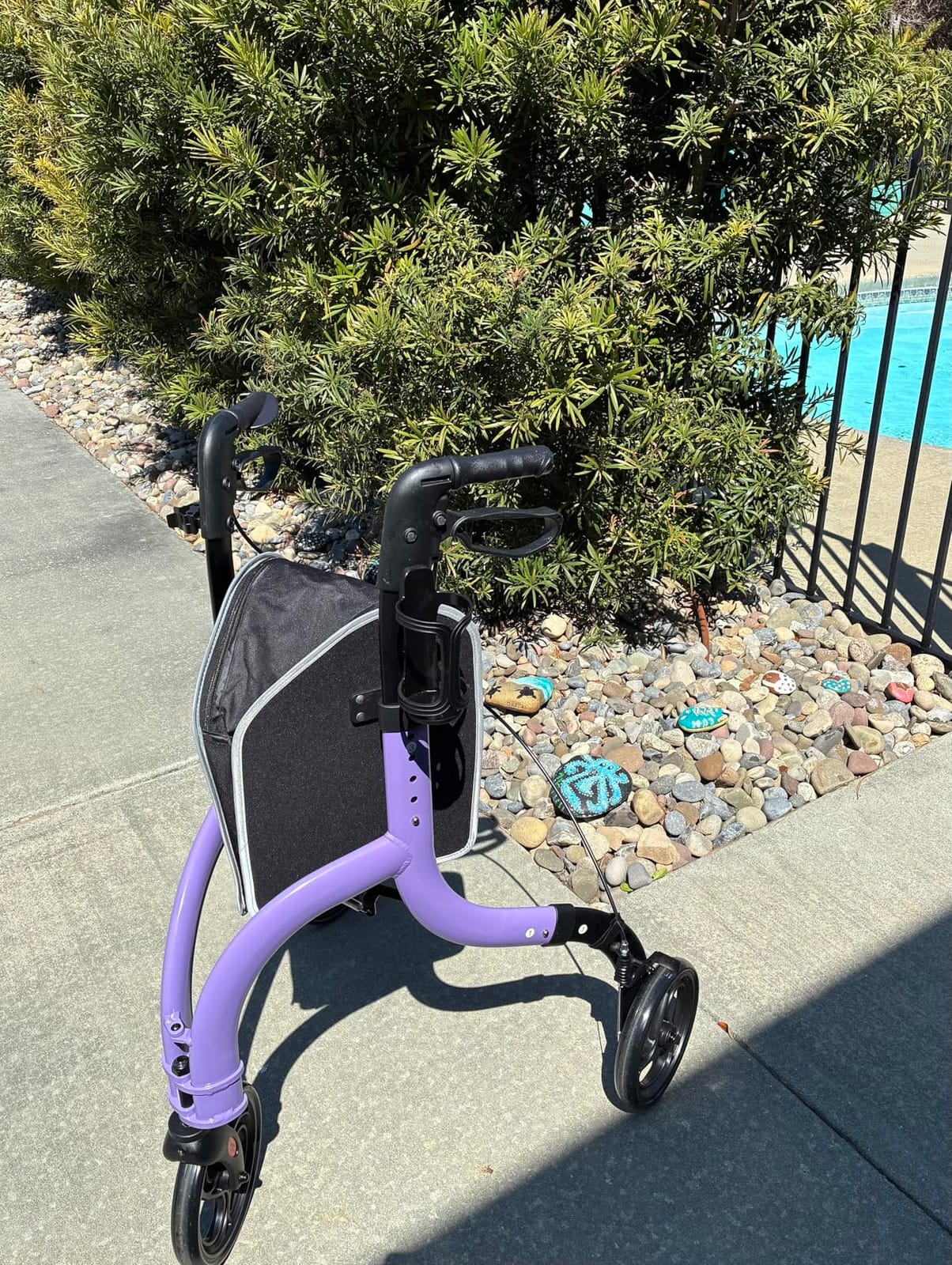
Reviewers describe it slipping through doorways and hallways that a four-wheel rollator cannot manage, and steering that lets it turn a full circle with a finger. That is the practical difference between this and a heavier four-wheel model in a terminal, a small hotel or a shop with tight aisles.
HOMLAND provides a one-year warranty with a one-year extension option and US-based customer support, which several buyers mention approvingly. The listed package dimensions are compact at 18.07 by 13.11 by 7.76 inches.
Best suited to tight indoor routes
This is the model for corridors, elevators, small bathrooms and turning circles where width matters more than stability. Reviewers who use it for travel describe the 10.4 pound figure as the difference between loading your own aid and waiting for help. The eight inch casters are a genuine step above the small wheels usually found on ultralight three-wheelers, and they handle carpet and tile well.
What reviewers are critical of
The bundled cup holder and cane holder draw the most complaints, described as useless and prone to breaking, and the water holder does not suit thermos-style cups. Several users also report that the walker becomes difficult to collapse back down once it has been assembled. Its 4.3 rating is the lowest in this group, and the reason is consistency rather than any single fault.
8. Lumex 3 Wheel Cruiser – The Narrow Frame For Small Bathrooms And Older Homes
Lumex 3 Wheel Cruiser – Lightweight & Narrow Three Wheel Walkers for Seniors & Tight Spaces
14 lb frame
28 inch overall width
8 inch wheels
250 lb capacity
Pros
- Narrow 28 inch frame built for tight spaces
- Large 8 inch wheels for carpet wood and tile
- Handles adjust from 33 to 37 inches
- Attached zippered pouch
- Model in production since 2005
Cons
- Heavier than the 10-11 lb ultralight three-wheelers
- No seat to rest on
- Only two color options
The Lumex 3 Wheel Cruiser is the odd one out in this roundup in the best possible way: it was first listed in 2005 and is still being made, which tells you how well it holds up. It carries a 4.5 rating from 637 buyers, most of whom chose it for one specific reason, the narrow frame.
At 28 inches overall width it is built for small bathrooms, narrow doorways and older homes where a standard 55 to 60 inch rollator simply will not turn around. Weight is about 14 pounds, with an attached zippered pouch for essentials and handles that adjust from 33 to 37 inches.
The 8 inch wheels are large for a three-wheeler and reviewers specifically call out how well they roll over carpet, wood, tile and uneven surfaces. That is a real advantage on a cruise ship, where carpeted corridors and threshold strips are unavoidable, and in a rental apartment with mixed flooring.
The trade against the newer ultralight models is weight. 14 pounds is fine for a car boot and workable in an airport, but it is three to four pounds heavier than the sub-11 pound three-wheelers in this list, and you will feel that in your arms at the end of a long travel day.
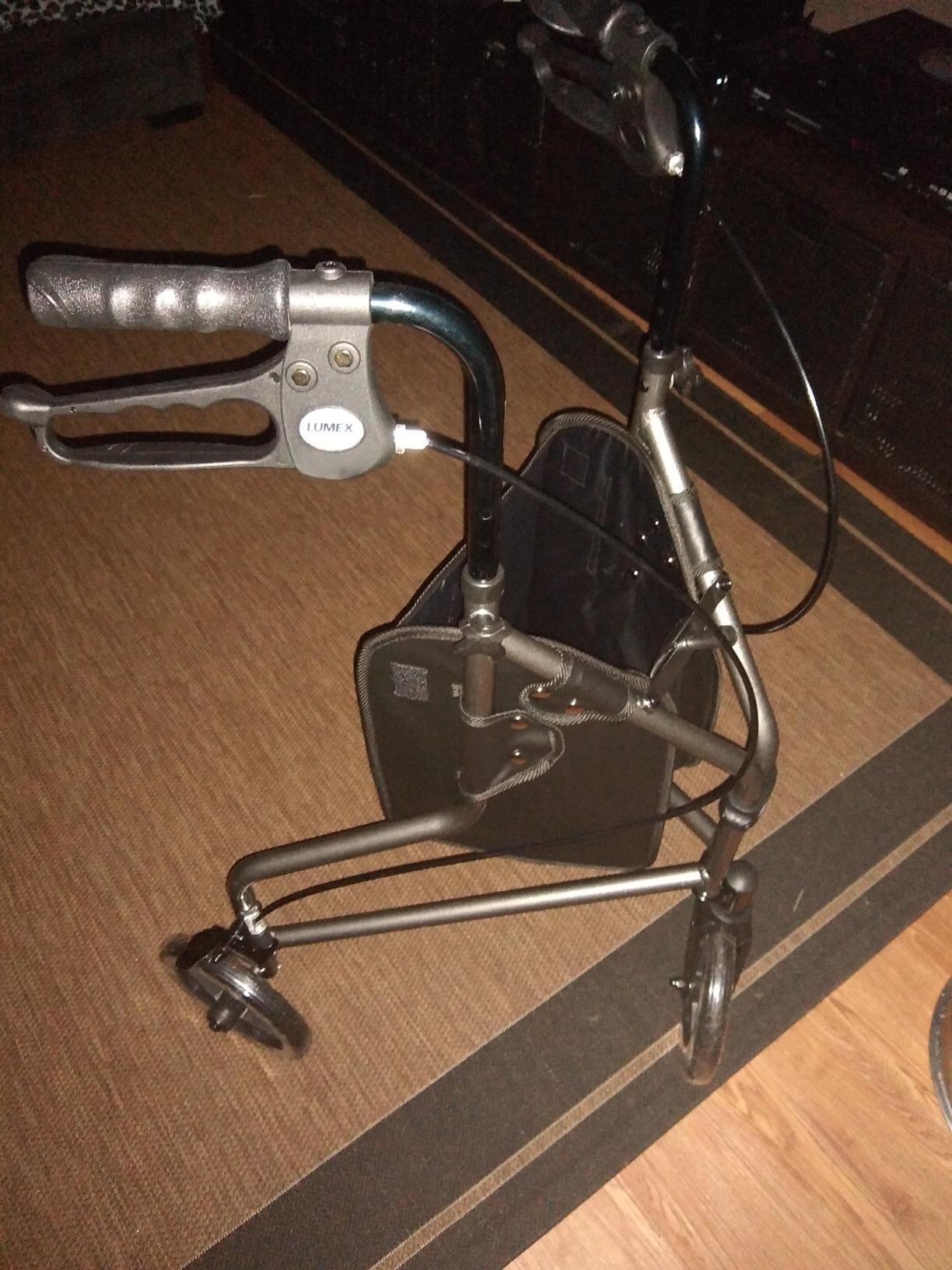
Why the narrow width changes daily life
A bathroom is where most travel happens, and it is where a wide rollator fails first. The Lumex turns in spaces that leave a four-wheel frame wedged against a wall, which also makes it a good choice for smaller European hotel rooms and older vacation rentals with tight corridors. The attached pouch means there is no bag to swing into the wheels as you turn.
Limitations to plan around
It has no seat, so it is a walking aid only. The listed capacity is 250 pounds, which is the joint-lowest rating in this roundup, so if you need a higher number, look at the HOMLAND with seat instead. And with only two color options, this is a functional purchase rather than a style choice.
9. Helavo 2 in 1 Walker Wheelchair Combo – The Pick That Converts Into A Transport Chair
Helavo 2 in 1 Walker Wheelchair Combo, Convertible to a Transport Chair
21.2 lb frame
300 lb capacity
Folds to 11.4 inch wide
Converts to transport chair
Pros
- Converts from walker to pushed chair in seconds
- Footrests swing flat while walking
- Handles suit both a 5 foot 2 user and a 6 foot 2 pusher
- Spacious 18.3 inch wide seat
- Assembles in about 5 minutes
Cons
- Heaviest in the roundup at 21.2 lb
- Hard plastic wheels struggle on cobblestone and gravel
- No good arm support in transport-chair mode
Long airport transfers are where a rollator stops being enough. The Helavo converts from a walker into a pushed transport chair in seconds, which means a companion, a cruise staff member or a wheelchair attendant on standby can take over without swapping equipment. For terminal corridors and long layovers, nothing else in this roundup offers that.
It folds to 27.6 by 11.4 by 32.7 inches with the footrests in place, supports up to 300 pounds, and has a rear step-lift bar to help tip the rear end over curbs. Handles adjust from 32.7 to 37.8 inches, tall enough for a 6 foot 2 pusher and low enough for a 5 foot 2 user to walk it themselves.
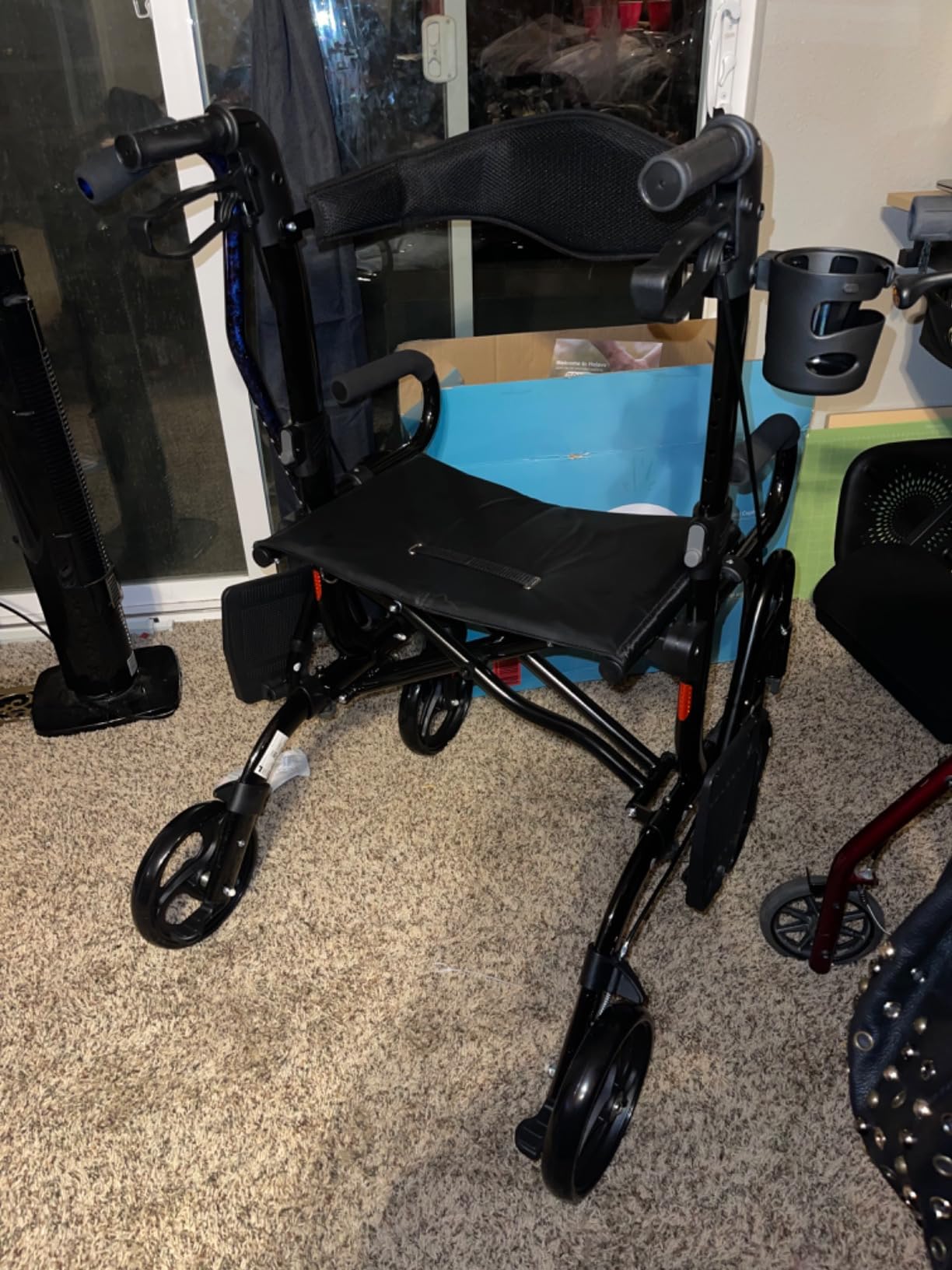
The footrests are height adjustable and swing flat to the sides when not in use, so they do not catch on a doorway while you are walking. The seat is 18.3 inches wide and reviewers with partners who push them rate the adjustability for two very different heights as the feature they notice most. Assembly takes about five minutes with the included video instructions.
There is a one-year warranty extendable to three years with support available around the clock, plus an integrated cane holder, a removable cup holder and a shopping bag.
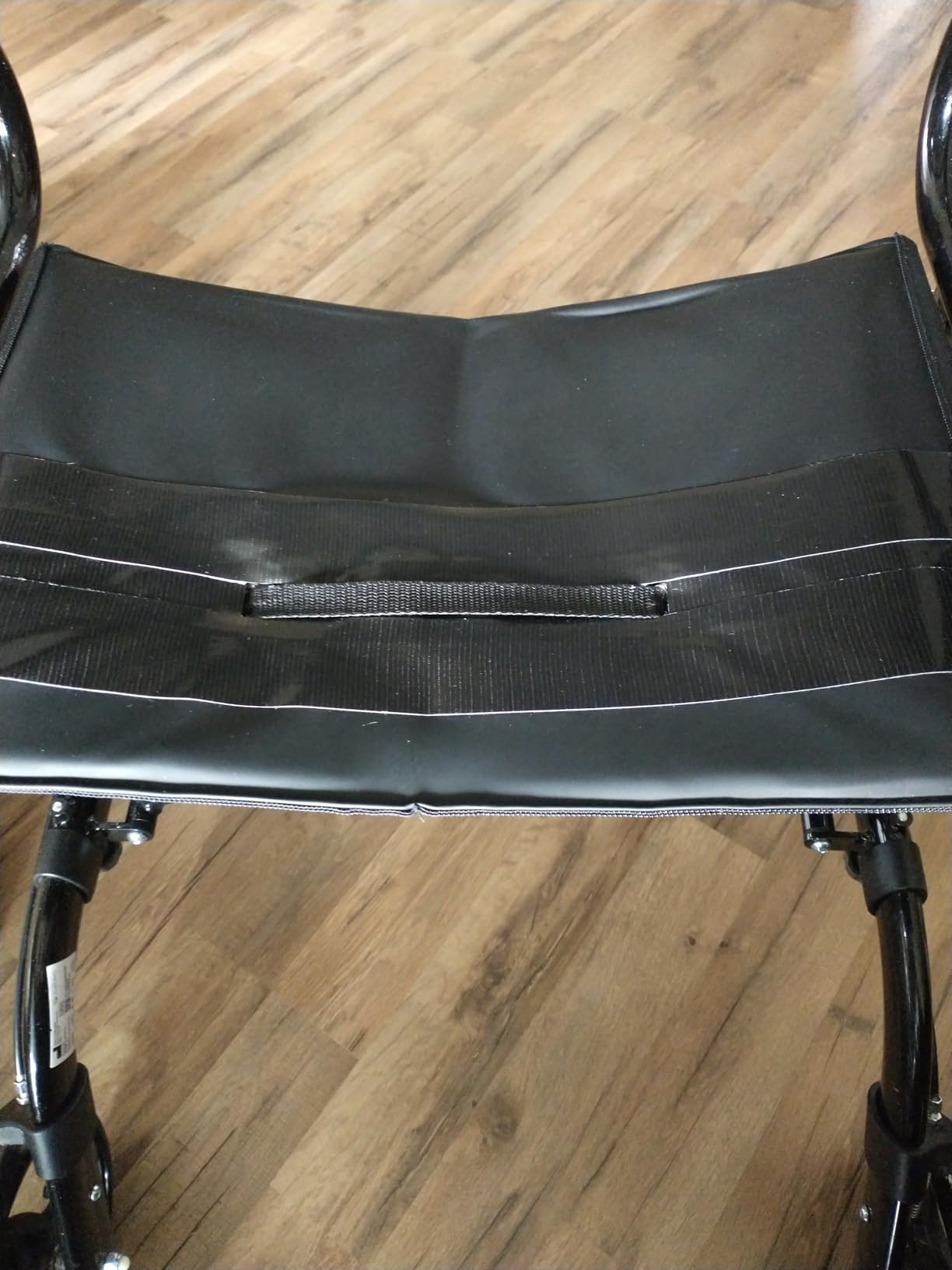
Where a transport chair conversion earns its keep
Cruise terminals, large airports and theme parks involve far more standing than a sightseeing day does. A device that becomes a chair turns a two-hour walk into a series of short walks with rests, and it means the person travelling with you is not hauling a second heavy device through the terminal. On stairs or escalators, fold it and carry it like a rollator.
Why it is not our top pick
It is also the heaviest product in this roundup at 21.2 pounds, which makes it a genuine two-person lift into a vehicle. The hard plastic wheels do poorly on cobblestone and gravel, which rules it out for sightseeing in historic European cities. In transport-chair mode there is no comfortable place for the rider to rest their arms, and the shallow seat can feel tight for larger users.
10. Vive Ultra Lightweight Rollator With Seat – The Entry Point If You Want A Seated Four-Wheeler
Vive Ultra Lightweight Rollator Walker with Seat – Foldable, Narrow
14 lb frame
300 lb capacity
24 inch wide frame
Seat and backrest included
Pros
- Entry-level pick that still includes a seat and backrest
- Tool-free assembly and folding
- Rolls gently on hardwood floors
- Many color options
- Underside pouch for small items
Cons
- Heavier in practice than the ultralight label implies
- Front track is not as narrow as a true three-wheeler
- 6 inch wheels are rough on outdoor ground
If you want a seated four-wheel rollator with a backrest at the entry level of this category, the Vive Ultra Lightweight is the one to look at. It weighs 14 pounds, supports up to 300 pounds, and it is FSA and HSA eligible with a one-year Vive guarantee behind it.
The frame is compact at 24 inches wide by 23 inches deep, with handles that adjust from 31 to 36 inches. The padded seat measures 14 by 12 inches at a height of 21 inches from the floor, and there is a matching backrest plus an under-seat storage pouch. Assembly and folding are both tool-free.
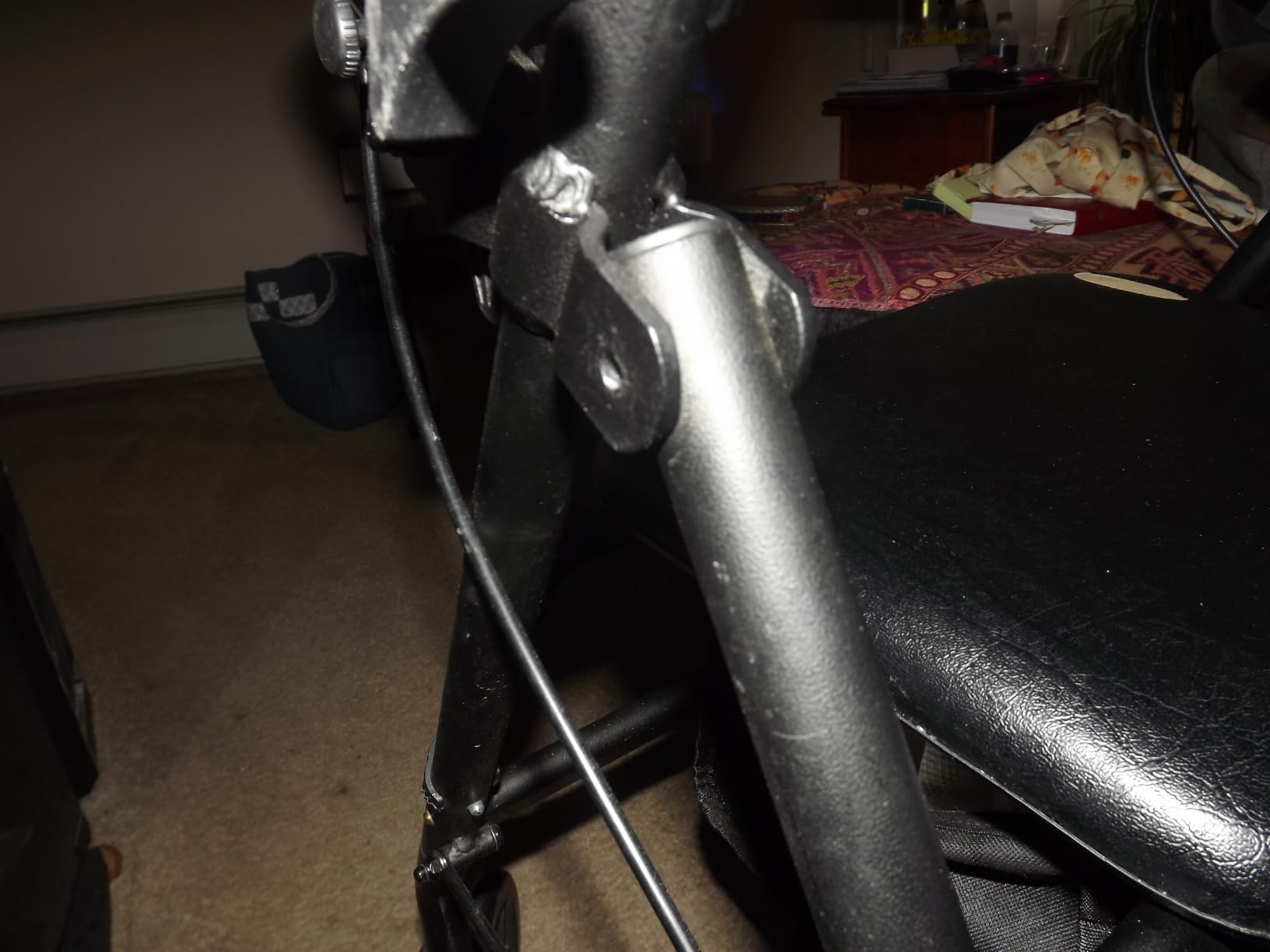
Buyers like the value for money, the quick assembly and the range of colors, including pink and floral seat patterns that are hard to find elsewhere. Reviewers also note that it rolls smoothly and does not scratch hardwood floors, which matters if you are moving between rentals.
The most common complaint is the weight. At 14 pounds it is not really in ultralight territory, and reviewers comparing it with true travel models say so directly. If lifting weight is your priority, the PLANET WALK 13 pound model is the better buy despite the higher tier.
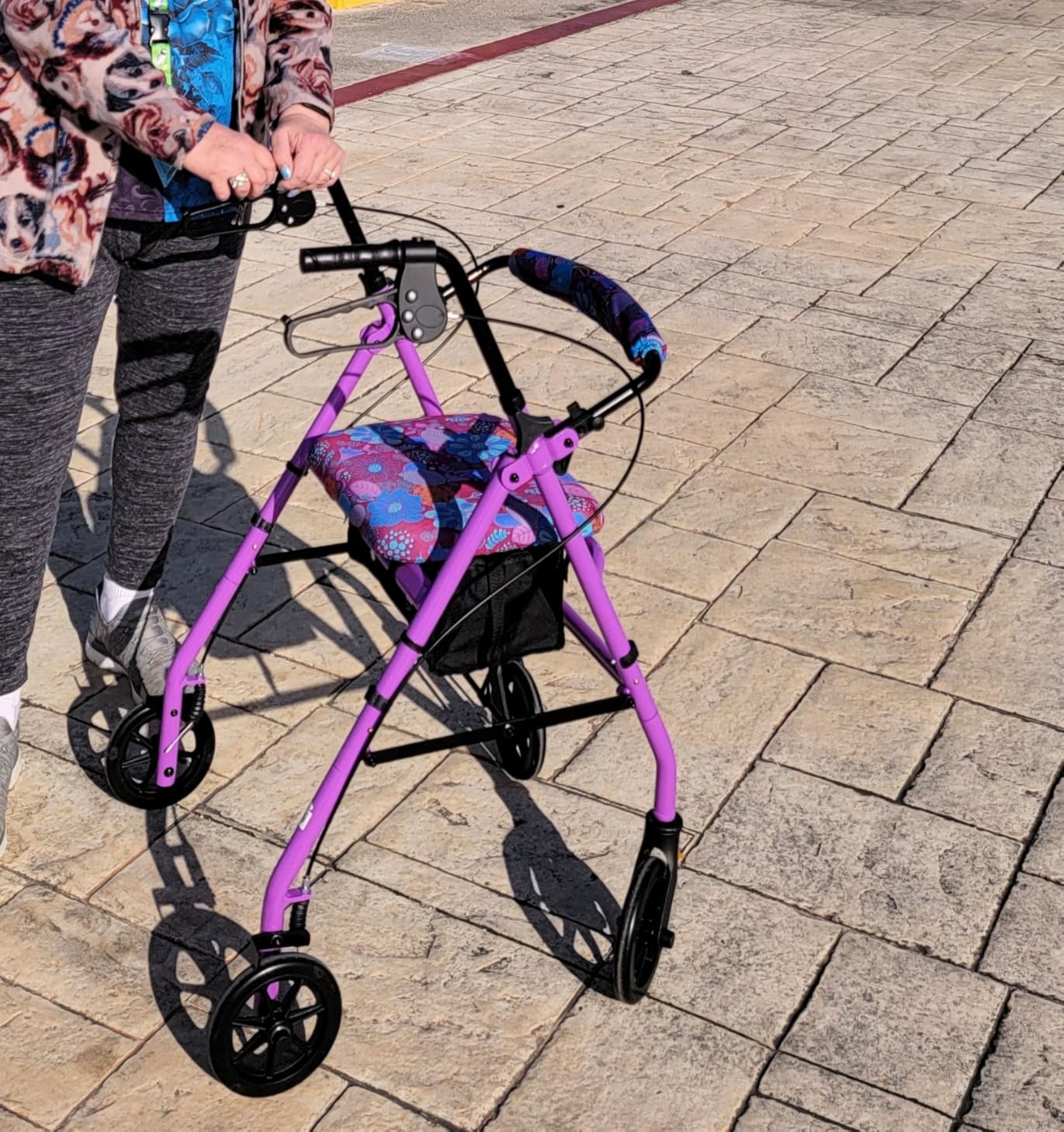
Best for everyday travel and home use
This is a sensible pick for cruises, hotel stays and family visits where you will mostly be rolling on smooth surfaces, and where a padded seat matters more than gram counting. The under-seat pouch keeps a phone and a wallet off your person, and the tool-free design means a companion can fold it without instructions. It is also the model most likely to live in a spare room between trips.
Where it falls short
The 6 inch wheels are rough on anything other than pavement and indoor flooring, the 14 inch seat is small for larger users, and the front track is wider than a true three-wheeler, so it will not slip through a narrow doorway the way the models above do. Treat the ultralight label as marketing rather than fact.
Taking A Rollator On A Plane, Cruise Or Train
Travelers on mobility forums raise one worry repeatedly: arriving at the gate with your own rollator and being told to use an airport wheelchair instead. One Cruise Critic thread recounts exactly that on an Iberia flight out of Italy, and the traveler never saw the walker again. So the practical advice is to settle the handling arrangements before you leave home rather than at check-in.
In the United States, the Air Carrier Access Act means airlines may not charge you a fee for your mobility device or for stowing and returning it, and gate-checked mobility aids normally travel in the cabin hold rather than the baggage system. That is exactly why folding speed and folded size matter so much. The same Cruise Critic thread reports gate agents and baggage handlers being impressed by how easily a walker folded and how small it was once flat.
Five steps make the process smoother. One, call the airline accessibility desk at least 48 hours ahead and give them the model, the weight and the folded dimensions. Two, arrive earlier than usual, since TSA asks travelers who use mobility devices to allow roughly 30 extra minutes for additional screening. Three, fold the rollator yourself at the jet bridge if the crew asks, which is far easier than letting a handler work out your frame. Four, take a photo of the folded device before handing it over. Five, check your seat and your device separately at baggage claim and report a missing aid immediately at the airline desk, because recovery is far easier in the first hour.
For cruise lines and rail, the questions are different but simpler. Ask the cruise line what fits in your cabin locker, because a 26 inch folded rollator is not going in a standard stateroom locker and is more likely to be stored by the cabin crew. On trains, folded rollators generally travel in the luggage rack or a designated space rather than the overhead bin, so check dimensions against the rack opening rather than the bin allowance.
One more thing worth packing: a small kit of the small parts that break. A Home Depot review of the Stander Space Saver described a cracked rear skid repaired with heavy duty tape, and forum threads mention brake levers and side pads failing while away from home. A spare brake lever, a skate-style tool and a roll of tape weigh almost nothing next to a replacement rollator in a foreign country.
What Actually Makes A Rollator Travel Friendly
The lightest rollator is not automatically the best travel rollator, because weight is only one of three things that matter. Folded size, standing stability and wheel diameter decide how the device behaves once you leave your front door, and a 14 pound model that folds to 10 by 11 inches can be easier to travel with than a 10.4 pound model that stays 35 inches long.
Measure your trunk before buying. Most of the folded packages in this roundup run between 8 and 35 inches in their longest dimension, and the difference between a 26 inch package and a 35 inch package is the difference between a rollator and a pile of luggage. If your handles come off, take them off before measuring, because several of these models collapse further once they do.
Frame material sets the weight ceiling. Aluminum covers most of this roundup and gives you the best value for strength. Carbon fiber, seen here only in the byACRE, is roughly half the weight of a comparable aluminum frame for premium-tier money. Polymer frames show up mainly on two-wheel walking aids and are not represented among the four-wheel models here.
Weight capacity should exceed your body weight by a comfortable margin, and the range across these picks runs from 250 to 350 pounds. If you are near the top of a model’s rating, look for the reinforced frames, not the ultralight ones. The 350 pound HOMLAND is the only model in this roundup that supports a heavier user and still folds quickly.
Wheel size decides your terrain. Six inch casters are smooth on airport floors and hotel carpet and unpleasant on cobblestone. Eight inch wheels handle sightseeing streets, cruise gangways and uneven park paths. Seven and a half inch rubber wheels sit in the middle. Whatever the size, the brakes are the part to test: push the walker forward and back over a seam and see how firmly it stops.
One-hand folding and a self-standing fold are the two features travelers notice most. If you cannot fold the frame with one hand while holding a suitcase in the other, airport travel gets harder quickly. And a fold that stands upright means you can park it in a corner of a cabin or a hotel room rather than laying it across the floor.
Three wheels, four wheels or a transport chair is the last decision. Three wheels turn tighter, fit through narrower doorways and weigh less, but feel less secure on rough ground and never have a seat. Four wheels are steadier, heavier, and can include a padded seat for resting. A two-in-one transport chair is the most versatile and the heaviest, and it is the right answer for long terminal transfers with a companion.
Frequently Asked Questions
Do airlines charge for rollators?
In the United States, the Air Carrier Access Act means airlines cannot charge you a fee for your mobility device or for storing and returning it. Gate-checked mobility aids also travel in the cabin hold rather than the regular baggage system, which is why models that fold quickly and compactly are much easier to hand over at the jet bridge. Check your airline’s accessibility desk at least 48 hours before departure and get the arrangement in writing.
What is the best rollator to take on an airplane?
The best rollator for a flight is one you can fold with one hand, that stands upright once folded, and that weighs under about 13 pounds. A tri-wheel model such as the 11 lb PLANETWALK Premium is the easiest to lift and store, while a seated four-wheel model such as the 13 lb PLANET WALK Super Lightweight works if you need a place to rest between flights.
What is the lightest weight rollator for seniors?
The lightest options we reviewed are the HOMLAND 3 Wheel at 10.4 pounds, the byACRE Carbon Ultralight at 10.58 pounds, and two 11 pound tri-wheelers from PLANET WALK and Vive Mobility. The three-wheel models have no seat, so the byACRE and the 13 pound PLANET WALK Super Lightweight are the lightest choices that still give you a place to sit.
What is the lightest, smallest rollator with a seat?
The Stander Space Saver is the smallest seated model in this roundup, folding into a 10 by 11 inch footprint at 14.5 pounds. Among the lighter options, the 13 pound PLANET WALK Super Lightweight folds to 26.5 by 10.9 by 35 inches and stands upright when folded, and the byACRE Carbon Ultralight at 10.58 pounds folds flat but has a seat sold separately.
What are the common problems with rollators?
The most reported problems are weight, small replaceable parts and terrain. Buyers repeatedly find that a 17 pound or 18 pound rollator is too heavy to lift into a car alone, rear skids and brake levers crack on compact models, and small 6 inch wheels catch on airport carpet and cobblestone. Three-wheelers also feel less stable than four-wheelers for heavier users, and several folding models remain bulky once collapsed.
Conclusion: Which Lightweight Rollator Should You Take
The PLANETWALK Premium 3 Wheel is our choice for most travelers, at 11 pounds with the largest review base in the group and a one-second fold. If you need a seat and a 350 pound capacity, the HOMLAND earns it. If you need the smallest folded footprint, the Stander Space Saver goes into spaces nothing else will. For the absolute minimum weight with a rigid frame, the byACRE Carbon Ultralight at 10.58 pounds is hard to beat, provided you buy the seat separately.
Whichever one you choose, measure your trunk, check the folded dimensions rather than just the weight, and call the airline before you book the flight. That thirty-minute phone call has saved more travelers’ trips than any model on this list. Here are the best lightweight rollators for travel in 2026 again, with the specs side by side above, so you can compare before you spend.