
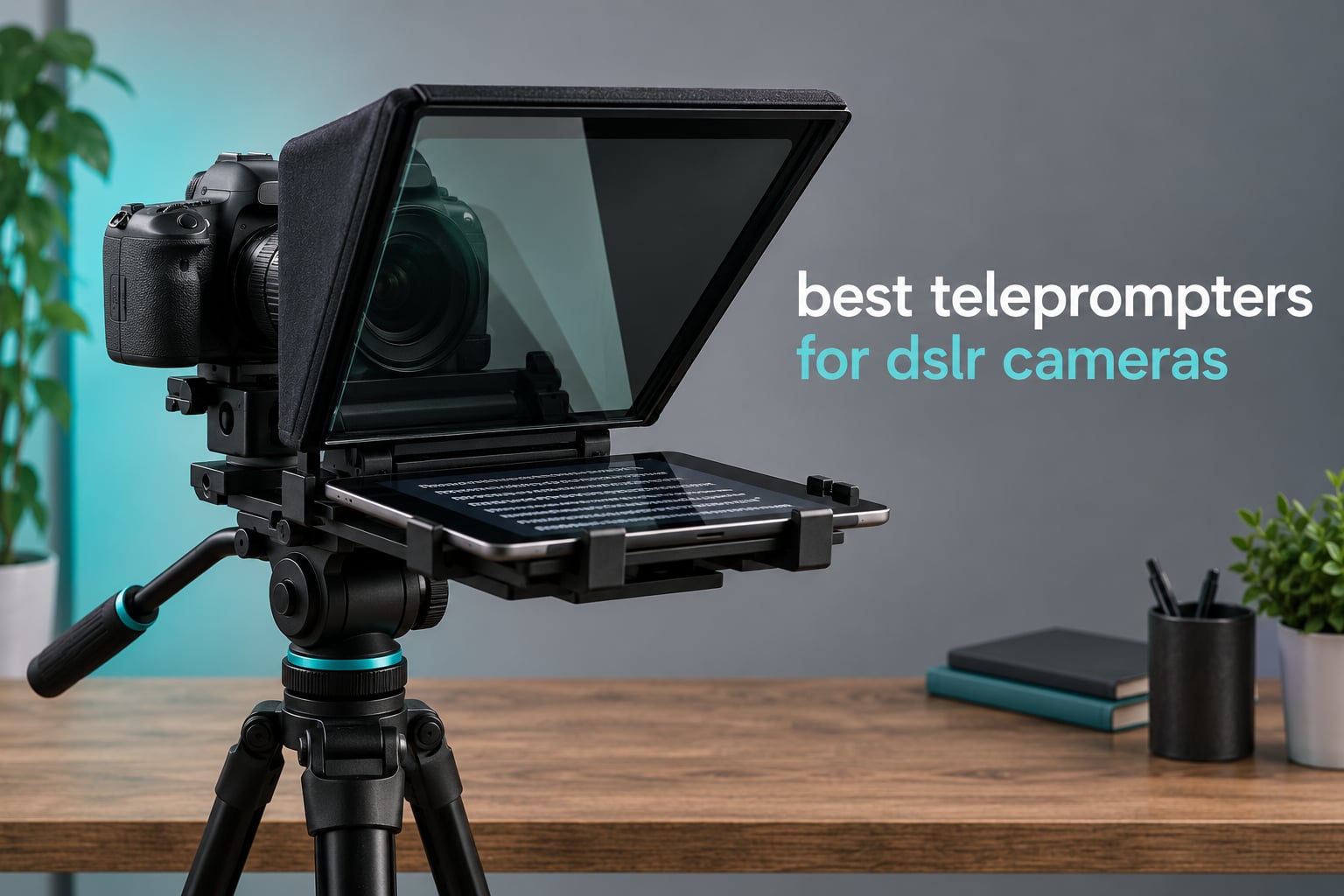
A teleprompter is the fastest way to make a scripted video look like a conversation, and for DSLR shooters it is also the fiddliest purchase in the camera bag. The glass has to match your lens thread, the camera platform has to carry the weight without upsetting autofocus, and the reading distance decides whether you sound like a person or a newsreader. We spent 2026‘s worth of comparison time narrowing the field to the best teleprompters for DSLR cameras, and every pick below is judged on those three things rather than on how the packaging looks.
Yes, politicians read from prompters — that is the most common question we get and the least useful one. The part that matters for your gear is simpler: a beam-splitter prompter puts a tablet, phone or built-in monitor behind coated glass, and the reflected script sits right on top of the lens so your eyes stay forward. If you also want a camera body for the same kind of setup, our outdoor camera guide covers the point-and-shoot side of things, though the mechanics here apply to any interchangeable body.
Twelve prompters made the cut, spanning the pocket-sized travel units to the studio kit that never leaves a corner of a newsroom. We read the fit specifications closely because that is where DSLR compatibility actually lives: adapter ring coverage, glass size against hood depth, tripod thread, and whether the camera hangs off the frame or sits on its own platform. Buyer questions about talking points and remote range come up constantly too, and the cameras built for outdoor use guide covers the weather side of shooting remotely if your prompter lives on location with you.
The short version: the NEEWER X11 is the best teleprompter for DSLR cameras overall because it pairs a large glass panel with a built-in monitor and an Arca type holder that most tripods already speak. The Elgato Prompter wins if you stream or run Zoom and want drag-and-drop control from a computer. Everything else fits somewhere more specific, and we say exactly where.
Table of Contents
Top 3 Best DSLR Teleprompters in 2026
These three cover the widest range of real shooting situations, from a single-camera talking-head setup to a streaming desk. Each is ranked in full below with the DSLR fit verdict and the drawback that actually stops people buying it.
NEEWER X11 2 in 1 Teleprompter
- Built-in 9 inch LCD
- 75% light transmission glass
- Arca type holder
- 75mm lens thread support

Elgato Prompter
- Built-in drag and drop display
- Stream Deck control
- Two year warranty
- Works on Zoom and Teams

NEEWER Basics X12B
- 12 inch 75% transmittance glass
- No assembly aluminum body
- Readable to 10 ft
- Folds flat with carry case
Best Teleprompters for DSLR Cameras in 2026: Quick Overview
Twelve prompters, ranked by DSLR fit first and price second. Use the table to narrow the field, then read the full review for the fit verdict.
| Product | Specs | Action |
|---|---|---|
| NEEWER X11 2 in 1 Teleprompter |
|
Check Latest Price |
| Elgato Prompter |
|
Check Latest Price |
| NEEWER Basics X12B |
|
Check Latest Price |
 AMBITFUL 7.5 inch Mini Teleprompter AMBITFUL 7.5 inch Mini Teleprompter |
|
Check Latest Price |
 Desview T5 Desview T5 |
|
Check Latest Price |
 Desview P13 Desview P13 |
|
Check Latest Price |
 Little Prompter LP-01 Little Prompter LP-01 |
|
Check Latest Price |
 Desview T3 Desview T3 |
|
Check Latest Price |
 Moman MT12 Moman MT12 |
|
Check Latest Price |
 GVM 12 inch Teleprompter GVM 12 inch Teleprompter |
|
Check Latest Price |
 Proaim P-TP300 Universal Kit Proaim P-TP300 Universal Kit |
|
Check Latest Price |
 LENSGO TC7 LENSGO TC7 |
|
Check Latest Price |
1. NEEWER X11 2 in 1 Teleprompter — Best Overall for DSLR Cameras
NEEWER X11 2 in 1 Teleprompter 11″ with Monitor, Supports Screen Mirroring
9 inch LCD at 1024 x 768
75% light transmission coated glass
Lens threads to 72 mm
1.3 pounds
Pros
- Built-in 9 inch LCD means no tablet or phone to balance
- Coated glass at 75% transmission keeps text readable in a lit room
- Arca type holder adjusts 10 cm across and 3 cm up
- Quick release plate rated for 2 kg
- Works as a second display on Windows and macOS
Cons
- Screen mirroring only works on phones over the DP protocol
- No voice-following sync
- First connection over HDMI needs a driver install
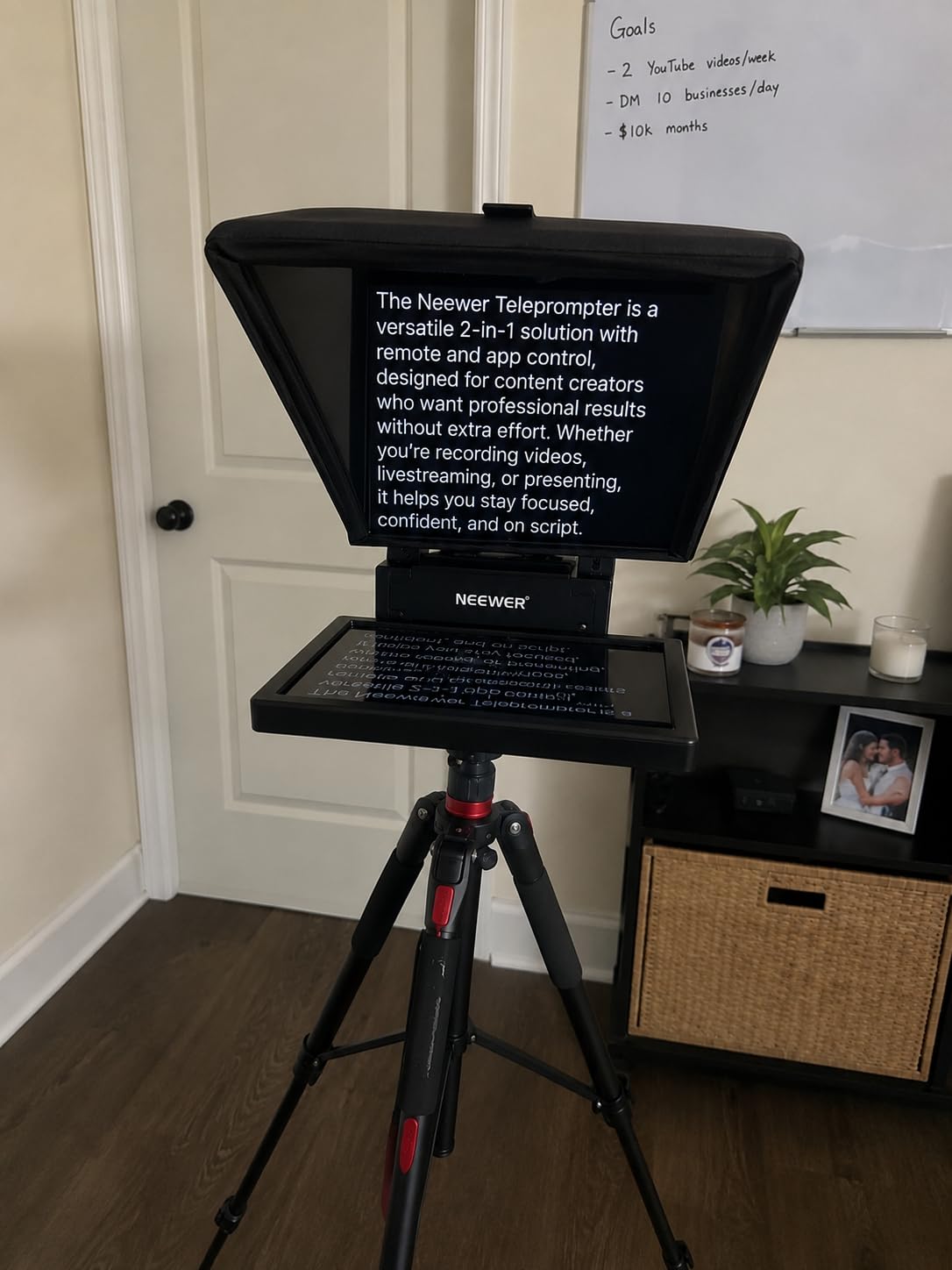
This is the one we kept coming back to. The X11 bundles a prompter and a 9 inch LCD in a single frame, so there is no tablet to wedge behind the glass and no second battery to remember. For a DSLR shooter that removes the single most common failure point in the category.
The glass is 11 inch with 75% light transmission and a multi-coated surface, which is bright enough for a room with curtains open. Buyers mostly praise the coating for killing the ghosted double image you get with cheaper panels, and the Arca type holder for making the balance obvious instead of guesswork.
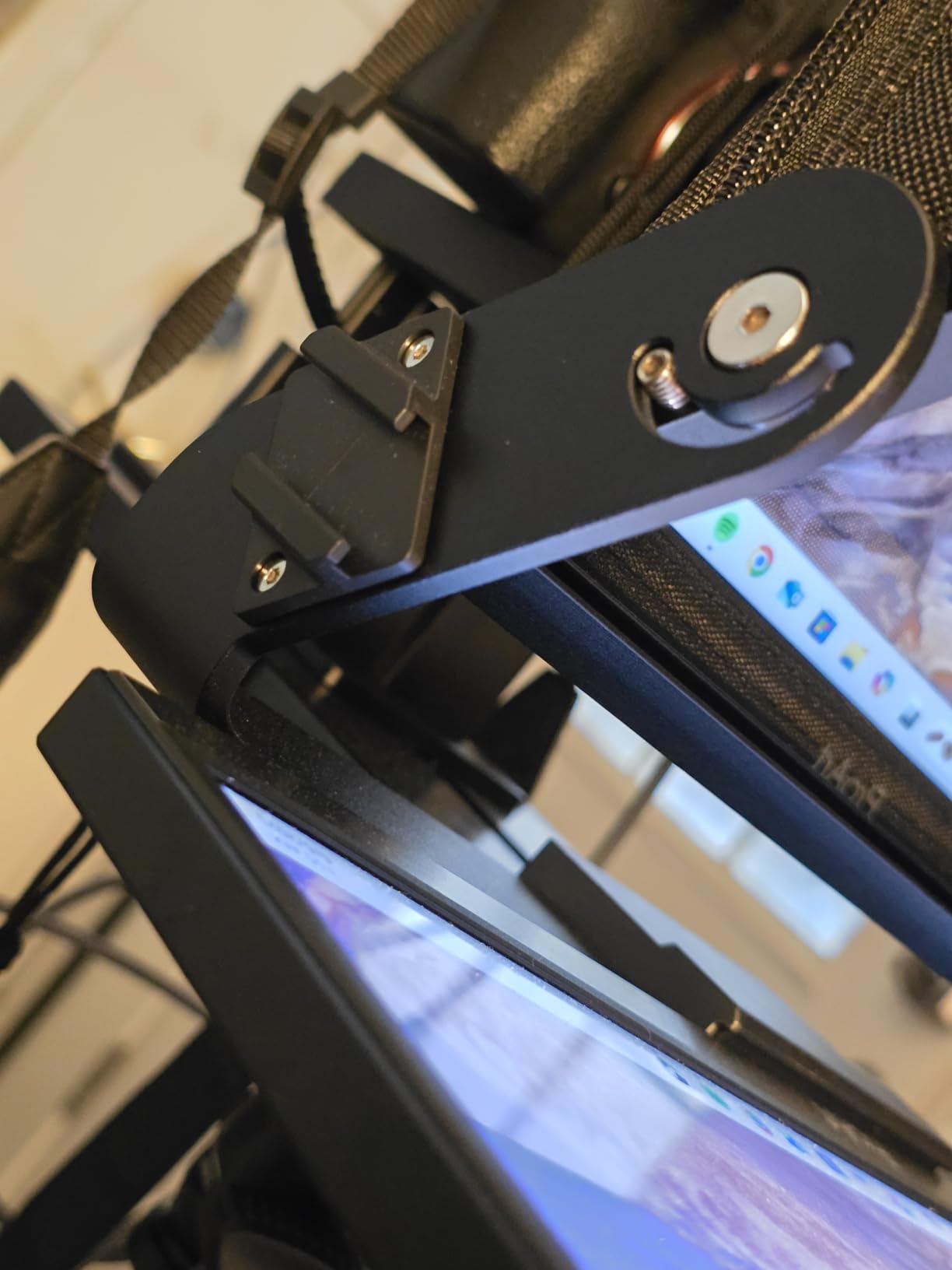
One detail matters more than it looks: the listed focal length support runs 35 to 200 mm and lens threads to 72 mm. That covers a standard kit zoom on any DSLR and most primes except the widest and the longest telephotos, so check your thread size before you commit.
The quick release plate carries 2 kg on a 1/4 inch screw, which is far more than a DSLR body needs. That headroom is the reason we would not worry about a heavier body like a pro DSLR with a battery grip on this rig.
What to check before ordering
Decide whether you want to prompt from the built-in LCD or from your own tablet. The LCD is the reason this model wins, but if you already own a bright tablet the frame still works without one.
Read the software section rather than the hardware section. Mirror mode is handled by the apps, and the bundled cables cover a laptop connection, but voice-following is not built in, so you will need an app that does it.
Where it falls short
Screen mirroring is narrower than the marketing implies. It works with iPhone and Android handsets using the DP protocol, so some tablets and desktop setups need the cable route instead.
The first hookup to a computer needs a driver install, and the mobile and desktop teleprompter apps download separately. None of it is difficult, but it is not quite the plug-and-play experience the box implies.
2. Elgato Prompter — Best for Streaming and Zoom Work
Elgato Prompter, Teleprompter with Built-in Screen
9 inch built-in drag and drop display
0.69 kg body
11.1 x 8.82 x 8.62 inches
Two year warranty
Pros
- Drag any window or app onto the display like a normal monitor
- Stream Deck control with no third party app
- Compact 0.69 kg body suits a small desk
- Two year manufacturer warranty
Cons
- Requires a Mac or PC so it is not standalone
- Mac setup needs DisplayLink plus privacy permissions
- Companion software can lag on busy systems
- Limited text formatting
- Some lenses frame the edge of the prompter
The Elgato Prompter is a different proposition. Instead of reflecting a tablet, it puts a real 9 inch display behind the glass and lets you drag any window onto it. Chat, script, meeting notes, whatever you have open, and your eyes stay on the lens the whole time.
For streaming and video calls that is a much stronger feature set than a script app alone. Stream Deck control works without opening anything, and reviewers consistently single out how quickly the eye line settles once the display is live.
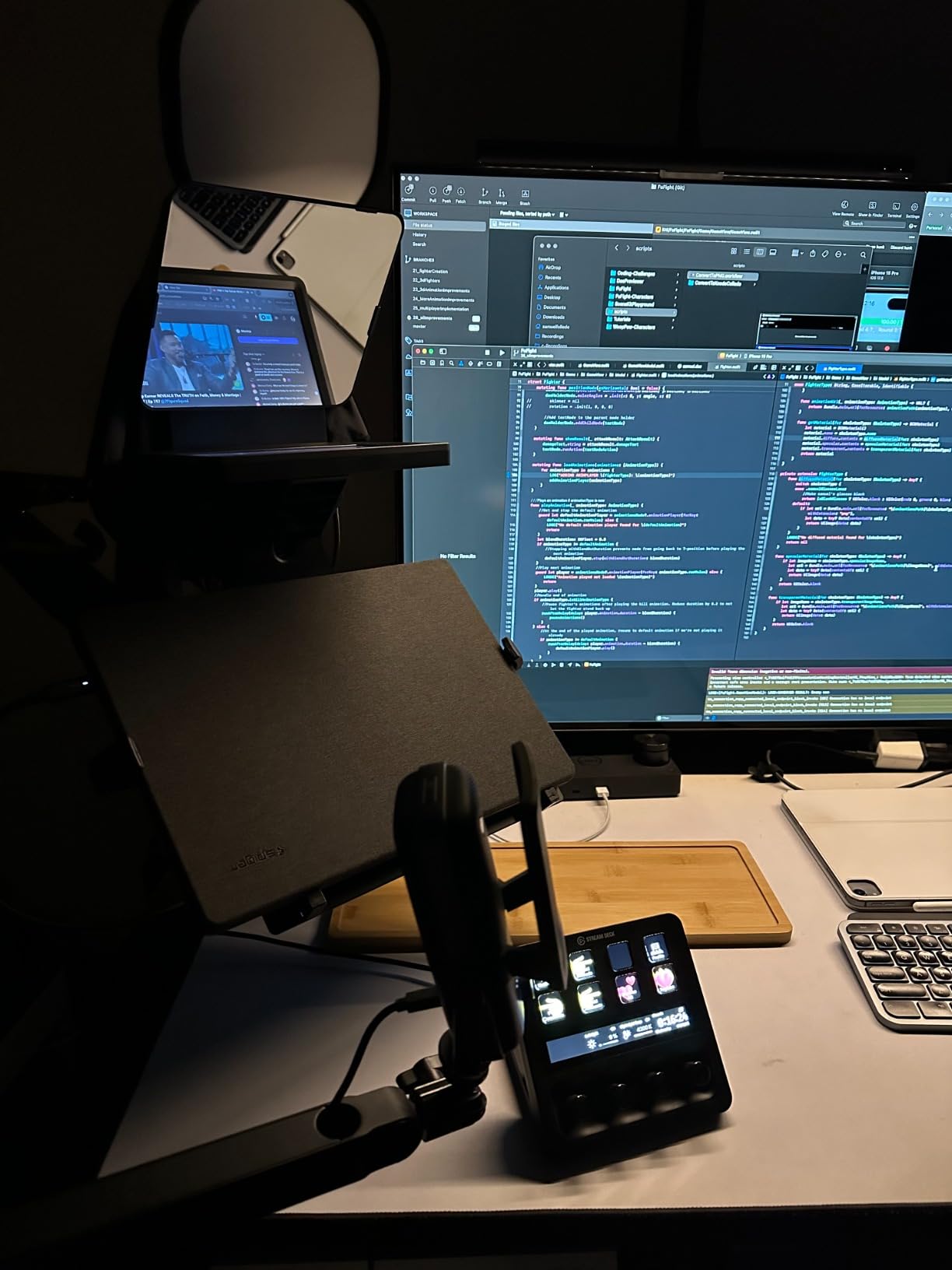
The DSLR fit is broad. It lists cameras, webcams, phones and computers, and the frame is light at 0.69 kg, which matters if you are mounting it above a camera body on a small tripod head.
A user setting one of these up on r/elgato reported that it is heavy enough on their rig that DSLR autofocus stopped behaving, which is worth taking seriously if your body is an older or heavier model. Balance the rig before you blame the glass.
Who this suits best
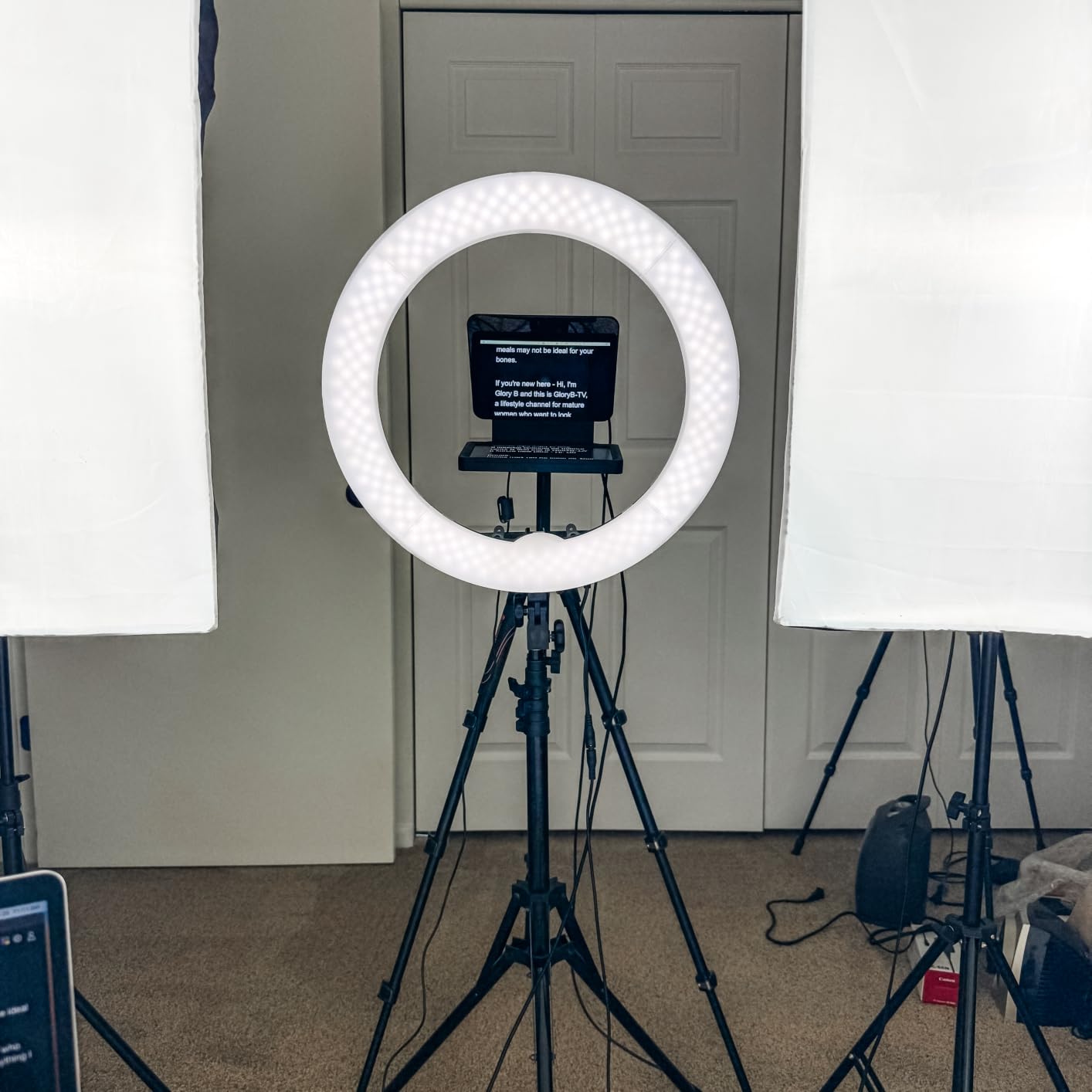
If your output is live streams, Zoom teaching or corporate calls, this is the clear pick. Showing live chat in the corner while you read a script is the feature no tablet-based prompter in this list can match.
It also removes a whole decision from your kit list. No tablet, no second device, no app subscription, just a display and the software that came with it.
Who should skip it
Skip it if you shoot away from a computer. It needs a Mac or PC running, and on Mac the setup involves DisplayLink plus a set of privacy and accessibility permissions that some users find fiddly.
Creators who work close to the camera also find the 9 inch screen smaller than they expected, and a few report the prompter edge entering frame on wide lenses. Both are fixable with distance and a quick zoom, but they are fixables rather than non-issues.
3. NEEWER Basics X12B — Best Value 12 Inch Teleprompter
NEEWER Basics X12B Aluminum Alloy Teleprompter 12″ for Tablet DSLR Camera
12 inch glass at 75% transmittance
0.25 kg aluminum body
Readable to 10 ft
One year warranty
Pros
- No assembly so it opens flat and shoots
- 0.25 kg aluminum body folds into the carry case
- 12 inch glass readable to 10 ft
- RT113 Bluetooth remote plus app control
- Liftable platform keeps the lens centered
Cons
- Prompter only with no built-in monitor and no self view
- Remote ships without AAA batteries
- Designed for tablets and cameras rather than phone shooting
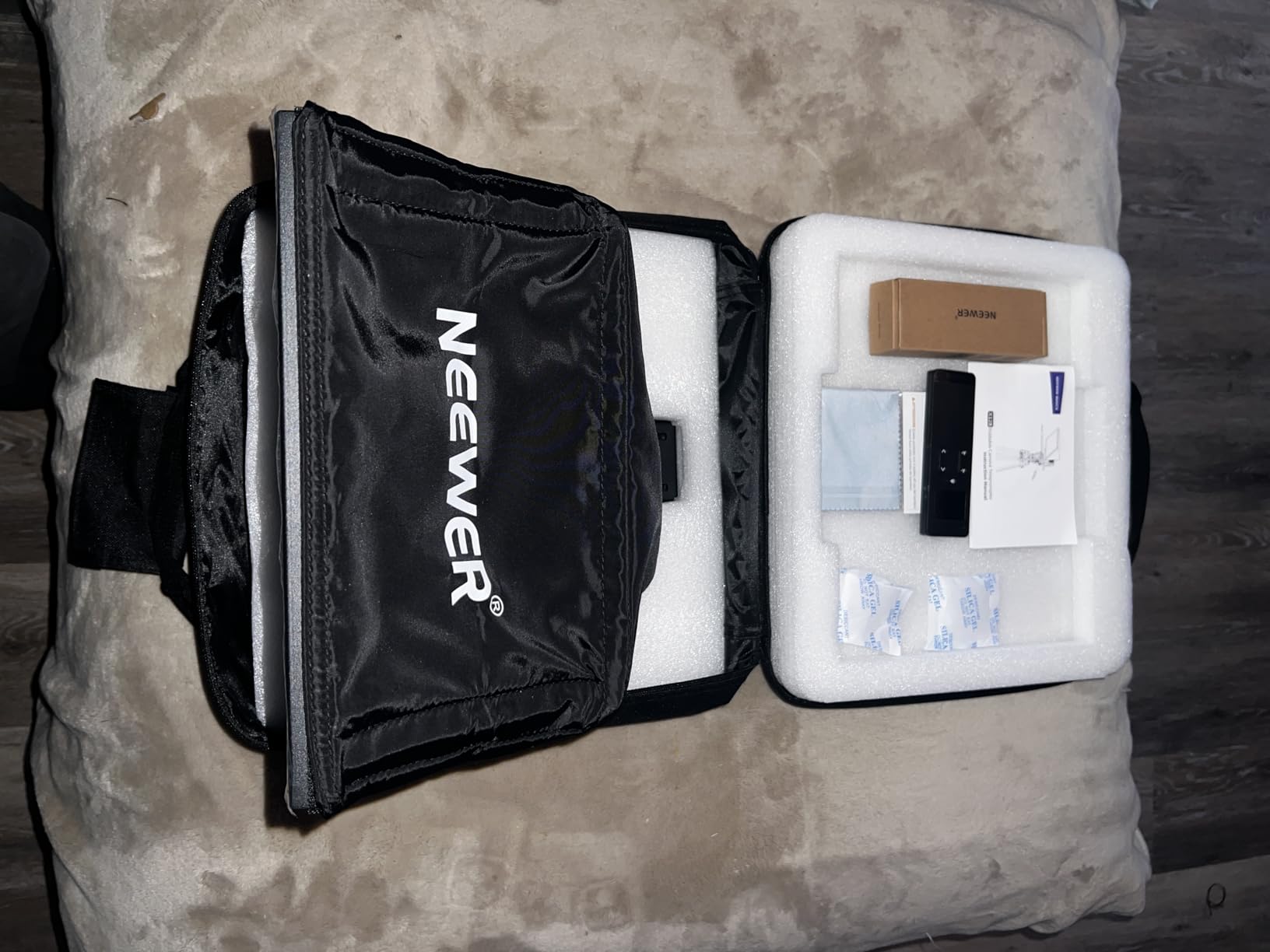
The X12B is the model we would hand to someone who has never used a prompter and does not want a manual. It is an installation-free aluminum frame, so you open it, drop in a tablet and shoot. The whole body weighs 0.25 kg.
Glass size is the star at 12 inch with 75% light transmittance, rated readable up to about 10 ft. A big panel at a modest reading distance is far easier to deliver from than a small panel held close.
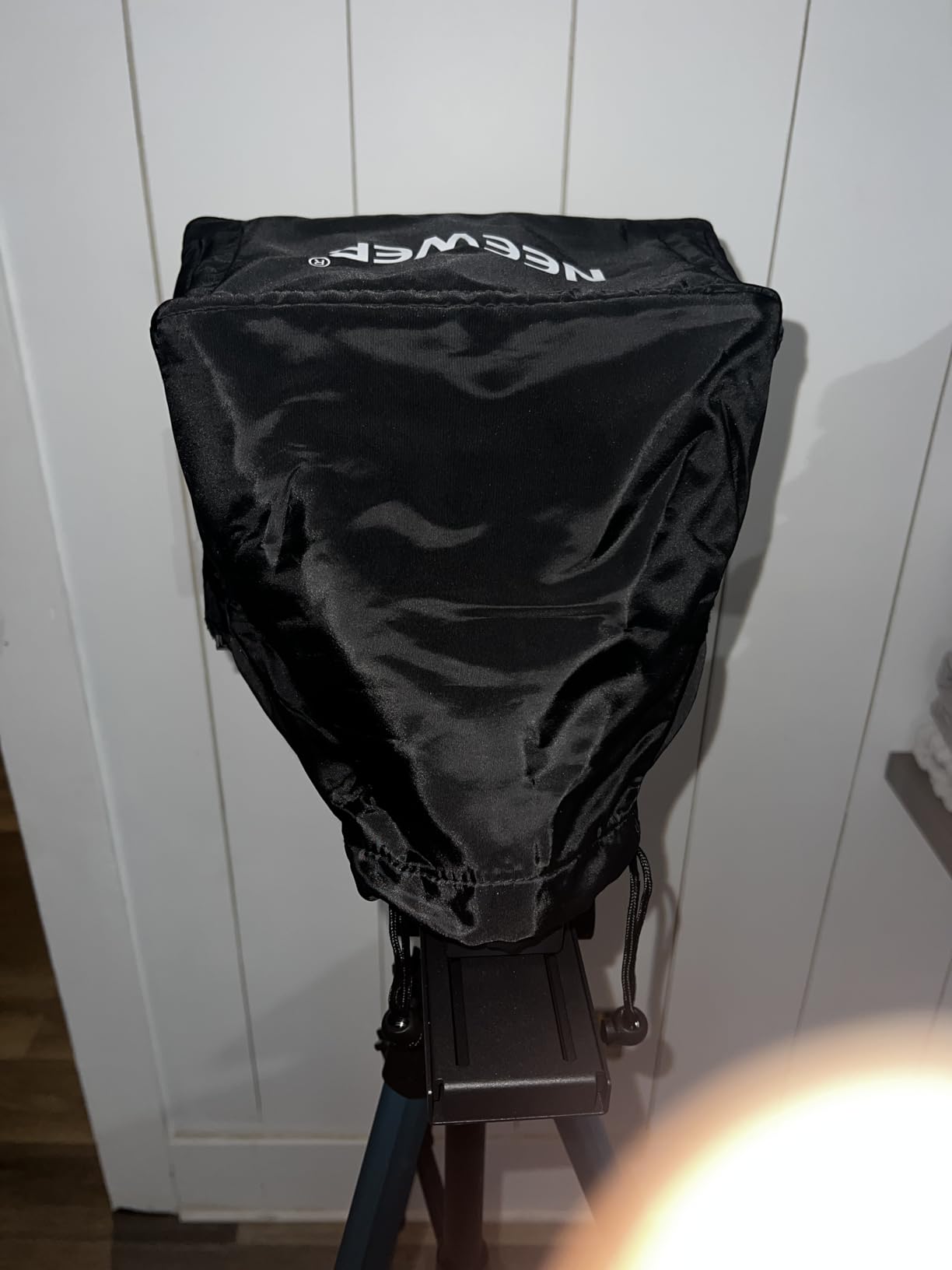
For a DSLR the liftable platform is the detail that matters, because it lets you raise the camera until the lens sits dead center behind the glass. Get that alignment wrong and the reflection lands high and you end up looking down through your own script.
Control comes from the RT113 Bluetooth remote and the NEEWER app on iOS and Android, covering play, scroll speed, page turns and font size. That is enough for a delivery read, though it is not voice-following.
What this model is best at
Travel and one-person production. It folds flat, comes with a carry case and weighs almost nothing, so it moves between a home office and a client site in a backpack.
It is also the safest first teleprompter. Nothing about the setup is irreversible, and the frame is forgiving of a misaligned platform in a way the studio kits are not.
What you give up
There is no monitor in the box, so there is no self view while recording. You are trusting your framing rather than seeing it, and for a first kit that is a fair trade.
The remote needs AAA batteries that are not included, and the listing is explicit that it is aimed at tablets and cameras rather than phone shooting. Both are small annoyances rather than dealbreakers.
4. AMBITFUL 7.5 Inch Mini Teleprompter — Best Budget Kit with Adapter Rings
AMBITFUL 7.5” Mini Teleprompter W/Desktop Tripod for Smartphone & DSLR
7.5 inch coated glass
Adapter rings 49 to 77 mm
1/4 inch tripod thread
Desktop tripod included
Pros
- Compact kit that fits in a camera bag
- Coated glass reflects without double images
- Adapter rings from 49 to 77 mm in the box
- Desktop tripod included for indoor shooting
- Bluetooth remote and app cover speed and font
Cons
- No tablet support so phones and cameras only
- Cameras need a 1/4 inch thread plus the matching ring
- 7.5 inch glass suits a phone more than a tablet
The AMBITFUL kit is the rare budget prompter that arrives complete. Adapter rings, a desktop tripod, a phone clip, a Bluetooth remote and a manual all sit in the box, so you can start shooting without a second order.
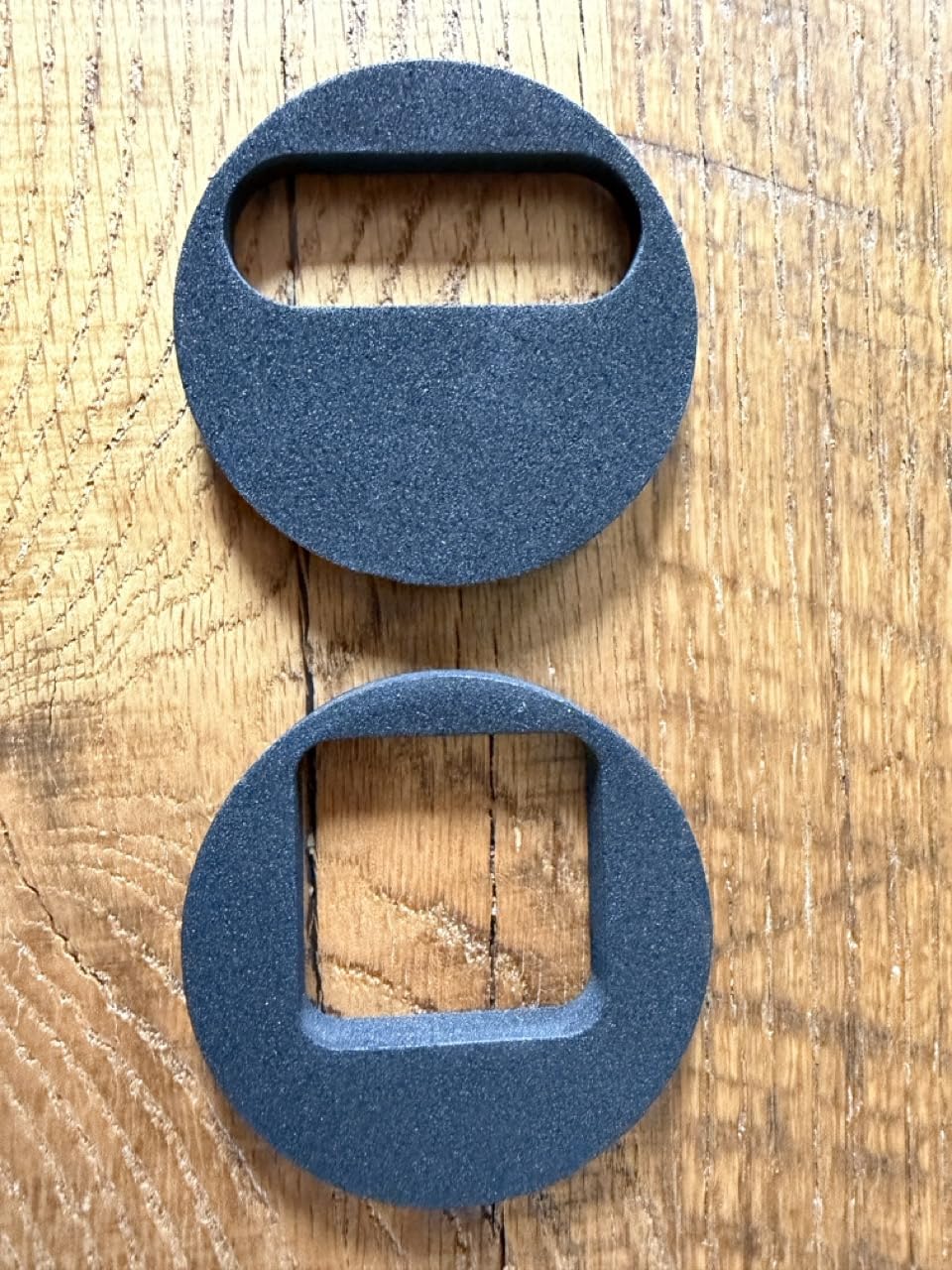
Glass is 7.5 inch with a high-transmittance coating, and the adapter rings cover 49, 52, 55, 58, 62, 67, 72 and 77 mm. That range covers the thread size on most consumer kit zoom lenses.
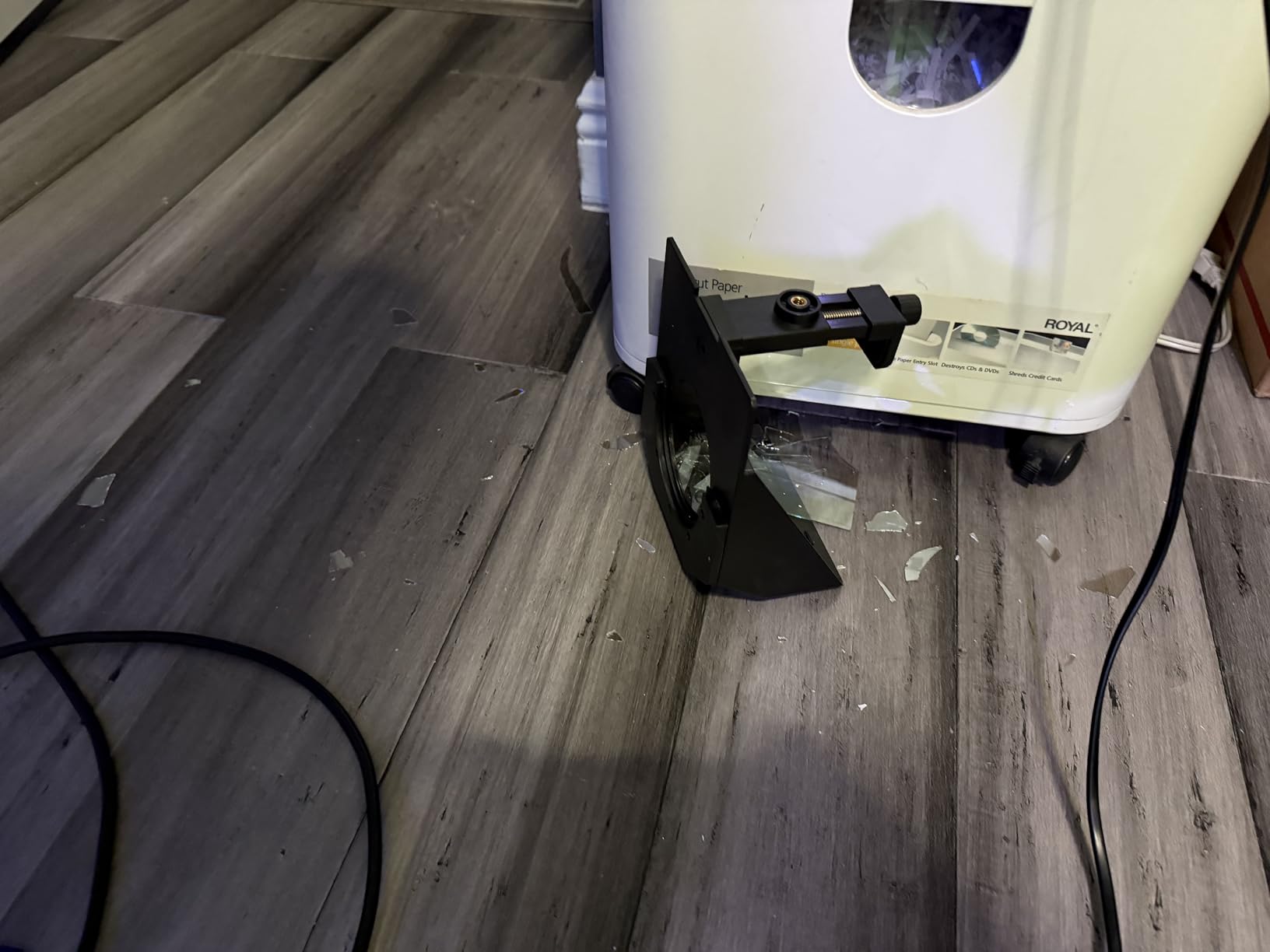
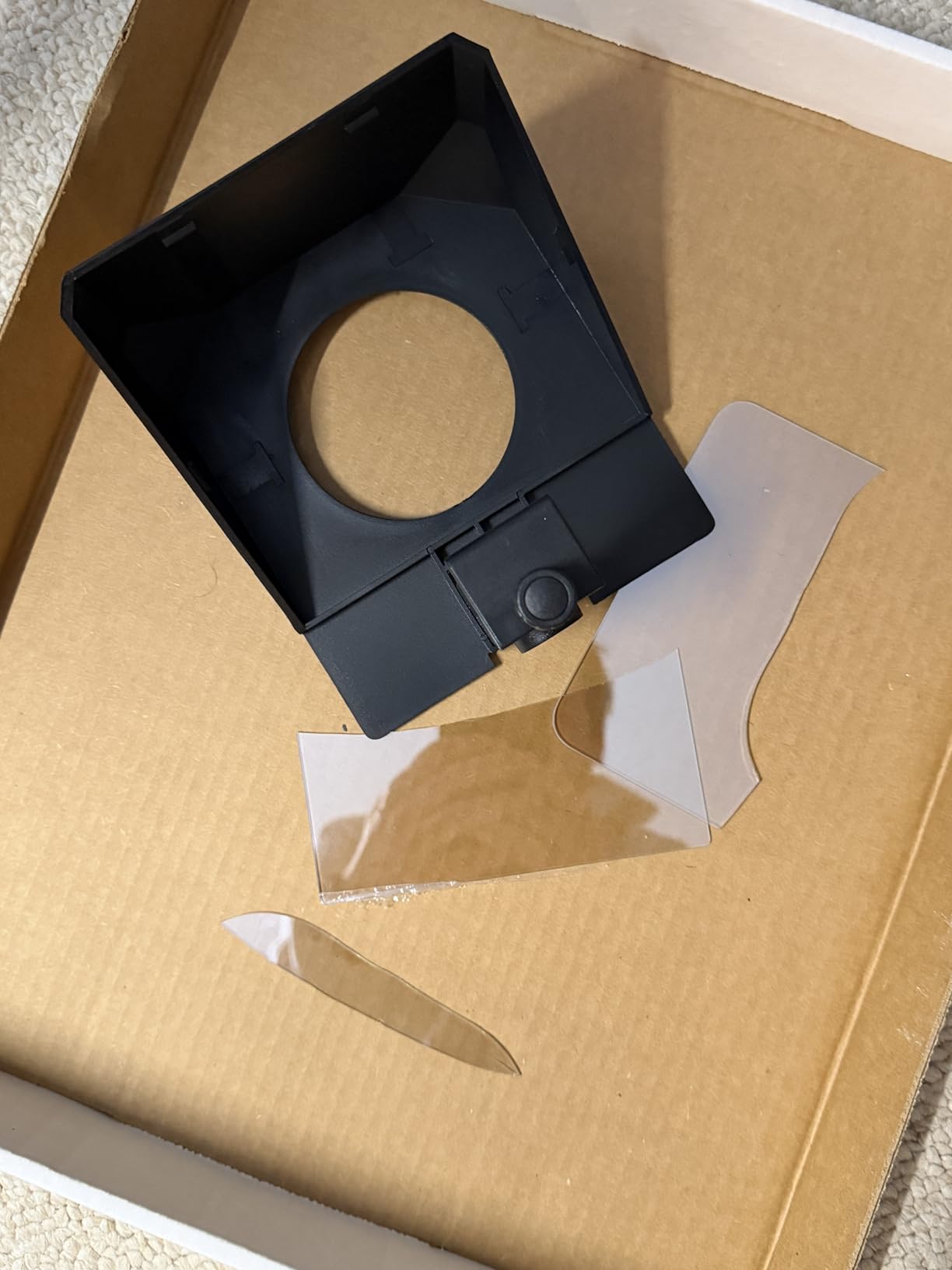
For a DSLR you need both the 1/4 inch tripod thread and the correct ring. The camera mounts to the front of the frame, so the ring sets the lens distance from the glass, and picking the wrong size is what makes the image look soft.
It supports wide angle lenses over 35 mm, so ultrawide primes will vignette against the hood edges. That is the practical ceiling on this kit.
Best used for
Tabletop and desktop shooting. The included tripod turns it into a self-contained unit for a phone or a compact camera body without any stand of your own.
It is also a good travel kit for a second camera. Nothing about it needs a power outlet, and the frame is small enough to sit in a bag between shoots.
Where it runs out of road
No tablet support at all. If your plan was to run an iPad, this is the wrong box, and reviewers point that out more than any other limitation.
The 7.5 inch panel suits a phone held at close range far better than a DSLR at arm’s length. Its rating also carries the highest share of one-star feedback in this group, which mostly reflects that mismatch rather than a build fault.
5. Desview T5 — Best for Phones, Tablets and DSLRs in One Frame
Desview T5 Teleprompter for Smartphone & Tablet, Video Recording | Compatible with DSLR Cameras. Includes 49-82mm Adapter Rings, Coated Glass, Bluetooth Remote, Free App for Streaming
Phones and tablets under 11 inch
Adapter rings 49 to 82 mm
0.52 kg
One year warranty
Pros
- One frame handles phones and tablets under 11 inch plus DSLR bodies
- Adapter rings from 49 to 82 mm included
- Foam light seal keeps the reflection clean
- Free app with txt and docx import plus mirror mode
- 0.52 kg so it moves between locations
Cons
- Phone clamp can block buttons on cased phones
- Needs a second phone or tablet to hold the script
- Remote and some plastic parts feel thin
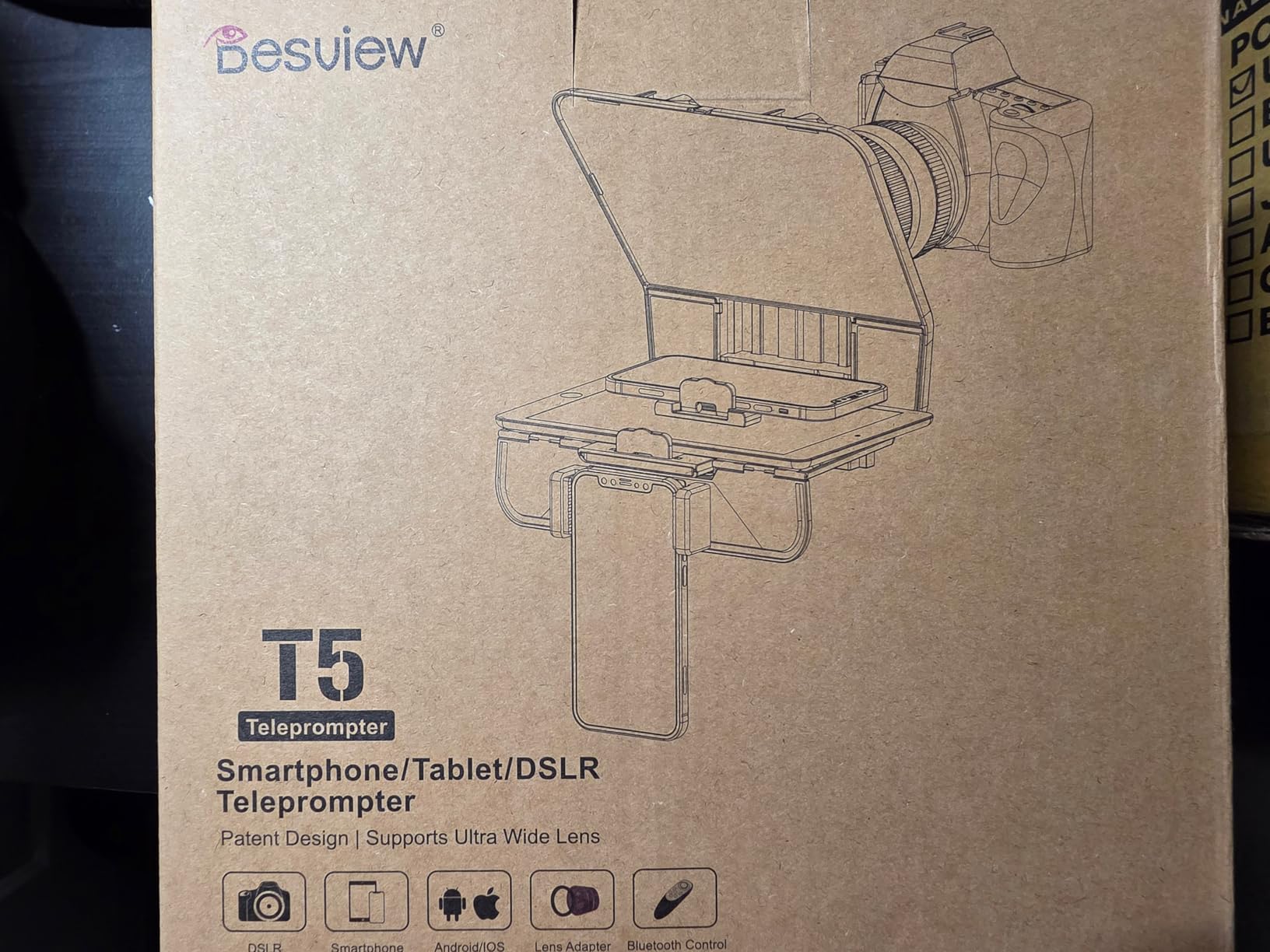
The T5 is the most flexible frame in this roundup for a mixed kit. It takes a phone, a tablet up to 11 inch or a DSLR body behind the same glass, and the front panel height adjusts as the device changes.
Adapter ring coverage runs the full 49 to 82 mm, which is the widest spread here and covers prime lenses that the smaller kits miss. For a DSLR shooter with more than one lens, that range is the reason to look here first.
The anti-scratch coated glass sits against a foam light seal, and reviewers single out how much cleaner the reflection looks because of it. Stray light leaking around the edge is the usual reason a prompter looks washed out.
Software is the free Desview app on iOS and Android, with txt and docx import, font and color control, mirror and rotate modes and a countdown timer. The Bluetooth remote handles scroll and page turns and sleeps after five minutes idle.
When to choose this one
Choose it when your shooting day includes a phone, a tablet and a camera. Swapping devices takes seconds rather than a rebuild, which is unusual at this level.
The docx import is a genuine time saver for anyone working from a written brief rather than a phone note, and the mirror and rotate controls make it forgiving of different app defaults.
What to watch for
The phone holder is the weak point. It can block side buttons, and a phone in a thick case may not clamp at all, so test with the case you actually use.
It is still a prompter frame with no screen of its own, and the plastic hardware plus the bundled remote are the parts reviewers describe as flimsy. Fine for a talking head, less fine for a rig you move daily.
6. Desview P13 — Best for Large Tablets and Big Glass
Desview P13 Teleprompter 13 Inch Aluminum Alloy with High Definition Glass, Compatible with iPad Tablet Phone DSLR, Portable No-Assembly Design for Video Recording
13 inch glass at 70/30 transmission
7H hardness surface
Carry bag included
One year warranty
Pros
- 13 inch glass with 7H hardness at 70/30 transmission
- Accommodates tablets and iPads up to 13 inch
- Detachable sun hood for bright locations
- Oxford cloth carry bag included
- Handles 35mm horizontal and vertical shooting
Cons
- Prompter edge can enter frame if the tripod sits too close
- Attachment points can strain the lens on a DSLR body
- Documentation is thin so setup takes experimenting
The P13 is the biggest glass in this roundup, and that is the whole pitch. A 13 inch panel with 7H hardness and 70/30 visible light transmission gives you a long, comfortable reading distance with a large script.
It accepts tablets and iPads up to 13 inch, so if you own a large iPad this is one of the few frames that takes it without a separate cradle. The no-assembly design sets up in a few minutes.
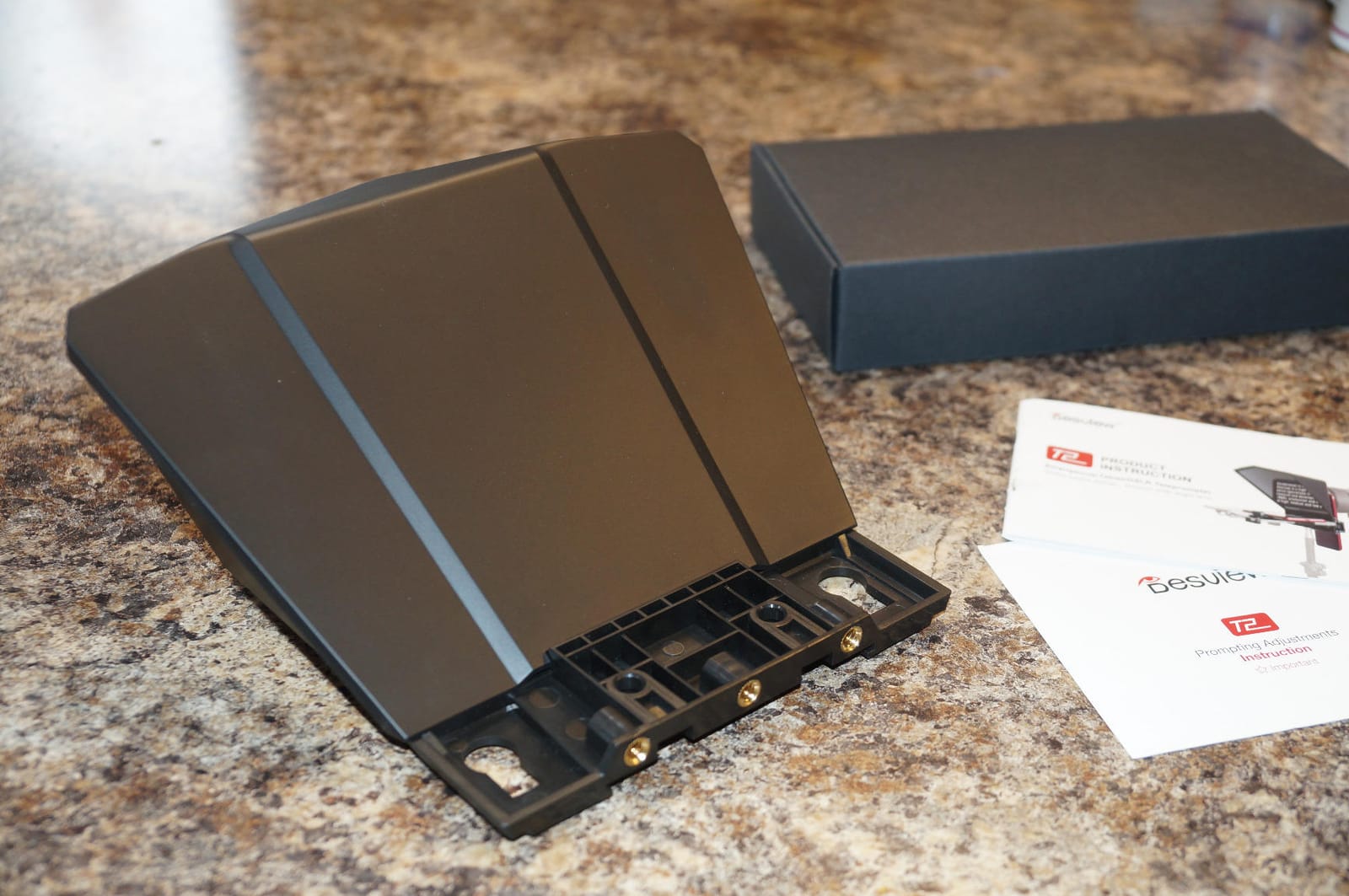
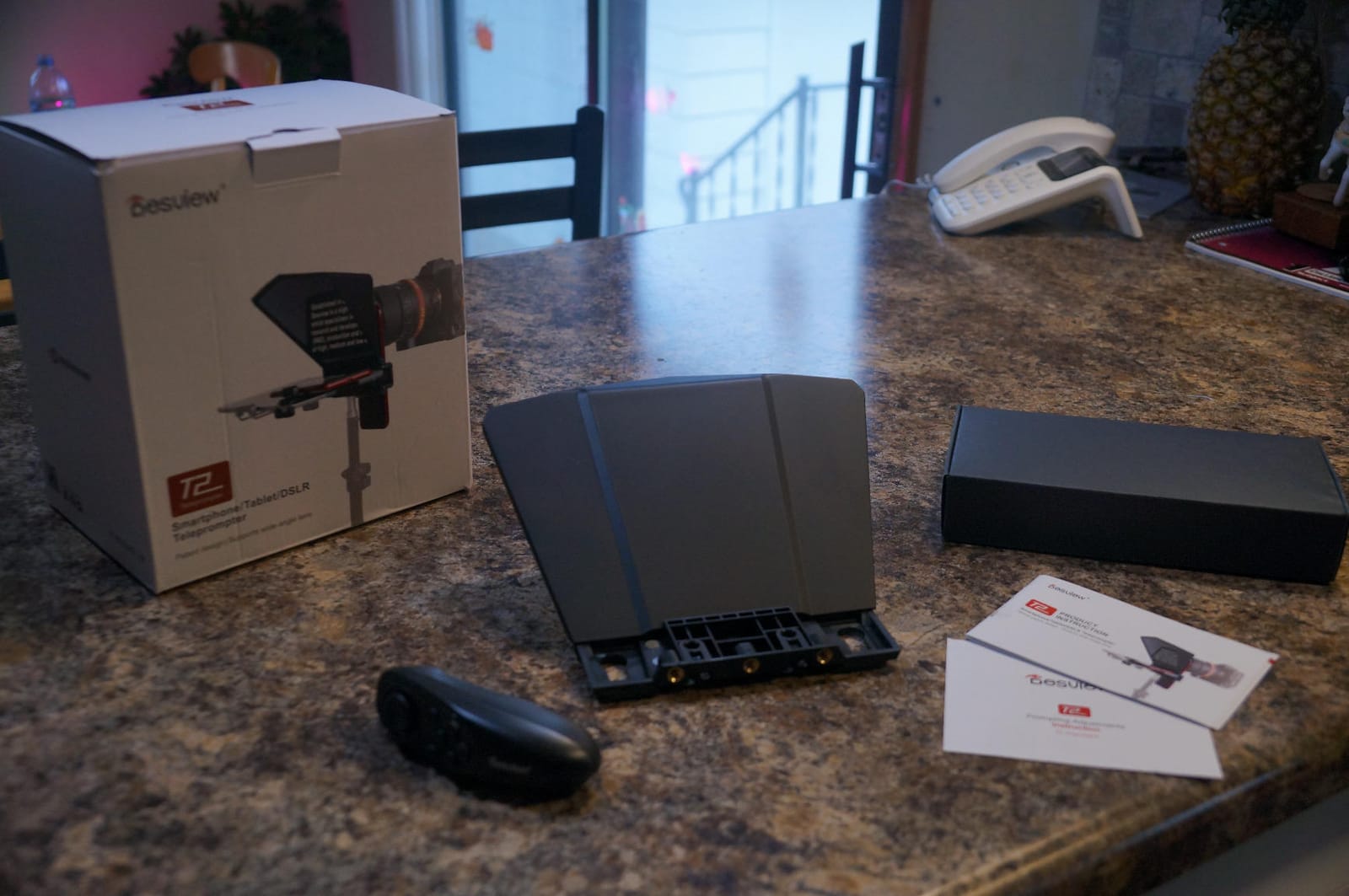
Working with a DSLR means checking hood depth rather than screen size. A 13 inch frame is deep, and the detachable sun hood helps, but the camera has to sit far enough back that the glass edge stays outside the frame.
That is the most common complaint in reviews. If the tripod is too close, part of the prompter enters the shot and the fix is distance or a small zoom rather than a different product.
What it does well
Glass clarity in bright conditions is the headline. Reviewers report a full-size view with no ghosting, and the detachable sun hood adds real protection when you shoot near a window.
The angle works both ways, handling 35mm horizontal and vertical without vignetting, which covers the two framing choices most creators make between a landscape body and a vertical deliverable.
What to watch for
If you mount the camera directly to the frame, the attachment points can put strain on the lens barrel. Use the camera platform where one is provided, or support the body independently.
The instructions are thin, so budget an afternoon for the first assembly. Some tablet apps also render text outside the visible area on a frame this size, which is an app problem rather than a hardware one.
7. Little Prompter LP-01 — Best for On-Location and Outreach Work
Little Prompter, The Original Compact Personal Teleprompter for Video Production. No Studio Required. Perfect for DSLRs, Webcams, and Built-in Laptop Cameras. Use with iOS or Android.
6 inch personal prompter
Folds to a 6 inch cube
14.08 ounces
Model LP-01
Pros
- Clamp design sets up in seconds with no assembly
- Folds to a 6 inch cube at 14.08 ounces
- Glass reflection does not visibly soften the image
- Tripod attachment bar supports a camera on a tripod
- Support from the manufacturer with free replacement hardware
Cons
- 6 inch reading area suits about 4 feet of distance
- No teleprompter app is included
- Clamp can be too narrow for large curved monitors
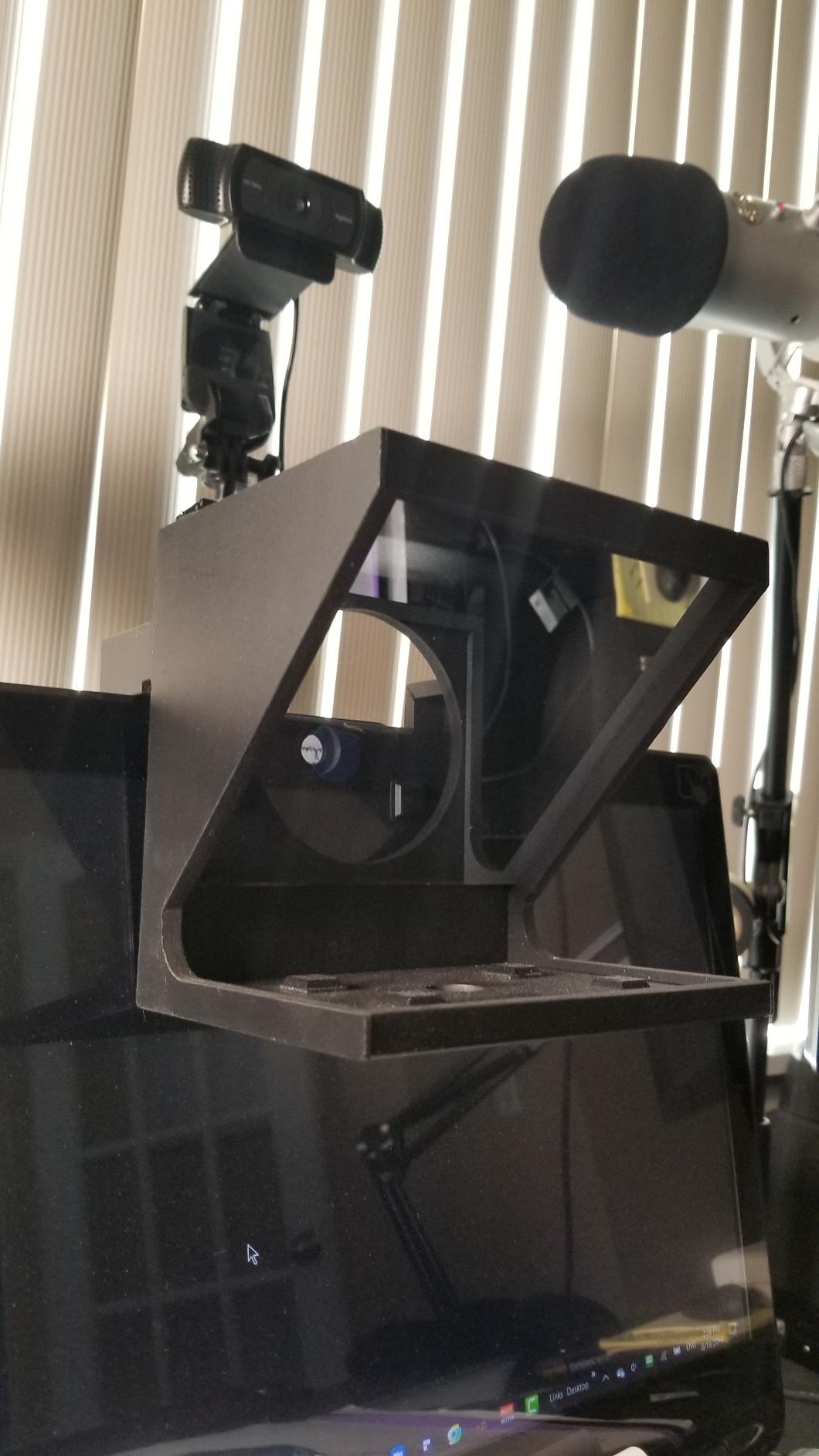
The Little Prompter is the oldest design idea in this list and still the fastest to deploy. A clamp slides over a phone, tablet or webcam and you are shooting, with no frame to assemble and nothing to thread together.
It folds to a 6 inch cube and weighs 14.08 ounces. Nothing else here packs this small, which is why it keeps showing up on outreach and teaching work where you carry the kit in one hand.
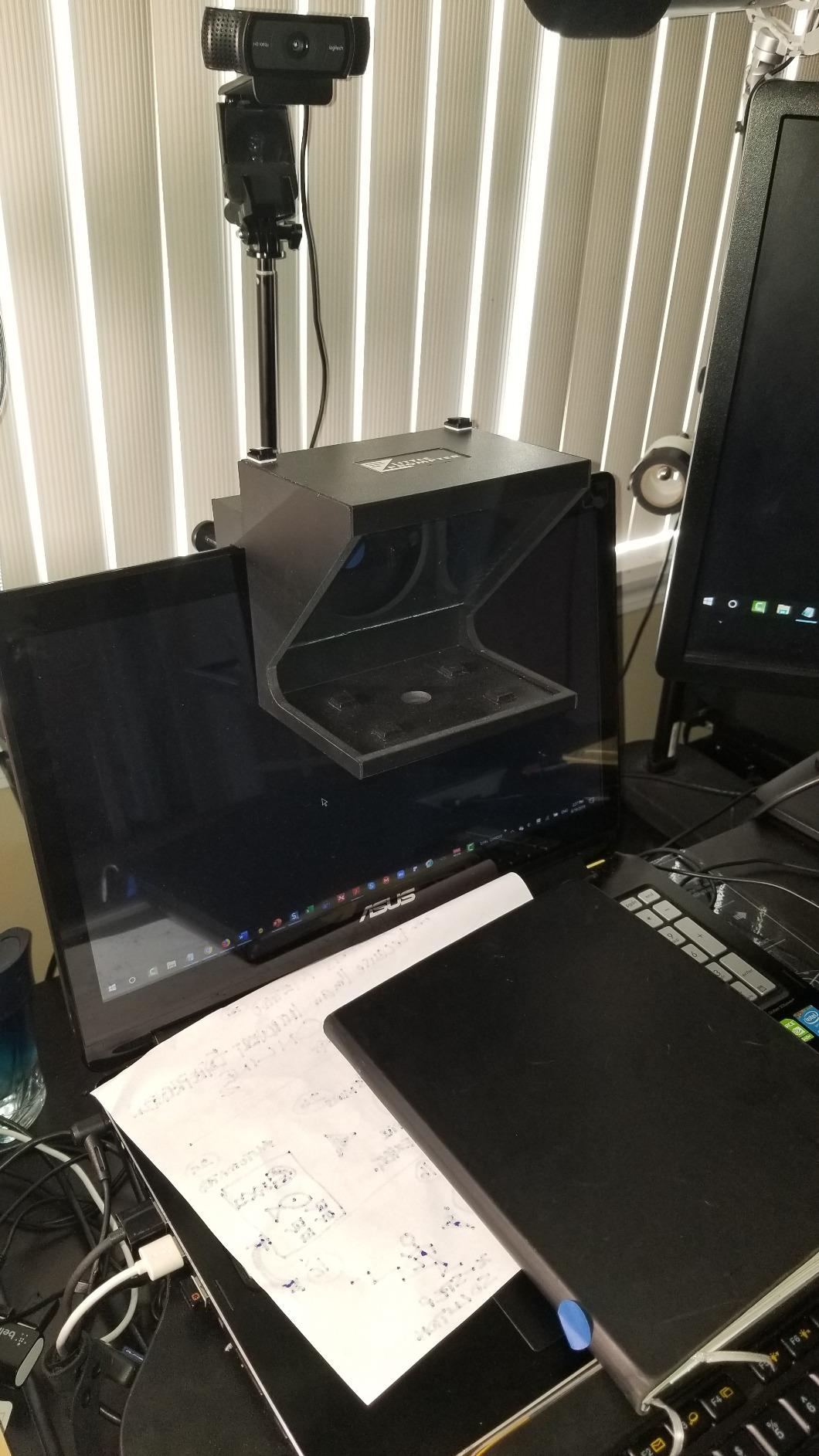
With a DSLR you use the tripod attachment bar, which turns the clamp into a mount for a camera body on a tripod rather than a handheld reader. The screws are designed to snap rather than damage your gear if you overtighten them.
Buyers consistently report that the glass does not visibly degrade image quality. That matters more than it sounds, because every bit of light the glass takes is light your camera does not receive.
Where it earns its place
Any shoot where you set up and move repeatedly. There is no assembly, so a location change takes seconds and the whole thing lives in a small bag between takes.
It also suits interview setups where the camera and the prompt device need to be separate. The clamp holds a phone or tablet while the DSLR sits on the tripod bar behind it.
Where it falls short
A 6 inch reading area gives roughly 4 feet of comfortable reading distance. Past that you will be straining, and a bigger glass is the fix rather than a bigger font.
No app is bundled, so you supply your own, and the clamp can be narrow for large curved monitors. A few units have cracked when a big webcam was forced into it.
8. Desview T3 — Best Glass Clarity for Travel Work
Desview T3 Portable Teleprompter for Camera & Smartphone, Tablet Prompter for iPad up to 10″, 70/30 Beam Splitter Glass, 9 Adapter Rings for DSLR, YouTube Video Recording & Live Streaming
70/30 glass with 26 anti-reflection layers
9 adapter rings 49 to 82 mm
15.52 ounces
Dual cold shoe mounts
Pros
- 70/30 glass with 26 anti-reflection layers and a 7H surface
- Nine adapter rings from 49 to 82 mm included
- Dual cold shoe mounts for a light or microphone
- One minute assembly with hand tightened screws
- 15.52 ounces with a 10 ft reading distance
Cons
- App can reset or reverse the mirror setting
- Bluetooth remote signal can drop through the glass
- Weight on the cold shoes upsets balance
The T3 is the reference point for glass quality in this list. Its 70/30 beam splitter carries 26 anti-reflection layers and a 7H hardness surface, and reviewers consistently describe the reflection as clear with no ghosting or blur.
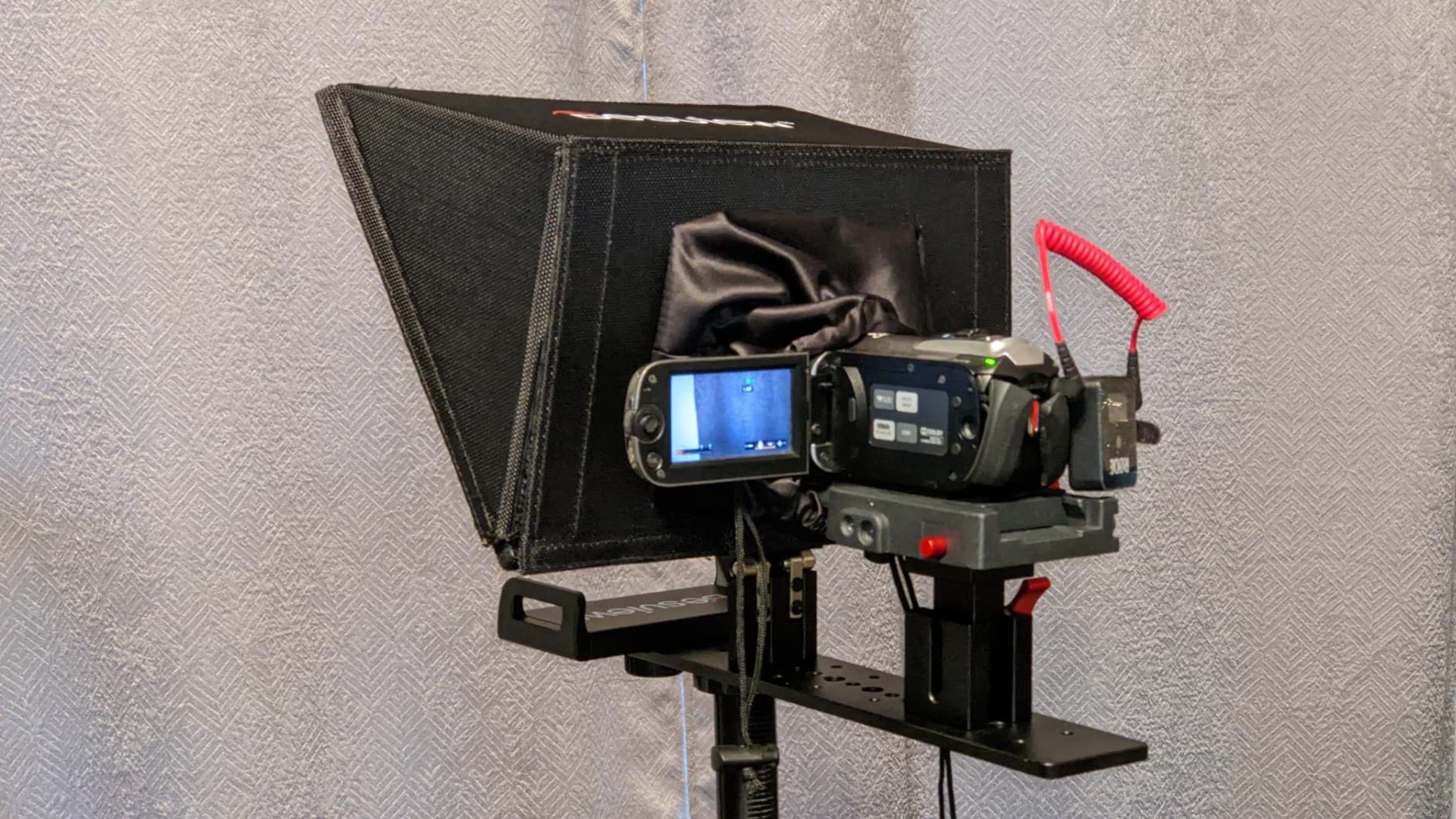
It takes tablets or iPads with a short side of 170 mm or less, plus phones and mirrorless or DSLR bodies. Nine adapter rings from 49 to 82 mm cover the lens threads you are most likely to own.
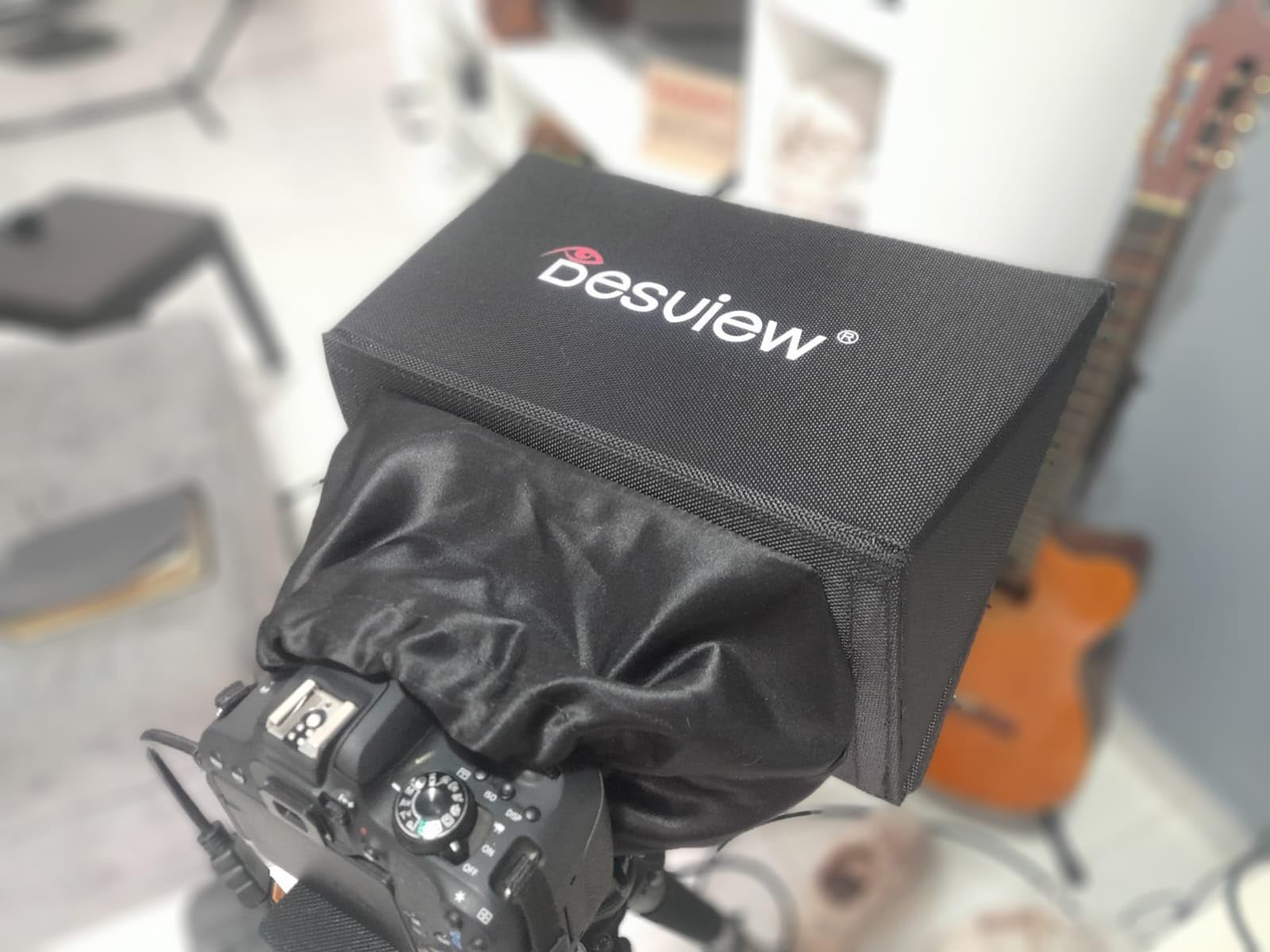
At 15.52 ounces it is one of the lighter full-size frames, and the listed 4.5 by 8 by 7 inch footprint means it shares a camera bag with a body and two lenses without becoming the problem.
Dual cold shoe mounts on top take a video light or a microphone, which is unusually useful for a DSLR shooter who would otherwise have to stack accessories on a separate bar.
Why the glass matters
A 70/30 panel reflects 70 percent of the display light back to your eyes and passes 30 percent to the lens. More layers of anti-reflection coating means more contrast in the reflected text and less haze over the image.
That clarity is why the T3 gets chosen for bright rooms and short scripts. If you deliver fast, the readability of the reflected line matters more than the size of the panel.
What could frustrate you
The app is the weak point. Reviewers report it resetting to defaults or reversing the mirror effect mid-session, so check the setting before you record rather than after.
Bluetooth remote signals can fail through the glass on some phones, and loading the cold shoe mounts unsettles balance on the lens. The remote also needs two AAA batteries that are not included.
9. Moman MT12 — Best for Long Reading Distance
Moman MT12 Teleprompter 12″ with APP Control for iPad Tablet DSLR Camera
12 inch tempered glass
15 ft reading range
6.05 pounds
Model MT14 listed
Pros
- 12 inch tempered glass with a 15 ft reading range
- Angle knob suits seated or standing delivery
- Clamp takes tablets up to 12.9 inch with phone clamp
- One-piece metal frame sets up and packs down fast
- 6.05 lb build that feels stable on a tripod
Cons
- Listed model number MT14 does not match the MT12 name
- 6.05 pounds is heavy for mobile shooting
- Countdown and text controls depend on the Moman app
The Moman MT12 solves a specific problem: reading a script from far away. Its 12 inch tempered glass is rated for a 15 ft reading range, so you can stand back from the camera instead of leaning into it.
That range is the reason to choose it. A presenter who paces the floor, or a teaching setup where the speaker moves around a desk, loses the eye line on a short-reading-distance prompter.
The reflective angle knob adjusts the prompt for seated or standing delivery, which most frames do not offer. The one-piece metal structure sets up fast and stores without disassembly.
The clamp handles tablets up to 12.9 inch and a phone clamp is included. For a DSLR the same 1/4 inch camera mounting screw used across this category applies.
What works in its favor
Large clear text at distance is the whole value proposition, and feedback centers on exactly that. The metal structure also feels like it will survive a van rather than a backpack.
If your speaker is not going to sit still behind the lens, the angle knob plus a 15 ft range is a combination nothing cheaper here offers.
What to be aware of
At 6.05 pounds it is the second-heaviest frame in this roundup, and that weight is felt when you carry a rig between rooms. It is a stand-and-shoot unit rather than a walk-and-talk unit.
The listing model number reads MT14 while the product is named MT12, which trips up anyone comparing spec sheets. Control also depends on the Moman app for countdown and text styling.
10. GVM 12 Inch Teleprompter — Best for Fast No-Assembly Setup
GVM 12″ Teleprompter for iPad Tablet Phone DSLR Camera, Collapsible Teleprompter Kit with Installation Free Design, HD Refective Display, APP Remote Control, Carry Case, for Video Recording
12 inch anti-reflective optical glass
1/4 and 3/8 inch mounts
15 ft reading range
5.68 pounds
Pros
- Installation free collapsible aluminum frame
- 12 inch optical glass with anti-reflective coating
- 15 ft reading range for clear text
- Camera mount takes 1/4 inch and 3/8 inch screws
- Wireless remote plus iOS and Android app
Cons
- Tablets limited to 8.6 inch
- 5.68 pounds is heavy for the size
- Short review history compared with the rest of this list
The GVM is a one-piece collapsible frame in aluminum alloy, so there is nothing to bolt together. You unfold it, set the device on top and the camera behind, and it holds an iPad, tablet, phone or camera body.
That dual 1/4 inch and 3/8 inch camera mounting screw is more useful than it sounds. Most lightweight tripods carry 1/4 inch while heavier heads use 3/8 inch, and having both means the prompter fits the head you already own.
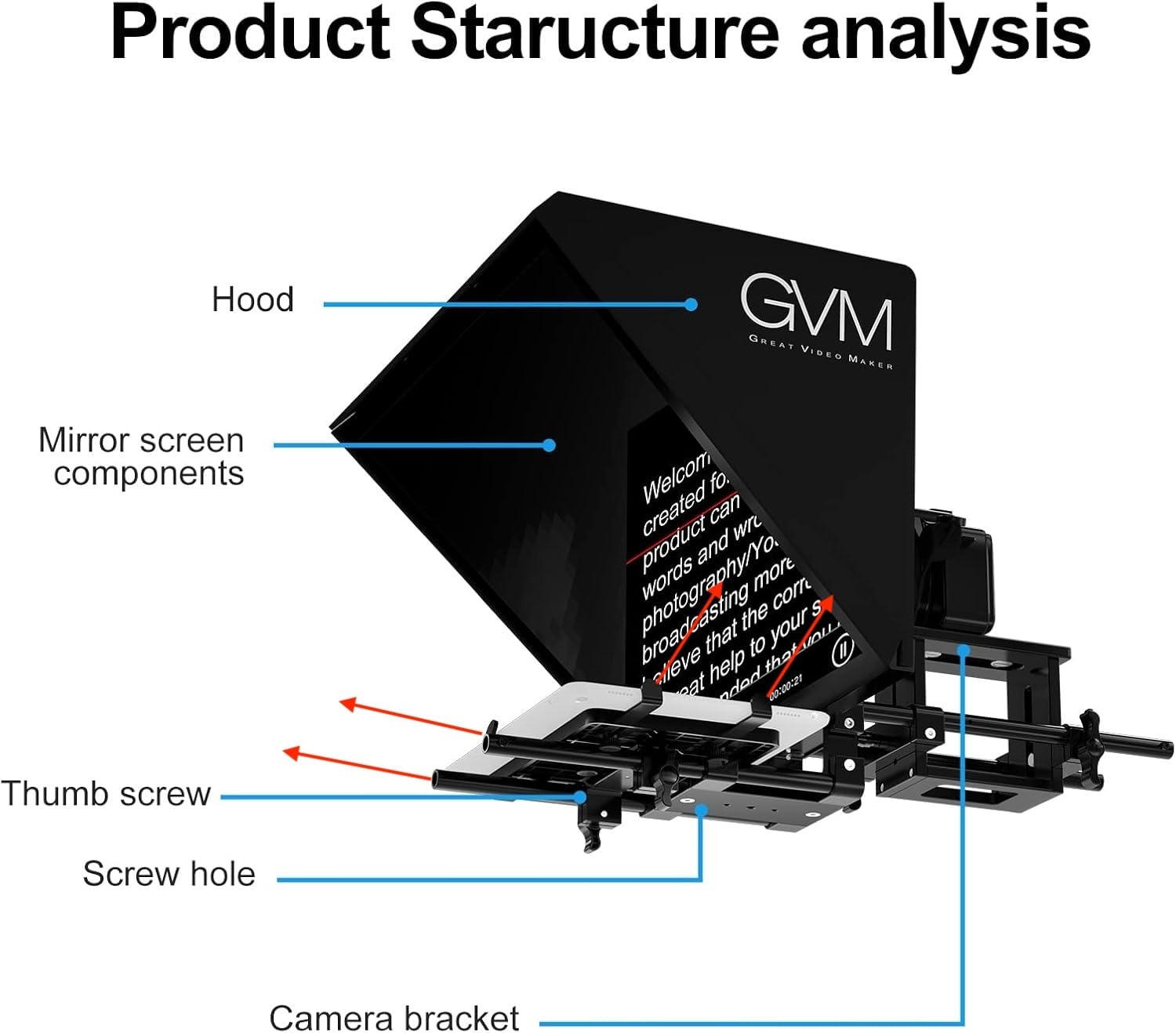
Glass is 12 inch with an anti-reflective coating and a listed reading range up to 15 ft, which is generous for a frame of this size and matches the larger panels in this list.
The fold flat design collapses into a carry bag, and the package measures 14.48 by 13.82 by 5.59 inches. Bring it out of the bag, unfold it, and you are set.
What makes it convenient
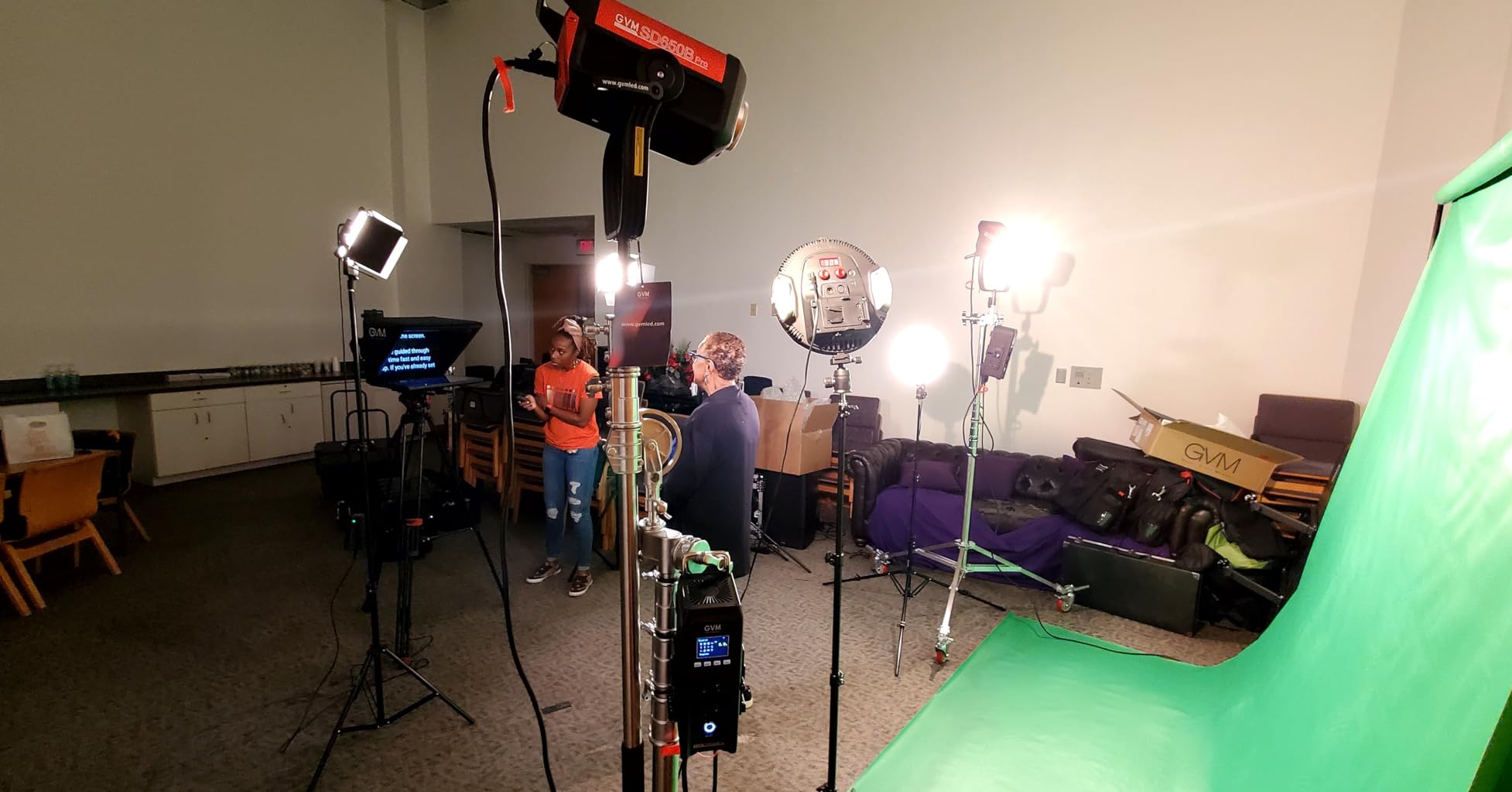
The absence of assembly is the feature. There is no frame to square, no ring stack to order, and nothing to go wrong when you set up in a dark room before a shoot.
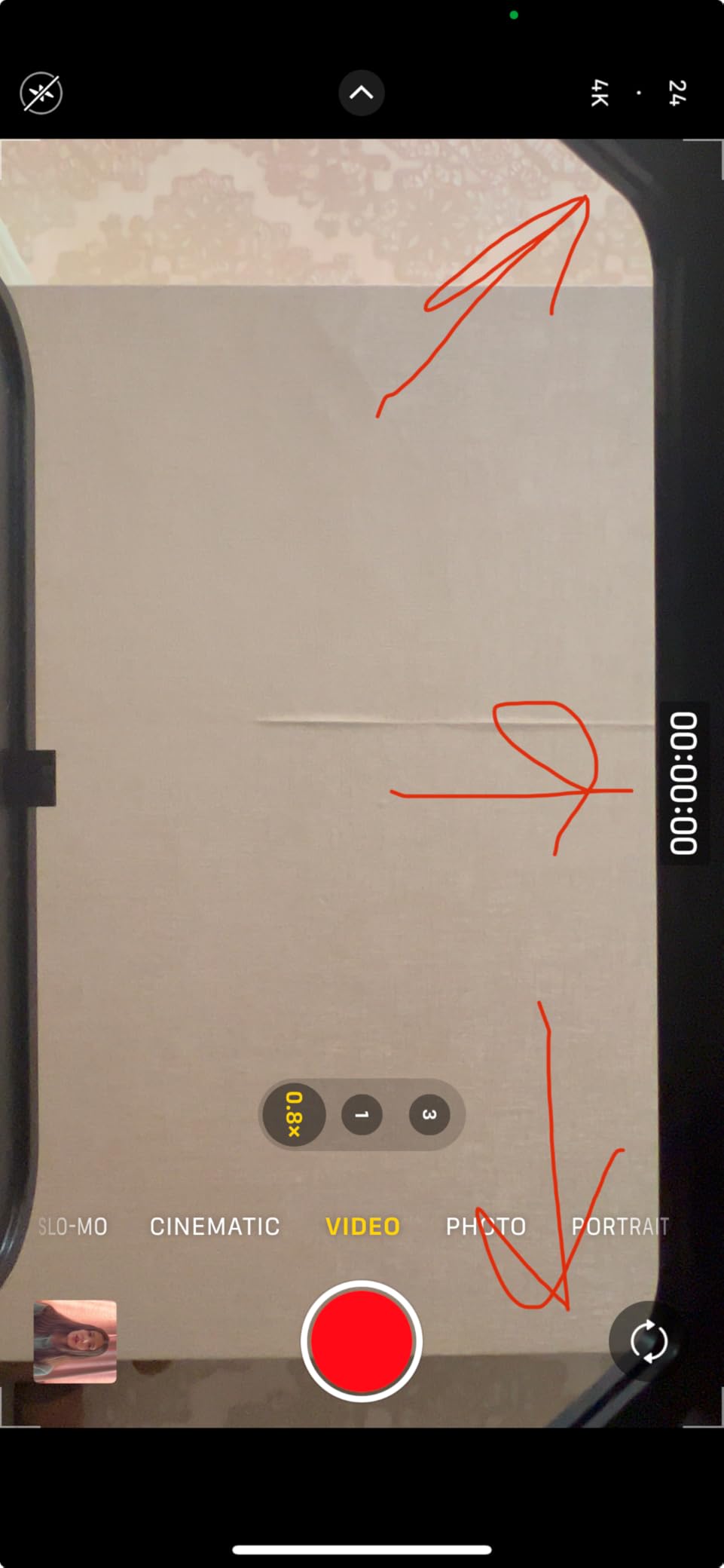
Control comes from a Bluetooth remote and the GVM app on iOS and Android, covering play, pause, scroll speed and font size. It folds and carries without a separate tripod plate.
What the trade-off is
Device capacity stops at tablets of 8.6 inch, so a larger iPad needs another frame. If you already own a big tablet this is the wrong model.
It also arrives with a much shorter review history than the rest of this list, so you are trusting the design rather than a long body of owner feedback. Reviewers do note the 5.68 pound weight as the main downside.
11. Proaim P-TP300 Universal Kit — Best for Studio Rigs
Proaim Universal Teleprompter Kit for Tablet/Smartphone/DSLR Video Cameras. 60:40 Beam Splitter, Quick Release Camera Plate. Sunhood & Cotton Gloves, 1/4″ & 3/8″ Tripod Threads + Hard Case (P-TP300)
60/40 beam splitter glass
Quick release camera plate
1/4 and 3/8 inch threads
3.3 kg
Pros
- 60/40 beam splitter glass rated to a 15 ft reading range
- Quick release camera base plate built into the frame
- Magnetic sunhood attachment
- Hard case and cotton gloves included
- Handles phones and tablets plus DSLR bodies
Cons
- 3.3 kg is a studio-only weight
- Glass assembly is fiddly the first time
- Plate is not standard Manfrotto spec
- Bulky hard case that does not pack flat
The Proaim kit is the only true studio rig here. It is universal across phones, tablets and DSLR or mirrorless bodies, uses a 60/40 beam splitter with a listed 15 ft reading range, and ships in a hard case with cotton gloves for handling the glass.
The quick release camera base plate is built in, so swapping between a tripod head and a stand does not mean re-hanging the camera each time. For a multi-camera facility that is worth more than portability.
The magnetic sunhood attaches without screws, which is the small design touch that makes a rig you touch every day bearable.
What makes it pro-grade
The glass is rated not to degrade the image on the camera side, and the 60/40 split is a longer throw than the 70/30 panels elsewhere in this list, so it suits a presenter standing further back.
Both 1/4 inch and 3/8 inch tripod threads are covered, and the collapsible frame means two of these can share a corner of a studio rather than a whole flight case.
Why most people skip it
At 3.3 kg it is by far the heaviest unit here, and reviewers describe the glass assembly as complicated and time-consuming the first time. It is built to be set up once and left.
The quick release plate is not standard Manfrotto compatible, and the hard case is bulky rather than packable. If you shoot on location even occasionally, the lighter options suit you better.
12. LENSGO TC7 — Best for Fast-Fold Travel
LENSGO 9.7” Teleprompter for Camera iPad Tablet Smartphone w/Remote Control, APP Compatible with iOS & Android System for Online Teaching Vlogger Live Streaming Interview, Fold in One Sec
8 inch glass with beam splitter coating
450 g body
Folds in one second
9 adapter rings 49 to 82 mm
Pros
- Folds flat in one second at 450 g
- Nine adapter rings plus six phone shade rings
- Multiple cold shoe mounts for a mic or light
- Handles wide angle lenses down to 17 mm
- Works with iOS and Android through the TCQI app
Cons
- Bundled remote is unreliable for some users
- TCQI app can crash or feel limited
- Alignment is fiddly and edges can enter frame
- Plastic build feels basic under a DSLR
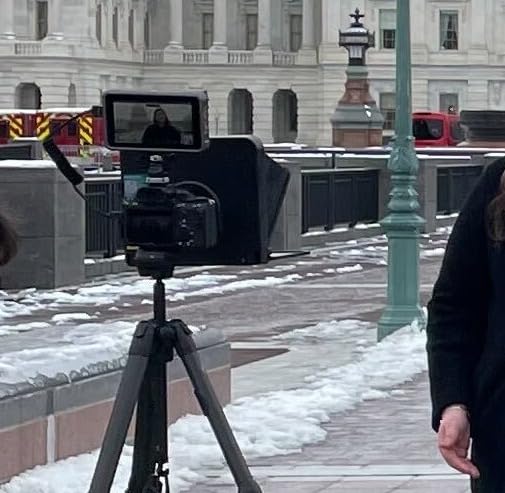
The TC7 folds in one second and weighs 450 g, which makes it the most travel-friendly unit in this roundup. The glass is fixed at a 45 degree angle and the whole thing collapses to the size of a small book.
It supports vertical or horizontal placement and shooting from either side, and it lists compatibility with wide angle lenses from 17 mm. Nine adapter rings from 49 to 82 mm plus six phone shade rings are included.
Multiple cold shoe mounts take a microphone, tripod or video light, and the listed real angle of view is 109.5 degrees, so a wide lens can still see past the hood edge at close range.
Remote control runs through the free TCQI app on iOS and Android for play, pause, speed, font and color changes, and the kit covers cameras, desktops, smartphones and tablets.
What it does well
Nothing about this kit needs a second purchase. The rings, shade rings, phone clip and remote are all in the box, and the accessory list is longer than most prompters twice its size.
For a one-person operation that moves between locations, being able to collapse the rig between shots rather than between days is a genuine time saving.
What reviewers complain about
The bundled remote and the app are the recurring complaints. Several owners switched to a third-party app and remote for reliability, which is a reasonable fix but an extra purchase.
Alignment takes practice and the prompter edge can enter frame if you are not centered. The plastic build also feels basic when a heavier DSLR body hangs off it.
How to Choose a Teleprompter for a DSLR Camera?
Choose by lens thread and reading distance first, then by how the camera is supported. Those three decisions eliminate most of the market, and everything else is preference. Here is what actually determines whether a prompter suits your body.
Lens adapter rings decide compatibility
A lens adapter ring is a threaded ring that sits between the front element of your lens and the inside of the prompter hood. Its job is to hold the lens at a fixed distance from the glass so the reflection stays sharp and the image does not soften.
The ring must match the thread printed on the base of your lens barrel, marked with a phi symbol and a diameter such as 58 mm. The common sizes run 49, 52, 55, 58, 62, 67, 72, 77 and 82 mm. Consumer kit zooms on most DSLRs sit in the 58 to 67 mm range, while many primes are smaller.
Buy the full spread rather than guessing one size. The Desview T5, T3 and LENSGO TC7 all cover 49 to 82 mm, and the NEEWER X11 lists support to 72 mm. If a ring is missing, buying one for the correct diameter is far cheaper than replacing the prompter.
70/30 versus 90/10 glass changes your framing
Beam splitter glass is coated glass that reflects part of the display light back to your eyes while passing the rest through to the lens. The ratio tells you the split: 70/30 reflects most of the light, which gives brighter, easier-to-read text and slightly less light reaching the camera.
A 90/10 panel reflects almost everything and passes only a tenth through, so you barely notice it in the image but you need a much brighter display. If you are shooting in daylight without a hood, 70/30 is the more practical ratio and it is what most of the units in this roundup use.
There is a second consequence people forget. Putting glass between the lens and the subject adds distance to the optical path, which effectively multiplies your focal length. On a crop sensor the effect is more visible, so a 50 mm lens can behave closer to 60 mm or more. After mounting, set one lens to manual focus and check framing before you trust autofocus.
Camera mounted versus freestanding changes the whole shot
A camera-mounted prompter hangs the camera directly off the prompter frame and is ideal for one operator and one camera. A freestanding or floor prompter sits on its own stand in front of the camera, which keeps weight off the lens and lets you reposition quickly.
Multi-camera studios tend toward freestanding units because each one can be rolled into position independently. That question comes up constantly on production forums, and the simple answer is weight: the heavier the body, the more you want it on its own support.
Weight and autofocus are linked
Adding a prompter changes the balance of a tripod head, and a camera that hangs forward of its center of gravity can unsettle autofocus on some bodies. A user on r/elgato described exactly this when their DSLR stopped autofocusing with a heavier prompt attached.
Counter it in three ways. Balance the head with the rig fully assembled, keep the heaviest part as close to the mount as possible, and switch the lens to autofocus with the focus ring fixed rather than allowing the barrel to drift. If the body still hunts, shift focus manually and accept the tradeoff.
Built-in monitor or your own screen
A built-in monitor means one less device to buy, charge and balance. The NEEWER X11 and the Elgato Prompter both take this route, and it removes the whole class of tablet balancing problems.
A tablet or phone gives you a bigger panel, more choice of prompting app and voice-following features. It also means you handle glare, brightness and battery life yourself. Whichever you pick, turn the screen brightness as high as it will go so the reflected text wins against the light on your face.
Pairing a teleprompter app with your DSLR rig
Any app with a mirror or horizontal-flip mode works with beam splitter glass, because the reflection reverses the text twice. PromptSmart Pro is the voice-following option, TeleprompterPAD is a solid cross-platform choice, and the MSDC Teleprompter app handles HDMI or AirPlay clean feed when the prompting device is separate from the camera.
Check what the app gates. Long script import, watermark removal and recording often sit behind a paid tier, and knowing that before you shoot avoids a ruined take. If your DSLR records separately, clean-feed output is the feature that keeps the script out of your recorded frames. If you also want a fixed camera covering a room while you shoot elsewhere, our pet cameras for seniors guide covers compact bodies that work well as monitoring cameras.
How to Mount a DSLR to a Teleprompter in 8 Steps
Set up the rig before the talent arrives and give yourself ten minutes, because the first attempt always takes longer than the instructions imply.
1. Mount the prompter first. Attach the frame to your tripod head before anything else. Prompter specs list both 1/4 inch and 3/8 inch camera mounting screws, so check which thread your head uses and fit the right one.
2. Fit the lens adapter ring. Read the thread diameter marked on your lens barrel and screw in the matching ring, or the closest size below if your exact size is not included. Hand tight is enough.
3. Attach the DSLR to the camera platform. Slide the body onto the plate and lock the quick release. Keep the lens as close to the glass as the hood allows without touching it.
4. Center the lens in the glass. Look through the viewfinder and adjust the platform horizontally and vertically until the lens sits in the middle of the frame and the prompter edges are not visible.
5. Place the prompting device behind the glass. Lay the tablet or phone flat, tilted slightly toward the speaker, with the brightest part of the display filling the glass.
6. Turn on mirror mode. Enable horizontal flip in the prompting app so the reflected text reads correctly. If the text is backwards, the app setting and the glass are flipping an odd number of times.
7. Set focus and check the throw. Switch to manual focus, take a test shot and zoom in on the reflected image. If it is soft, adjust the lens distance in small steps until the reflection sharpens.
8. Balance and rehearse the scroll. Balance the fully assembled rig, then read a paragraph aloud at your intended pace. Around 120 to 150 words per minute is deliberate delivery and 150 to 170 words per minute sounds conversational.
Frequently Asked Questions
What are the drawbacks of using a prompter?
The main drawbacks are setup time, weight and delivery style. A rig adds cost and takes ten minutes to assemble, the extra weight in front of the lens can unsettle a tripod head and upset DSLR autofocus, and the script or its reflection can leak into frame if mirror mode or the glass angle is wrong. Written lines also sound robotic unless you rewrite them conversationally, and many prompting apps gate long scripts or watermark removal behind a paid tier.
Which teleprompter is better, the Neewer X11 or the Elgato teleprompter?
The NEEWER X11 is the better choice for DSLR and mirrorless shooters because it works as hardware, accepts a tablet or phone, and includes a built-in 9 inch LCD you can use instead. The Elgato Prompter is better for streamers and Zoom users because its built-in display accepts any window by drag and drop and works with Stream Deck, but it needs a Mac or PC running at the same time. Choose Elgato for live work, NEEWER X11 for recorded shoots away from a desk.
What is the best teleprompter app for recording with my camera?
Any app with a mirror or horizontal flip mode works with beam splitter glass. PromptSmart Pro is the strongest voice-following option, TeleprompterPAD is the most reliable cross-platform pair, and the MSDC Teleprompter app handles HDMI or AirPlay clean feed when your prompting device is separate from the camera. Before you commit, check whether long script import and watermark removal sit behind a paid tier.
How do I choose a teleprompter for my DSLR?
Choose by lens thread, reading distance and how the camera is supported. Buy a kit whose adapter rings cover your lens filter thread, which is marked on the lens barrel, and pick a glass size that gives you a reading distance you can actually deliver from. Finally, confirm the camera mounting screw matches your tripod head, at 1/4 inch or 3/8 inch, and check that the hood is deep enough to clear your lens.
What size beam splitter glass or lens adapter ring do I need for a DSLR?
Glass size should match or exceed the device you prompt from, and 10 to 13 inch panels suit a DSLR at arm’s length while 6 to 8 inch panels suit a phone held close. For adapter rings, read the thread diameter marked on the base of your lens barrel and match that number, commonly 49, 52, 55, 58, 62, 67, 72, 77 or 82 mm. Kits covering 49 to 82 mm cover most consumer zoom and prime lenses.
Conclusion
The best teleprompters for DSLR cameras come down to fit, and fit means lens thread, reading distance and balanced weight. The NEEWER X11 wins overall because it carries its own display, its glass is bright and the Arca type holder makes a tripod balance predictable. The Elgato Prompter takes the streaming and video-call slot, and the NEEWER Basics X12B is the sensible first kit.
Check your lens thread before anything else, set the reading distance to where you will actually stand, and reassemble the rig before you blame autofocus. Our best teleprompters for DSLR cameras list is updated for 2026 and we revisit the fit verdicts as owner feedback builds.