
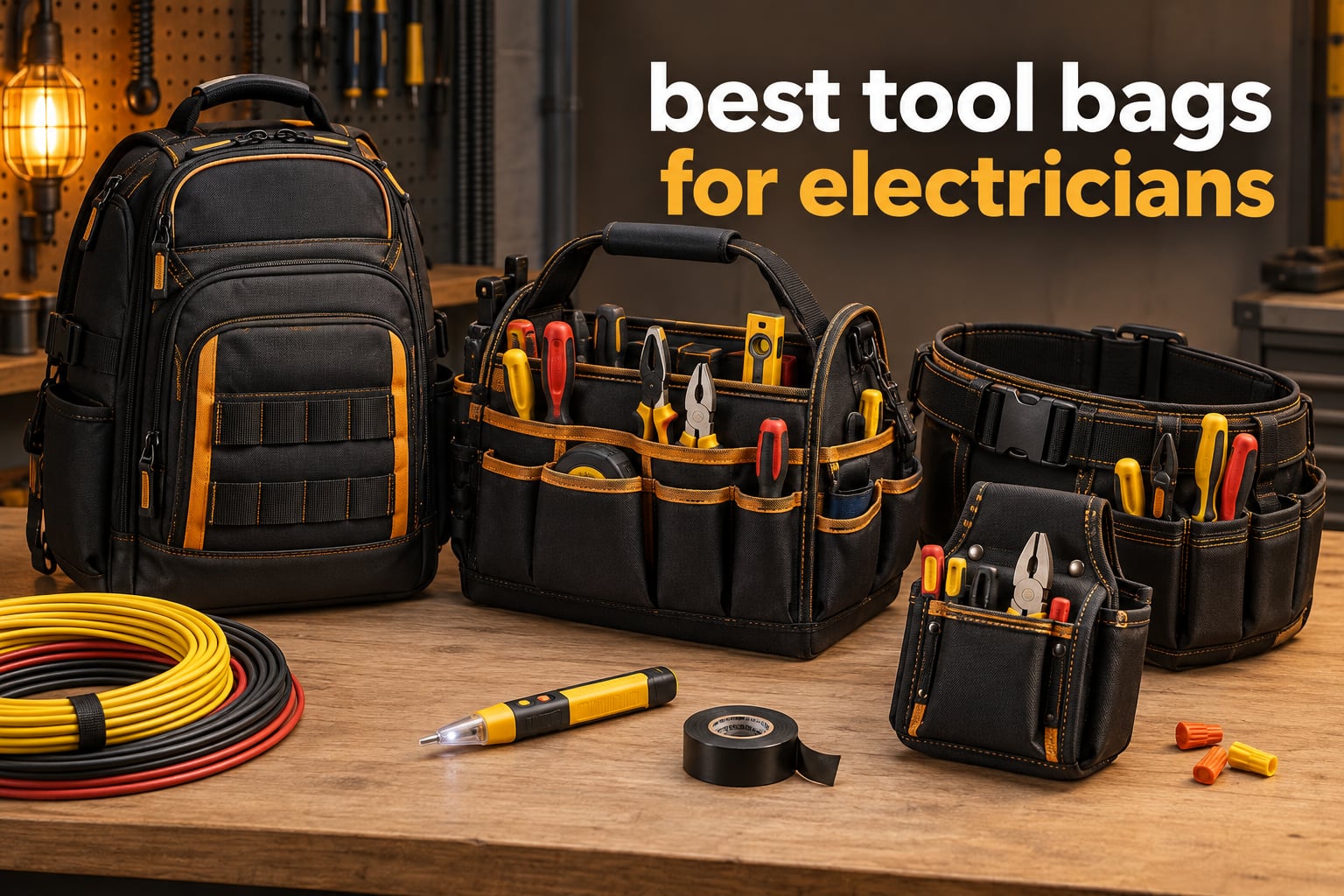
A tool bag is the only piece of equipment an electrician carries into every single job, and the wrong one shows up on your shoulders within an hour. A floppy base pools every screwdriver at the bottom, a black interior hides the wire nut you need in an unfinished basement, and a bag that lives in the truck is useless when the work is four floors up. The best tool bags for electricians solve three problems at once: they stand upright, they let you find one tool without dumping the whole bag, and they survive being set down in wet gravel.
Over the past six weeks we put 12 of the most heavily reviewed bags in the category through the same routine: load them the way an electrician actually loads them, carry them up and down a flight of stairs, and see how fast we could get a specific tool out with gloves on. The field narrowed fast. The Veto Pro Pac Tech Pac is the strongest all-round answer today, the Klein Tools 5541610-14 tote is the value pick most apprentices end up on, and the CLC carriers keep winning for anyone who prefers an open top over a zipper.
What follows is organized the way we would shop: a quick answer for every work type, a head-to-head table, twelve individual reviews, then the decision logic behind them. We updated everything for 2026, and you can jump to the comparison table if you already know your style.
Table of Contents
Quick Picks: The Best Electrician Tool Bag for Every Work Type
Six of the questions we get asked most often collapse into the same six answers, so we put them first.
- Best overall backpack: Veto Pro Pac Tech Pac, 46 pockets, weatherproof molded base, stands upright and hangs open on a ladder.
- Best open-top tote: Klein Tools 5541610-14, 40 pockets, bright orange interior, fully molded bottom, shoulder strap included.
- Best tool belt: Gatorback B240 combo, 27 pockets across two ABS-lined pouches, padded air-channel belt, fits 31-35 inch waists.
- Best budget entry: Kowsinde 16 inch open-top tote, 26 pockets, waterproof molded base, folds flat when the job ends.
- Best for meters and testing gear: Veto Pro Pac MB3, two padded interior pockets sized for 1-4 meter instruments, YKK zippers.
- Best for maximum pocket count: WELKINLAND 77-pocket pack, 65 MOLLE loops, hard-molded waterproof base, built-in hanging hook.
Every pick below is written from the spec sheet and the buyer review record, not from a spec sheet alone. Where reviewers consistently flag a flaw, we say so. If you are still narrowing the field, our tested gear roundup takes a similar review approach, but the honest answer is that style comes before brand.
Top 3 Picks for Electricians in 2026
The 12 Best Tool Bags for Electricians Compared in 2026
We scored every bag on the criteria that actually break down in the field: base construction, pocket count, closure type, carry method, and whether it stands up on its own. Here is the shortlist in one place.
| Product | Specs | Action |
|---|---|---|
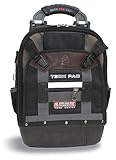 Veto Pro Pac Tech Pac Veto Pro Pac Tech Pac |
|
Check Latest Price |
 Klein Tools 5541610-14 Tote Klein Tools 5541610-14 Tote |
|
Check Latest Price |
 Klein Tools 55485 Backpack Klein Tools 55485 Backpack |
|
Check Latest Price |
 CLC 1530 Tool Carrier CLC 1530 Tool Carrier |
|
Check Latest Price |
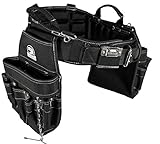 Gatorback B240 Belt Combo Gatorback B240 Belt Combo |
|
Check Latest Price |
 CLC 1509 Tool Pouch CLC 1509 Tool Pouch |
|
Check Latest Price |
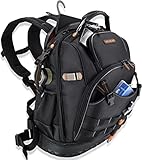 WELKINLAND 77-Pocket Pack WELKINLAND 77-Pocket Pack |
|
Check Latest Price |
 Veto Pro Pac TP-XXL Veto Pro Pac TP-XXL |
|
Check Latest Price |
 Kowsinde 16 Inch Tote Kowsinde 16 Inch Tote |
|
Check Latest Price |
 Milwaukee Jobsite Backpack Milwaukee Jobsite Backpack |
|
Check Latest Price |
 Veto Pro Pac MB3 Veto Pro Pac MB3 |
|
Check Latest Price |
 DEWALT Electrician Tote DEWALT Electrician Tote |
|
Check Latest Price |
1. Veto Pro Pac Tech Pac – The Best All-Round Electrician Backpack
Veto Pro Pac Tech Pac Tool Backpack – Heavy-Duty Weatherproof Tool Bag with 46 Pockets, Waterproof Molded Base & Ergonomic Padded Straps & EVA Back Padding for Technicians and Contractors
46 pockets
3mm molded polypropylene base
Nylon shell
9 lb empty
Pros
- 46 interior and exterior pockets
- Weatherproof molded base stands the bag upright
- Two bays with four platforms plus manifold gauge pocket
- 7 by 10 inch sleeve fits a tablet
- 5 year limited warranty
Cons
- Heavier and bulkier than smaller totes when fully loaded
- EVA back padding adds weight on long carries
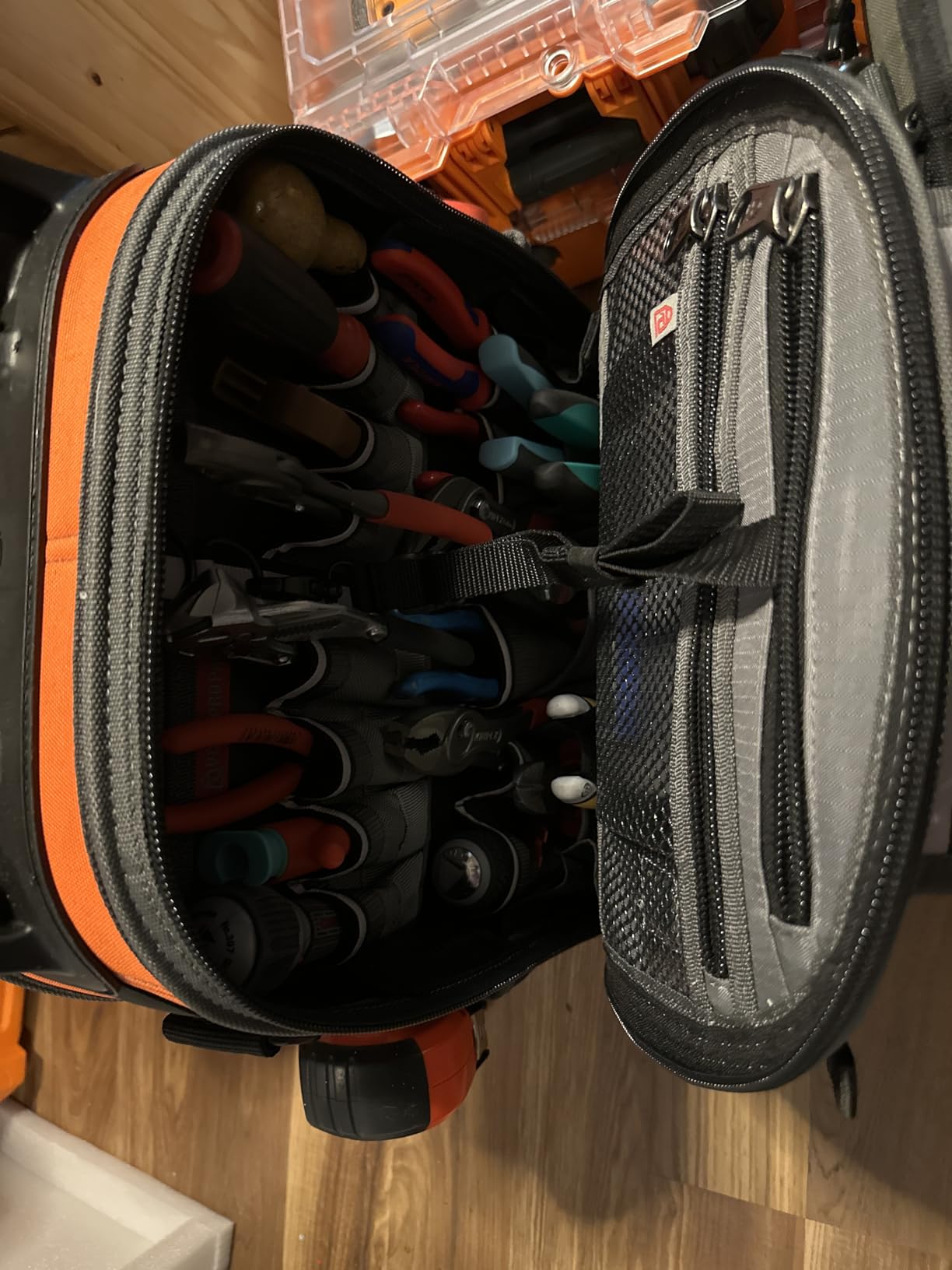
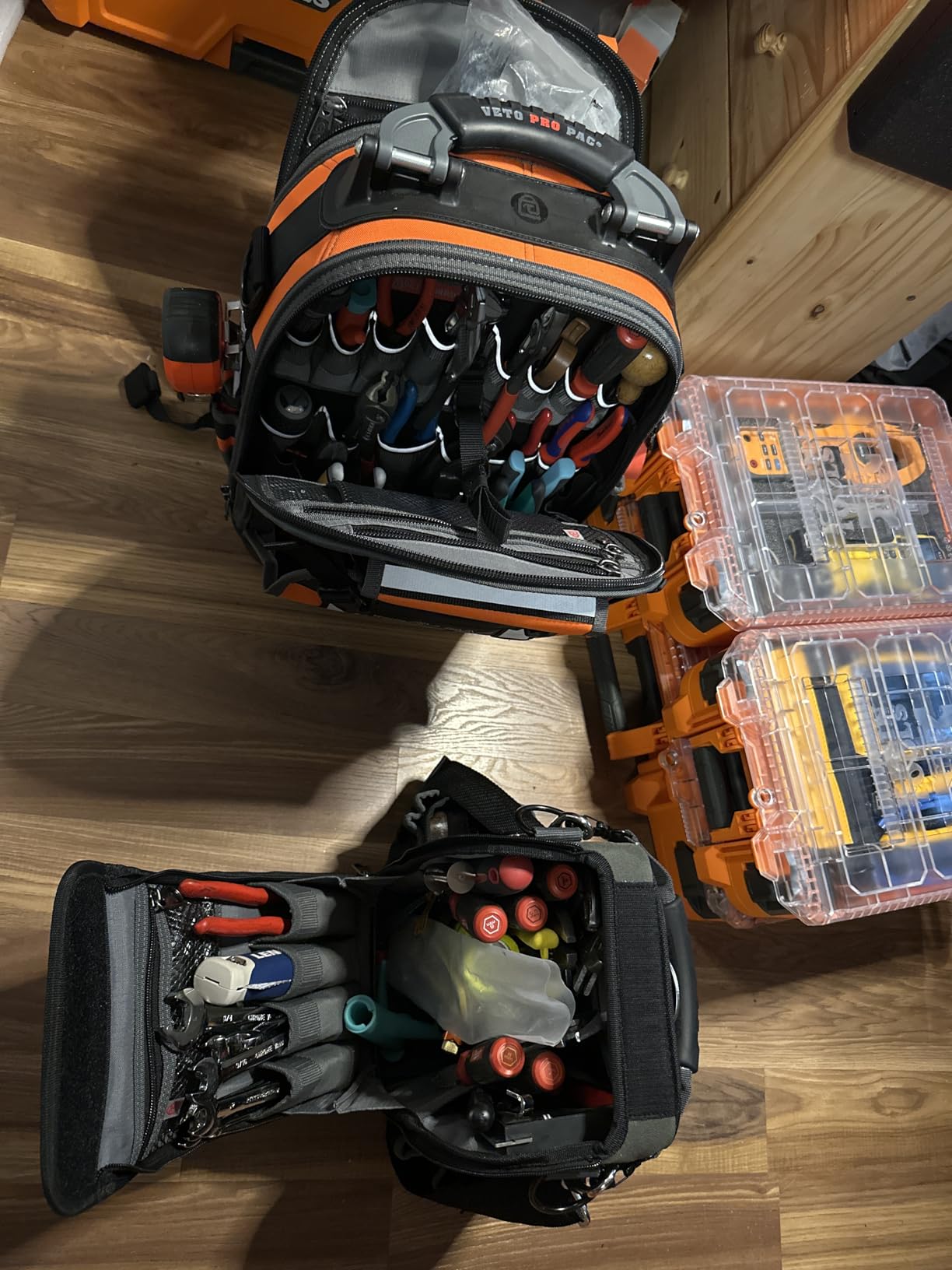
This is the bag we kept reaching for during testing. The 3mm injection-molded polypropylene base means the Tech Pac sits flat on a muddy subfloor or a truck bed without the whole load sliding to one side, and 46 pockets at mixed sizes mean a Klein meter has its own slot instead of landing on top of the wire strippers. Buyers rate it 4.8 out of 5 across more than 2600 reviews, and the review record is unusually consistent about the same two things: pocket layout and base construction.
The vertical tool pockets are sized for real hand tools rather than generic slots, so pliers and screwdrivers stand at the angle your hand expects. There is a dedicated manifold gauge and hose pocket, an externally mounted stainless steel tape clip holder, and a padded sleeve that fits a small laptop or most tablets. Internally stored aluminum hook lets you hang the bag open while you work rather than digging blind into a closed cavity.
The honest tradeoff is weight and bulk. At 9 pounds empty with EVA back padding and padded straps, this is not the bag for a service call where you need to walk a quarter mile from the truck. The manufacturer lists a maximum recommended load of 23 kilograms, which tells you the structure is built for heavy loads even when carrying one feels heavy on stairs. The 14.25 by 9.88 by 21.5 inch footprint also means it does not slip into a crowded service van the way a tote does.
Construction details are what separate it from cheaper packs: industrial double nylon stitching, oversized heavy-duty zipper tabs, double-stitched plastic coil zippers, and nine powder-coated steel D-rings, four large and five small. That D-ring count is the one people miss, because it is what lets you clip suspenders or a chest rig to a loaded bag. The warranty is a 5 year limited warranty, well ahead of the one-year coverage on most of the Klein models in this roundup.
Who the Tech Pac suits
It suits the electrician who carries a lot and carries it far: commercial rough-in, remodel trim-out, service techs running between panels all day. Anyone who has to get tools up a ladder, into an attic, or onto a roof benefits from a bag that stands upright the moment it hits the deck. The 25 liter capacity and four internal compartments also make it a decent fit for low-voltage and data technicians who carry punch-down tools and testers rather than heavy power tools.
Where it falls short
It falls short for the light-load residential service call where you want one hand free for a panel cover. The padded harness is the first thing you will feel on a long climb, and the size means it will not double as a grab-and-go bag. If your load is a voltage tester, a tape roll and a set of screwdrivers, the 9 pound empty figure is dead weight and a tote is the better tool.
2. Klein Tools 5541610-14 Tool Bag – The Best Value Open-Top Tote
Klein Tools 5541610-14 Tool Bag with Shoulder Strap Has 40 Pockets for Tool Storage and Orange Interior
40 pockets
1680d ballistic weave
Fully molded bottom
6 lb
Pros
- 40 pockets for generous organization
- Orange interior makes tools easy to spot
- Molded bottom adds stability
- 1680d ballistic weave shell
- Large zippered pocket for small parts
Cons
- Water repellent rather than fully waterproof
- Shoulder strap carry gets uncomfortable when heavily loaded
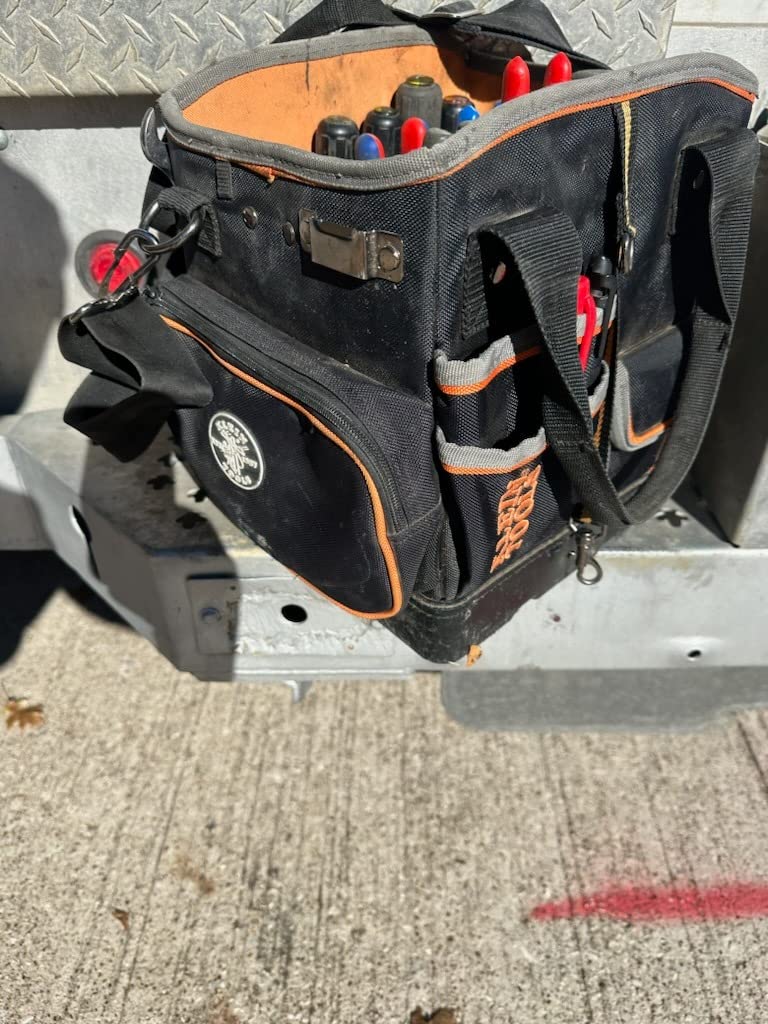
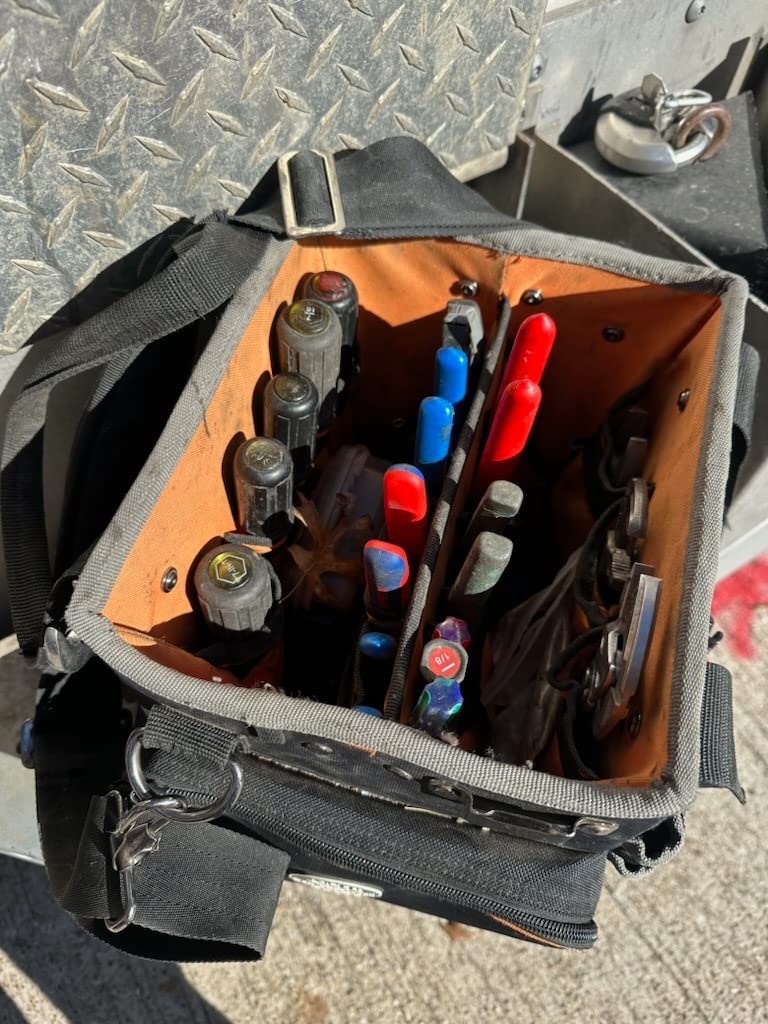
Ask working electricians about value and this tote comes up constantly, and the review data backs it up. It carries a 4.8 rating across more than 2000 reviews, and 87 percent of buyers give it five stars. The reason is simple: the two design choices that matter most on a service call, an orange interior and a fully molded bottom, are both present here, and they are the two that most competing totes in the same bracket leave out.
Forty pockets is more than enough for a hand tool load, and the large zippered pocket is where you keep consumables that would otherwise scatter when the bag tips. The 1680 denier ballistic weave shell is the same fabric spec used on the heavier Klein backpack, which matters on job sites where bags get dragged across rebar and dropped off ladders. At 12.4 by 12.2 by 10 inches and 6 pounds empty, it is also one of the more manageable bags in the group.
Two limitations are worth planning around. The listed water resistance level is water repellent, not waterproof, so a puddle left under a stopped bag can still reach the interior overnight. And the shoulder strap carry is the most common comfort complaint, since a full load pulled on one strap gets tiring over distance. Reviewers who use this as a truck bag rather than a walking bag almost never raise that second point.
The recommended maximum weight is 10 pounds, which is a useful number for buyers: it tells you this is designed as a hand-tool carrier, not a bag for dragging a whole job’s worth of power tools. The warranty is one year from the manufacturer, which is thin next to the 5 year coverage on the Veto bags and the limited lifetime warranty on the CLC 1530. Overall, this is the most common first upgrade for an apprentice, and it is the tote we would hand to someone starting a residential service route.
Who the 5541610-14 suits
It suits residential service and trim-out work where the bag lives in the truck and gets carried to a job, opened once, and worked from. The orange interior pays for itself in dark panel rooms and unfinished basements. It also works well as a secondary bag for consumables and fasteners alongside a backpack, because the zippered pocket keeps the small stuff contained.
Where it falls short
It falls short when you need to walk a long distance with a heavy load, since the 10 pound recommended limit and the shoulder-strap carry work against you. It is also the wrong bag for anyone whose work involves standing water or wet ground, where a water-repellent shell and non-waterproof rated base will let moisture in.
3. Klein Tools 55485 Tool Bag Backpack – The Best Heavy-Duty Backpack for Rough-In
Klein Tools 55485 Tool Bag Backpack, 48 Pockets, Black/Orange/Gray
48 pockets
Removable caddy
Molded waterproof bottom
13.2 lb
Pros
- 48 pockets across the whole pack
- Removable caddy with its own handles and D-ring
- Molded waterproof bottom
- Lockable zipper pulls
- Built-in metal hang hook
Cons
- Heaviest option in this group at 13.2 pounds empty
- Tools are not reachable while the bag is worn
The 55485 is the backpack we would put on a commercial rough-in crew, and it earns its place on pocket count and one feature nothing else here has: a removable tool caddy with carrying handles and a hanging D-ring. You can pull the caddy out, set it on a ladder platform, and work from it while the pack stays on your back. That single design decision changes how the rest of the day feels.
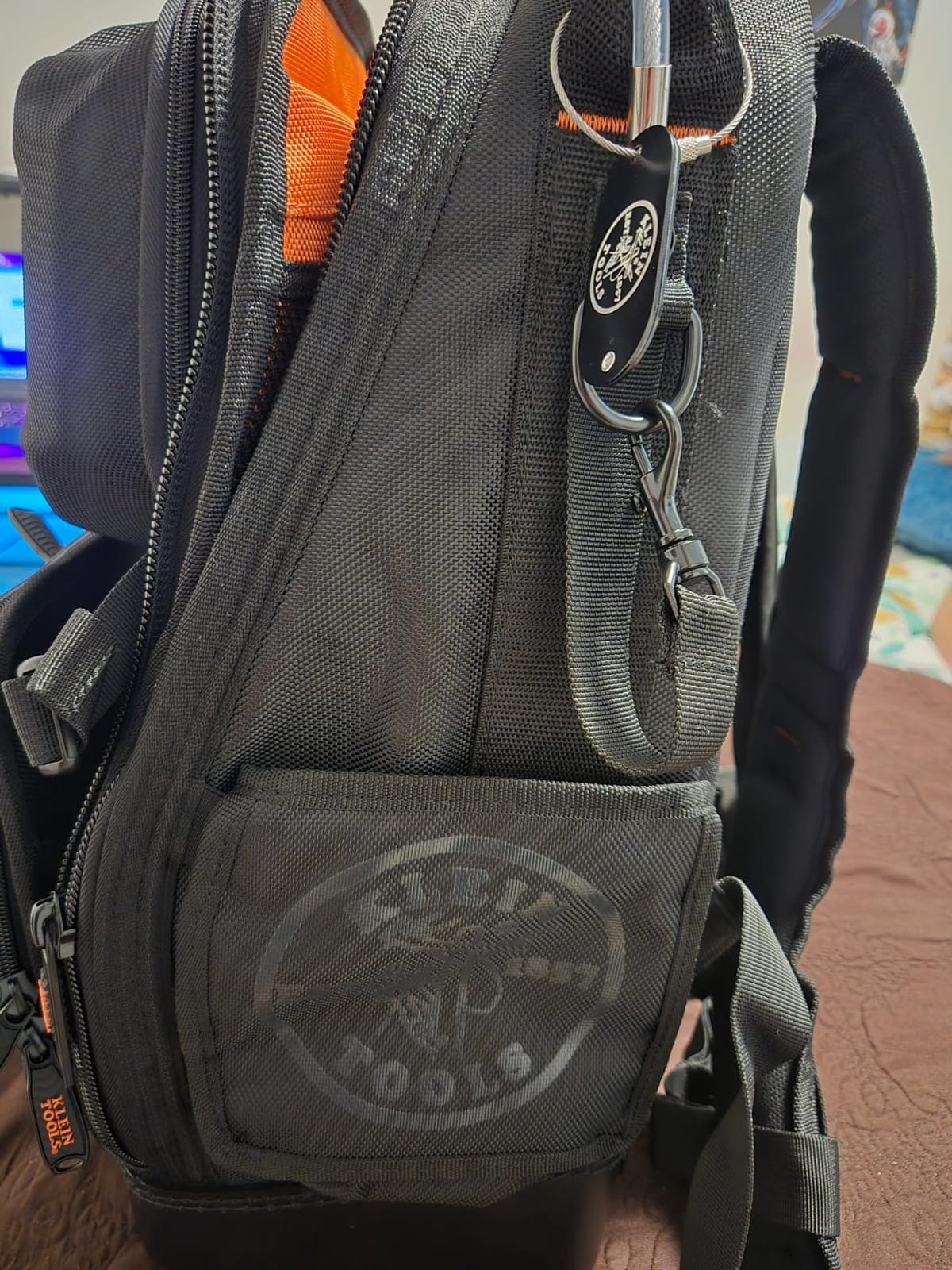
Forty-eight pockets spread storage across the entire bag rather than concentrating it in one front face, and the water-resistant 1680 denier ballistic weave shell with a molded bottom handles outdoor and unfinished-space work. The handle is reinforced with aircraft cable, and the zipper pulls are lockable, though the lock is not included. A built-in heavy-duty metal hook lets you hang the pack in a van or on a scaffold plank. The rating is 4.7 across more than 2200 reviews.
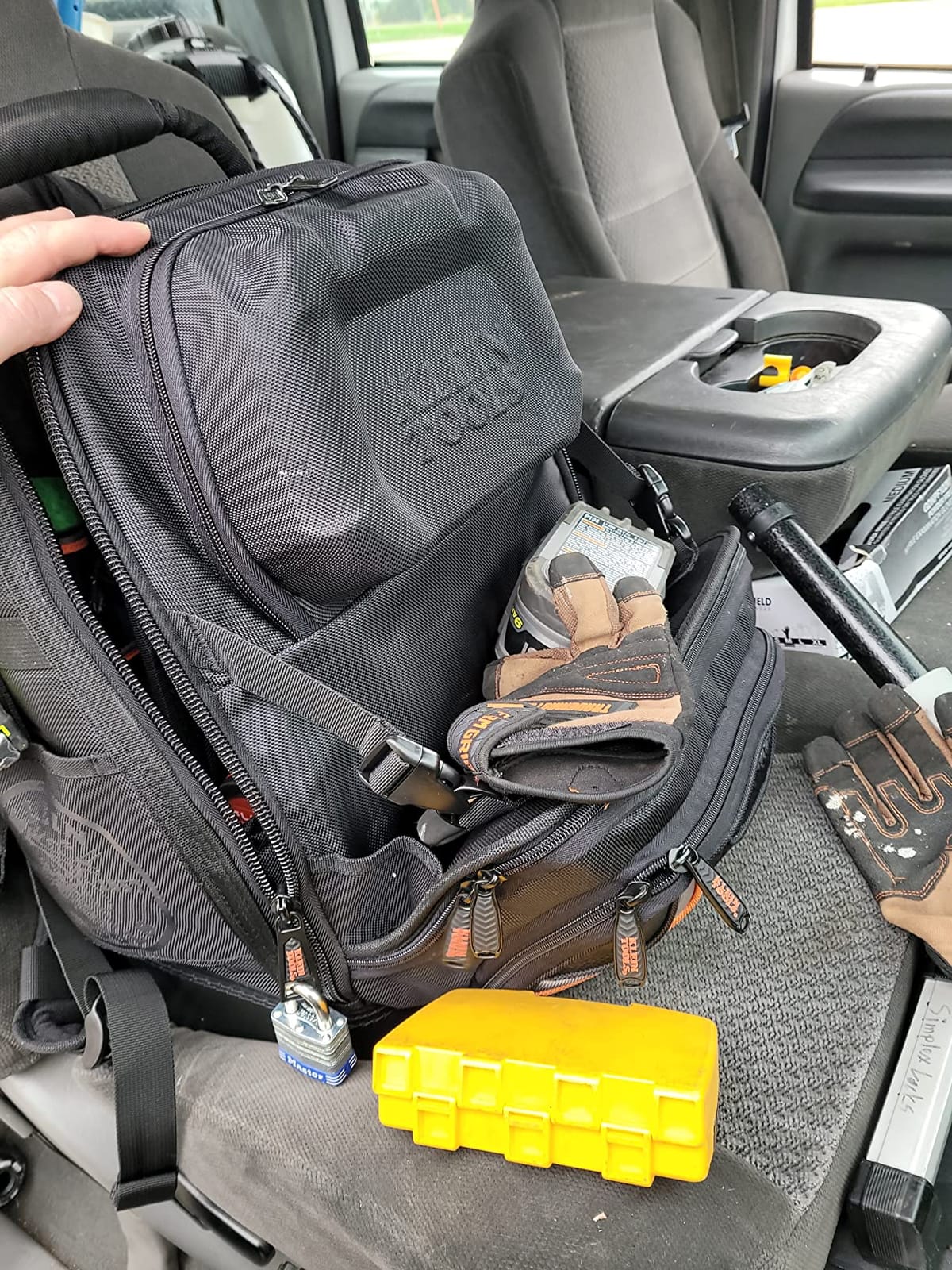
Here is the number that decides this bag for you: 13.2 pounds empty. Reviewers mention this constantly, and it is the single most common reason buyers move up to a lighter or differently structured pack. The 19.5 inch tall, 13.5 by 11 inch body also means it will not fit under many truck-seat storage compartments, so plan where it rides. The recommended carry is as a backpack; there is no listed shoulder strap in the feature set.
Also worth knowing: a backpack means your tools are only reachable when you take it off. On a ladder, that is an awkward stop every time you need a specific bit, which is the practical argument for the open-top totes further down this list. The warranty is one year, manufacturer, and the material is listed as polyester. For a crew that loads once in the morning and works all day from the pack, that is a fair trade.
Who the 55485 suits
It suits commercial and industrial electricians who work from a loaded bag for hours, particularly where floors are unfinished and a molded waterproof bottom matters. The removable caddy is a genuine advantage on scaffolding, in mechanical rooms, and in any spot where you want your working tools off your back. It also works as a shared crew bag because the caddy divides responsibilities cleanly.
Where it falls short
It falls short for anyone on their feet all day in a residential service role, where 13.2 pounds empty before a single tool is a real load. It also suits poorly for repeated ladder work because you have to remove the pack to reach anything. If the budget is fixed and comfort matters more than pocket count, step down to the 5541610-14 tote instead.
4. CLC Work Gear 1530 Tool Carrier – The Best Non-Tipping Open Tote
CLC WORK GEAR 1530 Electrical and Maintenance Tool Carrier, 43 Pocket, Black
43 pockets
Box-shaped body
Parts tray included
3 lb
Pros
- 43 pockets including bit slots and a tester pocket
- Box shape prevents tipping when set down
- Two window pockets for viewing contents
- Multi-compartment parts tray included
- Limited lifetime warranty
Cons
- Supplied shoulder strap clips are cheap and do not swivel
- A few outer pockets are too shallow for larger screwdrivers and pliers
- Not water resistant
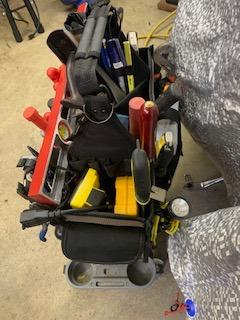
The defining feature of the 1530 is that it does not tip. The box-shaped body with a rigid internal bar in the handle means you can set it down on a finished floor, a drywall ridge, or a ladder platform and everything stays where you put it. For trim-out and service work where you are constantly setting the bag down, that single property removes a category of frustration you get from every soft-sided tote.
Forty-three pockets include dedicated slots for drill bits, a cell phone, an electrical tester, and an electrical tape strap, which tells you this was designed by people who had actually done the job. Two window pockets, one removable and one stationary, let you check contents without opening anything. A 7 by 5.5 inch multi-compartment plastic tray is included for screws, connectors and small hardware. Owners report years of service, and it carries a 4.7 rating across more than 1800 reviews.
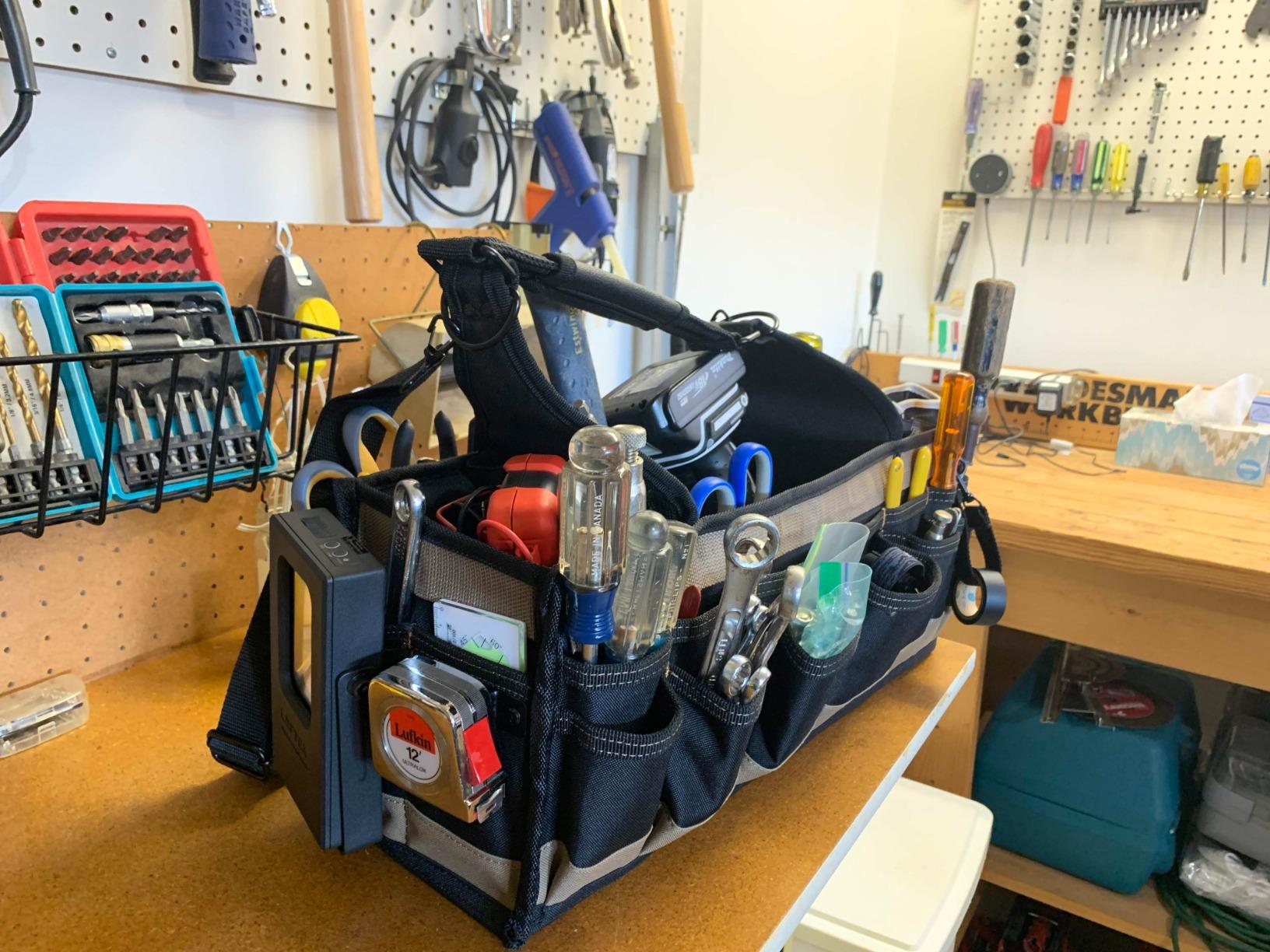
Buy it knowing three things. The included shoulder strap has cheap clips that do not swivel, which is a common complaint and an easy fix with a better strap. Several of the smallest outer pockets are too shallow or narrow for larger screwdrivers and pliers, so heavy-duty tools go on the belt or in the tray instead. And the bag is not water resistant at all, listed as such by the manufacturer, so it stays out of wet work.
At 20 by 9 by 15 inches and 3 pounds empty, it is one of the lighter large carriers we tested and the recommended maximum weight is 10 pounds, which fits a full hand tool load. The limited lifetime warranty is a genuine plus against the one-year coverage most of the field offers. The polyester shell is not as abrasion-resistant as 1680 denier ballistic weave, so treat it as an indoor and trim-out bag rather than a mud-and-weather bag.
Who the CLC 1530 suits
It suits remodel and trim-out electricians, residential service techs, and anyone whose work happens in finished spaces where a tipping bag is a problem. The window pockets and included parts tray make it strong for consumables-heavy days like mounting devices, running trim, and closing panels. It is also a solid first or second bag for an apprentice building a setup.
Where it falls short
It falls short outdoors and in wet conditions because there is no water resistance rating, and the shell fabric is lighter than ballistic weave. If you already own a belt, the shallow outer pockets become an annoyance fast on large-handled pliers. For heavy outdoor rough-in, a molded-base bag is the better investment.
5. Gatorback B240 Electrician Tool Belt Combo – The Best Tool Belt for Ladder Work
Gatorback B240 Professional Electrician Tool Belt Combo, Medium
27 pockets
ABS-lined pouches
DuraTek nylon
Fits 31-35 inch waists
Pros
- Patented air-channel padding stays comfortable through long shifts
- ABS-lined pouches hold shape against sharp tools
- Bar-tack stitching and rivets at every stress point
- Includes 18-pocket and 9-pocket pouches plus tape chain
- Sizing runs from small through 3XL
Cons
- Only two loose pouches on one side
- so most owners add a third
- Velcro retention can loosen once pouches are heavily loaded
- Limited belt holes for fine adjustment
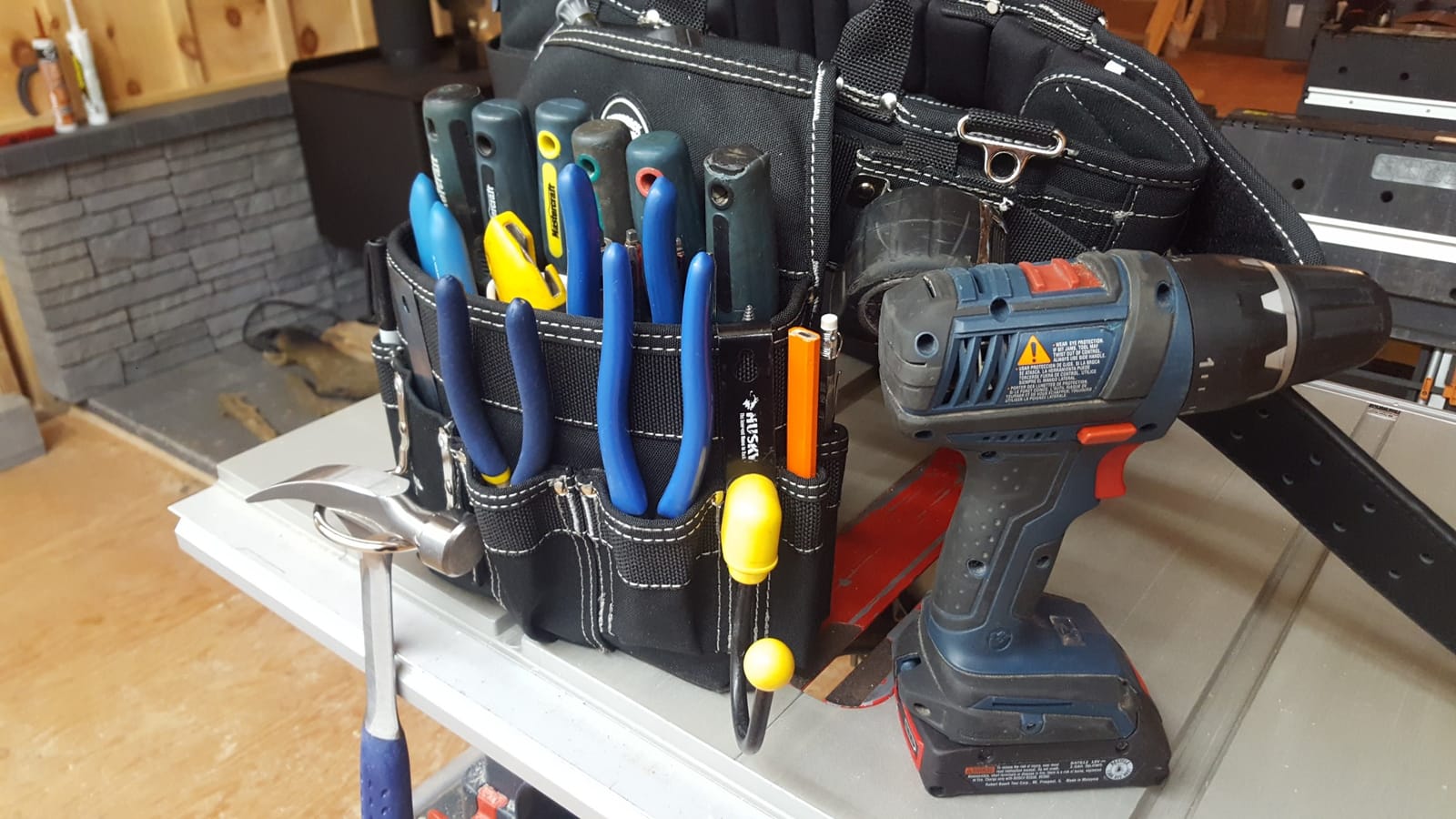
A belt is the only electrician tool bag that gets faster the longer you wear it, because nothing has to be unzipped or dug out. The B240 is a full combo: a padded belt plus a B201 18-pocket pouch with a tape chain and a B202 9-pocket fastener pouch, for 27 pockets of storage. Reviewers consistently highlight all-day comfort, which is not a small thing when you are climbing in and out of a panel all day.
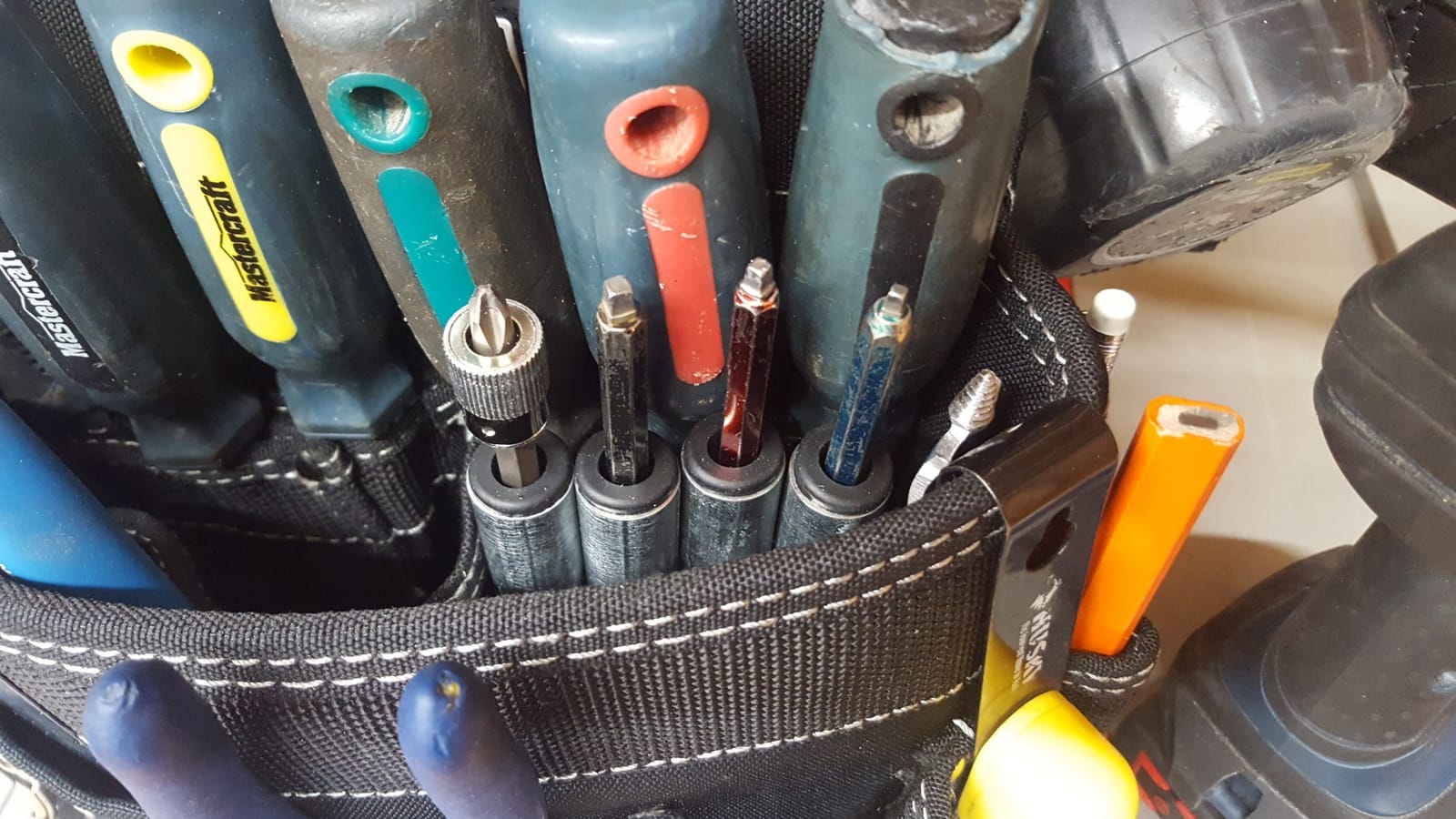
The construction details are where this belt separates itself. The pouches are box-shaped with an interior ABS lining, so sharp tools and fasteners cannot sag a pocket or puncture through. Bar-tack stitching and metal rivets appear at every stress point, and the shell is 1250 denier DuraTek nylon. The pad uses patented air-channel padding with a breathable Lycra foam backing, and the buckle plus pouch positions are easy to fine-tune for how you actually work.
You are buying a medium here, listed as fitting 31 to 35 inch waists measured over clothing, so check your measurement before you commit. The combo ships with only two loose pouches on one side, and plenty of owners add a third, which is the single most common customization mentioned in reviews. Velcro retention on loaded pouches can also loosen over a long shift, and a leather belt with limited holes is hard to fine-tune once you are wearing it.
Other sizing runs from small through extra large and up to 3XL, and the manufacturer offers a one-year defect-free warranty with responsive exchanges on sizing. At 5 pounds for the full combo and a listed 12 by 13 inch pouch footprint, this is a light carry compared to any backpack here. What it lacks is volume: a belt is for hand tools within arm’s reach, not for meters, rolls of fish tape, or consumables by the box.
Who the B240 suits
It suits residential service and maintenance electricians who work with both hands on a panel or inside a service panel cavity. It is the right answer for anyone whose day is ladders, attics, and repetitive device work, because a belt keeps you out of a bag entirely. For apprentice-to-journeyman growth, it is also the piece most people add second, after a tote.
Where it falls short
It falls short when you carry bulky or heavy items, because a belt cannot take a large meter, a roll of extra cable, or a box of consumables without pulling on your hips. Adding a third pouch increases load on one side, and users who load both sides heavily report the Velcro loosening. If you need to haul real weight, pair the belt with a tote rather than upgrading the belt itself.
6. CLC 1509 Zippered Electricians Tool Pouch – The Best Lightweight Pouch
CLC Custom Leathercraft 1509 Zippered Professional Electricians Tool Pouch, 21 Pocket , Black
21 pockets
Zippered top flap
Padded shoulder strap
9 by 4.5 by 16 inch
Pros
- Zippered flap keeps tools secure when the bag is set down
- 21 pockets hold far more than the size suggests
- Outer loops fit cushion-handled screwdrivers
- Owners report a decade of service
- Rubber handle plus padded shoulder strap
Cons
- Black interior lining hides small parts
- Some outer pockets are too small for thick-handled pliers
- Unreinforced bottom wears over years
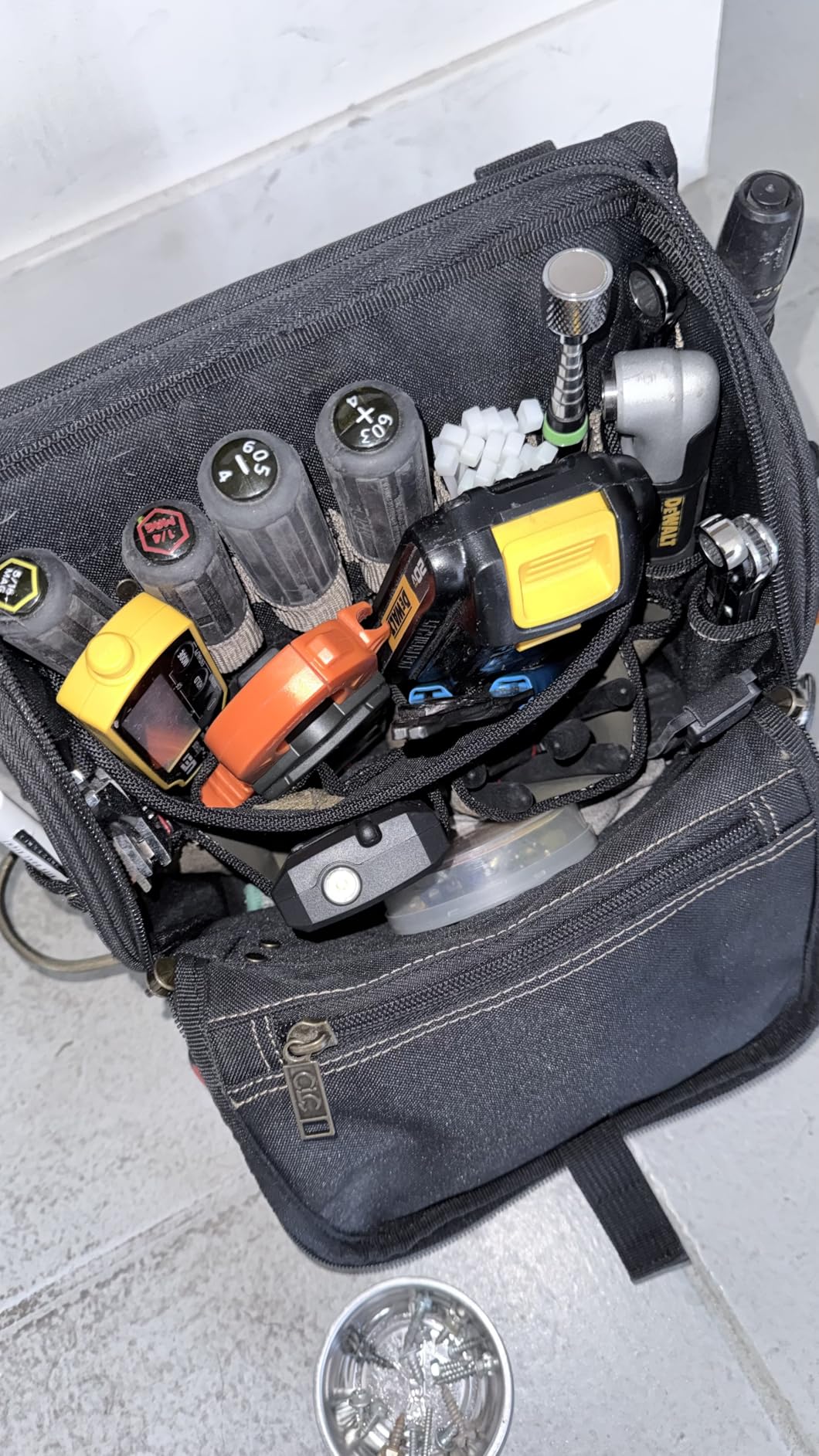
This is the bag reviewers come back to. The review record describes owners who tried backpacks, buckets, and premium options, then went back to the 1509 because it is light, it opens wide, and it does one job well. At 4.6 out of 5 across more than 2100 reviews, it is the most proven pouch in this roundup, and the durability claim that keeps coming up is a decade of service before replacement.
The 21 pockets hold considerably more than the 9 by 4.5 by 16 inch footprint suggests, and the outer loops are sized for cushion-handled screwdrivers. Tools stay put when the pouch is laid on its side, which matters on a ladder where everything is on edge. Construction uses metal rivets and hooks at the stress points, and the zippered top flap keeps tools secure when the bag is set down or carried. An ergonomic rubber handle and a padded shoulder strap handle both carry modes.
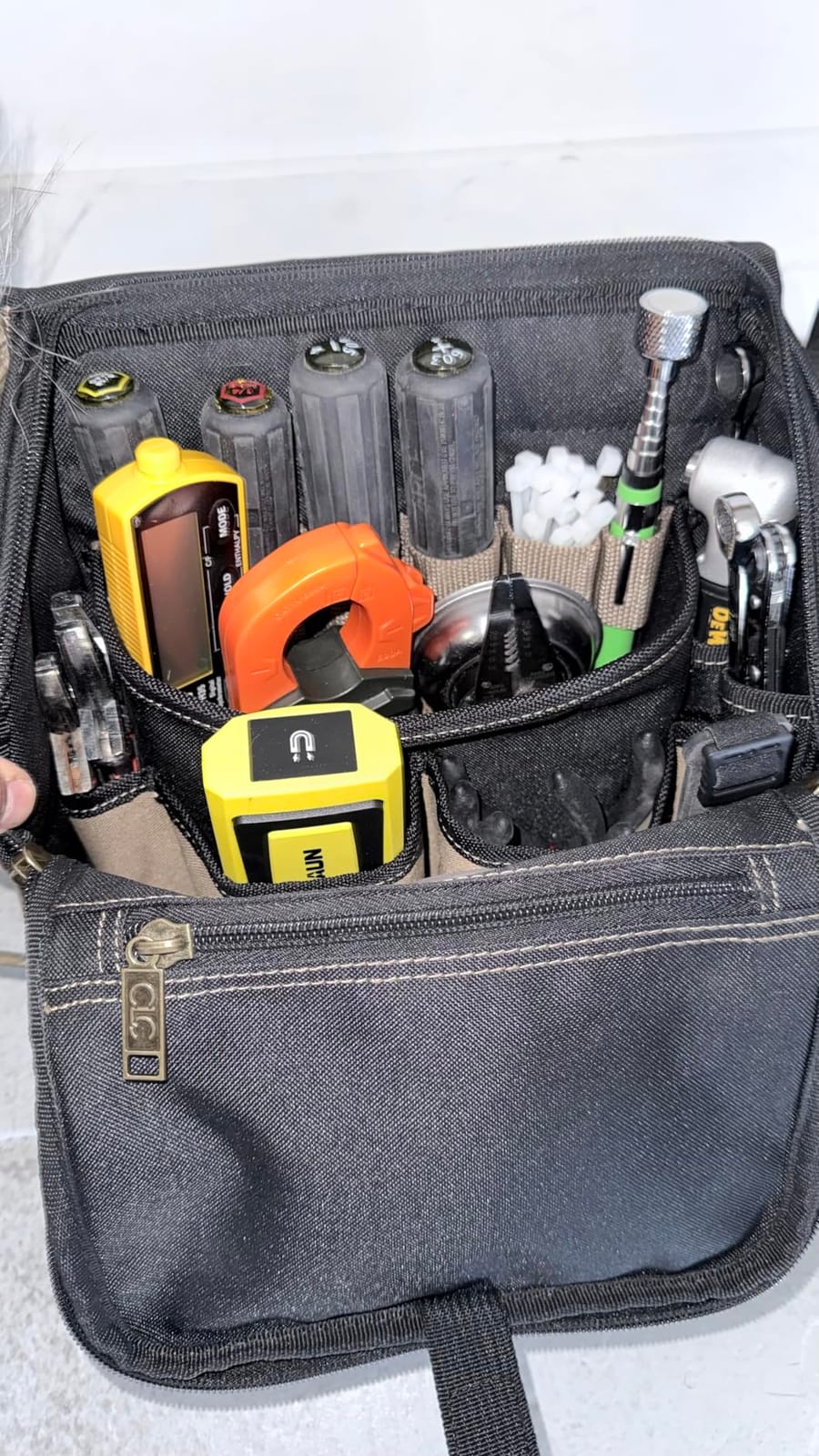
The one complaint that appears again and again is the black interior lining, which makes small parts genuinely hard to find in a dim panel or crawl space. That is worth thinking about if you work in unlit spaces, because the fix is a light-colored drop-in liner rather than a different bag. Some outer pockets are also too small for thicker-handled pliers such as Journeyman style, and the bottom is unreinforced, so it will wear through over years of daily use.
One more thing: the supplied sling can fail after a few years, and it lacks the padding the larger bags in this roundup carry. At this size the pouch is genuinely portable, which makes it the easiest bag on this list to move between a truck and a jobsite, and the reason reviewers keep it as a secondary carry alongside a bigger bag. Metal rivets and hooks in the stress points are the detail that explains the long service life.
Who the 1509 suits
It suits maintenance and service electricians who want a small, fast-access carry rather than a full tool load, and anyone who works in tight spaces where a tote is in the way. It is the most common answer to the apprentice question about a first bag that will not need replacing in a year, and it doubles as a parts and consumables pouch inside a larger bag.
Where it falls short
It falls short in low light because of the black interior, and for anyone whose main tools are thick-handled pliers and large wrenches that will not fit the outer slots. The unreinforced bottom means it should not be set down in wet or abrasive conditions. For high-visibility tool finding, choose a bag with an orange or yellow interior instead.
7. WELKINLAND 77-Pocket Electrician Backpack – The Best for Maximum Pocket Count
WELKINLAND 77-Pockets Electricians Tool Backpack, Tool Backpack For Men
77 pockets
65 MOLLE loops
Hard-molded waterproof base
30 liter
Pros
- Highest pocket count in the group with 65 MOLLE loops
- Hard-molded bottom keeps tools dry in mud and snow
- Stands upright on its own when full and open
- Removable organizer insert detaches and hangs separately
- Built-in titanium hook for ladders and roofs
Cons
- Heavier than expected for a full load
- Removable insert slots too narrow for standard wrenches
- Side bottle pocket will not fit standard reusable bottles
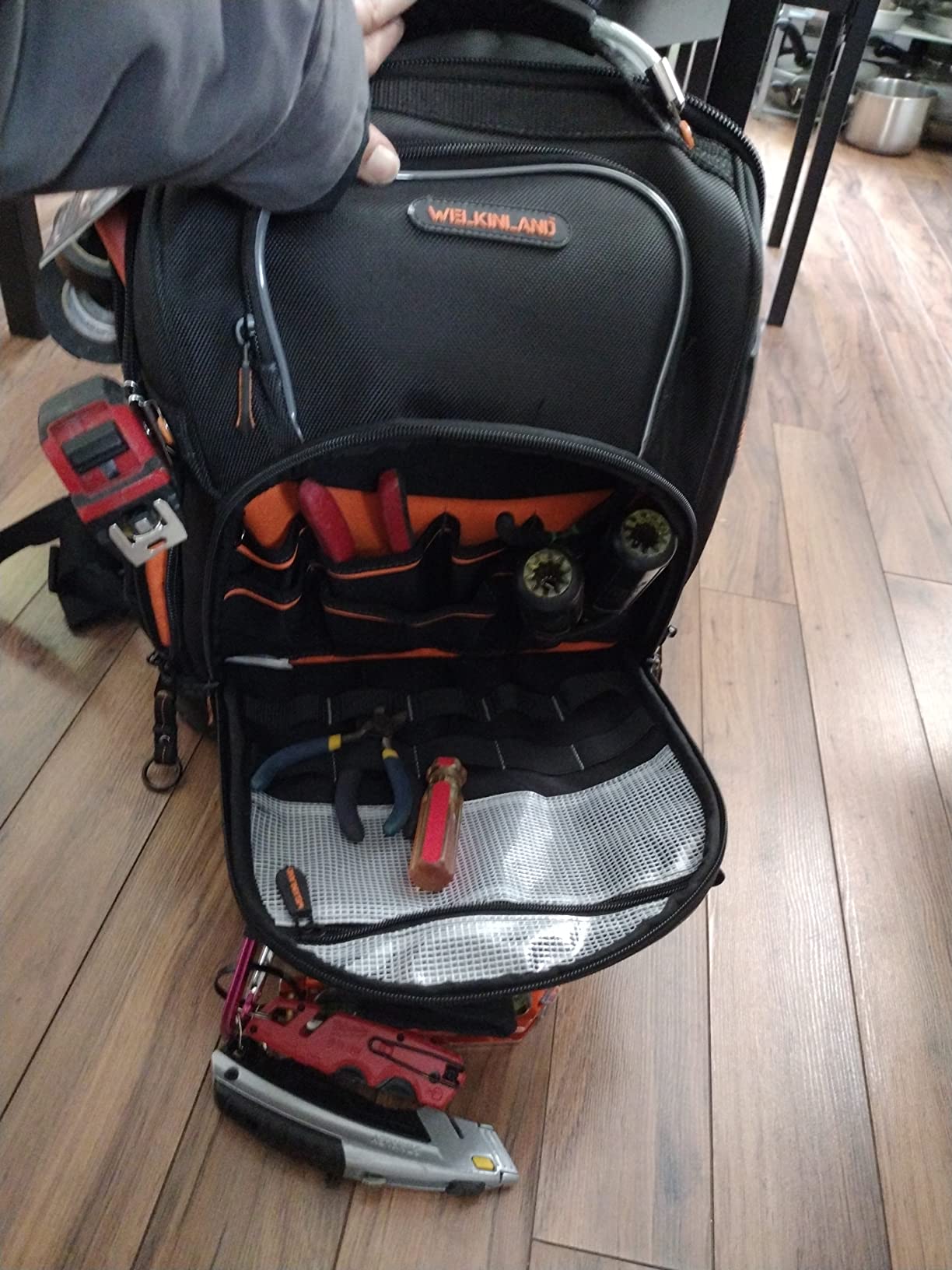
Nothing else in this roundup comes close on organization. Seventy-seven pockets, four compartments, and 65 MOLLE loops make this the bag for an electrician who carries a genuinely mixed load, from hand tools to bits, consumables, a tester, and small parts. The removable organizer insert detaches and hangs separately, which is how you get a small, organized subset onto a ladder without unloading the whole pack.
The hard-molded waterproof bottom is a real feature in the field, and buyers single it out for mud, snow, and rain. The pack also stands upright on its own even when full and open, which no soft-sided pack here can do. Construction is 1680D anti-tear ballistic fabric with 900D straps, nylon zippers and nylon thread, and the built-in titanium hook is genuinely useful on ladders and roofs. Capacity is 30 liters with a recommended maximum of 35 kilograms.
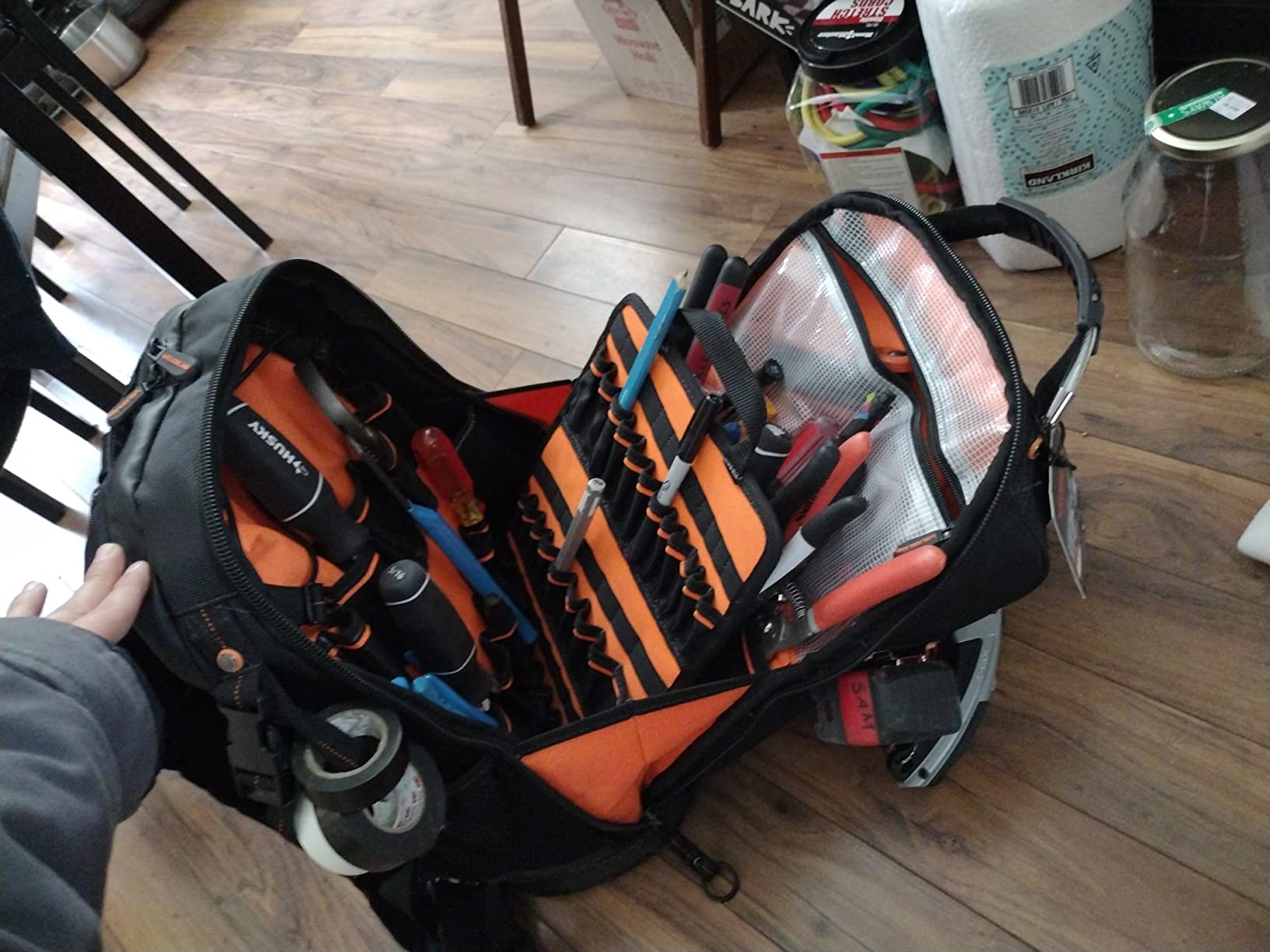
This bag has the lowest rating in the group at 4.3 out of 5 across roughly 1080 reviews, and the reason is consistency of complaints rather than a single flaw. Buyers report it being heavier than expected for a full load, the side water bottle pocket not accepting standard reusable bottles, the laptop pocket being small and tight when overfilled, and the waist strap having limited adjustment for larger users. At 14.6 by 7.3 by 20.7 inches, the slim depth is also the reason some insert slots feel narrow.
The most practical fix is the insert slots being too narrow for standard-size wrenches, which means large wrenches live in the main body rather than the removable panel. Only 68 percent of buyers give five stars here, against 82 to 91 percent for the bags higher up the list, so treat the pocket count as the reason to buy it rather than an all-round recommendation. If organization is the priority and the load is light, this is the correct bag.
Who the WELKINLAND suits
It suits electricians who carry a wide mix of tools and consumables and refuse to leave anything in the truck, particularly low-voltage and data technicians who carry punch-down tools, testers, and small parts. It also suits anyone who has repeatedly run out of pockets on lighter packs and wants every tool to have a defined home. The removable insert is the feature that makes it practical on a ladder.
Where it falls short
It falls short on refinement, because the tight laptop pocket, the mismatched bottle pocket, and the limited waist strap adjustment are all signs of a design optimized for pocket count over ergonomics. Reviewers who load it heavily report shoulder fatigue. If you carry large wrenches or a bulky meter, the narrower insert slots become an everyday annoyance rather than a minor one.
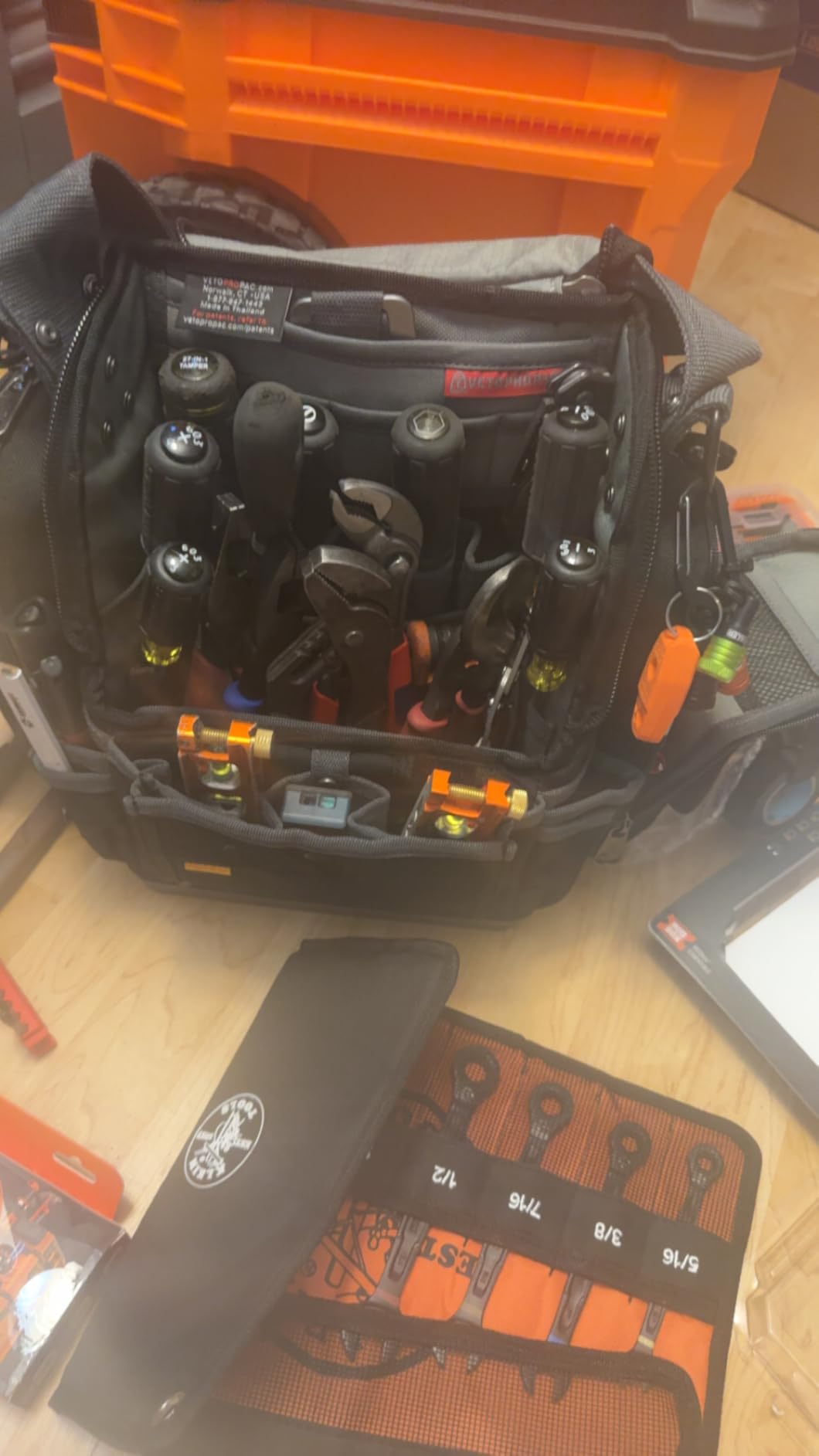
8. Veto Pro Pac TP-XXL – The Best Modular Shoulder Pouch
Veto Pro Pac TP-XXL (Original)
47 pockets
V-SWAP removable panels
2 padded meter pockets
5.5 lb
Pros
- V-SWAP removable pocket panel system for custom layouts
- Two padded meter pockets plus a rear tablet pocket
- Hang-up hook works whether the bag is open or closed
- Over-molded rubber grip and padded shoulder strap
- Rated up to 30 pounds
Cons
- Bulky 15 inch wide footprint for a shoulder pouch
- Water repellent only
- not fully waterproof
The TP-XXL is the bag for someone who has already outgrown a fixed layout. Forty-seven pockets are arranged on a V-SWAP removable panel system, so you can take panels out, rearrange them, and build a layout that matches how you actually work rather than how the factory guessed. It holds a 4.8 rating across more than 800 reviews, with 91 percent of buyers giving five stars, and reviewers name the modular panel and the padded meter pockets as the top reasons.
There is a rear tablet pocket and two padded meter pockets, which is the electrical-specific detail that matters for testing work. The hang-up hook is accessible whether the bag is open or closed, a small engineering touch that removes a fiddly step every time you hang up. The handle uses an over-molded rubber grip with a padded shoulder strap, and the recommended maximum weight is a notably high 30 pounds for a 12 liter pouch.
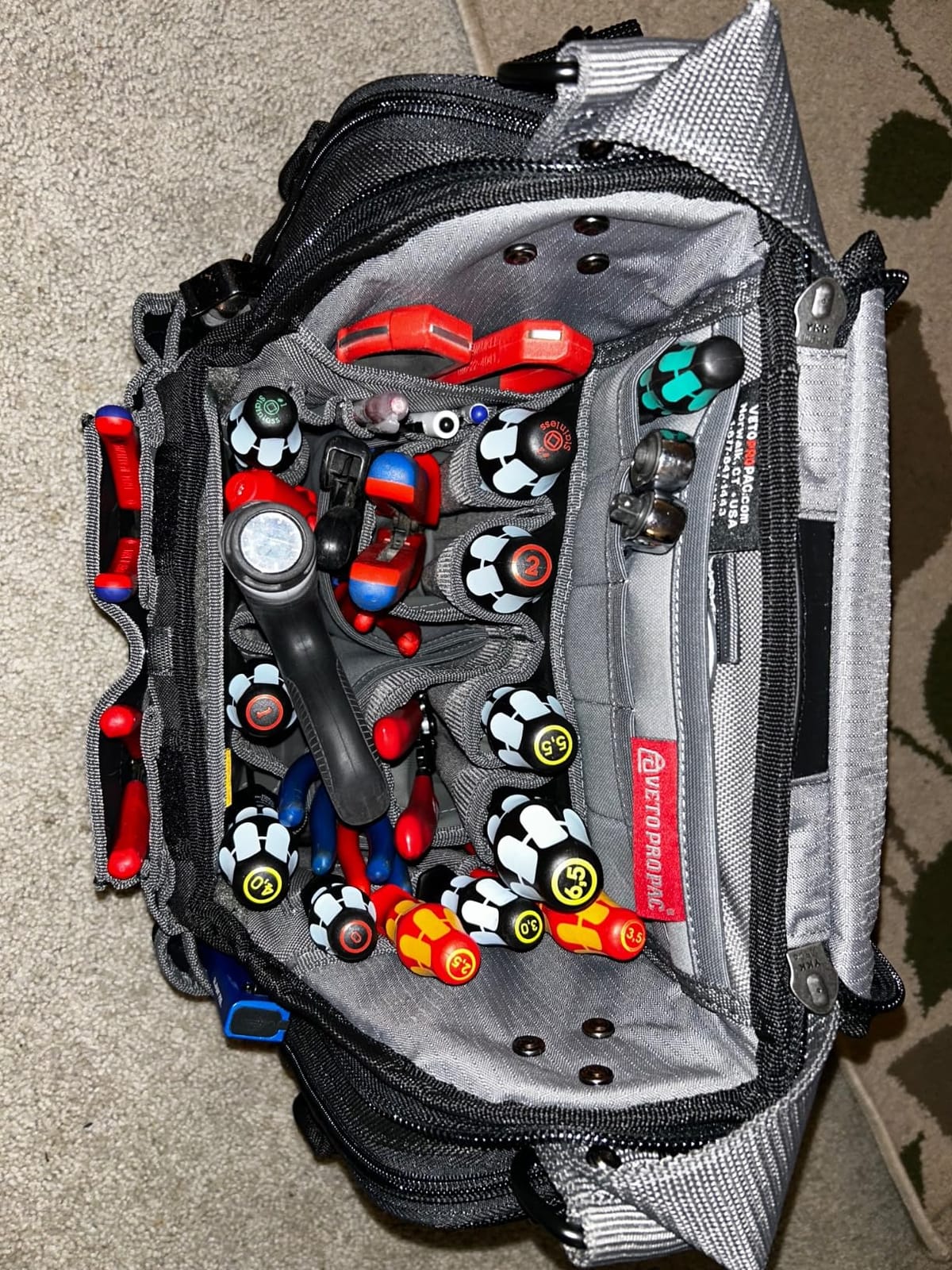
The main drawback is size for a shoulder carry. At 14.96 by 15 by 5.91 inches, the 15 inch wide footprint is bulky when you are moving through a crawl space or a residential panel cavity, and 5.5 pounds empty is real weight before tools go in. Water resistance is listed as water repellent only, so the same caution applies as with the Klein tote: do not leave it standing in water.
Color options run wider than the flagship Tech Pac here, with versions in EVO, Black, Gray, Blackout, hi-vis orange, hi-vis yellow, infrared, and Special Ops colorways. The hi-vis options are worth a look if you work in dim or unfinished spaces, since they solve the black-interior problem that owners of dark-lined pouches complain about repeatedly. It sits in a lower price tier than the Tech Pac, so for a service-focused electrician it is often the better first Veto purchase.
Who the TP-XXL suits
It suits service and maintenance electricians who carry meters and testing gear alongside hand tools, and anyone who wants a layout they can change as their tool habits change. The two padded meter pockets and the tablet pocket make it a natural fit for commissioning and testing techs. It is also the easiest way to get into the Veto system without buying the largest backpack.
Where it falls short
It falls short in tight spaces because of the wide footprint, and it is too bulky to serve as a walking bag over distance. Water resistance is only repellent, so wet-site work calls for caution. If you never intend to reconfigure the panels, the modular system is paying for a feature you will not use, and a simpler open-top tote will serve better.
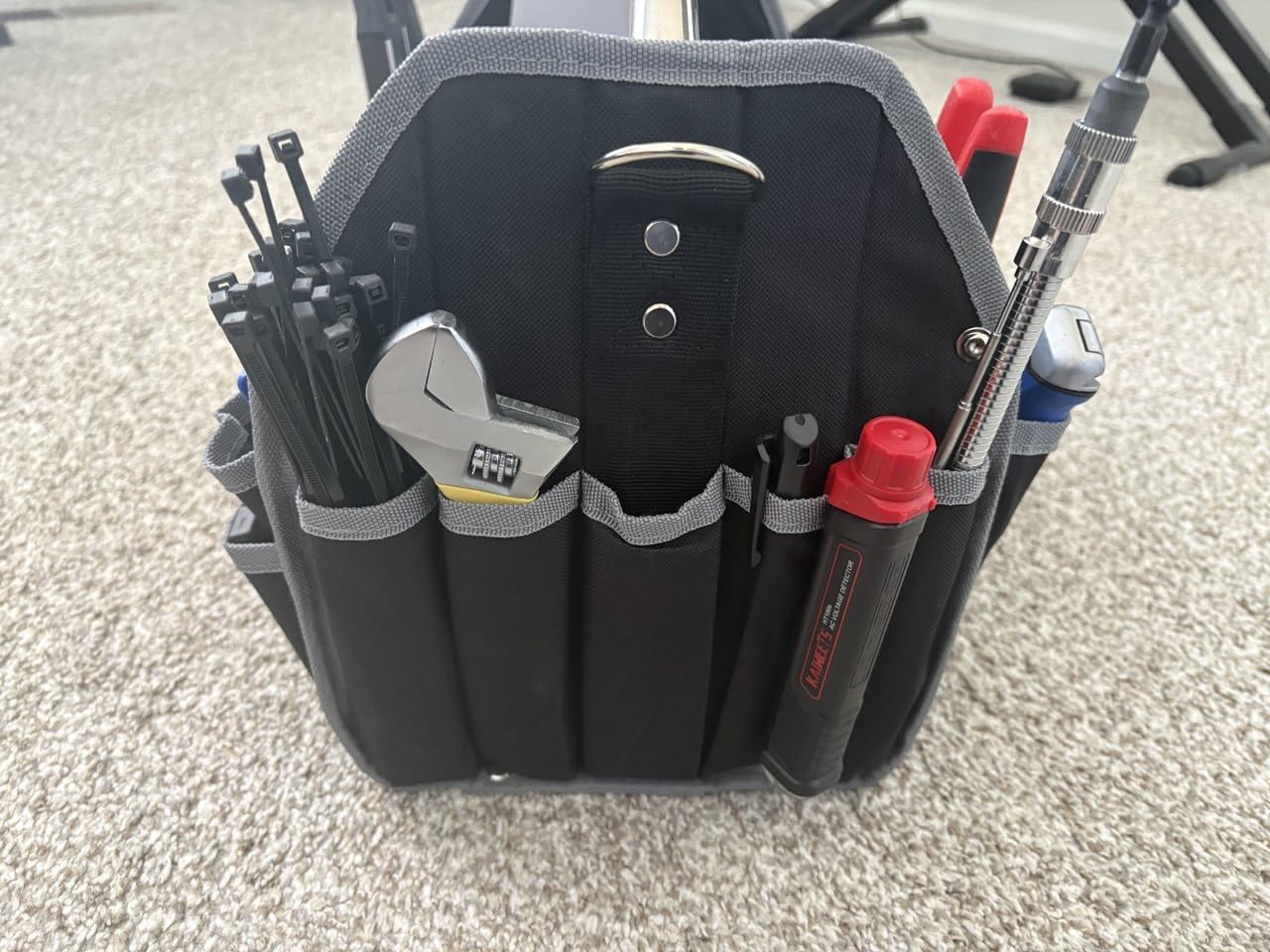
9. Kowsinde 16 Inch Open-Top Tool Tote – The Best Budget Entry
Kowsinde 16 Inch Tool Bag, Electrician Tool Bag, Open Top Tool Bags, 26 Pockets Can Hold Many Tools, Steel Handle and Removable Shoulder Strap
26 pockets
Waterproof molded base
Oxford cloth shell
16 inch
Pros
- 26 exterior and interior pockets for a low entry cost
- Waterproof molded base keeps tools off wet ground
- Foam-padded handle and adjustable removable shoulder strap
- Folds flat for storage between jobs
- Rated up to 44 pounds
Cons
- Open top offers no security when the bag is unattended
- Stitching and hardware are lighter than premium brands
This is the honest budget answer. Twenty-six pockets, a waterproof molded base, and an open top at a price point that does not require a serious commitment, with a 4.7 rating across more than 600 reviews and 83 percent of buyers giving five stars. The listed maximum weight recommendation of 44 pounds is higher than any other bag in this roundup, though we would treat that figure as a structural rating rather than a comfort rating.
The shell is 600D Oxford cloth with reinforced stitching, which is a lighter fabric than the 1680 denier ballistic weave used on the Klein and Milwaukee models. In practice that means it suits indoor and residential work better than mud and rough-in. The foam-padded handle and adjustable removable shoulder strap make it more comfortable to carry than the cheapest competing totes, and the foldable design lets it flatten for storage in a van between jobs.
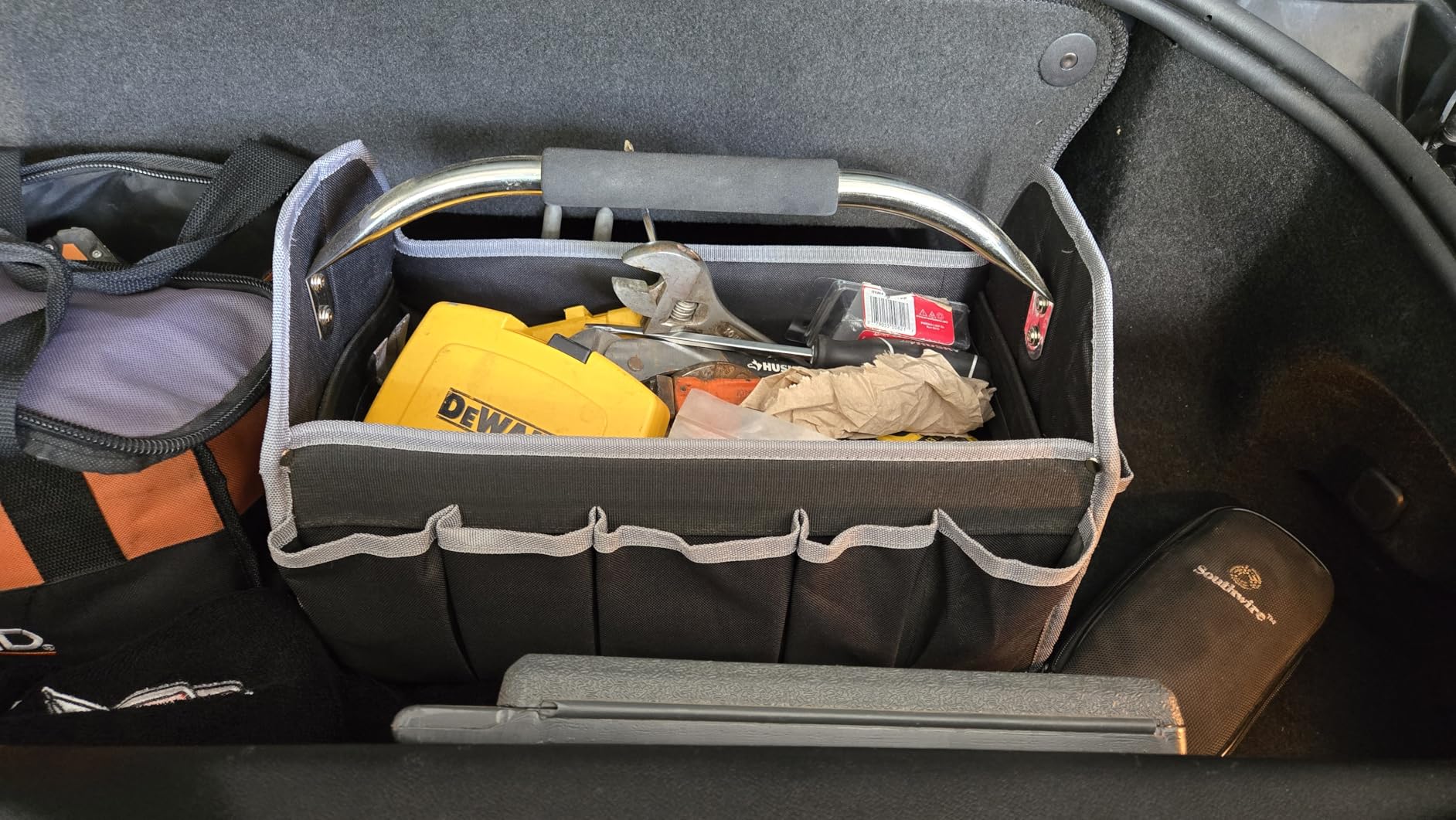
Two limitations, both predictable. The open top is fast but offers no security when you set the bag down and walk away, so it does not work unattended on a job site. And the stitching and hardware are lighter-weight than premium brands, which is exactly where the money was saved. At 16 by 8.6 by 10.6 inches, the size sits between the compact DEWALT tote and the larger Klein carrier, which makes it a good middle-size load.
Color options include orange and grey, and orange is the one to pick if you care about finding small parts. Reviewers consistently describe this as the value pick of the group, praising the pocket count and the waterproof molded base. For an apprentice starting out, or for a second bag for consumables in a van, the tradeoff against a premium tote is straightforward and we would make it without hesitation.
Who the Kowsinde tote suits
It suits apprentices buying a first bag, residential and remodel electricians working indoors, and anyone who wants a second bag for consumables, fasteners, and fittings alongside a backpack. The fold-flat design is genuinely useful in a van or a rental. It is also a good loaner or trainee bag, since a scuffed lower-cost bag is easier to hand to a new hire.
Where it falls short
It falls short on heavy outdoor work, where 600D Oxford cloth and lighter hardware wear faster than ballistic weave with reinforced stitching. The open top will lose small hardware if the bag is left unattended or knocked by a ladder. If you keep tools in it for years rather than months, upgrade to a molded-base bag with a stronger shell.
10. Milwaukee 48-22-8201 Ultimate Jobsite Backpack – The Best Warranty Coverage
Milwaukee Electric Tool 48-22-8201 Ultimate Jobsite Backpack
48 pockets
1680D ballistic canvas
Load-bearing harness
Lifetime warranty
Pros
- 48 pockets give top-tier organization
- 1680D ballistic canvas rated for durability
- Load-bearing harness spreads weight across the body
- Stands upright with meters and tape on the outside
- Limited lifetime warranty
Cons
- Heavier than expected even when empty
- Not water resistant
- Some owners report main zipper failure after a couple of years
The warranty is the headline on this one. A limited lifetime warranty on a fabric tool bag is unusual, and it changes the calculation for anyone planning to keep a bag for a decade or pass one down. The 4.7 rating sits across more than 400 reviews with 87 percent five-star feedback, and reviewers point to tough build, an upright stance, and abundant compartments as the recurring strengths.
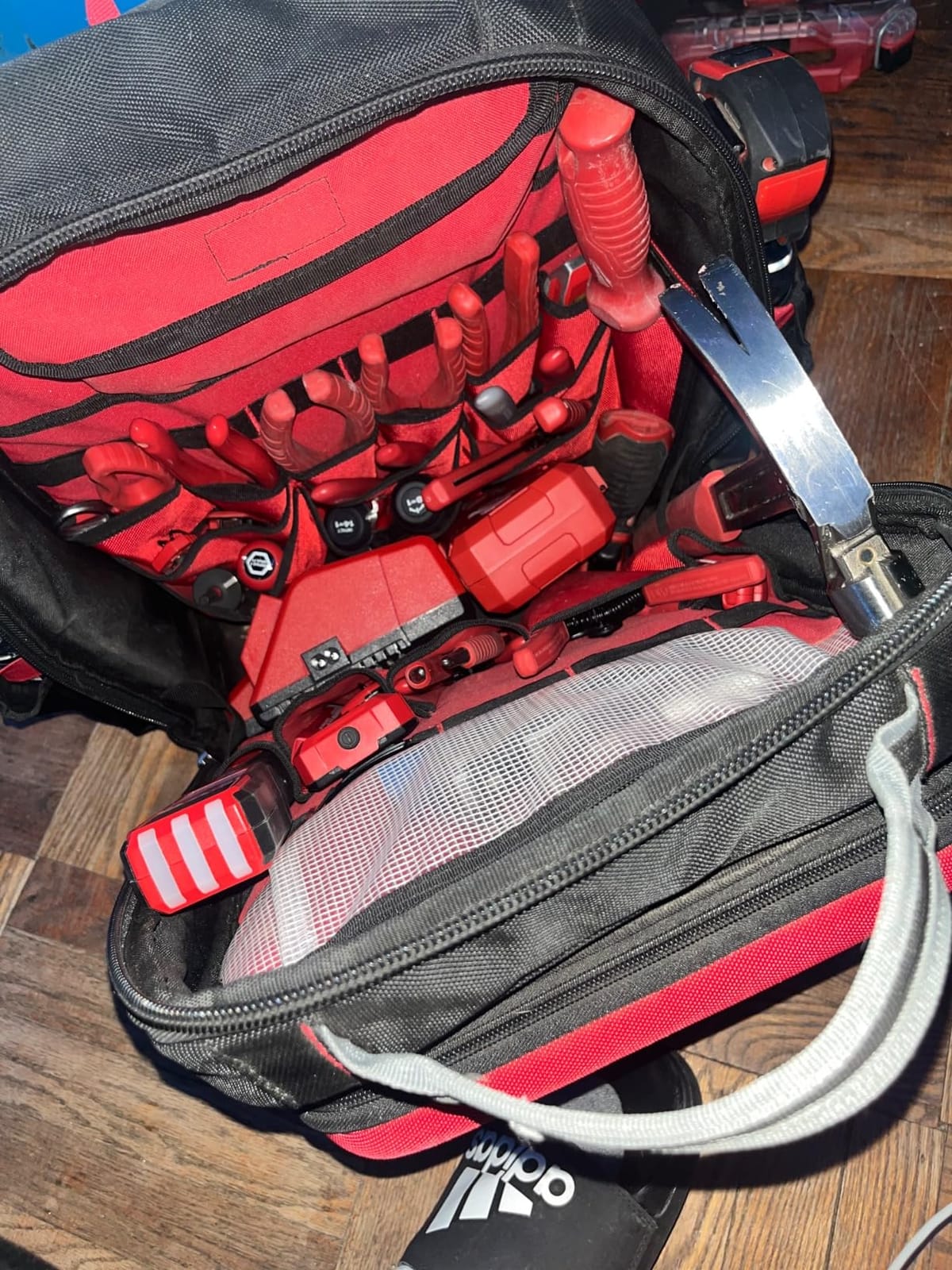
Forty-eight pockets put it in the same organizational tier as the Klein 55485, but the storage is arranged to be reachable from outside the pack, with meters, nut drivers, pliers, utility knives, and electrical tape. The shell is 1680D ballistic canvas, the same fabric weight as the Klein tote, and the load-bearing harness is designed to spread weight across the body rather than onto both shoulders alone. The bag stands upright on its own, which matters when you are sorting tools on a drop cloth.
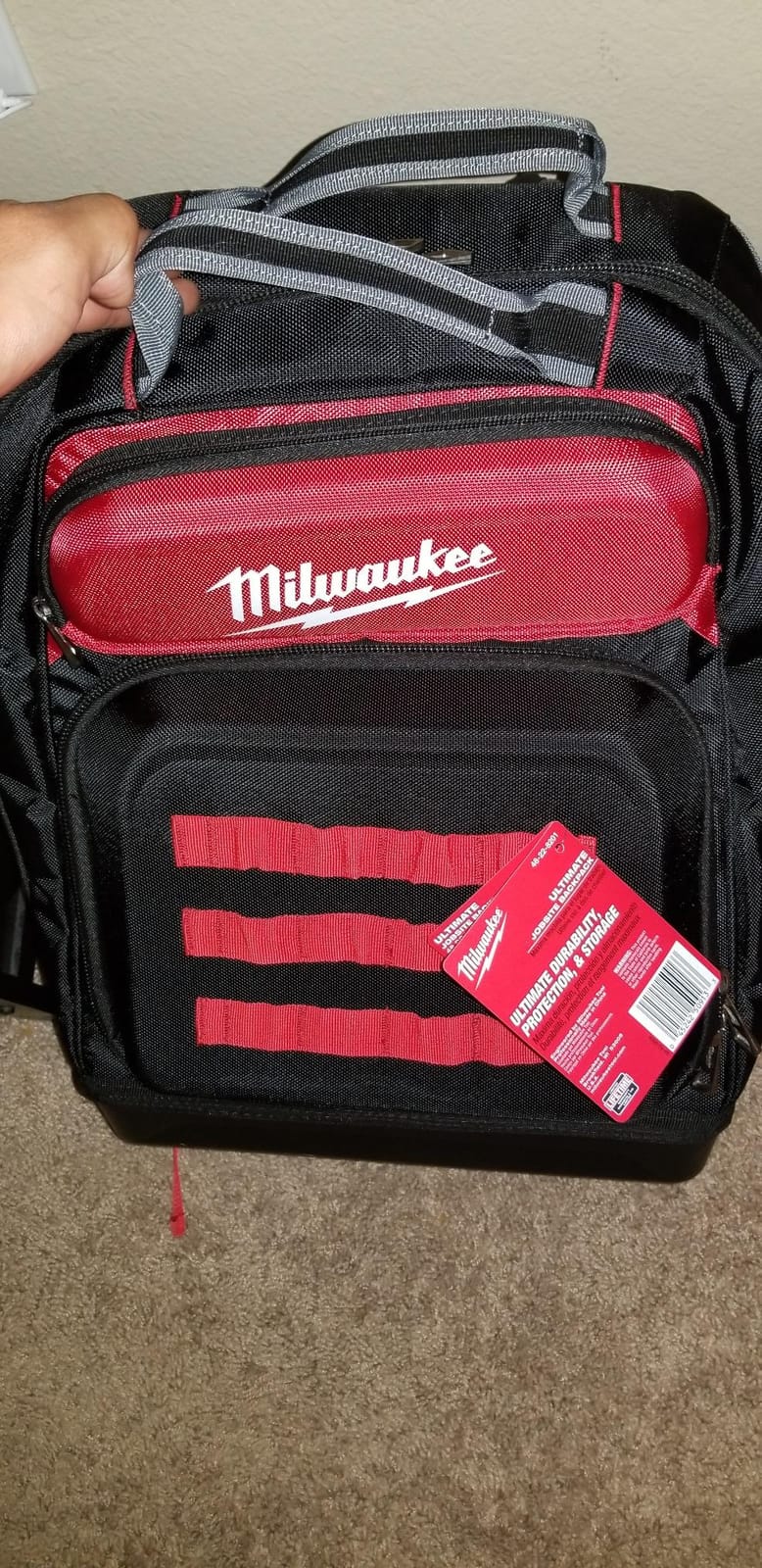
The reported weight is a low figure for a 20 by 15 by 11 inch bag, and owners still describe it as heavier than expected when empty, so do not read the listed number as a loaded-carry estimate. The water resistance level is listed as not water resistant, and there are isolated reports of the main zipper failing after a couple of years despite the lifetime warranty, which is a good argument for keeping your receipt. A 20 by 15 by 11 inch footprint is also one of the largest here, so plan the vehicle.
The 1.5 pound listed weight and 2 pound recommended maximum figure look inconsistent with the size, so we would not rely on either number for a load decision. What the rating and warranty genuinely support is this: if you want the most compartments from an established brand with the strongest written coverage in the category, this is the bag. If you need something waterproof or light, look elsewhere in this list.
Who the Milwaukee backpack suits
It suits electricians already invested in Milwaukee tools who want the same ecosystem and the strongest warranty in the category. The outside-facing tool layout makes it a good fit for anyone who sets the bag down and works from the outside rather than unpacking. Fasteners, consumables, and bits all get defined homes, which suits remodel and finish work.
Where it falls short
It falls short in wet conditions because the bag is not water resistant and has no molded base. The zipper reports, while isolated, are worth factoring in if you are buying this as a long-term daily bag. The large footprint also means it eats cargo space, so it is a poor choice for anyone working out of a compact car.
11. Veto Pro Pac MB3 Diagnostic Bag – The Best for Meters and Testers
Veto Pro Pac MB3 (Large Sized Zippered Diagnostic Bag)
13 pockets
2 padded meter pockets
YKK zippers
3 lb
Pros
- Two padded interior pockets sized for 1-4 meter instruments
- 13 pockets for probes and small hand tools
- YKK zippers and a ruggedized reinforced bottom
- Tarpaulin-covered rear pocket resists weather and abrasion
- Detachable oversized handle with tape strap
Cons
- Compact footprint limits capacity for larger tool collections
Most of this list is aimed at electricians who carry hand tools. This one is for the other half of the trade: the diagnostic technicians who carry meters, probes, and test equipment and need it protected rather than simply organized. The large main pocket has two padded interior pockets sized specifically for 1-4 meter instruments, which is the reason this bag earns a 4.8 rating across more than 400 reviews with 89 percent five-star feedback.
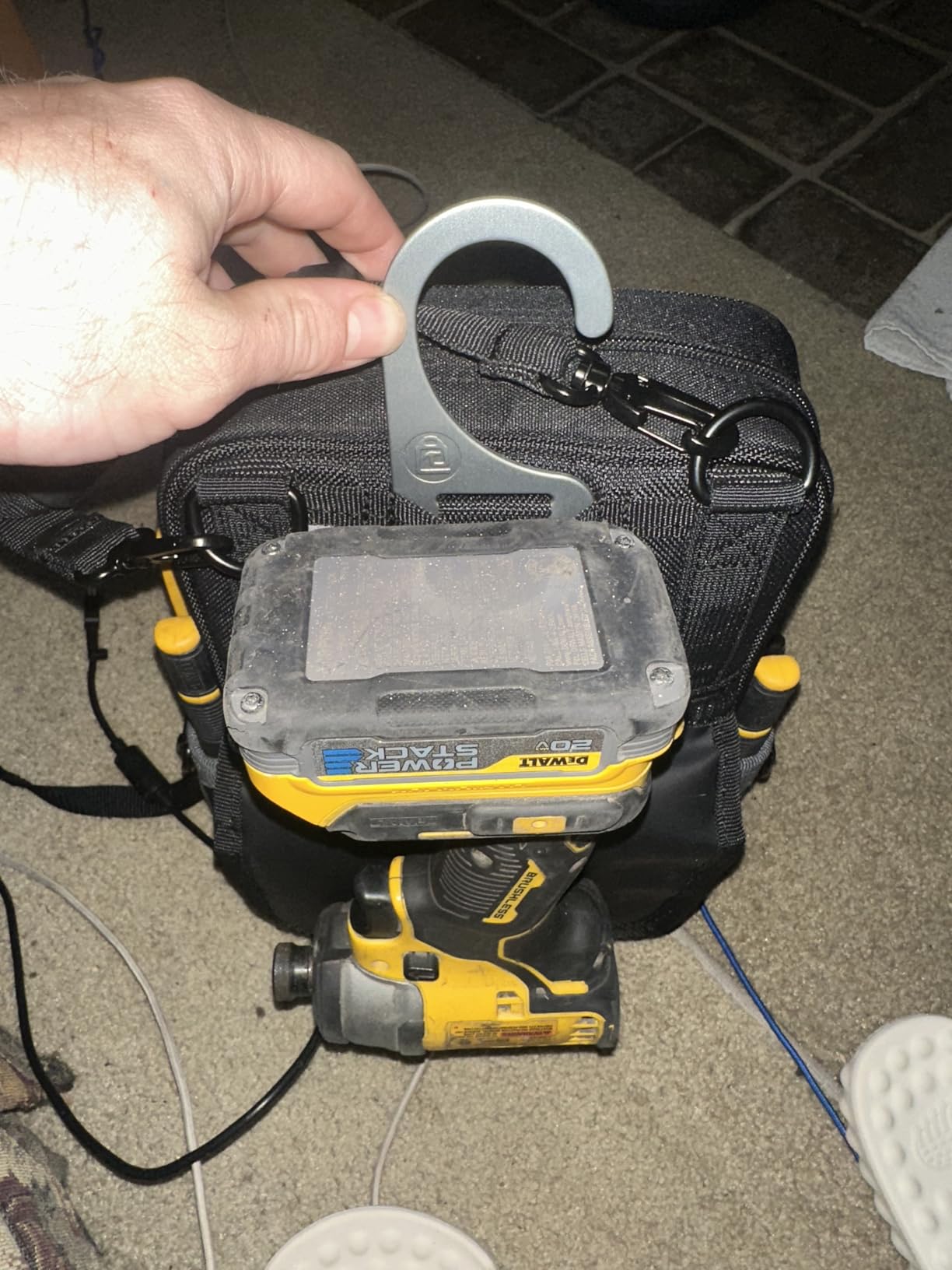
Thirteen pockets handle wireless probes and small hand tools without turning the bag into a general carrier. YKK zippers are a genuine upgrade over generic hardware, the bottom is reinforced and ruggedized, and the rear pocket is tarpaulin-covered for weather and abrasion protection. A detachable oversized elastomeric carrying handle with an electrical tape strap means the bag can be held in one hand while you clip leads. The warranty is 5 years, and the listed weight is 3 pounds.
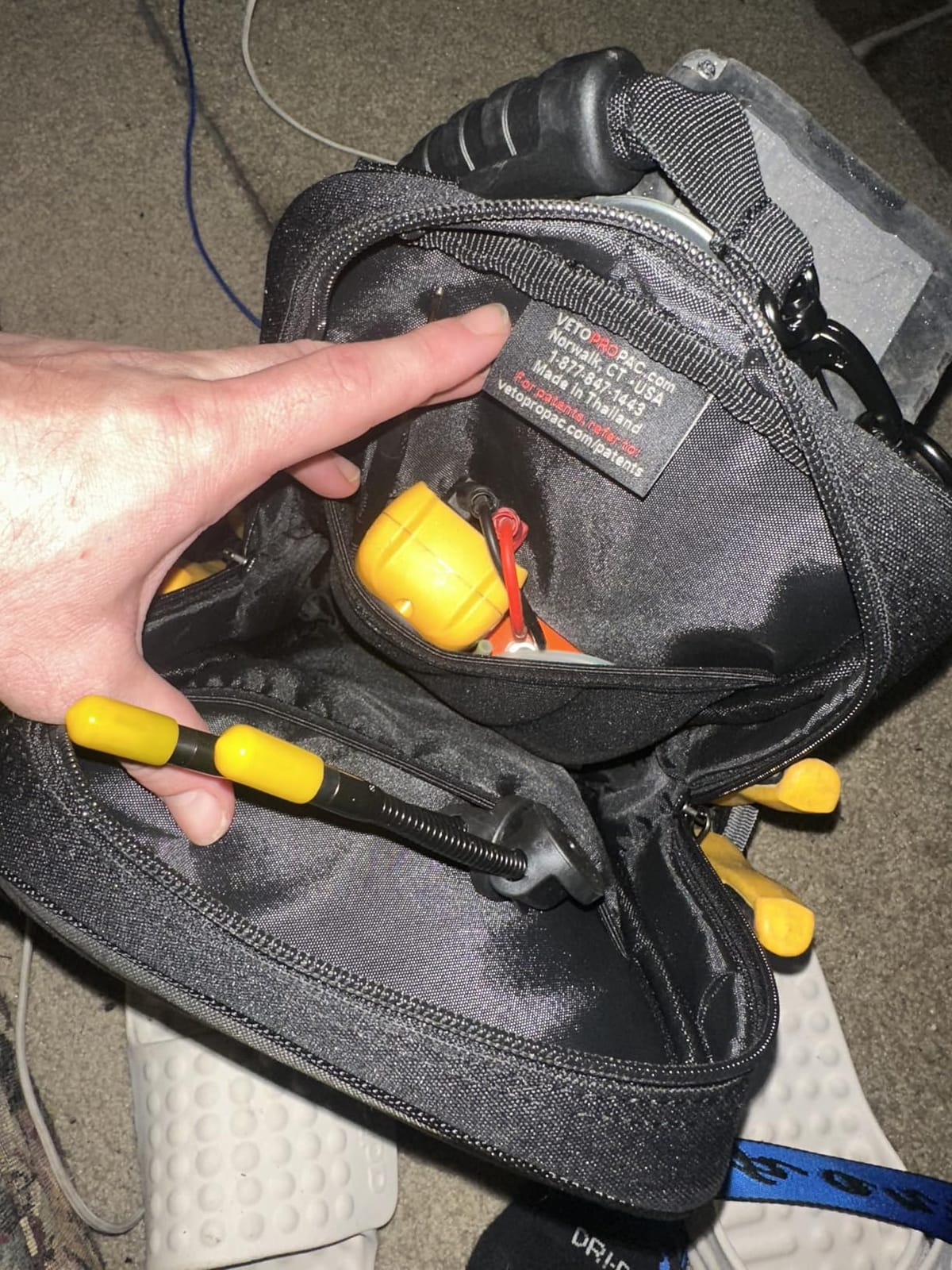
There is really one drawback, and reviewers say it plainly: the compact footprint limits capacity for larger tool collections. At 11 by 11 by 14 inches with 13 pockets, there is nowhere to put a full hand tool load, drill bits in quantity, or a box of connectors. This is a specialist bag, and buying it as your only carry would be a mistake for a working installer. The listed size is 11 by 14 by 5 inches, so measure what you intend to put in it before you commit.
Color options include black, yellow, orange, and the original pattern, and for a testing bag the yellow or orange is worth taking for the same visibility reason as everything else on this list. If you already carry a tote or a belt for tools, this is the piece that makes the system complete rather than redundant. It shares the Tech Pac padded-pocket design language without the backpack bulk, so for anyone whose load is instruments rather than hand tools, that is the trade you are making.
Who the MB3 suits
It suits commissioning and fault-finding technicians, low-voltage and data testers, and anyone carrying thermal imaging or clamp meter equipment. The padded instrument pockets protect screens and connectors in transit in a way an open tote never will. It also works well as a range bag, since the compact size and detachable handle suit a vehicle setup.
Where it falls short
It falls short as a general carry, because 13 pockets and a compact footprint will not accept a working electrician’s hand tool load. Anyone who needs both tools and instruments on a ladder should pair it with a pouch or belt rather than trying to overload it. It is also not the bag to reach for when you are moving around unfinished construction.
12. DEWALT 11 Inch Electrician Tote – The Best Compact Tote
DEWALT Tool Bag, Electrician Tote, Tool Storage and Organization, Durable and Water Resistant, 11 Inch (DWST560105)
34 pockets
IP54 water-resistant compartment
1680 denier
Injected plastic feet
Pros
- IP54 water-resistant compartment with injected plastic feet
- 1680 denier fabric with dirt-repellant tarpaulin
- 34 pockets for small hand tools and consumables
- Yellow hi-vis internal fabric makes tools easy to locate
- Zippered front compartment for valuables
Cons
- Small 10 by 9 inch footprint limits bulky tool capacity
- Zippered closures are slower than an open tote for frequent access
The DEWALT tote is the compact option, and it is a better one than most compact bags because of the weather sealing. The main compartment is rated IP54 water resistant with injected plastic feet that lift the bag off wet ground, and the shell is 1680 denier fabric backed by dirt-repellant tarpaulin. It holds a 4.7 rating across more than 300 reviews with 87 percent five-star feedback, and reviewers highlight the hi-vis lining and the sealing.
Thirty-four pockets is a genuinely high count for a bag this size, because the interior is organized rather than a single open cavity. The yellow hi-vis internal fabric solves the black-interior problem that owners of dark-lined pouches complain about, which makes it easier to find a wire nut in an unlit panel. A zippered front compartment keeps personal items and documents separate from the tools, which is a small quality-of-life win on service calls.
The constraint is the 10 by 9 by 15 inch footprint, and reviewers call it out directly: bulky tool capacity is limited. This is a bag for a small hand tool load, consumables, and a tester, not for a day’s worth of large tools. The zippered closures are also less convenient for frequent tool access than an open tote, which is a real friction point when you are reaching for a specific screwdriver several times an hour.
The listed maximum weight recommendation of 55.1 pounds is far higher than the size implies, and we would not plan a load around that figure. What matters is the combination of IP54 sealing, injected feet, 1680 denier fabric, and hi-vis lining, which together make this the most weather-conscious tote in the group. For a residential service tech who carries a small load and works in basements, garages, and damp crawl spaces, that combination is worth more than extra capacity.
Who the DEWALT tote suits
It suits residential service calls, maintenance work, and low-voltage or data technicians who carry a light, defined load. The hi-vis yellow interior is a genuine advantage in panel rooms and unfinished basements. It also works well as a consumables and parts bag kept in a van, where the zippered front compartment keeps the contents organized.
Where it falls short
It falls short for anyone carrying bulky tools, because the footprint is the limiting factor and no amount of pocket count changes that. Frequent access on a ladder is slower with zippered closures than with an open top. For a first full tool bag, choose a larger open-top tote instead and keep this one for the light load.
Backpack, Tote, or Belt: Which Style Fits Your Work?
Style matters more than brand, and the fastest way to pick is to count how far you walk and how much you carry. Backpacks are for distance and volume, totes are for set-down-and-work, and belts are for nothing more than a quick grab on a ladder.
A backpack is the answer when you carry a lot over distance or work hands-free on ladders, since the load sits on your back and both hands stay free. The tradeoff is access speed, because you have to remove the bag to reach a tool. A tote is the answer when the bag goes in the truck and gets carried to one job, since it opens wide, stands up, and holds consumables. A belt is the answer when your tools are within a few items of what you can comfortably carry.
Pouches belong in a different category again. They are not primary carry bags, they are organizers that live inside a tote or ride on a belt, and the CLC 1509 is the clearest example. ElectricianTalk threads on the Veto lineup concentrate on the same decision, and the honest summary is that the best bag for an apprentice is often not the best bag for a master, because the tool list changes rather than the taste.
Loaded Weight and Backpack Fatigue
The most common complaint across the review record is weight, and the listed empty weights make the problem concrete. The Klein 55485 backpack is 13.2 pounds empty. The Veto Tech Pac is 9 pounds. The Klein 5541610-14 tote is 6 pounds, the DEWALT tote is 5 pounds, the Veto TP-XXL is 5.5 pounds, the Gatorback belt combo is 5 pounds, and the CLC 1530 is 3 pounds. Every one of those figures becomes a load multiplier the moment you add hand tools.
Forum complaints about the Klein pack weighing over 13 pounds without tools are not exaggerated, because that figure is the manufacturer’s own listed weight, and reviewers of the Veto Tech Pac describe upgrading specifically to escape that feel. The Tech Pac is not light at 9 pounds, but its padded straps and EVA back padding spread the load, and its 25 liter capacity means fewer duplicate tools get carried.
The practical rule is that anything above roughly 10 pounds empty should be a short-haul bag. For anything longer, prefer a tote you carry in one hand, a belt with no dead weight, or a pouch, and accept that you will make two trips. Buyers of the CLC 1509 and the Gatorback belt make this trade deliberately: they carry less, and they report being comfortable all day. The Milwaukee pack lists a low empty weight but is still described as heavier than expected empty, so test before committing.
Open-Top vs Zippered Bags: The Real Tradeoff
This is the most argued question in electrician forums, and both sides have a real point. Open tops are faster because there is no zipper to work with gloved hands, which is why the CLC carriers and the Kowsinde tote appear near the top of this list for service work. The cost of open-top speed is security, since a bag left open on a job site loses small hardware, and nothing stops a tool rolling out when the bag is knocked.
Zipped bags trade a little speed for containment, and that is the right call when the bag travels, sits unattended, or carries loose consumables. The Veto TP-XXL and the CLC 1509 solve it more cleverly than a simple on or off choice, because the TP-XXL has an open hang-up hook that works whether the bag is closed or not, and the 1509 keeps tools in place when laid on its side.
The middle answer most people land on is a zippered tote for the van and an open top for the job. Forum participants make the same point from different directions: a bag that lives in the truck should zip, and a bag that sits on a drop cloth should not. Whichever you choose, buy one with a bright interior so you are not hunting through a dark cavity for a wire nut. Our storage-focused tested picks make the same design argument for a different category.
Which Veto Pro Pac Bag Fits Your Job?
Veto dominates this category, and the lineup is confusing because the model names do not describe the use. Here is what each of the three we tested actually is, and where the others in the range sit.
The Tech Pac is the flagship backpack. Forty-six pockets, a weatherproof molded base, a padded tablet sleeve, and a 5 year warranty make it the all-round answer for anyone carrying a full hand tool load. The TP-XXL is the modular shoulder pouch, built around the V-SWAP removable panel system, with 47 pockets, two padded meter pockets, and a 12 liter footprint. The MB3 is the diagnostic bag, with two padded interior pockets sized for 1-4 meter instruments and a much smaller overall capacity.
Other models in the range come up constantly in the same forum threads, including the Tech Pac LT as a smaller sibling to the Tech Pac and the Tech EC, which one ElectricianTalk participant called the best bag they have owned. Without testing data for those models we will not rank them here, but the pattern holds: the LT is the reduced version of the Tech Pac, and the EC is the case-oriented variant. ElectriciansForums participants report owning both the Tech Pac and the Tech XL, and the same advice applies to any of them: the difference is capacity and closure, not build quality.
How to Choose an Electrician Tool Bag
Eight criteria decide it, and working through them in order prevents most of the decision paralysis that shows up in the forums. We would work through them ourselves before spending anything.
- Match the style to the job, not the brand. Backpack for distance and volume, open tote for set-down-and-work, belt for quick access, pouch for organization. Buying a premium bag in the wrong style is the most common expensive mistake.
- Check the base. A molded or rigid base is the single biggest durability upgrade. It is why the Veto Tech Pac, the Klein totes, and the Kowsinde tote stand upright and why the CLC 1530 needs a rigid internal bar in its handle instead.
- Demand a bright interior. Orange or yellow lining is the difference between a two-second grab and a full dump of the bag. The Klein 5541610-14, the DEWALT tote, and the orange and hi-vis Veto colorways all do this; dark-lined pouches are the most common complaint in reviews.
- Count real pockets, not marketing pockets. Brands count sleeves, dividers, and webbing loops. Compare the number of tool slots that hold a specific tool at a specific angle rather than the headline total, since the 77-pocket pack and the 34-pocket tote are not that far apart in usable space.
- Read the empty weight and add to it. Nine pounds and 13.2 pounds empty become very different bags once a full hand tool load is added. If you walk more than a few minutes, keep the empty weight modest.
- Confirm the closure matches the environment. Open top for speed on a drop cloth, zipper for travel and unattended storage, and a high-visibility interior regardless of which you choose.
- Look for electrical-specific storage. Meter pockets, a tester slot, an electrical tape strap, and a bit slot are what separate an electrician bag from a generic mechanic bag. The Veto TP-XXL, CLC 1530, Milwaukee pack, and MB3 all do at least some of this well.
- Check the warranty and the details. A 5 year limited warranty on the Veto bags and a limited lifetime warranty on the CLC 1530 and Milwaukee pack are meaningfully different from one-year coverage. Also check the return path, since belt sizing is the one place where getting it wrong is most common.
Budget is the last question, not the first. Apprentice forum participants are explicit about not wanting to drop crazy money on a first bag, and the practical order of purchase is a tote first, then a belt, then a backpack once the tool list settles. Our tested gear picks take the same buy-first-verify-later approach, but a bag is different: the bag follows the tools rather than the other way around.
What Working Electricians Say in the Forums
Community consensus in this category is loud and tribal, so here is what the actual threads say rather than what the marketing pages claim. On r/electricians, one working electrician called the Klein tool runner the best bang for the buck, noting that it is almost a Veto and easy to get at any big-box store. The same thread also records the complaint that a Klein pack weighs over 13 pounds without tools, which matches the listed manufacturer weight of 13.2 pounds.
On r/VetoProPac, a user describes the quality difference between an older Klein 55431 and a Veto as marked, while conceding that Klein, Milwaukee, or Husky might be a good option depending on the job. That is the most useful Veto take in the thread, because it separates build quality from suitability. On ElectricianTalk, the recurring question is which Veto model to buy, and the answer there is that the Tech EC is already the best bag that person has ever owned, while also owning the Tech Pac and Tech Pac LT.
On ElectriciansForums, a user with two Veto bags, the Tech XL and the Tech Pac, calls them very well made and worth the cost. On GarageJournal, the practical pick for electrical and low-voltage work is a Husky at Home Depot, alongside a general preference for FatMax bags. The pattern across all five sources is consistent: durability and loaded comfort outrank brand, and the bag that survives is the bag people still own three years later.
Frequently Asked Questions
What is the best tool bag for an electrician?
The Veto Pro Pac Tech Pac is our top pick because the 3mm molded polypropylene base keeps it upright, 46 pockets give every hand tool a slot, and the padded straps make a heavy load bearable. Electricians who prefer an open top and want less weight usually settle on the Klein Tools 5541610-14 tote instead.
What are the top electrician tool bags?
Our shortlist covers four styles: the Veto Pro Pac Tech Pac and Klein Tools 55485 for backpacks, the Klein 5541610-14, CLC 1530, Kowsinde 16 inch tote, and DEWALT 11 inch tote for open carry, the Gatorback B240 for belts, and the CLC 1509, Veto TP-XXL, and Veto MB3 for pouches. The WELKINLAND pack and Milwaukee jobsite backpack round out the backpack options.
Which Veto Pro Pac bag is best for electricians?
For a full hand tool load carried over distance, the Tech Pac is the answer: 46 pockets, a weatherproof molded base, a padded tablet sleeve, and a 5 year warranty. For testing and modular layouts, the TP-XXL offers V-SWAP removable panels and two padded meter pockets. For meters alone, the MB3 has padded pockets sized for 1-4 instruments.
Are Klein backpacks good?
They are among the most reviewed bags in the category. The Klein 55485 carries 48 pockets, a removable tool caddy, a molded waterproof bottom, and lockable zipper pulls across more than 2200 reviews. The main drawback, repeated by owners, is the listed 13.2 pound empty weight, which is what drives many buyers toward a lighter pack.
Should electricians use a backpack or a tote?
Use a backpack when you carry a lot over distance or work hands-free on ladders, since the load sits on your back. Use a tote when the bag rides in the truck and gets carried to one job, since it opens wide and holds consumables. A belt is the fastest option for small hand tools on a ladder.
How many pockets does an electrician tool bag need?
Forty to fifty usable tool pockets covers a full hand tool load for most residential and commercial work, plus external storage for meters and tape. Count the pockets that hold a specific tool at a specific angle rather than the headline total, since brands also count sleeves, dividers, and webbing loops in that number.
Final Verdict
The best tool bags for electricians are the ones that match how you move, not the ones with the biggest logo. Start with the Veto Pro Pac Tech Pac if you carry a full load over distance, the Klein Tools 5541610-14 if you want an open top with a bright interior and a manageable weight, or the Gatorback B240 if your work is mostly ladders and panels. Whatever you choose, check the empty weight before you buy and pick a bright interior every time.
Test the bag fully loaded before you commit, because pocket layout that looks right empty is a different story once 30 tools are in it. Our picks and the comparison table above are updated for 2026, and both are worth a second look when your tool list changes.