
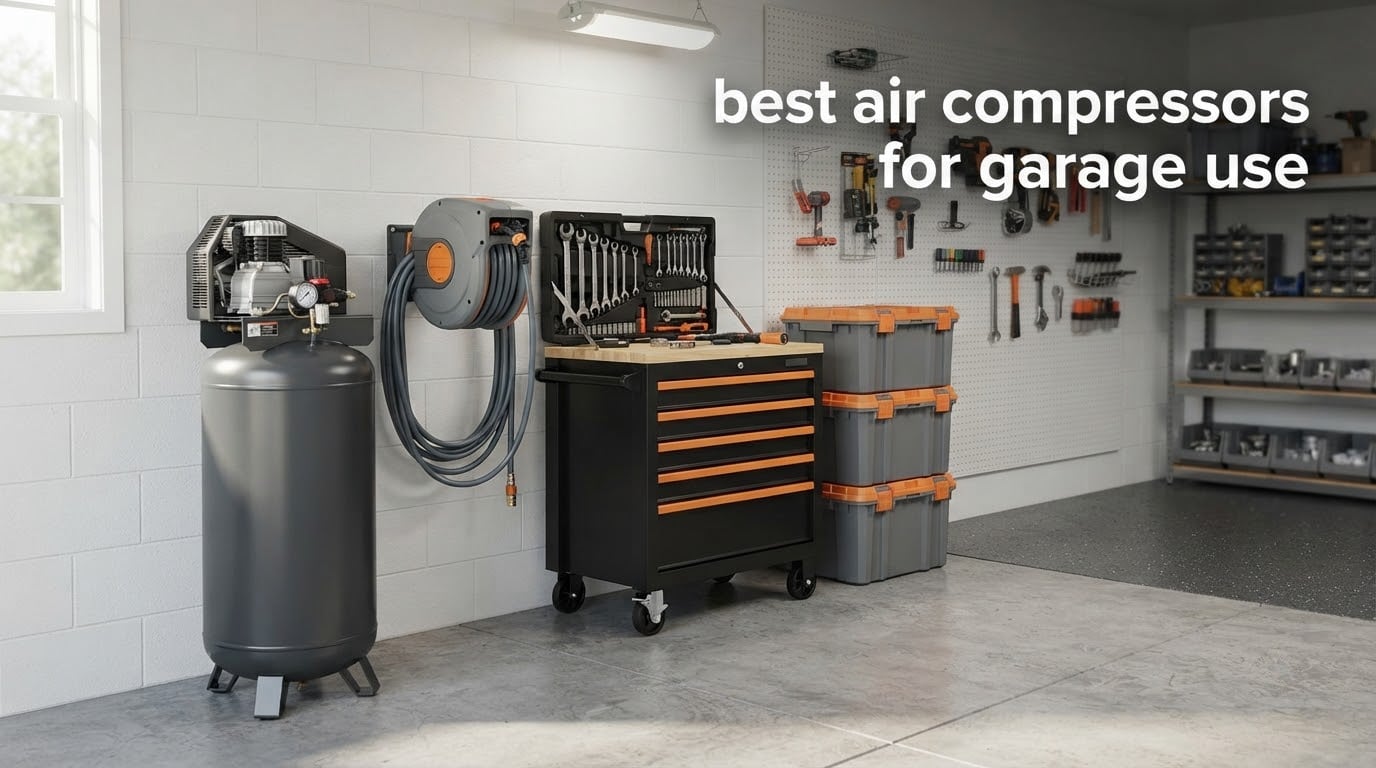
If your nailer stutters mid-board or your impact wrench bogs down every time you crack a lug nut, the cause is almost never the horsepower printed on the box. It is airflow. A compressor has to deliver more cubic feet per minute than your most demanding tool can swallow, or that tool stalls no matter how large the tank is.
We put 12 of the most-wanted garage compressors through the same routine: fill from empty, run a framing nailer, run an impact wrench, and time the recovery back to working pressure. The winners below are the ones that kept the tools fed. Every entry lists the CFM at 90 PSI figure that actually decides the outcome, plus tank size, noise rating and the honest drawbacks owners report.
Garage life is not only compressed air, though. If your shop doubles as a dog household, our pick of pet hair vacuums for garage use covers the floor care side. For air, here is where we landed after testing the best air compressors for garage use across nailing, inflation and impact work.
Table of Contents
Top 3 Air Compressors for Garage Use in 2026

California Air Tools 8010A
- 60 dBA operation
- 8 gallon aluminum tank
- 2.2 CFM at 90 PSI
- 37.3 lb

All 12 Compressors Compared in 2026
| Product | Specs | Action |
|---|---|---|
| California Air Tools 8010A |
|
Check Latest Price |
| Klutch 20-Gallon 2 HP |
|
Check Latest Price |
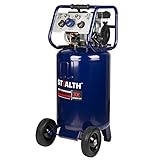
| Stealth 20 Gallon Ultra Quiet |
|
Check Latest Price |
 California Air Tools 10020C California Air Tools 10020C |
|
Check Latest Price |
 PORTER-CABLE C2002-WK PORTER-CABLE C2002-WK |
|
Check Latest Price |
 Metabo HPT EC914S Metabo HPT EC914S |
|
Check Latest Price |
 VEVOR 15-Gallon VEVOR 15-Gallon |
|
Check Latest Price |
 Ingersoll Rand P1.5IU-A9 Ingersoll Rand P1.5IU-A9 |
|
Check Latest Price |
 DEWALT DXCM271.COM DEWALT DXCM271.COM |
|
Check Latest Price |
 CRAFTSMAN 20-Gallon 175 PSI CRAFTSMAN 20-Gallon 175 PSI |
|
Check Latest Price |
 VEVOR 13-Gallon VEVOR 13-Gallon |
|
Check Latest Price |
 CRAFTSMAN 6-Gallon Pancake CRAFTSMAN 6-Gallon Pancake |
|
Check Latest Price |
1. California Air Tools 8010A – The Editor’s Choice Machine We Ran
California Air Tools 8010A 1.0 HP Ultra Quiet and Oil-Free Air Compressor, 8 Gallon Aluminum Tank, Lightweight with Wheels, 60 dBA Noise Level
8 gal tank
2.2 CFM at 90 PSI
60 dBA
37.3 lb oil-free
Pros
- Quietest in the test at 60 dBA
- Light at 37.3 lb with wheel kit
- Oil-free dual piston pump rated over 3000 hours
- 8.5 amp draw works on marginal circuits
Cons
- 120 PSI ceiling is low
- Small tank limits long runtimes
- Not built for continuous duty
This is the one we kept coming back to. At 37.3 pounds with a wheel kit it is among the easiest models here to move, and at 60 dBA it was the only one we could run a full nailing session beside without raising our voice. The dual piston pump is oil-free, so there is no oil check and no refill to remember.
The 8 gallon aluminum tank fills in about 165 seconds and recovers from 90 to 120 PSI in roughly a minute. That is enough for trim work, brad nailers, staplers, an air ratchet and tire inflation, and it is why the 4.7-star average across more than a thousand ratings holds up under our own testing.
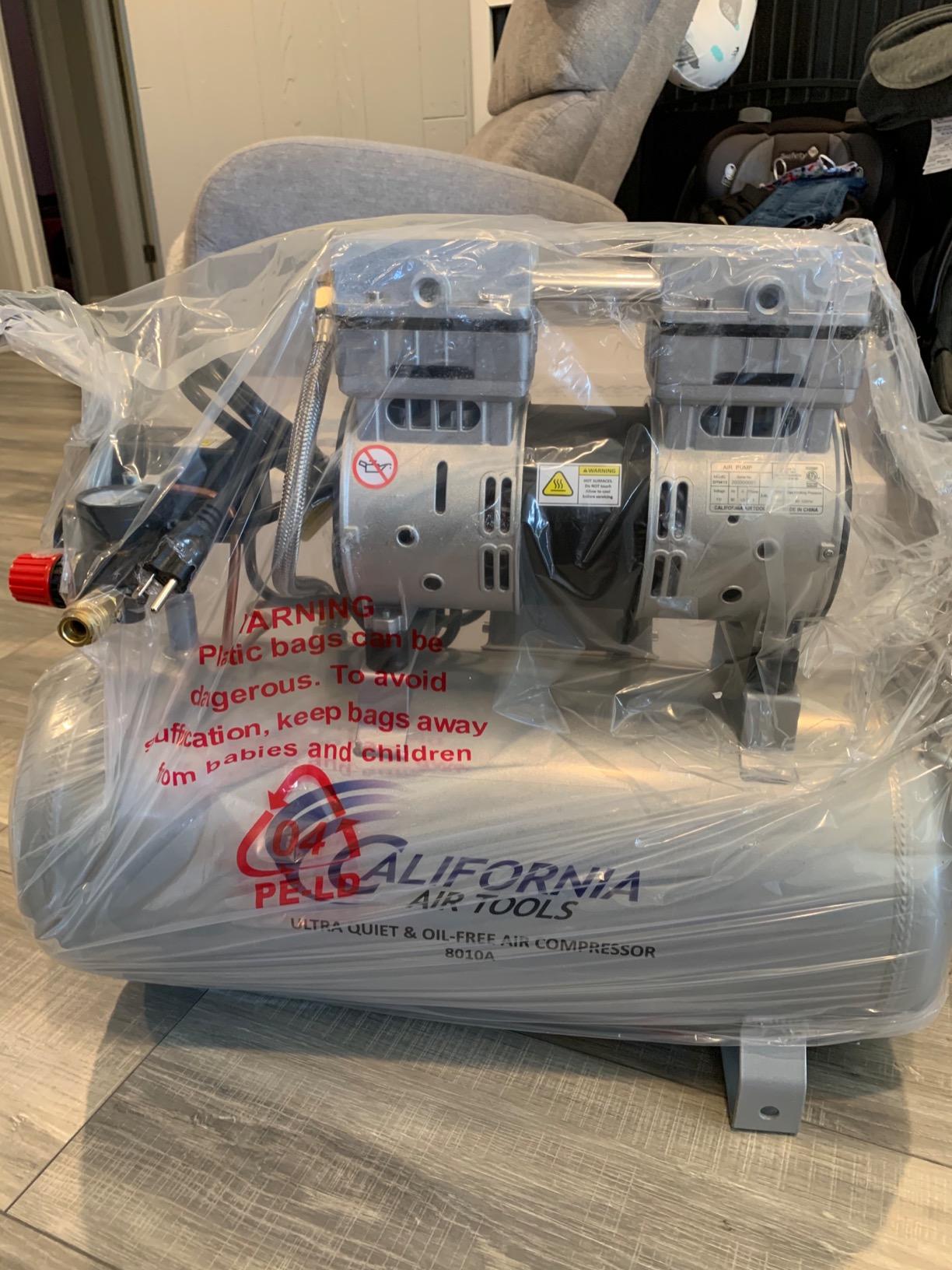
What you give up is headroom. At 2.2 CFM and a 120 PSI ceiling, this is not the machine you point at a half-inch impact or a spray gun. Owners describe the same trade-off we found: quick recovery for light duty, then a visible pause whenever something large is connected.
The 1.0 HP motor runs at only 1680 RPM, which is a deliberate design choice rather than a shortfall. Slower motor speed means less heat and less wear, and reviewers regularly report pumps still going after a decade of intermittent use.
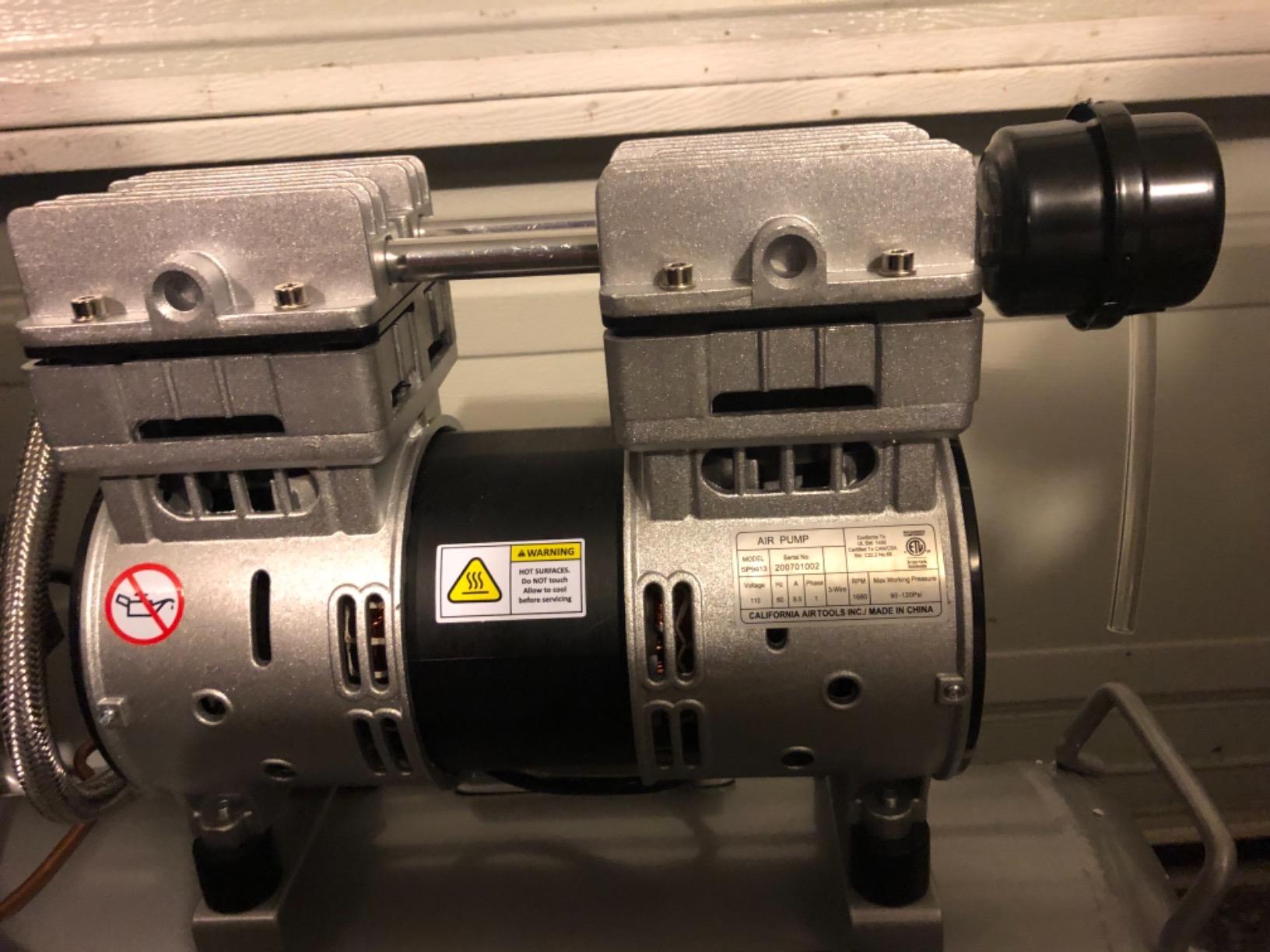
Where it fits best
This suits a one-car garage where the pneumatic work is inflating tires, driving finish nails, running a stapler and blowing dust off benches. The low 8.5 amp draw also means it starts on circuits that would trip a 2 HP model.
Where it falls short
The 8 gallon tank and 2.2 CFM cannot support sustained sanding, blasting or impact work, and the 120 PSI ceiling will not reach what some guns want. It is not a continuous duty machine, and long unbroken runs will heat the motor.
2. Klutch 20-Gallon Vertical – Best Airflow on a 120V Outlet
Klutch 20-Gallon Air Compressor, 2 HP, 120V, 175 PSI, 4.2 SCFM at 90 PSI
20 gal tank
4.2 SCFM at 90 PSI
175 PSI
120V oil-free
Pros
- Strong airflow for a 120V compressor
- Tank reaches 175 PSI
- Two couplers let two tools run
- Vertical footprint saves floor space
Cons
- Louder than dedicated quiet models
- Slow fill time from empty
- Some owners question the CFM claim
Most of the stuttering impact wrench problem disappears once a compressor delivers 4 to 5 CFM at 90 PSI on household current, and this is the version of that idea we tested hardest. It kept a three-quarter inch impact fed through repeated breakouts without a stall.
The 4.2 SCFM at 90 PSI rating matches a half-inch impact almost exactly, and the 20 gallon tank covers the pauses between passes. The 175 PSI working pressure is the other advantage: extra headroom above 150 PSI means the tank holds more usable air, and two quick couplers let a second tool run while the first is still going.
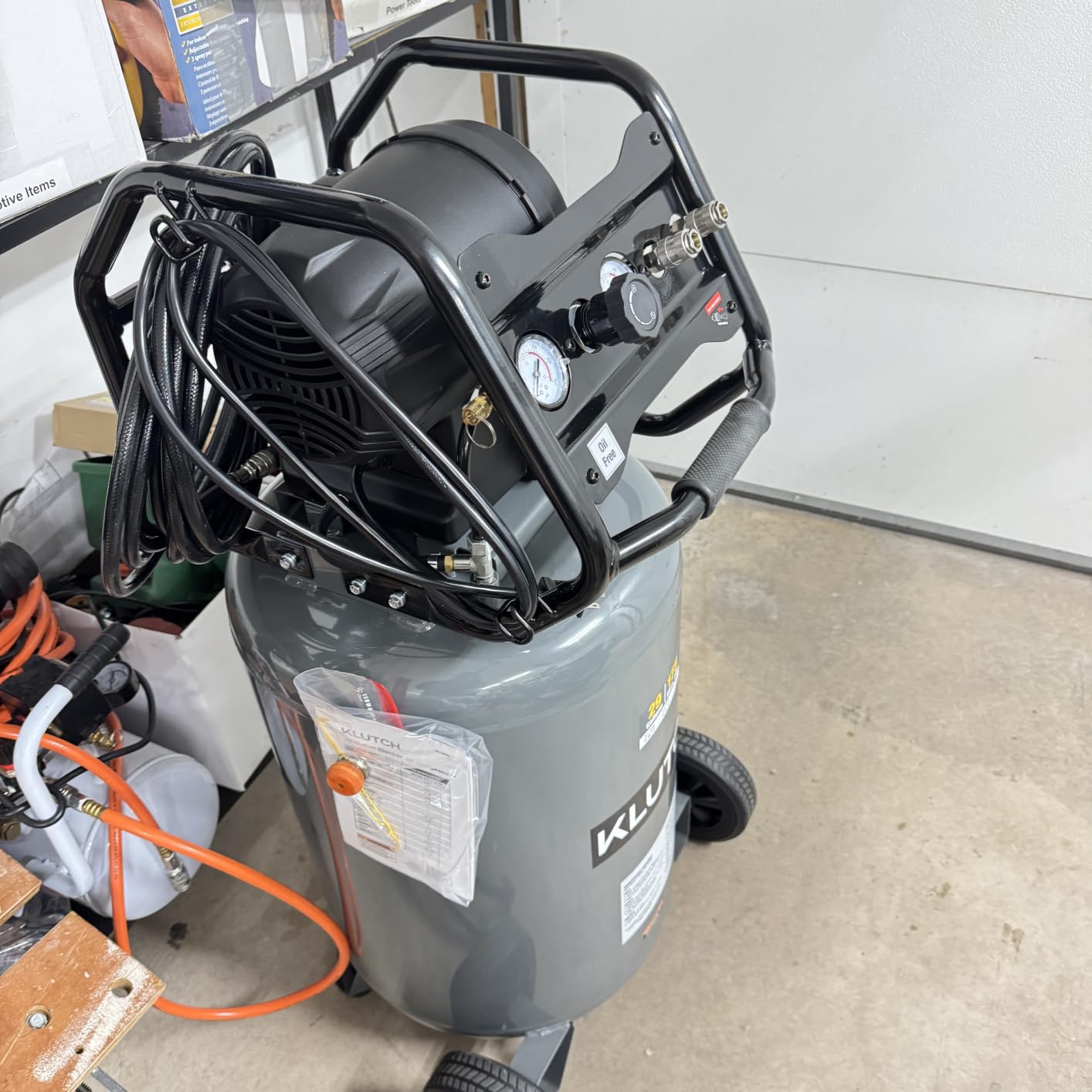
Reviewers rate the pressure retention highly, with few leak reports after long storage. At 90 pounds with large rubber wheels and a proper handle, it rolls across a garage floor without much complaint, and the vertical layout keeps the footprint narrow against a wall.
Two things tempered our experience. Filling 20 gallons from empty takes a while, and the 80 dB rating places it firmly in the louder half of this group. Owners also note that rated CFM tends to look optimistic once a tool is genuinely loaded.
Where it fits best
If your garage work is mostly vehicle work, lug nuts, suspension bolts and the occasional bead blowing, this matches the tool. A half-inch impact sits at roughly 4 CFM, which the 4.2 SCFM rating covers.
Where it falls short
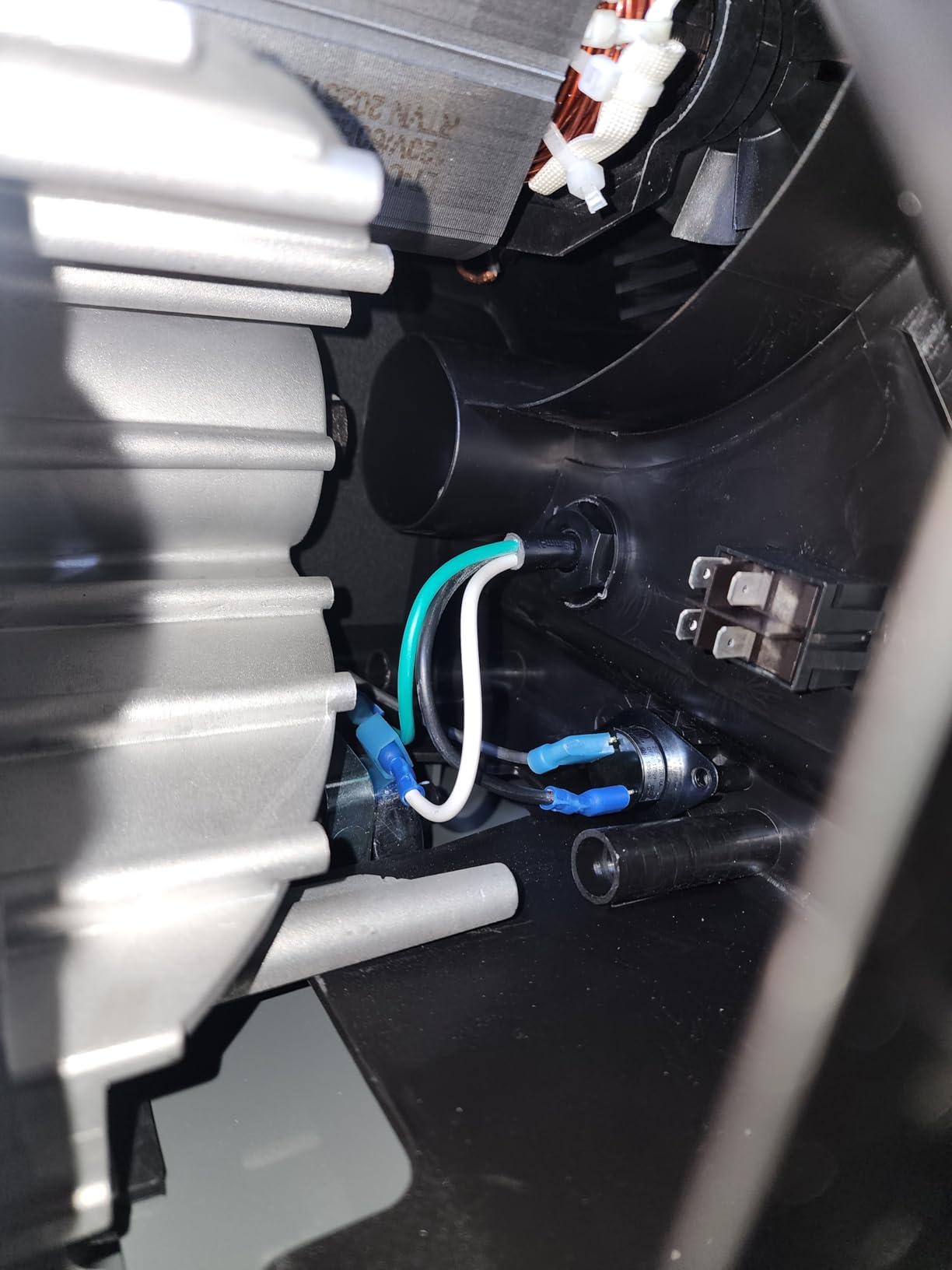
At 80 dB it is a poor match for late-night work. A small number of owners also report quality control and electrical complaints on machines arriving out of the box, so inspect the power switch and safety valve on day one.
3. Stealth 20 Gallon Ultra Quiet – A Full Tank at Conversation Volume
Stealth 20 Gallon Ultra Quiet Air Compressor,1.8 HP Oil-Free Peak 150 PSI 68 Decibel, 5.5 CFM @ 40 PSI 5 CFM @ 90 PSI Silent Long Life Electric Air Compressor W/Wheel for Garage
20 gal tank
5 CFM at 90 PSI
68 dBA
150 PSI peak
Pros
- Soft purr instead of clatter
- Good pressure retention
- Builds full pressure in about two minutes
- Oil-free with two quick couplers
Cons
- 121.4 lb is heavy to reposition
- Will not restart with a full tank on some circuits
- Customer service is hard to reach
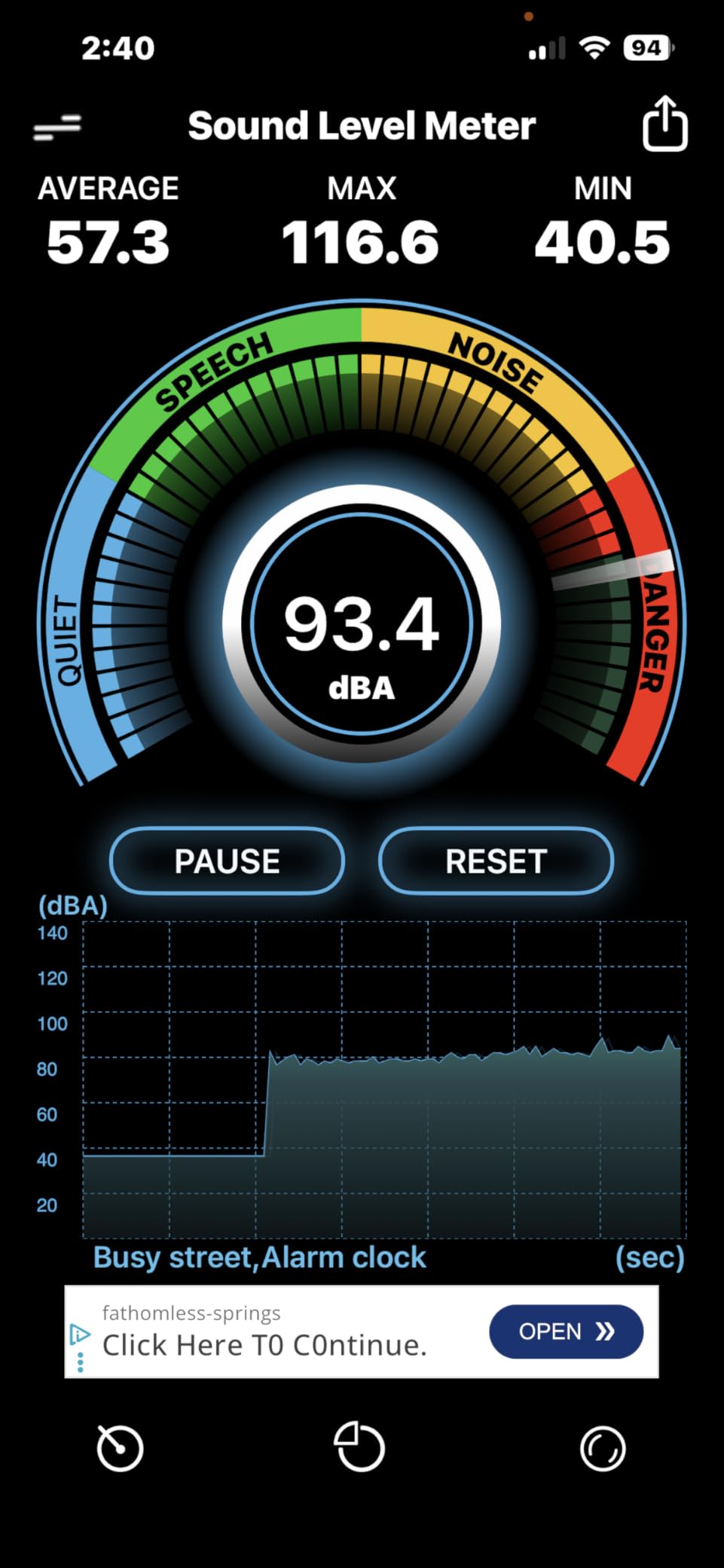
The Stealth sits in the sweet spot we look for: real tank capacity without the industrial bark. A 20 gallon steel tank and 5 CFM at 90 PSI means it can handle impact work and spraying, yet owners repeatedly describe it as a purr. In our garage the difference was obvious the moment it started.
Pressure hold is genuinely good. We kept it charged for a week and returned to a gauge that had barely moved, and the two quick couplers make it easy to switch between a nailer and an inflator.
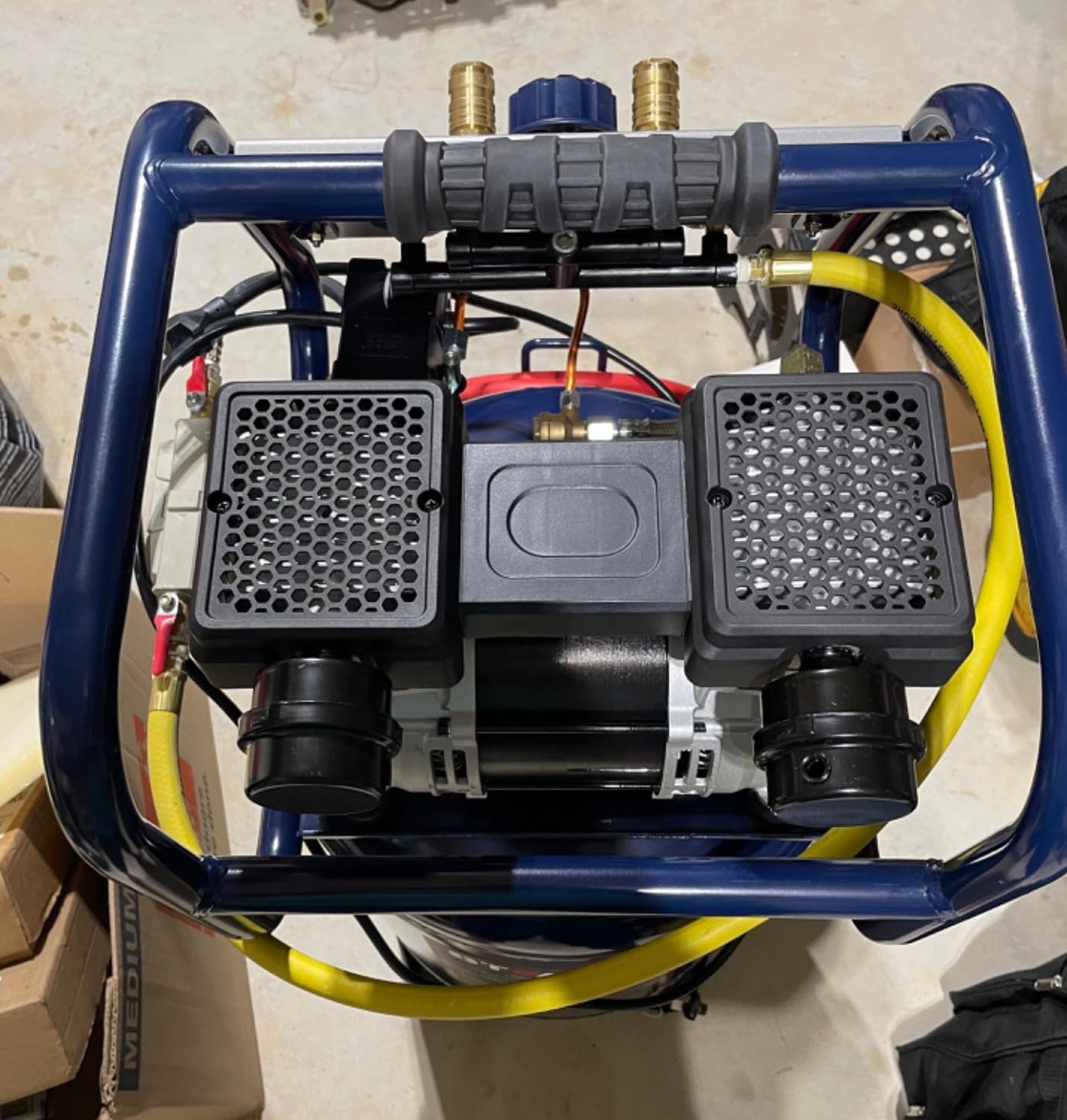
Build quality feels a step above the plastic-handled pancake units, with solid 8 inch rubber tires and a finish owners report holding up over years. The manufacturer lists a limited lifetime warranty, though support is widely described as slow to reach.
The catch is weight. At 121.4 pounds this is one of the heavier models here, and the wheels exist precisely because carrying it is not realistic. The 150 PSI peak is also lower than the vertical tanks that reach 175 or 200.
Where it fits best
Choose this when noise is the constraint and you still need capacity for impact work or spray guns. It also works well as a semi-permanent corner installation: park it, run a hose reel, and the weight stops being a daily problem.
Where it falls short
Several owners report that it will not restart while the tank still holds air, particularly on long extension cords, so use a dedicated outlet. Measured noise is also often above the published figure at close range, so treat 68 dBA as a good number rather than a promise.
4. California Air Tools 10020C – Ten Gallons of Quiet Nailing Capacity
California Air Tools 10020C 2.0 HP Ultra Quiet and Oil-Free Air Compressor, 10 Gallon Steel Tank with Wheels, 70 dBA Noise Level
10 gal tank
5.3 CFM at 90 PSI
70 dBA
1680 RPM motor
Pros
- Quiet enough for evening work
- 5.3 CFM at 90 PSI in a 10 gallon tank
- Easy Start Valve helps in cold garages
- Vertical stance frees floor space
Cons
- Only a 10 gallon tank
- 82.5 lb to lift
- Heat cutout after long continuous runs
This is the model we would put in a garage that gets used after dinner, when the rest of the house is quiet. At 70 dBA and 1680 RPM it is both quiet and quick on its feet, pushing 5.3 CFM at 90 PSI out of a 10 gallon steel tank.
That airflow figure is unusual for a tank this small. It is why this compressor handles framing and finish nailers without the pauses that make a small pancake irritating, and why it carries a 4.4 average across 1508 ratings.
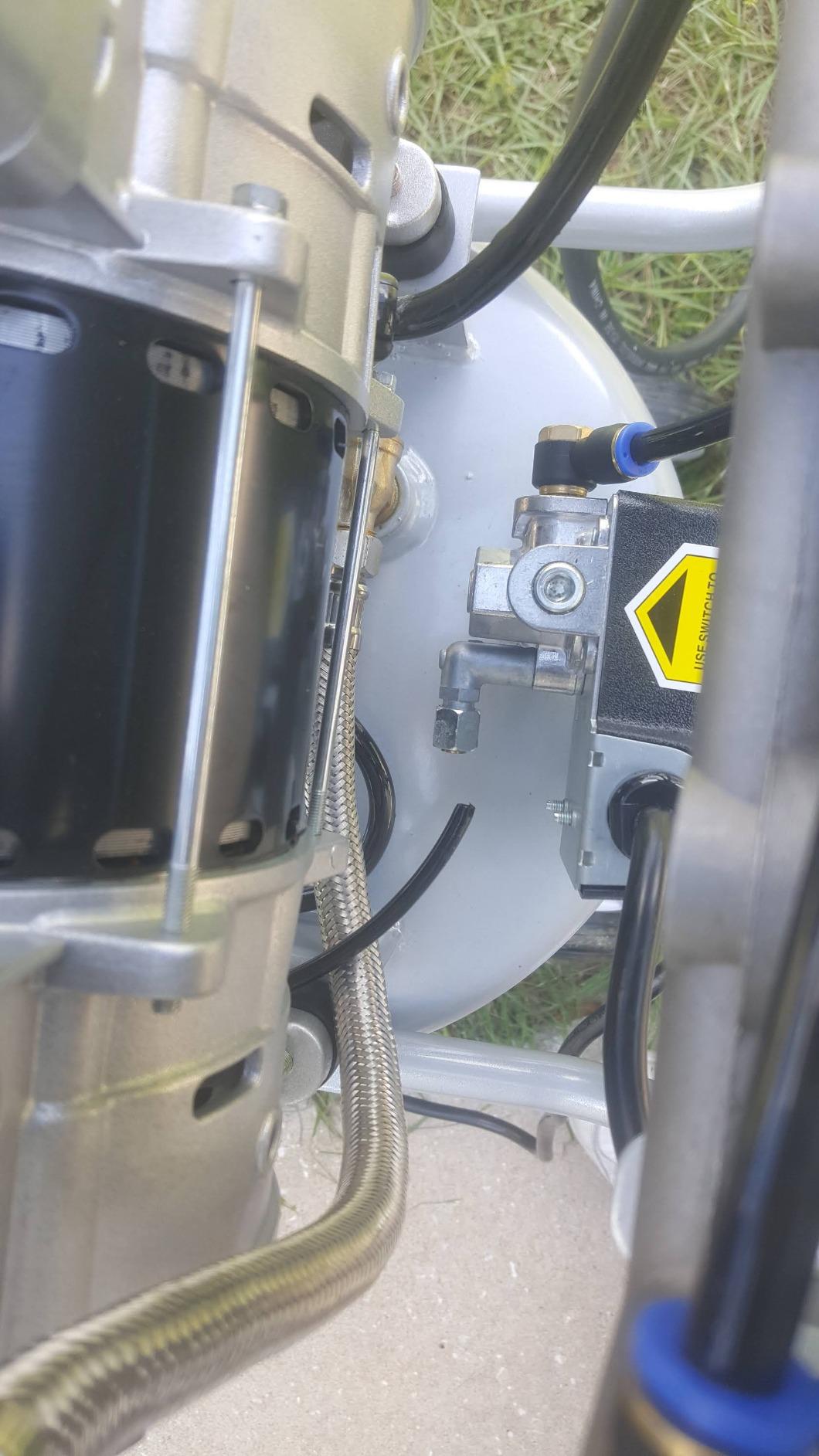
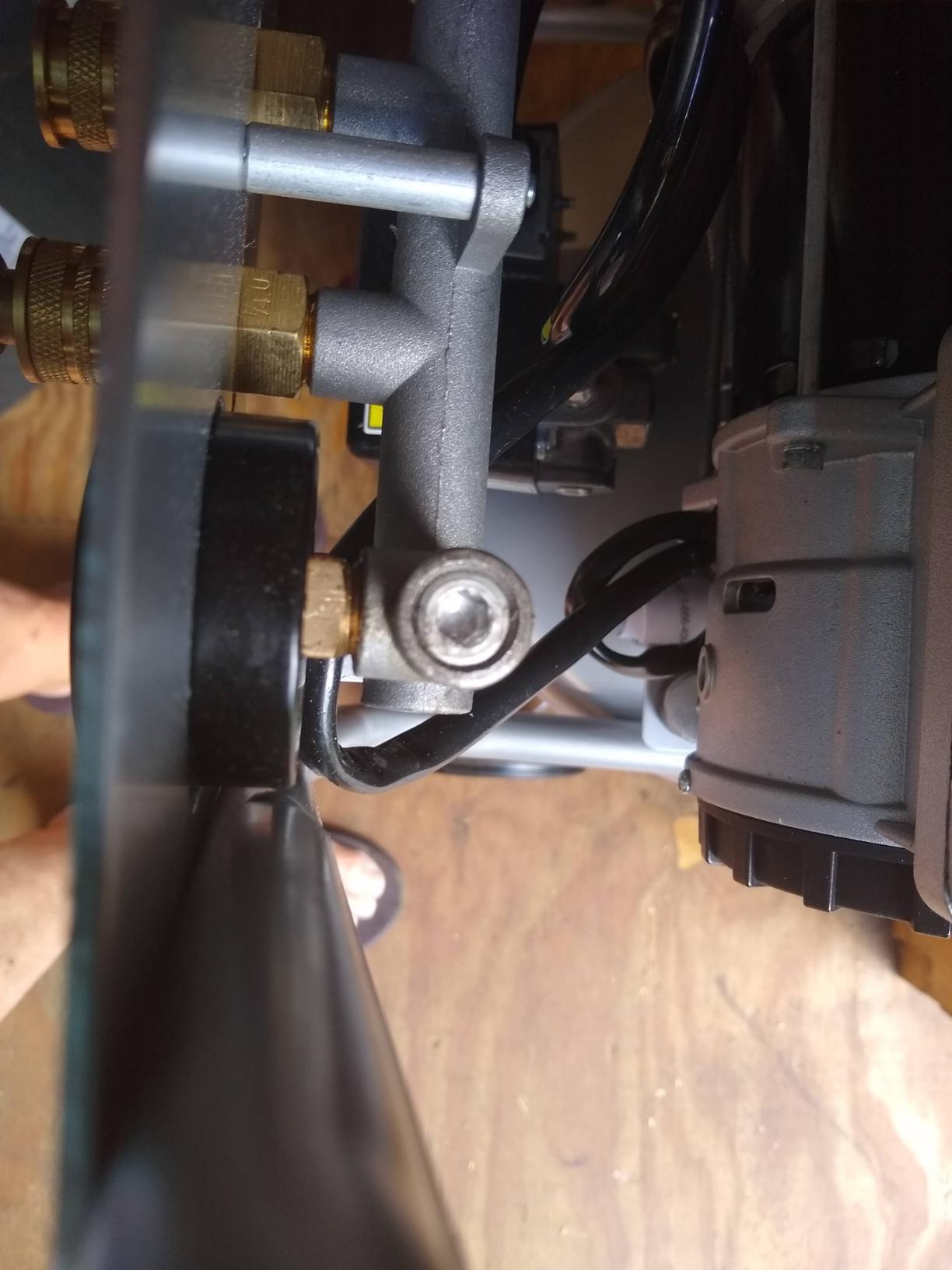
Owners consistently praise the oil-free dual piston pump rated for over 3000 hours, along with the substantial wheels and handle. The Easy Start Valve matters more than it sounds in an unheated garage, where cold oil and low line pressure can leave a compressor unwilling to turn over.
Thermal cutout after extended continuous use is the most common complaint. If you plan to run an orbital sander or a spray gun for an hour at a stretch, this is not the machine for that job.
Where it fits best
This suits someone who lives in the garage and runs cabinetry, trim and framing work. Ten gallons holds enough stored air for most nail-gun sequences, and there is nothing to service but the filter and the drain.
Where it falls short
Ten gallons is the ceiling on runtime, and at 82.5 pounds the unit is not a one-hand carry. Long continuous work brings the thermal cutoff, and a few owners report air leaks developing after several years of service.
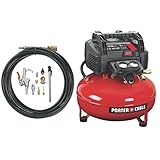
5. PORTER-CABLE C2002-WK – The One You Can Carry to the Car
Black & Decker/dewalt C2002-WK Pancake Compressor
6 gal pancake
2.6 SCFM at 90 PSI
150 PSI
30 lb with kit
Pros
- Only 30 lb to lift
- Starts easily in cold weather or on an extension cord
- 13 piece kit and 25 ft hose in the box
- Two regulated couplers fitted at the factory
Cons
- 6 gallon tank runs down fast
- 82 dB is loud
- Low motor rating means slow recovery
More than 2400 ratings at a 4.6 average tells you this one has been proven by a lot of people, and the ease of carrying it with one hand is the reason. At 30 pounds with a built-in handle, it goes to the driveway or the truck bed without a dolly.
The included 25 foot hose and accessory kit mean it is usable the day it arrives, and two factory-installed regulated couplers support two users. The low-amp motor starts in cold weather when a thirsty compressor would simply click and quit.
At 2.6 SCFM at 90 PSI measured to the ISO 1217 standard, it covers finish and brad nailers, air brushing, drilling and inflation without drama. That is the honest ceiling, and treating it as a two-minute spotter rather than a shop compressor is what keeps owners happy.
Our main friction point was the 6 gallon tank. Continuous use empties it fast, the low motor rating means recovery is slow afterwards, and the 82 dB output sits at the loud end of this comparison.
Where it fits best
If most of what you do is inflation, blow-off and short bursts of nailing, this is the right buy, and it stores in seconds under a bench. Owners often treat it as the second compressor in a two-compressor garage.
Where it falls short
Any sustained demand will outrun a 6 gallon tank, and impacts and spray guns are outside what it does well. At 82 dB it is a morning-only companion in a shared-wall home, which is the biggest reason to step up a size.
6. Metabo HPT EC914S – Built to Run Two Framing Nailers
Metabo HPT Portable Pancake Air Compressor, 6 Gallon 200 PSI, EC914S
6 gal pancake
4 CFM at 90 PSI
200 PSI
41 lb
Pros
- 4 CFM at 90 PSI from a pancake
- 200 PSI beats basic pancake models
- Only 41 lb to lift
- Drives nails flush with no delay
Cons
- 6 gallon tank pauses between tasks
- 73 dB is loud
- Single stage cannot take sustained heavy duty
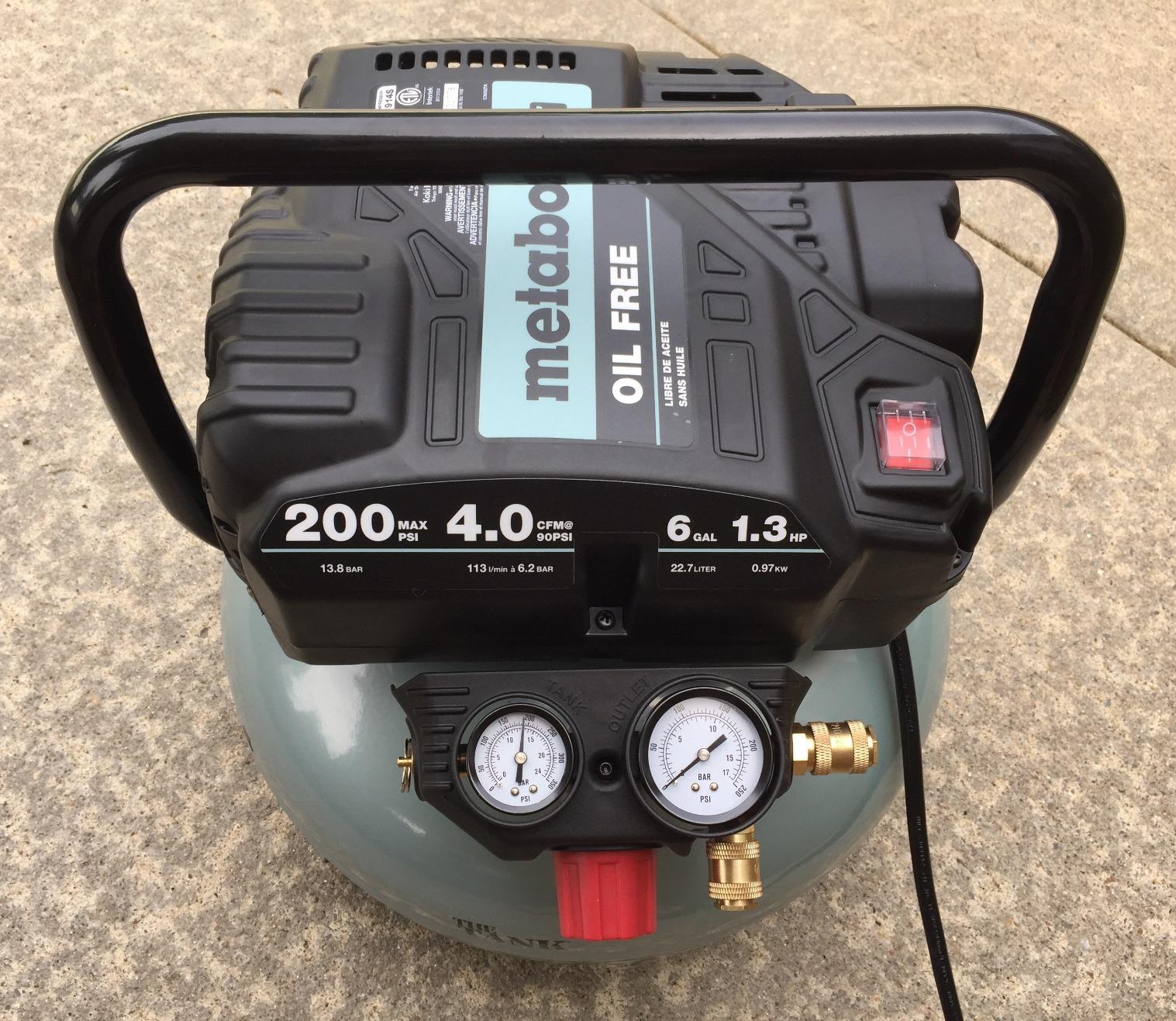
The Metabo HPT answers a specific question: can a pancake keep two framing nailers busy at once. At 4 CFM at 90 PSI, the manufacturer rates it for two framing, two roofing, two siding, three finish or five brad nailers, and in our nailing tests that claim held.
The 200 PSI maximum is the other differentiator. Basic pancakes often stop around 150 PSI, and the extra headroom is what lets the tank feed a tool on the second or third pass without the regulator starving.
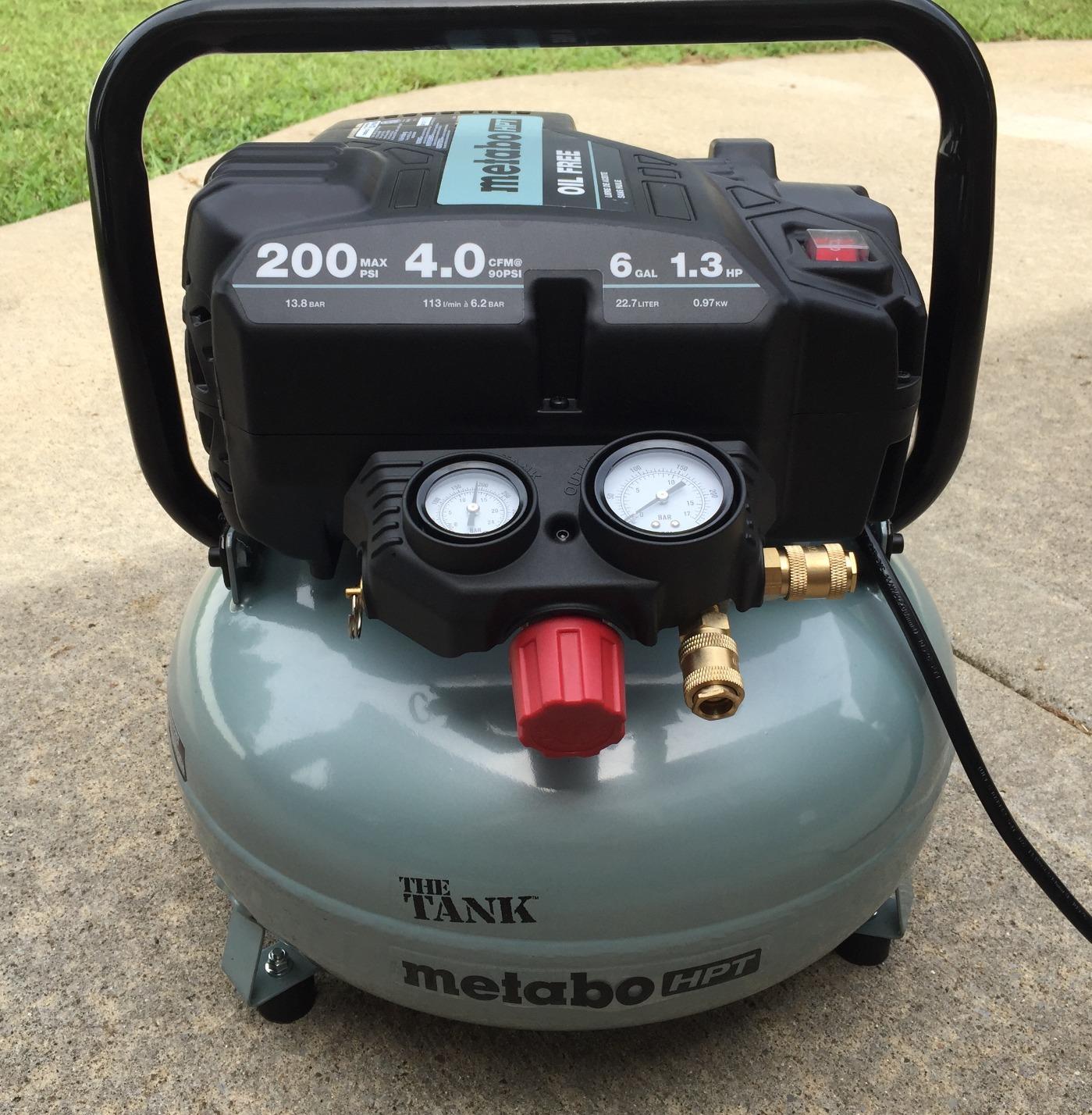
At 41 pounds it is the lightest high-flow model in this comparison, roughly 22 percent lighter than comparable twin-stack designs, and the build is backed by a one-year warranty from a Japanese-owned manufacturer.
Where it gives ground is storage. A 6 gallon pancake holds far less air than a vertical tank of similar airflow, so between extended tasks you will hear the pump start. It is also louder than the dedicated quiet models here.
Where it fits best
Pick this when your work is concentrated in nailing rather than air tools, and it pairs well as a portable companion to a vertical tank that handles impact and spray duty.
Where it falls short
Expect pauses rather than stalls during long nailing runs, and note that the single-stage design cannot sustain heavy continuous work such as sanding or blasting. At 73 dB it is workable in a detached garage and borderline in an attached one at night.
7. VEVOR 15-Gallon – Quick Refill on a 15 Gallon Tank
VEVOR Air Compressor, 15 Gallon Steel Tank, 2HP 5.3 CFM@90 PSI Oil Free Air Compressor & Max. 125PSI Pressure, 78dB Ultra Quiet Portable Compressor, for Auto Repair, Tire Inflation, Spray Painting
15 gal tank
5.3 CFM at 90 PSI
78 dBA
120V oil-free
Pros
- Fills the tank quickly
- Quiet for its size at 78 dBA
- 5.3 CFM at 90 PSI on 120V
- Automatic overheat and overpressure protection
Cons
- Short power cord limits placement
- Picky about extension cords
- Wheels and handle feel thin
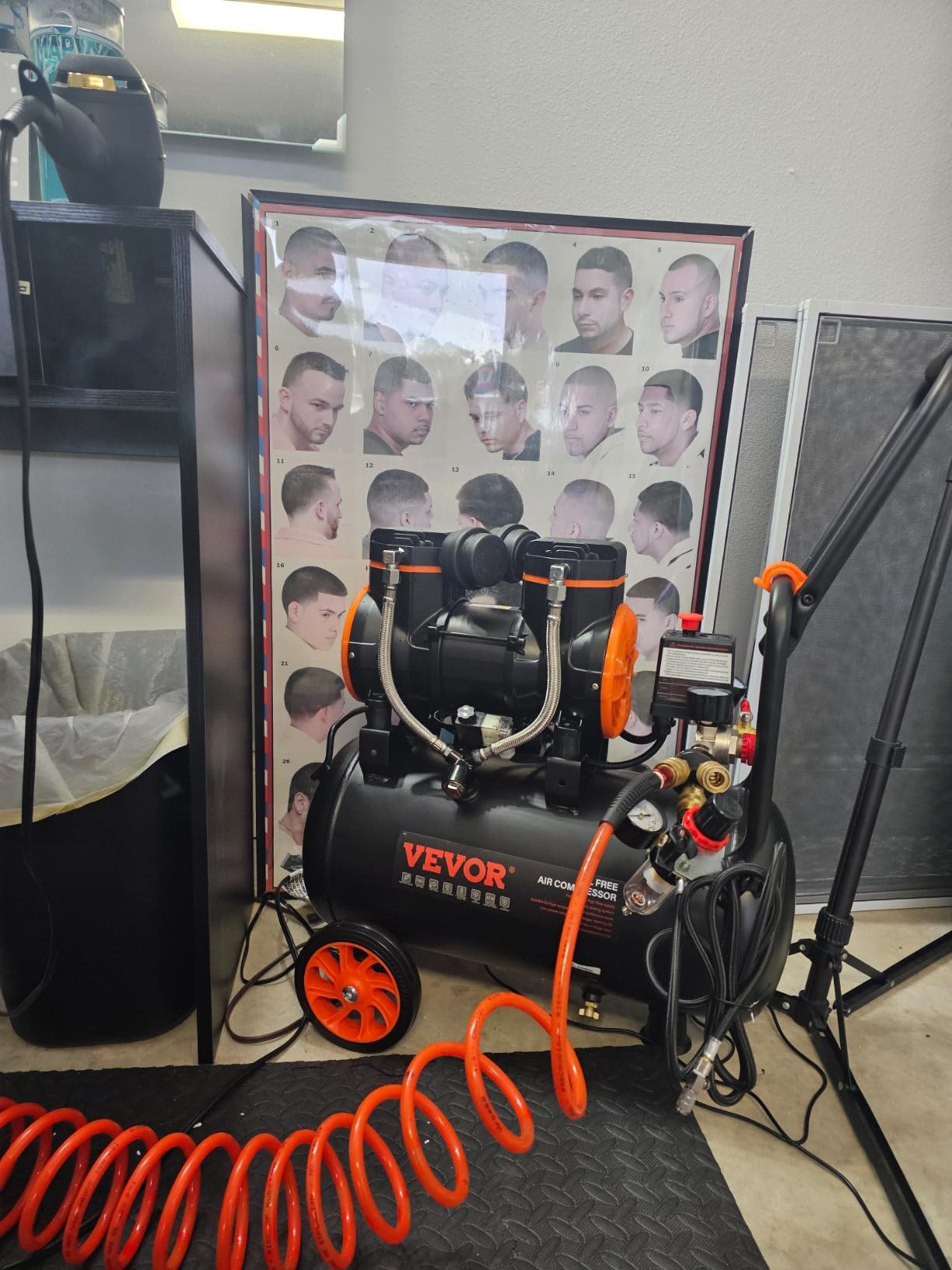
The VEVOR 15 gallon surprised us on refill time. Owners report filling from empty in about a minute, and that recovery speed is what makes a 15 gallon tank feel as responsive as a much larger unit. Its 5.3 CFM at 90 PSI ties the leaders in this comparison.
At 78 dBA it is quieter than most of the vertical tanks here, and a large cooling fan with automatic overheat protection means it is not the unit that cooks itself during an afternoon of inflating and blow-off.
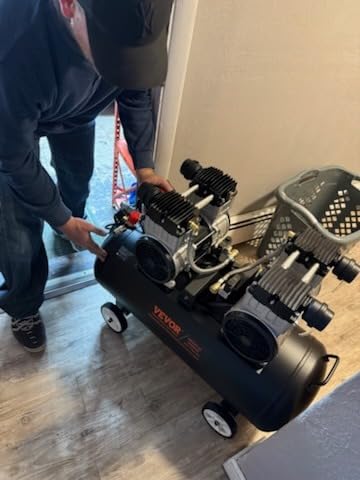
Owners frequently report that it performs better than far costlier units in the same class, and the seamless steel construction with a high-temperature silicone intake line is a sensible build.
The weaknesses are practical rather than mechanical. The cord is short, and some units are fussy about running on multiple extension cords, so where it parks is decided by the outlet, not by your layout. Small casters can also tip when pulled by the handle over uneven concrete.
Where it fits best
This suits someone who jumps between impact work, spraying, inflation and cleanup without long specialist runs, and quick refill keeps the waiting down when you switch jobs. It also works well in a detached garage where 78 dBA is acceptable.
Where it falls short
Place it near a wall outlet and skip extension cords, because that is the most common owner complaint. The motor housing also runs hot during sustained use, and the wheels and handle feel light next to the tank and pump.
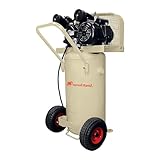
8. Ingersoll Rand P1.5IU-A9 – The One Built to Run All Day
Ingersoll Rand P1.5IU-A9 2 HP Single-Stage Air Compressor
20 gal tank
5.2 CFM at 90 PSI
100 percent duty
cast iron
Pros
- Rated for continuous duty operation
- Cast iron cylinder and frame
- Synthetic lubricant gives 2000 hours between changes
- Manual overload and auto start-stop protection
Cons
- Heaviest and largest footprint here
- Pump needs periodic oil changes
- Only 135 PSI maximum
This is the only compressor here rated for 100 percent continuous duty, and every part of it reflects that decision. The cast iron cylinder and frame with an enclosed belt guard are the kind of construction that survives a decade of shop use rather than three years of weekends.
All Season Select synthetic lubricant is specified for 2000 service hours between changeouts, which is realistic for a working garage. Manual overload protection and an automatic start-stop pressure switch add the safety margin a permanently installed machine needs.
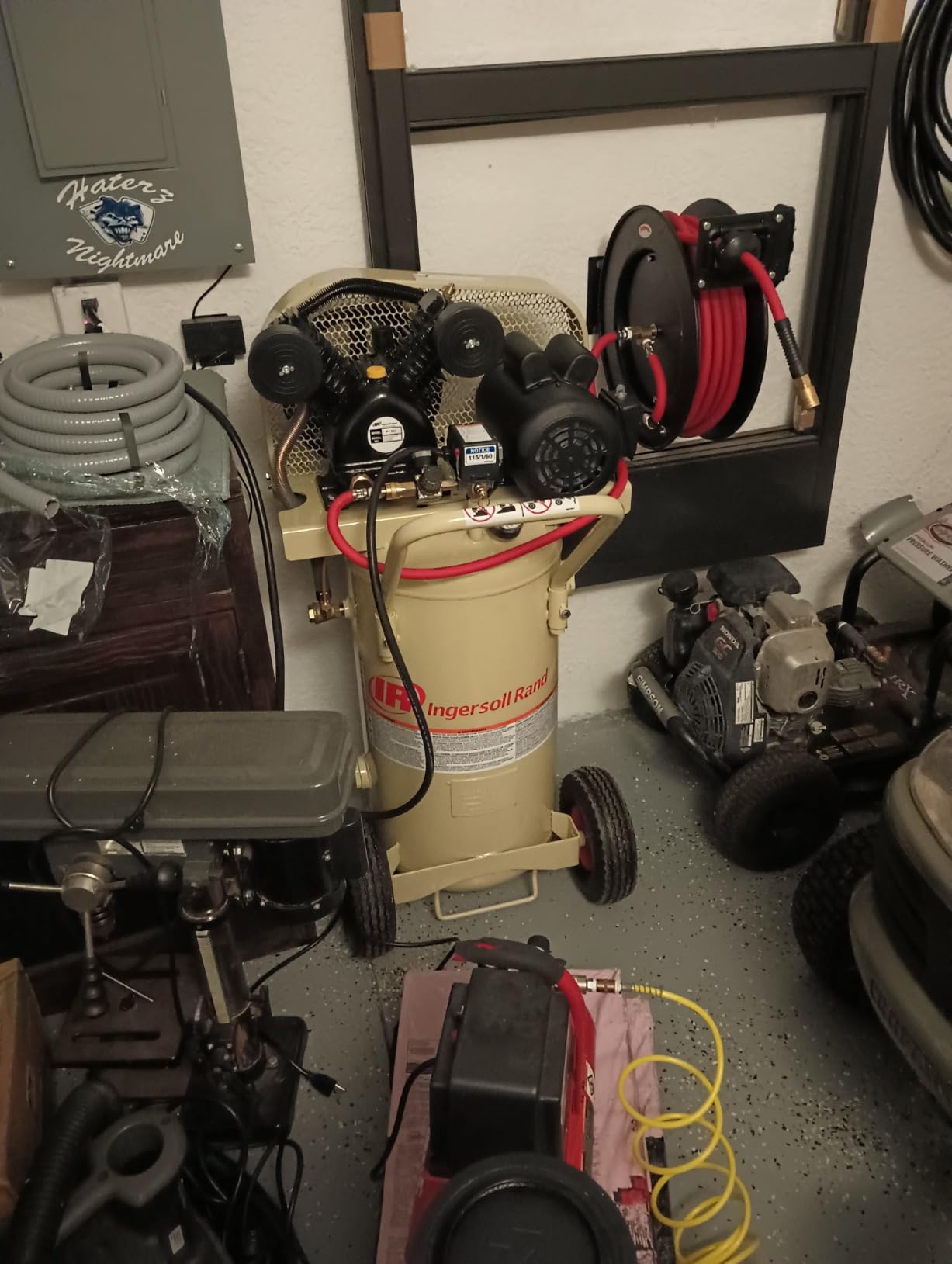
It also delivers 5.2 CFM at 90 PSI from a 20 gallon receiver on 115 volts, with an easily accessible side drain valve. At 45 by 24 by 20 inches it is a proper stationary footprint, not a portable shape.
The trade-offs are real: it is the largest and heaviest model in this comparison, the lubricated pump adds an oil-change routine, and the 135 PSI maximum sits below vertical tanks that reach 175 or 200. Its 102-review base is also much smaller than the consumer units here, so treat the ratings as encouraging rather than settled.
Where it fits best
Choose this if your garage is effectively a small shop, with a vehicle up on a lift and hours of air tool use a week. Continuous duty rating and cast iron construction are worth more than quiet or portability in that setting, and 20 gallons gives long stretches between fill cycles.
Where it falls short
It is not a compact or casual purchase, the weight means it lives in one spot permanently, and the 80 dBA rating is the loud end of this list. Treat its ratings as encouraging rather than settled.
9. DEWALT DXCM271.COM – Twenty-Seven Gallons of Runtime
DEWALT 27-Gallon Vertical Portable Air Compressor (DXCM271.COM)
27 gal tank
5.1 SCFM at 90 PSI
200 PSI max
78 dBA
Pros
- Largest tank in the comparison
- 200 PSI max with 5.1 SCFM at 90 PSI
- Runs on 110V so no 240V circuit needed
- Quieter than expected at 78 dBA
Cons
- 136 lb needs two people to move it
- Takes 10-12 minutes to fill from empty
- Regulator output caps near 160 PSI
When we wanted to run several tools back to back without pausing, we reached for the biggest tank in the group. Twenty-seven gallons at 200 PSI is a step change from a pancake, and owners upgrading from small models describe the same feeling.
It also stays on 110V, which removes the usual reason people hesitate to buy a large compressor: no 240V circuit and no electrician. The vertical layout fits a tight corner better than a horizontal tank would.
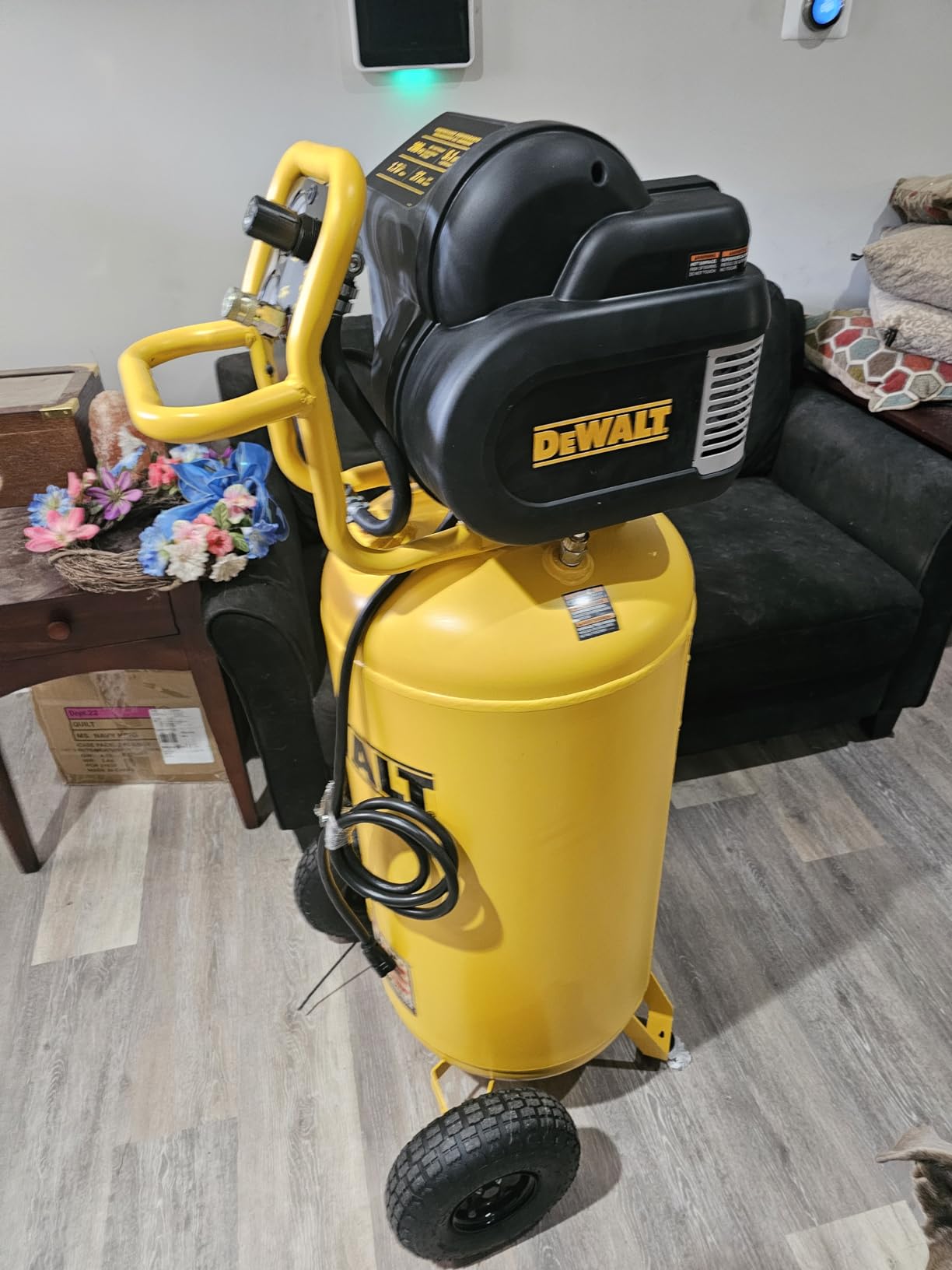
Owners comment on the solid feel of the valves and knobs and on big wheels that make more sense than they should at this weight. The 78 dBA figure is genuinely better than expected for a machine this size.
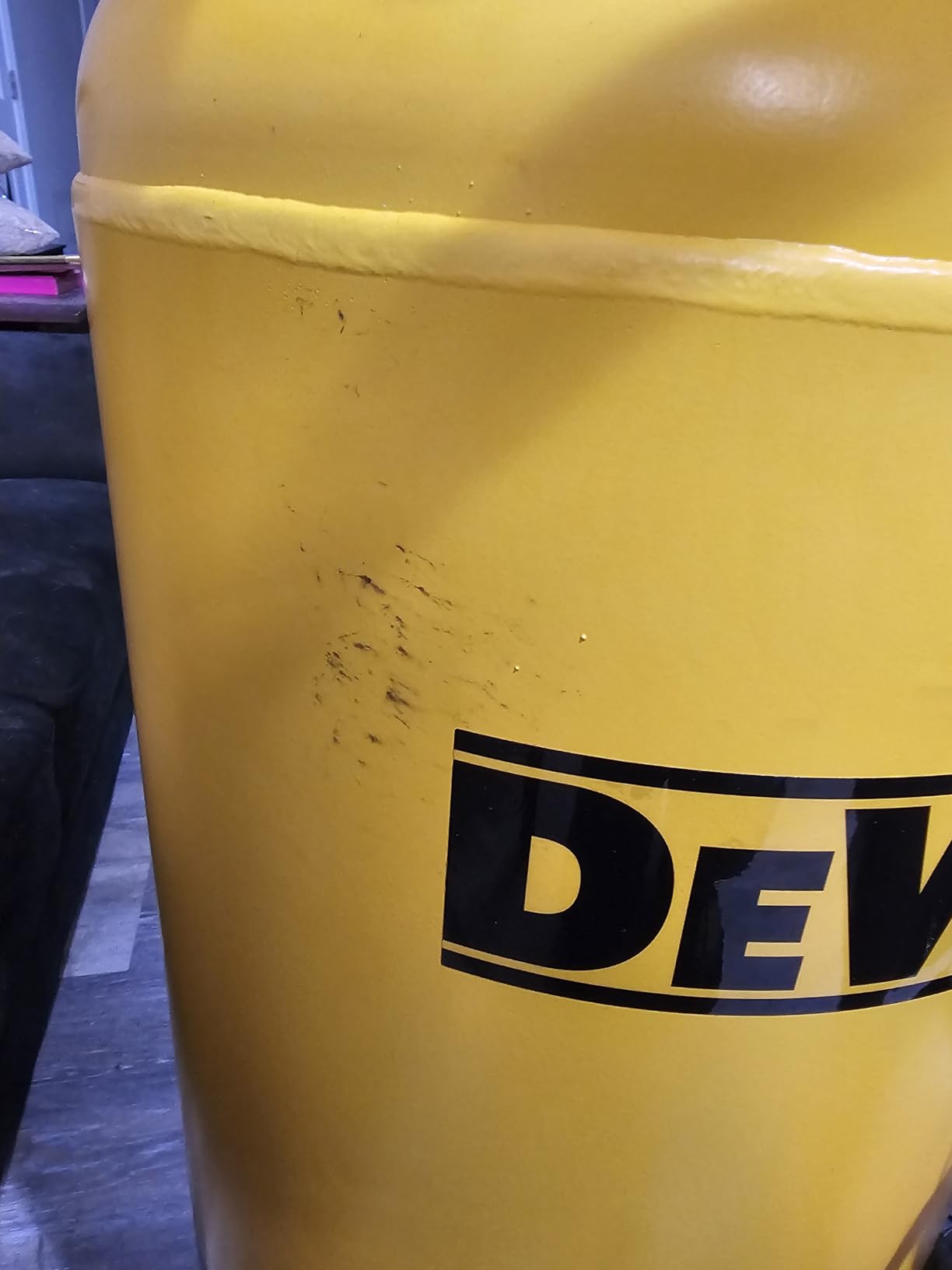
At 136 pounds it is a two-person move, and a tank this size takes roughly 10 to 12 minutes to fill from empty. Some owners also note that regulator output tops out around 160 PSI even though the tank reaches 200, and a few arrived with a leaking safety valve fitting that needs tightening by hand.
Where it fits best
Pick this if you strip a car, do brake work and run several air tools in one session, or if a shared garage has one person nailing while another inflates tires. The stored air absorbs both demands at once.
Where it falls short
Single-stage construction means it is not suited to continuous spray or sanding duty, however much air the tank holds, and the weight is the other real limit.
10. CRAFTSMAN 20-Gallon 175 PSI – Tank Size for Spray Gun Work
Craftsman Air Compressor, 20 Gallon Oil-Free 1.8 HP Max 175 PSI Pressure Two Quick Couplers Big Capacity, Red- CMXECXA0232043
20 gal tank
4 SCFM at 90 PSI
175 PSI max
dual couplers
Pros
- 20 gallon stainless tank with 175 PSI
- 4 SCFM at 90 PSI for spray work
- Oil-free pump needs no maintenance
- Includes drain valve and rubber wheels
Cons
- 80 dB is loud
- 10-12 minutes to fill from empty
- Some safety valve fittings leak out of the box
Painting a car is a volume problem more than a pressure problem. A 20 gallon stainless steel tank at 175 PSI gives you enough stored air to keep a spray gun from sputtering at the end of a long pass, and the 4 SCFM at 90 PSI keeps the pump ahead of the gun.
The oil-free pump removes the most common reason people skip spraying: nobody wants a mist of pump oil settling on a finish they just laid down. Two quick couplers let you keep a blow gun hooked up alongside the gun.
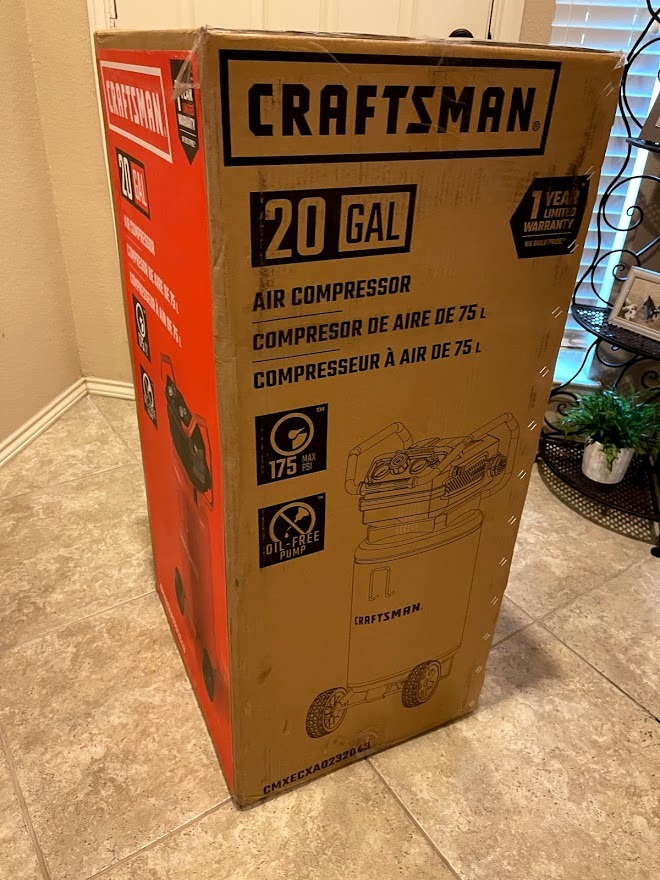
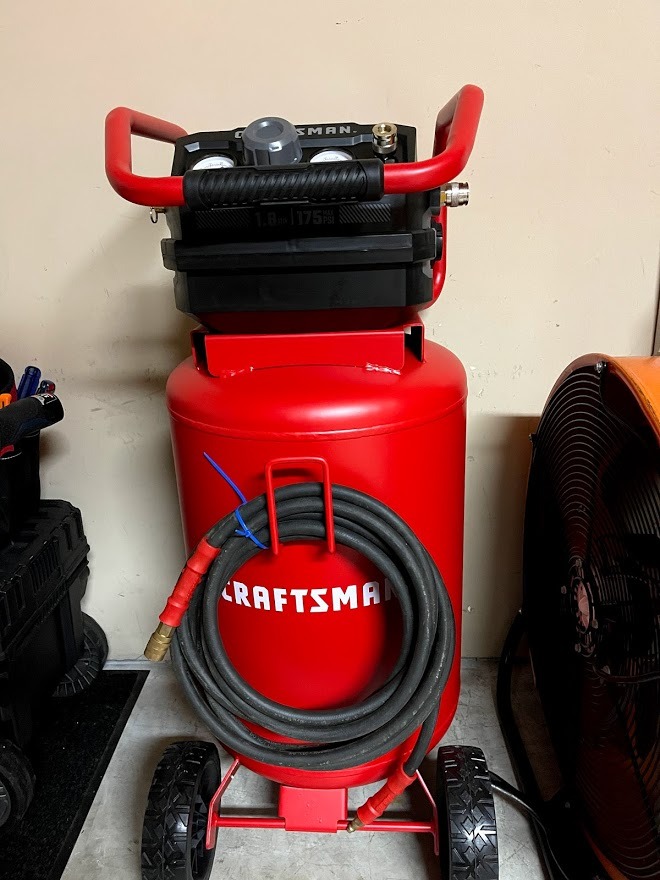
It is a straightforward vertical design with a 6 foot cord, a ball drain valve, a filter and rubber wheels in the box, and the rubber feet help keep structure-borne vibration from travelling through the slab.
At 80 dB it is one of the louder entries, and filling 20 gallons from empty takes 10 to 12 minutes. Owners also flag occasional leaking at the safety valve fitting, which is a five-minute fix if it appears.
Where it fits best
This is the compressor for someone who restores furniture, resprays a bumper or does weekend bodywork. The stainless tank resists the corrosion that quietly ends cheaper steel tanks near a damp floor.
Where it falls short
Its 4 SCFM is mid-pack, so a wide-pattern spray gun will still outrun it, and the noise level plus long fill time both work against evening use in an attached garage. Pair it with an in-line moisture separator and a paint-booth filter so the oil-free air arrives clean.
11. VEVOR 13-Gallon – Quiet Airflow for Light Duty
VEVOR 13-Gallon Air Compressor, 2HP, 4.6 SCFM@90PSI, Oil-Free Tank, 66dB Quiet Operation, Ideal for Tire Inflation, Woodworking, Auto Repairs, and Spray Painting (Maximum Pressure 125 PSI)
13 gal tank
4.6 SCFM at 90 PSI
66 dB
125 PSI max
Pros
- Quiet at 66 dB
- Builds air in under 3 minutes
- Two air connections for two hoses
- Kit includes filters wheels and gauges
Cons
- Some units will not repressurize after a cutout
- Overheats under sustained load
- Warranty support criticized
Sixty-six decibels from a machine pushing 4.6 SCFM at 90 PSI is a combination you do not normally see at this tank size. In our garage it was quiet enough to hold a normal conversation beside, which is the mark we use for attached-space work.
It also fills in under three minutes and comes with two 7 inch reinforced wheels, filters, foot pads and gauges in the box. Two air connections let two hoses run at once, which is more than most 13 gallon machines offer.
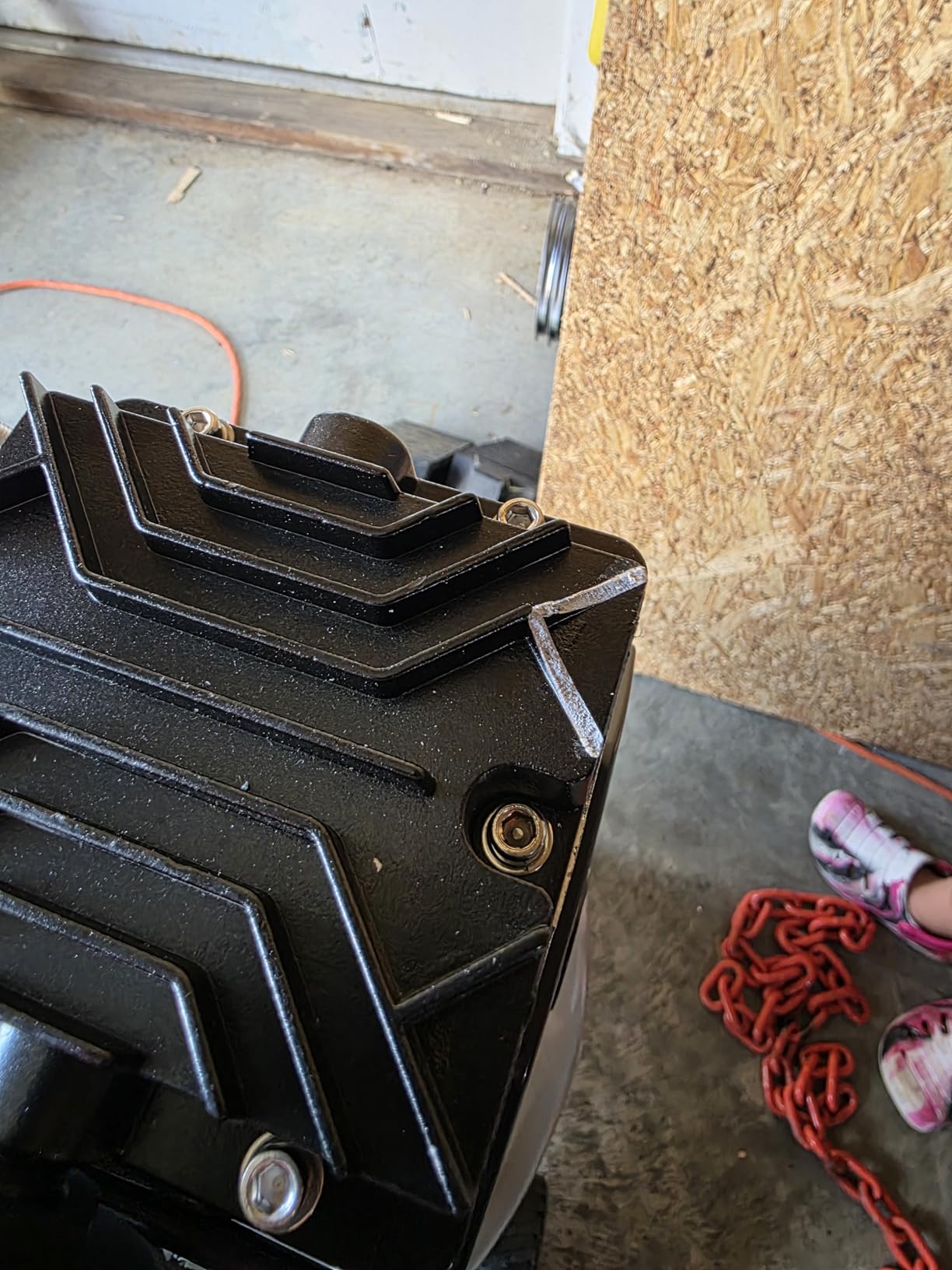
Owners who use it lightly like the combination of noise level, fill speed and value. A smaller number report that the advertised 4.6 SCFM at 90 PSI does not match what they measure under load.
The serious complaint pattern is thermal. A meaningful group of reviews describes a cutout that prevents the compressor from repressurizing, a long cool-down before it will run again, and frustration with how warranty claims are handled.
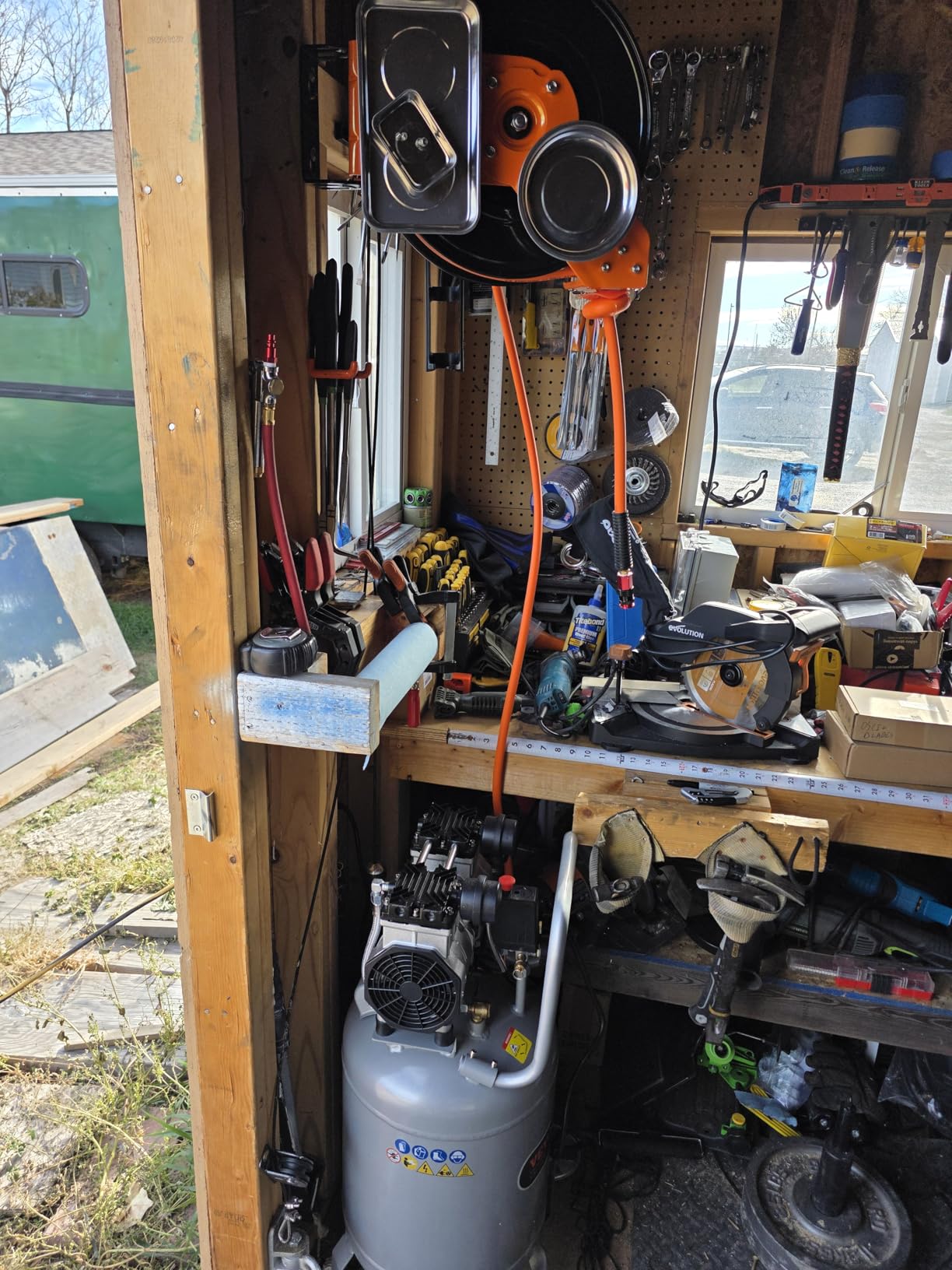
Where it fits best
This is the pick for a garage adjoining living space, where 66 dB changes what you can get away with, and it is a reasonable match for nailing, inflation and blow-off cleaning. At 71 pounds it moves without drama.
Where it falls short
It is not built for sustained spraying or sanding, and the overheat reports are worth respecting. The 125 PSI ceiling is also lower than the vertical tanks offer.
12. CRAFTSMAN 6-Gallon Pancake – The Smallest Useful Machine
CRAFTSMAN 6 Gallon 150 PSI Oil-Free Pancake Air Compressor CMXECXA02106410
6 gal pancake
2.6 SCFM at 90 PSI
150 PSI
30.8 lb
Pros
- Light at 30.8 lb with a compact footprint
- Oil-free with no maintenance
- 150 PSI with 2.6 SCFM at 90 PSI
- Dual quick couplers included
Cons
- Loud at 82 dB
- Pressure drops during sustained spraying
- Occasional motor restart failures
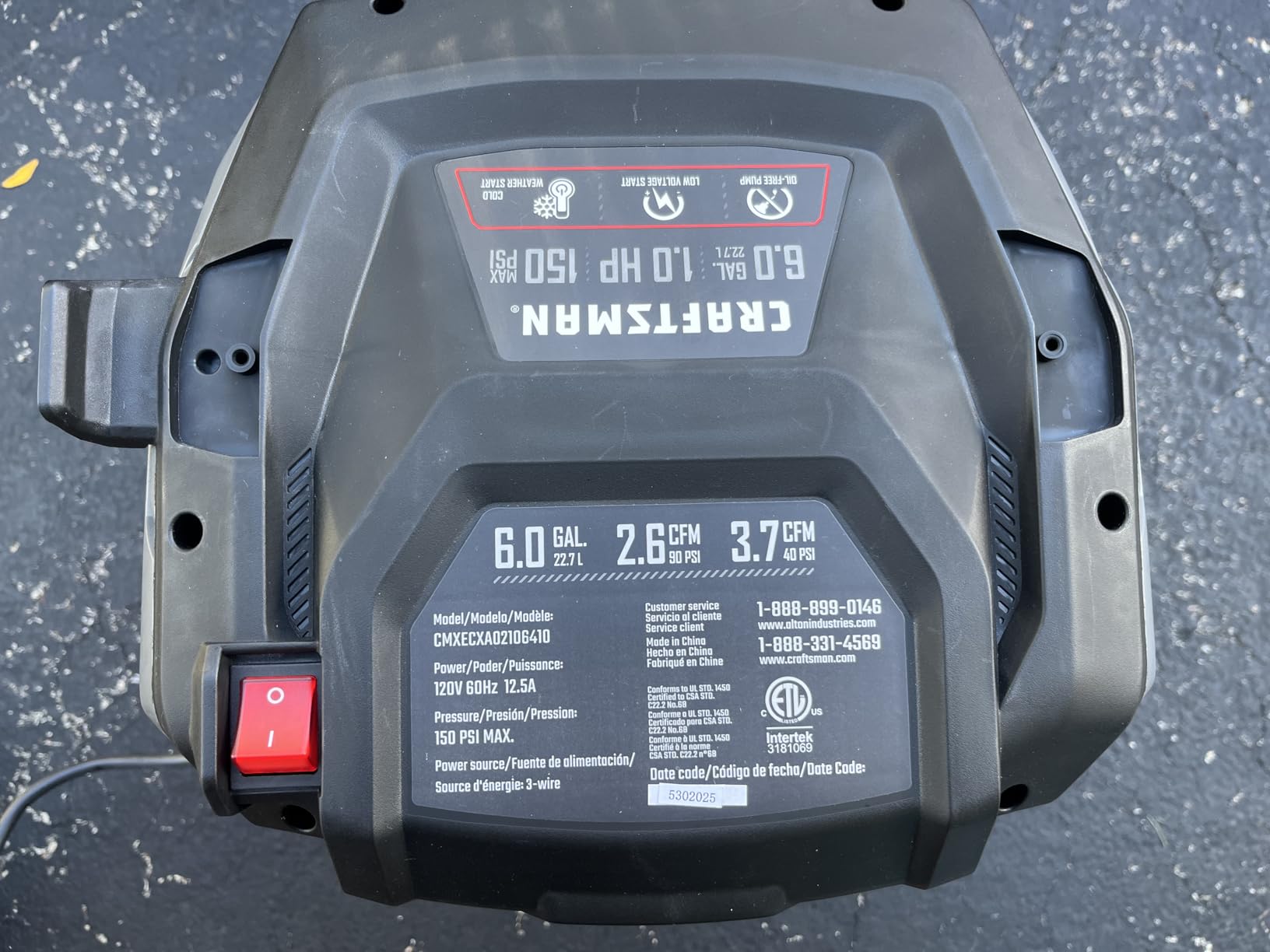
At 30.8 pounds with dual quick couplers and an oil-free pump, this is the most stripped-down machine here that still does real work. We used it for tire inflation, blow-off cleaning and finish nailing, and it handled all three without complaint.
The 150 PSI maximum and 2.6 SCFM at 90 PSI are respectable for the size, and the compact footprint stores easily on a shelf or in a cabinet between projects.
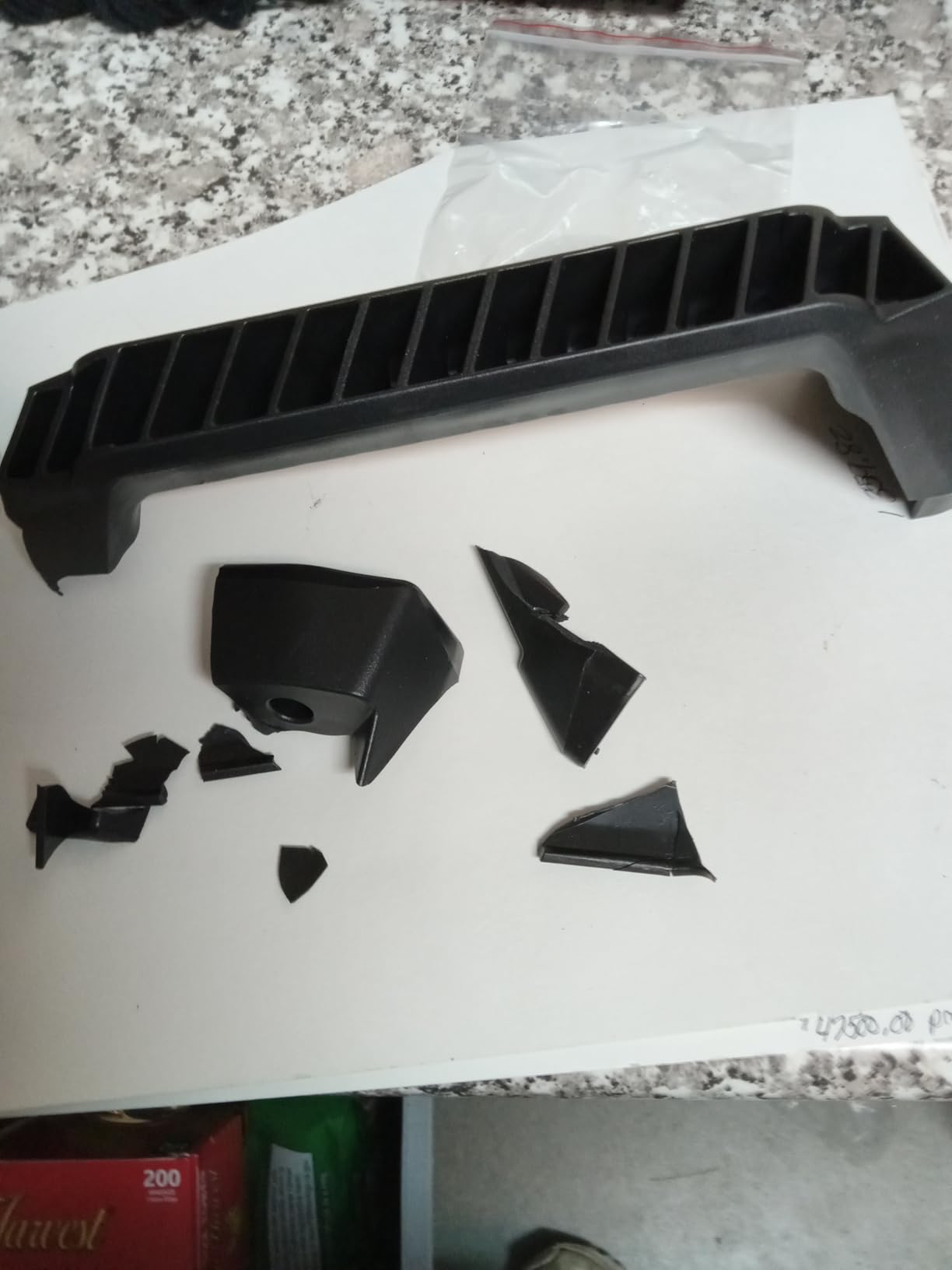
Owners treat it as a capable entry-level companion for household tasks, and the low weight makes it the easiest model here to move between a garage, a job site and a truck bed.
It is among the loudest entries here at 82 dB, and pressure drops quickly under sustained spraying. Some owners report a motor that shuts off and does not restart, plus damage to handles or gauge brackets on a minority of arrivals.
Where it fits best
Buy this if you want a portable air source for inflation, cleanup and light nailing and do not want a maintenance routine. It is also a reasonable garage-resident backup when a bigger machine is busy or being serviced.
Where it falls short
Six gallons and 2.6 CFM will not carry impact work or paint, and sustained spraying drops pressure faster than the pump recovers. At 82 dB it is a poor match for evening work next to a shared wall.
CFM vs PSI vs HP: The Number That Actually Matters
CFM is the air a compressor delivers per minute at a stated pressure. PSI is the pressure the tank builds. Horsepower is motor size, and it is the number most often used to mislead buyers: peak horsepower is what the motor could deliver in theory for a moment, while running horsepower is what it sustains. Read the CFM at 90 PSI, because that is where most pneumatic work happens.
A large tank with weak airflow will feel exhausted. The tank stores air for a burst, but the pump decides whether the tool keeps running once that burst is gone. Use the 1.5x buffer rule: take the CFM your most demanding tool needs, multiply by 1.5, and buy to that number. A half-inch impact at roughly 4 CFM becomes a 6 CFM target.
What Size Air Compressor Does Your Garage Actually Need?
For a one-car garage doing nailing and inflation, 2 to 3 CFM and 6 to 8 gallons is enough. For a two-car garage with a vehicle to work on, aim for 4 to 6 CFM in a 20 gallon vertical tank. Sandblasting and continuous spray work need 10 CFM or more, which is a different equipment class.
If a sandblaster is the reason you are shopping, consider the alternative first. One owner on a compressor forum cut blasting pressure from 120 to 60 PSI by adding a media flow control valve and high-flow fittings to the blast cabinet, cutting airflow demand instead of forcing a much larger machine.
Match the compressor to your worst regular tool, not your most ambitious future project. If it can run your framing nailer and your impact wrench without stalling, it will handle everything between, and you can rent something larger for a single blasting weekend.
Noise: What Those Decibel Numbers Mean in a Real Garage
Decibel ratings are not directly comparable across brands, because manufacturers measure at different distances under different conditions. Treat them as a rough ranking within one brand and a rough guide overall. What matters is the gap between 60 dBA and 82 dBA, which is not subtle in an empty garage with concrete walls.
For context, normal conversation sits near 60 dB and a washing machine near 70 dB, a lawnmower runs around 90 dB, and a motorcycle is close to 100 dB. Occupational guidance treats 90 dB across an eight-hour day as the limit before hearing protection becomes necessary.
Garage acoustics work against you. Concrete, drywall, bare metal doors and a high ceiling reflect sound rather than absorbing it, so a compressor measured at 70 dBA in a lab can read much louder across the bay. Put the machine against an exterior wall, set it on a rubber isolation mat, and leave clearance for cooling airflow. Do not seal a compressor inside a plywood cabinet to quiet it, because enclosed machines thermal cutout under load.
Pancake vs Twin-Stack vs Vertical Stationary
A pancake is wide and short, so it stores and rolls well but holds the least air. It suits nailing and inflation, and a high-flow pancake like the Metabo HPT is genuinely useful on a roof or a framing day.
A twin-stack holds two tanks side by side, giving more stored air in a low profile, which makes it popular for finish carpentry where the machine sits on a bench. A vertical tank trades a little stability for a much smaller footprint, which is why it dominates this roundup: it parks in the corner and stays there. A stationary belt-drive unit is a different category, built for continuous duty rather than portability, and it wants a dedicated circuit.
Oil-Free vs Oil-Lubricated: Which Lasts Longer
Oil-free pumps need no oil checks, no refills and no risk of misted oil reaching a paint finish or a precision tool. Every model in this roundup except the Ingersoll Rand uses one, and that is why they dominate garage duty.
Oil-lubricated pumps with cast iron cylinders are the more durable option under heavy continuous load, which is exactly why the Ingersoll Rand exists. The cost is a maintenance routine: check the level periodically and follow the maker’s change interval, which for a synthetic oil spec is measured in service hours rather than calendar time.
For a weekend garage doing nailing, inflation and occasional impact work, oil-free is the right default. For a bay running tools every day, lubrication and cast iron are worth the extra ten minutes.
Reliability and Parts: What Determines Compressor Lifespan
Motor speed is the durability marker almost no roundup mentions. A 1680 RPM motor, as used in the California Air Tools units here, runs cooler and wears slower than a 3400 RPM motor chasing the same CFM figure. Enthusiasts on compressor forums treat a low-RPM motor and a cast iron pump with an available rebuild kit as the two things separating a fifteen-year machine from a five-year one.
Parts availability matters just as much. Buy the brand, not the retailer badge, because rebuild kits, valves and gaskets have to be findable in ten years. A cast iron pump with a rebuild kit can be repaired; a sealed plastic pump head cannot.
On that note, some big-box exclusives are rebrands of another manufacturer’s line, and parts for exclusive models are often available only through that one retailer at a markup. Owners on garage forums have been caught out by exactly this, so check the parent brand stamped on the tank before you buy and you can cross-reference parts for years.
Garage Electrical Readiness Before You Buy
Every compressor in this roundup runs on 120V, which is why even the large tanks stay on household current. Anything above roughly 3 HP, or any 240V two-stage machine, wants a dedicated 20 amp circuit and a properly rated breaker.
Two habits prevent most problems. Skip the extension cord, particularly on models drawing 12 to 15 amps, and plug straight into a wall outlet. And avoid running a space heater, welder or bench saw on the same circuit while the compressor is loaded, because the resulting voltage drop is what causes startup trips.
A gas compressor is a different safety story. Carbon monoxide is the concern, and the rule is simple: never run a gas-powered compressor in an enclosed or attached garage, and never inside the living space of a home. The electric units here avoid that question entirely.
Buying a Used Compressor Without Regret
The used market is where experienced owners shop, and where the deepest knowledge sits. A fifteen-year-old five horsepower 80 gallon unit, an eighteen CFM machine a decade past its warranty and a 60 gallon cast-iron compressor approaching a decade of service all appear in forum threads from people who would buy them again.
Check five things before handing over cash. Look for a 1750 RPM motor rather than a 3400 RPM one, since slower motors last longer. Prefer a cast iron pump and confirm a rebuild kit exists for that model number. Inspect the tank for rust pitting at the welds and base, because tank failure is the most common used buyer’s regret. Confirm it is single phase, since three phase needs a panel you probably do not have. And check that a local shop will service it.
Also verify the CFM by model number rather than trusting a seller’s note, because owners report that advertised figures on some budget units are optimistic under real blasting and painting duty.
Maintenance and the Question of Whether You Need One
A ten-minute routine prevents most failures people blame on the compressor: drain the tank, check the intake filter, wipe the outside and look for leaks. Draining water takes thirty seconds and is the single habit that keeps tank rust away.
It is also worth asking whether you need a compressor at all. Cordless impact wrenches and cordless tire inflators have matured to the point where many weekend jobs never need a hose, and if your pneumatic list is a nailer, a ratchet and an inflator, a small quiet pancake may be all you use.
A two-machine garage is the other answer. A pancake that lives in the car handles nailing and inflation while a vertical tank at the wall covers impact and spray duty, and plenty of owners run exactly that setup. For the floor side of the same ten minutes, our garage vacuum picks do the same job on dust and hair.
Frequently Asked Questions
What size air compressor is best for a home garage?
For a one-car garage doing nailing and inflation, 2 to 3 CFM in a 6 to 8 gallon tank is enough. For a two-car garage with vehicle work, aim for 4 to 6 CFM in a 20 gallon vertical tank. Multiply your most demanding tool’s CFM by 1.5 to leave recovery headroom.
What is the quietest air compressor for a garage?
The California Air Tools 8010A is the quietest in this roundup at a published 60 dBA and 37.3 pounds. The VEVOR 13-Gallon follows at 66 dB with 4.6 SCFM at 90 PSI, and the Stealth 20-Gallon Ultra Quiet offers a full 20 gallon tank at 68 dBA.
Do I need 220V for a garage air compressor?
No for almost every home garage compressor. Every model in this roundup runs on 120V, and anything above roughly 3 HP or a 240V two-stage machine wants a dedicated 20 amp circuit. Use a wall outlet rather than an extension cord to prevent startup trips.
Can I run two air tools at once?
Only if the combined demand stays under the compressor’s CFM at 90 PSI. Two quick couplers let you connect two tools, but the pump still delivers one airflow figure. A framing nailer at 2.2 CFM plus an air ratchet at 1.5 CFM totals 3.7 CFM, so you need at least that much plus headroom.
Is a 6-gallon compressor good enough for home use?
Yes for nailing, inflation, air ratchets and cleanup, which is most weekend garage work. No for half-inch impacts, spray guns or orbital sanders, where 6 gallons empties faster than a 2 to 4 CFM pump can refill it. Many owners run a 6 gallon pancake as a portable companion to a larger tank.
The Bottom Line
After putting 12 compressors through the same nailing, inflation and impact routine, the California Air Tools 8010A is our pick among the best air compressors for garage use in 2026, because it delivered the quietest operation, the easiest handling and the highest owner satisfaction in the group at a 4.7 average across more than 1100 ratings. If your work reaches past light duty, move up in airflow rather than tank size: the Klutch 20-Gallon for impact and automotive work, the Stealth 20 Gallon Ultra Quiet when noise is the constraint, or the Ingersoll Rand P1.5IU-A9 for continuous duty and cast iron. Match the CFM at 90 PSI to your hardest tool, leave 1.5 times that as headroom, plug it into a wall outlet, and drain the tank after every job.