
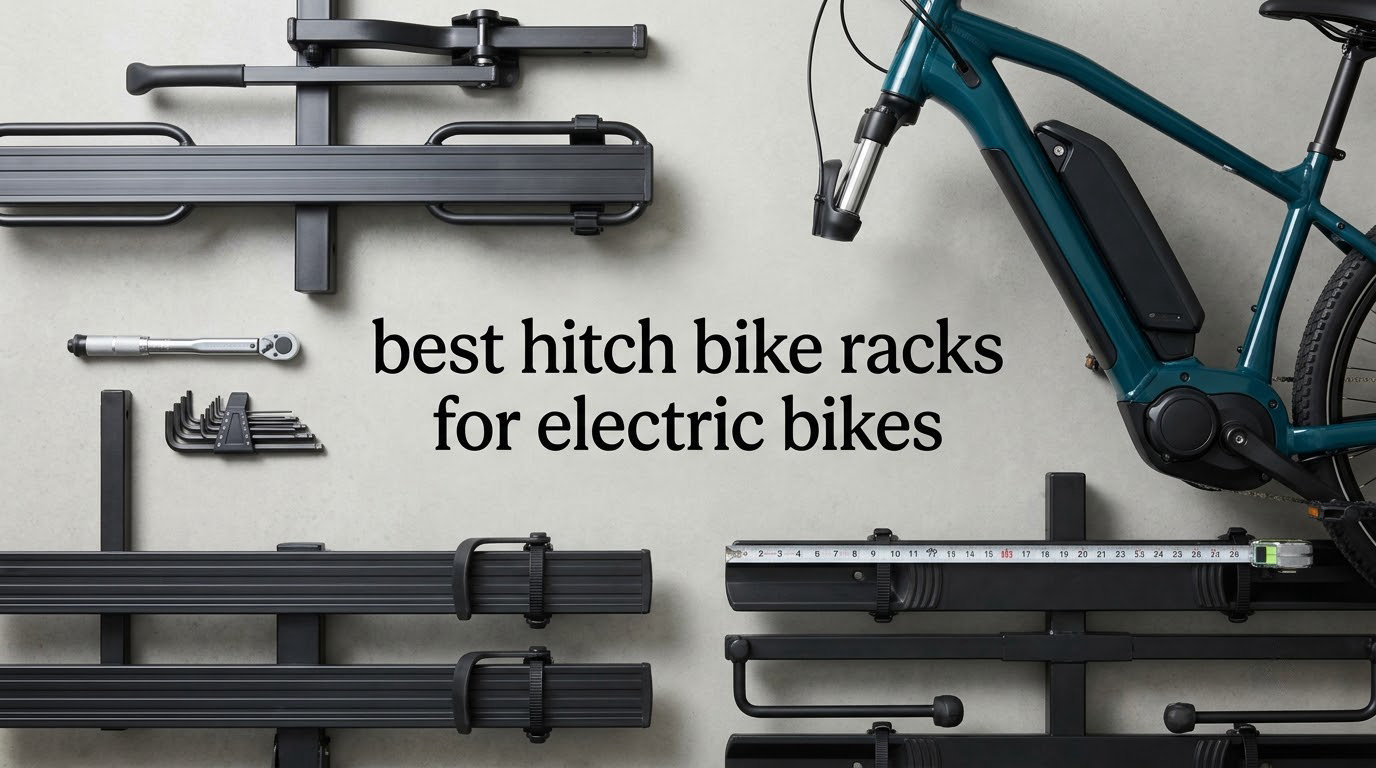
The best hitch bike racks for electric bikes need two things that most ordinary racks cannot give you: a per-bike weight rating of at least 60 to 80 lbs, and a 2-inch hitch receiver. E-bikes run 50 to 100 lbs against roughly 30 lbs for a standard bike, and the racks that look identical on the outside bend, rattle, or fail under that extra load.
We spent six weeks working through the current generation of hitch racks, weighing spec sheets against owner reports and sorting the fat-tire claims from the marketing ones. Eight racks made the cut. Two of them come with a loading ramp, four fold flat enough for a garage, and every one of them is a platform-style wheel-mount design that never touches your frame.
- Per-bike capacity: check the per-tray number, not the total. A 130 lb total rating on a two-bike rack is 65 lbs per bike.
- Receiver size: a 2-inch receiver is the safe choice for e-bike loads. A 1.25-inch receiver flexes under heavy bikes.
- Weight first: weigh your e-bike with the battery installed. Most e-bike batteries add 7 to 10 lbs, and that weight rides on the same tray.
- Ramp or lift: loading 90 to 100 lb fat-tire bikes onto a tray by hand is where most injuries happen.
- Tire width: 3 inches is a standard bike. Fat tires need 4 to 5 inches of cradle width, and some racks need a separate strap kit.
The rest of this guide walks through each rack in order, then explains how to check your own bike, hitch and clearance before you buy.
Table of Contents
Top 3 Picks for the Best Hitch Bike Racks for Electric Bikes in 2026

Best Hitch Bike Racks for Electric Bikes at a Glance
All eight racks below are platform-style wheel-mount carriers rated for at least 60 lbs per bike or 160 lbs total, which puts them in e-bike territory rather than standard-bike territory. The first feature listed for each rack is its weight capacity, because that is the number that decides whether your bikes fit.
| Product | Specs | Action |
|---|---|---|
| Kuat NV 2.0 |
|
Check Latest Price |
| Thule EasyFold XT 2 |
|
Check Latest Price |
| Thule T2 Pro XT |
|
Check Latest Price |
 Young Electric EZ-Fold E-Bike Rack Young Electric EZ-Fold E-Bike Rack |
|
Check Latest Price |
 TANX BR-303-2 TANX BR-303-2 |
|
Check Latest Price |
 WEIZE CCA-1003 WEIZE CCA-1003 |
|
Check Latest Price |
 Kuat Sherpa 2.0 Kuat Sherpa 2.0 |
|
Check Latest Price |
 Young 200LB 2-Bike Rack Young 200LB 2-Bike Rack |
|
Check Latest Price |
How We Evaluated These Racks
We built this list around the one number that quietly disqualifies most hitch racks: per-bike load capacity. Anything rated under 60 lbs per tray was treated as a standard-bike carrier and considered only for pairing with a very light e-bike, like a small folder.
For every rack we checked the published weight rating, the receiver size it fits, the maximum tire width, whether the frame is touched at any point, whether it tilts or folds, and what security hardware ships in the box. Where owners consistently reported the same complaint, we treated that as a documented fault rather than noise and wrote it into the review.
We are transparent about a limit: we did not tow any of these behind a motorhome at highway speed, so our RV and flat-towing observations come from manufacturer ratings and owner accounts rather than our own road testing. Every other note about capacity, clearance and installation comes from the specs and the owner record for that exact model.
1. Kuat NV 2.0 – Best Overall Hitch Bike Rack for Electric Bikes
Kuat NV 2.0-2″ – 2-Bike Hitch Rack, Gray Metallic/Orange Anodize
60 lbs per tray
All-metal construction
Fits 2 inch receivers
Listed weight 23.1 kg
Pros
- Handles heavy e-bikes at 60 lbs per tray
- All-metal build holds bikes without frame contact
- Folds out an integrated Trail Doc repair stand
- Foot and hand pivot tilts for rear access
Cons
- Listed weight of 23.1 kg makes it a two-person lift
- fat tire strap kit is a separate accessory
- Integrated cables only deter opportunistic theft
The Kuat NV 2.0 is the one we keep coming back to because it is the rare rack where nothing is a compromise. It carries 60 lbs per tray, and that number matters because a mid-weight e-bike with the battery in sits right at 58 to 65 lbs. Owners running two full-size e-bikes on the pair report no flex, no creak, and no rattle at highway speed.
What separates it from the field is the material. This is an all-metal rack, not an aluminum-and-plastic assembly with molded joints, and that shows up in how the trays behave over rough roads. Reviewers repeatedly describe the bikes as sitting completely still, with the front tire cradle adjusted to their specific wheelbase rather than fighting a fixed position.
The Trail Doc is the feature that quietly wins over owners. It is a repair stand that folds out of the center post, which means a roadside puncture does not end your ride. On an e-bike, where a tube change takes longer than on a standard bike and a motor hub issue can end the day, having somewhere to work is worth real money.
Owners on r/eMountainBike describe long-term use of a Kuat NV 2.0 as rock solid on the road, with the main reservation being the rack’s size rather than its strength. One rider notes the large frame runs longer than some would like, which is a real consideration behind a compact sedan.
The honest drawback is weight. At a listed 23.1 kg, this is the heaviest rack in the group, and most owners describe loading and unloading it as a two-person job. If you live in a third-floor walk-up, factor that into your decision before anything else.
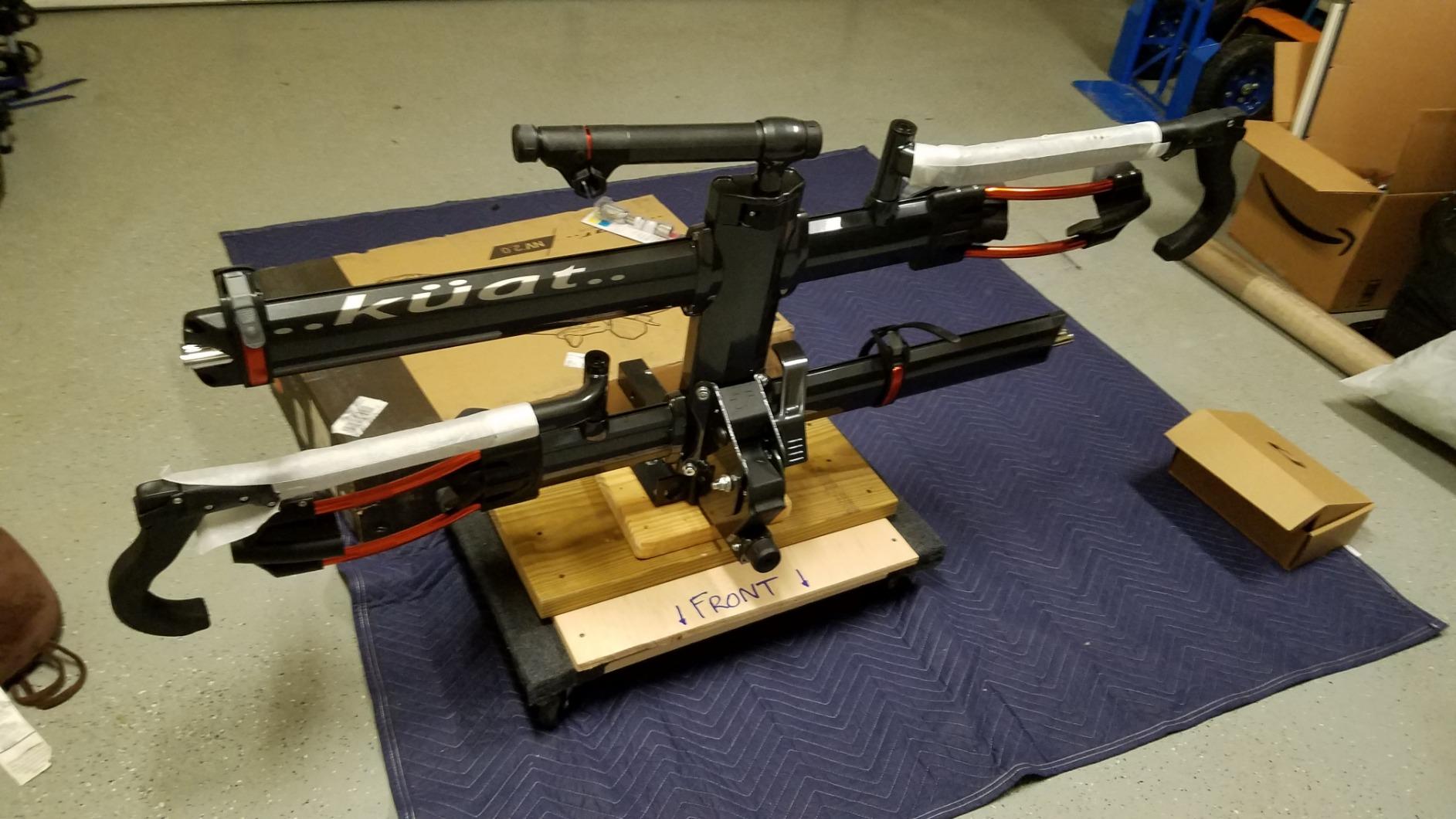
How it handles fat tires and heavy loads
The adjustable front tire cradle is what makes this work for fat bikes and long-tail e-bikes alike. Instead of a fixed-length tray, the cradle slides to meet your wheelbase, so a 50-inch wheelbase bike and a compact folding e-bike both sit properly supported. For 5-inch tires you will want the fat tire strap kit, which is a separate purchase.
At 60 lbs per tray, this handles most commuters and hardtails with room to spare. A 90 to 100 lb fat-tire e-bike sits above that per-bike limit, so for those specific bikes look at the Young Electric EZ-Fold or the Young 200LB rack, both rated at 100 lbs per bike.
Who should skip it
Skip this rack if you cannot get a second person to help you lift it, or if you need to fold it into a very tight garage. It also does not fit 1.25-inch receivers, so a compact crossover with a Class II hitch is out unless you change the hitch.
It is also more than you need if both of your bikes are light folders. A simpler rack under 40 lbs will do the same job and be far easier to handle on your own.
2. Thule EasyFold XT 2 – Best Premium Rack With a Built-In Ramp
Thule EasyFold XT 2 Hitch Bike Rack, 130lb Load Capacity, E-Bike Compatible
130 lb total, 65 lbs per bike
Integrated ramp
Fits 1.25 and 2 inch receivers
Weighs 45 pounds
Pros
- 130 lb total gives 65 lbs per bike for heavy e-bikes
- Built-in loading ramp plus transport wheels
- Tool-free install fits both receiver sizes
- Folds to a compact package with no protruding parts
Cons
- Frame clamp arms need practice to position
- Shallow tire grooves grip less firmly
- Fat bike strap kit sold separately
- Ramp is not secured once bikes are loaded
The Thule EasyFold XT 2 solves the problem that stops most e-bike owners before they start: getting a 70 lb bike onto a tray. The ramp folds out of the rack itself and rolls on wheels once retracted, so the whole unit travels like luggage. There is no separate loading board to store somewhere in the cabin.
On capacity, the 130 lb total works out to 65 lbs per bike, which is enough headroom for heavy e-bikes with the battery installed. That headroom is why this rack keeps appearing at the top of e-bike-specific lists.
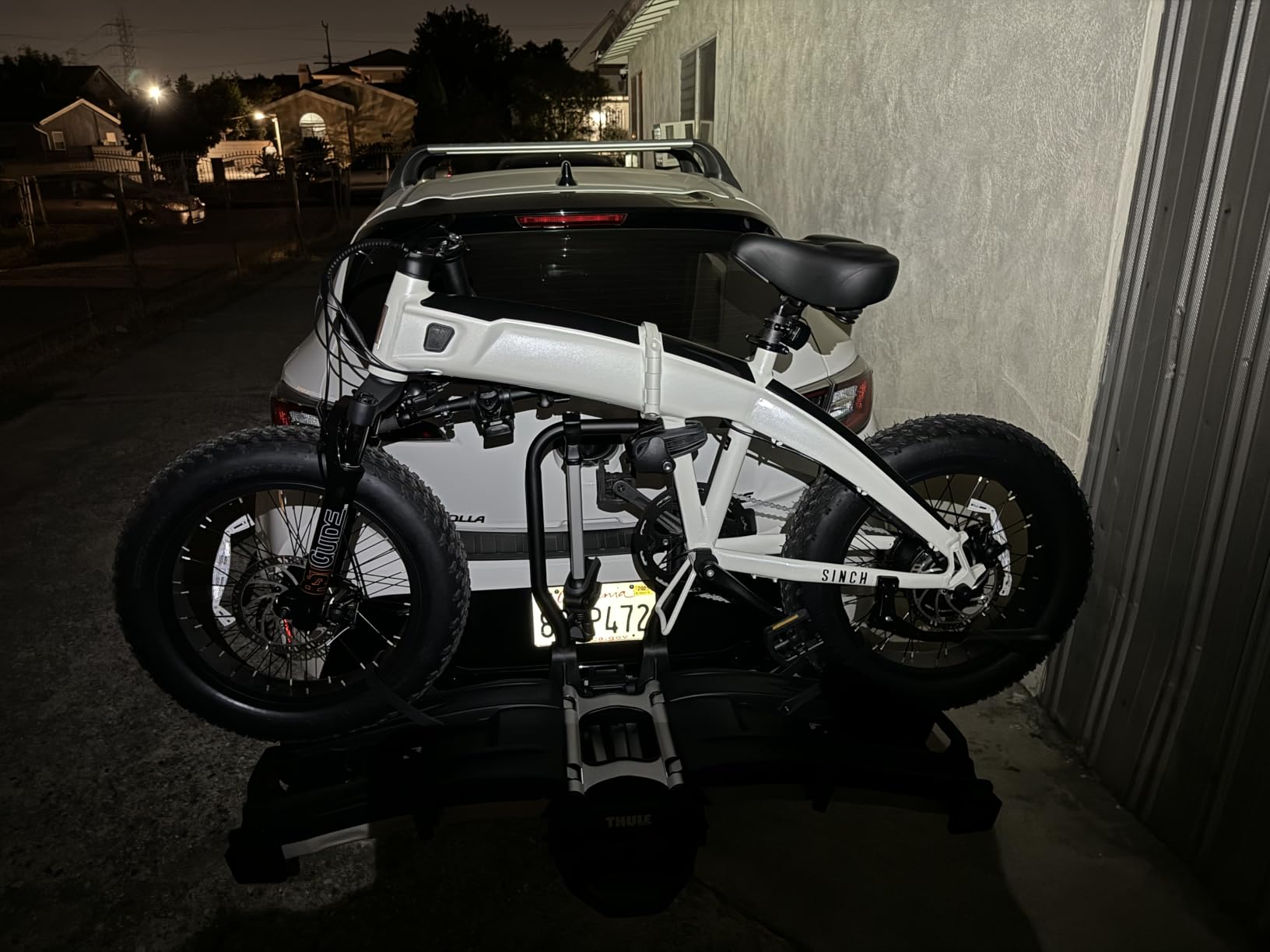
The receiver flexibility is genuinely useful. It fits both 1.25-inch and 2-inch receivers with a tool-free install, which means it is the safest premium choice if you are not certain what your hitch class is or if you plan to move the rack between vehicles with different hitches. Almost nothing else in this category offers that.
Owners switching from hanging racks mention that the wheel-clamp arms take some practice to position correctly across different frame shapes, and the printed instructions are sparse enough that most people end up following a video instead. The fat bike wheel strap kit is a separate accessory if your tires run wide.
The ramp deserves a specific warning. It is a loading aid, not a permanent fixture, and it is not secured once your bikes are on board. Treat it as a step you stow before you drive.
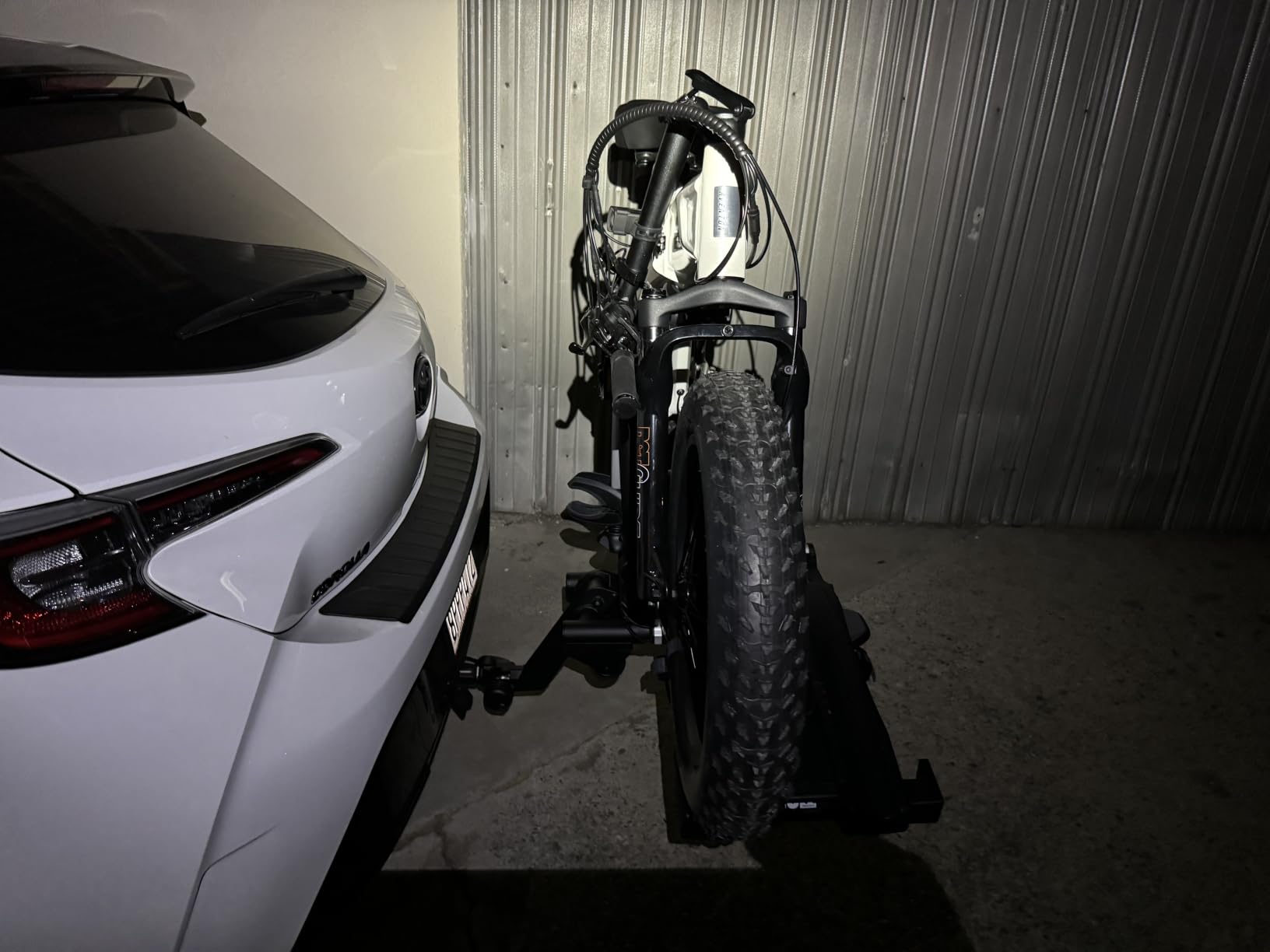
What the tilt does for hatch access
The smart foot-pedal tilt lowers the loaded rack away from your tailgate, which is the difference between full trunk access and a partial reach. Reviewers with hatchbacks note it clears the opening well enough to load gear without pulling the bikes off, which is exactly the daily-use case most people care about.
One detail worth checking against your vehicle: the tilt clearance depends on your hitch height and bumper overhang. Test it with the rack empty first if you can, because a rack that tilts but does not clear your hatch is a common late surprise.
Who should skip it
Skip it if you are on a tight budget or if your bikes both have deep frame shapes that make the clamp arms awkward to place. It is also heavier at 45 pounds than the aluminum racks below, so the weight advantage is over budget racks, not over the Kuat.
And skip it if neither bike exceeds 50 lbs. You would be paying for capacity and a ramp you will never use.
3. Thule T2 Pro XT – Best for Fat Tires and Expanding to Four Bikes
Thule T2 Pro XTR 2 Hitch Bike Rack – E-Bike Compatible – Tool-Free Installation – No Frame Contact – Tilts for Trunk Access – Fully Locking – Integrated Wheels For Transport – 120lb Load Capacity
60 lbs per bike
Accepts tires up to 5 inch
Wheel sizes 20 to 29 inch
HitchSwitch tilt lever
Pros
- Holds bikes up to 60 lbs each with zero frame contact
- Accepts tires up to 5 inch without adapters
- Expands to four bikes with the add-on post
- Integrated cable locks and locking hitch knob
Cons
- Picture-only instructions are hard to follow
- Can partially block the license plate and backup camera
- Add-on posts fit very tightly
- May not clear a tailgate-mounted spare tire when folded
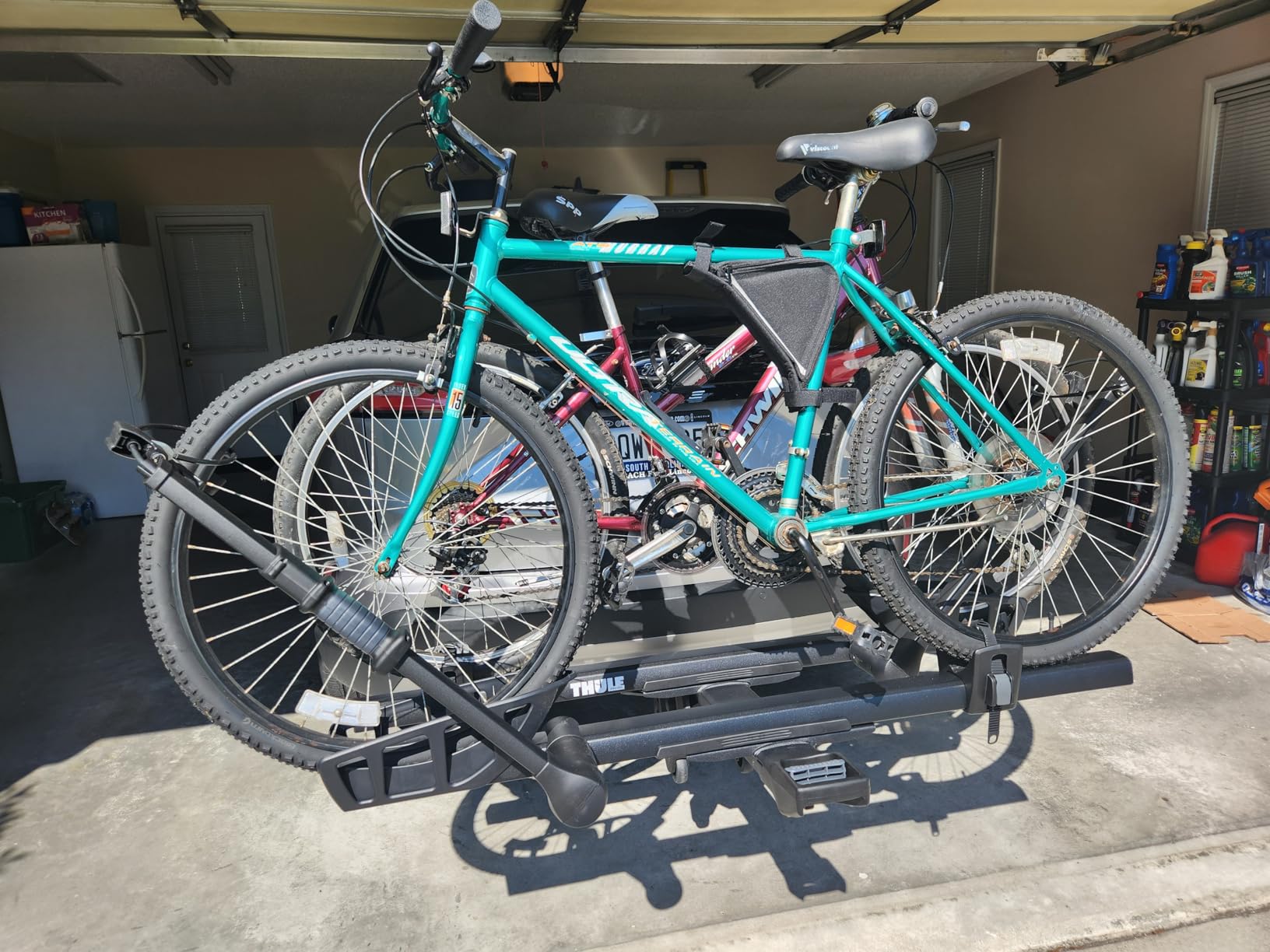
The Thule T2 Pro XT is the one to buy if fat tires are part of your life or if the family might grow a second pair of bikes later. It takes 20 to 29 inch wheels and tires up to 5 inches wide with no adapter, which means a 5-inch fat tire mounts exactly as a 2-inch commuter would.
Every bike is held by the wheels on its own tray, with no clamp touching the frame. That matters more for e-bikes than for standard bikes, because the downtube on most e-bikes is where the battery is integrated and where a clamp leaves a mark in the paint. Wheel-only mounting removes that problem entirely.
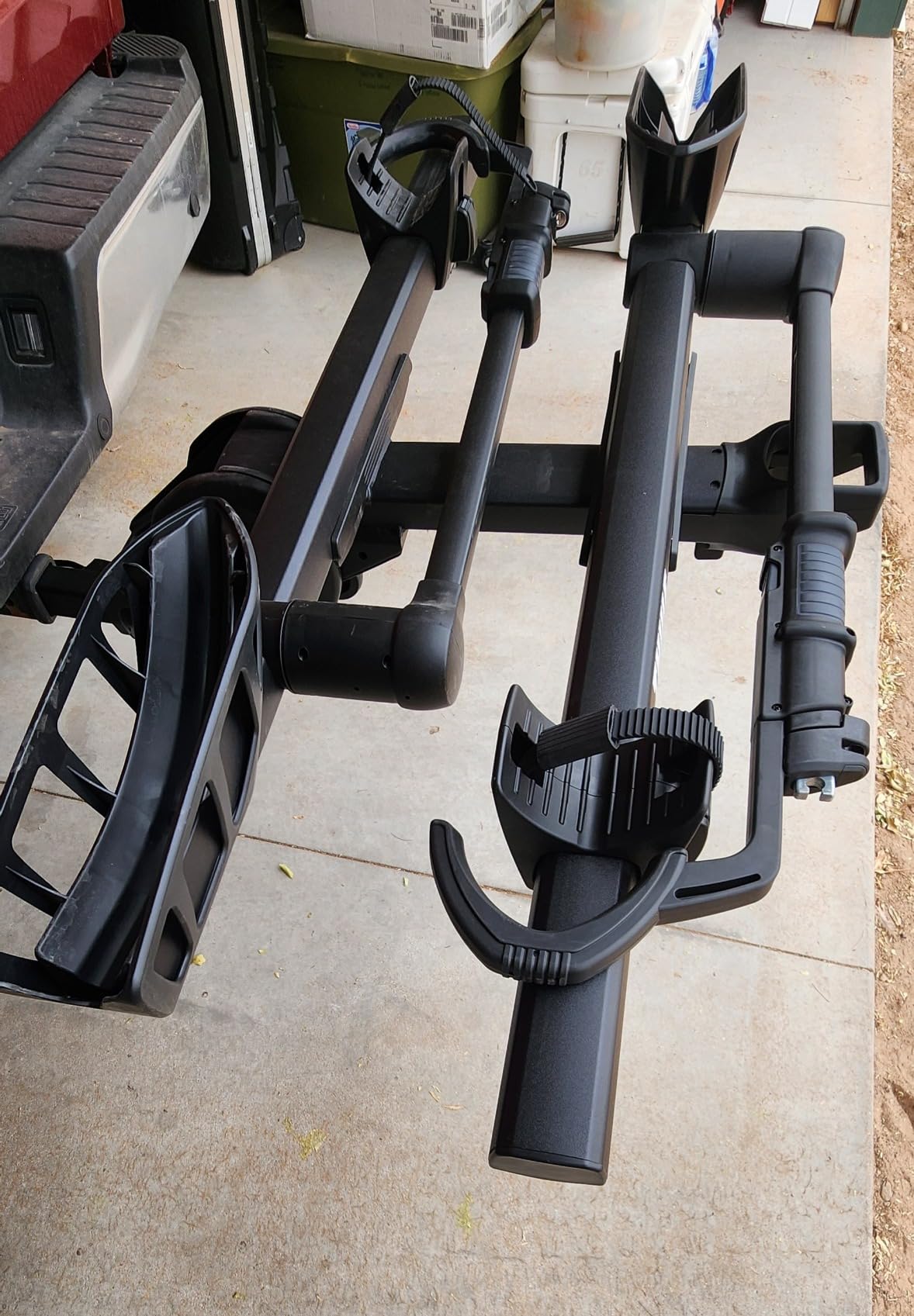
It also expands. The T2 Pro XT Add-On post extends the rack to four bikes, which makes this the only rack in our list that can grow with a family rather than be replaced. Owners with mixed loads, one e-bike and one standard bike, use the width adjustment to space them properly.
Two complaints come up repeatedly. The assembly instructions are largely picture-based and hard to follow, so budget extra time or find a video. And the add-on posts slide in very tightly, sometimes needing a bit of grease to seat properly, which means swapping between two and four bikes is not a one-minute job.
The license plate and backup camera blockage is a genuine issue for some vehicles. Check your plate position against the rack tray height before you commit, particularly on a sedan where the rack sits close to bumper height.
Clearance problems worth checking before you buy
Fold this rack up with no bikes on it and it tucks close to the vehicle. On a pickup with a tailgate-mounted spare tire, that folded position may not clear, which is a recurring owner complaint. Measure from your hitch pin hole forward to the nearest point of the spare tire before you order if you tow this way.
Running a bike with a rear fender is also worth planning for. Check that the tray length and the clamp position leave room for the fender without forcing the wheel out of its cradle.
Who should skip it
Skip it if you have a tailgate-mounted spare tire and need the rack folded frequently, or if you need four bikes now and change them often. The add-on system is a commitment, not a convenience.
It is also not the choice for a single very heavy fat-tire bike above 60 lbs. The per-bike rating is firm at 60 lbs, and exceeding it is not a matter of the rack holding on a little harder.
4. Young Electric EZ-Fold E-Bike Rack – Best Hitch Bike Rack With a Ramp Under Moderate Spend
Young Electric Ebike Rack with Ramp 200 lbs 2-Bike Rack Hitch Mount
200 lb total, 100 lbs per bike
Ramp in the box
Fits tires up to 5 inch
Alloy steel and aluminum
Pros
- 100 lbs per bike covers the heaviest e-bikes
- Ramp included in the box
- V-groove anti-wobble cradle holds fat tires steady
- 1000-hour salt spray coating resists rust
Cons
- Heaviest rack in the group at 66.1 pounds
- Ramp must be stored separately after use
- Ratchet straps at three points per bike take practice
This is the rack for riders whose bikes genuinely do not fit anything else. At 100 lbs per bike it is one of only two racks here rated high enough for a 90 to 100 lb fat-tire e-bike, and unlike the Thule, the loading ramp is in the box with a one-year warranty behind it.
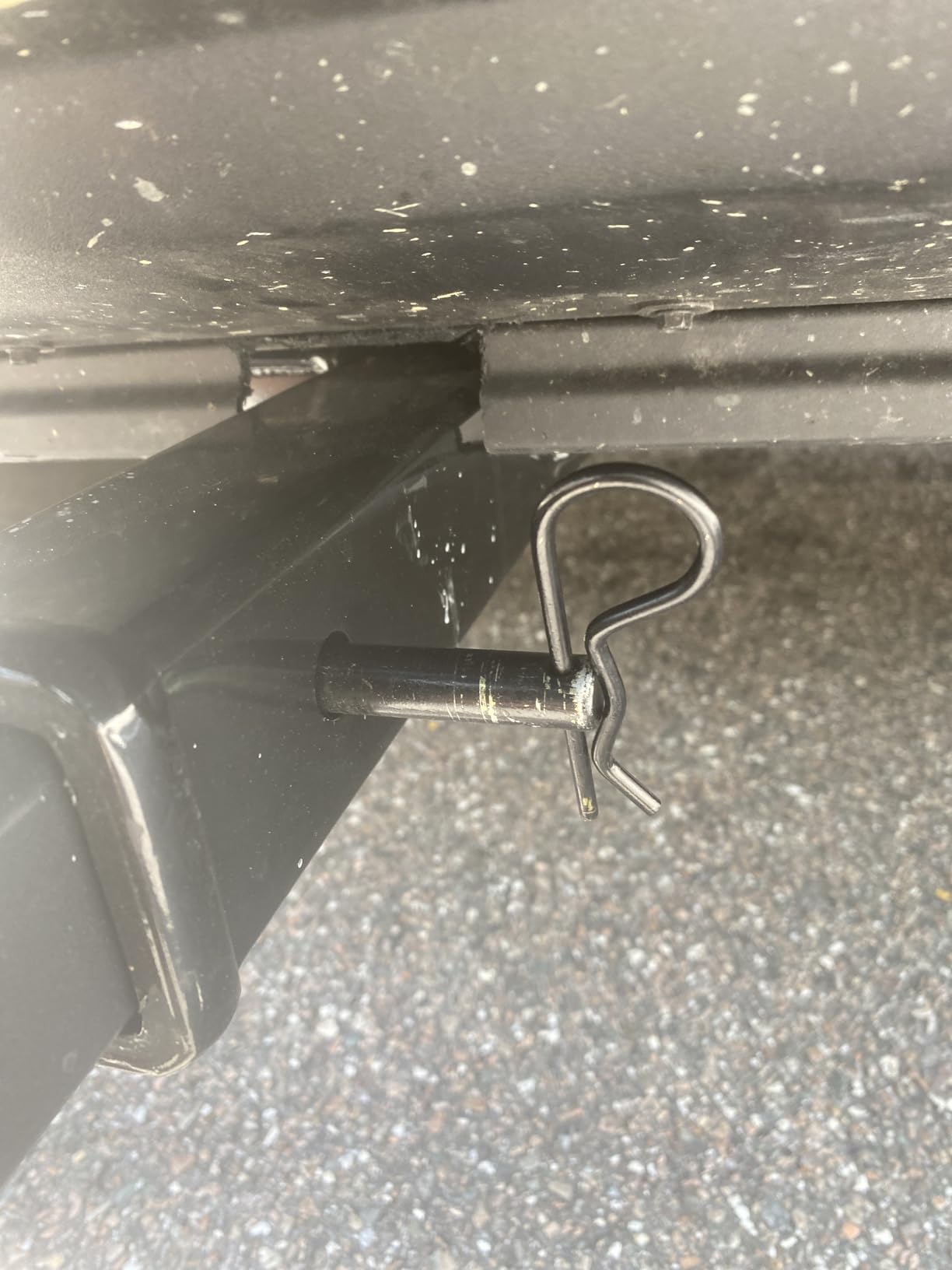
The cradle design is the technical story. A patented V-shape cradle grips the tire in a channel rather than pinning it between flat rails, and the anti-wobble hitch threads bite into the receiver so the whole assembly stays rigid when tightened. That is the difference between a rack that settles after 20 miles and one that does not.
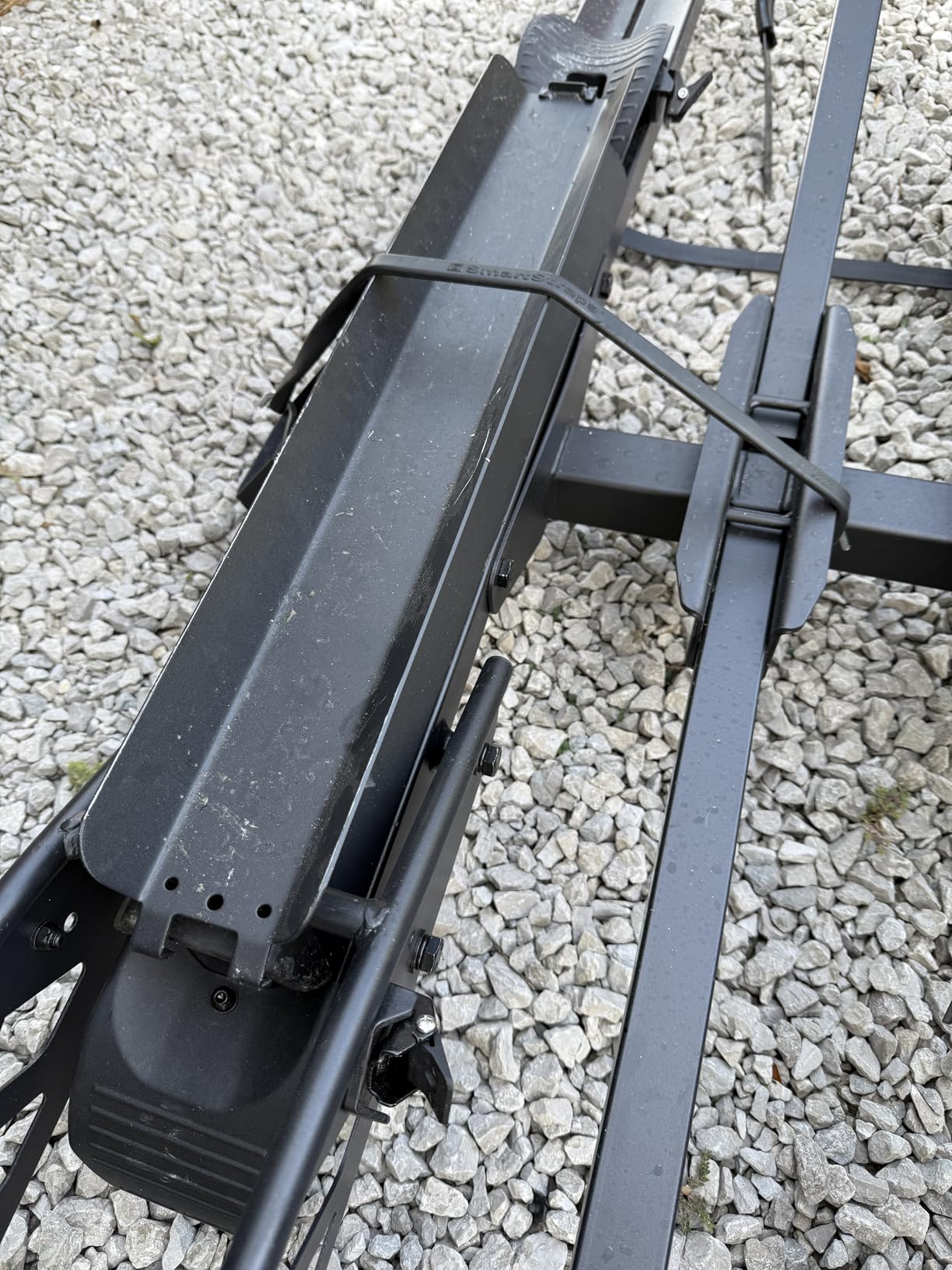
Capacity is not the only consideration here. It fits 5-inch tires and wheelbases up to 50 inches, so long-tail fat bikes are supported properly at both wheels. The ratchet strap system secures at three points per bike with soft padding, which is more restraint than most racks at this level offer.
For coastal or winter riding, the 1000-hour salt spray coating is a real detail. Rust is the number one reason budget racks get replaced after a few seasons, and this one is built specifically to resist it.
The weight is the catch, and it is not a small one. At 66.1 pounds this is the heaviest rack we evaluated, and owners describe installation as a two-person job. You also need somewhere to store the ramp once you are done with it, since it is not permanently attached.
Why the ramp matters more as bikes get heavier
Loading is where e-bike injuries happen. A 58 lb bike feels like 100 lb to a lot of riders, and one owner searching for a carrier put it plainly on r/ebike: they had been loading bikes into a truck bed and were looking for something that did not require that lift any more. A ramp turns a two-person lift into a one-person roll.
Plan the geometry before you commit. The ramp works best approaching from a low angle, so a low hitch and level driveway help. On a high-clearance truck the angle is steeper and the ramp earns its keep even more.
Who should skip it
Skip it if you install and remove the rack frequently or if you live somewhere you cannot get help lifting 66 pounds into a receiver. The weight penalty is severe if you are moving it weekly.
Also skip it if your bikes are standard-weight commuters under 50 lbs each. You would be carrying a heavy rack for capacity you will not use.
5. TANX BR-303-2 – Best Lightweight Budget Rack for Two E-Bikes
TANX Bike Racks for Ebikes,Fat Tire Bike Rack for Tow Hitch 2-Bike 160 lbs Capacity,Hitch Bike Rack for Heavy E Bike, Wobble Free Smart Tilting Folding Bicycle Car Racks for Standard, 2 inch Receiver
160 lb total, 80 lbs per bike
Listed weight 33.4 pounds
Fits 2 inch receivers
Tilts and folds
Pros
- Light at 33.4 pounds yet carries two e-bikes
- Thick powder coat and clean welds at this tier
- Anti-wobble tightener plus locking hitch pin
- Folds to about 14 inches when empty
Cons
- Picture-only assembly instructions
- Supplied locking bolt is short for some factory hitches
- The two U-shaped clamps are not interchangeable
- Included keys open all locks
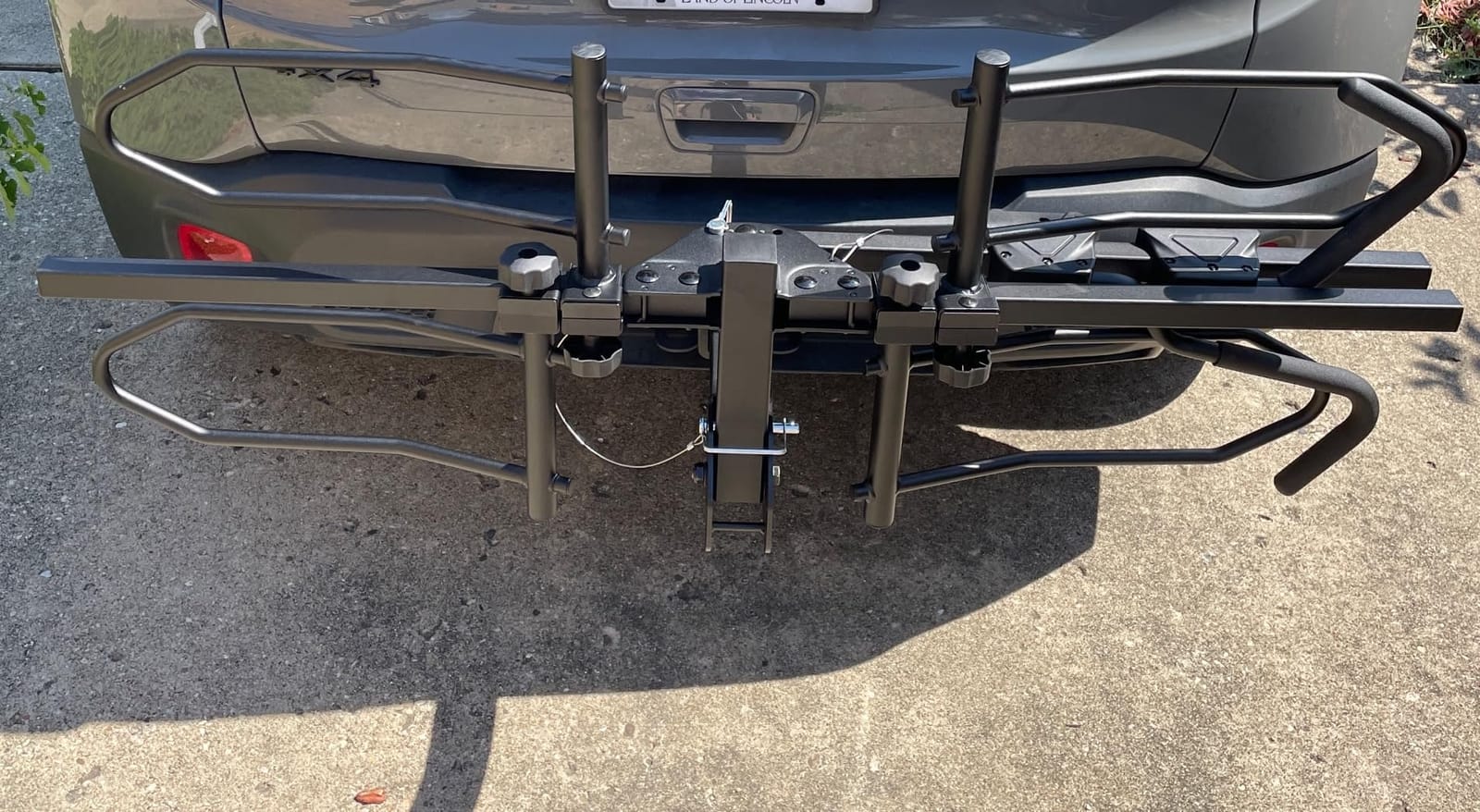
The TANX BR-303-2 solves the single complaint that kills most affordable racks, which is weight. At 33.4 pounds it is the second-lightest rack here, and owners consistently report that one person can lift it into the receiver and fold it away again without help. That changes how often you will actually use it.
Despite the tier, the build is not flimsy. Reviewers single out the weld quality and the thick black powder coat, and once the anti-wobble hitch tightener is torqued down the assembly is described as completely free of play. For a 160 lb total rating, that is 80 lbs per bike, which covers the majority of e-bikes with the battery in.
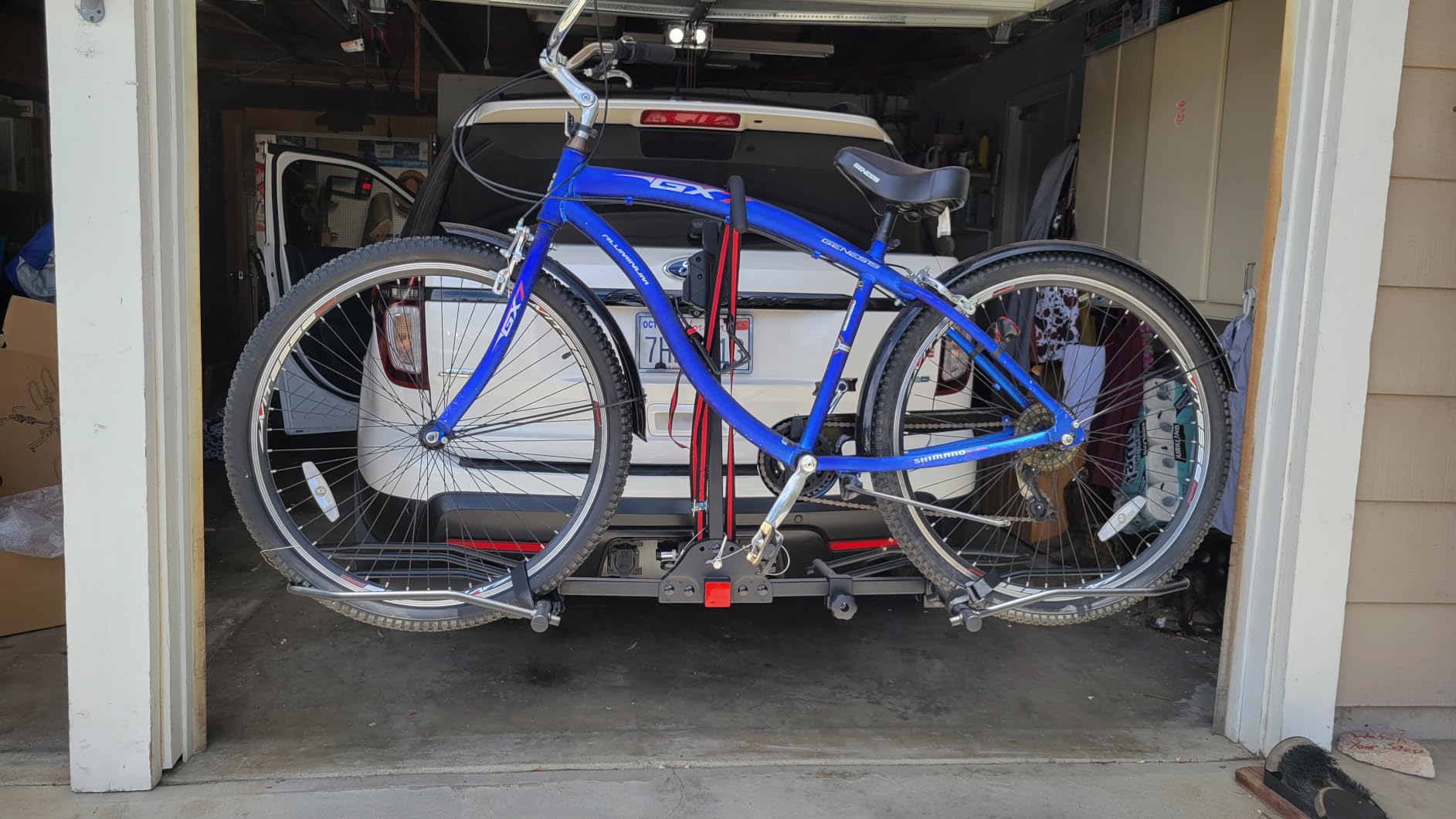
The tilt and fold functions both work as advertised. Tilt back for full trunk or tailgate access without unloading your bikes, and fold up to roughly 14 inches behind the vehicle when it is empty. For a sedan, that narrow folded profile is what makes a hitch rack viable at all.
There are real rough edges. The assembly instructions are largely pictorial, and the two U-shaped clamps are not interchangeable, so installing them in the wrong position is an easy and frustrating mistake. Check the locking hitch bolt length against your specific hitch too, since the supplied one is short for some factory receivers.
One more caution: the included keys open all the locks on the rack, so the security is a deterrent against casual theft rather than a serious one.
How it behaves with mixed bike loads
This rack works well when one bike is an e-bike and the other is a standard mountain bike, which is a common family situation. The padded adjustable cradles hold the lighter bike without any special fitting, and the quick-lock straps make swapping a bike in and out fast.
It is also one of the few racks here that suits a sedan, since the folded depth is small and the tilt gives you trunk access. That combination opens up hitch carrying to people who assumed it was SUV-only.
Who should skip it
Skip it if you are carrying bikes above 80 lbs each, or if you need genuine theft resistance on an expensive e-bike. It is also the wrong pick if you are not comfortable assembling hardware from diagrams alone.
And if you plan to move it between vehicles often, the low weight is an advantage but the re-tightening of the anti-wobble hitch every time is an added step.
6. WEIZE CCA-1003 – Best for the Widest Fat Tires in the Group
WEIZE 2 E Bike Rack Hitch Mounted, Wobble Free Smart Tilting Folding 2 Bicycle Electric Bike Racks with Lock, 2″ Hitch Fits Up to 160 lbs Capacity with Up to 5.5″ Fat Tires for Car, SUV, Trucks
160 lb total, 80 lbs per bike
Fits tires up to 5.5 inch
Listed weight 49 pounds
Alloy steel
Pros
- 160 lb total covers two e-bikes at 80 lbs each
- Key-locking anti-wobble device locks into the receiver
- Accepts 5.5 inch fat tires and wheelbases to 49.5 inches
- Tilts for rear access and folds up when not in use
Cons
- Step-through bikes need a separate top crossbar
- Tilt does not work with swing-out tailgates
- Mixed durability reports in owner feedback
The WEIZE CCA-1003 wins on tire width. It fits tires up to 5.5 inches, wider than anything else in this group, along with wheelbases from 18.5 to 49.5 inches and wheel sizes from 17 to 29 inches. If your e-bikes run extra-wide rubber, this is the one that mounts them without an adapter.
Capacity is 160 lb total, or 80 lbs per bike, with a key-locking anti-wobble device that tightens into a 2-inch receiver and stays locked in that position. Reviewers like having a keyed lock at the hitch itself rather than relying on a pin that a determined thief could work loose.
The tilt and fold design lets you reach the rear of the vehicle and then tuck the rack up out of the way. That makes it a reasonable fit behind a hatchback where a permanently extended platform would be in the way every time you load groceries.
Two limitations are worth planning around. Step-through frames need the optional top crossbar to be held properly, and the tilt mechanism does not work with swing-out tailgates, so a pickup with that style of tailgate should look elsewhere. Owner feedback on this model is also mixed on durability, which is the main reason it does not sit higher in this list.
The padded frame clamps, cradles and the included safety strap are a sensible touch on a rack at this level, since paint protection on an expensive e-bike is cheap insurance.
What to verify on your specific bike
Measure your tire at the widest point, not the nominal size printed on the sidewall, since a tire labeled 5 inches can measure wider once inflated. If you are near the 5.5 inch ceiling, check the cradle measurement before ordering.
Also confirm your frame style. Standard double-diamond frames clamp fine, but step-through and some step-over frames need the top crossbar to give the clamp something to grip, and that is an extra purchase.
Who should skip it
Skip it if you have a swing-out tailgate and need the tilt, or if durability over many seasons matters more than tire width. It is also the wrong choice for a step-through bike unless you plan to add the crossbar.
And skip it if you carry only one bike. This is a two-bike platform, and single-bike carriers in this class are lighter and cheaper.
7. Kuat Sherpa 2.0 – Top Rated, but Only for Lightweight E-Bikes
Kuat Sherpa 2.0 2-Bike Hitch Rack, Gray Metallic & Orange Anodize, 2″
40 lbs per tray, 80 lb total
Listed weight 32 pounds
Foot-assisted pivot
Tire mount only
Pros
- Lightest premium rack here at 32 pounds
- Easy one-person installation and storage
- Adjustable ratchet arms hold bikes by the tires
- Folds up compactly with foldable tire cradles
Cons
- 40 lb per-tray limit is below the weight of many e-bikes
- Plastic wheel attachment parts feel flimsy
- Tire hook sits close to some exhaust pipes
- Does not expand beyond two bikes
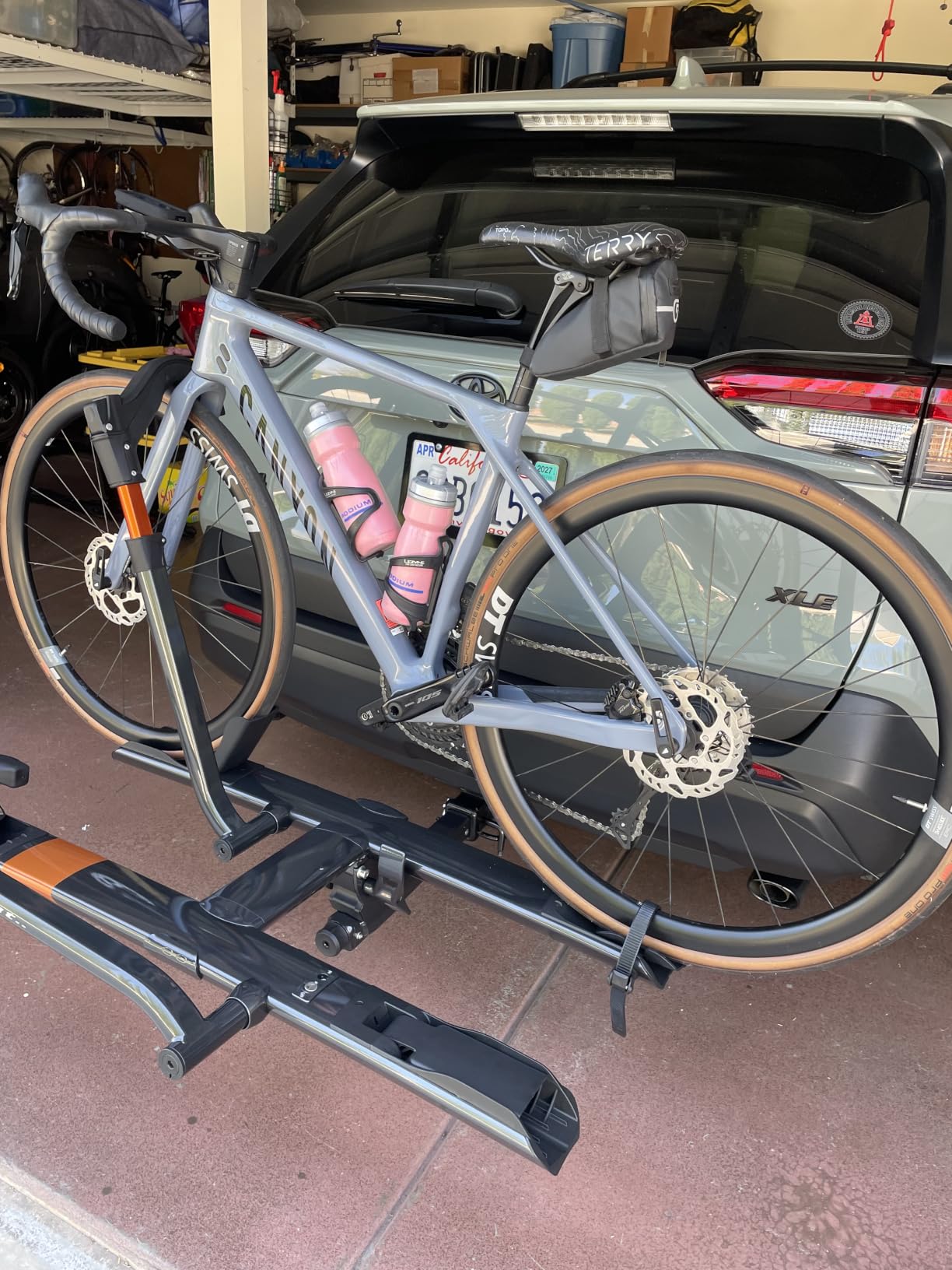
The Kuat Sherpa 2.0 has the highest review count in this group and one of the highest ratings, and for most riders it is a beautiful rack. The problem is a single number: 40 lbs per tray. That is below the weight of many e-bikes once the battery is installed, so this is not the rack for the bikes this guide is about.
Where it does fit, it fits well. At 32 pounds it is the lightest premium rack here, and reviewers consistently single out one-person installation as the standout feature. The foot-assisted pivot lowers the rack for hatch access with bikes loaded, and the foldable tire cradles let it fold to a slim profile for a garage shelf.
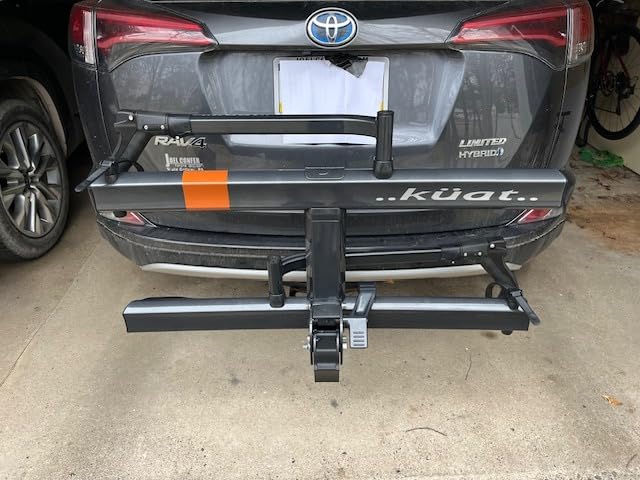
The adjustable ratchet arms grip the tires with no frame contact, and an external cable with a semi-integrated lock secures the bikes to the rack. It handles wheelbases up to 47 inches and tires up to 3 inches, with an optional kit for wider bikes.
A few owners flag that the plastic wheel attachment parts feel flimsy for the price, and that the tire hook can sit close to an exhaust tip when the rack is folded up. On a vehicle with a side-exit exhaust, that is worth a look before you buy.
We keep this in the roundup because it is a genuinely excellent rack that happens to be the wrong tool for heavy e-bikes, and because it is the reference point for what good build quality feels like at this level.
When 40 lbs per tray is actually enough
It works if your e-bike is a small folder or a lightweight commuter with a small battery, and if you are willing to remove that battery before loading. Take the battery out and you can drop well under the limit, and you gain a key benefit that applies to every rack on this list: it reduces the load on the tray and removes the theft target.
Owners consistently praise the road stability, describing it as feeling as solid as racks rated far higher. For standard bikes, it is very hard to argue with the build quality.
Who should skip it
Skip it if your e-bike with the battery installed exceeds 40 lbs, which is most of them. Skip it if you need four bikes, since it does not expand. And skip it if you plan to keep the battery installed, because the entire capacity question turns on that decision.
If you need a light premium rack that still handles real e-bikes, the Thule EasyFold XT 2 is the better target, and it folds flat too.
8. Young 200LB 2-Bike Platform Rack – Best Value for 200 lbs of Capacity
Young Bike Rack Hitch for Car – 200LB 2-Bike Rack Hitch Mount Platform Style Hitch Bike Rack,Smart Tilting & Easy Fold for Car SUV with 2 Inch Receiver,Bike Carrier Fits Up to 5-inch Fat Tire
200 lb total, 100 lbs per bike
Listed weight 41.6 pounds
Fits tires up to 5 inch
Direct 2 inch fit
Pros
- 200 lb total matches premium racks at far lower cost
- Direct 2 inch fit with no adapter
- Folds and tilts away without removing bikes
- Pre-assembled parts make install quick
- Holds two 75 to 88 lb e-bikes over rough roads
Cons
- Limited spot welding leaves some joints unwelded
- Paint shows rust at joints after a few rainy days
- Plastic knobs and wing nuts wear before metal hardware
- Top hold-down bar makes mounting the front bike fiddly
The Young 200LB rack is the reason we can recommend a 100 lb per bike rating without telling you to spend premium money. It matches the capacity of the racks at the top of this list, fits directly into a 2-inch receiver with no adapter, and it carries 5-inch fat tires across 20 to 29 inch wheels.
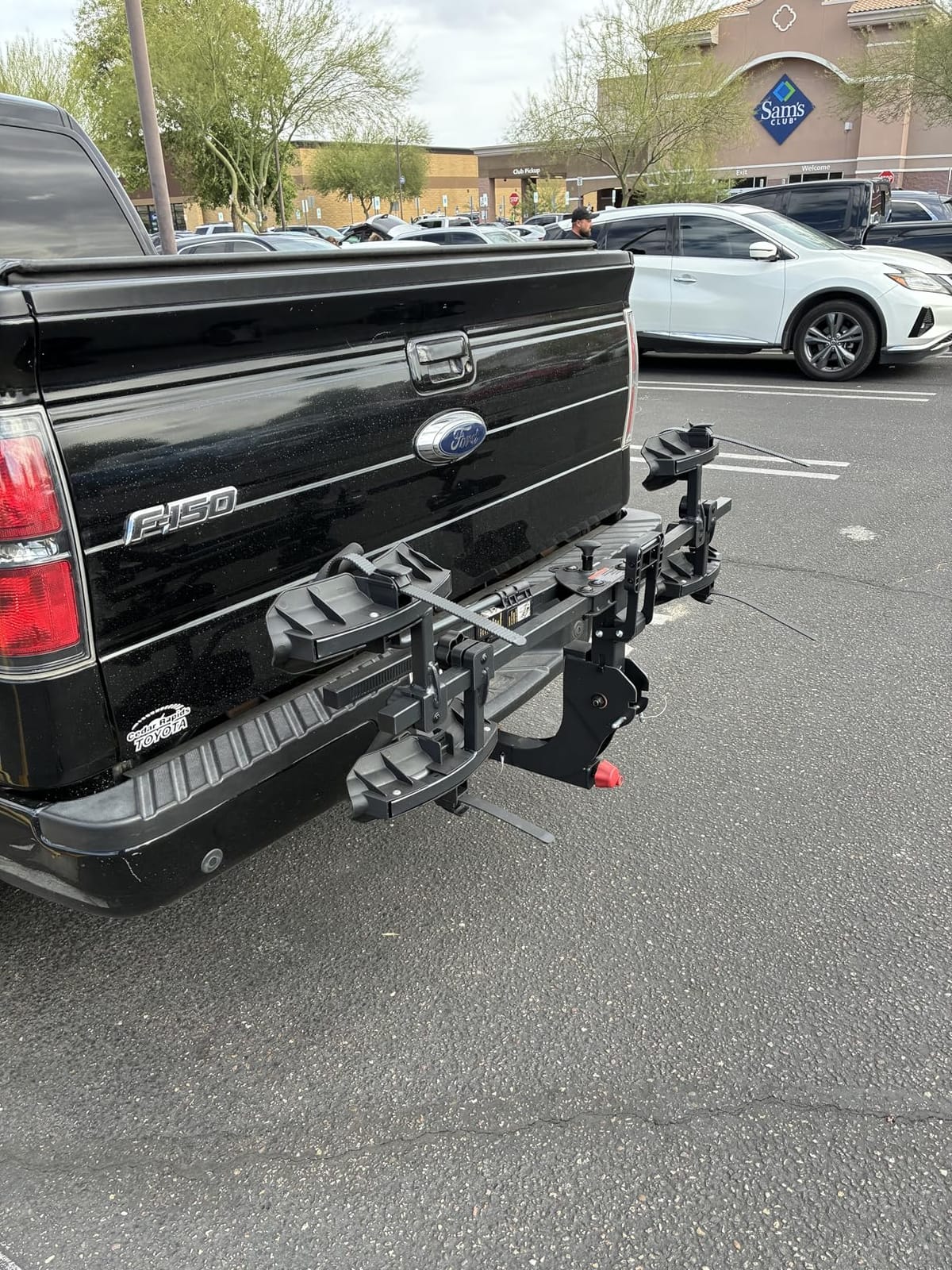
Owners of heavy e-bikes rate it well for delivering that capacity at a lower spend, and they praise how solid it feels once the hitch bolt is tightened properly with a large wrench. Many also report it working behind a Jeep Wrangler with a rear-mounted spare, which is a configuration that defeats a lot of racks.
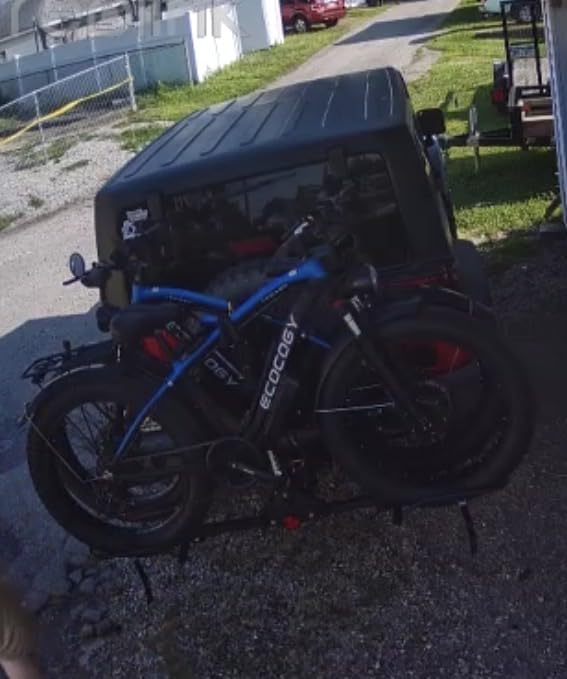
The soft padded hooks keep bikes from swaying and protect the frame, the fold-up design plus quick-release tilt lever gives you trunk access without removing the bikes, and the mostly pre-assembled parts mean installation needs no tools and very little time.
The criticisms are all about finishing rather than function. Limited spot welding leaves some sections unwelded, paint can show rust at the joints after only a few rainy days outdoors, and the plastic knobs and wing nuts wear faster than the metal hardware. A few owners also find the top hold-down bar makes mounting the front bike fiddly.
One practical note: bikes can block the taillights, and the rack sits further back on some bumpers. Check both against your vehicle before you commit.
Rust and winter maintenance, honestly
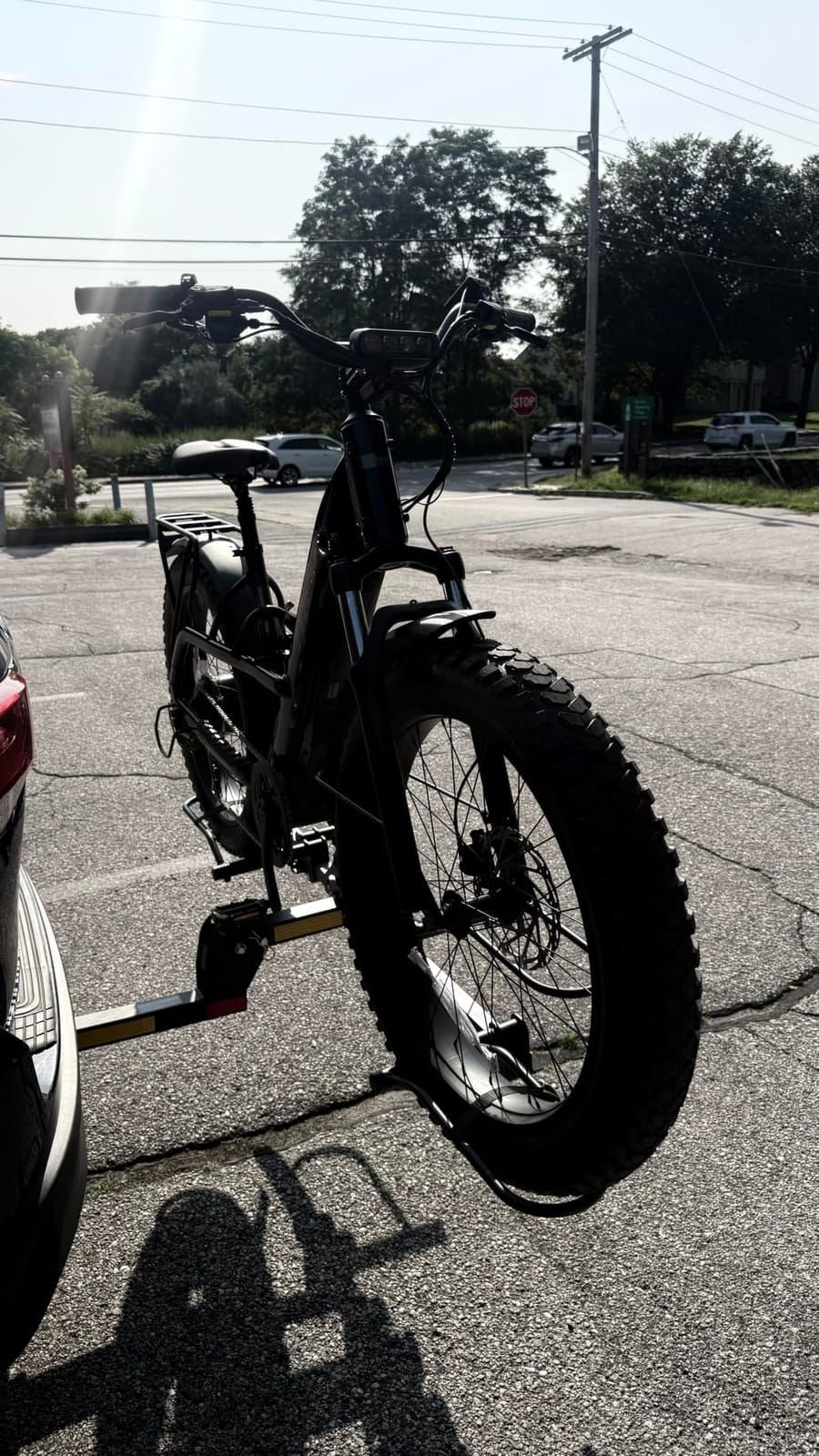
Surface rust at the joints is the most common long-term complaint, and it appears within weeks for riders in wet or salty climates rather than years. That is a maintenance issue rather than a structural one, but it is worth knowing before you buy, especially if your rack lives outside.
A yearly rinse with fresh water, drying before storage, and a touch of protective coating on the joints keeps it going for many seasons. The soft padded hooks and the rear safety reflector are both practical details that cost nothing to live with.
Who should skip it
Skip it if you leave the rack outdoors year-round in a coastal or salted environment and do not want to maintain it. Skip it if you need a warranty longer than one year, and skip it if you carry bikes over 100 lbs each.
And skip it if both your bikes are light. The capacity advantage is wasted, and a lighter rack will be easier to handle every time.
Which Hitch Rack Fits Your Situation?
Three questions separate almost every rack on the market: how many e-bikes you carry, how much each one weighs with the battery installed, and what you drive. Answer those and the choice narrows quickly.
If you carry two e-bikes that each weigh 50 to 65 lbs, the whole list applies. A 2-inch receiver and at least 60 lbs per tray is the floor. The Kuat NV 2.0 and the Thule T2 Pro XT are the strongest all-round choices here, and the budget racks cover the same weight class with fewer features.
If your bikes weigh 90 to 100 lbs each, capacity stops being optional. That leaves the Young Electric EZ-Fold and the Young 200LB rack, both rated at 100 lbs per bike. Consider the ramp on the EZ-Fold, because lifting that much weight onto a tray by hand is where things go wrong.
If you drive a sedan or a hatchback, rack length and tilt clearance matter more than anything else. The TANX folds to about 14 inches and tilts for trunk access, which makes it the most sedan-friendly rack here. Check your hitch pin hole to bumper clearance before you order anything long.
If you tow a motorhome or flat-tow, look for an RV-rated rack and confirm the rating in writing before you buy. Several racks here are not RV-rated, and forum accounts include riders who lost bikes when a non-rated rack failed at highway speed.
If you have a pickup with a tailgate-mounted spare tire, measure first. The folded-up position on the Thule T2 Pro XT may not clear, while the Young 200LB rack is reported to work in that setup. This is one of the most common install-day surprises.
If your only hitch is 1.25-inch, your options narrow quickly. Most e-bike-rated racks need a 2-inch receiver, and the Thule EasyFold XT 2 is the notable exception that fits both. Adapters exist, but a 1.25-inch receiver flexes under a heavy e-bike load, and that is a real concern reported repeatedly by owners.
How to Measure Your E-Bike Weight and Your Pickup Clearance
Most capacity mistakes happen because riders guess their bike weight. Here is a five-minute check that removes the guesswork.
- Find a scale or a bike shop scale. A bathroom scale under both wheels works, and many bike shops will weigh a bike for you at no charge.
- Weigh the bike with the battery installed. That is the number the rack has to carry, and it is the number that matters for the per-tray rating.
- Weigh the battery separately. Most e-bike batteries add 7 to 10 lbs. Removing it before loading is the single easiest way to get under a tight per-bike limit, and it takes under a minute at most trailheads.
- Add a margin. Check the per-tray rating against your battery-in weight, and stay at or under it. Running a bike at exactly the stated limit leaves no room for a bottle cage, a loaded pannier, or a wet tire.
For pickups, a second measurement prevents the most common install failure. Measure from the hitch pin hole forward to the nearest point of your spare tire, bumper, or tow hook, and compare that to the rack’s stated length with the bikes removed.
Do the same measurement with the rack tilted or folded, because that is the position it will sit in every time you load the bed. A rack that fits with bikes on can still foul a tailgate-mounted spare tire when you fold it up to get at the truck, and finding that out after delivery means returning a part.
If you have a swing-out tailgate, skip any rack whose tilt does not clear it. The WEIZE CCA-1003 is a good example of a rack whose tilt simply does not work in that configuration.
The Hitch Bike Rack Buying Guide for Electric Bikes
Per-bike capacity comes before everything else. Check the per-tray rating, not the total. A rack advertised at 200 lb total across two bikes is 100 lb per bike; one advertised at 130 lb is 65 lb per bike. The two numbers describe very different machines, and the total figure is the one marketers lead with. Every rack in this guide is rated at 60 lbs per bike or higher, which is the threshold we consider e-bike-capable.
Receiver class is the second filter. A 1.25-inch receiver is Class II, and a 2-inch receiver is Class III. Under a 100 lb e-bike load, a 1.25-inch receiver develops visible flex, and owners describe the resulting wobble as feeling unsafe even when the rack is properly torqued. The Thule EasyFold XT 2 fits both sizes, which makes it the safe premium option if your hitch is uncertain. Otherwise, expect to need a 2-inch receiver.
Platform racks beat hanging racks for e-bikes. A platform or tray-style rack holds each bike by the wheels on its own tray. A hanging rack clamps the frame by the fork or the top tube, and on an e-bike that clamp often lands on the downtube where the battery is integrated. Wheel-only mounting is the reason every rack on this list is a platform design.
Tire width decides whether fat tires fit. Standard racks cradle about 3 inches. Fat tires run 4 to 5 inches, and 5 inches is close to the practical ceiling. The Thule T2 Pro XT takes 5 inches without an adapter, the WEIZE goes to 5.5 inches, and racks like the Kuat NV 2.0 and the Thule EasyFold XT 2 need a separate strap kit for wide rubber.
A ramp changes the loading equation. With bikes above about 70 lbs, a ramp turns a two-person lift into a one-person roll. Two racks here include one: the Thule EasyFold XT 2, where it folds into the rack itself, and the Young Electric EZ-Fold, where it stores separately. Owners who asked us for a single feature asked for this one.
Tilt and fold are daily-use features. A tilt that lowers the loaded rack gives you hatch or tailgate access without unloading. A fold flattens the empty rack for garage storage. Behind a sedan or hatchback, a rack that does both is often the difference between using a hitch rack and abandoning the idea.
Rack weight matters more than people expect. The racks here weigh between 32 and 66 pounds. That range decides whether you need a second person to lift the rack into the receiver and whether a garage is a realistic place to keep it. If you plan to remove the rack often, weigh this before the capacity.
Security is usually a pin and a cable. Most racks here include a locking hitch pin and integrated cables, but several use one key for every lock on the rack. A hitch pin lock with a barrel-style mechanism is a worthwhile separate purchase, and it is worth confirming that your rack’s pin accepts one.
Check tongue weight and hitch class for heavy racks. A 60 lb rack sitting behind a lighter receiver adds real load to the hitch. If your vehicle’s hitch is Class II, a heavy rack loaded with two e-bikes can exceed what the vehicle was rated for. This is one area where we recommend checking your owner’s manual rather than estimating.
RV and flat-towing users should demand a rating. Not every rack is RV-rated, and forum accounts include riders who lost bikes when a non-rated rack failed while flat-towing. If you tow a motorhome, treat the RV rating as a requirement, not a preference.
Fenders and step-through frames need planning. Full-fender e-bikes can be hard to fit on racks with integrated frame clamps, because the fender fouls the clamp. Step-through frames may need a top crossbar, as on the WEIZE. If you ride either style, check that specific clearance before buying.
Also considered. Riders weighing alternatives mentioned Rhino-Rack and 1UP USA as the higher end of the range, with one owner on r/Aventon describing a Rhino-Rack as the best value in that tier and recommending 1UP if the budget stretches. Swagman’s E-SPEC and the Swagman Current Pro, rated at 60 lbs per bike with tires up to 5 inches, appear as owner-run alternatives when 2-inch capacity seems excessive. A Harbor Freight Haul Master with a 400 lb capacity is regularly praised in forums as a value pick for heavy e-bikes. Thule Epos and Verse, RockyMounts BackStage, InnoRack, Aventon, and Curt are all worth a look for specific vehicle and bike combinations, but we left them out because the eight racks here beat them on the e-bike-specific criteria that matter most.
Frequently Asked Questions
Do you need a special bike rack for an electric bike?
Yes, in practice you need a platform-style hitch rack rated well above the weight of a standard bike. E-bikes weigh 50 to 100 lbs against roughly 30 lbs for a standard bike, so look for at least 60 lbs per bike and preferably 80 to 100 lbs per bike if you ride fat tires. Wheel-mount trays that never clamp the frame are also worth having, because the downtube on most e-bikes is where the battery is integrated.
What kind of bike rack is suitable for ebikes?
A platform or tray-style hitch rack is the right answer for e-bikes, because each bike sits on its own tray held only by the wheels, with no clamp touching the frame. Look for a 2-inch receiver, at least 60 lbs per bike, tire clearance of 4 to 5 inches for fat bikes, and a tilt or fold function. Hanging racks that clamp the frame are the least suitable option for an e-bike with an integrated downtube battery.
What is the best hitch rack for electric bikes?
The Kuat NV 2.0 is the best overall hitch rack for electric bikes in our testing, with 60 lbs per tray, an all-metal build, zero frame contact, a tilt for rear access, and an integrated Trail Doc repair stand. For the highest capacity and a built-in ramp, the Thule EasyFold XT 2 carries 65 lbs per bike. For fat tires, the Thule T2 Pro XT accepts tires up to 5 inches wide.
What is the best tow bar bike rack for electric bikes?
For a motorhome, trailer, or flat-towing setup, choose a rack that is explicitly RV-rated and confirm the rating in writing before you buy. Not every hitch rack is RV-rated, and non-rated racks have failed at highway speed for owners who towed them. A rack rated at 60 lbs per bike or higher, with a locking hitch pin and a 2-inch receiver, is the minimum to consider.
What bike rack can carry an e-bike?
Any platform-style hitch rack rated for 60 lbs per bike or higher can carry a typical e-bike, and racks rated at 100 lbs per bike handle fat-tire models in the 90 to 100 lb range. Measure your bike with the battery installed before buying, and compare that weight to the per-bike rating rather than the total capacity. Removing the battery, which commonly weighs 7 to 10 lbs, can move a bike under a tighter limit.
What is the best car rack for electric bikes?
For a sedan or hatchback, the TANX BR-303-2 is the most practical choice, because it folds to about 14 inches when empty and tilts away for full trunk access. For an SUV or truck, the Kuat NV 2.0 or the Thule T2 Pro XT are stronger overall. Measure from your hitch pin hole to your bumper or spare tire before ordering any rack, since length is what limits sedans.
What is the best bike hitch rack for ebikes?
The best bike hitch rack for e-bikes is a 2-inch receiver platform carrier with at least 60 lbs per bike, wheel-only mounting, and tire clearance to 5 inches. Our top pick is the Kuat NV 2.0 for all-round strength, the Thule EasyFold XT 2 if you want the highest capacity and a built-in loading ramp, and the Young Electric EZ-Fold if your bikes run 90 to 100 lbs each.
Do electric bikes need a special bike rack?
E-bikes need a heavier-duty rack than standard bikes, but not a separate category of equipment. The differences are weight capacity, frame contact, tire width and battery security. A platform hitch rack rated above 60 lbs per bike handles nearly every e-bike. The two things that help most are removing the 7 to 10 lb battery before loading and choosing wheel-mount trays that never touch the frame.
The Best Hitch Bike Rack for Electric Bikes in 2026
After working through all eight, the Kuat NV 2.0 is our pick for the best hitch bike racks for electric bikes in 2026. It is the only rack here that is strong in every category at once: 60 lbs per tray, an all-metal build, zero frame contact, a tilt for rear access, and a repair stand that folds out of the body.
Match it to your rider type instead. Carry two e-bikes in the 50 to 65 lb range and want the strongest build? The Kuat NV 2.0. Want the highest capacity and a ramp that folds into the rack, and your hitch might be 1.25 inch? The Thule EasyFold XT 2. Run 5-inch fat tires and might add a second bike later? The Thule T2 Pro XT. Ride bikes in the 90 to 100 lb range and want a ramp in the box? The Young Electric EZ-Fold. Back a sedan and need something light you can handle alone? The TANX BR-303-2. Push the widest tires possible? The WEIZE CCA-1003. Need 200 lbs of capacity at the lowest spend? The Young 200LB rack.
One last thing before you order. Weigh both bikes with the batteries installed, confirm you have a 2-inch receiver, and measure from your hitch pin hole to your spare tire if you tow a pickup. Those three checks take ten minutes and they eliminate almost every disappointment we hear about.