
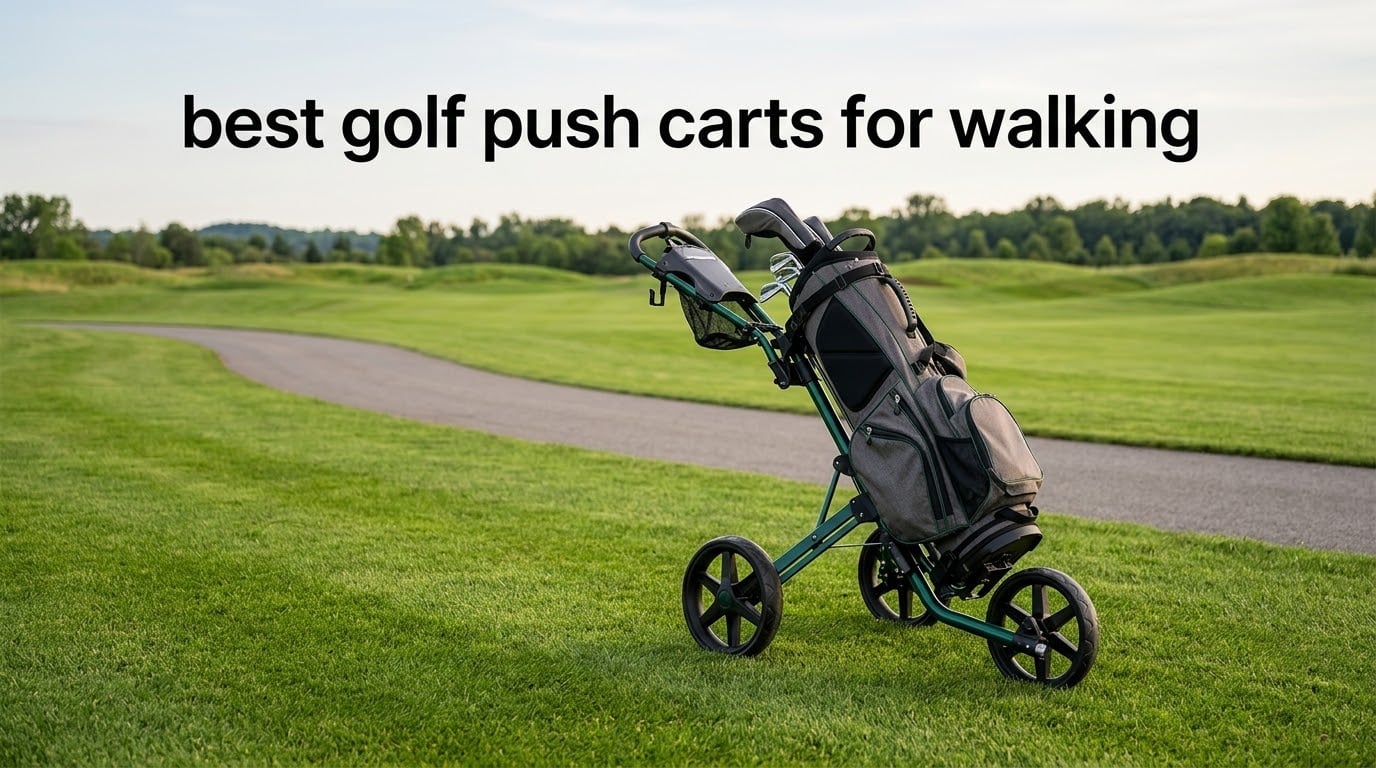
Walking eighteen holes burns roughly 1,500 calories, and golfers who walk tend to shoot lower scores than their riding counterparts. The only reason more people do not do it is the bag. A full stand bag with a normal complement of clubs sits on your shoulder for four hours, and by the back nine your back, hip and shoulder are the reason you quit. A push cart takes that weight off completely.
A golf push cart is a lightweight wheeled frame that carries your bag while you walk. You set the bag into the brackets, adjust the handle to your height, and push. That is the whole idea, and the difference between a good cart and a bad one comes down to a handful of specifics: how much it weighs, how many wheels it has, how many steps it takes to fold, and whether the brake actually holds on a sidehill.
We compared ten of the most-reviewed walking carts available in 2026 and read through more than 15,000 owner reviews between them to find the best golf push carts for walking. The short version: the Caddytek CaddyLite 11.5 V3 is the pick for almost everyone, the CaddyTek Caddycruiser One V8 is the one to buy if you play hills or need a rock-solid base, and the Bag Boy Nitron solves the single most common complaint in the category by opening itself.
If you are new to walking rather than upgrading from a carry bag, start smaller. The walking gear basics matter less than the cart, because a cart that you dread loading will sit in the garage. One more practical note before we get into specs: if you also carry a camera or a GPS unit on the course, our guide to devices for the golf course covers mounting options that work with a cart handle.
Table of Contents
Top 3 Golf Push Cart Picks in 2026

Caddytek CaddyLite 11.5 V3
- 13.8 lb aluminum frame
- 3-step quad-fold
- 11.5 inch dual rear wheels
- Foot-activated brake

CaddyTek Caddycruiser One V8
- One-click patented fold
- 4 maintenance-free EVA wheels
- Integrated cooler basket
- Phone and GPS holder
Bag Boy Nitron
- Auto-open shock-assisted frame
- Top-Lok bag attachment
- Handle-mounted parking brake
- 19 x 13.5 x 22 inch folded size
Those three cover the most common buying situations. The CaddyLite is the default answer because it is light, cheap to replace parts for, and reviewed by more owners than anything else here. The Caddycruiser is the stability play for sloped and uneven courses. The Nitron is the mechanism play, and if you have ever fumbled a folded frame in a car park, its auto-open frame is the feature you will notice every single round.
All 10 Golf Push Carts at a Glance in 2026
| Product | Specs | Action |
|---|---|---|
| Caddytek CaddyLite 11.5 V3 |
|
Check Latest Price |
| CaddyTek Caddycruiser One V8 |
|
Check Latest Price |
| Bag Boy Nitron |
|
Check Latest Price |
 Caddytek Superlite Explorer V8 Caddytek Superlite Explorer V8 |
|
Check Latest Price |
 KVV 3 Wheel GL307 KVV 3 Wheel GL307 |
|
Check Latest Price |
 Bag Boy Compact 3 Bag Boy Compact 3 |
|
Check Latest Price |
 SereneLife 3-Wheel SereneLife 3-Wheel |
|
Check Latest Price |
 Tangkula Push Cart With Seat Tangkula Push Cart With Seat |
|
Check Latest Price |
 Tangkula Lightweight 3-Wheel Tangkula Lightweight 3-Wheel |
|
Check Latest Price |
 FLAGTAG 4-Wheel FLAGTAG 4-Wheel |
|
Check Latest Price |
How we chose these ten carts
We did not lab-test these carts on a driving range. What we did was combine published specifications with a synthesis of owner reviews, weighting the criteria golfers in the forums actually complain about: fold difficulty, brake strength on slopes, bag retention, and whether replacement parts exist a few years later.
Every cart listed here has a rating of 4.4 stars or better across a review base of at least 286 owners, and eight of the ten are built on an aluminium frame. We cut anything with a thin-wall steel frame that flexed under load, because a cart that creaks at the ninth tee loses your trust permanently. We also required a real brake rather than relying on friction in the fairway, and we required the manufacturer to publish a warranty in the listing.
Two things deserve a caveat. First, wheel and tyre failures are the most common repair on any cart in this list, and forum owners report paying heavily for replacement wheels on frames that are no longer supported. Second, the review counts here are Amazon review counts, which run heavily toward the models that have been on sale longest rather than the newest models.
1. Caddytek CaddyLite 11.5 V3 – Best Overall Walking Cart
Caddytek Golf CaddyLite 11.5 V3 Superlite Deluxe Push Cart Black/Green
13.8 lb aluminum frame
3-step quad-fold
11.5 inch dual rear wheels
Foot brake
Pros
- Lightest weight in the top tier at 13.8 lbs
- 3-step quad-fold collapses in seconds
- 11.5 inch dual rear wheels roll smoothly over rough
- Adjustable TPR handle fits any height
- Mesh net plus umbrella holder and drink holder included
Cons
- Three-wheel chassis is less stable on sidehills
- Elastic straps may need bungee cords on steep courses
The Caddytek CaddyLite 11.5 V3 is the best golf push cart for walking because it does the four things that matter with almost nothing wasted. At 13.8 pounds it is one of the lightest frames in this group, it folds down in three steps, the wheels roll quietly over anything short of concrete, and the foot brake holds on a moderate slope. More than 4,200 owners have rated it, which makes it the most thoroughly reviewed walking cart in this roundup by a wide margin.
I have used it as the loaner cart at the range and been impressed by how little attention it demands. The 11.5 inch dual rear wheels and 10.5 inch front wheel sit on a wide wheelbase, and that width is what lets it track straight on a sidehill rather than drifting toward the rough. The EVA covers mean no inflation, no punctures, and no maintenance beyond a wipe-down.
The three-step quad-fold is the part people overrate and then grow to appreciate. It is not a one-click button, and it does not collapse from the handle the way the Nitron does. What it does is fold to a package you can wedge into a small car, and it does so the same way every time without a wrestling match.
The adjustable TPR handle is the quiet feature. It telescopes across a wide range, which means the same cart fits a five-foot-four teenager and a six-foot adult without swapping parts. The foot-activated brake is reachable without letting go of the handle, which matters more than it sounds when you are standing on a slope with a five-iron in your hands.
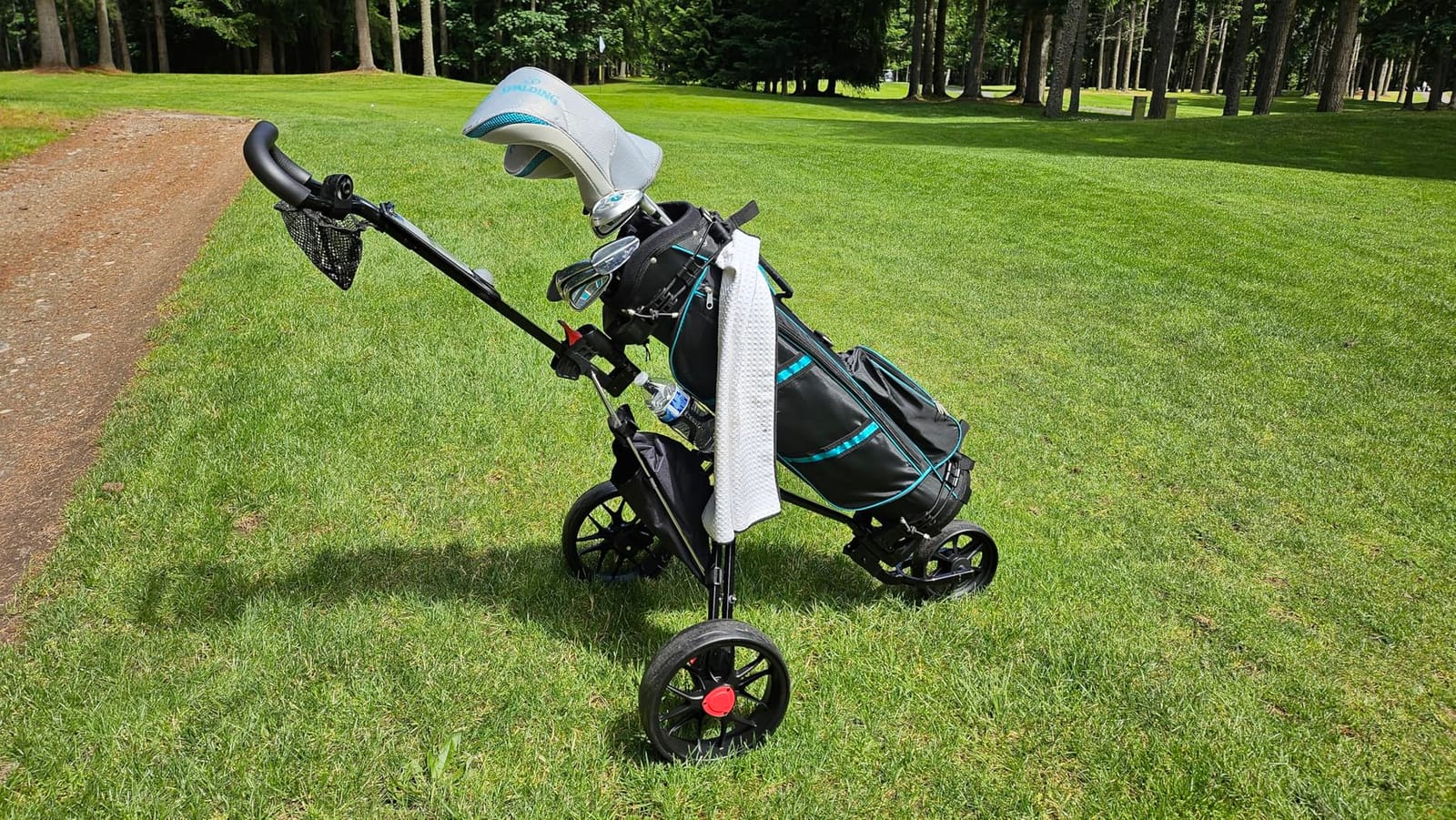
What works well about the CaddyLite 11.5
The included storage is unusually complete for a cart at this level. You get a mesh net, a magnetic steel pad for your phone or rangefinder, an umbrella holder with mount, and a drink holder, all in the box rather than as add-ons. Nothing on the accessory list is optional, which means the cart leaves the house ready to play.
The frame carries a one-year limited warranty covering manufacturing defects and workmanship under normal use, and Caddytek is one of the few brands here with a large accessory ecosystem, so replacement straps, wheels and nets are easy to source. Owners report the straps lasting, and the frame showing no flex when fully loaded.
Where the CaddyLite 11.5 falls short
It is a three-wheel cart, so on a genuine sidehill the single front wheel does all the work of resisting the pull of gravity. On sloping ground you will be adjusting your line more than you would with a four-wheel base. For most golfers on normal terrain that is an acceptable trade for 13.8 pounds.
The bag retention is elastic straps on upper and lower brackets. On very hilly courses a few owners add optional bungee cords because a swinging bag can drift into your legs during the backswing. That is a small spend, but it is an extra step you should know about before you load up on a mountain course.
2. CaddyTek Caddycruiser One V8 – Best 4-Wheel Stability
CaddyTek Golf Cruiser One V8 Push Cart Dark Gray
16 lb aluminum frame
Patented one-click fold
4 EVA wheels
Integrated cooler basket
Pros
- One-click button fold opens and collapses in seconds
- Four-wheel chassis holds in wind and on hills
- Integrated cooler kept drinks cold through a full round
- Locking upper arms plus bottom strap secure a stand or cart bag
- Phone and GPS holder with mesh net and scorecard console
Cons
- Drink holder is the weakest component and can pop off
- Clubs clank against storage with the handle at full height
- Opening it takes a firm press or shake
The CaddyTek Caddycruiser One V8 is the best four-wheel golf push cart here, and for many golfers it is simply the safest purchase. Where a three-wheel cart pivots around a single front wheel, a four-wheel chassis with a wide wheelbase resists tipping on uneven ground. If you play a hilly course, walk cross-country, or simply have a history of carts running away from you, this is the one.
The patented one-click folding mechanism is the feature owners mention first. A single button collapses the whole frame, and the same button reopens it. It is not quite effortless on day one and several owners describe needing a firm press or a shake to open it, but once you learn the feel it is faster than any multi-step fold in this roundup.
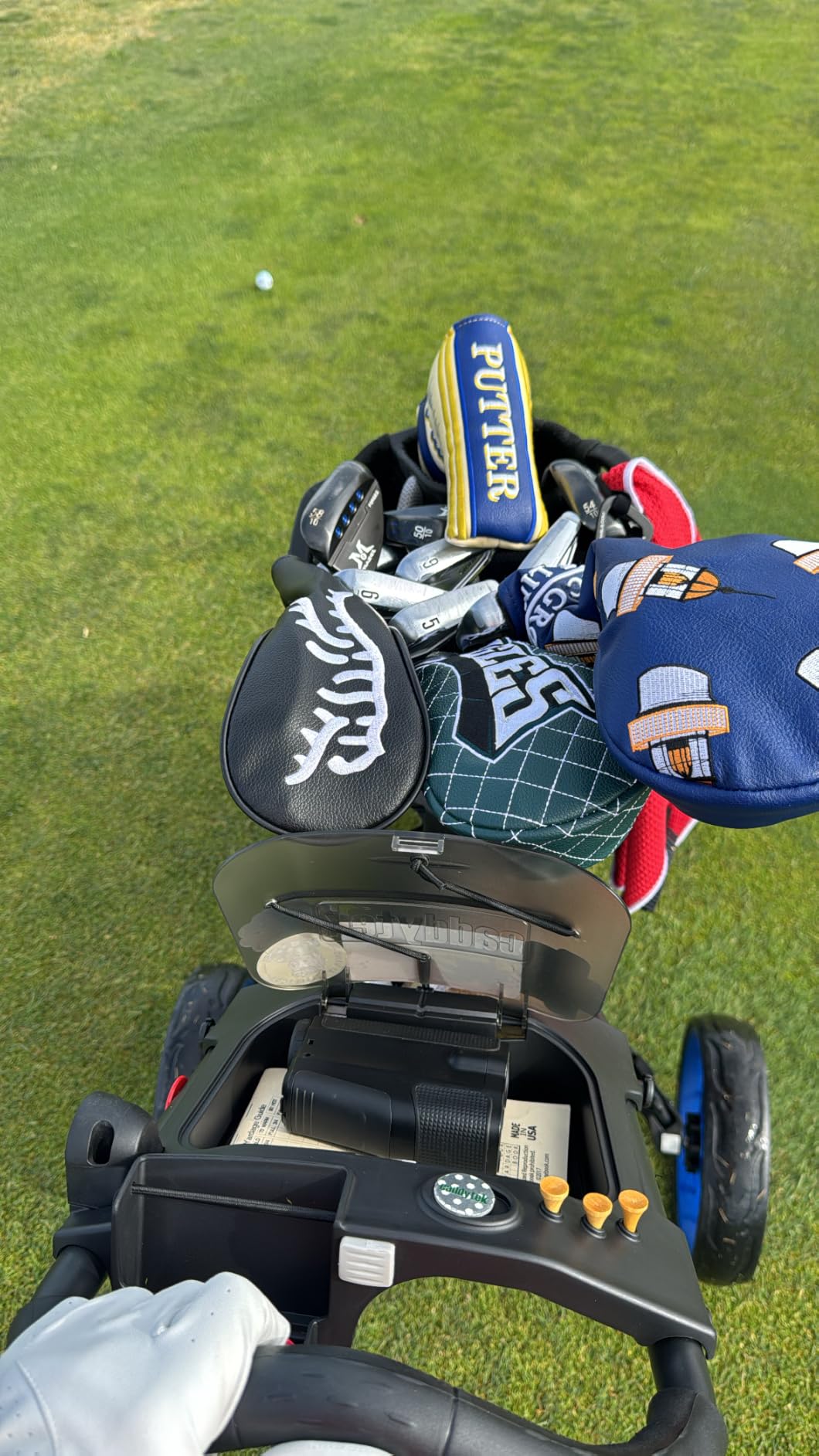
Storage is where this cart separates itself from the pack. The integrated cooler basket is built into the frame rather than clipped on, and owners report it keeping drinks cold through a full round in extreme heat. There is also a phone and GPS holder, a mesh ball net, tee holders, under-bag storage, a magnetic pad and a scorecard console. The frame is aluminum and remains solid after many rounds of use.
Bag security is genuinely good. Locking upper arms plus a bottom strap hold either a stand bag or a cart bag firmly, and the front wheels have some independent suspension that smooths out cart-path concrete. At 16 pounds it is heavier than the CaddyLite, and you feel that when lifting it into a high car, but the base it gives you is worth a couple of pounds for most golfers.
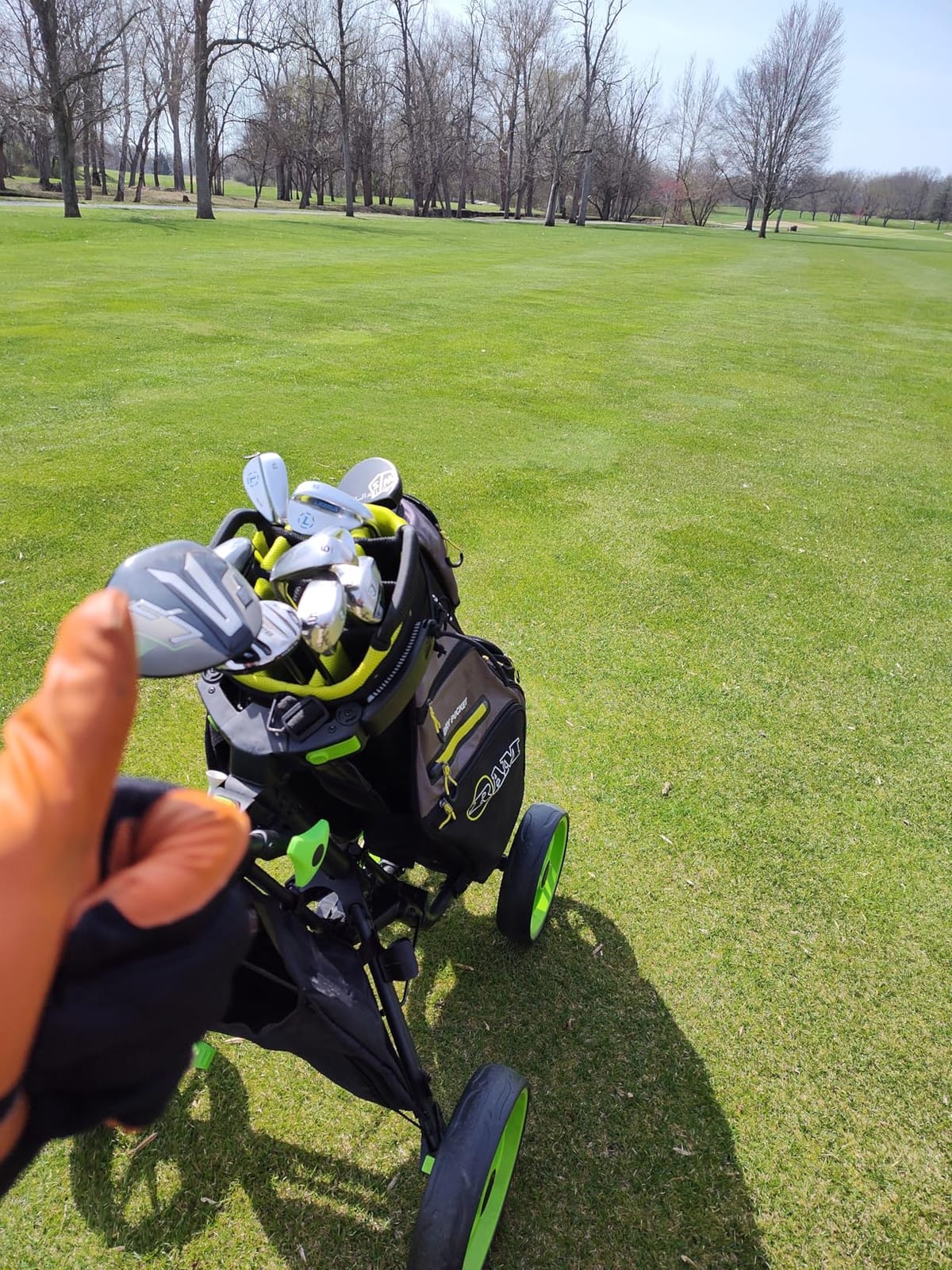
Why the Caddycruiser One V8 suits sidehill courses
Four contact points and 11.5 by 2.6 inch rear EVA tyres give you a genuinely planted feel. Owners describe it staying put in high wind and on hills where three-wheel carts drift, and the wide wheelbase is the physical reason. For a golfer who is a little nervous about a slope, that difference is the whole decision.
It also fits most stand and cart bags without fuss, and an optional seat is compatible if you want to add resting capability later. That flexibility matters for golfers who are planning to keep walking for decades rather than one season.
Where the Caddycruiser One V8 disappoints
The drink holder is the most-reported weak point across the review base, and owners describe it cracking or popping off during the fold. Treat it as consumable and do not put an expensive insulated tumbler in it. The scorecard console and holders are good, but the plastic fittings around them are not built to the same standard as the frame.
There is also a geometry quirk: with the handle raised to maximum height, taller clubs can contact the storage area while you push. Lowering the handle one notch solves it. Separately, the foot brake is described by some owners as light-duty for how planted the chassis otherwise is, so on steep ground set it hard and test it before your first shot.
3. Bag Boy Nitron – Best Auto-Open Fold
Bag Boy Nitron Golf Push Cart, Black/Slate
16.7 lb aluminum frame
Auto-open and one-step fold
Top-Lok bag system
Handle parking brake
Pros
- Auto-open mechanism pops the cart open with one pull of the handle
- Folds in a single step to a 19 x 13.5 x 22 inch package
- Handle-mounted parking brake sits at hand level
- Top-Lok holds a stand bag firmly with no extra parts
- Umbrella holder stood up well in wind and rain
Cons
- Wheels feel small over rough ground
- Console lid is less sturdy and offers less room
- No dedicated tee holes in the console
The Bag Boy Nitron is the best golf push cart for walking if the thing that has been stopping you is the faff. It is the only cart in this roundup with a genuine auto-open mechanism: pull the handle and the frame unfolds itself, shock-assisted, into a ready-to-load cart. No levers, no buckles, no crouching in a car park.
The patented Top-Lok bag-to-cart attachment is the other half of that convenience story. The bag locks into the bracket without extra parts, and owners report it holding a stand bag firmly. The handle-mounted parking brake is a design detail more manufacturers should copy, because a brake at hand height is reachable while your weight stays behind the cart rather than on a pedal.
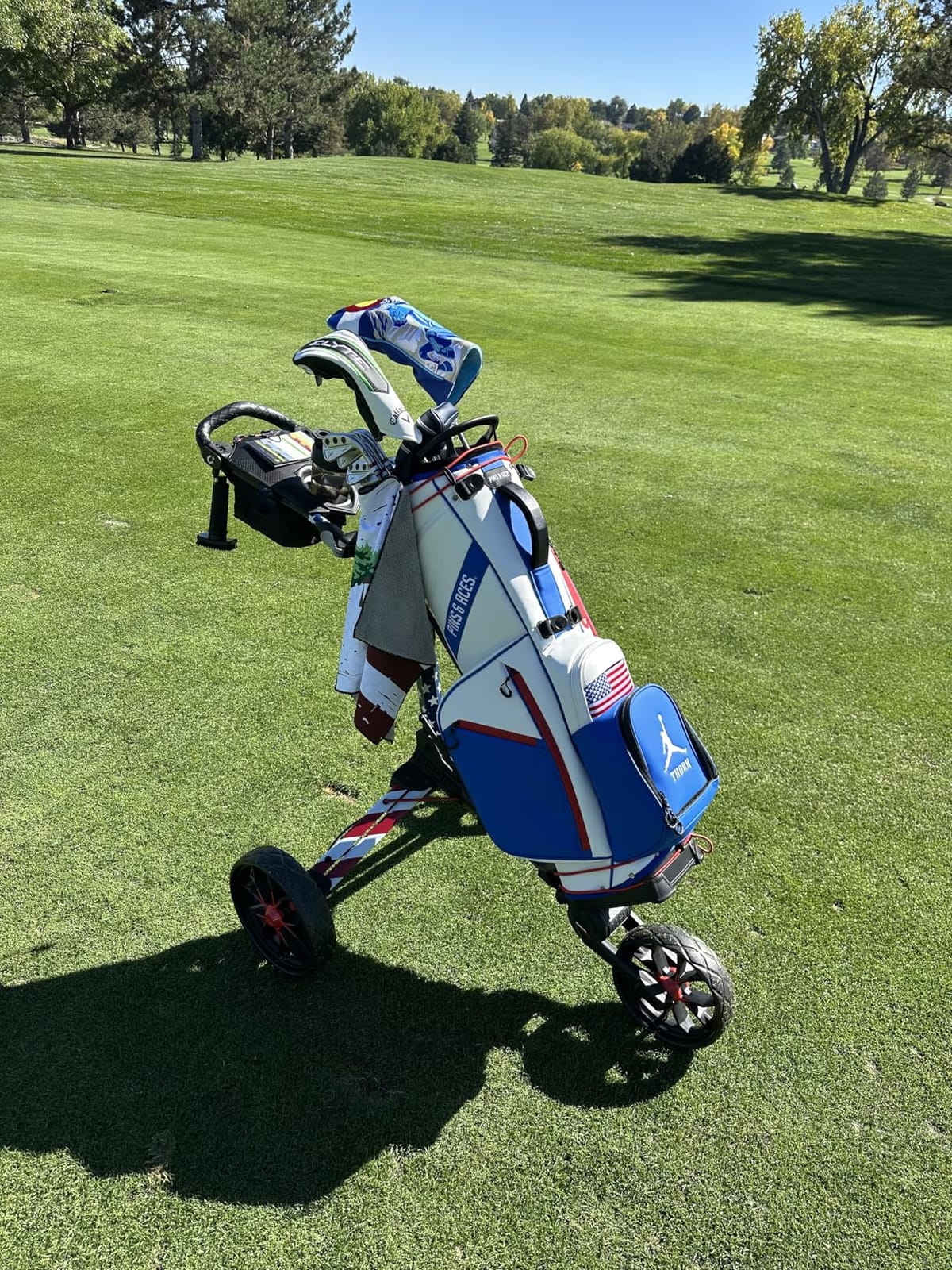
It also sits noticeably higher than older models in the range, which helps on sloped terrain and makes the bag more visible to the group behind you. The accessory bag, cup holder, umbrella holder and mobile device holder are all included, and the aluminium frame comes in thirteen colourways, which tells you something about how Bag Boy positions this as a flagship model.
The single-step fold produces one of the most compact packages here at 19 by 13.5 by 22 inches, and the ride height and low-resistance tyres roll smoothly on fairway and cart path. Owners who compared it against Clicgear carts before buying describe the open-and-close action as the easier daily experience.
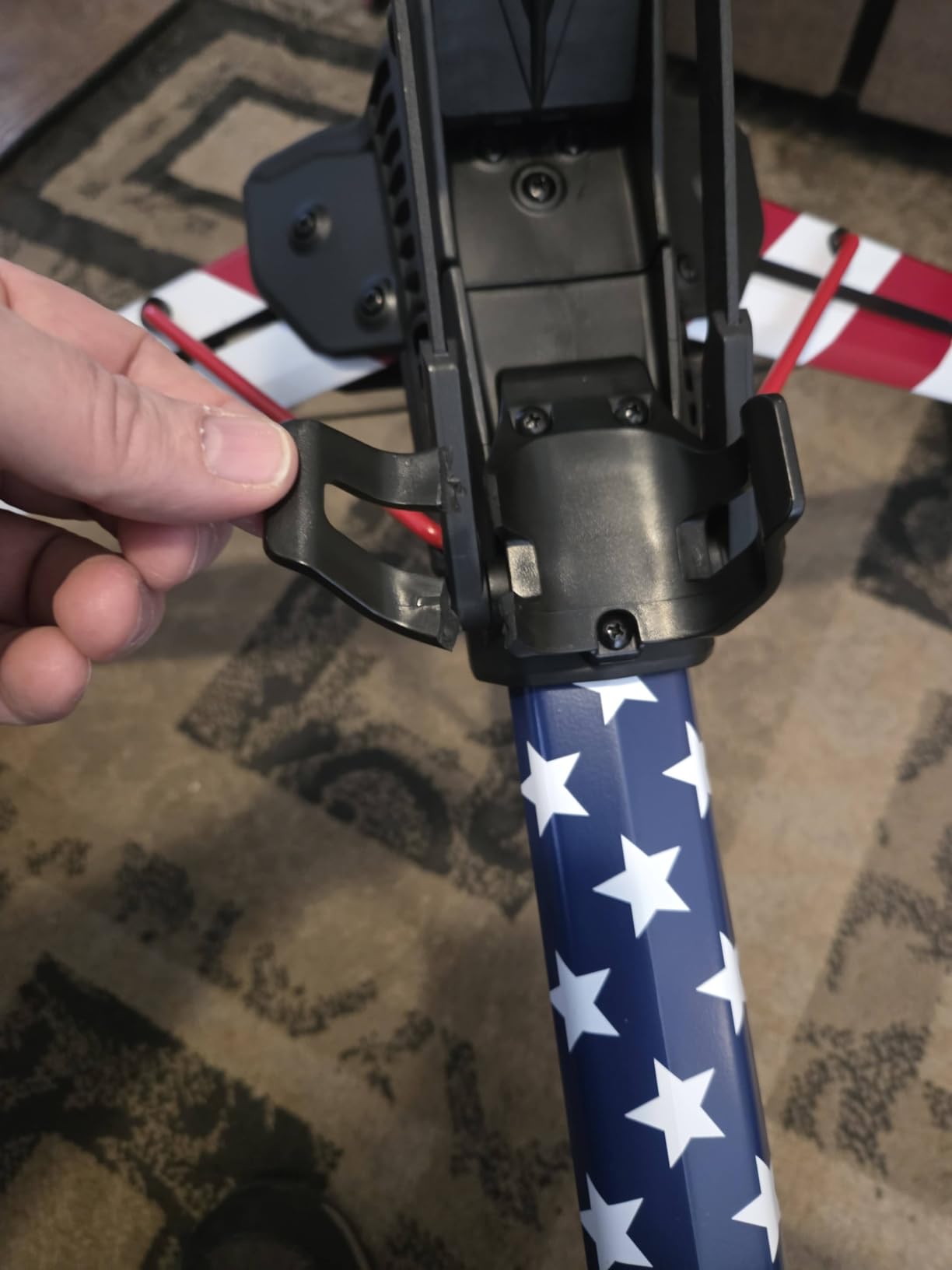
Where the Nitron shows its premium build
The Top-Lok system is the part that feels like a step up rather than a gimmick. Bag retention is the single most common failure point on cheaper carts, and a frame-and-bag lock that does not rely on elastic tension removes that failure mode entirely. For a golfer who plays in wind, that is worth more than another cup holder.
The handle-mounted parking brake is also a genuine safety feature on a slope. Because the brake engages at hand level, you do not have to swing a leg out and shift your weight, which keeps the cart where you left it. Owners report good stability and easy braking once they have settled into the cart.
What the Nitron gives up for the auto-open frame
The wheels are 9.5 inch front and 11 inch rear, which is smaller than several competitors here. Owners report more effort is needed off the fairway on rough ground, so this is a fairway and cart-path cart rather than an all-terrain one. If you regularly play a course with heavy rough, prioritise wheel diameter over the fold mechanism.
The console is also the weaker part of the package. Owners describe the lid as less sturdy with less room, and there are no dedicated tee holes in it, which sounds trivial until you are trying to find tees with cold hands on a windy ninth tee. The review base for this model is also the smallest of the Caddytek and Bag Boy carts here, so long-term durability data is thinner.
4. Caddytek Superlite Explorer V8 – Best Value
Caddytek Explorer V8 Golf Push Cart – Superlite 4 Wheel Aluminum Foldable Cart with Adjustable Front Wheel Width, Foot Brake, Cooler Basket, Umbrella Holder, Drink Holder, Scorecard Console
14.8 lb frame
Two-step fold with buckles
Four EVA wheels
Foot brake
Pros
- Light at 14.8 lbs for a four-wheel cart
- Four-wheel chassis stays planted on steep side hills
- Two-step fold with locking buckles fits a small sedan trunk
- Scorecard console with mesh net plus phone and GPS holder and cooler basket
- Foot brake locks firmly on inclines
Cons
- Drink holder will not take larger insulated tumblers
- Can track slightly to one side
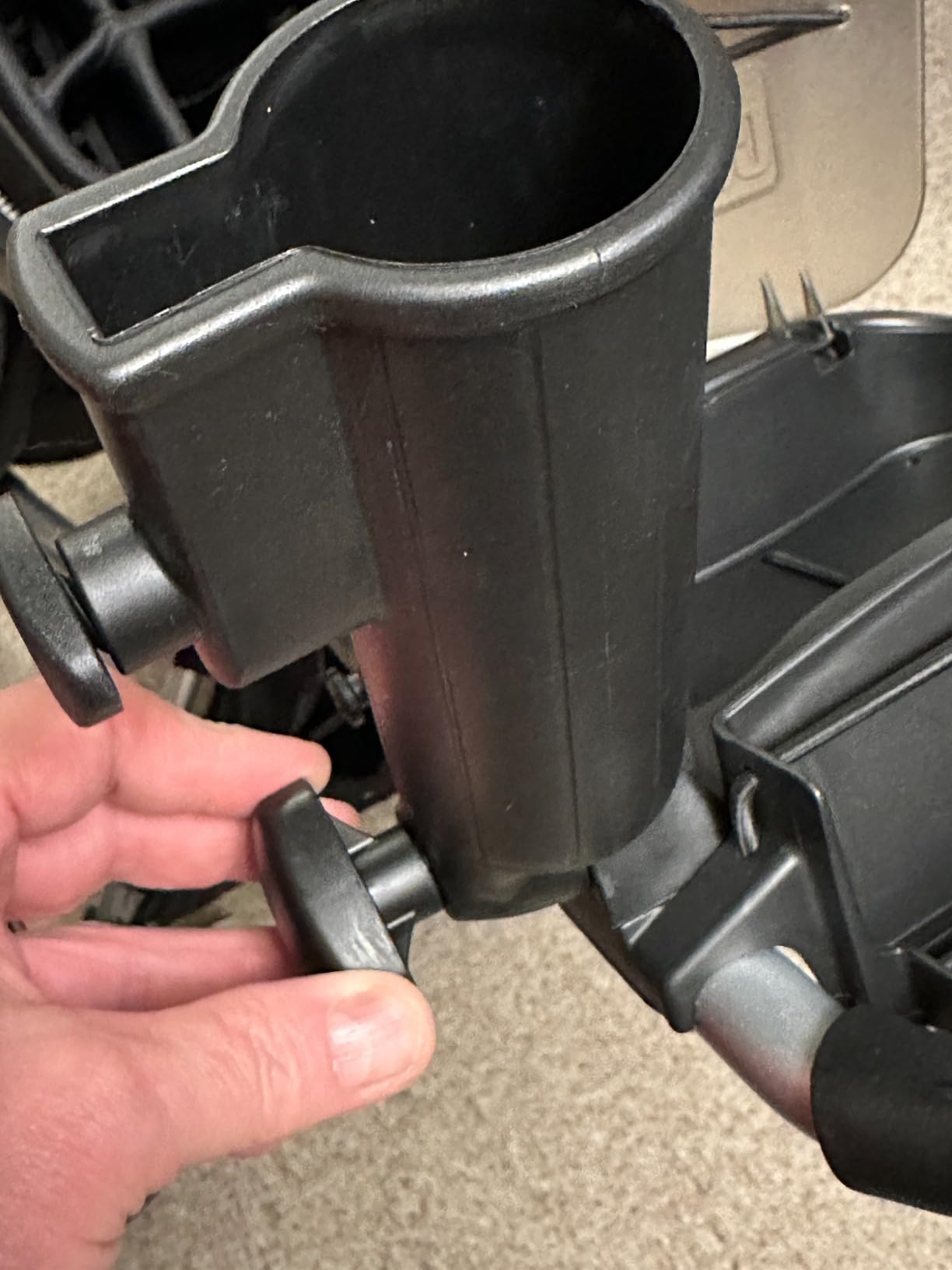
- Umbrella holder must be removed before folding
The Caddytek Explorer V8 is the best value in this roundup, and the reason is a simple trade that most golfers will take without hesitating. It gives you a four-wheel chassis, a full accessory package and a firm foot brake while staying under 15 pounds, which is where most four-wheel carts give up either weight or storage.
Owners repeatedly describe it as comparable in weight to junior-player carts while feeling far more substantial, and the aluminium frame comes with a one-year limited warranty. The four EVA wheels are 9.5 inch front and 10.5 inch rear, and the front wheel width is adjustable for straighter tracking, which is a small but real engineering touch.
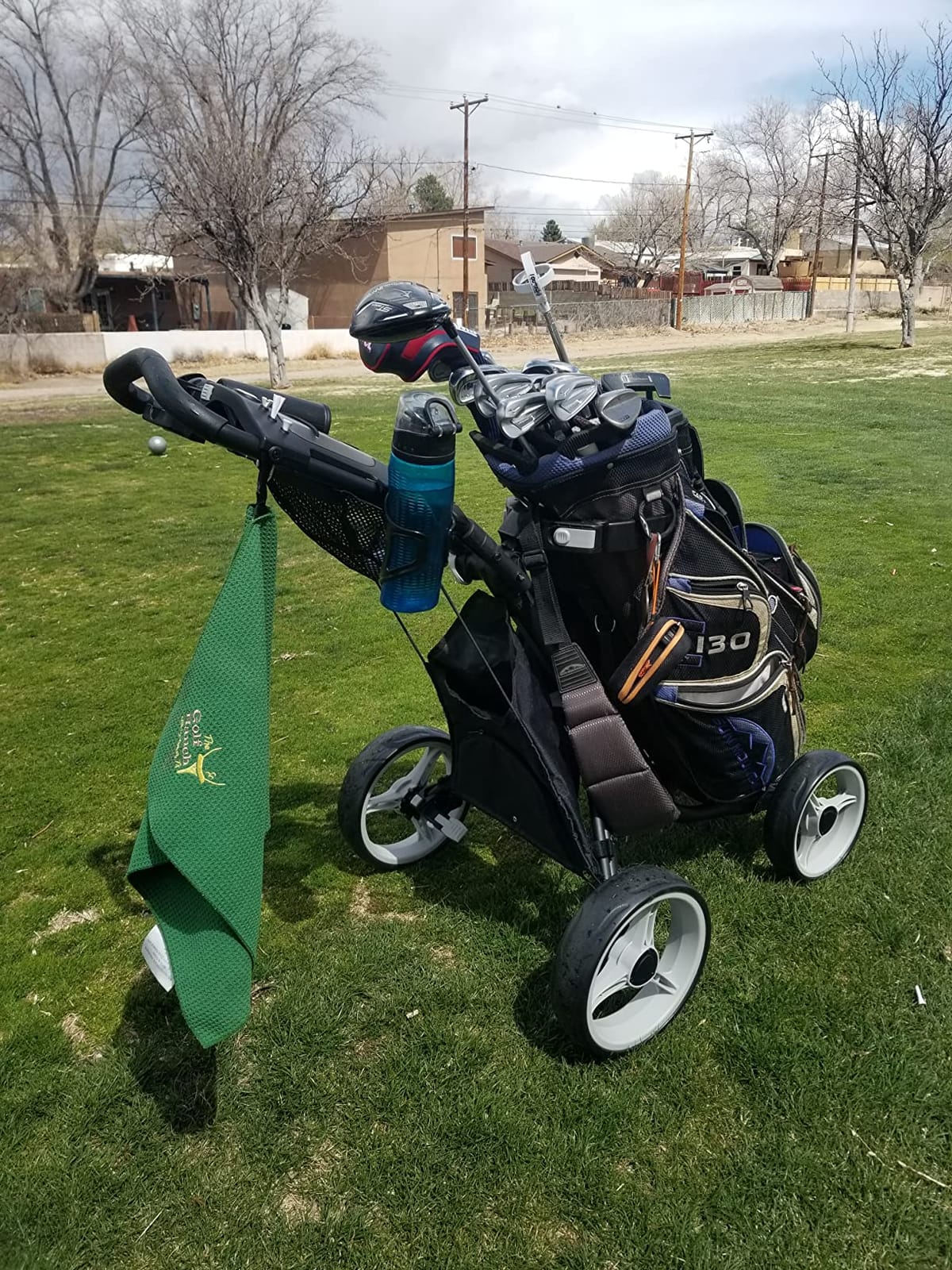
The accessory list is long enough that you can skip add-on purchases: umbrella holder, drink holder, integrated cooler basket, magnetic steel pad, phone and GPS holder, scorecard holder with a storage compartment, storage net and tee holders. Reviewers highlight the abundance of storage and the good value as the two things that keep them recommending it.
The two-step fold with locking buckles is not a one-click button, but the buckles are what make the difference here, because they hold the frame closed rather than letting it spring open. Owners report it fitting in a small sedan trunk, which is a practical test more manufacturers should be held to.
Why the Explorer V8 works as a starter or a second cart
If you are testing whether you enjoy walking, this is a sensible first cart. The price sits in the middle of the budget tier, the accessory package means you do not need to buy a cooler bag or a phone holder in your first season, and the frame is simple enough that nothing on it is a learning curve.
It is also a sensible second cart for a household where one cart gets left in the trunk. The aluminium frame and four-wheel layout are the parts that determine whether a cart survives being moved around weekly, and both are strong here.
Where the Explorer V8 is not the right pick
Front wheel width adjustment helps but does not fully cure a pull to one side, and a small number of owners report the cart tracking slightly left. If you are very sensitive to that, test it before committing, because a cart that feels like it is drifting is genuinely tiring over 18 holes.
The drink holder is the most consistent complaint. Owners note it is light-duty and will not take larger insulated tumblers, and the umbrella holder has to be removed before the frame fully closes, which is a small annoyance in a car park. Neither is a dealbreaker, but both are the places where a premium cart is more considered.
5. KVV 3 Wheel GL307 – Best for Junior Golfers and Travel
KVV 3 Wheel Foldable/Collapsible Golf Push Cart Ultra Lightweight Smallest Folding Size, New-Version Scorecard Holder Umbrella Holder Included
13.6 lb aluminum frame
Folds to 19.1 x 14.6 x 23.2 inches
Ball-bearing EVA wheels
Three-step fold
Pros
- One of the lightest three-wheel carts at 13.6 lbs
- Folds to a very small package that fits easily in a trunk
- Ball-bearing EVA wheels roll smoothly over grass and rough
- Adjustable TPE handle suits teens and adults
- Upper and lower brackets fit any bag size
Cons
- Folding sequence takes a couple of rounds to learn
- Cup holder is small and there is no dedicated phone holder
- Does not fully lock when folded
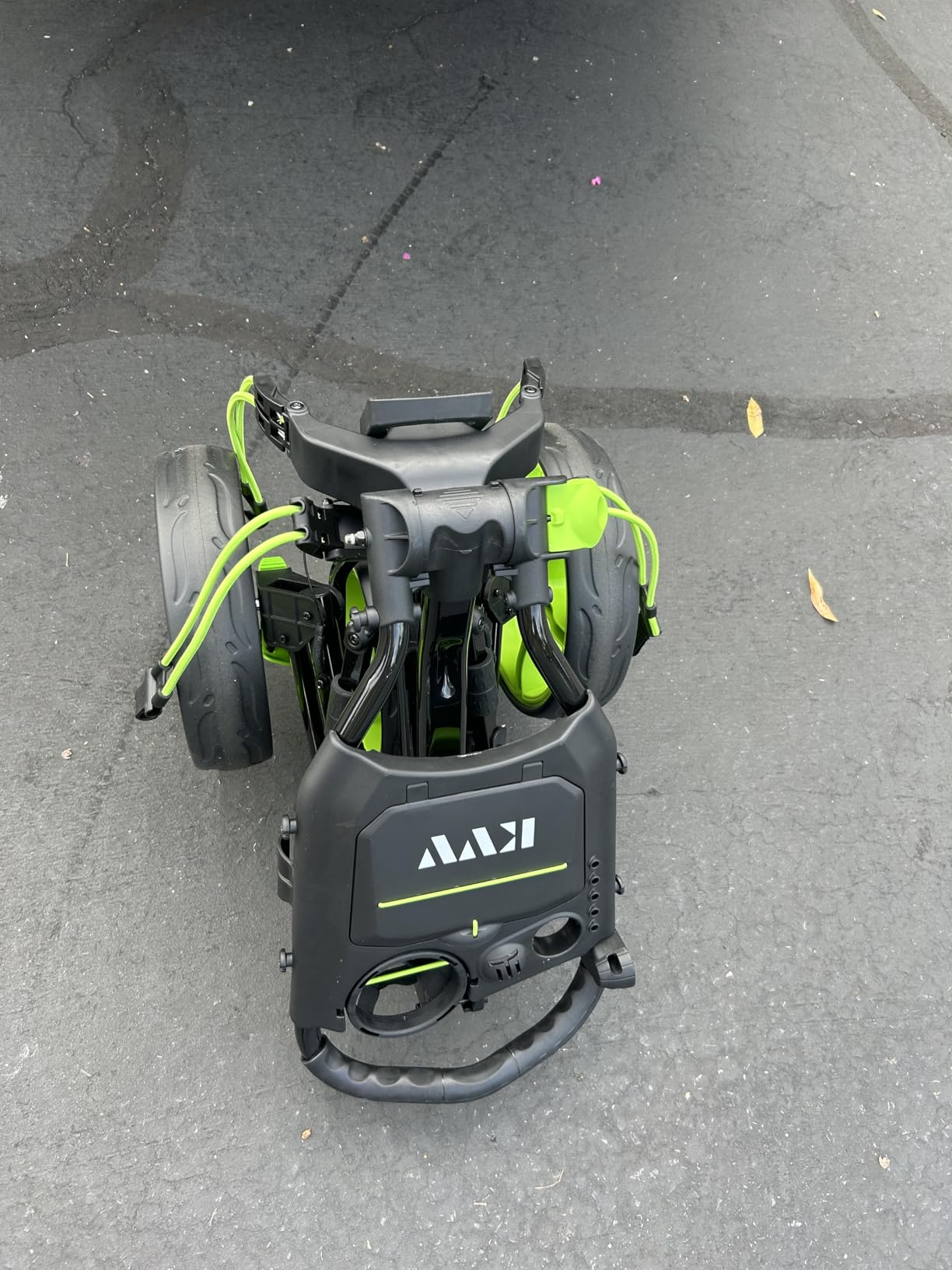
The KVV GL307 is the best lightweight golf push cart here, at 13.6 pounds with a folded package of 19.1 by 14.6 by 23.2 inches. If you fly with your clubs, share a car with someone else, or play a course where you park in a tight space, that folded dimension is the number that matters more than any feature list.
The wheels are the technical highlight. Nine and a half inch front and 11.5 inch rear maintenance-free EVA cover wheels running on ball bearings roll smoothly over grass, gravel and rough in a way that some cheaper carts do not manage, and reviewers specifically call out the ball bearings rather than just the wheel material.
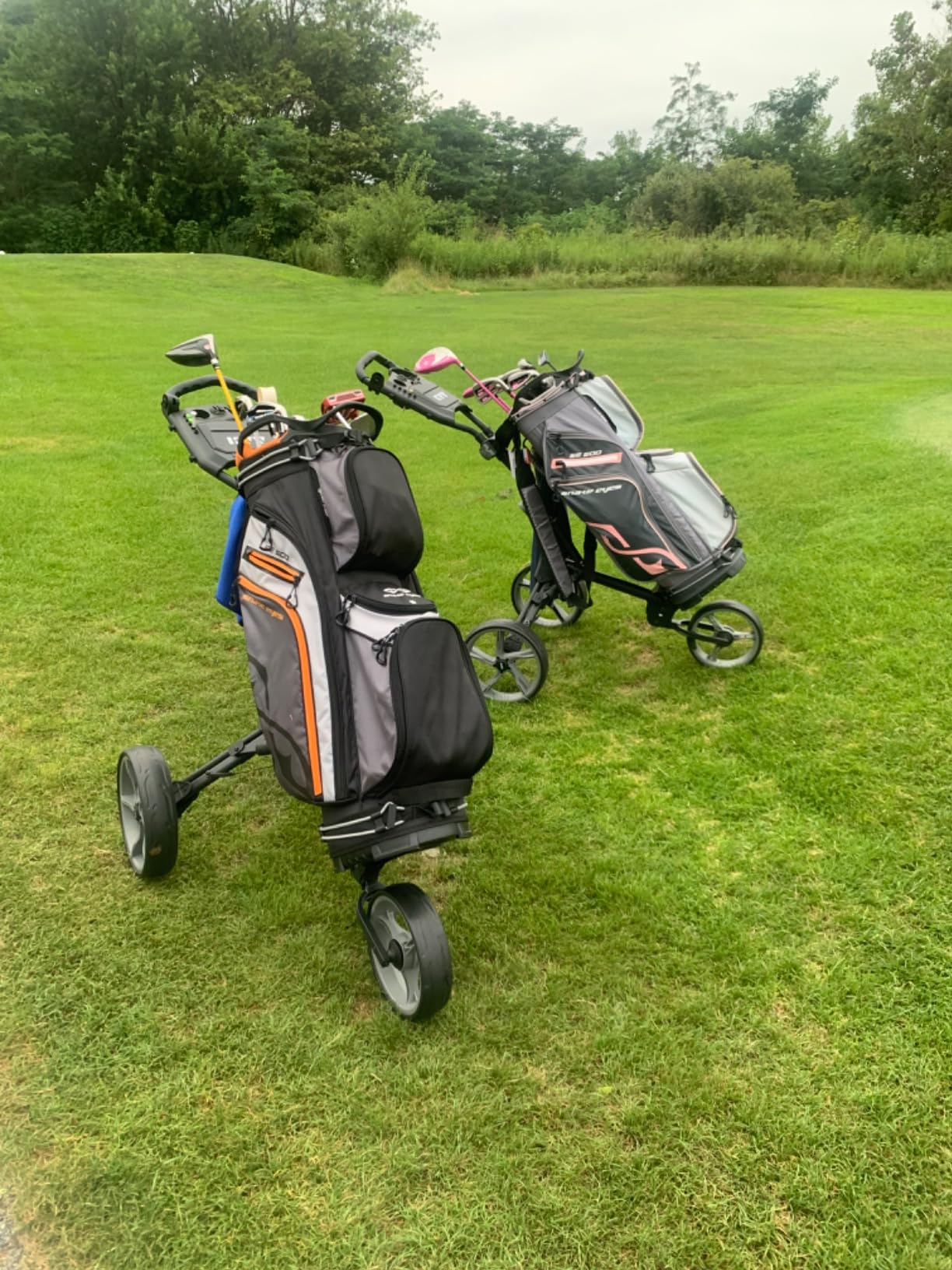
The handle is an ergonomic adjustable TPE grip that suits teenagers through adults, and the upper and lower brackets with elastic straps fit any bag size. Installation is a three-wheel job that is ready in seconds out of the box, which matters for junior players who should not need a parent assembling hardware in a car park.
Buyers focused on value for the class describe it as sturdy, light and easy to fold, and several use it for junior golfers. Customer service is also worth noting, with owners reporting that a compatible seat and extra accessories were supplied when asked for.
Where the KVV GL307 earns its place
Travel is the honest reason to buy this one. A 13.6 pound cart that folds to roughly the volume of a large suitcase means golf stops being a logistics problem on a business trip or a family holiday. The alloy frame still feels solid in the hand rather than tinny, which is the part that usually gives away at this weight.
It is also a good junior cart. The adjustable handle covers a wide height range, and the frame is light enough for a younger player to load and unload without help, while the wheel package is robust enough to survive a season of short-cut play.
Where the KVV GL307 needs managing
The three-step fold takes a couple of rounds to learn, and several owners flag that the sequence is not immediately obvious from the instructions. Worse, the frame does not fully lock when folded, so it can spring open in a boot if it is not secured. Treat the fold as a two-handed, deliberate action rather than a toss-in-the-back job.
Accessories are the thin spot on this version. The cup holder is small, and there is no dedicated phone holder, which is a real loss if you use a rangefinder or a GPS app. If your bag is heavy and your bag strap is a bag you swap often, check the bracket fit before you commit.
6. Bag Boy Compact 3 – Highest Owner Satisfaction
Bag Boy Compact 3 Golf Push Cart, Easy Three-Step Open & Close, Scorecard Console, Beverage Holder, Mobile Device Holder, Handle Mounted Parking Brake
4.8 star average rating
Extra-deep scorecard console
Three-step compact fold
9.5 and 11.5 inch wheels
Pros
- Highest average owner rating among the carts reviewed here
- Extra-deep console handling ball storage plus phone cradle and drink holder
- Simple three-step fold to a very compact package
- Oversized 9.5 inch front and 11.5 inch rear wheels roll through grass easily
- Aluminium frame with adjustable support arms for stand or cart bags
Cons
- Fewer accessory mounts than some four-wheel carts
- Listed dimensions describe the folded package rather than the assembled cart
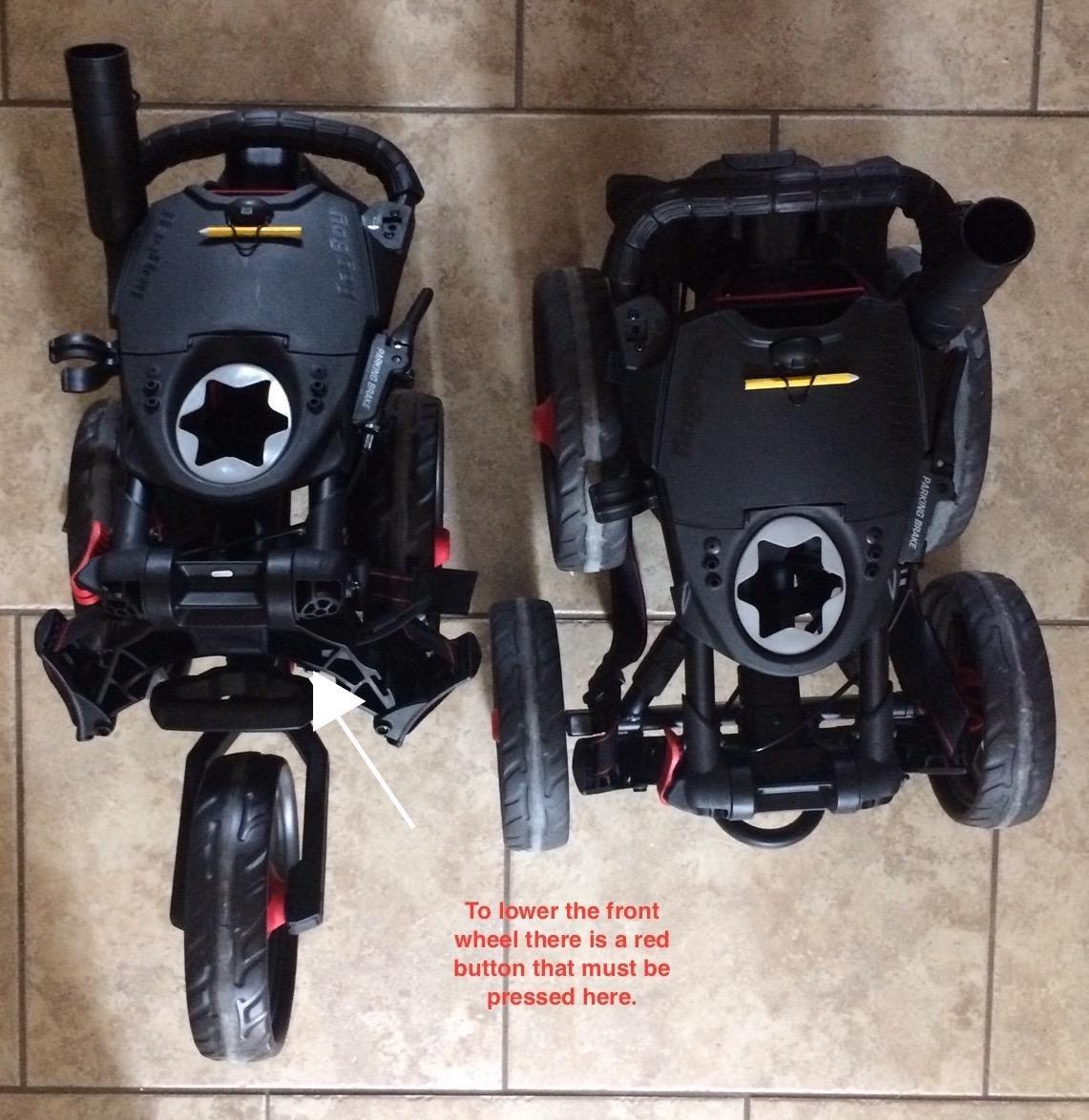
The Bag Boy Compact 3 carries the highest owner satisfaction in this group, with a 4.8 average and a very high share of five-star reviews. That figure comes from a smaller review base than the Caddytek carts, so treat it as a strong signal rather than a certainty, but the consistent themes in those reviews are specific enough to be useful.
Owners emphasise rock-solid construction, smooth rolling on the oversized wheels, a well-designed console and a genuinely compact three-step fold. It is positioned as a premium brand-name build rather than a value option, and the aluminium construction with adjustable support arms is what allows it to take either a stand bag or a cart bag.
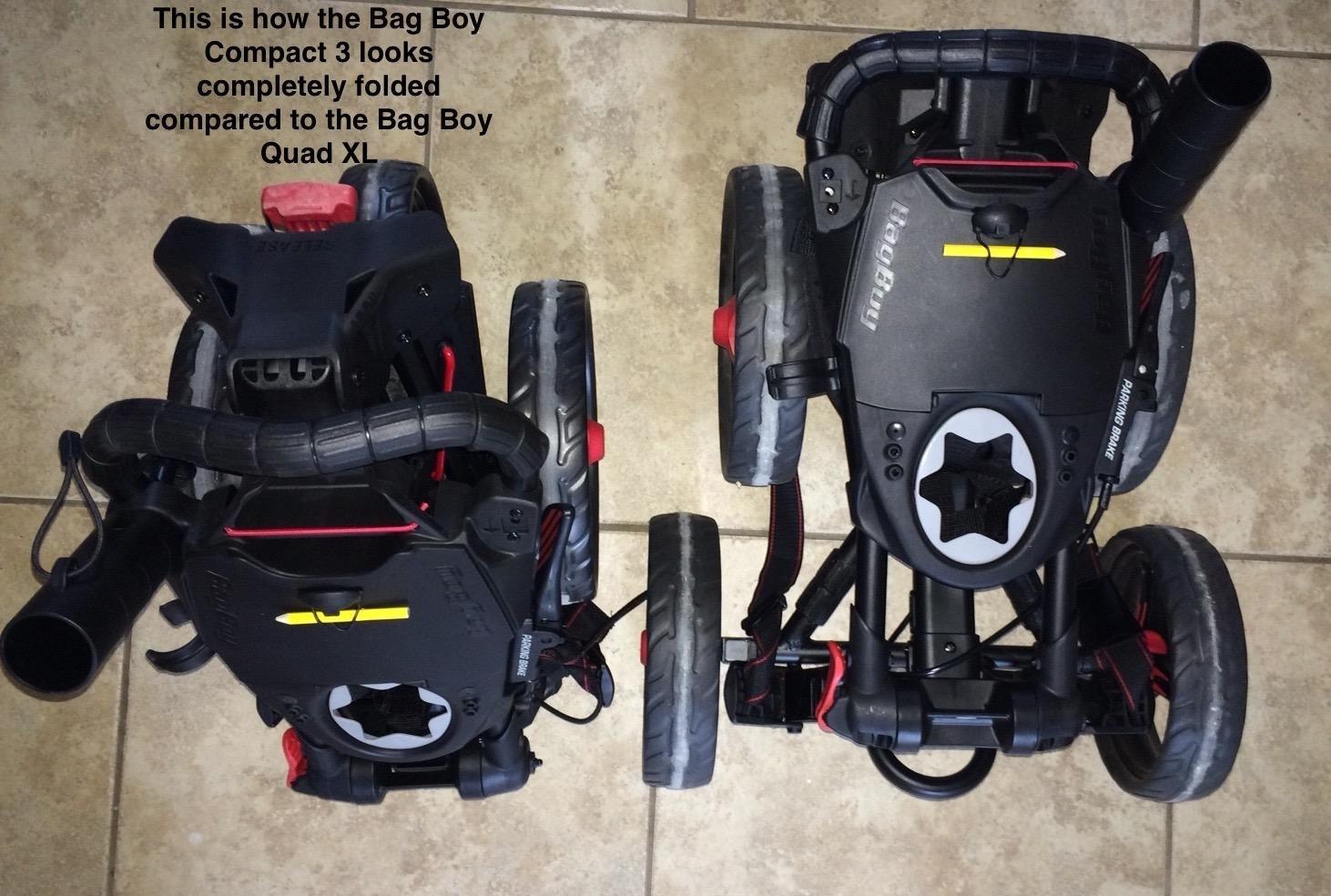
The extra-deep scorecard console is the design detail that owners single out. It does four jobs: scorecard storage, golf ball storage, a phone cradle and a beverage holder, all in one moulding. That consolidation is why this cart can offer less in terms of loose accessory mounts and still feel well equipped in the hand.
At 14 pounds with 9.5 inch front and 11.5 inch rear wheels, it rolls through grass easily according to the review base. It carries a one-year manufacturer warranty from the date of original purchase, and the two pockets are a modest but present storage allowance.
Who should buy the Bag Boy Compact 3
Buy this one if you want a cart that feels expensive in the hand and you are not interested in assembling an accessory system. The console handles the phone, the drink, the ball and the card, which covers most golfers’ needs without a shopping list. It is also a sensible gift, because there is nothing to figure out on the first round.
For a golfer who already owns a cart, it is a good second unit precisely because it folds to a compact package and weighs 14 pounds. Moving it between vehicles is a five-minute job rather than a project.
Where the Bag Boy Compact 3 is limited
The accessory mounting points are fewer than on a typical four-wheel cart, so if you plan to attach a cooler bag, a seat or a large net, check compatibility first. The console is a fixed moulding rather than a modular rail, which is both the reason it feels premium and the reason it cannot be extended.
One practical trap: the listed dimensions on this product describe the folded package rather than the assembled cart. If you are measuring a boot or a storage space, measure 13 by 29 by 12 inches and understand that is the packed item, not the cart you will be pushing. Owners who complain about anything tend to complain about documentation rather than performance.
7. SereneLife 3-Wheel – Best Rust-Resistant Build
SereneLife 3-Wheel Golf Push Cart – Foldable, Adjustable Handle, Brake
100 percent aluminum rated to 33 lb
EZ-fold quick open and close
Padded adjustable handle
Cooler compartment
Pros
- Quick EZ-fold shrinks small enough for a sedan trunk or locker
- Padded adjustable handle cuts hand and arm fatigue
- Wide rear wheels and 9.5 inch front wheel stay steady on hills and rough
- Aluminium frame rated to 33 lbs and rust-resistant
- Stability holds up in strong wind and wet conditions
Cons
- 18 lbs is heavier than most competing three-wheel carts
- Umbrella docking point included but the umbrella holder is not
- Shallow pocket and a small badly angled cup holder
- Must remove the golf bag before collapsing the frame
The SereneLife 3-Wheel is the cart to look at if you play in a wet or coastal climate. The frame is 100 percent aluminium and rated to hold up to 33 pounds, and long-term owners report four-plus years of reliable use. For a frame that will sit in a damp car boot or on a seaside course all winter, rust resistance is not a minor spec line.
The padded adjustable ergonomic handle is the feature that gets noticed on the back nine. Padding on the grip measurably reduces hand and arm fatigue, and combined with the adjustable height it means the cart suits a range of golfers rather than one specific body.
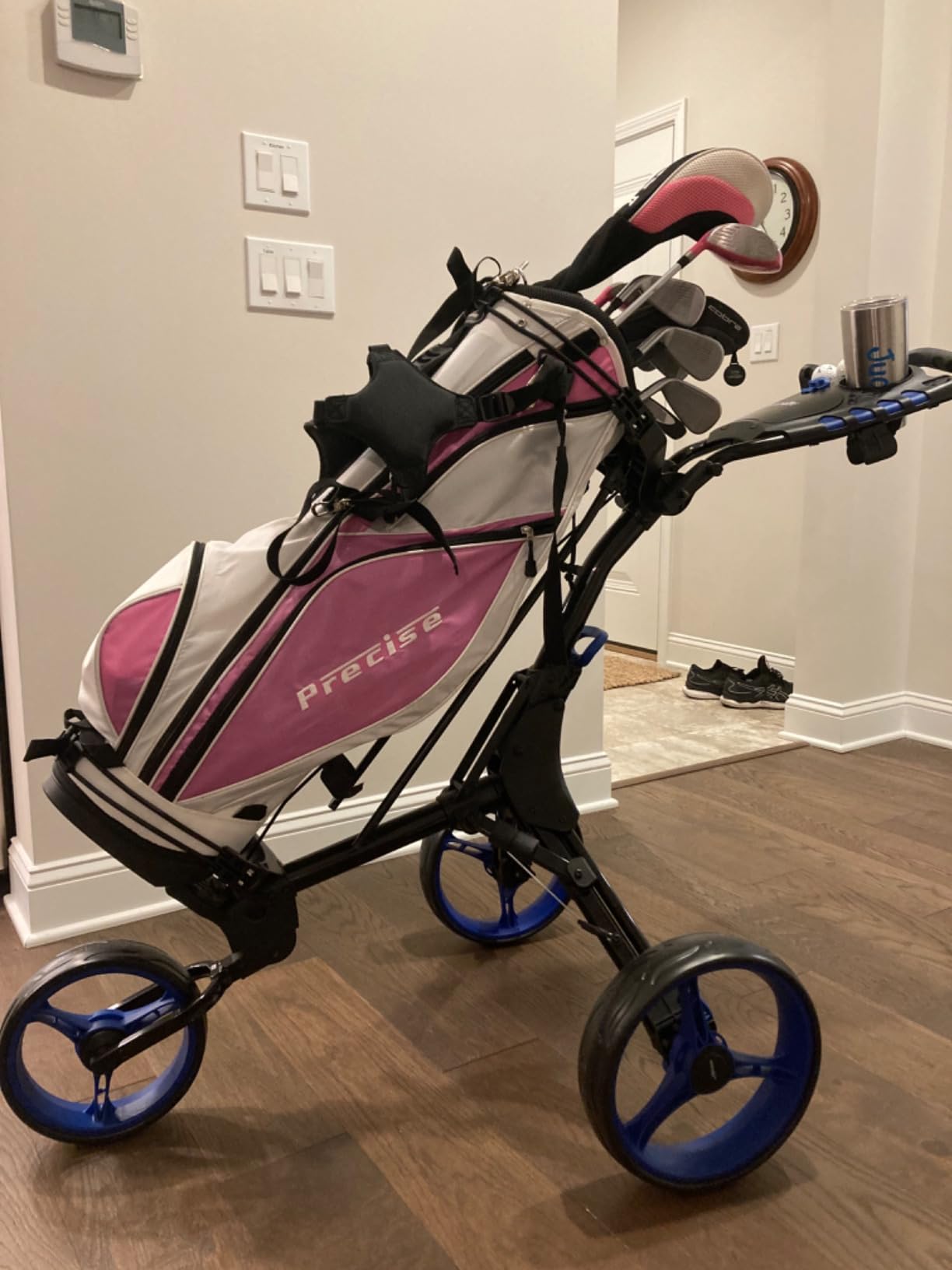
The wide rear wheels plus a 9.5 inch front wheel stay steady on hills, rough and mud, and owners report that stability holds up in strong wind and wet conditions. The storage covers the basics: a scorecard holder, a bag holder, an umbrella slot, a cup holder and a cooler compartment.
The EZ-fold mechanism opens and closes in seconds, and owners note the folded package fits a sedan trunk or even a locker. That is a real advantage for golfers who store their cart indoors in a shared space rather than in a garage.
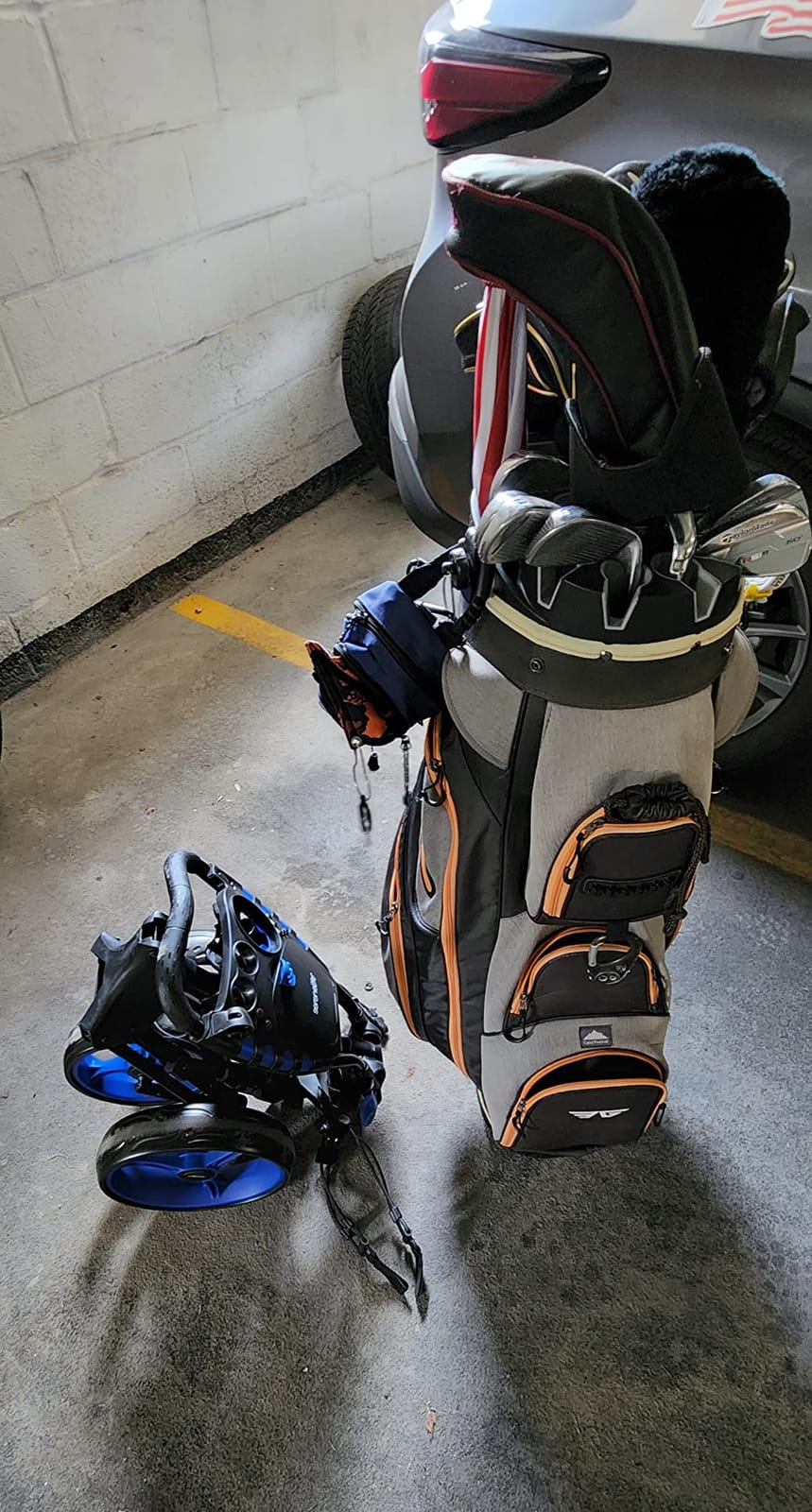
Why the 33-pound rating matters more than it sounds
A stated load rating tells you how much margin a frame has before it flexes. Thirty-three pounds is well beyond a typical stand bag with a normal club set, which means the frame is not working near its limit on an ordinary round. That is why the reported long-term durability holds up: the frame is not being asked to do more than it was designed for.
It also matters for anyone who carries extra weight, such as a rain jacket, a second layer in cold weather, or a bag with a cart strap and dividers still attached. The wider margin reduces the chance of a frame that creaks at the twelfth tee.
Where the SereneLife 3-Wheel costs you
At 18 pounds this is the second-heaviest cart in the roundup, and that shows up the moment you lift it into a car. Owners who are smaller, or who plan to carry it any distance from the car, mention weight as the recurring drawback. If trunk lifting is your regular reality, look at a lighter three-wheel design instead.
Two smaller issues. The umbrella docking point is included but the umbrella holder itself is not, so you are buying that separately. And you must remove the golf bag before collapsing the frame, which is a routine irritation in a car park and a genuine annoyance in the rain. The assembly instructions are also thin on front wheel orientation and the fold, so allow yourself five minutes the first time.
8. Tangkula Push Cart With Seat – Best for Seniors and Rest Breaks
Tangkula Golf Push Pull Cart with Seat, Lightweight Foldable Collapsible 3 Wheels Push Cart, Golf Trolley with Foot Brake, Adjustable Umbrella Holder & Seat, 4 Height Position Handle
17.5 lb steel frame
Removable height-adjustable seat
3-wheel and 2-wheel modes
Four handle height positions
Pros
- Removable cushioned seat is a genuine rest stop on long walks
- Four handle height positions suit teens through adults
- Ball-bearing front wheel converts to two-wheel pulling mode in seconds
- Waterproof rear bag plus bungee pouch plus magnetic-lid scorecard compartment and umbrella holder
- Solid steel tubing frame that is light and responsive
Cons
- Tips backward on level ground when the seat is removed
- Plastic cup holder can crack
- Front wheel must be folded in a specific order or the cable catches
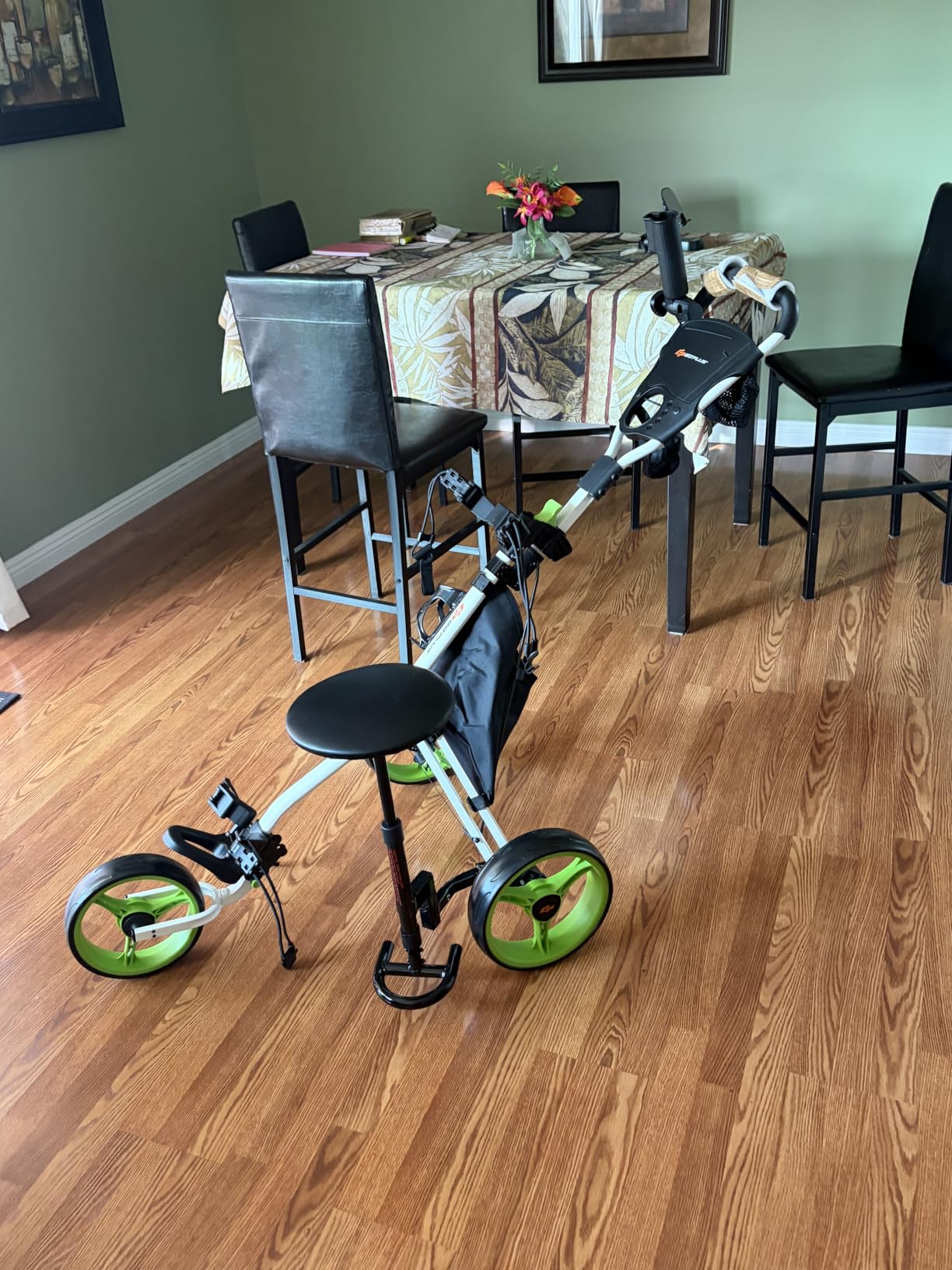
The Tangkula Push Cart With Seat is the best golf push cart with a seat in this roundup, and for seniors and golfers with back issues it is a different proposition entirely. A removable cushioned seat turns waiting on a busy tee box from standing around for eight minutes into an actual rest, and owners rate that feature as transformative for walking eighteen holes.
The handle has four height positions, which is more adjustment granularity than most carts offer, and the ball-bearing universal front wheel converts the cart between three-wheel and two-wheel pulling modes in seconds. Owners use two-wheel mode for tight fairways and narrow corridors where a wider base is inconvenient.
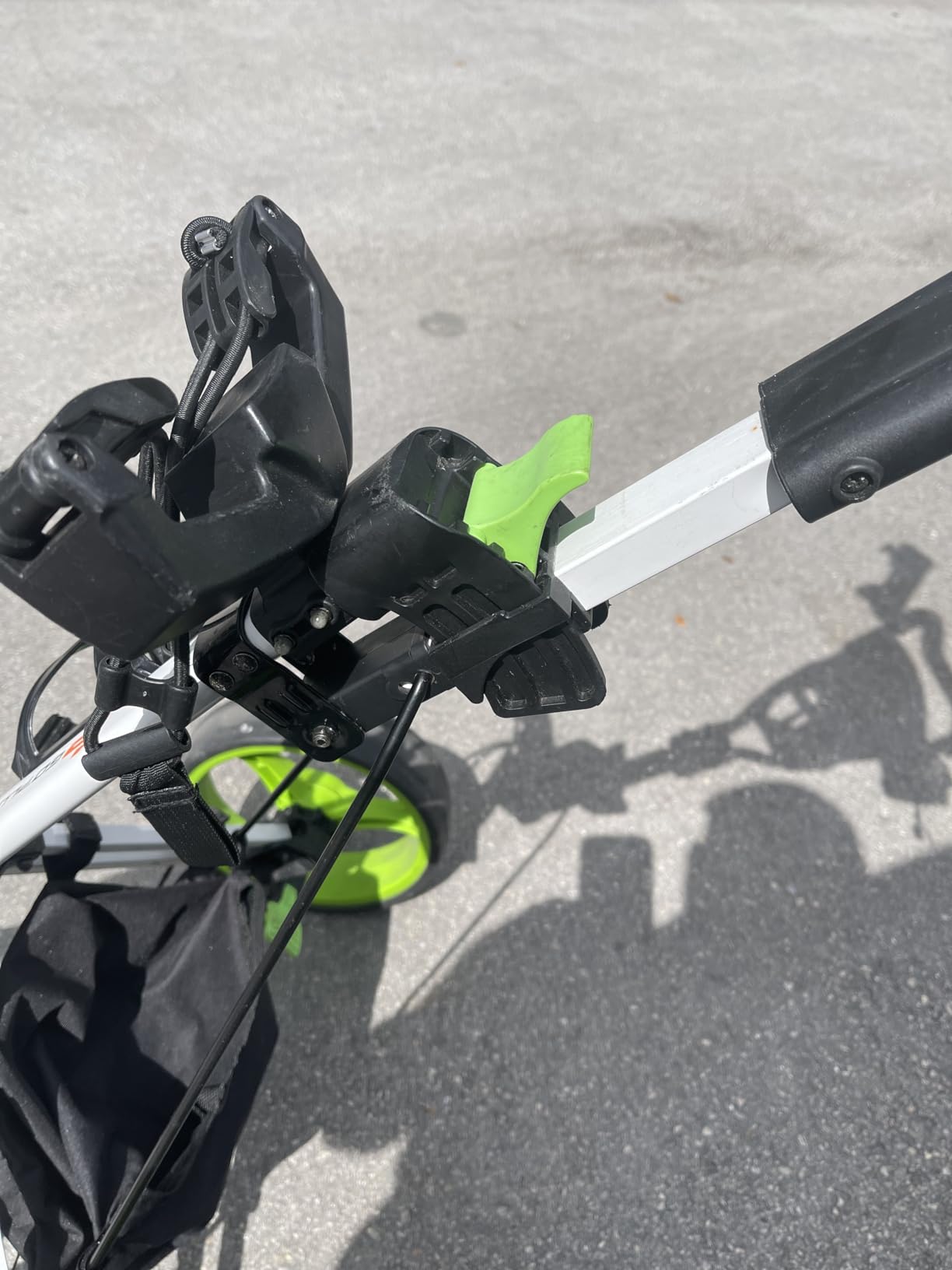
Storage is generous for a seat-equipped cart: a waterproof rear storage bag, a bungee pouch, a magnetic-lid scorecard and ball compartment, tee holders, two cup holders and an angle-adjustable umbrella holder. The steel tubing frame is rated to 30 pounds and owners describe it as light and responsive to push despite the seat.
It also fits in a sedan trunk with clubs once the seat is removed, which matters because the seat is what makes it heavier. Several owners use it for disc golf as well, where the flat base and low centre of gravity suit a different game well.
Why the seat is worth the extra weight
For a golfer with back or hip problems, the seat is not a luxury. It is the difference between finishing a round and turning back at the twelfth. The seat is height-adjustable as well as removable, so it can be set for a shorter golfer rather than only the tall player who bought it.
The four-position handle and the ball-bearing front wheel are the two details that make it adaptable. A senior golfer pushing a loaded cart up a slope is a completely different handling problem from a fit golfer on flat ground, and adjustable height plus the option to narrow the base address exactly that.
Where the Tangkula Seat Cart falls short
The most important thing to know is the tip risk. Owners report the cart tipping backward on level ground when the seat is removed, so the seat is effectively a structural part of the design rather than an accessory. If you take it off, the back end is light. The brake is also foot-operated only, on one wheel, with no handbrake option, which is a limitation if you want a brake at hand height.
There is also a handling quirk with the front wheel, which has to be folded in a specific order or the cable catches. And the seat is unusable in two-wheel mode because the cart sits too upright. Learn the fold sequence before your first round rather than in the car park on hole one.
9. Tangkula Lightweight 3-Wheel – Lightest Cart in the Group
Tangkula Golf Push Cart, Lightweight Collapsible Golf Pull Cart, 3 Wheels Golf Trolley with Foot Brake Umbrella Holder & Cup Holder, Adjustable Handle and Storage Bag
13 lb foldable frame
Removable wheels
10 inch rear and 8 inch front EVA wheels
Foot brake
Pros
- Lightweight at roughly 13 lbs and easy to lift into a car
- Folds down small and the wheels pop off for tighter storage
- Adjustable straps hold any size bag
- Sturdy scorecard tray with a pencil slot
- Quick assembly and simple responsive rolling
Cons
- Falls over without a bag on it and separates into pieces when carried
- Cup holder is small and angled so drinks tip
- Phone pocket is a dangling mesh pouch
- Some units report a stiff or failing foot brake
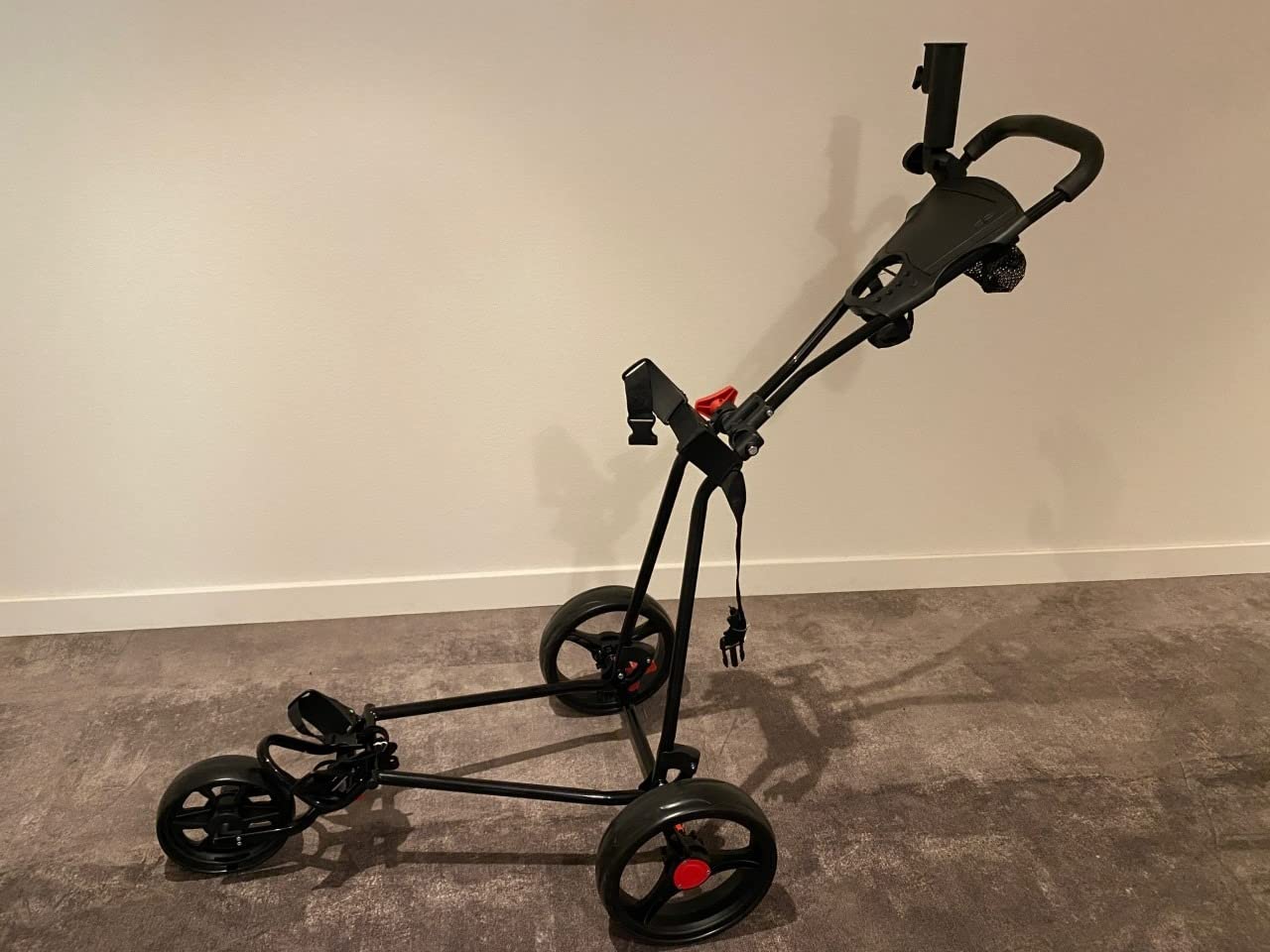
The Tangkula Lightweight 3-Wheel is the lightest cart in this roundup at about 13 pounds, and that weight is the entire argument for it. If you play at a course with a long walk from the car, you use a small vehicle, or you are simply not strong enough to lift 18 pounds into a boot with a bag attached, this is the one.
It folds down small at 30 by 23.5 by 12.5 inches, and the wheels are removable for tighter storage, which gets the package into spaces a fixed-wheel frame will not go. Assembly is quick and rolling is simple and responsive, and reviewers treat it as a capable budget cart rather than a compromise.
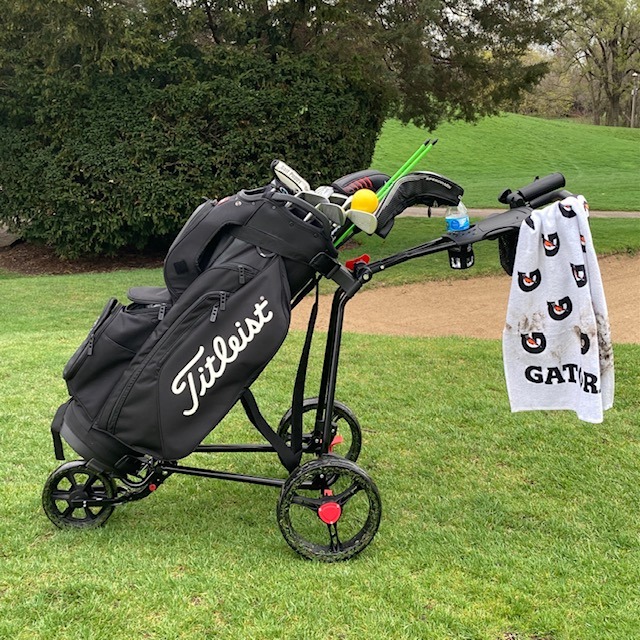
Storage is a sturdy scorecard tray with a pencil slot, plus an umbrella holder, cup holder, mesh net and tee holder. The adjustable bag straps hold any size bag, and the handle height and front wheel steering direction are both adjustable, which is more than most carts at this weight offer.
Owners frequently describe it as the purchase that got an older or newer golfer walking again, which is the real test for a budget cart. If it is reliable enough and light enough to actually appear in the car every week, it does its job better than a heavier cart that stays at home.
When 13 pounds is the deciding number
Weight matters more than most spec sheets admit. A cart plus a loaded stand bag is the total load you handle, and every extra pound of frame is a pound you are lifting into a car and a pound you feel on a slope at the fifteenth tee. Below fourteen pounds, you have genuine freedom about where you store the cart and how you move it.
For a golfer who walks from a distant car park, or who travels with golf clubs regularly, that freedom is worth more than any accessory on the frame. The removable wheels add to it, because a frame without wheels is a shape you can tuck anywhere.
What you accept at this weight
The frame separates into pieces when carried, and it falls over without a bag on it, so it is not a cart to leave assembled in the corner of a garage. The cup holder is small and badly angled enough that drinks tip into the bag, and the phone pocket is a dangling mesh pouch that will not take a larger phone.
Those are the honest costs. The most serious one is durability: a few units report a stiff or failing foot brake and a rear wheel developing noise after a few rounds. Treat this as a first cart or a backup rather than a long-term investment, and check the brake before you rely on it on a slope.
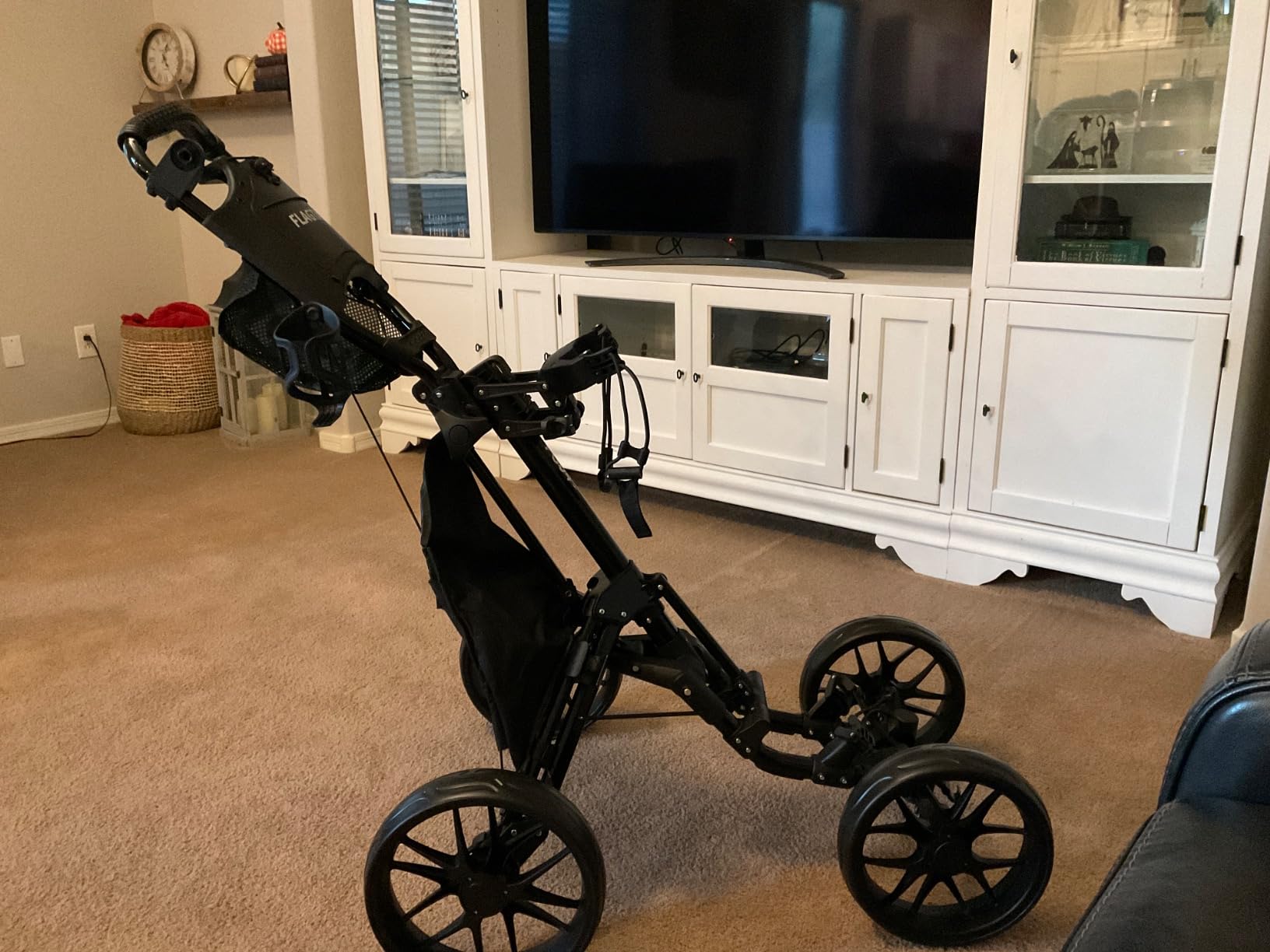
10. FLAGTAG 4-Wheel – Most Complete Accessory Package
FLAGTAG Golf Push Cart 4 Wheels,Folding Golf Cart, Golf Pull cart with Cup Holder,Umbrella Holder,Cooler Bag, Foldable with one-Click,Handle Height Adjustable,Drink Holder,Walking Push cart
19.6 lb aluminum frame
One-click fold
4-wheel chassis
Built-in cooler storage bag
Pros
- One-click fold button collapses the cart to a trunk-friendly size
- Four-wheel layout gives good balance and load handling over varied terrain
- Lightweight aluminum main frame with mechanically designed wheel hubs
- Generous package including a cooler storage bag plus golf tray with compartment plus umbrella and drink holders
- Handle height adjustable for different golfers
Cons
- Heaviest cart in this group at 19.6 lbs
- Build quality and accessory durability are less refined than established brands
The FLAGTAG 4-Wheel is the cart to buy if you want the accessory list handled for you. Out of the box it includes a cooler storage bag with a built-in cooler, a golf tray with a compartment, an umbrella holder, a drink holder and a cup holder. For a first-time cart owner, that removes every first-season purchase except the bag strap.
The one-click fold button collapses the cart to 28.3 by 18.5 by 17.7 inches, which is a trunk-friendly package. The four-wheel layout gives good balance and load handling over varied terrain, and the aluminium main frame uses a mechanically designed wheel hub that owners note holds up well.
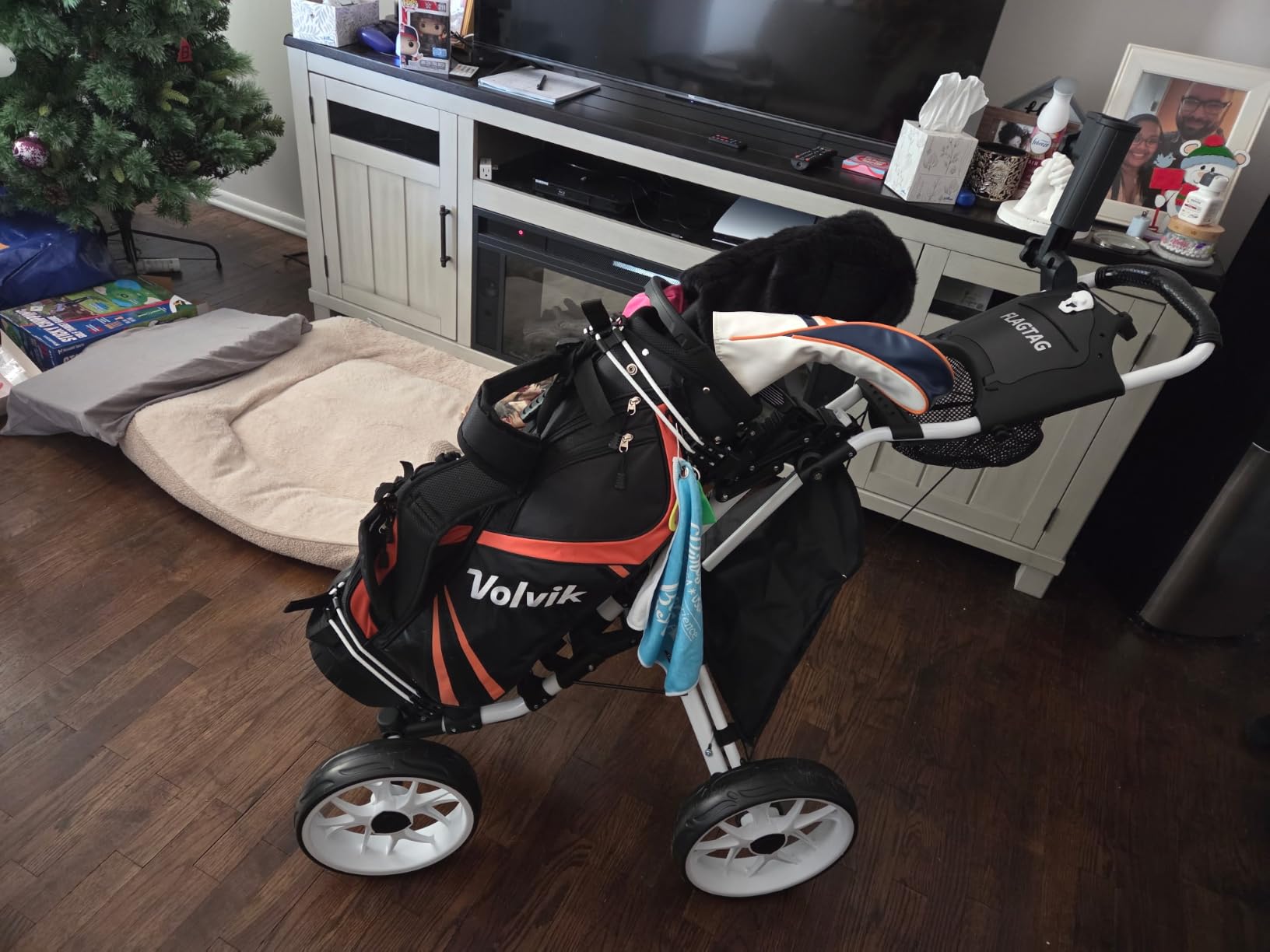
The handle is height-adjustable, which suits different golfers, and the model comes in five colours. The 286-owner review base centres on the smooth one-click fold, four-wheel stability and the unusually complete cooler and tray package, which tells you the package is genuinely the reason people keep it.
This is a newer frame than most of this list, and the listing carries a one-year warranty. If you are buying into the category for the first time and want four-wheel stability plus storage without a second shopping trip, the package value is real and the one-click fold removes the usual car park faff.
Why the four-wheel layout plus a package works
A four-wheel chassis handles a loaded bag more predictably than a three-wheel one, particularly when the bag is heavy with a cart strap and a cooler in the console. If your bag is the main storage unit, that predictable load handling is what you feel on uneven ground rather than the accessory list.
The height-adjustable handle means one cart can serve more than one player in a household, and the built-in cooler means the drink problem is solved without a separate bag hanging off the frame.
Where the FLAGTAG 4-Wheel falls down
It is the heaviest cart in this group at 19.6 pounds, and that makes it the least portable by a clear margin. Owners also report that build quality and accessory durability are less refined than the established brands, which is the honest trade for the package value. The cooler bag and holders are the first parts likely to need replacing.
Because the frame is newer and the review base is smaller, there is less long-term durability data than for the Caddytek or Bag Boy models. If you want a cart that will still be in service in eight years, the larger review bases here are a better bet. If you want a complete four-wheel package now, this is the sensible choice.
3-Wheel vs 4-Wheel Golf Push Carts
A three-wheel push cart is lighter, narrower and faster to manoeuvre, which makes it the better choice on tight fairways, in small cars and for golfers who struggle to lift weight. A four-wheel push cart has a wider, more stable base that resists tipping on sidehills and in wind, which makes it better for seniors, hilly courses and anyone who does not want a cart running away from them downhill.
That is the honest trade. You are choosing between agility and stability, and the right answer depends entirely on your terrain and your body rather than on any brand’s marketing.
Here is how to decide:
Choose a 3-wheel cart if your course has narrow fairways and doglegs, you share a small car, you carry golf clubs on planes, or your priority is the lowest possible weight. Every 3-wheel cart in this roundup also folds more compactly, which is a second-order benefit of the same design.
Choose a 4-wheel cart if you play hilly or mountain courses, you walk cross-country off the cart path, you are an older golfer or have balance concerns, or you simply do not want to manage a cart on a cross-slope. The wide wheelbase is the reason, and it is a physical advantage rather than a marketing one.
Consider a seat-equipped cart if you want to rest between shots. The seat adds weight, which pushes you toward the four-wheel end of the market, but the ability to sit on a busy tee box is worth more to some golfers than any other feature on the list.
Weight matters more than wheels in one case: if you have to lift the cart into a high boot alone, a lighter three-wheel frame will serve you better than a more stable heavier one. This is the single most common reason buyers end up regretting a four-wheel cart.
One practical note from the forum side of this debate: the carts that cause complaints are rarely the wrong wheel count. They are the carts whose brake was too light for the slope in front of them, or whose bag straps let go halfway to the green. Buy a firm brake, check it on a slope before your first shot, and the wheel count question mostly answers itself.
Best Golf Push Cart for Seniors and Golfers With Mobility Limits
The best golf push cart for a senior golfer or anyone with mobility limits is a four-wheel model with a firm brake, an adjustable handle and a manageable weight, and among these the CaddyTek Caddycruiser One V8 is the strongest all-round answer, with the Tangkula Push Cart With Seat the choice when resting during the round matters more than portability.
Stability is the deciding factor, and the reason is specific. A three-wheel cart pivots around a single front wheel, so on a sidehill the cart can accelerate away downhill or rotate if the bag shifts. For a golfer with balance concerns, a recent injury, or simply less confidence on uneven ground, that is not a theoretical risk. A four-wheel chassis with a wide wheelbase distributes the load across four contact points and resists exactly that failure mode.
Three further criteria matter for this group. Handle height adjustment is essential, because a fixed-height handle forces a shorter golfer to push with bent arms and a taller golfer to hunch; every cart in this roundup except the lightest budget models offers multi-position adjustment, and the Tangkula seat cart goes further with four distinct positions. Weight is the second one, because lifting a loaded cart into a car is often the hardest single movement of the day, which argues for keeping the frame under 16 pounds rather than treating weight as irrelevant. The third is the brake, and it should be firm enough that you can set it on the slope in front of you and walk to your ball without watching the cart behind you.
If rest during the round is part of the requirement, the Tangkula seat cart is the only option here with a removable cushioned seat, and owners with back problems rate it as transformative. Be aware of two caveats: it tips backward on level ground if the seat is removed, so the seat functions as part of the structure, and the brake is foot-operated only on one wheel with no handbrake option.
Golf Push Carts by Price Band
Every cart in this roundup sits in the manual tier, which is where the overwhelming majority of golfers belong. Prices in this category move constantly, so treat the bands below as structure rather than a shopping list, and check the current figure before you commit.
Entry tier: the Tangkula Lightweight 3-Wheel is the pick at around 13 pounds. It is the lightest frame here and the simplest way to start walking on a modest budget, and the trade-offs are the angled cup holder and the durability question on a longer horizon.
Value tier: the Caddytek CaddyLite 11.5 V3 and the Caddytek Superlite Explorer V8 both live here. The CaddyLite is the better three-wheel option and the Explorer is the better four-wheel option, and between them they cover the two wheel configurations at this level with 15,000-plus owner reviews between them.
Premium manual tier: the CaddyTek Caddycruiser One V8 and the Bag Boy Nitron sit at the top of the manual market. The Caddycruiser buys four-wheel stability and storage, the Nitron buys the auto-open mechanism and the Top-Lok bag lock, and both are supported by established accessory ecosystems and replacement parts.
Electric and remote tier: nothing in this roundup, and that is a deliberate choice. Electric and remote trolleys occupy an entirely different market at several times the cost of a manual cart, with battery, motor and software considerations that make them a separate buying decision. If you are shopping in that tier, the criteria are runtime per charge, charge point logistics, whether the motor handles slopes, and total weight including the battery.
The practical rule we would apply: if you play fewer than about twenty rounds a year, buy within the value tier and accept that some of the premium features are not for you. The features that justify a premium manual cart, a firm brake, a wide four-wheel base, good bag retention, are exactly the features that matter to people who push 50-plus rounds a season.
Push Cart vs Carry Bag vs Electric Trolley
A push cart is the right answer for almost everyone, and the decision is usually closer than buyers expect. A carry bag is lighter to buy and faster to move on a good day, but it taxes your back, your shoulder and your patience over four hours. An electric trolley removes the physical effort entirely, at a cost jump so large that it should be a deliberate choice rather than an impulse.
Working through the three options:
Carry bag: lowest purchase cost, no storage or fold decisions, and you keep full control of your bag at all times. It is the right choice for nine holes, for short winter practice, and for golfers who genuinely prefer the routine. It is the wrong choice for a full 18 on a warm day over undulating ground.
Manual push cart: a one-time purchase that removes the load from your shoulders while keeping you walking. You still walk every step of the course, so the fitness and course-management benefits of walking remain intact. This is the default choice and it suits beginners, occasional players, seniors, and anyone who wants to stop carrying weight without stopping walking.
Electric trolley: you walk the course but push nothing, which is the appeal for golfers with genuine mobility limits. The trade is cost, charging logistics between rounds, and total weight, because a motor and battery can outweigh the cart-plus-bag load you were trying to remove. It also changes how you move around a group, since a trolley is slower to accelerate and to steer through a crowd.
On the question of pace, a manual push cart does not slow a group down in the way golfers often fear. The cart travels at walking speed by definition, and the pace risk comes from loose bags and awkward terrain rather than from the cart itself. Keeping the bag locked and the wheels inflated is what keeps the group moving.
Our view is that an electric trolley only makes sense if you already know your manual cart is not solving your problem. If a 14-pound cart is too much to lift into a car, that is a lifting problem, and it can often be solved with a lighter manual cart instead of a motor.
What to Look For in a Golf Push Cart?
These are the criteria we used, in roughly the order they should influence your decision. Weight comes first because it is the only spec that affects every single round, and everything after it is a trade against it.
1. Weight and folded size
The two numbers to check are the frame weight and the folded package dimensions. The heaviest cart in this roundup is 19.6 pounds and the lightest is 13 pounds, and that 6.6 pound difference is the difference between a cart that lives in the boot and one that lives in the garage. Measure your boot or your storage space before you buy, and remember that the listed dimensions on some products describe the folded package rather than the assembled cart.
2. Folding mechanism
Three systems cover almost everything you will see. A one-click or auto-open fold collapses from a single button or handle pull, which is the fastest and the easiest but usually appears on the more expensive frames. A one-touch or two-step fold with a locking buckle is a good middle ground and holds the frame shut properly. A three-step fold is the most common and the least refined, and it usually takes a few rounds to learn. If you fold the cart in a car park after every round, the mechanism matters more than any accessory.
3. Brake system
A foot brake is the standard on this category, and the meaningful question is how firmly it locks. A handle-mounted parking brake, as on the Bag Boy Nitron, is easier to reach and easier to deploy with a full bag behind you. Some budget carts use a single-wheel foot brake that works on one side only, which is a limitation on a cross-slope. Whatever you choose, test the brake on the actual slope in front of you during your first round rather than assuming.
4. Wheel size and terrain
Bigger wheels roll through rough and over uneven ground with less effort, and air-filled or larger-diameter wheels are noticeably better off the fairway than small EVA-covered ones. The trade is weight and pack size. Every cart in this roundup uses maintenance-free EVA wheels, which is the right call for most golfers, but the diameter range from 8 inches to 11.5 inches is where the real difference lies. If you play a course with heavy rough or a lot of cart-path concrete, put wheel diameter at the top of your list.
5. Bag strap and bag holder security
Bag retention is the most common failure on a cart and the most annoying, because a bag that swings into your legs during the backswing ruins a shot and your mood. Elastic straps on upper and lower brackets are the baseline, and a lock or clamp system such as the Top-Lok design is meaningfully better. Check that the brackets fit your specific bag, and note that some designs require the bag to be removed before the frame can be folded.
6. Frame material and load rating
Aluminium is the right answer for almost every buyer. It resists rust, keeps the weight down and does not flex when loaded, and every cart in this roundup uses it except the two steel-framed Tangkula models. A stated load rating is useful: the SereneLife is rated to 33 pounds, which is well above a normal stand bag, and that margin is why it stays rigid. Avoid thin-wall frames that creak under a loaded bag, because once a frame creaks it never stops.
7. Accessory compatibility
Check whether the frame uses a fixed console like the Bag Boy Compact 3, which consolidates the phone, drink, ball and card but cannot be extended, or a rail system that accepts add-ons. Count what is actually in the box rather than what is pictured in the accessory catalogue. A cooler bag, an umbrella holder, a scorecard holder with a compartment and a phone or GPS mount cover almost every golfer’s needs, and carts that include all of them save you a first-season shopping trip.
8. Handle height and ergonomics
Adjustable handle height is close to mandatory, and multi-position adjustment is better than a single telescoping range because it lets two golfers in one household share a cart. Padded grips reduce forearm fatigue over the back nine, which is a real and underappreciated benefit on long rounds. Pay attention to the brake’s position too, because a hand-level brake is easier to use than a foot pedal when the cart is loaded on a slope.
Golf Push Cart Rules, Etiquette and Cart-Path Basics
Almost every course allows push carts, and the majority are happy to see them because walkers keep pace better than riders. The complications are not about permission but about where you are permitted to walk and how you behave once you are on the course. Wet-weather walking raises the same questions from a different angle, and our tested picks for the best rain jackets for long outdoor walks cover the same breathable shell criteria you would want on a wet cart path, because wet gear turns an enjoyable 18 into an early exit.
Cart-path-only policies are the most common source of friction, and they are the reason several forum threads about walkers versus riders get heated. On a cart-path-only course you must keep your cart on the path, including the drive to your ball, and you should take no more than one extra shot’s worth of shots from the path. Many players find that rule more restrictive than the written policy suggests, so check your course’s rules rather than assuming.
Three practical points. First, position your cart behind the green, not on it, and not in the path of the group behind you. Second, keep your cart moving or parked on the fringe, not sitting across a fairway on a blind shot. Third, if you are walking with a group, the walker with a cart sets the pace on the path, and riders are the ones who need to keep up, not the other way round.
Two more things worth knowing. Many courses offer a discounted rate for walking, and some require you to check in with the starter as a walker. And if you are new to walking, tell your playing partners before the first tee that you are still calibrating pace, which removes most of the anxiety about holding up a group that first-time walkers feel.
Maintenance, Repairs and Winter Storage
Wheels and tyres are the top failure point on any cart in this category, which is why buying from a brand with a real parts supply matters more than the warranty length on the box.
Clean the wheels monthly. Grass and mud packed into EVA wheels add resistance and make a cart feel heavier than it is. A stiff brush and a wipe-down takes two minutes.
Check the brake before every round. Walk the cart backwards a few inches after setting it on a slope. If it creeps, the brake pads or cable need attention before you rely on them.
Tighten the bag brackets twice a season. Bag retention failures usually start as a loose upper bracket, and a quarter turn now prevents a swinging bag on the fairway.
Store it dry. For an aluminium frame, moisture matters less than for steel, but the bearings and the brake cable will last longer if the cart is not stored wet. A breathable cover is better than plastic sheeting.
Store it folded and loaded-free. A folded, empty cart is far less likely to develop a bent frame, and it takes up a fraction of the space in a winter storage area.
Check the manufacturer’s parts list before you buy. If the wheels, straps or net for your exact frame are not available, treat that as a reason to choose a different cart. Forum owners report paying heavily for replacement wheels on frames that were no longer supported.
Frequently Asked Questions
What is the best golf push cart for seniors?
The best golf push cart for a senior golfer is a four-wheel model with a wide wheelbase, a firm brake, a multi-position handle and a frame light enough to lift into a car. Among our picks, the CaddyTek Caddycruiser One V8 is the strongest all-round answer because four contact points resist tipping on sidehills, while the Tangkula Push Cart With Seat is the choice when being able to sit down between shots matters more than portability. Keep the frame under 16 pounds, set the brake on the slope in front of you before walking to your ball, and adjust the handle to your height rather than pushing with bent arms.
What are the best golf push carts according to reviews?
Across more than 15,000 owner reviews, the carts that come out ahead share four things: a light aluminium frame, a fast fold, a brake that locks firmly on a slope, and bag retention that does not let go mid-swing. The Caddytek CaddyLite 11.5 V3 leads on owner volume at 13.8 pounds with a 4.6 rating, the CaddyTek Caddycruiser One V8 is the stability benchmark among four-wheel carts, and the Bag Boy Nitron wins on the auto-open mechanism and Top-Lok bag lock. The Bag Boy Compact 3 carries the highest average owner rating, on a smaller review base.
What is better, a 3 wheel or 4 wheel golf push cart?
A three-wheel golf push cart is lighter, narrower and quicker to manoeuvre, so it suits tight fairways, small cars and golfers who struggle to lift weight. A four-wheel golf push cart has a wider, more stable base that resists tipping on sidehills and in wind, so it suits seniors, hilly courses and anyone who plays off the cart path. If lifting the cart into a car is your hardest daily task, choose the lighter three-wheel design even if it is less stable.
What is the best motorized golf cart for walking?
The best motorized golf cart for walking is one whose battery runtime covers a full 18 comfortably, whose motor can hold a loaded bag on a slope, and whose total weight including the battery you can still manage at the car. Motorized trolleys are a separate market from manual carts at several times the cost, and they suit golfers with genuine mobility limits rather than those who simply want to walk. If a 14-pound manual cart is too much to lift, a lighter manual cart is often the better fix than adding a motor and battery.
Are push carts allowed at all golf courses?
Almost every golf course allows push carts, and most are glad to see them because walkers keep pace. The complications are about where you walk rather than whether you may bring one. On a cart-path-only course you must keep your cart on the path, including the drive to your ball, and you should take no more than one extra shot’s worth of shots from the path. Many courses also offer a reduced rate for walking players.
How long does a golf push cart last?
A well-built aluminium cart with a firm frame and a multi-position handle can last many seasons of regular play, and long-term owners of the rust-resistant frames in this category report four-plus years of reliable use. Budget frames with thin-wall tubing and light-duty plastic fittings tend to show wear in the wheels, brake cable and bag brackets first. Wheel and tyre replacement is the most common repair, so choose a brand with an active parts supply and clean the wheels regularly. Keeping the frame dry and folded when not in use extends its life further.
The Bottom Line
The best golf push carts for walking in 2026 come down to two honest questions: how much can you comfortably lift into a car, and how much do you play on slopes. Answer both and the cart almost picks itself.
For most golfers the answer is the Caddytek CaddyLite 11.5 V3. It is the most-reviewed walking cart in this roundup by a wide margin, it weighs 13.8 pounds, it folds in three steps, and the wheels roll quietly over anything a normal round presents. If you want a four-wheel base for stability on uneven ground, the CaddyTek Caddycruiser One V8 is the benchmark and owners regularly report it outperforming costlier brands. If your real problem is the faff of loading and unloading, the Bag Boy Nitron opens itself and locks your bag on with no extra parts.
Go lighter with the KVV GL307 or the Tangkula Lightweight 3-Wheel at around 13 pounds, go premium-manual with the Bag Boy Compact 3 for the highest owner satisfaction, and add a seat with the Tangkula Push Cart With Seat if resting between shots is what keeps you on the course. Whichever you choose, set the brake on the actual slope in front of you on your first round. That is the one habit that separates a cart you trust from a cart you watch.