
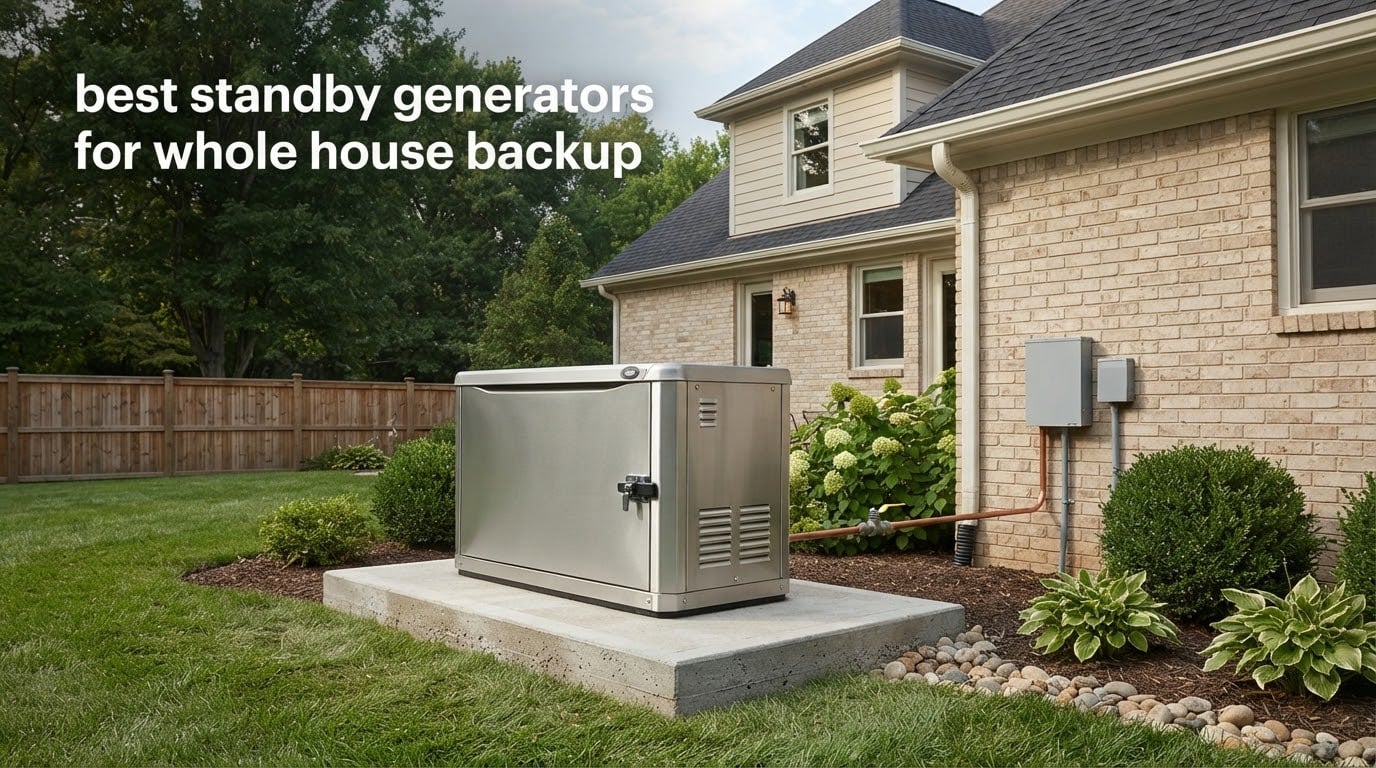
A standby generator is a permanently installed home backup system, about the size of a central air conditioning unit, that sits on a concrete pad outside your home and starts on its own within seconds of a power failure. It connects to your electrical panel through an automatic transfer switch and runs on natural gas or liquid propane to carry the whole house, not a handful of extension cords.
That last distinction is the whole argument. A portable generator makes you go outside, pull a cord, and hope the neighbors are not also running one. A standby unit notices the outage without being asked, transfers the panel, and keeps the furnace, well pump, refrigerator, sump pump and internet running until utility power comes back. For the best standby generators for whole house backup, the decision is not about peak wattage alone. It is about fuel plumbed to your lot, transfer switch amperage, where the unit can legally sit relative to the house, and whether a dealer who can service it lives within driving distance.
We went through six installed standby systems across the Generac Guardian, Generac Home Energy, Kohler Command Pro and Champion aXis lines. Units in this category ship in the 400 to 600 pound range, sit on a poured pad, and need a licensed electrician, a gas fitter and a permit, so the honest comparison is between complete systems rather than bare engines. Our criteria were running and surge capacity, whether the automatic transfer switch is included, cold-weather starting range, noise rating, warranty length, dealer serviceability, and the volume of real owner reports behind each model.
One quick note for anyone planning around indoor air during a long outage: dust and particulate from an outage week settle fast once the power is back on, and whole house air purifiers for pets are worth having on the same outage checklist as the generator itself.
Table of Contents
Top 3 Standby Generators for Whole House Backup (September 2026)
Our three picks reflect three different answers to the same question. The Generac Guardian 26kW is the most complete package here, arriving with a 200 amp transfer switch and Wi-Fi monitoring. The Kohler 20RESCL is the smarter spec sheet for coastal and salt-air properties. The Generac Guardian 22kW has the largest share of five-star reviews of any unit we evaluated, with 81 percent of 19 owner reviews at the top grade and no one-star reviews recorded.
Generac Guardian 26kW
- 26 kW rated output
- 200A transfer switch included
- Mobile Link Wi-Fi monitoring
- 5-year limited warranty

Kohler 20RESCL 20kW
- 20 kW air-cooled engine
- 200A service-entrance load shedding switch
- Corrosion-proof enclosure
- 10-second transfer

Generac Guardian 22kW
- 22 kW True Power output
- Quiet-Test self-test mode
- Mobile Link Wi-Fi
- Under 5 percent THD
Each pick has a catch worth naming up front. The 26kW is the heaviest Generac here at 518 pounds and carries the largest share of one-star reviews in its group. The Kohler needs a Group 51 battery that is not in the box. The 22kW arrives without a transfer switch, which pushes the installed cost up. We cover all three in detail below.
Standby Generator Shortlist in 2026
Six systems made the cut. The table below lists each one with the specifications that actually drive the purchase decision, so you can line them up before reading the individual reviews.
| Product | Specs | Action |
|---|---|---|
| Generac Guardian 26kW Home Generator with Transfer Switch and WiFi |
|
Check Latest Price |
| Kohler 20RESCL-200SELS 20kW Air-Cooled Standby Generator |
|
Check Latest Price |
| Generac Guardian 22kW Home Standby Generator with WiFi Monitoring |
|
Check Latest Price |
 Champion 14kW Home Standby Generator System with 200-Amp aXis ATS Champion 14kW Home Standby Generator System with 200-Amp aXis ATS |
|
Check Latest Price |
 Generac 18kW Whole Home Generator with Transfer Switch and Cellular Monitoring Generac 18kW Whole Home Generator with Transfer Switch and Cellular Monitoring |
|
Check Latest Price |
 Kohler 26RCAL-200SELS 26kW Air-Cooled Standby Generator Kohler 26RCAL-200SELS 26kW Air-Cooled Standby Generator |
|
Check Latest Price |
Read that table twice if you are still narrowing the field. The output numbers that matter are the propane and natural gas ratings listed separately, because a unit rated 26 kW on propane is not a 26 kW unit on natural gas. Kohler’s 26RCAL is the clearest example in this group, dropping to 24 kW when it switches to pipeline gas.
1. Generac Guardian 26kW Home Generator, Transfer Switch and WiFi Monitoring
Generac Guardian 26kW Home Generator, Transfer Switch & WiFi Monitoring
26 kW on gas or LP
200A transfer switch included
Mobile Link Wi-Fi
518 pounds
5 year warranty
Pros
- True Power Technology with under 5 percent harmonic distortion
- 200A transfer switch included for whole-house integration
- Mobile Link Wi-Fi status and maintenance alerts
- G-Force 1000 Series engine tuned for quiet running
- 5 year limited warranty
Cons
- Requires a certified licensed electrician to install
- 518 pounds needs professional placement equipment
- Highest share of one-star reviews in the Generac group at 13 percent
This is the system we keep coming back to, because the box is complete. Model 7291 pairs the 26kW air-cooled Guardian engine with a 200 amp transfer switch, so the electrical half of the job is included rather than quoted as a line item later. For anyone budgeting an installation, that single decision removes the most common source of surprise.
Output is the headline. True Power Technology delivers 26,000 watts at under 5 percent harmonic distortion, which is low enough for sensitive electronics, servers, and medical equipment without adding a separate inverter. The 999 cubic centimeter G-Force 1000 Series engine is the same family Generac uses across the Guardian range, and owners consistently describe it as needing less attention than older overhead-valve designs.
The 200 amp service switch is the underrated part. It sits at the service entrance, which means it can carry the entire home rather than a hand-picked circuit list. That removes the ceiling problem that trips up smaller installs, where the transfer switch rating rather than the engine size becomes the binding constraint.
Enclosure and build are unremarkable in the way you want them to be. The aluminum cabinet, 48.5 by 25.1 by 28.6 inches, is a standard residential NEMA outdoor-rated shell, and the unit runs on natural gas or LP with electronic ignition and low oil shutdown. Mobile Link Wi-Fi gives you status and maintenance alerts remotely, which matters more than it sounds when the unit is 30 feet from your kitchen door.
The caution here is the review distribution. About 13 percent of the 58 owner reviews are one-star, the highest one-star share among the Generac models in this lineup, and those complaints cluster on installation experience rather than the machine itself. If you buy it, buy it from an installer who has done this many times. At 518 pounds, this is a two-person handling job and not a weekend project.
What to check before the installer quotes you
Confirm the 200 amp switch is included in the delivered package rather than assumed. Ask the installer to state whether your existing service entrance panel can accept the switch or needs replacement, because a panel swap is the line item that turns a straightforward job into a long one.
Ask which firm performs the first annual service and what that visit includes. Owners are far more satisfied when the answer is a local dealer name and a written scope, not a generic service number.
Who this unit is wrong for
Skip it if your load list tops out well under 20 kW. This engine is sized for homes with central air, a well pump, an electric water heater, and a workshop or EV charger running together, and paying to carry 26 kW of headroom you never use buys you nothing except a higher installed bill.
It is also the wrong pick in a rural area with no natural gas line and no appetite for a large propane tank. The fuel decision should be settled before the model is, not after.
2. Kohler 20RESCL-200SELS 20kW Air-Cooled Standby Generator with 200 Amp Transfer Switch
Kohler 20RESCL-200SELS 20, 000W Air-Cooled Standby Generator with 200 Amp Whole-House, Service Entrance Rated, Load Shedding Automatic Transfer Switch
20 kW air-cooled
200A load shedding ATS
Corrosion-proof enclosure
500 pounds
5 year/2000 hour warranty
Pros
- Restores power to the home in about 10 seconds
- 200 amp service-entrance switch with load shedding built in
- 100 percent corrosion-proof enclosure for coastal sites
- Quiet operation for residential neighborhoods
- 5 year and 2000 hour limited warranty
Cons
- Group 51 battery required and not included
- 500 pounds so placement needs professional equipment
- Sold by a third-party seller which can complicate warranty claims
Model 20RESCL-200SELS is the system we would put on a house within a mile of salt water, and the load shedding switch is why. Where most residential transfer switches simply hand the whole load over, this one is service-entrance rated and load shedding, so the generator can prioritize circuits when the load list exceeds what 20 kW can serve at once. On an older home with a big central air compressor and a well pump, that feature is the difference between a clean start and a tripped breaker.
Kohler’s engineering claim on this model is speed. Owners report power restored to the home in roughly 10 seconds, which is the standard expectation for this category and worth having explicitly because it covers the window where freezer temperature and medical equipment start to matter.
The enclosure is the quiet differentiator. A 100 percent corrosion-proof shell rated for harsh seaside conditions is not marketing copy here, it is the reason to pick this model over a comparably priced unit if you live where salt spray reaches the pad. Elsewhere on the sheet, the numbers are conventional and solid: 20,000 watts, 500 pounds, 48 by 26.2 by 29 inches, air-cooled, with a 5-year and 2000-hour limited warranty.
Why the battery matters more than it looks
This unit requires a Group 51 battery and it is not in the box. That is a small, cheap part compared with the rest of the system, but it is also the part that decides whether the generator starts at all after a cold night on a dead grid. Budget for it and install a maintenance-free unit with sufficient cold-cranking amps.
On the warranty question, check the seller before you order. This listing is fulfilled by a third party rather than by Kohler directly, which is not a dealbreaker but does mean you should confirm in writing how a warranty claim is handled before the unit leaves the dock.
Where it falls short
At 500 pounds it still needs professional placement, and freight delivery of an air-cooled cabinet that size is not a curbside drop. Plan the path from the delivery point to the pad before the day arrives, because moving it twice is the expensive mistake.
20 kW is also the smallest number here that comfortably runs central air plus a well pump plus a water heater, and it will not add much beyond that. If your home has an electric range, a second HVAC zone, or a workshop with a welder, step up a size class instead of planning to ration circuits.
3. Generac Guardian 22kW Home Standby Generator with WiFi Monitoring
Generac Guardian 22kW Home Standby Generator, WiFi Monitoring
22 kW True Power
Quiet-Test self-test
Mobile Link Wi-Fi
466 pounds
5 year warranty
Pros
- 4.7 average rating with 81 percent of reviews at 5 stars
- Quiet-Test mode runs at lower RPM to cut noise and fuel
- Mobile Link Wi-Fi status and maintenance alerts
- 22000 watts at under 5 percent harmonic distortion
- Owners report multi-day outages handled on one unit
Cons
- Transfer switch is not included in the box
- Requires a certified licensed electrician
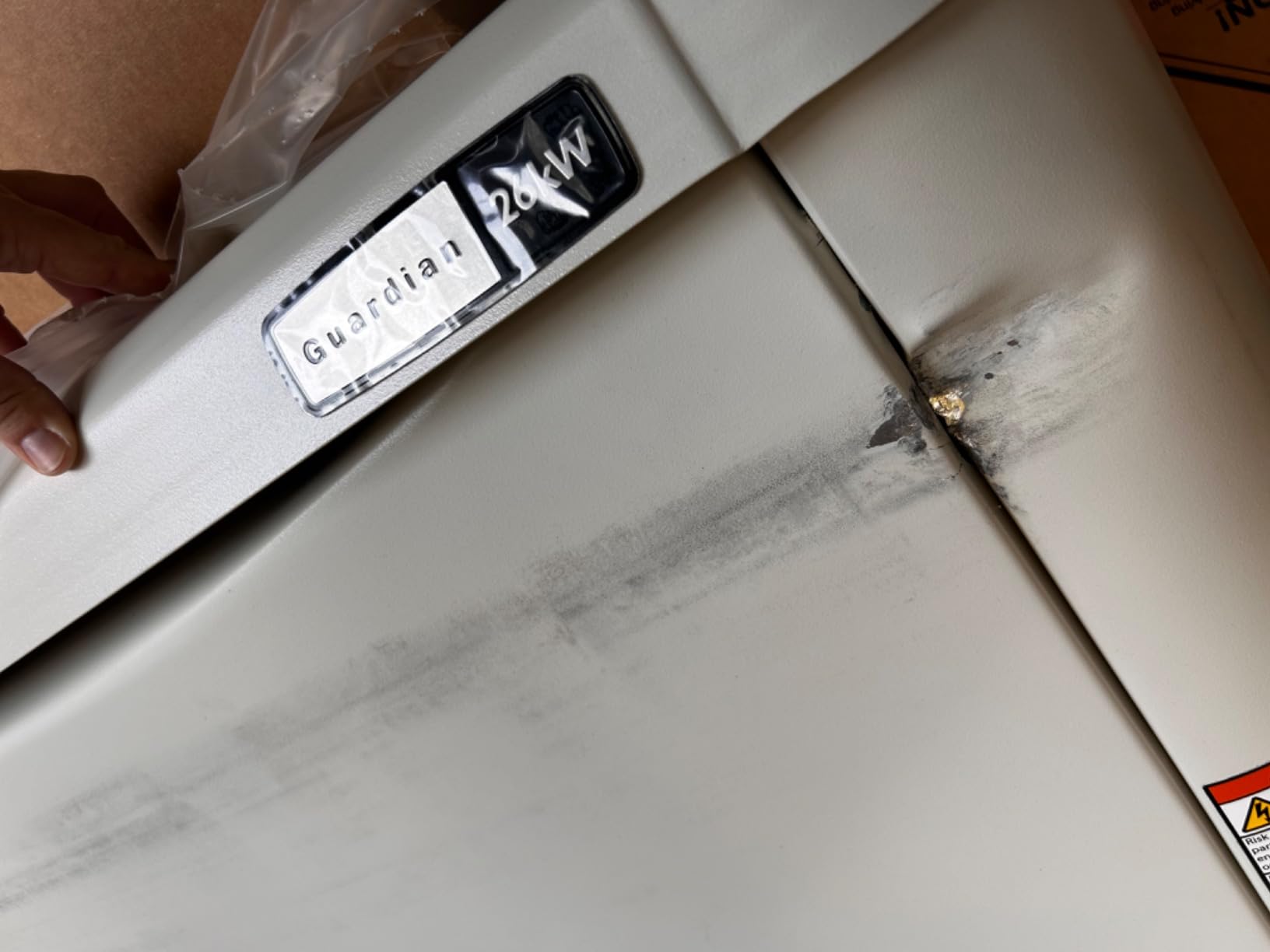
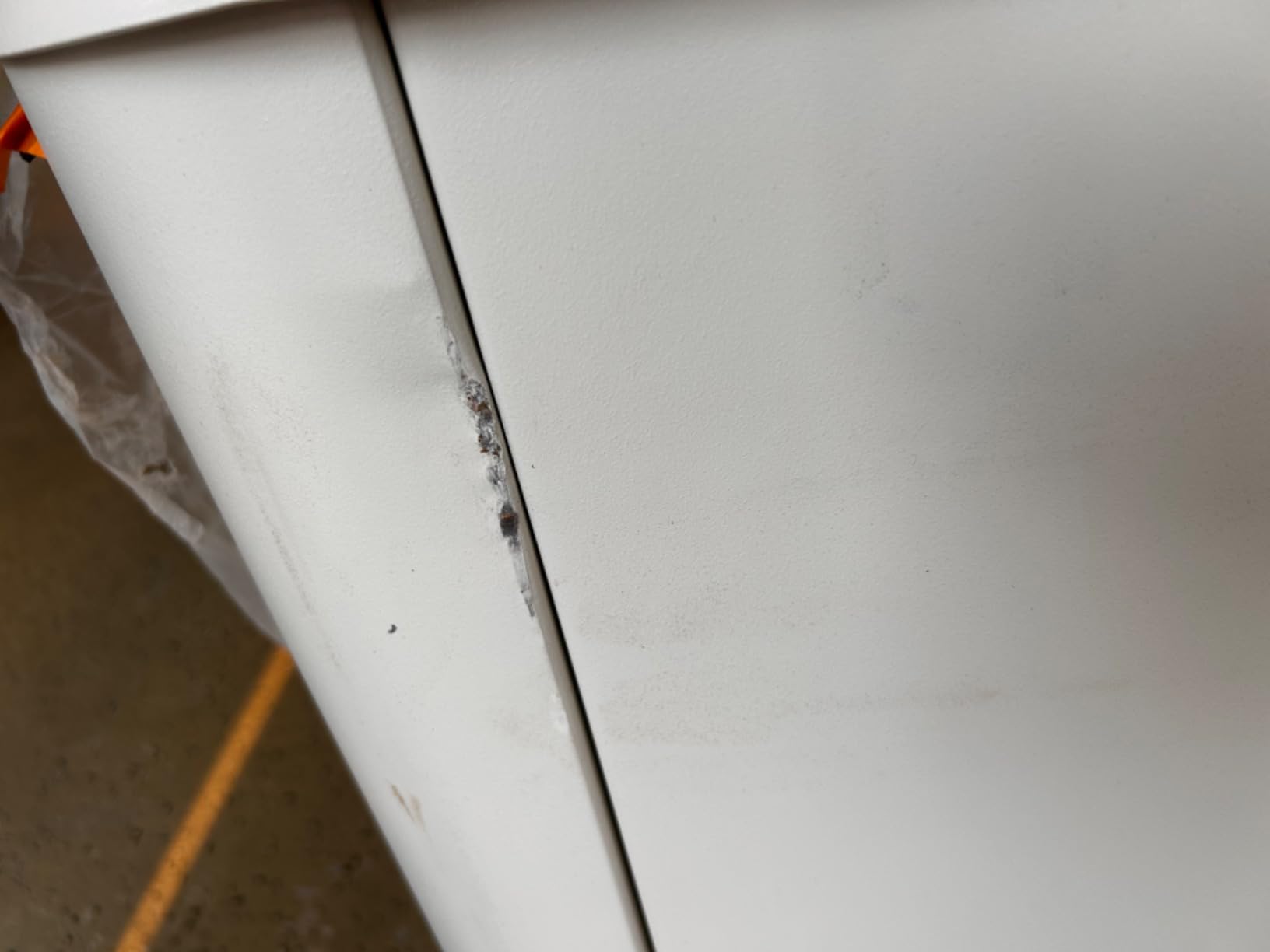
- 466 pounds and some units arrive with dented panels
Model 7042 has the best owner rating in the whole group, 4.7 stars with 81 percent of reviews at five stars and no one-star reviews recorded. It also has an owner report we kept coming back to during this review: a 22kW Guardian running continuously through a five-day hurricane outage, powering the house including HVAC with no perceptible transition when the transfer switch took over.
Quiet-Test is the feature that separates this from a generic 22kW. Instead of running the weekly self-check at full RPM, the engine drops to a lower speed, which cuts fuel use and noise during the test cycle. On a unit that sits 30 feet from a bedroom wall in a quiet neighborhood, that is a real difference in daily life rather than a spec-sheet line.
Power quality is the same True Power platform as the larger Guardian, delivering 22,000 watts at under 5 percent harmonic distortion on the 999 cubic centimeter G-Force 1000 Series engine. Electronic ignition, low oil shutdown, fully enclosed aluminum cabinet, natural gas or LP, 240 volts. The unit measures 48 by 25 by 29 inches and weighs 466 pounds.
Understand the package before you order. This listing is the generator, not a system, and the transfer switch is a separate purchase. Buyers who price the unit in isolation and then discover the switch, pad, gas line run and permit on top tend to be the disappointed ones. The Mobile Link Wi-Fi module is included and is worth keeping enabled.
How we would size this unit
Twenty-two kilowatts is the sweet spot for a home between roughly 1,800 and 3,000 square feet with a gas furnace, a well pump, a refrigerator, a sump pump, and moderate HVAC. It leaves headroom for a washing machine and dryer running during an outage without crossing the line where you start shedding loads.
If your list includes a 5-ton central air conditioner, an electric water heater, and a well pump all starting within a few minutes of each other, this is exactly the size that handles it without a load management discussion. Size up one class for a second floor or an EV charger on Level 2.
What buyers report as problems
Transit damage is the recurring complaint. Some units arrive with cosmetic damage such as a dented rear panel, so photograph the cabinet the moment it is delivered and before the installer signs the acceptance sheet.
App reliability comes up more broadly across standby generators than the machines themselves. Wi-Fi drops and delayed notifications are the usual complaints, so treat Mobile Link as a convenience for status checks rather than as something you would rely on for real-time alerts. Our earlier guide to battery backup for critical pumps covers the same problem from the other direction, where monitoring is local rather than cloud dependent.
4. Champion Power Equipment 14kW Home Standby Generator System with 200-Amp aXis Transfer Switch
Champion Power Equipment 100837 14kW Home Standby Generator System, 200-Amp aXis Automatic Transfer Switch
14 kW on propane and 12.5 kW on gas
200A aXis ATS included
62 dBA
482 pounds
10 year warranty
Pros
- 14000 watts on propane and 12500 watts on natural gas
- 200A aXis transfer switch with four priority levels included
- 62 dBA with sound dampening and a low-tone muffler
- Starts between -22 F and 104 F with no cold weather kit
- 10 year limited warranty with free lifetime technical support
Cons
- Lowest average rating in the group at 3.5 stars
- No local dealers in many areas so warranty work needs a paid third party
- aXis control module and dip-switch setup is confusing to configure
The Champion 100837 is the specification winner on paper and the risk buyer in practice, and both halves of that statement come from the same fact: this is a complete system with a 200 amp aXis automatic transfer switch in the package, paired with a 10-year limited warranty that is twice the length of anything else in this group. You get the whole electrical half of the installation included.
Cold-weather starting is the standout number. The 24-volt starting system is rated to operate between -22 and 104 degrees Fahrenheit with no cold weather kit required, and owners of Champion machines in northern climates report confident starts in deep cold. For Minnesota or Maine winters, that specification alone justifies a look.
The 200A aXis ATS is genuinely capable, managing unlimited high-demand loads across four priority levels with Wi-Fi setup. Quiet operation at 62 dBA comes from sound dampening and a specifically designed low-tone muffler, and the bat-wing enclosure doors that open wide for service access draw repeated praise from owners who have had the unit apart. Free lifetime technical support from dedicated experts is included with the warranty.
Why the 3.5-star rating deserves a closer read
Thirty percent of the 16 reviews are one-star, which is the widest polarization of any unit here. The pattern behind the critical reviews is consistent: start-up and voltage faults that leave owners needing a service visit, combined with an absence of local dealers who will pick up the phone. The aXis control module and its dip-switch configuration are also described as poorly documented, which turns a fault into a puzzle.
The fix is procedural rather than product related. Confirm a Champion dealer or qualified service company within reasonable driving distance before you buy, and budget a service plan if the answer is no. A 10-year warranty is only as good as the company that shows up.
Where the sizing stops
Fourteen kilowatts on propane and 12,500 watts on natural gas is the smallest capacity in this group, and the gap between those two numbers matters if you are on pipeline gas. Plan on covering essentials and a limited load set: furnace or heat pump, refrigerator, lighting, sump pump, internet, and a well pump if you have one.
Central air, an electric water heater, and a washer or dryer all running together will push past what this unit can deliver without load shedding. For those homes, this is the wrong size regardless of how good the warranty is. Appliance selection during an outage also matters, and our large house vacuum guide covers which high-draw appliances to keep off the generator when capacity is tight.
5. Generac 18kW Whole Home Generator with Transfer Switch and Cellular Monitoring
Generac 18kW Whole Home Generator, Transfer Switch & Cellular Capability
18 kW dual fuel
Cellular monitoring built in
Stainless enclosure
426 pounds
5 year warranty
Pros
- Lightest enclosure in the group at 426 pounds
- Built-in cellular monitoring needs no Wi-Fi network
- Oil level sensors and improved cold-start performance
- Sloped roof and rear intake reduce ice and snow intrusion
- Works with ecobee by Generac and PWRcell systems
Cons
- Cellular monitoring requires a Mobile Link premium subscription
- Bundled and non-bundled variants confuse what hardware is included
- Only 6 reviews so little long-term reliability data
Model 7324 is the pick when the pad has to be poured by hand, the path from the delivery point is narrow, or a second person is not available to help. At 426 pounds it is the lightest standby unit we evaluated, and the stainless enclosure is easy to site close to the house without worrying about how two people maneuver it into position.
Built-in cellular connectivity is the interesting feature. Instead of joining your Wi-Fi network, the unit talks to the Mobile Link app over a cellular connection, which removes the most common complaint about cloud monitoring on other models, namely weak in-home Wi-Fi at the far end of a property. The catch is that advanced remote features require a Mobile Link premium subscription, so treat the cellular link as monitoring rather than as a free service.
Cold-climate engineering is better here than the price class suggests. Oil level sensors, improved cold-start performance, a sloped roof and a rear intake design that reduces ice and snow intrusion all point to a unit designed for climates where the enclosure sees water rather than just dust. Electronic fuel and ignition control is intended to cut fuel use and emissions relative to the older Guardian Series, and the unit is compatible with the Generac Home Energy Ecosystem including ecobee thermostats and PWRcell battery systems.
What the 18kW class actually covers
Eighteen kilowatts handles a home up to roughly 2,000 square feet with a gas furnace, refrigerator, lighting circuits, sump pump, internet, and a modest amount of HVAC. It is the right call for a house that has already decided to give up on central air during an outage, or one with no central air at all.
If you run a heat pump rather than a gas furnace, check the surge requirement carefully. Locked rotor amps on a large compressor are what knock undersized units offline, and 18 kW leaves less cushion than 22 or 26 kW for simultaneous motor starts.
What the thin review history means for you
Six reviews is not enough to draw long-term reliability conclusions, and we would not pretend otherwise. The more substantive concern in the data is a detailed report describing the unit as dependent on continuous power to keep its starting battery alive, which could leave it unable to start after a long outage if the battery is not maintained. Confirm the cold-start battery provision with your installer.
Bundled and non-bundled variants of this model also confuse what hardware actually arrives, and some buyers have overpaid on installation as a result. Write the exact contents of the package into your purchase order, including whether a transfer switch is included.
6. Kohler 26RCAL-200SELS 26,000-Watt Air-Cooled Standby Generator with 200 Amp Transfer Switch
Kohler 26RCAL-200SELS Air-Cooled Standby Generator with 200 Amp Transfer Switch Single Phase, 26,000-Watt
26 kW on LP and 24 kW on NG
999cc V-Twin
200A ATS with OnCue Plus
625 pounds
5 year warranty
Pros
- 26 kW rated on liquid propane and 24 kW on natural gas
- 200 amp automatic transfer switch and OnCue Plus monitoring included
- 999cc Command Pro V-Twin engine
- Every reviewer who left feedback rated it 5 stars
- 5 year manufacturer warranty
Cons
- Heaviest unit in the group at 625 pounds
- Only 3 reviews which is the smallest sample in the lineup
- No listing price shown so a dealer quote is required
This is the Kohler to buy if you have a large house and want the transfer switch and monitoring handled by one brand. Model 26RCAL-200SELS bundles the 26,000-watt engine, a 200 amp automatic transfer switch, and OnCue Plus monitoring in a single package, and the engine is a 999 cubic centimeter Command Pro V-Twin rather than a single-cylinder design.
The two fuel ratings are the important detail. Rated output is 26 kW on liquid propane and 24 kW on natural gas, so this is a machine for homes where central air, two HVAC zones, an electric water heater, a well pump and a workshop may all need to run at once. Very few residential units in this class honestly publish both numbers side by side.
Every owner who left feedback rated it 5 stars, which sounds like a recommendation and is not one. Three reviews is the smallest sample in this lineup, and a perfect score from three people tells you about the experience of three people. Treat the rating as a signal of build satisfaction and nothing more, and lean on the included 5-year manufacturer warranty instead.
Placement and handling realities
At 625 pounds this is the heaviest unit we evaluated, and it is the one to plan around rather than react to. The delivery has to reach the pad, and the path from there to the final position has to be clear. Crews handling a unit this size typically use lifting equipment, which belongs in the installation quote rather than in your garage.
Plan the siting with your installer against local code and the manufacturer clearance requirements. Exhaust venting and combustion air matter more as output goes up, and an inspector will look at them.
Who should pass on this one
If your home is under about 2,500 square feet with a single HVAC zone, this is more capacity than your load list can justify. A smaller air-cooled unit will start faster, sit on a lighter pad foundation, and cost less to install and service.
Also weigh the route to a dealer. This listing does not show a price and is not Prime-eligible, so it is typically a dealer-delivered installation. That is normal for this class, but it means your purchase decision depends on the relationship with a local Kohler dealer, not on a checkout button.
How to Choose a Standby Generator for Your Home?
Pick the fuel and the amperage before the model, because both are expensive to change later. Everything else in this guide is refinement on top of those two decisions.
Size It From Your Load List, Not Your Square Footage
Square footage is a proxy, and a bad one. A 2,500 square foot house with a gas furnace and no well pump needs far less standby capacity than a 1,800 square foot house with a 5-ton compressor, a 1 hp well pump, an electric water heater, and a finished basement with a sump pump. Write down the nameplate watts or running amps of every circuit you intend to run, then add the motor loads.
Motor loads are the trap. Refrigerators, compressors, well pumps, and garbage disposables draw a brief spike far above their running draw, and that spike is described as LRA, locked rotor amps, on the appliance plate. A well pump or air conditioner with high locked rotor amps can trip a breaker that a running-watts calculation says should be fine.
As a rough guide, most homes under 1,500 square feet land near 10 to 14 kW, homes between 1,500 and 2,500 square feet land between 14 and 18 kW, and homes above 2,500 square feet with multiple motor loads belong in the 22 to 26 kW range. Add roughly 20 percent headroom to whatever your list totals, and never size to the largest single appliance alone.
Natural Gas vs Liquid Propane
Natural gas is the default when a gas line already reaches your property, because the fuel is piped, continuous, and needs no tank refilling. Every unit in this group runs on natural gas, and all but the Generac 18kW also run on liquid propane, so dual capability is standard rather than premium.
Propane earns its place in rural properties with no gas line. The trade-off is tank logistics: a full 40 pound propane tank is about 5 gallons, and runtime depends entirely on how much of the house you are running. On a partial essential load you get roughly a day from a full cylinder, and a full-house load burns through it much faster. Size the tank and the refill contract for a multi-day outage, not a single evening.
Watch the dual ratings. The Kohler 26RCAL gives you 26 kW on propane and 24 kW on natural gas. The Champion 14kW gives you 14,000 watts on propane and 12,500 watts on natural gas. In both cases, sizing off the propane number and running on pipeline gas leaves you short by 7 to 10 percent exactly when you have leasted the margin.
Air-Cooled vs Liquid-Cooled: Where the Split Happens
Every unit in this lineup is air-cooled, and that is not a compromise for most homes. Air-cooled engines radiate heat through the enclosure and need no radiator, no coolant, and no block heater, which removes an entire class of winter failure. For residential use up to roughly 26 kW, air cooling is the normal and correct choice.
Liquid cooling becomes relevant at two thresholds. First, in sustained high-load duty where an engine runs near its rating for long periods, such as powering a large shop or a home with multiple HVAC zones through a heat wave. Second, in extreme cold, where a liquid-cooled engine can be more forgiving of repeated starts. The tradeoff is added cost, added service points, and a larger footprint.
For most whole-house residential applications, the real decision between air-cooled and liquid-cooled never arises. The decision that does matter is whether your load list pushes you above 26 kW at all, and if it does, you are looking at commercial-grade equipment and a different class of installer.
The Transfer Switch and Load Shedding
The automatic transfer switch is what makes the system automatic. It senses the loss of utility power, signals the engine to start, and moves the home’s electrical load to the generator within seconds. When utility power returns, it moves the load back and shuts the engine down. The switch must be sized to your service, and that rating, not the engine, is often the real limit on a small install.
A 100 amp switch covers a home with fewer critical circuits. A 200 amp service-entrance switch, as on the Generac Guardian 26kW, the Kohler 20RESCL, and the Champion aXis system, can carry the whole home. Load shedding, which the Kohler and Champion switches provide, is a smarter version: the switch prioritizes circuits and manages demand rather than simply handing everything over at once.
Check what is actually in the box. The Generac Guardian 26kW and the Champion 14kW systems include a 200 amp switch. The Kohler 20RESCL includes one. The Generac Guardian 22kW does not, and the Kohler 26RCAL bundles one with OnCue Plus monitoring. Buying the generator without the switch is a very common and very expensive mistake.
Noise, Placement and Distance From the House
Published noise figures are measured at a fixed distance, usually 23 feet, which means they are useful for comparing products and useless for predicting what your bedroom will hear. The Champion system is quoted at 62 dBA, which is the lowest figure in this group. For everything else, assume a permanently installed air-cooled unit is audible from inside the home during a load test, and plan the location accordingly.
Placement is a code question, not a preference question. Exhaust venting, combustion air intake, clearance to openings, and required distance from the structure are all set locally and by the manufacturer. A generator tucked against a wall to hide it can fail inspection and force a rebuild.
Carbon monoxide is the safety issue that matters most. Generator exhaust is colorless and odorless, and backflow through open windows or a slightly open garage door can push it into living space. The Consumer Product Safety Commission guidance is to keep portable and standby units at least 20 feet from the house and never use them in an enclosed space, with exhaust pointed away from doors, windows, and vents. Manufacturers publish their own clearance figures, often in the 5 to 10 foot range to the structure with specific exhaust venting requirements, and those figures are the ones your inspector enforces.
Every home with a generator should have working carbon monoxide alarms on every level, outside sleeping areas. Look for units certified to the UL 2034 standard, and replace the sensors on the manufacturer’s schedule rather than testing a battery and calling it done.
Installation: Where the Real Cost Sits
This is the point where buyers get surprised, and the surprise is consistent across brands. The generator is the visible cost. The installation is often equal to it or more, and it is made up of line items that are easy to overlook until the quote arrives: the transfer switch, a pad, a gas line run, electrical permitting, panel work, and possibly a panel replacement.
Owners on homeowner forums describe installed projects regularly landing in the range of a five-figure total for mid-size homes, with the generator and transfer switch together accounting for well under half. One frequently cited Generac 22kW example had a total installed figure near 10,000 while the generator and switch alone were under 5,000. The drivers of variance are the length of the gas line run, whether your electrical panel needs upgrading, and how far the pad site is from the panel.
Get two or three written quotes that itemize the same line items, and ask each one whether the price includes permits, the pad, the gas line, the transfer switch, and any electrical panel work. A quote that is not itemized cannot be compared against another one that is.
Maintenance Schedule and Service Visits
A standby generator runs a self-test, most models weekly, and that is genuinely all it does between outages. Yet annual service visits are commonly quoted in the low hundreds of dollars, and owners regularly object to paying that for a machine that ran for half an hour a week. The objection is understandable and the service is still necessary, because the self-test does not exercise the transfer switch under load, does not change the oil, and does not check the battery, the coolant, the air filter, or the spark plugs.
Budget for oil, a filter, a battery check, and valve clearance inspection at minimum, and ask exactly what your dealer includes. Warranty terms generally require documented maintenance, so skipping service can affect coverage on major components.
Verify the Dealer and Service Network First
Before you fall for a model, find out who will service it. Dealers own the customer relationship after the install, and a brand with no local presence turns a start fault into a logistics problem. Owners across homeowner forums describe this as the decisive filter in the purchase, and it is a filter most product pages never mention.
Three questions to ask a dealer before you commit: how far away is the nearest certified technician, who performs the first annual service visit, and what happens to the warranty if the unit is moved to a second property. Also check whether a freeze or flood claim is covered, since those are the events that trigger most generator failures in the first place.
Is a Standby Generator Worth It for Your Household?
It depends almost entirely on two things: how often your grid fails you, and what happens in your house when it does.
For a household with medical dependencies, the calculation is easy. CPAP machines, oxygen concentrators, electric mattress systems, and powered lift recliners are not conveniences, and a lift recliner that loses power in a dark house during an outage is a genuine emergency. Several owners on homeowner forums described needing multiple responders to free someone trapped in one. For those homes, standby power is safety infrastructure and the cost conversation is not a cost conversation.
For a household in a wildfire, hurricane, tornado, or ice-storm zone with a history of multi-day outages, the answer is similarly yes. The economics change completely when outages are rare. If your area loses power a handful of times a year for a few hours, you are comparing an installed system that runs its self-test against the value of not losing frozen food, a sump pump, or a work week. A less expensive path exists: a portable generator with a manual transfer switch, or a home battery system that covers the essential circuits without a fuel line or a pad.
That middle option deserves a real look. A home battery paired with a transfer switch can keep refrigeration, internet, lights, and medical devices running silently with no combustion and no fuel deliveries, and it sidesteps zoning rules that ban fuel-burning equipment in some developments. If your main worry is a few critical circuits rather than the whole house, battery backup for critical loads covers that category in detail. The trade is capacity, and capacity is what you give up when you leave fuel burning out of the picture.
Two cost-benefit points that cut the other way. First, a standby generator is not reliably reported to add resale value. Owners are commonly told by people in the industry that it does not meaningfully move a sale price, and if you are counting on recovery at resale, treat that as unproven. Second, a generator you cannot service is a liability rather than an asset, which puts the dealer network check ahead of the spec sheet in the decision order.
Generac vs Kohler vs Champion and Carbon Monoxide Safety
Three brands cover all six units here, and they are not close substitutes. Generac is the volume player, Kohler is the enclosure and specification specialist, and Champion is the warranty play with the smallest dealer footprint.
Generac dominates installed standby systems, and posts in r/Generator regularly point out that roughly eight of every ten standby installs carry the Generac badge. That scale cuts two ways: the dealer and service network is by far the largest and easiest to find, and the brand name is common enough that most installers already have the tools and parts on hand.
Kohler’s distinguishing marks in this lineup are the 100 percent corrosion-proof enclosure on the 20RESCL, which is the reason to pick it in salt air, and the V-Twin engine in the 26RCAL. Forum sentiment consistently favors Kohler and Cummins for build quality, quieter running, and durability, at the understanding that you pay more and you need a dealer.
Champion’s argument is arithmetic. The 10-year limited warranty is the longest standard coverage in the home standby category, the 200 amp aXis transfer switch is included, and free lifetime technical support comes with it. The counterargument is equally concrete: the lowest average rating in this group, and owners in areas without a local dealer report paying a third-party service company to resolve start-up and voltage faults. Verify a dealer exists before choosing this one, because the warranty is only as good as the response.
On warranty length across the group, note the spread: five years on the Generac Guardian 26kW, the Generac Guardian 22kW, the Generac 18kW, and the Kohler 26RCAL, five years and 2000 hours on the Kohler 20RESCL, and ten years on the Champion. Owners weigh this heavily, and the document should be read for what it excludes, not just for the headline number.
Carbon monoxide deserves its own final word because it is the only safety item on this list that can be fatal. Generator exhaust is odorless, and the failure mode is exhaust entering the house through a door, window, or pressure in the building. Keep the unit at the required clearance from the structure, run the exhaust away from openings, and never operate it inside a garage, basement, or enclosed porch, even with the door open.
Then treat alarms as the last layer rather than the first. Install working carbon monoxide alarms on every level and outside sleeping areas, choose models certified to the UL 2034 standard, and replace sensors on the manufacturer’s schedule. A generator sited to code plus UL 2034 alarms is the combination we would put in our own house, and skipping either half of it is a false economy measured in a different unit than money.
Frequently Asked Questions
How much is a whole house generator for a 2000 sq ft house?
The generator is only part of the number. A 14 kW to 18 kW air-cooled unit covers a home of that size, and the installed total includes the transfer switch, concrete pad, gas line run, permits and any electrical panel work. Owners regularly report installed projects in the five-figure range for mid-size homes, with the generator and switch making up well under half. Get two or three written quotes that itemize the same line items before you compare anything.
What is the average cost to install a Generac whole house generator?
Installation frequently equals or exceeds the unit price. The variables that move the total most are the length of the natural gas or propane run, whether your electrical panel can accept the transfer switch or must be replaced, and how far the pad site sits from the panel. Generac installs are the easiest to price locally because the dealer network is the largest, but any quote should be itemized before you sign it.
Is a whole house generator a tax write-off?
Generally no. A standby generator installed to power your personal residence is treated as a capital improvement to your home, not a deductible business expense, and it is not depreciated as equipment. It can affect your property tax assessment in some jurisdictions after installation. If the generator is used to power a business operated from the home, ask a tax professional, because that is a different situation entirely.
Is it worth it to get a whole house generator?
For homes with medical dependencies, frequent multi-day outages, or a well pump and sump pump that protect a finished basement, yes. For a household that rarely loses power, the installed cost is hard to justify and a portable generator with a manual transfer switch or a home battery covering essential circuits is a better spend. Be honest about your outage frequency before ordering a 20 kW system.
What size standby generator do I need for my home?
List the running watts of every circuit you want on the generator, add the starting surge for motors such as air conditioners, well pumps and refrigerators, then add roughly 20 percent headroom. Most homes under 1,500 square feet land near 10 to 14 kW, homes from 1,500 to 2,500 square feet near 14 to 18 kW, and larger homes with multiple motor loads belong at 22 kW or above. Check locked rotor amps on any large motor.
How long can a standby generator run?
On natural gas, indefinitely, because the supply is continuous. On liquid propane it runs until the tank is empty, and a full 40 pound cylinder is about 5 gallons. A partial essential load can stretch that across roughly a day, while a full-house load burns through it much faster. For multi-day outages, budget for a larger tank and a refill agreement rather than assuming a single cylinder is enough.
Do standby generators need regular maintenance?
Yes. Most models run a weekly self-test, and that test does not exercise the transfer switch under load or change oil, filters, spark plugs, coolant or the starting battery. Annual service visits are commonly quoted in the low hundreds of dollars, and warranty terms on major components generally require documented maintenance. Ask the dealer exactly what the visit includes before you accept it.
What fuel does a standby generator use, natural gas or propane?
Most residential standby units run on both, which is what makes dual fuel standard. Natural gas is continuous and needs no tank, so it is the better choice when a gas line already reaches the property. Propane is the answer for rural lots with no gas line, at the cost of tank logistics. Note the ratings differ by fuel: a unit rated 26 kW on propane may deliver 24 kW on natural gas.
Final Verdict on Whole House Backup Power
Six systems, one clear recommendation. The Generac Guardian 26kW (model 7291) takes our Editor’s Choice because it is the only unit in this group that pairs a 26,000-watt engine with an included 200 amp transfer switch and Wi-Fi monitoring, and because its 58 owner reviews give it more real-world evidence than anything else here. The main caution is installation, not hardware.
Match the rest to your situation. The Kohler 20RESCL is the pick within a mile of salt water, and its load shedding switch is the smarter electrical design. The Generac Guardian 22kW has the largest share of five-star reviews in the group, with owners reporting multi-day hurricane outages on a single unit, and it is the best fit for a 1,800 to 3,000 square foot home. The Champion 14kW aXis wins on warranty length and cold starting down to -22 degrees Fahrenheit, provided a dealer exists near you. The Generac 18kW is the lightest to place and the right answer for smaller homes and tight access. The Kohler 26RCAL covers the largest homes, with the transfer switch and OnCue Plus monitoring in the box.
Before any of them, do the two checks that decide most outcomes: write your load list with locked rotor amps, and find out who will service the unit. Sizing from a list prevents tripped breakers on the first cold night, and a dealer within driving distance turns a fault into a service call instead of a dead end.
Our picks for the best standby generators for whole house backup were reviewed and updated for 2026. If a generator is not in your budget range, a portable unit with a manual transfer switch handles essential circuits at a fraction of the installed cost.