
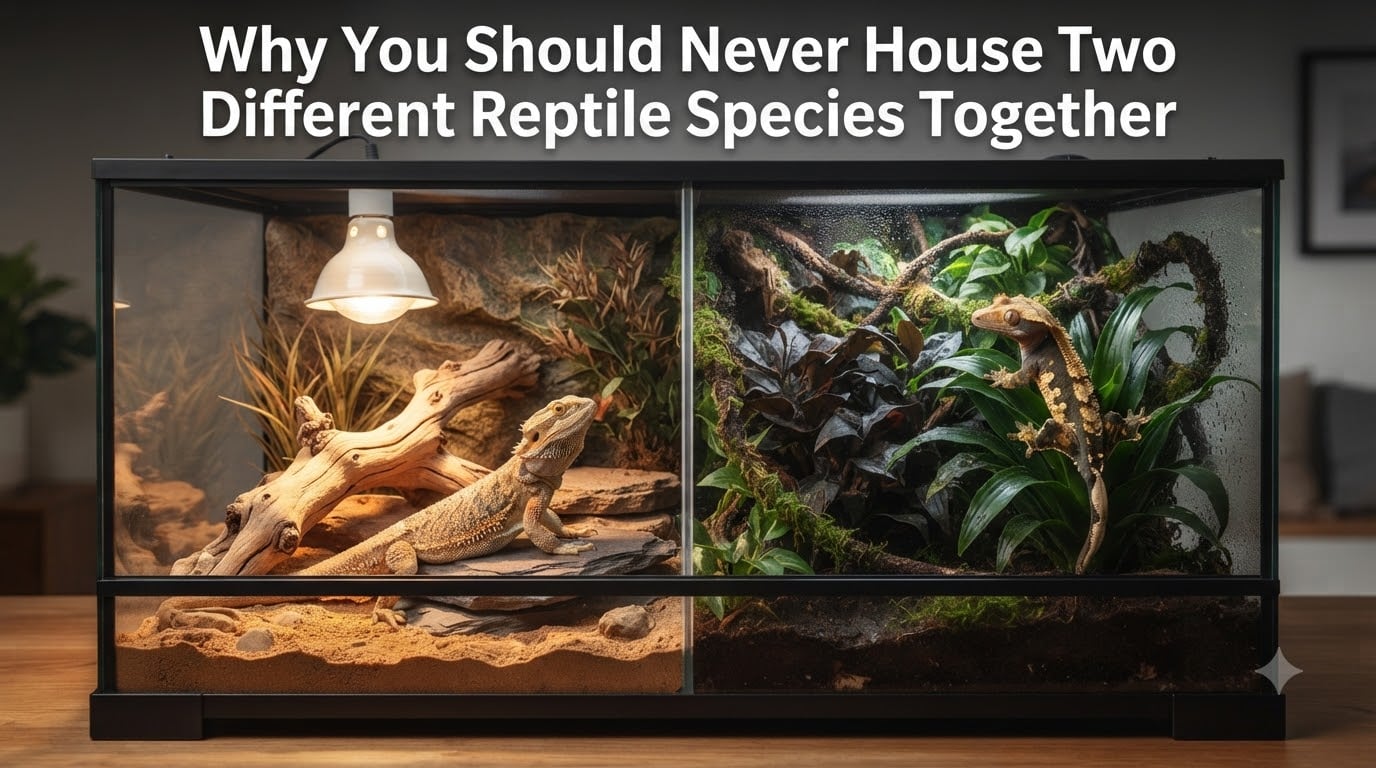
Housing two different reptile species together is one of the most common and most dangerous mistakes new keepers make. Different reptiles evolved in different continents, deserts, and rainforests, and forcing them to share a single enclosure almost always leads to stress, injury, or death.
I have spent years working with reptiles in rescue and home setups, and I have seen the aftermath of cohabitation gone wrong far too many times. This guide explains exactly why you should never house two different reptile species together, and what to do instead.
Table of Contents
Why Housing Two Different Reptile Species Together Is Dangerous?
The short answer is that every reptile species has its own combination of temperature, humidity, diet, lighting, and behavior. When you place two different species in one enclosure, at least one of those animals will be living in the wrong conditions.
The Reddit reptile community is unanimous on this. A huge percentage of reptiles are not social and should never share a space, regardless of how peaceful the pairing might appear at first. Even experienced keepers who tried mixed setups have posted regret threads after losing animals.
The seven biggest dangers are temperature and humidity mismatch, dietary conflicts, disease transmission, aggression and territoriality, substrate incompatibility, predator-prey dynamics, and bacterial contamination from shared waste.
Temperature and Humidity Requirements Almost Never Match
Reptiles are ectothermic, meaning they depend entirely on their environment to regulate body temperature. A bearded dragon needs a basking spot around 100 to 110 degrees Fahrenheit with low humidity. A crested gecko needs 72 to 78 degrees with 60 to 80 percent humidity.
Put them in the same terrarium and one of them is suffering. The bearded dragon will develop respiratory infections from the humidity. The crested gecko will dehydrate and stop eating in the dry heat.
Temperature gradient needs are just as incompatible. Diurnal species like bearded dragons need a hot basking end and a cool retreat. Nocturnal species like leopard geckos need a gentler gradient with belly heat from an under-tank heater. You simply cannot create a gradient that satisfies both.
UVB lighting adds another layer. Some reptiles require strong UVB output to synthesize vitamin D3. Others are sensitive to it and hide from bright light. Housing two different reptile species together forces a compromise that fails both animals.
Dietary Conflicts and Food Competition Create Nutritional Gaps
Different reptile species eat different foods, and that is where competition starts. An adult leopard gecko eats insects. A young bearded dragon eats insects and greens. Feed them together and the faster eater steals everything.
I have watched keepers struggle with this exact problem. The dominant animal eats until full, then guards the feeding station. The subordinate animal loses body condition over weeks, becoming thin, lethargic, and prone to parasites. By the time the keeper notices, the damage is done.
Nutritional deficiencies follow. Insectivores need calcium-dusted prey. Herbivores need greens free of animal protein. Mix the wrong foods and one animal eats what it cannot digest, leading to impaction or kidney damage.
Live prey creates even more danger. Crickets and roaches left uneaten in a mixed enclosure will bite anything soft, including the eyes and toes of smaller reptiles. A nocturnal gecko sharing space with a hungry bearded dragon is at constant risk of being mistaken for food.
Disease Transmission Between Species Is a Hidden Killer
Different reptile species carry different parasites, bacteria, and viruses, and most of these pathogens do not respect species boundaries. Salmonella, for instance, lives in the gut of almost every reptile and sheds continuously in feces.
When two species share an enclosure, they also share fecal matter, water dishes, and basking spots. Bacteria like Pseudomonas and Aeromonas spread rapidly in warm, humid conditions. A healthy-looking reptile can carry a pathogen that devastates a different species with no prior exposure.
Quarantine is standard practice for a reason. New reptiles should spend at least 60 to 90 days in a separate room before any contact with existing animals. Housing two different reptile species together removes that safety net entirely.
Zoonotic disease risk rises too. Several reptile-borne illnesses can transfer to humans, especially children and immunocompromised individuals. A shared enclosure multiplies the bacterial load and makes hand washing far less effective.
Aggression and Territorial Behavior Lead to Injuries
Most reptiles are solitary by nature. They do not form bonds, recognize friends, or benefit from company. Putting two animals together triggers competition for the best basking spot, the best hiding place, and the first meal.
Predator and prey dynamics make this worse. A large monitor lizard will see a smaller gecko as food. A snake will see a mouse-sized lizard as food. Even when both animals are roughly the same size, the instinctive response to small, fast movement can end in a bite.
Size difference is one of the most underestimated dangers. A 200 gram bearded dragon will bully a 40 gram leopard gecko without hesitation. The smaller animal lives in constant fear, hides constantly, refuses to eat in the open, and develops chronic stress.
Chronic stress suppresses the immune system. Stressed reptiles show slower growth, duller colors, and reduced breeding success. They are more likely to develop mouth rot, respiratory infections, and shedding problems. The animal appears healthy on the surface while slowly breaking down inside.
Substrate Compatibility and Bacterial Contamination
Substrate choice depends on the species. Sand works for some desert reptiles but causes impaction in others. Coconut fiber holds humidity for tropical species but dries out desert dwellers. Cypress mulch carries oils that irritate certain snakes.
You cannot pick one substrate that suits two species from different biomes. One animal will always be on the wrong floor. Bacterial contamination adds another layer. Waste from one species mixes with water and food, creating a soup of pathogens that affect both.
Bioactive vivaria attempt to solve this with clean-up crews of isopods and springtails, but even those setups fail when the inhabitants have incompatible humidity needs. The cleanup crew dies, waste builds up, and bacterial blooms follow.
Water dishes become another shared hazard. Soaking behavior differs by species, and the dish quickly becomes contaminated with feces and shed skin. Bacterial counts rise overnight, and both reptiles absorb the pathogens through their cloaca during soaking.
Even Same-Species Cohabitation Carries Serious Risks
The same logic that makes housing two different reptile species together dangerous applies to many same-species setups. Leopard geckos, bearded dragons, and most snakes do best alone.
Two male bearded dragons in the same enclosure will fight, often until one is seriously injured. Two male leopard geckos compete for territory and food. Even two females of the same species can show dominance behaviors that suppress the subordinate animal.
Garter snakes are one of the few commonly cited exceptions. They tolerate same-species groups reasonably well when given enough space and food. Some species of tortoise also coexist in small groups in the wild, but only with carefully managed enclosures and separate feeding stations.
If you must keep more than one reptile, give each animal its own enclosure in the same room. They can see and smell each other without competing for the same resources. That is the closest thing to enrichment that most reptiles need or want.
Frequently Asked Questions
Can you house different reptiles together?
No. Housing two different reptile species together is unsafe because their temperature, humidity, dietary, and behavioral needs almost never align. The result is chronic stress, aggression, disease transmission, and often death for one or both animals.
Is it okay to house two leopard geckos together?
It can work in limited cases, such as two females of similar size with a large enclosure and separate feeding stations. However, most keepers recommend housing leopard geckos separately to avoid dominance disputes, food competition, and accidental breeding.
Is it okay to house two bearded dragons together?
Generally no. Two male bearded dragons will fight, and a size-mismatched pair leads to bullying and food theft. Even female pairs need very large enclosures and careful monitoring. Single housing is the safest choice for bearded dragons.
Can you house two snakes together?
Most snake species should be housed separately. Snakes are solitary, do not benefit from companionship, and compete for the best hiding spots. Feeding two snakes in the same enclosure also risks accidental cannibalism in some species.
What reptiles can live together in a tank?
Very few. Garter snakes are one of the few commonly cited examples that tolerate same-species groups. Otherwise, reptiles from different species should never share an enclosure because their care requirements almost always conflict.
Do reptiles get lonely if housed alone?
No. Reptiles are not social animals in the way mammals or birds are. They do not form bonds, recognize owners as friends, or experience loneliness. A properly set up single enclosure meets all of their psychological needs.
Final Thoughts on Keeping Reptiles Safe and Separate
The temptation to house two different reptile species together usually comes down to space, money, or curiosity. None of those reasons are worth the risk to the animals involved. Every reptile deserves an enclosure built around its specific needs, not a compromise that suits none of them.
If you want to keep multiple reptiles, plan for multiple enclosures from the start. Each setup costs more upfront, but it prevents the heartbreak, vet bills, and lost animals that come from cohabitation failures. Our team has seen too many keepers learn this lesson the hard way.
The bottom line is simple. House two different reptile species together only if you want to choose which one gets sick first. Otherwise, give every animal its own species-appropriate enclosure, watch them thrive, and skip the risk entirely.