
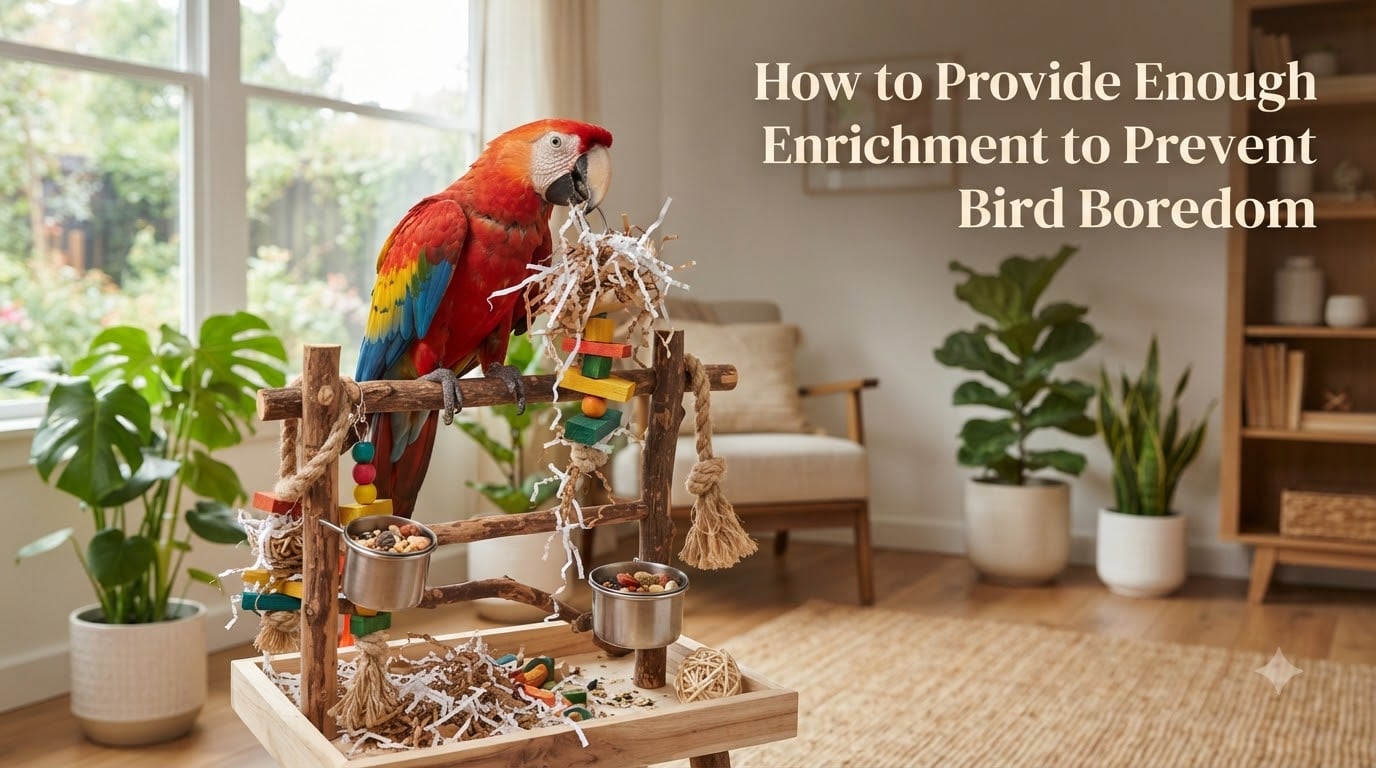
Birds are not decorations. They are parrots, cockatiels, conures, and finches with brains wired by millions of years of evolution to forage, problem-solve, and stay busy from dawn to dusk. In the wild, a parrot spends six to seven hours a day working for every meal, so when we scoop that food out of a bowl and place it next to a bored bird, we set the stage for screaming, plucking, and destruction. Bird enrichment is the fix, and this guide shows you how to provide enough enrichment to prevent bird boredom in a way that actually works.
I have lived with companion birds for years, and I have watched a cockatiel go from cage-bound screamer to confident forager by changing how I spend twenty minutes a day. In this article, I will walk you through the signs of bird boredom, the two rules every owner should know, the categories of enrichment that matter, and a practical daily routine you can start tomorrow.
Table of Contents
Why Bird Enrichment Is Important?
Bird enrichment is anything that engages a bird’s mind, body, or senses in a way that mimics natural behaviors. The wild version of your pet spends most of its day hunting, cracking, climbing, hiding, and socializing. A captive bird without enrichment has every need met in seconds, then nothing to do for the next twenty-two hours. That gap is where behavior problems grow.
Research on parrot welfare consistently shows that captive birds without enrichment develop abnormal repetitive behaviors like pacing, head bobbing, and feather plucking. These are not quirks. They are signs of a brain in withdrawal. When you provide enrichment, you give that brain a job, and the birds we work with respond within days. Less screaming, calmer handling, and brighter eyes are the typical payoff.
Signs Your Bird Is Bored
Birds are good at hiding discomfort, but boredom leaves fingerprints. If you recognize any of these signs, your bird is asking for more enrichment today.
Feather plucking or barbering. Chewing or pulling feathers is the most common red flag. It often starts on the chest or thighs where the beak can reach.
Excessive screaming. Birds vocalize, but screaming that lasts minutes at a time and stops only when you return is attention-seeking boredom behavior.
Aggression and biting. A bored bird that has nothing to chew may redirect that energy onto your hand.
Destructive chewing. Molding, blinds, furniture, and your favorite book are targets when a bird needs to chew.
Lethargy and withdrawal. A bird that sits fluffed and silent on the same perch all day is not relaxed. It is shut down.
Repetitive movements. Pacing, route tracing, and head swinging are classic signs of under-stimulation.
If you see one or two of these signs, do not panic. Most birds bounce back quickly when enrichment improves. If plucking has gone on for months, schedule a vet visit first to rule out medical causes, then rebuild the enrichment plan.
The 3-3-3 Rule and the 60-40 Rule Explained
Two simple rules shape how experienced bird owners think about enrichment. I have asked dozens of avian caretakers what they wish they had known earlier, and these two come up every time.
The 3-3-3 Rule for Birds
The 3-3-3 rule describes how a new bird settles into a home. It stands for 3 days to decompress, 3 weeks to settle into a routine, and 3 months to feel at home and trust you. During the first phase, do not flood the bird with toys. Give it a quiet space, predictable feeding times, and a single perch of comfort. Real enrichment during decompression is simply calm.
After the first three weeks, you can rotate toys in slowly. After three months, you will see the real personality of your bird and what kinds of enrichment it actually loves. Skipping the 3-3-3 rhythm is the most common reason new owners report “my bird will not play with anything.” The bird was not ready yet.
The 60-40 Rule for Birds
The 60-40 rule is about how much of your bird’s diet should come from foraging. The recommendation is that 60% of daily food should be earned through foraging behavior, and only 40% should come from a regular bowl. Wild birds work for almost every bite, and the 60-40 split is the closest we can reasonably come in captivity without burning out the bird or the owner.
You do not have to do this overnight. Start with breakfast in the bowl, then move to one foraging station. Add a second station the next week. Within a month, you will have a bird that knows how to manipulate paper, cardboard, and acrylic puzzles to find its food, and you will see the difference in behavior almost immediately.
Types of Bird Enrichment
Bird enrichment is not just toys. The five categories below cover every angle of a bird’s life. The best plans pull from all five every day.
Foraging Enrichment
Foraging is the gold standard because it mimics the most time-consuming behavior in the wild. Food puzzles, paper-wrapped treats, hidden pellets, and DIY foraging stations all count. A single toilet paper tube stuffed with millet and crimped at the ends can keep a cockatiel busy for an hour.
Physical Enrichment
Physical enrichment covers climbing, perching, flapping, and foot play. Rope perches, ladders, swings, and foot toys all work the body. Let your bird walk across the floor of a bird-safe room, fly short distances between you, or flap on a perch. A bird that has not stretched its wings in days is a frustrated bird.
Social Enrichment
Birds are flock animals. You and your family are the flock. Talk to your bird, eat near the cage, and include it in daily life. Even ten minutes of focused attention is more valuable than another toy in the cage.
Sensory Enrichment
Sights, sounds, smells, and textures all count. A window perch with a view of trees, a rotated playlist of music, a snack of fresh herbs, and a rotation of perches with different diameters give the brain something new to process each day.
Occupational or Cognitive Enrichment
Training, learning tricks, and solving puzzles grow the bird’s brain. Five minutes of clicker training is one of the highest-value enrichment activities you can offer, and it doubles as relationship building.
How to Provide Enough Enrichment to Prevent Bird Boredom?
This is the core of the article. The list below is the practical toolkit I share with anyone who asks how to enrich their bird. Pick three or four to start this week, then add more as your routine settles in.
1. Use Foraging Toys and Food Puzzles
Foraging toys are the single most powerful enrichment tool. Acrylic puzzle boxes, stainless steel skewers, and paper-wrapped treat bags all work. Start easy for shy birds: a shallow dish with a single sunflower seed buried under a piece of paper. Then move to wrapping pellets in a muffin cup, then to a real puzzle. The “win” of finding food is its own reward.
2. Rotate Toys on a Weekly Schedule
Birds get bored of the same toys in about five to seven days. Keep a stash of five to seven toys and rotate two or three into the cage each week. Put the rotated-out toys in a clean bag, take them out again in two weeks, and suddenly the “old” toy is new again. This single habit fixes the “my bird ignores every toy I buy” problem for most owners.
3. Build DIY Enrichment From Household Items
You do not need a budget to start. Birds love empty toilet paper tubes, paper cups, unscented cardboard, plain paper, and natural wood. Stuff a tube with millet, crimp the ends, and hang it in the cage. Shred a piece of printer paper and wrap a treat inside. Tie a knot in a strip of vegetable-tanned leather for shredding. The key is to use bird-safe materials only. Avoid zinc, lead, and pressure-treated wood.
4. Train a New Trick Every Week
Training is the most overlooked enrichment activity. Five minutes of clicker training teaches your bird to target, turn around, wave, or fetch. Each session uses the brain, builds your relationship, and burns off energy. According to avian trainers, even five minutes a day produces calmer, more confident birds within two weeks.
5. Schedule Out-of-Cage Time Every Day
No cage is large enough to be a full-life habitat. Aim for at least one to two hours of supervised out-of-cage time per day, more if your bird is flighted. A play stand in the living room, a tabletop gym in the kitchen, or a shoulder perch while you cook all count. Movement is enrichment.
6. Add Audio and Visual Stimulation
Leave a radio or playlist on when you leave the house. Birds enjoy music, talking, and natural soundscapes. A window with a view of trees, birds, or moving traffic also gives the brain a channel to watch. Rotate what is on the screen or radio so the same loop is not repeated continuously.
7. Offer Foraging Opportunities Outside the Cage
Hide treats in a snuffle mat, a paper bag, or a cardboard box with holes. Scatter pellets in a tray of shredded paper. Your bird will happily dig through fifteen minutes of work for a single sunflower seed, and the foraging instinct is satisfied far more than a bowl ever could.
8. Provide a Variety of Textures and Materials
Texture is a fast path to enrichment. Rope, sisal, palm leaves, soft wood, hard wood, and stainless steel all give different beak and foot experiences. Birds raised on one texture alone have a hard time with new toys. Variety prevents that.
9. Use Bathing and Mist as Enrichment
Many birds love a daily mist or a shallow dish bath. Bathing is a natural behavior that occupies time, calms the bird, and improves feather condition. It is enrichment that also doubles as grooming.
10. Set Up a “Discovery Zone” for Treats
Once a week, set up a foraging “discovery zone” on a play stand: a paper bag filled with crinkled paper, a few hidden treats, a foot toy, and a fresh piece of vegetable. Let your bird work through it for twenty minutes while you cook dinner. This is the kind of high-payoff enrichment that experienced owners swear by.
Keeping Your Bird Entertained While You Are at Work
Forum threads are full of guilt-stricken owners asking how to keep a bird busy for eight hours. The truth is that a well-set-up cage with enrichment can keep most birds content while you work. The combination below is what I use, and it works for cockatiels, conures, quakers, and most small parrots.
Set Up a Foraging Station Before You Leave
Place three or four foraging opportunities in the cage before you walk out the door. A paper-wrapped treat, a hidden pellet bowl, a foot toy, and a fresh piece of millet in a holder gives the bird a “to-do list” that lasts hours. Rotate the stations so the bird does not predict what is coming.
Leave the Radio or TV On
Constant silence is unnatural for a flock animal. A talk radio station, a curated playlist, or a nature documentary on low volume gives the bird company. Many birds learn to recognize themes and respond to specific voices.
Position the Cage Near a Window
A window with a view of trees, sky, or a feeder is a free enrichment channel. Make sure the bird can move out of direct sun if it wants to, and avoid drafty windows.
Provide a Pre-Dawn “Work Project”
Some birds wake up ready to scream at sunrise. Beat the morning noise by presenting a fresh foraging project at dawn. A clean piece of cardboard with treats tucked into slits gives the bird a head start before you head to work.
Skip the Mirror
Mirrors are a common suggestion, but they often create hormonal and behavioral problems. A real bird or a stuffed animal that mimics a flock mate is a healthier long-term option than a mirror that gives the bird an endless fake companion.
A Sample Daily Bird Enrichment Routine
Most owners do not need more time. They need a structure. Below is the routine I use with my own birds. Adjust the times to your schedule, but keep the categories the same every day.
Morning (15 minutes)
Refresh food and water, open the cage, and offer a five-minute training session. Target training, step-up practice, or a new trick all work. Training first thing in the morning uses the bird’s fresh energy and sets the tone for the day.
Midday (10 minutes, sustainable while at work)
Before leaving, set up two or three foraging stations and leave the radio on. A short check-in at lunch, even a five-minute chat on the phone near the cage, gives the bird a social boost.
Evening (45 minutes to 1 hour)
Out-of-cage time, a fresh vegetable chop, a rotation of two toys, and a longer training session. This is also the ideal time for flight recall, supervised exploration, or a bath.
Night Wind-Down (10 minutes)
Cover the cage, dim the lights, and offer a shreddable toy for the last few minutes before sleep. Most parrots sleep ten to twelve hours, and a consistent bedtime routine reduces night-fright and screaming.
Frequently Asked Questions
What is the 3 3 3 rule for birds?
The 3-3-3 rule for birds describes how a new bird settles into a home: 3 days to decompress, 3 weeks to settle into a routine, and 3 months to feel truly at home and trust you. Owners should respect each phase by keeping the environment calm during the first days, slowly introducing enrichment and routine during the first weeks, and using the three-month mark as the point when the real personality emerges and deeper training and bonding can begin.
How to make your bird less bored?
To make your bird less bored, rotate toys every 5 to 7 days, offer at least one foraging opportunity per day, schedule daily out-of-cage time, train short clicker sessions, and place the cage where the bird can see and hear you. Birds become bored when their environment stops changing, so swapping toys, hiding food in new puzzles, and adding social interaction every day are the fastest fixes.
How to provide mental stimulation for birds?
Provide mental stimulation for birds by combining foraging toys, training, social interaction, and puzzle feeders. Start with simple foraging, such as wrapping a treat in paper, then progress to acrylic puzzles and clicker training. Rotate toys weekly, leave a radio or TV on during the day, and offer a fresh shreddable material two or three times per week. Five to ten minutes of focused training each day is one of the highest-value mental stimulation activities.
What is the 60 40 rule for birds?
The 60-40 rule for birds recommends that 60% of a bird’s daily food be earned through foraging behavior, while only 40% is offered in a regular bowl. This ratio mimics the wild lifestyle where birds spend most of their day finding food, and it reduces boredom, feather plucking, and screaming. Owners can transition gradually by replacing one bowl feeding per week with a foraging station until the 60-40 split is reached.
What are some bird enrichment ideas?
Some bird enrichment ideas include stuffing toilet paper tubes with millet, hiding pellets in a snuffle mat, wrapping treats in paper, building a cardboard foraging box, scheduling a daily training session, offering a fresh vegetable to shred, playing music or nature sounds, providing a window perch, scheduling out-of-cage flight time, and rotating toys weekly. Variety across foraging, physical, social, sensory, and cognitive categories keeps a bird engaged and prevents boredom-related behavior problems.
Final Thoughts on Bird Enrichment
Bird enrichment is not a luxury. It is the difference between a bird that lives and a bird that thrives. The good news is that you do not need a perfect plan from day one. You need a rotation of toys, one foraging opportunity a day, five minutes of training, and a daily routine that gives your bird a reason to wake up excited.
Start with one change this week. Add a foraging station tomorrow. Rotate the toys on Sunday. Build a slow week-by-week upgrade from there. Within a month, your bird enrichment plan will be running on autopilot, and the scream-at-dawn problem will quietly fade into the past.