
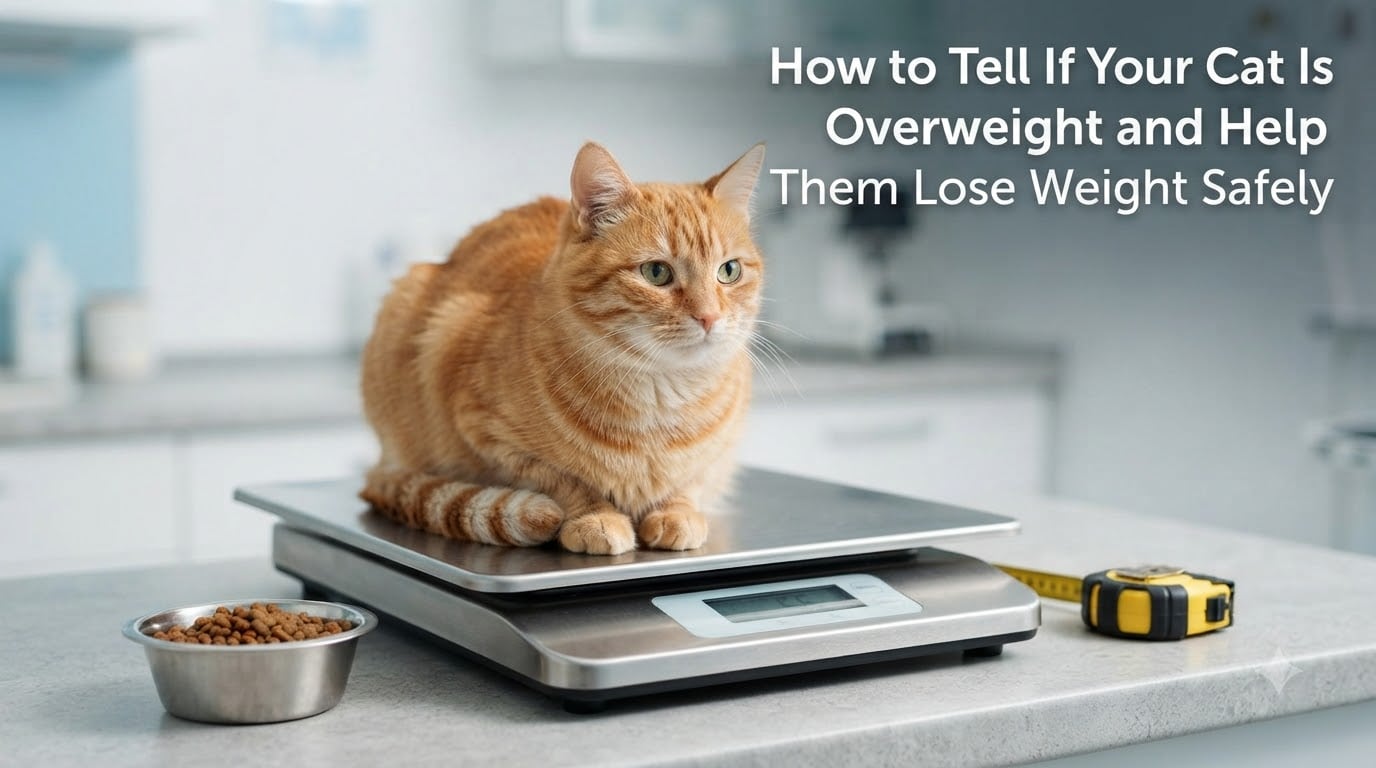
When I adopted my tabby Marmalade six years ago, the shelter staff smiled and called him “chonky.” I thought it was cute until our vet showed me the scale: 16 pounds on a frame built for 10. That conversation launched my own deep dive into cat overweight weight loss, and it’s the reason I wrote this guide for 2026.
Here’s what you’ll learn: how to spot an overweight cat using three hands-on checks vets actually use, the exact weight thresholds that define overweight versus obese, the health problems tied to extra fat, and a safe step-by-step plan to help your cat slim down without putting their liver at risk.
One more thing before we start: roughly 60% of indoor cats in North America are overweight or obese, according to the Association for Pet Obesity Prevention. If your cat falls in that group, you’re not alone, and you can absolutely reverse it.
Table of Contents
How to Tell If Your Cat Is Overweight: 3 Hands-On Checks
You don’t need a scale to start answering “is my cat overweight?” You just need your hands and your eyes. I run these three checks on Marmalade every month now, and they take about 60 seconds total.
The Rib Test: Your First Check
Run your fingers along your cat’s side, just behind the shoulder blades. You should feel each rib individually, with a thin layer of fat covering them, like the back of your hand. If you have to press through a thick pad of flesh to find the ribs, your cat is overweight. If you can’t feel the ribs at all, your cat is likely obese.
The visual cue matters too: a healthy cat shows a subtle hourglass shape from above. A round, barrel-shaped torso with no waist tuck means fat has piled up around the ribs and spine.
Waistline and Belly Check
Stand above your cat and look down. A healthy cat has a visible waist narrower than the ribcage and hips. If your cat looks like a tube of cat food from this angle, that’s a problem.
From the side, the belly should tuck upward toward the hind legs. A sagging, swaying belly that almost touches the floor when your cat walks is a classic sign of excess abdominal fat, the kind that drives insulin resistance.
Understanding the Body Condition Score (BCS)
Vets use a 1-to-9 Body Condition Score to standardize what you’re doing with your hands. Here’s how the scale breaks down:
1-3 (Too thin): Ribs, spine, and hip bones visible. Severe tuck at the waist.
4-5 (Ideal): Ribs easily felt with light fat cover. Visible waist. Minimal belly tuck.
6-7 (Overweight): Ribs hard to feel under heavy fat. Waist barely visible. Slight belly sag.
8-9 (Obese): Ribs not palpable. No waist. Pendulous belly. Fat deposits over the spine.
Most cats I see in vet waiting rooms sit at a 6 or 7. Aim for 4 to 5, and you’ll add years to your cat’s life.
Weight Thresholds: When Is a Cat Overweight vs Obese
Numbers matter because they tell you how aggressively to act. A cat is considered overweight when they weigh 10-20% above their ideal body weight, and obese when they weigh more than 20% above ideal.
So if your cat’s ideal weight is 10 pounds, anything from 11 to 12 pounds puts them in the overweight range. Anything over 12 pounds crosses into obesity. That extra 2 pounds on a 10-pound cat is the equivalent of a 180-pound person carrying 36 extra pounds.
Ideal weights vary by breed and frame. Here are general ranges for common breeds:
Domestic Shorthair/Longhair: 8-12 pounds (males), 7-10 pounds (females)
Persian: 7-12 pounds
Siamese: 8-12 pounds
Maine Coon: 12-18 pounds (yes, big is normal for this breed)
Bengal: 8-15 pounds
Maine Coons and other large breeds throw people off. A 16-pound Maine Coon with a visible waist and palpable ribs is healthy. A 16-pound domestic shorthair with a sagging belly is obese. Frame and build matter more than the number on the scale.
Why Is My Cat Getting Fat? Common Causes
Cat weight gain almost always comes down to energy in exceeding energy out. But the specific reasons vary, and fixing them matters more than just cutting calories.
Free-feeding is the biggest culprit. Leaving a bowl full of kibble all day means most cats eat way more than they need. A 10-pound cat only needs about 200 calories a day, roughly half a cup of average dry food. Free-feeders often eat 30-50% more than that.
Indoor lifestyle: Outdoor cats burn calories hunting and patrolling territory. Indoor cats don’t, so the same food intake leads to weight gain. Neutered and spayed cats have 20-30% lower calorie needs than intact cats, which catches a lot of owners off guard.
Age and metabolism: Middle-aged cats (8-12 years) often gain weight as activity drops but food stays the same. Senior cats sometimes lose weight from disease, but many pack on pounds from reduced movement.
Medical causes: Hypothyroidism is rare in cats compared to dogs, but other conditions like Cushing’s disease or insulin resistance from early diabetes can cause weight gain. This is exactly why a vet visit matters before you start a diet.
Behavioral and emotional eating: Some cats overeat out of boredom, stress, or learned begging behavior. Reddit users in r/dechonkers describe cats who scream for food the moment someone stands up. We’ll cover how to handle that later.
Health Risks of Feline Obesity
Extra fat isn’t just cosmetic. It’s metabolically active tissue that drives inflammation and disease. Here’s what the research links to overweight and obese cats:
Diabetes mellitus: Obese cats are 4 times more likely to develop diabetes. Fat cells interfere with insulin signaling.
Osteoarthritis: Extra weight stresses joints. Overweight cats show arthritis signs earlier and more severely.
Hepatic lipidosis (fatty liver disease): This is the big one for fast weight loss. When an obese cat stops eating, the body floods the liver with fat, which can cause fatal liver failure. It’s why rapid crash diets kill cats.
Urinary tract disease: Overweight cats move less, drink less, and urinate less, all risk factors for bladder issues.
Cardiovascular strain: The heart works harder to supply blood to extra tissue.
Shorter lifespan: Studies show obese cats live 2-3 fewer years on average than lean cats.
Reading that list scared me straight when Marmalade was at 16 pounds. It should give you the same urgency.
How to Help Your Cat Lose Weight Safely: Step-by-Step
Safe cat weight loss follows one rule: slow and steady. The target rate is 1-2% of body weight per week. For a 14-pound cat, that’s roughly 1.5-2.5 ounces lost per week. Faster than that risks hepatic lipidosis and lean muscle loss.
Step 1: Talk to Your Vet First
Never put an obese cat on a diet without veterinary supervision. Your vet needs to rule out medical causes (thyroid issues, diabetes, Cushing’s), calculate a target weight, and set a calorie goal. Vets also weigh your cat precisely and assign a starting BCS, so you have a real baseline to compare against later.
If your cat has any existing health condition, the diet may need to be adjusted. Cats with early kidney disease, for example, need special protein management that your vet will prescribe.
Step 2: Switch to Scheduled, Measured Meals
Free-feeding ends now. Measure every meal with a kitchen scale or measuring cup, and feed at the same times each day, usually twice daily for adult cats. This does two things: it controls calories precisely, and it lets you notice fast if your cat stops eating (an early warning sign of hepatic lipidosis).
Splitting the daily ration into 3-4 smaller meals also helps. It stabilizes blood sugar, reduces hunger begging, and mimics natural hunting patterns.
Step 3: Calculate the Right Calories and Choose the Right Food
A general rule: an ideal-weight cat needs roughly 20-25 calories per pound per day to maintain weight. To lose weight, you reduce that by 20%. So a 10-pound cat at ideal weight needs about 200-250 calories to maintain, and 160-200 calories to lose weight.
Wet food vs dry food: wet food has higher protein, higher moisture, and fewer calories per gram. Most veterinary weight loss plans use wet food because cats feel fuller on fewer calories. If you must use dry food, choose a veterinary weight management formula and weigh every portion.
Puzzle feeders and slow feeders are game-changers here. They extend meal time from 90 seconds to 15-20 minutes, which increases satiety and provides mental stimulation. Marmalade’s foraging toy reduced his begging in three days.
Exercise Tips for Indoor Cats
Cats won’t run on a treadmill. You have to trick them into moving through play. The goal is 15-30 minutes of active play daily, broken into 2-3 short sessions.
Wand toys and laser pointers: The single most effective exercise for indoor cats. Mimic prey movements: dart, hide, pause. End every session with a “catch” so your cat doesn’t get frustrated.
Vertical spaces: Cat trees, shelves, and window perches encourage climbing. A cat that climbs burns more calories than one that lounges.
Cat wheels: Yes, they exist, and yes, some cats actually use them. The One Fast Cat wheel has a track record of getting lazy cats moving. Start with treats on the wheel to introduce it.
Food puzzles: We covered these above, but they double as exercise. Tossing kibble down the hall so your cat chases and “hunts” each piece adds up.
Clicker training: Teaching tricks like sit, paw, or jump through a hoop burns mental and physical energy. Many cats love it once they get the hang of click = treat.
For lazy cats who refuse to play, start with 2-minute sessions and build up. Don’t chase them. Let them stalk the toy.
Managing Weight Loss in Multi-Cat Households
This is where most owners fall off the wagon. The overweight cat can’t have free access to food because the slim cat needs it, but separating meals creates stress and logistics problems. Here’s what actually works.
Separate feeding stations: Feed cats in different rooms behind closed doors. Pick up bowls after 20-30 minutes. This is the simplest, lowest-cost method and works in most homes.
Microchip feeders: These open only for the assigned cat’s microchip or RFID collar tag. The SureFeed Microchip Pet Feeder is the most popular option. They cost more upfront but eliminate the cat-food-stealing problem permanently.
Height-based separation: Some cats tolerate eating on high surfaces others can’t reach. Risky for kittens or elderly cats, but workable for healthy adults.
Calorie-count each cat: If you can’t separate physically, at least feed the overweight cat a measured portion and remove the bowl immediately. Don’t leave anything out.
Reddit users in r/dechonkers and r/CatAdvice consistently report that the microchip feeder was the turning point in their multi-cat weight loss journey. It’s expensive, but if separation battles are wearing you down, it’s worth it.
How to Handle Begging and Behavioral Challenges?
Here’s the painful part: when you reduce your cat’s food, they will beg. Loudly. Constantly. For days or weeks. This is normal and it passes.
Ignore the begging. Don’t feed in response to meowing. Every reward trains the behavior to continue. This is the hardest part for me too. Marmalade yowled for 11 days before he accepted the new routine.
Add water and fiber. Wet food has high moisture which fills the stomach. You can also add a teaspoon of plain cooked pumpkin (not pie filling) to meals for extra fiber and satiety without calories.
Distract with play. When the begging starts, grab a wand toy. Many cats redirect that food-seeking energy into hunting play if you offer it.
Watch for emotional eating triggers. Some cats beg because of boredom, not hunger. Increase enrichment, window perches, and play sessions before assuming the diet isn’t working.
Treats should be less than 10% of daily calories. If your cat gets 200 calories a day, treats can only be 20 calories. That’s roughly 3-4 small treats. Most people massively exceed this without realizing it.
Tracking Progress: How Fast Should Your Cat Lose Weight
Weigh your cat every 2-4 weeks at home or at the vet. Use the same scale, same time of day (before breakfast is most consistent). A baby scale works well for smaller cats.
Safe weight loss rate is 1-2% of body weight per week. For a 14-pound cat, that’s about 2-4 ounces weekly. For a 20-pound cat, it’s about 3-6 ounces weekly. Faster loss is dangerous because of hepatic lipidosis risk.
Realistic timeline: an obese cat takes 6-12 months to reach ideal weight. That’s not a failure. That’s safe. Some cats take a year and a half. That’s also fine.
Watch for warning signs of too-fast loss: lethargy, refusing food, vomiting, yellowing of the eyes or gums. Stop the diet immediately and call your vet if you see these.
Common Mistakes to Avoid
I’ve made several of these myself. Learn from my errors:
Cutting calories too fast. Crash dieting is the most dangerous mistake. The risk of hepatic lipidosis is real, and it’s often fatal.
Free-feeding “light” food. Reduced-calorie kibble still adds up if the bowl is always full. Measure every portion.
Ignoring treats. Those little Temptations add up fast. Track every treat, every table scrap, every bite of human food.
Inconsistent portions. If one person feeds a tablespoon and another feeds a quarter cup, you’re not controlling calories. Agree on portions and stick to them.
Skipping the vet visit. “It’s just fat” isn’t always true. Diabetes, hypothyroidism, and other conditions need medical management before diet works.
Giving up after 2 weeks. Weight loss is slow. The first month often shows little change because fat loss is masked by water shifts. Give it 8-12 weeks before judging results.
Frequently Asked Questions
How to slim down overweight cats?
To slim down overweight cats safely, reduce daily calories by 20% under veterinary guidance, switch to scheduled measured meals, and increase play-based exercise to 15-30 minutes daily. Aim for a weight loss rate of 1-2% of body weight per week to avoid hepatic lipidosis. Use puzzle feeders to slow eating and boost satiety.
How chubby is too chubby for a cat?
A cat is overweight at 10-20% above their ideal body weight and obese at over 20% above ideal. For a 10-pound ideal-weight cat, anything over 11 pounds is overweight and anything over 12 pounds is obese. You should be able to easily feel your cat’s ribs with light fat cover and see a visible waist from above.
How do I get my indoor cat to lose weight?
To help an indoor cat lose weight, combine scheduled portion-controlled meals with daily interactive play. Use wand toys, laser pointers, and cat trees to encourage movement. Switch from free-feeding to measured meals twice daily, and consider puzzle feeders to extend eating time and reduce begging.
How long does it take for an overweight cat to lose weight?
Safe cat weight loss takes 6-12 months on average, sometimes up to 18 months for severely obese cats. The target rate is 1-2% of body weight lost per week. A 14-pound cat losing at a safe rate reaches 10 pounds in roughly 4-6 months. Faster weight loss is dangerous and can cause fatal hepatic lipidosis.
Final Thoughts on Cat Overweight Weight Loss
Helping an overweight cat lose weight safely comes down to three things: a vet-approved calorie target, scheduled portion-controlled meals, and daily movement through play. The 10% and 20% thresholds tell you whether you’re dealing with overweight or obese, the rib and waist checks tell you where your cat stands today, and the 1-2% per week rule keeps the process safe.
Start with one change this week. Measure your cat’s current food intake, schedule a vet visit for a baseline weight, and run the rib and waist checks I described above. That’s it. Small steps compound. Marmalade is now a steady 11 pounds, and our vet expects another healthy 5-7 years because of it.
1 thought on “How to Tell If Your Cat Is Overweight and Help Them Lose Weight Safely 2026?”