
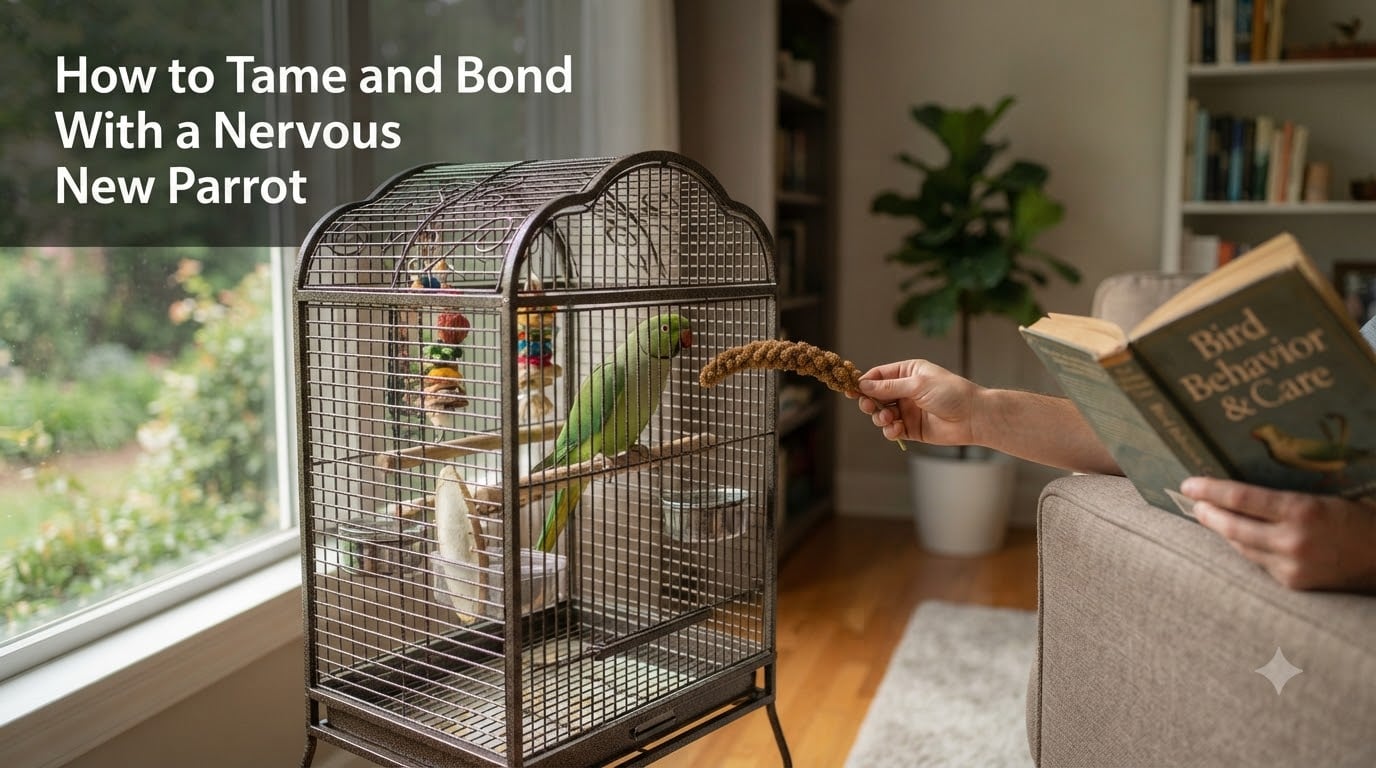
Taming and bonding with a nervous new parrot is the process of building trust through patient, consistent, and positive interactions that help your bird see you as safe and worth being around. It works by creating a history of small, rewarding experiences – calm voices, gentle movements, favorite treats – that slowly overwrite your parrot’s fear responses.
I have spent the last decade working with rehomed Amazons, scared cockatiels, and one very opinionated African Grey who arrived in a towel. Our team has helped dozens of first-time parrot owners move from “my bird lunges every time I walk by” to “my bird flies to my shoulder to say hi.”
This guide walks you through exactly what we do, in the exact order we do it. By the end, you will know how to read your parrot’s body language, what treats to use, when to push forward, and when to back off. We will also cover realistic timelines and what to do if your bird was rehomed or had a rough start.
Table of Contents
Understanding Why Parrots Get Nervous
Parrots are prey animals in the wild, which means their default setting is “that thing might eat me.” Every sudden movement, loud noise, or hovering hand gets processed through that lens. Your nervous new parrot is not being difficult – it is following millions of years of survival programming.
Common reasons a parrot shows fear when you bring it home include:
- Unfamiliar environment: new smells, sounds, cage position, and people all at once.
- Previous handling: rehomed parrots often come from homes where force was used or noise was constant.
- Lack of early socialization: birds hand-raised without exposure to different stimuli tend to be more reactive as adults.
- Trauma history: rescue parrots and birds from abusive situations may flinch at fast hands or eye contact.
- Species baseline: cockatiels and budgies tend to be shyer; conures and caiques tend to be bolder – but every bird is an individual.
Understanding the “why” behind the fear is the foundation. Once you see your parrot as a small creature deciding in real time whether you are safe, every training decision gets easier.
The Foundation: Patience and Trust
Trust is the only currency that matters with a nervous parrot. You cannot buy it with toys, speed it up with seed, or force it with a towel. It is earned one calm interaction at a time.
The most important rule I can give you is this: move at your parrot’s pace, not yours. If your bird backs away when you reach in the cage, you have moved too fast. If your bird leans in when you talk softly, you are on the right track.
Three pillars hold this work up:
- Consistency: handle your bird the same way, at the same times, with the same energy every day.
- Predictability: announce what you are about to do – “I’m going to change your water now” – so your bird is never surprised.
- Respect: if your parrot says no through body language, that no means no. Pushing past it resets your progress.
There is no shortcut. I have tried them all over the years. Slow is fast, and patient is the only speed that actually works.
Reading Your Parrot’s Body Language
Your parrot is talking constantly – you just need to learn the language. Reading body language is the single biggest difference between owners who bond quickly and those who spend months spinning their wheels.
Signs your parrot is relaxed and curious:
- Loose feathers, soft eye pinning (rapid dilating that slows down)
- Beak grinding when settling on a perch
- Preening in your presence, sometimes even with you nearby
- Head bobbing toward you, asking for attention
- One foot tucked up, body weight shifted low on the perch
Signs your parrot is stressed or scared:
- Crouched posture with feathers tight against the body
- Tail fanned and rigid, wings slightly raised in a “fright” position
- Eye pinning that’s rapid and intense
- Pinning eyes wide with a frozen body – this is the “I’m about to bite or bolt” signal
- Backing into a corner, climbing the cage walls, or panting with beak open
If you see stress signals, stop. Pull back, lower your energy, and give your bird space. Try again later at a calmer moment. This is the body language feedback loop that makes trust building possible.
Your First Day and First Week With a Nervous Parrot
The old advice was to leave your new parrot completely alone for three to seven days. I want to gently tell you to throw that advice out. Birds who are ignored in those first days often become cage-bound and more fearful, not less. You can be present without being pushy.
Here is the day-by-day rhythm our team uses with new nervous parrots:
- Day 1: Place the cage in a busy (not loud) family area. Sit nearby reading or scrolling your phone. Talk softly. Do not reach in.
- Day 2-3: Sit closer. Offer treats through the bars – a piece of millet spray works for almost every species.
- Day 4-5: Open the cage door and let your bird choose to come out on its own. Many won’t, and that is fine.
- Day 6-7: Try hand-feeding inside the cage, holding the treat still and waiting.
During this first week, also run desensitization drills in the background. Vacuum while your bird eats. Sweep nearby. Drop a book once. Your goal is to teach your parrot that household sounds are not threats, so they stop triggering panic later when your hand is involved.
Step-by-Step Taming Process
Once your bird is eating from your hand through the bars, you can begin the real work. Work through these steps in order, repeating each one until your bird is comfortable before moving on.
- Proximity: Sit arm’s length from the cage for 15-20 minutes, 3-4 times a day. Read or talk softly.
- Hand near cage: Rest your hand on the outside of the cage while you talk. Do not move it.
- Hand inside cage, far from bird: Place your hand on a perch your bird is not using. Stay still.
- Hand near bird: Move your hand one perch-width closer over several sessions. Never above the bird – that feels predatory.
- Treat offering: Hold a treat between your fingers at chest height. Wait. Most nervous birds will take a treat within 2-3 sessions.
- Step-up onto a perch: Offer a handheld perch or stick. Lure with a treat just past the perch so the bird has to step on to reach it.
- Step-up onto hand: Once the perch is easy, switch to a flat hand. Use the same treat positioning.
Each step might take a single session or several weeks. The exact timeline depends on your bird’s history, species, age, and how consistent you are.
Using Positive Reinforcement Effectively
Positive reinforcement means adding something your bird wants right after a behavior you want to see again. The “something” is called a reinforcer. Find the right reinforcer and your bird will volunteer for training sessions.
There are two flavors of reinforcement that matter here:
- Primary reinforcers: food, water, head scratches – things your bird needs or naturally loves.
- Secondary reinforcers: verbal praise, a clicker, a specific word – things your bird has learned to associate with good things.
Clicker training is a classic secondary reinforcer. The click is short, consistent, and always followed by a treat, so it becomes a powerful bridge between behavior and reward. If you have ever seen birds doing complex tricks on YouTube, clicker training is almost always the engine behind it.
Negative reinforcement (not punishment) can also play a role. It means removing something uncomfortable when your bird does the right thing. For example, if your bird tolerates your hand for 3 seconds, you remove your hand. You are taking the pressure off. Done correctly, it teaches your bird that calm behavior makes scary things go away.
Choosing the Best Treats for Training
Treat selection is half the battle. A nervous parrot who is offered a treat it does not care about will simply stay scared and empty-handed. Find the food your bird goes crazy for, and reserve it for training only – that creates high value instantly.
Treats that work across most parrot species:
- Millet spray: the gold standard for scared budgies, cockatiels, and most small parrots. Almost universally loved.
- Sunflower seeds: high-value for cockatiels, conures, and many Amazons. Limit quantities because of fat content.
- Cashews and almonds: prized by medium and large parrots. Great for African Greys, Eclectus, and macaws in small pieces.
- Pine nuts, pumpkin seeds, walnuts: excellent alternatives for variety so one treat does not lose appeal.
- Sugar snap peas or fresh corn: useful for birds that refuse seeds during training.
If your bird ignores the first treat you try, do not take it personally. Try another. Watch which food it runs to first when its dish is full – that is your high-value reinforcement.
Common Mistakes to Avoid
I have made most of these mistakes myself over the years, so I am not judging. Learn them, watch for them, and course-correct when you catch yourself doing them.
- Reaching from above: predator style. Always approach your bird at chest level or below.
- Staring: direct eye contact feels threatening. Soft eyes, slow blinks.
- Forcing step-up: pushing a hand into a bird’s belly breaks trust faster than almost anything else.
- Inconsistent handling: one family member’s patience undoes another family member’s pushiness.
- Skipping sessions: trust decays faster than it builds. Daily short sessions beat weekly long ones.
- Ignoring body language: if your bird is leaning away, you have lost this round. Pull back.
- Expecting fast results: the average nervous parrot takes 2-6 weeks to take treats from a hand. Some take months.
The biggest mistake of all is giving up. Birds do not stay scared forever. They also do not forgive rushed trust once it breaks. Patience is the entire job.
How Long Does It Take for a Parrot to Trust You?
There is no single answer, but here are realistic ranges based on species and history. These are averages from our work and from community reports – some birds beat these numbers, others take longer.
- Young hand-raised budgies and cockatiels: 1-4 weeks to take treats from a hand.
- Conures, quakers, and pionus: 2-6 weeks for first step-up.
- Greys, Amazons, and Eclectus: 1-6 months for consistent step-up and handling.
- Macaws and large cockatoos: 1-3 months minimum, often 6 months for full comfort.
- Rescue or rehomed parrots with trauma: 6-12 months is common. Some never become cuddly but can become comfortable companions.
Progress is rarely linear. Your parrot might be eating from your hand for weeks, then suddenly refuse for two days after a loud thunderstorm. That is normal. Stay consistent, soften your approach, and keep going.
Special Considerations for Rehomed and Traumatized Birds
Rehomed parrots carry their history with them. They may flinch at brooms, panic when hands rise quickly, or scream at specific sounds. These are learned fears and they can be unlearned, but the work goes slower and the stakes feel higher.
For these birds, shrink your milestones. Instead of “step up,” aim for “stays on perch while hand is within 6 inches.” Instead of “eats from hand,” aim for “eats within 12 inches of hand.” Celebrate smaller wins.
Also: never punish regression. If your parrot who was taking treats suddenly lunges, drop everything, back off, and observe. Something spooked them – maybe a smell, a piece of clothing, a gesture. Identify it and avoid it.
Traumatized birds often bond more deeply once they trust. The flip side is that trust takes longer to build. Plan for a marathon, not a sprint.
Frequently Asked Questions
How do I befriend a scared parrot?
To befriend a scared parrot, start by sitting near the cage without reaching in. Talk softly, move slowly, and offer high-value treats like millet spray through the bars. Let the bird set the pace and never force interaction. Most scared parrots begin to relax within 2-4 weeks of consistent, calm exposure.
How do I bond with a new parrot?
Bonding with a new parrot requires daily short sessions focused on positive reinforcement. Sit near the cage, hand-feed treats, read your bird’s body language, and progress from proximity to hand-feeding to step-up commands. Consistency and patience matter more than time spent. Most new parrots bond within 1-3 months of patient work.
How long does it take for a parrot to trust you?
Most parrots begin showing trust within 2-6 weeks of consistent work, though some species and individuals take much longer. Budgies and cockatiels may trust you in a few weeks, while rehomed Amazons, Greys, and cockatoos can take 6-12 months for full comfort. Traumatized or rescue parrots often need 6-12 months at minimum.
How do I bond with a traumatized parrot?
To bond with a traumatized parrot, shrink your training goals and progress in very small steps. Use highly valued treats, avoid known triggers, and never force handling. Allow the bird to set the pace, and work on being a calm, predictable presence before expecting physical interaction. Progress may be slow but is absolutely possible.
What are the best treats for training a nervous parrot?
The best treats for training a nervous parrot are usually millet spray, sunflower seeds, cashews, or pine nuts – whichever your specific bird runs to first. Whatever the bird ignores in a normal food dish is probably not high-value enough. Reserve training treats for sessions only to keep their value high.
Final Thoughts on Taming and Bonding With a Nervous New Parrot
Taming and bonding with a nervous new parrot is less about technique and more about who you choose to be every day: patient, predictable, and respectful. The hands-on work is simple – read body language, use high-value reinforcement, and progress through small steps. The hard part is showing up consistently for weeks or months without forcing the outcome.
If you keep at it, one morning your parrot will step up onto your hand without hesitation. That moment makes every quiet afternoon of just sitting nearby worth it. Trust is the only gift that actually counts with a parrot, and it is something only you can give.