
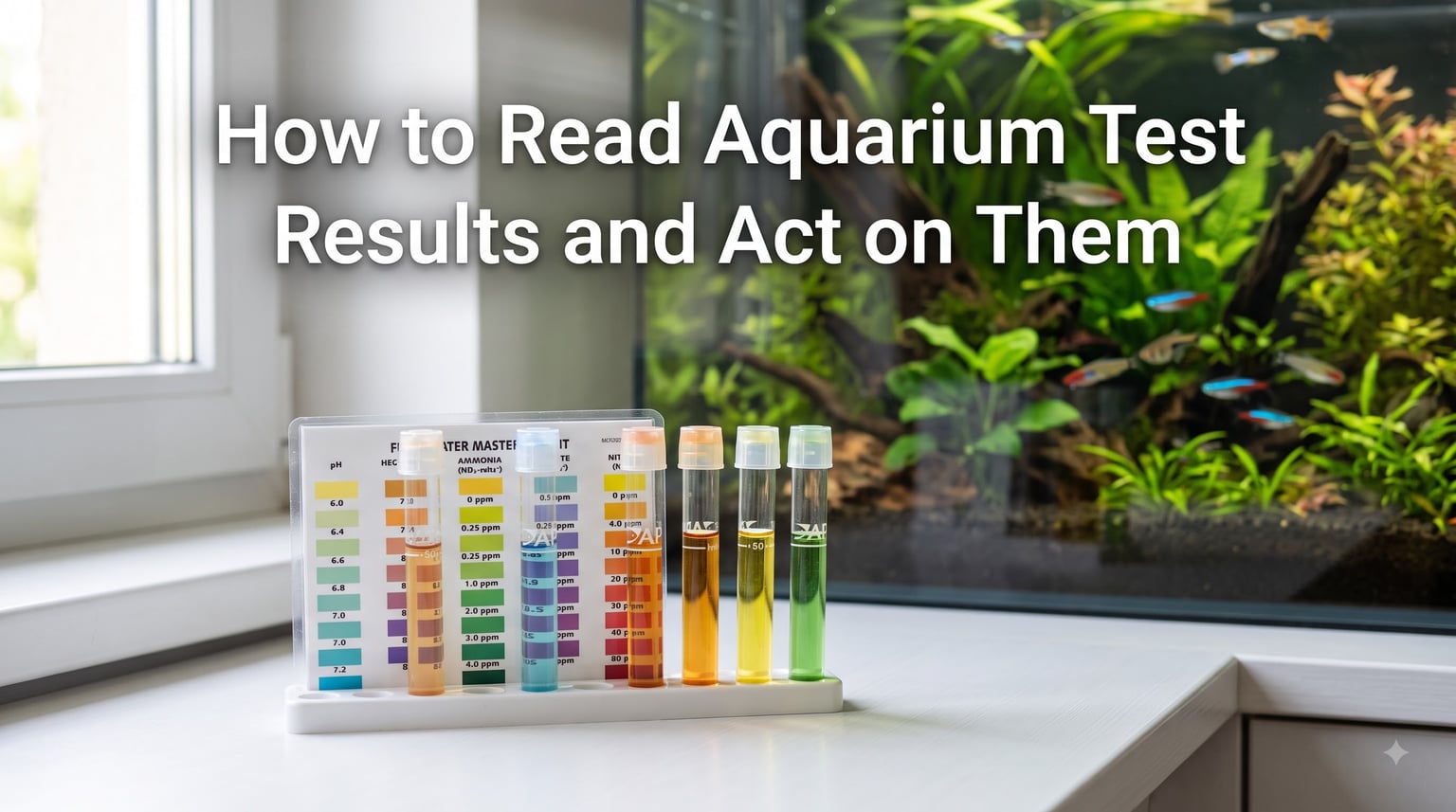
Walking past your aquarium, everything looks peaceful. Fish are swimming, plants are swaying, and the water looks crystal clear. But underneath that calm surface, invisible chemicals could be building up right now, silently threatening everything living in your tank.
That is exactly why learning how to read aquarium test results is the single most important skill in this hobby. Your fish cannot tell you when the water is toxic. By the time they gasp at the surface or clamp their fins, damage has already started. Water testing catches problems days before symptoms appear.
I learned this the hard way years ago when I lost a tank of beautiful cardinal tetras overnight. The water looked perfect. But I had never tested for ammonia, and the level had climbed to a lethal 2.0 ppm without any visible warning. That experience sent me on a mission to understand every number on a test kit and exactly what to do about each one.
This guide walks you through every parameter you need to track, what each reading means, and the specific actions to take when numbers fall outside safe ranges. Whether you are cycling a brand new tank or managing an established display, you will leave knowing exactly what your test results are telling you.
We will cover the nitrogen cycle from start to finish, break down pH, ammonia, nitrite, nitrate, KH, and GH in plain language, and give you an emergency action plan for when things go wrong. No chemistry degree required.
Table of Contents
Quick Reference: Ideal Aquarium Water Parameters
Here is the short answer to the question every new aquarist asks. These are the target ranges for a typical freshwater community aquarium.
If your test results fall within these ranges, your tank is in good shape. If any number is off, jump to the corresponding section below for specific actions.
Ammonia (NH3/NH4+): 0 ppm (zero, always)
Nitrite (NO2-): 0 ppm (zero, always)
Nitrate (NO3-): 20 to 40 ppm or below (lower is better)
pH: 6.5 to 7.8 for most community fish (stability matters more than the exact number)
KH (Carbonate Hardness): 4 to 8 dKH (50 to 100 ppm)
GH (General Hardness): 4 to 12 dGH (70 to 200 ppm), species-dependent
Temperature: 74 to 80 degrees Fahrenheit (varies by species)
Print this list, screenshot it, or tape it to the wall above your tank. These six numbers form the foundation of every healthy aquarium.
Understanding the Nitrogen Cycle in Your Aquarium
Every aquarium is a tiny ecosystem, and the nitrogen cycle is its engine. Understanding this cycle is the key to making sense of your test results.
It starts with fish. Fish produce waste, uneaten food decays, and dead plant matter breaks down. All of this organic material releases ammonia into the water. Ammonia is extremely toxic, even in tiny concentrations. At levels as low as 0.25 ppm, it begins damaging fish gills and internal organs.
Fortunately, naturally occurring beneficial bacteria called Nitrosomonas colonize your filter media, gravel, and decorations. These bacteria consume ammonia and convert it into nitrite. The problem is that nitrite is also highly toxic, preventing fish blood from carrying oxygen effectively.
A second group of bacteria called Nitrobacter then converts nitrite into nitrate. Nitrate is far less toxic than ammonia or nitrite, but it still builds up over time and causes problems at high levels. This is why regular water changes are non-negotiable. They dilute accumulated nitrate.
In a fully cycled, established aquarium, your test results should always read zero ammonia and zero nitrite, with nitrate climbing slowly between water changes. If you are seeing ammonia or nitrite in an established tank, something has disrupted your bacterial colony. Possible causes include over-cleaning the filter, adding too many fish at once, a medication that killed beneficial bacteria, or a dead fish decomposing unnoticed.
What Is New Tank Syndrome?
New tank syndrome occurs when fish are added to an aquarium before the nitrogen cycle is established. Without enough beneficial bacteria to process ammonia, levels spike rapidly and kill fish. This is the number one reason new hobbyists fail.
A fishless cycle takes 4 to 8 weeks. During this time, you add a pure ammonia source and test daily, watching ammonia rise, then nitrite spike, then both drop to zero as nitrate appears. Only when your test reads 0 ppm ammonia and 0 ppm nitrite consistently should you add fish.
If you already have fish in an uncycled tank, test every single day and be prepared to do partial water changes frequently. You are doing a fish-in cycle, which is stressful but survivable with constant monitoring.
How to Read Aquarium Test Results: pH Levels
pH measures how acidic or alkaline your water is on a scale from 0 to 14. A reading of 7.0 is neutral. Below 7.0 is acidic, and above 7.0 is alkaline or basic.
Most community freshwater fish thrive in a pH between 6.5 and 7.8. Livebearers like guppies, mollies, and platies prefer slightly alkaline water around 7.0 to 8.0. Tetras, rasboras, and discus prefer slightly acidic water around 6.0 to 6.8. African cichlids from rift lakes need harder, more alkaline water at 7.8 to 8.6.
Is 7.8 pH Too High for an Aquarium?
No, 7.8 pH is not too high for most community aquariums. Many tap water supplies naturally run between 7.4 and 8.2. As long as the pH is stable and your fish are eating, swimming normally, and showing bright colors, 7.8 is perfectly fine for the vast majority of common community species.
The biggest mistake beginners make is chasing a perfect pH number. I have seen aquarists dump pH-lowering chemicals into their tanks repeatedly, sending fish into shock from rapid fluctuations. Fish adapt to a wide range of pH values. What they cannot handle is sudden change. A stable 7.8 is always better than a swinging pH that bounces between 6.8 and 7.5 every other day.
If you want to lower pH naturally for species like tetras or discus, use driftwood, peat moss in the filter, or Indian almond leaves. These release tannins gently and gradually. To raise pH and hardness for African cichlids, crushed coral in the filter or substrate works reliably over time.
What Causes pH Crashes?
A pH crash happens when the carbonate hardness (KH) in your water drops too low. Without enough buffering capacity, natural acid production from fish waste and decaying matter overwhelms the water and pH drops suddenly, sometimes falling below 6.0 overnight. This is why testing KH is just as important as testing pH itself.
Ammonia Test Results: The Most Dangerous Reading
Ammonia is the most toxic compound in your aquarium. It should always read zero on your test kit. Any detectable ammonia means something is wrong and needs immediate attention.
What makes ammonia especially dangerous is that it becomes more toxic at higher pH and higher temperatures. At a pH of 6.0 and temperature of 68 degrees, a total ammonia reading of 1.0 ppm might be relatively harmless because most of it exists as ammonium (NH4+), which is far less toxic. But at a pH of 8.0 and temperature of 80 degrees, that same 1.0 ppm reading is lethal because a much larger fraction exists as free ammonia (NH3).
Most liquid test kits measure total ammonia nitrogen (TAN), which includes both forms. This is why you must know your pH when interpreting an ammonia reading. High pH plus any ammonia equals a true emergency.
Can Fish Survive 0.25 Ammonia?
Fish can survive a 0.25 ppm ammonia reading in the short term, especially if your pH is below 7.0 and your water is on the cooler side. However, 0.25 ppm is still causing low-level gill irritation and stress. It weakens the immune system over time and opens the door to disease. You should treat any ammonia reading above zero as a warning sign.
For a reading of 0.25 ppm, do a 25 percent water change immediately and test again the next day. If ammonia persists, do another water change and investigate the cause. Overfeeding, an overcrowded tank, a dead snail hidden in the gravel, or a disrupted filter are the usual suspects.
Immediate Actions for Any Ammonia Reading Above Zero
Do a partial water change of 25 to 50 percent immediately with temperature-matched, dechlorinated water.
Add a liquid ammonia detoxifier like Seachem Prime or API Ammo-Lock to temporarily bind the ammonia.
Stop feeding for 24 hours to reduce waste input.
Check for dead organisms hidden in the tank or filter.
Test again in 24 hours and repeat the water change if needed.
Nitrite Test Results: The Silent Killer
Nitrite is the second stage of the nitrogen cycle, and it is nearly as dangerous as ammonia. Your test should always read 0 ppm. Any detectable nitrite means your biological filter is not fully processing waste.
Nitrite enters fish through their gills and binds to hemoglobin in their blood, forming methemoglobin. This prevents the blood from carrying oxygen. Fish essentially suffocate from the inside, even in well-oxygenated water. The condition is called brown blood disease because affected fish blood turns a chocolate-brown color. Symptoms include rapid gill movement, gasping at the surface, lethargy, and fish hanging near water flow from filters or air stones.
What makes nitrite especially dangerous is that it can spike rapidly in a tank that previously tested fine. A single overfeeding event, a dead fish, or washing filter media under tap water can crash the nitrite-processing bacteria overnight.
The Salt Trick for Nitrite Poisoning
If your nitrite test reads above 0, adding aquarium salt at a dose of 1 teaspoon per 10 gallons provides immediate relief. The chloride ion competes with nitrite for uptake through fish gills, effectively blocking nitrite absorption. This buys you time while water changes and bacteria restoration bring nitrite back to zero.
Note that salt is not safe for all plants and invertebrates. Scaleless fish like loaches and some catfish are also sensitive. Research your specific livestock before dosing salt.
Nitrate Levels: Managing the End Product
Nitrate is the final product of the nitrogen cycle, and unlike ammonia and nitrite, it is relatively harmless at low levels. But that does not mean you can ignore it.
For most freshwater community tanks, aim to keep nitrate below 20 ppm. Levels between 20 and 40 ppm are acceptable for hardy species but should be reduced through water changes. Anything above 40 ppm stresses fish, weakens immune function, promotes algae growth, and contributes to stunted growth in young fish. Some sensitive species like discus and certain shrimp need nitrate below 10 ppm.
If your nitrate test reads high, the fix is straightforward. Do a water change of 30 to 50 percent, then test again a few hours later. If nitrate is still above 40 ppm, do another water change the next day rather than replacing all the water at once, which can shock fish.
Why Your Nitrate Keeps Climbing
A common frustration I hear from aquarists is that nitrate keeps rising even with regular water changes. There are several reasons this happens.
Overfeeding is the most common cause. Food you put in the tank becomes ammonia, which becomes nitrite, which becomes nitrate. Less food means less nitrate. Feed only what fish can consume in 30 to 60 seconds.
Overstocking is another factor. More fish means more waste. If you have a 10-gallon tank with 15 fish, your bacteria colony simply cannot keep up with the nitrate production, and no amount of water changes will permanently solve it.
Live plants are a natural nitrate filter. Fast-growing plants like hornwort, water wisteria, pothos roots hanging in the water, and floating plants like duckweed and salvinia absorb nitrate directly. Adding more plants is one of the most effective long-term nitrate management strategies.
KH (Carbonate Hardness): Your pH Buffer
KH, also called carbonate hardness or alkalinity, measures the amount of carbonate and bicarbonate ions dissolved in your water. These compounds act as a buffer, absorbing acids before they can change your pH.
Think of KH as a shield around your pH reading. When KH is high, your pH stays stable because the carbonates neutralize acids produced by fish waste, decaying matter, and bacterial activity. When KH is low, that shield is thin. Acids overwhelm the buffer, and your pH can crash overnight from a stable 7.4 down to 5.5 or lower. That kind of swing kills fish.
The ideal KH range for most freshwater aquariums is 4 to 8 dKH (approximately 50 to 150 ppm). Below 2 dKH is dangerous territory where pH crashes become likely. If your test shows low KH, you can raise it by adding crushed coral to the filter, using baking soda (sodium bicarbonate) at 1 teaspoon per 20 gallons, or doing water changes with higher-KH tap water.
I always recommend testing KH alongside pH. They are connected parameters. If your KH is healthy, your pH will naturally stay stable. If your KH is low, pH instability is guaranteed sooner or later.
How to Raise KH Safely
Crushed coral in a mesh bag inside your filter is the easiest long-term solution. It dissolves slowly, raising both KH and GH over weeks. This gives you set-and-forget buffering. For a faster fix, dissolve pure baking soda (sodium bicarbonate with no additives) in tank water and add slowly over an hour. One teaspoon per 20 gallons raises KH by roughly 2 to 3 degrees.
Never raise KH by more than 2 degrees in a single day. Rapid changes in water chemistry stress fish, even when the change is in the right direction.
GH (General Hardness): Minerals Your Fish Need
GH measures the total amount of dissolved calcium and magnesium in your water. These minerals are essential for fish bone development, scale formation, nerve function, and a process called osmoregulation, which is how fish balance fluids inside their bodies against the water outside.
Without adequate minerals, fish struggle to maintain their internal water balance. Soft water species like tetras and discus evolved in mineral-poor environments and thrive at 1 to 4 dGH. Hard water species like livebearers, goldfish, and African cichlids need 8 to 12 dGH or higher. Most community fish do well in the middle range of 4 to 8 dGH.
Test strips often measure GH and KH together as a combined hardness reading. For more precision, a liquid GH test kit gives you a number in degrees of general hardness (dGH) or parts per million (ppm). To convert, 1 dGH equals approximately 17.8 ppm.
If your tap water is very soft and you keep hard-water species, GH can be raised using mineral supplements like Seachem Equilibrium, crushed coral, or wonder shells. If your water is very hard and you need softer water for species like discus, mixing tap water with reverse osmosis (RO) water is the most reliable approach.
Matching GH to your fish species matters more than hitting a universal number. Research where your fish come from in the wild and aim for water that approximates their natural environment.
How to Read Test Kit Color Charts Accurately
One of the biggest pain points aquarists share on forums is the difficulty of matching test tube colors to printed color charts. The difference between 0.25 ppm and 0.5 ppm ammonia is subtle. The line between 10 ppm and 20 ppm nitrate can look identical under the wrong lighting.
Here is the step-by-step method I use to get accurate readings every single time.
Step 1: Use Natural Daylight
Test your water during daylight hours near a window. Natural daylight provides the most accurate color rendering. Incandescent bulbs cast a yellow tint that makes every reading look warmer. LED lights with cool color temperatures make readings appear bluer than they are.
If you must test at night, use a daylight-spectrum LED bulb rated at 5000K to 6500K. Avoid warm white household bulbs at all costs.
Step 2: Hold the Tube Against White Paper
Place a sheet of plain white paper on a flat surface. Hold the test tube against the white background and place the color chart next to it. The white background eliminates color interference from your surroundings and gives you a clean baseline for comparison.
Step 3: Look Down Through the Tube
For the most accurate color matching, look down through the test tube from the top rather than through the side. The depth of liquid gives you a richer, more saturated color that is easier to match. Side-by-side comparison works too, but top-down viewing is the gold standard recommended by experienced aquarists.
Step 4: Read Within the Recommended Time Window
Every test kit specifies how long to wait before reading. API liquid tests typically require 5 minutes for most parameters. Test strips usually need 30 to 60 seconds. Reading too early means the color has not fully developed. Reading too late means the color starts to fade or shift, giving you a false reading.
Set a timer the moment you add the reagent drops. This is not optional for accuracy.
Step 5: The Nitrate Daylight Tip
Nitrate is the hardest parameter to read accurately because the color range goes from pale yellow to deep orange-red. A nitrate reading of 5 ppm looks almost identical to 0 ppm under artificial light. Many aquarists panic thinking their tank has zero nitrate when it actually reads 5 to 10 ppm, or worse, they miss a reading of 40 ppm thinking it looks like 20.
Always read nitrate in natural daylight. Hold the tube against white paper. If you see any hint of orange compared to the pale yellow zero reference, you have detectable nitrate. The stronger the orange tint, the higher the concentration.
Test Strips vs. Liquid Test Kits
Test strips are fast, cheap, and convenient. Dip, wait 30 seconds, compare to the chart. They are excellent for quick weekly check-ins on established tanks. However, they are less precise and can give inconsistent readings if the strips absorb moisture over time.
Liquid test kits like the API Freshwater Master Test Kit take more time and effort but provide significantly more accurate readings. Each parameter is measured individually by adding specific reagent drops to a water sample. For new tanks, sick fish, or any situation where precision matters, liquid kits are the right choice.
My recommendation: use test strips for routine weekly monitoring on stable tanks, and keep a liquid kit on hand for cycling, troubleshooting, and emergencies.
When to Test Your Aquarium Water
Testing frequency depends on the age and stability of your tank. Here are the guidelines I follow and recommend.
New Tanks (First 6 to 8 Weeks During Cycling)
Test daily. You are tracking the nitrogen cycle as it establishes. Watch ammonia rise first, then nitrite spike (often higher than ammonia), then both drop to zero as nitrate appears. Once you read 0 ammonia, 0 nitrite, and some nitrate for three consecutive days, your tank is cycled and ready for fish.
Recently Stocked or Changed Tanks
Test every 2 to 3 days for the first two weeks after adding new fish, changing filter media, or rearranging the tank. Any disruption can affect the bacterial colony, and you want to catch ammonia or nitrite spikes early.
Established, Stable Tanks
Test once a week. Check nitrate to determine water change frequency, and spot-check pH and KH to catch any gradual drift. If parameters stay consistent for months, you can reduce to every two weeks, but never stop testing entirely.
Sick Fish or Unexplained Deaths
Test immediately. Ammonia and nitrite are the first suspects when fish behave abnormally or die without obvious cause. Check pH and temperature too. Rapid parameter shifts are the most common cause of sudden fish loss.
After Medication Treatments
Many medications harm beneficial bacteria. Test daily for a week after any treatment to catch ammonia or nitrite spikes caused by bacterial die-off. Be prepared for extra water changes during recovery.
Emergency Action Steps for Ammonia and Nitrite Spikes
When your test shows ammonia above 0.5 ppm or nitrite above 0.5 ppm, you are in an emergency situation. Fish are being actively damaged. Follow this protocol immediately.
Step 1: Immediate Water Change
Do a 50 percent water change right now. Use water that is within 2 degrees of your tank temperature and has been treated with dechlorinator. This instantly cuts the toxin concentration in half. For extreme readings above 2.0 ppm, do back-to-back 50 percent changes, refilling and re-draining, to achieve a 75 percent total reduction.
Step 2: Add a Chemical Detoxifier
Dose the tank with Seachem Prime or API Ammo-Lock according to the package instructions. Prime binds ammonia into a non-toxic form for 24 to 48 hours, protecting your fish while the biological filter recovers. Redose every 48 hours until tests read zero.
Step 3: Stop Feeding
Fast your fish for 24 to 48 hours. Fish can easily go several days without food. Every flake you add becomes ammonia. Reducing input gives your bacteria a chance to catch up.
Step 4: Increase Aeration
Ammonia and nitrite both damage gills, reducing oxygen absorption. Add an air stone, increase filter flow, or lower the water level slightly so the filter output creates surface agitation. Extra oxygen helps fish cope with toxin stress.
Step 5: Investigate the Root Cause
Once fish are stable, find out why the spike happened. Did you add too many fish at once? Did you wash filter media in tap water, killing bacteria with chlorine? Is there an overfeeding issue? Did a fish die and decompose unseen? Fixing the root cause prevents the spike from repeating next week.
Step 6: Consider a Bacterial Supplement
Products like Tetra SafeStart, API Quick Start, or FritzZyme 7 contain live beneficial bacteria that can jump-start your biological filter. They are not instant cures, but they can shave days off the recovery time in a crisis. Add them after the water change, not before, since you do not want to drain out what you just added.
Common Aquarium Testing Mistakes to Avoid
After years of helping beginners on forums, the same mistakes come up again and again. Here are the ones I see most frequently.
Testing right after a water change. Wait at least 2 to 4 hours after a water change before testing. The fresh water needs time to circulate and equilibrate. Testing immediately gives readings that do not represent your tank’s actual conditions.
Not shaking nitrate bottles. The API nitrate test requires Bottle 2 to be shaken vigorously for 30 seconds before adding. If you skip this step, the reagent separates and gives false low readings. You might think your nitrate is fine when it is actually dangerous.
Using expired test kits. Liquid reagents degrade over time. A kit that is 2 or 3 years old will give inaccurate readings. Check the expiration date on every bottle and replace kits annually if you test frequently.
Dipping test strips too long or not long enough. Follow the timing instructions exactly. One second too long in the water changes the reading. Keep a stopwatch handy.
Not testing the source water. Sometimes the problem is not your tank but your tap water. Test your tap water for ammonia, nitrate, pH, and KH before assuming your tank is the issue. Some municipal water supplies contain trace ammonia or nitrate directly from the tap.
Ignoring small readings. A 0.25 ppm ammonia reading is not something to dismiss. It is a warning that something is off. Address it early before it becomes a 2.0 ppm crisis.
Not keeping a log. Write down your test results in a notebook, spreadsheet, or phone app. Tracking trends over weeks and months reveals patterns you would never notice from individual readings. A gradual pH decline over 3 months tells you your KH is being consumed. Individual readings cannot show that.
Frequently Asked Questions
What should my aquarium water test results be?
For a healthy freshwater community aquarium, your test results should read: ammonia 0 ppm, nitrite 0 ppm, nitrate below 20 to 40 ppm, pH between 6.5 and 7.8, KH between 4 and 8 dKH, and GH between 4 and 12 dGH. Zero ammonia and zero nitrite are non-negotiable. Any reading above zero for either requires immediate action.
What should my aquarium test strips read?
A properly cycled aquarium test strip should show ammonia at 0, nitrite at 0, nitrate at 20 ppm or below, pH in your target species range (typically 6.5 to 7.8), KH at 4 to 8 dKH, and GH at 4 to 12 dGH depending on your fish. If ammonia or nitrite shows any color change from the zero baseline, your tank needs attention.
Is 7.8 pH too high for an aquarium?
No, 7.8 pH is not too high for most community aquariums. Many tap water supplies naturally fall between 7.4 and 8.2. Fish adapt to stable pH levels within a wide range. As long as the pH is consistent and your fish are eating and behaving normally, 7.8 is perfectly fine for guppies, mollies, platies, bettas, and most common species.
How do I read my water test results?
Fill a test tube with tank water, add the specified reagent drops, shake or invert as directed, wait the recommended time (usually 5 minutes for liquid kits, 30 to 60 seconds for strips), then compare the resulting color against the chart in natural daylight. Hold the tube against white paper for the most accurate match, and view from top-down through the liquid.
How long will new tank syndrome last?
New tank syndrome typically lasts 4 to 8 weeks. During this period, ammonia and nitrite spike as beneficial bacteria colonies establish in your filter. Test daily, do partial water changes when ammonia or nitrite exceed 0.25 ppm, and avoid adding too many fish at once. Once tests consistently read 0 ammonia and 0 nitrite, the tank is cycled.
Can fish survive 0.25 ammonia?
Fish can survive 0.25 ppm ammonia short-term, especially at lower pH and cooler temperatures where most ammonia exists in the less toxic ammonium form. However, even 0.25 ppm causes gill irritation and immune stress over time. Do a 25 percent water change immediately, reduce feeding, and test again in 24 hours to confirm the level is dropping.
Conclusion
Learning how to read aquarium test results is not optional in this hobby. It is the difference between fish that thrive for years and fish that mysteriously disappear after a few weeks. The six parameters we covered, ammonia, nitrite, nitrate, pH, KH, and GH, tell you everything happening inside your tank that you cannot see.
Remember the core principles. Zero ammonia and zero nitrite are the rules, not goals. Nitrate should stay manageable through regular water changes. pH stability always matters more than hitting a perfect number. KH protects your pH from crashing. GH provides the minerals your fish need for healthy bodies.
Start a testing log today. Write down every result with the date. Over time, those numbers will reveal patterns that make you a better aquarist than any book or video ever could. Your fish are counting on you to be their water quality watchdog, and now you have the tools to do exactly that.