
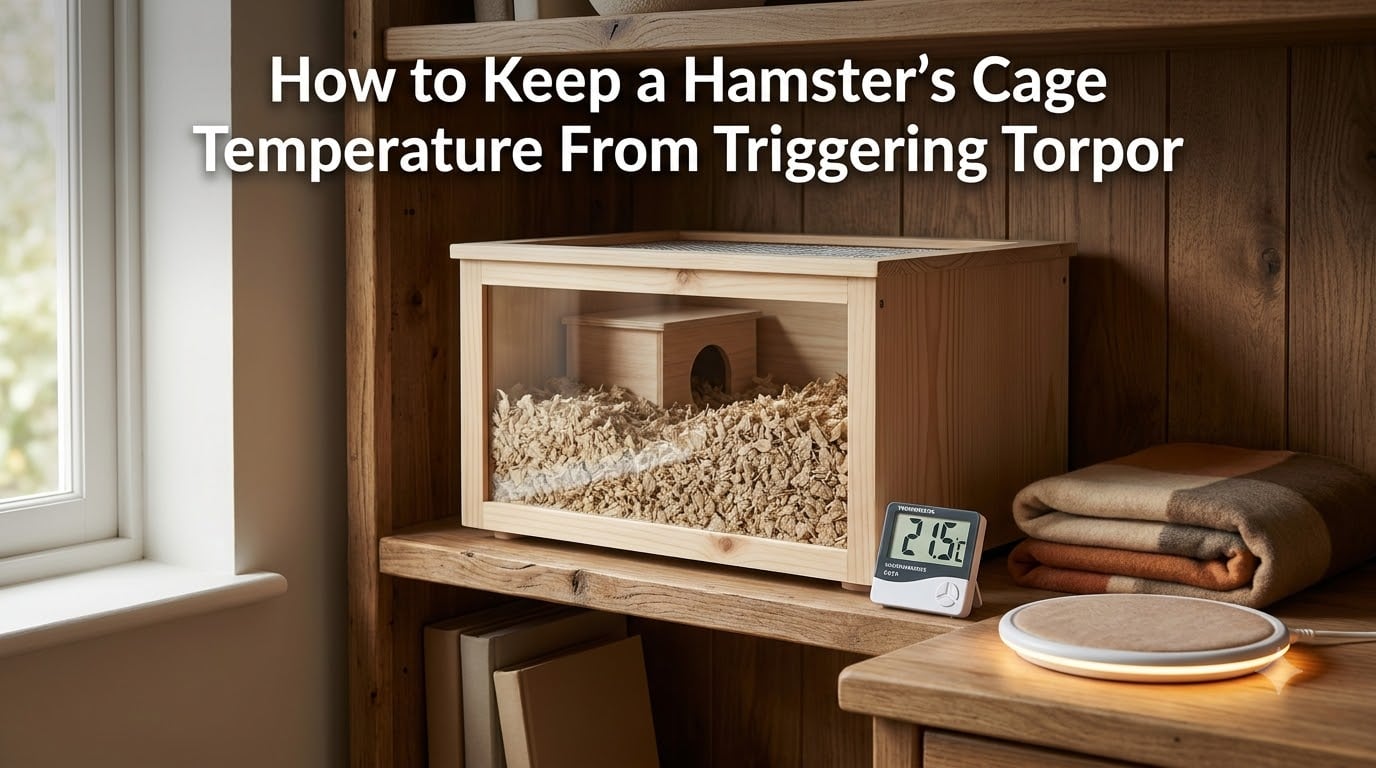
Three winters ago, I nearly lost my Syrian hamster, Biscuit, after the heating in my apartment failed overnight. I found him curled tight, cold to the touch, and barely breathing. He had entered a dangerous state called torpor, and the experience taught me that hamster cage temperature is not a minor detail — it can be the difference between life and death.
This guide walks through everything I learned the hard way about how to keep a hamster’s cage temperature from triggering torpor. You will find the exact safe temperature range, warning signs to watch for, step-by-step prevention methods, and a careful emergency warming protocol backed by veterinary guidance.
Whether you live in a drafty flat, keep hamsters in a converted shed, or simply want a winter survival plan for a power outage, the advice here applies. Let us start with the basics of what torpor actually is, because understanding the biology makes prevention far easier.
Table of Contents
What Is Torpor and Why It Is Dangerous for Hamsters?
Torpor is a state of low body temperature and low metabolic rate that hamsters can enter when exposed to cold for too long. It looks like hibernation, but for domestic hamsters it is not a safe winter survival strategy — it is an involuntary crisis that can kill within hours.
The confusion between torpor and hibernation causes most owners to underestimate the danger. Wild hamsters evolved to survive cold seasons through controlled torpor cycles. Pet hamsters, bred indoors for generations, have largely lost the ability to safely enter and exit that state.
Torpor vs Hibernation: The Key Difference
Hibernation is a planned, seasonal survival strategy where an animal slowly lowers its metabolism and survives on stored fat reserves over weeks or months. Torpor in domestic hamsters is an emergency response triggered suddenly when the environment gets too cold.
Wild hamsters cycle in and out of torpor on a daily or weekly rhythm, rousing to drink and adjust. Pet hamsters drop into torpor and often cannot rouse themselves at all. Their bodies are not prepared, their fat stores are insufficient, and without help they simply do not wake up.
Which Hamsters Are Most at Risk
Syrian hamsters are the most commonly affected species, and their larger body mass means the consequences of torpor are often fatal. Dwarf hamsters — including Winter Whites, Campbell’s, and Roborovskis — can also enter torpor, though some owners report slightly better survival odds.
Older hamsters, hamsters that are underweight, and hamsters with underlying illness are all at higher risk. A healthy young Syrian in a warm room is far less likely to slip into torpor than an elderly hamster housed near a drafty window.
Why Torpor Is Life-Threatening
When a hamster enters torpor, its body temperature can drop to match the surrounding air, sometimes falling below 50°F (10°C). The heart rate slows dramatically, breathing becomes shallow, and blood sugar crashes to dangerous lows — a state called hypoglycemia.
If the hamster cannot rouse itself, organ damage begins. The longer torpor lasts, the harder safe recovery becomes, because warming a torpid hamster too quickly can cause shock, cardiac failure, or aspiration of fluids.
At What Cage Temperature Does Hamster Torpor Start
Hamsters typically begin entering torpor when cage temperatures fall below 60°F (15°C) for any extended period. The risk rises sharply as the temperature drops further, and most experts consider anything below 50°F (10°C) a life-threatening emergency.
The safe range for hamster cage temperature sits firmly between 65°F and 75°F (18°C to 24°C). Within this band, a hamster’s metabolism stays stable, digestion works normally, and the risk of torpor is very low.
The Safe, Caution, and Danger Zones
Safe zone: 65°F to 75°F (18°C to 24°C). This is where you want the cage to sit year-round. Aim for the middle of the range, around 70°F (21°C), to leave a buffer on both sides.
Caution zone: 60°F to 65°F (15°C to 18°C). The hamster is not yet in torpor, but you are approaching the danger line. Move the cage to a warmer spot, add insulation, and monitor closely for early warning signs.
Danger zone: below 60°F (15°C). Torpor is likely or imminent. Take immediate action to raise the temperature, and check the hamster every couple of hours through the night.
Sudden Drops Are Worse Than Slow Declines
A fast temperature drop — such as a heating failure overnight or a window left open during a cold snap — triggers torpor far faster than a slow seasonal cooling. The hamster’s body has no time to acclimate, so even a hamster housed in a normally warm room can slip into torpor in a single cold night.
This is why I now keep a cheap room thermometer next to Biscuit’s cage and check it before bed. The five-second routine has caught two near-misses I would otherwise have missed.
Warning Signs Your Hamster Is Entering Torpor
Catching torpor early dramatically improves survival odds, but the early signs are subtle and easy to mistake for normal sleep. Knowing the difference between a deep sleep, illness, and true torpor is one of the most useful skills a hamster owner can develop.
Early Behavioral Changes
The first sign is often a hamster that seems sleepier than usual, especially during times when it would normally be active. You may notice it eating less, hoarding less, or staying curled tightly in its hideout even at night.
Cool paws, a cool nose, and reluctance to move when gently disturbed are red flags. A healthy hamster roused from sleep will usually stretch, blink, and start to move within seconds. A hamster sliding toward torpor may barely respond.
Physical Symptoms of Established Torpor
Once torpor sets in, the hamster feels cold to the touch, particularly on the back, belly, and ears. Breathing becomes very slow and shallow — sometimes only a few breaths per minute. The body may feel stiff, and the hamster might appear lifeless.
Whiskers may stop twitching, and the eyes often stay closed. In deep torpor, the hamster may not respond at all to gentle handling, which is exactly why so many owners mistakenly believe their hamster has died.
Torpor vs Death: How to Tell the Difference
This is one of the most common panic moments described on hamster forums, and the difference matters enormously. A torpid hamster is still alive and may be savable. A dead hamster obviously is not, but assuming torpor is death leads owners to give up on hamsters that could have been rescued.
Look closely at the chest for slow, faint breathing. Hold a small mirror near the nose and watch for condensation. Gently pinch a paw — a torpid hamster may show a tiny reflex movement, while rigor mortis indicates death.
If there is any doubt, treat the hamster as if it is in torpor and begin gradual warming immediately. There is no harm in trying to warm a hamster that has already passed, but there is enormous harm in giving up too soon on one that is still alive.
How to Prevent Torpor by Controlling Cage Temperature
Prevention is always easier and safer than emergency response. The goal is simple: keep the cage within the safe temperature range consistently, and have backup plans ready for cold nights, heating failures, and power outages.
Step 1: Choose the Right Room and Cage Location
Where you place the cage matters more than most people realise. Avoid exterior walls, drafty windows, outside doors, and uninsulated floors. An interior wall in a regularly heated room is almost always the best spot.
Keep the cage off the ground — floor temperatures can be 5°F to 10°F (3°C to 6°C) colder than the air at standing height. A sturdy table or shelf works well, as long as it is away from direct draughts and not directly under a heating vent that blasts hot air intermittently.
Nobody should place a hamster cage in a shed, garage, conservatory, or unheated utility room during cold months. These spaces drop below the danger line quickly at night, even when daytime temperatures feel reasonable.
Step 2: Monitor Temperature Consistently
You cannot manage what you do not measure. A basic digital room thermometer placed near the cage, at the same height, costs only a few dollars and removes all guesswork.
Check the temperature at least twice a day — once in the morning and once before bed. The before-bed check is the most important, because overnight is when most torpor cases occur. If the reading dips below 65°F (18°C), take action that evening rather than waiting until morning.
Step 3: Add Safe Cage Heating
The most reliable heating option is a heat mat designed for small animals, placed under one third of the cage — never the whole floor, so the hamster can move away if it gets too warm. Always use a thermostat with any electrical heat mat to prevent overheating.
Microwaveable heating pads, such as the Snugglesafe pad, are an excellent non-electrical option, especially for backup use during power cuts. They hold heat for several hours and can be tucked under a layer of bedding inside a fleece pouch.
Avoid heat lamps, ceramic heat emitters aimed directly at the cage, and hairdryers. Direct radiant heat can overheat one side of the hamster while leaving the other cold, and forced hot air is too drying and too aggressive for safe warming.
Step 4: Improve Cage Insulation
Thick, deep bedding is one of the simplest and most effective insulation methods. Aim for at least 6 to 8 inches (15 to 20 cm) of paper-based or aspen bedding, which lets the hamster burrow and hold its own body heat.
Provide a cosy hideout — a wooden house or enclosed ceramic hide lined with torn tissue paper or fleece strips. Hamsters build nests to trap warmth, so the materials you provide directly affect how well they can self-regulate.
Avoid ceramic and metal hideouts in cold weather. They draw heat away from the hamster and can chill a sleeping animal quickly. Swap to wood, plastic, or fabric-based shelters for the winter months.
Emergency Response: How to Warm a Torpid Hamster Safely
If you find a hamster that appears to be in torpor, stay calm and act deliberately. The single most important rule is to warm the hamster gradually. Rapid warming causes shock, organ damage, and often death — and it is the most common mistake panicked owners make.
Step-by-Step Gradual Warming Protocol
Step 1: Move the hamster’s cage or carrier to a warm room — around 70°F to 75°F (21°C to 24°C). Do not place the hamster directly next to a heater or fire.
Step 2: Hold the hamster against your skin, ideally cupped in both hands against your chest or under your shirt. Your body heat provides a slow, gentle warming source that is exactly what a torpid hamster needs.
Step 3: Wrap the hamster loosely in a warm — not hot — towel or fleece that has been briefly heated in a tumble dryer or against a radiator. A hot water bottle wrapped in a towel can be placed nearby, never directly against the hamster.
Step 4: Continue gentle warming for 30 to 60 minutes. The hamster should slowly begin to stir, twitch its whiskers, and attempt to move as its body temperature rises.
Step 5: Once the hamster is responsive and trying to stand, offer a tiny smear of honey or glucose gel on the gums to counteract hypoglycemia. Do not give liquids to a hamster that is not fully alert.
The Aspiration Risk Every Owner Should Know
One of the most heartbreaking warnings I have read on hamster forums comes from an owner whose hamster died after inhaling sugar water during recovery. Giving fluids to a hamster that is not fully conscious — even one that appears to be improving — can cause aspiration, where liquid enters the lungs.
Only offer food or liquids once the hamster is alert, standing, and able to swallow on its own. Even then, use a tiny amount on the gums or a fingertip rather than a syringe, and watch carefully for coughing or distress.
When to Contact a Vet
If the hamster does not begin to respond after an hour of gradual warming, or if it shows signs of breathing difficulty, blue-tinged extremities, or seizures, contact an exotic pet vet immediately. Torpor lasting more than a few hours often needs professional intervention, including warmed intravenous fluids and oxygen support.
For owners in rural areas where weekend or out-of-hours vet care is unavailable, it is worth researching emergency clinics in advance and keeping their number posted near the cage. Minutes matter during a torpor crisis.
Seasonal Preparation Checklist for Hamster Owners
The best time to prepare for cold weather is before it arrives. Use this checklist each autumn to make sure your hamster setup is ready for the colder months.
Replace thin summer bedding with deep, insulating paper or aspen bedding. Add a wooden or fabric hideout if you have been using ceramic ones. Buy or locate a microwaveable heating pad as a backup for power cuts, and place a digital thermometer near the cage at hamster height.
Identify the warmest room in your home and have a plan for moving the cage there during a cold snap. Stock up on honey, glucose gel, or syrup so you have it on hand for emergency sugar dosing. Talk to your household about the importance of not opening windows near the cage during winter.
For power outage planning, consider a thermos of hot water, extra fleece blankets, and a Snugglesafe pad charged and ready. A few minutes of preparation can save your hamster’s life during an overnight heating failure.
Balancing Winter Warmth With Summer Heat Safety
Keeping a hamster warm in winter is only half the picture. Summer heat is just as dangerous, and hamsters cannot sweat or pant effectively to cool themselves. The same cage setup that prevents torpor in January can cause heat stress in July.
Above 75°F (24°C), watch for signs of heat stress: lethargy, lying flat with limbs spread, heavy breathing, and a wet or greasy-looking coat. Move the cage to a cooler room, provide a ceramic tile chilled in the fridge as a cooling pad, and keep blinds closed during peak sun hours.
The comfortable range of 65°F to 75°F (18°C to 24°C) protects your hamster in both directions. Aim for that middle ground year-round, and you will avoid both torpor and heat exhaustion.
Frequently Asked Questions
At what temperature do hamsters go into torpor?
Hamsters typically begin entering torpor when cage temperatures drop below 60°F (15°C), with the risk rising sharply below 50°F (10°C). The safe range is 65°F to 75°F (18°C to 24°C).
How to reverse torpor in hamster?
Warm the hamster gradually over 30 to 60 minutes using body heat held against your skin, a warm towel, or a hot water bottle placed nearby but not touching the hamster. Never warm rapidly, and only offer food or sugar once the hamster is fully alert and able to swallow safely.
How common is it for hamsters to go into torpor?
Torpor is relatively common in cold climates or when heating fails, especially among Syrian hamsters and elderly or underweight hamsters. With proper cage temperature management, it is largely preventable.
What temperature is too hot for a hamster?
Temperatures above 75°F (24°C) can cause heat stress, and anything above 80°F (27°C) is dangerous. Move the cage to a cooler room and provide a chilled ceramic tile if your hamster shows signs of overheating.
How to tell if a hamster is in torpor or dead?
Check for slow, faint breathing by watching the chest or holding a small mirror near the nose to detect condensation. A torpid hamster may twitch slightly when a paw is pinched. If there is any doubt, begin gradual warming immediately — there is no harm in trying to warm a hamster that has already passed.
Conclusion: Temperature Control Is the Heart of Hamster Winter Care
Learning how to keep a hamster’s cage temperature from triggering torpor comes down to three things: knowing the safe range of 65°F to 75°F (18°C to 24°C), monitoring consistently, and having a backup plan for cold nights and power failures.
Spot the early warning signs, keep the cage insulated and off the floor, and never warm a torpid hamster quickly. With a thermometer, a microwaveable heating pad, and a clear emergency protocol, you can protect your hamster through the coldest months.
Biscuit survived his close call because I warmed him slowly against my chest for nearly an hour, and because I had read about torpor before it happened. Preparation is everything. Review your setup today, before the next cold snap arrives.