
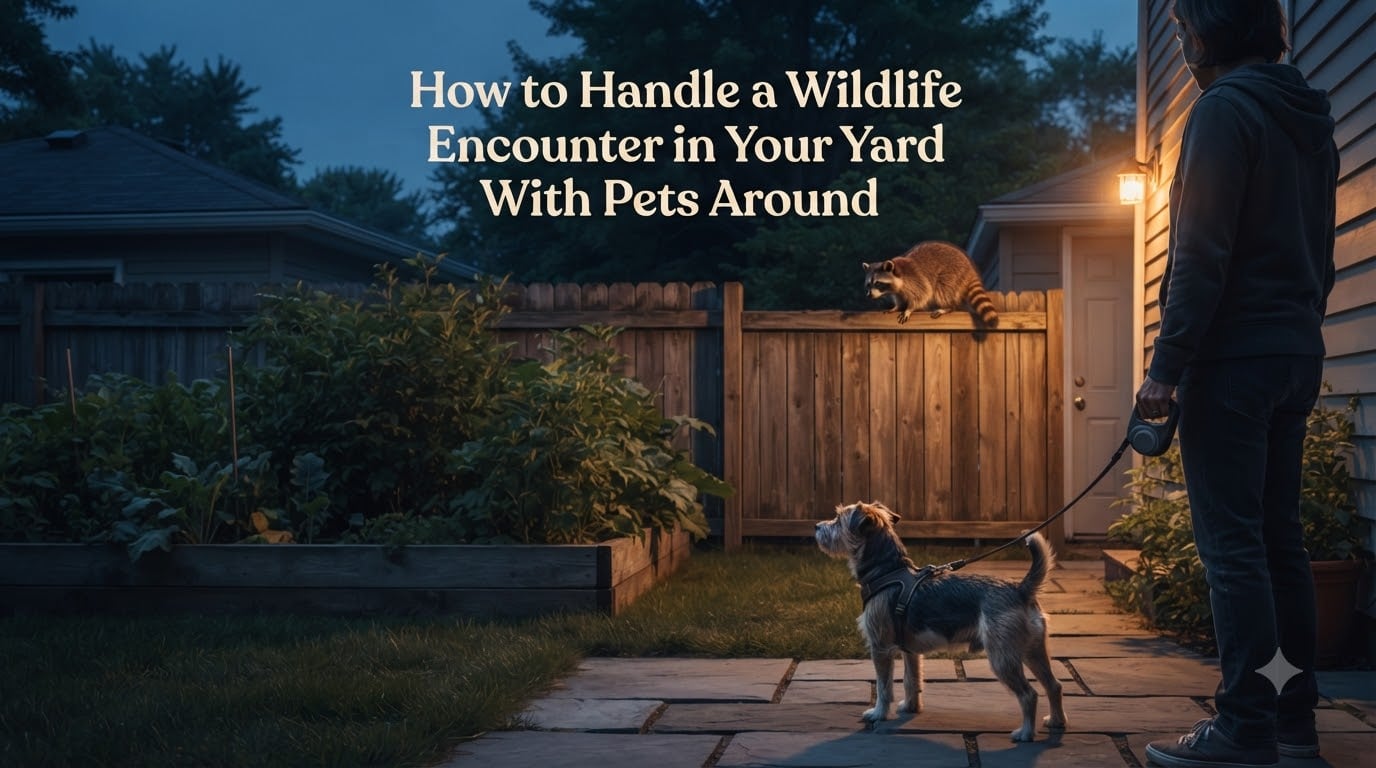
I learned the hard way that a quiet backyard can flip to chaos in seconds. One evening last summer, I opened the back door to let my terrier out and nearly walked into a raccoon three feet from the steps.
That moment pushed me to research, talk to wildlife control officers, and test every protocol I could find. This guide collects what actually works when you face a wildlife encounter in your yard with pets around, and how to prevent the next one.
Table of Contents
Why Wildlife Encounters in Your Yard Put Pets at Risk?
Wildlife encounters put pets at risk because wild animals carry diseases, defend territory aggressively, and view small pets as either prey or competition. Coyotes, raccoons, skunks, and foxes have all moved into suburban neighborhoods in record numbers over the last decade.
According to wildlife biologists tracking urban expansion, coyote populations have adapted to city life in nearly every U.S. state. Raccoons now outnumber rural populations in many counties because they thrive on pet food, garbage, and garden crops.
The risks fall into three buckets: physical injury from bites or scratches, disease transmission such as rabies and leptospirosis, and trauma that can change a pet’s behavior for months. Each of these deserves a different response, which is why a one-size-fits-all approach fails.
Understanding the threat helps you spot it before it escalates. Dogs under 25 pounds face the highest predator risk, but even a 70-pound Lab can lose a fight with a determined raccoon defending kits.
Step-by-Step Wildlife Encounter Response Protocol
Follow these seven steps the moment you spot wildlife with your pet in the yard. I keep this list printed near the back door for quick reference.
Stay calm and quiet. Do not scream, run, or make sudden movements that can trigger a chase response.
Bring your pet indoors immediately. Call them by name in a normal tone rather than yelling.
Do not approach the wild animal. Even small mammals can carry rabies and bite without warning.
Make yourself look large if the animal advances. Raise your arms, open your jacket, and speak firmly.
Back away slowly while facing the animal. Never turn your back or run, which triggers pursuit.
Secure the yard once indoors. Close gates, turn on lights, and remove any food attractants nearby.
Inspect your pet for injuries. Check for bite marks, scratches, limping, or signs of stress within the next hour.
Wildlife control experts stress that your goal during any wildlife encounter is separation, not confrontation. The animal wants food, water, or shelter, not a fight with a human.
If the animal is trapped in your yard, contact animal control rather than trying to herd it out yourself. Cornered animals are far more dangerous than ones with an escape route.
What to Do If the Animal Attacks Before You Reach Your Pet?
Use a loud voice, throw objects near (not at) the animal, and activate any motion lights or sprinklers. Most suburban wildlife will disengage once they feel exposed.
Never get between your pet and the animal. Your first job is to create distance, not to play hero. Once separated, you can call for backup.
Species-Specific Encounters: Coyotes, Raccoons, Snakes, Skunks, and Deer
Different species demand different responses. Treating a deer like a coyote or a snake like a raccoon can make things worse. Here is what our team learned after surveying wildlife officers in seven states.
Coyote Encounters in the Yard
Coyotes are the most dangerous backyard predator for pets in most regions. They hunt in pairs, hunt at dawn and dusk, and have learned that small dogs and cats look like prey.
If you spot a coyote with your pet outside, bring the pet inside immediately. Make noise, spray with a hose, and pick up small pets rather than relying on voice commands in a high-stress moment.
For ongoing coyote problems, hazing works. Carry an air horn or whistle, yell, and wave your arms whenever you see one. Coyotes that associate your yard with fear eventually move on.
Raccoon Encounters With Pets
Raccoons rarely attack unprovoked, but they fight viciously when cornered or protecting young. They are also the most common rabies vector in many U.S. regions, which makes any bite a medical emergency.
Keep your pet leashed near known raccoon dens in attics, sheds, or woodpiles. If a raccoon approaches your pet without backing off, assume it may be sick and call animal control.
Secure garbage in metal cans with locking lids, and never feed pets outdoors overnight. Raccoons follow smell trails more than visual cues, so removing food sources is the single most effective deterrent.
Snake Encounters in the Yard
Snake encounters are the most panic-inducing because owners cannot always tell venomous from harmless species. In the United States, copperheads, cottonmouths, and rattlesnakes pose the biggest pet risk.
Step one is getting your pet away without trying to identify the snake in the moment. Carry small pets inside and leash dogs, walking calmly out of the area.
If your pet is bitten, immobilize the area and head to the vet immediately. Do not apply ice, tourniquets, or cut the wound. Snake venom spreads through movement, so quiet transport saves lives.
Snake-proof your yard by sealing gaps under decks, removing wood and brush piles, and keeping grass short near play areas.
Skunk Encounters and Skunk Spray
Skunks almost never attack without warning. They stomp, hiss, and raise their tail before spraying. If your pet comes across a skunk, you usually have time to recall them before the spray.
If spraying happens, rinse your pet with a hydrogen peroxide, baking soda, and dish soap mix rather than tomato juice. The peroxide mix breaks down skunk oils far more effectively.
Skunks also carry rabies, so any direct bite or scratch warrants an immediate vet visit even if your pet is vaccinated.
Deer in the Yard With Pets
Deer are not predators, but they injure pets every year by kicking when cornered and by attracting ticks that carry Lyme disease. During fawning season in late spring, does defend their young aggressively.
Give deer space and bring pets inside until they move on. Deer learn quickly that yards without food become uninteresting, so avoid planting deer favorites like hostas and tulips near play zones.
Tick checks after any deer-adjacent outdoor time protect both you and your pet from long-term Lyme exposure.
Prevention Strategies That Keep Wildlife Out of Your Yard
Prevention works better than reaction. Our team’s survey of wildlife officers ranked habitat modification as the single most effective long-term deterrent, ahead of fencing, lights, and sprays.
Remove Food, Water, and Shelter
The three things that bring wildlife to your yard are food, water, and shelter. Remove one, and most species move on. Remove two, and your yard becomes uninteresting overnight.
Secure garbage in metal cans with bungee cords or locking lids. Feed pets indoors, or bring food bowls inside right after meals. Clean outdoor grills after each use and store them covered.
Eliminate standing water by emptying bird baths, fixing leaky hoses, and clearing clogged gutters. Even a few inches of water draws raccoons and opossums.
Seal entry points to sheds, decks, porches, and crawl spaces with hardware cloth. A raccoon can squeeze through a 4-inch opening, so measure twice and seal tight.
Yard Design and Fencing Choices
Solid fences at least 6 feet tall deter most deer and coyotes. For diggers, extend fencing 12 inches underground or add a wire apron. Coyote rollers on top of fences prevent climbing.
Motion-activated lights and sprinklers discourage nocturnal visitors without harming them. Sprinklers work especially well for cats, raccoons, and coyotes in open yard areas.
Keep landscaping tidy. Trim shrubs at least 18 inches off the ground to remove hiding cover, and avoid dense ground cover near the house.
Supervision and Leash Habits
Always accompany small pets outside, especially at dawn and dusk when wildlife is most active. I keep a short leash by the back door for late-night bathroom breaks with my small terrier.
For larger dogs, fenced yards with supervision work well. Avoid invisible fences, which do not stop wildlife from entering and can leave pets feeling trapped when a coyote shows up.
Turn on lights before letting pets out at night. Most suburban wildlife avoids well-lit areas because open light means open exposure to humans.
Vaccinations and Disease Prevention After Wildlife Exposure
Vaccinations are your pet’s last line of defense if prevention fails. Core vaccines like rabies and distemper are required by law in most states, and exposure incidents can trigger booster recommendations.
Core Vaccines Every Pet Needs
Rabies vaccination is mandatory for dogs in most U.S. counties and strongly recommended for cats. Even indoor cats need it because bats, the most common rabies source, get inside homes.
Distemper, parvovirus, and adenovirus vaccines protect against diseases carried by raccoons, foxes, and skunks. The leptospirosis vaccine protects against a bacteria spread through wildlife urine that can cause kidney failure in dogs.
For outdoor cats, the feline leukemia vaccine is worth discussing with your vet. FeLV spreads through saliva and bite wounds, making wildlife encounters a real risk.
Booster Protocols After Exposure
If your vaccinated pet is bitten or scratched by wildlife, your vet may recommend an immediate rabies booster. The booster is most effective when given within 72 hours of exposure.
For unvaccinated pets exposed to potentially rabid wildlife, quarantine or, in some jurisdictions, euthanasia is required by law. This is heartbreaking but preventable with up-to-date vaccines.
Keep vaccination records accessible, including a digital copy on your phone. Wildlife control officers and emergency vets often ask for proof on the spot.
Post-Encounter Pet Care and When to Call the Vet
Check your pet carefully after any wildlife encounter, even one that looked minor. Fur hides puncture wounds, and adrenaline masks pain. Bite marks under thick fur often look like small scratches at first.
Call your vet if you notice any of these signs within 24 hours of an encounter: puncture wounds, scratches that break skin, lethargy, vomiting, pale gums, difficulty breathing, limping, or unusual aggression.
Snake bite symptoms can take hours to appear. Watch for swelling, drooling, dilated pupils, and sudden weakness. Even a “dry” bite from a venomous snake warrants a vet visit.
For raccoon or skunk contact, monitor for neurological changes over the next 10 days. Rabies incubation varies widely, but early symptoms include behavior changes, anxiety, and hypersensitivity to light or sound.
Document everything with photos and timestamps. Wildlife exposure records help your vet make faster decisions and may be required for local reporting in some jurisdictions.
Seasonal Wildlife Patterns and Regional Differences
Wildlife activity follows predictable seasonal patterns. Knowing when activity peaks in your region helps you step up supervision during high-risk windows.
Spring (March through May) is fawning season for deer and birthing season for raccoons. Does protect young aggressively, and raccoons teach kits to forage, often in yards.
Summer (June through August) brings the highest snake activity as reptiles warm up. Coyote pups emerge in late spring and learn to hunt through summer, increasing sighting frequency.
Fall (September through November) drives bears, raccoons, and coyotes to pack on calories before winter. They become bolder around food sources and may take more risks in daylight.
Winter (December through February) slows most wildlife, but coyotes remain active year-round and rodents often move into garages and sheds. Seal entry points before the first cold snap.
Regional differences matter. Mountain lions live primarily in western states, alligators in the Southeast, and moose in northern New England. Check your state’s wildlife agency website for species-specific guidance.
Pet First-Aid Kit for Wildlife Encounters
Keep a pet-specific first-aid kit near the back door or in your car. I built mine after my raccoon scare and have used it twice since for minor incidents.
Essential items include: gauze pads and rolls, self-adhering vet wrap, antiseptic wipes safe for pets, saline rinse for eyes and wounds, a digital thermometer, hydrogen peroxide (for skunk spray only), tick remover, and a soft muzzle.
Add emergency contact cards with your vet’s number, the nearest 24-hour animal hospital, and animal control. Save these numbers in your phone too in case the paper kit is somewhere else.
Include a recent photo of your pet in case you get separated during an emergency evacuation. A current vaccine record copy completes the kit.
Check the kit every six months to replace expired items and refresh saline solution.
Training Commands to Protect Your Pet From Wildlife
A reliable recall is the single most valuable skill your pet can have during a wildlife encounter. Train it like your life depends on it, because one day it might.
Start with high-value treats and zero distractions in the yard. Reward every recall within seconds. Gradually add distance and mild distractions like a squeaky toy.
Add the “leave it” command so your pet drops focus on wildlife the moment you give the cue. This works for snakes, skunks, and even deer that wander close.
Practice emergency recall with a distinct whistle or phrase your pet only hears during drills. Reserve the highest-value reward, freeze-dried liver or cheese, for these drills so the cue becomes irresistible.
Even well-trained dogs fail under extreme stress. Never rely on training alone during a predator sighting. Combine strong commands with physical barriers, leashes, and supervision for layered safety.
Frequently Asked Questions About Yard Wildlife Encounters
How can I safely coexist with wildlife in my yard?
Safely coexist with wildlife by removing food, water, and shelter attractants, securing garbage in metal cans, feeding pets indoors, sealing entry points to sheds and decks, and keeping pets supervised at dawn and dusk when most wildlife is active.
What smells do wild animals hate?
Wild animals dislike strong scents like ammonia, vinegar, peppermint oil, garlic, and cayenne pepper. Predator urine from coyotes or wolves also deters rodents and deer, though smells fade quickly and need regular reapplication to remain effective.
What to do if a wild animal is in your yard?
Bring your pet indoors immediately, do not approach the animal, make yourself look large if it advances, back away slowly while facing it, and contact animal control if the animal appears sick, trapped, or refuses to leave.
Can you shoot a coyote if it is in your backyard?
Laws vary by state and county. Many jurisdictions allow lethal removal of coyotes threatening pets or livestock, but some require permits or prohibit discharge within city limits. Check your local wildlife agency before taking action and contact animal control as a safer first step.
How can I survive an encounter with a wild animal?
Survive a wild animal encounter by staying calm, making yourself look large, speaking firmly, backing away slowly without turning your back, and protecting your pet by carrying small animals and leashing dogs during high-risk seasons.
What should I do if my pet is bitten by a wild animal?
If your pet is bitten, rinse the wound with clean water, immobilize the area to slow venom or infection spread, and head to the vet immediately. Bring vaccination records and, if safe, a photo of the animal for identification.
How do I keep snakes away from my pets?
Keep snakes away by sealing gaps under decks, removing wood and brush piles, keeping grass short, and clearing rodent hiding spots. Snake-proof fencing with small mesh works for high-risk yards, and training a strong recall prevents pets from investigating snakes.
When are coyotes most active around homes?
Coyotes are most active at dawn and dusk, though urban coyotes often shift to nighttime activity to avoid people. Spring pup season and fall hyperphagia before winter are the highest-risk windows for yard sightings.
Final Thoughts on Keeping Pets Safe From Wildlife
Handling a wildlife encounter in your yard with pets around comes down to three habits: prevent first, respond calmly, and follow up with vet care when anything seems off. Most pet owners I know have faced at least one backyard surprise, and the ones who came through it best had a plan.
Build yours today. Lock the trash, train the recall, stock the first-aid kit, and keep those vet records current. These small steps turn a potential crisis into an inconvenience you handle with confidence in 2026 and every year after.