
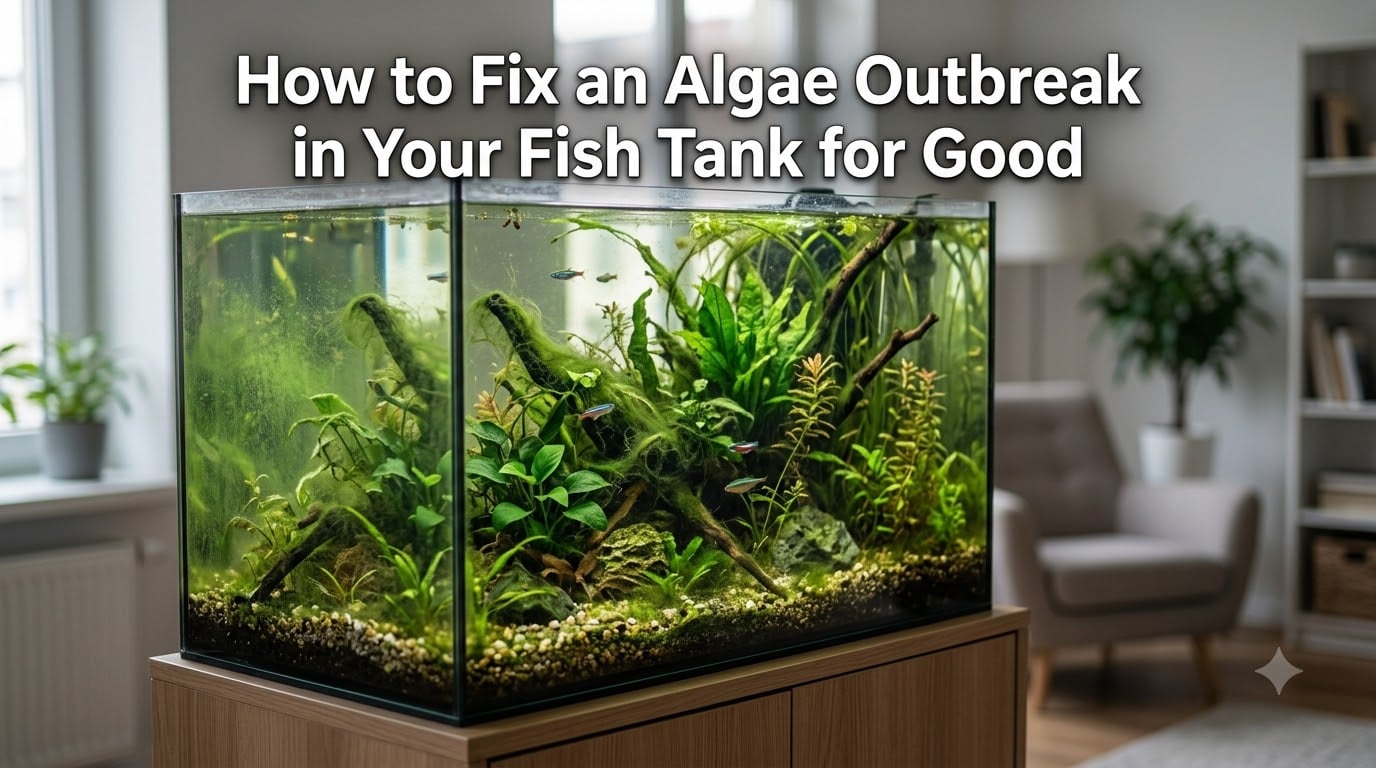
You’re staring at a tank full of green water. The glass feels fuzzy. The leaves on your plants look like they grew beards overnight. I get it – that sinking feeling when you realize the algae is winning is one of the most frustrating moments in fish keeping.
I’ve been there more times than I want to admit. After running planted tanks for years and helping fellow hobbyists through forum threads, I can tell you this: an algae outbreak is not a death sentence, and it is absolutely fixable. This guide on how to fix an algae outbreak in your fish tank for good walks through the exact steps that actually work – not the generic advice that gets recycled everywhere.
By the time you finish reading, you’ll know what type of algae you’re fighting, why it showed up in the first place, and the specific protocol to clear it out and keep it gone.
Table of Contents
What Causes an Algae Outbreak in Your Fish Tank?
An algae outbreak happens when three conditions line up: too much light, too many nutrients, and not enough competition. Algae are opportunistic organisms – they’re always present in your water, waiting for a chance to take over.
The main triggers I see most often are:
Excessive light duration or intensity – more than 8-10 hours per day, or direct sunlight hitting the tank.
Nutrient imbalance – high nitrates above 20 ppm, elevated phosphates, or excess organic waste from overfeeding.
Imbalanced tank ecosystem – not enough live plants to compete for nutrients, or insufficient bacteria in the biofilter.
Poor water circulation – dead spots where detritus collects and feeds algae.
Infrequent filter maintenance – organic buildup in canister filters becomes a slow-release fertilizer.
The real fix means addressing the root cause, not just scrubbing the glass. As TFH Magazine put it, treating algae without fixing the cause is like taking aspirin for a toothache – it helps the symptom, not the problem.
How to Identify the Type of Algae Growing in Your Tank?
Different algae need different solutions. Matching your cure to the species saves you weeks of frustration. Here’s the quick field guide I use when I diagnose a tank.
Green water (phytoplankton) – your water looks like pea soup. Caused by suspended single-celled algae blooming from nutrient spikes or excess light. Fish are fine, but visibility is gone.
Hair algae – long, green threads that drape over plants and hardscape. Common in new tanks with high light and low plant mass.
Black beard algae (BBA) – dark blue-grey to black tufts that look like beard fuzz. Loves fluctuating CO2 and low flow areas.
Brown diatoms – dusty brown coating on glass and leaves. Shows up in new tanks cycling, often clears on its own within weeks.
Blue-green algae (cyanobacteria) – slimy, dark green to black sheets that smell earthy. Not technically algae – it’s bacteria – and it thrives in low-nitrate, low-flow environments.
If you can match what you’re seeing to one of these, skip ahead to the cure steps that match. If not, no worries – the general protocol below works on most types.
Step-by-Step: How to Fix an Algae Outbreak in Your Fish Tank for Good
This is the protocol I run through whenever I’m hit with a bloom. Follow the steps in order – earlier steps handle 80% of cases.
Step 1: Cut the light in half immediately. Drop your photoperiod to 4-6 hours. Cover the tank with a blanket or blackout curtain for 3-4 days if you have green water. Algae needs light to photosynthesize, and starving it speeds up everything else.
Step 2: Do a 30-50% water change. Use a gravel vacuum to pull detritus from the substrate. This dumps the dissolved nutrients algae is feeding on.
Step 3: Clean your filter media. Rinse sponges and mechanical media in old tank water – never tap water, which kills your beneficial bacteria. If you’re running a canister, do this monthly to prevent organic buildup.
Step 4: Test your nitrates and phosphates. Nitrates above 20 ppm or phosphates above 0.5 ppm mean excess nutrients. Address with more frequent water changes and reduced feeding.
Step 5: Add a UV sterilizer or diatom filter for green water. These kill suspended algae as water passes through. UV sterilizers are particularly effective and run continuously until water clears.
Step 6: Manually remove visible algae. Scrape glass with an algae scraper, pull hair algae by twisting it around a toothbrush, and prune heavily affected plant leaves.
Step 7: Introduce algae eaters (if appropriate). Amano shrimp, Nerite snails, and certain plecos will graze hair algae and diatoms. They won’t solve the root problem but help maintain balance.
Step 8: Restore light gradually. After 1-2 weeks, return to 6-7 hours and add a timer so you never forget.
Most tanks show major improvement within 7-14 days. Full clearance can take 4-6 weeks depending on the algae type.
Light Management: The Fastest Way to Starve Algae
Light is the single most common cause of algae problems. I see hobbyists with high-end planted tanks run 10-12 hour photoperiods and wonder why their glass turns green within a week.
The sweet spot for most freshwater tanks is 6-8 hours per day. If you have heavy plant growth, you can go to 8-10 hours with strong CO2 injection. If you’re fish-only or lightly planted, stick to 6.
Direct sunlight is the silent killer. A tank near a window can get 4-6 hours of intense, unfiltered light that no timer controls. I moved my first tank away from a south-facing window and the green water cleared within ten days.
Use an inexpensive outlet timer so the schedule stays consistent. Variable day length confuses plants and gives algae an opening.
Nutrient Control and Water Change Schedule
Algae thrives on the same nutrients your fish produce – nitrates and phosphates from waste, uneaten food, and decaying plant matter.
Test your water with a liquid test kit. Strip tests are cheaper but less accurate. Aim for nitrates under 20 ppm and phosphates under 0.5 ppm in planted tanks, even lower in fish-only setups.
The weekly water change is your best defense. Replace 25-30% of tank water every 7 days. During an active outbreak, increase to twice weekly at 30% each until parameters stabilize.
Overfeeding is the most common nutrient source I see. Fish only need what they can eat in 2-3 minutes. Anything more becomes algae food. I feed once daily, skip one day per week, and have not had a major algae issue in three years.
Filter Maintenance: The Hidden Cause Most Fishkeepers Miss
This is the one piece of advice I wish someone had told me earlier. Your filter doesn’t just move water – it traps organic waste that slowly decomposes into nitrates and phosphates.
On aquarium forums, I see the same pattern over and over: someone does perfect water changes, gets the lights right, and still fights algae. Then they finally clean their canister filter and the problem vanishes within weeks.
Clean your filter media once a month. Rinse sponges in old tank water to preserve bacteria. Replace carbon and chemical media on schedule. A clogged, dirty filter is a hidden algae farm.
Prevention Checklist: Keep Your Tank Algae-Free
Once you’re clear, prevention is everything. I run this checklist on all my tanks:
Light timer set to 6-8 hours, no direct sunlight
Weekly 25-30% water change with gravel vacuum
Monthly filter media rinse
Feed once daily, no more than fish eat in 2-3 minutes
Live plants filling 50%+ of substrate for nutrient competition
Airstone or powerhead for surface agitation and gas exchange
Nitrate test every 2 weeks
Stock levels matching tank size to limit waste
One thing competitors skip: temperature and aeration matter too. Warmer water holds less oxygen and accelerates algae metabolism in some species. Adding an airstone raises surface agitation, increases CO2 off-gassing at night, and improves oxygen for your fish.
If you want biological help, add Amano shrimp or Nerite snails. They graze continuously and don’t add to your bioload. A small cleanup crew makes a noticeable difference in mature tanks.
For planted tanks specifically, aim for allelopathy – healthy fast-growing plants release natural compounds that suppress algae. Strong plant growth is the single best long-term algae defense.
FAQ
How do I get rid of algae in my fish tank fast?
The fastest method is a 3-4 day blackout combined with a UV sterilizer. Cover the tank completely to block all light, run a UV clarifier, and do a 50% water change on day one and day four. Green water clears in 5-7 days. For visible algae on surfaces, manually scrape and pull what you can while the tank is dark.
Will algae go away on its own in an aquarium?
Sometimes, but rarely in established tanks. Brown diatoms in new tanks often clear within 4-6 weeks as the biofilter matures. Most other algae types need intervention – they will not resolve on their own once light and nutrients are out of balance. Addressing the cause is faster than waiting.
What kills algae immediately?
A UV sterilizer kills suspended algae as water passes through the unit – green water clears within days. For algae on surfaces, hydrogen peroxide at 1-2 ml per gallon spot-treats without harming fish when applied directly with a syringe. Algicides work but should be a last resort because they disrupt your biofilter.
What kills algae without killing fish?
A 3-day blackout, increased water changes, manual removal, and UV sterilization are all fish-safe. Amano shrimp and Nerite snails consume algae without harming fish. Spot-treating with diluted hydrogen peroxide (3%) at 1-2 ml per gallon targets algae directly. Avoid copper-based algicides in tanks with shrimp or snails.
Final Thoughts on Beating Your Algae Outbreak
An algae outbreak is not a sign that you’ve failed as a fishkeeper. It’s a signal that something in your tank’s balance has shifted – usually light duration, nutrient loading, or filter maintenance.
If you remember nothing else from this guide on how to fix an algae outbreak in your fish tank for good, remember these three points. Cut the light. Change the water. Clean the filter. Run that protocol consistently for two weeks and your tank will recover.
Pick up a liquid test kit today, set your lights on a timer, and schedule a monthly filter clean. Those three habits will keep your tank clear long after the bloom is gone.