
You walk over to your fish tank one morning, and the water that was crystal clear yesterday now looks like milky soup. I have been there, and I know the panic that sets in immediately. The good news is that cloudy aquarium water is one of the most common issues fish keepers face, and the color of that cloudiness tells you almost everything you need to know about the cause.
Learning how to diagnose cloudy aquarium water by color saves you time, money, and stress. Instead of blindly doing water changes or dumping in chemicals, you can identify the exact problem and apply the right fix the first time.
In this guide, our team breaks down every type of cloudy water you might encounter, what each color means, and the exact steps to clear it up. We have pulled insights from aquarium forums, tested methods, and water chemistry fundamentals to give you a resource that goes beyond the surface.
Table of Contents
Quick Diagnosis by Color: What Your Aquarium Water Is Telling You
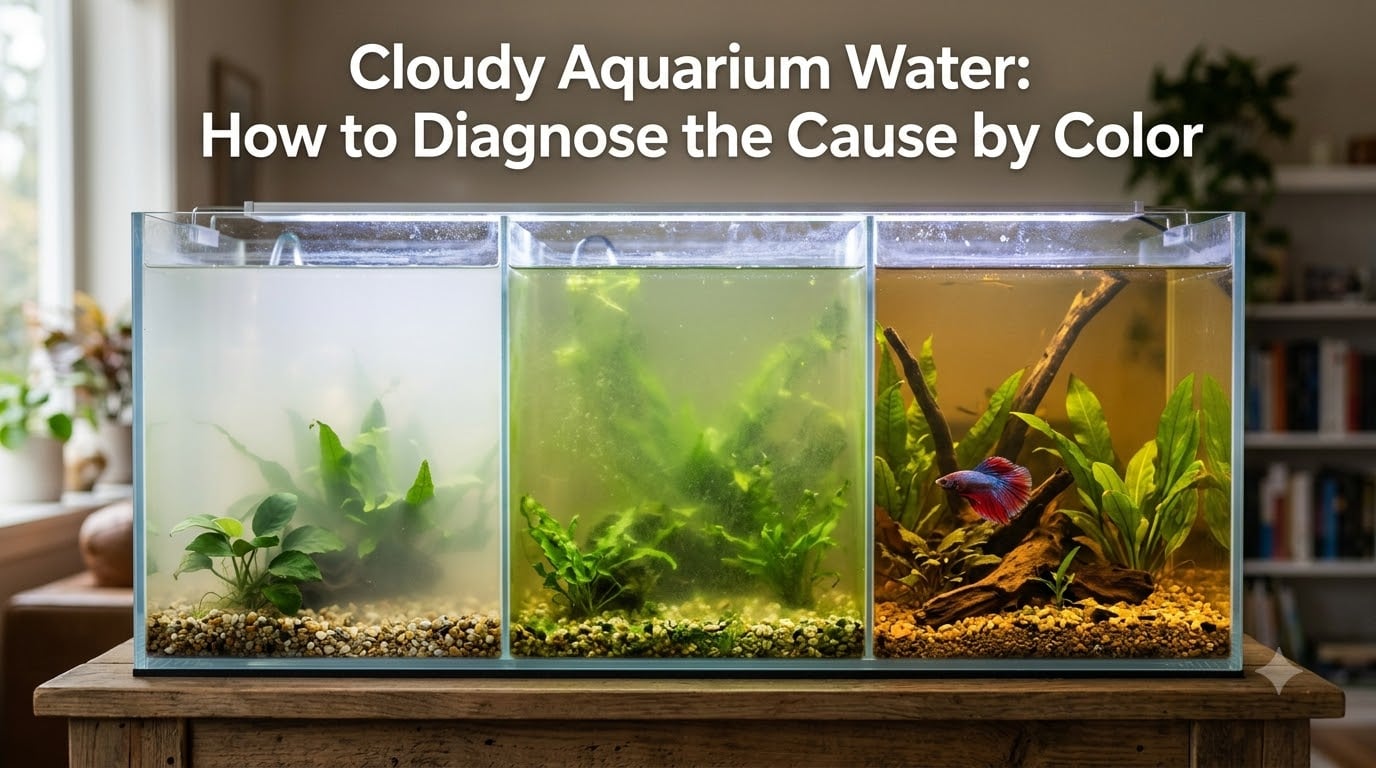
The fastest way to diagnose cloudy aquarium water by color is to look at the tint. White or gray water points to a bacterial bloom. Green water signals an algae bloom. Brown or yellow water usually comes from tannins or sediment. Each cause has a completely different fix, which is why color identification is the first step.
Here is a quick reference to help you identify your situation at a glance:
- White or milky gray: Bacterial bloom (most common in new tanks), substrate dust, or overfeeding
- Green: Free-floating algae (phytoplankton) caused by excess light or nutrients
- Brown or tea-colored: Tannins from driftwood, leaves, or peat. Also possible substrate sediment
- Yellowish tint: Dissolved organic compounds, tannins, or an aging filter
Before you do anything else, grab a water test kit. Aquarium forum communities consistently say that test results are essential for proper diagnosis. You need to know your ammonia, nitrite, nitrate, and pH levels before treating the problem. Guessing without test data is the number one mistake I see new fish keepers make.
White or Gray Cloudy Water: Bacterial Bloom and Substrate Issues
White cloudy aquarium water is the most common type of cloudiness, especially in tanks that have been set up for less than six weeks. In nearly every case, the culprit is a bacterial bloom. This happens when heterotrophic bacteria multiply rapidly in the water column, feeding on excess dissolved organic matter.
A bacterial bloom is different from the beneficial nitrifying bacteria that live in your filter. Heterotrophic bacteria reproduce fast and can turn your tank cloudy overnight. They feed on fish waste, uneaten food, and decaying plant matter.
The most common triggers for white cloudy water include:
- Setting up a new tank before the nitrogen cycle is established
- Overfeeding your fish, which adds excess nutrients to the water
- Cleaning your filter too thoroughly, which wipes out beneficial bacteria colonies
- Adding too many fish at once, causing an ammonia spike the bacteria cannot keep up with
- Using unwashed gravel or substrate that releases fine dust into the water
Here is something I learned the hard way. Many fish keepers see cloudy water and immediately do a large water change. The cloudiness often comes back worse within hours. This happens because the water change removed bacteria but did not remove the food source the bacteria are feeding on. The remaining bacteria simply multiply again.
To fix white cloudy water properly, follow these steps:
- Test your water for ammonia, nitrite, and nitrate. If ammonia or nitrite is above zero, the tank is not cycled.
- Reduce feeding to once every other day. Fish produce less waste this way, cutting off the bacteria’s food supply.
- Do a 20 to 25 percent water change, not a massive one. Small, frequent changes are more effective.
- Use a gravel vacuum to remove uneaten food and waste trapped in the substrate.
- Check that your filter is running properly and that the media is not clogged.
- Add a bacteria starter culture if the tank is new. This helps jump-start the biological filter.
- Be patient. Bacterial blooms typically clear on their own within 5 to 10 days once the food source runs out.
If your tank was just set up and the water turned cloudy within the first few days, this is almost certainly New Tank Syndrome. The bloom is part of the cycling process and will resolve as the biological filter matures. I cover this in more detail below.
One warning worth noting: a UV sterilizer will clear a bacterial bloom quickly, but it only solves the symptom, not the cause. If excess nutrients remain, the bloom will return once the sterilizer is off. Always address the root cause first.
Green Cloudy Water: Algae Bloom Diagnosis and Treatment
Green cloudy aquarium water is caused by a bloom of free-floating single-celled algae called phytoplankton. Unlike the algae that grows on your glass or decorations, these microscopic algae live suspended in the water column itself. The result is water that looks like green pea soup.
The difference between a bacterial bloom and an algae bloom is straightforward once you know what to look for. Bacterial blooms produce a milky white or gray haze. Algae blooms produce a distinct green tint that gets darker over time. If you hold a white object behind the tank, green water makes it look like you are looking through tinted glass.
Green water is caused by two things working together: excess light and excess nutrients. Specifically:
- Leaving the aquarium light on for more than 8 to 10 hours per day
- Placing the tank in direct sunlight from a window
- High nitrate or phosphate levels from overfeeding or infrequent water changes
- Overstocked tanks where fish waste exceeds the filter’s capacity
- Using tap water high in phosphates or silicates
Algae blooms are rarely harmful to fish directly. However, they indicate that your tank has a nutrient imbalance that needs attention. Severe algae blooms can also deplete oxygen levels at night when the algae switch from photosynthesis to respiration.
To treat green cloudy water, our team recommends a layered approach:
- Reduce lighting to 6 hours per day for one week. Turn the light off completely for 2 to 3 days as a starting shock.
- Do a 30 to 50 percent water change to reduce dissolved nutrients.
- Test nitrate and phosphate levels. Target nitrates below 20 ppm and phosphates below 0.5 ppm.
- Add fast-growing live plants like hornwort or water sprite. They compete with algae for the same nutrients.
- Use a UV sterilizer rated for your tank size. Green water typically clears within 2 to 5 days of UV treatment.
- Consider adding a phosphate-removing filter media if phosphates remain high after water changes.
A blackout is the most aggressive treatment for stubborn green water. Cover the entire tank with a dark blanket for 3 to 4 days, keeping the filter running but blocking all light. The phytoplankton will die off without light. Just make sure the tank does not overheat and that the fish have enough oxygen.
Prevention comes down to controlling light and nutrients. Set your aquarium light on a timer for 8 hours maximum. Avoid placing the tank near windows. Feed sparingly and do regular water changes.
Brown or Yellow Cloudy Water: Tannins and Sediment
Brown or yellow cloudy aquarium water is usually the least dangerous type of cloudiness. In most cases, it is caused by tannins leaching into the water from natural decorations. Tannins are organic compounds released by driftwood, Indian almond leaves, peat, and some types of wood-based substrates.
Tannins stain the water a tea-like color. The water remains clear in the sense that you can see through it, but it takes on a yellow or amber tint. This is completely harmless to fish and is actually beneficial for many species. South American fish like tetras, angelfish, and discus evolved in tannin-rich blackwater environments.
If you added a new piece of driftwood to your tank and the water turned brown within a day or two, tannins are the cause. Some woods release tannins for weeks or even months. The intensity depends on the type of wood and whether it was pre-soaked.
To reduce tannin staining, here is what works:
- Boil new driftwood for 1 to 2 hours before adding it to your tank. This pulls out a large amount of tannins upfront.
- Soak the wood in a separate container for 1 to 2 weeks, changing the water daily until it stays clear.
- Add activated carbon to your filter. Activated carbon absorbs tannins effectively and is the fastest way to clear brown water.
- Replace the carbon every 2 to 4 weeks, since it becomes saturated over time.
- Do regular partial water changes to dilute the tannin concentration.
If your water is cloudy rather than just tinted, the issue might be sediment rather than tannins. This happens when fine particles from unwashed substrate or disturbed gravel stay suspended in the water. The particles are too small for most filters to catch.
Substrate sediment is common after setting up a new tank with unwashed gravel or sand. It is also common after a deep gravel vacuuming session that stirs up trapped debris. In these cases, the water has a murky brown or gray appearance.
To clear sediment cloudiness:
- Add a fine filter pad or polishing pad to your filter to trap small particles
- Use a water clarifier product that clumps fine particles together so the filter can catch them
- Allow 24 to 48 hours for particles to settle naturally if the filter alone is not enough
- Rinse new substrate thoroughly before adding it to any tank
If you are dealing with yellow water that is not from tannins, dissolved organic compounds may be the cause. This often means your filter media is overdue for replacement or your tank is overstocked. A water change plus fresh activated carbon usually resolves this within a day.
New Tank Syndrome Explained: Why New Aquariums Go Cloudy
New Tank Syndrome is the term used when a freshly set up aquarium goes through its initial cycling process. During this period, the beneficial nitrifying bacteria that process fish waste have not yet established themselves in the filter. The result is a bacterial bloom that turns the water white and cloudy.
Here is what is happening biologically. Fish produce ammonia through waste and respiration. In a mature tank, nitrifying bacteria convert ammonia into nitrite, and then nitrite into nitrate. This is the nitrogen cycle. In a new tank, those bacteria do not exist yet, so ammonia builds up in the water column.
The cloudy white water you see is actually a bloom of heterotrophic bacteria feeding on the excess organic matter. These are not the same bacteria that perform the nitrogen cycle. They are fast-growing bacteria that multiply when nutrients are abundant.
A typical timeline for New Tank Syndrome looks like this:
- Days 1 to 3: Tank looks clear. Ammonia starts rising as fish produce waste.
- Days 3 to 7: White cloudiness appears. This is the bacterial bloom.
- Days 7 to 14: Ammonia peaks, then starts dropping as nitrifying bacteria colonize the filter.
- Days 14 to 21: Nitrite spike occurs as bacteria convert ammonia to nitrite.
- Days 21 to 42: Nitrite drops, nitrate appears. The tank is cycling.
- Weeks 4 to 6: Cloudiness clears as the biological filter stabilizes. The cycle is complete.
The most important thing to understand about New Tank Syndrome is that patience is the treatment. Forum communities consistently emphasize this point. The bacterial bloom will clear on its own once the nitrogen cycle is established. Doing large water changes or adding chemicals only delays the process.
If you are setting up a new tank, you can shorten the cycle significantly by adding bottled nitrifying bacteria and using filter media from an established tank. I have used both methods and seen cycles complete in 10 to 14 days instead of 4 to 6 weeks.
During the cycling process, test your water daily. If ammonia or nitrite levels spike above 0.25 ppm, do a small 20 percent water change to protect your fish. Never change more than 25 percent during cycling, as you will slow down the bacterial establishment.
When to Wait vs When to Act: A Decision Guide
One of the biggest sources of confusion for aquarium owners is knowing when cloudy water is harmless and when it is an emergency. The answer depends on the color, the age of the tank, and your water test results. This decision guide addresses the most common pain point I see in aquarium forums.
Here is when you can safely wait and let nature take its course:
- The tank is new (under 6 weeks old) and the water is white and cloudy. This is a normal bacterial bloom during cycling.
- Fish are behaving normally, eating well, and showing no signs of distress.
- Ammonia and nitrite levels are at or near zero.
- You added new driftwood and the water turned brown. Tannins are harmless.
- The cloudiness appeared after a filter cleaning and is gradually improving.
Here is when you need to take immediate action:
- Fish are gasping at the surface, hovering near the filter output, or showing rapid gill movement. This indicates low oxygen or ammonia poisoning.
- Ammonia or nitrite tests show levels above 0.5 ppm. Do an immediate 30 percent water change.
- The water turned green very quickly and the fish are stressed. Check light exposure and nutrient levels.
- Multiple fish have died within 24 hours. This signals a toxic water condition that needs urgent attention.
- The tank smells foul or sulfur-like. This may indicate anaerobic pockets in the substrate that need addressing.
A key insight from forum discussions: cloudiness that returns immediately after a water change means you are treating the symptom, not the cause. If you change the water and it goes cloudy again within hours, stop doing water changes and investigate the root cause. Check your feeding habits, filter performance, and bio-load.
Another common question is whether to do water changes when the water is cloudy. For bacterial blooms in new tanks, small water changes are fine if ammonia is present. But if ammonia and nitrite are at zero, the best approach is to wait. The bloom will starve itself out.
For green water, water changes alone rarely solve the problem. The algae reproduce too quickly for water changes to keep up. You need to address light and nutrients simultaneously for lasting results.
If cloudiness persists for more than two weeks despite your best efforts, consider these hidden causes:
- Your filter is undersized for your tank volume or fish load
- The filter media is clogged or exhausted and needs replacement
- You are overfeeding without realizing it. Most fish need only what they can eat in 2 minutes.
- Tap water contains silicates or phosphates that feed algae or bacteria
- A dead fish or snail is decaying somewhere you cannot see it
Prevention Tips: Keeping Your Aquarium Water Crystal Clear
Preventing cloudy water is far easier than treating it. After years of keeping aquariums, our team has identified the habits that consistently produce clear, healthy water.
- Feed your fish only what they can consume in 2 minutes, once or twice per day. Remove uneaten food immediately.
- Perform a 25 percent water change every week or a 50 percent change every two weeks. Consistency matters more than volume.
- Use a gravel vacuum during every water change to remove trapped waste from the substrate.
- Replace filter media on a rotating schedule. Never replace all media at once, as this destroys your bacterial colony.
- Keep aquarium lights on a timer for no more than 8 hours per day.
- Avoid placing the tank in direct sunlight.
- Stock your tank gradually, adding no more than 3 to 4 small fish at a time.
- Run a water test weekly during the first two months and monthly after that.
One of the most overlooked prevention steps is proper filter maintenance. Rinse your filter media in old tank water during a water change, never under tap water. Chlorinated tap water kills the beneficial bacteria living in the media. I made this mistake once and my tank went cloudy for a full week afterward.
Frequently Asked Questions
How do you fix cloudy aquarium water?
To fix cloudy aquarium water, first identify the color. White or gray water means a bacterial bloom, which clears by reducing feeding, doing small water changes, and waiting for the cycle to mature. Green water indicates an algae bloom, which requires reducing light and nutrients. Brown or yellow water comes from tannins and can be removed with activated carbon in your filter.
How long does it take for cloudy aquarium water to clear?
Bacterial blooms in new tanks typically clear within 5 to 10 days as the biological filter establishes. Green water treated with a UV sterilizer usually clears in 2 to 5 days. Tannin staining clears within 24 to 48 hours after adding fresh activated carbon to your filter.
Will cloudy aquarium water clear on its own?
Yes, in most cases cloudy aquarium water clears on its own. Bacterial blooms in new tanks resolve naturally as the nitrogen cycle completes. However, green water from algae will not clear without addressing the underlying light and nutrient causes. When in doubt, test your water parameters and only intervene if ammonia or nitrite levels are dangerous.
Is cloudy aquarium water bad for fish?
Cloudy water itself is usually not harmful to fish. The bacteria that cause white cloudiness do not directly harm fish. However, cloudy water often signals underlying water quality issues like elevated ammonia or nitrite that can be dangerous. If fish are gasping at the surface or behaving erratically, test the water immediately and perform a partial water change.
Does cloudy water mean ammonia?
Not always, but cloudy white water in a new tank often coincides with an ammonia spike because both occur during the cycling process. Bacterial blooms feed on organic waste, which also produces ammonia. The cloudiness itself does not mean ammonia is present, but the conditions that cause a bloom often create elevated ammonia. Always test your water to confirm.
Why did my tank get cloudy overnight?
A tank that goes cloudy overnight almost always has a bacterial bloom triggered by a sudden increase in nutrients. Common causes include overfeeding, adding too many fish at once, disturbing the substrate during cleaning, or a dead organism decaying in the tank. Test ammonia and nitrite immediately and do a 25 percent water change if levels are elevated.
Conclusion
Diagnosing cloudy aquarium water by color takes the guesswork out of fish keeping. White or gray water points to a bacterial bloom that needs patience and reduced feeding. Green water signals an algae bloom that requires light and nutrient control. Brown or yellow water comes from tannins that activated carbon can remove.
The most important takeaway from this guide is simple: test your water before you act. Understanding how to diagnose the cause of cloudy aquarium water by color gives you the confidence to fix the root problem instead of chasing symptoms. With the right approach, your tank will be crystal clear again in days, not weeks.