
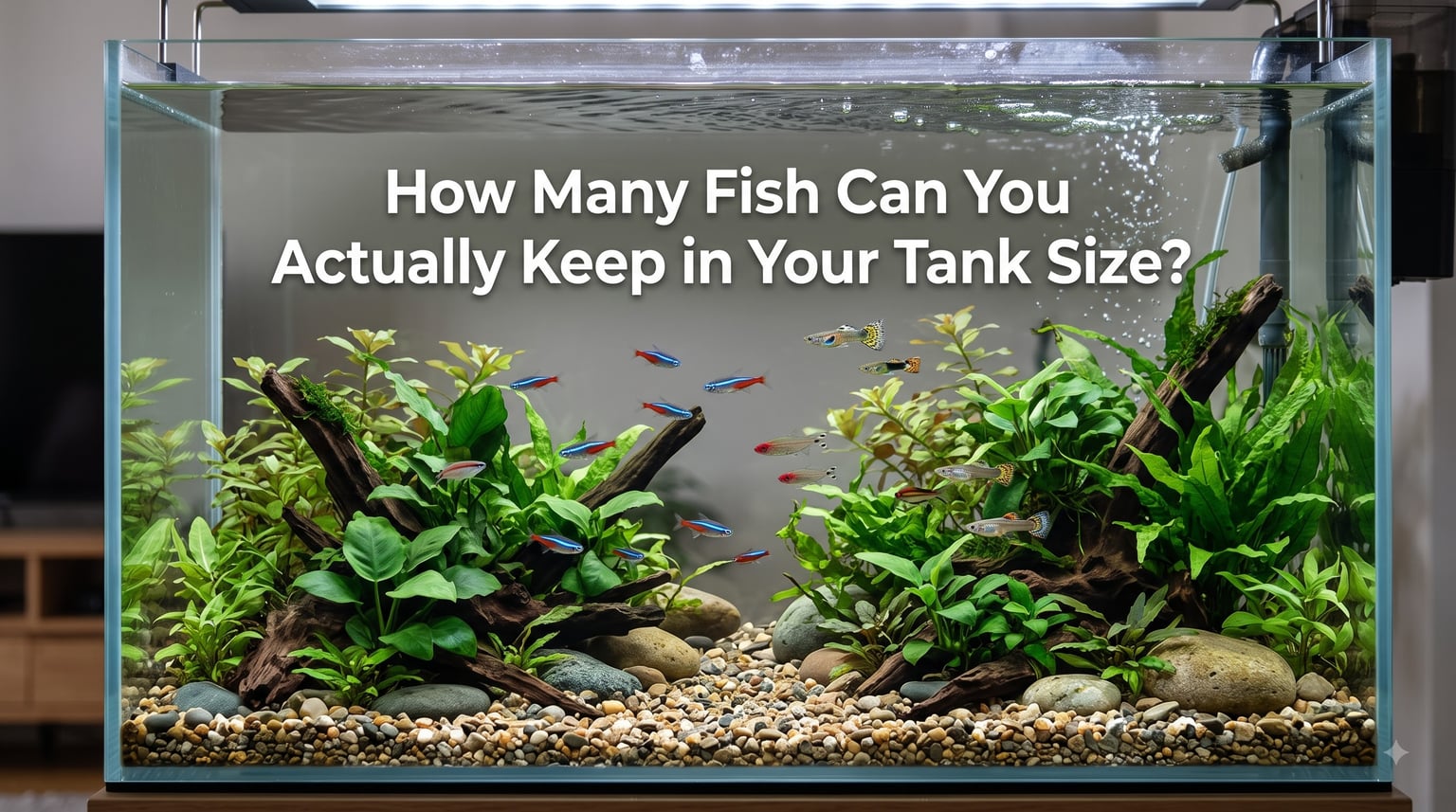
Every new aquarium owner asks the same question at some point: how many fish can you actually keep in your tank size? It seems simple, but the answer depends on filtration, fish species, swimming habits, waste production, and how established your tank is. The old “one inch of fish per gallon” rule gets thrown around constantly, and while it is a starting point, it has serious limitations that catch beginners off guard.
Our team has kept community tanks, planted setups, and species-only aquariums for years, and we have seen firsthand what happens when a tank gets crowded too fast. In this guide, we break down how to figure out the real stocking capacity of your tank using methods that actually work. We cover the inch-per-gallon rule, why it fails, how to calculate your true water volume, and exactly how to stock a tank safely without crashing your water quality.
Table of Contents
The 1-Inch Per Gallon Rule Explained
The 1-inch per gallon rule says you can keep one inch of fish for every gallon of water in your aquarium. A 20-gallon tank would theoretically hold 20 inches of fish, so you could keep ten 2-inch tetras or five 4-inch fish. It is the guideline most pet stores repeat, and it works as a very rough estimate for small, slim-bodied community fish in the 1-to-3-inch range.
The rule has roots in practical simplicity. It gives beginners a number to start with instead of guessing blindly. For a standard filtered tank with moderate stock and regular water changes, it will not lead you wildly wrong on day one. The problem is that fish are not all built the same, and one inch of one species produces a completely different waste load than one inch of another.
Think of the rule as a ceiling, not a target. Most experienced keepers recommend stocking to about 70 percent of what the rule allows and then watching your water parameters before adding more.
Why the 1-Inch Rule Breaks Down
The inch-per-gallon rule fails because it measures length, not mass or waste output. A 3-inch goldfish produces many times the waste of a 3-inch neon tetra, yet the rule treats them as equal. Fish with deep or round bodies, like discus, angelfish, and goldfish, carry far more body volume per inch of length than slim species like danios or rasboras.
Waste production matters more than length when calculating bioload. A single adult Oscar at 12 inches generates enough ammonia to crash a tank that the inch rule says could hold it. The same tank might comfortably house two dozen small tetras that add up to the same total length.
Another blind spot is swimming behavior. Active schooling fish need horizontal room to move, while sedentary species do not. Twenty inches of zebra danios in a 20-gallon tall tank will look and feel far more crowded than twenty inches of bottom-dwelling corydoras. The rule ignores behavior entirely.
Finally, the rule does not account for fish growth. Many species sold in stores are juveniles. A 2-inch juvenile cichlid may grow to 8 inches within a year, and the tank that seemed fine suddenly holds four times the bioload you planned for.
How to Calculate Your Real Tank Water Volume?
Your tank’s labeled gallon size is almost never the actual amount of water inside it. Gravel substrate, rocks, driftwood, decorations, and even the thickness of the glass all displace water. A tank sold as 20 gallons typically holds about 15 to 17 gallons of actual water once you add substrate and decor.
A reliable estimate is to subtract roughly 15 percent from the labeled capacity to get your real water volume. For a 20-gallon tank, that gives you about 17 gallons of working water. A 55-gallon tank with deep substrate and heavy hardscape might only hold 46 gallons.
For precision, measure your tank’s interior dimensions in inches and use the formula: length times width times water depth, divided by 231. That gives you true gallons based on the actual water column. This matters because your filtration, bacteria colony, and oxygen exchange all respond to real water volume, not the number printed on the box.
Surface Area and Oxygen Exchange
Surface area controls how much oxygen enters your tank and how much carbon dioxide leaves. A wide, shallow tank with a large surface area supports more fish than a tall, narrow tank of the same gallon capacity. This is why a 20-gallon long tank can typically handle more stock than a 20-gallon tall.
A traditional guideline uses surface area directly: roughly 1 inch of fish per 12 square inches of surface area for slim-bodied fish, and 1 inch per 20 square inches for deep-bodied fish like goldfish. Measure the length times the width of your tank interior to get surface area in square inches.
Surface agitation from a filter output, air stone, or wavemaker increases gas exchange and boosts the effective capacity of your tank. Stagnant water, even in a large tank, holds less dissolved oxygen and limits how many fish you can safely keep.
Key Factors That Determine How Many Fish You Can Keep
Stocking capacity is not one number. It is the combined result of several variables working together, and changing any one of them shifts your limit up or down.
Filtration Capacity
Your filter is the single biggest factor after tank size. Biological filtration, the beneficial bacteria that convert ammonia into nitrite and then nitrate, determines how much waste your system can process. A filter rated for a tank twice your size gives you a much larger safety margin.
Canister filters and sponge filters generally provide more biological surface area than hang-on-back filters of the same physical size. Whatever you run, never replace all your filter media at once, because that throws away your bacteria colony and causes an ammonia spike.
Fish Temperament and Territorial Behavior
Aggressive and territorial species need more space per fish than peaceful community species. A single male betta claims a territory of several gallons, and two territorial cichlids in a small tank will fight until one is injured or killed. Research each species’ temperament before adding it.
Even peaceful fish can become territorial during breeding. Provide hiding spots, plants, and broken lines of sight so subordinate fish can escape harassment. A tank that is technically under capacity can still be unlivable if the layout gives dominant fish control of the entire space.
Schooling Requirements
Schooling fish like tetras, rasboras, barbs, and danios need to be kept in groups of at least six of their own species. Fewer than that causes stress, faded color, and abnormal behavior. This means a 10-gallon tank that fits six ember tetras comfortably might be at capacity after adding just that one school.
Always plan your stock list around minimum school sizes first, then add individual fish or pairs afterward. A common mistake is buying three of one schooling species and three of another, when the fish would be healthier as a single group of six.
Adult Fish Size and Growth Rate
Always stock based on the adult size of the fish, not the size it is when you buy it. Pet stores sell juveniles, and some species grow fast. A pleco sold at 2 inches can reach 18 inches. Common goldfish can hit 10 inches or more and produce waste accordingly.
Look up the adult size of every species before purchase. If the adult size does not fit your tank long-term, choose a different fish or plan to upgrade the tank. Overcrowding by growth is one of the most frequent causes of tank crashes reported by hobbyists.
Tank Size Recommendations: How Many Fish Per Gallon
Here is a practical breakdown of realistic stocking for common tank sizes. These are conservative starting points for community tanks with standard filtration and regular maintenance.
5-gallon tank: Best for a single betta or a small group of shrimp. Maybe 5 to 6 inches of small fish maximum. This size does not support schooling fish properly and has poor temperature stability.
10-gallon tank: One school of six small tetras or rasboras, plus a few nerite snails. About 8 to 10 inches of fish. Avoid active swimmers that need horizontal length.
20-gallon tank: Two schools of small fish plus a cleanup crew, or one school plus a small centerpiece fish. About 15 to 18 inches of fish. A 20-long gives you better options than a 20-tall.
30-gallon tank: Three schools or a mix of community species. About 22 to 28 inches of fish. You can add a pair of dwarf cichlids or a small group of bottom dwellers.
55-gallon tank: Larger community fish, multiple schools, and a centerpiece species like angelfish or a small group of rainbowfish. About 40 to 50 inches of fish.
75-gallon tank and above: Flexibility for larger species, multiple territories, and bigger schools. About 55 to 75 inches of fish depending on filtration and layout.
These numbers assume slim-bodied community fish, good filtration, and weekly water changes of 25 to 30 percent. Cut every recommendation by at least 25 percent if you are stocking deep-bodied fish, goldfish, or high-waste species like cichlids.
How to Tell If Your Tank Is Overstocked?
Your fish and your water tests will tell you when a tank has too many fish. Watch for these warning signs rather than relying on a formula.
Fish gasping at the surface is an urgent sign of low oxygen, often caused by too high a bioload. Chronic algae blooms, cloudy water, and a smell of ammonia all point to a system that cannot process the waste being produced.
Aggression that was not there before, fish hiding constantly, faded colors, and stalled growth are behavioral signs of overcrowding. If your nitrate level climbs above 40 ppm even with weekly water changes, your tank is carrying more bioload than it can handle.
Test your nitrate weekly using a liquid test kit. If nitrate increases by more than 20 ppm between water changes, you are overstocked or under-filtered. The fix is to either remove fish, upgrade filtration, increase water change frequency, or add fast-growing live plants.
How Live Plants Affect Stocking Capacity?
Live plants give you a real stocking buffer because they absorb nitrate, the end product of the nitrogen cycle, as fertilizer. Fast-growing stem plants and floating plants like frogbit and water sprite pull significant amounts of nitrogen directly from the water column.
A heavily planted tank can safely hold modestly more fish than a bare or artificial setup, because the plants act as a secondary biological filter. This is why planted tank keepers often run higher stock densities without water quality problems.
Plants are not a substitute for filtration or water changes. They supplement your system and buy you margin, but you still need a proper filter, regular testing, and a maintenance schedule. Think of plants as a bonus that lets you push toward the upper end of your capacity rather than a reason to exceed it.
Step-by-Step: Safely Stocking Your Aquarium
Gradual stocking is the single most important habit for a healthy tank. Adding all your fish at once overwhelms the bacteria colony and causes an ammonia spike that can kill everything in the tank.
Step 1: Cycle the tank fully before adding any fish. The nitrogen cycle takes 4 to 8 weeks. Test for ammonia and nitrite and wait until both read zero with a measurable nitrate level.
Step 2: Add your first group of fish, no more than 25 to 30 percent of your planned total stock. Choose hardy species for the first addition.
Step 3: Wait at least two weeks. Test ammonia and nitrite every few days. If both stay at zero, your bacteria colony has grown to match the new bioload.
Step 4: Add the next group, again about 25 to 30 percent of total stock. Repeat the testing cycle for another two weeks.
Step 5: Continue this pattern until you reach your target stock. If ammonia or nitrite spikes at any point, stop adding fish, do a partial water change, and wait for the bacteria to catch up before proceeding.
This patient approach, recommended consistently by experienced keepers, is what separates tanks that thrive from tanks that crash in the first month.
Common Beginner Mistakes to Avoid
The most common mistake is trusting the inch-per-gallon rule blindly and stocking to the maximum on day one. The second is buying fish without researching their adult size, especially common with plecos, goldfish, and cichlids.
Adding too many fish at once before the bacteria colony can handle the waste is the fastest way to lose livestock. This is why gradual stocking matters even when your numbers look conservative on paper.
Ignoring the nitrogen cycle entirely is a mistake that leads to what hobbyists call new tank syndrome, where ammonia and nitrite spike and kill newly added fish. Always cycle first, test often, and add slowly.
Finally, trusting pet store advice without independent research is risky. Stores sell fish that are too large for beginner tanks, give outdated stocking numbers, and have a financial incentive to sell you more livestock. Cross-check every recommendation against species profiles from established aquarium sources.
Frequently Asked Questions
Can we keep 10 fishes in an aquarium?
Yes, you can keep 10 fish in an aquarium if the tank is large enough to support the total bioload. A 20-gallon tank can typically hold 10 small community fish like neon tetras or guppies, assuming good filtration and regular water changes. Ten larger fish would require a much bigger tank.
Can we keep 7 fishes in an aquarium?
Yes, 7 fish is a manageable number for most tanks of 10 gallons or larger. A 10-gallon tank can hold 7 small fish such as ember tetras or celestial pearl danios, while a 20-gallon tank can comfortably hold 7 medium-sized community fish. Always base the count on adult fish size and filtration capacity.
How many fish can I keep in my tank?
As a starting guideline, use one inch of adult fish per gallon of real water volume, then subtract 15 percent for substrate and decor displacement. A 20-gallon tank holds roughly 17 real gallons, supporting about 17 inches of small community fish. Adjust down for deep-bodied or high-waste species and stock gradually over several weeks.
How do I know if I have too many fish in my tank?
Signs of an overstocked tank include fish gasping at the surface, chronic algae blooms, cloudy or smelly water, rising nitrate above 40 ppm between water changes, increased aggression, and faded colors. Test ammonia, nitrite, and nitrate weekly. If nitrate climbs more than 20 ppm before your next water change, reduce stock or upgrade filtration.
Conclusion
Figuring out how many fish you can actually keep in your tank size comes down to understanding bioload, not just counting gallons or inches. The 1-inch per gallon rule is a starting point, but real capacity depends on filtration, fish body type, adult size, swimming behavior, surface area, and how established your tank is. Calculate your true water volume, plan around minimum school sizes, stock gradually over several weeks, and let your water test results guide you. A patiently stocked, slightly under-capacity tank will always outperform a maximally stocked one, and your fish will live longer and show better color because of it.