
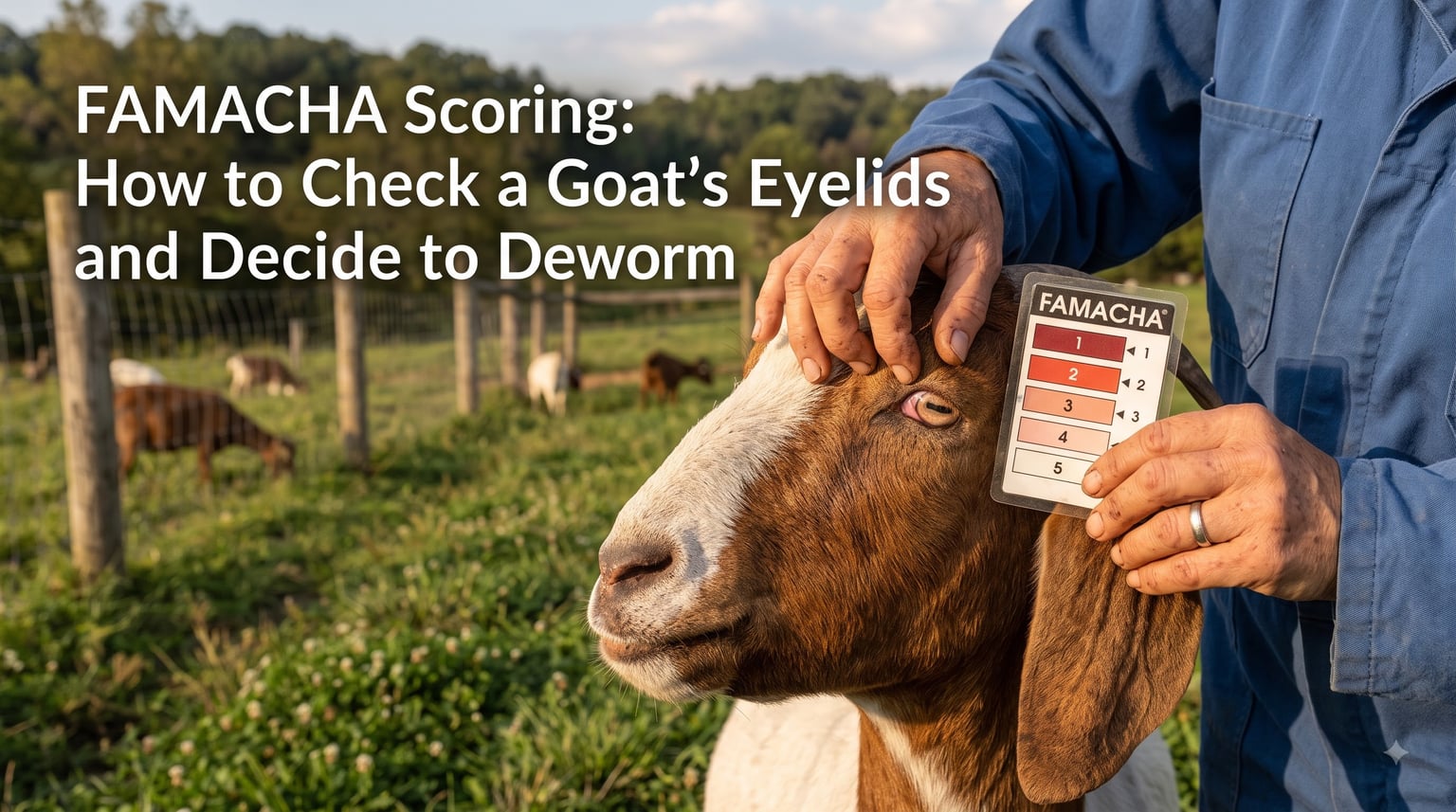
If you keep goats on pasture, barber pole worm is one of the deadliest threats to your herd. I have seen apparently healthy goats go from fine to critical in under 48 hours. The good news is that FAMACHA scoring goat eyelids gives you a simple, fast, and reliable way to catch anemia early and decide which animals actually need deworming.
In this guide, I will walk you through exactly what FAMACHA scoring is, how to check your goat’s eyelids the right way, how to read the 5-point color scale, and when to deworm versus when to hold off. This is the same method our team has used on our herd for years, and once you learn it, a single check takes about 15 seconds per goat.
You will also learn how to avoid the common mistakes that lead to false readings, what to do when a score does not improve after treatment, and how often you should be checking during peak parasite season.
Table of Contents
What Is FAMACHA Scoring?
FAMACHA scoring is a field method for detecting anemia in goats and sheep by examining the color of the mucous membrane inside the lower eyelid (the conjunctiva). You compare the eyelid color to a standardized 5-point color chart to decide whether the animal needs deworming.
The system was developed in South Africa by Dr. Faffa Malan (the name comes from FAffa MAlan CHArt) specifically to combat Haemonchus contortus, the barber pole worm. This parasite feeds on blood, and heavy infections cause severe anemia that can kill a goat before you notice any outward signs of illness.
Before FAMACHA, most goat owners dewormed the entire herd on a schedule. That approach speeds up dewormer resistance, where the surviving worms pass their resistant genes to the next generation. Within a few years, your dewormer stops working entirely.
FAMACHA changed that by enabling targeted selective treatment. You only deworm the goats that actually need it, which leaves a population of unmedicated worms (called refugia) in the herd. Those susceptible worms dilute the resistant ones, slowing resistance development dramatically.
Research from universities like Ohio State and organizations like the American Consortium for Small Ruminant Parasite Control (ACSRPC) has validated FAMACHA as a practical, low-cost tool for any pasture-based goat operation. All you need is a FAMACHA card and your thumb.
Which Parasites Does FAMACHA Detect?
FAMACHA scoring goat eyelids detects anemia caused primarily by Haemonchus contortus, the barber pole worm. This blood-feeding parasite is the leading cause of goat deaths in warm, humid climates across the southern and eastern United States.
The adult barber pole worm attaches to the goat’s abomasum (the fourth stomach) and drinks blood. A heavy infection can drain enough blood to drop a goat’s packed cell volume (PCV) to dangerous levels within days. Each adult worm can remove about 0.05 mL of blood per day, and a goat carrying thousands of worms loses blood faster than its body can replace it.
Here is the important limitation: FAMACHA only detects blood-feeding parasites. It will not tell you about coccidia, tapeworms, lungworms, or brown stomach worms that cause weight loss and diarrhea without anemia. If your goat has a great FAMACHA score but is losing weight or has messy fecals, those parasites are not showing up in the eyelid check.
This is why experienced goat keepers combine FAMACHA with the 5-point check system, which also looks at body condition, fecal consistency, coat condition, and bottle jaw. FAMACHA is your early warning system for the deadliest parasite, but it is not a complete parasite diagnostic on its own.
If you live in a hot, humid region where barber pole worm is endemic, FAMACHA is absolutely essential. In cold, dry climates where barber pole is less common, the technique is still useful but less critical to your routine.
The FAMACHA Score Chart: Understanding the 5-Point Scale
The FAMACHA card uses a 5-point color scale that runs from healthy red (Score 1) to deadly white (Score 5). Each score corresponds to a range of packed cell volume and tells you exactly what action to take. Here is what each score looks like and what you should do about it.
Score 1: Red and Healthy
The conjunctiva is a strong, solid red color. This goat has healthy blood cell levels and no significant anemia. PCV is typically above 30 percent.
Action: No deworming needed. This animal is handling its parasite load well and may even have natural resistance, which is exactly what you want to breed for in your herd.
Score 2: Red-Pink
The eyelid is still predominantly red but slightly lighter, with a pinkish tone. PCV is generally between 24 and 30 percent. This goat is in good shape.
Action: No deworming needed. Keep monitoring on your regular schedule. Most healthy adult goats on well-managed pasture sit at Score 1 or 2 for most of the season.
Score 3: Pink (The Decision Point)
The conjunctiva is a clear pink, noticeably lighter than Score 2 but still showing some red tone. PCV is roughly 18 to 24 percent. This is where FAMACHA scoring gets nuanced, and where I see the most confusion among goat owners.
Action: This score requires judgment. For a healthy, non-stressed adult goat, Score 3 usually means recheck in 7 to 10 days. However, for pregnant does in late gestation, lactating does, and young kids, I typically recommend deworming at Score 3. These animals are under significant physiological stress and their immune systems cannot fight off the parasite load the way a healthy dry doe can.
If a goat stays at Score 3 across multiple checks, that tells you the parasite burden is actively growing and not being controlled by the animal’s immune system alone. Time to treat.
Score 4: Pink-White
The conjunctiva is noticeably pale, a washed-out pink-white color. PCV has dropped to about 12 to 18 percent. This goat is anemic and deteriorating.
Action: Deworm immediately. This animal is in trouble and will likely progress to Score 5 within days if untreated. I also recommend a follow-up check in 7 days to confirm the dewormer is working.
Score 5: White and Critical
The conjunctiva is white or nearly white, sometimes described as the color of raw chicken breast. PCV is below 12 percent. This goat is in severe anemia and is at risk of sudden death.
Action: Deworm immediately and contact your veterinarian. A goat at Score 5 may need additional supportive care beyond deworming, including iron supplementation, vitamin B12, and in some cases a blood transfusion. Even with treatment, goats at Score 5 have a significant mortality risk.
One important note from experience: a white eyelid tells you the PCV is below 17 percent, but it does not tell you how far below. I have seen goats with white eyelids at a PCV of 12 recover in 3 to 4 days after treatment, while others took 3 weeks. The color is a threshold indicator, not a precise measurement.
How to Check Goat Eyelids (Step-by-Step)
Learning FAMACHA scoring goat eyelids properly is the difference between catching problems early and missing them entirely. The technique matters. I have talked to many goat owners on forums who thought they were checking correctly but were looking at the wrong part of the eye entirely.
Step 1: Restrain the Goat Safely
Get the goat into a stanchion, tie them to a fence post, or have a helper hold them steady. You need both hands free, and the goat needs to hold still for about 15 seconds. Trying to check a moving target will give you a bad reading and stress the animal.
Step 2: Position Your Thumb Correctly
Stand beside the goat’s head. Use your non-dominant hand to cup the goat’s jaw or hold the cheek for stability. With your dominant hand, place your thumb on the bony ridge just below the eye. This is where most people get it wrong, so pay close attention to this detail.
Your thumb should rest on the lower rim of the eye socket, pressing gently inward and downward on the skin below the lower eyelid. Do not press on the eyeball itself.
Step 3: Pull the Lower Eyelid Down and Out
Roll your thumb downward and slightly outward to evert the lower eyelid, exposing the conjunctiva inside. The inner membrane should fold outward and become visible as a band of tissue along the lower lid. This is the tissue you are scoring.
The key mistake people make is just looking at the outer eyelid margin, which is often darkly pigmented and tells you nothing. You must see the inner conjunctiva, the moist pink tissue that lines the inside of the eyelid. If you are looking at skin rather than moist tissue, you are not seeing what you need to score.
Step 4: Compare to the FAMACHA Card Immediately
Hold the FAMACHA card right next to the exposed conjunctiva and match the color. Do this in natural daylight if at all possible, because indoor lighting and flashlights alter color perception. Morning light on an overcast day gives the most accurate reading.
Do not try to memorize the color and compare later. Colors shift in your memory. Match the card to the eye in real time, and assign a score on the spot.
Step 5: Check Both Eyes
Always check both the left and right eyelid. I have seen cases where one eye reads Score 2 and the other reads Score 4. When this happens, always go with the worse (higher) score. The lighter eyelid is telling you something is wrong even if the other eye looks acceptable.
Asymmetric scores can also indicate irritation or inflammation in one eye rather than anemia, which is another reason to cross-check with body condition and other signs. But never dismiss a pale eyelid just because the other one looks fine.
Step 6: Record the Score
Write down the date, the goat’s name or ID, and the score for each eye. This is non-negotiable if you want to use FAMACHA effectively. A single score is a snapshot. The real value comes from tracking trends over time.
I keep a simple spreadsheet with each goat down the side and dates across the top. When I see a goat trending from Score 1 to Score 2 to Score 3 over a few weeks, I know to pay closer attention to that animal even before it hits the treatment threshold.
When to Deworm Based on FAMACHA Scores?
The decision to deworm should never be based on a single factor alone, but FAMACHA gives you the strongest signal for barber pole worm risk. Here is a clear breakdown of when to treat and when to wait.
Scores 1 and 2: Do Not Deworm
If both eyes read Score 1 or 2, do not deworm. These goats are managing their parasite load well. By leaving them untreated, you preserve refugia and slow dewormer resistance. This is the entire point of selective treatment.
Score 3: Evaluate the Context
Score 3 is where you apply judgment. For a healthy, dry adult doe or buck in good body condition, recheck in 7 to 10 days before deciding to treat. If the score stays at 3 or worsens, deworm.
For pregnant does in the last month of gestation, lactating does, and kids under 6 months, I recommend treating at Score 3. These animals are under too much stress to fight off an increasing worm burden on their own. Waiting risks losing them.
Scores 4 and 5: Deworm Immediately
A Score 4 or 5 means active, dangerous anemia. Do not wait. Administer an effective dewormer right away. For Score 5 goats, call your veterinarian as well, because supportive care may be needed alongside the dewormer.
After deworming, recheck the FAMACHA score in 7 days. If the score has not improved or has worsened, the dewormer you used may not be working. This is a sign of dewormer resistance, and you need to work with your vet to run a fecal egg count reduction test and identify which drug class still works on your farm.
What to Do When the Score Does Not Improve?
This is one of the most common questions I see in goat forums. If you deworm a goat and the FAMACHA score has not improved after 10 to 14 days, three things could be happening.
First, the dewormer may be ineffective due to resistance. Run a fecal egg count reduction test (FECRT) with your vet. Second, the goat may have such a heavy parasite load that a second treatment is needed. Third, the anemia may be caused by something other than barber pole worm, such as liver flukes or a mineral deficiency.
Either way, a goat that stays at Score 4 or 5 after deworming needs veterinary involvement. Do not just keep giving different dewormers blindly. You will accelerate resistance and may be treating the wrong problem entirely.
How Often Should You Check FAMACHA Scores?
Checking frequency depends on your climate, season, and the risk level of your animals. During peak barber pole worm season, which in most of the United States runs from late spring through early fall, I check my herd every 7 to 10 days.
In the peak of summer heat and humidity, when barber pole worm transmission is at its highest, weekly checks are not excessive. This parasite can go from egg to infective larva in as little as 4 days in ideal conditions. A goat that was Score 1 last week can be Score 4 this week.
High-risk animals need the most frequent monitoring. Kids under 6 months, lactating does, and any animal that has been treated for barber pole worm in the current season should be on your radar constantly. Check them first and most often.
During the off season (winter in most climates), you can reduce checks to monthly or even less frequent. Barber pole larvae do not survive freezing temperatures well, so the risk drops significantly. But do not stop entirely. A warm winter spell can reactivate transmission.
If you live in a warm, humid climate like the Southeast or Gulf Coast where barber pole worm is active nearly year-round, maintain at least biweekly checks even in winter.
Common Mistakes to Avoid
After years of FAMACHA scoring goat eyelids and talking with hundreds of goat owners, these are the mistakes I see most often. Avoiding them will make your checks far more accurate.
Checking the Wrong Tissue
The single most common mistake is looking at the outer edge of the eyelid or the skin around the eye instead of the inner conjunctiva. If you see dry, pigmented skin, you are in the wrong place. You need to see the moist pink tissue on the inside of the everted lid.
Deworming at Score 3 for Every Goat
Some owners default to treating any Score 3 goat. This over-treatment defeats the purpose of FAMACHA and accelerates dewormer resistance. Reserve Score 3 treatment for stressed, young, pregnant, or lactating animals. Healthy adults can often handle a Score 3 with monitoring.
Checking in Bad Lighting
Dim barn interiors, colored LED lights, and harsh direct sunlight all distort color perception. Check in natural daylight whenever possible. If you must check indoors, use a full-spectrum light.
Ignoring Other Health Indicators
FAMACHA only tells you about anemia. A goat can have a dangerous coccidia infection, a heavy tapeworm load, or severe weight loss while scoring a perfect Score 1. Always cross-check with body condition scoring, fecal consistency, coat quality, and bottle jaw assessment.
Not Keeping Records
If you are not writing down scores with dates and goat IDs, you are losing the biggest advantage of FAMACHA. Trend data tells you which goats need culling from your breeding program (consistently high scores indicate susceptibility) and which pastures are driving parasite loads.
Using a Faded or Photocopied Card
The official FAMACHA card is printed with carefully calibrated colors. Photocopies, phone photos of cards, and faded old cards will give you inaccurate comparisons. Replace your card every 2 to 3 years, and store it out of direct sunlight.
Frequently Asked Questions
How to check goat eyelids for worms?
To check goat eyelids for worms, restrain the goat, place your thumb on the bony ridge below the eye, and gently pull the lower eyelid down and outward to expose the inner conjunctiva. Compare the color of this moist pink tissue to a FAMACHA score card, where darker red means healthy and white means severe anemia. Always check both eyes and record the score.
How to tell if a goat needs deworming?
A goat needs deworming when its FAMACHA score reaches 4 or 5, indicating significant anemia from barber pole worm infection. At Score 3, deworming is recommended for pregnant does, lactating does, and young kids, while healthy adults should be rechecked in 7 to 10 days. Also watch for weight loss, diarrhea, rough coat, and bottle jaw swelling under the jaw.
What parasites does FAMACHA target?
FAMACHA scoring specifically targets Haemonchus contortus, the barber pole worm, which feeds on blood and causes anemia. It does not detect coccidia, tapeworms, lungworms, or other non-blood-feeding parasites. For those parasites, you need fecal egg counts and observation of symptoms like diarrhea and weight loss.
Can I give my goat too much dewormer?
Yes. Over-deworming or giving incorrect doses can cause toxicity and accelerates dewormer resistance in the parasite population. Always weigh your goat and dose by actual body weight, use the correct route of administration, and only deworm goats that need it based on FAMACHA scores and other health indicators. Giving dewormer to every goat on a schedule is the fastest way to make all dewormers stop working on your farm.
Why is my goat’s FAMACHA score not improving after deworming?
If a FAMACHA score has not improved 10 to 14 days after deworming, the dewormer you used may be ineffective due to parasite resistance. Work with your veterinarian to run a fecal egg count reduction test to determine which drug class still works. The anemia could also be caused by something other than barber pole worm, such as liver flukes or a mineral deficiency.
Conclusion
FAMACHA scoring is one of the most valuable skills any goat owner can learn. It takes about 15 seconds per goat, costs nothing after you buy the card, and can literally save your animals’ lives by catching barber pole worm anemia before it becomes deadly.
Get an official FAMACHA card from your veterinarian, a local extension office, or the ACSRPC website. Start checking your herd on a regular schedule, write down every score, and combine what you see with body condition scoring and fecal checks for a complete parasite management strategy.
The goats that consistently score 1 and 2 are your resistant genetics. The ones that keep hitting 3, 4, and 5 are telling you something about their parasite resilience. Use that data to build a stronger, healthier herd over time.