
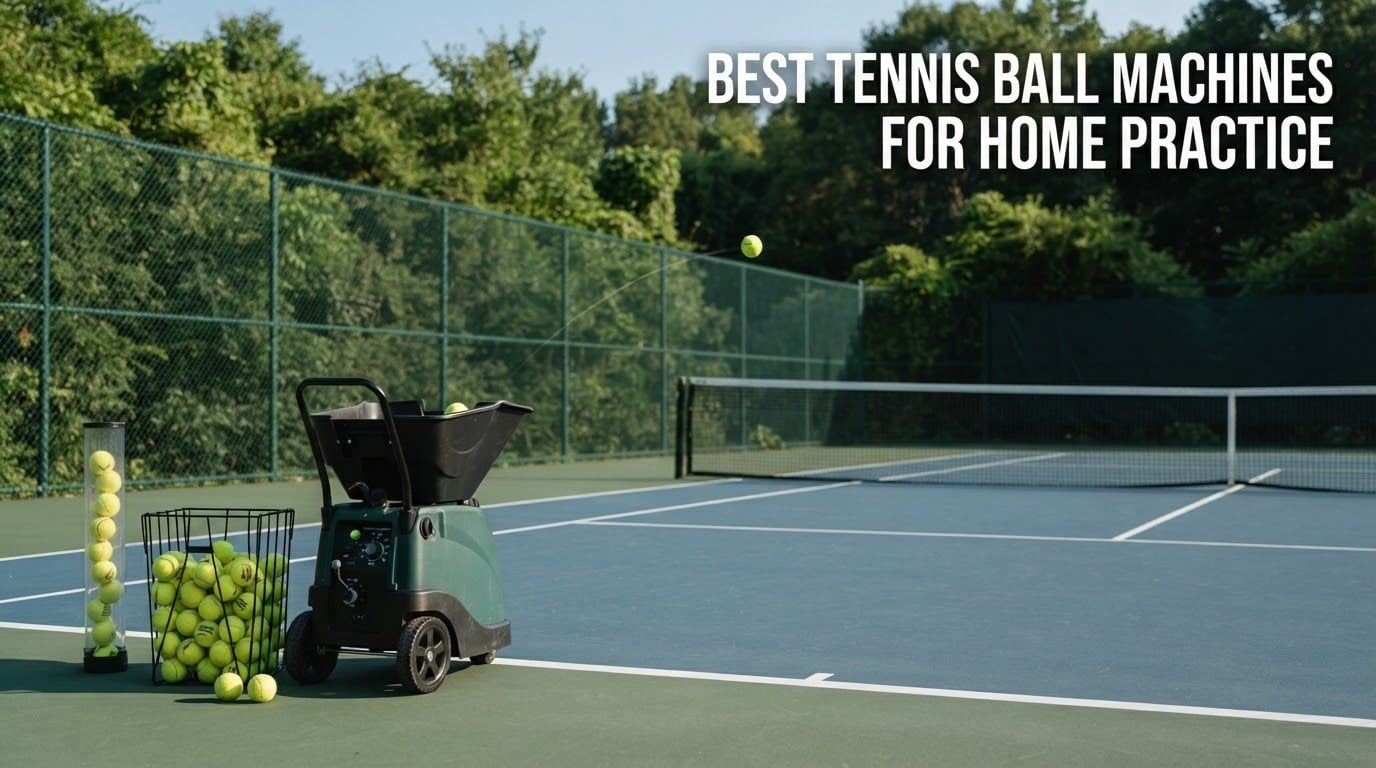
Looking for the best tennis ball machines for home practice? The short answer is the Lobster Elite for most players who have a driveway or a private court, the Spinshot Plus-2 if you want programmable shot variety, and the Furlihong 3819BH if you just want cheap groundstroke reps without a four-figure outlay. A competitive player might hit 300 shots an hour in a match but can work through roughly 900 an hour off a machine, and that extra repetition is what actually changes a stroke.
If your own court is an option, the same repetition logic we cover in our guide to automatic ball launchers for fetch training applies here. We looked at ten machines that are all available to buy now, weighing hopper capacity, oscillation, spin, remote and app control, real battery runtime, and the thing most spec sheets ignore: how heavy the machine plus its balls is when you have to get it to a court. Search results for this topic are dominated by manufacturer pages, so this roundup leans on owner review data instead of brochure numbers.
Two things shape almost every recommendation here. First, home practice is a logistics problem as much as a hitting problem, because a machine plus 50 to 150 balls plus a hopper can weigh as much as the machine itself. Second, the gap between advertised battery hours and the hours you will actually hit is where most buyer frustration lives. We flag both for every pick below.
Table of Contents
Top 3 Tennis Ball Machines for Home Practice in 2026

Lobster Elite Tennis Ball…
- 10-80 MPH speed range
- Topspin and backspin
- Horizontal oscillation
- 4-6 hours per charge

Spinshot Plus-2 Tennis…
- Phone app programs each shot
- 120+ ball foldable hopper
- Any oscillation pattern
- Quiet operation

Furlihong 3819BH Portable…
- Only 4 kg to carry
- 5 angle settings
- 30 MPH top speed
- Runs on 8 D-cell batteries
10 Best Tennis Ball Machines for Home Practice (October 2026)
| Product | Specs | Action |
|---|---|---|
| Lobster Elite Tennis Ball Machine |
|
Check Latest Price |
 Spinshot Pro Tennis Ball Machine Spinshot Pro Tennis Ball Machine |
|
Check Latest Price |
| Spinshot Plus-2 Tennis Ball Machine |
|
Check Latest Price |
| Furlihong 3819BH Portable Machine |
|
Check Latest Price |
 PUSUN PT-Smart Tennis Ball Machine PUSUN PT-Smart Tennis Ball Machine |
|
Check Latest Price |
 Tenniix Basic Portable Tennis Robot Tenniix Basic Portable Tennis Robot |
|
Check Latest Price |
 Nisplay 26 lb Dual Motor Machine Nisplay 26 lb Dual Motor Machine |
|
Check Latest Price |
 Pongbot Pace S Pro Pongbot Pace S Pro |
|
Check Latest Price |
 Furlihong 3807BH Triangular Base Machine Furlihong 3807BH Triangular Base Machine |
|
Check Latest Price |
 Spinshot Lite Basic Model Spinshot Lite Basic Model |
|
Check Latest Price |
1. Lobster Elite Tennis Ball Machine – Our Overall Pick for Home Practice
LOBSTER Sports Elite One Tennis Ball Machine – Auto Portable Launcher, Adjustable Ball Speed, Spin Control, Lob Electronic Switch, Horizontal Sweep, Lightweight, Holds 150 Balls, with 2-Button Remote
10-80 MPH
Spin and oscillation
150 balls
4-6 hours per charge
Pros
- Very consistent feed quality
- 10 to 80 MPH range covers every level
- Random oscillation forces real lateral movement
- Electronic elevation control for lobs and overheads
Cons
- 42 lb is awkward to load into a car
- Folding handle latch is plastic and can break
- Remote is sold separately
This is the machine we keep coming back to after working through the whole list. Owners describe the feed as exceptionally consistent, which sounds like a small thing until you realise it is the difference between a 20-ball warm-up and a 100-ball session. The speed range runs from 10 MPH for gentle volleys all the way to 80 MPH for high-speed groundstrokes, and the same machine genuinely covers a child’s first rally and an adult hitting flat at pace.
It runs on a rechargeable battery for 4 to 6 hours of gameplay, and Lobster’s customer service comes up repeatedly and positively in owner reviews. That matters more than it sounds, because the failure points on any machine are the battery contacts and the feed wheels, and a brand that answers a support request quickly turns a annoyance into a non-event.
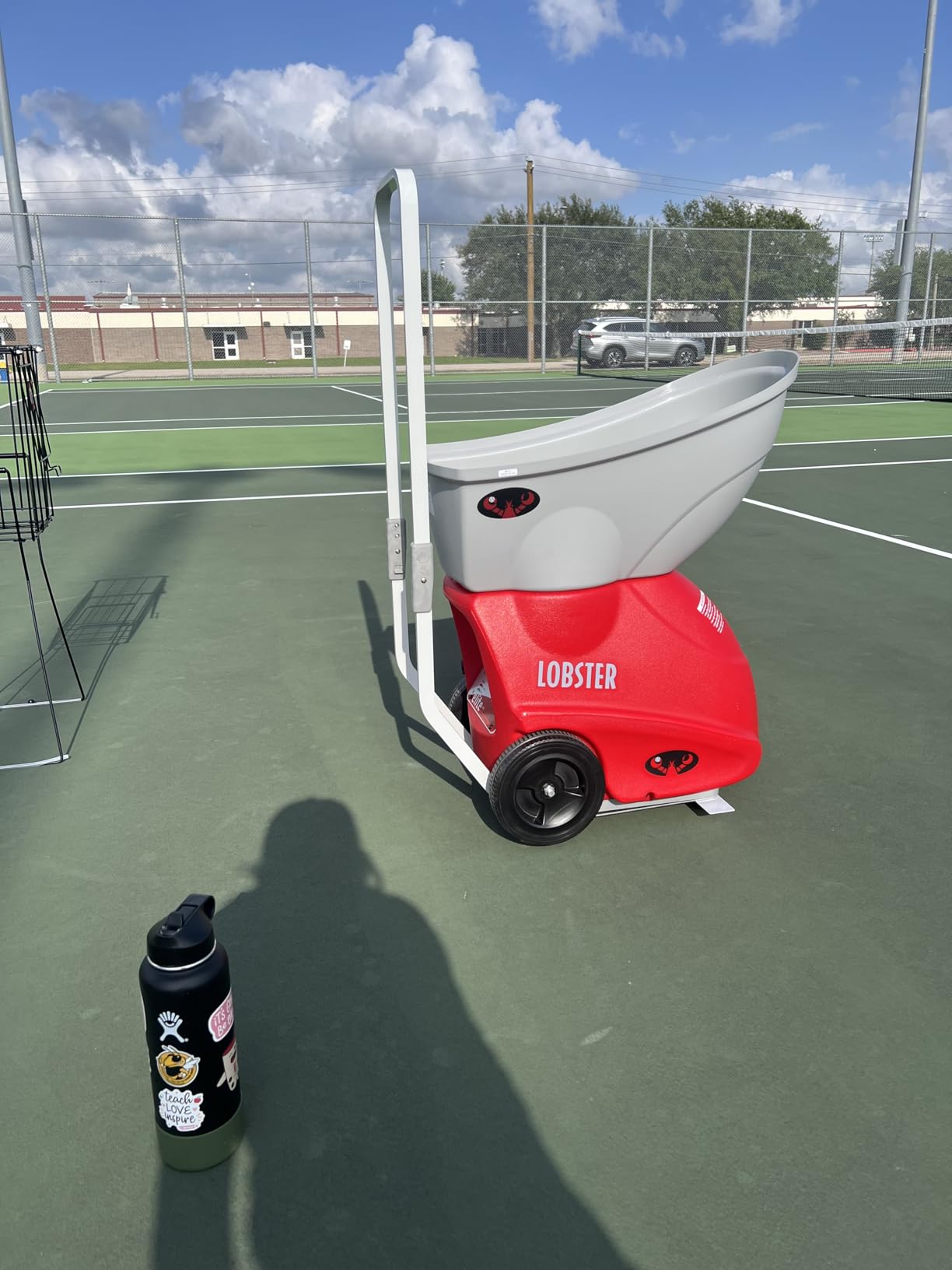
The honest weakness is portability, and it is a real one. At 42 lb with a folding handle, this is not something you carry to a public court across a field, and several owners mention the handle bend is sharp enough to mark a car interior or scratch arms. Grip points are not well placed for a lift into a boot, so this is a wheeled-and-load machine rather than a shoulder-carry one.
Second, the remote control is not included, and that is an odd omission on a machine at this level. The ball basin also holds closer to 40 balls in practice once the machine is tipped for rolling, so a high-capacity hopper in the spec list does not necessarily mean 150 balls per dump. Bring a second basket or a tube if you plan long sessions.
Is the Lobster Elite the right machine for your court setup?
If you have a driveway, a garden court, a club court you visit weekly, or a garage within a short walk of a hard court, this is the strongest all-round pick in the group. The 150 ball capacity, random horizontal oscillation and 4 to 6 hours of runtime mean one charge typically covers a full practice session without a mid-session pause.
You also want it if you are working on groundstrokes and consistency, because the feed reliability and the range of speeds let you build a progression from 30 MPH to 70 MPH inside one session. The electronic elevation control adds lobs up to 60 degrees, which unlocks overhead and net work without a second machine.
When should you skip the Lobster Elite?
Skip it if you have no car and no home court, or if the walk from where you park is more than a couple of minutes on uneven ground. Forty-two pounds plus a hopper of balls is a two-person job in the way that an 18 lb machine is not, and buyers who underestimated that step are the ones who regret it.
Also skip it if you plan to run long sessions without a way to retrieve balls, or if you need remote and app control as a dealbreaker. The extra remote is a separate purchase, and there is no app. If programmable drills matter to you, the Spinshot Plus-2 covers more ground.
2. Spinshot Pro Tennis Ball Machine – The One Built to Survive
Spinshot Pro Tennis Ball Machine (The Best Model for Easy Use)
Metal and PU body
1 to 10 second feed
Topspin and underspin
About 60 balls
Pros
- Metal and PU construction not plastic
- Feed rate adjustable from 1 second to 10 seconds
- Oscillation and lob functions
- Spinshot support replaced a failed battery and flap
Cons
- Battery not included and must be bought separately
- Heaviest machine in the group at 49.8 lb
- Balls occasionally jam in the dispenser
Everything on this machine that is not battery-related feels overbuilt. The body is metal and polyurethane rather than plastic, and owners who have had one for years describe it as built like a tank, with some reporting thousands of balls through it without feed problems. The feed rate runs from one ball per second down to one ball every ten seconds, which is the widest interval spread here.
It offers topspin and underspin modes plus dedicated oscillation and lob functions, and the hopper holds around 60 balls. That is enough for a focused 20-minute block rather than a marathon session. Spinshot’s support is singled out in reviews as fast and helpful, including free replacements outside warranty.
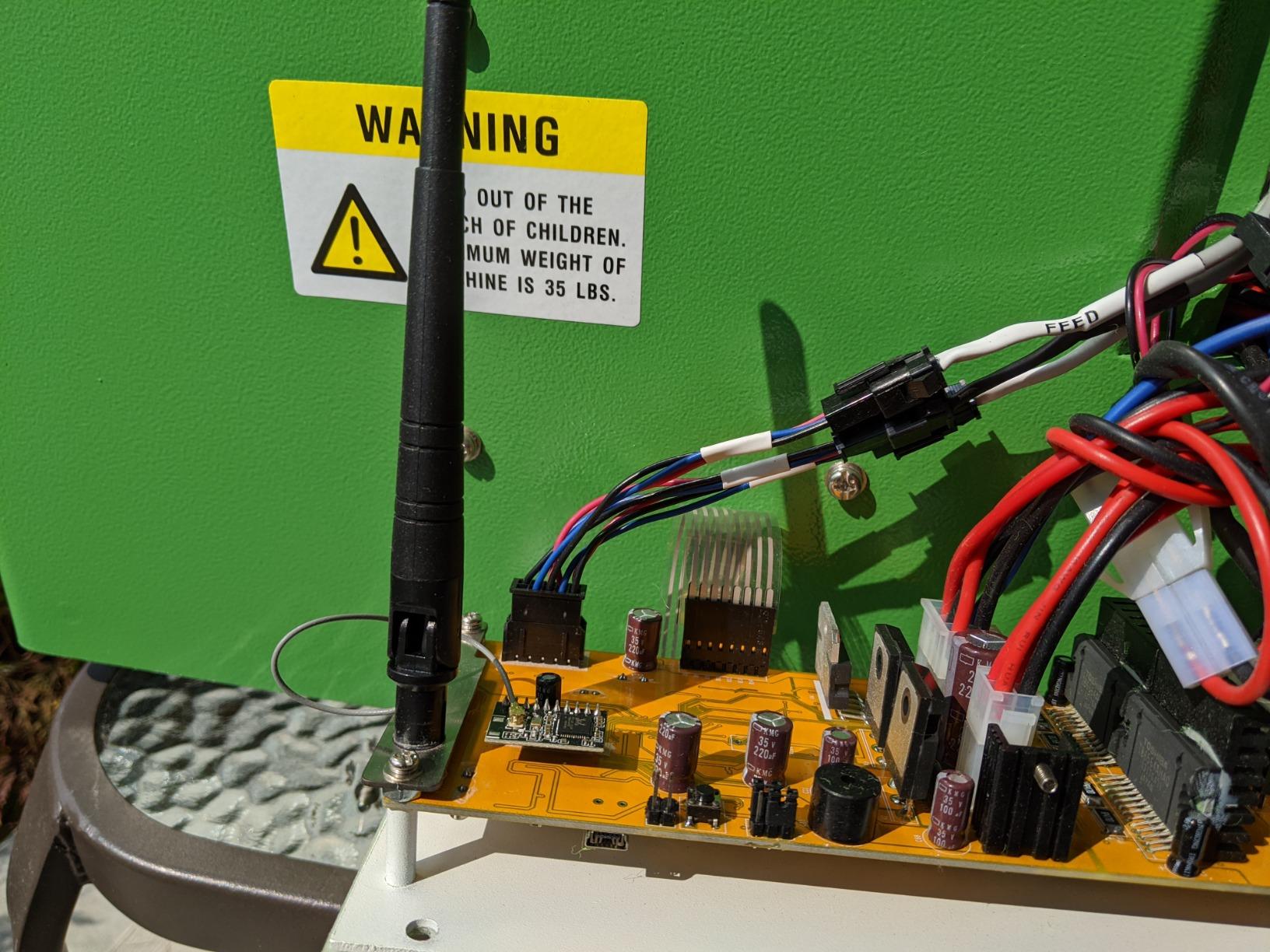
The battery is the catch, and it is a significant one. The pack is not included. Several reviews describe a battery that held only 10 to 15 minutes before a free replacement, and one owner reports a machine that stopped working after about ten sessions. Budget for a proper battery up front, because the machine is useless without one.
At 49.8 lb this is the heaviest machine in the roundup, which makes it awkward even with wheels. Balls occasionally jam in the dispenser and need clearing, the hopper flap is described as flimsy with no clear view of remaining balls mid-session, and the battery compartment connection can loosen enough to silently stop feeding at high speed. Also note only one spin type can be dispensed per session.
Who gets the most out of the Spinshot Pro?
This suits players who hit a lot of balls, practice at a fixed court where a heavy machine is not a problem, and want a chassis that will still work in five years. The metal-and-PU body is the reason it holds up, and the long interval range makes it good for everything from rapid-fire forehand drills to slow point-by-point work.
It is also the pick for anyone who lives somewhere dry and dusty, or who prefers a knob-and-switch machine to an app. Everything is knob-controlled and simple enough for a junior to operate, which matters if a child is feeding for a parent.
Who should buy something lighter instead?
Anyone carrying a machine on foot, storing it upstairs, or loading it into a small car on its own should look elsewhere. Fifty pounds plus a battery you have to buy separately is a lot of commitment for a machine whose hopper only holds about 60 balls, which is fewer than several much lighter rivals.
If you dislike finicky consumables, be aware that the feed wheels, hopper flap and battery connection are all service points. Nothing here is fragile, but nothing is entirely maintenance-free either.
3. Spinshot Plus-2 Tennis Ball Machine – Best Shot Variety and Programming
Spinshot Plus-2 Tennis Ball Machine (Plus2 Model =Plus Model + Player Model)
120+ ball foldable hopper
App and watch control
Any oscillation pattern
Quiet operation
Pros
- Almost unlimited custom drill programming
- Produces moon balls and drop shots
- App and Apple Watch control from the baseline
- Quiet enough for early mornings and shared courts
Cons
- App connection is inconsistent and can lock up
- Batteries fail earlier than expected
- Balls do not always feed and shut the machine down
If the question is what a ball machine can do that a hitting partner cannot, this is the answer. The phone app programs each individual shot for speed, spin, height, angle and feed rate, and users build custom sequences and approach patterns rather than choosing from a fixed menu. Owners report moon balls and drop shots from the same unit that feeds groundstrokes, which expands a solo session well beyond rally hitting.
The foldable hopper holds over 120 balls, you can set any oscillation pattern you want, and operation is quiet enough for residential courts and early mornings. App and Apple Watch control means you can change settings from the hitting stance instead of walking back to the machine between drills.
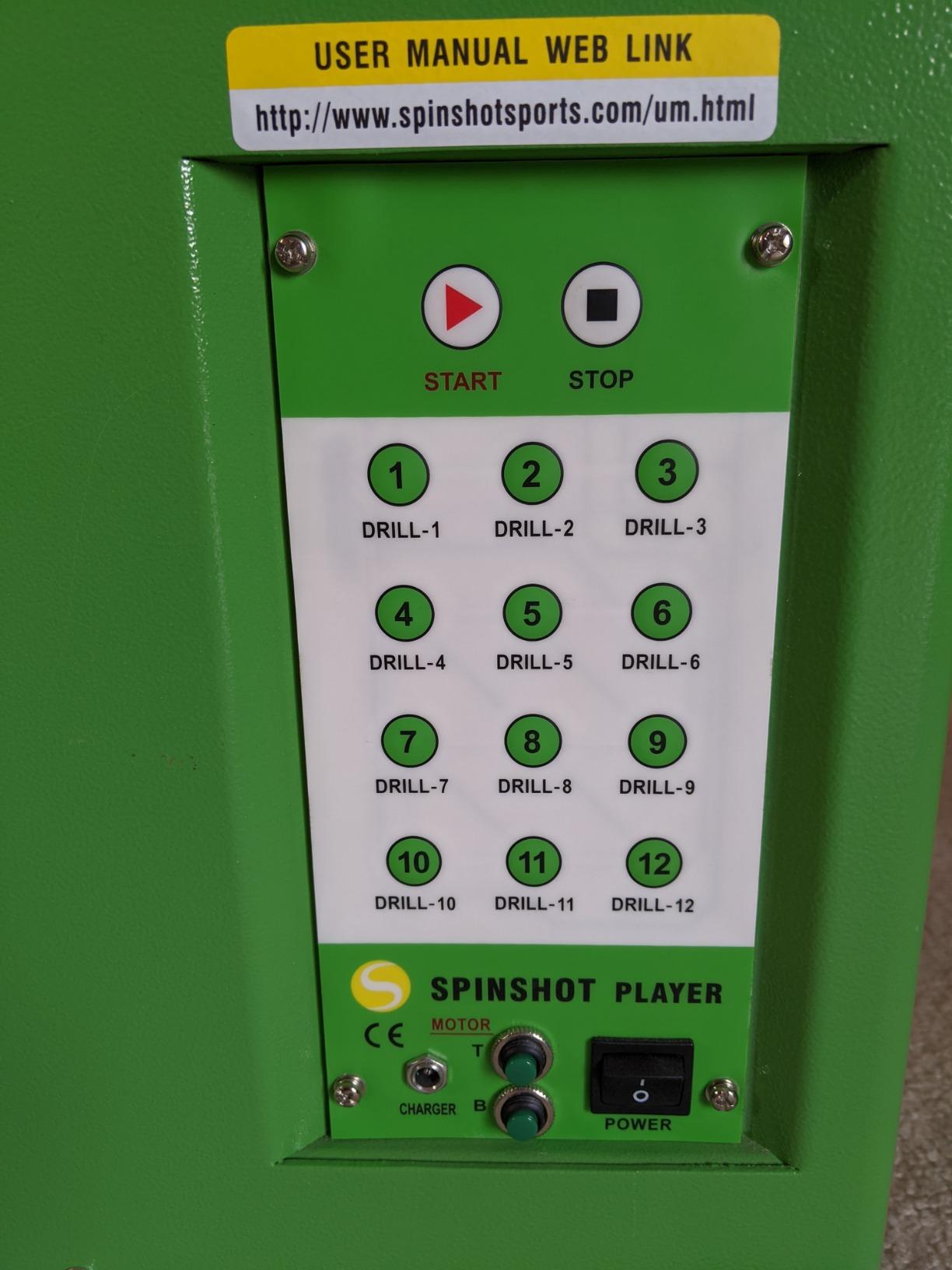
Reliability is the divide in owner reviews. Battery life is the most common complaint, with some owners replacing packs twice, and the app connection is inconsistent, sometimes locking up or losing state until you force-close and reopen it. Balls also do not always feed into the feeder, which shuts the machine down until you reset it, and the hopper flap design is called out as a genuine flaw.
The wheels are undersized for grass or gravel, and support is email-only and slow to respond. None of this is disqualifying if you program drills and hit regularly, because most owners report their machine working well and helping juniors and adults improve, but it is more temperamental than the Lobster.
Is the Plus-2 worth it for a home practice player?
Yes, if you have a specific technical problem to solve. Serve-and-return consistency, a slice you have never trusted, overheads against a high feed, or building a forehand that holds under lateral pressure are all drill problems that programmable sequences solve better than a random-feeder machine.
It also makes sense if the machine lives at a club or a shared court, because the 120+ ball hopper means fewer pickup breaks and the quiet operation is a genuine courtesy to neighbours. Random placement is specifically praised for forcing footwork.
What are the compromises with the Spinshot Plus-2?
The battery is sold separately here as well, and owners replacing them twice suggests budgeting for a second pack sooner than the marketing hours imply. If app stability is going to bother you, this is the wrong machine; the Lobster and Nisplay do the job without a phone.
It is also priced above the mid-range field for capability rather than build, and if your priority is pure groundstroke volume per pound of machine, a simpler machine serves you better.
4. Furlihong 3819BH Portable Tennis Ball Machine – Best Budget Practice Partner
Furlihong 3819BH Portable Tennis Ball Machine
About 4 kg to carry
5 angle settings
30 MPH
8 D-cell batteries
Pros
- Exceptionally light and easy to carry
- Five angles plus two power levels cover most reps
- Simple dial controls and 3 second feed for beginners
- Quick spiral ball track assembly
Cons
- Feeds are inconsistent with every second or third ball short
- 8 D-cell batteries instead of a rechargeable pack
- 30 MPH is low and forces a closer court position
This is the machine for someone who wants solo reps without a major purchase, and for anyone whose real constraint is carrying gear to a court. At roughly 4 kg it is the easiest machine here to move by hand, which owners say directly increases how often they actually practice rather than just own a machine.
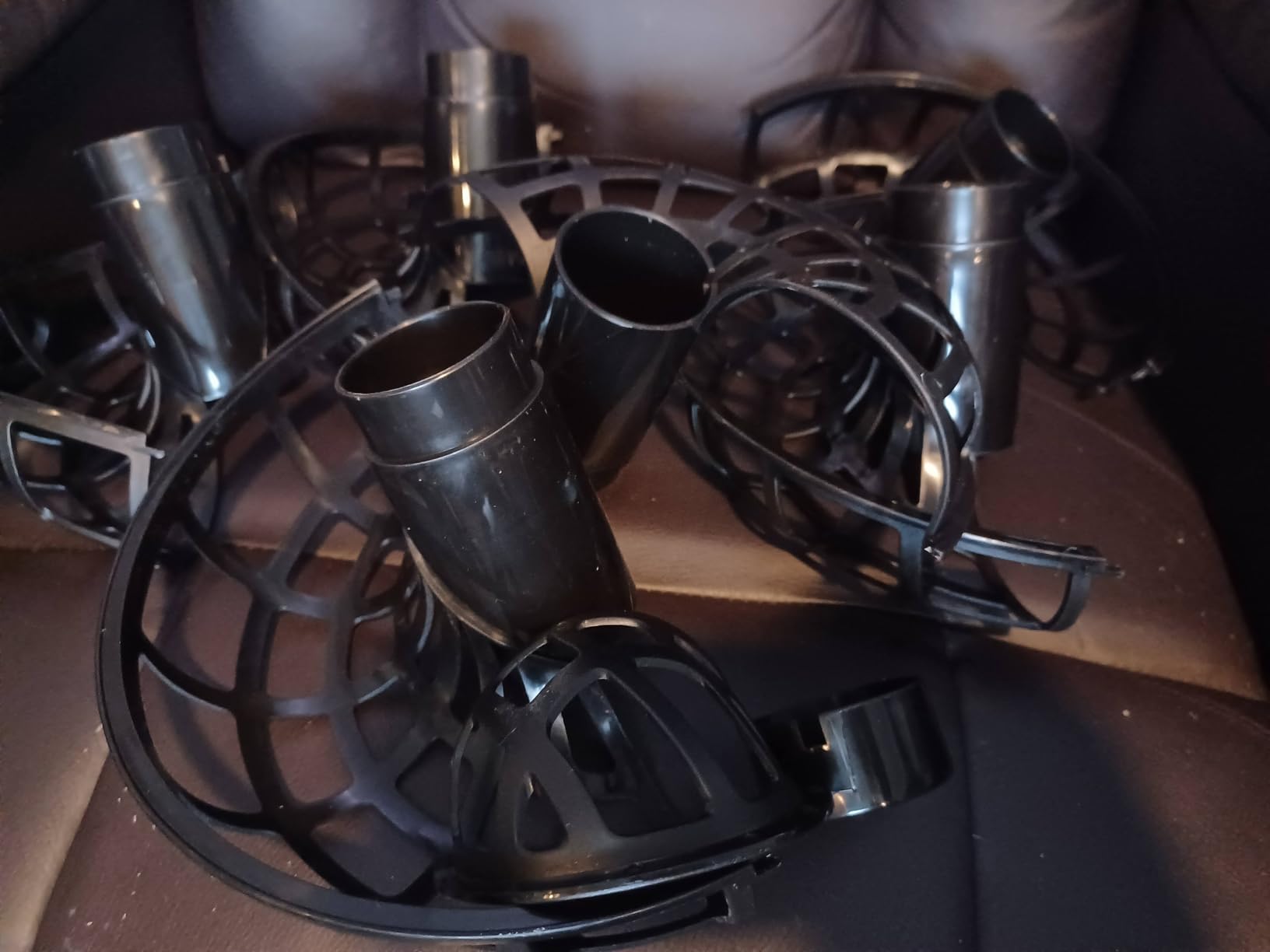
Five angle settings cover forehand, backhand, flat, slice and volley positions, with two power levels and four serve intervals. The spiral ball track assembles in seconds, the dial controls are simple enough for a beginner, and the 3 second feed is a sensible rhythm for early-stage groundstroke work.
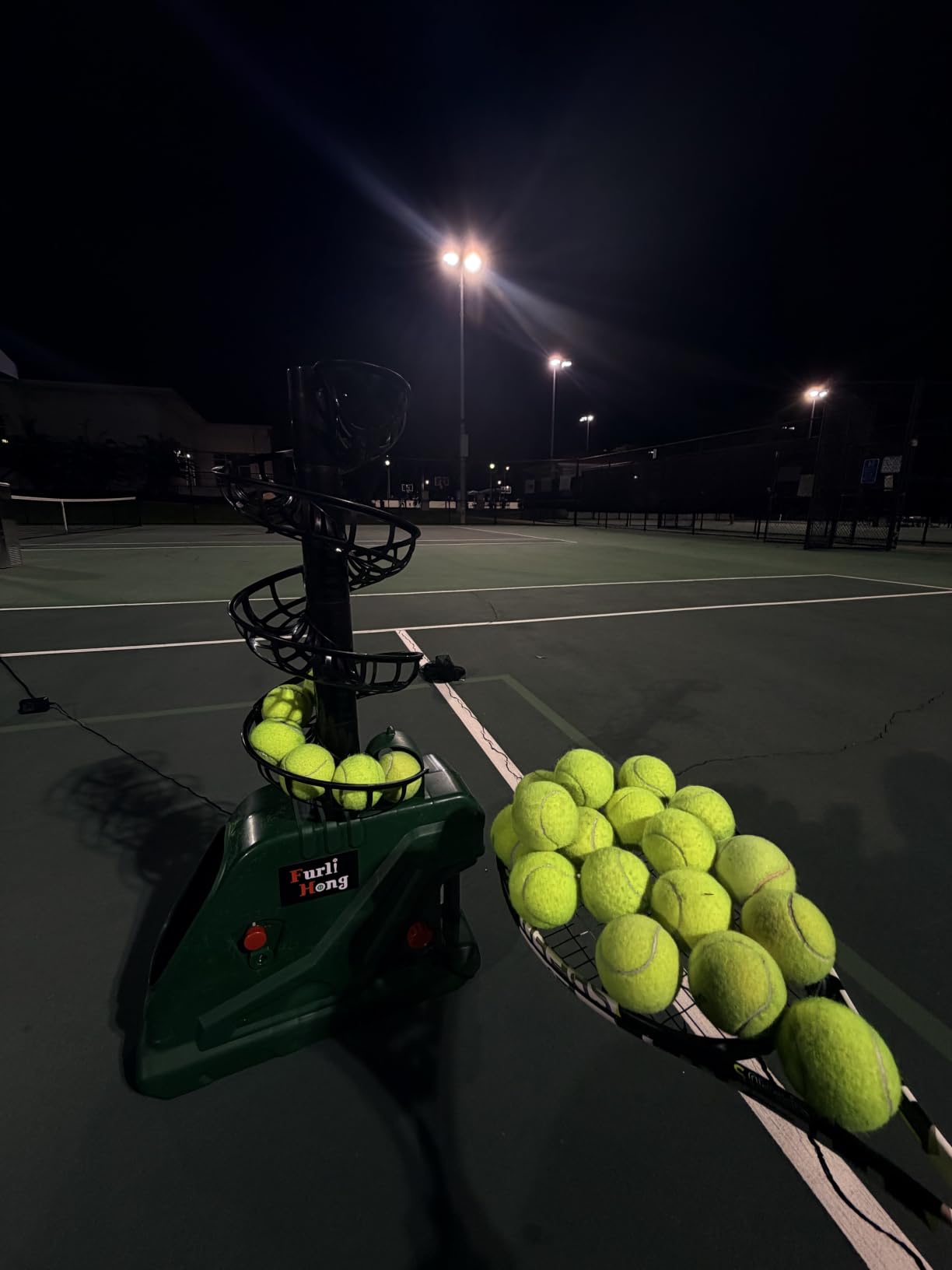
The compromises are real and reviewers are consistent about them. Every second or third ball falls short, so you are working with a less predictable feed than any of the mid-range machines. A 30 MPH ceiling is low, which means you set up closer to the service line rather than the baseline, and output reportedly weakens after a few months of regular use.
It runs on 8 D-cell batteries rather than a rechargeable pack, and owners repeatedly ask for a rechargeable option. There is no remote, so a second person is needed to start a session, and new ball fuzz jams the feed until you clear it. One owner also reported an upper motor failing after three days.
Is the Furlihong 3819BH good enough for a beginner?
For a beginner, yes, and this is the strongest case for it. Beginner stroke development needs repetition of a simple pattern, not precise placement or high speed. A cheap machine that you will actually carry to the court beats an expensive one that stays in a garage, and this is the easiest to move of the whole list.
It is also a reasonable second machine for a household, a way to test whether you enjoy solo practice before committing, and a compact unit for group drills where every player hits the same feed rather than chasing precise targets.
When is it the wrong buy?
It is the wrong buy if you already have consistent groundstrokes and are chasing depth, spin or placement under pressure, because the 30 MPH ceiling and falling shot tension work against that. Anyone who wants to practise serves properly should also look elsewhere, since a 3 second feed and a low ceiling do not simulate a serve.
It is also worth considering that the machine is rated best sellers rank high in its category largely on novelty and low cost. If you want something that still works in three years, spend more.
5. PUSUN PT-Smart Tennis Ball Machine – Best App and Watch Controlled Training
PUSUN Tennis Ball Machine,Portable Tennis Launcher,Tennis Trainer,PT-Smart
12 training modes
28-point placement
6 spin levels
4-6 hour battery
Pros
- 12 built-in modes plus 14 padel drills
- 28 programmable landing points with external oscillation
- 6 spin levels across a 12-75 MPH range
- Removable 153.6Wh battery charges away from the machine
Cons
- Small review base so long-term reliability is unproven
- App and Apple Watch features are still new to the platform
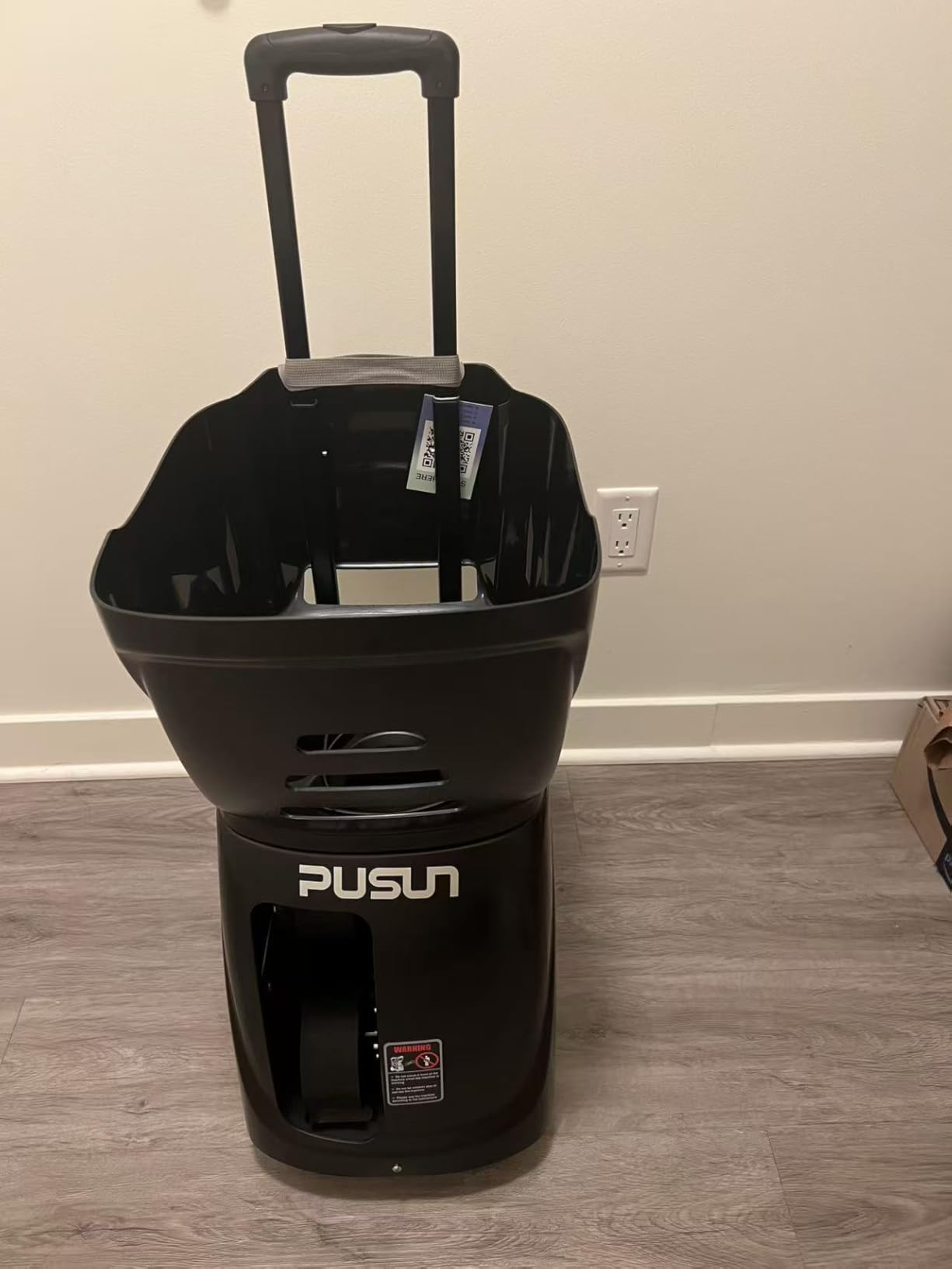
This is the most explicitly coaching-oriented machine here. Twelve built-in training modes plus a Padel mode with 14 specialised drills are mapped to NTRP 1.0 through 5.0, so instead of dialling numbers you pick a level and a progression style. Feed intervals run from 1.8 to 8 seconds across a 12 to 75 MPH range with six spin levels.
Control is triple: app, remote and Apple Watch compatibility, so you can start, pause and adjust from the hitting stance. The 28 programmable landing points with external oscillation give you depth targets rather than just a direction, and the dust-proof mainboard is rated for hard courts and red clay, accepting pressurised, non-pressurised and training balls.
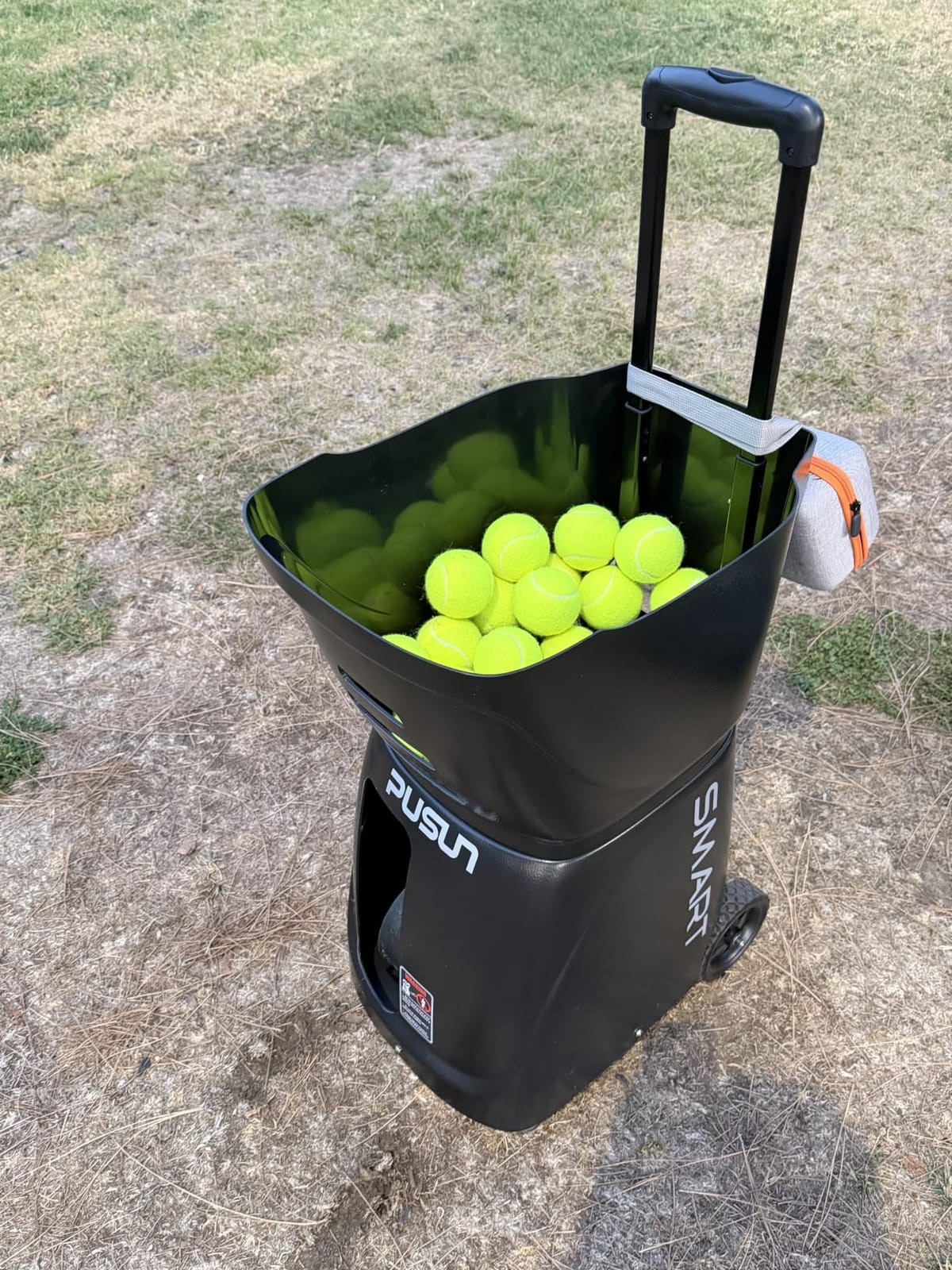
The 100-ball hopper collapses and the whole machine is 32.6 lb, which fits in a standard SUV boot. The 153.6Wh external battery pack is the design detail owners rate most highly, because you can leave the machine at a club and carry only the pack home to charge. Rated runtime is 4 to 6 hours.
Be measured about it. The listing carries only 50 reviews, so long-term durability is not yet documented, and the app and watch features are new enough that software refinement is likely. Ratings skew strongly positive, with roughly three quarters of reviews at five stars, but the history behind those stars is short.
Who should choose the PUSUN PT-Smart?
Players working with a coach or a structured progression plan, because NTRP-mapped modes and 28-point placement are closer to a drill board than any competitor’s menu. It is also the pick if you play padel as well as tennis, since the Padel mode is included rather than an add-on.
It suits a mixed-ball household too, since it handles pressurised, non-pressurised and training balls, and a player who stores a machine at a club because of the removable battery.
What should you watch for before buying?
You are buying a young product with a thin owner history, so accept that firmware and app behaviour may change. If you need a proven long-term record, the Lobster and Spinshot machines have years of accumulated owner feedback behind them, which is the main gap on this listing.
At 32.6 lb it is not a carry machine, and the app is the main control surface, so an app that misbehaves is more disruptive here than on a machine with physical dials.
6. Tenniix Basic Portable Tennis Robot – The Lightest Machine to Carry
TENNIIX Basic Tennis Ball Machine, 18.7LB Portable Tennis Robot, Black
18.7 lb folding chassis
75 MPH dual wheel
Voice armband control
1,800 shots per charge
Pros
- Lightest full-featured machine here at 18.7 lb
- Voice armband means no walking back to the machine
- 9 shot patterns plus a 6 style Match Mode
- Battery reserve matches the advertised 3 to 4 hours
Cons
- No wheels so it must be carried
- Forced 5 second pause between programmed patterns
- Hopper opening too narrow to pour a basket cleanly
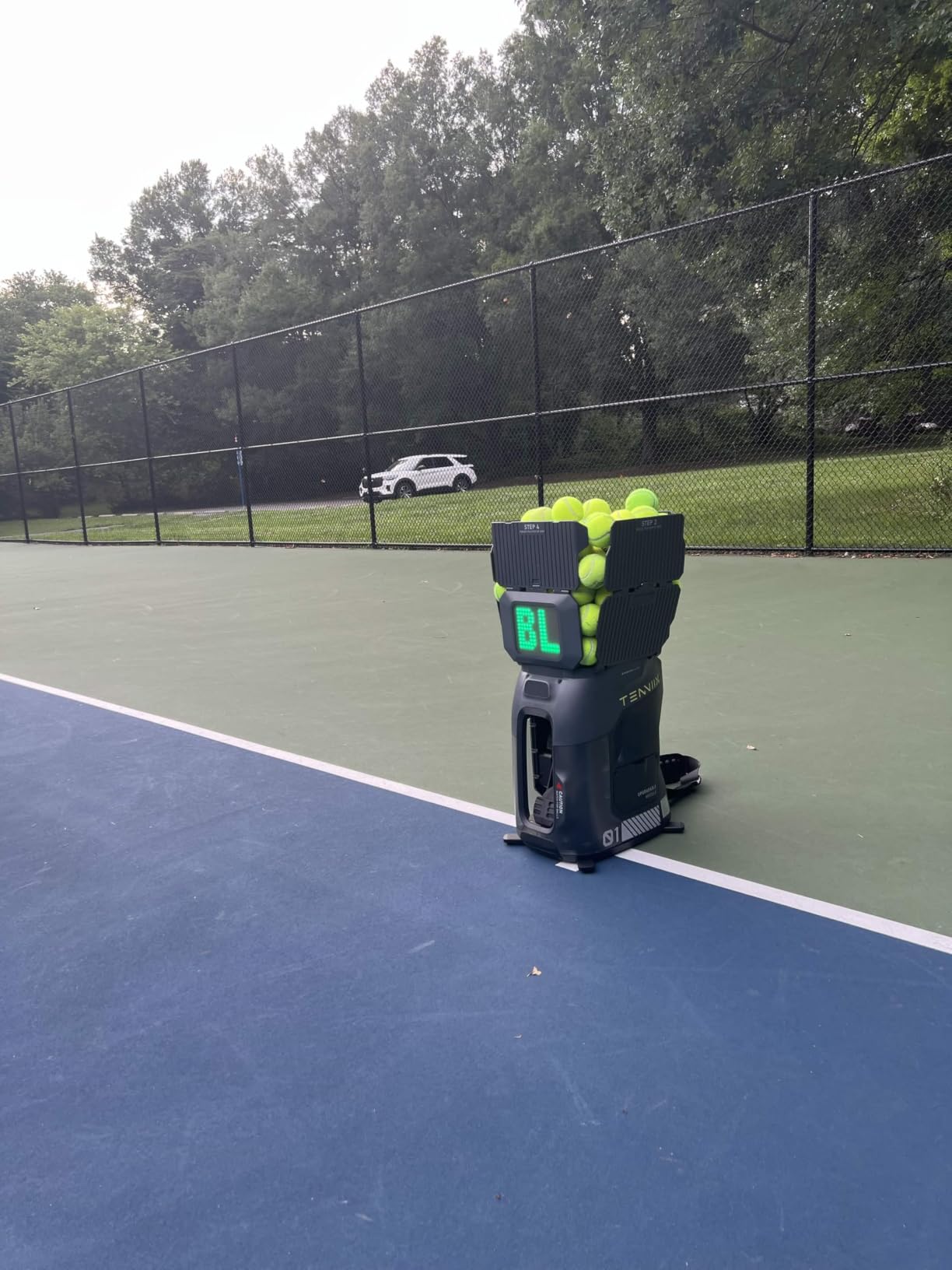
Portability is the decisive theme in owner reviews, and it is why this machine keeps showing up. At 18.7 lb with a folding chassis, non-slip handles and a shoulder strap, multiple owners replaced a much heavier legacy machine specifically because they now reach the court and start hitting within minutes. Everything else on the spec sheet follows from that design goal.
The dual-wheel launch system reaches up to 75 MPH, the 7000 mAh removable battery gives up to 4 hours of runtime and about 1,800 shots per charge, and the 1000+ ball combinations are adjusted through the app. A wireless wrist armband adds 46 voice command keywords, so you can start, stop and change drills hands-free.
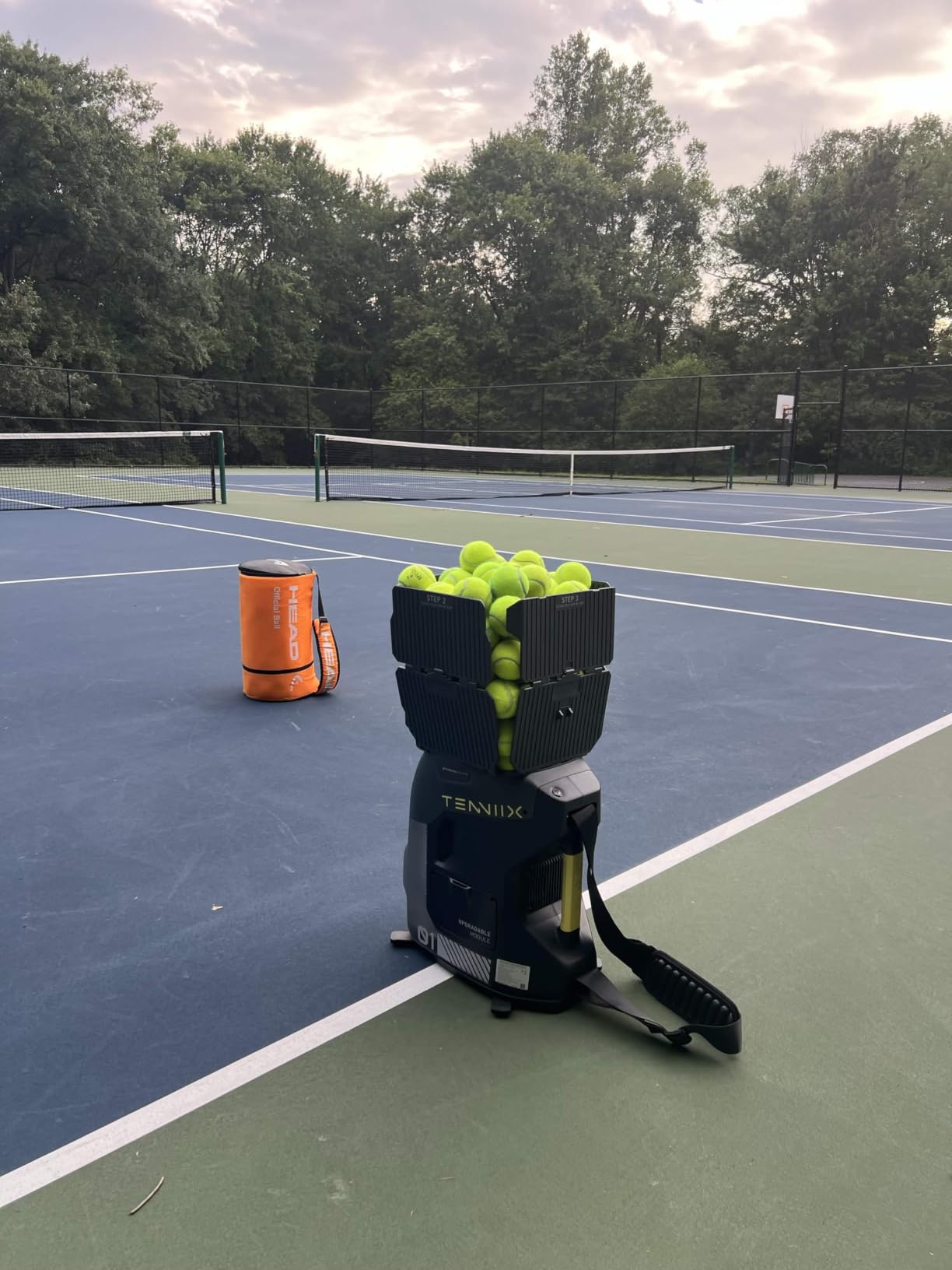
There are nine shot patterns including moon balls and kill shots, plus a Match Mode with six rally styles and NTRP L1 to L3 presets. The Move Drill in Match Mode is described as appropriately challenging because it forces side-to-side movement. It is also upgradeable later with an AI vision module for shot scoring without replacing the machine.
Build quality feels solid with no flex, and owners note the battery reserve matches the advertised 3 to 4 hours rather than exceeding or undershooting it. Some also report top speed falling short of the advertised 75 MPH in real use.
Is the Tenniix Basic good for public courts?
It is the best of this group for anyone without a home court who has to walk or cycle to a session. At 18.7 lb with a folding chassis and a shoulder strap it is a genuinely manageable carry, and the voice armband means you are not walking back to the machine every time you want to change a pattern.
It is also a strong first machine for a club player who wants a real feature set without a large machine. The Match Mode and the nine patterns cover far more than a random-feeder unit, and the app stores custom drills.
What are the compromises?
There are no wheels, so it is carried rather than pushed, and there is a mandatory 5 second pause between programmed patterns that interrupts drill flow in a way some owners find irritating. The hopper holds slightly fewer balls than advertised and the opening is too narrow to pour a basket cleanly.
Control depends on a phone app, and one owner reports the app and its updates stopped working, leaving only on and off. Support is hard to reach despite the advertised one-year warranty, which is the main thing to weigh before choosing it over a brand with a service reputation.
7. Nisplay 26 lb Dual Motor Machine – Best for Everyday Court Use
Nisplay Portable Tennis Ball Machine (26lbs) – Dual Motor for TopSpin and Backspin, 80+ Balls, Max 68MPH, 4+ Hours Play with External Lithium Battery (Ball Machine + Oscillator Combo)
26 lb with wheels
68 MPH and 0-50 degrees
Dual motor spin
4+ hour lithium battery
Pros
- Removable battery lets the machine live at the club
- Three feed holes self-correct stuck balls
- Fast 1 ball per second feed rate
- Aluminium build holds up under daily use
Cons
- Remote cannot switch the oscillator on or off
- Oscillator spray is lopsided
- Advertised top speed reads high over the net
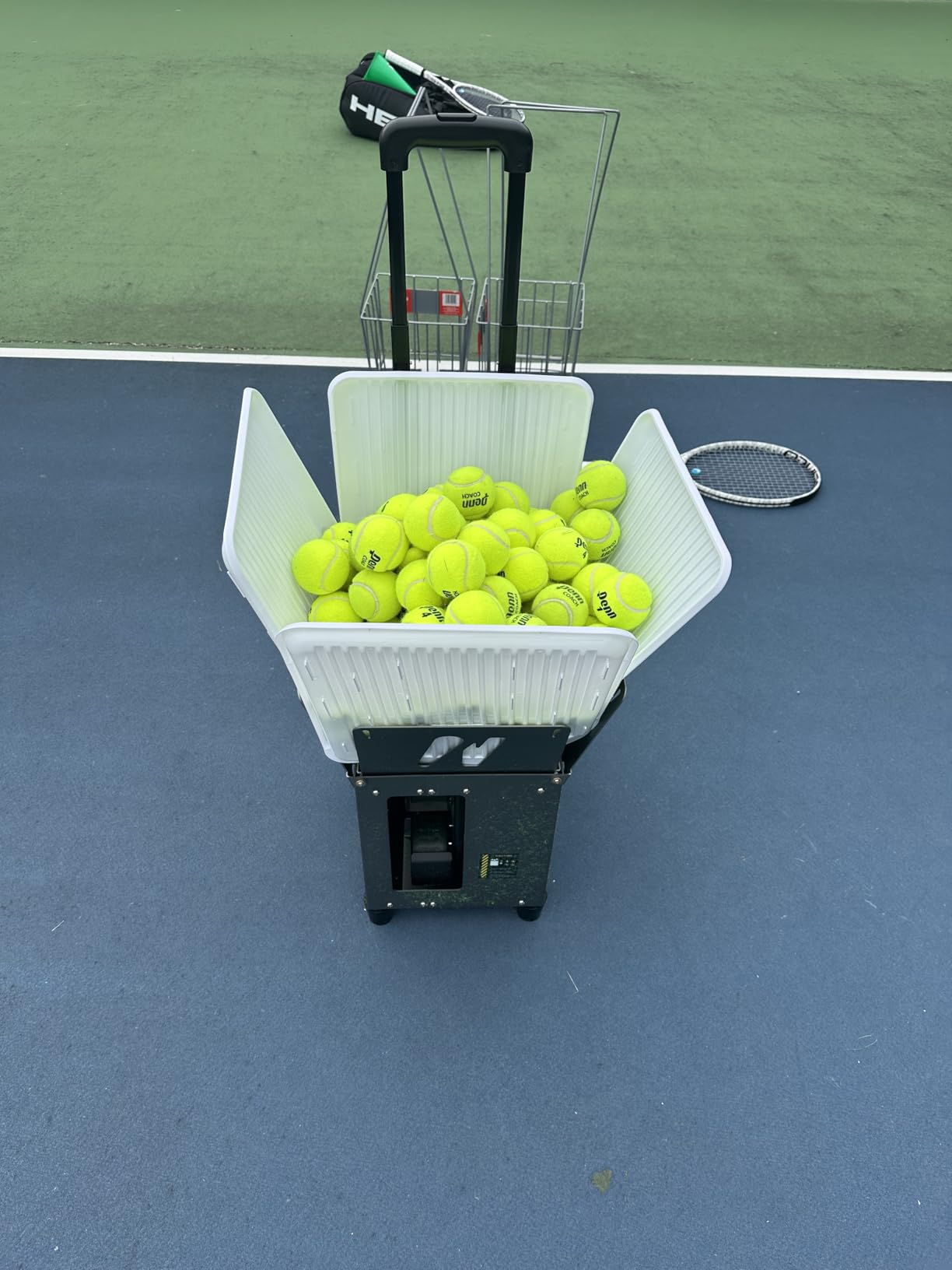
This machine carries the highest average rating in the group at 4.5, and owners point to two things above everything else. The first is the removable external lithium battery, which lets the machine stay in a club or garage while only the pack goes home to charge. The second is a build that survives daily use rather than surviving occasional use.
It is compact and light for a dual-motor machine at 26 lb, roughly the size of a basketball, and it fits in a sedan boot. Oversized wheels and a 3 foot folding handle take it over grass, gravel and curbs, and three ball-feed holes self-correct a stuck ball, which is why owners report it rarely jams.
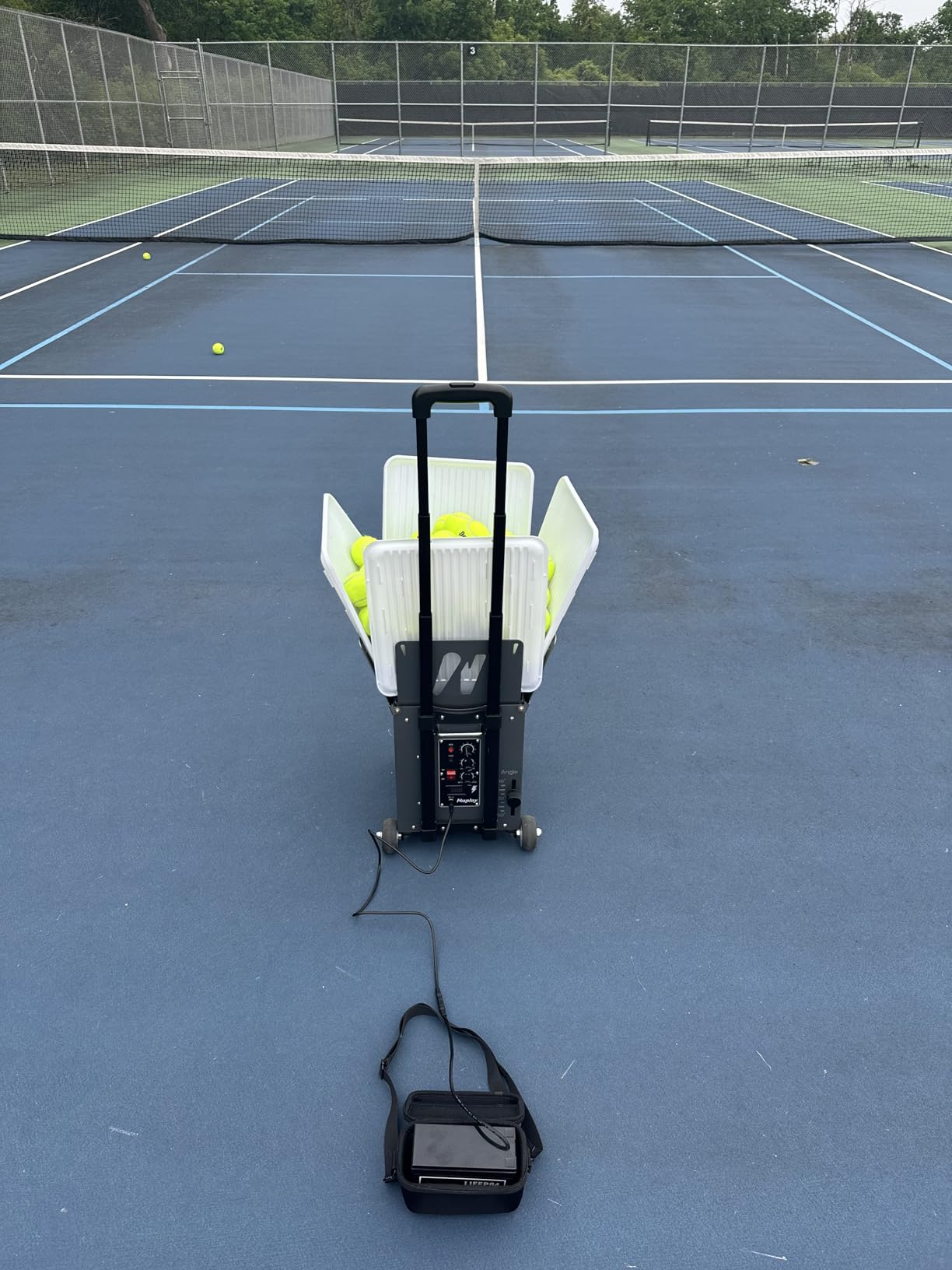
Speed reaches up to 68 MPH with elevation from 0 to 50 degrees, feed rate runs from 1 to 9 seconds between balls, and the dual-motor design handles flat, topspin and backspin at adjustable levels. The 1 ball per second feed is the fastest in this group, and the 80+ ball capacity with manual oscillation gives real forehand and backhand reps without repositioning.
Nisplay’s customer service is credited with replacing a missing power splitter cord, a lost remote and a faulty oscillator. That kind of responsiveness on accessories and small parts is a genuine advantage over brands that only honour the main unit warranty.
Why do owners rate the Nisplay so highly?
Because it solves the two things that end sessions early: ball jams and battery logistics. Rare jamming means you are not walking across the court mid-drill, and the removable battery means the machine is always charged, which is the difference between a weekly session and a monthly one.
It is also a sensible pick if you want a dual-motor spin setup at a mid-range weight. Adjustable topspin and backspin levels make it usable for both rally balls and attacking patterns, and 4+ hours of play per battery pack covers a long session.
What holds the Nisplay back?
The remote is the main frustration. It cannot engage the oscillator or stop the launch wheels, so you still walk over mid-session, and it has few buttons, with no spin level, frequency or oscillation width adjustment. The frequency knob is labelled in seconds between balls, so a higher number means fewer balls, which catches people out.
Also expect the oscillator spray to pivot further to one side than the other, the spin output to be modest for the money, and the Y-cable between battery, machine and oscillator to be too short and gradually damaged by the pivoting motion.
8. Pongbot Pace S Pro – Best for Long Sessions and Large Hoppers
PONGBOT Tennis Ball Machine, APP and Remote Control, Custom Drills, 150 Ball Capacity, Max 80mph,8+ Hours of Endurance, Dual Motor for Topspin and Backspin, PACE S PRO
150 ball capacity
80 MPH and 60 rps spin
8+ hour runtime
App and remote drill sync
Pros
- Largest hopper here at 150 balls
- 8+ hours from a removable battery with a BMS
- 80 MPH and 60 rps spin across 6 oscillation spots
- Remote opens the barrel for pickup and cleaning
Cons
- Only 34 reviews so reliability is untested
- 46 lb despite the wheeled design
- Newly released so app and firmware stability is unknown
On paper this is the most capable machine in the roundup. A 150 ball capacity is the largest hopper here, which matters more than any spec sheet suggests because every dump is a pause in your session. Runtime is over 8 hours from a removable battery with a built-in battery management system, so in practice one charge covers a whole week of sessions.
Top speed is 80 MPH with 60 rps spin across 6 oscillation spots, and it works on clay, hard and grass courts as well as padel. Hundreds of drills are pre-loaded with unlimited custom ones, 30 drills sync from app to remote with over-the-air updates, and there is a user community for sharing and downloading drills made by other players.
Smart sensors drive adaptive rallies, recovery drills and NTRP match challenges, and a remote-controlled barrel opening simplifies ball pickup and internal cleaning, which is a small but genuinely useful touch when you are handling 150 balls at a time.
The catch is history. This listing launched in late 2025 and carries 34 reviews, so nobody has yet documented three years of durability, wheel wear or battery degradation. Weigh that against the accumulated owner histories of the Lobster and Spinshot machines, which have been running in the wild for years.
Is the Pace S Pro worth choosing for long sessions?
If your practice pattern is two or three hours at a time, yes. The 150 ball hopper and 8+ hour runtime mean you set it up once and stop interrupting to refill, and the remote barrel opening makes loading and cleaning quick. For short sessions, those same features are overkill and you are paying for capacity you will not use.
It is also the pick for someone who likes community and updates, because the drill-sharing ecosystem and OTA updates add value that a fixed-program machine cannot match. The adaptive rally and match challenge modes suit players who want point-based play rather than pure repetition.
What should you be cautious about?
At 46 lb it is among the heaviest machines here despite the wheeled design, so it still needs a car or a cart. Untested firmware and app stability is the other caution: a new platform can change behaviour under you, and a 34-review base gives you no early warning of that from other owners.
If you want proof before you commit, the Lobster and Nisplay options have the kind of long owner track record that tells you how these machines age.
9. Furlihong 3807BH Triangular Base Machine – Best Low-Cost Starter Unit
Furlihong 3807BH Tennis Ball Machine with Triangular Base
Iron triangular base
Swing launch port
Dual power with AC adapter
Carry bag included
Pros
- Iron triangular base stays stable through repeated feeds
- One button swing launch port holds any angle
- Runs from batteries or the included AC adapter
- Carry bag makes moving to a court straightforward
Cons
- Lowest rated here at 3.8 with about 1 in 5 reviews at one star
- Ball tracks need assembly before first use
- Tennis balls are not included
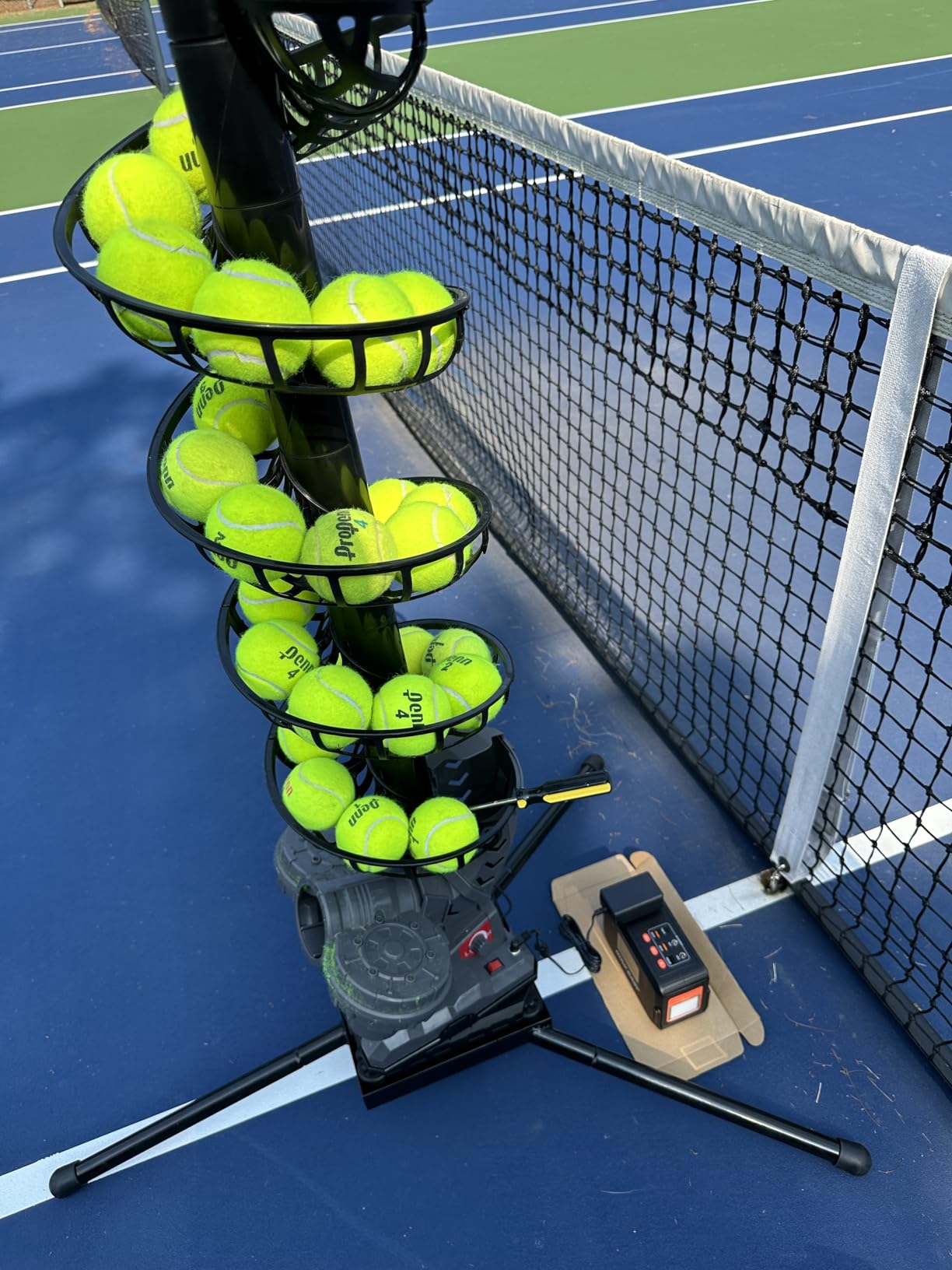
The selling point is physical. A triangular iron base does not wander or tip during repeated feeds, which is a real upgrade over the folding plastic stands used by cheaper machines, and the automatic up-and-down swing launch port holds any launch angle after a single button press. Once set, you are not adjusting height between drills.
It runs from either batteries or the included AC adapter, so the same machine works indoors and out, and a carrying bag is included. The adjustable low-to-high speed range covers beginner and intermediate work, and this is one of the few low-cost machines where owners consistently mention the physical design first rather than the feed.
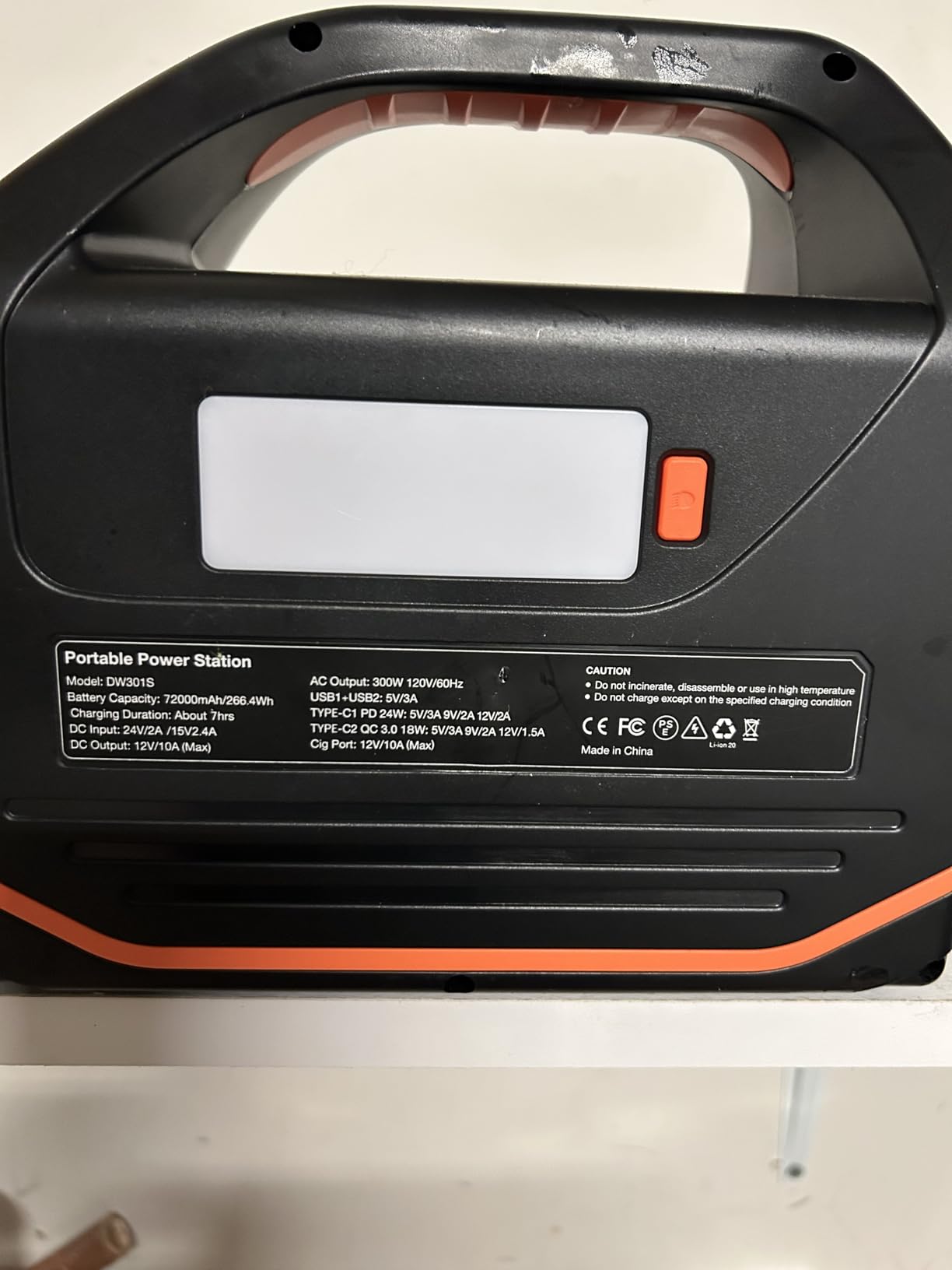
The satisfaction data is the caution. This carries the largest review count of the two Furlihong machines but the lower rating at 3.8, with about one in five reviewers at one star. That is a build and consistency problem rather than a missing feature, and it is why this sits lower in the ranking despite the sensible design.
Setup also takes longer than a plug-and-play machine, because the ball tracks need assembly and fitting before the first use. Tennis balls are not included, which matters at this end of the market where every accessory adds to the cost. Budget for a set of balls, a hopper and possibly a second machine sooner rather than later.
When does the stable base actually matter?
It matters if you are hitting repeated feeds at a fixed position and the machine is on an uneven or sloped surface, which is common on community courts. A base that will not shift means the launch angle stays where you set it, and that is a real training benefit rather than a cosmetic one.
It is also the right cheap option for someone practising in a fixed spot at home, indoors, or anywhere a mains connection is available and the battery is not the deciding factor. The dual power input is genuinely useful for that.
Who should spend more instead?
If you are buying this to last, spend more. A 3.8 average with a fifth of reviewers at one star is a signal that the feed and the build are not consistent, and inconsistency is the one thing a ball machine cannot tolerate if you want to train shot tolerance.
Anyone chasing spin, speed or a large hopper should also look elsewhere, since none of those are the reason to buy this machine. The 3819BH is the better Furlihong for carry weight, and a mid-range machine is the better buy for anyone who will practise more than a couple of times a month.
10. Spinshot Lite Tennis Training Machine – Lightest Spinshot, Weakest Specs
Spinshot Lite Tennis Training Machine Basic Model (Best Model for Junior Player)
Compact and light
Built-in oscillation
About 50 balls
Multi speed settings
Pros
- Light and compact enough to move by hand
- Built-in oscillator is unusual at this level
- About 2 hours of constant play per charge
- Fits in a car trunk for spontaneous sessions
Cons
- Lowest rated here at 3.5 with about 1 in 5 reviews at one star
- Holds only about 50 balls
- Weak speed forces a close court position
This is the most portable machine in the Spinshot range, aimed at intermediate and junior players, and the built-in side-to-side oscillator at this size is unusual. It runs on battery with no court-side cord, has multiple speed settings and adjustable launch height, and gives about two hours of constant play per charge with a quick recharge.
For someone whose real problem is getting a machine to a court, or fitting one in a small car trunk for a spontaneous solo session, that is a real set of advantages. The footprint is small and non-intrusive on a shared court.
Capacity is the consistent complaint. The hopper holds barely over 50 balls, so a session quickly becomes half picking up, which defeats the purpose of a machine in the first place. The speed is weak and not very adjustable, so the machine has to be placed near the service line rather than the baseline.
The side-to-side setting sprays balls into the doubles alley, which makes it unsuitable for the young children this model targets, and it adds noticeable topspin that is excessive for a junior. Multiple owners also report units failing within weeks or months, one after only 30 minutes of use.
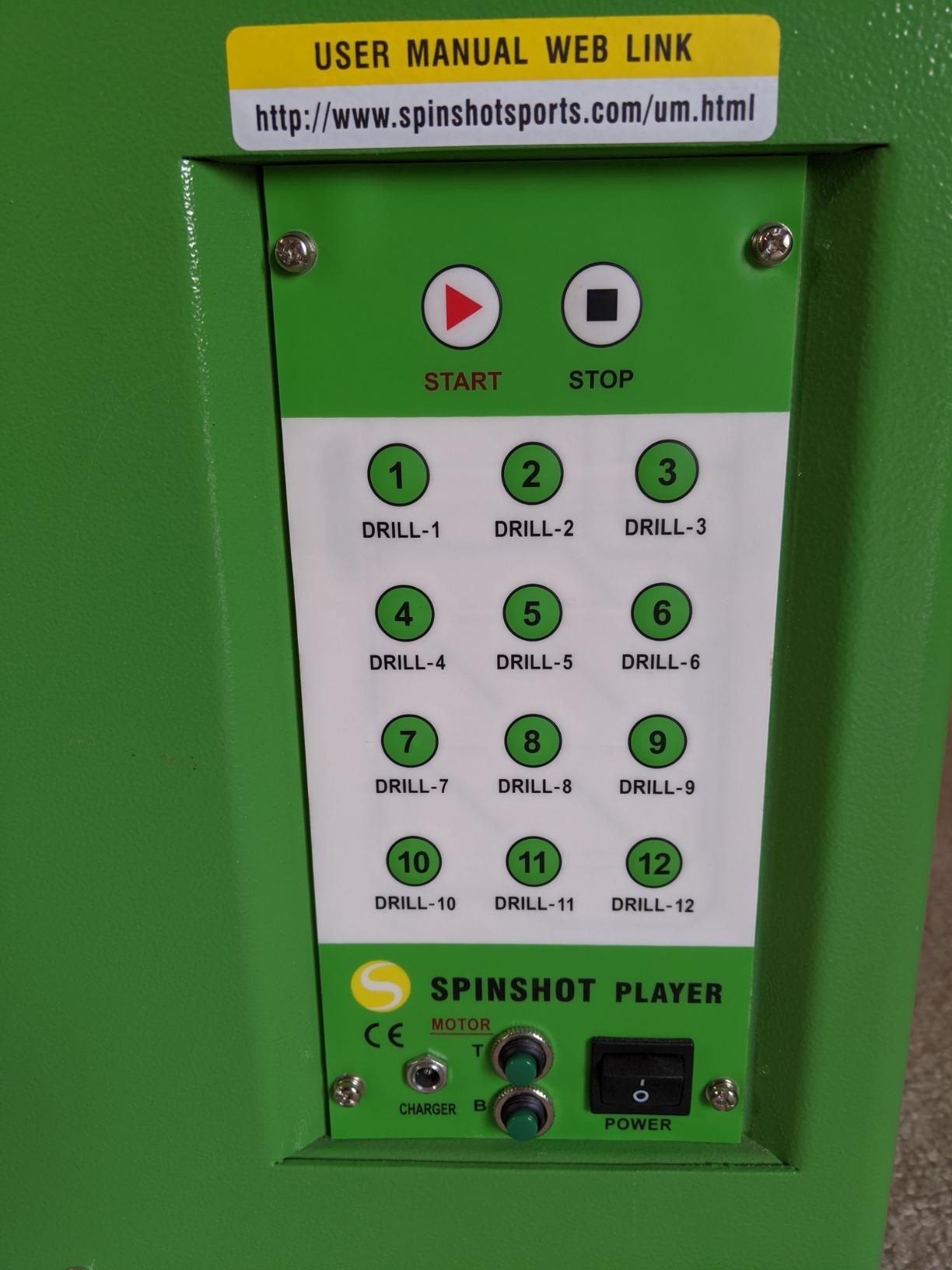
Is it the right pick for a young player?
Only if the player is genuinely working on fundamentals at close court position, with a supervising adult. A built-in oscillator and two hours of cordless play are meaningful for a junior who cannot be trusted with setup, and the small footprint is friendly on a busy public court.
If the child is old enough to handle a remote, a hopper upgrade and a slightly better machine will last far longer than this one. The optional hopper extension exists precisely because 50 balls is not enough.
Why does it sit last in our ranking?
Because the 3.5 rating with about 22 percent of reviews at one star is the weakest here, and the reasons are structural rather than a missing accessory. A small hopper plus a weak speed plus occasional unit failures is a combination that adds friction to every session.
Anyone buying once for a decade should choose a machine with a large hopper, a real speed range and a documented durability record. The Lobster Elite and Nisplay both deliver that, and the Spinshot Plus-2 adds the programming this machine lacks.
How to Choose a Tennis Ball Machine for Solo Practice
Start with your court, not the spec sheet. A machine that will not get to your court is worth nothing, so weight and power source come first, then the features that shape the quality of your repetition. Here are the criteria that actually change the practice experience.
Power source: AC, battery or both
Battery power is what makes home practice possible, because no court has a mains outlet at the baseline. Most machines in this roundup quote 4 to 6 hours of gameplay, and the Pongbot claims over 8 hours from a removable pack with a battery management system. Check whether the battery is included: two of the three Spinshot machines ship a charger but sell the battery separately, which is an expensive surprise.
A removable external battery is the most practical design, because it lets the machine live at a club while the pack charges at home. Dual-power machines that accept both batteries and an AC adapter are more flexible for indoor use and for anyone who wants a mains option as a backup.
Propulsion: spinning wheel versus pneumatic
Almost everything modern in this roundup uses counter-rotating wheels that grip and launch the ball, which is what allows speed and spin to be dialed in precisely and controlled by an electronic setting. Pneumatic machines force balls down a tube with air pressure and generally need a separate spin attachment, which adds size and complexity. For a home setup, wheel propulsion is simpler, quieter and easier to maintain.
Ball capacity and the pickup-time maths
This is the number most people underweight. Hoppers here run from about 28 balls to 150, and a 50 ball hopper means a session is as much pickup as hitting. Do the arithmetic honestly: 20 balls at a 3 second feed is one minute of hitting, so a 50 ball hopper gives you roughly 2 to 3 minutes before you are walking.
Hopper size also interacts with weight. A 150 ball hopper holds roughly 10 lb of balls on its own, and 100 balls is closer to 7 lb. If you are collecting by hand, add a tube, a hoop or a cart to the plan, and treat pickup time as part of the session rather than an interruption to it.
Oscillation: horizontal versus vertical
Horizontal oscillation sweeps the feed across the court, which forces lateral movement and means one machine can feed both forehand and backhand. Every machine here has it, though some only from a button you must press in person, as with the Nisplay, and the Tenniix inserts a mandatory pause between patterns. Vertical oscillation raises and lowers the launch point, which is what enables high lobs, moon balls and overheads, and only the Spinshot Plus-2 offers user-defined vertical patterns.
Speed, feed rate and spin
Speed ranges from 30 MPH on the budget Furlihong to 80 MPH on the Lobster and Pongbot, and the practical question is where you play from. Under 40 MPH forces you to stand near the service line, which trains contact points you will not use from the baseline. Feed rate is quoted in seconds between balls, and note that some machines label this in a counter-intuitive direction where a higher number means fewer balls.
Spin is where practice value jumps. A flat feeder trains depth; topspin trains the high bounce that lets you hit heavy from behind the baseline; slice and underspin train you to take the ball early. Machines with adjustable spin, such as the Lobster, the PUSUN with six levels, and the dual-motor Nisplay, let you rotate through all three in a single session.
Remote, app and voice control
A remote is the minimum for solo practice, because walking to the machine to restart it costs you 20 seconds every few minutes. An app adds programmable sequences, placement and NTRP progressions, as on the PUSUN, the Tenniix and the Pongbot, and voice control through an armband removes the walk-back entirely. Check what the remote cannot do: on the Nisplay it will not engage the oscillator or stop the wheels, and on some units the app is the only control surface at all.
Weight, wheels and getting it to the court
Weights run from about 4 kg on the Furlihong 3819BH to nearly 50 lb on the Spinshot Pro, and that single number determines whether you practise twice a week or twice a year. If you are carrying rather than loading, anything above about 20 lb needs a plan: a trolley, a wagon, a car, or a machine you can shoulder-carry like the Tenniix at 18.7 lb.
Wheels matter more than they look. The Lobster has 8 inch all-terrain wheels, the Nisplay has oversized wheels with a 3 foot folding handle for gravel and curbs, and the Spinshot Lite has no wheels at all. Small wheels on rough surfaces are the difference between rolling a machine to the baseline and dragging it.
Battery Life in Real Hours, Not Marketing Hours
Advertised battery hours assume a gentle feed rate and a light machine. In practice, higher speeds, heavier balls and a full hopper draw more, so the figure that matters is shots per charge rather than hours on a label. Owners report about 1,800 shots per charge on the Tenniix, and mid-tier machine owners commonly report something closer to 800 shots than the 1,000 to 1,500 they hoped for.
Second, whether the battery is user-replaceable and upgradable. A Lobster Elite Liberty owner swapped the included 9Ah lead-acid pack for a 10Ah lithium unit after 300 to 700 charges, and noted the lighter weight hardly mattered because everything was wheeled anyway. The pattern is clear: check the battery is replaceable before you buy, and consider a lithium upgrade later.
Third, expect packs to age before machines do. Multiple Spinshot owners in this roundup replaced batteries twice. If your practice plan is long term, treat one spare pack as part of the purchase rather than a future expense.
What You Need Beyond the Machine
The machine is the cheapest part of a home practice setup. A standard can of balls holds three, and 100 balls is roughly 7 lb, so a full hopper plus a machine plus a tube plus rackets is often a bigger carry than the machine alone. Decide how you will collect balls before you buy, because it changes which machine makes sense.
A pickup tube or hoop attachment cuts collection time dramatically compared with picking up by hand, and a cart or ball basket lets you carry the whole load in one trip. A minimum ball count of 60 to 100 gives you a real session, and dead or badly worn balls feel inconsistent, disrupt rhythm, and will not be fixed by a better machine, so rotate your ball stock rather than tolerating old ones.
If you plan to walk to a public court, weight is the constraint. The lightest option here is the Furlihong 3819BH at about 4 kg, followed by the Tenniix at 18.7 lb. If you have no car and no home court, renting a machine at the local court is the option experienced players on the Talk Tennis forums keep recommending, and it is the right call for anyone who practises a few times a year.
Tennis Ball Machine or AI Tennis Robot?
The terminology blurs, because several brands now market their machines as robots. A conventional ball machine fires on a timer or on a pattern you set. An AI tennis robot adds a camera or vision module that tracks where you are on the court and adapts the feed to your position, which is more like practising with a partner who feeds you where you are weak.
The Tenniix Basic in this roundup is the bridge case: it runs nine shot patterns and a Match Mode with NTRP presets today, and it is upgradeable later with an AI vision module for shot scoring without replacing the machine. That is the practical reason to prefer a machine with an upgrade path over a closed system.
The trade-off is straightforward. Vision systems cost more and add software that can age badly, while pattern-based machines are cheaper, quieter and well understood. For most home practice, a reliable feed with horizontal oscillation and a large hopper delivers more useful repetition than adaptive placement you do not yet need.
Should You Buy a Ball Machine or Rent One?
Buy if you will practise at least weekly, if your court is fixed, and if you want control over feed speed, spin and placement. That is the only scenario where ownership pays back, because the value is in the repetition you can stack, not in the machine itself.
Rent if you have no home court, if you practise a handful of times a season, or if you are still deciding whether solo practice suits you. Renting removes the logistics problem entirely, because the machine is already at the club.
Many experienced players on the Talk Tennis forums make a third argument, which is worth taking seriously: a mid-priced machine plus a real hitting partner beats a premium machine alone. A machine gives you volume and consistency of feed; a partner gives you direction and targets. Owning one does not mean refusing the other, and the best practice sessions we have seen combine both.
5 Solo Drills Worth Running on a Machine
Set the machine to a fixed depth and hit 20 forehands, counting out of 10 rather than judging by feel. A speed around 40 to 50 MPH is a sensible starting point for most club players, and the Lobster’s random oscillation is ideal because you cannot time the ball.
Switch the feed to a two-ball pattern, one forehand and one backhand on a wider oscillation, and keep counting out of 10. This is the fastest way to find out which side is actually holding up under repetition rather than in a warm-up.
For return practice, use the remote to start the machine while you serve, or program a short interval so you are always moving. A drop-shot or slice feed on the Spinshot Plus-2 tests your ability to take the ball early, which match play rarely gives you.
Movement drills work best with vertical oscillation or a high feed. Set a lob to 60 degrees and hit overheads under time pressure, or use the Tenniix Move Drill in Match Mode, which owners describe as appropriately challenging for exactly this reason.
Finish with points rather than reps. Set a games-to-11 scoring rule against the machine with a target score, so you are practising closing a game and not just hitting. Repetition drills transfer across sports in the same way, which is the thinking behind our guide to automatic ball launchers for fetch training.
Frequently Asked Questions
What is the best tennis ball machine for practice?
The Lobster Elite is the best all-round tennis ball machine for home practice: a 10 to 80 MPH speed range, topspin and backspin, random horizontal oscillation, a 150 ball hopper and 4 to 6 hours of battery runtime. The Spinshot Plus-2 wins on shot variety and app programming, and the Furlihong 3819BH is the cheapest workable option. Choose based on your court access and hopper needs.
Are tennis ball machines worth it?
They are worth it if you practise weekly on a fixed court, because repetition is what changes a stroke. A competitive player hits roughly 300 shots an hour in a match but can work through around 900 an hour off a machine. If you only practise a few times a season or have no home court, renting a machine at a club is usually the better call.
Do tennis pros use ball machines?
Yes, ball machines are a standard part of professional and academy training. They are used to build repetition, to isolate a technical weakness, and to serve hundreds of balls in a session. Pros normally use club machines with large hoppers and programmable feeds, and most combine machine work with partner drills rather than replacing a hitting partner entirely.
How long does a tennis ball machine battery last?
Expect fewer shots per charge than the label suggests once you use higher speeds and a full hopper. Owners commonly report around 800 shots per charge on a mid-tier machine, while the Tenniix Basic is rated for about 1,800 shots and up to 4 hours, and the Pongbot Pace S Pro claims over 8 hours. Check whether the battery is included, because two Spinshot models sell it separately.
Can you use a ball machine on a public court?
Yes, but weight decides whether it is practical. Machines here range from about 4 kg to nearly 50 lb, and anything above 20 lb needs a trolley, a car or a shoulder-carry design. Most public courts have power for ball machines, and experienced players without a home court often recommend renting a machine at the club instead of carrying one to every session.
How many tennis balls do I need for a ball machine?
Plan on 60 to 100 balls minimum. Hoppers here hold from about 28 to 150, and at a three second feed a 50 ball hopper gives you only a few minutes of hitting before you are picking up. A can holds three balls, so 100 balls is roughly 7 lb, which means a full hopper can weigh more than you expect when you are also carrying a machine.
The Verdict: Which Tennis Ball Machine Should You Buy?
The best tennis ball machine for home practice is the Lobster Elite if you have a car or a court within wheeling distance. Its 10 to 80 MPH range, random oscillation, 150 ball hopper and dependable feed make it the most complete package, and Lobster’s support shows up favourably across owner reviews even when the handle latch does not.
Buy the Spinshot Plus-2 instead if shot variety and programming matter more than build simplicity. Buy the Tenniix Basic if you carry your gear to the court, the Nisplay if you want the removable battery and the highest rating in the group, the Pongbot Pace S Pro if you want a 150 ball hopper and very long runtime, and the Furlihong 3819BH if budget is the only constraint.
Whatever you choose in 2026, decide how you will collect balls and how far you will carry them before you buy, because that decision has more impact on whether you actually practise than the difference between 68 MPH and 75 MPH.