
The best microscope for students overall is the National Geographic Dual LED Microscope Science Kit, because it is the only scope in this group that combines optical glass lenses, top and bottom LED illumination and a 50-plus piece accessory set at a level of build quality that survives being handed around a kitchen table every week.
That said, “best” depends heavily on who is using it. A seven year old needs something that focuses without adult help and does not break on the floor, while a high school student running an AP Biology lab needs fine focus, a mechanical stage and a head that does not tire one eye after twenty minutes. We looked at twelve compound microscopes and compared them on the four things that actually decide whether a student microscope is any good: real optical magnification, glass versus plastic optics, fine focus, and whether the frame and stage are metal.
Everything in this guide covers elementary, middle school, high school, homeschool and intro college use, and every product below was judged on the same criteria regardless of price tier. No internal links were available for this topic, so nothing here is padded with cross-references to unrelated posts.
Table of Contents
Key features to look for in a student microscope
Real optical magnification: total magnification equals eyepiece power multiplied by objective power. A 10X eyepiece on a 40X objective gives 400X of true optical image, and anything above that usually comes from an auxiliary lens.
Fine focus: a separate fine focus knob is what makes 400X and above usable. Without it, a student is cranking the coarse knob and overshooting the specimen.
Mechanical stage: a movable platform with control knobs lets you scan a slide systematically instead of shoving it around by hand.
Optical glass and a metal frame: plastic objectives and plastic bodies warp, crack and lose alignment, which is the most repeated complaint about cheap scopes.
Dual LED illumination: bottom light for transparent slides, top light for solid objects like leaves, hair, coins and insects.
Top 3 Picks for the Best Microscopes for Students in 2026

National Geographic Dual…
- 20x and 50x optical glass lens sets
- Dual top and bottom LED illumination
- Over 50 accessories with 10 prepared slides

TOMLOV CM101 Compound Micro…
- Coaxial coarse and fine focus
- Achromatic 4x/10x/40x objectives
- 6-position color filter disc
Omano Juniorscope Microscop…
- Glass objectives to 400x
- Works on solid and transparent specimens
- Lifetime limited warranty
Best Microscopes for Students in 2026: All 12 Compared
Every microscope below is a real compound instrument rather than a plastic novelty toy, which is the line we drew when assembling this list. The table shows what each one actually does rather than what the listing headline claims.
| Product | Specs | Action |
|---|---|---|
| National Geographic Dual LED Science Kit |
|
Check Latest Price |
 National Geographic Kids Microscope 400x National Geographic Kids Microscope 400x |
|
Check Latest Price |
 BEBANG 2000X Compound Microscope BEBANG 2000X Compound Microscope |
|
Check Latest Price |
| TOMLOV CM101 Compound Microscope |
|
Check Latest Price |
 Uarzt 58-Piece Kids Microscope Kit Uarzt 58-Piece Kids Microscope Kit |
|
Check Latest Price |
| Omano Juniorscope Microscope Kit |
|
Check Latest Price |
 PalliPartners Compound Microscope PalliPartners Compound Microscope |
|
Check Latest Price |
 Emarth 40X-1000X 52-Piece Kit Emarth 40X-1000X 52-Piece Kit |
|
Check Latest Price |
 JECONE 40X-2500X Compound Microscope JECONE 40X-2500X Compound Microscope |
|
Check Latest Price |
 PALOBIL 100X-2000X Compound Microscope PALOBIL 100X-2000X Compound Microscope |
|
Check Latest Price |
 Herwicm Binocular Microscope Herwicm Binocular Microscope |
|
Check Latest Price |
 PalliPartners Trinocular Microscope PalliPartners Trinocular Microscope |
|
Check Latest Price |
1. National Geographic Dual LED Microscope Science Kit: Best Overall for Students
National Geographic Dual LED Microscope Science Kit for Kids Ages 8-12
20x and 50x optical glass lens sets
Top and bottom LED
Over 50 accessories
2 pound battery powered
Pros
- Two illumination sources so kids can view slides and solid objects
- Over 50 accessories including 10 prepared slides and a mini geode
- Sturdy plastic metal and glass construction
- Compact and light enough to move between rooms
- Simple eyepiece swap a child can do alone
Cons
- Maximum 20x/50x is too low for serious specimen work
- Bottom LED can be too bright to resolve fine detail
- Eyepieces do not lock into the body
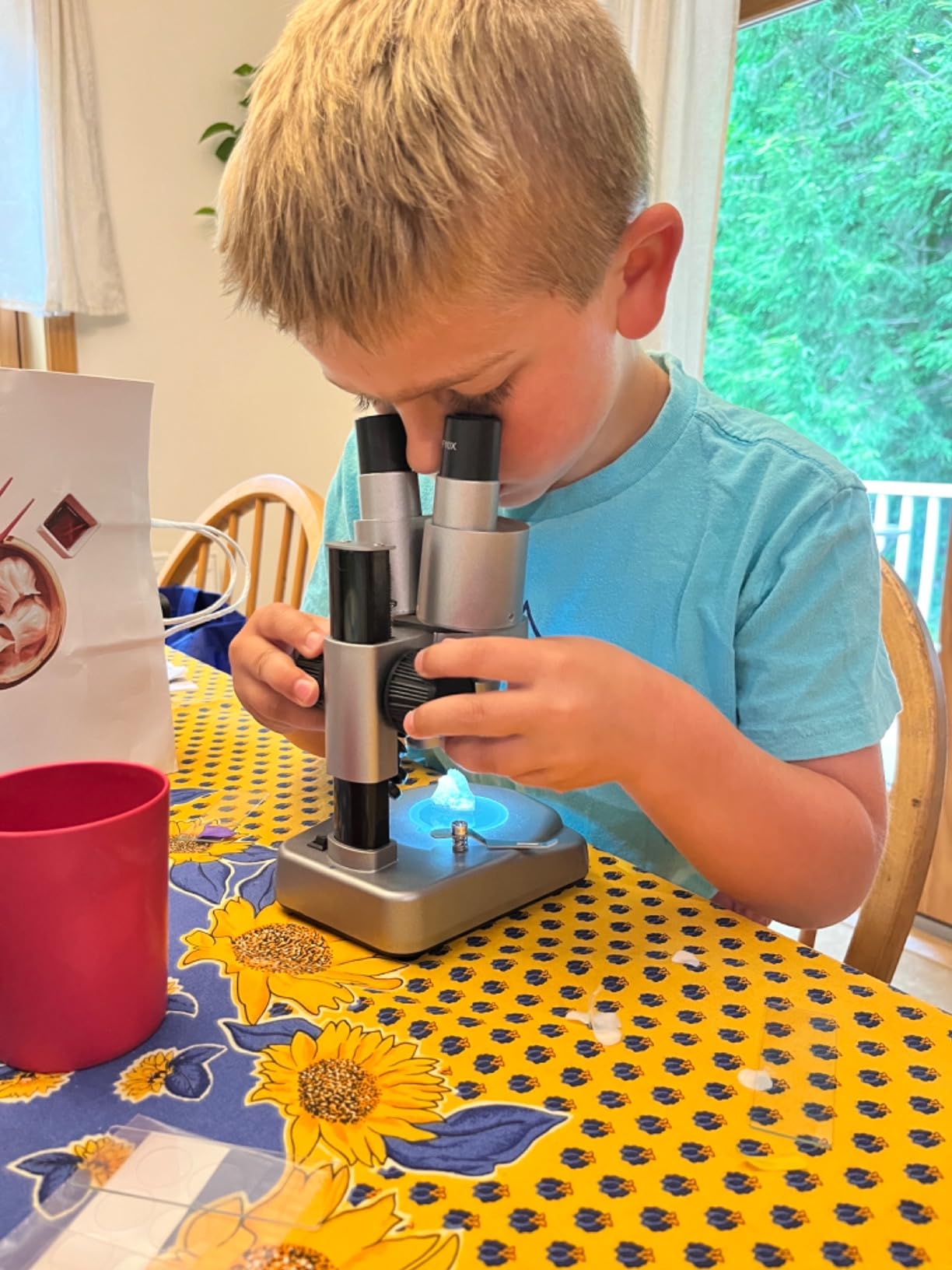
The thing that separates this kit from the pack is the dual lighting system. The lower LED handles prepared slides and the upper LED lights solid objects, so a child can look at a prepared slide and then flip a coin, a leaf or a strand of hair onto the stage without owning a second instrument. The two optical glass lens sets at 20x and 50x are the honest kind, and they swap by hand in a couple of seconds.
It also arrives genuinely ready to use. The box holds more than fifty pieces, including ten prepared slides, blank slides, cover slips, tweezers, an eye dropper and a mini geode, which means nobody spends the first Saturday hunting for supplies. Reviewers consistently describe it as a durable first microscope for school-aged children and praise the accessory count and the ease of use for kids operating it independently.
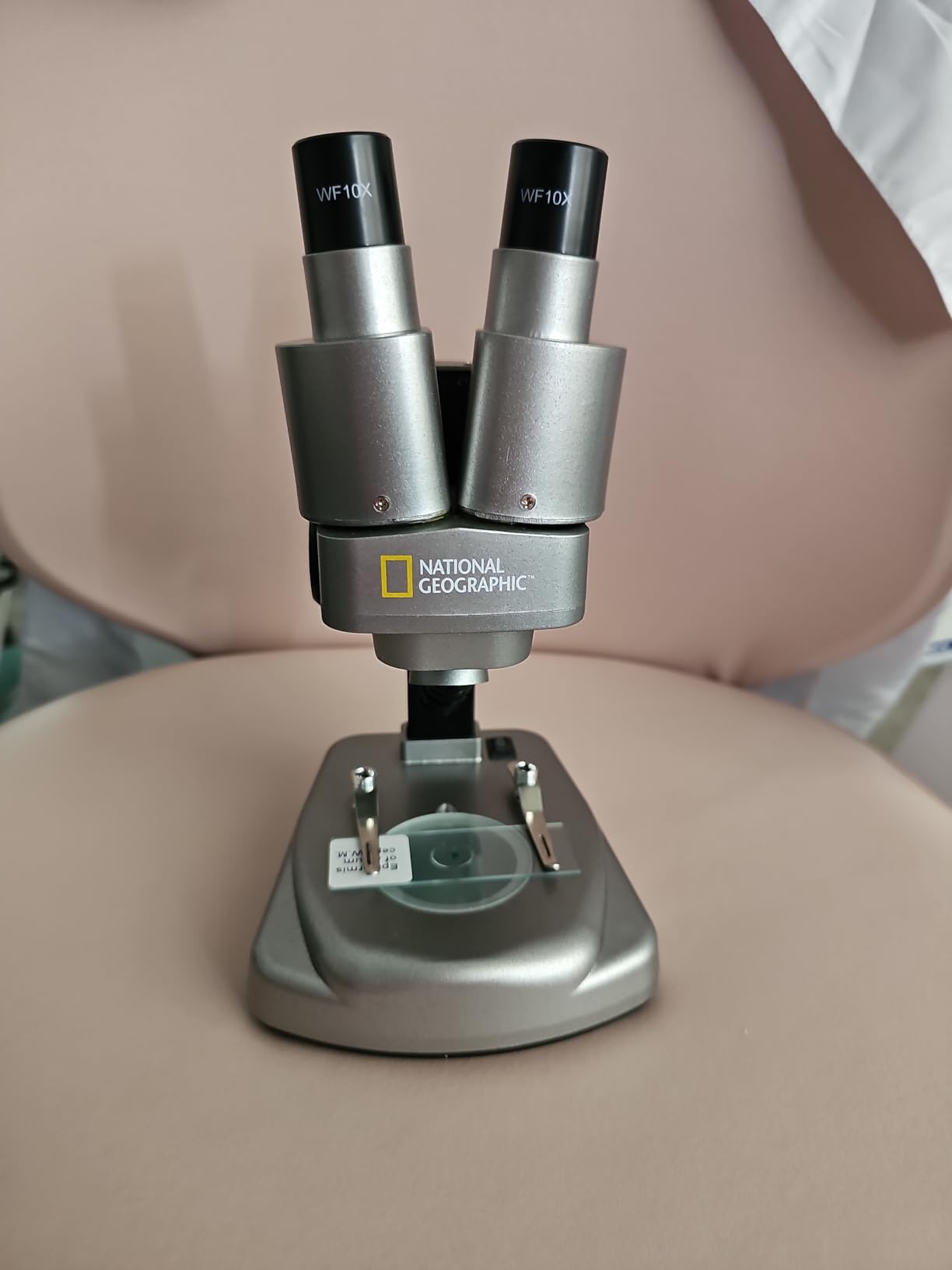
The catch is magnification, and it is a real one. Twenty times and fifty times is nowhere near enough for a seventh grader working through a cell biology unit, and the brightest reviewers are the ones whose children aged past it. The bottom LED is also intense enough that fine detail washes out unless you dim it, and the eyepieces do not lock into the body, so they can be shaken loose during transport.
One more practical note: the stage is glass, which looks premium on a spec sheet and behaves like glass when a nine year old drops the scope. Handle it like a piece of lab glass rather than a toy, and it will outlast the school year comfortably.
Who this microscope suits
This is the scope I would hand to a child between roughly 7 and 11, and it works just as well in a homeschool room shared by two or three kids of different ages. Because it is battery powered and only 2 pounds, it moves from the kitchen table to the patio without an extension cord, and the accessory count means one purchase covers an entire term of science fair projects.
It is also the one I would buy for a family that is not sure how long the microscope phase will last. You get a real optical instrument with glass lenses rather than a battery of plastic buttons, and if the child later graduates to a compound scope with higher power, the National Geographic kit has already taught them the correct vocabulary and stage-handling technique.
Who should skip it
Skip it if your student is heading into high school biology this year. At 50x there is no cell detail, no bacteria, no nucleus structure, and the frustration of not being able to resolve a specimen tends to sour a student’s interest right when formal lab work begins.
Also skip it if the microscope will live in a busy shared classroom. A glass stage and loose eyepieces are the wrong combination for equipment that gets bumped between thirty students a day, even though the construction feels sturdy in the hand.
2. National Geographic Kids Microscope with 400x: Best for Ages 5 to 8
National Geographic Microscope for Kids with Up to 400x Magnification
Up to 400x across three levels
LED above and below
1.8 pounds battery powered
11L x 6.7W x 12H inches
Pros
- Large focus knobs and soft-touch eyepiece suit small hands
- Three magnification levels up to 400x with lights above and below
- 18 supplied slides plus pipette dish and tweezers
- Lab guide with viewing activities and merit badges
- Lightweight and well packaged for gifting
Cons
- Focus mechanism is stiff and jumps rather than gliding
- Dim lighting makes fine detail hard to resolve
- Light build quality for a National Geographic branded product
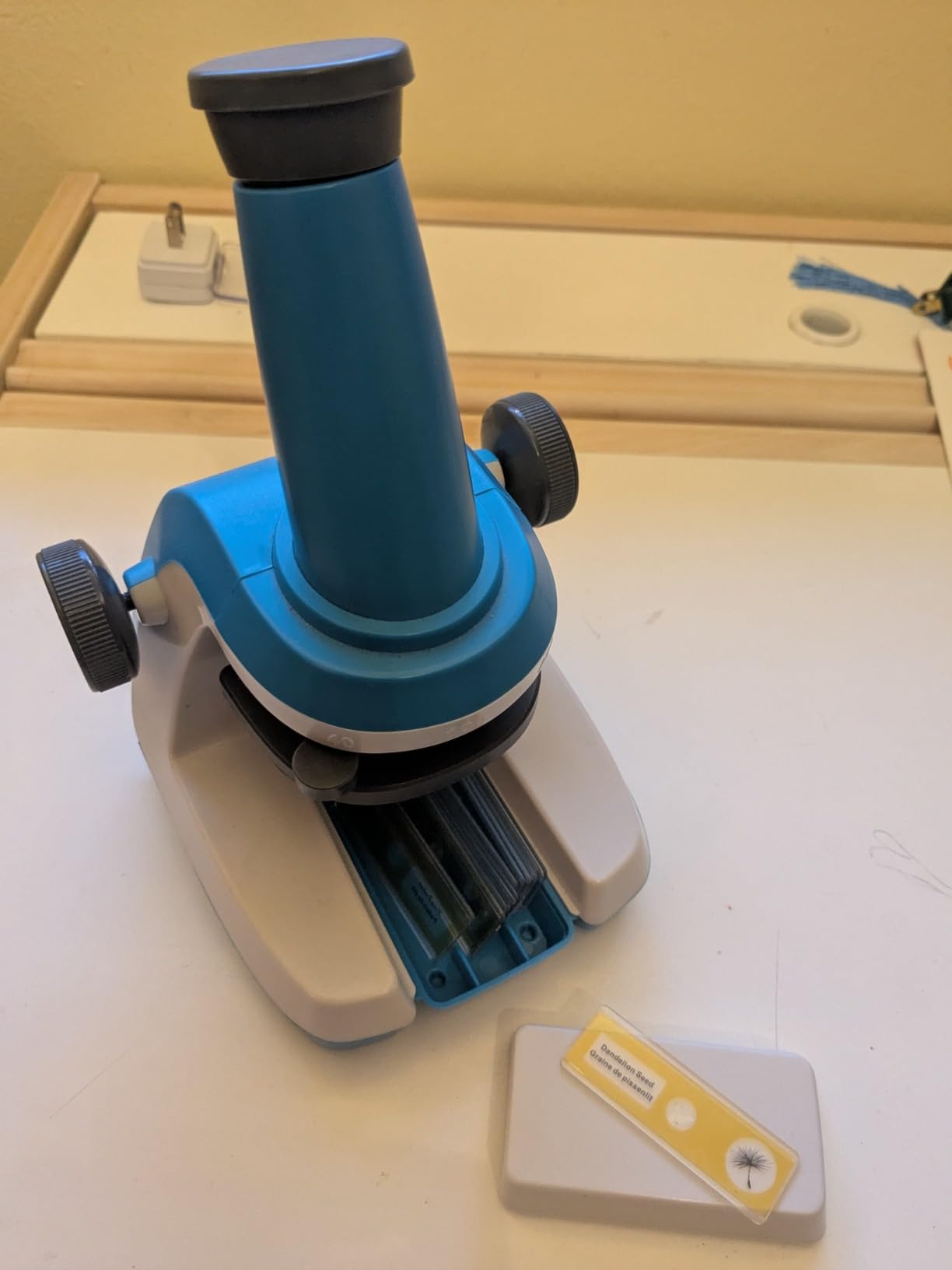
This is the youngest-child entry in the list and the only one where the lab guide matters as much as the instrument. It ships with 18 slides, six prepared plant slides, six rock and mineral slides and six blanks, plus a pipette, specimen dish and tweezers, and the guide turns those into viewing activities and a merit badge game that a five or six year old can actually follow.
The ergonomics are the best part. Focus knobs are oversized and grippy, the eyepiece has a soft-touch cover, and the whole thing weighs 1.8 pounds, so a small child can reposition it on the stage without an adult steadying the base. Reviewers treat it as a solid gateway microscope that sparks real curiosity in the under-eight set.
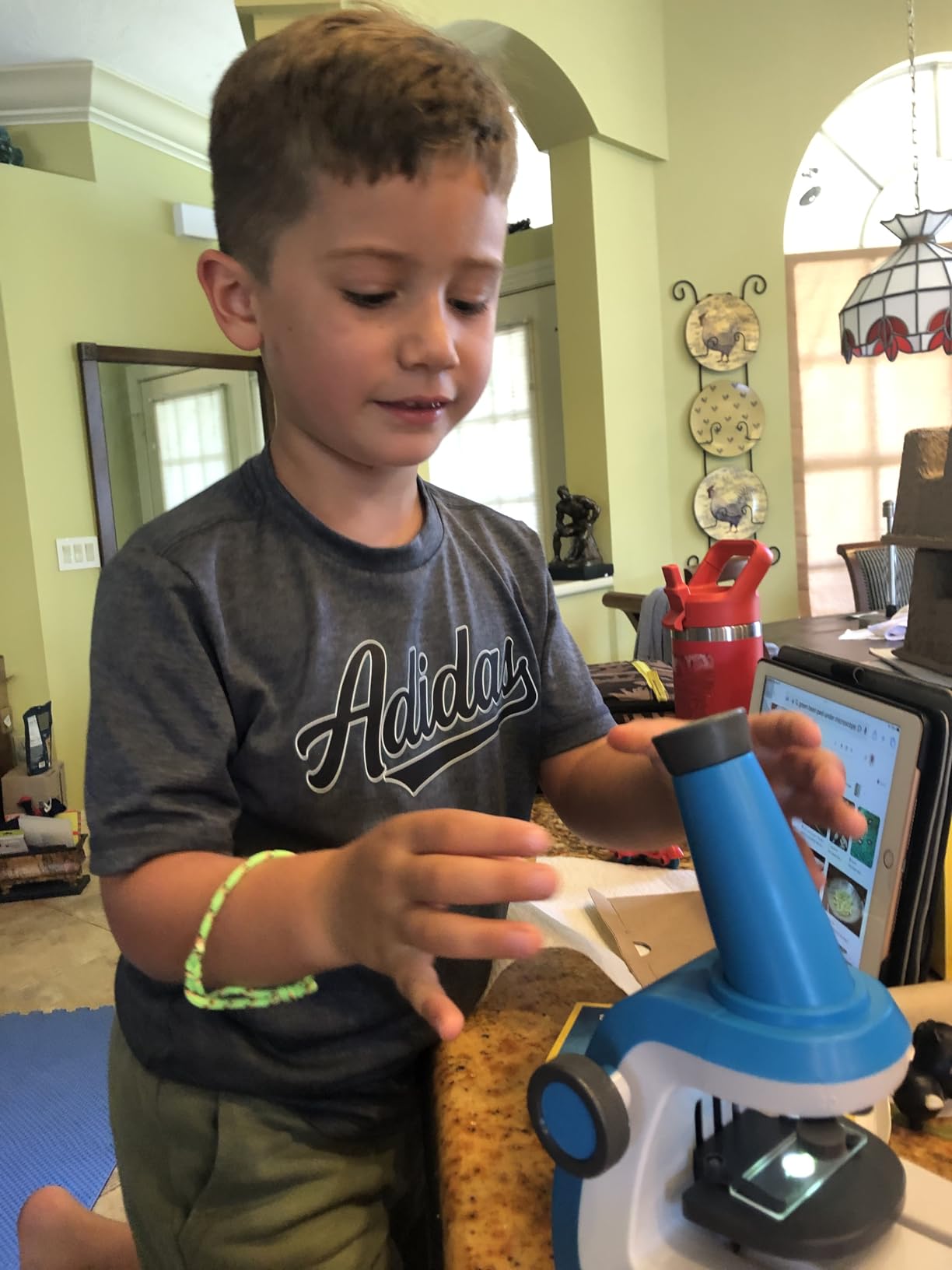
Where it falls down is mechanics. The focus mechanism is stiff and tends to jump rather than move smoothly, which is frustrating precisely when a child is hunting for the specimen. The lighting is also dim enough that fine detail is hard to resolve, and reviewers repeatedly note that the build feels lighter and cheaper than the National Geographic branding suggests.
The included prepared slides and mineral samples also underwhelm once you push past the lower magnification levels. Setup takes a little practice to understand, so budget an afternoon with an adult before handing it to a five year old solo.
Who this microscope suits
It suits a five, six or seven year old whose curiosity has just outgrown naked-eye exploration. Batteries mean no cable across the floor, and the activity guide gives a parent something structured to do with the child rather than leaving them to stare at a blurry onion skin and lose interest in a week.
It is also a good birthday or holiday gift when you do not know how committed the child is, because the accessory count reads as generous in the box and the three magnification levels are enough to feel like real science for a full semester.
Who should skip it
Skip it for a child over about nine who is already reading about cells. Three levels topping out at 400x with dim light will disappoint, and the stiff focus will teach an impatient older child that microscopes are fiddly rather than fascinating.
Skip it as a shared classroom scope as well. The plastic shell and light frame do not survive being knocked off a desk by a class of eight year olds, and the dim illumination is a problem in a room where everyone is trying to see the same thing at once.
3. BEBANG 2000X Compound Microscope: Best Metal-Frame Starter
2000X Compound Microscope for Kids Adults: Microscope for Biology Education
Metal frame with coarse and fine focus
4x/10x/40x objectives with WF25X eyepiece
Dual LED with 0.65 NA condenser
2.4 pounds AC and battery
Pros
- Six magnification settings from 100x to 2000x
- Coarse and fine focus knobs on a solid metal frame
- Dual top and bottom LED with condenser and disc diaphragm
- Phone adapter and 15 slides in the box
Cons
- Monocular head means one eye is closed at all times
- The 2000x figure depends on a 2X auxiliary lens
- Needs AC power or batteries for the LED base
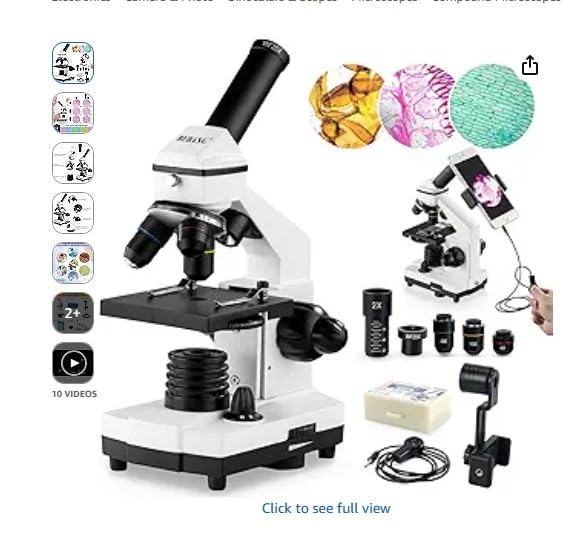
This is where the metal frame story starts to matter. The body is metal rather than plastic, which means the stage does not flex when you lean on the focus knobs and the arm does not creep out of alignment, and the frame ships with separate coarse and fine focus knobs instead of a single combined control. For a student who will keep this scope for years, that is the difference between a tool and a toy.
The optics are a genuine compound layout with 4x, 10x and 40x objectives, a WF25X eyepiece and a 0.65 NA condenser with a disc diaphragm, plus top and bottom LED illumination. You also get a phone adapter, a wire shutter, ten operating accessories, 15 slides and a carrying bag, and the box runs on AC power or batteries.
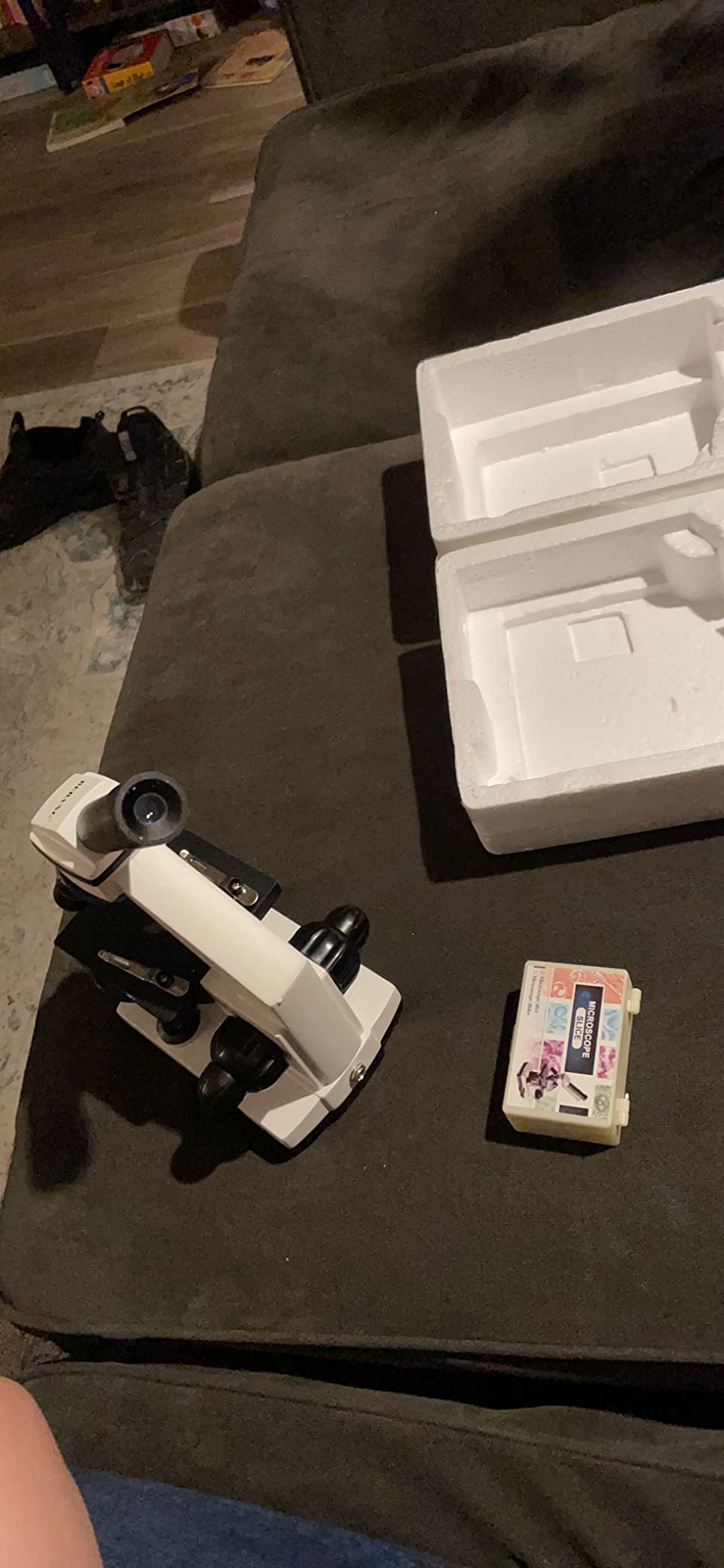
Now the honesty part. That 2000x headline is reached by putting a 2X auxiliary lens on top of the eyepiece, so the true optical power tops out well below the printed number. It is a legitimate way to get a closer look at a prepared slide, but it adds empty magnification rather than resolving power, and students should understand the difference before they assume a blurry 2000x view means they need a better scope.
The other structural limitation is the monocular head, which means one eye is always closed. Reviewers commonly report that this tires users quickly, particularly in longer sessions, and it is a real limitation for anyone who plans to spend an hour at the eyepiece. Brand support and manual quality are also described as limited.
Who this microscope suits
It suits a middle school or early high school student who wants real optical power on a durable frame without moving to a full binocular lab scope. The fine focus makes 400x comfortable, the condenser and disc diaphragm help with contrast on faint specimens, and the included 15 slides mean the student can start working the same week it arrives.
It is also a good pick for a family that expects to keep one microscope for a decade. A metal frame with a mechanical-style focus survives moves between a bedroom desk, a kitchen table and a homeschool co-op room far better than anything molded in plastic.
Who should skip it
Skip it if the student wears glasses and has astigmatism, or if long sessions are likely. With one eye closed and no relief diopter adjustment, the monocular head is the first thing that becomes tiring, and no amount of extra magnification fixes that.
Skip it if you intend to photograph lab work. A monocular head has no camera port, so the phone adapter only works by holding a phone against the eyepiece, which produces dim, soft images rather than documentation you would put in a report.
4. TOMLOV CM101 Compound Microscope: Best Value
TOMLOV Compound Microscope with Coarse & Fine Focus for Students, 40X-2000X
Coaxial coarse and fine focus
Achromatic 4x/10x/40x objectives
WF10X and WF25X eyepieces
6-position filter disc
Pros
- Coaxial coarse and fine focus gives repeatable focusing
- Achromatic objectives reduce color fringing at the edges
- 6-position disc diaphragm with colored filters helps low-contrast specimens
- Dual LED for transmitted and reflected light
- Metal frame with a 360 degree rotatable head
Cons
- Focus can drift and needs the rack and pinion re-tightened
- Monocular design supports one viewer
- Usable magnification well below the advertised 2000x
Coaxial coarse and fine focus is the headline here, and it is the right feature to lead with. Both controls sit on the same axis, so once you have found the specimen with the coarse knob you can refine it with the fine knob without shifting your hand position or losing the image, which is exactly the technique formal lab work teaches.
The optics are specified properly for a student scope. Triple achromatic 4x, 10x and 40x objectives sit on a rotating nosepiece, paired with WF10X and WF25X wide-field eyepieces, and the achromatic correction keeps colors from fringing at the edge of the field. A six-position disc diaphragm offers clear, yellow, purple, blue, green and red positions for boosting contrast on pale specimens, and dual LEDs cover both transmitted and reflected light.
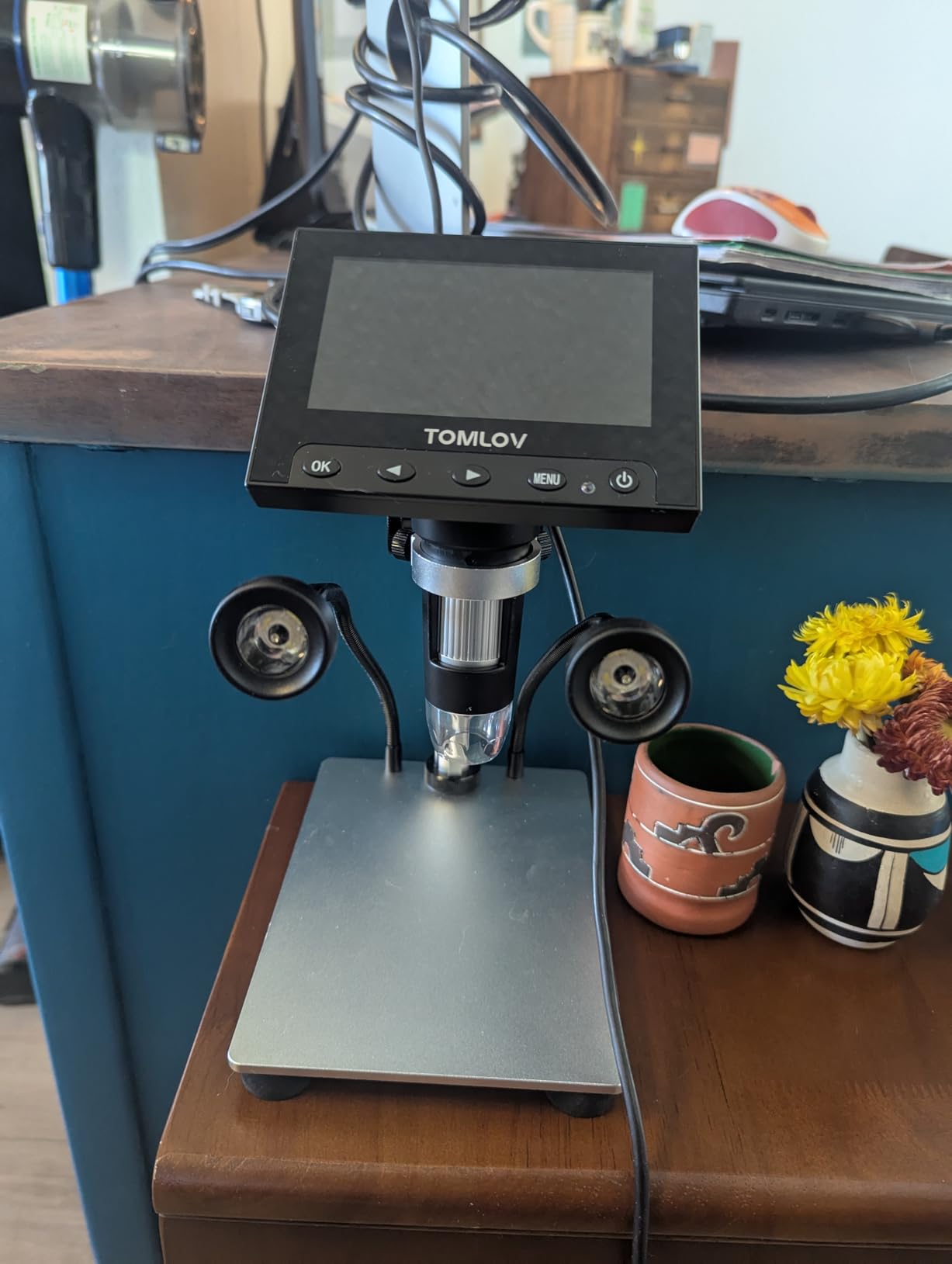
The recurring complaint from experienced buyers is focus drift. After a session the adjustment loosens and the rack and pinion needs tightening, which is a five minute fix with a screwdriver if you are comfortable opening the base and a genuine annoyance if you are not. Reviewers also flag that the maximum useful magnification is well below the advertised 2000x, and a few report the power connection or the unit itself failing after extended use.
It is monocular, so it supports one viewer at a time. In a homeschool setting with siblings crowding around, that is the single most common frustration people report, and it is the main reason this is not our top pick despite the higher rating and heavier review count on our winner.
Who this microscope suits
It suits a high school student or serious adult beginner who wants a proper compound instrument with corrected optics and real fine focus, without stepping up to binocular viewing. Experienced buyers call it a capable hobby and beginner scope, and the filter wheel is the feature most often singled out as more useful than expected.
It is also the pick I would make for a student who will move into AP Biology and might later take an introductory college lab course. The achromatic objectives, the fine focus and the metal frame are the three things that keep paying off as the student gets more demanding, and 2.7 pounds is a manageable weight for a bedroom lab bench.
Who should skip it
Skip it if you are buying for a child under about ten. A monocular head, an achromatic objective turret and a loose-focus risk are poor matches for small hands, and a younger student will get more out of a kit built around big knobs and a guide.
Skip it if the microscope will be shared by more than one person studying at the same time, or if anyone in the household has astigmatism. One eye open, one eye closed, for an hour, is how scopes get abandoned.
5. Uarzt 58-Piece Kids Microscope Kit: Best Accessory Kit
58-Piece Kids Microscope Kit – 100X-1200X Magnification, Metal Body, LED Light, Carrying Box – Science Experiment Toy for Kids Ages 5-12
58 pieces including 13 prepared specimens
31 blank slides and tools
Metal and plastic body
4.6L x 2.75W x 8.15H inches
Pros
- 58 pieces including 13 prepared specimens and 31 blank slides
- Everything fits in the included carrying case
- Metal and plastic construction feels sturdier than typical kids kits
- Colored guide teaches the parts of a microscope
Cons
- Highest magnification setting produces noticeably blurry images
- Weak resolution leaves specimens hard to distinguish
- Included scalpel is cheap plastic rather than metal
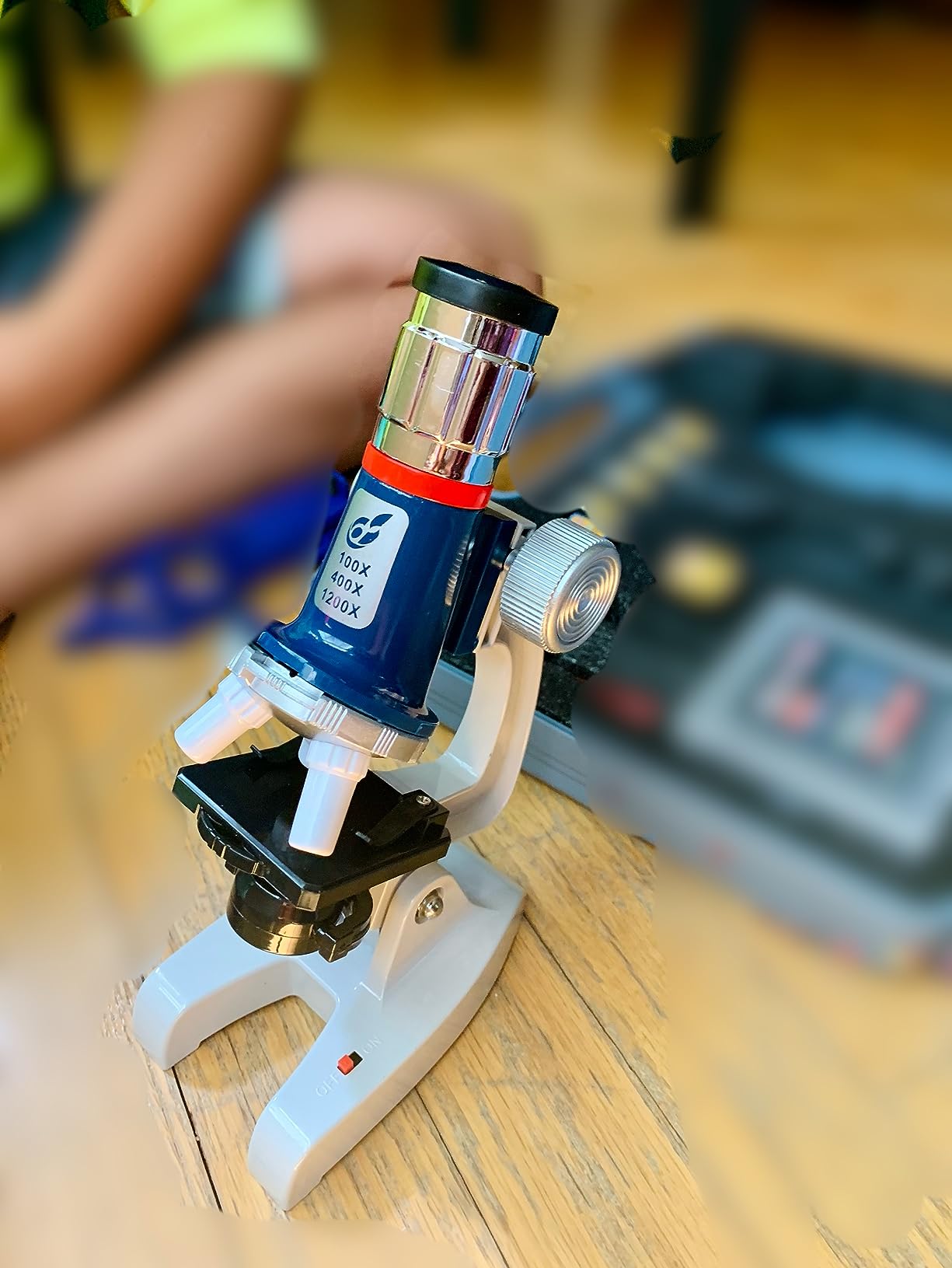
Nobody is going to complain about the contents. Thirteen prepared specimens, 31 blank slides, tweezers, a dropper and a scalpel all pack into an included carrying case, and the whole thing is a metal and plastic build that feels sturdier than the typical molded plastic kids kit. The colored instruction guide walks through the parts of a microscope and basic STEM skills, which parents consistently mention as a genuine help.
It is also battery powered and screen free, which makes it a good fit for a family that wants a science activity that does not involve a tablet. Reviewers report that it keeps young kids engaged for hours and that the case keeps everything tidy when the microscope is put away.
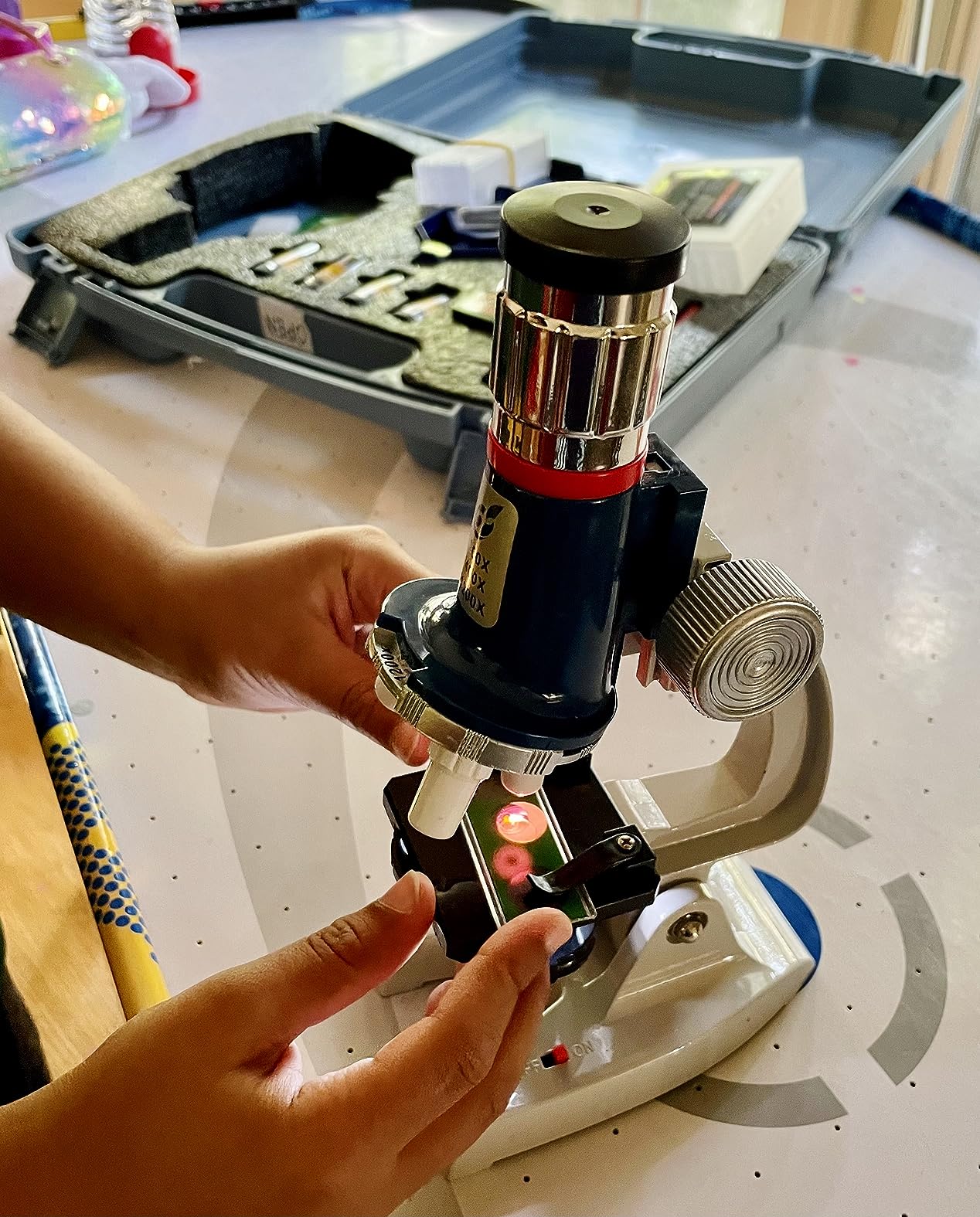
The problem is optical. Reviewers consistently report soft resolution and blur, especially at the higher magnification settings, which means a child who cranks the magnification sees a fuzzy field rather than more detail. The included scalpel is cheap plastic rather than sharp metal, which is arguably a safety win but also a hint about the overall component quality, and focusing may need adult help for younger children.
One practical detail catches people out: it runs on 2 AA batteries that are not included. That is not a dealbreaker, but it is the kind of small omission that strands a child on the first morning of a school break.
Who this microscope suits
It suits a family shopping for a birthday or holiday gift for a child between about 5 and 9 who wants a complete, tidy, self-contained science activity. The carrying case matters more than it sounds: it means the kit survives being moved between a playroom, a grandparent’s house and a homeschool co-op without losing eleven pieces.
It is also a strong choice for a classroom activity bin or a screen-free enrichment afternoon, because the accessory count supports group work where every child needs their own slide and tool.
Who should skip it
Skip it if the child is old enough to want to see cell structure, because the resolution will not deliver it no matter how the magnification is advertised. A microscope that cannot resolve detail at its top setting is worse for an older student than no microscope at all, because it teaches that the specimen is the problem.
Skip it for a school-aged child who already has a compound scope at home. This is a discovery kit, not a learning tool, and it does not replace anything.
6. Omano Juniorscope Microscope Kit: Most Versatile
Omano Juniorscope Microscope for Kids – Microscope Kit for Kids 8+ for Science Microscope Experiments – Kids Microscope Kit that Encourage STEM Exploration – Beginner Microscope for Kids 8+
Glass objectives at 40x, 100x and 400x
LED lighting for solid and clear specimens
3 pounds battery powered
Lifetime limited warranty
Pros
- Quality glass objective lenses at 40x
- 100x and 400x
- Works on both solid objects and transparent specimens
- All-inclusive kit with petri dish
- forceps
- dropper and test tube
- Five guided experiments plus an activity set
- Lightweight battery powered and portable
Cons
- Larger and heavier than most plug-and-play kids scopes
- Plastic body limits durability for rough classroom handling
- 400x ceiling is below what older teens may expect
For the money, this is the most complete first microscope in the group, and the lifetime limited warranty is the detail that separates it from the kits around it. A scope that will be handed down, resold or passed between siblings is a completely different purchase from one with a one year warranty, and buyers consistently rate the Omano as a clear, dependable first microscope for ages 8 and up.
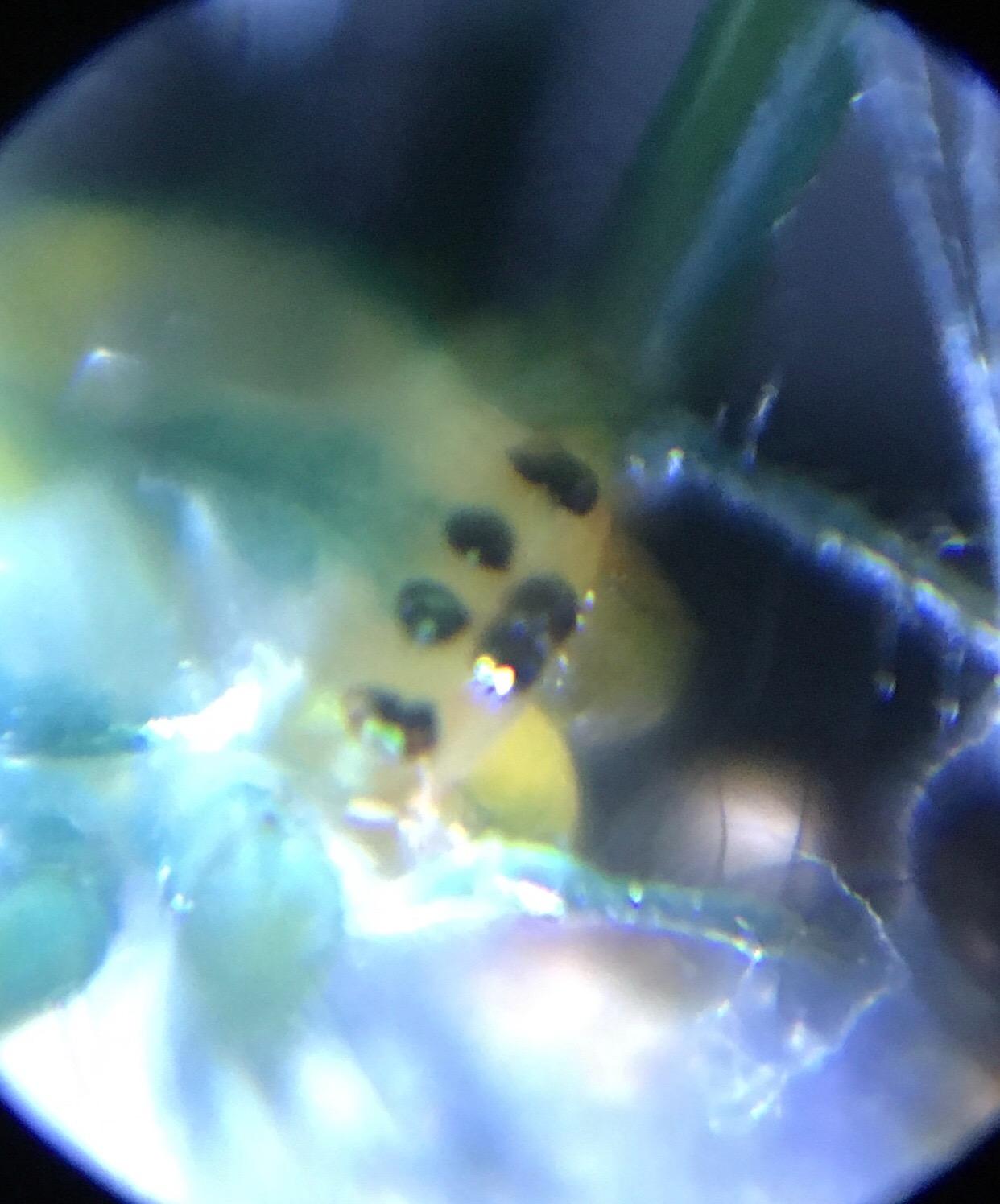
The optics are real glass objectives at 40x, 100x and 400x, which is enough resolving power to see plant cell structure properly rather than just colored blobs. It works on solid objects as well as transparent specimens, and the kit includes a petri dish, forceps, dropper, test tube and slides, plus five guided experiments and an activity set to work through.
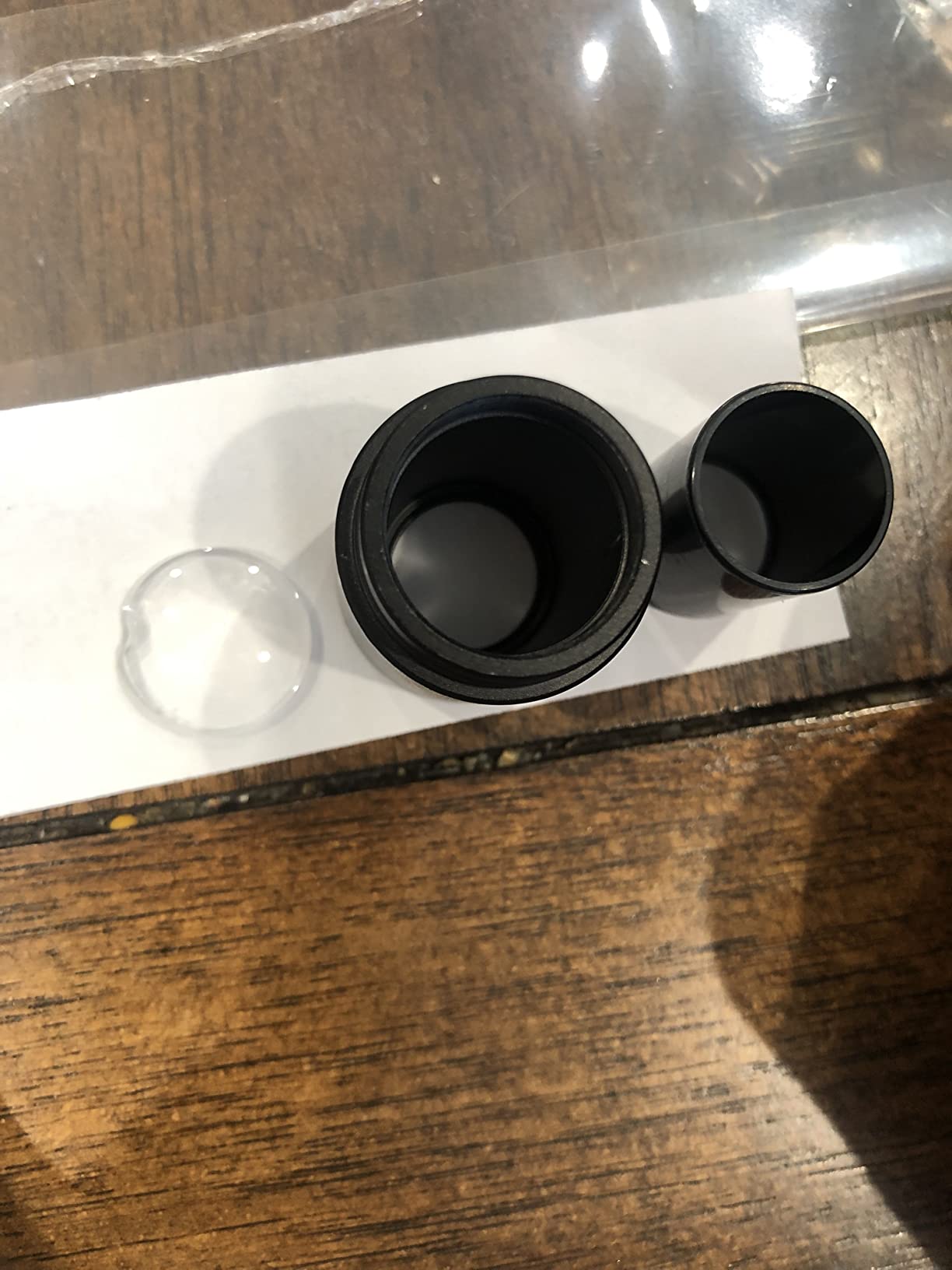
It is bigger and heavier than most plug-and-play kids scopes at 3 pounds and 9 by 6 by 14 inches, and the plastic body is the weak point in a shared classroom. The 400x ceiling is also below what an older teen expects, and reviewers note that setup and the instructions take practice before children can work independently.
At 400x there is no fine focus in the way a high school scope has one, so a student moving up from this will notice a real difference in control. That is the trade: you get a complete, durable, warranted first microscope rather than a tool for advanced work.
Who this microscope suits
It suits a family with one child around 8 to 11 who wants a complete kit that will not fall apart and comes with a warranty that means something. The guided experiments mean a parent with no science background can hand the child something structured to do rather than asking them to invent a project.
It is also the scope I would buy for a sibling pair, because the warranty covers the second owner and the accessory set supports two children working at the same time. Battery power keeps it portable for backyard and nature exploration, which is where a lot of a child’s first microscope interest actually comes from.
Who should skip it
Skip it for a high school student entering formal biology. At 400x with no mechanical stage, they will outgrow it within a term, and the plastic body is the wrong choice for a scope that will live in a busy classroom or be carried between lab benches.
Skip it if you need something portable. At 3 pounds and 14 inches tall, it is the largest and heaviest kids scope we tested, which is the mirror image of what you want for a field microscope.
7. PalliPartners Compound Microscope for Adults and Students: Best for Ages 8 to 18
PalliPartners Compound Microscope for Adults & Students, White
4x/10x/40x objectives with WF25X eyepiece
28-slide kit with 10 prepared specimens
Adjustable top and bottom LED
1.65 kg battery powered
Pros
- 100x to 2000x range from 4x/10x/40x objectives and a WF25X eyepiece
- 28-slide kit with 10 prepared and 18 blank slides
- Adjustable top and bottom LED for opaque and translucent specimens
- Coaxial coarse and fine focus knobs
- SGS certified non-toxic materials for ages 8-18
Cons
- Lenses can wobble in the housing if handled roughly
- No movable stage so locating a specimen takes longer
- Usable magnification closer to 400x than the advertised 2000x
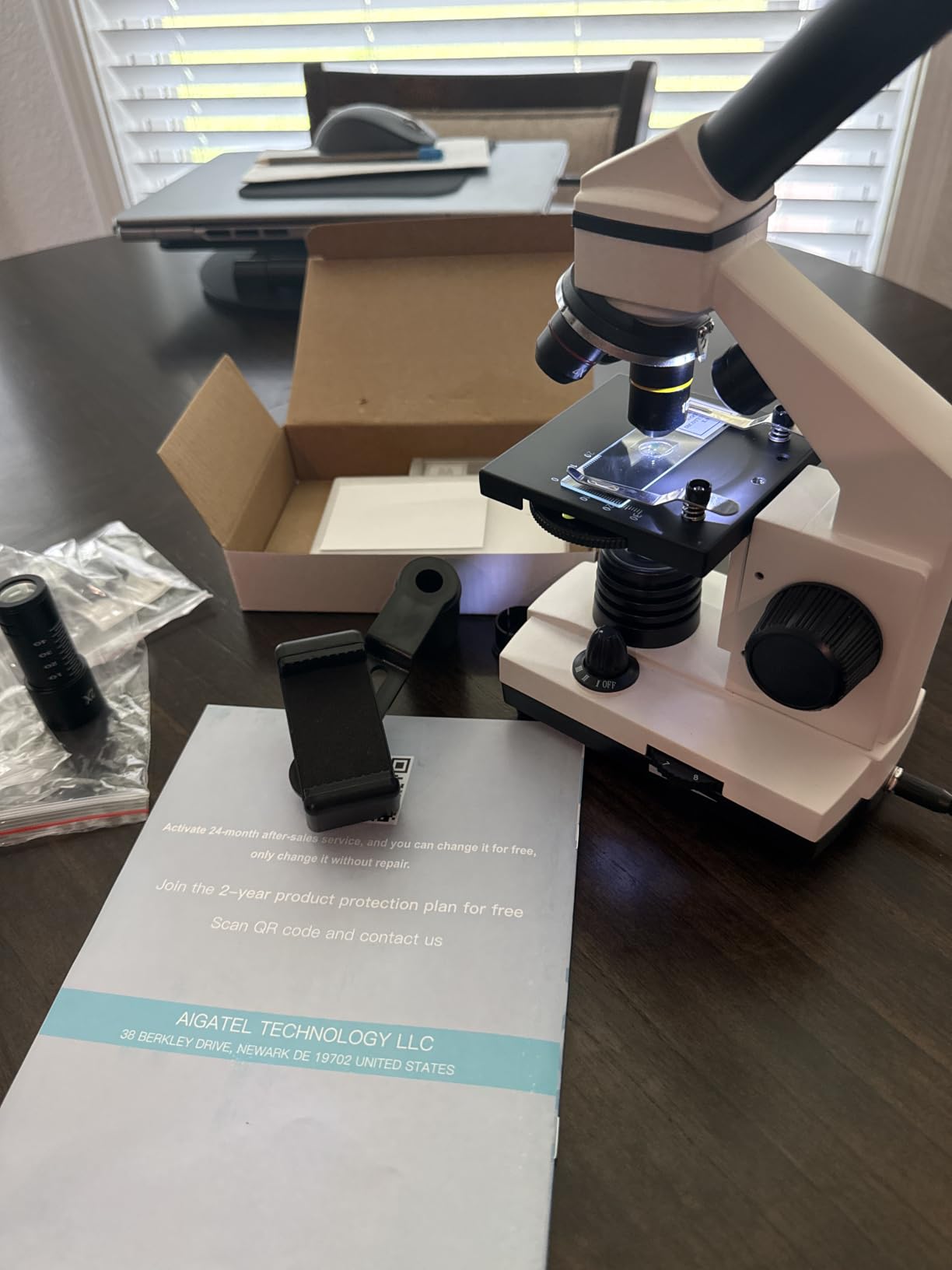
This one is explicitly certified for ages 8 through 18 with SGS verified non-toxic materials, which makes it an unusually honest fit for a wide age span. The optics are 4x, 10x and 40x objectives with a WF25X eyepiece and a 2X auxiliary lens, and the illumination is adjustable at both the top and the bottom so a student can move from a translucent cell slide to an opaque insect or coin without a second light source.
The 28-slide kit is the strongest consumables bundle in this group, ten prepared specimens and 18 blank slides, plus a phone clip, a Bluetooth shutter and a power adapter. Coaxial coarse and fine focus knobs give sharp adjustment, and at 1.65 kg the unit is compact enough for a small room or a home lab corner.
Two limitations stand out. There is no movable stage, so finding a specimen means sliding the glass around by hand, and at 400x that hunt is genuinely tedious. Reviewers also report that the lenses can wobble in their housings if the scope is carried roughly, and the real usable magnification is closer to 400x than the 2000x on the box.
There are also complaints about regional power supplies and manuals that are not useful outside the US, and occasional reports of the light dimming over time. None of these are dealbreakers, but they are the kinds of details that surface eighteen months into ownership.
Who this microscope suits
It suits a single student somewhere between a late elementary and a late high school age, and the wide age certification is not just marketing here. A 10 year old can use the 100x setting on a prepared plant slide, and a 16 year old can take the same scope to 400x on cell samples, which is the range most students actually need.
It is also a good fit for a family that wants a complete, self-contained purchase. The 28 slides, the phone clip and the Bluetooth shutter mean you are not buying consumables or accessories in the first month, which is where a lot of microscope budgets quietly leak.
Who should skip it
Skip it if the student takes a formal lab course where slides need to be scanned systematically. Without a mechanical stage, every finding has to be done by hand, and that is the exact skill a lab course is trying to teach.
Skip it for a shared classroom or a home with more than one curious child at the same time. There is no stage movement and no way to bring a second person to the eyepiece, so it will be a bottleneck in a busy homeschool room.
8. Emarth 40X-1000X 52-Piece Microscope Kit: Best All-In-One Kit
Microscope for Kids Beginners Children Student, 40X- 1000X Compound Microscopes with 52 pcs Educational Kits
True compound microscope to 1000x
10X and 25X swappable eyepieces
Metal objective housings
6 built-in color filters
Pros
- True compound microscope with reasonably bright images at high magnification
- Two swappable eyepieces at 10X and 25X
- Metal objective lens housings and a sturdy frame
- 6 built-in color filters to improve contrast
- 52-piece kit with prepared slides
- blank slides and tools
Cons
- Plastic frame is lighter and shakier than a fully metal scope
- Instructions mention a dust cover that is not included
- Included plastic slides are limiting so extra glass slides are worth buying
This is one of the few kits in the group that is a genuine compound microscope rather than a magnified novelty, and that distinction shows up in the image quality. Reviewers report reasonably bright images even at the higher magnification settings, and side-by-side comparisons regularly find it outperforming cheaper kids scopes at a similar outlay.
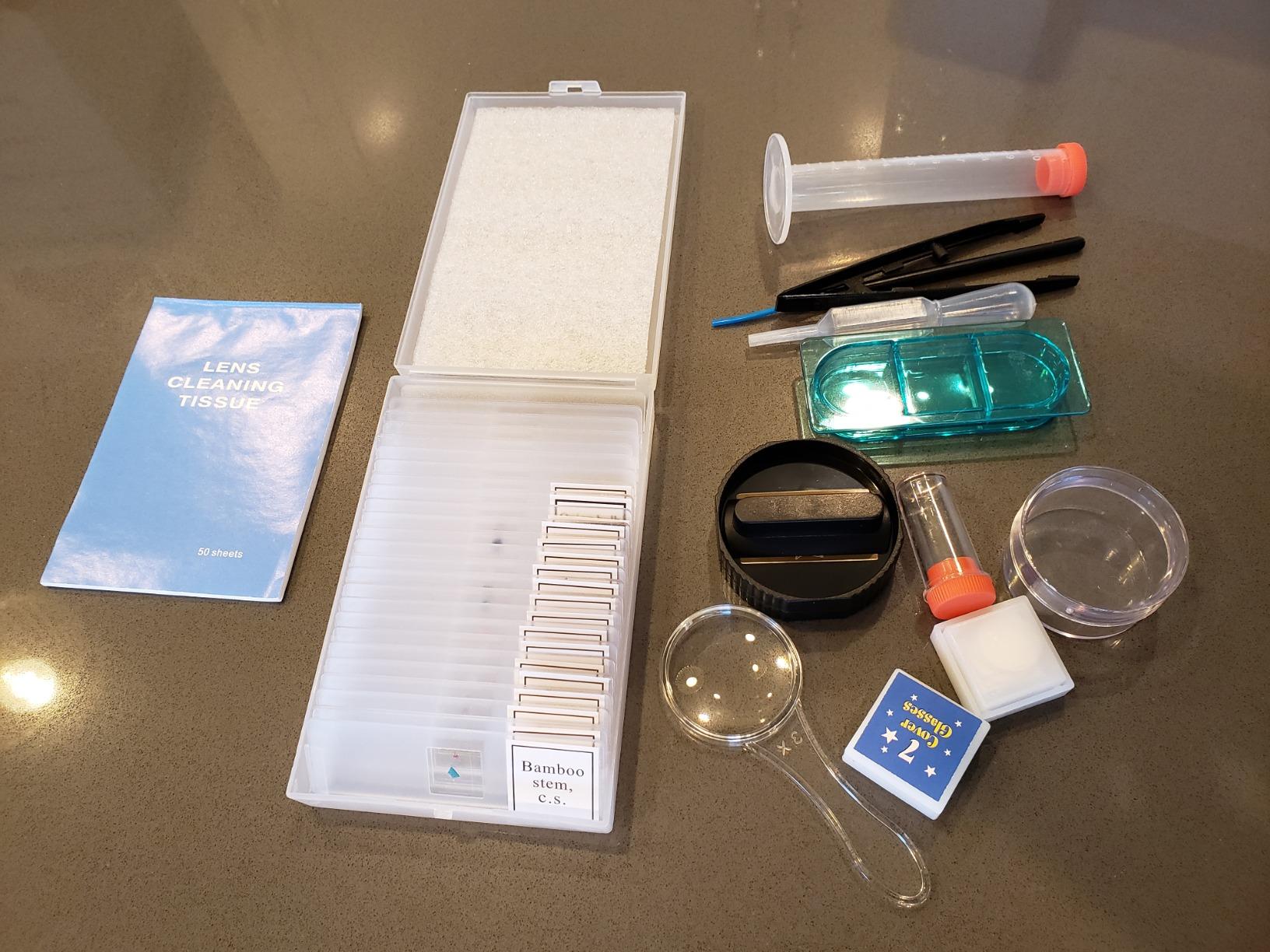
Two swappable eyepieces at 10X and 25X give quick magnification changes without rotating anything, metal objective lens housings protect the most delicate part of the instrument, and six built-in color filters improve contrast on pale specimens without buying a separate accessory. The 52-piece kit covers prepared slides, blank slides and tools.
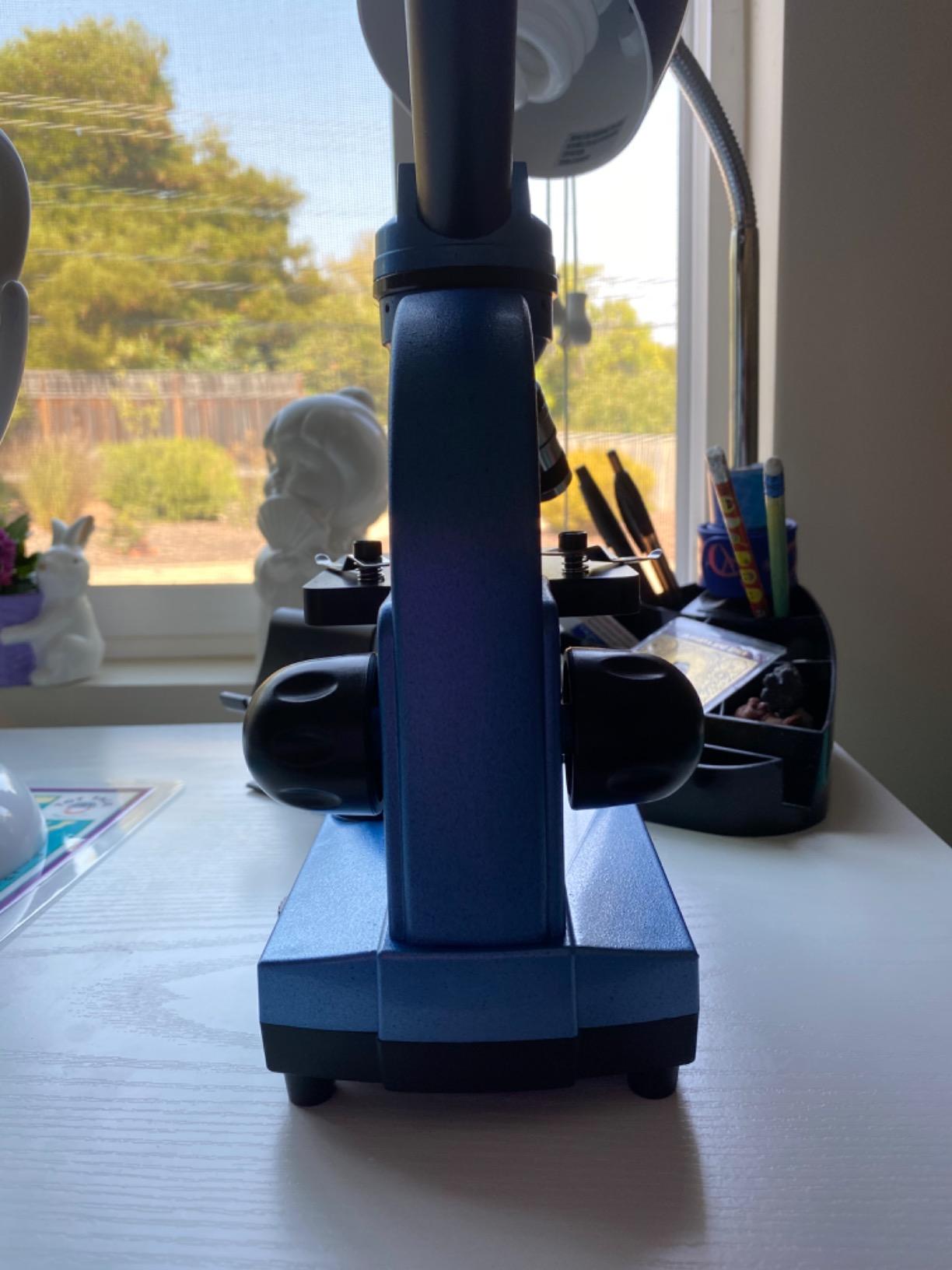
The frame is plastic even though the objective housings are metal, so it is lighter and shakier than a fully metal-bodied scope, and reviewers note that leaning on the frame makes fine adjustment harder. Light intensity is not independently adjustable above and below, which limits you when a specimen needs less light rather than more.
Two smaller annoyances are worth flagging. The instructions reference a dust cover that is not actually included, and the bundled slides are plastic, so buying a pack of glass slides and cover slips in the first week is a reasonable upgrade. Children under about 8 will likely need an adult nearby.
Who this microscope suits
It suits a family that wants one purchase to cover a specific range of ages without topping up on accessories. A 100x setting keeps a nine year old engaged, 400x starts to show real cell structure for a twelve year old, and the 1000x figure gives a high school student something to work toward.
It is also a strong pick for a homeschool family covering a full general science curriculum across multiple children, because the 52-piece kit and the filter set support a lot of different activities without a second instrument.
Who should skip it
Skip it if the microscope will live in a busy classroom where it gets handled roughly, because the plastic frame and the wobble it produces is exactly the failure mode that shows up after a term of shared use. Skip it for electronics or coin inspection too, since light intensity cannot be dialled down for opaque reflective objects.
And skip it for a very young child. This is a real instrument with a real learning curve, not a discovery toy.
9. JECONE 40X-2500X Compound Microscope: Best With Phone Holder
Microscope for Adults & Kids, 40X-2500X High-Power Compound Microscope for Students, School Lab & Home Schooling,Equiped with Slides Set & Phone Holder (White)
WF25X and WF10X eyepieces with 4x/10x/100x objectives
Dimmer knob for light control
5-color filter wheel
1.59 kg metal frame
Pros
- WF25X and WF10X eyepieces with 4x/10x/100x objectives for six settings from 40x to 2500x
- Dual incident and transmitted LED with a dimmer knob for intensity
- Separate coarse and fine focus knobs
- 5-color filter wheel under the stage
- Phone holder and 360 degree rotating eyepieces
Cons
- Monocular head limits viewing to one user at a time
- Highest steps are not true optical power
- Lightweight metal frame can wobble during fine adjustments
The dimmer knob is the detail that separates this from every other scope in the list. Almost every student microscope is either too bright or too dim, and having independent control over light intensity is what lets you properly look at a transparent specimen without washing out the detail or a pale one without losing it entirely.
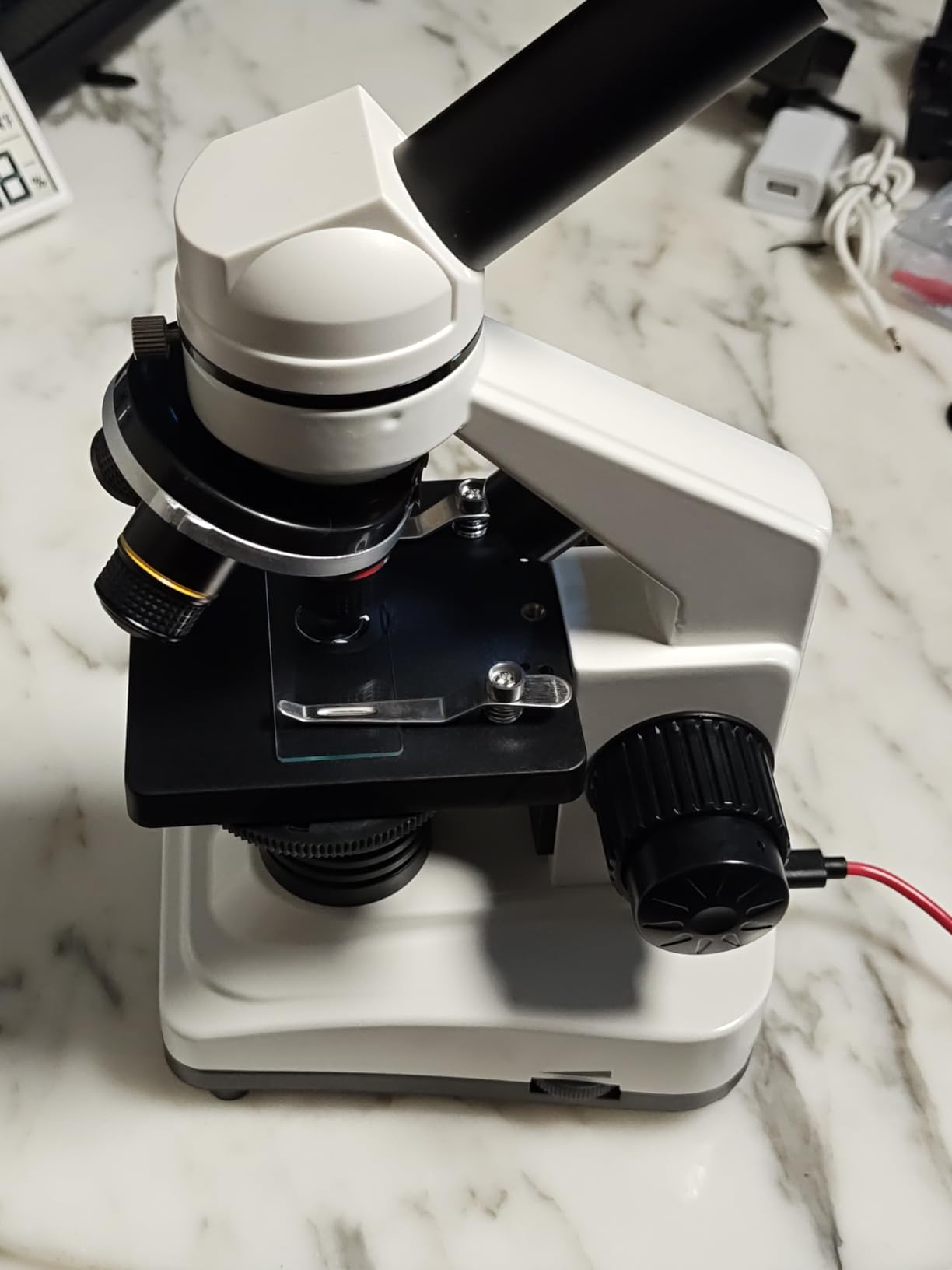
The rest of the specification is strong for the tier. WF25X and WF10X eyepieces pair with 4x, 10x and 100x objectives across six settings from 40x to 2500x, separate coarse and fine focus knobs handle the two-stage adjustment properly, and a five-color filter wheel sits in a rotating disk under the stage. The phone holder and 360 degree rotating eyepieces make it straightforward to capture images for a lab report or a science fair poster.
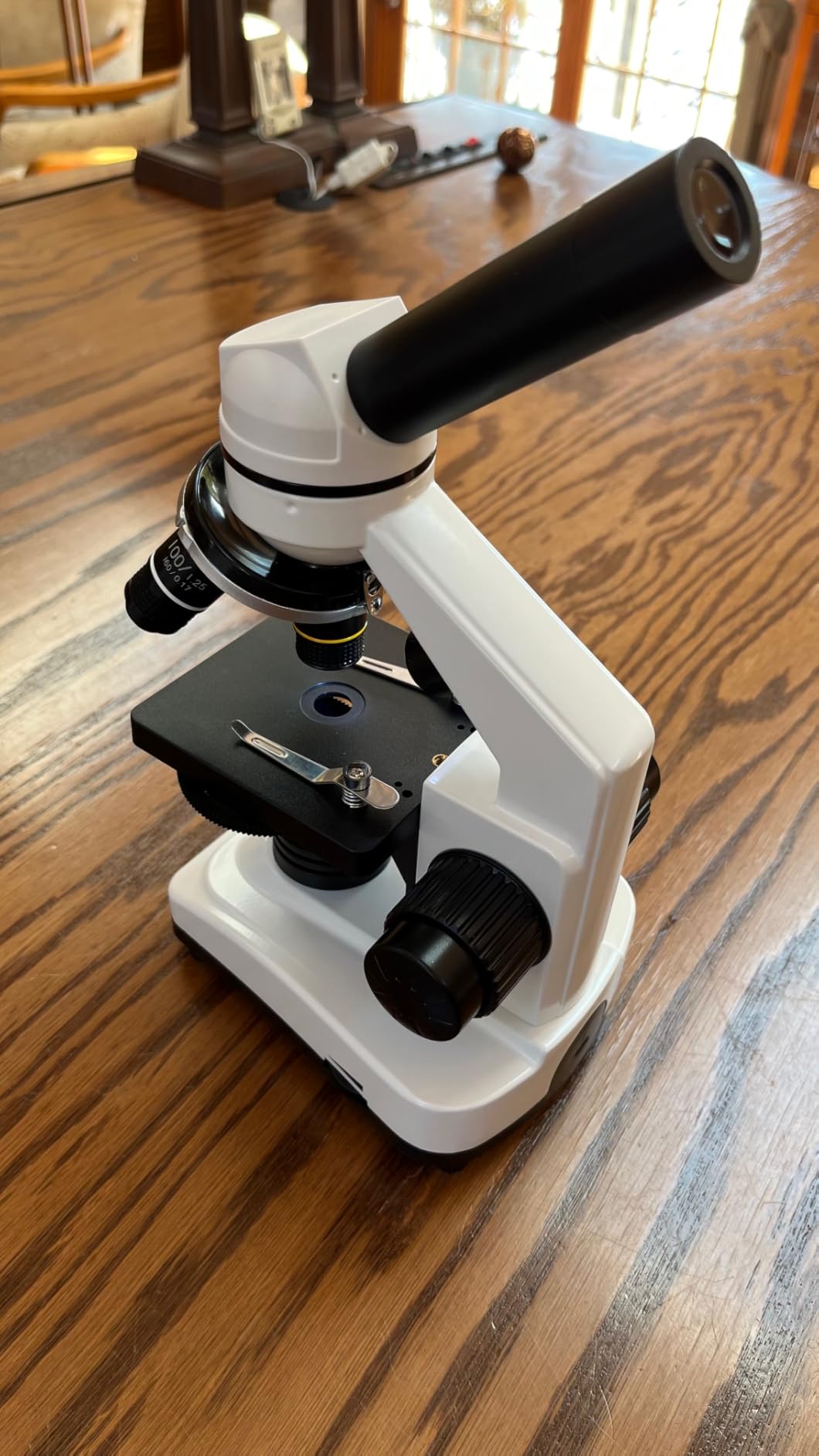
The compromises are structural. The monocular head limits viewing to one user, the highest magnification steps are not true optical power in the way the listing implies, and the lightweight metal frame can wobble during fine adjustments if the table is disturbed. The small footprint also means the stage area is limited for larger slides.
One thing to weigh is the review base, which is thinner than the established names in this list, so long-term reliability feedback is more limited. The features it does have are consistently the ones owners highlight, and the light controls are unusually good for a student-grade instrument.
Who this microscope suits
It suits a student whose assignment requires photographic evidence, which is more common than parents expect in middle school and very common in science fair work. The phone holder keeps the camera steady at the eyepiece, and a dimmer knob is exactly what you need to stop bright specimens blowing out in a phone photo.
It also suits a student working with light-sensitive or faint specimens, since independent intensity control is what separates a usable image from a washed-out one. A 1.59 kg metal frame is light enough to move between a desk and a shelf without being a chore.
Who should skip it
Skip it if two people need to look at the same specimen at once, since a monocular head forces a queue. Skip it if your priority is proven long-term durability over features, because the review history here is thinner than the group leaders.
And skip the highest advertised settings if you need real resolving power. The 100x objective and the 2X auxiliary do the work behind the 2500x figure, and a student chasing detail there will find a soft image rather than more information.
10. PALOBIL 100X-2000X Compound Microscope Kit: Best for Field and Battery Use
Microscope for Adults Professional:Compound Microscope for Kids 8-12,100X-2000X Kids Microscope Kit with Prepared Microscope Slides and Covers,Plant Stereo Microscopes for Kids Homeschool Lab
4x/10x/40x objectives with a WF25X eyepiece
Metal frame with 5-color disk aperture
AC adapter or 3 AA batteries
1.65 kg
Pros
- Six magnification settings from 100x to 2000x with 4x/10x/40x objectives
- Metal frame described as sturdy and scratch resistant
- Top incident and bottom transmitted light with a 5-color disk aperture
- Phone adapter and 11-piece experiment kit included
- Runs on 3 AA batteries or the included AC adapter
Cons
- Monocular head means a single viewer and eye strain on long sessions
- Only 163 reviews so long-term feedback is limited
- Objective lens quality is modest against dedicated lab scopes
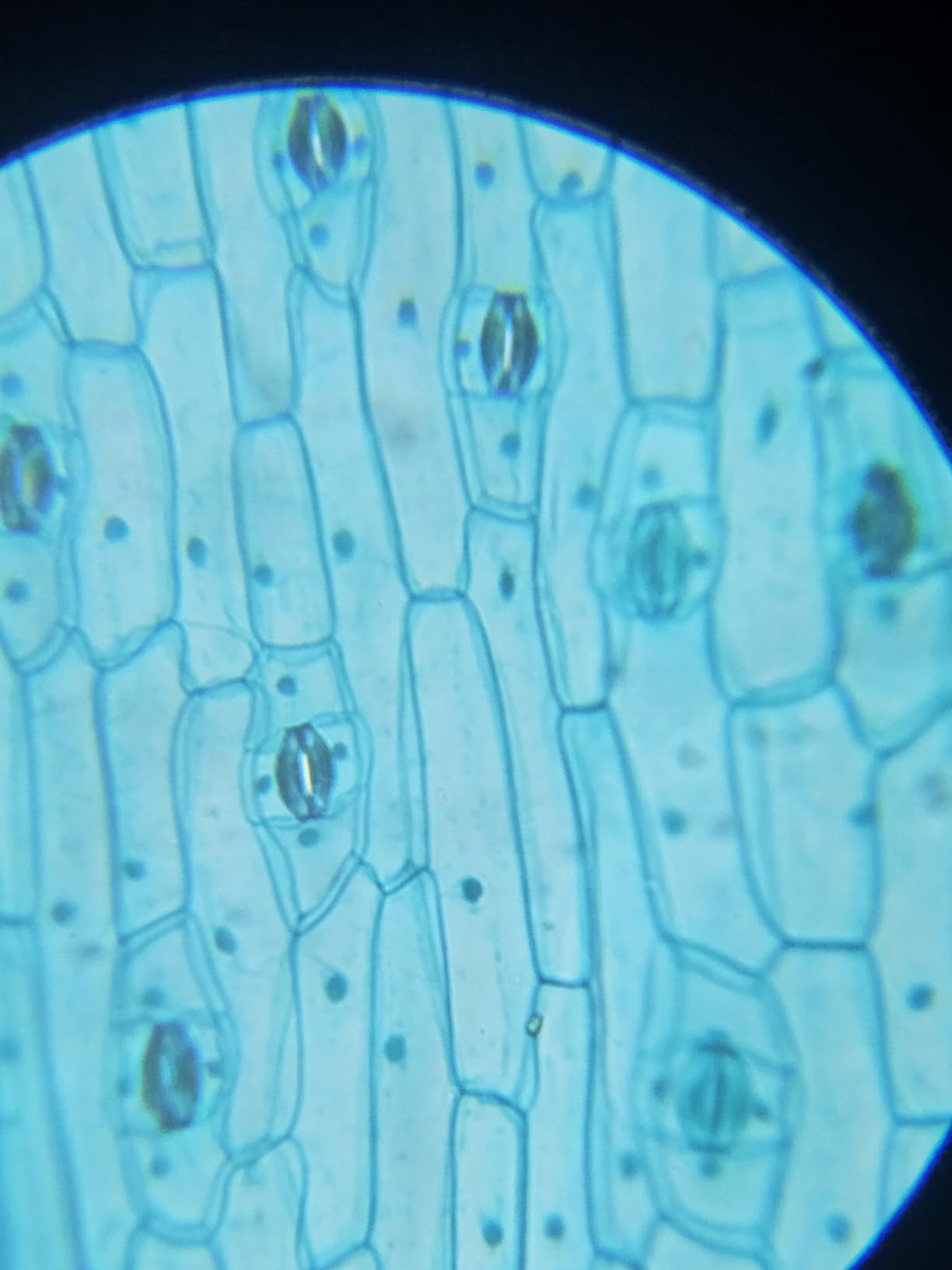
The dual power option is what makes this one interesting. It runs on 3 AA batteries or the included AC adapter, and for a student who wants to take a microscope outside to look at pond water, a leaf or a dead insect, that flexibility is genuinely useful rather than a spec-sheet nicety. Buyers rate it highly for classroom and homeschool use.
The frame is metal and described as sturdy and scratch resistant, illumination comes from both a top incident and bottom transmitted LED with a five-color disk aperture for contrast, and the accessory set includes a cell phone adapter, an 11-piece beginner experiment kit and instructions. The packaging is shockproof and drop-proof, which matters more than it sounds when the microscope lives in a backpack.

As with most of this group, the 2000x headline comes from the WF25X eyepiece paired with a 2X auxiliary lens rather than genuine objective power. The monocular head means one viewer and some eye strain over long sessions, and the achromatic objective lens quality is modest next to a dedicated lab scope.
The honest caveat here is volume. With 163 reviews, the rating reflects a small sample, and there is simply less long-term reliability data behind this model than behind the picks at the top of the list. That is not a reason to skip it, but it is a reason to know that you are taking a slightly larger bet.
Who this microscope suits
It suits a student who does fieldwork. Battery power means a nature walk, a pond sample or a school garden investigation does not require a mains socket, and the dual illumination means the same scope handles a wet mount and an opaque insect without a second light.
It is also a sensible pick for a classroom where a metal frame is a priority over features, and for a family that wants a phone adapter included from day one for documenting a science fair project.
Who should skip it
Skip it if you need proven longevity and the purchase will be made once and used for a decade, because the thin review history makes that harder to assess. Skip it for anyone sensitive to monocular viewing fatigue, and skip it for image quality that has to stand up to comparison with a real lab scope.
Also worth noting that the shockproof packaging protects the transit, not the instrument. A metal frame still needs a case if it is going in a backpack daily.
11. Herwicm Binocular Microscope with Two-Layer Mechanical Stage: Best Binocular Pick
Compound Microscope,40X-2500X ,WF10x and WF25x eyepieces, Dual LED Lighting and Two-Layer Mechanical Stage,Microscope for Adults…
Ultra-wide binocular eyepieces
Two-layer mechanical stage
Dual LED with fill light
Corded electric power
Pros
- Binocular ultra-wide-angle eyepieces give a large field of view and reduce eye fatigue
- Two-sided coaxial coarse and fine focus handwheels
- Large two-layer mechanical stage with a spiral moving scale
- Telescoping objective lens with auto-protection
- Automatic fill light for transparent and opaque specimens
Cons
- Corded electric power means it cannot be taken outdoors
- Binocular head and larger body take more desk space
- Highest settings depend on the WF25X eyepiece
This is the only binocular scope in the group, and that single fact changes the experience. Both eyes stay open, the ultra-wide-angle eyepieces give a noticeably larger field of view, and buyers who choose it consistently point to reduced eye fatigue over long sessions. It also ranks high in its binocular category for its tier, which is a decent signal for a price below most binocular student scopes.
The mechanical stage is the other reason to pay attention. A large two-layer stage with a spiral moving scale lets you position slides precisely instead of pushing them by hand, and the two-sided coaxial coarse and fine handwheels mean you can work the focus from whichever side your body is on. The telescoping objective lens has auto-protection to stop objectives touching the sample, which protects the optics and the slide at the same time.

The trade-off is that it is corded electric, so it stays on a desk. At 14.37 by 11.41 by 6.49 inches the binocular head and body also take substantially more space than a monocular student scope, which is a real problem in a bedroom or a small homeschool corner. As with the rest of this group, the highest magnification settings lean on the WF25X eyepiece rather than true objective power.
The review base is modest at 256 ratings, so it is less proven than the higher-rated picks at the top. Buyers who need binocular viewing at this tier generally find it worth the compromise.

Who this microscope suits
It suits a student who wears glasses, has astigmatism, or simply plans to spend long sessions at the eyepiece. Binocular viewing is the standard answer to eye strain in a lab, and having a real mechanical stage is what lets a student scan a specimen systematically rather than sliding it around.
It is also the pick for a student moving toward intro college microbiology, where both eyes open and a stage with a coordinate scale are the tools that formal lab technique actually depends on.
Who should skip it
Skip it if the microscope needs to be portable or if desk space is tight, because the mains cord and the larger body rule both out. Skip it if you want the deepest flexibility on magnification, since the headline number again overstates the optical power.
And skip it if the priority is the longest warranty or the largest review base, because it trails the top picks on both.
12. PalliPartners Trinocular Microscope: Best Trinocular Pick
PalliPartners 40x-2000x Biological Compound Trinocular Microscope
Trinocular head with camera port
Double-layer stage and dual LED
40x to 2000x range
1 year manufacturer warranty
Pros
- Trinocular head lets two people view while a camera is attached
- Sharp clear imaging that holds up at high magnification
- Double-layer stage holds slides securely with dual LED lighting
- Separate coarse and fine focus knobs
- Simple setup with useful accessories included
Cons
- Lightweight stand and plastic base can shake if the table is leaned on
- Coarse and fine wheel can slip during use
- Highest magnification is not true optical power
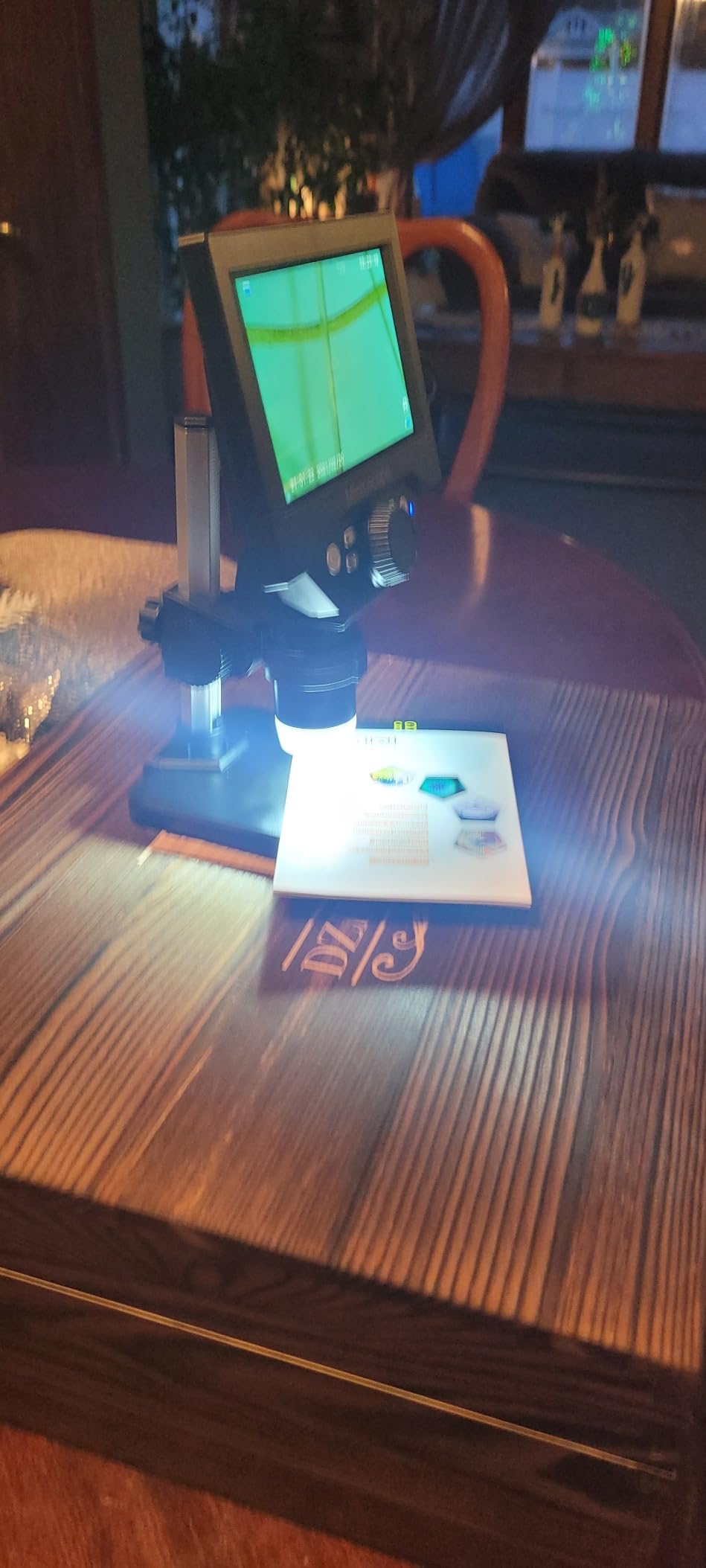
A trinocular head is the one configuration that solves three problems at once. Two people look through the eyepieces while a camera or imaging device occupies the third port, which means a lab group can work on the same slide and the image can still be captured. For a student documenting a practical, or a family sharing one microscope between siblings, that is the head type that makes sense.
Owners also report sharp, clear imaging that holds up well even at high magnification, a double-layer stage that holds slides securely, and dual LED lighting that suits both transparent and non-transparent samples. Separate coarse and fine focus knobs give sharp, quick adjustment, and the setup is described as simple with useful accessories included.
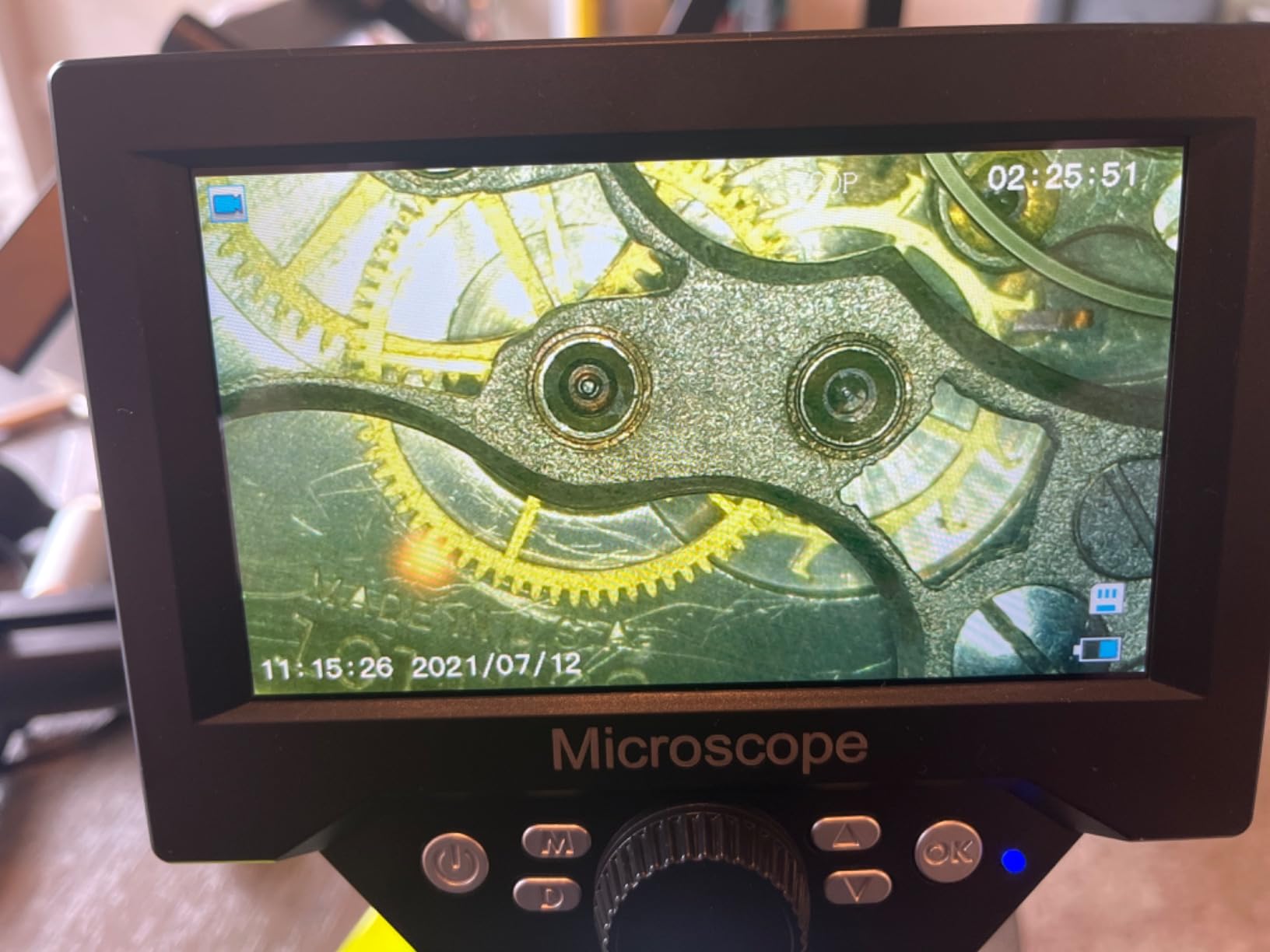
The complaints are mechanical rather than optical. The lightweight stand and plastic base components can shake if the table is leaned on, and the coarse and fine wheel can slip during use, both of which become annoying at high magnification when you are trying to hold a specific cell in frame. At this tier, resolution is acceptable for budget work rather than impressive.
The advertised maximum magnification is again not true optical power in the way the listing implies, and the review base of 120 ratings is the smallest here for what is the most specialist instrument in the group. Buyers treat it as a capable budget microscope, and that framing is accurate.
Who this microscope suits
It suits a student whose coursework requires photographed lab work, and it is the only option in this list where a camera can be attached without removing anyone’s eyepiece. It also suits a two-person lab setup, whether that is a study pair, a homeschool co-op table or a classroom pair sharing one instrument.
For a student heading into intro college, the trinocular format is the one they will meet again in a teaching lab, so learning on it is not wasted effort.
Who should skip it
Skip it if a sturdy, vibration-resistant base matters more than camera capability, because the stand and base are the weak points here. Skip it if you want a generous body of long-term user feedback, since 120 ratings is thin for an instrument at this level.
And skip it if the microscope has to travel between rooms, since the light stand is not built for a backpack.
How to Choose a Student Microscope That Lasts?
Match real magnification to grade level
Start with the grade, not the magnification number on the box. A first microscope for a 7 to 11 year old needs to be forgiving and clear at low power, a middle school student needs to reach 400x, and a high school student doing formal lab work needs 1000x and a mechanical stage. Buying above that line is wasted money, and buying below it produces frustration.
Elementary, ages 6 to 10: 100x to 400x is plenty. Prioritise large focus knobs, a simple eyepiece swap and a guide, because those decide whether a child keeps using it.
Middle school, ages 11 to 13: 400x of true optical power is the target. This is where cell structure starts to resolve and where a child can tell the difference between a real microscope and a toy.
High school and AP Biology: 1000x, fine focus and a mechanical stage. Oil immersion is worth having here if the course covers microbiology.
Intro college microbiology: 1000x with a mechanical stage, achromatic objectives, and a binocular or trinocular head so the format matches what you will meet in a teaching lab.
Total magnification is eyepiece times objective, and here is how to spot a padded claim
Total magnification is simple arithmetic: the eyepiece power multiplied by the objective power. A 10X eyepiece with a 40X objective gives 400X. A 25X eyepiece with a 40X objective gives 1000X. Anything that does not divide evenly into an eyepiece and an objective number is usually an auxiliary lens or a digital zoom, and it adds size to the image without adding detail.
So a scope advertising 2000x built from 4x, 10x and 40x objectives and a WF25X eyepiece is really giving you 1000X of optical power, with the 2X lens on top of that. That is exactly what happens with the BEBANG, the PALOBIL and the PalliPartners models in this list. Digital microscopes push it further still, where a headline 1000x can correspond to roughly 50x to 100x of true optical resolution.
The practical test is simple. Look up the objective and eyepiece numbers. If the maximum is not their product, treat the headline figure as a viewing convenience rather than a specification.
Fine focus and the mechanical stage decide longevity
If you only add one feature to a budget, make it fine focus. A separate fine focus knob lets a student refine focus without overshooting, and it is the difference between a scope that is pleasant at 400x and one that fights the user. Forums consistently point at missing fine focus as the moment a student microscope stops being fun, and that is the moment families buy a replacement.
A mechanical stage is the second feature that extends a microscope’s useful life. It is a movable platform with control knobs that shifts the slide precisely, so you can scan a specimen at 400x or 1000x instead of shoving the glass with your fingers. Forum guidance is blunt on this: the practical difference between 1000x and 2000x matters far less than having fine focus and a mechanical stage. Only the binocular and trinocular models in this list have a real mechanical stage, and that absence in the monocular models is the single most important thing to weigh before you buy a student scope meant to last.
Monocular, binocular and trinocular heads, and eyeglasses
A monocular head has one eyepiece, so one eye stays open and one stays closed. It is cheaper and lighter, and it is fine for short sessions, but it tires users quickly over an hour and it is uncomfortable for anyone with astigmatism. Most of the models in this list are monocular, which is the main reason none of them is a comfortable all-day instrument.
A binocular head has two eyepieces and is the standard in teaching laboratories. It halves the strain of long sessions and works well with glasses, though the interpupillary distance has to be adjusted. The Herwicm in this list is the binocular option here.
A trinocular head adds a third port for a camera, so two people can look through the eyepieces while an image is still being captured. The PalliPartners trinocular is the option in this group. If anyone in the household has astigmatism, a digital scope with a built-in screen avoids the problem entirely, though it trades away true optical magnification.
Metal frame, optical glass and what a plastic scope really costs
The most repeated complaint about cheap microscopes is that toy-grade plastic bodies warp, crack and lose alignment under daily use. It is not a durability abstraction, it is the specific mechanism by which a scope becomes unusable: the stage stops being flat, the arm creeps, and fine adjustment turns into a fight.
Look for a metal frame or at least metal objective housings, and for optical glass lenses rather than plastic. An achromatic objective is a lens corrected so colors do not fringe at the edges of the field, which matters more than most buyers expect once a student starts looking at stained cells.
Warranty length is the other honest signal. A lifetime limited warranty on a kids scope is worth something; a one year warranty on a product with no spare parts is a countdown. Forum users repeatedly single out brands with spare parts availability as the deciding factor for owning a microscope for a decade, because a broken focus knob should not end a microscope’s life.
Power source, accessories and what a kit actually includes
Battery or AC power is a simpler decision than it looks. Cordless LED scopes are right for field work, a backyard, a co-op room and a school garden, and they are wrong for a student who will leave the scope plugged in on a desk for two hours of lab work. The PALOBIL is the pick here that does both.
On accessories, count what you will actually use. Prepared slides, blank slides, cover slips, tweezers, a dropper and a specimen dish cover most of a school year, and a 52 or 58 piece kit saves a second shopping trip. A brine shrimp hatchery is a nice idea, but the eggs in kits frequently fail to hatch, so treat it as a bonus rather than a reason to buy.
Do buy a pack of glass slides. Several of the kits here ship plastic slides, which scratch, fog and break, and a scratched slide ruins the image no matter how good the microscope is.
What teachers buying a classroom set should check
No teacher is buying one scope. Bulk purchasing changes the criteria entirely, and the things that matter for a single household purchase invert at scale. Standardization comes first: if every microscope on the bench is identical, a class of thirty can be taught the same technique in the same vocabulary, and a spare part fits every unit.
Durability outranks features. A metal frame with a mechanical stage and a fine focus knob survives being bumped between thirty students, where a plastic kit with a glass stage does not. Optical durability matters too, since a scratched objective in a shared scope is a permanent image defect, so metal objective housings are worth more than an extra filter color.
Stock spares and consumables before you buy the first set, not after a scope fails in November. Replacement bulbs, blank slides, cover slips and objectives should be a line in the department budget, and teachers should budget a cleaning and storage routine too, because dust on an objective is the most common cause of a blurry image in a school setting.
Frequently Asked Questions
What microscope is used in most classrooms?
Most classrooms use a monocular compound microscope with 4x, 10x and 40x objectives, a 10X eyepiece for 400X total, LED illumination and a mechanical stage. Budget models often add a 25X eyepiece for 1000X total. The monocular head is standard because it is cheaper, lighter and easy for a class of students to queue up at, and the mechanical stage is what lets a student scan a slide systematically instead of pushing it by hand.
What are the best microscopes for teenagers?
For teenagers the best microscopes for students are the ones that pair real optical magnification with fine focus and a metal frame. Our picks for this age group are the National Geographic Dual LED kit for younger teens, the TOMLOV CM101 for its coaxial fine focus and achromatic objectives, the Emarth 52-piece kit for a complete bundle, and the Herwicm binocular scope for long sessions and students who wear glasses.
Is 1000x enough to see sperm?
Yes. 1000X total magnification is the standard for viewing sperm and is achieved with a 40X oil immersion objective and a 25X eyepiece. You need immersion oil between the lens and the cover slip, and a mechanical stage or a very steady hand, because the working distance is tiny and the field of view is very small. Anything advertised above 1000X on a student scope usually comes from an auxiliary lens and adds size rather than detail.
What is a good microscope for a beginner?
A good microscope for a beginner is a true compound scope with glass objectives, LED illumination and simple controls, not a plastic novelty toy. Our budget pick is the Omano Juniorscope at up to 400x with a lifetime limited warranty, and the best all-in-one option is the Emarth 52-piece kit. Both reach enough power for a child to see real cell structure, which is the point where curiosity turns into a habit.
What is the best microscope for homeschooling biology?
For homeschool biology, buy one solid metal-body compound microscope that can serve multiple children across multiple grade levels rather than an age-specific toy. The TOMLOV CM101 and the Emarth kit both handle ages 8 to 18, while the Herwicm binocular model is the pick if more than one child needs to look at the same slide or anyone wears glasses. Budget for extra glass slides, which cost little and outlast the microscope.
Can you use a microscope with astigmatism?
You can, but a monocular head makes it much harder. With one eye closed and no relief diopter adjustment, astigmatism turns fine detail into a frustrating blur, and long sessions become painful. A binocular head with adjustable interpupillary distance is the most comfortable option, and a digital microscope with a built-in screen works well because you relax your eyes and look at a large display instead. A wide-field eyepiece also helps, since a larger field of view makes finding and holding a specimen easier.
Final Thoughts on the Best Microscopes for Students
The best microscopes for students all share three things that no amount of advertised magnification can substitute for: optical glass objectives, a frame that does not flex, and a focus system that gives the student real control. The National Geographic Dual LED kit takes the top slot because it delivers glass optics, genuine construction and a complete accessory set at the highest rating and by far the largest review base in this group.
Match the model to the grade. For a child under 8, the National Geographic 400x or the Uarzt kit keeps curiosity alive. For a student from about 8 to 13, the Omano Juniorscope or the Emarth 52-piece kit is the right durability-versus-power balance. For high school and intro college, the TOMLOV CM101 and the Emarth handle 1000x, and the Herwicm binocular or the PalliPartners trinocular is worth stretching for if long sessions, glasses or lab photography are part of the picture.
One last piece of advice we would give any family: buy the highest grade level you can justify now, because a microscope is a ten year purchase if the frame and optics are real. Check the objective and eyepiece numbers before you trust a headline figure, and add a pack of glass slides in the first week.