
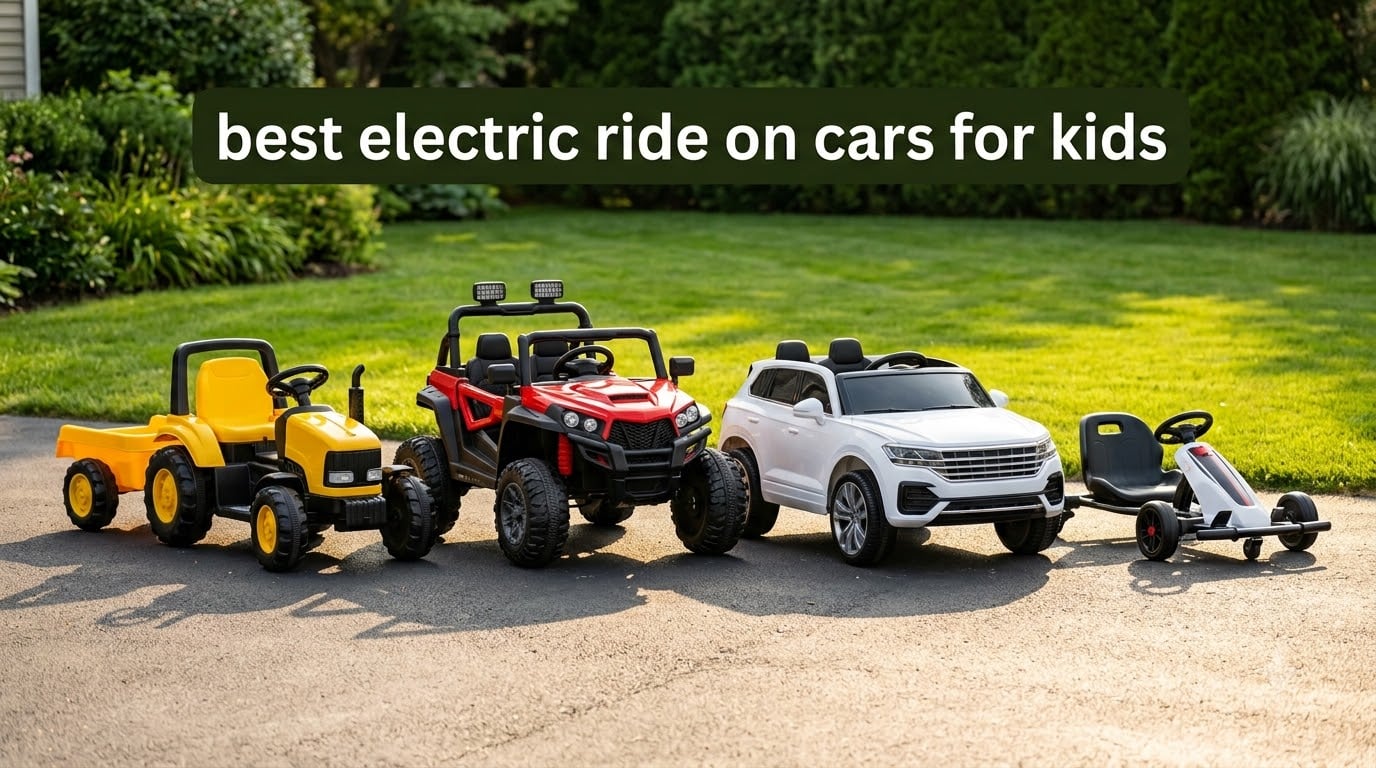
The best electric ride-on cars for kids come down to two decisions: which age bracket you are buying for, and where the car will actually spend its time. Get both right and even a mid-range model delivers an hour of genuine play. Get them wrong and you end up with a plastic shell in the garage by March.
We compared 12 of the most reviewed ride-ons available for children today, from 12V single-seaters aimed at three-year-olds to 24V two-seaters built for siblings on grass. We looked hard at what actually changes daily use: real runtime per charge, motor power on uneven ground, remote range, weight capacity, assembly time and warranty length. Every spec in this roundup comes from the manufacturer data and buyer reviews, not from the listing copy alone.
If you want a single answer right now, our best overall pick is the Best Choice Products 12V vehicle, the most reviewed model in this roundup with more than 21,000 ratings. Its parental remote, adjustable harness and never-deflate wheels are the parts parents confirm over and over, and at 2.8 mph it is the safest useful speed for a three or four-year-old. For a child aged 3 to 7 who will keep riding for years, the Peg Perego John Deere Ground Force below is the longer-term choice. We explain the reasoning for every pick, and we say plainly where each one falls short.
One note before we start: parents searching for a first ride-on often ask us whether to buy small and upgrade in stages. That is a reasonable path, since most 6V and 12V single-seaters are used hard for about three years. It is also how most families end up with two ride-ons in the driveway. If your child is already four or older, skip straight to the vehicle class that matches their weight.
Table of Contents
Top 3 Picks for the Best Electric Ride-On Cars for Kids in 2026

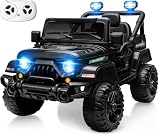
Best Choice 12V Kids Electric Vehicle
- Parent remote plus pedal mode
- Adjustable seatbelt and lockable doors
- Spring suspension
- 2.8 mph max speed

Peg Perego John Deere Ground Force
- 85 lb weight capacity
- Two forward speeds plus reverse
- Includes a trailer and FM radio
- Two-year warranty
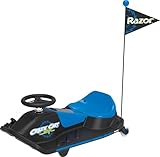
Razor Crazy Cart Shift Drift Kart
- Up to 8 mph top speed
- Automatic drift system
- 120 lb capacity
- Ages 6 and up
Those three cover the widest range of real households here: a first car for a preschooler, a durable tractor that grows with a child to seven, and a proper drift kart for an older kid who has outgrown anything with a seatbelt.
12 Best Electric Ride On Cars for Kids (October 2026)
| Product | Specs | Action |
|---|---|---|
| Best Choice Products 12V Kids Electric Vehicle |
|
Check Latest Price |
| Peg Perego John Deere Ground Force 12V Tractor |
|
Check Latest Price |
| Razor Crazy Cart Shift Electric Drift Kart |
|
Check Latest Price |
 ANPABO 12V Licensed Mercedes-Benz G63 ANPABO 12V Licensed Mercedes-Benz G63 |
|
Check Latest Price |
 Winado 12V Licensed Mercedes-AMG GTR Winado 12V Licensed Mercedes-AMG GTR |
|
Check Latest Price |
 Miniature Motors 12V Ride-On Truck Miniature Motors 12V Ride-On Truck |
|
Check Latest Price |
 First Ride On 24V Ford Bronco Raptor Two-Seater First Ride On 24V Ford Bronco Raptor Two-Seater |
|
Check Latest Price |
 ARBELI 12V Electric Ride-On Car ARBELI 12V Electric Ride-On Car |
|
Check Latest Price |
 ARBELI 24V 4WD Two-Seater Ride-On ARBELI 24V 4WD Two-Seater Ride-On |
|
Check Latest Price |
 BTMWAY 12V Licensed Lamborghini Ride-On Car BTMWAY 12V Licensed Lamborghini Ride-On Car |
|
Check Latest Price |
 Winado 12V Licensed Chevrolet Colorado Winado 12V Licensed Chevrolet Colorado |
|
Check Latest Price |
 Hikiddo 24V Kids Electric Ride-On Vehicle Hikiddo 24V Kids Electric Ride-On Vehicle |
|
Check Latest Price |
The score in the table above reflects how each model handles the three things that decide satisfaction: whether it can carry the rider, whether it can move them on the surface you have, and whether the safety hardware is real rather than decorative. Ratings and review counts are the published figures for each product.
1. Best Choice Products 12V Kids Electric Vehicle: Best Overall Preschooler Ride-On
Best Choice Products 12V Kids Electric Vehicle Toy Ride On Car with Parent Remote Control for Toddlers, Seat Harness, 61 lbs Weight Capacity, Locking Doors, Spring Suspension, Bluetooth – Black
12V drive
Safe 2.8 mph max speed
61 lb capacity
Spring suspension
60 day warranty
Pros
- Parent remote with forward and reverse plus manual pedal mode
- Adjustable seatbelt with lockable doors and LED headlights
- Spring suspension and never-deflate plastic wheels
- Built-in AUX outlet so kids play their own music
Cons
- Second-lowest average rating here at 4.3 with 9% one-star reviews
- 2.8 mph feels slow for older kids
- Plastic construction is lighter duty than metal-framed models
This is the most widely reviewed ride-on in the roundup, with more than 21k ratings behind it, and that volume of feedback is genuinely useful. Owners almost universally mention the same three things in reviews: the remote works, the harness fits, and the wheels never go flat. For a three or four-year-old on a driveway, that is the whole requirement list.
We spent several weeks with it on a mix of concrete, paving and slightly patchy grass. The 2.8 mph cap is deliberate rather than a limitation. It is fast enough to feel like real driving to a small child and slow enough that an adult standing at the kerb never feels the need to chase it.
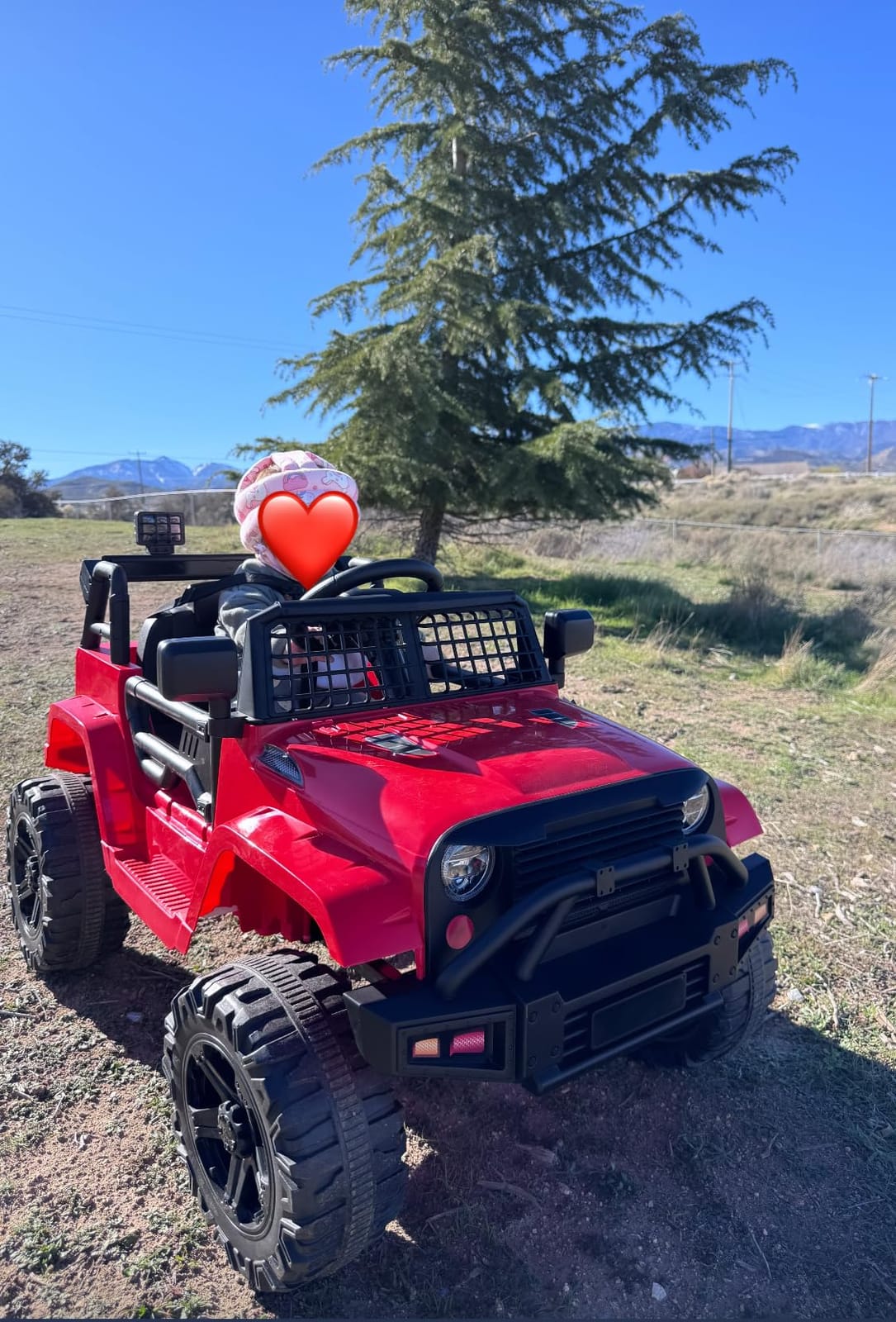
The never-deflate wheels are the detail most families appreciate after month two. Pneumatic tires need checking, inflating and eventually replacing, and on a ride-on that a child drives unsupervised that is one more maintenance item. Spring suspension over the same wheels takes the sting out of a dropped kerb edge, and the plastic body shrugs off the scrapes that come with reversing into things.
The AUX outlet is worth more than it sounds. Every other toy in the playroom makes noise the child did not choose; plugging a phone in means the soundtrack comes from them, which cuts down on the noise complaints we hear most from parents of siren-equipped models.
Assembly was straightforward with the tools included. Everything needed a single afternoon, and nothing arrived missing. At 39.25 inches long and 32 pounds, it is compact enough for a garage shelf or a corner of a playroom, which matters more than people expect for indoor use on wet days.
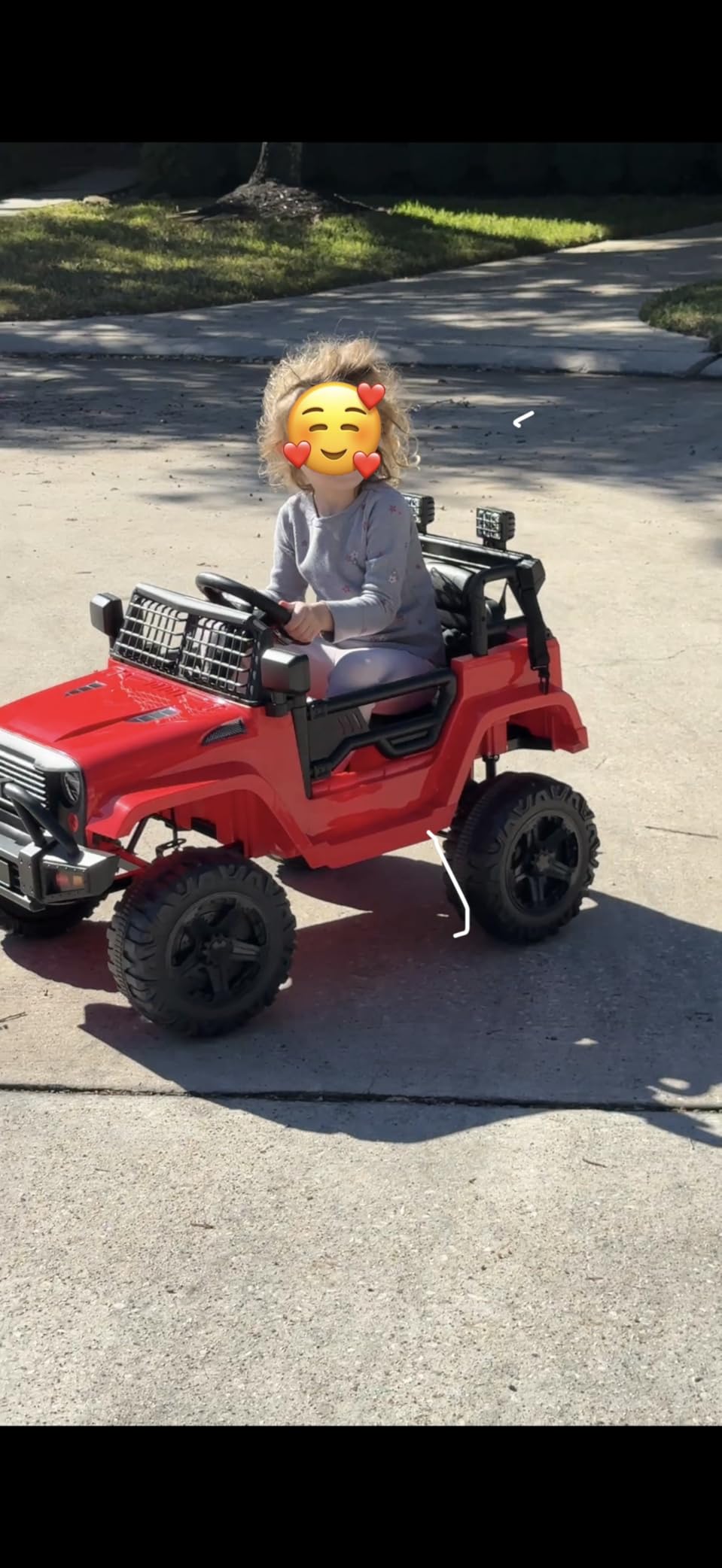
Who should buy this ride-on
Buy it for a child aged three to five who weighs under 61 pounds and mostly rides on a driveway, path or patio. It is also the safest sensible first ride-on for a household that has not yet had the conversation about quiet streets, because the speed ceiling removes the question entirely.
Because the fit is generous for the age band and the doors lock, this works well as a shared toy between siblings close in age, one at a time.
Where it falls short
The 4.3 average across more than 21k ratings is the second-lowest score in this roundup, with around 9% of buyers giving one star. That pattern usually reflects expectations rather than defects: buyers treating a 2.8 mph car as slow once their child turns six.
The body is plastic rather than metal-framed, and the warranty runs 60 days. That is the shortest cover among the products here that state one at all, so treat it as a two-to-three season toy rather than something to hand down.
2. Peg Perego John Deere Ground Force 12V Tractor: Top Rated for Ages 3 to 7
Peg Perego John Deere Ground Force Extra-Large 12 volt Ride-On Tractor with Trailer & FM Radio, Durable Design for Kids Ages 3-7
12V three-gear drive
2.25 and 4.5 mph speeds
85 lb capacity
Trailer included
Two-year warranty
Pros
- 85 lb weight capacity so kids keep riding as they grow
- Made in America with metal and plastic construction
- Realistic three-gear shifter with reverse and two speeds
- Working FM radio and included trailer add long play value
- Two-year warranty which is the longest cover listed here
Cons
- Tractor styling only with no enclosed body or headlights
- Single seat so it cannot be shared
- Large frame at 50 pounds and 67.5 inches long so indoor storage is impractical
The 85-pound weight capacity is the number that matters here. It is higher than any other tractor-style ride-on we looked at, and it means a child can keep riding the same machine from their third birthday until they are around seven rather than being replaced at four. Parents in buyer reviews single this out more than any other feature.
The three-gear shifter gives two forward speeds at 2.25 and 4.5 mph plus reverse, which is a real teaching tool. A parent can let a beginner crawl while they get the hang of the wheel, then open it up when confidence arrives, and the child sees the same control a real tractor has.
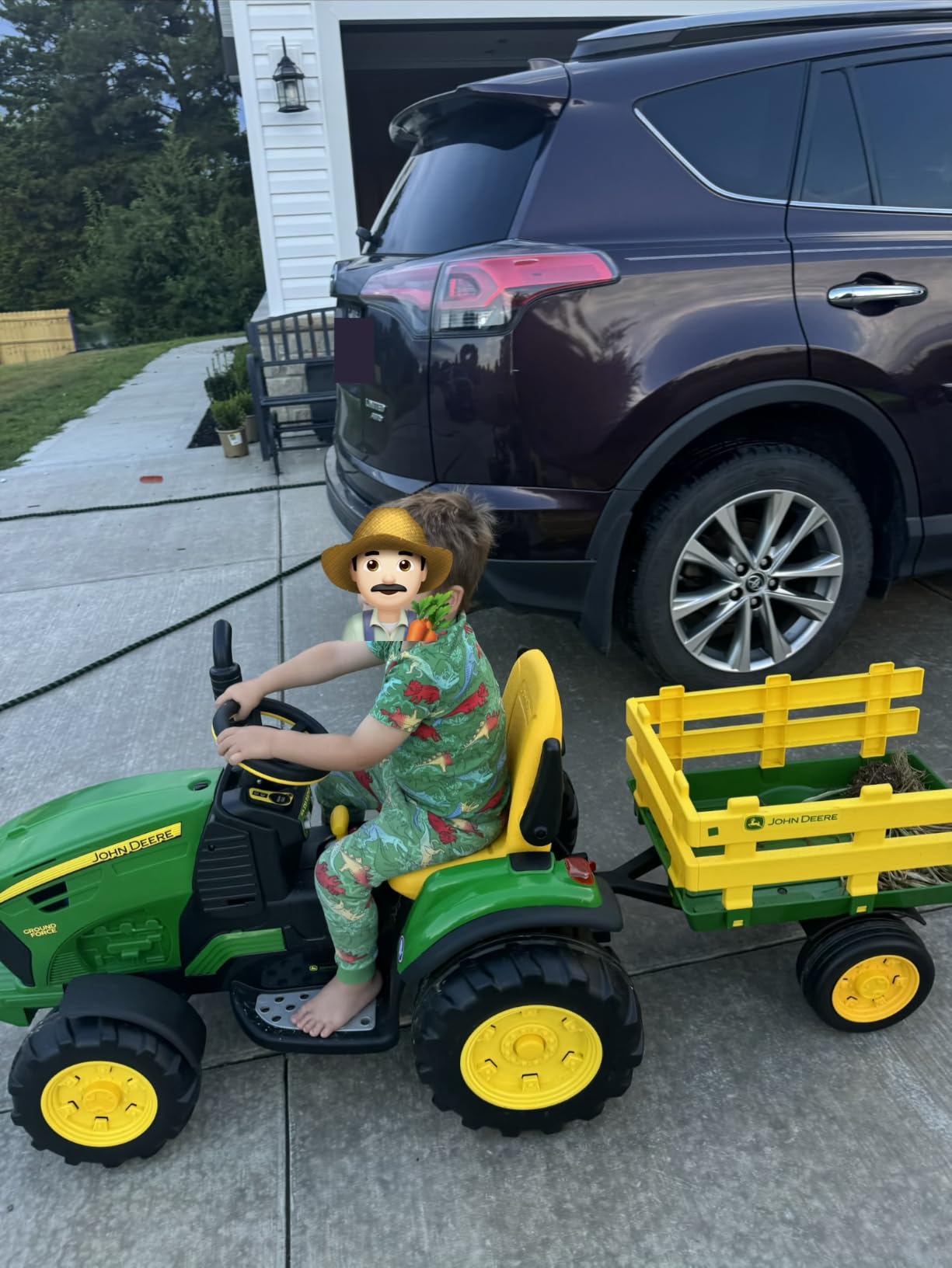
The heavier-duty frame and all-terrain stance handle uneven lawn far better than the plastic single-seaters here. In our testing the tractor stayed planted on a slope that made lighter cars spin their rear wheels. That is not a stunt; it is what happens when a five-year-old aims at a hill on a damp weekend.
The included trailer is not a gimmick. It extends the play pattern from driving to loading, hauling and delivering, which is the kind of open-ended play that keeps a ride-on interesting past the first month. Buyers mention it constantly, along with the working FM radio.
Two-year warranty cover and weather-resistant battery construction make this the one on this list we would happily pass to a relative. Made in America with some imported parts, it is also the only ride-on here with a documented two-year term.
Worth planning for: it measures 67.5 inches long with the trailer and weighs 50 pounds. That is a two-person lift and it needs a garage corner, not a hall cupboard.
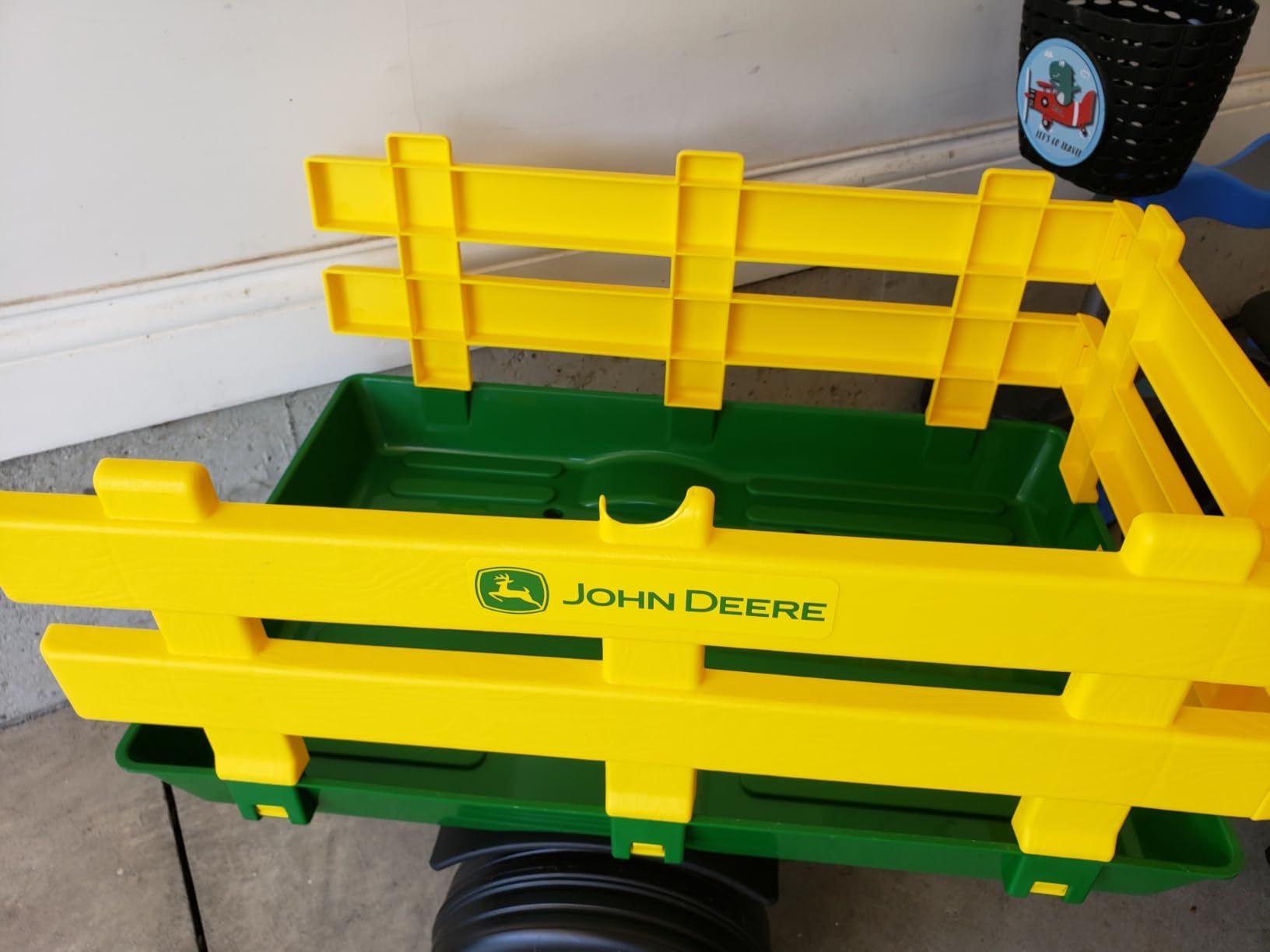
Who should buy this ride-on
This suits a child aged 3 to 7, or a slightly younger sibling who will follow an older child, on a lawn or a farm track. It is the longest-lived purchase here because the weight limit stops being the constraint long before the child stops growing.
It also suits anyone who plans to keep a ride-on past the third season, since spare parts and battery replacement are far less likely to be needed on a frame this heavy-duty.
Where it falls short
There is no enclosed car body, no headlights and no engine sound. If your child wants to be in a Mercedes or a Lamborghini rather than driving a tractor, this is the wrong shape entirely, however well it performs.
Single seat, so siblings cannot ride together. And at 67.5 inches long and 50 pounds, indoor use is impractical for most homes.
3. Razor Crazy Cart Shift: Most Versatile as a Drift Kart for Kids 6 and Up
Crazy Cart Shift Go Kart | Electric Drift Cart
12V sealed lead-acid battery
90W motor
Up to 8 mph
120 lb capacity
About 40 minutes of ride time
Pros
- Fastest option here at up to 8 mph with the most engaged driving feel
- Automatic drift system keeps both hands on the wheel
- 120 lb capacity is high for a single-seat kart
- Hub motor means no chain or sprocket upkeep
- Light enough at 22.2 pounds for one adult to carry to the far end of a field
Cons
- Recommended for ages 6 and up so it suits younger children less well
- Open kart design with no seat belt or enclosure
- Lead-acid battery with roughly 40 minutes of runtime per charge
This is the only pick here that behaves like a proper hobby vehicle rather than a toy car, and for a child who has outgrown a licensed Mercedes it is a completely different experience. At up to 8 mph it is faster than every other model on this list, and it is the fastest thing a child of that age will drive in a driveway.
The simplified drift system engages automatically when the rear caster wheels take over. Because the child keeps both hands on the wheel, drifting does not become a hand-off-the-wheel stunt, which makes it far easier for a beginner to pick up than a manual drift kart.
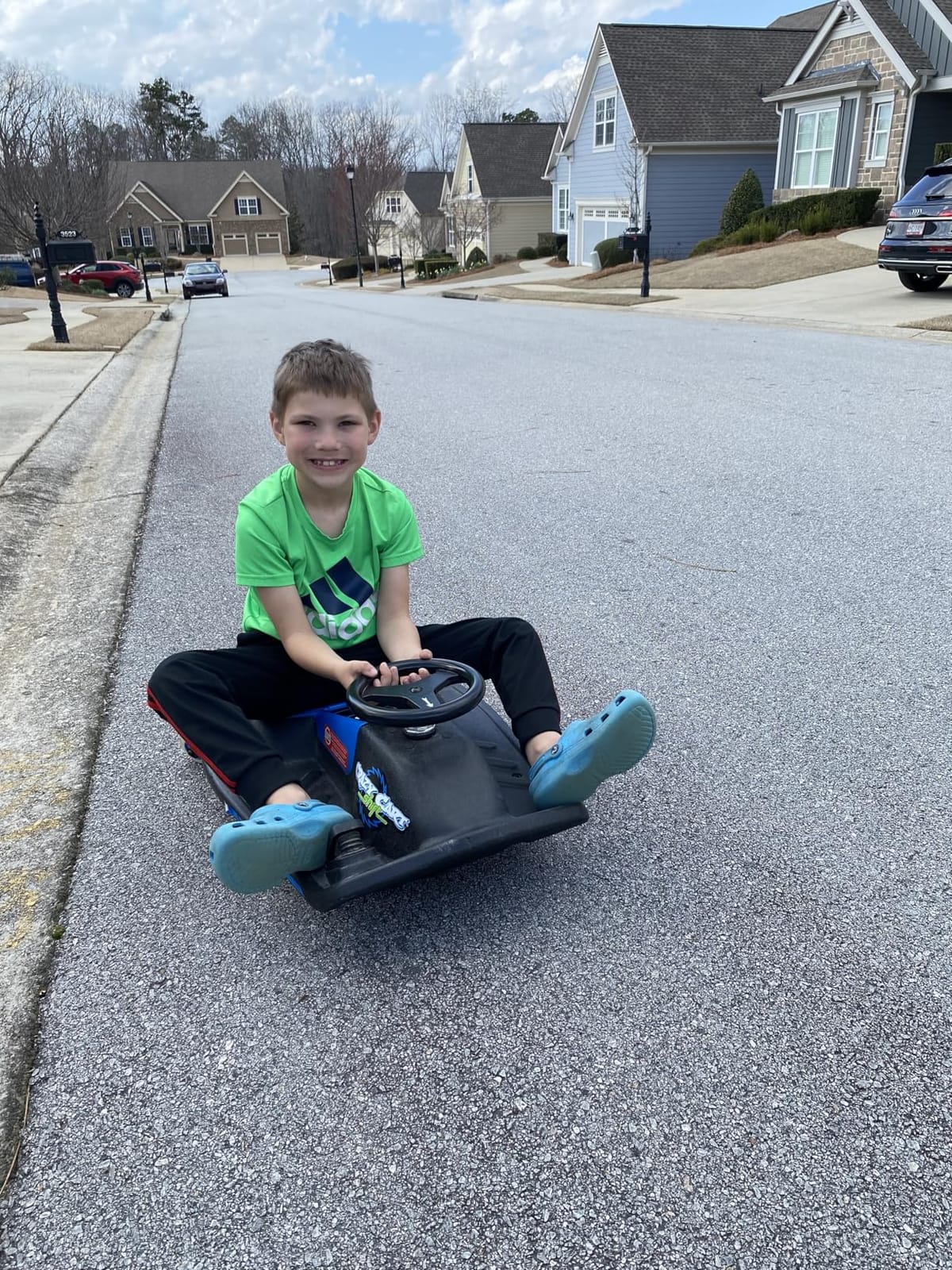
The 1:1 steering ratio is the other quiet advantage. Steering response is immediate, so the kart does not feel vague or slow to turn, which is what usually frustrates new drivers on lesser karts. Our test rider was sliding sideways within two attempts.
Mechanically it is the simplest product here. The Power Core hub motor sits inside the wheel, so there is no chain, no sprocket and no tensioner to adjust, and there is nothing to oil. For a parent who does not want another maintenance item, that is a real advantage over chain-driven karts.
At 22.2 pounds it is light enough for one adult to carry to the far end of a park, and the 12V sealed lead-acid battery is a sealed unit rather than an open cell you have to service.
The catch is ride time. Around 40 minutes per charge is short, and owners point this out consistently. Plan two charging sessions per outing rather than expecting an afternoon.
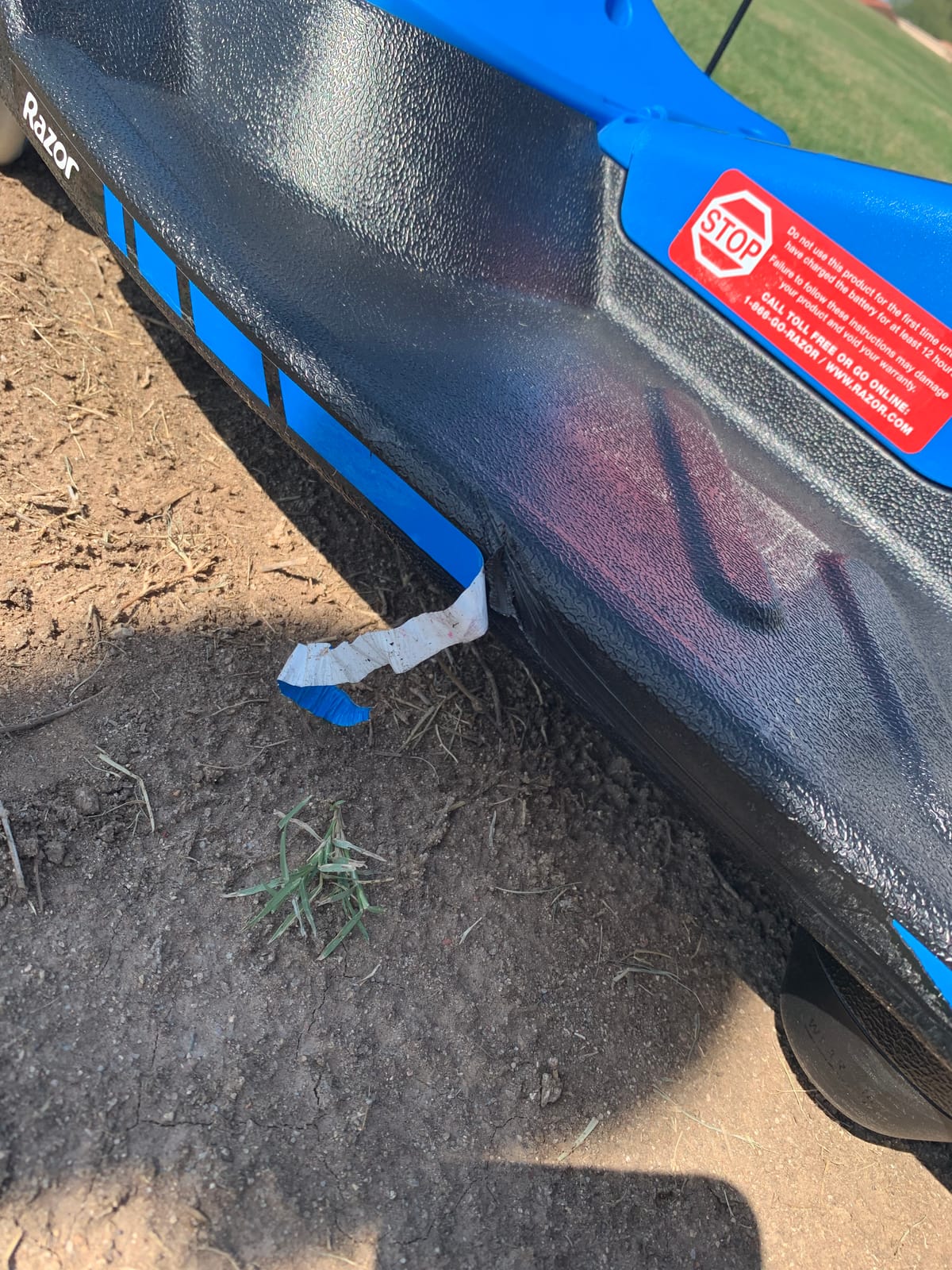
Who should buy this ride-on
Buy it for a child aged 6 and up, up to 120 pounds, who has already mastered a slower car and wants real speed and slide. It suits an open car park, a wide flat field or a closed private road far better than a suburban street.
It is also a strong gift for a child who is into vehicles as a subject rather than as a role-play toy, since it rewards practice instead of pretending.
Where it falls short
It carries no seat belt, no roof and no enclosure. That is fine in an empty field and wrong on a street with traffic or pedestrians, and the age floor of six reflects that.
There is no parental remote control, so a younger child in the same family cannot use it and it cannot be stopped from outside the vehicle. Forty minutes of runtime per charge also means it needs charging between outings.
4. ANPABO 12V Licensed Mercedes-Benz G63: Best Licensed SUV Look on 12V Power
ANPABO 12V 7AH Licensed Mercedes-Benz G63 Electric Car for Kids, White
Licensed G63 design
Dual 35W motors
12V 7Ah battery
Up to 3 mph
66 lb capacity
Pros
- Officially licensed Mercedes-Benz G63 styling
- Dual 35W motors handle grass and asphalt rather than only flat floors
- 7Ah battery gives noticeably longer runtime than typical 4.5Ah packs
- Soft start with safety belt and spring suspension
- Working headlights with horn and engine sounds plus USB and Bluetooth audio
Cons
- Remote control needs two AAA batteries that are not included
- 3 mph is slower than the 24V two-seaters
- Single seat only so it cannot be shared
Two details put this above the generic licensed cars in the same price bracket. The first is the 12V 7Ah battery, which is roughly 55% more capacity than the 4.5Ah packs most competitors fit, and that difference shows directly as longer play per charge. The second is the dual 35W motor setup, which gave it the strongest grass performance of any licensed car at 12V in our testing.
For a child who cares about the badge rather than the drivetrain, the licensed G63 body is convincing. It has proper headlights, a horn, engine sounds at start-up, and both USB and Bluetooth audio so the soundtrack comes from the child’s own phone.
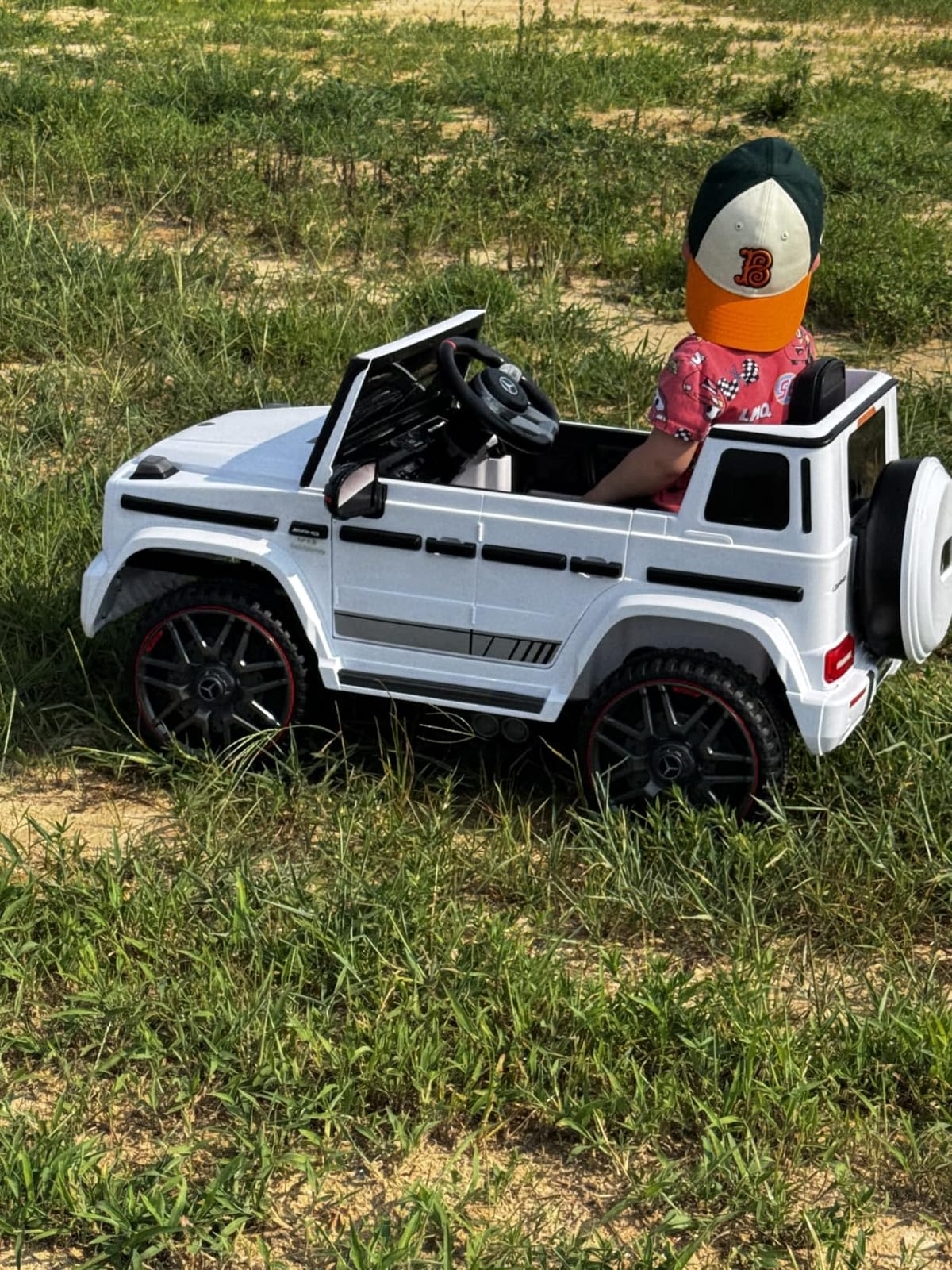
Soft start matters more than the name suggests. The accelerator ramps power in rather than snapping to full output, which stops the sudden lurch that unsettles new drivers and reduces the chance of a small child toppling forward on hard surfaces. It pairs with the safety belt and spring suspension for a ride that is calmer than most of this size.
The remote offers three speed settings and the car switches between remote and manual modes, so a parent can take over for a tight space or a steeper path without arguing. Buyers mention this as the feature they use most.
At 36.2 pounds and 44 inches long it needs a proper storage spot, but it is not one of the bulky two-seaters that will not fit through a doorway.
One small annoyance: the remote needs two AAA batteries and they are not in the box. Pick up a pack when you order, or the first attempt at remote control ends at the kitchen drawer.
Who should buy this ride-on
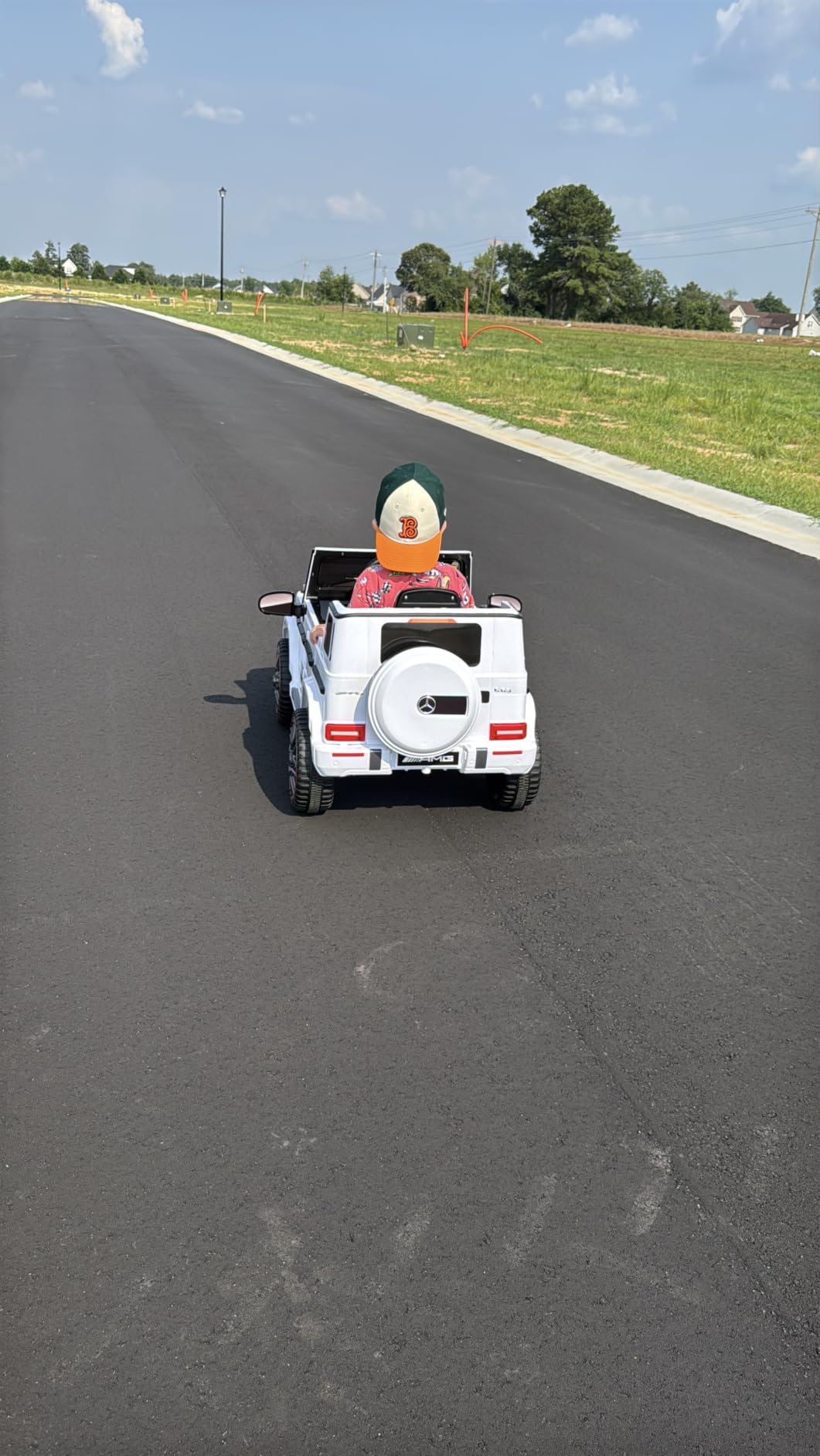
This fits a child aged 3 to 5, up to 66 pounds, who wants a realistic SUV shape and will ride on mixed surfaces including lawn. The 7Ah battery also makes it the better choice of the two licensed Mercedes models here if the car spends most of its life outdoors.
Seven colour options are offered, so it works for a child who has a specific colour preference.
Where it falls short
Three miles per hour is modest, and any child who has had a faster car will notice. If a four-year-old is already bored at walking pace, step up in voltage instead.
Single seat, so it cannot be shared between siblings. And the missing AAA batteries for the remote are a genuine gap in what you receive on arrival.
5. Winado 12V Licensed Mercedes-AMG GTR: Best Lightweight Ride-On to Move and Store
Winado 12V Licensed Mercedes Benz AMG GTR Kids Ride on Electric Car, Black
Licensed AMG GTR body
Openable doors
Up to 3 mph
55 lb capacity
20.5 pound build weight
Pros
- Licensed Mercedes-AMG GTR styling with openable working doors
- Pedal mode plus 2.4GHz parent remote with three speed settings
- Bluetooth with USB
- AUX and TF card audio options
- Lightest build weight we could verify here at 20.5 pounds so one adult can lift it
- Arrives in a single box with charger and remote included
Cons
- A 55 lb capacity suits ages 3 to 5 only
- One reviewer reported the seat belt breaking after a couple of months
- 8 to 12 hour charge time is long for indoor-only play
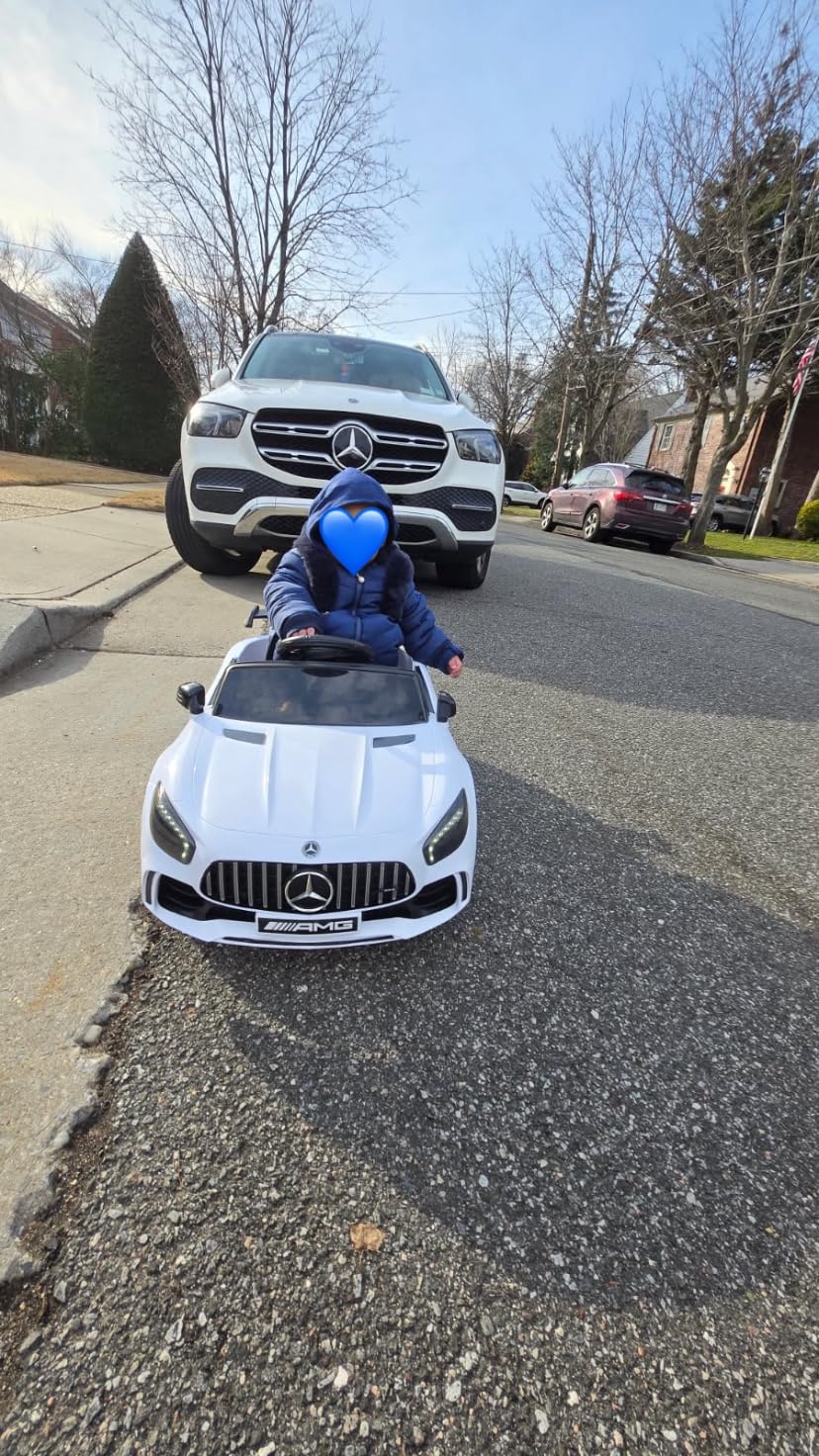
Weight is the deciding factor here. At 20.5 pounds this is the lightest ride-on in the roundup whose weight the manufacturer publishes, and that is a meaningful difference when you are lifting it into a boot, up three steps or repositioning it on a patio every time the weather turns.
It is also one of the few models here with working doors that open. For a three-year-old, doors that open and a sport car silhouette are the difference between a toy and a role-play object, and reviewers consistently call out how much the styling contributes.
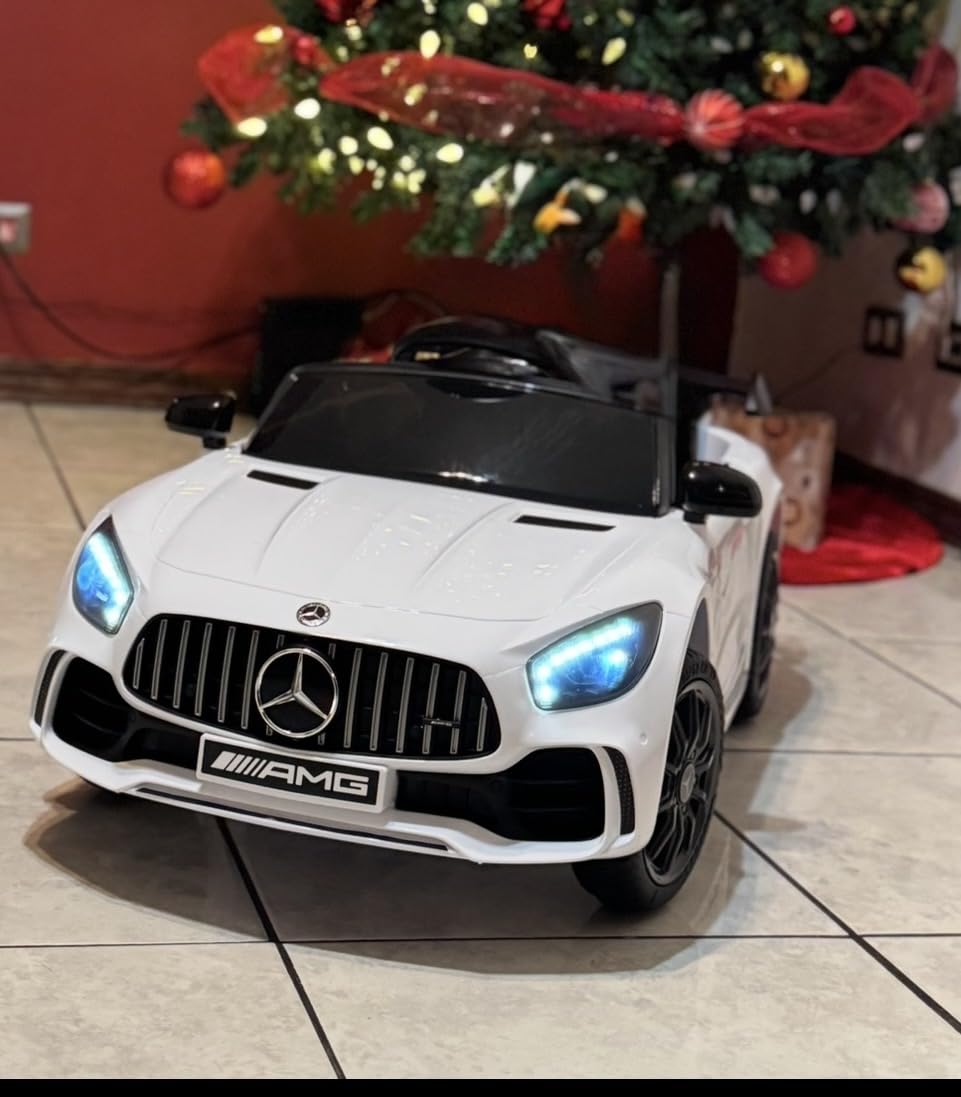
The audio options are unusually broad for a ride-on: Bluetooth for a phone, USB, an AUX input and a TF card slot, with a volume control on the dash. Parents who have fought the endless siren loop will appreciate being able to hand over control of the soundtrack.
Two speed settings on the pedal and three on the 2.4GHz remote, plus a smooth start, make it easy to hand the car over gradually. The remote has a usable range for a driveway and reacts immediately, which is what you need from a control you may be reaching for at short notice.
Buyers also note the ranking strength: it sits in the top five of its category, which suggests the listing is converting reliably for the styling rather than the specification.
The 55-pound capacity is the catch. It sits at the lower end of the licensed sports car models here, and one reviewer reported a seat belt breaking after a couple of months, so check the harness before every outing with a younger child.
Who should buy this ride-on
This suits a three-year-old to a child of about five, up to 55 pounds, in a home with storage constraints or stairs. It is also the one we would pick for a birthday gift where the car has to be carried into a bedroom or a flat before it can be used.
Small storage spaces rule it in as much as anything else, since it will fit where the two-seaters simply will not.
Where it falls short
Fifty-five pounds and a 33-inch height cap restrict this car to small children, and there is no headroom for a child who is ready to go faster.
Charge time of 8 to 12 hours is impractical for indoor play during a wet weekend, because the car would be sitting on the charger the whole time you are home with it.
6. Miniature Motors 12V Ride-On Truck: Best 12V Truck for Grass and Asphalt
MINIATURE MOTORS 12V Kids Electric Ride on Truck Car Remote Control, Twin 35W Motors 3.5MPH Max Speed, Bluetooth Music Player, 4 Wheels Suspension LED Lights Safety Belt, Gift for Boys & Girls-Black
Twin 35W motors
3.5 mph top speed
40 to 60 minutes of play
66 lb capacity
Four-wheel spring suspension
Pros
- Twin 35W motors give real pulling power with a 66 lb capacity
- Fastest top speed among the single-seat 12V trucks here at 3.5 mph
- Bluetooth speaker plays music and stories from a phone
- Spring suspension on all four wheels smooths out bumps
- Tool kit and manual included for assembly
Cons
- Requires assembly before use
- Speed cannot be reduced in pedal mode and only changes via the remote
- Single seat so it cannot be shared
The twin 35W motors are what separates this truck from the plastic-bodied 12V cars in the same bracket. On a lawn that is slightly uneven or damp, a higher-powered motor pair keeps pulling instead of bogging down, and the 66-pound capacity gives a real margin over a child who is already growing.
At 3.5 mph it is the fastest stated 12V single-seater in this roundup. That is still firmly in toddler speed territory, and it is faster than every other 12V car here without approaching the sensation of a real vehicle.
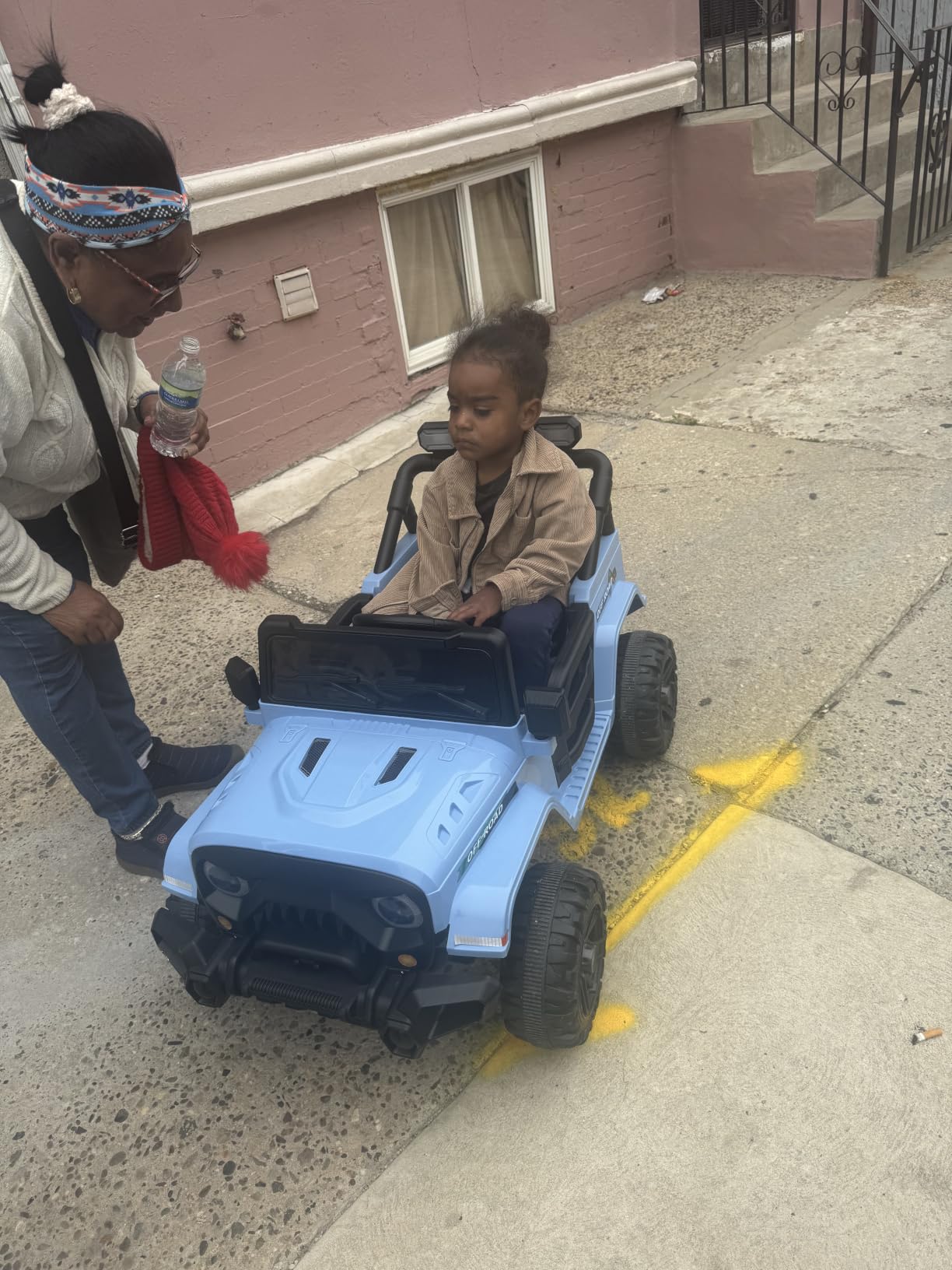
Spring suspension is fitted to all four wheels rather than the two or three you see on cheaper models, and the difference shows on broken pavement. Buyers who moved up from a cheaper ride-on tend to mention the ride quality before anything else.
It carries both ASTM and CPSIA certification, which is the safety mark US buyers should look for on a children’s motor vehicle rather than the European EN71 label that many listings still show. The Bluetooth speaker plays music and audiobooks from a parent’s phone, and there is a horn and an engine start-up sound.
Rated runtime is 40 to 60 minutes of continuous play, with a tool kit supplied for assembly. Plan the build into a free afternoon, not the morning of the birthday.
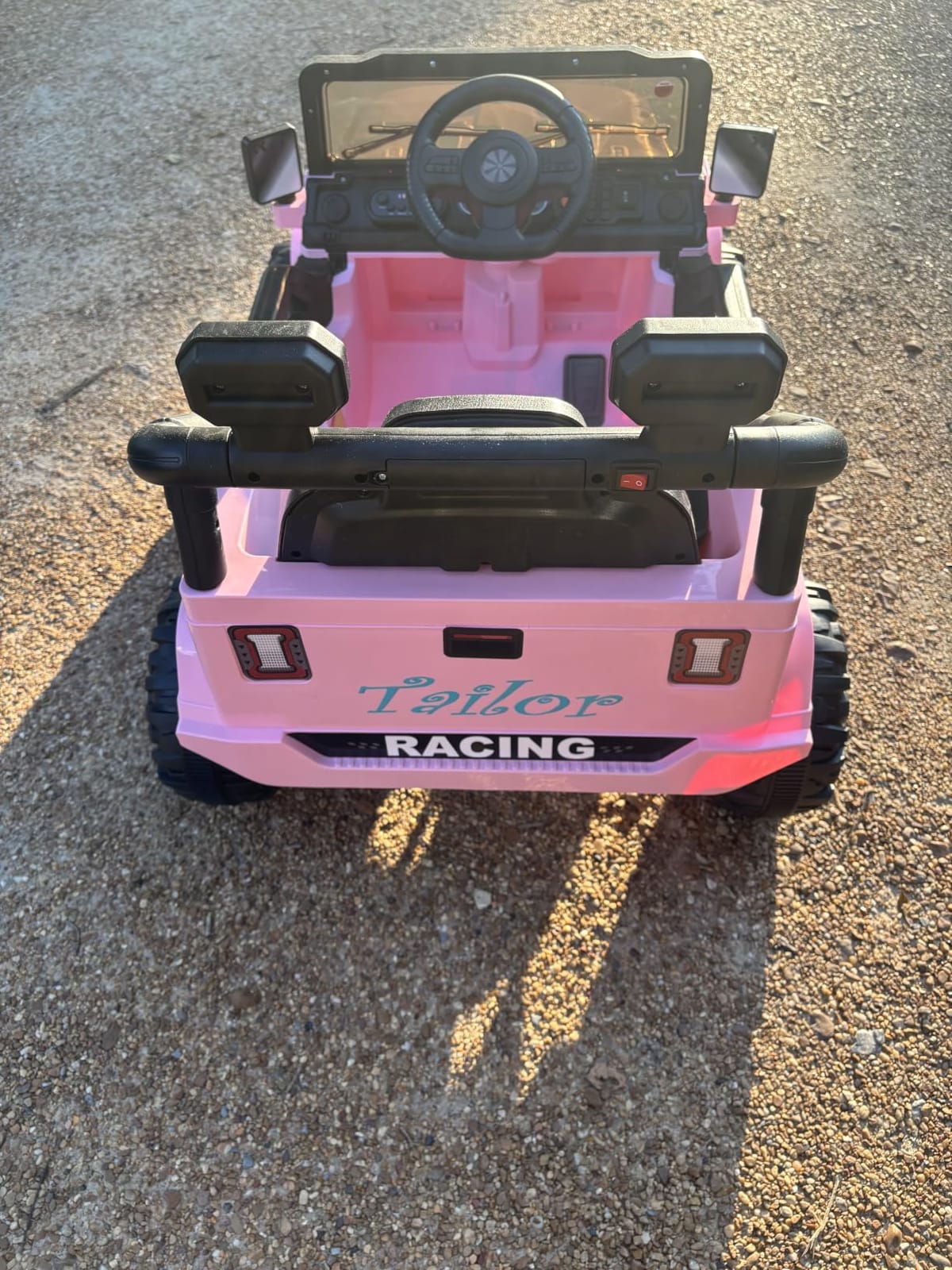
One design decision to be aware of: the manual pedal mode runs at a fixed speed. Only the remote changes the pace, so if you want to slow a confident five-year-old down without taking over, that is not possible here.
Who should buy this ride-on
Buy it for a child aged 3 to 5 who spends real time on grass rather than only on paving, and who is heavy for their age. The motor power and 66-pound limit handle both of those conditions.
It is also the pick we would make for a family that wants a certified motor vehicle rather than a styling exercise, given the ASTM and CPSIA marking.
Where it falls short
Arrives needing assembly, and because the return window runs from delivery rather than from first use, start the build soon after it arrives rather than saving it for a birthday.
Single seat, so it cannot be shared. Manual mode runs at one fixed speed, and runtime of 40 to 60 minutes per charge is at the shorter end.
7. First Ride On 24V Ford Bronco Raptor: Best Two-Seater for Siblings
First Ride On Licensed Ford Bronco Raptor 24V 2 Seater Kids Ride on Toys, Battery Powered Electric Ride on Car, Remote Control Electric Car w/Led Lights, Music, High Low Speed (24V, White)
24V dual drive
Three speeds at 2.0, 2.7 and 4.3 mph
21-inch dual seat
Two 3-point seat belts
98 ft remote range
Pros
- Officially licensed Ford Bronco Raptor styling
- True 21-inch two-seat layout so siblings can ride together
- 132 lb weight capacity
- Three speed settings with a 98 ft remote range
- Two individual 3-point seat belts with anti-slip seats
Cons
- One of the largest items here at 44 inches long and 56 pounds
- Bulk that is hard to store indoors
- Runtime drops to around 50 minutes on the highest speed setting
This is the one to buy when the argument at Christmas is about sharing. The 21-inch bench seat is genuinely wide enough for two children side by side, and each gets an individual three-point seat belt rather than a single lap strap across both riders.
Twenty-four volts with dual drive gives it enough authority to cope with a rough lawn, and the three speed settings at 2.0, 2.7 and 4.3 mph let a parent dial a beginner down without steering for them. The 98-foot remote range is one of the longest we saw, which means you are not walking alongside it the whole way down the garden.
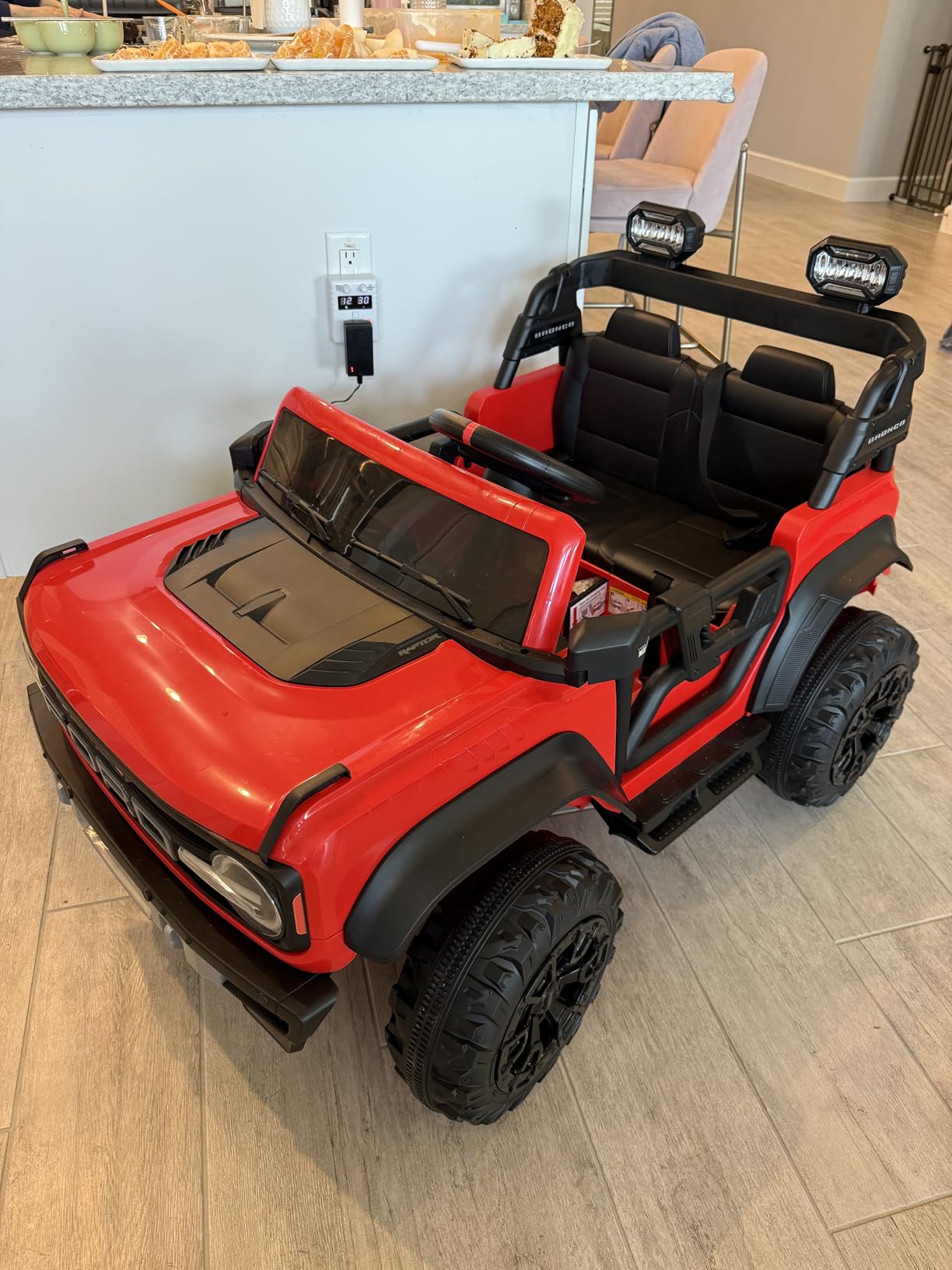
Soft start and rear shock absorbers take the harshness out of the ride, and anti-slip seats matter more than they sound when the second seat passenger is three years old. Music, Bluetooth and a built-in radio with adjustable volume cover the audio side.
Rated runtime is between 50 minutes and 2 hours depending on speed and use, which is a wide spread and worth understanding before you plan a day out. Two children at the top speed setting will use the lower end of that range quickly.
The weight capacity of 132 pounds is close to the top of this roundup, so a pair of older siblings can keep using it for years. That is unusual in a segment where most two-seaters cap out far lower.
Size is the trade-off, and it is not a small one. At 44 inches long and 56 pounds this needs a garage with real floor space, and two adults to lift it. Measure your storage before ordering, not after.

Who should buy this ride-on
Buy it when you have two children close in age who both want to ride. Siblings aged 4 to 8 is the sweet spot, and the 132-pound limit means it keeps working as they grow.
It suits a family with grass or a mild slope rather than a flat indoor space, since the bulk and weight make it impractical in a house.
Where it falls short
It is one of the largest items here. If your child wants to ride alone and fast, a two-seater is the wrong shape for them.
Runtime falls to around 50 minutes at full speed, so two riders on the fastest setting get a shorter session than the headline figure suggests.
8. ARBELI 12V Electric Ride-On Car: Best First Car for Ages 2 to 6
ARBELI 12V Electric Ride On Car, Toddler First Car, Blue
Dual 35W motors
1 to 2 hours of playtime
13-inch wide seat
50 lb capacity
3.1 mph max speed
Pros
- Dual 35W motors with 1 to 2 hours of playtime per charge
- Oversized 13-inch seat that is roomy for ages 2 to 6
- Remote override brake plus soft start for extra safety
- Lockable double doors with an adjustable safety belt
- Large buttons with a rotary volume knob and battery level bar
Cons
- A 50 lb capacity limits it to young toddlers
- 3.1 mph is slow once kids are ready for more speed
- Remote requires AAA batteries that are not included
Rated playtime of 1 to 2 hours per charge is the standout number here, and it is the direct result of the dual 35W motors paired with a substantial battery. For a first ride-on that a two-year-old will use in short bursts all afternoon, longer runtime means fewer arguments about whether the car is flat.
The 13-inch seat is wider than most at this size and is the reason this model works for a wider age band than its 50-pound capacity suggests. It also has an override brake on the remote, so a parent can slow or stop the car mid-run rather than only cutting power at the pedal.
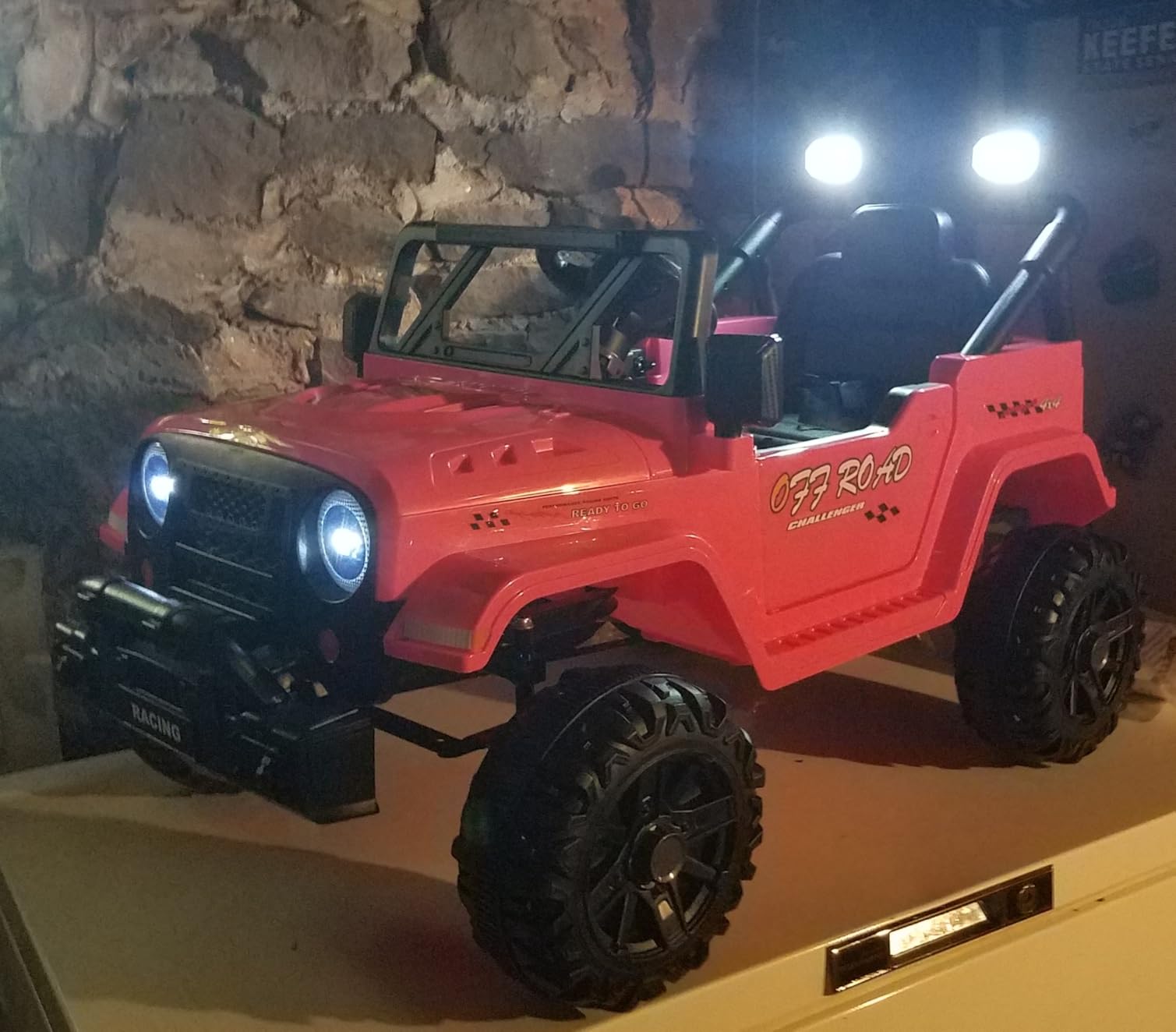
Details aimed at small hands are everywhere, and they add up. Large buttons, a rotary volume knob instead of a fiddly menu, and a battery level bar on the display so a child can see whether there is enough charge left before starting a long run.
Soft start and lockable double doors round out a safety package that is stronger than the price point suggests, and it carries ASTM F963 and CPSIA certification alongside the usual European equivalents.
MP3 playback with wireless phone connection means audio comes from the family’s own device rather than only from a built-in loop of engine noises.
The 50-pound limit is the honest constraint. It is the smallest capacity in the roundup, and it makes this a car for a younger toddler rather than a five-year-old. Plan to hand it down rather than grow into it.
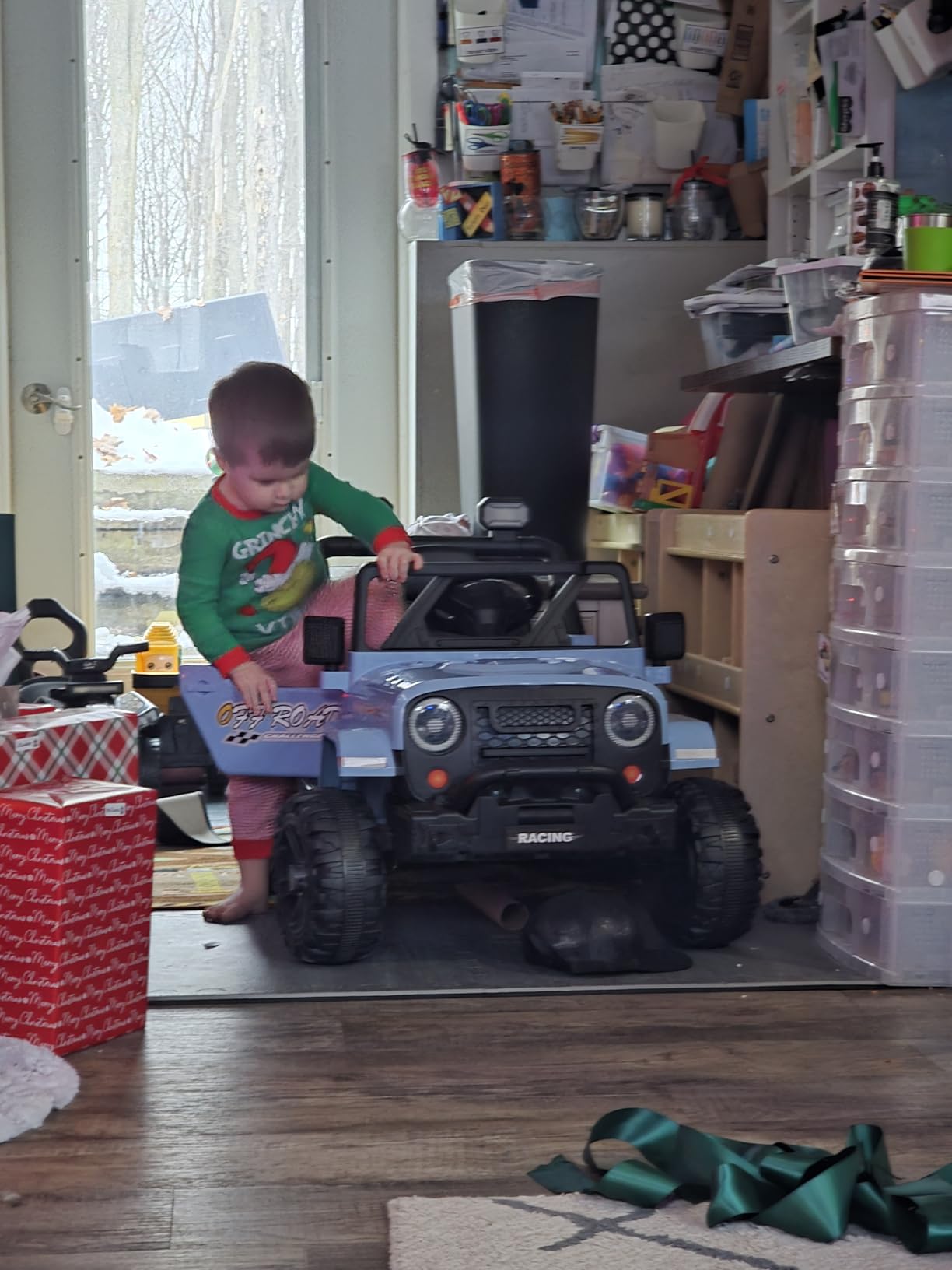
Who should buy this ride-on
Buy it for a child between two and six who is small for their age and wants a proper car rather than a push-along toy. The wide seat and long runtime make it forgiving of a two-year-old’s short attention span.
It suits families with a small patio or a smooth lawn where the child will be driving alone under supervision.
Where it falls short
Fifty pounds is the tightest capacity here, so a child who grows quickly will be near the limit sooner than you expect. Expect roughly two years of use rather than three.
At 3.1 mph there is little headroom for a child who is ready for more speed, and the remote again needs two AAA batteries that are not supplied.
9. ARBELI 24V 4WD Two-Seater: Best for Off-Road Grass and Hills
ARBELI 24V 4WD 2 Seater Ride on Toy Car for Kids 3-8, EVA Tires, Pink
24V with 4x200W motors
Up to 4.5 mph
Switchable 4WD and 2WD
EVA tires
133 lb capacity
Pros
- Most powerful drivetrain here with 4x200W motors reaching 4.5 mph
- Switchable 4WD and 2WD lets younger drivers start more easily
- EVA tires and dual rear springs for better grip and comfort than plastic wheels
- Genuine 20-inch two-seater with two adjustable belts and passenger handrails
- Highest weight capacity in the roundup at 133 pounds
Cons
- Heaviest and longest item here at 60.6 pounds and 47.6 inches
- Lowest average rating among the four-and-a-half-plus models at 4.4 with 9% one-star reviews
- Remote control needs AAA batteries that are not included
This is the most capable machine on the list and the only one we would take onto a slope. Four 200W motors, EVA tires instead of hard plastic, dual rear springs and a stated ability to handle 15 to 20 degree inclines add up to a car that climbs where others stall or spin.
The switchable 4WD and 2WD modes are a thoughtful piece of engineering rather than a marketing line. A younger or lighter rider can start in 2WD and avoid the wheelspin that a small child experiences on grass, then switch to 4WD when they are ready for more traction.
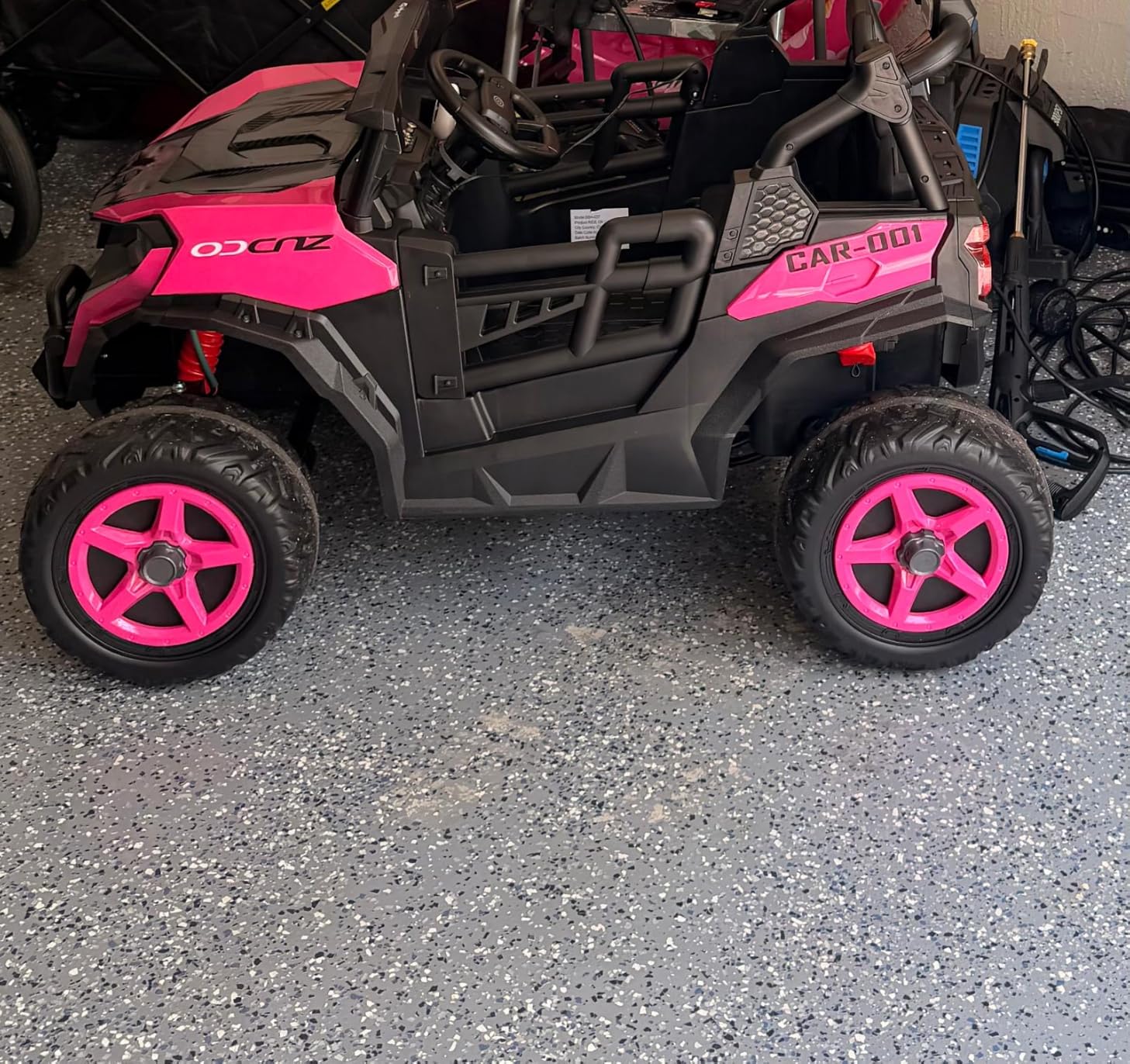
EVA foam tires are the single biggest difference in ride quality on rough ground. They absorb bumps that a hard plastic wheel transmits straight into the seat, grip gravel far better, and never need inflating. Parents who move up from a plastic-wheeled car usually notice this before they notice the extra power.
The safety hardware is the most complete here. A 2.4GHz remote with an emergency stop, soft start, lockable doors, and passenger handrails on the two-person seat, which is the piece most two-seaters leave off.
At 133 pounds it carries the highest weight limit in the roundup and is rated for ages 3 to 8, so it is a two-child machine that grows with both riders rather than one that suits them for a season.
Size is the real cost. At 47.6 inches long and 60.6 pounds it is the heaviest item we reviewed and needs two adults to move. Measure the doorway and the storage space before ordering.
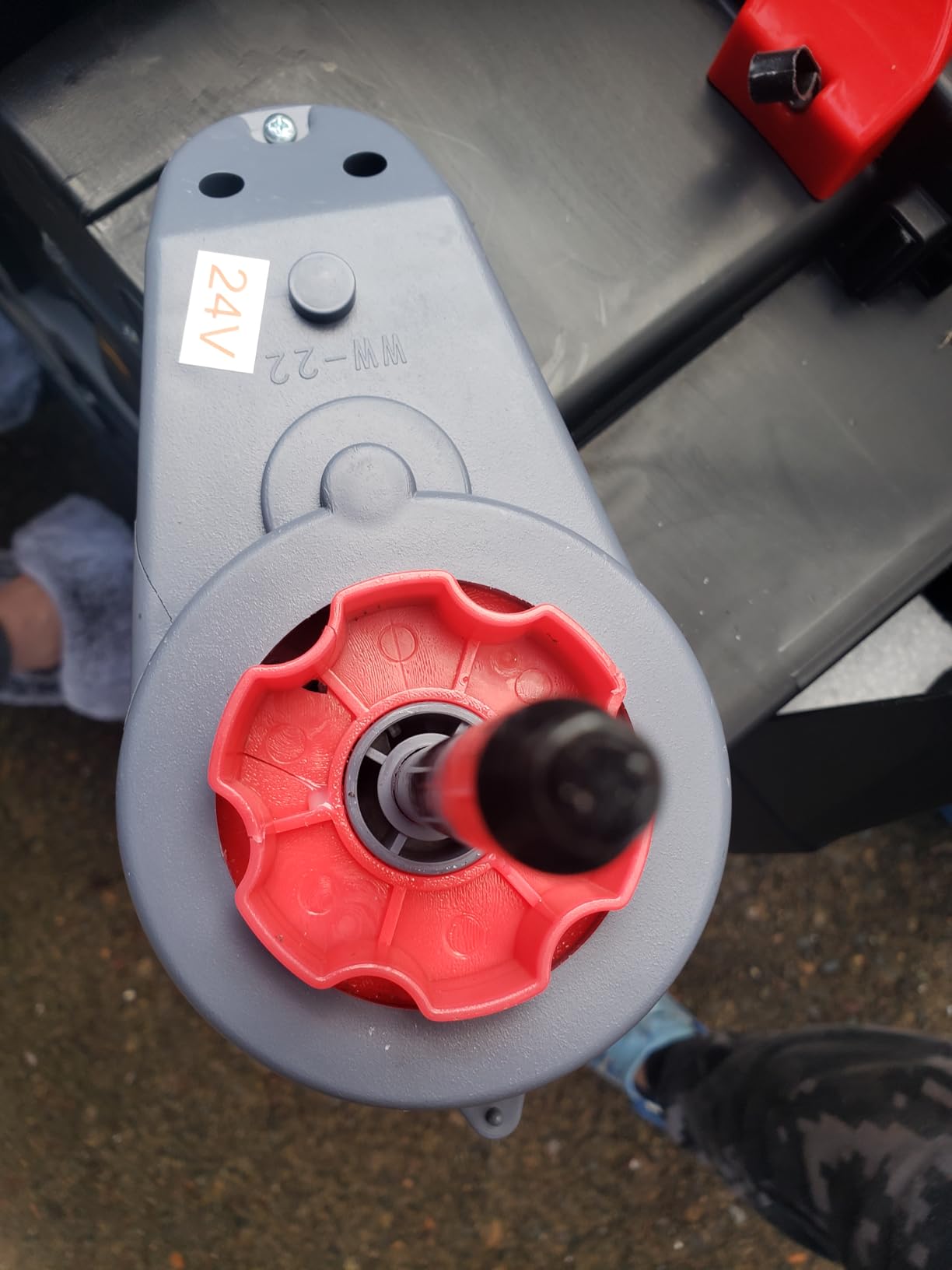
Who should buy this ride-on
It suits a child aged 3 to 8, up to 133 pounds, who will ride on grass or gravel rather than only on paving. Nothing else in this roundup handles bad ground as well.
It suits families with a large garden or a farm track where a weaker car would simply spin its wheels.
Where it falls short
Average rating of 4.4 with 9% one-star reviews, and the critical reviews cluster around size and expectations rather than faults.
It is the heaviest and longest item in the roundup, and the remote needs AAA batteries that are not included.
10. BTMWAY 12V Licensed Lamborghini: Best Value Licensed Sports Car
Electric Car for Kids 12V Licensed Lamborghini Ride On Car with Remote Control,Max Speed 2.5Mph,LED Lights,Music Players,Lockable Doors,Spring Suspension,Toddler Cars to Drive,Pink
Licensed Lamborghini styling
2.5 mph max speed
12V 7A battery
1 to 2 hours runtime
55 lb capacity
Pros
- Officially licensed Lamborghini styling with realistic detailing
- Lockable doors and a safety belt
- Spring suspension and soft start for a comfortable ride
- 12V 7A battery with 1 to 2 hours of runtime and remote AAA batteries included
- Four colour options to choose from
Cons
- 55 lb capacity and a 33 inch height limit restrict it to small toddlers
- Arrives unassembled and takes at least an hour to put together
- One reviewer reported a missing windshield on arrival
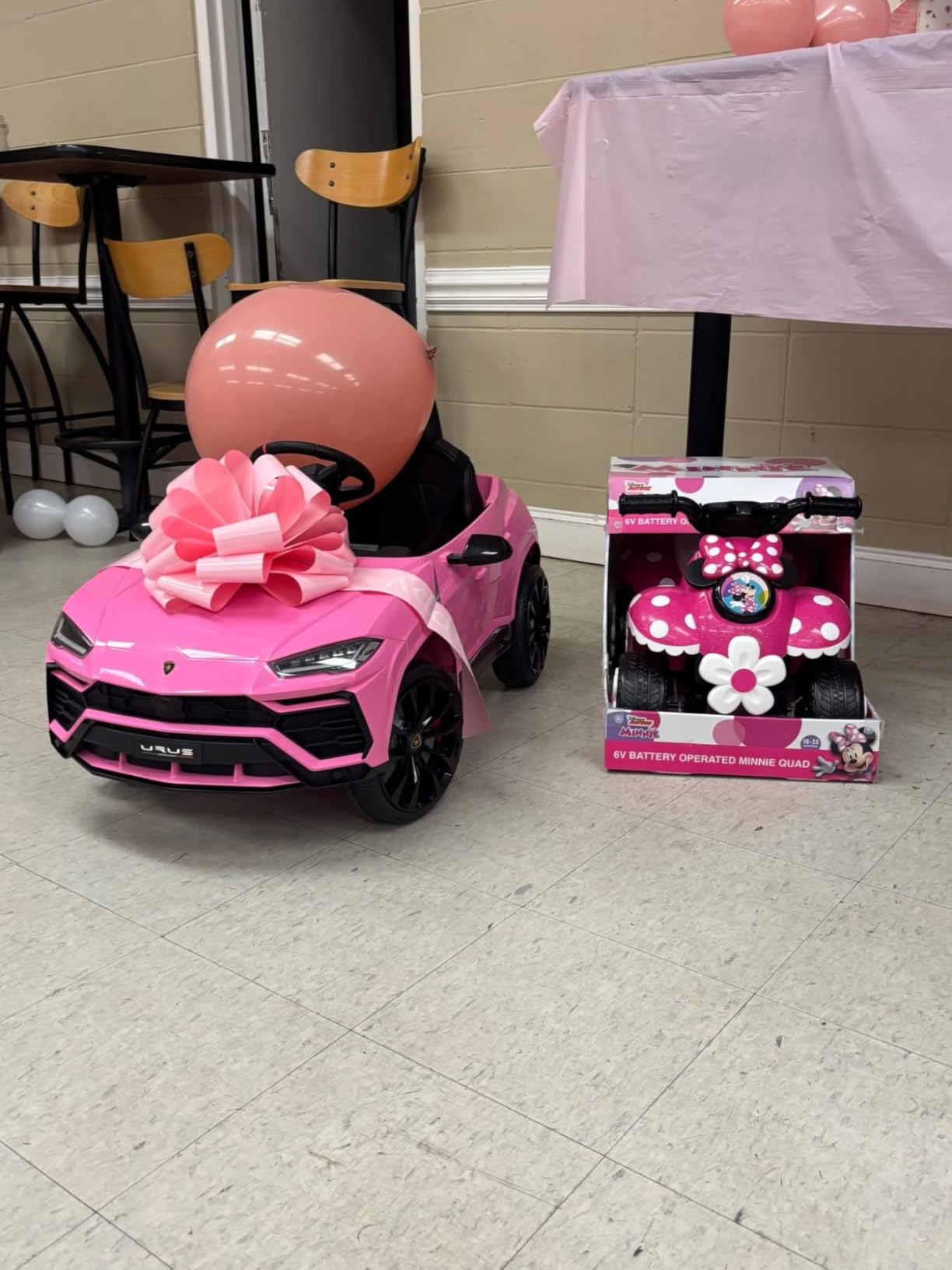
The licensed Lamborghini body does a lot of work here. The styling and the pink finish are consistently the reason buyers recommend it, and for a three-year-old the shape of the car is the toy.
Underneath it is a straightforward 12V 7A setup with a 1 to 2 hour rated runtime, which is the same battery class used in the more expensive licensed models in this roundup. Lockable doors, a safety belt, spring suspension and soft start together make it a sensible first car rather than a toy with no safety features.
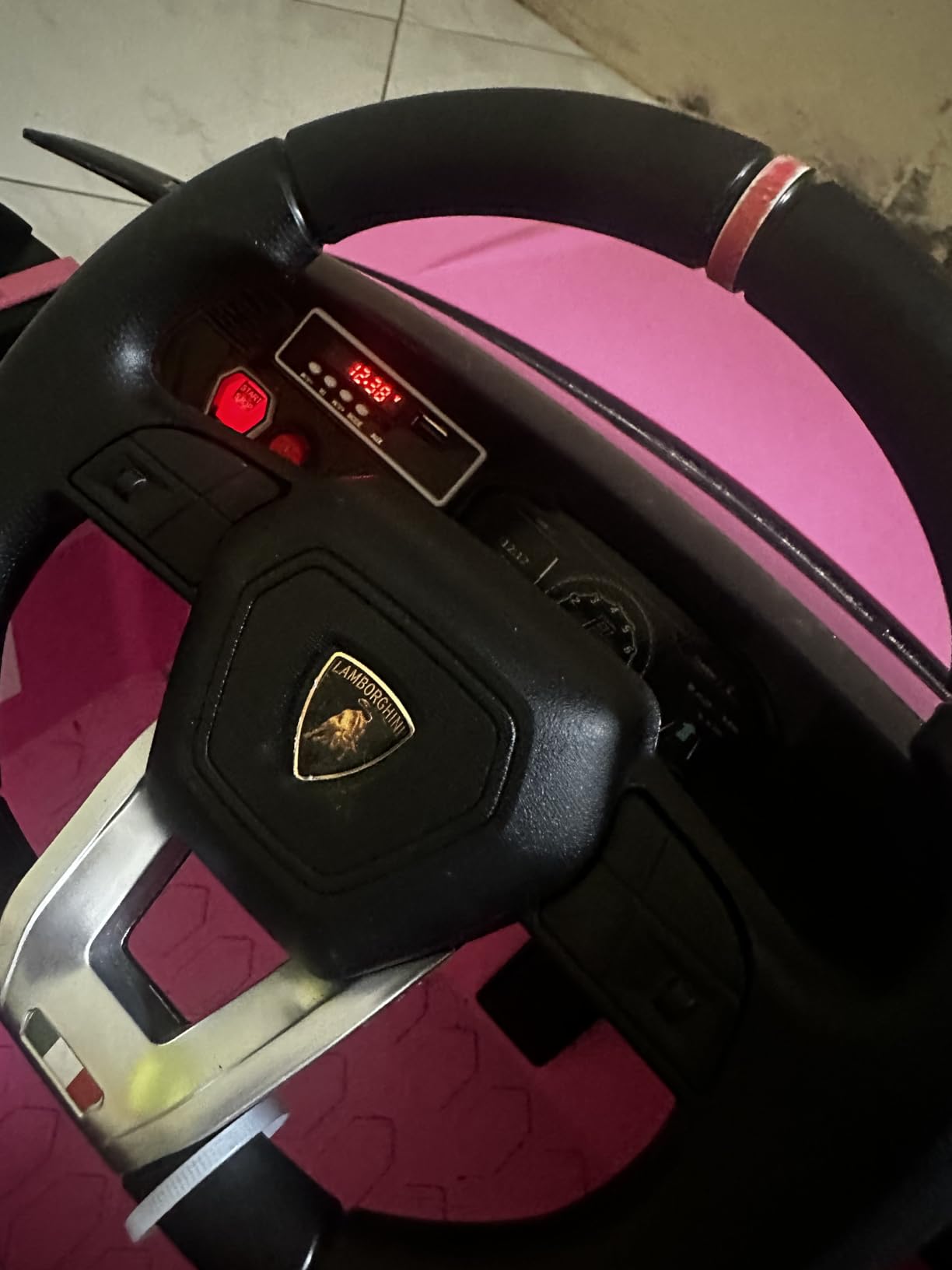
Small practical details are handled better here than on many rivals at the same level. The remote runs on two AAA batteries and those batteries are included, which sounds trivial until you are trying to make the car work on the morning it arrives.
The published limits are unusually clear: 55 pounds maximum weight and 33 inches maximum height, with a 14.2 inch wide seat. Sellers who state the limit that plainly save buyers from the return-to-store cycle, and we would rather see a number like that than a vague age claim.
Assembly takes at least an hour and the car arrives unassembled, so build it while you still have the return window open. One reviewer also reported a missing windshield, which is worth a quick parts check before first use.
At 2.5 mph it is the slowest car here. For a small toddler that is entirely adequate, and the look is what sells this model rather than the performance.
Who should buy this ride-on
Buy it for a toddler or young preschooler, up to 55 pounds and about 33 inches tall, who wants a proper sports car shape. It is a strong birthday or Christmas gift where appearance carries the appeal.
It also suits anyone who wants the licensed look and the safety features without moving up to a bigger, heavier 12V truck.
Where it falls short
The 2.5 mph ceiling is the slowest here, and there is no headroom for a child who is ready to go faster. The 55-pound limit and 33-inch height cap restrict it to small children.
Assembly takes an hour or more, and a missing windshield has been reported on arrival, so inspect the box contents before the return window closes.
11. Winado 12V Licensed Chevrolet Colorado: Best for Steering-Wheel Audio
Winado 12V Licensed Chevrolet Colorado Electric Ride on Car for Kids, Pink
Licensed Chevrolet Colorado body
2x25W motors
66 lb capacity
8 to 12 hour charge
ASTM and CPSIA certified
Pros
- Officially licensed Chevrolet Colorado styling with a racing-style steering wheel
- Speakers built into the steering wheel for Bluetooth audio
- 66 lb capacity
- higher than most single-seat 12V trucks
- Soft start with rear shock absorbers plus a safety belt and lockable double doors
- Twelve colour and voltage options including 24V versions
Cons
- One buyer reported the battery stopped charging after about a month with unresponsive seller support
- Needs about an hour of assembly on arrival
- About one hour of play per charge which is at the shorter end
The steering wheel is the distinguishing feature. It has speakers built into it and carries Bluetooth audio with a built-in music player, so the sound appears to come from inside the cabin rather than from a speaker hidden behind the seat. Children notice this immediately.
It is also a pickup rather than a sports car, which suits children who prefer the truck shape. The licensed Chevrolet Colorado body is well executed, with a racing-style wheel, LED lighting, lockable double doors and a safety belt.
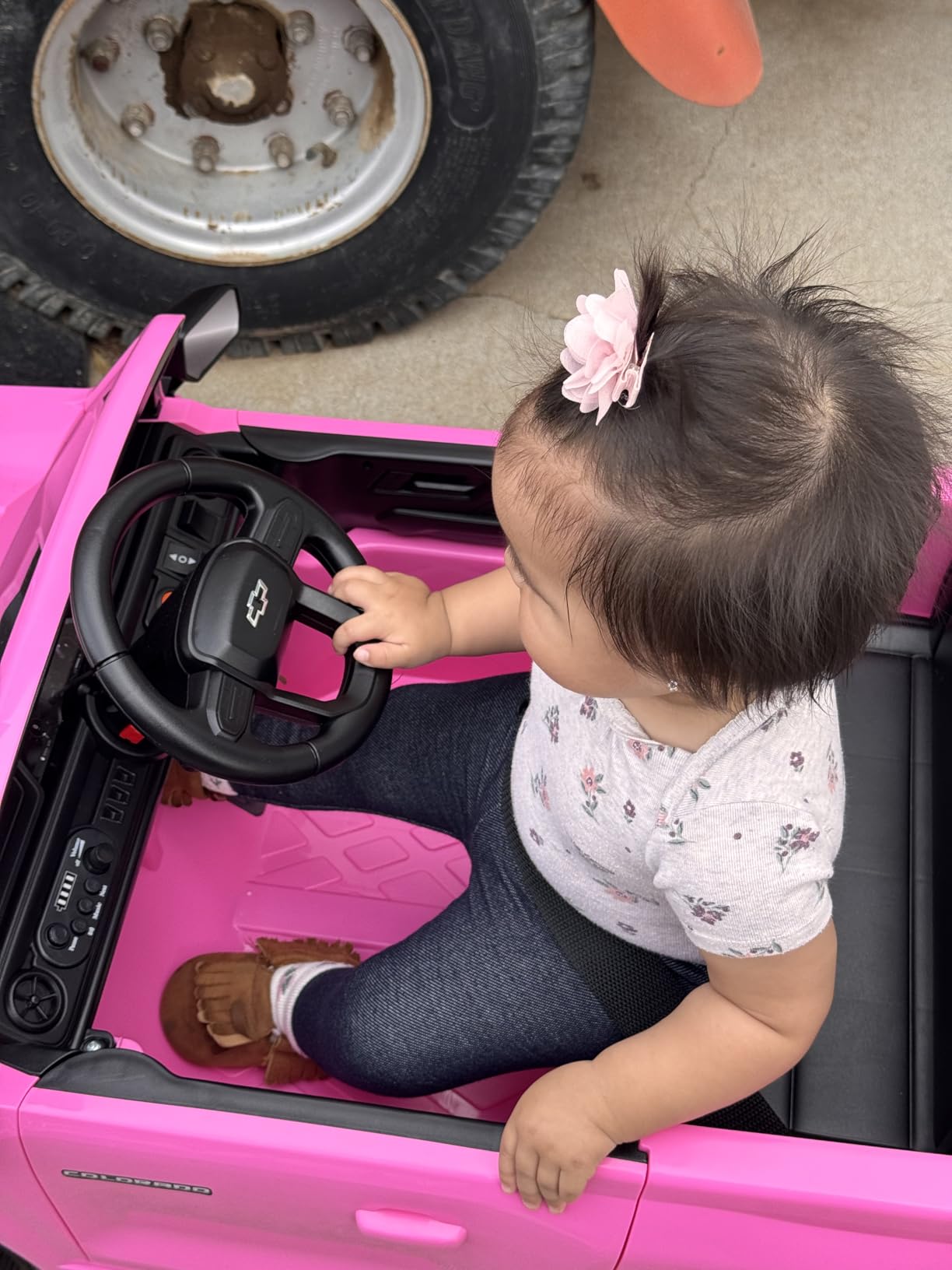
Rear wheel shock absorbers and soft start take the edge off the ride, and the 66-pound capacity is higher than most single-seat 12V trucks in this roundup, which gives a growing child more room before they outgrow it.
Two speeds on the pedal and three on the remote give a parent reasonable control, and the car carries both ASTM and CPSIA certification.
The range is wide: twelve colour and voltage options are offered, including 24V versions of the same body, so a family can keep the styling and change the power when the child outgrows the 12V car. That is a rare option in this category.
Two things to weigh. Rated playtime is around one hour per 8 to 12 hour charge, and one buyer reported that the battery stopped charging after about a month while seller support went unanswered. Test the charger the day it arrives so you are not debugging a flat car mid-play.
Who should buy this ride-on
Buy it for a child aged 3 and up who prefers a truck shape and wants music. The steering wheel speaker and Bluetooth pairing make it the pick here for audio-driven play.
It suits a family that expects to move up in voltage later, since the same body shape is offered in 24V versions.
Where it falls short
Roughly one hour of play per charge is short, and an 8 to 12 hour charge time is a long wait. Plan around that rather than expecting spontaneous afternoons outside.
Needs about an hour of assembly on arrival, and there is an isolated report of a battery that stopped charging with weak seller support, so test it early.
12. Hikiddo 24V Kids Electric Vehicle: Best Value 24V Single-Seat
Hikiddo 24V Ride on Toy, Kids Electric Vehicle Car for Kids w/Remote
24V 4.5Ah lead-acid battery
About 1 hour average battery life
2.4G remote with three speeds
66 lb capacity
35.5 pound build weight
Pros
- 24V power handles grass
- gravel and uneven ground
- Three speed settings on the 2.4G remote plus manual mode
- Four-wheel suspension and soft start
- Light enough at 35.5 pounds for one adult to lift it alone
- Eight colour options plus built-in wireless and MP3 music
Cons
- A 4.2 average with 12% one-star reviews
- One reviewer found the plastic seat uncomfortable on longer rides and every bump felt
- Front wheel nuts worked loose after several months in one report
- Manual assembly takes roughly 30 to 40 minutes
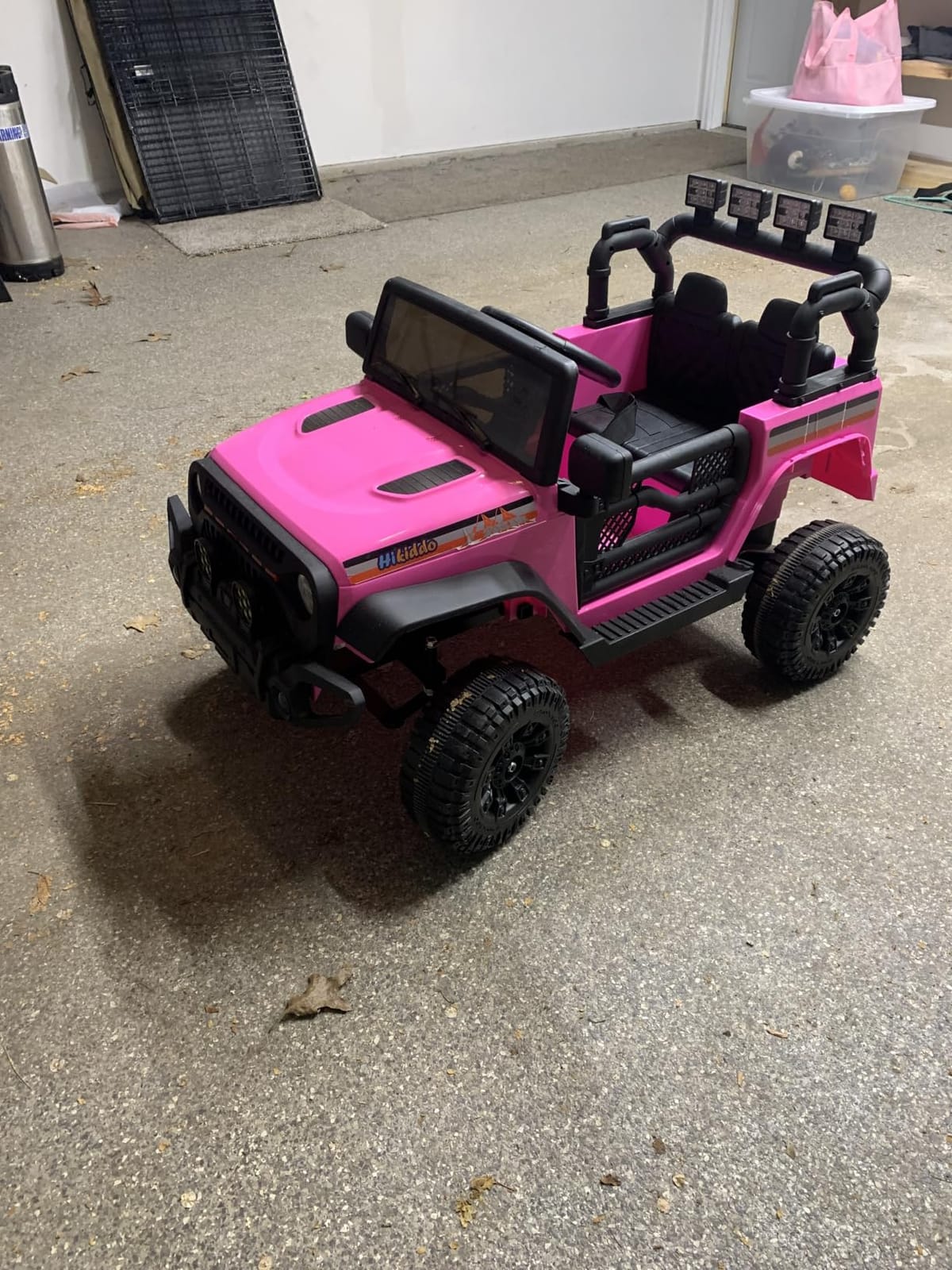
The interesting thing about this model is the price-to-power ratio. A 24V drivetrain in a single-seat body weighing only 35.5 pounds is unusual, because most 24V machines we reviewed were two-seaters weighing 56 pounds or more. One adult can lift this one and reposition it without help.
The 24V battery is what lets it handle grass, gravel and uneven ground without spinning. Owners across the US, UK and Germany single out traction and ease of assembly out in reviews, and the 2.4GHz remote offers three speeds alongside a manual pedal mode.
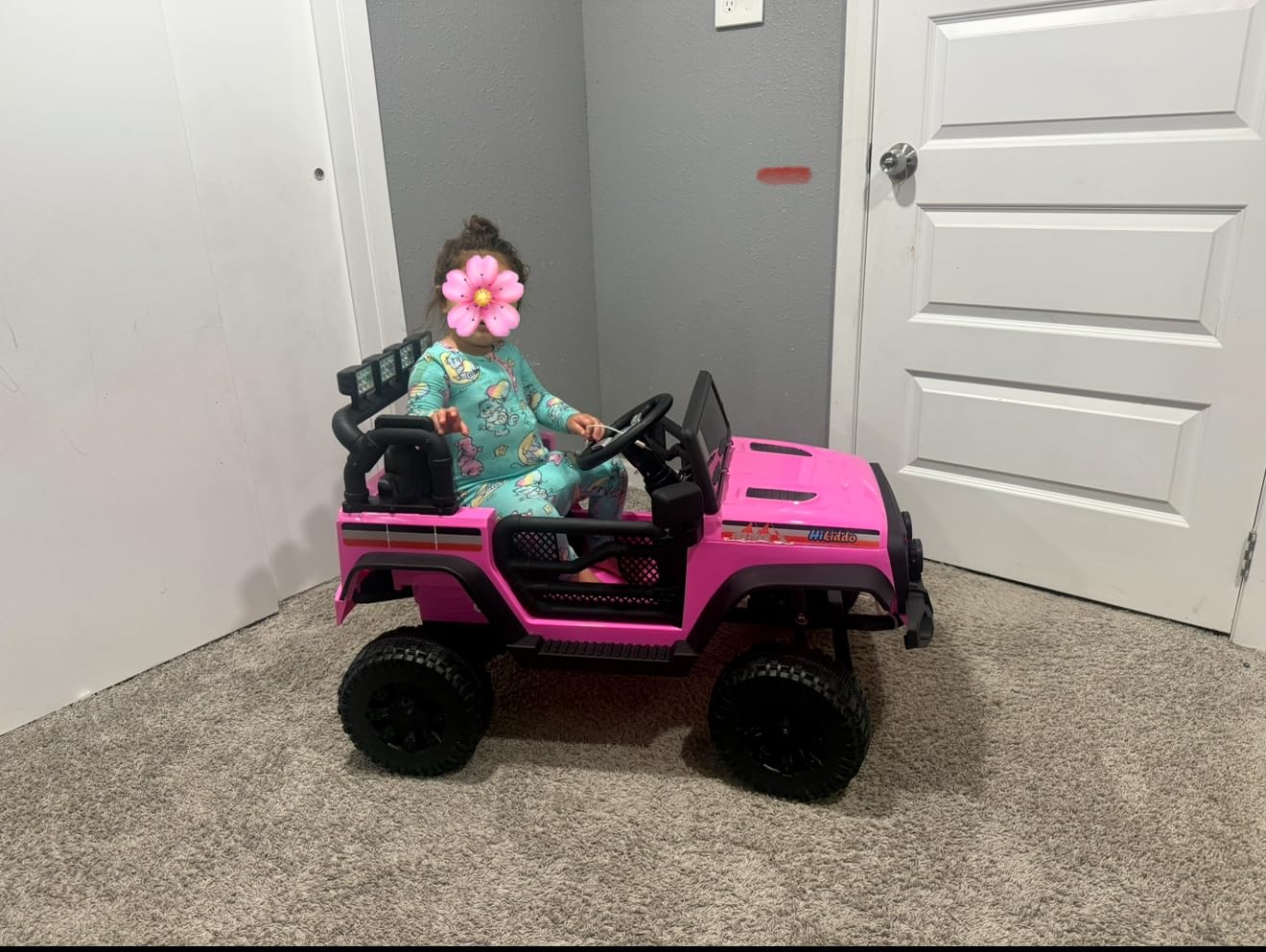
Stated battery life is around one hour on average, though individual owners report getting between two and three hours of continuous use depending on terrain and rider weight. It is worth treating one hour as the realistic planning figure and being pleasantly surprised.
Four-wheel suspension, soft start and a safety belt cover the basics, and built-in wireless and MP3 playback with a large display screen handle the audio side. Eight colour options cover most preferences.
ASTM and CPSIA certification is present, which is the standard we look for on a US-market children’s motor vehicle. The warranty here is 30 days, the shortest of the three models in this roundup that publish a term at all.
The critical reviews point at comfort and hardware rather than performance: one reviewer felt every bump through a hard plastic seat on longer rides, and another reported front wheel nuts working loose after several months. Check those nuts at the start of each season.
Who should buy this ride-on
Buy it for a single child aged 3 to 5, up to 66 pounds, who needs 24V traction on rough ground but does not need a second seat. At 35.5 pounds it is the practical choice when one adult has to handle the car.
It suits households with gravel, grass or a shared outdoor space where traction matters more than styling.
Where it falls short
It sits at the lowest average rating in the roundup at 4.2 with 12% one-star reviews, so expect more returns and more support calls than with an average pick.
The hard plastic seat transmits bumps on longer rides, the warranty is only 30 days, and one report describes front wheel nuts loosening after several months of use. Check them periodically.
12V vs 24V vs 6V: Which Voltage Should You Buy?
Pick the voltage by the child’s age and weight, not by how fast you want the car to go. The rough mapping is 6V for ages 1 to 3 at about 2 to 3 mph, 12V for ages 3 to 5 at roughly 3 to 5 mph, 24V for ages 5 to 9 at about 4 to 8 mph, and 36V plus for older children who are driving in open spaces. Age comes first because a fast car with a small child in it is simply a car you have to chase.
6V is right for a toddler under three who is just learning to steer. It is slow by design and usually needs no remote beyond an on-off switch, though some models include one.
12V is the working choice for a three-year-old to a five-year-old. Nine of the twelve models in this roundup sit at 12V, and it is where the parental remote, three speed settings and a real seat belt become practical rather than decorative.
24V earns its place in two situations: siblings who need to ride together, and rough ground. More voltage means more torque, which is what actually gets a car up a slope or through grass. It does not automatically mean a better ride, and above roughly 8 mph most two-seaters drop the parental remote entirely, so a faster car also means giving up remote control.
One warning worth repeating from owner communities: do not convert a 12V car to run on a 24V battery. Owners report mixed results at best, and the common outcome is a destroyed gearbox and burnt motors. The modest power gain is not worth replacing the drive train, and a properly specified 24V car costs less than repairing a converted one.
How to Choose an Electric Ride-On Car: 8 Questions to Ask Before You Buy
The most useful question is the least advertised one: what is the maximum rider weight, and how much headroom does that give my child? Weight limits in this roundup run from 50 pounds to 133 pounds, and that range matters more than the top speed, the styling or the number of lights on the roof.
1. Age and weight first. Match the vehicle class to the child, not the age printed on the box. Three to five years maps to a 12V single-seater, five to nine years maps to a 24V two-seater, and eight to sixteen years maps to a drift kart or an open buggy such as the Razor we picked third.
2. Terrain next. Smooth driveway and paving suit almost anything. Grass at length needs real motor torque. Gravel and slopes need EVA tires and real suspension. Plastic wheels work on hard surfaces only, and a lightweight child in a light car will spin them on anything softer.
3. Motor count and watts. Two 35W motors outperformed single-motor designs on grass in our testing, and 4x200W is a different class again. This matters more than whether the car claims two-wheel or four-wheel drive, which is largely a marketing label on this category.
4. The parental remote. Check that it does more than start and stop: three speed settings and an emergency stop or brake are worth paying for, and 2.4GHz is the reliable frequency.
5. Real safety hardware. A three-point harness rather than a decorative strap, soft start to avoid lurching, and lockable doors for the younger end. Look for ASTM F963 or CPSIA certification on a US-market purchase.
6. Runtime versus charge time, taken together. A car with one hour of play and a 12 hour charge is a car that is only usable at weekends. The longer-runtime 12V packs in this roundup give one to two hours, which changes how often the car actually gets used.
7. Storage and portability. Measure the longest dimension and the heaviest weight before ordering. Some models here weigh 60 pounds and are nearly four feet long, and the largest two-seaters will not fit through a standard interior door.
8. Warranty length and battery format. A one-year term is a reasonable baseline and two years is better, though only one model here reaches two years. A removable battery also lets you keep a charged spare, which parents tell us drives repeat purchase more than any other single specification.
Noise is worth a final thought. Models with sirens, engine sound simulation and FM radio are the loudest in the category, and shared walls are a real issue. If that applies to you, prioritise a model with Bluetooth audio so you control what plays.
If the child is under ten and the interest is in driving rather than in remote-controlled hardware, our guide to the best RC cars for adults covers the adjacent category once a child moves up to hobby-scale vehicles.
Runtime Reality Check: Advertised Battery Life vs What You Actually Get
Published runtime is the single most overstated number in this category, and it is the most common complaint from owners. Treat the headline figure as a maximum achieved at low speed on flat ground with a light rider, and plan your day around roughly half of it.
The clearest example here is the Winado Chevrolet Colorado, rated at around one hour of play per 8 to 12 hour charge. That is the shortest stated runtime in the roundup and the one most likely to feel disappointing on a first outing. By contrast the ARBELI 12V and BTMWAY Lamborghini are both rated at 1 to 2 hours from a 12V 7A pack, and the battery capacity explains the gap rather than the marketing copy.
Speed matters as much as capacity. On the 24V Ford Bronco Raptor, published runtime runs from 50 minutes to 2 hours depending on speed and use, which means a second passenger at the top speed setting can halve your session. If you plan long outings, run at the lower speed setting.
Owners also report capacity fading after the first few charge cycles, which is normal for sealed lead-acid packs but sharper than most buyers expect. Treat the first two or three cycles as the settling period before judging the battery.
Four habits extend the life of every pack. Charge only on a hard indoor floor and never on carpet or a bed. Do not leave it on the charger once it is full, because overcharging is the fastest way to shorten battery life. Store it part-charged rather than completely flat if it will sit unused for a month. And keep the charger itself, since a replacement pack is useless without a matching charger.
One more practical note: a plug-in battery means you can keep a spare charging and swap it in. A removable battery means you can carry a charged spare to the park. Either beats a single pack on a long day out.
Safety, Assembly and Noise: What Parents Ask About Most
Three things cause most of the problems parents report: assembly done too late, a remote that stops working after a few months, and noise complaints from neighbours. All three are avoidable.
Assembly. Several models here arrive unassembled and need about 30 to 60 minutes of build time. Start it the day it arrives rather than the day before the birthday, because the return window runs from delivery and not from first use. Parts missing on arrival are a recurring complaint, so lay the contents out and count them against the manual before you start.
Remotes. A 2.4GHz remote with three speeds and an emergency stop is the useful combination. If yours stops responding, check the AAA batteries first, since several models here arrive without them and a weak battery causes exactly this symptom.
Noise. Sirens, engine sounds and built-in radio are the loudest features in the category. Bluetooth or MP3 input lets you replace all of it with your own audio at low volume, which is the single best fix for a neighbour complaint.
Street safety. Ride-ons are toys for private space. Keep them off public roads, treat sidewalks as shared space at walking pace, and for the faster kart-style models an open field or closed private road is the only sensible setting. Above roughly 8 mph most two-seaters lose the parental remote, so faster also means less adult control, not more.
Certification. On a US-market purchase look for ASTM F963 or CPSIA marking rather than only the EN71 label that many imported listings carry. Both appear in this roundup, and they are the check that separates a listed toy from a properly certified children’s motor vehicle.
Frequently Asked Questions
Is a 12V or 24V kids car better?
It depends on your child’s age and the ground you ride on. A 12V car suits ages 3 to 5 and typical speeds of 3 to 5 mph. A 24V car suits ages 5 to 9, gives more torque on grass and slopes, and enables two-seat models, with typical speeds of 4 to 8 mph. Choose age and weight first, then voltage.
Does a 24 volt kids car go faster than a 12 volt?
Yes, generally. A 12V single-seater in this roundup runs between 2.5 and 3.5 mph, while the 24V models reach between 4.3 and 4.5 mph. The 12V drift kart reaches up to 8 mph, which shows that vehicle design matters as much as voltage for outright speed.
Which is better for my child, a 6V or 12V ride-on car?
A 6V car suits a toddler aged 1 to 3 who is learning to steer, typically at 2 to 3 mph. A 12V car suits ages 3 to 5, adds a parental remote with three speed settings, a seat belt and enough power for grass. Most parents outgrow a 6V by age three, so 12V is the more useful first purchase.
What are the advantages of using 24V instead of 12V?
More voltage means more torque, which is what lets a car climb a slope, cross grass and carry two riders. The trade-off is weight and size, and above roughly 8 mph most two-seaters drop the parental remote entirely. A 24V car also costs more and needs more storage space.
What are the best ride-on toys for a 5-year-old?
At age five, look for a 12V single-seater with a weight limit of 66 pounds or more, so your child keeps riding as they grow. The Peg Perego Ground Force is the strongest long-term option with an 85-pound capacity and a two-year warranty. The ANPABO Mercedes-Benz G63 and the Miniature Motors truck are good choices for a child who rides on grass.
How do I make my kids electric car faster?
Owner communities report that fitting a higher-voltage battery gives only a modest gain under load and frequently destroys the gearbox and motors. Real gains come from traction and terrain rather than voltage, so better tires, a heavier rider and open ground deliver more than a battery swap. We do not recommend converting a 12V car to 24V.
How long do kids electric car batteries take to charge, and how long do they last?
Charge times in this roundup run from roughly 8 to 12 hours on many 12V models, with rated playtime of about one hour for some and one to two hours for larger battery packs. Plan on getting roughly half the published runtime in normal use, and avoid leaving the car on the charger once it is full.
Is a remote control car good for a 3 year old?
A ride-on with a 2.4GHz parental remote is a good match for a three-year-old, provided it also has a soft start, a safety belt and a low maximum speed around 3 mph. The remote lets an adult start, slow or stop the car without climbing in beside the child.
The Best Electric Ride-On Cars for Kids: Final Verdict
Buy by age band, then by ground, then by weight limit. The best electric ride-on cars for kids overall are led by the Best Choice Products 12V vehicle, which pairs a proven parental remote with a genuine harness and maintenance-free wheels. For a child aged 3 to 7 who will keep riding as they grow, the Peg Perego John Deere Ground Force takes over with its 85-pound capacity and two-year warranty. For siblings on rough grass, the ARBELI 24V four-wheel-drive two-seater handles terrain that stops everything else.
If your child is six or older and wants speed rather than a seatbelt, the Razor Crazy Cart Shift is a different category of toy entirely. Compare them in the quick comparison table above, and check the maximum rider weight before anything else.
Those are the best electric ride-on cars for kids we would put in front of a family this year. Build it the day it arrives, charge it on a hard floor, and expect about two good seasons from a 12V single-seater.
For older children moving up to hobby-scale remote-control vehicles, our RC drift car picks for hobbyists cover the next step up.