
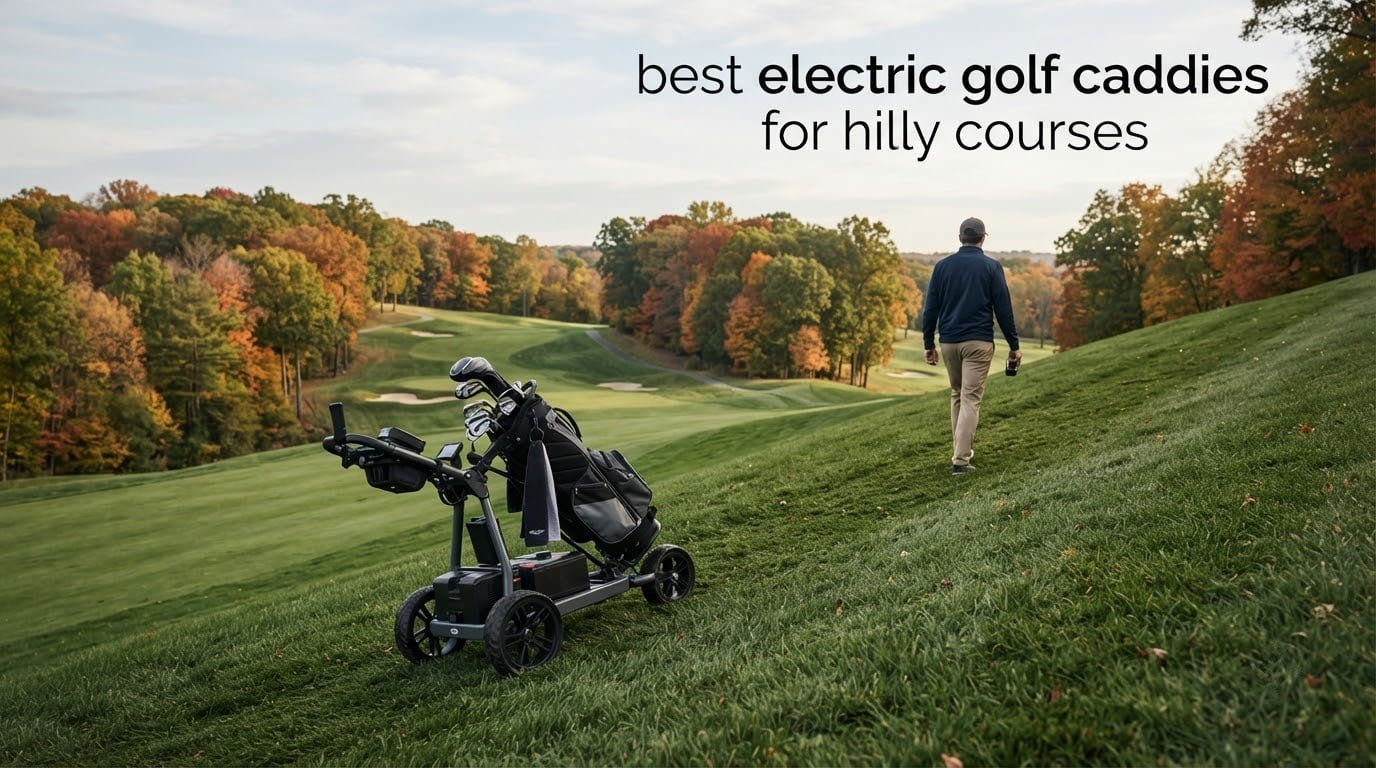
Short answer: the MGI Zip Navigator AT is the best electric golf caddy for hilly courses, and the spec that decides it is the rear fifth-wheel stabilizer paired with downhill cruise control. On a slope, most carts fail in one of two ways: they run away from you on the way down, or the bag and frame tip sideways on a cross-slope fairway. A wide rear stabilizer fixes the second problem, and electronic braking on descents fixes the first one.
I compared eight electric golf caddies for this guide, reading every spec sheet, warranty term and owner review pattern available for each one, then sorting them by how each one behaves on a gradient. The lineup covers remote-controlled carts, handle-controlled carts, one conversion kit, and one auto-follow model, so whatever your course looks like there is a relevant pick here.
Hills change the maths on hills more than most spec pages admit. A cart that covers 36 holes on the flat regularly finishes a hilly round short, and the remote signal that works on an open fairway can drop when the cart crests a ridge ahead of you. So the best electric golf caddies for hilly courses are not simply the most powerful ones; they are the carts with a stabilizer, real downhill control and a battery you can size for the climb.
One more note on terminology. Searchers split across electric golf caddy, electric golf trolley and electric push cart, and this guide uses all three for the same thing. Every cart below is motorized. If you own a manual push cart already and want to add power, one of the picks below is a conversion kit that bolts onto a frame you already own.
If you want to scout a course before you commit, our pet camera picks for golf roundup covers the gear side of course research, and our electric bikes for hills guide explains the same motor-and-gearing logic that decides whether a machine can hold a grade.
Table of Contents
Top 3 Picks for Hilly Courses in 2026

MGI Zip Navigator AT
- 5th-wheel rear stabilizer
- Downhill cruise control
- 36-hole lithium battery
Best Electric Golf Caddies for Hilly Courses in 2026
| Product | Specs | Action |
|---|---|---|
| MGI Zip Navigator AT |
|
Check Latest Price |
 Alphard Cybercart Alphard Cybercart |
|
Check Latest Price |
 tianhong G5 tianhong G5 |
|
Check Latest Price |
 MGI Zip X5 MGI Zip X5 |
|
Check Latest Price |
 KVV Remote Electric Cart KVV Remote Electric Cart |
|
Check Latest Price |
 Motocaddy M7 Motocaddy M7 |
|
Check Latest Price |
 Cart-Tek Yellowstone Cart-Tek Yellowstone |
|
Check Latest Price |
 Alphard Club Booster V2Pro Bundle Alphard Club Booster V2Pro Bundle |
|
Check Latest Price |
1. MGI Zip Navigator AT – Best Overall for Hills
MGI Zip Navigator All Terrain Electric Golf Cart – 36 Hole Battery – Remote Control – Accessories Included (Drink, Umbrella, & GPS-Phone Holer), Gloss Black-Matte Black
5th-wheel rear stabilizer
Downhill cruise control
36-hole lithium battery
37.5 lbs
Pros
- 5th-wheel stabilizer plus dual all-terrain swivel front wheels
- Downhill cruise control and gyroscope straight tracking
- 36-hole removable lithium battery with USB port
- Highest owner review volume in the group at 299
Cons
- Heaviest common cart in the set at 37.5 lbs for car loading
- Premium price position in the electric caddy category
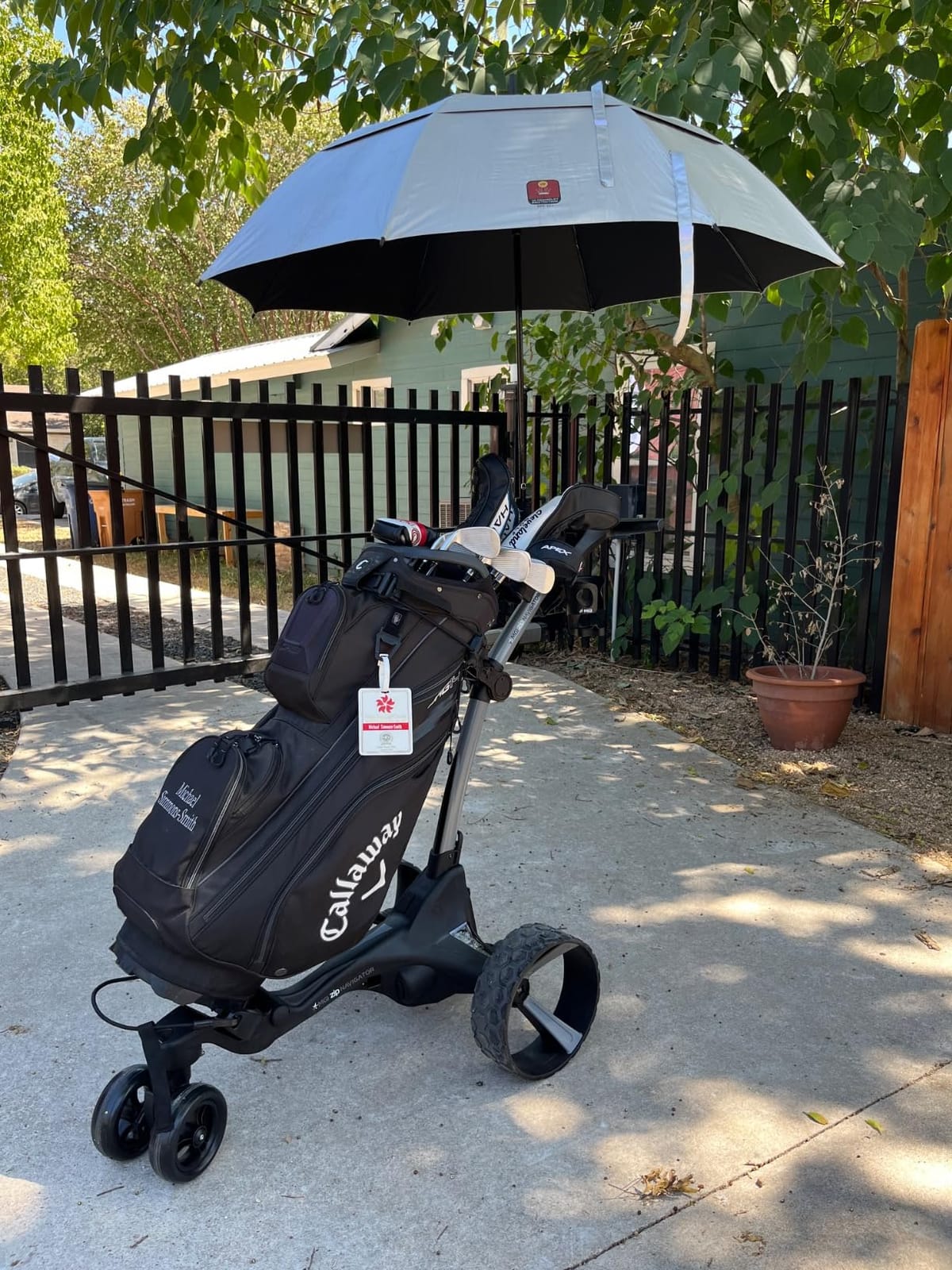
This is the cart I keep coming back to for a reason that has nothing to do with wattage. Its stability comes from geometry: dual oversized all-terrain swivel front wheels, treaded rear wheels, and a fifth wheel behind the bag that physically prevents the frame from rotating over on a side slope. On a course where you walk across the fall line repeatedly, that rear wheel is the difference between a normal round and a bag on its side.
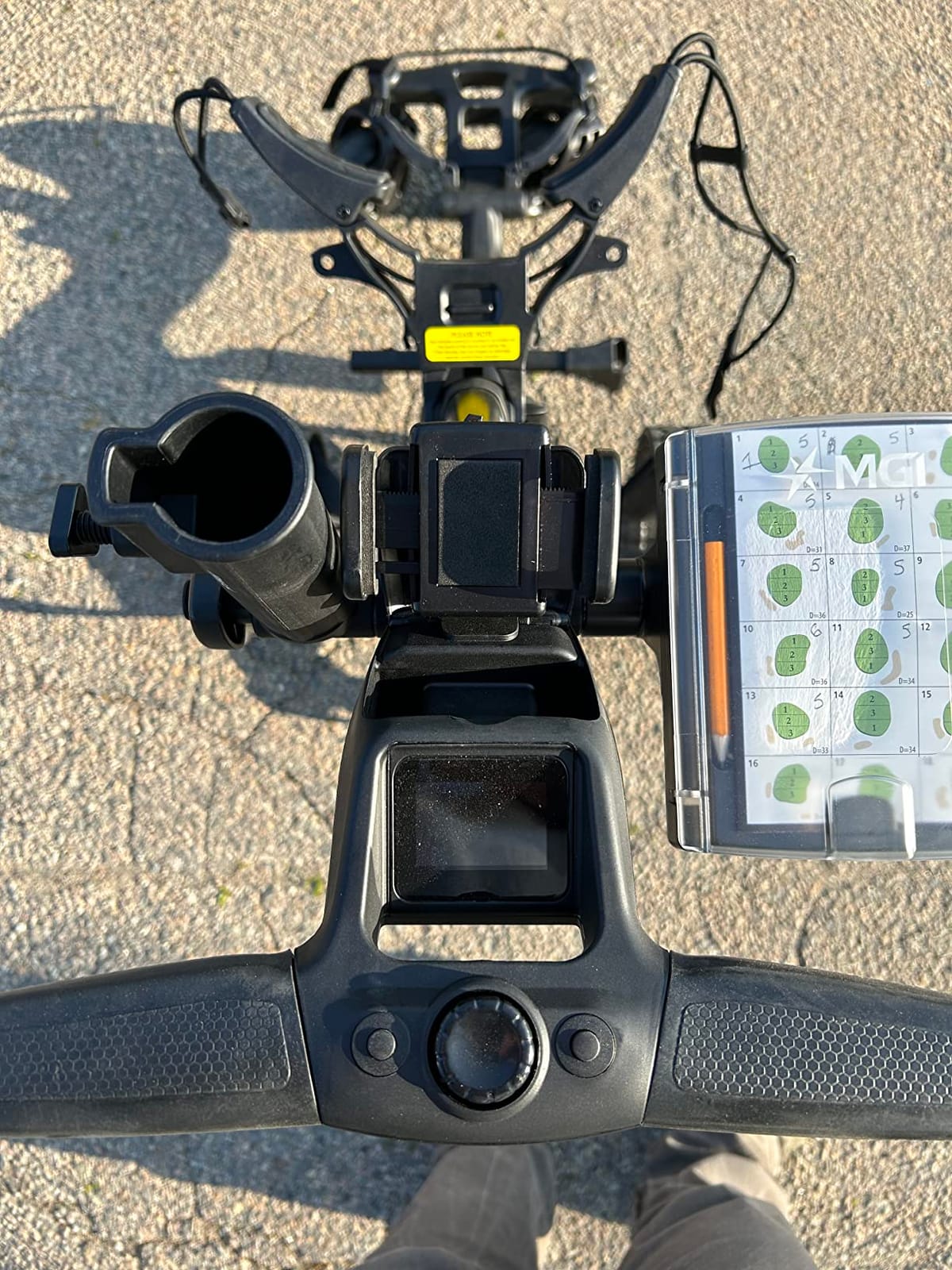
The handle-mounted display gives you twenty speed settings, colour-coded battery levels and distance tracking, which matters more on hills than it sounds. You can slow to a crawl for a steep fairway walk and still have the speed you need on the flat run back to the clubhouse.
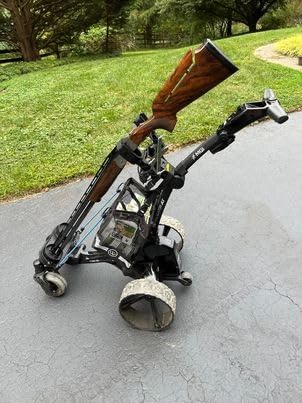
Downhill cruise control and gyroscope straight tracking are the two features that keep this cart composed on uneven ground. The gyro holds the line when the bag shifts or the wheels cross a rut, and the downhill setting applies braking so a descent does not become a sprint. Remote range is 360 degrees, and speeds run from 1 to 20, so the cart can crawl through a narrow wooded corridor or hold a steady pace on an open climb.
The Click and Go lithium battery is rated for up to 36 holes and slides on and off without tools, which makes overnight charging painless. There is a USB charging port on the handle, plus drink and umbrella holders and a phone or GPS mount in the box. The 3 year manufacturer warranty covers parts including the lithium battery and charger, which is longer than most of the field.
What you gain on a hilly course
The fifth-wheel stabilizer is the reason this cart tops my list for gradients, and reviewers consistently single out the same thing. An owner posting on r/golf described a very hilly home course and said the cart had handled the hills without any issues. Reviewers also point to the combination of downhill control and gyroscope tracking as the feature that lets them walk at pace rather than creeping uphill.
At 299 owner reviews it is also the most thoroughly tested cart here, and roughly 70 percent of those ratings are five stars. That matters for a purchase you will use on uneven terrain for years: you are buying a known failure history, not a hope.
Where it costs you
Weight is the honest drawback. At 37.5 lbs with the battery, it is the heaviest of the mainstream carts in this roundup and the least pleasant to lift into a sedan boot. If you do not have a hatchback or a golf course where a caddy host takes the bag, factor in two people for every car trip.
The premium price position is real too, and the all-terrain hardware it buys is partly wasted on a flat parkland course. For genuinely hilly terrain, though, that hardware is exactly what you are paying for, and this is the one cart where I would not talk you down to a cheaper model.
2. Alphard Cybercart – Best for Slope Safety
Alphard Cybercart Electric Golf Cart | Remote Control & Compact Folding
Auto parking brake
Downhill speed control
6-axis gyro
Low center of gravity
Pros
- Automatic parking brake holds on any slope
- Downhill speed control prevents run-away on descents
- Low center-of-gravity chassis with 6-axis gyro tracking
- Out-of-range auto stop on the LCD remote
Cons
- Heaviest cart in the group at 40 lbs
- No auto-follow or smartphone app control
- Only 46 owner reviews
No other cart in this group puts so much of its engineering budget into holding still on an incline. The automatic parking brake is specified to hold on any slope, which means you can set the bag down on a side-hill lie without wedging a foot under the frame. For golfers who play courses with abrupt elevation changes, that single feature is worth more than raw climbing watts.
The chassis is built around a low center of gravity, and a 6-axis gyroscope handles terrain tracking rather than the simpler gyro found on cheaper carts. Downhill speed control works alongside that, and the remote carries an out-of-range auto stop, so if the cart drops out of signal on the far side of a ridge it stops instead of continuing unsupervised.
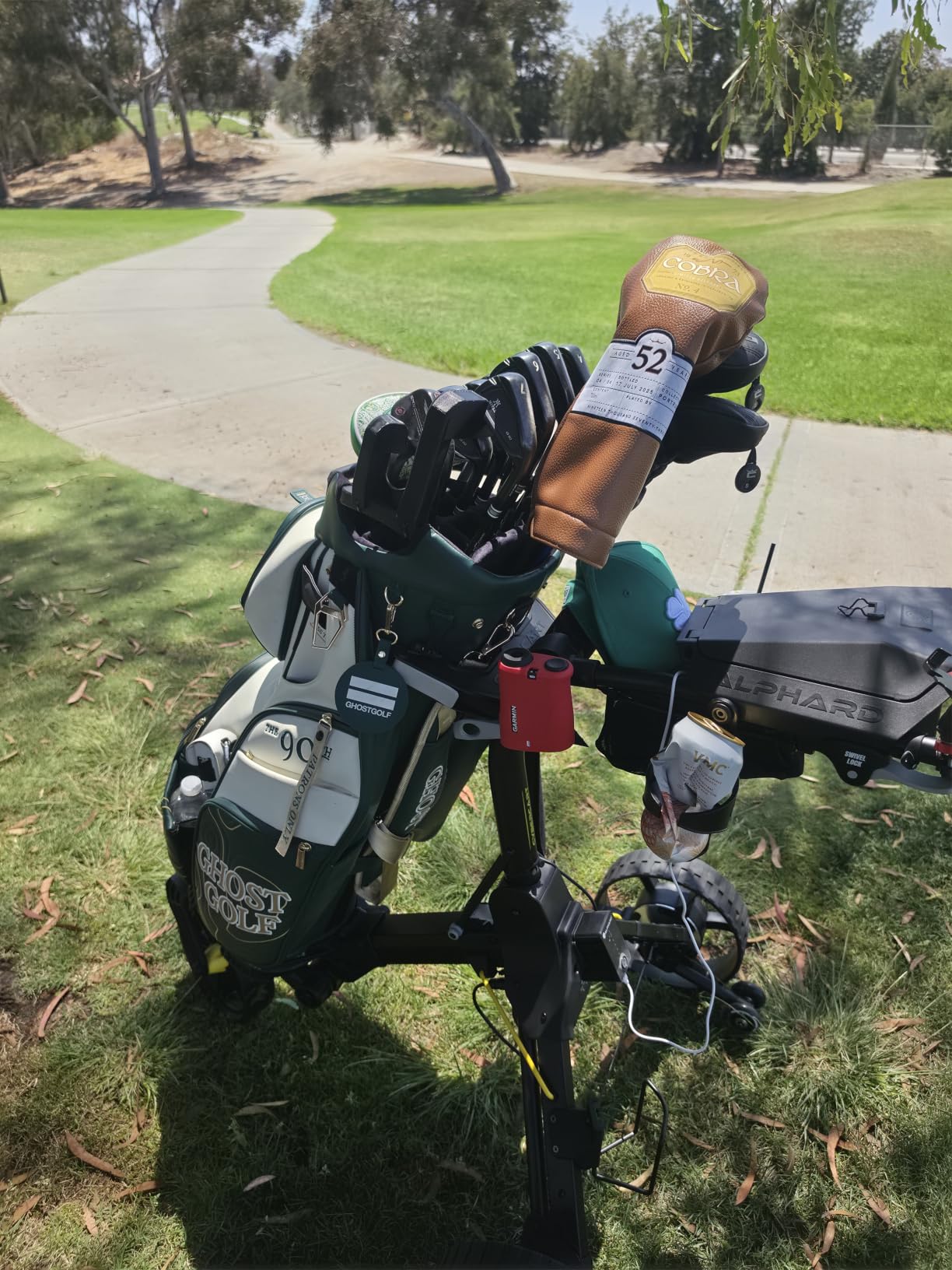
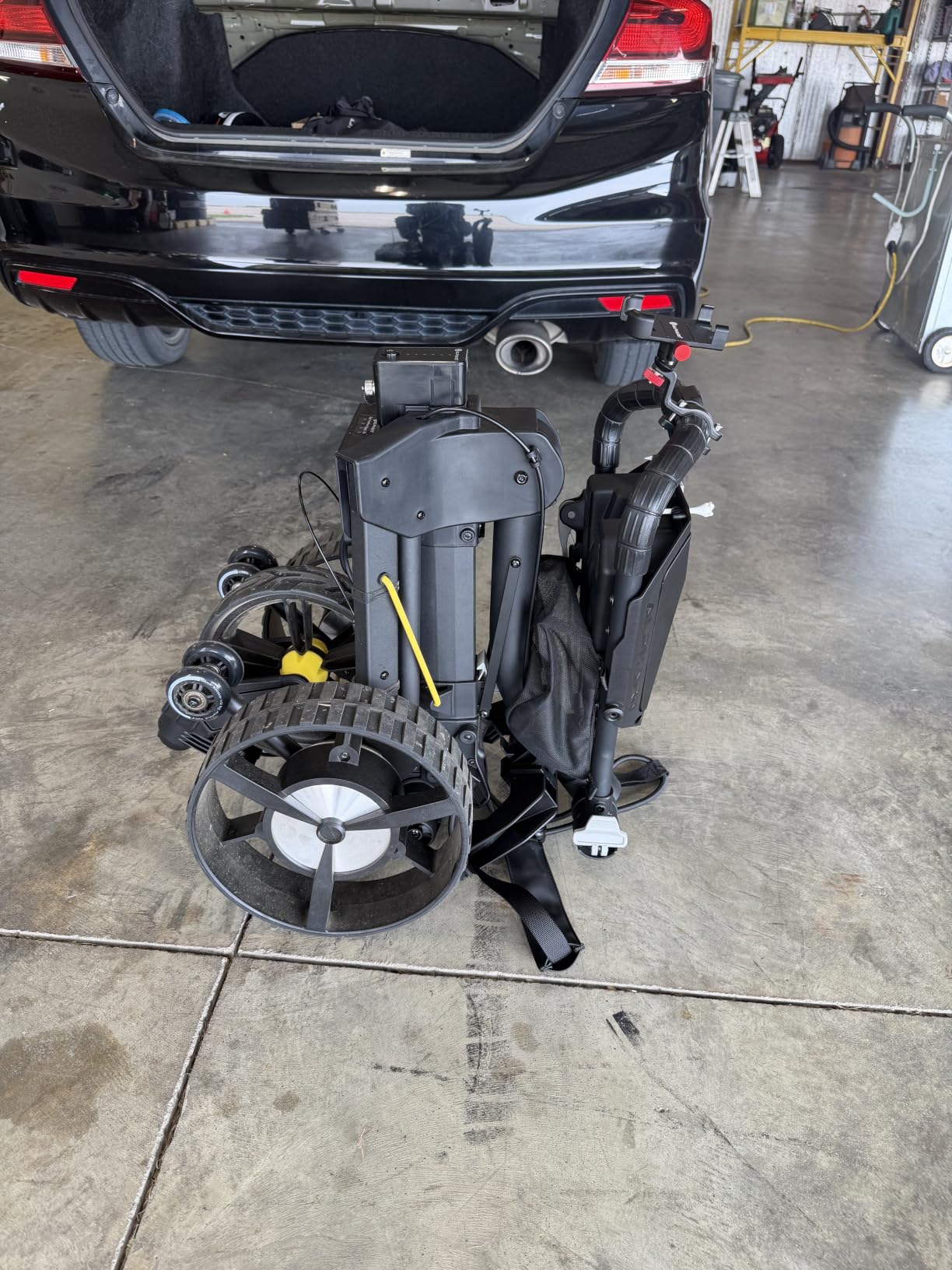
It also folds with a one-click system to a compact 21.5 by 22.5 by 25.5 inch package, and it offers a freewheel manual mode so the cart can be pushed like a conventional push cart if the battery runs down. The 36-hole battery and anti-tip wheels round out an unusually complete hill package.
At 4.5 average across 46 reviews with 74 percent five-star, satisfaction is high, and the reviews focus on stability and slope control. One owner posting on The Hackers Paradise called the Alphard Cybercart easily the best electric push cart on the market and specifically praised how small it folds for getting to the course.
Where this cart wins on gradients
Parking brake behaviour and low centre of gravity are the two advantages here, and they matter most on side-hill fairways and on shots where you have to leave the cart parked above you while you play a risky angle. The auto-stop feature also lets you send the cart on ahead down a slope without riding behind it, which is otherwise a nerve-wracking move on a descent.
It ranks third in the electric golf cart category on the retailer listings I checked, so the model is established rather than experimental despite the modest review count.
What you trade away
Forty pounds is the heaviest cart here, and the gap versus a 27.9 lb budget cart is the sort of difference you feel in a car park rather than on the course. Loading it unassisted is genuinely awkward, and the anti-tip wheel assembly adds to that bulk.
There is no auto-follow mode and no app control, so this is a pure remote cart. The 46-review base also means less long-term data than the MGI, and a handful of owners report fit issues between the frame and stand bags, so check your bag style before committing.
3. tianhong G5 – Best for Auto-Follow on Hills
tianhong G5 Electric Golf Cart,Electric Golf Push cart Auto-Follow You,45 Hole Battery,All-Terrain Anti-Tipping,Electric Golf Push cart with Remote(APP/Manual Control), Foldable,Black+Orange
45-hole battery
Sensor auto-follow
Dual anti-tip wheels
IPX5 waterproof
Pros
- Five control modes including sensor auto-follow and one-touch recall
- 45-hole battery covers two full rounds
- All-terrain tires with dual anti-tip wheels
- IPX5 waterproof rating and UL 2271 certification
Cons
- Auto-follow and recall need the battery powered on and the remote activated
- Shortest warranty coverage in the group at 6 to 12 months
- Only 38 owner reviews
The tianhong G5 is the only cart in this roundup with genuine sensor-based auto-follow, and that changes the hill equation in a specific way. Auto-follow needs line of sight, and that is exactly what you lose cresting a ridge or walking into a tree-lined corridor, so treat follow mode as a flat-to-moderate-hill convenience rather than a mountain solution.
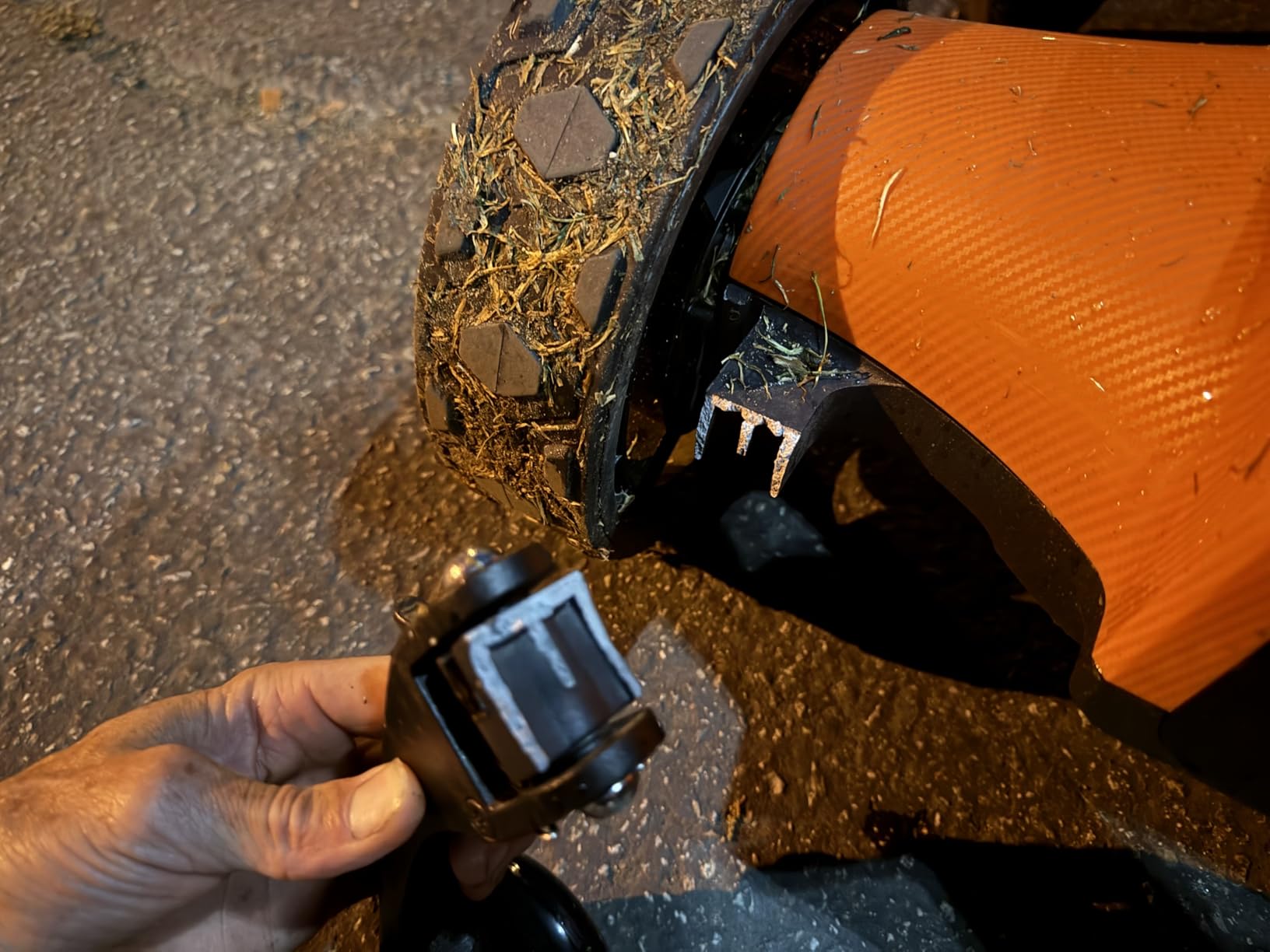
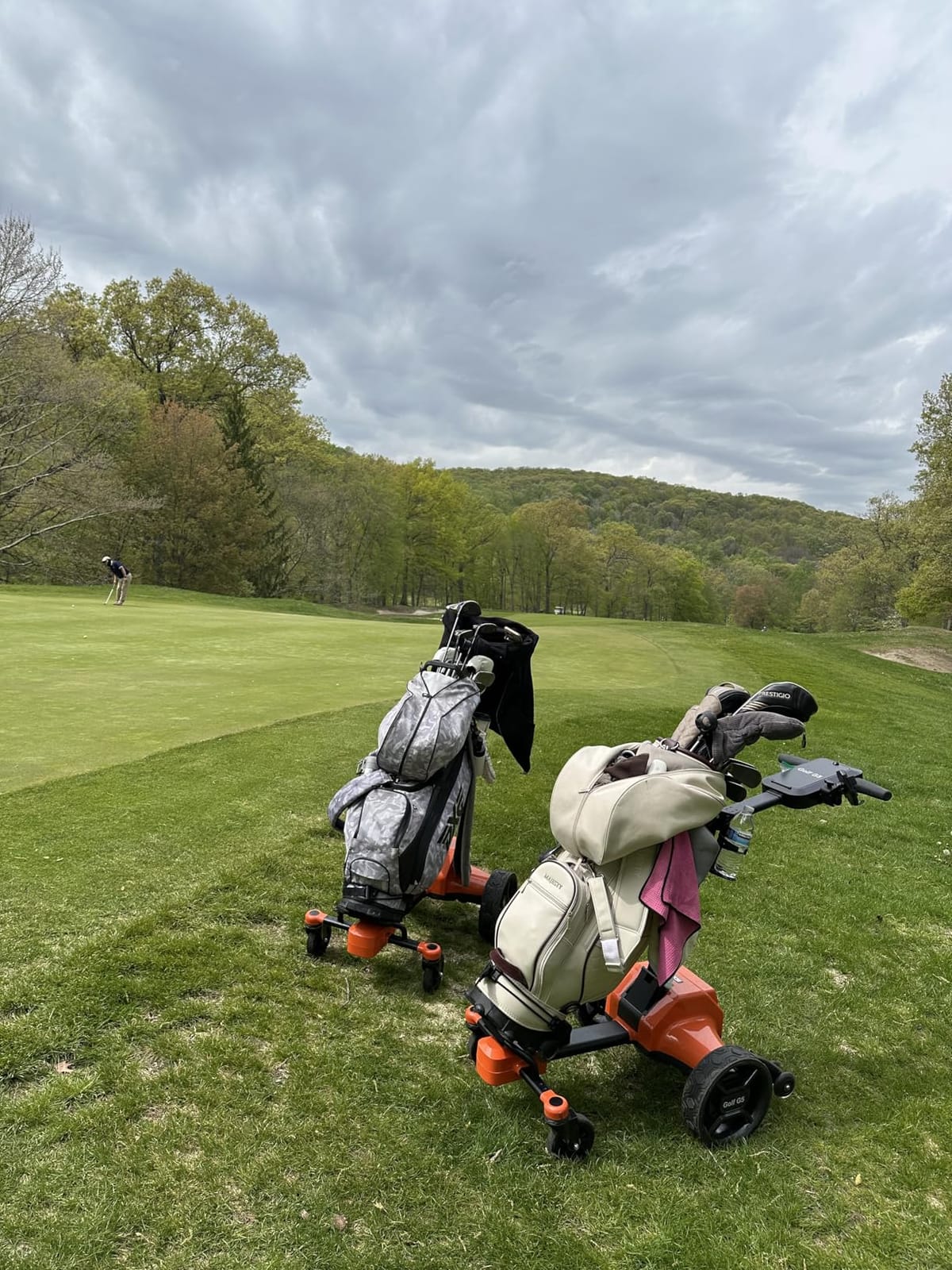
What it does offer on gradients is hardware. All-terrain tires and dual anti-tip wheels are specified as stable to 30 degree slopes, which is the most generous stability claim in the group, and it carries the longest single-charge range here at 45 holes. The IPX5 waterproof rating is a genuine plus for wet-grass rounds in a coastal climate.
Control options are unusually broad: hand push, remote, one-touch recall, follow-me and constant-speed cruise. A colour LED display shows speed, battery, mode and mileage, and the whole cart folds in about three seconds after roughly ten minutes of initial assembly. That combination makes it the easiest to move between a car boot and the first tee.
It scores 4.6 across 38 reviews with 79 percent five-star and no one or two star ratings at all, which is the strongest satisfaction signal in the pool. The reservations are not about performance; they are about support and sample size.
Why the 45-hole battery matters on hills
Because every climb costs extra current, the buffer is what protects you. A 45-hole pack means a 27-hole hilly round still finishes with charge left, and owners who walk mountain courses will feel that difference at the turn. The battery is also the first thing to check when the warranty is short, since packs are the most expensive replacement on a cart.
IPX5 water resistance and UL 2271 certification together suggest the electricals are built for rain and wet grass, which is where traction gets interesting on slopes.
Where I would hesitate
Warranty coverage is listed at six months with one year stated in the feature copy, the shortest here by a wide margin, and that is the main thing I would want improved before recommending it as a long-term purchase on an expensive round. The 38-review base is also the second smallest in this list.
One owner on Buggies Gone Wild asked specifically for carts that handle hilly terrain and gravel roads without slowing down, which is exactly the use case this cart targets. But follow-me mode on a wooded hill is the failure mode owners report most, so keep the remote in hand.
4. MGI Zip X5 – Best Value Electric Cart for Hills
MGI Zip X5 Electric Golf Cart – 36 Hole Battery – (Drink, Umbrella, & GPS Phone)
230W single motor
Downhill speed control
36-hole battery
30.6 lbs
Pros
- Downhill speed control and electronic parking brake on a mid-range budget
- 36-hole lithium battery with USB port
- 5th wheel stabilizer and all-terrain rear wheels
- Lighter than most remote carts at 30.6 lbs
Cons
- Handle-only control with no remote option
- Rear low-slung battery takes ground strikes on rough
- High center of gravity can spill a light bag
The Zip X5 is the cart I recommend to golfers who want the hill hardware without the remote. It carries a 5th wheel stabilizer and all-terrain rear wheels, and it adds downhill speed control and an electronic parking brake, which are the two features that stop a handle cart from becoming a problem on a descent.
A single 230W motor drives it, so it will feel slower than a dual-motor cart on a sustained climb to the top of a long hole. In exchange it weighs 30.6 lbs with the battery and 25.90 lbs without, which makes it one of the easier carts to load, and the rear wheels tuck inward for a tighter fold.
The 2.5-inch LCD shows colour-coded battery levels, and the Click and Go lithium pack is rated at up to 36 holes with a USB charging port. Handle control runs 20 speed settings with a start-stop dial, which is more range than most rivals at this level and lets you creep uphill without stalling the motor.
Owners rate it 4.4 across 92 reviews, and the recurring theme is reduced fatigue on hilly walking courses plus quiet, consistent speed. A poster in the MyGolfSpy forum rated this MGI model as probably the best, with the MGI Zip Navigator close behind, which matches how I rank the two here.
Handle control versus a remote on slopes
A handle means you are always attached to the cart, so signal loss is never an issue, and the parking brake handles the moments when you walk away. That is a real advantage on a tree-lined course where a remote cart would repeatedly lose line of sight behind a ridge or a stand of trees.
The cost is walking speed. You set the pace rather than the cart, so uphill sections are slower by design. For a golfer who is walking anyway and wants a reliable partner, that trade usually works out well.
Where the compromises show
Two design choices work against gradients. The battery sits low and rear-mounted, so it takes ground strikes in rough and long grass, and the high centre of gravity makes a light bag vulnerable to spilling on flatter ground, which is a stability warning on side slopes too.
Owners also flag that the plastic display cover cracks easily and that the speed dial is very light to the touch, so accidental speed increases are a known irritation. I would treat this as the sensible value pick rather than the extremes pick.
5. KVV Remote Electric Cart – Best Budget Pick
KVV Electric Golf Push Cart with Remote Control, Smallest Folding Size, Suitable for All Terrains, Lightweight and Super Compact Electric Golf Cart
9 speed settings
Manual push fallback
27.9 lbs
Folds to 17.5 x 18.7 x 22 inches
Pros
- Lightest and most compact fold in the group at 27.9 lbs
- Wide 30.5 inch rear wheelbase aids stability
- Manual push fallback if the battery runs down
- Responsive parts and pairing support
Cons
- Remote accepts one command at a time
- Steering is jerky at speed on sloped ground
- One rear wheel can lift on steep cross-slopes
- Brittle plastic bag hooks
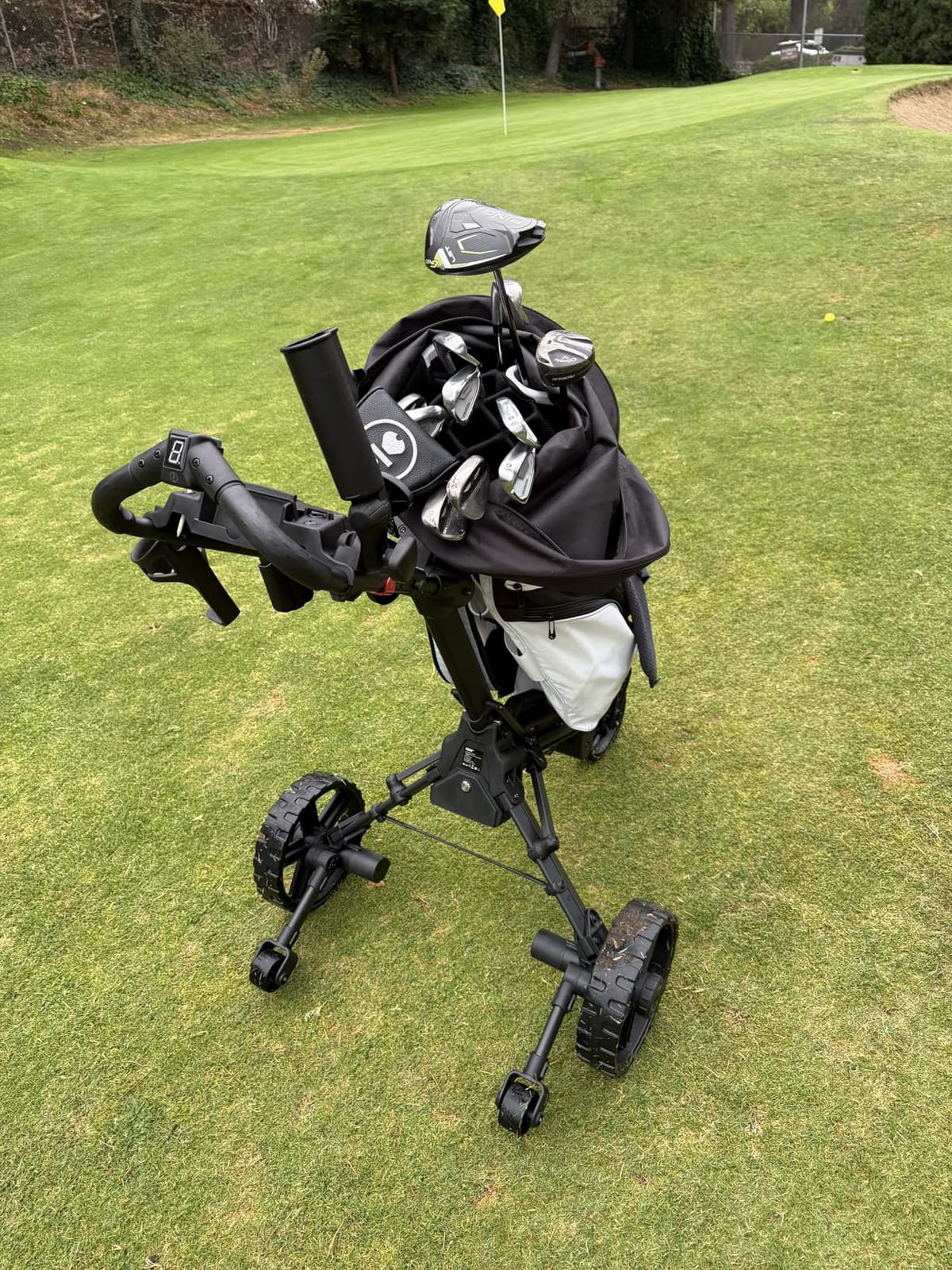
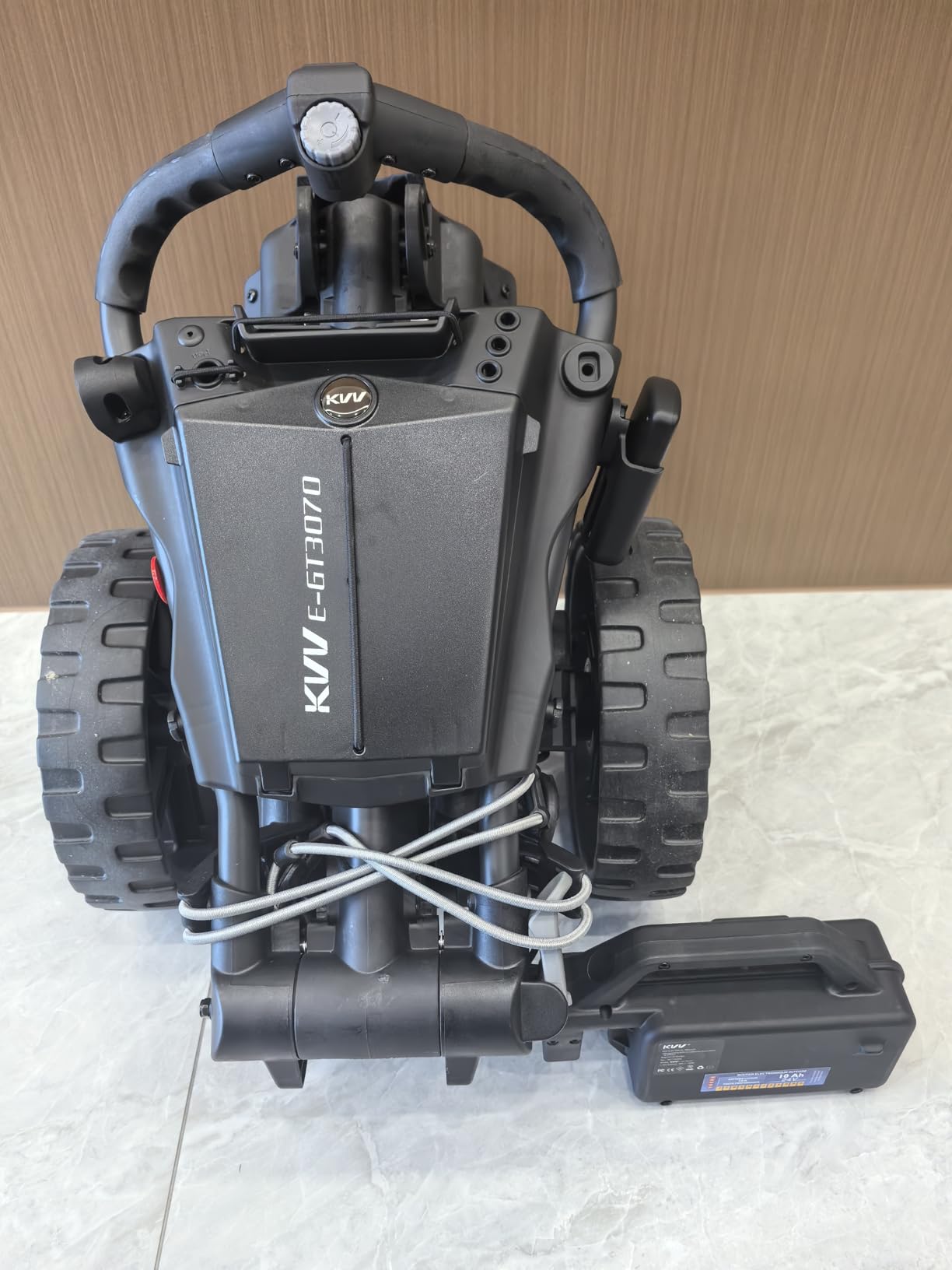
The KVV is the option for hilly golfers who need a light, compact cart and can accept a rougher remote. At 27.9 lbs and folding to 17.5 by 18.7 by 22 inches it is the easiest cart here to fit in a sedan boot.
Stability comes from a wide 30.5 inch rear wheelbase plus rear training wheels, and the straight-line tracker helps it hold course on broken fairway. The rechargeable lithium pack is rated at 18 holes or more, which is thinner than the 36-hole packs elsewhere, so on a hilly round you should expect to charge overnight regardless.
There is a manual push fallback mode, which is the safety net that matters most on a remote cart: switch off the power and you can walk it like a conventional push cart. Rear wheel lock knobs have to be turned to move between electric and manual, which is an extra step worth knowing before you need it.
It scores 4.4 from 113 reviews, and owners highlight build quality, compactness, value and reduced back fatigue on hilly courses. A competitor page we reviewed earlier listed it as its number two cart, and a dedicated independent review tested it over 18 holes for remote control, all-terrain stability and battery life.
Where it handles hills well
The wide wheelbase is doing quiet work here, and it is the reason a cart this light still feels planted on moderate gradients. Owners also mention that the included insulated cooler bag and holders make long hilly walks more tolerable, which is a comfort factor rather than a performance one.
Support has been a genuine strength: several reviews mention the manufacturer resolving parts and remote pairing problems quickly, which matters a lot on a less established brand.
Where the remote will frustrate you
The remote executes one command at a time, so changing direction means stopping first, and steering is described as jerky and inconsistent across speed settings on sloped ground. Owners also report that on steep cross-slopes one rear wheel can lift, which spins the cart dangerously when it touches back down. That is the failure mode to test on your own course before you rely on it.
Brittle plastic bag hooks are the other recurring complaint, and the 2 year manufacturer warranty is a year shorter than the MGI carts. Budget buyers get a lot of cart here, but the terrain tolerance is lower.
6. Motocaddy M7 – Best Warranty Coverage
Motocaddy M7 Remote Electric Golf Caddy – Electric Golf Push Cart with Remote, All-Terrain Ready, Automatic Downhill Control, and Long-Lasting Battery – Accessories Included (Black)
Dual 230W motors
Downhill control
28V lithium battery
60 month battery warranty
Pros
- Dual motors with adaptive terrain stability on sloped courses
- Downhill control and anti-tip rear wheels
- Longest warranty here at 60 months on the lithium battery
- Remote supports reverse
- pause and resume
Cons
- Lowest average rating here at 4.1 with 15 percent one-star reviews
- Critical reviews focus on remote responsiveness
- No auto-follow or app control
The M7 is the spec-sheet winner on paper for a hilly course. Dual 230W motors with adaptive terrain stability give it the highest climbing reserve in the group, and downhill control plus anti-tip rear wheels target exactly the two hill problems that catch other carts out. All-terrain tires add traction on gravel paths and wet grass.
The remote handset is USB-C rechargeable and supports forward, reverse, left, right, pause and resume, so you can position the cart precisely on a slope rather than nudging it. A 2.8-inch LCD widescreen display and a compact frame that folds to roughly 26 by 19 by 17 inches round out a well-specified package.
What the warranty buys you
Warranty is 24 months on the trolley and charger and 60 months on the lithium battery, the longest battery coverage of any cart here by more than two years. On a machine that lives in a car boot and takes knocks on root balls, that is meaningful protection.
It also folds small enough for most boots, which offsets the package weight of 21.41 kg more than the lighter aluminium frames in this list.
Where the owner reviews give me pause
The rating distribution is the weakest in this roundup: 4.1 average with 15 percent one-star reviews, against 68 percent five-star. Critical reviews concentrate on remote responsiveness and reliability, which on a hilly course is exactly the specification you cannot compromise on.
There is also no auto-follow and no app control. A MyGolfSpy forum poster rated the MGI M7 as probably the best, closely followed by the MGI Zip Navigator, and a Golf Club Atlas discussion framed the choice as: play a hilly course and take the AT, otherwise the Motocaddy range. I agree with the framing, and I would still put the MGI ahead on remote reliability.
7. Cart-Tek Yellowstone – Best Steel Frame for Gravel Paths
Cart-Tek Electric Golf Push Cart with Remote Control, Rugged Steel Frame, Dual Quiet Motors, 36+ Holes, 10.4 AH Lithium-Ion Battery, Easy to Use Golf Trolley Caddy the Yellowstone
Powder-coated steel frame
Dual quiet motors
10.4Ah 36-hole battery
Auto-stop remote
Pros
- Steel frame tolerates rough ground
- gravel and repeated loading
- 36-hole 10.4Ah battery with handle charge readout
- Remote auto-stop safety plus distance-send
- Folds to 24 x 27 x 17 inches
Cons
- No downhill control listed among the headline features
- 33 lbs is heavy to load unassisted
- Only 54 owner reviews
Frame material is the story with the Yellowstone. Everyone else here is built on aluminium or plastic, and this is a powder-coated steel chassis, which is the most rugged construction in the group and the one I would trust over gravel cart paths and root balls on a woodland course.
Two quiet motors carry the bag up slopes without the whine of some single-motor designs, and the 10.4Ah lithium battery is rated to 36 holes with a handle-mounted level display. The remote supports distance-send and auto-stop, so you can send the cart ahead and it will halt rather than run on unattended.
Why steel matters on a rough course
Gravel paths and wet grass appear over and over in owner discussions about hilly courses, and a steel frame is simply less likely to twist or crack at the joints than a folding aluminium tube. It also handles being dropped in a boot or carried over a kerb without the same anxiety.
A GolfWRX owner reports the Cart-Tek GRi-1500Li does a great job on some rather hilly courses, which is a useful long-term owner data point for this brand on gradients.
Where it falls short
Downhill control is not listed among the headline features, and on a course with real descents that is the specification I would want to see confirmed in person. Handle dial speed control is there, but that is not the same as electronic braking on a slope.
At 33 lbs it is heavy for a cart without a fifth-wheel stabilizer, and the fold to 24 by 27 by 17 inches is bulkier than the compact folders here. With 54 reviews, owners describe hills as manageable rather than effortless, and Cart-Tek is a family-run company in Bend, Oregon with phone support and stocked replacement parts, which is a real plus for service.
8. Alphard Club Booster V2Pro Bundle – Best Conversion Kit
Alphard Electric Golf Cart: Omni Cart + Club Booster V2Pro Bundle
Club Booster V2Pro base
6-axis gyro
App control
Silent brushless motors
Pros
- Two-motor booster base adds climbing torque
- 6-axis gyro keeps tracking straight over bumps
- Electronic parking brake and anti-tip wheelie bars
- Under one minute course setup
- App-enabled control
Cons
- Smallest review base here at 23
- Two-piece design means more parts to store and carry
- Less low-end grunt on very steep grades than one large motor
This bundle is a different proposition from the other seven. The Club Booster V2Pro is a motorized base that bolts to the Club Car-style Omni Cart, so if you already own a decent push cart or light buggy chassis, this converts it into an electric golf caddy instead of replacing it.
For hills, the relevant detail is that the booster base carries two motors with permanently attached wheelie bars. The 6-axis gyroscope does auto terrain detection and straight-line tracking, and an electronic parking brake holds the cart while you play a shot from above it.
The conversion route for a hilly course
Conversion kits appeal when you already own a frame with a wide wheelbase, because you inherit that stability and add power. Setup is under a minute at the tee: place the Omni Cart on the booster and pivot the wheelie bars out. No clamp tightening, no tools.
A Facebook owners group member running the Club Booster V2 with an Omni Cart describes it as a game changer, and MyGolfSpy rated this kit best value remote trolley, which is the same route this guide takes.
What to check before you buy
At 23 reviews this is the smallest sample in the roundup, with 79 percent five-star, so sentiment is strong but thin. There is also a two year manufacturer warranty, and the two-piece format means more components to store and carry than a single integrated frame.
The real limitation is the honest one from owners: silent brushless motors give less low-end grunt feedback on very steep grades than one large motor. On moderate hills this is excellent value. On a mountain course with long sustained climbs, I would choose a dedicated dual-motor cart instead.
What Owners Say About Electric Caddies on Hills
Owners are consistent about four failure modes on gradients, and they show up again and again across forums. Worth reading before you buy, because most product pages do not mention any of them.
Remote signal drops on descents and below the player. The most repeated complaint on hilly courses is that the cart loses the remote when it is downhill of you on a steep fairway or behind a ridge. Out-of-range auto stop, as on the Alphard Cybercart, is the feature that turns a signal loss into a non-event rather than a runaway.
Follow and auto-follow modes lose line of sight. Sensor-based follow works until a tree-lined hill or a narrow wooded corridor breaks the sightline. That is why I would not build a round plan around auto-follow on a mountain course, despite it being the most comfortable feature when it does work.
Carts slowing or stalling partway up steeper inclines. This is usually motor sizing or battery sag rather than a fault. Single-motor designs report it more often, and the fix is a lower speed setting, which is another argument for the 20 setting range on the MGI carts.
Battery drain above the advertised hole count. Owners regularly finish a hilly round with less charge than the printed 36-hole rating suggests, and that is the expected behaviour of any pack on a climbing course rather than a defect.
The positive reports point the same way. An r/golf owner with the MGI Zip Navigator AT says the course is really hilly and the cart has handled the hills without any issues. On The Hackers Paradise, an Alphard Cybercart owner praises the fold rather than the power, which tells you something about what daily golfers actually notice. And on Buggies Gone Wild the recurring request is narrow: carts that handle hilly terrain and gravel roads without slowing down.
Which Cart for Your Course Type?
Match the cart to the gradient and the shape of the course, not to the spec sheet. Here is how I would sort these eight by terrain.
Moderate hills, 8 to 12 degrees. The MGI Zip X5 handles this with the handle control, downhill speed control and the 5th wheel stabilizer, and it is the least money you need to cover this ground. The Alphard Club Booster V2Pro bundle also fits here if you already own a base cart.
Steady climbing courses, 12 to 18 degrees. The MGI Zip Navigator AT is my pick, with the Alphard Cybercart close behind for anyone who values the parking brake more than the weight. The tianhong G5 suits you if you want the longest battery and do not mind remote-only control.
Abrupt elevation and long descents. Safety hardware decides it. The Alphard Cybercart, with auto parking brake, downhill speed control and anti-tip wheels, is the one I would pick here. The MGI Zip Navigator AT is a fine alternative at lower weight.
Gravel paths, root balls and rough. The Cart-Tek Yellowstone steel frame is the sturdiest option, and the MGI Zip Navigator AT all-terrain wheels are a close second. The KVV is the lightest to carry on such a course but the least sure-footed on steep cross-slopes.
Tree-lined and wooded courses. Avoid making auto-follow your primary mode. The MGI Zip X5 with handle control sidesteps the problem entirely, and the MGI Zip Navigator AT and Alphard Cybercart both have out-of-range or downhill protection for when the sightline breaks.
Tight car storage or a shared cart with a partner. The KVV at 27.9 lbs and a 17.5 by 18.7 by 22 inch fold is the clear answer, with the MGI Zip X5 second at 30.6 lbs.
How to Choose an Electric Golf Caddy for Hills
Size the battery for the climb, not the printed number. A 36-hole rating is a flat-ground figure. If your course climbs consistently, treat 36 holes as the floor rather than the promise, and prefer the tianhong G5 at 45 holes or the Cart-Tek at a 10.4Ah pack if you walk a long hilly loop. Lithium chemistry is standard across this group, and a detachable pack means you can charge it overnight rather than planning a mid-round swap.
Decide remote or handle before anything else. A handle-controlled cart is slower but immune to signal loss. A remote cart lets you play a shot and walk to the next lie at your own pace, but only works with reliable downhill control and out-of-range auto stop on gradients. The MGI Zip X5 is the only handle-controlled option here.
Check the stabilizer geometry, not the wheel size. A 5th wheel or anti-tip wheel behind the bag is the single best predictor of behaviour on a side slope. The MGI Zip Navigator AT, the MGI Zip X5, the Alphard Cybercart, the tianhong G5 and the Club Booster bundle all have one in some form. The Cart-Tek does not, and it compensates with a steel frame instead.
Test on your own course before you trust it. The most common forum request is a way to check a cart’s hill performance in person. Ask a retailer to demo the cart on the steepest path at your course, or buy from a seller with a return window and spend one round on it deliberately. Pay attention to how it behaves on a descent, on a cross-slope lie, and when you send it ahead down a slope.
Weigh the transport penalty honestly. Weight here ranges from 27.9 lbs for the KVV to 40 lbs for the Alphard Cybercart. A heavy cart with a fifth wheel is the right call if your course is steep and you have a hatchback. If you drive a sedan or share the boot, a lighter cart will save you more frustration than any extra hill performance.
Look at warranty length as a quality signal. The Motocaddy M7 carries 60 months on the lithium battery and the MGI carts carry 3 years on parts including the battery and charger. The tianhong G5 sits at 6 to 12 months. On a purchase like this, a short warranty is a fair reason to look elsewhere.
Confirm the manual fallback exists. Freewheel or manual push mode means a flat battery ends your comfort, not your round. The Alphard Cybercart, the KVV and the Club Booster bundle all offer it. This matters more on a remote cart than a handle cart, because the remote is useless without power.
Buy the chassis for the terrain you actually play. Steel for gravel and root balls, aluminium or plastic for manicured parkland. Pneumatic-style all-terrain tread helps on wet grass, and wet uphill grass is where traction complaints usually start.
Frequently Asked Questions
What is the best electric golf cart for hilly terrain?
The MGI Zip Navigator AT is the best overall for hilly courses. Its fifth-wheel rear stabilizer resists tip on side slopes, downhill cruise control applies braking on descents, and gyroscope tracking holds the line over broken ground. The Alphard Cybercart is the alternative if you weight slope safety features, particularly the automatic parking brake, above carry weight.
Can electric golf carts go up steep hills?
Yes, within limits. Carts in this roundup use 230W single motors or dual-motor bases, which covers moderate gradients comfortably. The factors that decide it are gearing, the rated slope, a fifth-wheel stabilizer for stability and downhill control for the way back down. The tianhong G5 claims stability to 30 degrees, the most generous rating in the group.
Why does my electric golf cart struggle to go up hills?
Four reasons cause this: a single motor with less climbing reserve, a fully charged pack losing voltage under load, a heavy bag raising total mass, and too high a speed setting for the gradient. Drop to a lower speed, lighten the bag, and check the pack is fully charged before the round. If it happens on a flat hole too, the battery or motor may need service.
Why does my electric golf cart slow down when going uphill?
It is working as designed. Motors trade speed for torque, so a climb pulls the cart toward a slower speed as load rises, and the pack draws more current at the same time. That extra draw is why hilly rounds finish with less charge than the printed hole count, which is why a 36-hole rating should be read as a flat-ground figure.
What is the best electric golf push cart with remote control?
The MGI Zip Navigator AT for all-terrain hills, the Alphard Cybercart for the strongest slope safety features, and the Alphard Club Booster V2Pro bundle if you want to convert a base cart you already own. The KVV is the lightest and most compact remote option, though owners report jerky steering on sloped ground.
Can I push an electric golf caddy manually if the battery dies mid-round?
Yes, on carts with a freewheel or manual push mode. The Alphard Cybercart, the KVV and the Club Booster bundle all support manual pushing, and most other carts release the rear wheels so they roll like a conventional push cart. On the KVV you turn the rear wheel lock knobs to switch between electric and manual, so know that before you need it.
Are follow-me electric golf carts reliable on slopes?
They are reliable on open ground and moderate hills, less so on tree-lined courses. Sensor-based follow needs line of sight, and a ridge, a stand of trees or a sharp turn will break the tracking. Keep the remote active as a backup and treat follow mode as a convenience rather than your main control method on a hilly course.
Final Verdict
The MGI Zip Navigator AT is the best electric golf caddy for hilly courses, and the fifth-wheel stabilizer is the reason. It has the most owner history in the group, real downhill cruise control, and a 36-hole battery with a 3 year warranty. Buy it if your course climbs, and accept the 37.5 lbs as the price of that stability.
Pick the Alphard Cybercart if slope safety comes first and you can load 40 lbs into your car. Pick the MGI Zip X5 if you would rather hold the handle and never think about signal loss. Pick the tianhong G5 for the longest range and multi-mode control, and the KVV if weight and fold size decide your purchase.
Whichever you choose, test it on the steepest path your course offers before you trust it with a full round in 2026.