
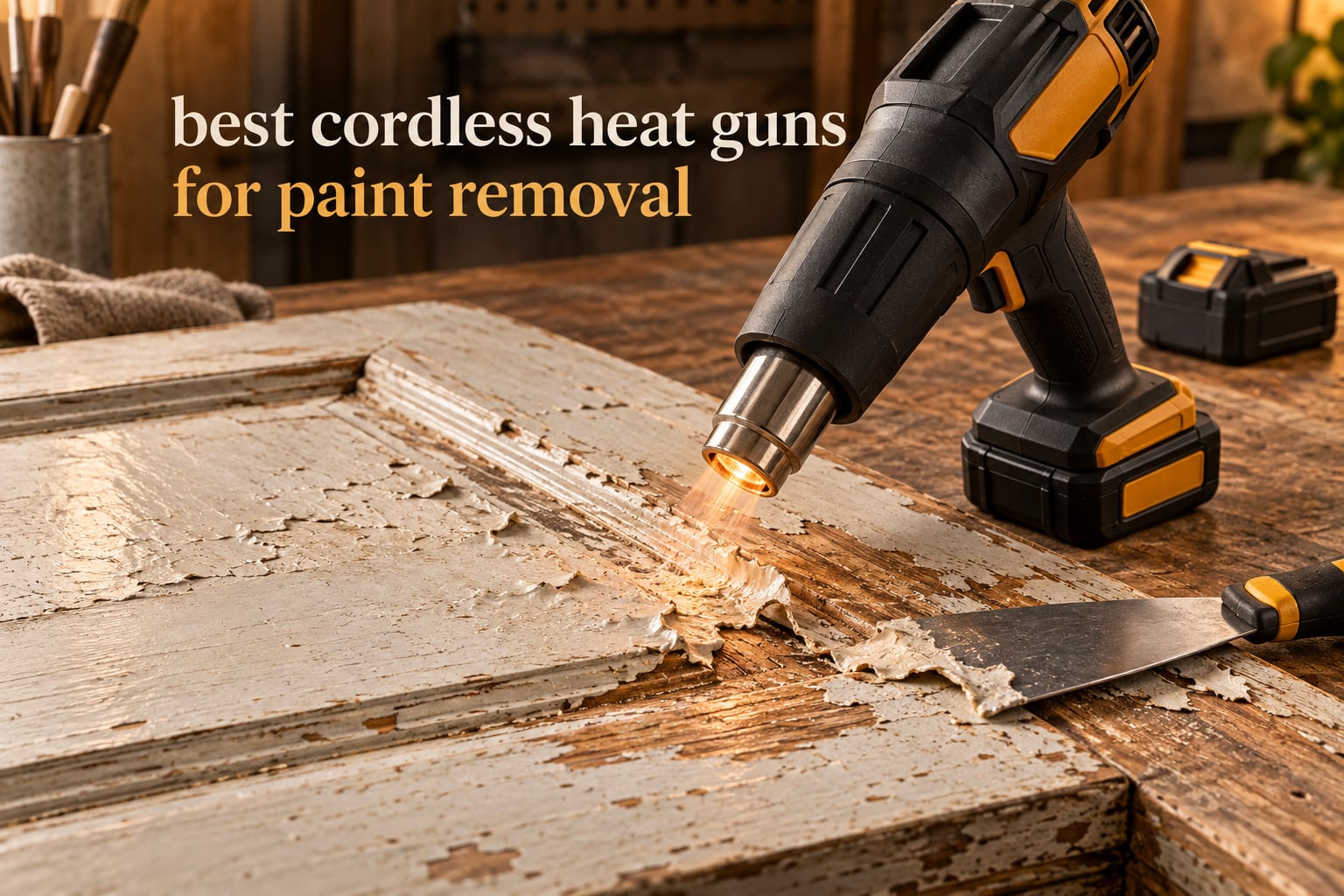
If you want the short answer: the DEWALT DCE530B is the best cordless heat gun for paint removal, because it puts out up to 990F of focused air from the most widely owned 20V battery platform in North America, carries a lock-on button so you can keep both hands on the scraper, and has been put through work by more than six thousand owners. If you already run Milwaukee M18 packs, the 2688-20 is the faster-heating alternative. And if you own neither ecosystem, a platform-compatible gun like the LIVOWALNY unit is the cheapest way in.
A cordless heat gun is a battery-powered hot-air tool that blows heated air at a surface to soften or bubble paint so a scraper can lift it. A heating element draws in ambient air at the back, a fan pushes it through the element, and the hot stream leaves the barrel in a focused cone. Hold that cone a few inches from the surface until the coating softens, then push a putty knife underneath. It is the same principle as a hair dryer, with far more heat and a much narrower stream.
Heat stripping is faster, cleaner and far less toxic than chemical paint stripper. No fumes to ventilate, no methylene chloride residue, no bags of stripped paint to dispose of, and it works on coatings that chemical strippers refuse to touch. The trade is heat control: get it wrong and you scorch bare wood, melt vinyl, or crack a single-pane window. Read the technique and safety sections below before your first pass.
How we picked: every gun here was assessed on the specs that actually matter when stripping coatings, namely maximum temperature, airflow, temperature control granularity, run-time per pack, weight in the hand, and nozzle range. We also weighted durability heavily, because the loudest complaint on the big home-improvement forums is that cheap heat guns die in months rather than years. Budget platform-compatible guns appear here honestly, with the compromises spelled out, because for a weekend door project they are the right call.
Table of Contents
Top 3 Cordless Heat Guns for Paint Removal (September 2026)

DEWALT DCE530B 20V MAX Heat Gun
- Up to 990F max temperature
- Up to 42 minutes runtime
- 6.7 CFM airflow
- Lock-on button and LED light

Milwaukee 2688-20 M18 Heat Gun
- Reaches temp in 7 seconds
- 875F max temperature
- Compact 6.4 inch body
- Built-in LED light

Ryobi ONE+ P3150 Heat Gun
- Up to 875F max temperature
- Heats up in under 10 seconds
- Deflector and concentrator nozzles
- ONE+ battery compatible
Milwaukee 2688-20 ties for the highest star rating in this group at 4.5 and reaches operating temperature in seven seconds. The DEWALT wins on endurance and on how many packs exist in the wild that will fit it, and it carries a lock-on button the Milwaukee lacks.
Best Cordless Heat Guns for Paint Removal in 2026
| Product | Specs | Action |
|---|---|---|
| DEWALT DCE530B 20V MAX Heat Gun |
|
Check Latest Price |
| Milwaukee 2688-20 M18 Heat Gun |
|
Check Latest Price |
| Ryobi ONE+ P3150 Heat Gun |
|
Check Latest Price |
 Bosch Professional GHG 18V-50 Heat Gun Bosch Professional GHG 18V-50 Heat Gun |
|
Check Latest Price |
 Milwaukee M18BHG-0 Cordless Heat Gun Milwaukee M18BHG-0 Cordless Heat Gun |
|
Check Latest Price |
 CRAFTSMAN V20 CMCE530B Heat Gun CRAFTSMAN V20 CMCE530B Heat Gun |
|
Check Latest Price |
 LIVOWALNY DEWALT 20V Compatible Heat Gun LIVOWALNY DEWALT 20V Compatible Heat Gun |
|
Check Latest Price |
 LIVOWALNY Milwaukee 18V Compatible Heat Gun LIVOWALNY Milwaukee 18V Compatible Heat Gun |
|
Check Latest Price |
 Edtran Makita 18V LXT Heat Gun Edtran Makita 18V LXT Heat Gun |
|
Check Latest Price |
 Synxiter DEWALT 20V Heat Gun Synxiter DEWALT 20V Heat Gun |
|
Check Latest Price |
Two patterns jump out of the spec sheet. Every mainstream-brand gun here tops out between 872F and 990F with a single fixed temperature and no display, while every budget platform-compatible gun claims a far higher ceiling between 1022F and 1328F. The real-world difference is the opposite of what those numbers suggest, because airflow is what moves heat into the coating, and airflow on the budget units is roughly half.
1. DEWALT DCE530B 20V MAX Cordless Heat Gun for Long Stripping Sessions
DEWALT 20V MAX Heat Gun, Cordless, Up to 990 Degrees, 42 Minutes of Run Time, LED Light, Heatgun with Flat and Hook Nozzle Attachments,Tool Only (DCE530B)
Up to 990F
42 min per charge
6.7 CFM
Lock-on button
LED light
Pros
- Heats up fast and evenly
- Works with the huge DeWalt 20V pack range
- Lock-on button frees both hands
- LED lights dark window wells
- Two nozzles in the box
Cons
- Airflow is lower than a corded 1500W gun
- Battery drains fast on high
- Trigger can feel stiff
- Not built for all-day commercial use
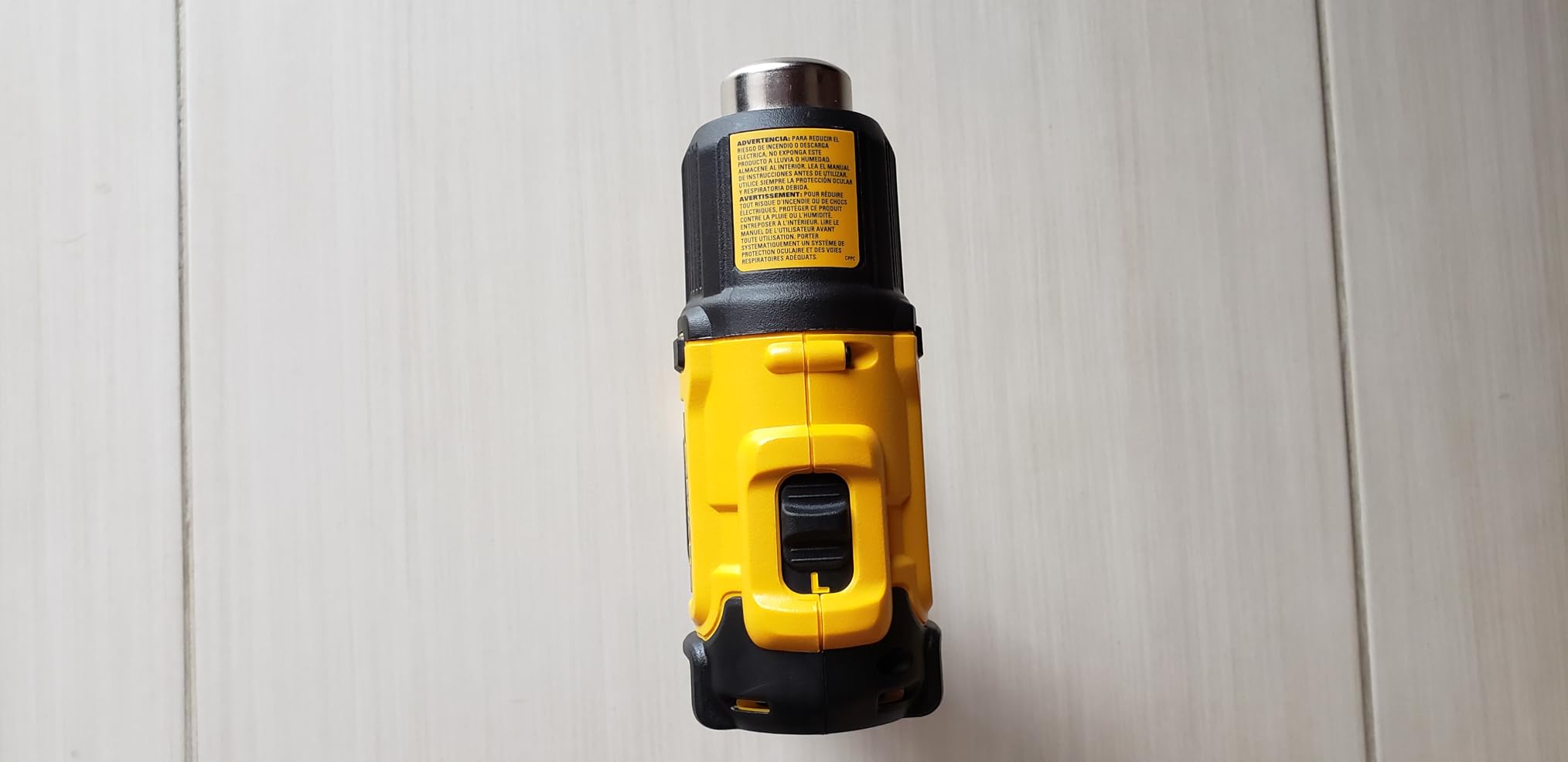
The DCE530B is the gun I hand to people who are stripping an entire house of trim. It weighs 1.65 pounds, puts out up to 990F, moves 6.7 CFM, and claims up to 42 minutes of run-time per charge. That run-time figure is the headline, and it is what separates this from every other platform gun in the group: you can finish a bathroom’s worth of casing without swapping packs.
In hand, the lock-on button is the feature that earns its keep. Stripping paint is a two-hand job, one for the gun and one for the putty knife, and having to hold a trigger through a slow pass across a six-foot board is miserable. The LED work light matters more than it sounds too, because window casings and the back of door panels are exactly the dark cavities you end up stripping.
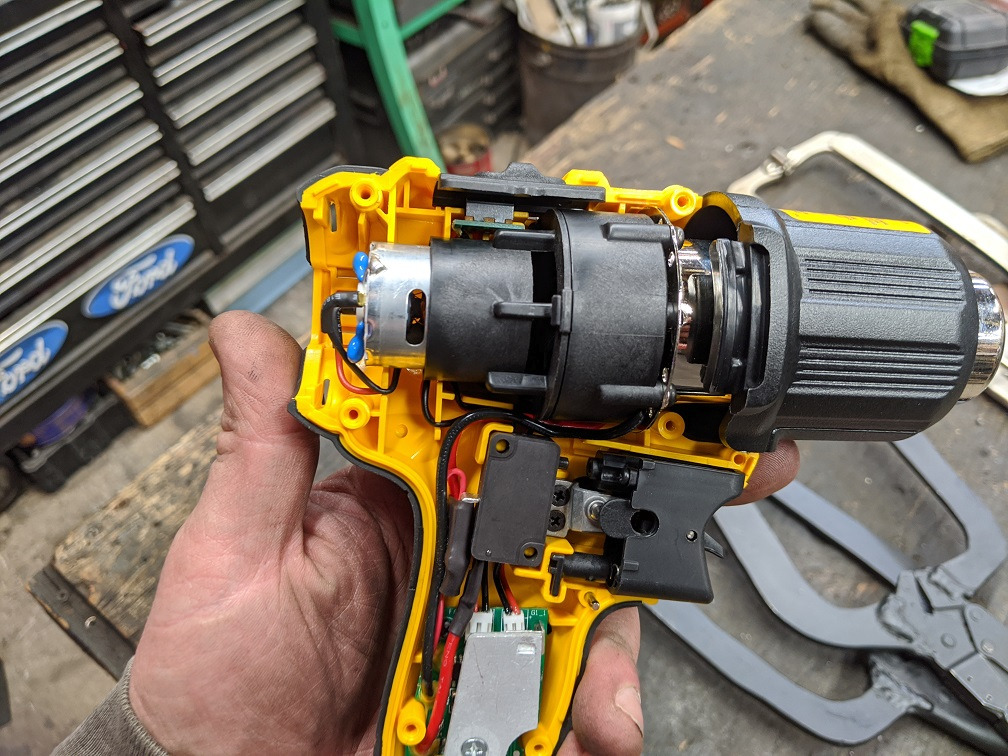
The 6.7 CFM airflow figure is the honest limitation. A 1500W corded gun pushes considerably more air per minute, and on thick multi-layer paint that difference shows up as more passes. What you get back is a machine you can use on a ladder, in an attic, on a fence ten feet from an outlet, or in a house mid-renovation with the power off. The flat and hook nozzles in the box cover the wide-area sweep and the detail corners.
One more thing worth knowing: 42 minutes assumes a healthy high-capacity pack. Reviewers consistently report that small packs run out much sooner, so if you do not already own DeWalt 20V batteries, budget for at least one 4Ah-class pack before you start.
Check this before you buy for paint removal
Owning DeWalt 20V packs is the deciding factor. If you have none, the price of a battery and charger can exceed the price of the gun, and that total is what you should compare against a corded alternative. If you already own two or more packs, this becomes one of the cheapest ways into cordless heat.
Expect to work in 6 to 10 inch sections and to re-heat two or three times. This is not a one-pass sander; nothing at this airflow is. The speed advantage over chemical stripper still lands, because you are removing a few square feet an hour instead of waiting on gel to do its work.
When to skip it
Skip it if you are a full-time trade user running a gun eight hours a day. Multiple reviewers point out that it is not designed for continuous heavy-duty use, and the battery will be cycling constantly. Professional electricians on forums like r/AskElectricians say the same thing about heat guns in general, that longevity is the attribute they buy for.
Also skip it if you are removing thick epoxy or aluminium roofing sealant, where a 990F ceiling and modest airflow will test your patience. Choose a hotter budget unit or a corded gun for that work.
2. Milwaukee 2688-20 M18 Cordless Heat Gun for Speed and Build Quality
Milwaukee Electric Tool 2688-20 Cordless Heat Gun, Red
875F max
7 second heat-up
6.4 inch length
1.7 lbs
LED light
Pros
- Reaches operating temperature in 7 seconds
- 4.5 star rating across more than 1300 reviews
- Short 6.4 inch body fits tight cavities
- Solid metal construction
- M18 XC 5.0 battery power
Cons
- No trigger lock for hands-free work
- Battery drains quickly
- Airflow trails corded guns
- Costs more than most rivals
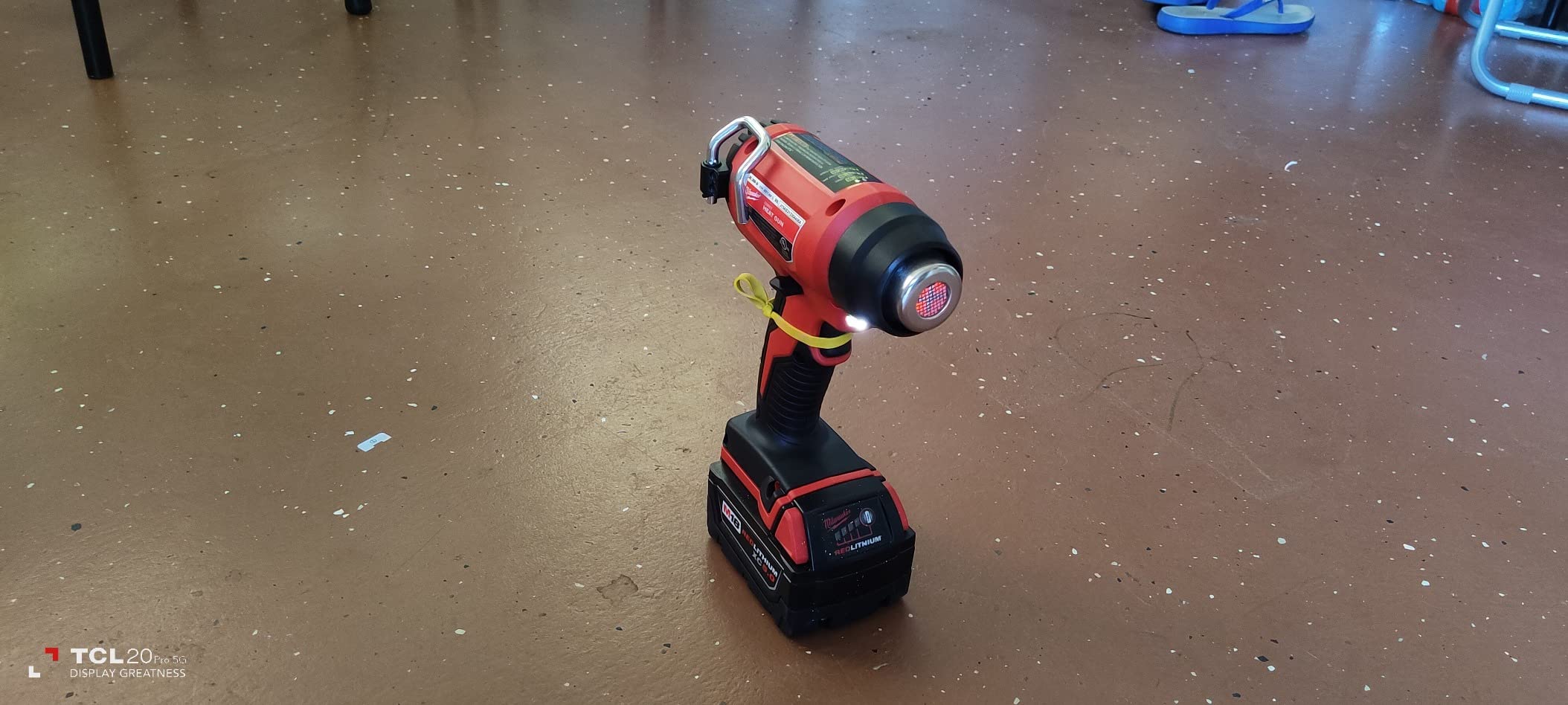
The 2688-20 is the best cordless heat gun for paint removal when you want to be done quickly and the coating is not thick. It reaches operating temperature in seven seconds, which sounds like marketing until you have scrubbed ten door frames in a row and every second of dead time adds up. At 1.7 pounds and 6.4 inches long, it is the easiest of the platform guns to maneuver around a door arch.
Milwaukee owners consistently single out the build. In a category where the top-ranking forum thread is literally titled most reliable heat gun, a tool that feels solid in the hand and comes from a brand with an established repair network is worth real money. The 875F ceiling is lower than the DEWALT’s 990F, and for stripping old hardened oil paint you will feel that difference.
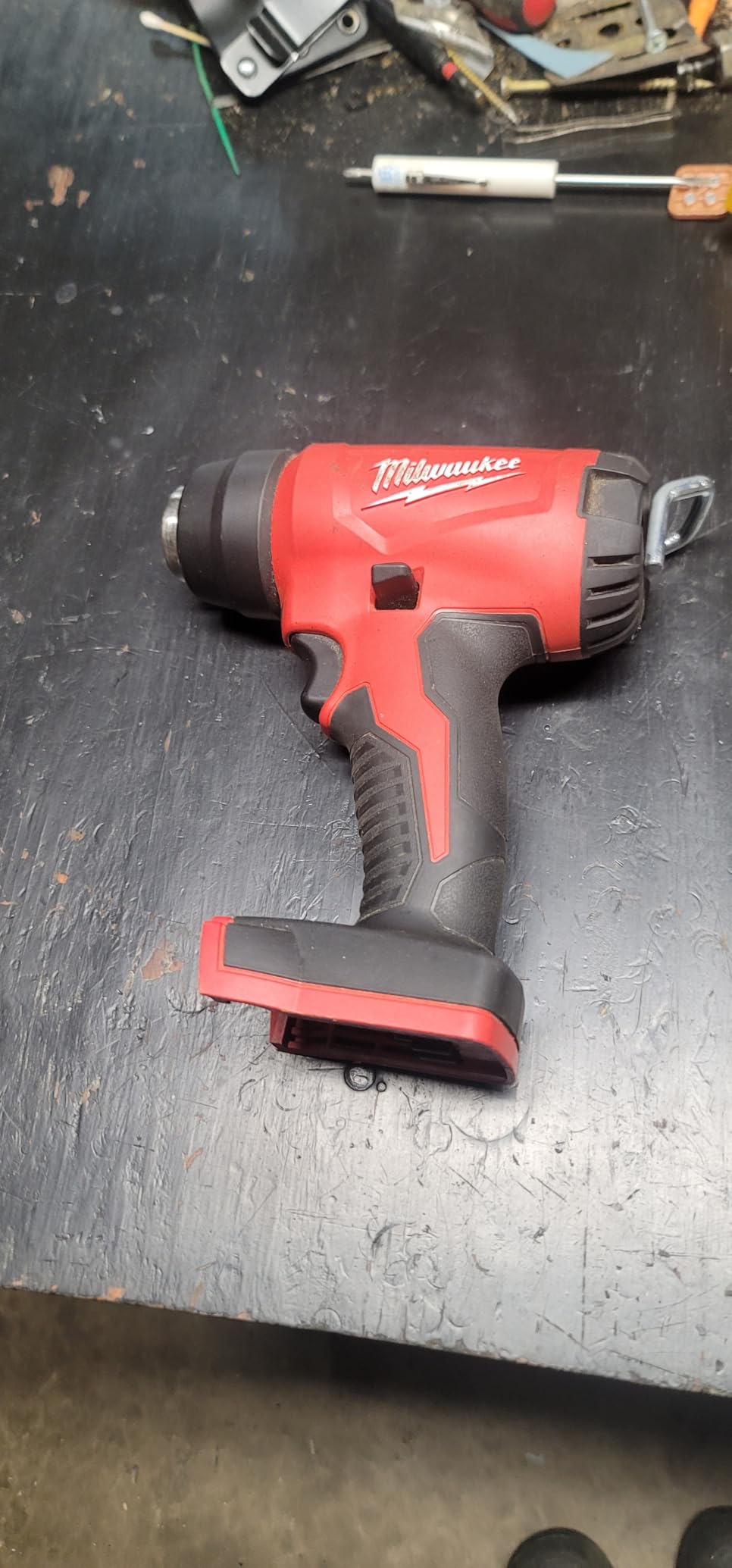
There is one design omission to plan around: no trigger lock. Unlike the DEWALT, you cannot set the gun running and step back, which means long passes on a wide board mean holding the trigger the whole way. For paint work that is manageable because you are actively scraping between passes, but for long drying jobs it is a genuine irritation.
The listing is bare tool, so the M18 XC 5.0 pack is a separate purchase unless you already have one. That is the normal pattern for platform tools, and it is the second thing to check after platform fit.
Check this before you buy for paint removal
Confirm you own M18 packs, and prefer a high-capacity pack in the 5.0Ah XC class if you have one. Run-time scales almost entirely with battery capacity on these tools, and the drain-rate reviews here are consistent enough to plan around.
Test the airflow against your paint before committing to a whole trim package. At 875F with moderate airflow, this is a strong performer on latex and modern coatings, and a slower one on lead paint and multiple layers of hardened oil.
When to skip it
Skip it if you need hands-free operation. For drying filler, curing varnish, or long glue joints, the missing trigger lock is a real daily friction, and a competitor with a lock-on button will serve you better.
Skip it if you are starting from zero batteries and want the lowest total entry cost. The tool plus a pack plus a charger is meaningfully more than a platform-compatible third-party gun that does the same basic job.
3. Ryobi ONE+ P3150 Cordless Heat Gun for Existing ONE+ Owners
Ryobi ONE+ 18V Cordless Heat Gun (Tool Only)
875F max
Under 10 second heat-up
1.8 lbs
Two nozzles
18V ONE+
Pros
- Works with the large ONE+ battery range
- Heats up in under 10 seconds
- Deflector and concentrator nozzles included
- Lightweight and comfortable to hold
- Sensible entry point for occasional use
Cons
- 875F ceiling is low for thick paint
- Airflow is weaker than premium rivals
- ABS plastic feels less premium
- Battery drains quickly
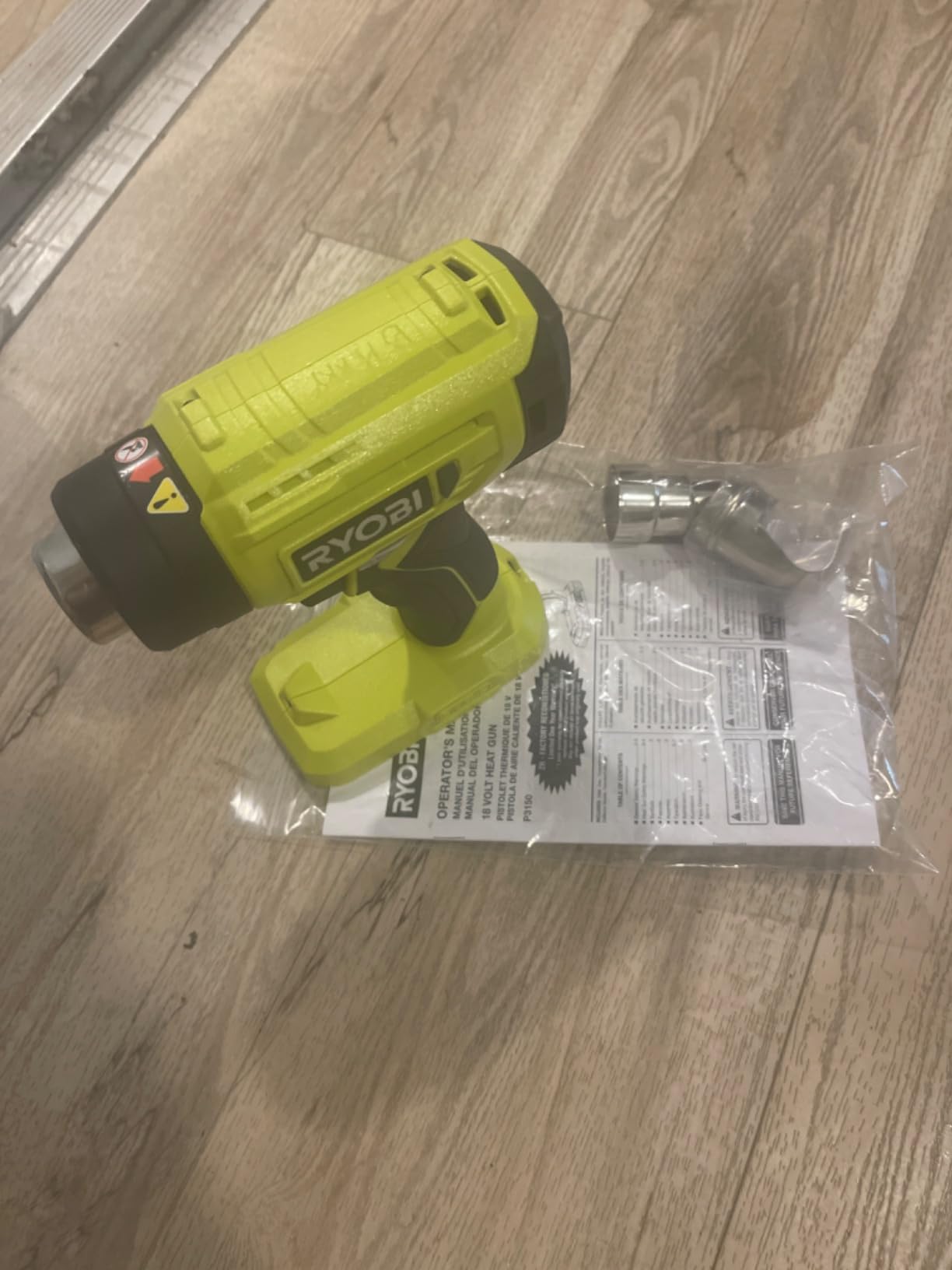
The P3150 is the pick for anyone whose garage is already full of Ryobi ONE+ tools. It hits up to 875F, heats up in under ten seconds, and comes with both a deflector and a concentrator nozzle, which is more in the box than several pricier guns. At 1.8 pounds it is comfortable for a full afternoon of trim work.
Where it gives ground is heat ceiling and airflow. Both are a notch below the platform leaders, and on old hardened coatings you will be making more passes and waiting longer between them. On fresh latex or a cabinet door that has been painted twice, it is perfectly adequate and the shared battery ecosystem is the reason to buy it.
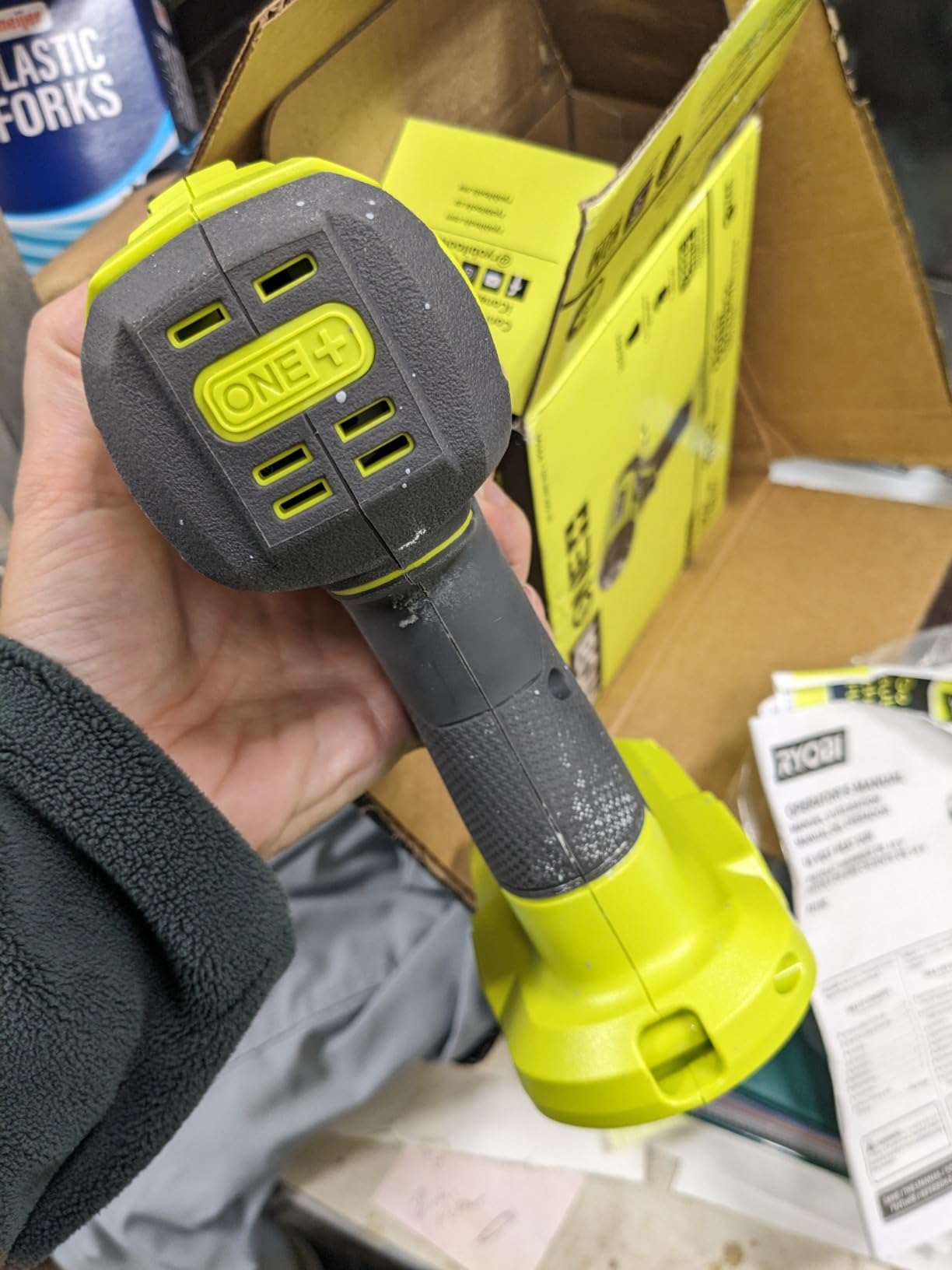
Tool only, so the battery and charger come separately, and that is the right call if you already own ONE+ packs. If you are buying into the platform from nothing, this becomes an ecosystem purchase rather than a heat gun purchase, and you should do that arithmetic first.
One caution about build feel. The housing is ABS plastic, and reviewers consistently describe it as less premium in the hand than a metal-bodied tool. It is not a durability complaint so much as a tactility one, and it is worth handling one in a store if that matters to you.
Check this before you buy for paint removal
Count the ONE+ packs you already own, including higher-capacity ones. With two or more healthy packs this is one of the cheapest quality options in the roundup. With none, add pack and charger cost before comparing it against the budget platform-compatible units.
Test on a hidden section first. If the coating is thick, hardened oil, or lead, a higher airflow gun will save you time even after you account for the lower purchase cost.
When to skip it
Skip it for large flat surfaces like a solid wood door slab or a stair stringer where airflow matters more than anything. The 875F ceiling is fine for trim; it is marginal for heavy stripping.
Some tool owners have raised durability reservations about Ryobi products generally in online communities. If you are buying for occasional weekend work rather than a long renovation, that risk is low. If you want a tool that will survive daily trade use, choose a metal-bodied option instead.
4. Bosch Professional GHG 18V-50 Heat Gun for Electrical and Glue Work
Bosch Professional GHG 18V-50 18V System Battery Heat Gun (Including Reflector Nozzle, 32 x 33 mm, Reducing Nozzle, 9 mm, without Battery/Charger)
572F max
6 second heat-up
0.61 kg
Reflector and reducing nozzles
24 month warranty
Pros
- Heats to working temperature in 6 seconds
- Lightest tool in the group at 0.61 kg
- Reflector and 9 mm reducing nozzle included
- 24 month manufacturer warranty
- Professional Bosch construction
Cons
- 572F ceiling is too low for most paint stripping
- Requires the Bosch Professional 18V system
- Battery and charger not included
- Harder to find than mainstream brands
The GHG 18V-50 is the lightest cordless heat gun in this roundup at 0.61 kg, and it heats to working temperature in six seconds. That combination works well for heat-shrink tubing, cable work, and softening adhesives. It is also the pick with the best ratio of star rating to complaints: 4.5 stars across more than 500 reviews, with build quality and warranty the recurring positives.
Here is the problem for this article specifically: it tops out at 300C, or 572F. That is well below what you need to bubble and lift latex, oil, or polyurethane paint off trim. This is a technician’s tool that happens to be cordless, and the paint on your door frames is not its strength.
Where it does earn a place is adjacent work. Stripping paint from a window frame often means softening old glazing putty or caulk first, and this is gentle enough to do that without scorching the wood. The 24 month manufacturer warranty is also the longest warranty in the group alongside the LIVOWALNY units.
Check this before you buy for paint removal
Confirm Bosch Professional 18V packs. The Professional line is a distinct battery family from the green Bosch tools, and the packs do not cross over. Buyers who assume they do end up with a tool they cannot power.
Consider whether your real task is paint at all. If it is heat-shrink, adhesive removal, or a lighter finish, the fast heat-up and low weight make this a genuinely good tool. If it is paint, look at the next section down instead.
When to skip it
Skip it for any primary paint-stripping project. The 572F ceiling means you are working below the point where most coatings bubble, so you will spend more time heating than scraping and the cost per stripped foot goes up.
Skip it if you are new to a platform purchase. A Bosch Professional pack and charger are a real outlay for a tool that will not do the job you are shopping for.
5. Milwaukee M18BHG-0 Cordless Heat Gun for a Metal Body You Can Abuse
Milwaukee M18 BHG-0 Cordless Heat Gun 18V Bare Unit, RED
M18 compatible
2.2 lbs
Metal body
60 dB operation
Compact handheld
Pros
- Metal construction feels built to last
- Compact handheld form factor
- Works well with Forge high-capacity packs
- Quiet 60 dB operation
- Solid Milwaukee platform support
Cons
- No trigger lock for hands-free use
- Airflow weaker than expected
- Battery drain varies a lot by pack
- Higher cost than the 2688-20
If you drop tools, work in a van, and expect to keep the same heat gun for years, the M18BHG-0 is the one to look at. It has a metal body rather than the ABS plastic used by several competitors here, and at 60 dB it is the quietest operation in the group, which matters if you are working in a closed room.
For paint removal specifically it is adequate rather than exciting. Reviewers praise heat-up speed and durability, and criticise airflow as weaker than expected. That combination means it will get a stubborn door done, but it is not the tool you want if speed on thick coatings is the goal.
The honest comparison here is internal. Milwaukee makes the 2688-20 as well, that unit heats faster, weighs less, and is generally the better buy at a lower cost. The M18BHG-0 earns its place only if the metal body and the form factor matter to you more than those two advantages.
Check this before you buy for paint removal
Be honest about the airflow. The 60 dB number is genuinely low, but the fan is doing less work, and that is the same limiting factor you feel on every paint gun in this list. Test a small section on your hardest coating before committing to a full project.
Battery capacity drives everything here. Owners report a wide range of run-times depending on which M18 pack they use, so if you own Forge or XC high-capacity packs, this tool is in much better shape than if you are working from an older compact pack.
When to skip it
Skip it if you are an M18 owner shopping purely for paint removal. The newer 2688-20 from the same brand is a better tool for less money, and reviewers of this model say as much.
Skip it if you need hands-free operation. Like the 2688-20, it has no trigger lock, and that limits it for drying and curing jobs even though it is fine for active scraping.
6. CRAFTSMAN V20 CMCE530B Cordless Heat Gun for Small Jobs
CRAFTSMAN V20 Cordless Heat Gun, Up to 950 Degrees, Portable Heat Gun, Tool Only (CMCE530B)
950F max
7 second heat-up
Two temp settings
1.63 lbs
Two nozzles
Pros
- Reaches 950F
- hot enough for most household paint
- 7 second heat-up time
- Two temperature settings with a variable trigger
- Flat spreader and curved deflector nozzles
- Compact 8 inch body
Cons
- Only about 15 minutes of run-time per charge
- Needs 4Ah or larger packs to perform well
- Drains smaller batteries very quickly
- Tool only
- battery sold separately
The CMCE530B does something the other platform tools mostly do not, and that is temperature selection. Two settings plus a variable speed trigger give you a low mode for delicate varnish and a high mode for stubborn latex, which is exactly the control you want when moving from a cabinet door to a window casing on the same project.
At 950F and a 7 second heat-up, it has the numbers to be genuinely useful for paint. The flat spreader and curved deflector nozzles both come in the box, so you have a wide-area option and a detail option from day one. Reviewers also note the practical benefit that there is no cool-down cycle to wait through.
The limitation is run-time, and it is significant: around 15 minutes per charge. That is fine for a bathroom cabinet, a single door, or a batch of trim boards, and it becomes frustrating on a whole house. The gun also needs a 4Ah or larger pack to behave, and reviewers are blunt that small batteries drain it quickly.
Check this before you buy for paint removal
Scope the job to the run-time. One cabinet, one door, one window trim set: this fits comfortably. A full renovation across dozens of openings: plan on multiple batteries, or pick a gun with a longer run-time per pack.
Confirm you own Craftsman V20 packs of 4Ah or greater. The difference between the same gun on a 2Ah pack and a 5Ah pack is not subtle, and it is the difference between a usable tool and a frustrating one.
When to skip it
Skip it for big jobs where you will be heating continuously for more than a few minutes at a stretch. Fifteen minutes per pack, plus a recharge on a V20 charger, is the rhythm of occasional work rather than production stripping.
Skip it if you are starting from zero packs. Same arithmetic as the other platform tools applies, and this is where the budget compatible units earn their place.
7. LIVOWALNY DEWALT 20V Compatible Heat Gun for Real Temperature Control
Cordless Heat Gun Compatible with Dewalt 20v Battery (Tool Only)
122-1022F range
LCD display
6 fan speeds
5 nozzles
2 year warranty
Pros
- Actual variable temperature across a wide range
- Large LCD shows air temperature and fan speed
- Six airflow speeds let you match heat to the job
- Five nozzles in the box
- Two year manufacturer warranty
Cons
- Airflow is weak even on the highest setting
- Plastic housing feels inexpensive
- Needs a 4Ah or larger pack for real run-time
- Display reads higher than the delivered air
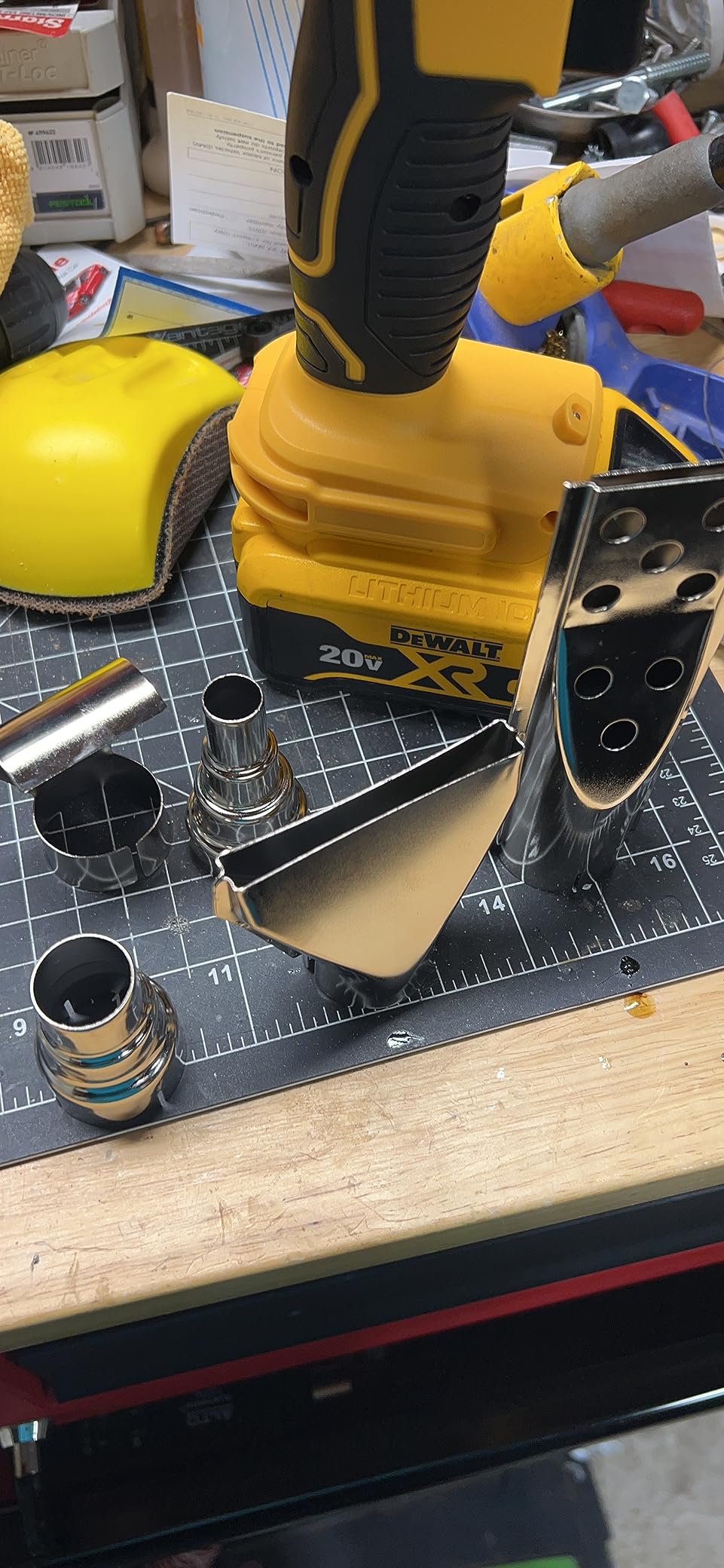
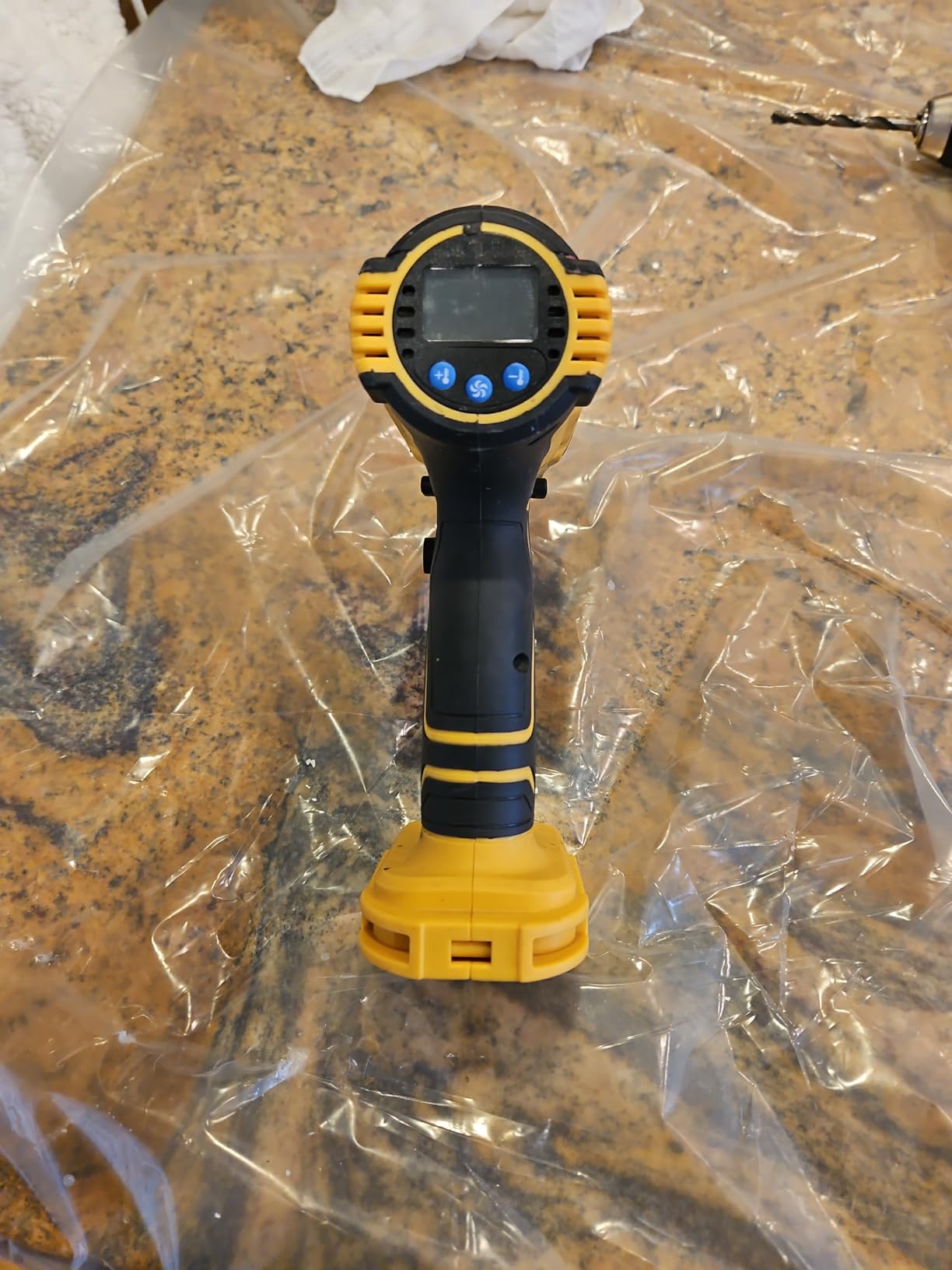
This is the gun that answers the temperature-control question better than anything else in the roundup. Two modes covering 122F to 1022F, six airflow speeds, and a large LCD that shows both air temperature and fan speed while you work. On a door with three different finishes, being able to dial down for varnish and up for latex is a real advantage, and no mainstream platform gun here offers it.
It runs on DEWALT 20V packs, which is the second thing to know. The listing names compatibility with common 20V pack models, and there is a 2 year manufacturer warranty, which is longer than most budget rivals and comparable to the Bosch. Five nozzles ship in the box.
The problem is airflow, and it is the single most important spec on this list. Weak airflow is the consistent complaint in reviews, and weak airflow is exactly what makes paint stripping slow, because heat has to reach the coating rather than the air in front of it. The rated ceiling of 1022F is also the kind of number that a display can claim while the delivered air is cooler, and reviewers make that point directly.
So: superb control, superb accessories, weak blower. For sticker and decal removal, softening caulk, heat-shrink, and small paint jobs on trim, that is a winning combination. For a large door slab, the airflow will be the bottleneck.
Check this before you buy for paint removal
Check the pack. Reviewers are consistent that this needs a 4Ah or larger DEWALT 20V pack to give you usable run-time, and that smaller packs make it feel far weaker than it is. If you are buying new packs for this, factor that into the total.
Check the coating. Thin and recently applied paint responds well to a wide, soft airflow. Thick, oily, or multi-layer paint needs volume, and this gun does not have it.
When to skip it
Skip it for heavy stripping or for anyone who needs a tool to survive daily trade use. Reviews explicitly describe it as not suitable for heavy-duty or commercial work, and the plastic housing is the first thing to feel that.
Skip it if you do not already own DEWALT 20V packs. The tool is inexpensive, but the pack and charger are the real cost, and adding them to a competing platform changes the arithmetic entirely.
8. LIVOWALNY Milwaukee 18V Compatible Heat Gun for Hands-Free Drying Work
Heat Gun Compatible with Milwaukee 18V Battery (Tool Only)
122-1022F range
LCD display
Temperature lock
6 fan speeds
5 nozzles
Pros
- Temperature lock button allows continuous hands-free heating
- Works with common Milwaukee M18 pack models
- Same wide variable temperature range as the DeWalt unit
- Five nozzles included
- Two year manufacturer warranty
Cons
- No cool-down mode
- Weak airflow even on the top setting
- Drains a 5Ah pack in 10 to 15 minutes
- Housing runs hot
- Display reads higher than delivered air
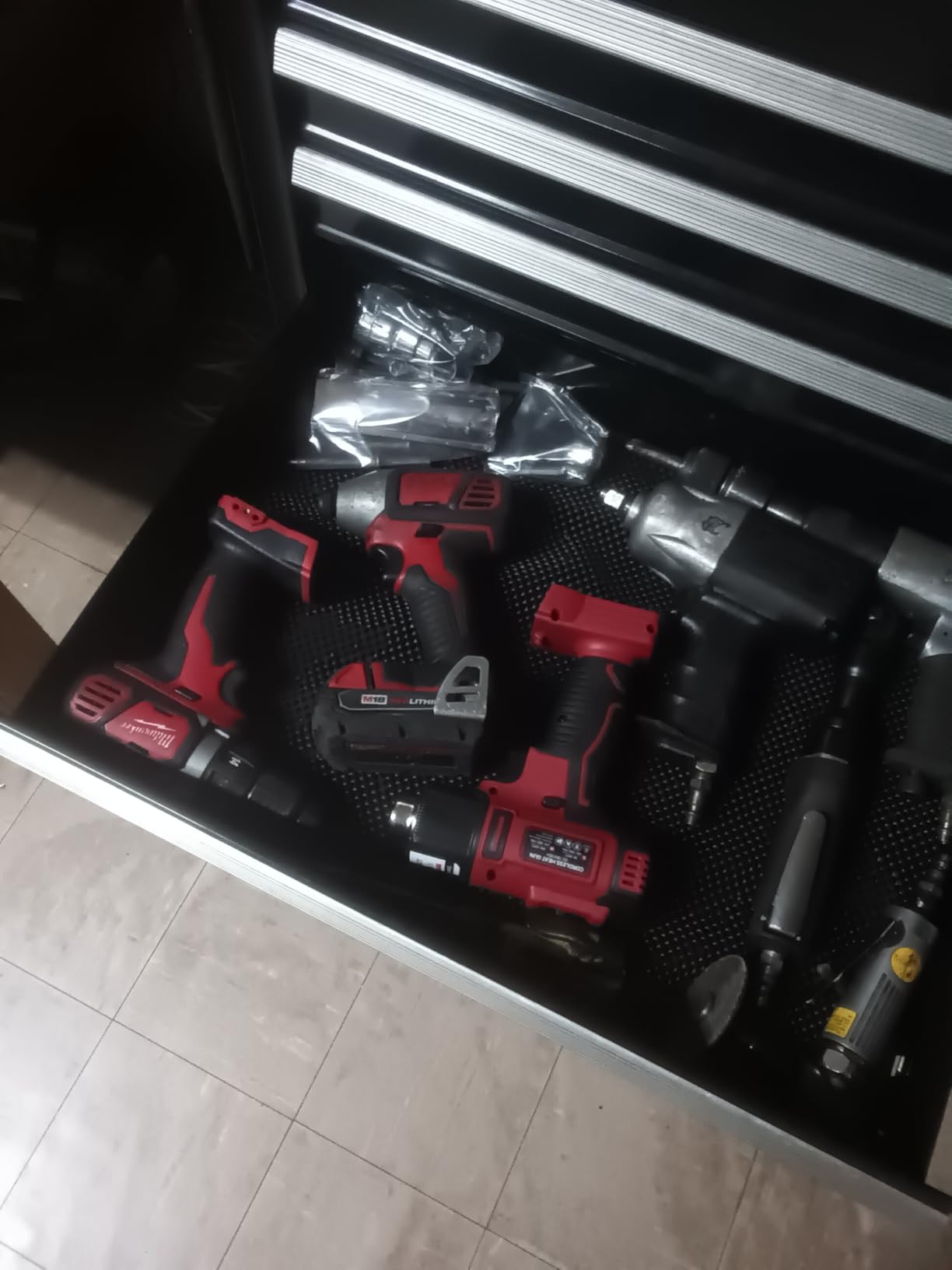
If you already run Milwaukee M18 packs and you want precise heat control without paying platform-brand money, this is the unit to look at. It has the same 122F to 1022F range, the same six airflow speeds, and the same LCD readout as the DEWALT-compatible version, plus one feature the DeWalt unit lacks: a temperature lock button that holds the setting for continuous hands-free operation.
That lock is the reason this is on the list. Stripping paint is active work, but softening caulk, drying filler, or loosening a rusted bolt benefits from setting the gun and walking away. The listing names compatibility with a long list of M18 pack models, so check yours against that before ordering.
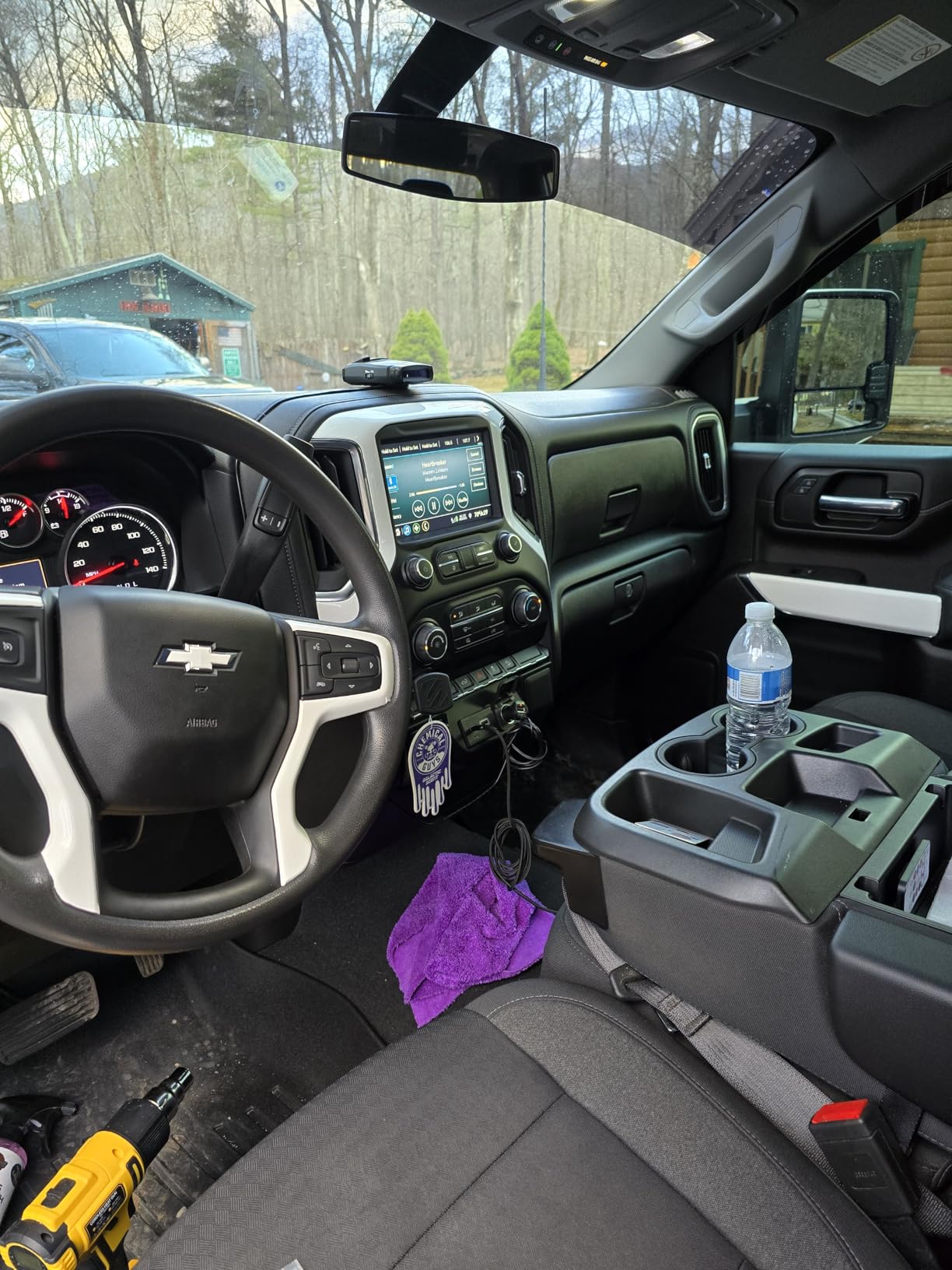
Two drawbacks get repeated and both matter. There is no cool-down mode, which reviewers flag as a long-term concern for coil life, so the habit is to switch it off at the trigger rather than relying on an automatic cooldown. And the battery drain is severe, with reports of 10 to 15 minutes from a 5Ah pack, which means you plan the job around pack swaps.
The housing also runs hot during use, and the delivered air temperature reads lower than the display shows. Both are consistent with a light build and a modest element, and both feed into the same conclusion: this is a capable tool for targeted jobs, not a high-output stripper.
Check this before you buy for paint removal
Model-number check. The listing names specific M18 pack numbers, and cross-check yours. Compatible-with claims in this category are usually accurate but always worth ten seconds of verification.
Expect roughly 10 to 15 minutes per 5Ah pack, and buy a second pack. Stripping a full set of door casings in one session means several pack cycles, and a warm spare is the difference between finishing and stopping.
When to skip it
Skip it for long unattended heating sessions despite the lock, because the lack of a cool-down mode is exactly the situation where coil degradation happens. Use it for controlled bursts instead.
Skip it if your project is large flat surfaces. Weak airflow plus fast pack drain makes that a frustrating combination, and a higher-output platform gun is the better buy for bulk stripping.
9. Edtran Makita 18V LXT Heat Gun for Makita Workshop Owners
Cordless Heat Gun, Hot Air Gun Compatible for Makita 18V Volt LXT Battery, 3 Nozzle, 2-Temp Setting Max 932°F(500°C) Heat Gun for Crafts, Shrink Tubing, Resin & Decorating(No Battery)
662F and 932F settings
200 L/min
3 nozzles
1.59 lbs
Lock-off button
Pros
- Runs on widely used Makita 18V LXT packs
- Two clear temperature settings at 662F and 932F
- Three nozzles included for detail and directed work
- Lock-off button prevents accidental starts
- Overheat protection built in
Cons
- Slow to reach working temperature
- Weak fan even at the top setting
- 932F ceiling is modest for paint
- Lock-off button reported as janky
- Some units failed early
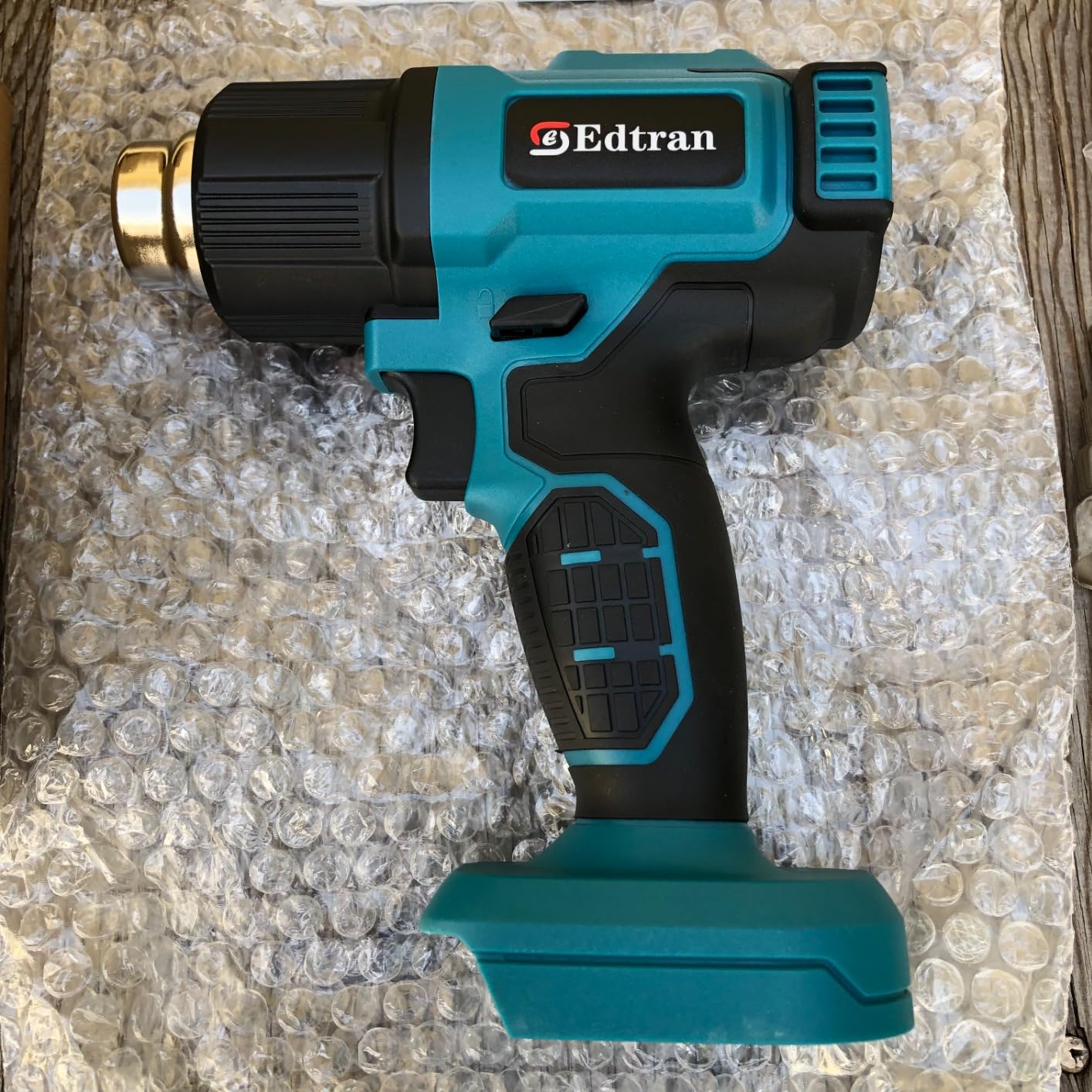
The Makita option in this roundup, and it does the basics for anyone whose tools are all LXT. Two temperature settings at 662F and 932F, airflow up to 200 L/min, three nozzles, overheat protection, and a lock-off button that stops the trigger being pulled in a bag. At 1.59 pounds it is light enough for overhead work on a ceiling cornice.
Heat-up is the weak point, and it is the one reviewers mention most. Where the Milwaukee and Bosch reach working heat in six or seven seconds, this takes noticeably longer, and on a strip-and-scrape rhythm that delay lands after every pause.
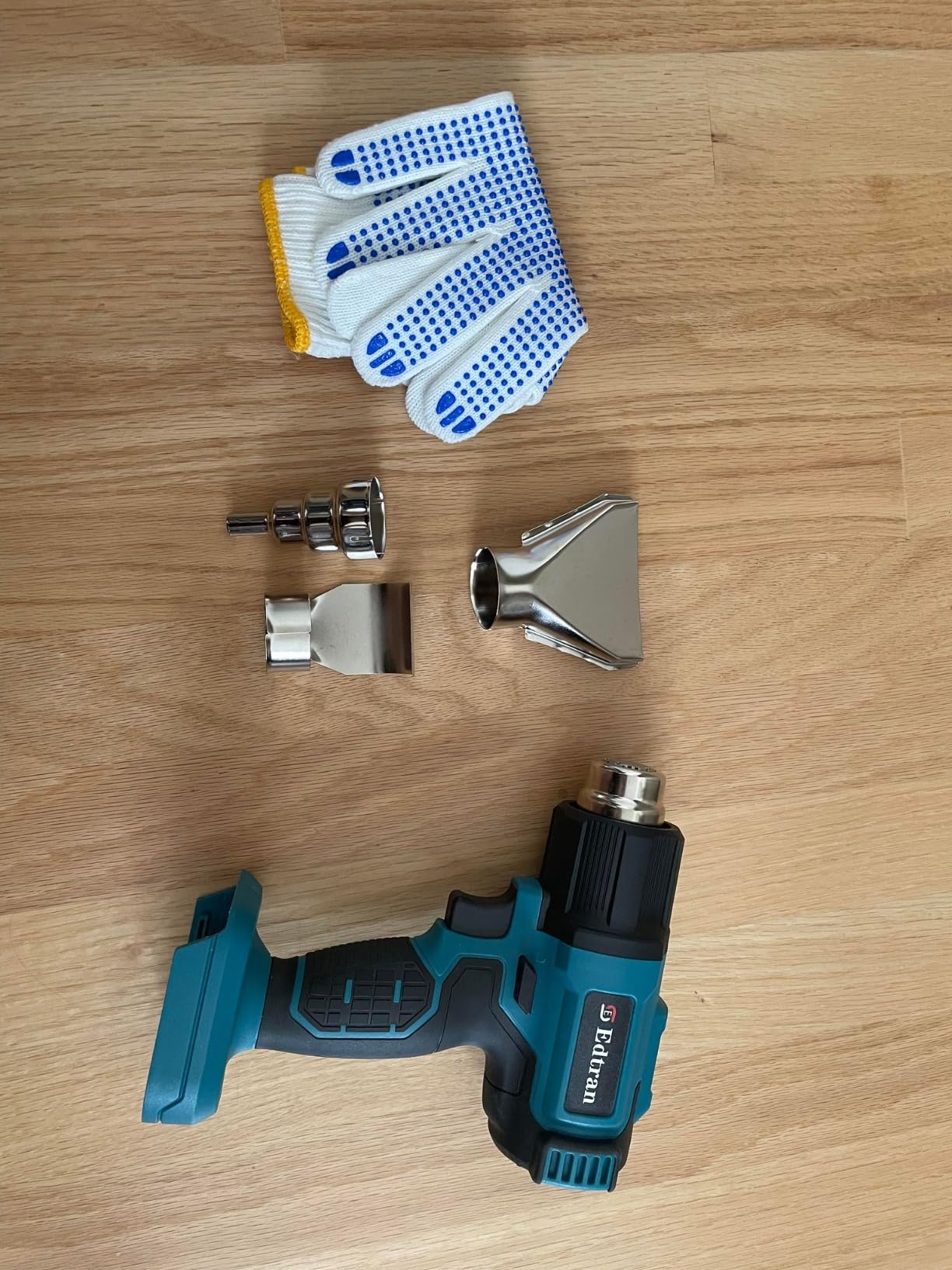
For paint, the 932F ceiling combined with weak airflow makes it a touch-and-go tool. It will soften fresh latex and most interior trim paint. It will not power through thick hardened layers without patience. Reviewers also flag reliability concerns, with some units failing after a small number of uses, which is the single biggest reason to skip it for anything you cannot replace easily.
Where it makes sense is crafts, resin work, heat-shrink tubing, and light duty tasks around the shop, which is exactly what the listing is positioned for.
Check this before you buy for paint removal
Verify your LXT pack capacity. Run-time is poor on smaller packs, and owners consistently say 4Ah or higher is the point where this becomes usable for extended work.
Test the lock-off button early. Reports describe it as janky on some units, and a trigger that is hard to disengage mid-job is an annoyance worth knowing about in advance.
When to skip it
Skip it as a primary paint-stripping gun. The 932F ceiling plus weak airflow plus slow heat-up is three compromises stacked in the same direction, and any of the higher-rated guns above handles paint better.
Skip it if reliability history matters to you and the tool will live in a van. Cheaper components and reported early failures make it a better workshop tool than a job-site tool.
10. Synxiter DEWALT 20V Heat Gun for the Highest Temperature Claim
Cordless Heat Gun for Dewalt 20V Battery(NO Battery), 350W,LED Light,Fast Heating Soldering Hot Air Gun 1022℉-1328℉ Variable Temperature Control with 4pcs Nozzles&Scraper for Crafts, Shrink Wrap
1022F and 1328F modes
LED display and light
4 nozzles plus scraper
1.4 lbs
Pros
- Highest temperature claim in the roundup at 1328F
- LED display shows temperature and pack voltage
- Built-in LED work light
- Temperature lock for continuous heating
- Four nozzles and a scraper in the box
- Lightest tool here at 1.4 lbs
Cons
- Airflow tops out at a weak 7 CFM
- Some units overheat and shut down after a few minutes
- Display missing on some units per reviews
- Only a 12 month warranty
Highest rated number in the group, and the lowest rated number in the group. The Synxiter claims two modes at 1022F and 1328F, which no other tool here matches, and it ships with four nozzles plus a scraper. The LCD shows both air temperature and pack voltage, there is a built-in LED work light, and a temperature lock lets it run hands-free. At 1.4 pounds it is the lightest gun in the roundup.
That 1328F figure needs context. Peak temperature without volume is not what strips paint, and this gun’s maximum airflow is 7 CFM, which is at the weak end even for the budget class. High heat and low air can scorch a surface while failing to lift the coating, which is the worst possible outcome because now you have damage as well as paint.
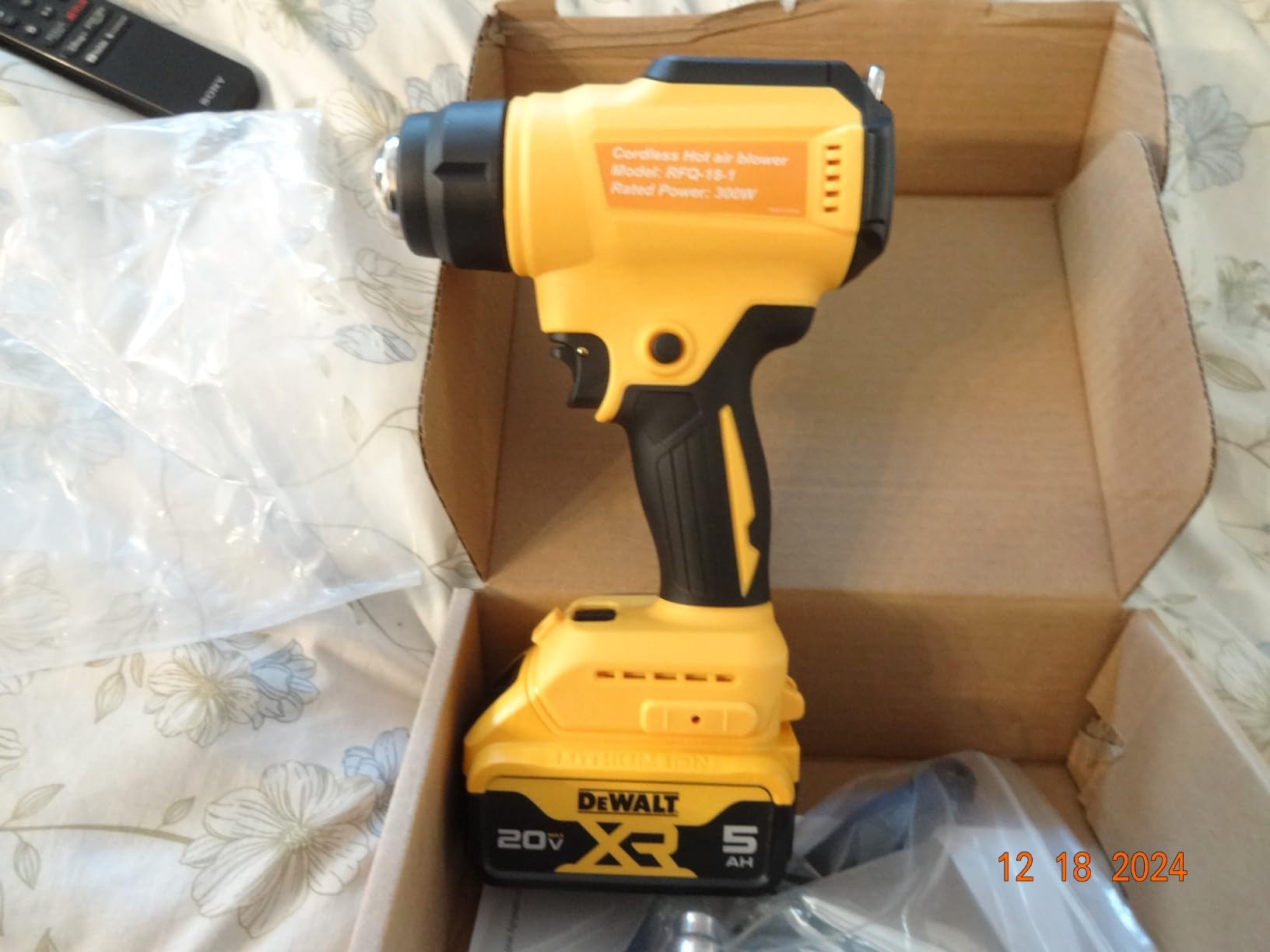
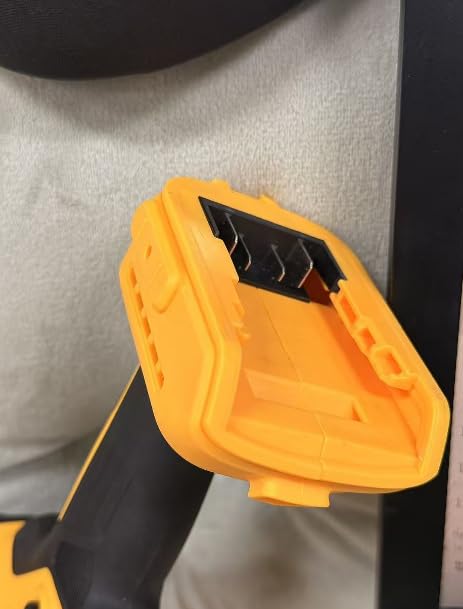
Quality control is the other concern. Reviews report some units shutting down after three or four minutes from overheating, and some arriving without the LED display fitted. Neither failure is dangerous, but both are exactly the kind of inconsistency that the top-ranking reliability thread complains about.
Used properly, though, it is a capable tool for sticker and decal removal, softening old adhesive, heat-shrink, and light paint work on small trim, and the 12 month service window is the shortest warranty in this group.
Check this before you buy for paint removal
Inspect on arrival. Open the box, power it on, confirm the display lights and the temperature modes switch cleanly, and run it for five uninterrupted minutes before you start a project. That check takes a minute and covers the two issues owners report most.
Match it to the coating. On thin, recently applied paint the high mode works. On thick hardened layers, the low airflow will limit you and you will be tempted to hold it closer, which is how you scorch wood.
When to skip it
Skip it for any job where a shutdown mid-session would cost you real time, and skip it for a big stripping project. The airflow ceiling makes it a poor primary tool for the exact job this article is about.
Skip it if you want the highest temperature figure to mean something. The LIVOWALNY units two places up claim 1022F, deliver better airflow, and carry a two year warranty instead of one.
How to Strip Paint With a Cordless Heat Gun?
Heat stripping is a patience exercise, not a blasting exercise. The difference between a clean job and a scorched one is mostly how long you hold the gun and how close you hold it. The community consensus on forums is that paint takes multiple heating passes and a scraper, and guns that appear to do it in one are actually being used with more airflow and more heat than a cordless gun can give you.
Before you switch it on
Test for lead paint first, especially in any home built before 1978. If the test is inconclusive, treat it as lead and follow the precautions in the safety section below. Scraping unknown paint without a respirator is the highest-risk thing in this entire article.
Clear the area of anything that melts or burns. Move curtains, drop cloths that could scorch, plastic storage, and adhesives. Have a fire extinguisher within reach, and know that a heat gun on sawdust or paper in a garage is genuinely dangerous.
Working distance and scraper angle
Hold the nozzle 3 to 6 inches from the surface, keep it moving, and never park it in one spot. Closer is not faster. Closer is how you burn a dark patch into bare pine, and paint only bubbles when the heat has soaked into the coating rather than charring the surface under it.
When the paint starts to lift at the edges and you can see a soft line, hold the scraper at about 30 degrees, almost flat, and pull it toward you along the grain. Work in sections roughly 6 to 10 inches wide, and re-heat as you go. Expect two or three passes on a stubborn area. Users describe a rhythm of heat, wait, scrape, repeat, and a single-pass approach does not exist.
Watch for these four mistakes
Vinyl siding and vinyl trim melt well before paint releases, so stop the moment the surface goes soft or shiny. Single-pane glass windows crack from thermal shock, so heat the paint on the sash and not the glass, or move the gun constantly. Painted MDF and laminate on cabinet doors scorches and swells permanently, so keep the gun moving and drop to the low setting. And on hardwood floors or fine trim, use a deflector nozzle to spread the air rather than concentrating it.
What Temperature Does Paint Removal Need?
Most household paint starts to soften and bubble between 130F and 200F. Fresh latex is the easiest and sits at the low end. Hardened oil paint, polyurethane varnish, and lead-based coatings need the upper end of the range, closer to 300F, and often need patience more than they need a higher setting.
This is why airflow matters as much as peak temperature. A gun that can quote 1328F but pushes 7 CFM will not out-perform one that quotes 990F and pushes 6.7 CFM of properly directed air across a larger area. Volume transfers energy into the coating; temperature alone mostly rattles the air in front of it.
A practical mapping: fresh latex and interior trim paint soften early and need patience more than heat. Oil-based paint and polyurethane varnish need sustained high heat and a slow scraper. Window caulk and old glazing compound need heat to go soft and pliable rather than to bubble. Epoxy and thick roofing adhesive sit well beyond what any of the cordless guns here will handle efficiently, and a corded 1500W unit or a different method entirely is the right answer there.
For varnish specifically, the one variable that changes everything is control. A gun with two fixed settings forces you to choose between too cool and too hot, and too hot means burning through the finish to get to the wood. The budget variable-control units handle varnish far better than the single-setting platform guns, which is the opposite of what the specification sheet implies.
Which Battery Platform Should You Buy Into?
This is the real decision for a cordless heat gun, and the top-ranking forum threads are blunt about it: owners with a DeWalt 20V or Milwaukee M18 collection buy within their ecosystem and treat it as settled. That is a reasonable position, because every platform gun here is a bare tool and the pack is the expensive part.
DeWalt 20V MAX has the deepest third-party support in this roundup, with three separate units here running on those packs, including the two with the widest temperature control. Milwaukee M18 has two options, a metal-bodied tool and a 7 second heat-up unit, plus a compatible third-party gun with a temperature lock. Makita 18V LXT has one option here, and Bosch Professional 18V has one, which is a thin ecosystem for a first-time buyer.
Run the arithmetic before you buy. A platform gun plus a high-capacity pack plus a charger can cost several times the gun itself. If you own no packs in a platform, a third-party compatible unit with a two year warranty and a 122F to 1022F variable range is a genuinely good entry point, and the two DEWALT-compatible options in the lower half of this list are the ones to compare. If you already own packs, the platform gun is the better buy every time.
One more cold-weather note. Battery capacity drops in low temperatures, and cordless heat guns drain hardest when they are working against cold air. If your project is outdoors in winter, plan on more pack cycles than the same job would take in a warm room.
Safety: Lead Paint, Respirators and Fire Risk
Stripping paint is one of the higher-risk jobs in home renovation, and the risk is in the fumes and the dust rather than the heat. This is not an area to improvise, and it is worth the paragraph.
If your home predates 1978, assume lead until a certified test says otherwise. Lead paint dust is a recognised health hazard, and the act of heating and scraping it puts that dust into the air. A P100 or P3 respirator, safety goggles, and a HEPA vacuum to clean up debris are the minimum, not the comfortable option. Contain the work area, keep children and pets out of it, and wash your hands and face before you sit down to eat. Picking up the dried debris afterwards is a separate job, and our guide to upright vacuums that capture fine dust covers the filter types worth using for it.
For ventilation, open windows on two sides of the room and let air move through the space, not just out of it. If you want a cleaner approach to the dust that stripping always creates, a HEPA air purifier is a worthwhile addition to the room and does more for the air than a cracked window alone. If you are also tackling accumulated dust and dander while the room is open, our guide to air purifiers for odor removal covers the filter types that actually capture fine particles.
For the fire risk, the rules are simple. Never leave a running heat gun unattended, keep it away from the pack so the charger and cells are not sitting in the heat, set it on a non-combustible surface with the nozzle clear, and keep the extinguisher in the room rather than the garage. Do not use one on sawdust, paper, cardboard, or plastic sheeting, and keep any other heat source in the workspace well away from the gun, including a clamp or bench lamp like the heat lamp options we compared. And treat the nozzle as live after switch-off, because the metal barrel holds heat long after the airflow stops.
Finally, do not point a hot nozzle at your hand to test it. Use the back of your fingers near, never on, the airflow to feel temperature, and keep the tool moving so the heat does not concentrate on one spot of substrate.
Cordless Heat Gun Buying Guide
Temperature control beats maximum temperature. Every gun here advertises a headline number, and the higher ones are not automatically better. A gun with two settings and a variable trigger will protect delicate finishes and let you work on varnish; a gun with one setting and a huge claimed ceiling will give you less usable control. Prioritise the gun that matches your coatings, not the one with the biggest number.
Airflow is the second spec to read, and it is the one that decides stripping speed. Figures appear as CFM or as L/min depending on the manufacturer, and higher is better. The DEWALT and Synxiter units rate at 6.7 and 7 CFM, the LIVOWALNY units claim up to 9.9 CFM, and the Makita-compatible unit lists 200 L/min. None of them match a corded 1500W gun, so plan on multiple passes regardless of which you buy.
Run-time per pack decides how big a job you can do in one sitting. The published figures range from about 15 minutes per charge on the Craftsman to up to 42 minutes on the DEWALT, and real-world results depend heavily on the capacity of the pack you fit. If you do not already own batteries, choose the platform you can buy packs for most easily rather than the tool with the best spec sheet.
Bare tool versus kit is the number one source of confusion in this category, and it is worth being blunt. All ten units here are sold as the tool only. A kit with a battery and charger is more expensive up front, but if you own no packs in that platform, the kit is often the cheaper total. Check what you already own before you compare anything.
Weight and balance matter more than they look, because stripping is overhead, repetitive, and one-handed between scrapes. Everything here falls between 1.4 pounds and 2.2 pounds, and at that spread you can feel the difference after an hour on a ladder. A lock-on button is the feature that most improves comfort during active scraping, and only some of these guns have one.
Nozzles matter less than most guides suggest, because two ship with almost every tool here, and the set is broadly interchangeable in spirit: a flat or concentrator nozzle for directed heat, and a deflector for spreading it. The tools that stand out are the ones including five nozzles, or four nozzles plus a scraper, which saves a trip to the hardware store.
On durability, the pattern across reviews is consistent and worth heeding. Metal-bodied tools from established brands attract comments about lasting; plastic-bodied budget units attract comments about feeling inexpensive, and occasionally about failing early. The top-ranking thread on the most reliable heat gun is filled with professionals saying their tools last six months. If you are a hobbyist, that risk is acceptable. If this is your job, buy the metal body.
Frequently Asked Questions
What is the best heat gun for removing paint?
The DEWALT DCE530B is the best cordless heat gun for paint removal in 2026, reaching up to 990F with 6.7 CFM of airflow and up to 42 minutes of run-time per charge. Its lock-on button lets you keep both hands on the scraper, and it runs on the widely owned DEWALT 20V battery platform.
Do heat guns work to remove paint?
Yes. A heat gun softens or bubbles paint so a scraper can lift it, which is far faster and cleaner than chemical stripper. It works best on wood trim, doors, cabinets and window frames, and needs about 3 to 6 inches of working distance plus several passes on stubborn coatings. It can scorch bare wood, melt vinyl, or crack glass if held too close or left still.
What temperature heat gun for paint removal?
Most household paint softens between 130F and 200F, while hardened oil paint, polyurethane varnish and lead coatings need closer to 300F. Airflow matters as much as peak temperature, because heat has to reach the coating rather than the air in front of it. Hold the gun 3 to 6 inches away and keep it moving to avoid burning the substrate.
What is the best battery-powered heat gun?
It depends on the platform you already own. DEWALT 20V MAX and Milwaukee M18 have the broadest third-party support, and the DEWALT DCE530B and Milwaukee 2688-20 are the strongest options in those ecosystems. For wide temperature control, the LIVOWALNY units run 122F to 1022F and work with common 20V and M18 packs.
Which heat gun is best for removing paint?
The DEWALT DCE530B is our pick for the best overall cordless heat gun for paint removal, while the Milwaukee 2688-20 reaches operating temperature in seven seconds. The Ryobi P3150 suits existing ONE+ owners, and the CRAFTSMAN V20 offers two temperature settings for mixed-finish projects.
What type of heat gun is best for stripping varnish?
A variable-temperature gun is best for varnish, because a single fixed setting forces you to choose between too cool and too hot, and too hot burns through the finish to reach the wood. The LIVOWALNY units covering 122F to 1022F with six airflow speeds give the most control, while the CRAFTSMAN V20 offers two selectable settings for less demanding varnish work.
Conclusion
The best cordless heat guns for paint removal in 2026 come down to which battery platform you already own. Start with the DEWALT DCE530B if you run 20V MAX packs: it has the longest run-time in the group, a lock-on button that makes active scraping far less tiring, and the widest support of any platform on this list.
If you are an M18 owner, take the Milwaukee 2688-20 for its seven second heat-up and build quality, or the M18BHG-0 if a metal body matters more to you than speed. Ryobi ONE+ owners should take the P3150, and the CRAFTSMAN V20 is the pick when you want two temperature settings and a short job. If you own no packs at all, the LIVOWALNY DEWALT-compatible unit gives you genuine variable control from 122F to 1022F on a two year warranty.
Whatever you choose, respect the technique. Keep the nozzle 3 to 6 inches away, keep it moving, work in small sections, and expect several passes. That is the difference between a clean strip and a scorched one, and it costs nothing but patience.