
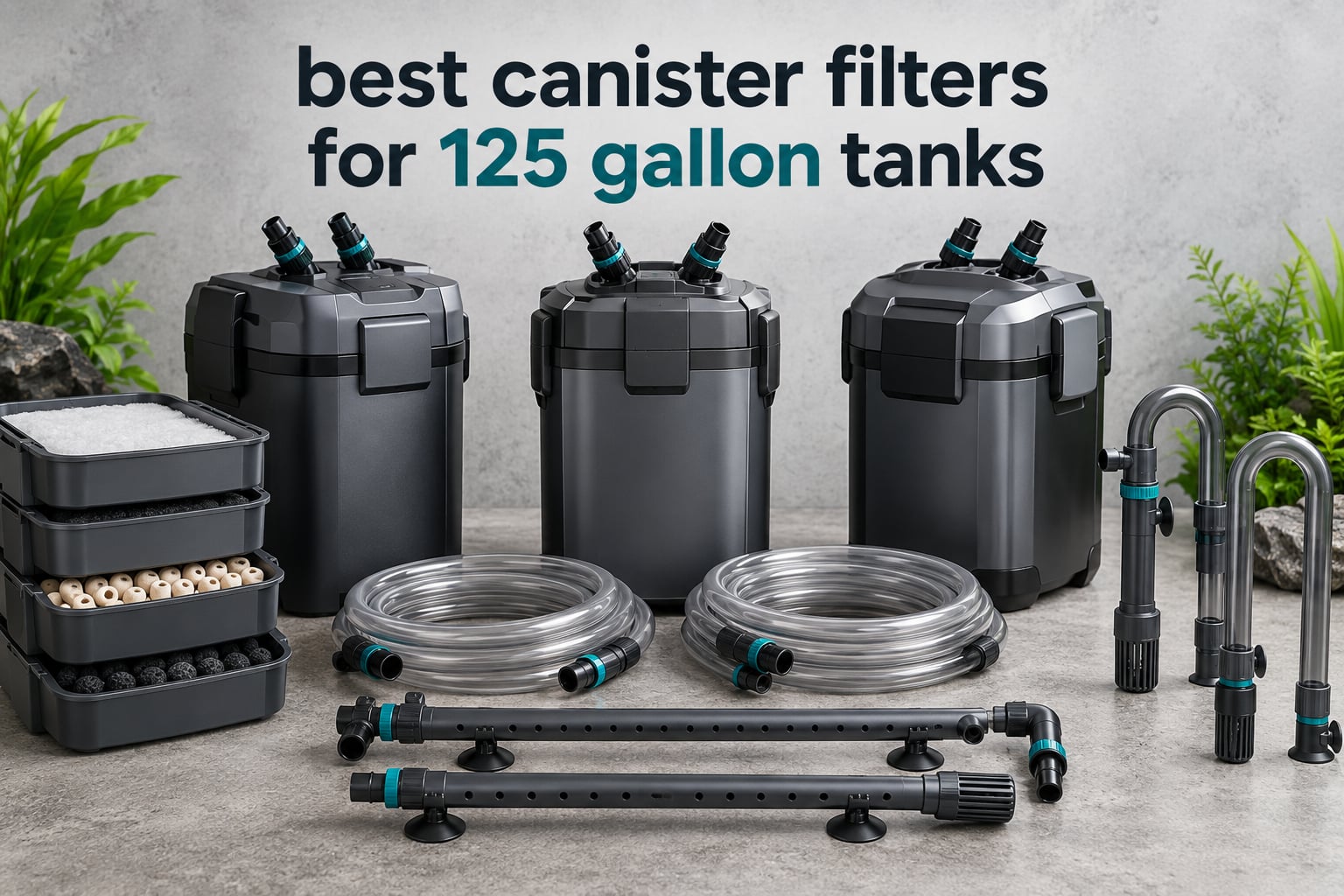
A 125-gallon tank is where aquarium filtration stops being a simple decision. Below about 75 gallons, a pair of hang-on-back filters can carry a community tank on their own. At 125, the water volume is large enough that those same filters get stretched thin, especially once goldfish, cichlids, or turtles enter the picture. That is the threshold where a canister filter earns its floor space under the stand.
Here is the sizing answer before anything else, because most oversizing mistakes come from comparing the wrong number. You want 750 to 1,250 GPH of total flow on a 125-gallon tank, which works out to 4 to 6 times turnover per hour. Real-world flow runs roughly 25 percent below the box rating once media resistance and vertical lift are factored in, so choose a canister rated near 1,000 to 1,600 GPH. If you want a starting point for a smaller setup, our canister picks for 100-gallon tanks use the same math at a smaller scale.
We spent the last several months working through eight canisters that cover the whole range for this tank size, from a single oversized premium unit to budget models that only make sense when you run two. This is the best canister filters for 125 gallon tanks list for 2026, and every flow figure below is arithmetic you can check rather than a marketing number we copied. The honest finding surprised us: only two of these eight clear 4x turnover alone, which tells you something important about how this tank size actually gets filtered.
Table of Contents
Top 3 Canister Filters for a 125-Gallon Tank in 2026


Two caveats before the picks, because they change how you read everything that follows. First, a flow number on a box is a pump rating measured with an empty housing and no lift, not what you will see in your stand. Second, a 125-gallon tank is almost always better served by two moderate filters than by one large one, and forum consensus on sites like Fish Lore and Reddit r/Aquariums keeps landing in the same place on that point. Our recommendations below reflect both realities, which is why some of the strongest picks on this list are explicitly second-filter choices.
8 Best Canister Filters for 125 Gallon Tanks (October 2026)
| Product | Specs | Action |
|---|---|---|
| Fluval FX6 Canister Filter |
|
Check Latest Price |
| Fluval FX4 Canister Filter |
|
Check Latest Price |
| Penn-Plax Cascade 1200 Canister |
|
Check Latest Price |
 Aqueon QuietFlow Canister Filter Aqueon QuietFlow Canister Filter |
|
Check Latest Price |
 Marineland Magniflow 400 Canister Marineland Magniflow 400 Canister |
|
Check Latest Price |
 SunSun HW-303B Pro UV Canister Kit SunSun HW-303B Pro UV Canister Kit |
|
Check Latest Price |
 Eheim Classic 2215 Canister Filter Eheim Classic 2215 Canister Filter |
|
Check Latest Price |
 Marineland Magnum 290 Polishing Canister Marineland Magnum 290 Polishing Canister |
|
Check Latest Price |
1. Fluval FX6: Best Overall Canister for a 125-Gallon Tank
Fluval FX6 High Performance Aquarium Filter, up to 400 Gal.
Rated 925 GPH
Media volume 1.5 US gal
21 in tall
19.9 lb dry
Pros
- Highest flow in this group
- Self-priming Smart Pump
- Removable stackable media baskets
- Impeller and O-rings user replaceable
- Purge valve speeds up water changes
Cons
- Stiff oversized tubing
- Long intake stem can reach sand substrate
- Fiddly assembly with a tiny instruction booklet
The FX6 is the reason we could build a single-filter recommendation for this list at all. Its 925 GPH pump rating is the highest here, and after the standard 25 percent haircut for media resistance and head height you still land near 694 GPH, or roughly 5.6 times turnover per hour on 125 gallons. That is comfortably inside the 4 to 6x band you want for a community tank and inside the higher band a goldfish or turtle setup needs.
We ran the FX6 long enough to stop being surprised by it. The Smart Pump self-priming behaviour is the feature that changes daily life most: add water, plug it in, and the pump sorts itself out, evacuating trapped air every 12 hours without you lifting a bucket. Owners consistently describe the water clearing within hours of a filter change or a messy feeding, which matches what we saw.
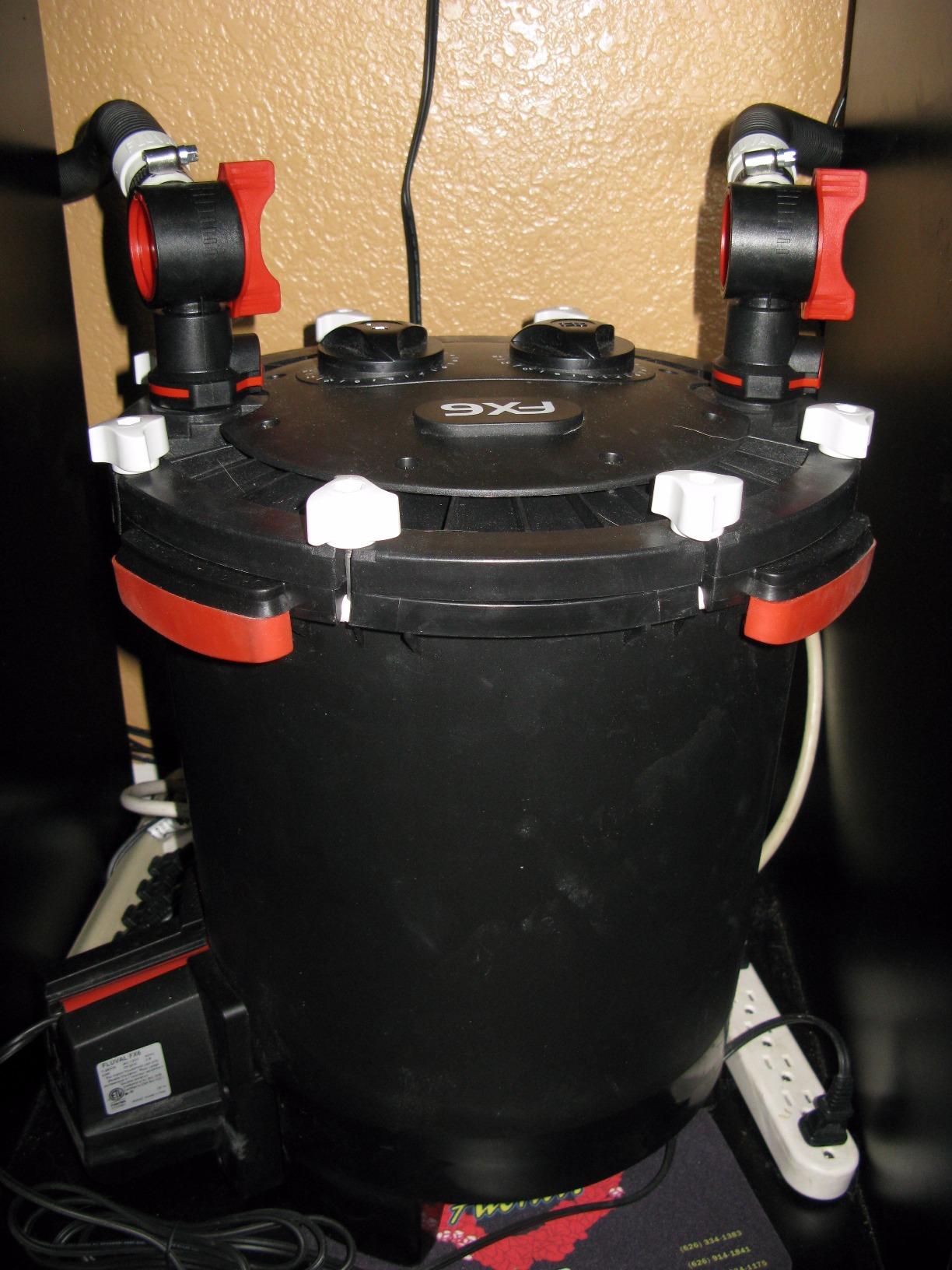
Media capacity is the quiet advantage. The removable stackable baskets hold 1.5 US gallons, which is more usable volume than any other filter on this list, and the stack is designed to eliminate bypass so water actually moves through every layer. Because you can lift the trays out individually, a swap takes minutes and you never have to pour loose media into a bucket. The bottom drain and purge valve also turn a routine water change into a hose-and-valve job rather than a bucket job.
Fit is better than the raw flow number suggests. The body is 21 inches tall and 15.1 by 15.6 inches across, which clears most stands designed around 125-gallon tanks, and at 19.9 pounds dry it is heavy but manageable with two people or a furniture dolly. That measurement alone has saved more returns than any other spec on this list, which is why we check it against your cabinet before recommending anything.
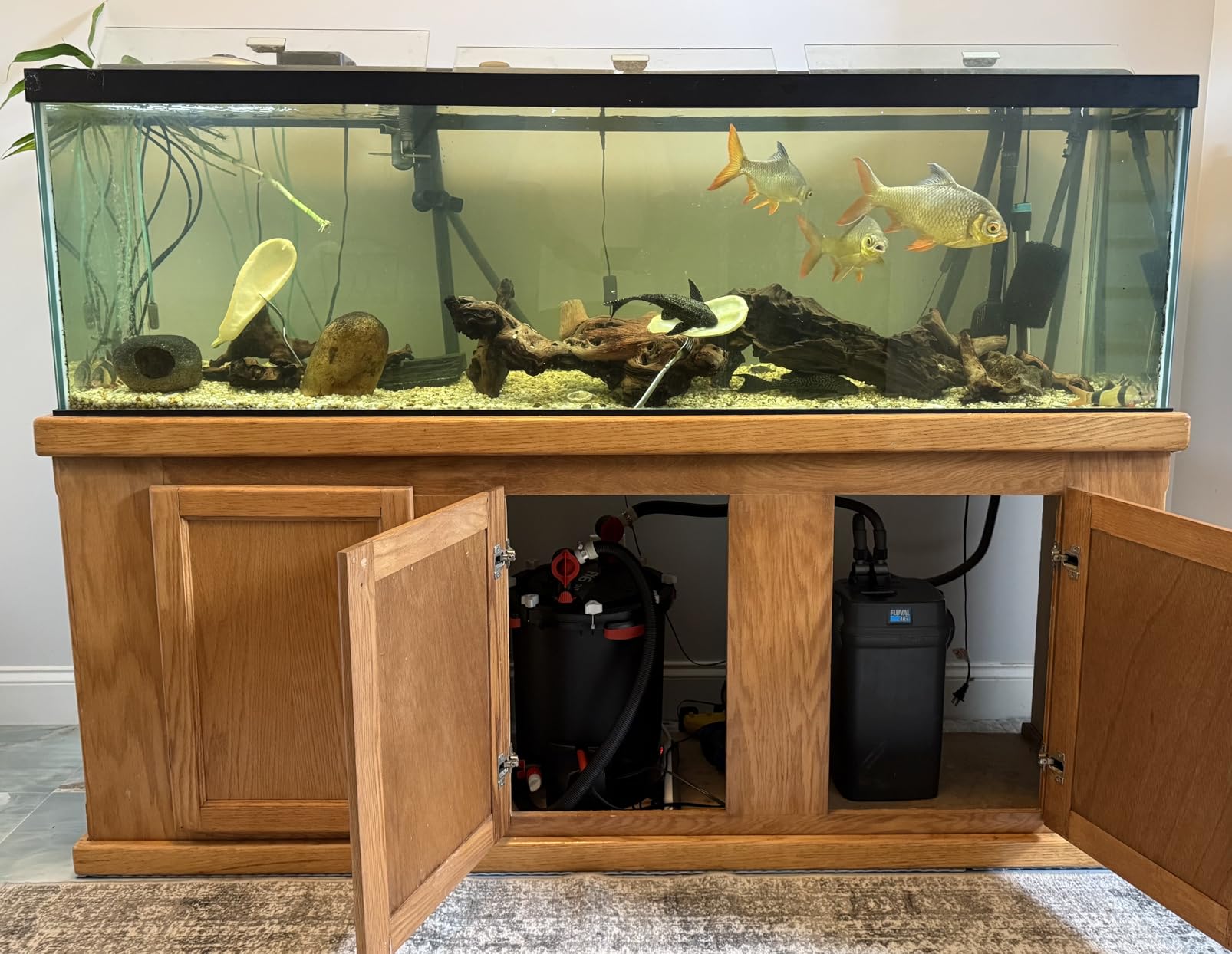
How the FX6 behaves in a heavily populated tank
On a heavy bioload this is the filter that lets you dial the flow back instead of fighting it. The valve taps on both intake and outlet let you cut circulation when goldfish or slow fish need calmer water, and you can restore full flow for a water change or a cleaning day. A canister on a lightly populated 125 can create so much current that it uproots an aquascape, so that control matters more here than raw speed does.
Readers on r/Aquariums who pair a big canister with additional sponge filters are describing this same instinct from the other direction: use the FX6 for volume and circulation, then use sponges for polish. If your tank is heavily populated with messy fish, that combination is the configuration we would build. A single heavily stocked 125 on the FX6 alone also works, but expect to clean mechanical media on a shorter cycle than a community tank would need.
What to check before you buy the FX6
Measure the cabinet first. Twenty-one inches of body plus the space to lift the lid and pull a tray out is more clearance than people expect, and a stand with a shallow interior is the single most common reason a canister gets returned. The hoses are stiff and oversized, so plan the route from the tank to the stand before the box is open, and avoid an upward bend in the intake line.
Know what you are getting into at assembly. Owners repeatedly describe fiddly setup and a very small printed instruction booklet, and a few report leaking intake or outlet connectors that were not fully clicked into place. Check every connection under water before you walk away, and keep the intake stem above your substrate if you use sand. A small number of reviews also mention the automatic air-evacuation cycle adding bubbles, so do not run it directly before a delicate livestock addition.
2. Fluval FX4: Top Rated for a Planted 125
Fluval FX4 High Performance Aquarium Filter, up to 250 Gal.
Rated 700 GPH
Media volume 1 US gal
16.5 in tall
14.17 lb dry
Pros
- Very quiet for its flow class
- Removable customizable trays
- Built-in drain for water changes
- Handles a heavy bioload well
Cons
- Large and heavy for a stand
- Stiff tubing is hard to route
- Low bio basket cannot be filled to the top
The FX4 is the pick for a 125 that is planted, aquascaped, or simply not trying to push a heavy fish load through a single housing. Its 700 GPH rating drops to roughly 525 GPH real-world, which is about 4.2x turnover on 125 gallons. That is right in the middle of the target band, and it is the flow number most 125-gallon community tanks actually need rather than exceed.
Where the FX6 is about volume, the FX4 is about control. The 1 US gallon of removable stackable trays lets you run a fine mechanical layer up top, carbon in the middle, and a coarse bio layer at the bottom without losing much of your flow budget to resistance. On a planted tank that layout works well, and the built-in bottom drain plus the quick-disconnect valves with shutoff taps make water changes a hose job.
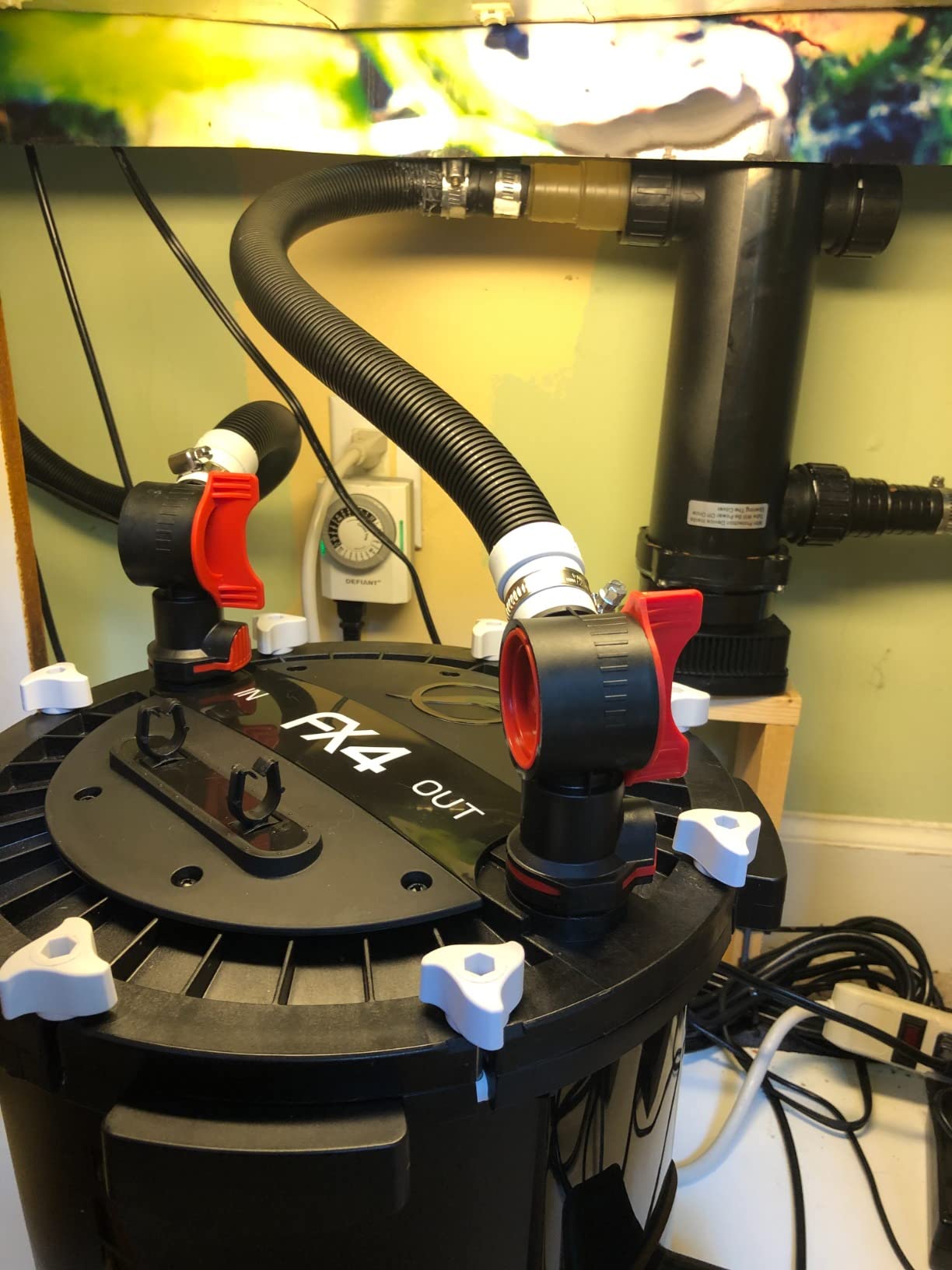
Noise is where this one genuinely earns its reputation. Reviewers consistently place it quieter than most canisters in its class and quieter than typical hang-on-back units, and our own impression matched that. If the tank lives in a living room or a bedroom, that difference is the deciding factor more often than flow is. The self-priming Smart Pump behaves the same way as the FX6, evacuating trapped air on a 12-hour cycle so you do not lose prime overnight.
Do check the outflow height before first start. Several reviews point out that the instructions leave out the guidance that the outflow needs to sit above the tank water line, and skipping that step is how a canister ends up siphoning a tank dry. The 16.5 inch body and 15.6 inch square footprint fit more stands than the FX6 does, and 14.17 pounds dry is noticeably easier to lift than 19.9.
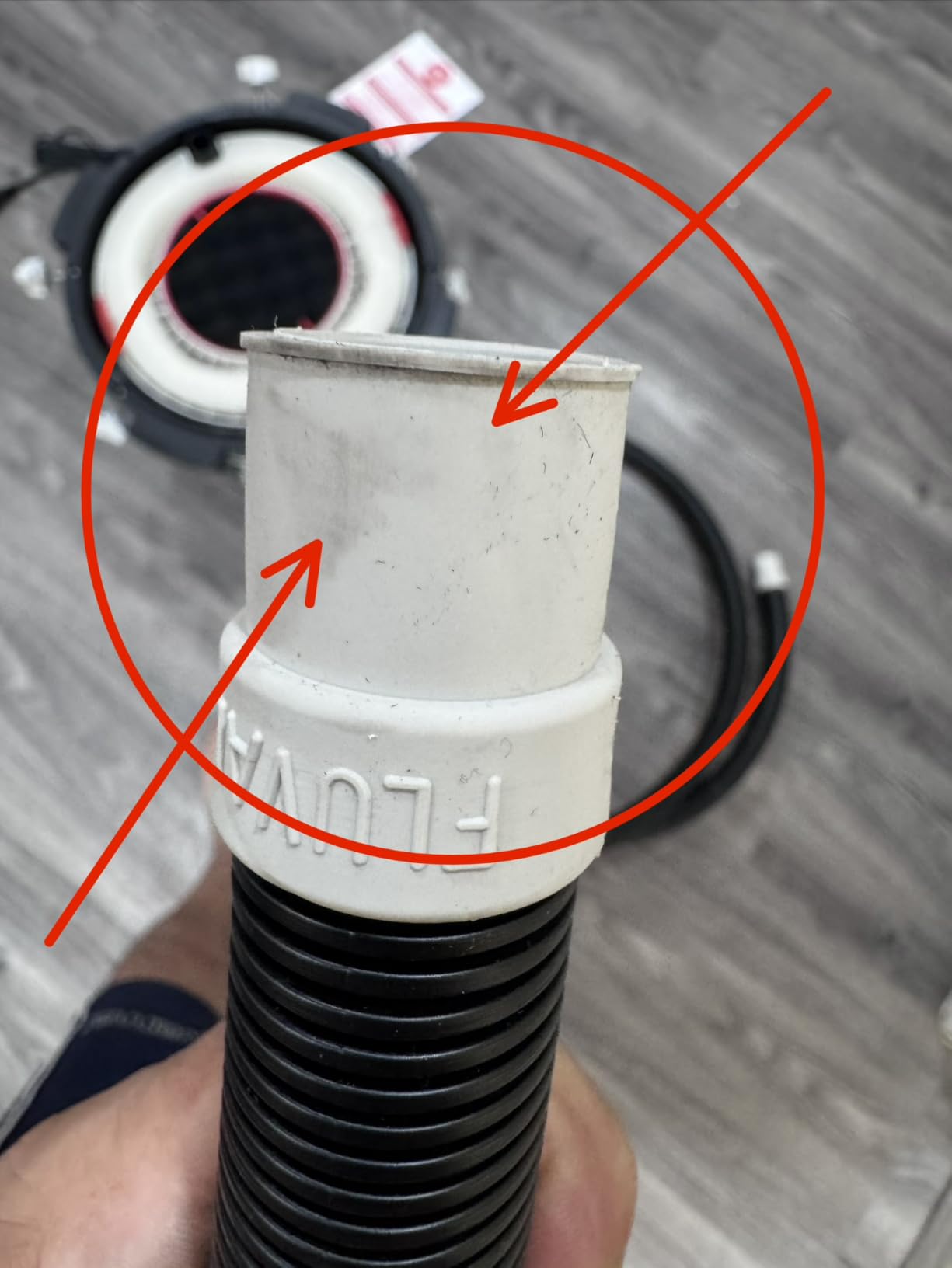
Where the FX4 sits against the FX6 on a 125
The gap between these two is roughly 170 GPH of real-world flow and half a gallon of media volume. On a 125-gallon community or planted tank that gap rarely matters, and the smaller footprint and lower weight are real advantages in a shallow stand. Where it does matter is a heavy bioload, where the extra flow and the larger media stack of the FX6 give you headroom you would not have otherwise.
A common forum argument is that two FX4-class canisters beat one FX6, both for redundancy and for the fact that two smaller housings hold more total media. That argument has merit. It also doubles the plumbing under the stand and doubles the failure surface, so we would only build that way if the cabinet has the room and you are comfortable servicing two units.
What to check before you buy the FX4
Check the cabinet and the lid clearance, because the clips on this one are stiff and reviewers regularly complain about them feeling like ordinary plastic. The bio media basket also sits low and cannot be filled completely, so plan your media quantities accordingly rather than assuming a full liter of bio media.
Budget for two small setup problems. The tubing is stiff enough that routing it under a tight stand takes patience, and the input connection can leak on first assembly if it is not fully seated. Owners also report a small number of motors that stopped running within about a year, and frustration when the extended warranty was requested, so keep your purchase record somewhere you will find it if that happens.
3. Penn-Plax Cascade 1200: Best Budget Second Filter
Penn-Plax Cascade 1200 Canister Filter, 315 GPH for Tanks Up to 150 Gallons
Rated 315 GPH
Four stackable baskets
20.5 in tall
11.5 by 11 in base
Pros
- Four handled stackable baskets
- 360 degree rotating valve taps
- Push button primer starts quickly
- Works for freshwater saltwater and turtle tanks
Cons
- Hoses are stiff and on the short side
- Narrow base can tip during servicing
- Included floss pads wear out fast at high bioload
With more than ten thousand reviews behind it, the Cascade 1200 is the most battle-tested canister on this list, and that consistency is the reason it holds up as a long-term purchase. The 315 GPH rating works out to roughly 236 GPH real-world, or about 1.9x turnover on a 125-gallon tank. On its own that is not enough, which is exactly why we recommend it as a second filter or as one half of a pair.
Run two of these on a 125 and you get roughly 3.8x combined real-world turnover, with 2,300 gallons of combined nominal flow and eight media baskets. That is the redundancy configuration forum readers recommend most often on Fish Lore and AquariumAdvice, and it is why the Cascade shows up so often in conversations about this tank size. If your budget is the deciding factor, a pair of these is a legitimate answer that many experienced keepers would defend.
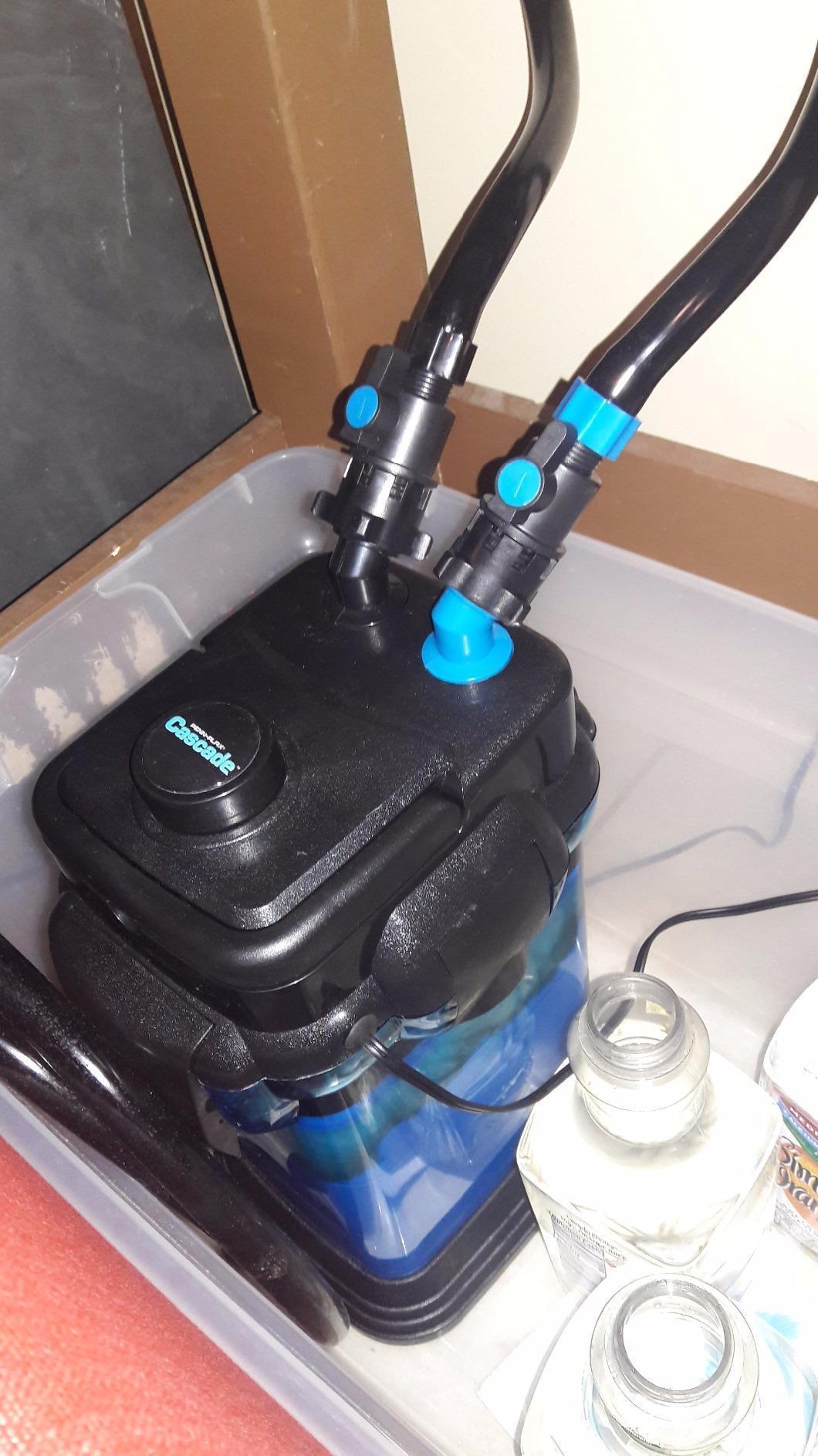
The hardware is unusually good for the money. Four large stackable baskets with built-in handles is a media capacity you struggle to match at this level, and the dual 360-degree rotating valve taps solve the single most annoying installation problem on a narrow stand: pointing the flow where you actually want it. The push-button primer starts it cleanly, and the kit includes floss pads, a coarse bio-sponge, a carbon bag, a spray bar, hose clamps, alignment clamps, and a tip-proof base.
It is also the most versatile filter here on habitat. The manufacturer lists freshwater, saltwater, and turtle use, which matters more than it sounds if your bioload is a turtle or a messy fish. A turtle keeper on r/turtle who over-sizes filtration on purpose is following the same logic, because those animals produce far more waste than the tank volume suggests.
When the Cascade 1200 is the right call on a 125
It is right when you want two filters instead of one, when your stand has two usable corners, or when you want a second filter you can switch to while the main one is being cleaned. The 360-degree valve taps make it far easier to install in a tight cabinet than most competing canisters, and the 20.5 inch height is standard rather than oversized.
It is also right as a heavily stocked 125 companion filter, because the baskets let you load coarse sponge and ceramic media without worrying about fine pads clogging in a few weeks. Reviewers note that the included floss pads wear out quickly under a heavy bioload, so plan to add your own mechanical media rather than treating the supplied pads as a long-term solution.
What to check before you buy the Cascade 1200
Measure your hose run twice. Reviewers repeatedly mention that the supplied hoses are stiff and not especially long, and extending them is normal on a 48-inch tank where the stand sits at one end. Also check the base footprint, because 11.5 by 11 inches with a narrow base means the unit is easy to tip while you are pulling trays, so pull baskets out slowly and with a hand on the housing.
Know the primer. It is reliable, but it collects detritus over time and a clogged primer button is a common reason people think a canister will not prime. Clean it during your routine service and the problem does not arise. A small number of reviews report motor failure after extended use, and with a unit this old, that is worth weighing against the fact that replacement parts and media are easy to find.
4. Aqueon QuietFlow: Best for Low-Effort Upkeep
Aqueon QuietFlow Canister Aquarium Filter 100-150 Gallons
Rated for tanks up to 150 gallons
8.5 by 8.5 by 20.5 in
19.45 lb dry
Three stage
Pros
- Detachable polishing stage above the tank
- Three return options including spray bar
- Quick disconnect valves
- Quiet enough for a bedroom
Cons
- Monthly consumable cartridge cost
- Large 20.5 inch body
- Replacement media is brand specific
The QuietFlow makes a different trade than everything else here: it puts the part of the filter you touch most above the tank. The included hang-on-back polishing unit detaches and mounts on the tank rim, so the monthly cartridge change happens at eye level instead of on a floor under a stand. On a 125-gallon tank with a 20.5 inch body, that difference in ergonomics is bigger than it sounds.
It is rated for aquariums up to 150 gallons, which makes it a legitimate fit for this tank size on paper. Note that the manufacturer does not publish a US gallon-per-hour figure in the product listing we worked from, so we are not going to invent one and we are not going to compute a turnover figure we cannot support. What the specification set does confirm is a three-stage biological, chemical, and mechanical layout with quick disconnect valves, pump locking heads, and three return options: spray bar, water director, and the polishing unit.
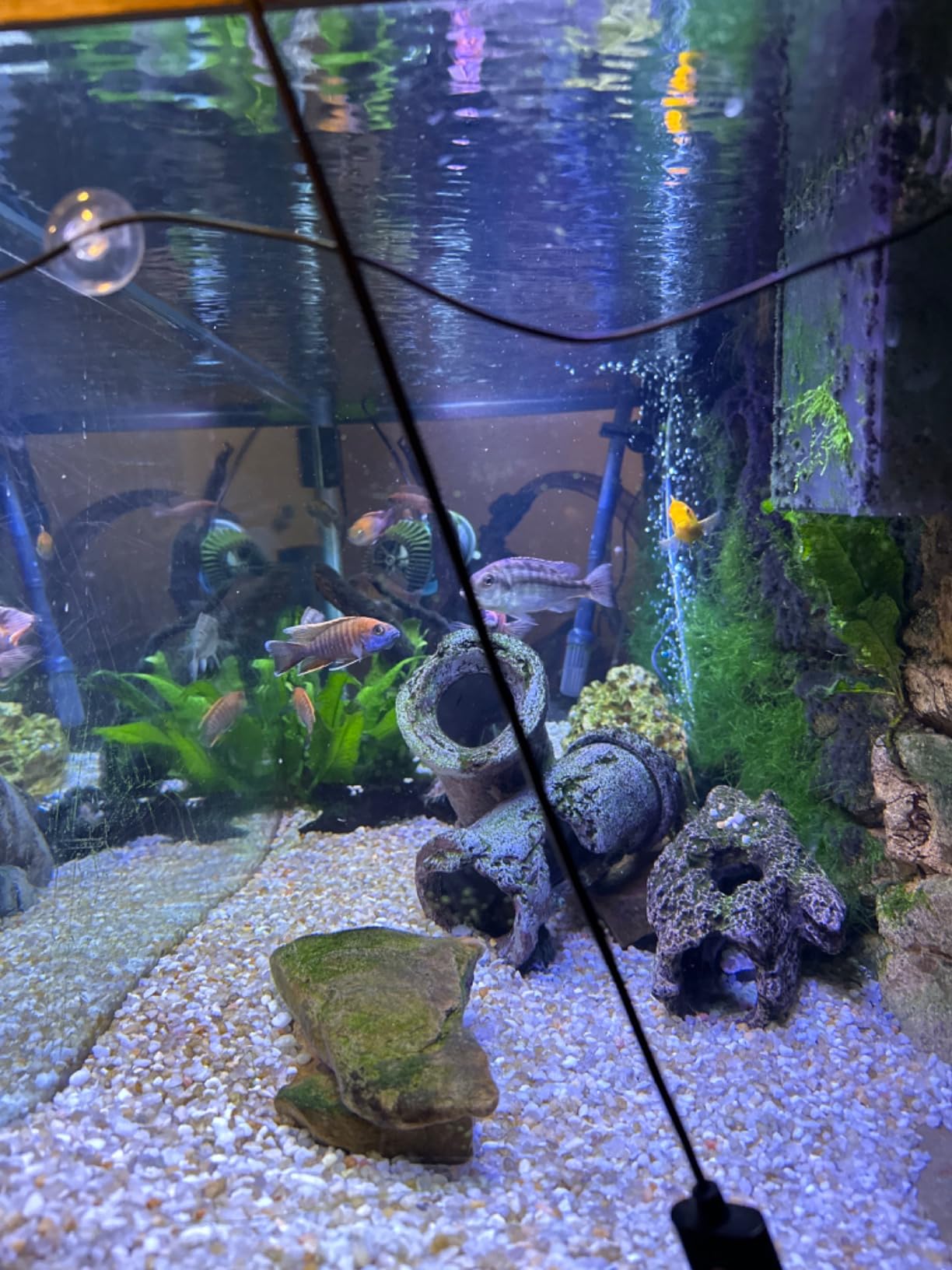
What convinced us is the maintenance math, not the flow. A canister you service every eight to twelve weeks on a floor is a different chore from a polishing cartridge you swap in a minute at the rim. If your 125-gallon tank is a lightly populated freshwater setup and you want the lowest-friction ownership experience on this list, the QuietFlow is the one to look at first.
The included media set is generous for a factory package: activated carbon, coarse foam, bio-balls, bio-ceramic rings, and a cartridge in the polishing unit. Owners credit the quiet running and the choice of return fittings, with several noting it is quiet enough for a bedroom setup. For a planted tank, running the spray bar instead of the water director gives you a broader, less directed current that is easier on substrate.
Where the QuietFlow fits in a two-filter setup
Because the manufacturer does not publish a flow figure for this model, we will not claim where it lands in a turnover calculation. What we can say is structural: its three-stage layout and its polishing stage make it a natural partner to a second canister rather than a replacement for one. A pairing of this with a Cascade 1200 or a Fluval FX4-style unit gives you redundancy, a clear cleaning rotation, and a filter that stays accessible for routine swaps.
That matters more on a 125 than on a smaller tank because the volume of water involved makes a mid-service failure a real event rather than an inconvenience. Experienced keepers on r/Aquariums who plan a 125 around a large canister plus additional sponge filters are solving the same problem in a different way, by accepting redundancy in exchange for accepting less polish convenience.
What to check before you buy the QuietFlow
Measure the cabinet and know the running cost. The 8.5 by 8.5 by 20.5 inch body is tall and needs real clearance, and at 19.45 pounds dry it is one of the heavier units here for how compact the footprint looks. The polishing cartridge is a monthly consumable and the replacement media is brand specific, so that cost is recurring and not optional.
Look closely at the plastic fittings. Reviews report quick-disconnect fittings and clips that crack or leak after extended use, and a few buyers report weaker suction than expected after a few months. Neither is universal, but both are the kind of hardware complaint that gets annoying rather than dangerous, and it is worth keeping an eye on the connections during your first few weeks of use.
5. Marineland Magniflow 400: The Quiet Heavy-Bioload Builder
Marineland Magniflow 400 GPH Canister Aquarium Filter
Rated 400 GPH
11 by 11 by 18 in
19.27 lb dry
Stack N Flo trays
Pros
- Very quiet for a 400 GPH pump
- Strong media bundle included
- Stackable trays per media layer
- Quick prime button
Cons
- Weak included plastic hose clamps
- Lid gasket often missing from the box
- Short in-tank intake pipe for deeper tanks
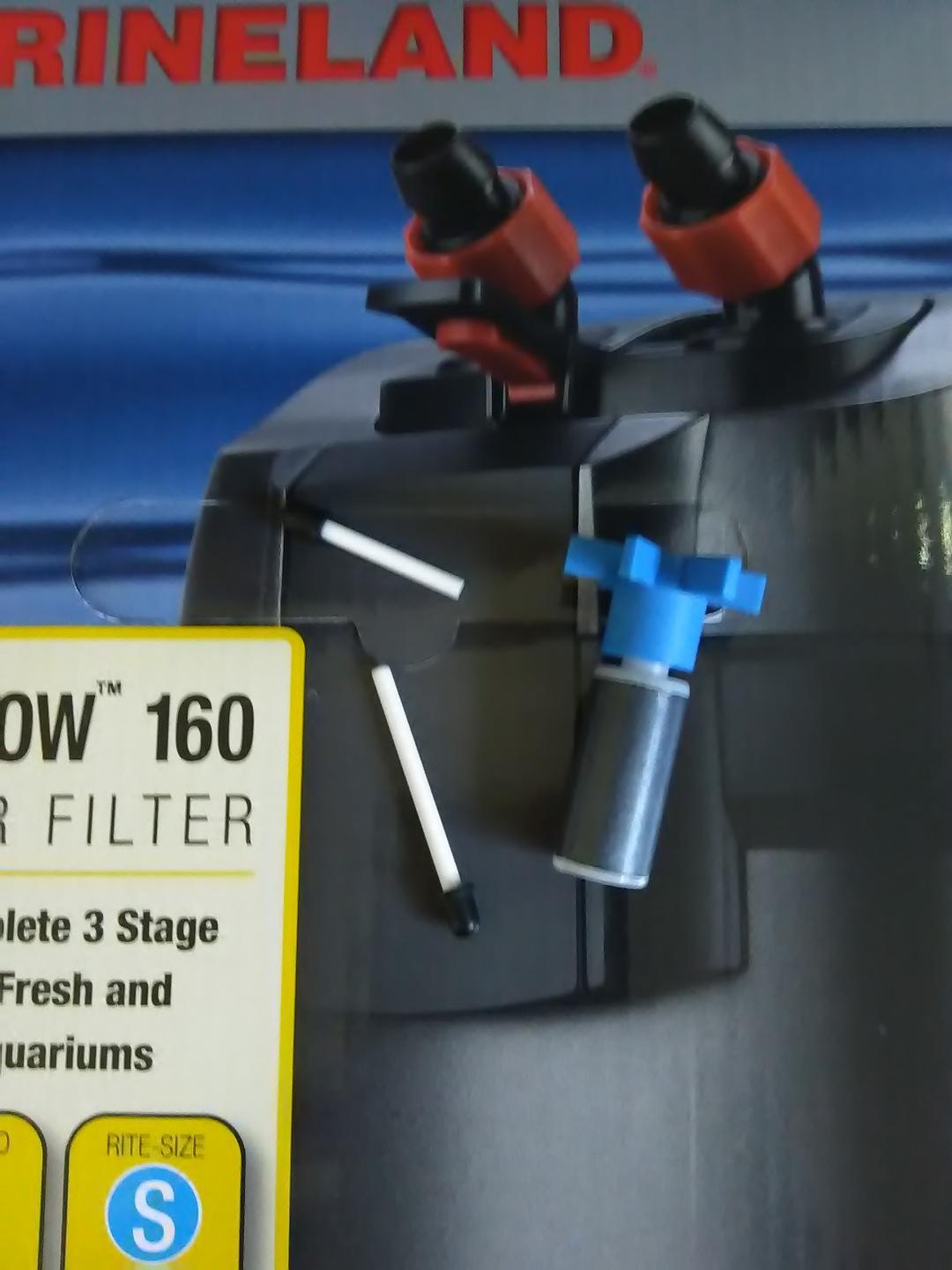
The Magniflow 400 moves a genuine 400 GPH, which is roughly 300 GPH real-world and about 2.4x turnover on a 125-gallon tank by itself. Run as a pair, you are at nearly 5x combined, and that pairing is the way we would use this filter on this tank size. It is built for a heavy bioload, and the marine-capable design plus the included media set make it a common choice for turtle setups.
What we like most is the tray design. The Stack N Flo trays force water through each media layer in sequence, and each medium has its own shelf, so you can load a coarse mechanical layer, carbon, and a bio layer without worrying about everything mixing into one undifferentiated block. That separation is exactly what you want when the tank runs a heavy fish load and the mechanical layer needs frequent replacement.
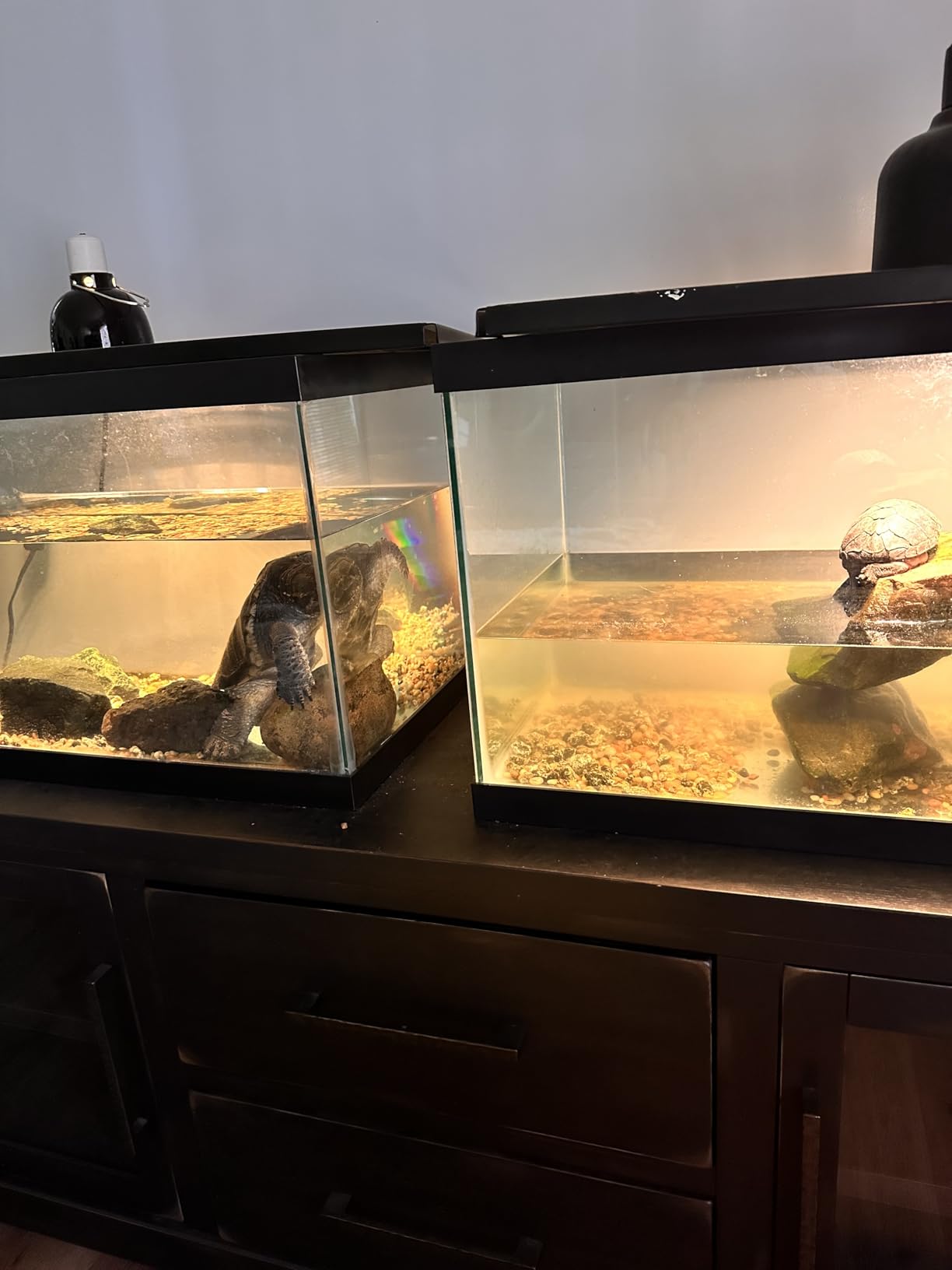
The included media is unusually complete for the price: filter foam, premium activated carbon bags, bio-filter balls, ceramic filter rings, and polishing pads. Owners also note that replacement media is widely available and that the unit runs very quietly relative to its flow, clearing cloudy water in about a day when a tank gets messy. The quick prime button fills the chamber for a simple startup, and the lid seal lifts up for media access.
For a turtle or heavily populated 125, the pairing logic is strong. A turtle produces far more waste than its tank volume suggests, and keepers on r/turtle routinely run filtration well above the stated tank size for that reason. Two Magniflows handle both volume and media demand without the single point of failure that one oversized canister leaves you with.
When the Magniflow earns its place on a 125
It earns its place when the bioload is the constraint rather than the tank size. Goldfish, cichlids, and turtles all push a filter harder than the water volume suggests, and the 400 GPH pump plus a generous media bundle handles that better than the smaller units on this list. It is also one of the quieter large-capacity options, which matters in a living room.
As a single filter on a lightly populated 125, it is under-specced, and we would not pretend otherwise. As one half of a pair, or as the main filter on a turtle or messy-fish setup, it is a strong and quiet performer. Its compatibility with Marineland Rite-Size T media also means the consumables are easy to source, which is a real advantage over proprietary systems.
What to check before you buy the Magniflow 400
Replace the hose clamps before first use. This is the single most consistent complaint in the reviews, and the included plastic clamps are a common source of leaks; metal clamps solve it immediately. Check for the lid gasket in the box as well, because it is often missing and the instructions do not mention fitting it, which is how first runs end with water spraying out of the housing.
Plan the intake depth. The in-tank intake pipe is short, and on a 48-inch tank it may not reach the far corner properly, so a top-heavy tank can leave a low-flow pocket. The tubing is also rigid, which makes the outflow hard to position. None of this is a deal-breaker, but all of it is a twenty-minute job you should do before the tank is full.
6. SunSun HW-303B Pro: Best Canister With a UV Sterilizer
SunSun Hw303B 370GPH Pro Canister Filter Kit with 9-watt UV Sterilizer
Rated 370 GPH
10.5 by 10.5 by 16 in canister
16 lb
UV kit included
Pros
- Bundled 9 watt UV sterilizer
- 370 GPH flow for the money
- Full media load included
- Three baskets for layered filtration
Cons
- UV lamp and ballast need periodic replacement
- Occasional small leaks at intake fittings
- Minimal instructions
This is the only canister on the list that ships with a UV sterilizer in the box, and at 9 watts it is a meaningful dose for a 125-gallon tank rather than a token addition. Reviewers single out the UV as the reason to pick this kit, noting that it measurably reduces green water and algae at a cost well below buying a UV unit and a plain canister separately.
The flow rating of 370 GPH works out to roughly 277 GPH real-world, or about 2.2x turnover on 125 gallons alone. That is a second-filter number, not a main-filter number, which is fine because this kit is most attractive in a pairing. Two of these give a UV stage and roughly 4.4x combined turnover, which is a configuration that is hard to get anywhere else at this level.
The media load is what most people underestimate. The kit includes 1 lb of premium filter carbon, 1 lb of ceramic rings, a set of bio balls, 3 white filter pads, 1 blue coarse pad, and 3 media baskets. That is enough media to fill the stack properly on day one, which removes the single most annoying part of buying a canister, which is buying media separately for two weeks while the tank cycles.
Three baskets give you a proper mechanical, chemical, and biological split, and the canister body itself is a compact 10.5 by 10.5 by 16 inches, which fits more stands than the taller units here. If algae pressure is your main complaint on a 125, this is the kit that addresses it directly rather than relying on carbon alone.
When a UV sterilizer is worth having on a 125
It is worth it when algae is the specific problem you are fighting, or when you keep a tank where waste load is high enough to keep the water cloudy between cleanings. A UV stage reduces free-floating algae and the organisms in the water column, but it does not replace mechanical filtration or a sensible water change schedule, so it works best as an addition to good media rather than a substitute for it.
It is less worth it on a low-tech planted 125 that is already stable, where the running cost is a lamp and a ballast to replace on a cycle. On a turtle or messy-fish setup it is genuinely useful, because it addresses what the suspended organic load is doing to the water between changes. Know that the lamp and ballast are consumables and that replacement parts for off-brand units take more effort to source than they do for Fluval or Eheim.
What to check before you buy the SunSun kit
Budget for the consumables and the instructions. The UV lamp and ballast need periodic replacement, and the instruction sheet is minimal, so expect to spend extra time on the first setup and on getting the priming right. Some buyers report small leaks at the intake fittings that needed tightening, so check every connection wet before you leave it running.
Check the hose length against your stand. Buyers note the hose length and diameter are limited for larger setups, and on a 48-inch tank that can mean extending them. Also confirm the UV lamp is actually seated and running before you add livestock, because a UV stage that is powered but not illuminated looks fine from the outside.
7. Eheim Classic 2215: Best for Quiet Operation
EHEIM Classic Canister Filter 2215, Classic 350 – PetOverstock
14.57 in tall
6.07 lb dry
11 by 7.28 in base
Bottom inlet top outlet
Pros
- Effectively silent pump
- Media volume is high for its size
- Shutoff valves on both lines simplify cleaning
- Durable European build
Cons
- No priming button so first start needs siphoning
- Loose media in this model rather than baskets
- Poorly written instructions
- Short stiff hose
If the only thing you care about is how much noise comes out of your living room, this is the filter to look at. Owners of the Classic line describe the pump as essentially silent, with several noting it becomes quieter as it ages, and the 6.07 pound dry weight makes it by far the lightest canister here. On a 125-gallon tank in a shared space, that combination is worth more than raw flow.
The design choice that matters most is the bottom inlet and top outlet layout. Water enters at the base and leaves at the top, so it has to travel through the full media stack without a bypass path, and both the inlet and outlet carry their own shutoff valves. That means you can clean the filter without draining the hoses and without re-priming, which is the workflow advantage that the Fluval self-priming systems match in a different way.
Media volume relative to body size is another strength people notice. The permo-elastic silicone sealing ring fixed on the pump head makes closing the filter after a service straightforward and safe, and the kit arrives complete with Eheim Mech and Substrat Pro media, spray bar, inlet pipe, hose, valves, and installation accessories. Durability is the other theme in the reviews, with owners describing units that have run for years.
On a 125-gallon tank, treat this as a second filter or as part of a pair rather than a single answer. The 2215 is one of the smaller Classic bodies at 14.57 inches tall, and owners of the smaller models note that the narrower diameter needs cleaning more often than the larger Classic units. A pair of these gives you two quiet housings, twin shutoff valves, and a cleaning rotation that never leaves the tank unfiltered.
Where the Eheim fits in a two-filter setup
It fits best where quiet is the primary constraint and redundancy is the goal. Pairing two Eheim Classics on a 125 is the setup a Fish Lore advice thread recommended, and the logic holds up: two housings mean one can be serviced while the other runs, the media stacks stay generous for the body size, and the valve layout makes water changes straightforward.
Against a Fluval, the comparison is straightforward. Fluval wins on media basket customizability, the self-priming Smart Pump, and a large parts and media ecosystem that makes repairs easy. Eheim wins on quiet operation, mechanical build quality, and a cleaner look under a cabinet. The 2215 in particular is the quieter and lighter option, and it is also the one without a priming button, which is the trade you make.
What to check before you buy the Eheim Classic 2215
Read up on the setup order before you start. The instruction sheet is criticized repeatedly, and combined with the lack of a priming button many buyers resort to manual siphoning on first setup. That is a ten-minute job, but it is a surprise if you were expecting a push button, so know it in advance.
Plan around loose media. In this smaller Classic model the media sits loose rather than in removable baskets, so reaching the pads means pouring media out and putting it back in the right order. Also expect to cut and extend the supplied hose, which is short, and note that the green tubing is stiff and the bottom inlet stub can snap off if you force it. The motor is 120V only, which matters if you are outside North America.
8. Marineland Magnum 290: Best Polishing Companion Filter
Marineland Magnum 290 GPH Polishing Canister Aquarium Filter
Rated 290 GPH
7.5 by 3.5 by 9.88 in
2.91 lb dry
Submerged motor
Pros
- No priming needed
- very small and light body
- Two refillable chambers accept any media
- Micron cartridge gives a polished finish
Cons
- Small media volume limits biology
- Monthly micron cartridge cost
- No flow control valve on the intake
The Magnum is a different category of device from everything else here, and pretending otherwise would be a mistake. It is an internal canister with a submerged motor, weighing 2.91 pounds and measuring 7.5 by 3.5 by 9.88 inches. At 290 GPH it delivers roughly 217 GPH real-world, about 1.7x turnover on a 125-gallon tank, which makes it a companion unit rather than a primary filter.
What it does well is polish. The two refillable chambers accept carbon or any custom media, and the included high-efficiency micron cartridge gives a visibly clearer finish. Buyers position it as an affordable second stage to sit behind a larger main filter, and on a 125-gallon tank that is genuinely useful once your biological filtration is already handled by something with real media volume.
There is one feature no other canister on this list has. The submerged motor means there is no priming step at all: fill it and plug it in, and it runs. That removes the single most common canister complaint in forum threads, the filter that will not prime, entirely from the equation. If you are building a redundancy plan and want a second filter that literally cannot fail to start, this is it.
Continuous three-stage filtration runs the whole time, so it also works as a light stand-alone filter for a smaller setup. For a 125-gallon tank with a heavy bioload, though, the small chamber volume is the limiting factor, and reviewers are clear that it is better suited to polishing or secondary service than to carrying the tank alone.
When the Magnum makes sense on a 125
It makes sense in two situations. The first is the polishing companion: a main canister handles biology and mechanics, and the Magnum adds carbon or a micron cartridge for a clearer finish at low cost and near-zero weight. The second is redundancy, where you want a second filter that starts instantly and can be dropped into service the moment your main unit goes down for cleaning.
It does not make sense as the only filter on a heavily populated 125-gallon tank. Small media volume limits the biological capacity, the micron cartridge is a recurring consumable, and there is no flow control valve on the intake, so you cannot dial the current back if the tank is sensitive. A self-contained reading of its rating is also that the manufacturer positions it for aquariums up to 97 gallons, which is a clear signal about its intended role.
What to check before you buy the Magnum
Check that you have a use for it before you buy it. Because the plumbing is single-stage with no flow control on the intake, it is a fixed-output device and you cannot regulate it the way you can a canister with valve taps. If your plan is polishing or backup, that does not matter at all.
Account for the consumable and the media volume. The micron cartridge is a regular replacement and not optional if you want the polishing effect. The two chambers are small, so if you intend to put bio-media in here, plan carefully, because a heavy bioload will outrun what two small chambers can hold. Everything else about this unit is simple by design.
How Many GPH Do You Need for a 125-Gallon Tank?
Here is the arithmetic in one place, because this is the question most searchers bring and the one most roundups handle badly. Divide real-world flow by tank volume and you get turnover per hour. A 125-gallon tank wants 4x turnover for a clean community setup, 5x for a typical freshwater tank with moderate fish load, and 6x when the bioload is heavy, such as goldfish, cichlids, or turtles. Multiply back out: 4x means 500 GPH of real-world flow, 5x means 625 GPH, and 6x means 750 GPH of delivered water.
Because real-world flow sits about 25 percent below the rated number, you divide your target by 0.75 to find the rating you need. That turns 500 to 750 GPH of real-world flow into a rated capacity of roughly 667 to 1,000 GPH. Buyers who want headroom for a heavily populated tank or for heavy media will land nearer 1,200 to 1,600 GPH rated, which is why premium canisters marketed at 150 to 250 gallons can be appropriate on a 125.
That is the whole sizing conversation, and it is short. The complexity everyone else adds comes from three variables: rated flow versus circulation flow, head height, and media resistance. We covered canisters at other tank sizes in our 75-gallon canister guide, and the same three variables apply there at a smaller scale.
Rated GPH versus circulation GPH
Some manufacturers print a single pump number, and others print a second, lower circulation figure measured with media installed. The second number is the one closer to what you will see. Comparing a pump rating to a circulation rating is the most common way readers end up with a filter that is either too weak or absurdly overpowered, and it is worth checking which figure a listing is quoting before you compare two products.
We use the rated pump figure throughout this article and then apply a flat 0.75 factor, which is the same conservative haircut applied consistently so the numbers are comparable. Where a manufacturer does not publish a flow figure at all, as with the Aqueon QuietFlow, we say so rather than estimating.
Head height and media resistance
Head height is the vertical distance the pump has to push water upward from the submerged intake to your tank rim. Every canister sits on a floor and every tank is above it, so this cost is unavoidable, and it grows with the cabinet height. Routing hoses to keep upward bends to a minimum is the single cheapest flow improvement available, which is why the stiff tubing on several models here is a practical issue and not just an annoyance.
Media resistance is the other half. Coarse sponge and floss in the first basket cost little. A deep stack of fine pads, carbon, and Purigen in the last basket can cut flow sharply, and a clogged mechanical layer does it faster. This is why our quick-overview list gives real-world figures instead of box figures, and why we rate media capacity so heavily for a 125-gallon tank. If you want to see the same math at the neighbouring sizes, our 100-gallon canister roundup works through the same conversions.
Canister vs HOB vs Sponge for a 125-Gallon Tank
Let us make the honest counterargument first, because it is the strongest argument against everything above. For a lightly populated 125-gallon freshwater tank, a pair of hang-on-back filters can be cheaper to buy, quieter to run, and cheaper to own over five years than a single premium canister. One experienced keeper quoted on r/Aquariums described running 125-gallons all three ways and settling on multiple mid-size canisters as the best balance, and a long-standing forum recommendation is a pair of AquaClear 110s or a pair of Tidal 110s precisely because the media is cheap and the units are long-lived.
Sponge filters are the third option and they are genuinely good value on a 125, provided your livestock can tolerate the current. A pair of large sponges driven by a good air pump costs very little, holds a large volume of coarse sponge for biology, and is trivially reliable. What you give up is the ability to run fine mechanical media and carbon, and the ability to dial the flow back. Our hang-on-back filter guide covers that category in more detail if you want the comparison from the other side.
When the forum consensus points to two filters
The most repeated recommendation across Fish Lore, Reddit r/Aquariums, AquariumAdvice, and MonsterFishKeepers for this tank size is redundancy. The reasoning is straightforward: on 125 gallons a mid-service failure or a power outage has consequences, and two filters halve the impact. A canister plus a hang-on-back, or two moderate canisters, both satisfy that, and several of the picks on our list, including the Cascade 1200, the Eheim Classic, and the Magnum, are built to be run exactly that way.
Redundancy is also what resolves the FX6 versus two smaller canisters argument. The FX6 wins on total flow, media volume, and a single point of plumbing. Two moderate canisters win on resilience, on combined media volume, and on the fact that a partly clogged basket in one does not halve your filtration. If you are deciding based on how you want to live with the tank for ten years, the second argument is the stronger one, and our ranking reflects that by giving the best second filters a badge too.
When a canister is not worth it
It is not worth it when your tank is lightly populated, your livestock is sensitive to current, and a good pair of hang-on-back filters is already running. It is not worth it when the tank is heavily planted and a strong current will simply uproot the aquascape, unless you can run a directed outlet low in the tank. And it is not worth it if you have no clear plan for where it goes, because clearance and hose routing are the two problems people hit immediately and cannot engineer around.
It is worth it when the bioload is heavy, when media volume is the limiting factor, when noise matters and you want the pump outside the room, and when you want the ability to run carbon or fine mechanical media without constantly swapping cheap cartridge media. On a 125-gallon tank those conditions are common enough that we consider a canister the default recommendation and everything else a considered exception.
Will It Fit Under Your Stand? Clearance and Hose Routing
Physical dimensions are the least glamorous and most returned-on specification in this category, and almost nobody publishes them well. Here are the measured figures for all eight filters, taken from the product data rather than the marketing copy. The pattern is that premium units are big and heavy, budget units are narrow and tall, and the height number is the one that decides whether the filter goes in the cabinet at all.
Fluval FX6 measures 15.1 by 15.6 by 20.7 inches and weighs 19.9 pounds dry. Fluval FX4 measures 15.6 by 15.6 by 17.7 inches at 14.17 pounds. The Aqueon QuietFlow is 8.5 by 8.5 by 20.5 inches at 19.45 pounds, so it has a small footprint but a tall body and a surprisingly heavy lift. The Marineland Magniflow 400 is 11 by 11 by 18 inches at 19.27 pounds, while the Marineland Magnum is 7.5 by 3.5 by 9.88 inches at only 2.91 pounds.
The Penn-Plax Cascade 1200 is 11.5 by 11 inches at the base and 20.5 inches tall. The SunSun canister body inside the HW-303B Pro kit is 10.5 by 10.5 by 16 inches at 16 pounds, with the full package measuring 12 by 12 by 20 inches. The Eheim Classic 2215 is the most compact at 11 by 7.28 by 14.57 inches and 6.07 pounds dry. If you are planning a stand build, our aquarium stand guide covers the clearance questions from the furniture side.
Two 125-gallon tank shapes, two different hose problems
A 125-gallon tank usually arrives in one of two footprints, and the difference changes your install. The 48 by 18 by 21 inch standard long is shallow and wide, so your stand is wide, the canister sits further from the tank’s centre of mass, and the return spray bar reaches the whole front pane in a single sweep. The 48 by 24 by 24 inch version is deeper and taller, which means more vertical lift loss on the intake side and a return that needs careful aiming to avoid a strong current down the length of the tank.
On the wider tank you can usually run the intake and return in opposite corners and get even circulation. On the deeper tank, place the intake low in the far corner and the return spray bar near the surface on the opposite end, then use the valve taps to dial the intake down if the surface agitation is too strong. Before you drill anything, run the hoses with the power off and make sure the canister lid can be removed and lifted out with the trays still in the frame.
Cleaning Your Canister Without Crashing the Cycle
A canister service on a 125-gallon tank is a two-hour job, and doing it badly can cost you the cycle you spent weeks building. The rule that keeps everyone stable is simple: never clean the filter and change large volumes of water on the same day. The forum advice on this is unusually consistent, because the people who learned it the hard way tend to be the loudest about it.
Start by unplugging the power, then close the inlet and outlet valves if the filter has them. The Eheim Classic and the Fluval models both have shutoff valves that let you isolate the hoses, which means you never have to drain a foot of hose to reach the housing. Remove the lid, lift each basket out one at a time, and keep the order. Media order is the whole trick: mechanical first at the top, chemical in the middle, biological at the bottom, in that order.
Rinse mechanical media in water you have already drawn from the tank, not under the tap. Tap water kills the bacteria you are trying to preserve, and this is the single most common way people crash a cycle while doing exactly what they were told to do. Squeeze sponge gently and stop when the water runs roughly clear. Bio-media should never be rinsed at all, only moved, and the same bucket of tank water should do the whole job.
Replacement cadence by media type
Mechanical pads and floss change on condition rather than on a clock, which on a heavily populated 125 could be every three to four weeks. Replace carbon every four to six weeks, and more often if you run one. Rinse or replace coarse sponge, ceramic rings, and bio-balls in rotation rather than all at once, so you always leave a large biological surface area in the housing.
On a two-filter setup, service one unit and let the other run for two weeks before touching it. That staggered schedule is the practical reason redundancy pays for itself, and it is why a pair of mid-size canisters can outperform one large one over a decade even when the total flow numbers look similar.
Frequently Asked Questions
How many GPH do I need for a 125-gallon tank?
Aim for 750 to 1,250 GPH of total delivered flow, which is 4 to 6 times turnover per hour. Since real-world flow runs roughly 25 percent below the rated GPH once media and head height are factored in, choose a canister rated around 1,000 to 1,600 GPH. A filter rated 925 GPH, such as the Fluval FX6, lands near 694 GPH in real use.
Is a Fluval FX6 overkill for a 125-gallon tank?
On a lightly populated community tank, yes, the FX6 is more flow than you need. Its 925 GPH rating drops to roughly 694 GPH after the real-world haircut, about 5.6 times turnover, and that current can stress slow fish or uproot a planted aquascape. On a heavy bioload such as goldfish, cichlids, or turtles, the headroom is exactly why we recommend it.
Why won’t my canister filter prime?
An air lock is the usual cause. Close the valves, fill the canister body and hoses with water from a bucket, restore power briefly to loosen the impeller, then rock the canister gently to displace trapped air and check for upward hose bends that collect air. A clogged priming button and a body that gurgles continuously are the two other common causes. Note that the Marineland Magnum has no priming step at all.
Is Fluval or Eheim better?
Fluval is generally better for hobbyists who want customizable removable media baskets, a self-priming Smart Pump, and a large parts and media ecosystem that makes repairs easy. Eheim is generally better for quiet operation and mechanical durability. The Eheim Classic 2215 is the quieter, lighter choice, while the Fluval 407 and FX6 are the stronger media-platform picks.
Are Penn-Plax canister filters good?
Yes. The Cascade 1200 has more than ten thousand reviews behind it, four handled stackable media baskets, and 360-degree rotating valve taps that solve tight-cabinet installation better than most competitors. The caveats are stiff hoses that may need extending, a narrow base that can tip during service, and included floss pads that wear out quickly under a heavy bioload. At 315 GPH it belongs in a pair on a 125-gallon tank.
Do I need a canister, or are two hang-on-back filters enough?
For a lightly populated 125-gallon freshwater tank, two good hang-on-back filters can be cheaper, quieter, and cheaper to own over five years than a premium canister, and a pair of large sponges on an air pump is a solid low-cost option. A canister earns its place once the bioload is heavy, when fine media and carbon matter, or when you need the pump outside the room. Many experienced keepers run a canister plus a second filter for redundancy.
The Bottom Line for 125 Gallon Tanks in 2026
For most people reading this, the Fluval FX6 is the right single-filter answer. It is the only canister here that clears 5x real-world turnover on a 125-gallon tank on its own, it holds more usable media than anything else on the list, and its self-priming behaviour and purge valve make ownership straightforward. If your tank is planted and lightly populated, drop to the Fluval FX4 and dial the flow back with the valve taps.
If the bioload is heavy, build a pair instead of a single unit. A Magniflow 400 or a SunSun HW-303B Pro handles volume and a Cascade 1200 or an Eheim Classic gives you the second housing, the valve control, and the cleaning rotation. A Fluval FX4 paired with a Cascade 1200 covers a 125 comfortably and keeps a spare media profile on hand. Skip the canister entirely if your tank is lightly populated and a good pair of hang-on-back filters is already running quietly.
Whatever you choose, measure the cabinet and the hose route before the box arrives. Clearance is the one problem you cannot engineer around after the tank is full, and it is the one that sends filters back. Our best canister filters for 125 gallon tanks shortlist reflects that, so take the free sizing step first and the purchase second.