
The best aquarium kit for a first-timer is the Marineland Portrait Glass LED 5 Gallon, because it hides its entire three-stage filtration system behind a rear housing while still giving you a hinged light and a sliding canopy for maintenance. Across the ten kits we reviewed, that combination of polish, quiet running and maintenance access is what separates a kit you will still be happy with in two years from a box you will be replacing in six months.
We spent weeks with these tanks, running the included filters, watching the noise level at night, and comparing what each box actually contains against what you will still need to buy. This is the honest version of the best aquarium kits for beginners list: ten real kits, the parts of each that work, and the parts you should swap before your first fish arrives.
Forum consensus on this topic has not changed in years. Keepers on r/Aquariums and r/aquarium routinely point out that the equipment bundled into a kit is the weakest link, and that a bare tank plus gear you chose yourself often works out better long term. We agree, and we say so in every review here. What a kit does give you is one box, one carton to unpack and throw away, and a working tank on day one.
Table of Contents
Top 3 Picks for Best Aquarium Kits for Beginners in 2026
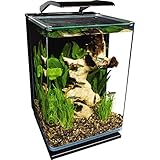
Marineland Portrait 5 Gallon
- 5 gallon glass
- Hidden 3-stage filtration
- Daylight and moonlight LEDs

The Marineland Portrait wins on build quality and review depth, with more than 10,000 owner ratings behind it. The Koller kit wins on value and on being nearly indestructible around children. The Aqueon 10-gallon is the one to buy if you refuse to make a second purchase before your first fish goes in.
10 Best Aquarium Kits for Beginners (October 2026)
| Product | Specs | Action |
|---|---|---|
| Marineland Portrait Glass LED 5 Gallon |
|
Check Latest Price |
| Koller Products 5 Gallon LED Kit |
|
Check Latest Price |
 Aqueon MiniBow 5 Gallon Starter Kit Aqueon MiniBow 5 Gallon Starter Kit |
|
Check Latest Price |
 Fluval SPEC Aquarium Kit 5 Gallon Fluval SPEC Aquarium Kit 5 Gallon |
|
Check Latest Price |
| Aqueon 10 Gallon Starter Kit |
|
Check Latest Price |
 GloFish 20 Gallon LED Kit GloFish 20 Gallon LED Kit |
|
Check Latest Price |
 Tetra Complete 29 Gallon Kit Tetra Complete 29 Gallon Kit |
|
Check Latest Price |
 hygger Horizon 8 Gallon Kit hygger Horizon 8 Gallon Kit |
|
Check Latest Price |
 PENN-PLAX Water-World Radius 5 Gallon PENN-PLAX Water-World Radius 5 Gallon |
|
Check Latest Price |
 NICREW 2.5 Gallon Nano Nature Kit NICREW 2.5 Gallon Nano Nature Kit |
|
Check Latest Price |
1. Marineland Portrait Glass LED 5 Gallon – Best Overall Kit for Beginners
Marineland Portrait Glass LED Aquarium Kit, 5 Gallons, Hidden Filtration,Black
5 gallon glass
Hidden 3-stage filtration
Daylight and blue LED modes
Hinged light
Pros
- All-angle glass viewing
- Hidden filtration keeps sightlines clear
- Day and night LED modes
- Hinged light and sliding canopy
Cons
- Rounded housing reduces interior space
- Bright LEDs may need dimming
- No heater included
This is the kit we put on a desk first, and it is the one we kept. The rounded front glass with clear corners gives you a view from the side and the front, which matters more than it sounds when you are trying to watch shrimp or check a corner for algae.
The filtration is the reason it earns top billing. Instead of a plastic intake box bolted to the back, the three-stage system sits inside a housing at the rear, out of sight. Your tank reads as a clean piece of glass furniture rather than a box with hardware attached to it.
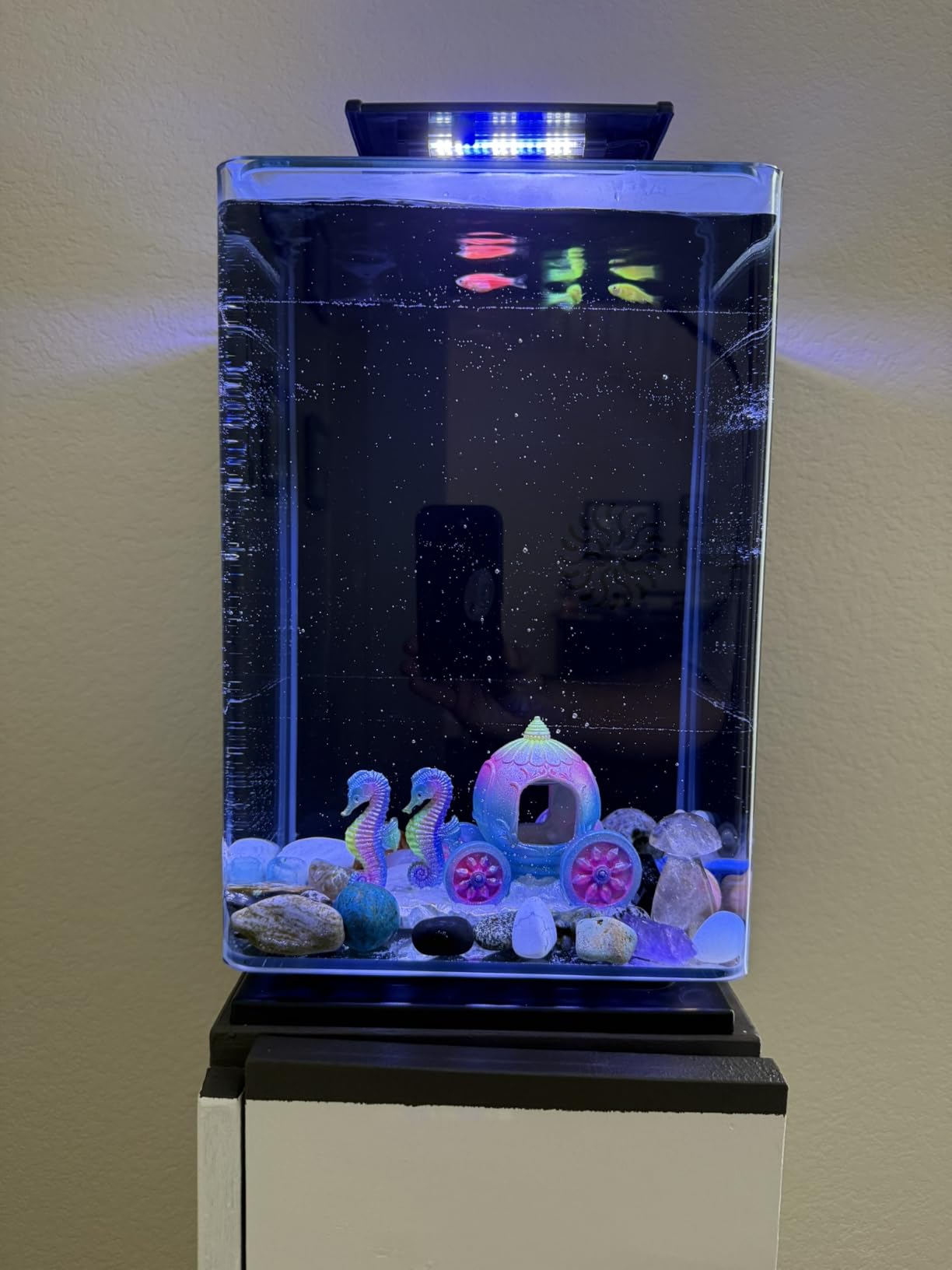
Owners consistently mention two things in reviews: the day-and-night LED effect, and how much easier maintenance is because of the hinged light and the sliding glass canopy. You lift the light, slide the canopy, and you have full access without fishing your hand around a fixed bracket.
At 16 pounds empty and measuring just under 10 inches square, it is genuinely portable. We moved it between a desk and a shelf without drama, which is not something you can say about the 45-pound tanks further down this list.
What the Marineland Portrait Is Good At
Quiet operation and clean appearance win here. The pump is not the loudest in the roundup, and reviewers frequently describe the running noise as unremarkable, which matters if the tank lives in a bedroom or on a desk next to a microphone.
It suits a betta or a small shrimp colony beautifully, and the white plus blue LED modes let you run a day cycle and a night cycle on one fixture. For a nano planted tank, the light is bright enough to support low to medium light species when you keep it on a timer.
The 3-stage filtration accepts standard Marineland Rite-Size Z cartridges, so replacement media is never a hunt. That single detail saves beginners more frustration than any feature on the list.
Where It Falls Short
The rounded canopy and the rear filtration housing do eat into usable interior space. On a 5-gallon tank that means noticeably less swimming room and fewer hiding spots than a rectangular tank of the same volume, which is a real consideration if you plan on shrimp.
The LEDs are genuinely bright, and reviewers with light-sensitive fish report needing to dim them or run them on shorter cycles. There is no heater in the box, and the filter output is generous for a nano, so a prefilter sponge is the first accessory you should add.
2. Koller Products 5-Gallon Kit – Best Value for a Kid-Friendly First Tank
Koller Products 5-Gallon Aquarium Kit with LED Lighting and Power Filter, Ideal for a Variety of Tropical Fish
5 gallon one-piece plastic
30 LEDs with 4 modes
2/4/8 hour timer
45 GPH filter
Pros
- Leak-proof one-piece plastic body
- Four lighting modes plus timer
- 45 GPH internal filter
- Light enough to carry easily
Cons
- Plastic scratches over time
- Modest flow needs cartridge changes
- No heater included
If your household has a curious seven-year-old and a cat, the material of the tank matters more than any other spec. Koller builds this one as a single moulded plastic piece with no silicone seams, which means there is no seam to fail and nothing sharp to cut on when it inevitably gets knocked.
It weighs 4.8 pounds empty. That is the lightest kit here by a wide margin, and it is the difference between a tank you can move to a shelf for tank cleaning and one you have to drain first.
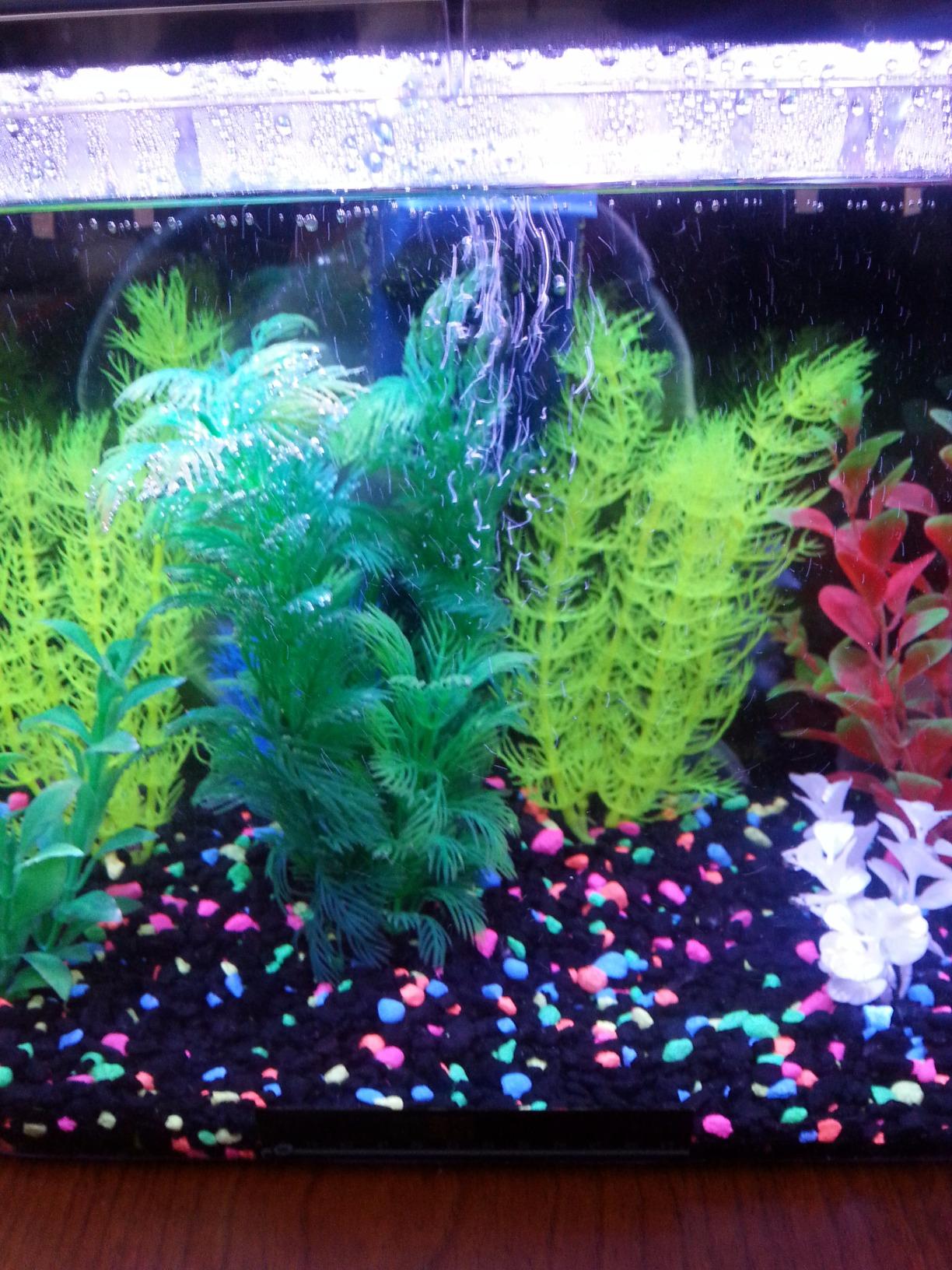
The lighting is the sleeper feature. Thirty LEDs with white, warm, blue and mixed modes, plus a 2, 4 or 8 hour timer with memory, means you set a photoperiod once and the tank holds it every night without you touching anything.
The internal power filter is rated at 45 gallons per hour, which is ample for a 5-gallon tank and is marketed to clear organic pollutants, odors, discolorations and heavy metals. Media is the standard Koller S-series cartridge, so replacements are simple to find.
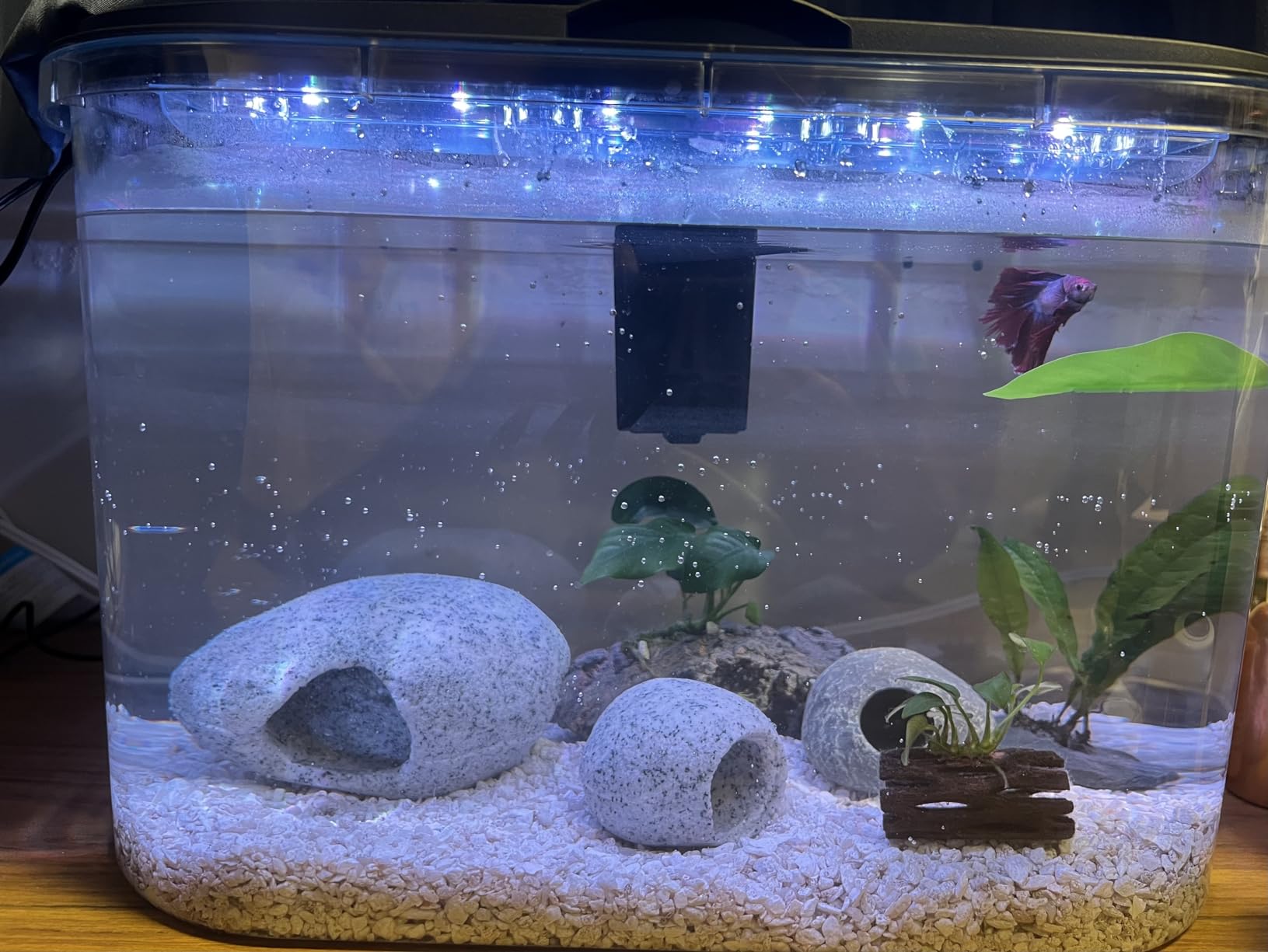
What the Koller Kit Is Good At
Durability. Reviewers describe using this as a first tank for children learning to care for a pet, and the plastic body tolerates the knocks and drops that a glass tank of the same size would not survive.
It is also the easiest entry point without giving up a timer light or a filter of any real quality. For a betta, a couple of shrimp, or a small group of guppies, it does everything a first tank needs to do.
Because there is no silicone seam, there is no seam to fail slowly in the background. That is a genuine long-term reliability argument, not just a safety one.
Where It Falls Short
Plastic scratches. Every acrylic and plastic tank does, and reviewers note that clarity slowly dulls with normal cleaning, particularly if the tank is dried with a microfiber cloth used on other surfaces.
The 45 GPH output is modest, so this is not the kit to build a heavily stocked tank around, and the cartridge needs replacing on a schedule. There is no heater in the box, so budget for a small adjustable heater and a thermometer before you add tropical fish.
3. Aqueon MiniBow 5-Gallon Starter Kit – Best for Bettas and Shrimp
Aqueon MiniBow Small Aquarium Starter Kit, All-in-One Desktop Fish Tank for Betta, Shrimp or Small Fish, Includes SmartClean Filter Technology, LED Light and Conditioner, Black, 5 Gallon
5 gallon acrylic
LED hood and elevated base
SmartClean filter
Conditioner and food included
Pros
- Genuinely all-in-one bundle
- SmartClean filter speeds water changes
- Durable acrylic body
- Compact desktop footprint
Cons
- Acrylic scratches and dulls
- Modest LED for planted tanks
- No heater included
This is the kit most beginners end up in, and for betta setups specifically it is hard to argue with. The MiniBow includes a low-profile LED hood, an elevated base, the filter, water conditioner and food samples, so the only two things you must add are a heater and your livestock.
SmartClean is the real product here. A covered cartridge holder lifts out of the pump and goes straight into a bowl of old tank water, so a water change takes under two minutes. On a small tank where water changes are the main chore, that is not a minor convenience.
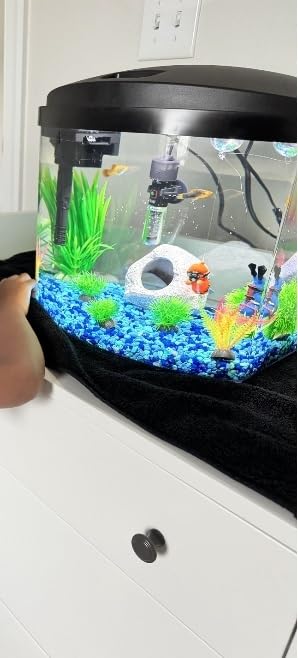
The elevated base tilts the tank forward slightly, which makes the front viewing pane easier to look through and gives the hood somewhere to sit. It reads as a designed product rather than a tub with a clip-on light.
Reviewers rate it as a consistent performer, and the tank holds its position as a top seller in the starter kit category for a simple reason: it is complete and it is compact.
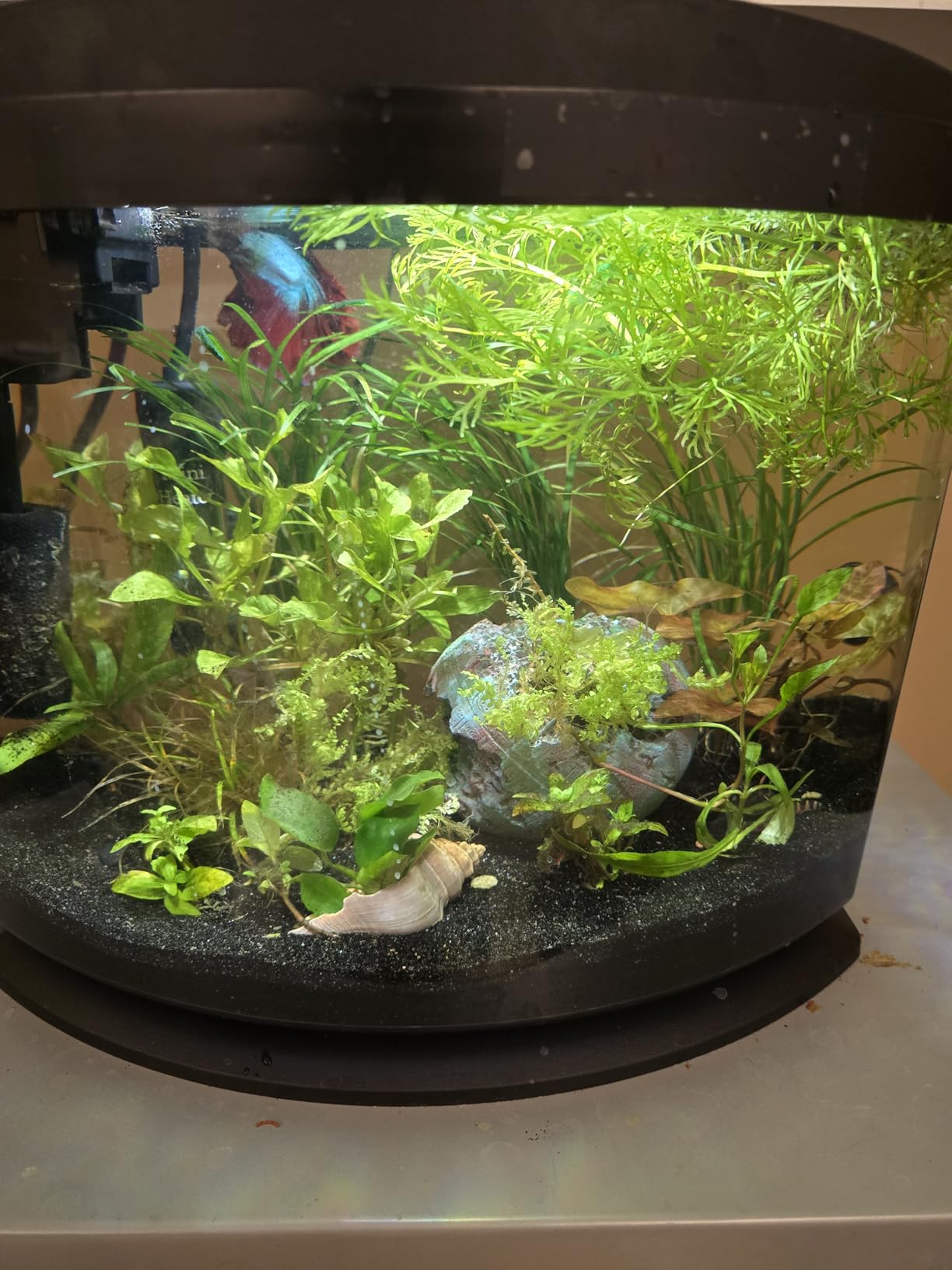
What the Aqueon MiniBow Is Good At
Maintenance speed. If you keep a betta, you are doing small frequent water changes, and a two-minute change is the difference between a tank you service happily and one you start putting off.
It is genuinely a desktop unit, measuring just over 14 inches wide and 10 inches deep, so it fits a shelf where a rectangular 10-gallon will not. The small footprint is the reason it works in an office or a bedroom.
For shrimp keepers, the covered SmartClean intake is a meaningful safety feature, since it reduces the chance of pulling in tiny juveniles while still moving plenty of water.
Where It Falls Short
Like the Koller, it is acrylic, and reviewers report the same scratching and gradual loss of clarity over a year or two of use. It handles bumps better than glass but looks its age sooner.
The LED is modest, which reviewers say limits planted tank options. There is no heater included, and the 5-gallon volume is small enough that temperature swings in a room with direct sun can affect a betta quickly.
4. Fluval SPEC Aquarium Kit 5-Gallon – Most Versatile for a Built-It-Looking Nano Tank
Fluval SPEC Aquarium Kit, 5-Gallon
5 gallon etched glass
37 LED array at 821 lumens
55-80 GPH pump
Hidden rear chamber
Pros
- Filtration fully hidden
- Very quiet pump
- Long swim lane
- Roomy rear filter chamber
Cons
- Strong outflow for bettas
- Intake slit risks fry
- No heater included
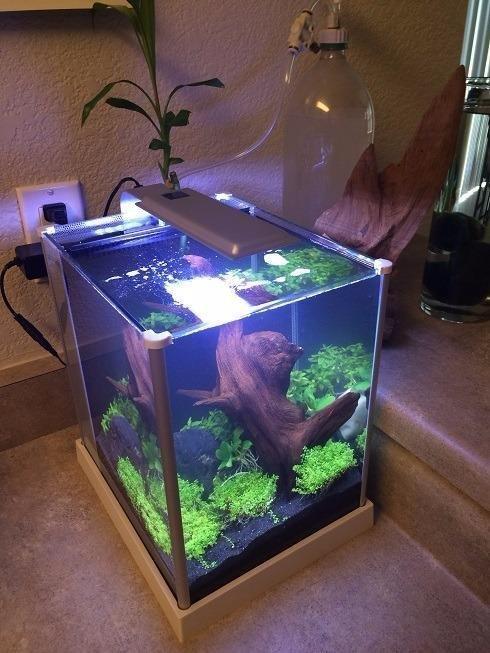
The Fluval SPEC is the one that makes a nano tank look like cabinetry. Etched glass, aluminium trim and a rear chamber that swallows the entire filter give it a silhouette nothing else at this size matches.
The light is a serious fixture: 37 LEDs putting out 821 lumens at 7000K, roughly 20 percent brighter than the generation before it. That is enough light for low to medium light plants if you run it on a timer rather than all day.
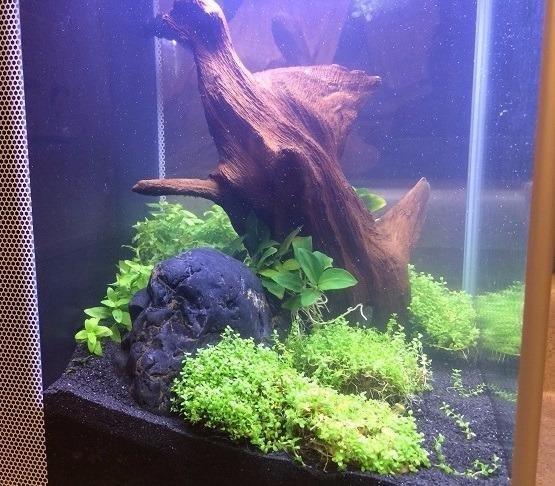
Reviewers single out two things above everything else. The pump is quiet, with several owners saying they cannot hear it at all from across the room. And the swim lane is unusually long for five gallons, which sounds trivial until you watch a betta use it.
The rear chamber is roomy enough to accept a small heater and modular filter baskets, which solves the awkward problem of where a heater goes in a nano tank with hidden filtration.
What the Fluval SPEC Is Good At
Appearance and quietness. If the tank is going to sit where people see it, this is the one that gets asked about. Several reviewers note that guests comment on it before they notice there is a filter in it at all.
It suits a betta in a bedroom or a small planted tank on a sideboard. The bright LED, the hidden chamber and the near-silent pump cover the three things people care about in a display nano.
Media capacity is generous for a 5-gallon, with oversized mechanical, chemical and biological stages and a foam block, activated carbon and BioMax bio rings in the box.
Where It Falls Short
Outflow is strong for slow-flow fish, and the most common single piece of owner advice is to add a prefilter sponge on the outflow before adding a betta. Without it the current is too much for a lot of bettas and shrimp.
There is also a lower intake slit that is a genuine hazard for fry, shrimp and microfauna, and reviewers recommend plugging it. No heater is included, and a minority of owners report a springy light arm bracket that can droop if it is not fully seated, plus algae pressure if the LED runs too long.
5. Aqueon 10-Gallon Starter Kit – Best Complete All-In-One Set
Aqueon Aquarium Starter Kit with Smart Clean Filtration and LED Lighting, Freshwater and Saltwater Fish, Perfect for Tetras, Guppies, Platies, 10-Gallon
10 gallon glass
SmartClean filter
Preset 50W heater
Net, thermometer, food, conditioner
Pros
- Most complete bundle we found
- Preset heater holds a steady 78F
- Fast SmartClean water changes
- Quiet motor for its type
Cons
- Thin glass panes
- Weak LED for plants
- Sticker thermometer fails early
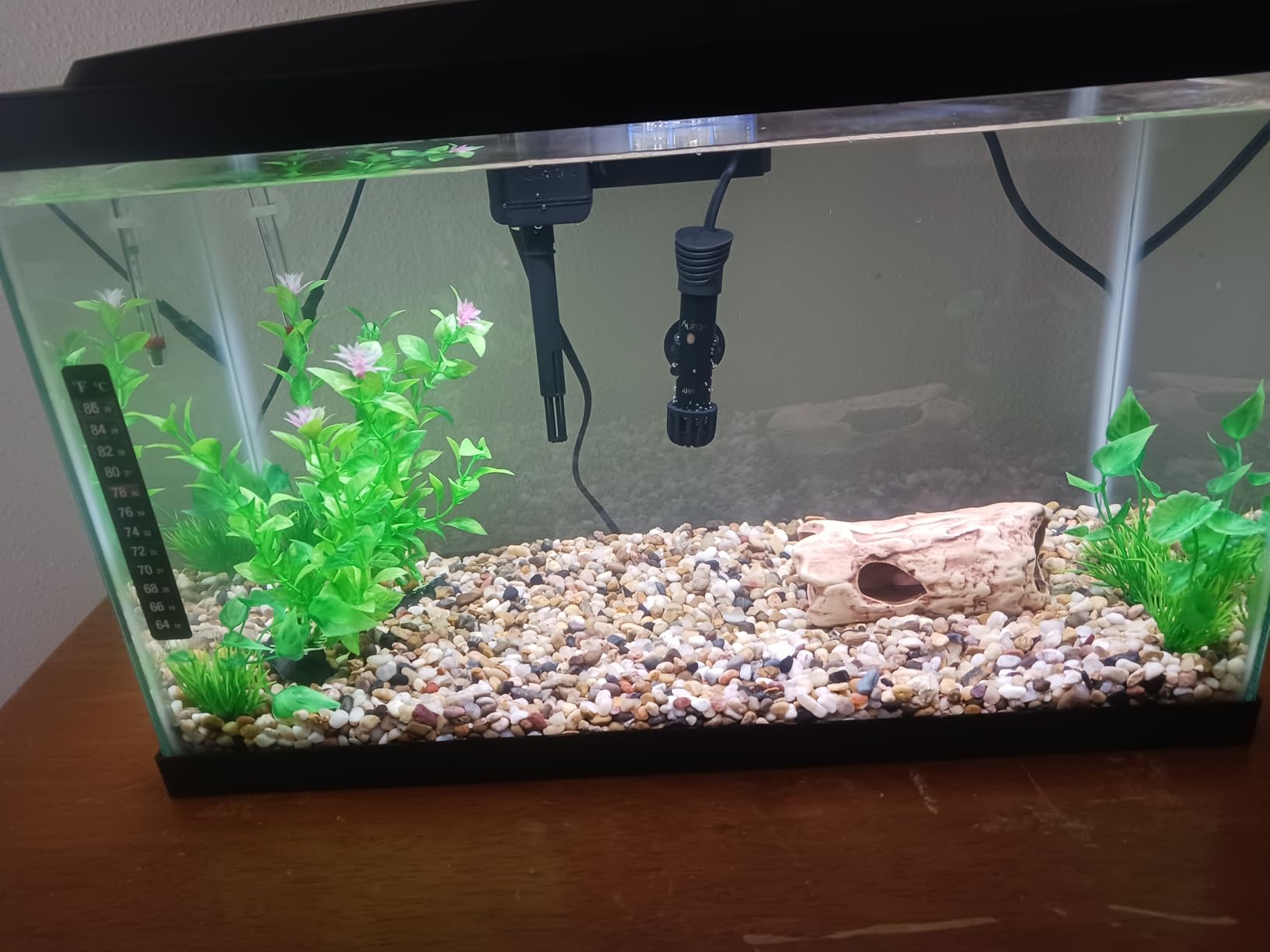
This is the kit we recommend to anyone who asks what has to be in the box before their first fish arrives. Tank, hood, filter, heater, thermometer, net, food and water conditioner all come in it. There is nothing on the shopping list except gravel and livestock.
10 gallons is the size where a beginner can make real mistakes and still recover from them. The extra water volume compared with a 5-gallon nano buffers temperature swings and dilution, and it comfortably holds a small community of tetras, guppies or platies.
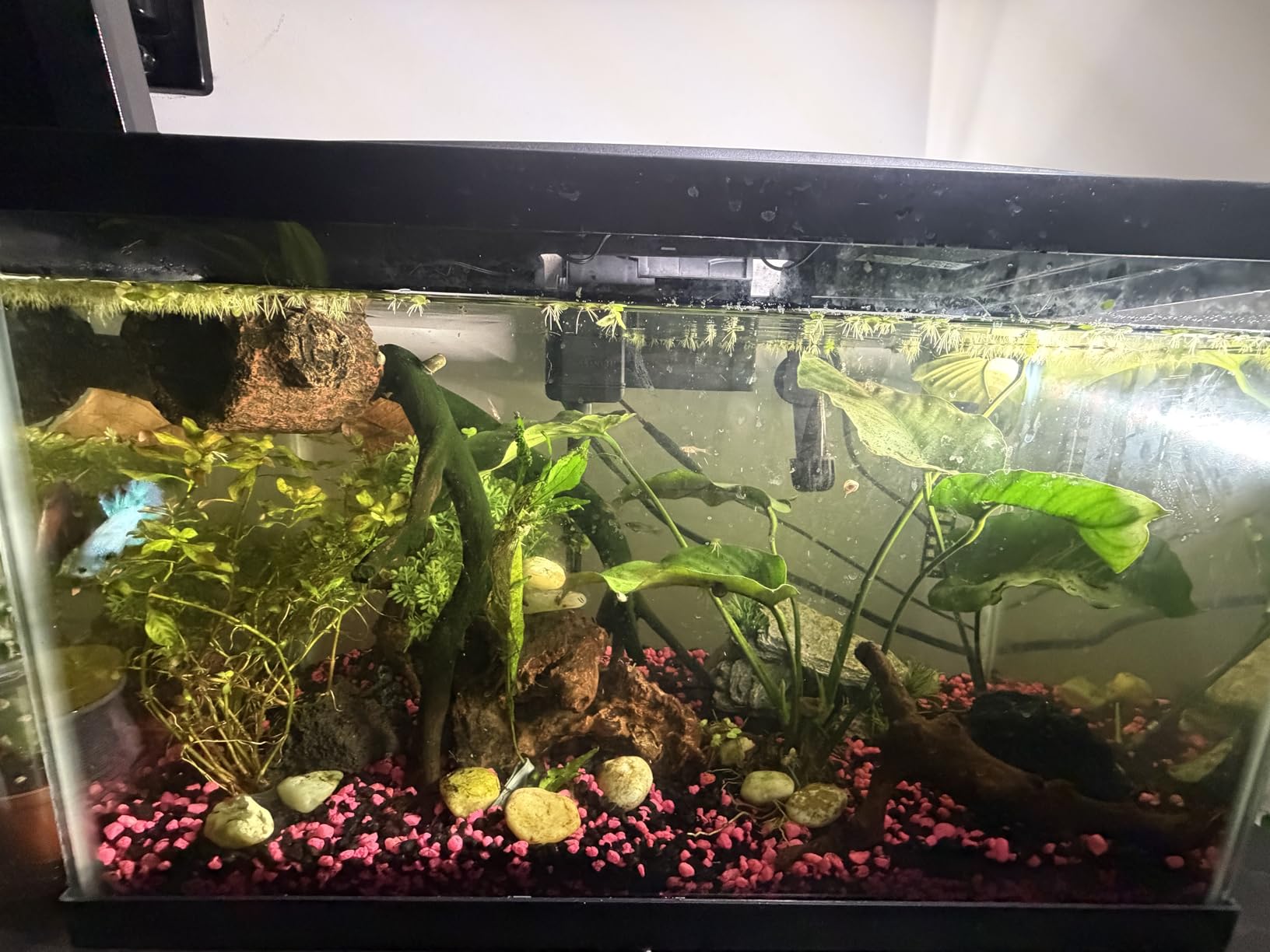
The heater is preset to 78F, which is a sensible tropical default, and reviewers confirm it reads accurate in practice. That is a small detail that removes a whole category of first-week worry, because a fluctuating heater is the most common cause of stressed, sick fish in new setups.
Reviewers also report the motor is quiet relative to other internal power filters of this type, and that these kits have turned up with no cracks and nothing missing inside.
What the Aqueon 10-Gallon Is Good At
Completeness. If you want a single purchase that gets you to a running, heated, filtered tank with a thermometer in the water, this is the short answer. Every other kit here makes you add at least a heater and a thermometer.
It also suits both freshwater and saltwater setups for beginners, which means you are not locked out of a future transition if a live rock reef is calling. You would still need more equipment for marine, but the tank itself is not wasted.
Ten gallons is the sweet spot between commitment and capacity, and it is the size we tell most beginners to start at. Our full guide to 10 gallon aquarium starter kits covers the stocking maths.
Where It Falls Short
The glass panes feel thinner than expected to reviewers, and thin glass is more vulnerable to a knock than the heavier tanks in this category. The LED is weak for a planted tank, so treat it as a fish-only or decor setup unless you add a better light.
Two small quality issues come up repeatedly: the included sticker thermometer stops working after a short time, so buy a real one, and the filter intake can pull small fish unless you add a foam prefilter. A small number of owners also report the filter pump failing at around the six-month mark.
6. GloFish 20 Gallon LED Kit – Best Glow-Up for a Display Tank
GloFish 20 Gallon Aquarium Kit with LED Lights, Decor Heater and Filter
20 gallon USA-made glass
Blue LED hood plus light stick
Tetra Mini UL heater
Whisper 20 filter
Pros
- Striking blue LED display
- Heater and filter both included
- USA-made scratch-resistant glass
- Decor plants and anemone in box
Cons
- 34 pound tank is awkward to move
- Blue light is not plant-friendly
- Gravel and livestock sold separately
Every other kit on this list is trying to look like aquarium furniture. GloFish is trying to look like a neon sign, and it succeeds. The blue LED hood plus a 13-inch light stick turns the whole tank into a glowing display that reads as a deliberate design choice rather than a fish home.
At 20 gallons this is also the first kit on the list that gives a beginner real stocking room, and it arrives with a Tetra Mini UL heater and a Tetra Whisper 20 filter already specified. You are not gambling on whether the basics are present.
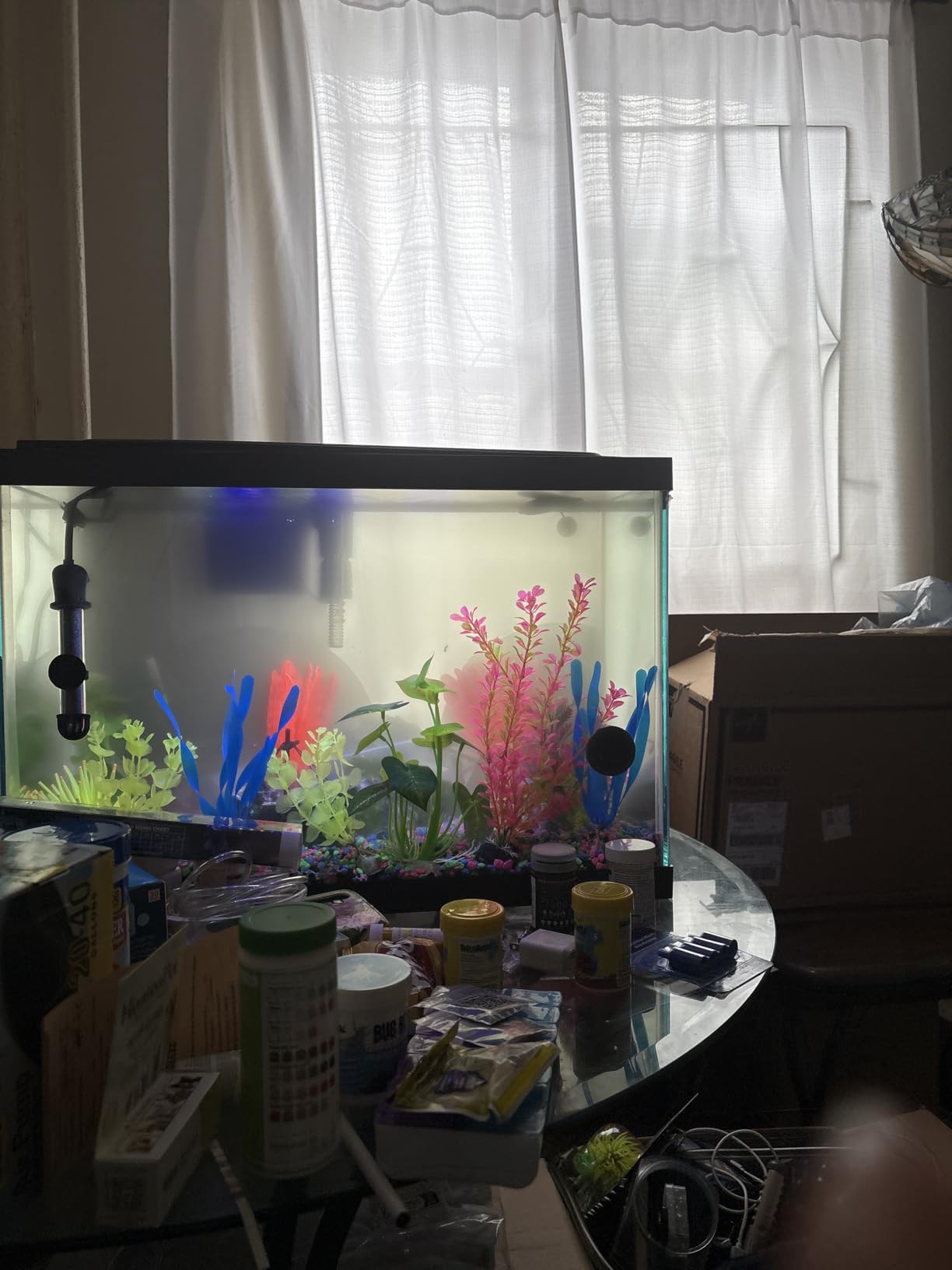
Reviewers love that three GloFish plants and a yellow anemone are included in the box. For a child, a ready-made glowing tank with a clownfish and an anemone is a very persuasive argument, and the decor gives you somewhere to put the fish that is not a bare bottom.
The glass is described as scratch-resistant and made in the USA, which is a step up from the acrylic and plastic builds lower down the list.
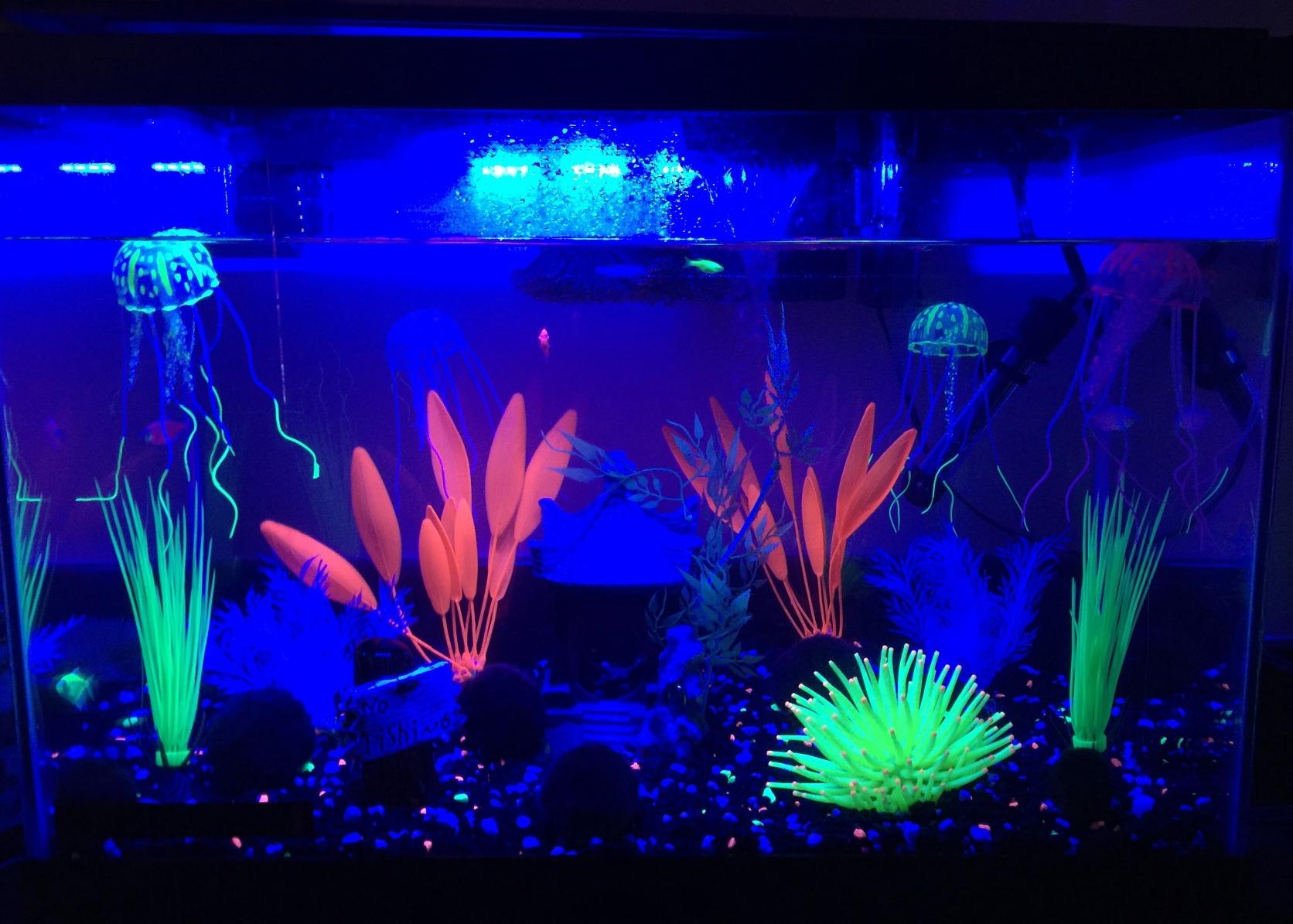
What the GloFish Kit Is Good At
Glow. If the tank is a gift, a bedroom centrepiece or a display piece, the blue lighting is the feature. Owners report it draws attention in a way a plain white LED never does.
Twenty gallons is a genuinely useful size for a community tank, and the included heater and filter combination is a known, serviceable pairing with parts available everywhere.
It also works for a clownfish-only setup, which some beginners building their first marine tank ask about. At 20 gallons you have room for a pair with proper filtration, though you will need additional equipment to run it properly as marine.
Where It Falls Short
It weighs 34.32 pounds empty and considerably more filled. Reviewers note the tank is heavy and awkward to move, so you should get it into position before you fill it rather than after.
The blue lighting is decorative rather than plant-friendly, so live plants will struggle unless you swap the light. And gravel and livestock are not included, which undercuts the all-in-one promise that the other Aqueon and Tetra kits deliver on.
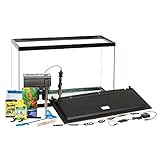
7. Tetra Complete 29 Gallon Kit – Best for Large Tanks and Long-Term Keeping
Tetra 29 Gallon Complete Tropical Fish Tank Kit
29 gallon glass
Whisper PF 30 power filter
200 watt heater
White LED strip
Pros
- Largest true beginner footprint here
- Heater and accessories all included
- Strong oxygenation
- Handles planted layouts
Cons
- Light bar clips to the rim and falls
- No flow adjuster and loud at high setting
- Manual filter priming
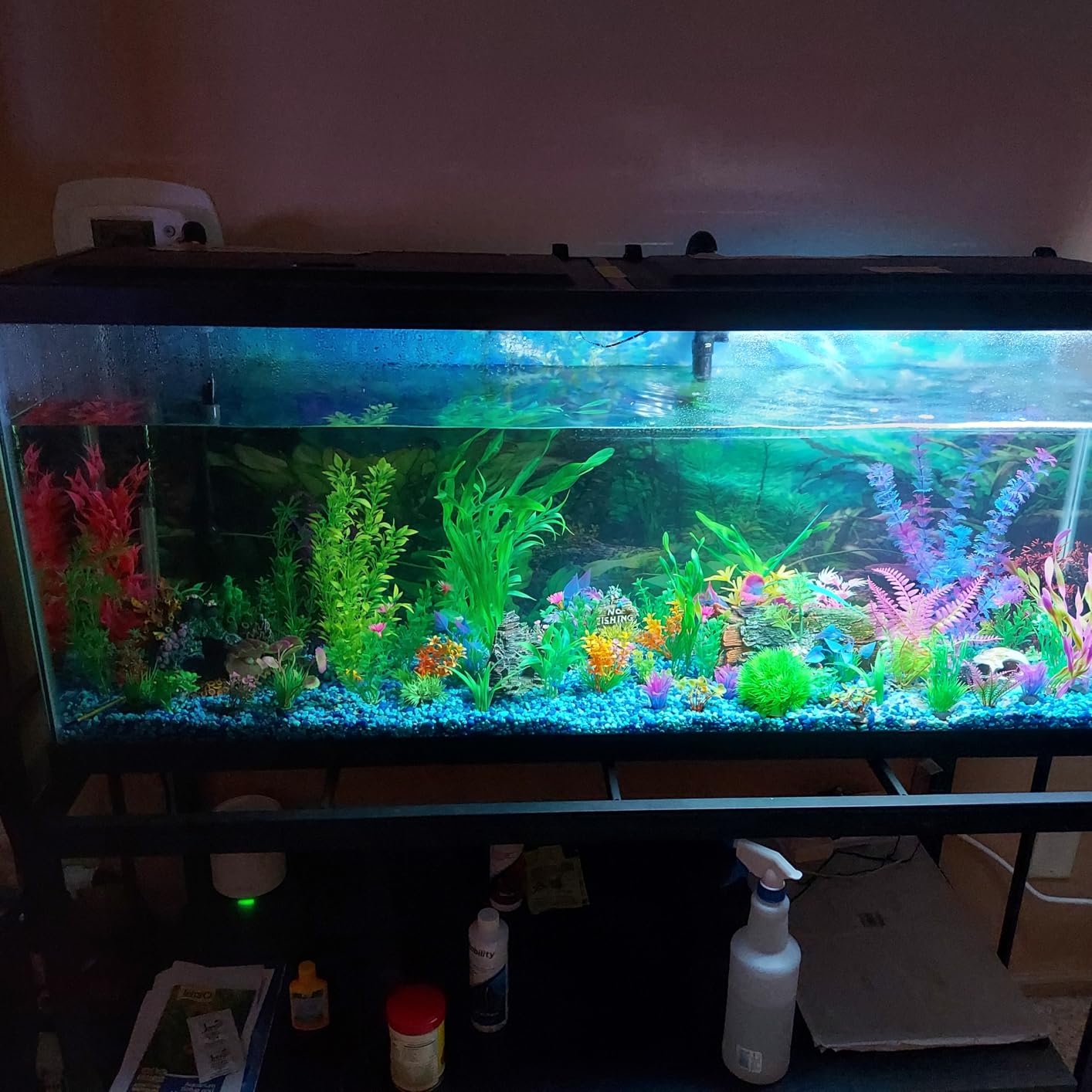
Twenty-nine gallons is the size at which a beginner can keep twenty-plus fish without cutting corners on water volume, and the Tetra Complete is the largest kit we reviewed that still arrives as a genuine beginner bundle.
It measures 30 inches wide by 12 inches deep by 18 inches high, which is worth checking against your furniture before you buy. Note that those dimensions match a 20-gallon long footprint exactly, while a 20-gallon high is a much narrower and taller box, so measure the cabinet you actually plan to use.
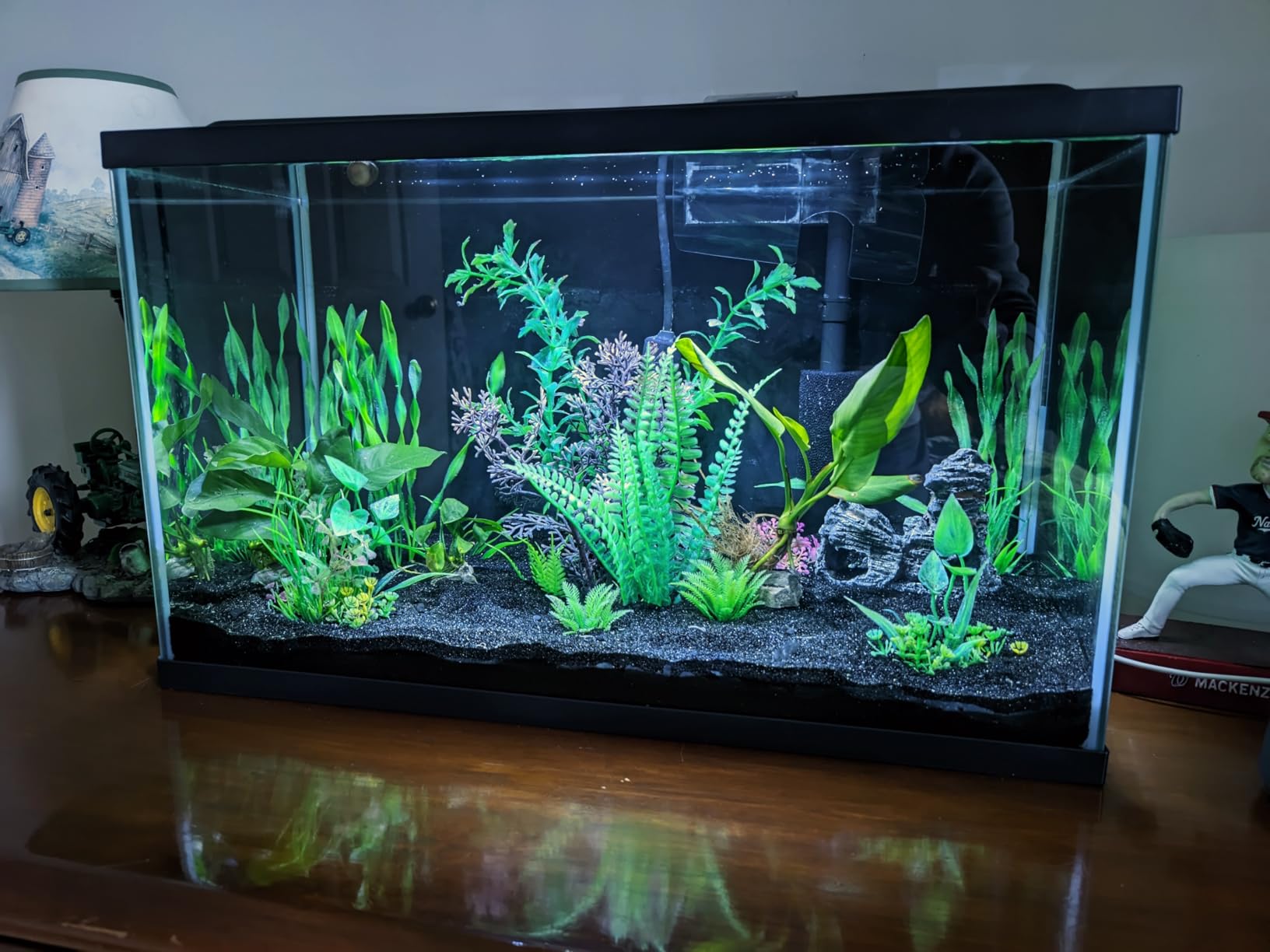
The Whisper PF 30 power filter with a large Bio-Bag cartridge gives a real waterfall effect and strong oxygenation, which owners consistently praise. It handles planted and riverbed layouts well, and the plastic hinged hood is cheap but serviceable.
A 200 watt heater, a thermometer, a fish net, a water conditioner sample and a food sample are all included in the box. For a tank this size, that is an unusually complete package.
What the Tetra 29-Gallon Is Good At
Buffering. A 29-gallon volume forgives the errors a 5-gallon cannot. Temperature moves more slowly, water changes move the needle less, and a beginner who overfeeds has far more room to recover before it becomes a problem.
It suits people who already suspect a 20-gallon will feel cramped within a year. The filter output matches the stocking level this tank can support, which is where several smaller kits fall short.
It is also the right stepping stone for a future marine setup, and it handles both freshwater and saltwater fish according to the manufacturer.
Where It Falls Short
The light bar clips to the inner rim and is the single most repeated complaint, with owners reporting it gets knocked off during cleaning and has to be re-seated. The light itself is a simple white strip, adequate for low-light setups but not for demanding plants.
The filter has no flow-rate adjuster, which is a problem if you later move to long-finned or slow-flow fish, and it can be loud at the top of its range. It also has to be manually filled before first use or it primes noisily, and a minority of tanks arrive with a faulty filter or a light bar different from the listing photos. At 45 pounds empty, moving it once it is filled is a two-person job.
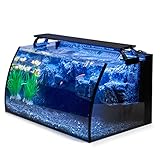
8. hygger Horizon 8 Gallon Kit – Best LED Lighting and Scaping
hygger Horizon 8 Gallon LED Glass Aquarium Kit for Starters with 7W Power Filter Pump, 18W Colored led Light, Wide View Curved Shape Fish Tank with Undetachable 3D Rockery Background Decor
8 gallon curved glass
18W LED with 5 brightness levels
110 GPH waterfall filter
3D rockery background
Pros
- Best in class LED with timer and colours
- Curved glass and rockery look fantastic
- Waterfall outlet adds oxygenation
- Filter opens for custom media
Cons
- No lid so evaporation is fast
- Rockery blocks the filter cubby
- Over strong pump for small fish
The lighting is why this kit is on the list. An 18W DC12V LED with a digital controller, a 3, 6 or 12 hour timer, five brightness levels and multiple colour modes puts it ahead of every other light in this roundup by a distance.
The hardware it drives is equally confident: 7W, 110 GPH internal power filter with two-stage filtration and an adjustable waterfall spout, mounted in a tank with curved wide-view glass and an undetachable 3D rockery background. It is a display piece before you add any livestock.
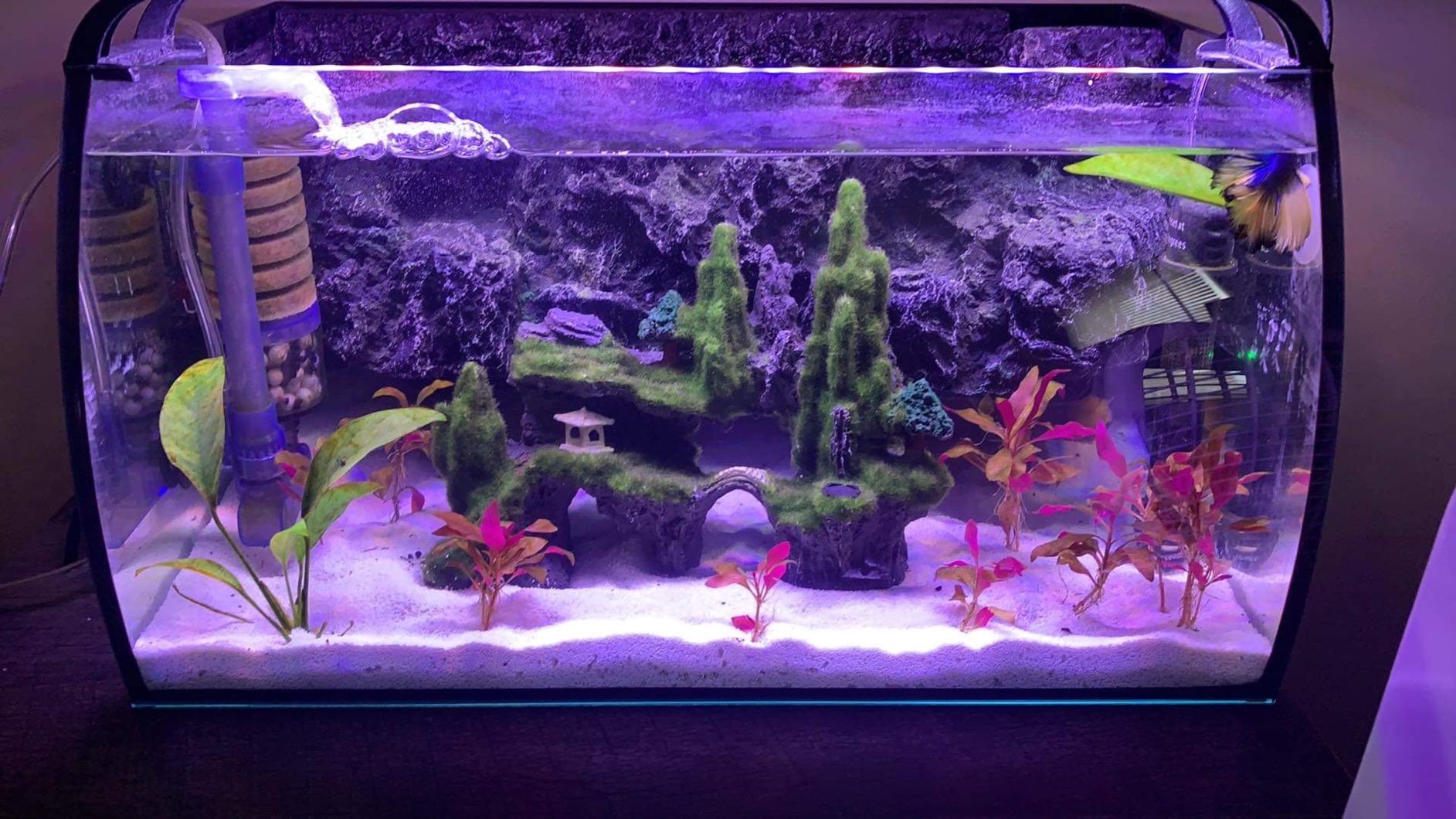
Shrimp keepers rate it highly and reviewers report long-running colonies in it. The rockery gives shrimp and small fish genuine cover, and the waterfall outlet adds oxygenation while hiding newly hatched shrimp from the adults that hunt them.
Note the working volume. The tank is an 8-gallon shell but holds about 6 gallons once the fixed background is accounted for, and it weighs around 68 pounds when full, so plan the stand accordingly.
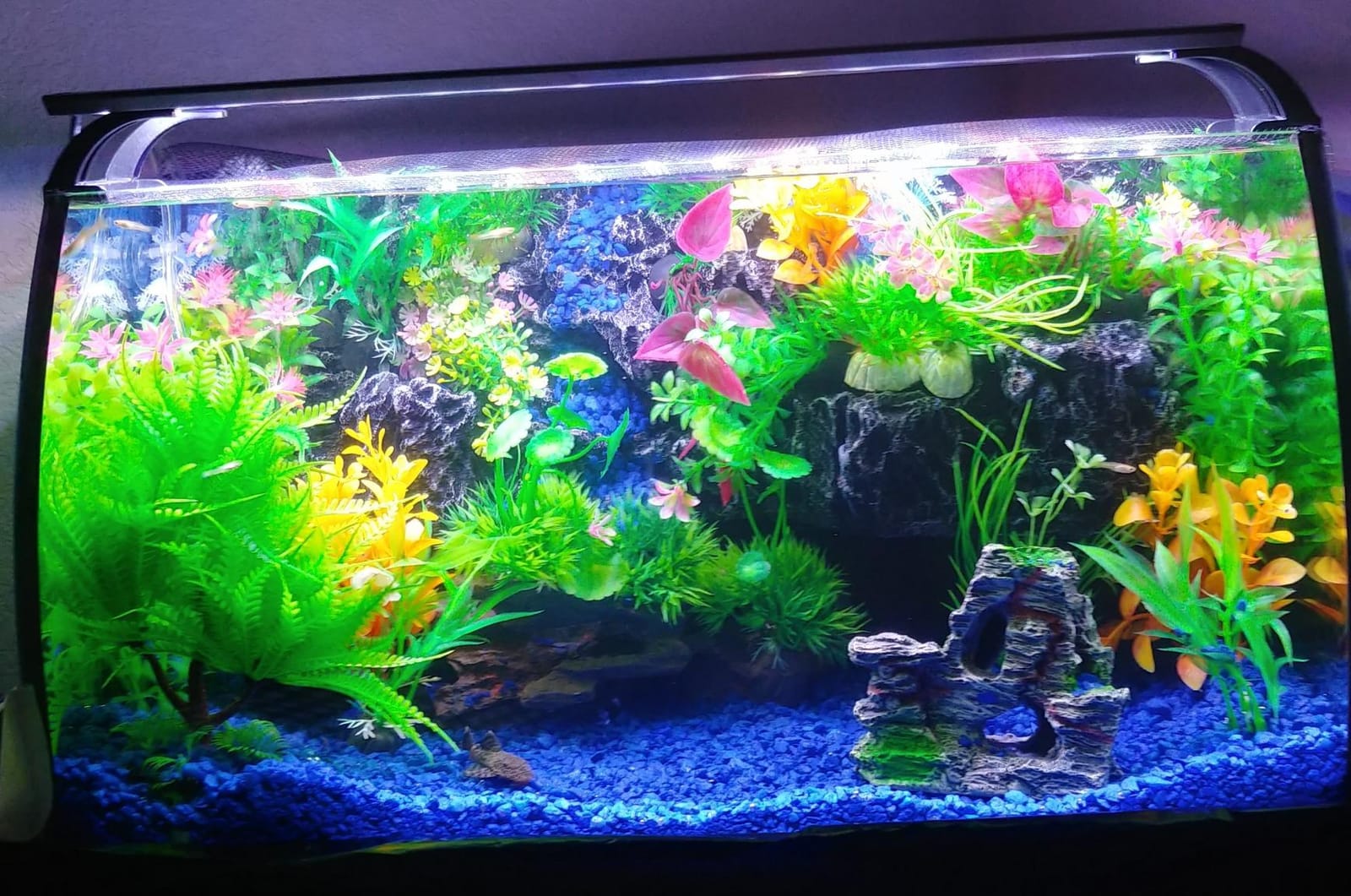
What the hygger Horizon Is Good At
Aquascaping in a box. The curved glass and rockery are the reason most people buy it, and reviewers describe it as a genuine centrepiece. If your goal is a tank that photographs well, this is the one.
The LED’s five brightness levels and timer are useful for plants and for controlling algae, and the extendable brackets fit a range of tank widths if you later upgrade the aquarium itself.
The filter disassembles easily so you can cut foam and carbon to fit, which makes it a good first filter to learn cartridge and media maintenance on.
Where It Falls Short
There is no lid. Water evaporates quickly, and jumpers can leave, so you need a plastic sheet or a clip-on lid from day one. The rockery partially blocks the filter cubby, weakening circulation at the back, and it is hard to clean and grows algae quickly.
The 110 GPH pump is far too strong for any fish under two inches without modification, the flow valve is touchy, and the tubes clog fast. Some tanks have also arrived with a bottom crack or a chipped rim, so inspect the glass before you fill it.
9. PENN-PLAX Water-World Radius 5 Gallon – Best Desktop Nano
Penn-Plax Radius Nano Aquarium Kit, Curved Bent Glass Fish Tank, 5 Gallon
5 gallon frameless bent glass
Cascade 300 filter at 70 GPH
Silver LED
Glass lid with clips
Pros
- Frameless curved glass gives wide views
- Strong 70 GPH filtration for a nano
- Lid and clips included
- Small desk-friendly footprint
Cons
- 70 GPH is too strong for bettas
- Clear lid reduces light for plants
- No heater
- substrate or livestock
This is the most elegant object in the roundup. Frameless one-eighth inch bent glass with two curved front corners gives you an unobstructed view from every angle, and at 13.75 inches wide by 8.75 inches deep it fits a file cabinet as easily as a desk.
Unlike most nano kits, the lid is included. It comes with a silver LED, a glass lid with clear mounting clips and a pre-glued levelling mat, so the tank is stable and covered from the moment it arrives.
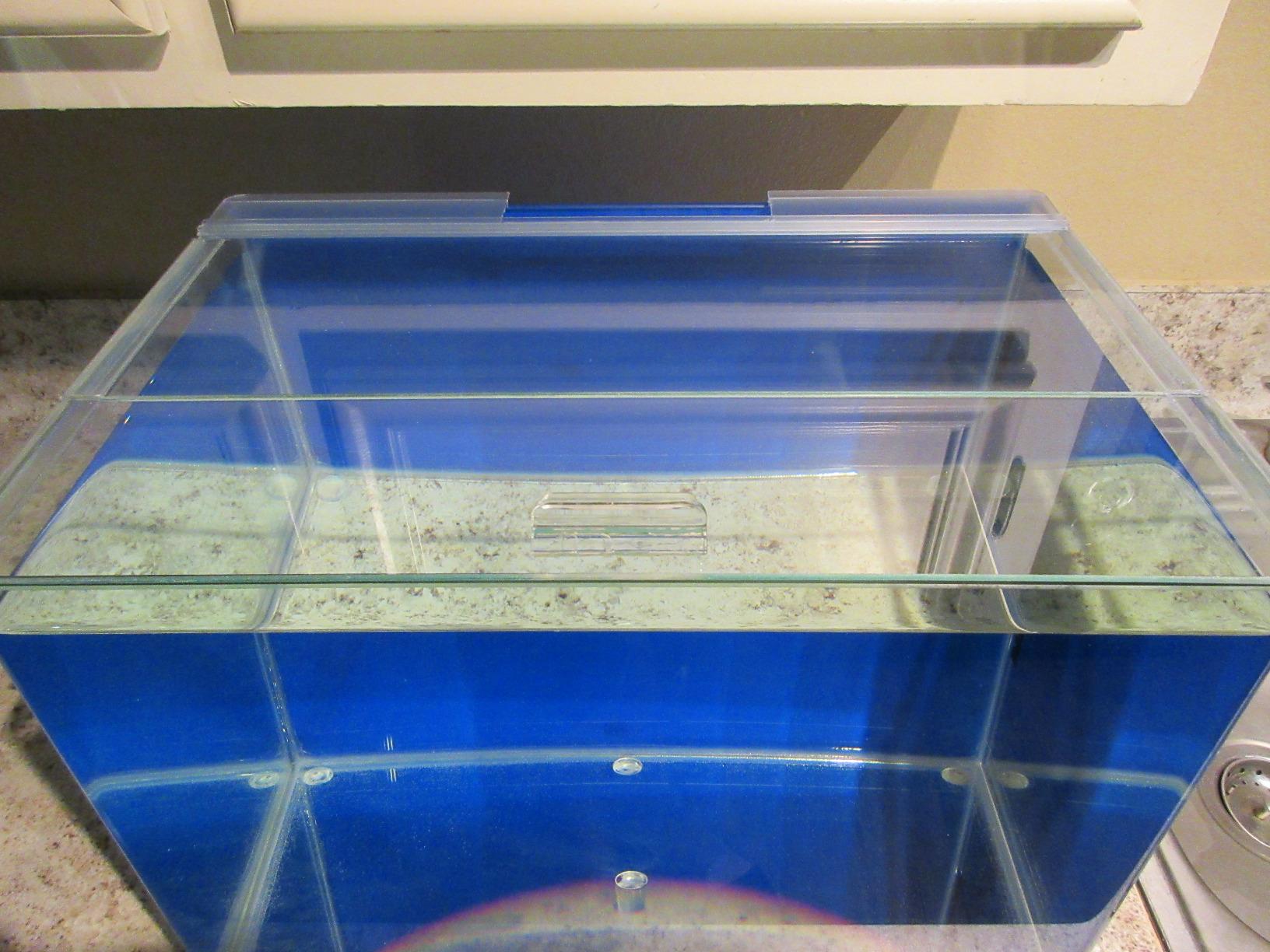
The filter is the Cascade 300, fully submersible at 70 GPH with a refillable carbon cartridge and an internal bio-sponge. Seventy gallons per hour is genuinely strong for five gallons of water, which is a good thing for shrimp colonies and a problem for a betta.
Reviewers note it is quiet enough to sit in an office, which is the main reason this tank shows up on work desks rather than in living rooms.
What the PENN-PLAX Radius Is Good At
Design. If the tank lives on a desk where you look at it all day, the frameless curved profile is worth more than any specification on the box, and the levelling mat stops the glass rocking.
It is also one of the few kits that includes a lid, which removes the evaporation and escape problems that cost beginners money and fish.
At 70 GPH with both a carbon cartridge and a bio-sponge, it has more media capacity than most nano kits and gives you a sponge to seed from an established tank if you want to skip part of the cycle.
Where It Falls Short
Seventy GPH is too powerful for bettas and other slow-flow fish unless you add a prefilter sponge, and that is the single most repeated caveat in reviews. The clear lid also cuts down on light, so a planted setup needs a better light or the lid removed and a cover improvised.
No heater, substrate or livestock is included, so this is a tank, not a starter bundle. Our nano aquarium kit roundup covers the alternatives that include more in the box.
10. NICREW 2.5 Gallon Nano Nature Kit – Best for Shrimp and Bettas
NICREW 2.5 Gallon Nano Nature Aquarium Kit Betta Fish Tank, Complete, Black
2.5 gallon nano tank
91.2 percent light transmittance glass
Lid and leveling mat preinstalled
Beginner setup guide
Pros
- Highest average rating in the roundup
- Exceptionally clear glass
- Lid and mat already fitted
- Compact enough for a countertop
Cons
- Only suits betta
- shrimp or tiny schools
- Filter and light are very simple
- No heater
- substrate or livestock
This is the highest-rated kit we reviewed, at 4.6 stars across 890 ratings with 80 percent five-star. That is a genuinely strong score rather than a high average built on a handful of reviews, and it tells you something about consistency.
What earns it is simplicity combined with the two things a nano always needs. The glass has 91.2 percent light transmittance, so aquascapes look noticeably sharper than through a plastic or acrylic bowl, and both the lid and a pre-glued levelling mat are already fitted when it arrives.
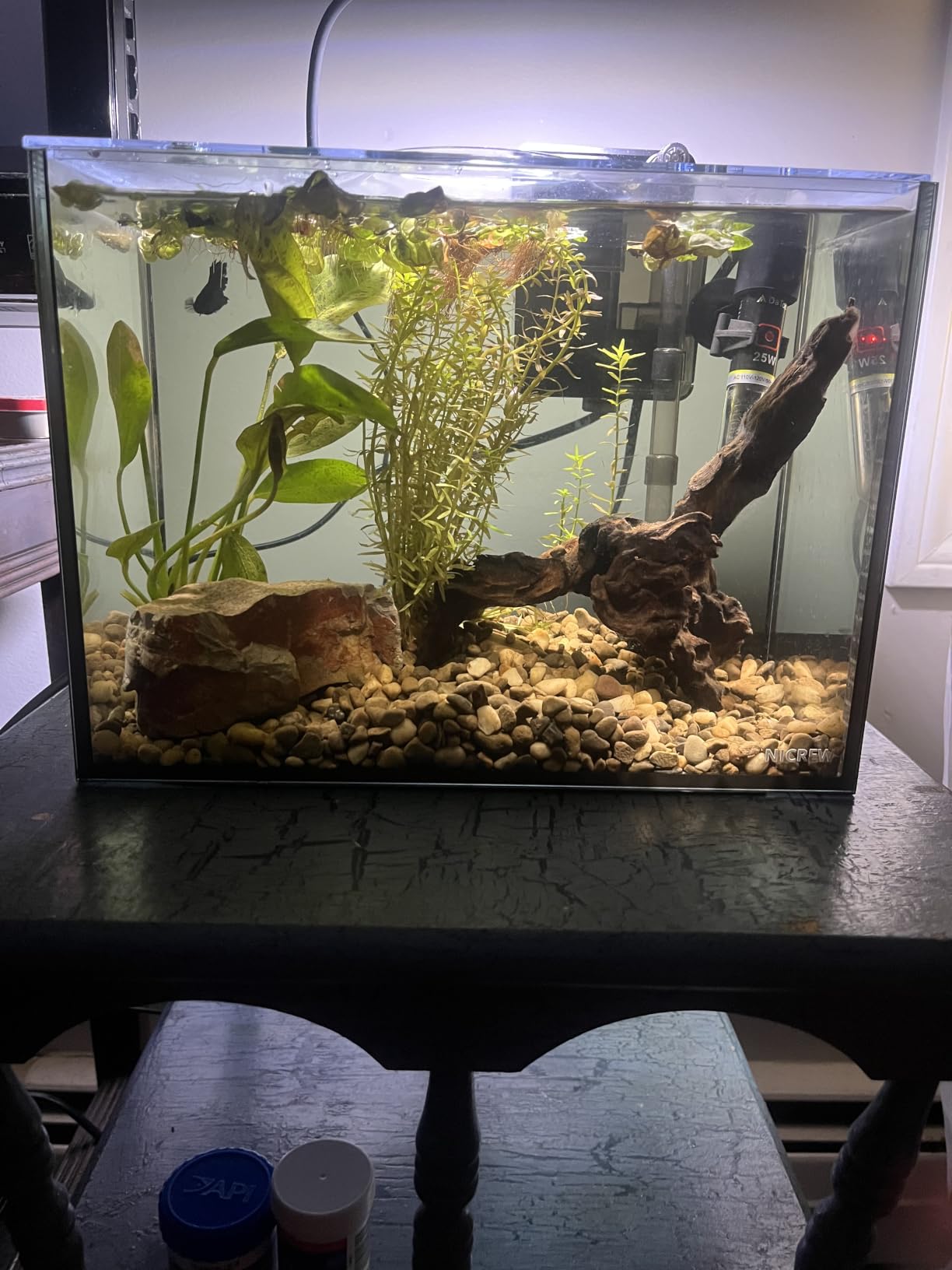
That last point is the beginner advantage. There is no assembly step, no levelling to guess at, and the setup guide is written specifically for people who have never kept fish. You rinse it, fill it, and you are running a tank.
At 2.5 gallons it is the smallest tank here, and reviewers are clear about the trade: a betta, a shrimp colony or a very small school, and nothing larger.
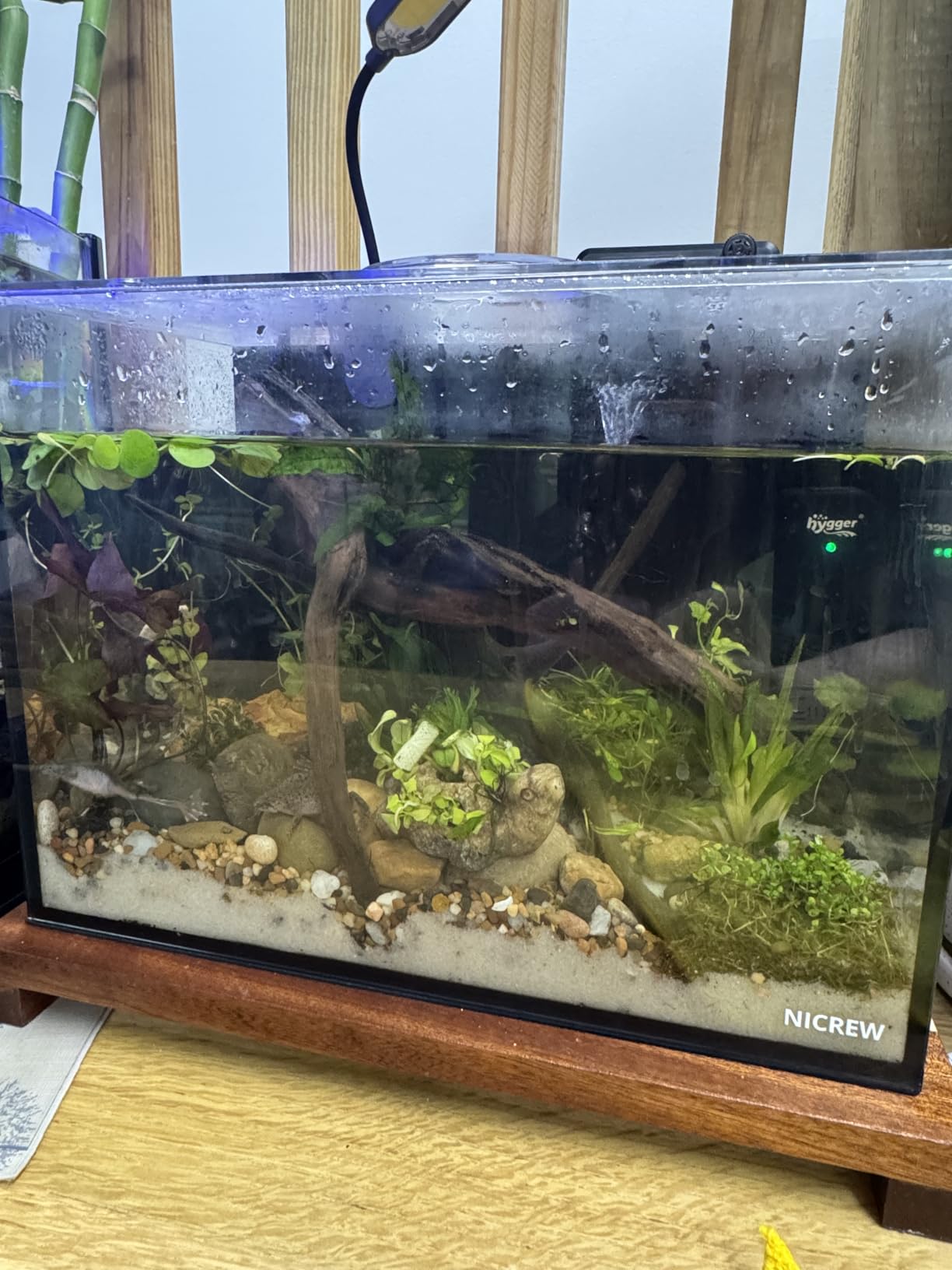
What the NICREW Nano Is Good At
Shrimp. At 2.5 gallons with a lid included, it is one of the safest shrimp setups on the list, and the clear glass shows off a planted aquascape better than anything else in this size class.
It is also the lowest-effort kit here. The filtration and lighting are deliberately simple systems designed for low-effort upkeep, which means less to go wrong on your first month.
For a first tank on a desk or a countertop, it is the shortest path from opening the box to a living aquarium of any kit we tested.
Where It Falls Short
Two and a half gallons is very little water. Reviewers note it suits a betta, shrimp or micro-fish and is not appropriate for anything larger, and a volume this small swings in temperature quickly if it sits in a sunny window.
The filter and light are not aimed at demanding planted tanks, and there is no heater, substrate or livestock included. If you want more than a single betta and a handful of shrimp, the Aqueon 10-gallon is the step up.
Kit vs. Buying Equipment Separately: What a Kit Actually Saves You
Buy a kit if you want one decision instead of six, if the tank is a gift, or if you are setting up a tank your own children will maintain. Buy the components separately if you already know what you want or if you are building a specific aquascape.
The honest truth is that the tank itself is where a kit saves you real money. A glass tank, a hood and a filter are sold together at a discount, and you avoid paying retail three times for three separate boxes. What a kit does not save you is money on the small parts, because those are usually the same price either way.
Where the money leaks is in the components you will replace. The honest verdict from the keeper community is that most people end up swapping the included filter, the included heater, or both. Once you accept that, the kit is still often the better buy, but only if you factor the replacement into your plan from the start rather than after something fails.
One more trap: kit media is often wet or inkjet-printed. Keepers distrust printed media because it can leach contaminants into new water, and the safer habit is to buy your own sealed dry dechlorinator and dry filter media rather than using the sample in the box.
The practical version of this rule is simple. If the kit includes a heater, keep it. If it does not, buy one before the fish arrive. If its filter is overpowered for your chosen livestock, add a prefilter sponge rather than replacing the whole unit.
What to Buy After Your Kit: The Extras Nobody Includes
Almost no kit includes the four things you need most. Buy a liquid test kit, a water conditioner you trust, an adjustable heater if one is not in the box, and an aquarium stand sized for the filled weight.
A liquid test kit is not optional. Strips are fine for a quick ammonia glance but they are not accurate enough to tell you a tank is cycled, and cycling is the step beginners skip that costs them the most fish. Test for ammonia, nitrite and nitrate weekly for the first month.
For water changes, get your own bottle of conditioner rather than relying on the sample in the box. A sample size will not last a year of weekly changes, and the dechlorinator protects the beneficial bacteria you spent three weeks building.
Stands deserve their own line in the budget. This tank is 45 pounds before a single drop of water goes in, and a filled 29-gallon is heavy enough that a furniture piece not rated for it is a real risk. Match the stand to the filled weight, not the tank weight.
Beyond that, add substrate, live or artificial plants, a gravel vacuum for cleaning, and food suited to the species you plan to keep. Our guides to aquarium maintenance kits and gravel cleaners cover that side of the setup.
How to Choose the Right Aquarium Kit
Choose size first, because it is the decision you cannot easily reverse. A larger water volume is easier to keep stable, and beginners do better in a 10-gallon or larger than in the smallest tank on the market.
Between 5 and 7 gallons is a nano band, and it suits one betta or a shrimp colony with careful water changes. Between 10 and 20 gallons is the beginner sweet spot that holds a real community tank. Above 20 gallons you are buying volume you have to clean, move and stand correctly, so our guide to larger aquarium kits is worth reading first if that is your target.
Filter Type and Flow Rate
Flow rate is measured in gallons per hour, and the useful rule is four to six times your tank volume turned over per hour. That is 40 to 60 GPH for a 10-gallon, or 200 to 300 GPH for a 50-gallon, and it is a good sanity check on any kit you are considering.
Be cautious with overpowered kit filters. A pump rated far above what the tank needs creates a current that pushes fish around the surface, causes constant swimming effort, and makes feeding harder. The fix is usually a prefilter sponge on the outflow rather than a new pump, and it costs a fraction of replacing the unit.
Glass, Acrylic and Plastic
Glass is the standard for a reason: it does not scratch, it does not yellow with UV exposure, and it looks better. Acrylic and plastic are lighter and survive drops, which matters in a house with small children, but they scratch and lose clarity over a year or two of normal cleaning.
Weight is the deciding factor for most households. The Koller kit at 4.8 pounds and the Aqueon MiniBow at 5.25 pounds can be moved with one hand, while the 29-gallon glass tank is 45 pounds empty. Know which category you are in before you buy furniture.
Heater, Thermometer and Lighting
Check for a heater first, because seven of these ten kits do not include one. A preset heater is fine for a tropical tank if it reads accurately, but an adjustable one with a dial gives you a range for coldwater fish and lets you compensate for a cool room.
Buy a real thermometer regardless. Two of the kits here include sticker thermometers that reviewers report failing quickly, and an unverified temperature is how cold-water fish shock happens in summer.
On lighting, be honest about your plants. A blue decorative LED will not grow a planted tank, and a modest white strip suits a low-light setup. A timer matters more than brightness for algae control, so whichever kit you pick, run the light on a schedule rather than leaving it on.
Which Brand to Trust
Fluval and Aqueon are the specialist brands and are the safest general recommendation, with Aqueon winning on complete bundles and Fluval on build quality and quiet pumps. Tetra is the widest range and best for a first larger tank. Marineland, Koller and Penn-Plax are strong at the nano end.
Hygger is the pick if lighting and aquascaping matter more to you than long-term brand serviceability, and GloFish is decor-led. No brand is best at everything, which is why the award labels on this list split by use case rather than by manufacturer.
Your First 30 Days With a New Kit
Do not add fish in the first week. The tank needs to cycle first, and adding livestock to an uncycled tank is the single most common cause of new tank syndrome, where ammonia and nitrite spike and kill everything in the tank.
Days 1 and 2 are setup. Rinse the substrate, fill the tank with dechlorinated water, add the conditioner, install the filter and heater, and run both. Add an air stone or surface agitation if the filter outlet does not break the surface well.
Days 3 to 7 are the bacteria phase. Ammonia rises as the first bacteria population establishes. Test ammonia and nitrite every two or three days so you can see the curve rather than guessing at it.
Weeks 2 to 4 is the conversion phase. Nitrite appears as the bacteria consume ammonia, then both fall as nitrifying bacteria establish. A tank is generally considered cycled when both ammonia and nitrite read zero on a liquid test and have stayed there for several days.
Weeks 4 to 6 is the safe stocking window. Add a small number of hardy fish first, feed sparingly, and test weekly. Fishless cycling, which doses pure ammonia to feed the bacteria without any fish present, is the fastest reliable route and avoids new tank syndrome entirely.
New tank syndrome lasts anywhere from a few days to several weeks depending on how it is triggered. Fish that are moved into a new tank also need a slow acclimation, roughly a week of floating and gradual mixing, before they are fully adjusted.
Frequently Asked Questions
What is the best aquarium setup for a beginner?
A 10-gallon to 20-gallon freshwater tank with a properly sized filter, an adjustable heater, a thermometer, an LED light on a timer, and substrate is the standard beginner setup. Choose a kit that includes the heater and filter so you make one purchase, then add a liquid test kit and water conditioner. A liquid ammonia and nitrite test is what tells you the tank is safe for fish.
Are aquarium kits worth it, or should I buy equipment separately?
Kits are worth it for the tank, hood and filter combination, which is cheaper together than apart. Most buyers end up replacing the included heater or adding a prefilter sponge anyway, so plan for one extra purchase. Buy components separately only if you already know the exact filter and heater you want for a specific aquascape.
Can a tank be cycled in 1 week?
Not reliably with fish in the tank. A fishless cycle dosed with pure ammonia typically takes 3 to 6 weeks, and forcing a one-week timeline is the most common cause of new tank syndrome. A tank is ready when ammonia and nitrite both read zero on a liquid test and have stayed there for several consecutive days.
How to tell if a tank is properly cycled?
Test for ammonia, nitrite and nitrate. The tank is cycled when ammonia reads zero, nitrite reads zero, and nitrate reads something other than zero. Test twice a week, and if both ammonia and nitrite are zero across two tests a week apart, the bacteria colony is established and you can add fish slowly.
How long will new tank syndrome last?
New tank syndrome can last anywhere from a few days to several weeks. It shows up as an ammonia and nitrite spike, often with cloudy water, in a tank that was stocked too early. The fix is to stop feeding, perform frequent small water changes with dechlorinated water, and wait for the cycle to complete before adding any more livestock.
What is the best aquarium testing kit?
A liquid test kit that covers ammonia, nitrite, and nitrate is the most important purchase after your tank. Test strips are useful for quick checks but are not accurate enough to confirm a completed cycle. Test ammonia and nitrite twice a week while cycling, then weekly once livestock are in, and keep spare reagents on hand.
What is the easiest aquarium to maintain for a beginner?
A 10-gallon or larger tank with a filter rated at four to six times the tank volume, an adjustable heater, and a simple weekly water change routine is the easiest to maintain. Larger volumes are more forgiving of mistakes, and kits with covered filter intakes like the Aqueon SmartClean design make water changes fast and prevent fish being drawn into the filter.
Final Verdict
The Marineland Portrait Glass LED 5 Gallon is our pick as the best aquarium kit for beginners, because hidden filtration, a quiet pump, and a hinged light with a sliding canopy give you the most finished tank with the least modification. It is also the most reviewed kit here by a wide margin, at more than 10,000 ratings.
Pick the Aqueon 10-Gallon Starter Kit instead if you want the heater, thermometer, net, food and conditioner in the same box, and the Koller 5-Gallon if you want the tank that survives a knock from a child or a cat. The GloFish 20-gallon is the pick if the tank is a display, and the Tetra 29-gallon if you want to start at a size you will not outgrow.
Whichever you choose, buy a liquid test kit, cycle the tank before you add livestock, and expect to swap the included filter media rather than trust it. That last habit is the difference between a first aquarium that runs for years and one that does not.